

Sample Category Title
The US Dollar Strengthens After Inflation Data: AUD/USD and USD/CAD at Key Levels
The US dollar strengthened against commodity currencies following the release of July US inflation data. The annual Consumer Price Index (CPI) came in at 3.4%, exactly in line with forecasts and down from the previous 3.5%, while prices rose by 0.1% month-on-month. Core inflation also matched expectations, at 0.2% month-on-month and 2.5% year-on-year. Despite the continued easing in price pressures, the report did not deliver any additional disinflationary surprise to the market. Inflation is gradually moving towards the Fed’s target, but the current pace of decline is still insufficient to significantly strengthen expectations of an imminent easing of monetary policy. Against this backdrop, the US dollar managed to recover some of its earlier losses.
USD/CAD
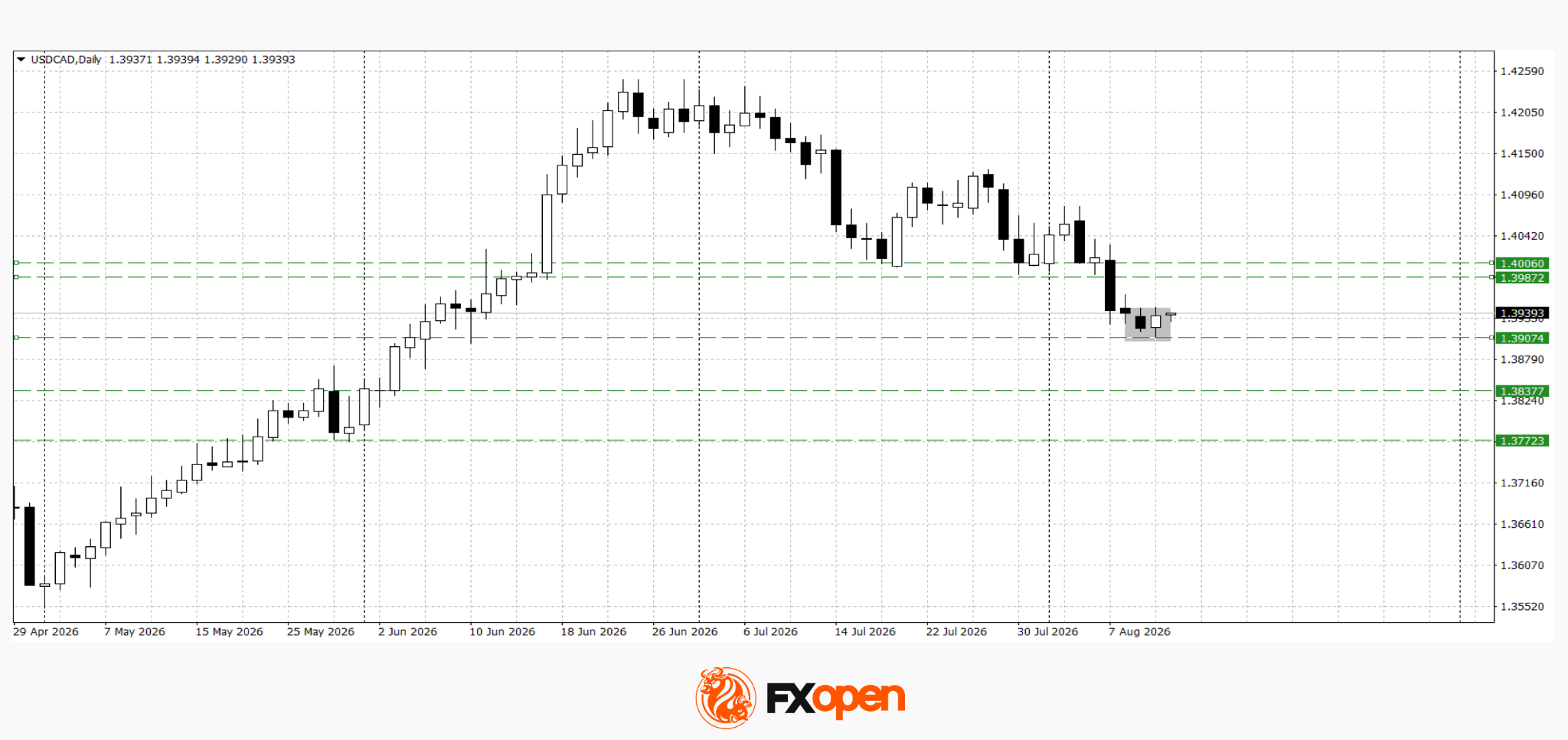
In USD/CAD, a bullish engulfing pattern is forming after a test of the key support level around 1.3900. Technical analysis of USD/CAD points to the possibility of a move higher towards 1.3980–1.4000. A break below yesterday’s low could trigger a resumption of the downtrend, with potential targets in the 1.3770–1.3840 area.
Key events for USD/CAD:
- today at 15:30 (GMT+3): US Producer Price Index (PPI);
- today at 15:30 (GMT+3): US initial jobless claims;
- today at 15:40 (GMT+3): speech by Thomas Barkin, member of the US Federal Open Market Committee (FOMC).
AUD/USD
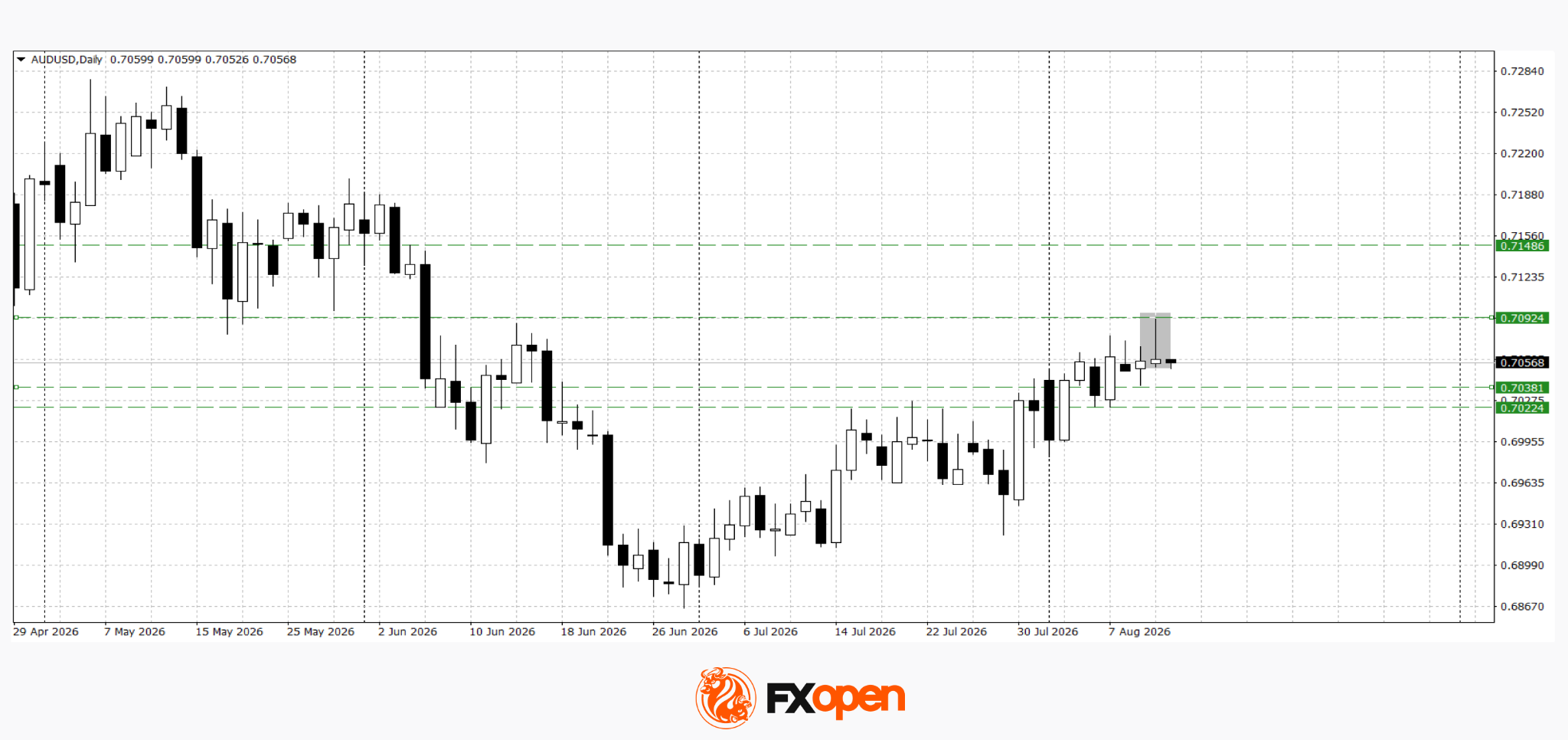
AUD/USD buyers attempted to test the key resistance level around 0.7100 today. The attempt failed, with the price retreating sharply from the level and forming a doji pattern. The appearance of a doji near resistance indicates buyer indecision and increases the likelihood of a corrective decline towards 0.7020–0.7040. The bearish scenario would be invalidated by a firm break and close above 0.7100.
Key events for AUD/USD:
- tomorrow at 02:30 (GMT+3): speech by Reserve Bank of Australia Governor Michele Bullock;
- tomorrow at 04:30 (GMT+3): Australian housing finance data;
- tomorrow at 15:30 (GMT+3): US core retail sales.
Overall, the inflation data allowed the US dollar to recover some of its earlier losses, but did not provide the market with sufficient grounds for a new sustained move. The further dynamics of AUD/USD and USD/CAD will depend on today’s US producer-price and labour-market data. Stronger-than-expected figures could support the US dollar and increase pressure on commodity currencies, while weaker data could revive expectations of a more dovish Fed policy and limit the dollar’s recovery.
Trade over 50 forex markets 24 hours a day with FXOpen. Take advantage of low commissions, deep liquidity, and spreads from 0.0 pips (additional fees may apply). Open your FXOpen account now or learn more about trading forex with FXOpen.
This article represents the opinion of the Companies operating under the FXOpen brand only. It is not to be construed as an offer, solicitation, or recommendation with respect to products and services provided by the Companies operating under the FXOpen brand, nor is it to be considered financial advice.
RBNZ Survey Was Hawkish. So Why Did NZD Fall?
TL;DR: The RBNZ's latest Survey of Expectations pointed to a September hike and firmer growth, yet NZD fell across the board — because markets had already priced the hawkish rate path and instead traded an 81-basis-point collapse in near-term inflation expectations.
A Survey That Looked Hawkish on Paper
On paper, the RBNZ Survey of Expectations looked like something NZD bulls should have welcomed. Respondents effectively expected a September hike, saw the OCR climbing further over the following year, and became more optimistic on growth and wage inflation. Yet the Kiwi fell across the board and New Zealand's 2-year yield dropped around 6bp. The market didn't misunderstand the survey — it simply traded the part that was actually new.
The Real Surprise: Inflation Expectations Collapsed
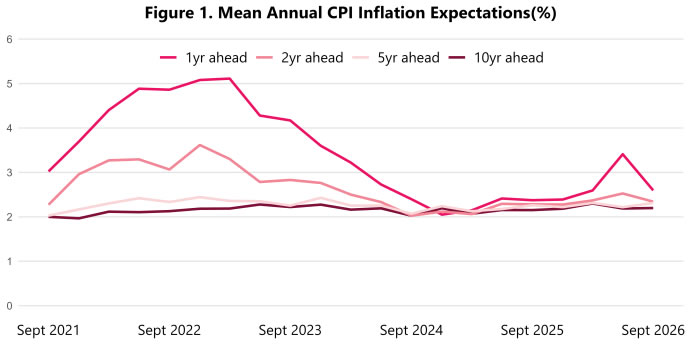
That surprise came from inflation expectations. One-year-ahead CPI expectations collapsed from 3.41% to 2.60%, an extraordinary 81bp drop, while the two-year measure eased from 2.53% to 2.34%. Longer-term expectations stayed anchored, with five- and ten-year readings at 2.31% and 2.20%. The survey therefore didn't show confidence in the inflation target deteriorating — it showed respondents expecting substantially less near-term inflation pressure.
The Rate Path Itself Stayed Hawkish
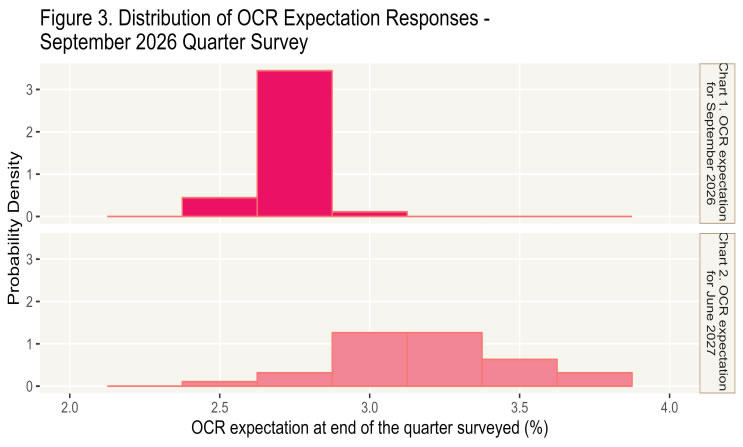
Contrast that with the rate path. The end-September OCR expectation stood at 2.73%, essentially pointing to a 25bp hike from the current 2.50%, while the one-year-ahead expectation climbed from 3.01% to 3.21%. Together with firmer GDP growth and wage expectations, that's hardly a dovish policy signal — the RBNZ tightening story survived the survey intact.
Why Markets Traded the Inflation Number, Not the Rate Path
The problem for NZD bulls is that markets already knew most of it. Swaps had roughly 90% of a September hike priced before the release, leaving little room for another hawkish rate signal to surprise. The 81bp plunge in one-year inflation expectations was different — that was new information, and markets reacted to the marginal change rather than the headline policy bias.
So the NZD selloff doesn't necessarily mean traders suddenly doubt a September hike. The more nuanced interpretation is that markets are questioning how much tightening may ultimately be needed beyond it — the RBNZ can still hike while inflation risk around the future path becomes less threatening. The next NZ Business PMI will help determine whether softer inflation expectations stand alone or are beginning to align with broader evidence of slowing activity.
ActionForex's Technical View on NZD/USD
That distinction is also important technically, because NZD/USD has weakened sharply without yet breaking its near-term bullish structure. The pair continues to defend both the rising channel floor and the 55-day EMA, and remains well above the 38.2% retracement of 0.5625 to 0.5907, at 0.5799.
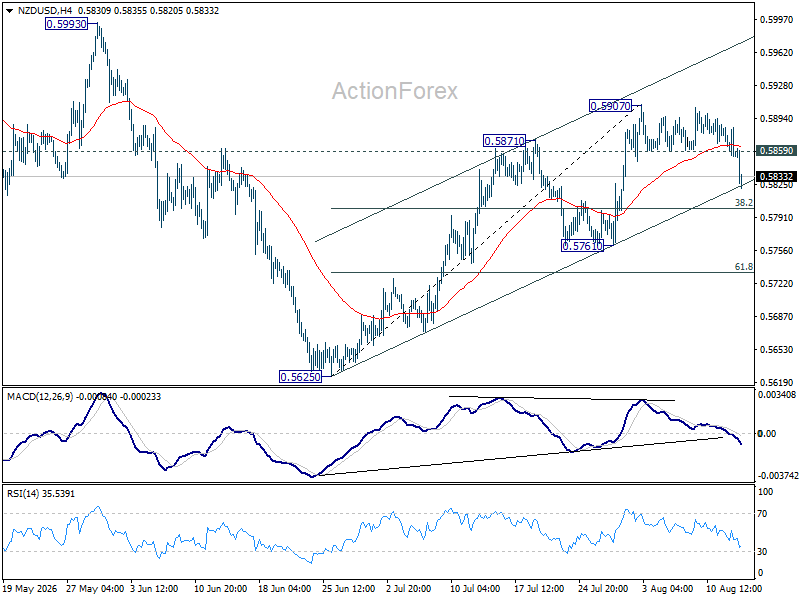
A break back above 0.5859 minor resistance would suggest the pullback has run its course, while clearing 0.5907 would resume the rise toward the medium-term range top around 0.6000.
The real warning would come from a sustained break of 0.5799. That would strengthen the case the decline is becoming more than a data-driven dip and expose 0.5733, the 61.8% retracement, with room for deeper losses.
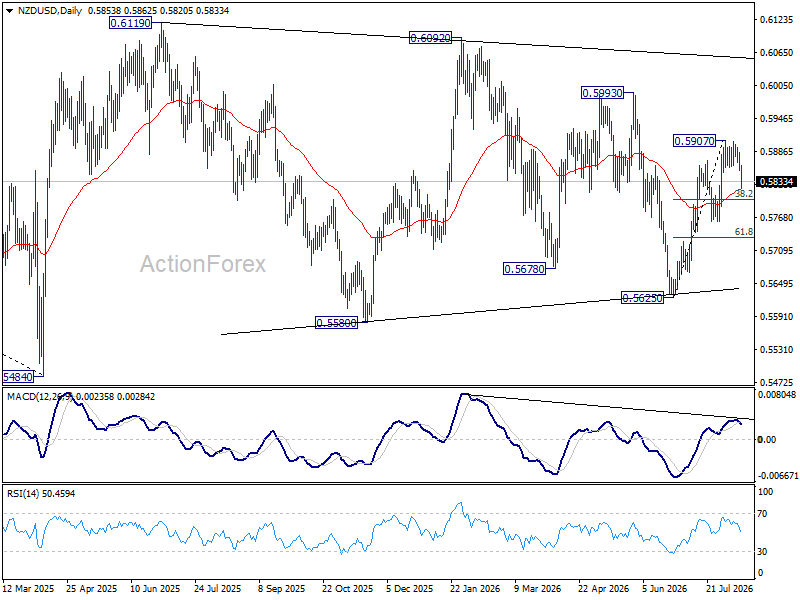
Until then, the market message is narrower than price action initially suggests: the survey was hawkish, but the hawkishness was already priced. What the Kiwi wasn't prepared for was near-term inflation expectations falling by 81bp.
Key Takeaways
- The RBNZ Survey of Expectations pointed to a September hike, firmer growth, and higher wage inflation — a hawkish signal that left the tightening story intact.
- One-year-ahead inflation expectations collapsed 81bp, from 3.41% to 2.60%, the actual surprise that drove NZD lower despite the hawkish rate path.
- Swaps had already priced roughly 90% of a September hike, meaning the rate-path signal carried little new information for markets to trade.
- The selloff likely reflects doubt about how much tightening is needed beyond September, not doubt about the hike itself.
- NZD/USD remains above 0.5799 support; a sustained break would expose 0.5733 and suggest the pullback is more than a data-driven dip.
First Impression: RBNZ Survey of Inflation Expectations, September Quarter 2026
Inflation expectations remained contained in the RBNZ’s latest survey. High oil prices and elevated near-term inflation don’t appear to have boosted medium-term inflation expectations.
RBNZ inflation expectations survey
- 1 year ahead: 2.60% (Prev, 3.41%, down 81bps)
- 2 years ahead: 2.34% (Prev: 2.53%, down 19bps)
- 5 years ahead: 2.31% (Prev: 2.22%, up 9 bps)
- 10 years ahead: 2.20% (Prev: 2.19%, up 1 bp)
Expectations for inflation over the next couple of years have dropped back in the RBNZ’s latest survey of professional forecasters and selected businesspeople.
Expectations for inflation one year ahead fell to 2.60%, down sharply from 3.41% last quarter.
Similarly, the closely watched measure of inflation in two years’ time fell to 2.34% (down from 2.53% previously).
This will be welcome news for the RBNZ. With the rise in oil prices in recent months, inflation has risen to over 4%, and it’s likely to remain elevated for the remainder of this year.
But despite such pressures, respondents to the RBNZ’s survey do not expect the current uplift in inflation to be enduring.
We did see some rise in expectations for longer term inflation (five and ten years ahead), but those increases are well within the normal quarter-to-quarter volatility we typically see.
All of the measures of expected inflation are either at or slightly below where they were six months ago, before the Iran conflict.
Implications for the RBNZ
While expectations remained contained in today’s survey, the RBNZ is still looking at a firm near term inflation outlook, with core inflation at firm levels even before the Middle East conflict. In addition, other business surveys point to ongoing pressures on operating costs.
The RBNZ hiked the Official Cash Rate 25bps at their last policy meeting in July and signalled further hikes over the coming months. We’re forecasting two more 25bp hikes this year, most likely at the RBNZ’s September and December meetings.
USD/JPY in Positive Territory: Yen Gives Back Intervention Gains
USD/JPY rose to 159.53 on Thursday, returning towards the 160.00 area as the Japanese yen weakened. The move has kept markets on alert for possible further intervention by the authorities amid persistent currency weakness.
Fundamental factors continue to weigh on the yen: a wide interest rate differential, rising fiscal risks, and elevated energy and import costs.
The yen failed to gain much traction even after softer US inflation data, which eased pressure on the Federal Reserve and reduced the likelihood of an imminent rate hike.
In Japan, producer prices rose 7.2% year-on-year in July, slightly below the 7.3% recorded in June and the 7.4% forecast. At the same time, the Bank of Japan’s summary of opinions from the July meeting noted growing risks of accelerating inflation, with one board member acknowledging that the pace of rate hikes could quicken.
Technical Analysis
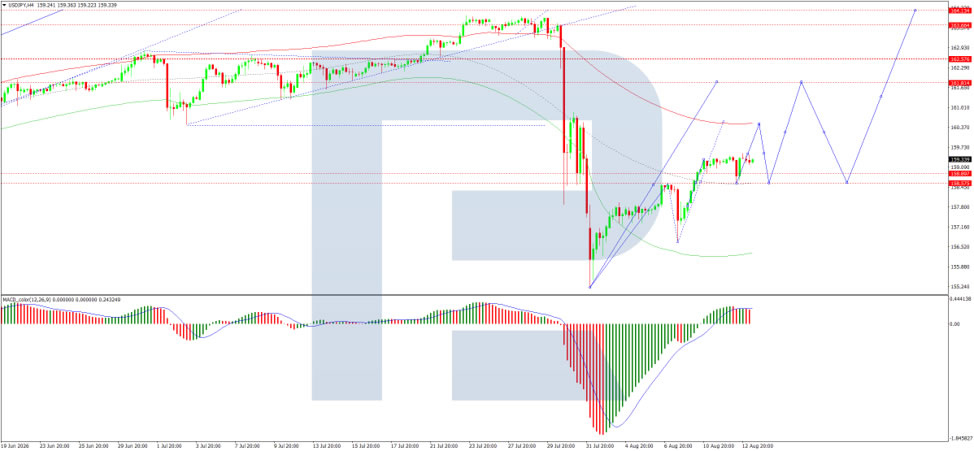
On the H1 chart, USD/JPY has completed an upward move to 159.52. A consolidation range is currently forming below this level. An upside breakout would open the way for a move higher to at least 160.50. The Stochastic oscillator confirms this scenario, with its signal line above 50 and trending upward towards 80, indicating short-term upside momentum.
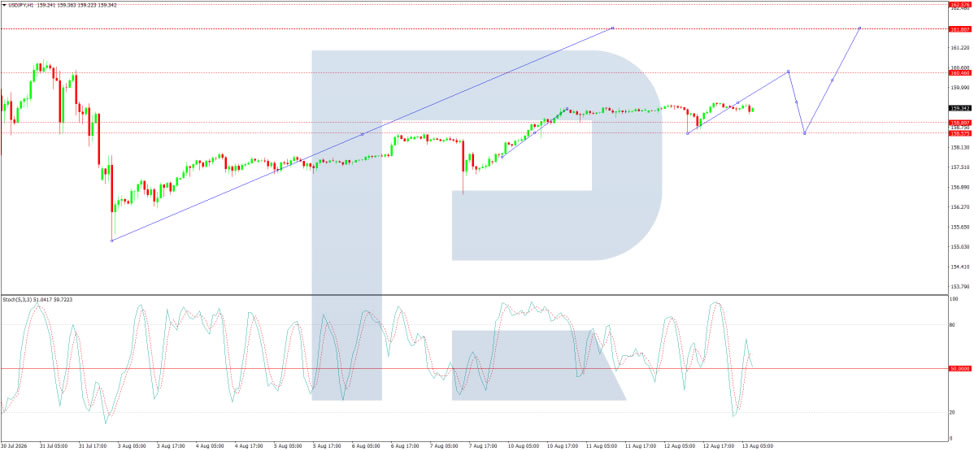
On the H1 chart, USD/JPY has completed an upward move to 159.52. A consolidation range is currently forming below this level. An upside breakout would open the way for a move higher to at least 160.50. The Stochastic oscillator confirms this scenario, with its signal line above 50 and trending upward towards 80, indicating short-term upside momentum.
Conclusion
USD/JPY has moved back into positive territory as the yen’s post-intervention gains continue to fade. Despite softer US inflation data reducing pressure on the Fed, the yen has failed to capitalise, underscoring the persistent fundamental headwinds – interest rate differentials, fiscal risks, and high energy costs – that continue to weigh on the currency. Domestic producer price data came in slightly below expectations, but the Bank of Japan’s July meeting summary pointed to rising inflation risks and the potential for faster rate hikes. Technically, USD/JPY appears poised for further upside towards 160.50, with the market remaining on high alert for possible intervention by Japanese authorities as the pair approaches the key 160.00 level.
Natural Gas Analysis: Attempted Wedge Breakout Amid Lower Eia Forecast
On 11 August, the US Energy Information Administration (EIA) lowered its forecast for the average natural gas price in the third quarter to $2.87 per million BTU — 50 cents below its previous estimate. The main reason is increased domestic production and inventories, which could create the largest stockpile in a decade ahead of the start of the heating season. Planned maintenance at the Freeport LNG export terminal may have added further pressure to the balance by reducing demand for gas used in liquefaction. Meanwhile, global LNG trade had already faced shipping disruptions in the Strait of Hormuz in July, highlighting the market’s continued sensitivity to geopolitical risks.
Technical Analysis of Natural Gas
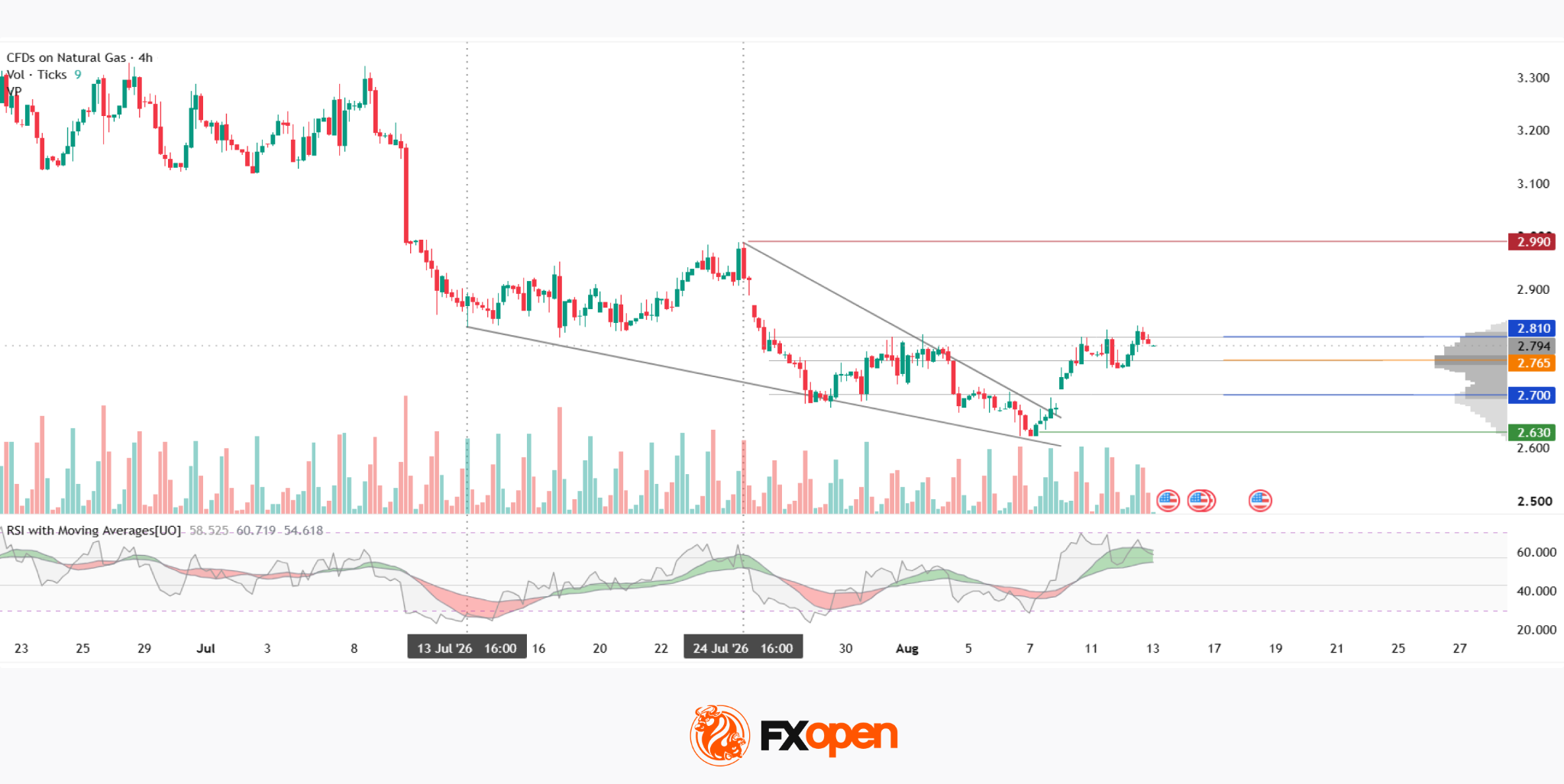
A descending wedge has formed on the XNGUSD (H4) chart, with the upper boundary being broken to the upside by a move that began on 10 August following a gap formed on notably below-average volume — a detail that calls the conviction behind the breakout into question.
Subsequent price action has been reduced to consolidation within the current profile: the price is currently moving between the Point of Control (POC) at $2.765 and the upper boundary of the profile at $2.810. The red resistance level at $2.990 is poised to meet the price near the base of the pattern.
If the breakout proves to be false, the price will have to overcome the market density within the profile. Should it break below the lower boundary at $2.700, prices could encounter resistance around the pattern’s apex at $2.630. The RSI + MAs indicator shows readings of 58, 60 and 54. Although the oscillator and fast moving average remain above the upper boundary of the neutral zone, the indicator’s slow MA has yet to move beyond it, leaving the signal incomplete.
Key Takeaways
Low volume on the breakout of the descending wedge, combined with the unresolved RSI + MAs signal, leaves the sustainability of the rise in question. The EIA’s softer price forecast, against a backdrop of record inventories, adds fundamental arguments for limiting the upside potential.
Start trading commodity CFDs with tight spreads (additional fees may apply). Open your trading account now or learn more about trading commodity CFDs with FXOpen.
This article represents the opinion of the Companies operating under the FXOpen brand only. It is not to be construed as an offer, solicitation, or recommendation with respect to products and services provided by the Companies operating under the FXOpen brand, nor is it to be considered financial advice.
UK GDP Beats June Forecast with 0.4% M/M Growth as Services Keep Economy Moving
UK growth slowed in Q2, but economy finished quarter considerably better than June forecasts had suggested. GDP expanded 0.4% q/q after 0.6% growth in Q1, matching expectations, while annual growth accelerated from 0.9% to 1.2%, beating 1.1% consensus. GDP per head also increased 0.4% q/q, leaving it 1.0% higher than a year earlier. Services remained engine of expansion, growing 0.5% q/q over quarter, alongside a 0.3% rise in construction, while production stagnated.
More encouraging signal came from June. GDP rebounded from 0.0% to 0.3% m/m, versus expectations for a 0.1% decline, reversing some concern that growth was fading sharply after strong start to year. But improvement was concentrated in services, which rose 0.4%, while production contracted -0.2% and construction slipped -0.1%. Manufacturing weakened further from a revised -0.2% to -0.5%, showing that stronger headline GDP still masks considerable divergence across economy.
Overall, the report shows UK economy lost some momentum from Q1 but avoided sharper slowdown feared into quarter-end. Stronger June growth suggests a firmer handoff into Q3, although dependence on services and continuing weakness in manufacturing argue against describing recovery as broad based. For BoE, resilience in headline activity gives policymakers somewhat more room to stay focused on inflation, but GDP data alone are unlikely to materially change near-term policy stance.
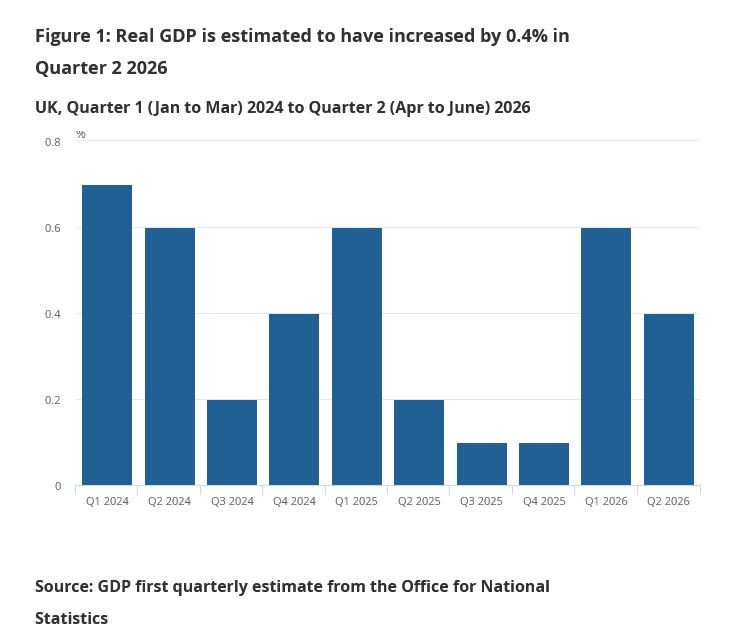
Q2 GDP Summary
| Indicator | Actual | Expected | Previous |
|---|---|---|---|
| GDP q/q Q2 | 0.4% | 0.4% | 0.6% |
| GDP y/y Q2 | 1.2% | 1.1% | 0.9% |
| Services Output q/q Q2 | 0.5% | — | 0.8% |
| Production Output q/q Q2 | 0.0% | — | 0.2% |
| Construction Output q/q Q2 | 0.3% | — | — |
June GDP Summary
| Indicator | Actual | Expected | Previous |
|---|---|---|---|
| GDP q/q Q2 | 0.4% | 0.4% | 0.6% |
| GDP m/m Jun | 0.3% | -0.1% | 0.0% |
| Services Output m/m Jun | 0.4% | — | 0.1% |
| Production Output m/m Jun | -0.2% | 0.0% | -0.7% |
| Construction Output m/m Jun | -0.1% | — | -0.8% |
| Manufacturing Production m/m Jun | -0.5% | -0.3% | -0.2% |
Key Takeaways
- UK GDP slowed from 0.6% to 0.4% q/q in Q2, exactly matching expectations, while annual growth strengthened from 0.9% to 1.2%, beating 1.1% forecast.
- June GDP surprised clearly on upside, accelerating from 0.0% to 0.3% m/m against expectations for a -0.1% contraction.
- Services remained main growth engine, rising 0.5% q/q in Q2 and 0.4% m/m in June.
- Growth was uneven beneath headline, with production flat in Q2 and down -0.2% m/m in June, while manufacturing fell -0.5%.
- GDP per head rose 0.4% q/q and 1.0% y/y, adding a more constructive dimension to headline growth.
- Overall picture is of UK economy slowing rather than stalling, with stronger June activity providing a firmer handoff into Q3.
- For BoE, data modestly support patience by showing economy is holding up better than feared, though weak production prevents a broad-based growth signal.
Soft Inflation Supports Hold From Norges Bank
In focus today
In Norway, we expect Norges Bank to stay on hold at 4.25% at today's policy rate meeting, after the low inflation figures for June and July. However, we expect the Monetary Policy Committee to keep some form of tightening bias, and signal that further tightening may be needed. Focus will be on any forward guidance and comments regarding expectations on August inflation, especially the effect from kindergarten prices.
Ahead of the rate decision, Statistics Norway releases the Q3 oil investment survey and Q2 wage figures. We expect little change to the oil investment outlook but see a good chance that Q2 wage growth was below Norges Bank's 4.5% forecast for 2026, reinforcing the signal from recent inflation data that wage and price pressures are easing.
Out of Sweden, the final July inflation figures are due and will shed more light on the upside surprise in the preliminary release, which was mainly driven by goods prices. We suspect that higher commodity prices and supply disruptions in the spring played a role.
In the UK, the June GDP estimate, and thus also the Q2 GDP estimate, is released today. PMIs suggest close to zero growth, although the carryover from Q1 will push the Q2 total higher. The economy looks to have regained some momentum in July.
From the US, July PPI is due for release today, with focus on whether producer prices echo yesterday's in-line CPI release. The Fed's Hammack and Barkin will also be on the wires in the afternoon.
In the euro area, we receive June industrial production figures. After declining 0.2% m/m in May, consensus expects unchanged industrial production in June.
Economic and market news
What happened overnight
In Japan, July PPI increased 7.2% y/y (prior: 7.3%, cons: 7.4%), as lower-than-expected oil-related costs were offset by rising metals prices, AI-related demand and price pressures from the weak yen. The Bank of Japan has highlighted the recent rise in PPI as a key sign of building inflation risks, reinforcing expectations of a possible rate hike in September.
What happened yesterday
In the US, July CPI was broadly in line with expectations, with headline inflation at 3.4% y/y and core inflation at 2.5% y/y. The monthly details were also close to expectations as headline inflation increased 0.1% m/m and core inflation increased 0.2% m/m. The report did not deliver the upside surprise that some Fed officials had suggested could prompt them to support a hike at the coming meeting. Together with the recent jobs report, the CPI release reduced market pricing of a September hike, with markets now pricing around a 40% chance of a hike by the meeting, down from approximately 50/50 yesterday morning.
In commodities, Brent crude traded around USD88-89/bbl yesterday as the International Energy Agency reported that global oil supply is set to fall by 4.3 million bpd this year, creating a 1.8 million bpd deficit in Q3 amid renewed Middle East hostilities and disrupted trade flows. The IEA also expects demand to contract by 1.6 million bpd as tighter refined-product supply and higher prices weigh on consumption.
Equities: Global equities rose 0.3% yesterday, with the S&P 500 up 0.3% and Nasdaq up 0.5% as the July CPI print landed close to expectations and removed the immediate risk of an upside inflation surprise, thus we take it as a relief, but not a full risk-on signal in itself. After two days with defensives performing better than cyclicals it was the other way around yesterday, with tech and industrials at the top. Semis led the tech performance. Overnight, Asian equities are also in the green, while futures point to a flat opening in Europe this morning. In particular, it is worth highlighting Japan, which is rising 1.8% at the time of writing, supported both by the AI trade and the lower Fed pricing.
FI and FX: The Scandi currencies were on diverging paths yesterday. EUR/SEK rose above 11.00, while EUR/NOK fell a little on the back of the still high oil price and despite the recent easing of rate hike expectations. The 2Y US Treasury yield fell a little as US inflation dropped as expected. German government yields were largely unchanged. EUR/USD was broadly steady yesterday.
Dollar Is Giving EUR/USD Every Chance to Rally. So What’s Holding Euro Back?
TL;DR: EUR/USD has nearly everything bulls could ask for — a weaker Dollar, fading Fed hike bets, and rising ECB hike odds — yet the pair hasn't broken out, because Euro itself isn't confirming the move broadly across its other crosses.
The Dollar Has Given EUR/USD Every Reason to Rise
EUR/USD has been handed almost everything bulls could reasonably ask for over the past week. July payrolls unexpectedly contracted, forcing markets to scale back Fed tightening bets. July CPI then showed core inflation returning to 2.5%, back at its pre-Iran-war level. September Fed hold probability has consequently risen from around 45% a week ago to roughly 60%. The Dollar has given EUR/USD plenty of room to move higher.
The Euro Side Should Be Helping Too
Renewed oil surge has pushed the expected probability of a September ECB hike above 90%, up from around 70% a month earlier. The obvious counterargument is that the ECB may be making a policy mistake by tightening into weak growth, eventually turning higher rates into a negative for the Euro. Yet the latest activity data don't provide much support for that conclusion — the Eurozone PMI Composite strengthened for a second straight month in July, with Germany also showing improvement. For now at least, the economy doesn't look weak enough to explain the Euro's reluctance to rally.
So What's Actually Holding EUR/USD Back?
There may not be one hidden macro catalyst. The more telling explanation is simpler: Dollar weakness is doing its part, but the Euro itself isn't attracting enough broad demand to confirm the move. EUR/USD can rise because the Dollar falls, but a durable breakout becomes much easier when the Euro is also strengthening across crosses. So far, that confirmation is missing.
That puts EUR/GBP, EUR/AUD, and EUR/CAD under the spotlight. Declines in those crosses would suggest Euro weakness is broadening beneath the surface and could eventually drag EUR/USD lower even if Fed expectations remain relatively Dollar-negative. Conversely, stabilization or recovery across Euro crosses would make EUR/USD's current hesitation easier to dismiss as consolidation before another push higher. The question is therefore becoming less about whether the Dollar has weakened enough, and more about whether the Euro can finally take advantage.
ActionForex's Technical View on EUR/USD
The technical picture captures that uncertainty neatly. The base case remains that the broader decline from 1.2081 completed a three-wave correction at 1.1323, after support emerged around the 38.2% retracement of 1.0176 to 1.2081, at 1.1353. Bullish divergence in the daily MACD reinforces that interpretation.
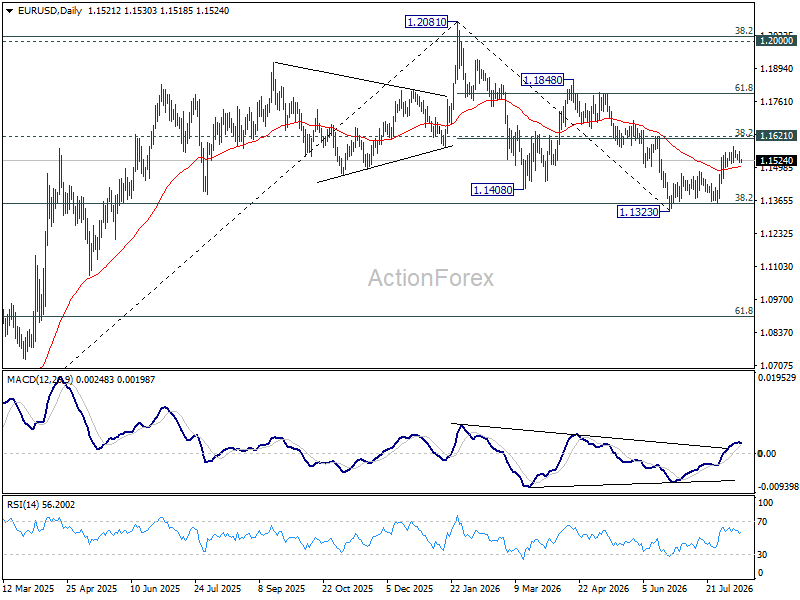
But EUR/USD still has to break the 1.1621 cluster resistance — the 38.2% retracement of 1.2081 to 1.1323, at 1.1613 — decisively. A sustained move through that zone would provide the confirmation price action has so far lacked, strengthening the case that the rebound from 1.1323 is developing into something larger.
Until then, failure matters. Rejection from 1.1613/21, followed by a break of 1.1481, would flip the interpretation, suggesting the rebound from 1.1323 was only corrective and that the larger decline from 1.2081 is ready to resume through 1.1323.
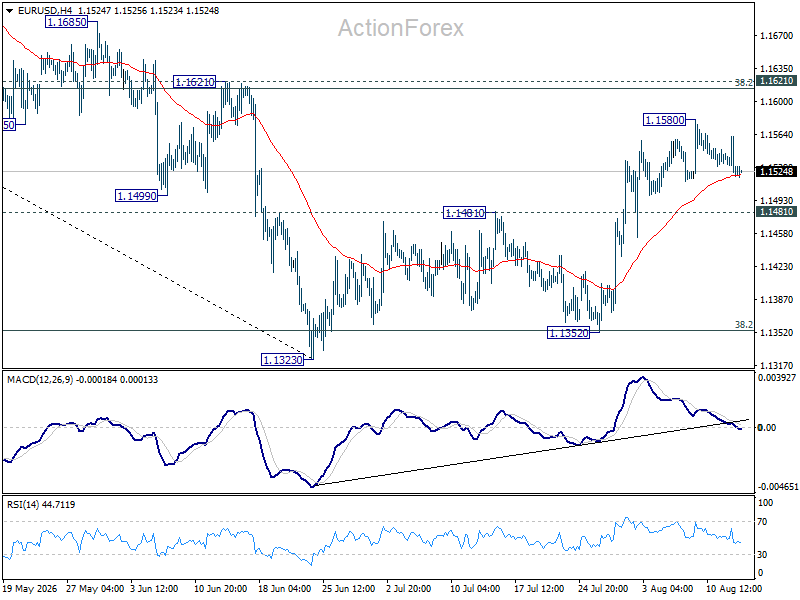
EUR/USD still has a bullish setup, but not yet a bullish confirmation. The Dollar has opened the door; now the Euro has to walk through it.
Key Takeaways
- September Fed hold odds have risen from 45% to 60% in a week, driven by contracting payrolls and core CPI returning to its pre-war 2.5% level.
- September ECB hike odds have risen above 90% on renewed oil strength, with Eurozone PMI data showing no evidence of growth weak enough to undercut that case.
- EUR/USD's stalled breakout likely reflects a lack of confirmation from Euro crosses (EUR/GBP, EUR/AUD, EUR/CAD) rather than any single hidden catalyst.
- A decisive break above the 1.1613-1.1621 resistance cluster would confirm the rebound from 1.1323 is developing into a larger move higher.
- Rejection at 1.1613/21 followed by a break of 1.1481 would instead suggest the rebound was only corrective, reopening the broader decline from 1.2081 toward 1.1323.
Elliott Wave View: Oil (Cl) Maintains Short Term Bullish Framework
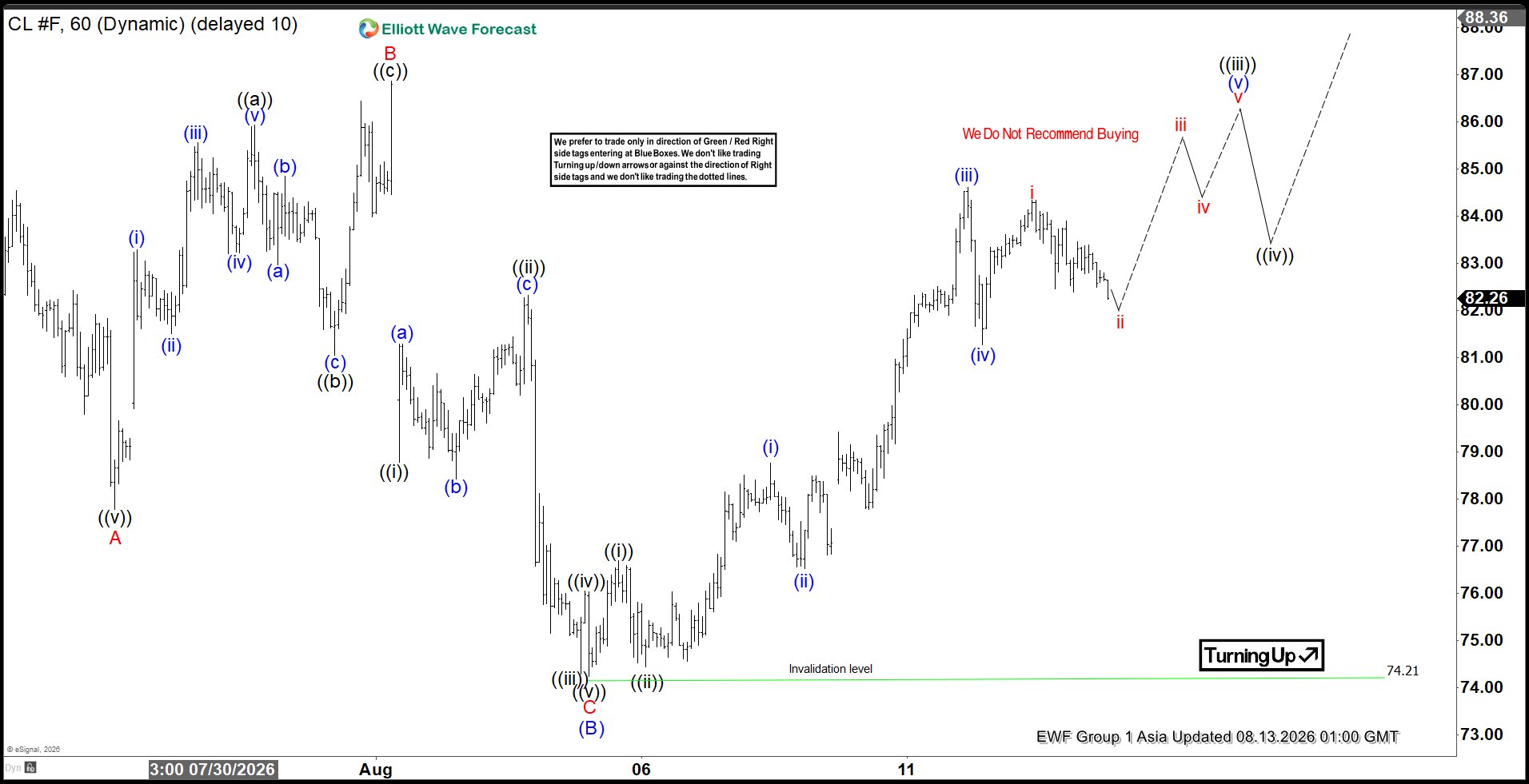
The short‑term Elliott Wave outlook in Oil indicates that the cycle from the July 2, 2026 low remains impulsive and favors further upside. The initial five‑wave rally from that low concluded in wave (A) at $93.50. A corrective pullback in wave (B) is proposed complete at $74.21, as reflected in the one‑hour chart. The internal subdivision of wave (B) unfolded as a zigzag structure. Down from wave (A), wave A ended at $77.78, followed by wave B at $86.87. The final leg, wave C, terminated at $74.21, thereby completing wave (B) in higher degree.
Oil has since resumed higher in wave (C). However, a decisive break above the prior wave (A) peak at $93.50 is required to eliminate the risk of a double correction. From wave (B), wave ((i)) ended at $76.70, while the pullback in wave ((ii)) concluded at $74.75. The instrument then advanced in wave ((iii)), forming another impulsive sequence of lesser degree. Within this progression, wave (i) ended at $78.77, and wave (ii) dips found support at $76.53. Wave (iii) extended higher to $84.61, followed by a corrective wave (iv) at $81.27. Near term, as long as the pivot at $74.21 remains intact, dips are expected to find support in either three or seven swings, favoring continuation to the upside. This structure underscores the bullish potential, with the market poised for further extension once key resistance levels are surpassed.
Oil (CL) 60 Minute Elliott Wave Chart
Oil (CL) Elliott Wave Video
https://www.youtube.com/watch?v=u2FCka25hkA
AUD/USD Slips After Rally, Yet Bulls May Find Support
Key Highlights
- AUD/USD started a fresh increase above the 0.7025 resistance.
- A rising channel is forming with support near 0.7050 on the 4-hour chart.
- EUR/USD failed near the 1.1580 resistance and dipped.
- WTI Crude Oil prices could face hurdles near $84.20 and $85.00.
AUD/USD Technical Analysis
The Aussie Dollar formed a base above 0.6980 against the US Dollar. AUD/USD started a fresh increase above the 0.7000 and 0.7025 resistance levels.
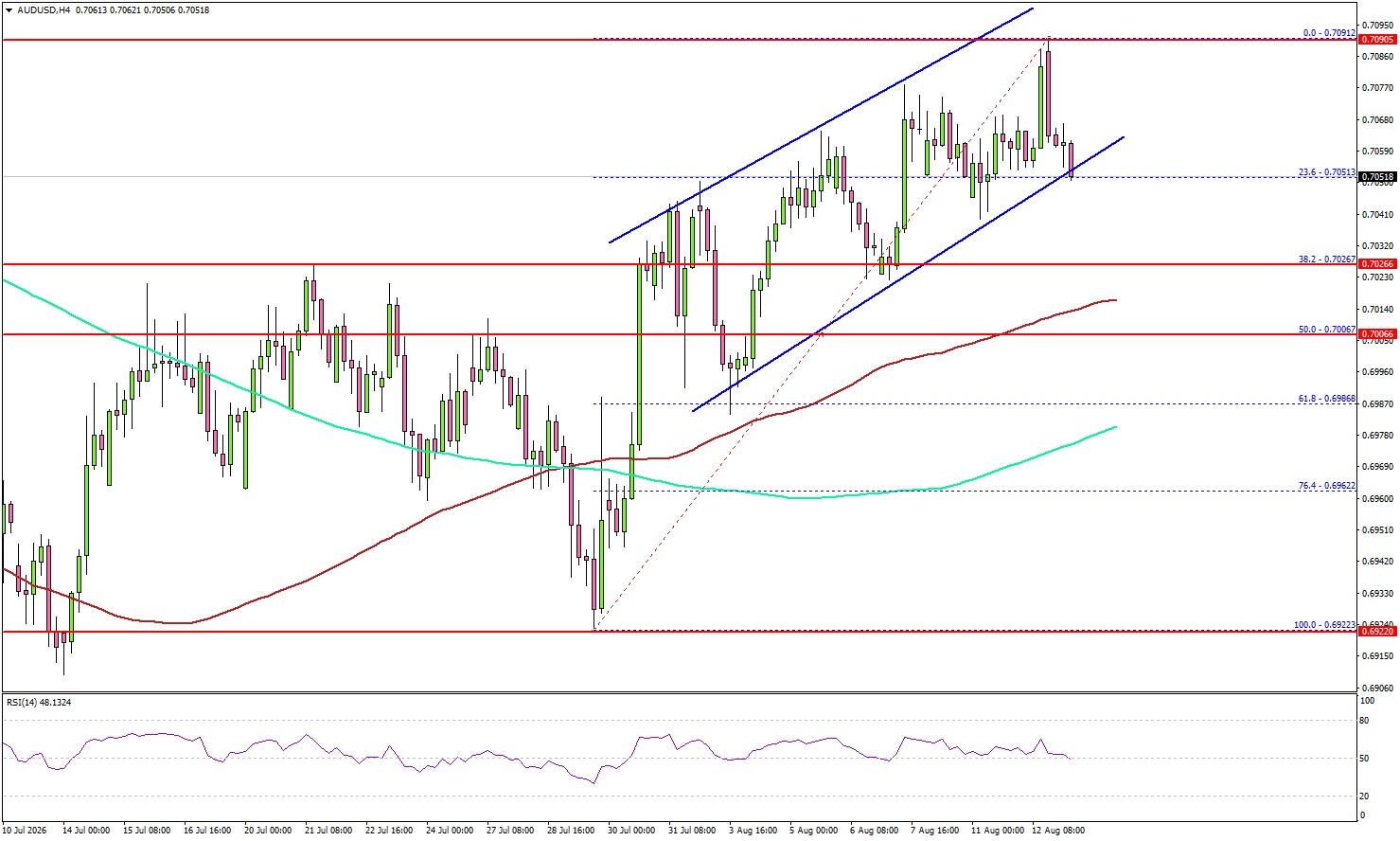
Looking at the 4-hour chart, the pair gained pace for a move toward 0.7100. A high was formed at 0.7091, and the pair is now correcting some gains. There was a move toward the 23.6% Fib retracement level of the upward move from the 0.6922 swing low to the 0.7091 high.
The pair is still well above the 100 simple moving average (red, 4-hour) and the 200 simple moving average (green, 4-hour). There is also a rising channel forming with support near 0.7050.
On the upside, the pair could face resistance near 0.7080. The next major resistance might be 0.7100. A close above 0.7100 could start another steady increase. In the stated case, the bulls could aim for a move to 0.7145.
Any more gains might open the door for a test of 0.7200. If there is a downside correction, the pair might find bids near 0.7050. The next major support could be near 0.7025 and the 50% Fib retracement level.
The main support might be 0.7000. A downside break and close below 0.7000 might send the pair toward 0.6960. Any more losses could open the doors for a test of 0.6920.
Looking at EUR/USD, the pair failed to continue higher above 1.1580 and started a downside correction.
Upcoming Key Economic Events:
- US Initial Jobless Claims - Forecast 202K, versus 199K previous.
- US Producer Price Index for July 2026 (MoM) – Forecast +0.2%, versus -0.3% previous.
- US Producer Price Index for July 2026 (YoY) – Forecast +4.9%, versus +5.5% previous.