

Sample Category Title
Further Signs of Easing US Price Pressures Support Markets
In focus today
- In the US, US July retail sales data is due for release today. Private consumption was the most important growth driver in Q2, and the release will provide markets with the first hard data evidence of whether the strength also continued into late summer. The August flash consumer sentiment survey from the University of Michigan will provide an even more forward-looking signal.
- From the euro area, we will receive the second estimate for Q2 GDP growth, including details such as employment figures and further country by country breakdowns. The flash estimate showed strong Q2 GDP growth at 0.4% q/q, which we expect the release to confirm.
- Early Monday morning, China releases the monthly batch of data for July, including retail sales and housing. Retail sales have been weak in recent months, and the housing crisis has continued, which we expect to be evident in July figures as well. That said, home sales have shown tentative signs of stabilisation, so it will be interesting to see if this picture is reflected in the data.
- Also early on Monday, Japan releases Q2 GDP figures. The Bank of Japan's (BoJ) quarterly Tankan survey and PMI data suggests growth has remained solid, with private spending in particular picking up as wage growth has outpaced inflation, helped by government energy subsidies. Continued solid growth remains a prerequisite for further hikes from the BoJ.
Economic and market news
What happened overnight
In the US, President Trump said he will impose new tariffs on drone imports and components, arguing the country is "too reliant" on foreign suppliers. The measures include 100% tariffs on larger drones, 25% on smaller drones, 15% on drones and components from the EU, Japan, South Korea, Switzerland, Taiwan and Liechtenstein, and 10% on imports from the UK. The White House said the tariffs will generally take effect 21 days after signing, with some component tariffs delayed by 180 days.
What happened yesterday
In Norway, Norges Bank kept the policy rate unchanged at 4.25%, as expected. The Monetary Policy Committee maintained its tightening bias, acknowledging weaker-than-expected inflation over the summer but stressing that inflation is still too high. They repeated that it "may still become necessary to raise the policy rate". We maintain our call for a final hike in September, although the probability has clearly fallen and it is now a close call. Much will depend on whether August core inflation moves back above 3% and on the incoming growth figures.
Also in Norway, Statistics Norway's quarterly oil investment survey showed upward revisions for both 2026 and 2027. The revisions point to small nominal declines in oil investment of 0.1% this year and 0.9% next year, leaving the release broadly neutral for Norges Bank. The more important signal came from the wage figures, where annual wage growth slowed to 4.0% y/y in Q2 from 4.3% in Q1, below Norges Bank's 4.5% estimate for 2026. Together with the latest inflation figures, this should be positive news for Norges Bank and may suggest that wage growth is slowing faster than expected.
In Sweden, the final July inflation figures confirmed the flash estimate. Headline inflation came in at 0.2% y/y, CPIF at 0.7% y/y and CPIF excluding energy at 0.6% y/y. The details confirmed that goods prices surprised on the upside, likely reflecting the high global prices seen during the spring. Fuel tax cuts continued to have a significant impact, leaving CPIF 1.4 percentage points lower than it otherwise would have been. Without these tax cuts, CPIF would have been 2.1% rather than 0.7%. Public transport prices were also cut in half from July, with an estimated effect of around 0.1 percentage points.
In the UK, Q2 GDP grew by 0.4% q/q (cons.: 0.4%, prior: 0.6%) largely driven by business investments. The figures suggest the economy weathered the energy price shock well. However, growth is still expected to slow in the coming months, with the Bank of England estimating underlying growth at only around 0.1% and expecting it to fall to zero in Q3. Markets continue to price in one hike from the BoE this year and a second one in 2027. We think the most likely scenario is that we get no hikes and then the first rate cut by next summer.
In the US, July PPI was slightly softer than expected at 4.7% y/y (cons.: 4.9%). Volatile trade and transportation services pulled the reading lower, while broader services price pressures were a little stronger than expected. Core goods were steady and energy was in line with expectations. Weekly jobless claims, released at the same time, were also mixed, with continuing claims a touch lower than expected and initial claims higher. Overall, the market reaction was muted.
Also in the US, long-term borrowing costs rose to their highest level since 2001 at a USD25bn auction of 30-year Treasury bonds. The auction reflected growing investor concern over the growing federal debt burden and inflation that remains above the Fed's target. The higher borrowing costs add pressure as debt servicing already exceeds defence spending, while the large fiscal deficits and a shift towards more short-term issuance leave public finances more exposed to interest rate moves. On the wires, Fed's Hammack, one of the dissenters who voted for a hike at the last meeting, reiterated that she continues to see the case for higher policy rates and said the Fed needs to act now to bring inflation under control.
Euro area industrial production was unchanged in June, as expected. Behind the unchanged figure is a strong rebound in non-durable consumer goods and continued growth in energy output, which was offset by steep declines in capital goods and intermediate goods production. Notably, the May figures were revised sharply upward from the initially reported -0.2% m/m to +0.3% m/m.
Equities: Global risk sentiment was positive yesterday with global equities rising 0.6%, on a new push to the disinflation story from the US. S&P 500 rose 0.7% to reach new record highs, Nasdaq 0.8% while Russell 2000 rose 0.2%. Tech (driven by software) and comm services were amongst the top performers, where only materials stood back amid a commodity setback yesterday. Overnight Asian equities are mixed, with the tech heavy indices in green. Notably, Kospi has entered a bull market, and is now 25% higher than the 30 July lows. US futures are broadly unchanged.
FI and FX: The most notable movement in the FX market yesterday was the NOK that weakened after Norges Bank held interest rates unchanged and the oil price dropped. SEK recovered a bit and EUR/USD was about flat on the day. Yields fell across the curve and the Atlantic driven by the before-mentioned drop in oil prices, but also the slower-than-expected rise in the US PPI.
Yen Intervention Bought Two Weeks. Can a BoJ Rate Hike Make the Rescue Last?
TL;DR: USD/JPY's rebound from last month's intervention is stalling just below 160, as reports of an informal US-Japan understanding — support for the Yen in exchange for BoJ hiking room — reshape how traders read the months ahead.
A Rebound Stalling at a Loaded Level
USD/JPY's sharp rebound from last month's crash has extended further this week, with the dollar climbing back above 159 against the yen — but the advance is now stalling just below the psychologically loaded 160 level. That hesitation isn't random, and understanding why means rewinding to late July, when Japan and the United States stepped in together to rescue a currency that had spent this year sliding to lows not seen in decades.
The rescue worked, at first. The dollar plunged from near 164 to around 155 in a matter of days. Then, within about two weeks, most of that move had reversed — which is exactly the rebound now running out of steam near 160.
That fade might look like a failed rescue. But new reporting this week suggests something more interesting: the rescue may never have been designed to work alone in the first place. It may have been the visible half of a bigger deal — one that's only now becoming clear, and one that could decide whether 160 holds or breaks.
Why Propping Up a Currency Rarely Works Alone
To understand what's going on, it helps to understand why the yen keeps falling. Japan's interest rates are far lower than rates in the US and most other major economies. That gap creates an opportunity known as the "carry trade": investors borrow yen cheaply, since it costs so little in interest, then use that money to buy assets in countries offering much higher returns. It's a bet that pays off as long as the yen stays weak — and the wider the interest rate gap, the more attractive the bet becomes.
This is exactly why last month's rescue faded so fast. When intervention pushes the yen higher, it doesn't fix the underlying interest rate gap — it just creates a better price for investors to place the same bet again. One fund manager told Reuters intervention is "a great opportunity to sell the yen at higher levels." Traders aren't defying the rescue. They're pricing it in and moving on.
Economists have said for months there's really only one lasting fix: Japan's central bank, the Bank of Japan, needs to actually raise interest rates and close that gap. A currency rescue can buy time. It can't buy a permanent solution.
The Deal Behind the Curtain
Here's where this week's news comes in — and it's more significant than it might first appear. Reports now suggest July's joint currency rescue wasn't a standalone decision. According to Japanese media, it was made possible by the Bank of Japan's own governor sounding notably more open to raising rates at the very meeting where the rescue was agreed. Analysts at Mitsubishi UFJ believe this points to something close to an informal understanding: the US would help defend the yen, and in exchange, Japan's central bank would get political room to keep raising rates.
This week, the government side of that understanding became public. Bloomberg reported that Prime Minister Sanae Takaichi's government now supports the Bank of Japan raising rates soon — possibly as early as September or October.
That's a real shift worth pausing on. Takaichi has built her reputation as a big spender who favors looser policy, not tighter. She has previously pushed the central bank to keep buying government bonds to hold down borrowing costs, and several of her closest advisers have openly worried the bank was tightening too quickly. A government with that track record signaling support for a rate hike isn't a small thing — it looks like exactly the kind of political cover a central bank would need to move faster than usual.
A word of caution, though. Officially, the Prime Minister's office says interest rate decisions are entirely up to the Bank of Japan — not something the government controls or promises. That's a meaningful hedge. Supportive words cost nothing; an actual rate hike is the only thing that will really prove this shift is real. It's also worth noting that markets barely reacted to the report — the yen barely moved — a sign traders had already assumed something like this was coming.
The Countdown to September 18
All of this now points to a single date: the Bank of Japan's next policy meeting, on September 18. Traders currently see roughly a three-in-four chance of a rate hike then. If it happens, it would be Japan's third rate increase in under a year — the fastest pace of tightening since 1989, the year Japan's legendary asset-price bubble peaked.
The next few weeks essentially come down to two paths. If the Bank of Japan delivers the hike, it confirms this week's story was the real turning point — a government and central bank finally moving together to fix the yen's real problem, not just paper over it.
If the bank delays again, the disappointment could be worse than any hold before it. Markets have already priced in action. A delay now wouldn't just be a missed opportunity — it would break an understanding that, by most accounts, the market believes is already in place. Analysts warn that kind of letdown could trigger a sharper, faster bout of yen weakness than anything seen so far this year.
Either way, September 18 is no longer just another item on the calendar. It's the moment that decides whether this week's news was the real deal — or just more talk.
ActionForex's Technical View on USD/JPY
Price action already reflects this stand-off. After crashing from just under 163.97 to 155.22 during the intervention, USD/JPY has clawed back roughly half of that drop, running into resistance in a band that lines up closely with the 160 ceiling analysts believe Japan's intervention tools are designed to defend. That's not a coincidence — this level matters both as a chart pattern traders watch and as a real policy line in the sand.
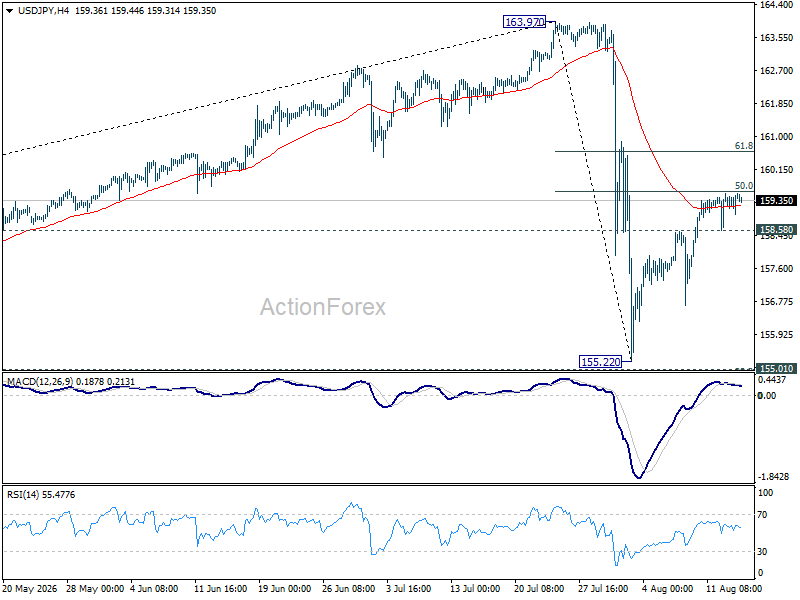
From here, two paths. A rejection at current levels, followed by a break of 158.58 minor support, would suggest BoJ hike expectations are building momentum. If the Bank of Japan actually follows through on next month's hike, USD/JPY would likely be dragged further down toward the 155.22 low.
On the other hand, USD/JPY could still grind higher if skepticism about the BoJ continues, or on other developments. But the pair will likely lose momentum somewhere between 159.59 and 160.62 — the 50% and 61.8% retracement levels of the 163.97-to-155.22 crash. Traders will likely wait for the BoJ's verdict before attempting to push USD/JPY through this resistance zone.
Either way, 160 is where the fundamental story and the chart are, for once, telling the exact same story.
Key Takeaways
- USD/JPY's rebound from the intervention low of 155.22 is stalling near 160, the level analysts believe Japan's intervention tools are designed to defend.
- The July rescue faded within two weeks because intervention alone doesn't close the US-Japan interest rate gap driving the yen carry trade.
- Reports suggest July's intervention was tied to an informal understanding: US support for the Yen in exchange for BoJ room to keep hiking rates.
- PM Takaichi's government, historically dovish, now reportedly supports a BoJ hike as early as September or October — a notable shift in political cover.
- September 18 is the key date: traders price roughly a 75% chance of a hike, with a delay risking a sharper yen selloff than any seen so far this year.
NZ PMI Manufacturing Cools to 54.3 After June Surge, Expansion Holds
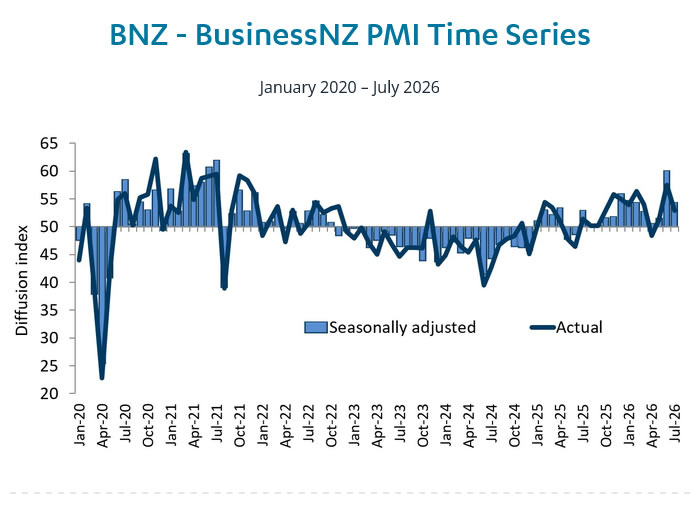
New Zealand manufacturing remained firmly in expansion in July, though momentum moderated after June’s exceptional surge. BusinessNZ PMI Manufacturing fell from 60.1 to 54.3, still comfortably above 50 expansion threshold and long-term average of 52.5. All five sub-indices remained above 50, with Production easing from 59.2 to 57.3, Deliveries from 57.6 to 55.8, Employment from 55.6 to 52.8, and Finished Stocks from 56.9 to 53.2.
Most notable slowdown came from New Orders, which dropped sharply from 64.1 to 53.3, suggesting forward demand normalized much faster than current production. Business sentiment was also considerably less upbeat than headline PMI, with 57% of respondent comments negative. Manufacturers continued to cite Middle East conflict, high fuel and raw-material costs, weak customer spending and election uncertainty as concerns, although steady order books and stronger export sales provided some offset.
Overall, July reading looks more like normalization from an unusually strong June than a renewed downturn. As BNZ Senior Economist Doug Steel noted, month-to-month volatility is common and 54.3 is “not an immediate cause for concern.” Still, sharp retreat in New Orders and deterioration in sentiment warrant attention, particularly if cost pressures stay elevated. For RBNZ, data continue to point to an expanding manufacturing sector, but with enough moderation to avoid adding materially to already hawkish policy expectations.
Data Summary
| Component | Current | Previous | Trend |
|---|---|---|---|
| PMI Manufacturing | 54.3 | 60.1 | Slower expansion |
| Production | 57.3 | 59.2 | Slower expansion |
| Employment | 52.8 | 55.6 | Slower expansion |
| New Orders | 53.3 | 64.1 | Sharp moderation |
| Finished Stocks | 53.2 | 56.9 | Slower expansion |
| Deliveries | 55.8 | 57.6 | Slower expansion |
Key Takeaways
- New Zealand PMI Manufacturing fell from 60.1 to 54.3 in July, but stayed above both 50 expansion threshold and long-term average of 52.5.
- Every major sub-index remained in expansion, indicating broad activity stayed positive despite slowdown from June’s exceptional reading.
- New Orders fell most sharply, from 64.1 to 53.3, pointing to much softer forward demand momentum.
- Production remained strongest component at 57.3, while Employment was weakest at 52.8.
- Sentiment was less encouraging than activity data, with 57% of respondent comments negative amid high fuel, freight and raw-material costs, Middle East tensions and cautious customer spending.
- July is best read as normalization rather than a renewed downturn, but weaker New Orders make upcoming surveys important for confirming whether expansion can hold.
Fed’s Goolsbee Sees “Golden Path” Back to 2% as Inflation Data Improve
Chicago Fed President Austan Goolsbee said recent US inflation data have been “a little better,” raising hope that price growth can resume its decline toward Fed’s 2% target as effects of tariffs and Iran-war oil shock fade. Speaking Thursday in an interview with Fox News, Goolsbee said, “If we can get some of this stuff into the rearview mirror then I think we get back on what I was calling the golden path, which is inflation heading back to 2%.” He nevertheless stressed that inflation around 3% remains “too high” even as latest readings provide some encouragement.
Goolsbee acknowledged that disinflation had previously stalled and even started moving in wrong direction, but said recent data may be changing that picture. “For a couple of months, we’ve been getting a little bit better readings and hopefully that will continue,” he said. July CPI and PPI both came in relatively benign this week, reinforcing possibility that earlier tariff and energy shocks are fading rather than becoming embedded in broader price pressures.
For policy, Goolsbee’s remarks support patience while Fed determines whether improvement is durable. He described economy as “fairly stable” and said policymakers are “mostly watching the inflation component,” suggesting there is little urgency to change rates while incoming price data continue to improve. His “golden path” therefore depends on temporary shocks moving into rearview mirror and inflation continuing toward 2% without renewed deterioration.
Key Takeaways
- Chicago Fed President Austan Goolsbee said recent inflation data have been “a little better,” raising hope that disinflation can resume.
- He sees potential return to Fed’s “golden path” if tariff effects and higher oil prices from Iran war move into rearview mirror.
- Goolsbee stressed inflation around 3% is still “too high”, so recent improvement does not amount to an all-clear.
- He acknowledged inflation progress had previously “stalled out a little bit and was going the wrong way,” making latest two months of better readings more significant.
- Broader economy still feels “fairly stable,” leaving Fed primarily focused on whether inflation continues to improve.
- His message supports policy patience: if temporary shocks fade and disinflation persists, Fed can keep rates steady while inflation moves back toward 2%.
USD/JPY Stumbles at Resistance as Bulls Search for Momentum
Key Highlights
- USD/JPY found support at 155.25 and started a recovery wave.
- A rising channel is forming with support near 158.40 on the 4-hour chart.
- Gold failed to extend gains above $4,450 and might correct some gains.
- Bitcoin remains below the key resistance at $65,500 and $66,650.
USD/JPY Technical Analysis
The US Dollar started a decent recovery above 156.00 against the Japanese Yen. USD/JPY climbed above 157.20 to move into a short-term positive zone.
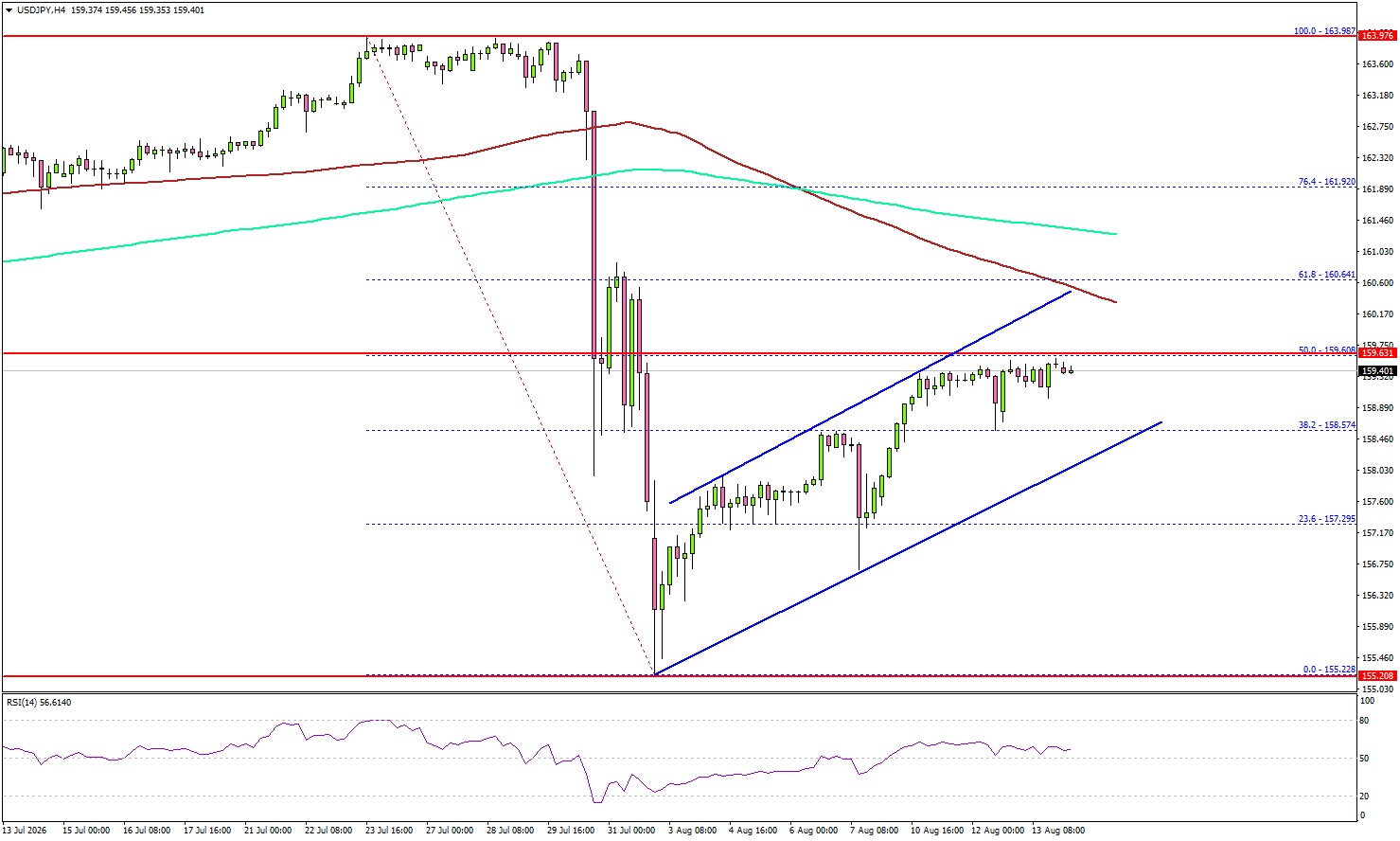
Looking at the 4-hour chart, the pair almost tested the 50% Fib retracement level of the downward move from the 163.98 swing high to the 155.22 low. However, the bears seem to be active below 159.60.
The pair is also below the 100 simple moving average (red, 4-hour) and the 200 simple moving average (green, 4-hour). On the upside, the pair could face resistance near 159.60.
The next major resistance might be 160.50 and the 100 simple moving average (red, 4-hour). A close above 160.50 could start another steady increase. In the stated case, the bulls could aim for a move to 161.20.
Any more gains might open the door for a test of 162.00. If there is a fresh decline, the pair might find bids near 158.50. There is also a rising channel forming with support at 158.40.
The next major support could be near 158.00. The main support might be 157.20. A downside break and close below 157.20 might send the pair toward 156.50. Any more losses could open the door for a test of 155.25.
Looking at Gold, the bears are active below the $4,500 resistance, and they could aim for a downside correction in the near term.
Upcoming Key Economic Events:
- US Retail Sales for July 2026 (MoM) – Forecast +0.1%, versus +0.2% previous.
- Michigan Consumer Sentiment Index for August 2026 (Prelim) – Forecast 54.5, versus 55.2 previous.
Cliff Notes: A Cautious Turn
Key insights from the week that was.
This week the RBA took centre stage in Australia deciding unanimously to keep the cash rate unchanged for a second consecutive meeting. As detailed by Chief Economist Luci Ellis, the accompanying statement highlighted that the MPB is prepared to increase the cash rate from here, if upside risks to inflation materialise. This is more specific and narrower language than in May, when it stated that the cash rate would be increased “if needed”.
Headline and trimmed mean inflation have both come in lower than the RBA expected in May, and the labour market and housing market are both weaker than it anticipated. These outcomes have strengthened their assessment that monetary policy is somewhat restrictive, likely sufficiently so to bring inflation below the target range mid-point by 2028. Inflation risks are still regarded as skewed to the upside, however, and the labour market tight. So, we expect the RBA’s communications to maintain a hawkish tone while they remain on hold through late-2026 and early-2027. By August 2027 though, we believe a period of below-trend growth, an unemployment rate above the full employment level and a trend deceleration in annual inflation will be enough to warrant the first of three 25bp rate cuts, to be followed up in November 2027 and February 2028. Until this relief is given, the consumer is likely to remain cautious on spending and housing, topics assessed in depth in our latest Red Book.
On the data front, the July NAB business survey captured businesses’ reaction to the breakdown of the US/Iran Memorandum of Understanding and the brief spike in Brent oil above USD100 per barrel. Business conditions continued to show resilience (+1pt to 4), but confidence remained sub-par, registering a second-consecutive reading of -6 – 11pts below its long-run average and within the bottom 10% of outcomes recorded since 1997. Input cost increases are materially affecting business profitability, particularly in sectors where weak and/or fragile demand is limiting the ability of firms to pass costs on. The survey’s gauge of profitability remained only modestly below its long-run average, and the employment index in line. That said, forward orders showed a 3pt decline in July to -3 highlights a need to monitor risks closely.
Offshore, US inflation data was in focus. Again, it proved benign, headline prices rising 0.1% and 0.2% excluding food and energy. While annual headline inflation is still a multiple of the FOMC’s 2.0%yr target (3.4%yr in July), core inflation has moderated all the way back to 2.5%yr. And recent monthly outcomes suggest further progress is in train. Since December 2025, core goods prices have essentially been flat. Core services inflation has meanwhile averaged 0.3% per month over the period with an outsized contribution from shelter. Indeed, 6-month annualised inflation excluding food, energy and shelter was just 1.6% in July compared to 2.4% for the traditional ex food and energy measure. There is little the FOMC can do about shelter inflation in the short to medium-term, and inflation across the rest of the basket is clearly not suggesting a hike(s) is necessary now or in coming months.
Last Friday’s nonfarm payrolls report also argues in favour of restraint by the FOMC, the employment gauge surprising to the downside in July (-23k) following a -103k revision to the prior two months. Household survey employment was weaker still, with 87k fewer people reporting they are employed in the month, continuing the trend of the past 6 months (an average monthly decline of 153k). Declining participation continues to mask the deterioration in household employment. Had participation not fallen 1.2ppts since January 2025, the unemployment rate would be through 5.0%. Average hourly earnings are increasingly reflecting labour market slack, rising just 0.1% in the month, slowing the annual pace to 3.2%.
All told, we expect the US economy to continue to show resilience, growing around trend in 2026–28. But the household sector is set to remain under considerable pressure, with excess capacity likely to build in the labour market and the ability to unlock housing wealth constrained by borrowing costs and uncertainty. A complete update of our global analysis and forecasts will be made available in our August Market Outlook today on Westpac IQ.
NASDAQ-100 Wave Analysis
Nasdaq-100: ⬆️ Buy
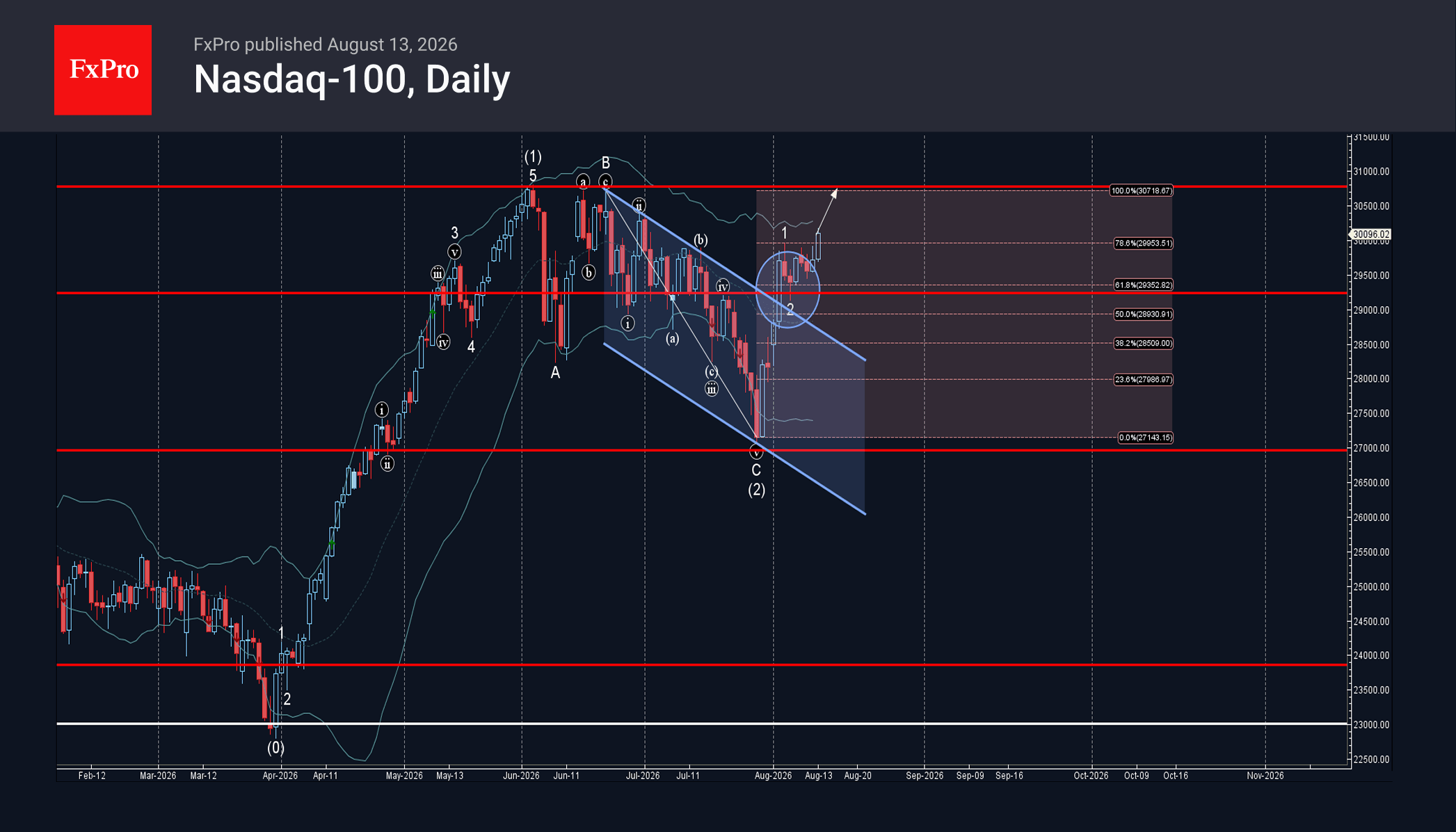
– Nasdaq-100 broke daily down channel
– Likely to rise to resistance level 30770.00
Nasdaq-100 index recently broke the resistance zone between the resistance trendline of the daily down channel from June intersecting with the 61.8% Fibonacci correction of the downward impulse C from June.
The breakout of this resistance zone accelerated the active minor impulse wave 3 that belongs to the intermediate impulse wave (3) from the end of July.
Given the prevailing uptrend, Nasdaq-100 index can be expected to rise further to the next resistance level 30770.00 – former double top from June.
Eco Data 8/14/26
| GMT | Ccy | Events | Act | Cons | Prev | Rev |
|---|---|---|---|---|---|---|
| 22:30 | NZD | BusinessNZ PMI Jul | 54.3 | 59.7 | 60.1 | |
| 09:00 | EUR | Eurozone Trade Balance (EUR) Jun | 1.8B | -4.2B | -5.0B | -6.1B |
| 09:00 | EUR | Eurozone GDP Q/Q Q2 P | 0.40% | 0.40% | 0.40% | |
| 12:30 | CAD | Manufacturing Sales M/M Jun | 0.10% | -0.10% | 1.30% | |
| 12:30 | CAD | Wholesale Sales M/M Jun | 2.80% | 2.70% | 0.00% | |
| 12:30 | USD | Retail Sales M/M Jul | -0.60% | 0.20% | 0.20% | |
| 12:30 | USD | Retail Sales ex Autos M/M Jul | -0.30% | 0.20% | -0.20% | |
| 14:00 | USD | Business Inventories Jun | 0.00% | 0.20% | 0.30% | |
| 14:00 | USD | UoM Consumer Sentiment Aug P | 51 | 54.1 | 55.2 | |
| 14:00 | USD | UoM 1-Yr Inflation Expectations Aug P | 4.30% | 4.20% |
| 22:30 | NZD |
| BusinessNZ PMI Jul | |
| Actual | 54.3 |
| Consensus | |
| Previous | 59.7 |
| Revised | 60.1 |
| 09:00 | EUR |
| Eurozone Trade Balance (EUR) Jun | |
| Actual | 1.8B |
| Consensus | -4.2B |
| Previous | -5.0B |
| Revised | -6.1B |
| 09:00 | EUR |
| Eurozone GDP Q/Q Q2 P | |
| Actual | 0.40% |
| Consensus | 0.40% |
| Previous | 0.40% |
| 12:30 | CAD |
| Manufacturing Sales M/M Jun | |
| Actual | 0.10% |
| Consensus | -0.10% |
| Previous | 1.30% |
| 12:30 | CAD |
| Wholesale Sales M/M Jun | |
| Actual | 2.80% |
| Consensus | 2.70% |
| Previous | 0.00% |
| 12:30 | USD |
| Retail Sales M/M Jul | |
| Actual | -0.60% |
| Consensus | 0.20% |
| Previous | 0.20% |
| 12:30 | USD |
| Retail Sales ex Autos M/M Jul | |
| Actual | -0.30% |
| Consensus | 0.20% |
| Previous | -0.20% |
| 14:00 | USD |
| Business Inventories Jun | |
| Actual | 0.00% |
| Consensus | 0.20% |
| Previous | 0.30% |
| 14:00 | USD |
| UoM Consumer Sentiment Aug P | |
| Actual | 51 |
| Consensus | 54.1 |
| Previous | 55.2 |
| 14:00 | USD |
| UoM 1-Yr Inflation Expectations Aug P | |
| Actual | 4.30% |
| Consensus | |
| Previous | 4.20% |
Fed’s Hammack Rejects Slow Inflation Glide, Calls for Immediate Tightening
Cleveland Fed President Beth Hammack reiterated Thursday that Fed should raise rates now, arguing current policy is not providing enough restraint to bring inflation back to 2% quickly enough. Speaking at Dayton Area Chamber of Commerce in Dayton, Ohio, Hammack pointed to businesses still eager to borrow and invest, warning that excessive growth could add to price pressures. “We need to make sure that we’ve got some amount of restraint coming from policy,” she said, so inflation can move from above 3% back toward Fed’s objective.
Hammack acknowledged that inflation data have improved over past two months, but said that was not enough to convince her disinflation will persist. “I don’t have confidence that we’re going to continue to see that or that we’re going to see them low enough that it’s going to bring us back down to that 2%,” she said. She also challenged idea that Fed can tolerate a very gradual return to target, asking, “If it takes us another three or four years to get there, is that OK?” Her concern is not simply whether inflation eventually reaches 2%, but whether current policy gets there fast enough to preserve credibility.
That leaves Hammack firmly on hawkish side of Fed debate after dissenting at July meeting in favor of higher rates. She cited businesses pre-emptively raising prices because they expect future cost pressures, as well as household strain from high gasoline and living costs, as evidence that prolonged inflation carries real consequences. Her conclusion was explicit: “I think that we need to act now,” because current rates imply too slow a glide back to target. For markets, message is that two softer inflation reports have not changed her preference for immediate tightening.
Key Takeaways
- Cleveland Fed President Beth Hammack reiterated that Fed should raise rates immediately, arguing current policy is not restrictive enough to return inflation to 2% quickly enough.
- Hammack said businesses are still eager to borrow and invest, which could keep demand strong and add to price pressures.
- She acknowledged inflation has improved over past two months but said, “I don’t have confidence that we’re going to continue to see that.”
- Hammack challenged a slow return to target, asking, “If it takes us another three or four years to get there, is that OK?”
- She also warned persistent inflation may be changing business pricing behavior, with firms raising prices in anticipation of future cost pressure.
- Her conclusion was explicit: “I think that we need to act now.” That keeps her firmly among Fed’s most hawkish voices after dissenting for a hike in July.
Fed’s Barkin Says Another Hike May Not Be Needed if Inflation Shocks Fade
Richmond Fed President Thomas Barkin said Thursday that it is still unclear whether Fed will need to raise rates again to bring inflation back to 2%, arguing that several recent price pressures may fade without additional tightening. In remarks prepared for delivery to Greenville Chamber of Commerce, Barkin said, “The open question is how it gets there. Will the Fed need to raise rates or is inflation already on a path down to target?” He added that “much of today’s elevated inflation level has come from shocks, which should pass,” citing tariffs, higher oil prices and AI-related demand for labor and supplies.
Barkin said that if those shocks ease, “the current level of interest rates, many think, is still restrictive enough to bring inflation down.” That framing supports case for keeping policy steady while Fed assesses whether existing restraint is sufficient. But he also warned that inflation could prove “more embedded” if supply-chain problems persist or AI investment remains strong enough to keep raising costs. Inflation having stayed above target since 2021 also creates risk of “an upward shift in the price expectations of firms and consumers.”
Comments place Barkin firmly in wait-and-see camp rather than signaling a clear preference for another hike. His message is that Fed does not need to choose between commitment to 2% inflation and policy patience: if current shocks fade, existing rates may do enough. But if inflation expectations drift higher or temporary pressures prove persistent, another increase could still become necessary. That leaves incoming inflation data and evidence on whether current cost shocks are actually dissipating as key tests for policy path.
Key Takeaways
- Richmond Fed President Tom Barkin said it is still an open question whether Fed needs another hike to return inflation to 2%.
- Barkin argued that much of current inflation reflects shocks that “should pass,” including tariffs, higher oil prices and AI-related demand for labor and supplies.
- If those pressures fade, he said current interest rates may already be restrictive enough to bring inflation down without further tightening.
- Barkin nevertheless warned that inflation could prove “more embedded” if supply disruptions persist or AI investment keeps costs elevated.
- He also highlighted risk of “an upward shift in the price expectations of firms and consumers” after years of above-target inflation.
- Overall message supports a September hold bias, while leaving another hike as a contingency if inflation expectations or underlying price pressures worsen.