Sample Category Title
Week Ahead – Summer Lull Could Be Tested by Geopolitics and Central Bank Expectations
- US dollar stabilizes as September Fed hike bets remain subdued.
- Market volatility stays low, but thin liquidity could amplify movements.
- Key UK data could challenge pound strength; euro craves bullish catalysts.
- Middle East tensions could upset markets; yen weakness persists.
Dollar gains, equities trade sideways but bond yields rise
It has been a relatively monotonous week, with the US dollar desperately trying to recover from last Friday's nonfarm payrolls-induced losses, the main equity indices trading mostly sideways amidst a quiet earnings calendar, and sovereign bond yields reminding everyone of their pivotal role in the current financial system.
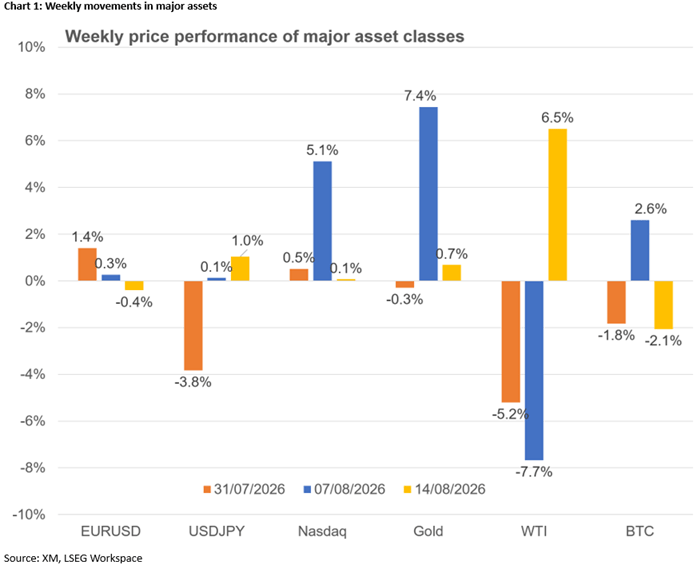
These market moves are partly connected to the Middle East developments. At the time of writing, an interim US-Oman-Iran agreement remains elusive, increasing the chances of fresh military operations. Oil prices remain elevated, with the December 2026 WTI oil futures contract clearly pointing to elevated uncertainty and angst.
The main derivative of the oil price rollercoaster is the softer Fed rate hike expectations, with the September hike bets hovering below 50% despite Fed hawks coming out in force. Wednesday's July US CPI report failed to produce an upside surprise, with the Jackson Hole Symposium gradually gaining importance.
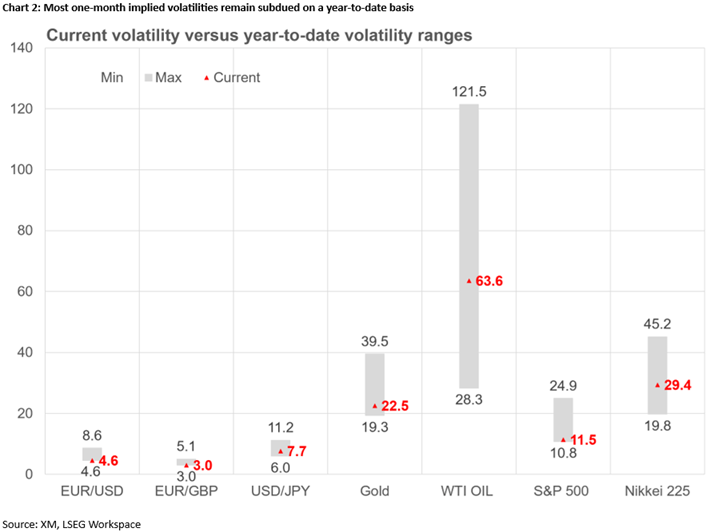
Interestingly, with the exception of yen crosses, the Nikkei 225 index and WTI oil, one-month implied volatilities for most assets are near year-to-date lows. This confirms the current low appetite for aggressive positioning amidst the summer lull and thin liquidity conditions.
Light US data calendar, but the September hike bets will remain in focus
Investors will have to make do with a less impressive data calendar next week. Numerous housing data releases, key business surveys such as the Philadelphia Fed Manufacturing survey and the S&P Global PMIs will offer valuable insight into the Fed's next action.
But the most important event might prove to be Wednesday's release of the July 29 FOMC meeting minutes. While usually treated as an out-of-date event, the minutes could offer a clearer view of the hawkish sentiment within the committee. A hawkish set of minutes could add further weight to the hawkish voices calling for a September rate hike and boost the US dollar. We already heard from Cleveland's Hammack and Minneapolis' Kashkari, who dissented at the July 29 Fed meeting, and a number of non-voters like St Louis' Musalem, Boston's Collins and Dallas' Logan supporting rate hikes.
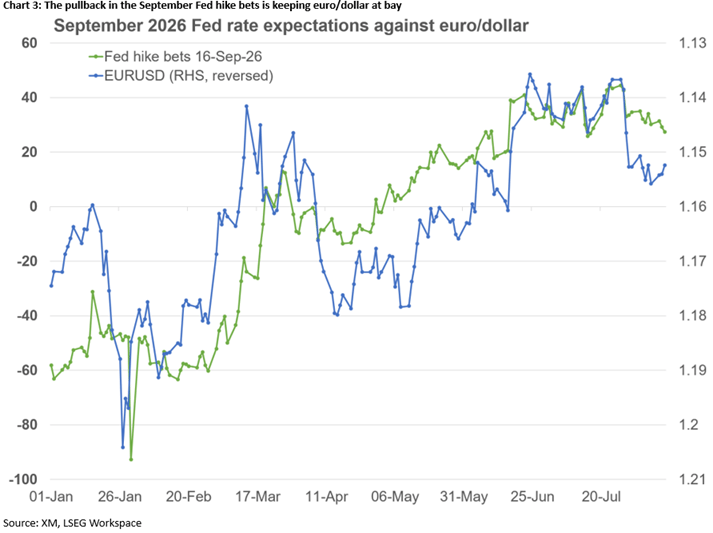
As Chart 3 above shows, the probability of a rate hike in September has dropped aggressively lately, keeping the dollar under pressure, while the first 25bps move is currently fully priced in for December, a significant adjustment from mid-July.
The FOMC voting committee is dominated by dovish members, thus making it even more difficult for hawks to push through their opinions, unless Chair Warsh decides to pick a side. Crucially, the countdown to the late-August Jackson Hole Symposium has commenced, where Warsh might have to choose between opening the door to a September rate hike or just setting out his priorities for the following 12 months.
Could pound strength be challenged by UK data?
The pound has been showing unexpected strength against both the dollar and the euro since July 29, with investors probably forgetting the dovish rhetoric from BoE Governor Bailey and the reduced chances of BoE rate hikes in the remainder of 2026. One rate hike is currently priced in for December, down from 49bps of tightening expected ahead of the July meeting.
Key labour market data, the July CPI and PPI reports, the July retail sales figures and the preliminary PMI surveys for August are expected to keep pound traders exceptionally busy next week. Obviously, Wednesday's CPI report stands out, as an upside surprise in the core indicator could prove to be the most market-moving event.
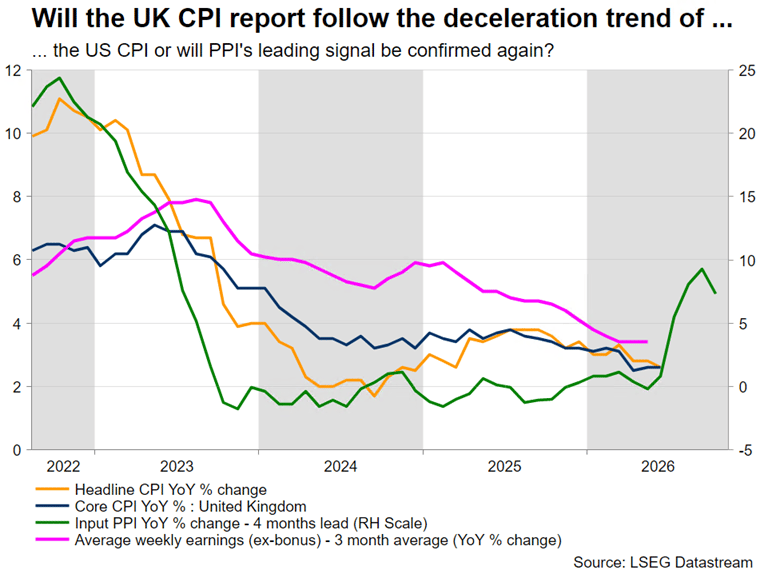
Core inflation has been stabilizing at current levels, ignoring the persistent deceleration seen in the headline figure. An acceleration towards 3% could upset market expectations and further boost the pound mostly against the euro, but also against the dollar if Fed hike bets remain subdued. Crucially, euro/pound is hovering at the critical area of 0.8530, with a potential drop towards 0.8504 opening the door to a retest of the one-year low of 0.8454.
Could bullish catalysts arise for the euro?
The euro has gained around two big figures since late July against the dollar, fully capitalising on the greenback's broader weakness. However, euro-based bullish catalysts remain scarce, with expectations for a September ECB hike being the euro's main tailwind.
With ECB members taking advantage of the summer lull, next week's preliminary PMI surveys could test the current euro strength. A significant weakness in the PMIs, signalling weaker growth momentum, could raise questions about the ECB's next steps. An upset to the current solid September hike bets could prove market-moving, challenging the euro's gains, as market tightening via higher bond yields might prove sufficient for many ECB members.
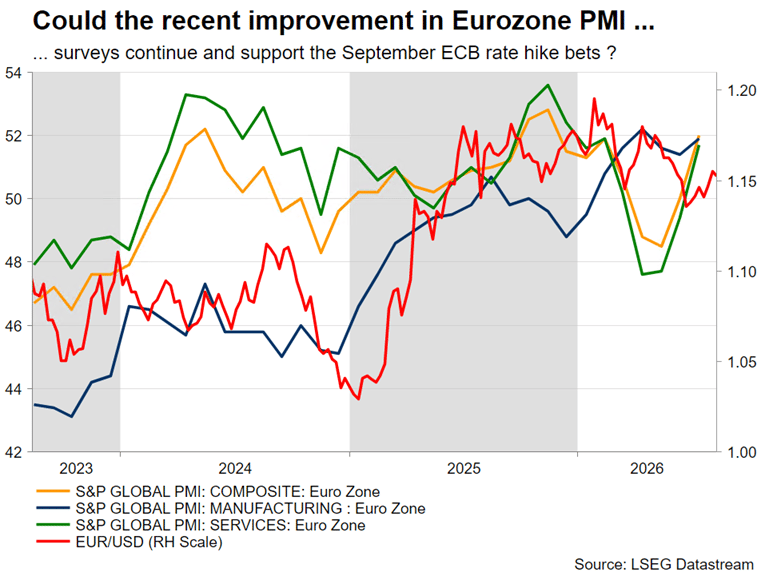
At the end of the day, though, the ECB's actions depend on Middle East developments. The lack of an interim agreement could overshadow data releases and maintain the ECB's current course of action, supporting the euro. In the low-probability scenario of positive news from the Oman-Iran negotiations, weaker eurozone data could offer a way for the ECB doves, thus denting the euro's appeal. A drop towards the lower boundary of the recent one-year-long range at 1.1470 could be on the cards for euro/dollar, with moves potentially amplified by the lighter liquidity conditions.
Middle East in the spotlight, Yen suffering persists
Iran's additional demands about reopening the Strait of Hormuz have stalled negotiations for an interim agreement. While President Trump is eager to close this chapter and focus on the midterm elections, a restart of hostilities is still on the table. In this case, oil prices could quickly climb to recent highs, and even threaten a return to the triple-digit territory.
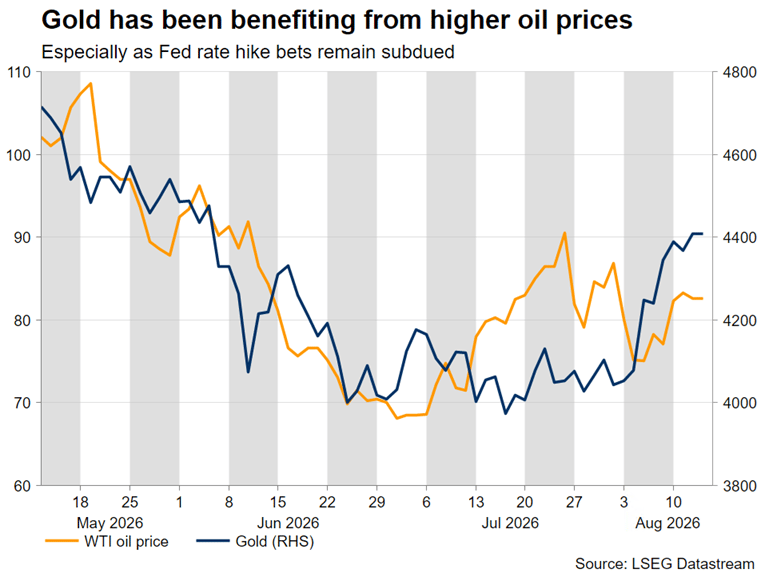
The latter could be the final nail in the coffin for the late July yen intervention. Unsurprisingly, with dollar/yen potentially flirting with 160 again, we are witnessing a repeat of the previous BoJ interventions when the engineered dollar/yen drop was followed by a consistent rally.
Japanese officials are apparently trying to buy time, hoping that the US dollar will eventually start to weaken, while also mistakenly expecting that domestic firms will repatriate their funds and invest in Japanese bonds. All in all, the yen remains at the mercy of the markets, despite some growing expectations for a September BoJ hike.
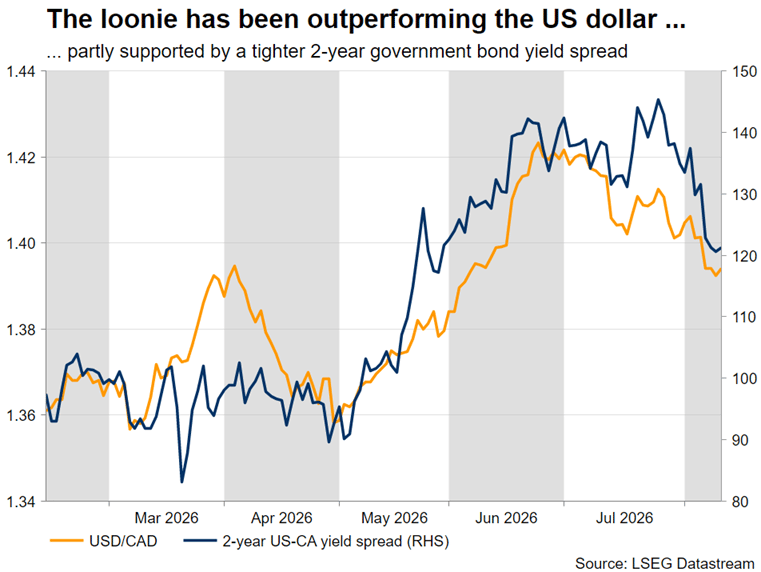
Interestingly, both the aussie and the loonie have been outperforming the US dollar since June 24. Next week, the loonie's strength could be challenged by a plethora of data prints, especially Monday's CPI report. Compared with the neighbouring US, inflation has been well behaved, with core inflation gradually easing to 2.1%.
However, the loonie's biggest test will probably be the August 19 tariff deadline set by Trump to impose 50% tariffs on certain Canadian imports. If no agreement is reached between the US and Canada, the loonie could be under severe pressure, with a move towards 1.4000 being on the cards.
Gold, equities in auto-pilot mode
The softer Fed rate hike expectations have given both US equity indices and gold some valuable breathing space. While equities are drifting higher, powered by an impressive earnings season, the precious metal is posting gains for the second straight week for the first time since mid-April. A potentially aggressive dollar rally could really test the viability of the current upside move in gold, challenging the gold bugs' renewed optimism for a retest of $4,500 ahead of the Jackson Hole Symposium.
Sunset Market Commentary
Markets
July US producer price inflation pushed US Treasuries higher for the third time in the past five sessions. Previous attempts to lock in sustained gains, after weak payrolls last Friday and following yesterday's in-line CPI release, failed but eventually one straw broke the camel's back. Looking at the numbers, they're not outright soft. The headline PPI pace was slower than expected (0% flat) with the Y/Y-figure falling from 5.5% to 4.7% (vs 4.9% consensus). Core PPI gauges on the other hand were more stubborn, ranging between 0.2% & 0.4% M/M and printing above consensus Y/Y (4.2% excl food & energy and 4.7% excl food, energy & trade). On top, retreating transportation costs are likely to see a reversal in August in line with energy prices. The key message from yesterday and today probably is that inflation is not re-accelerating. If upside inflation risks don't materialize, it might keep the Fed at bay for longer. That seems to be the current market reasoning at least. US yields shed 4.8 bps (30-yr) to 6.7 bps (5-yr) as September rate hike bets are further scaled down from 50% to 33%. US Treasuries outperform German Bunds and UK Gilts today with German/UK yields only losing up to 3 bps at the front end of the curve. Loss of interest rate support doesn't harm the dollar with EUR/USD currently changing hands around 1.1535. JPY fails to capitalize on this morning's Bloomberg report that the Japanese government supports faster BoJ tightening (September or October). The yen already lost half of the advance following joint US/Japan FX interventions end July. Markets are testing policy makers' resolve, both on the government and the central bank level. Japanese money markets attach a 75% probability to a September rate hike with such action fully discounted by October. Sterling (EUR/GBP 0.8540) is unmoved by preliminary Q2 GDP data. Quarterly growth slowed from 0.6% to a still decent 0.4% (1.2% Y/Y), broadly in line with expectations. Details were solid though with private consumption (0.3% Q/Q), gross fixed capital formation (1.2% Q/Q), exports & imports (both 0.5% Q/Q) all beating consensus. Government spending (-0.3% Q/Q) was a drag on growth.
News & Views
The Norwegian central bank kept its policy rate unchanged at 4.25% today in a widely anticipated decision. In June the Committee assessed that it WOULD LIKELY BE necessary to raise the policy rate further at one of the forthcoming meetings. However, this week's softer July core CPI print tilted the balance somewhat. The Norges Bank welcomed slower inflation (2.7% Y/Y vs 3.3% forecast in June policy report for CPI ATE) but thinks it is too early to conclude that the inflation outlook has changed materially. Its forward guidance did change though: "it MAY become necessary to raise the policy rate". The Committee judges that a restrictive monetary policy stance is still needed to bring inflation down to target within a reasonable time horizon, but does not want to restrict the economy more than needed. Apart from inflation developments, the Norges Bank notes that economic activity, the labour market and the EUR/NOK FX-rate all moved broadly as expected. Odds of a 25 bps September rate hike, when a new Monetary Policy Report will be released, are currently 60%. The NOK trades a tad weaker in the aftermath of today's decision with a lower oil prices weighing as well. EUR/NOK moved from 10.93 to 11, holding well within the trading band of the past couple of months (10.75-11.30).
The Turkish central bank (CBRT) presented its latest quarterly inflation report today. They raised the end-2026 CPI forecast from 26% in the May report to 28% while keeping the interim-target of 24% unchanged. End-2027 and end-2028 forecasts were left unchanged at respectively 15% and 9%. Governor Karahan called the central bank's inflation performance a partial failure. Inflation was brought back from a 75%+ peak towards the low 30s but has remained above (short-term) targets. Consequent external shocks, and a very serious global price rise driven by energy supply issues, are to blame though. The CBRT vows to maintain a tight monetary policy stance (policy rate of 37% since January). It believes that monetary policy is working even as supply shocks caused a delay, given weak domestic demand and falling core inflation. The Turkish lira is unfazed today. It continues a structural weakening trend with EUR/TRY at an all-time high above 55.
Sluggish Dollar as Fed Gets More Reason to Wait, Brent Runs Out of Reasons to Rally
Why Dollar and Brent are both stalling at the same moment, and what each market needs to move again
Dollar Softens Again as PPI Strengthens Fed Hold Case
Dollar attempted a recovery earlier Thursday but slipped again in early US trading after July PPI undershot expectations, adding to the case for the Fed to leave rates unchanged in September. Headline producer prices moved from -0.1% to 0.0% m/m, below the 0.2% expected, while annual PPI slowed sharply from 5.5% to 4.7%, undershooting the 4.9% consensus.
Coming one day after an in-line CPI report showed core inflation returning from 2.6% to 2.5%, back at its pre-Iran-war level, July's price data collectively suggest the inflationary effects of the first oil shock have largely washed through. Fed funds futures now price close to a 70% probability of a September hold, up from around 45% a week ago.
That is a substantial shift in rate expectations. Yet the Dollar's response remains surprisingly restrained.
July PPI at a Glance
- Headline PPI: -0.1% to 0.0% m/m, below the 0.2% expected.
- Annual PPI: slowed from 5.5% to 4.7% y/y, below the 4.9% consensus.
- September hold probability: near 70%, up from around 45% a week ago.
Fed Hold Is Becoming Consensus, but Dollar Bears Lack Momentum
Dollar is the second-weakest major currency on the day, behind Kiwi, but selling has failed to develop into a broad directional move. Swiss Franc is strongest, followed by Euro and Yen, while Sterling and Canadian Dollar sit in the middle. Aussie is third weakest.
Outside several Kiwi crosses, however, most major pairs remain trapped inside Wednesday's ranges. That leaves the overall FX market better described as indecisive than decisively Dollar-bearish.
Part of the explanation is that much of the Fed repricing has already happened. July's surprise payroll contraction started the process, CPI removed evidence of renewed core inflation, and PPI has now reinforced the same conclusion. Thursday's data therefore strengthen an increasingly established September-hold narrative rather than introducing an entirely new one.
Fed hold is becoming consensus, but Dollar bears are struggling to extract another trend move from it.
July Inflation Gives Fed More Reason to Wait
Both CPI and PPI reports largely describe the price environment before the latest US-Iran re-escalation and renewed Brent surge. The Fed therefore knows the first oil shock has largely passed through inflation data, but it still has to determine whether a second shock will do the same.
That reinforces the hold-and-wait position ahead of the September 15–16 meeting. August employment data will determine whether July's labor-market deterioration persists, while August inflation reports will begin showing whether higher energy prices are again spilling into broader costs.
Brent's Six-Session Rally Hits $90 Wall
The oil market is facing its own waiting game.
Brent has rallied roughly 12% over six sessions, but the advance has stalled around the psychological $90 level. WTI has also eased, as geopolitical news flow stops providing fresh reasons to extend the risk premium.
US-Iran talks remain deadlocked, but the deadlock itself is no longer new information. Pakistan's defense minister suggesting earlier this week that parties could be "close to some sort of arrangement" provided one mildly de-escalatory signal, but there has been no breakthrough in either direction.
Current price therefore appears to reflect the existing standoff rather than expectation of an imminent new escalation. Continued hostile rhetoric or another confirmation that negotiations are stuck may no longer be enough to drive Brent decisively through $90. A new escalation would likely be needed to expand the geopolitical premium further.
Without Fresh Escalation, Fundamentals Start to Matter Again
Oil's underlying fundamental picture is also becoming less supportive.
US crude inventories jumped 9.1 million barrels in this week's data, the biggest weekly increase since February. That bearish signal has so far been overshadowed by Middle East risk, but it becomes relevant if the geopolitical backdrop stops deteriorating.
That means "no new news" does not necessarily imply Brent simply settles into a plateau around $90. If the US-Iran standoff remains static and the risk premium stops expanding, the bearish inventory backdrop could begin pulling prices back through $87–88. A deeper grind toward $85–86 would then become increasingly plausible.
Oil's Asymmetric Setup
- To sustain a break above $90: fresh escalation is probably needed.
- Absent escalation: bearish inventories (+9.1 million barrels, biggest weekly build since February) leave room for fundamentals to pull Brent back toward $87–88, and potentially $85–86.
Two Markets Waiting for the Next Catalyst
Dollar and oil are arriving at similar points from opposite directions.
Fed markets have received enough benign July inflation data to make a September hold increasingly likely, but further Dollar downside now requires another catalyst. Oil has received enough geopolitical tension to lift Brent toward $90, but further upside increasingly requires escalation beyond the current stalemate.
That leaves both markets waiting. For Dollar, the next decisive information comes from August labor and inflation data. For Brent, it comes from whether the US-Iran standoff actually worsens or simply stays unresolved.
Fed has more reason to wait. Brent, for now, is running out of reasons to rally.
Related Coverage
Fed & Rates Deep Dives
- Read the full PPI breakdown showing falling energy and food prices drove much of July's softness: US PPI Slows to 4.7% Y/Y as July Prices Come in Flat.
- See why rising initial jobless claims add another mildly soft labor signal even as the four-week average holds steady: US Jobless Claims Rise to 209K, but Continuing Claims Ease.
Currency Divergence Deep Dives
- Read why NZD fell despite a hawkish RBNZ Survey, as one-year inflation expectations plunged from 3.41% to 2.60%: RBNZ Survey Was Hawkish. So Why Did NZD Fall?.
- See why EUR/USD is struggling to rally even with a favorable macro backdrop and September ECB hike odds above 90%: Dollar Is Giving EUR/USD Every Chance to Rally. So What's Holding Euro Back?.
Global Data Deep Dives
- Read why weak capital and intermediate goods offset stronger consumer production in June: Eurozone Industrial Production Stalls in June as Capital Goods Weigh.
- See why stronger June growth suggests the UK economy entered Q3 with more momentum than feared: UK GDP Beats June Forecast with 0.4% M/M Growth as Services Keep Economy Moving.
- Read why Yen-based import inflation near 30% is still limiting relief for the BoJ despite cooling producer prices: Japan PPI Cools Slightly to 7.2% Y/Y, but Weak Yen Keeps Import Inflation Near 30%.
Central Bank Commentary
- See why RBA's Kent says tightening is working, but the Board isn't yet ready to call the cycle finished: RBA's Kent Says Tightening Is Working, but Policy Restraint Remains Hard to Gauge.
Frequently Asked Questions
Q: Fed hold odds jumped to near 70%. Why isn't the Dollar selling off harder?
A: Because most of the repricing that drove the shift had already happened before Thursday. July's surprise payroll contraction started the process, CPI removed evidence of renewed core inflation, and PPI simply reinforced a conclusion markets had already reached. With Dollar still trapped inside Wednesday's ranges against most majors outside a few Kiwi crosses, the FX market looks indecisive rather than decisively Dollar-bearish.
Q: Why did Brent's rally stall right at $90 instead of breaking through?
A: Because the US-Iran deadlock stopped being new information. The rally's roughly 12% six-session advance was built on genuine escalation headlines, but continued stalemate, even hostile rhetoric or another confirmation that talks are stuck, no longer adds fresh geopolitical premium. A break decisively above $90 likely requires actual new escalation, not just continuation of the current standoff.
Q: What would move Dollar and Brent from here?
A: For Dollar, the next decisive catalyst is August labor and inflation data, due ahead of the September 15–16 FOMC meeting. For Brent, it's whether the US-Iran standoff actually worsens rather than just persisting. Absent a real escalation, oil's bearish backdrop, including a 9.1 million barrel inventory build, the biggest since February, leaves room for prices to drift back toward $87–88 or lower.
Key Takeaways
- PPI reinforced the Fed hold case: September hold odds rose to near 70%, up from around 45% a week ago, after annual PPI slowed from 5.5% to 4.7%.
- Dollar's decline lacks momentum: Much of the Fed repricing already happened via July's payroll contraction and CPI, so PPI reinforced rather than created the move, and most pairs remain trapped in Wednesday's ranges.
- Brent's rally stalled because the deadlock is no longer new information: The roughly 12% six-session advance hit a wall near $90 as continued US-Iran stalemate stopped adding fresh geopolitical premium.
- US crude inventories jumped 9.1 million barrels, the biggest weekly build since February: That bearish signal is currently overshadowed by geopolitical risk but becomes relevant if tensions stop escalating.
- Oil's setup is asymmetric: A break above $90 likely needs fresh escalation, while the absence of escalation leaves room for fundamentals to pull Brent toward $87–88, and potentially $85–86.
- Dollar and Brent are both waiting on different catalysts: August labor and inflation data for Dollar, an actual worsening rather than continuation of the US-Iran standoff for oil.
What to Watch Next
August employment and inflation data will be the next major test for Dollar ahead of the September 15–16 FOMC meeting. For oil, watch whether the US-Iran standoff shows genuine signs of escalation or de-escalation, rather than simply persisting, since continued deadlock alone may no longer be enough to move Brent through $90.
US Jobless Claims Rise to 209K, but Continuing Claims Ease
US initial jobless claims rose from a revised 200K to 209K in week ending August 8, above 202K consensus, adding another mildly softer signal. Increase was 9K on week, while four-week moving average held unchanged at 199K, suggesting latest rise is noticeable but not yet evidence of a sharp deterioration in layoffs.
Continuing claims moved in opposite direction. Insured unemployment fell from a revised 1.799M to 1.777M in week ending August 1, while four-week average declined from a revised 1.79075M to 1.7855M. Insured unemployment rate was unchanged at 1.2%. That suggests labor market is not weakening uniformly: new claims picked up, but those already unemployed were not becoming more numerous.
Initial claims above expectations fit broader evidence that labor conditions have softened, but stable four-week claims and lower continuing claims argue against reading one week as a clear acceleration in job losses.
Data Summary
| Indicator | Actual | Expected | Previous |
|---|---|---|---|
| Initial Jobless Claims | 209K | 202K | 200K |
| Initial Claims 4-Week Average | 199K | — | 199K |
| Continuing Claims | 1.777M | — | 1.799M |
| Continuing Claims 4-Week Average | 1.7855M | — | 1.79075M |
| Insured Unemployment Rate | 1.2% | — | 1.2% |
Key Takeaways
- Initial jobless claims rose from revised 200K to 209K, above 202K consensus, providing another mildly softer labor-market signal.
- Four-week average of initial claims was unchanged at 199K, indicating latest increase has not yet developed into a sustained rise in layoffs.
- Continuing claims fell from revised 1.799M to 1.777M, while their four-week average declined to 1.7855M.
- Insured unemployment rate held steady at 1.2%.
- Overall report is mixed rather than decisively weak: new claims increased, but continuing claims and their trend improved.
US PPI Slows to 4.7% Y/Y as July Prices Come in Flat
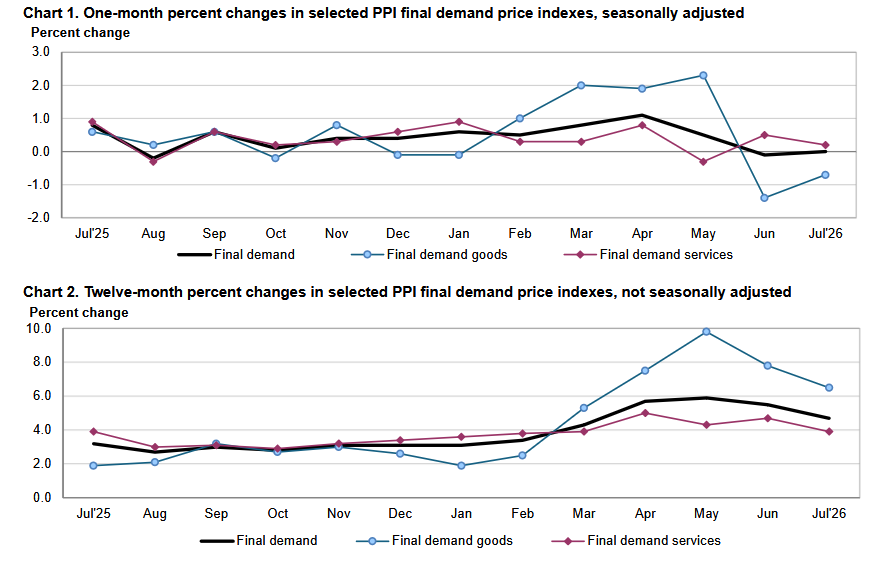
US producer inflation came in softer than expected at headline level in July, reinforcing evidence that price pressures from first oil shock are fading. PPI improved from a revised -0.1% to 0.0% m/m, below 0.2% consensus. Annual rate slowed sharply from 5.5% to 4.7%, undershooting 4.9% expected. Weakness was concentrated in goods, where prices fell -0.7% m/m, while final-demand services rose 0.2% and construction prices jumped 2.2%.
Goods breakdown was particularly soft. Energy prices fell -3.1% m/m and food declined -0.9%, while goods excluding food and energy rose just 0.1%. Services were firmer but uneven: trade services slipped -0.1% and transportation and warehousing fell -1.8%, while other services rose 0.6%. One caution came from Fed’s preferred underlying producer-price gauge excluding food, energy and trade services, which accelerated from 0.1% to 0.4% m/m, even as annual rate eased from 5.0% to 4.7%.
Overall, release strengthens case that headline pipeline inflation is cooling, but it is not an entirely dovish report. Falling energy prices did much of work at goods level, while underlying monthly measure accelerated. Combined with this week’s softer CPI, data further reduce immediate need for another Fed hike, but policymakers will be reluctant to declare victory before August figures capture latest rebound in oil prices.
Data Summary
| Indicator | Actual | Expected | Previous |
|---|---|---|---|
| PPI m/m | 0.0% | 0.2% | -0.1% |
| PPI y/y | 4.7% | 4.9% | 5.5% |
| Final Demand Goods m/m | -0.7% | — | -1.4% |
| Final Demand Services m/m | 0.2% | — | 0.5% |
| Final Demand Construction m/m | 2.2% | — | — |
| Food m/m | -0.9% | — | -0.5% |
| Energy m/m | -3.1% | — | -6.5% |
| Goods ex Food & Energy m/m | 0.1% | — | 0.2% |
| Trade Services m/m | -0.1% | — | 1.4% |
| Transportation & Warehousing m/m | -1.8% | — | -0.5% |
| Other Services m/m | 0.6% | — | 0.2% |
| PPI ex Food, Energy & Trade m/m | 0.4% | — | 0.1% |
| PPI ex Food, Energy & Trade y/y | 4.7% | — | 5.0% |
Key Takeaways
- US PPI came in softer than expected in July, moving from -0.1% to 0.0% m/m versus 0.2% expected, while annual rate slowed from 5.5% to 4.7%.
- Goods prices were main drag, falling 0.7% m/m, led by a 3.1% drop in energy and 0.9% decline in food.
- Services were firmer at 0.2% m/m, while construction prices rose 2.2%.
- Underlying picture was less dovish than headline: PPI excluding food, energy and trade services accelerated from 0.1% to 0.4% m/m, even as annual rate eased to 4.7%.
- Trade services fell 0.1% and transportation and warehousing dropped 1.8%, offsetting some strength in other services.
- Release supports case for a September Fed hold, but August PPI will be more important for judging whether renewed oil strength feeds back into broader producer costs.
The Yen Needs a Helping Hand
- The US dollar has prioritised geopolitics over inflation.
- Only the BoJ has the power to halt USDJPY gains.
The US dollar has proved the sceptics wrong, as it strengthened despite slowing inflation and a lower chance of Fed rate hikes. In July, consumer prices slowed from 3.5% to 3.4%, and the core inflation rate fell from 2.6% to 2.5% y/y. They are moving further and further away from May’s peak, which allows the central bank to keep rates at their current level. In theory, this development should have put pressure on the US dollar. All the more so given that Treasury bond yields fell and stock indices rose.
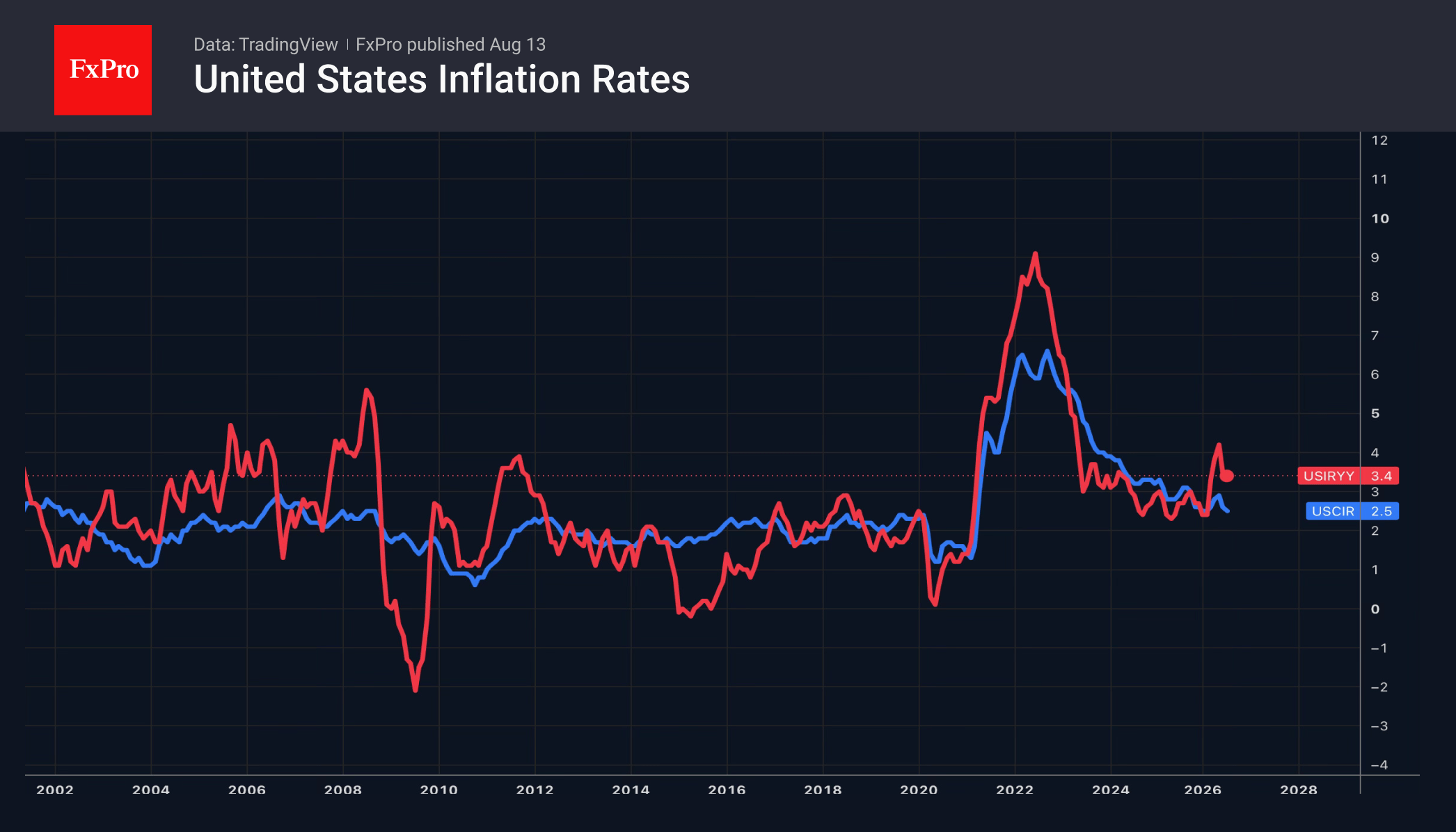
However, investors still have geopolitics in mind. The slowdown in inflation in June was linked to the signing of an agreement between the US and Iran to reopen the Strait of Hormuz. This brought Brent back to the levels seen before the conflict in the Middle East. However, tensions have since escalated, and Brent crude has rallied above $90 per barrel. Along with this, petrol prices are rising, as are the risks of accelerating consumer price inflation.
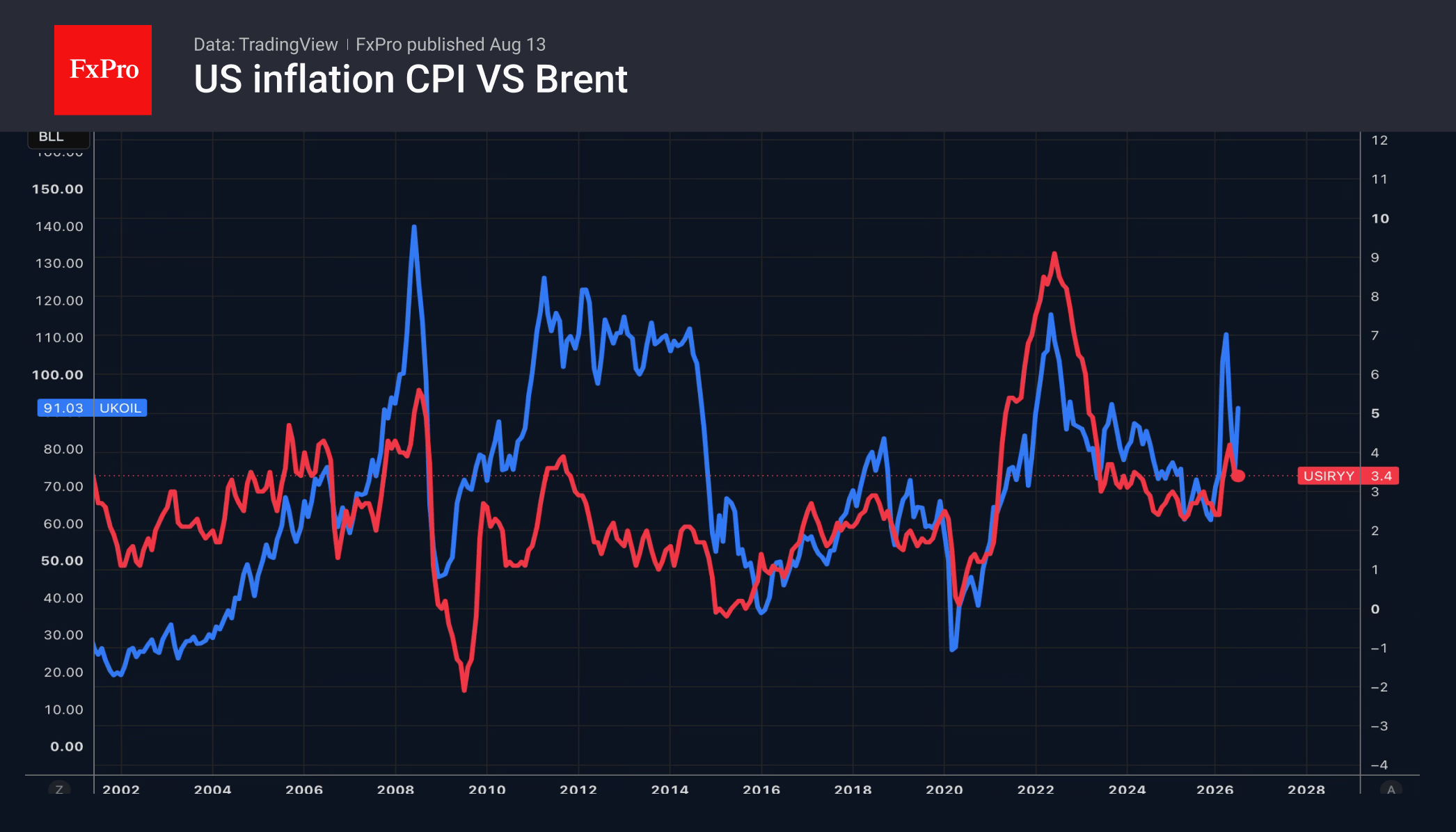
The strengthening of the US dollar has pushed USDJPY towards 160, increasing the likelihood of another round of currency interventions. Speculators have capitalised on the contradiction between the US Treasury’s recommendations to the Bank of Japan to accelerate the tightening of monetary policy and the government’s desire to keep interest rates low so as not to increase the cost of servicing its colossal debts. The rumours were so rife that the Cabinet was forced to respond.
According to a Bloomberg insider, Sanae Takaichi has no objection to short-term monetary tightening. The Prime Minister is concerned about inflation, which threatens her political approval ratings, and also about the perception that funds spent on currency intervention have been wasted.
There is a growing realisation in the market that the current USDJPY levels can only be sustained if the Bank of Japan changes its stance. It must either accelerate the cycle of monetary tightening or increase the anticipated scale of monetary tightening. The rationale for this is the acceleration in inflation. Indeed, producer prices rose by 7.2% in July. While this is slightly lower than June’s 7.3%, the figure remains close to a more-than-three-year high.
The FxPro Analyst Team
EUR/USD Daily Outlook
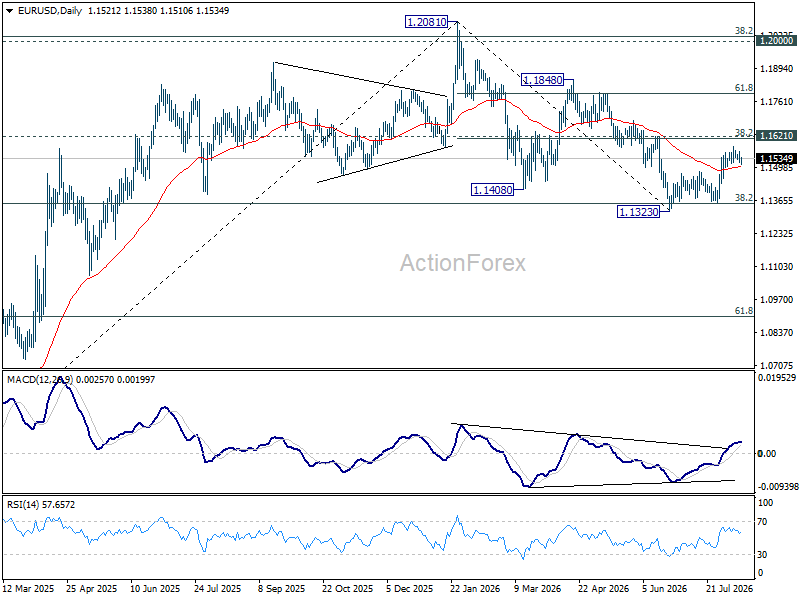
Intraday bias in EUR/USD stays neutral for the moment. Above 1.1580 will extend the rebound from 1.1323 to 1.1621 cluster resistance (38.2% retracement of 1.2081 to 1.1323 at 1.1613). Decisive break there will solidify the case that fall from 1.2081 has completed as a three wave correction at 1.1323. Further rally would then be seen to 61.8% retracement at 1.1791. However, break of 1.1481 resistance turned support will dampen this case, and turn bias back to the downside for 1.1352 support instead.
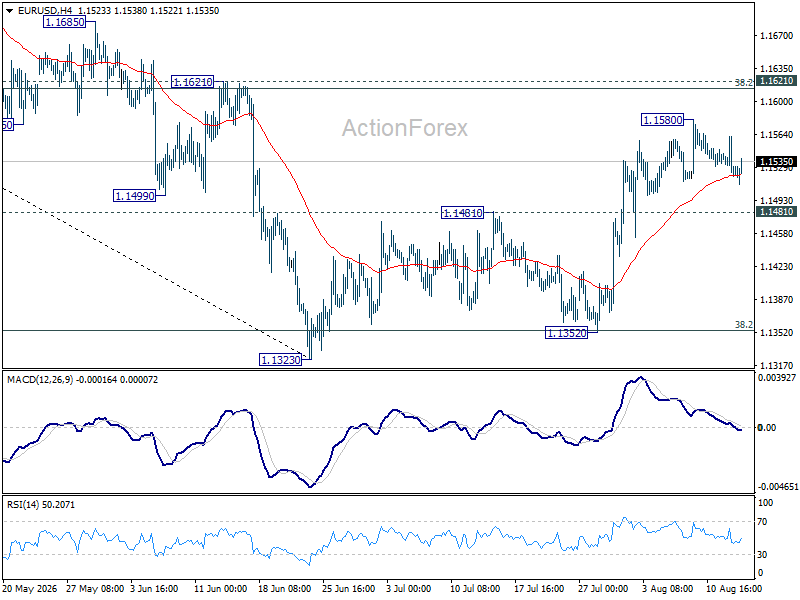
In the bigger picture, focus is staying on 38.2% retracement of 1.0176 to 1.2081 at 1.1353. Decisive break there will revive the case of medium term bearish trend reversal after rejection by 1.2 key cluster resistance level. Further fall should be seen to 61.8% retracement at 1.0904. Nevertheless, strong rebound from 1.1353, followed by break of 1.1621 resistance, will retain medium term bullishness.
USD/JPY Daily Outlook
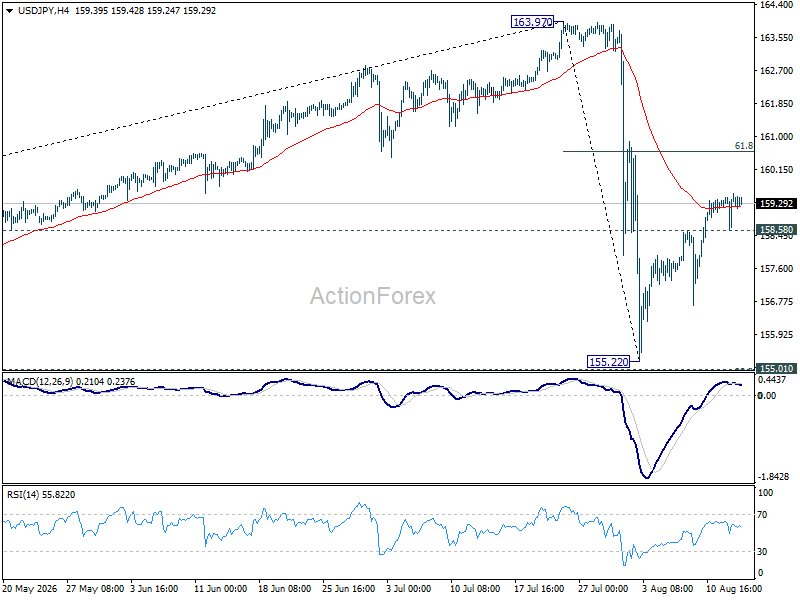
Intraday bias in USD/JPY remains mildly on the upside. Sustained trading above 55 4H EMA (now at 159.19) will argue that fall from 163.97 has completed, and target 61.8% retracement of 163.97 to 155.22 at 160.62. On the downside, below 158.58 minor support will turn intraday bias neutral first.
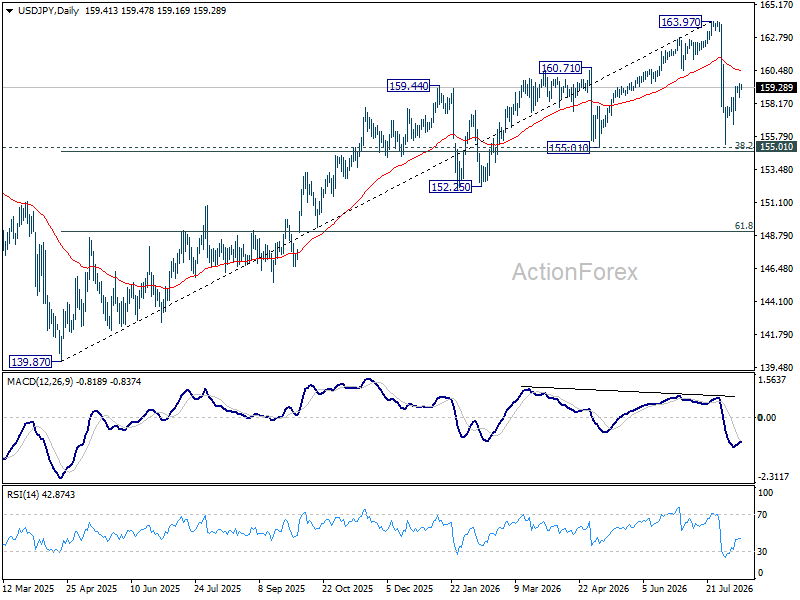
In the bigger picture, as long as 155.01 cluster support (38.2% retracement of 139.87 to 163.97 at 154.76) holds, the larger up trend is still expected to continue through 163.97 after current correction completes. However, firm break of 155.01 will raise the chance that USD/JPY is already in a larger scale correction, and open up deeper fall back to 139.87 (2025 low) in the medium term.
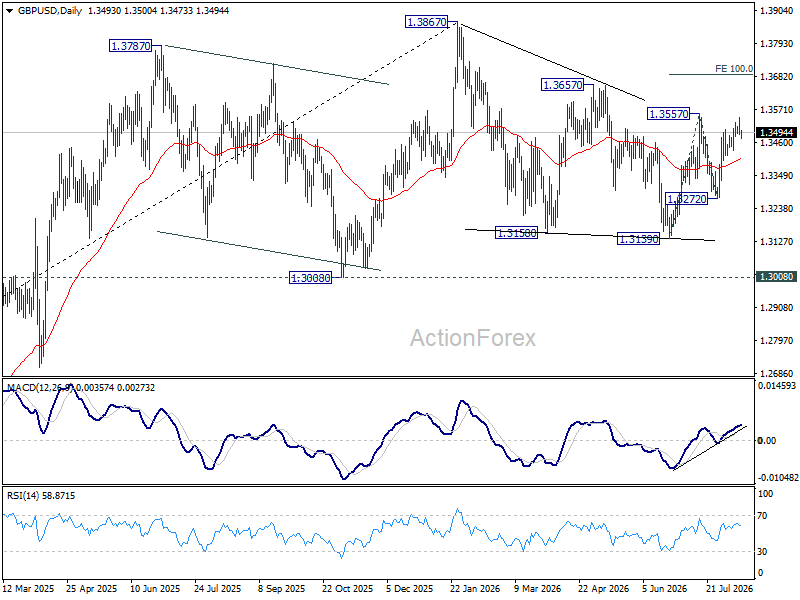
GBP/USD Daily Outlook
Intraday bias in GBP/USD is turned neutral first with current retreat. On the upside, above 1.3545 will target 1.3557 resistance. Firm break there will resume the rise from 1.3139 and target 100% projection of 1.3139 to 1.3557 from 1.3272 at 1.3690. On the downside, break of 1.3433 will turn bias back to the downside for 1.3272 support.
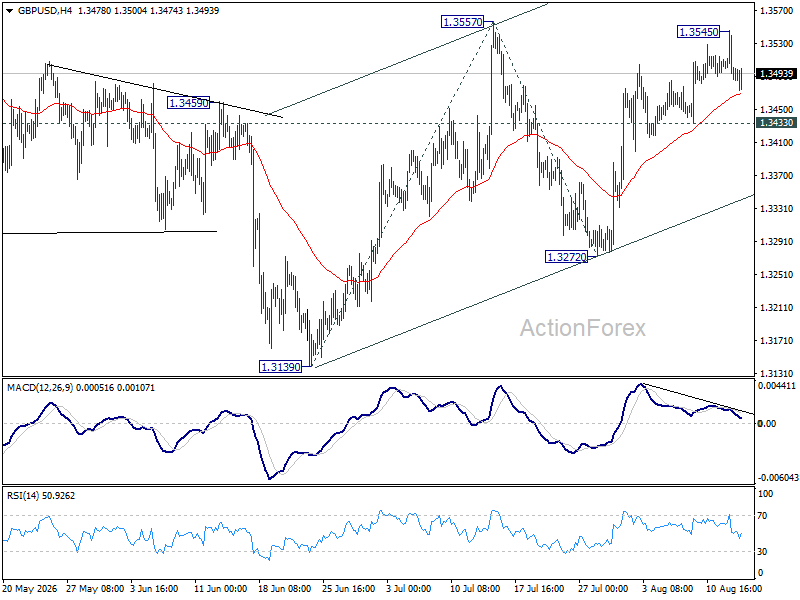
In the bigger picture, price actions from 1.3867 are a corrective pattern within the broader up trend from 1.0351 (2022 low). With 1.3008 support intact, medium term bullishness is maintained and break of 1.3867 is in favor for a later stage, towards 1.4248 key resistance (2021 high). However, firm break of 1.3008 will at least bring deeper fall to 38.2% retracement of 1.0351 to 1.3867 at 1.2524, with increased risk of bearish reversal.
USD/CHF Daily Outlook
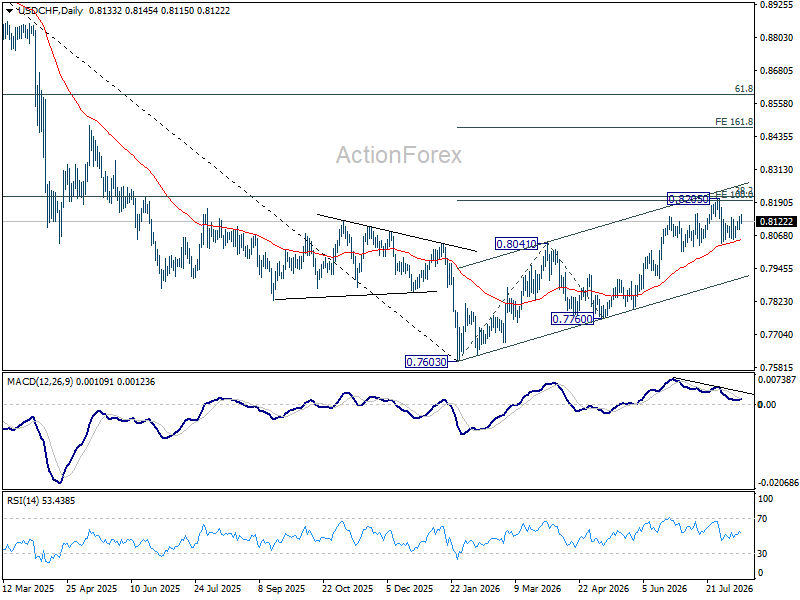
Range trading continues in USD/CHF and intraday bias stays neutral. Further rally is expected as long as 0.8029 support holds. Firm break of 0.8205 will extend the rally from 0.7603 to 161.8% projection 0.7603 to 0.8041 from 0.7600 at 0.8469. However, decisive break of 0.8029 will bring deeper fall to channel support (now at 0.7912).
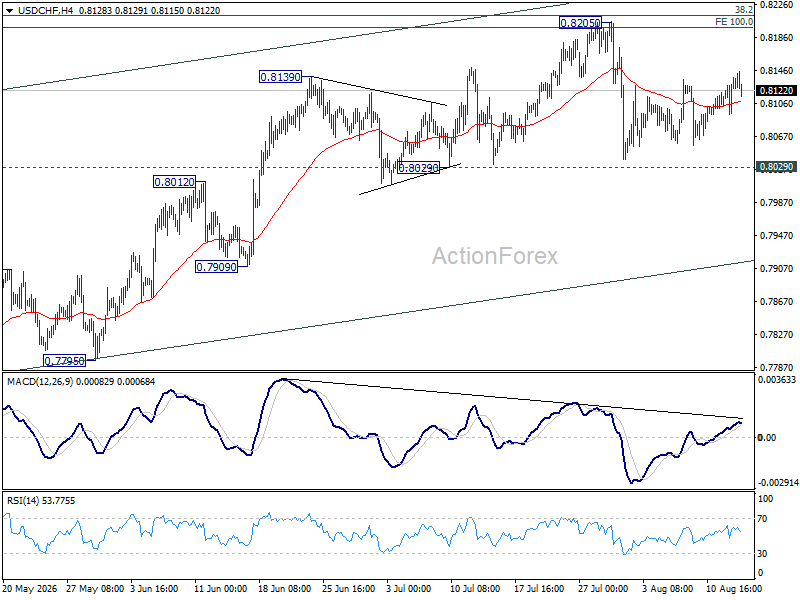
In the bigger picture, focus is now on 38.2% retracement of 0.9200 (2025 high) to 0.7603 at 0.8213. Decisive break will argue that USD/CHF is reversing the medium term trend, and turn focus to 0.8332 support turned resistance (2023 low) for confirmation. Nevertheless, rejection by 0.8213 will maintain medium term bearishness for another fall through 0.7603 at a later stage.