

Sample Category Title
AUD/USD Daily Report
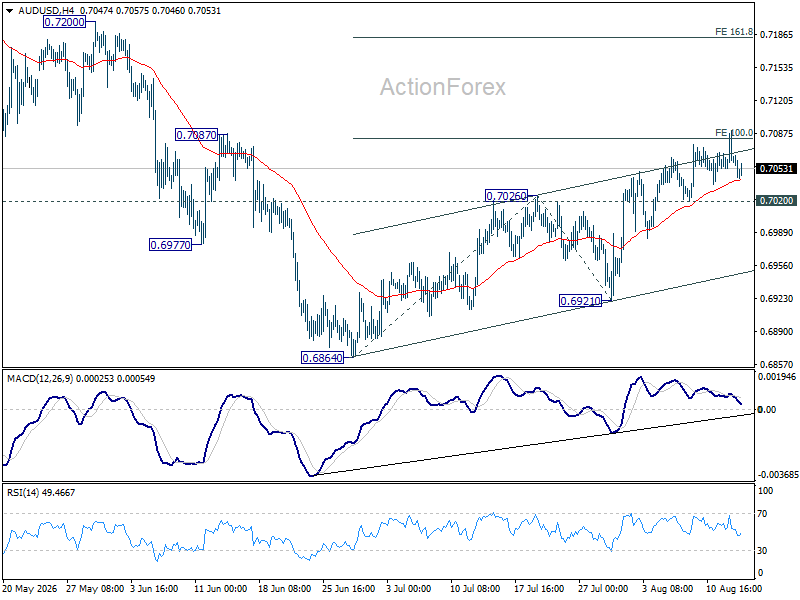
As long as 0.7020 support holds, further rise is in favor in AUD/USD. Sustained break of 100% projection of 0.6864 to 0.7026 from 0.6921 at 0.7083 could prompt upside acceleration to 161.8% projection at 0.7183. On the downside, below 0.7020 minor support will turn bias back to the downside for 0.6921 instead.
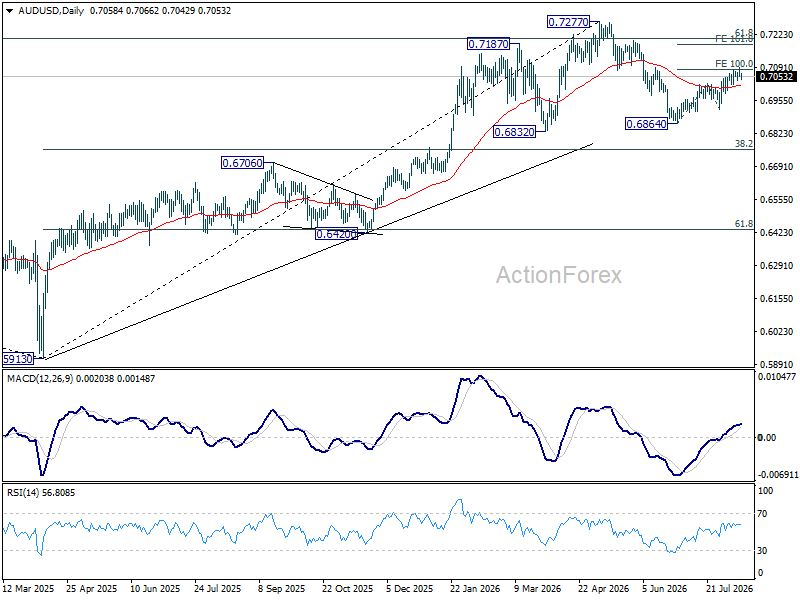
In the bigger picture, price action from 0.7277 medium term top is seen as developing into a correction to rise from 0.5913 only. While deeper decline cannot be ruled out, downside should be contained by 38.2% retracement of 0.5913 to 0.7277 at 0.6756 to bring rebound. Consolidations would continue below 0.7277 for a while, before an eventual upside breakout.
USD/CAD Daily Outlook
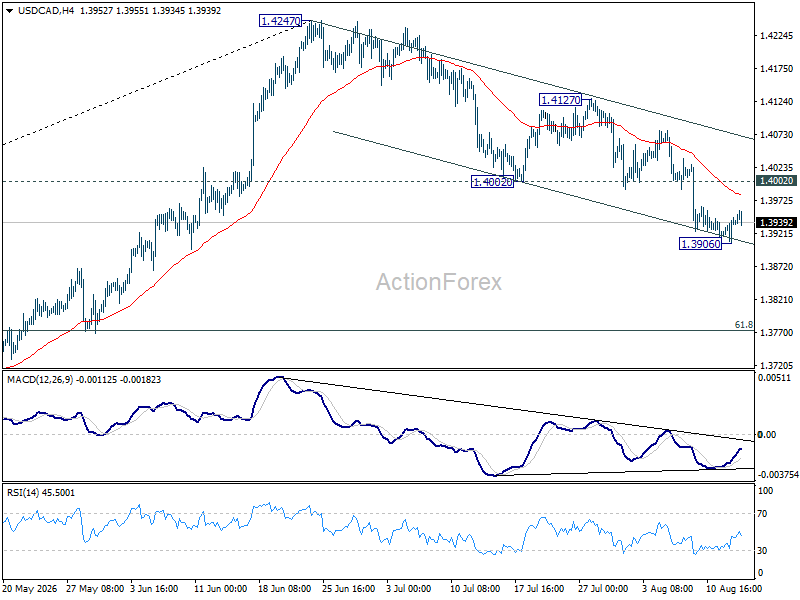
Intraday bias in USD/CAD is turned neutral first with current recovery. On the downside, below 1.3906 will extend the fall from 1.4247 to 61.8% retracement of 1.3480 to 1.4247 at 1.3773. However, firm break of 1.4002 support turned resistance will turn bias back to the upside for stronger rebound.
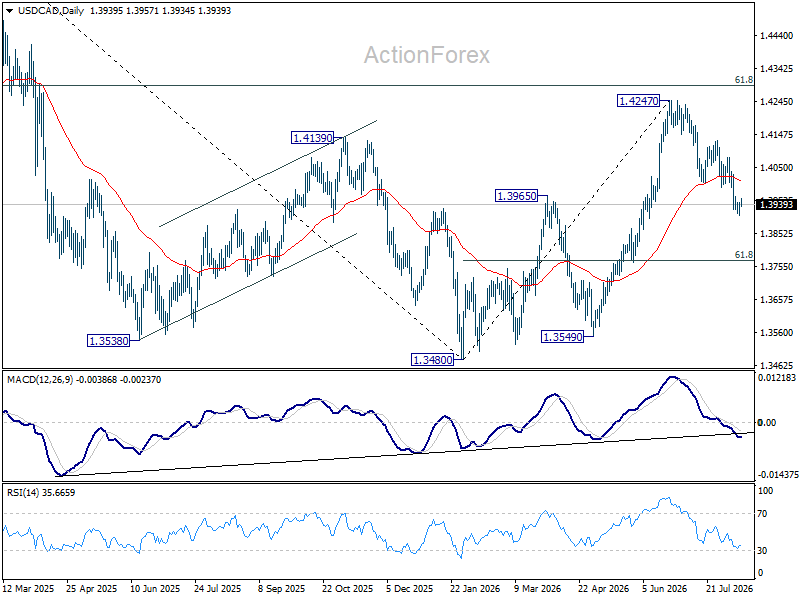
In the bigger picture, rejection below 61.8% retracement of 1.4791 to 1.3480 at 1.4290 suggests that the pattern from 1.4791 medium term is still extending. Firm break of 55 W EMA (now at 1.3883) will solidify this case, and bring deeper decline through 1.3480 low.
GBP/JPY Daily Outlook
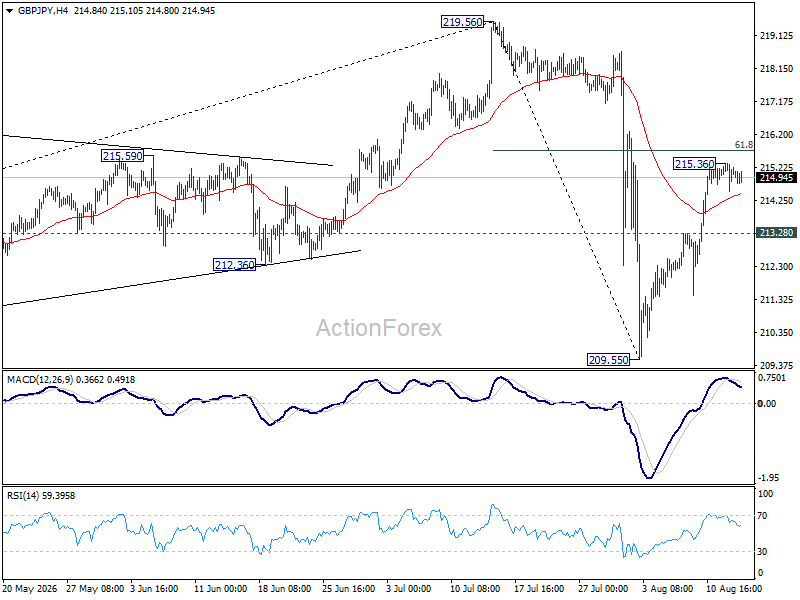
Intraday bias in GBP/JPY is turned neutral first with current retreat. On the upside, above 215.36 will extend the rebound from 209.55 to 61.8% retracement of 219.56 to 209.55 at 215.73. Firm break there will pave the way to retest 219.56 high. On the downside, below 213.28 minor support will turn intraday bias back to the downside for deeper pullback.
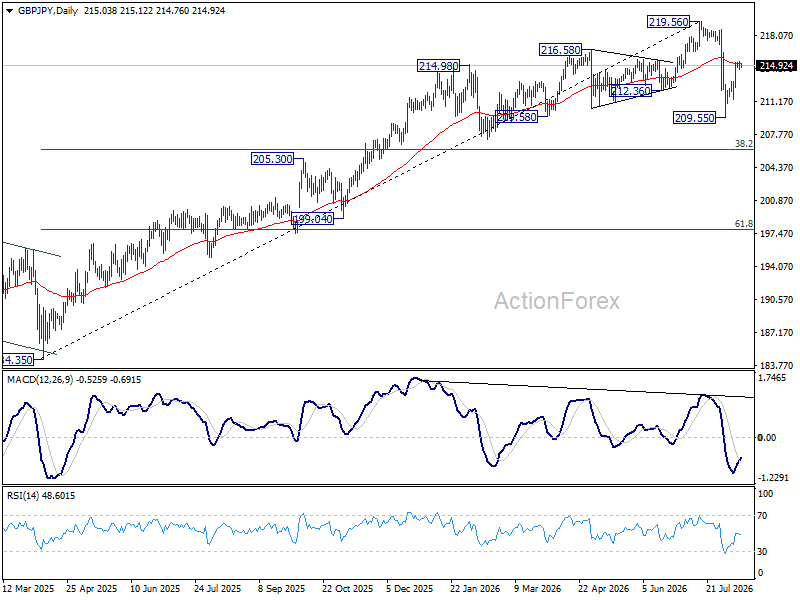
In the bigger picture, focus is on 55 W EMA (now at 209.10). Strong rebound from there will keep the up trend from 123.94 (2020 low) intact. Another rally is expected through 219.56 at a later stage. However, sustained break of 55 W EMA will argue that it's already in a medium term down trend to 184.35 support.
EUR/JPY Daily Outlook
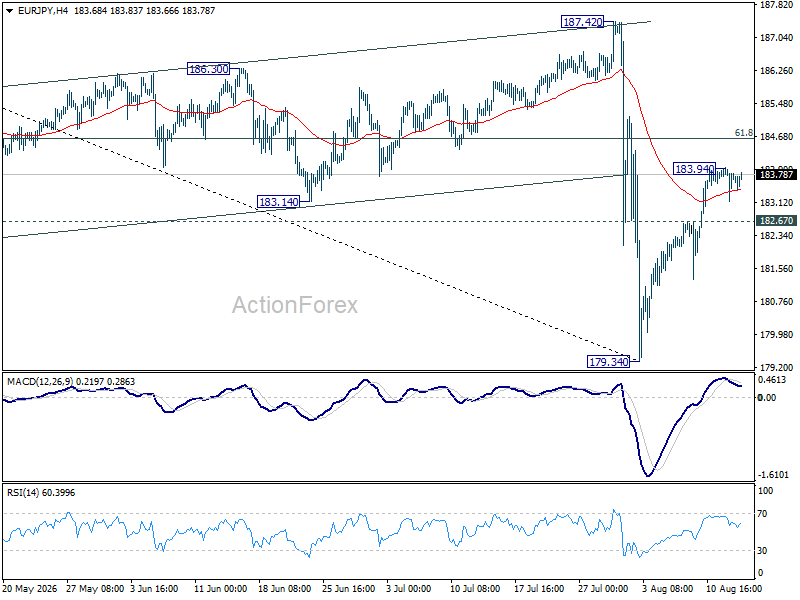
Intraday bias in EUR/JPY is turned neutral first with current retreat. Above 183.94 will extend the rebound from 179.34 to 61.8% retracement of 187.93 to 179.34 at 184.64. Decisive break there will pave the way to retest 187.93 high. On the downside, below 182.67 minor support will turn bias back to the downside for deeper pullback.
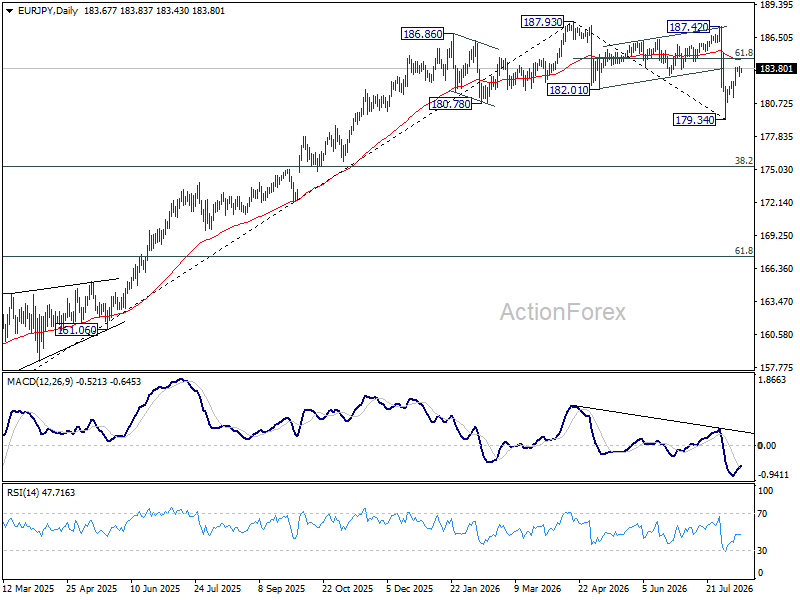
In the bigger picture, focus is now on 55 W EMA (now at 180.42). Strong rebound from there will indicate that the up trend from 114.42 (2020 low) remains intact. That would set up another rally through 187.93 to 78.6% projection of 124.37 (2022 low) to 175.41 (2025 high) from 154.77 at 194.88. However, sustained break of 55 W EMA will argue that it's already in a medium term down trend to 175.41 resistance turned support and below.
EUR/GBP Daily Outlook
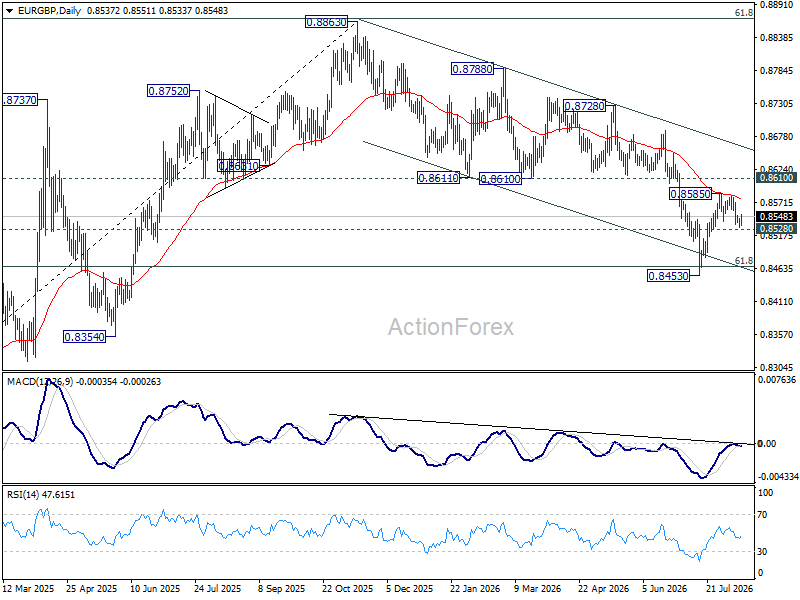
Intraday bias in EUR/GBP stays neutral at this point. While rebound from 0.9453 might extend, strong resistance should be seen from 0.8610 support turned resistance to limit upside. On the downside, break of 0.8528 support will argue that the corrective rebound from 0.8453 has completed, and turn bias back to the downside for retesting this low. However, firm break of 0.8610 will bring stronger rally to falling channel resistance (now at 0.8664).
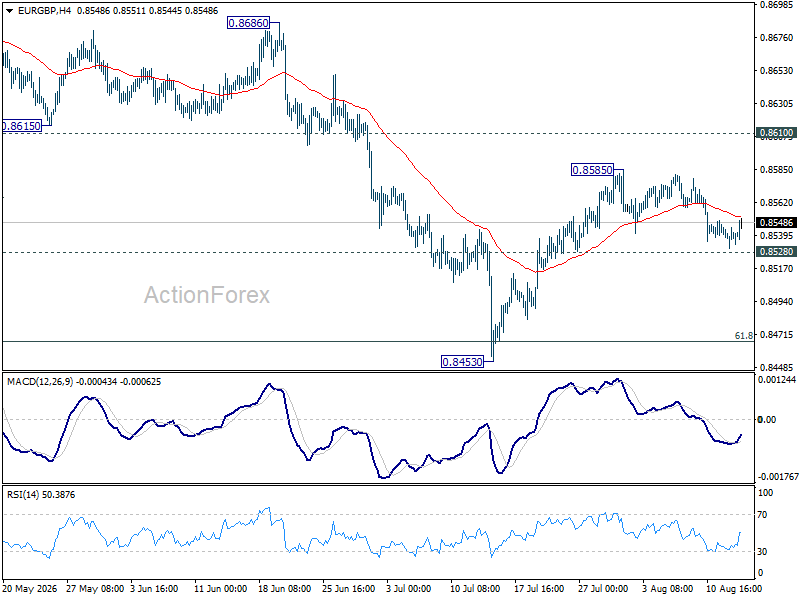
In the bigger picture, rise from 0.8221 (2024 low) should have completed at 0.8863, just ahead of 38.2% retracement of 0.9267 (2025 high) to 0.8221 at 0.8867. Deeper fall would be seen back to 0.8221. For now, outlook will be neutral at best as long as 0.8610 support turned resistance hold.
EUR/AUD Daily Outlook
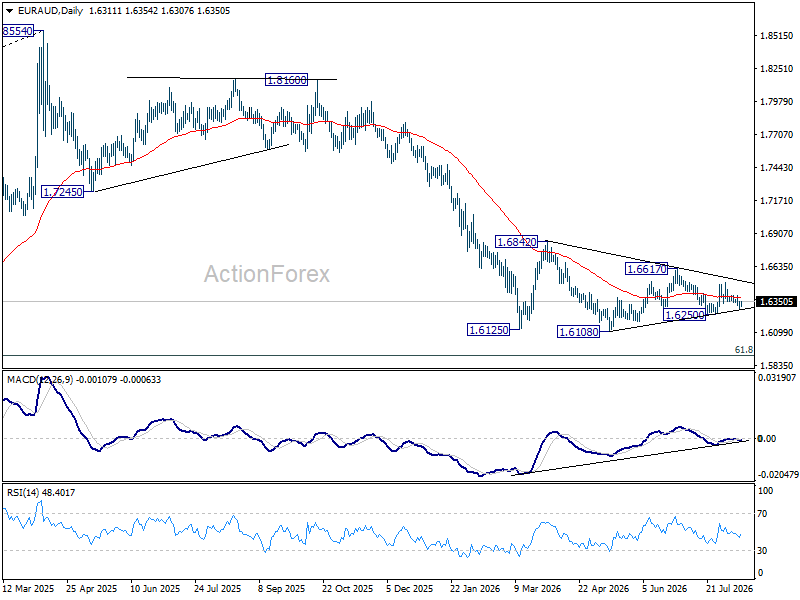
No change in EUR/AUD's outlook and intraday bias remains neutral. Corrective pattern from 1.6108 (or 1.6125) is still extending. On the upside, above 1.6530 will target 1.6617 resistance first. On the downside, break of 1.6250 will bring deeper fall back to retest 1.6108 low.
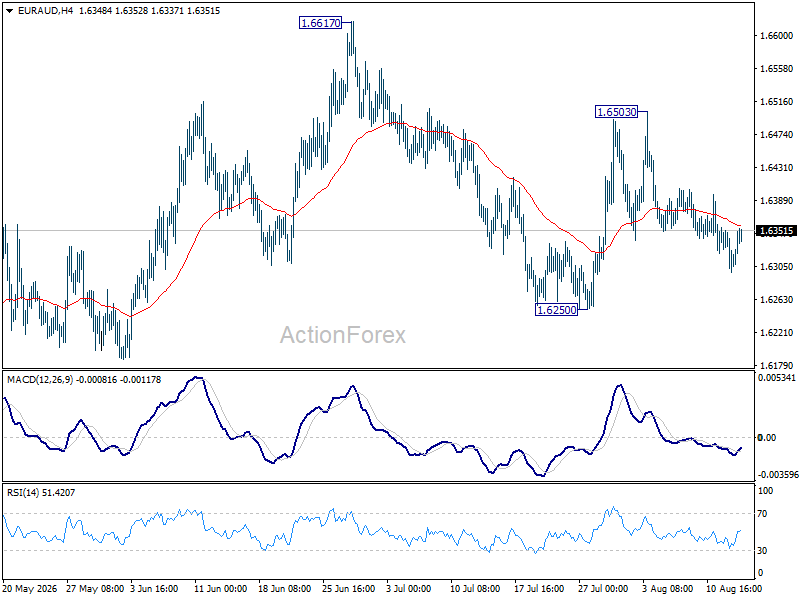
In the bigger picture, outlook will stay bearish as long as 1.6842 resistance holds. Fall from 1.8554 (2025 high) is expected to continue to 61.8% retracement of 1.4281 to 1.8554 at 1.5913. Decisive break there will pave the way back to 1.4281 (2022 low). However, firm break of 1.6842 should confirm medium term bottoming, and bring stronger rally.
EUR/CHF Daily Outlook
Intraday bias in EUR/CHF remains on the upside for the moment. Decisive break of 100% projection of 0.8979 to 0.9264 from 0.9094 at 0.9379 will carry larger bullish implications, and extend the rise from 0.8979 to 138.2% projection at 0.9488. On the downside, below 0.9326 minor support will turn intraday bias neutral again.
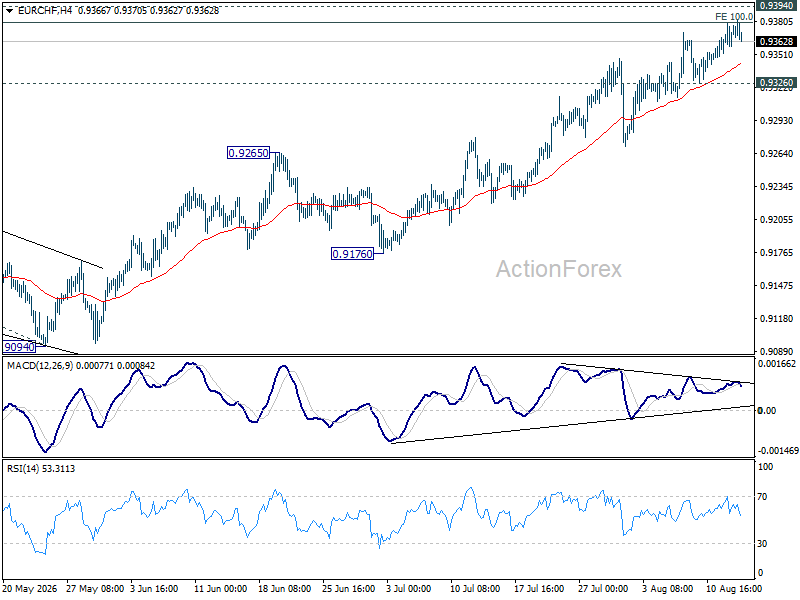
In the bigger picture, considering bullish divergence condition in W MACD, rise from 0.8979 medium term bottom should at least be reversing the fall from 0.9928, with prospect of developing into a medium term up trend. Firm break of 0.9394 resistance will add more credence to this case. For now risk will remain on the upside as long as 0.9094 support holds, in case of retreat.
Gold – Bulls Take a Breather Under New Multi-Week High Ahead of US Economic Data
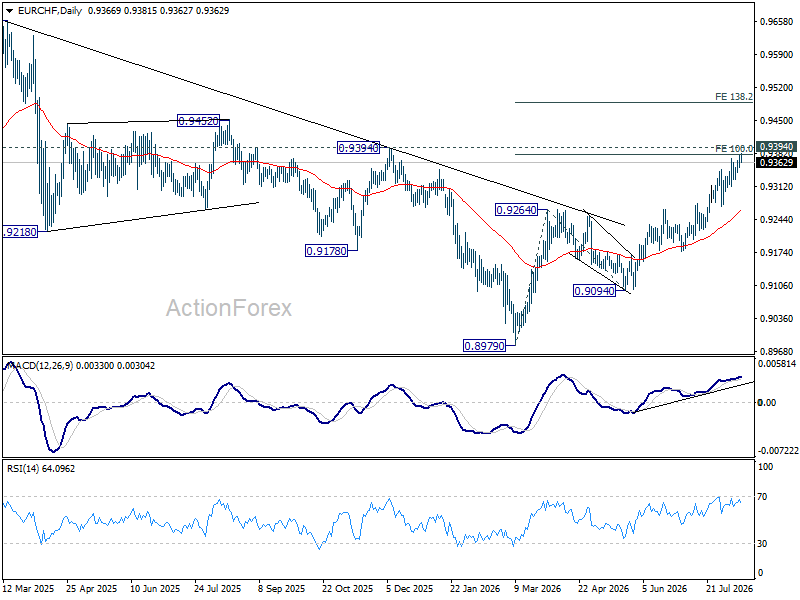
Gold price edged lower from new 9-week high in early Thursday trading as positive impact from lower inflation in July started to fade while investors focus on US Producer Price Index data (due later today) which would provide more details about the Fed’s policy outlook.
Recent strong acceleration higher started to show signs of fatigue after a triple failure to register daily close above cracked Fibo barrier at $4416 (50% retracement of $4889/$3942 bear-leg), with stretched daily studies contributing to scenario.
On the other hand, near-term action holds above the top of daily Ichimoku cloud ($4358) for the third consecutive day that keeps bulls intact for renewed attacks.
Firm break of $4416 pivot to generate initial signal of bullish continuation and expose next targets at $4501 (200DMA) and $4527 (Fibo 61.8%).
Conversely, violation of cloud top would risk further easing, with extended dips to find firm ground at $4260 zone (Fibo 38.2% of $3960/$4449 / rising 10DMA) to mark a heathy correction before bulls regain control.
US PPI is expected to ease significantly in July that may provide fresh impetus to the metal’s price (US July PPI 4.9% f/c vs June 5.5%; Core July 4.2% f/c vs June 4.7%) on release at or below expectations.
Res: 4416; 4449; 4501; 4502
Sup: 4358; 4304; 4260; 4203
Bitcoin: Will Patience Be Rewarded?
Market Overview
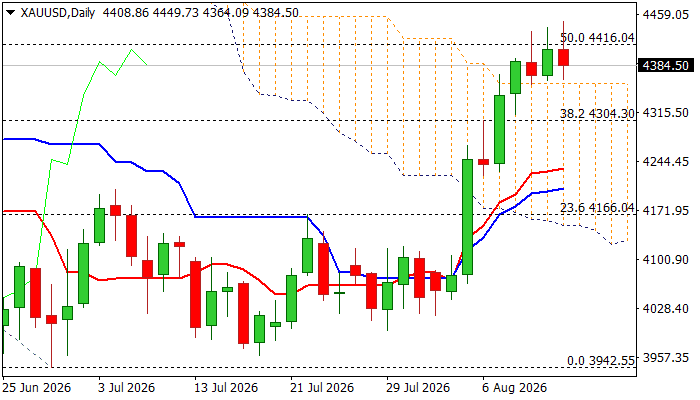
The crypto market capitalisation has once again shown little change, remaining around the $2.19T ‘centre of gravity’ for the third day running, fluctuating between $2.18T and $2.20T. This marks the continuation of a protracted sideways trend that has been ongoing since early June. As traders become accustomed to a range, they tend to tighten their stop losses and increase their leverage. It is also not uncommon for the market to be pushed down during what is known as ‘final capitulation’. However, towards the end of a range-bound period, large volumes often emerge as major long-term players gradually build positions around a particular market view. In this case, they may be anticipating the passage of cryptocurrency legislation later this autumn, following the congressional recess. Our medium-term optimism does not, however, rule out the risk of a sharp pullback in the coming weeks.
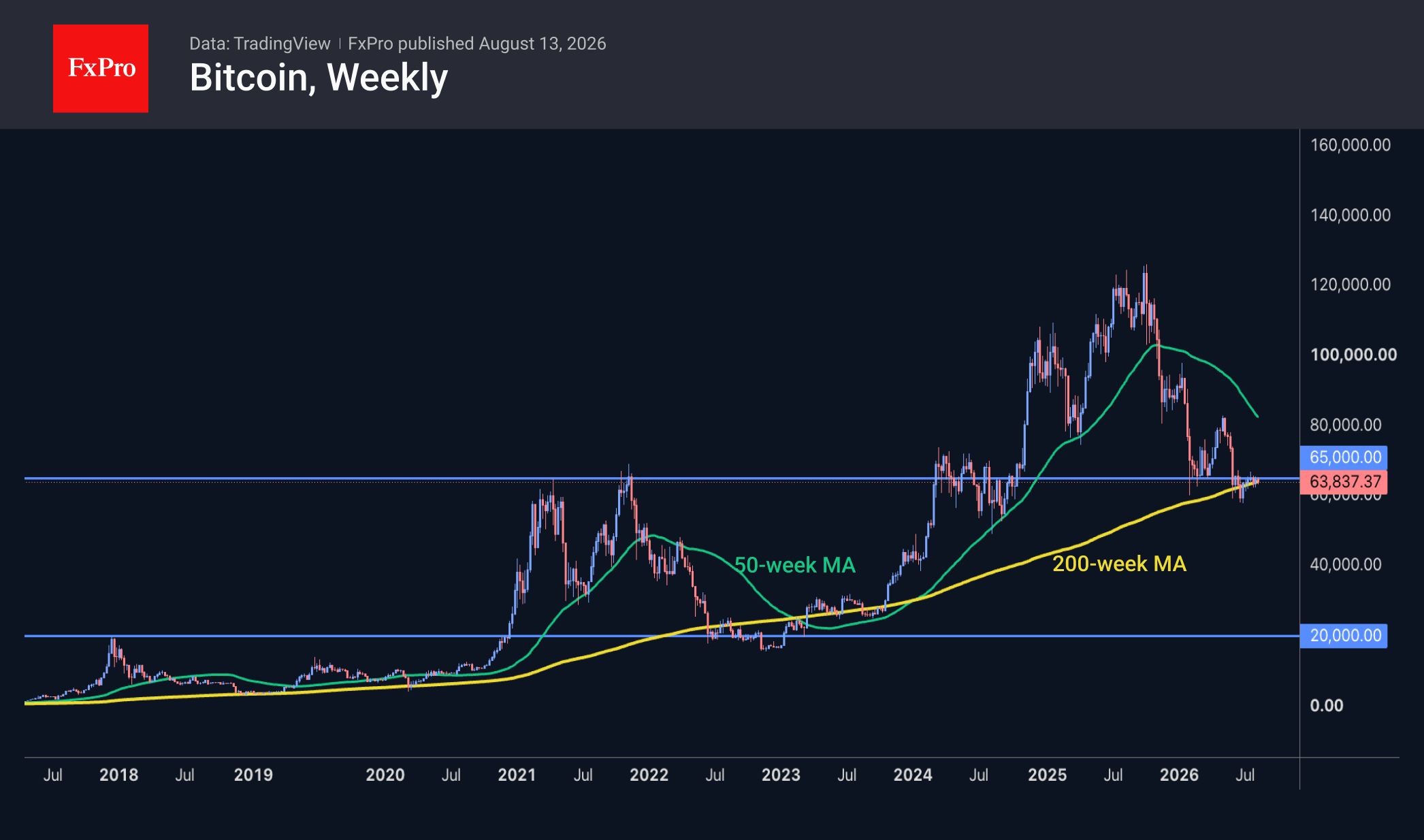
Bitcoin is struggling to break away from its support level and has been hovering around $64K for the third day in a row, trading slightly below it on Thursday morning but above the 50-day moving average. The peaks of the 2021 bull market were close to these levels. Three years ago, Bitcoin’s decline generally halted at $20K, which was close to the peak of the previous bull market at the end of 2017. This supports our view that the decline may have run its course, with bearish momentum fading as Bitcoin approaches the 200-week moving average. While speculators may still be looking for a better entry price, long-term investors are steadily accumulating at current levels, as evidenced by the remarkable price stability despite fairly active price movements in other markets. At the end of 2022, the market fell nearly 25% below $20K before reversing higher, effectively offering a ‘discount’ to investors willing to take the risk. We could see something similar this time, but it would be unwise to rely on such a pullback.
News Background
Bitcoin’s prolonged downtrend has reached a ‘point of exhaustion’, as selling pressure on the asset has eased, according to Fairlead Strategies. However, the weakening of downward momentum does not, in itself, guarantee an immediate market reversal.
Twenty One Capital reported a net loss of $413.5 million for the second quarter due to a fall in the value of the leading cryptocurrency on its balance sheet. The company, which ranks second among public corporate holders of Bitcoin, owns 43,514 BTC worth approximately $2.8 billion.
Phong Le, CEO of Strategy, has promised to resume Bitcoin purchases by the end of the year. He emphasised that the volume of purchases is “approximately 25 times greater” than sales: since January, the company has acquired 175,000 BTC but has sold only around 7,000 BTC. According to Phong Le, Strategy is the “JPMorgan of the digital economy”.
Bitcoin miners’ revenue from transaction fees remains close to 10-year lows, Glassnode notes. Last July was, on the whole, the least profitable month for miners in nearly three years. Transaction fees have accounted for less than 1% of revenue for the past year.
Spot trading volume on crypto exchanges in July fell by 21.7% compared with June, according to figures from Wu Blockchain. For the first time in three years, the figure failed to reach the $500 billion mark. Activity in the futures market was seven times higher than in the spot market.
On 12 August, due to a routing failure at the infrastructure provider TeraSwitch, validators accounting for 28.8% of Solana tokens in staking were taken offline simultaneously. The figure approached the 33.34% threshold at which the network would have ceased finalising transactions.
Two short positions on Bitcoin, with a combined value of over $210 million and 40x leverage, have been opened on the Hyperliquid platform. Their liquidation levels are close to $64.1K and $64.6K, respectively.
One of Hong Kong’s first crypto-millionaires, who began investing in cryptocurrency in 2013, has been found dead in Paraguay. In the first half of the year, 46 attacks on cryptocurrency holders were recorded, with losses exceeding $30 million, according to Chainalysis.
The FxPro Analyst Team
Eurozone Industrial Production Stalls in June as Capital Goods Weigh
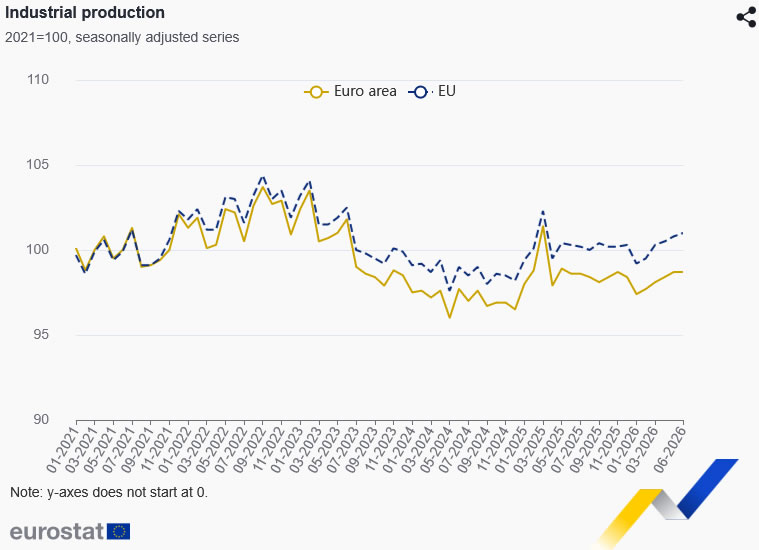
Eurozone industrial production lost momentum in June, slowing from 0.3% to 0.0% m/m, while EU output eased from 0.3% to 0.2%. On annual basis, production was only 0.1% higher y/y in Eurozone and 0.6% higher in EU, underscoring that industrial recovery remains subdued despite recent improvement in survey indicators. Headline Eurozone reading also fell slightly short of expectations for a 0.1% monthly increase.
Breakdown showed considerable divergence across sectors. In Eurozone, intermediate goods fell -0.8% m/m and capital goods dropped -1.4%, offsetting gains of 1.5% in energy, 0.3% in durable consumer goods and a strong 3.0% rise in non-durable consumer goods. EU showed similar pattern, with intermediate goods down -0.7% and capital goods down -0.9%, while energy rose 1.0%, durable consumer goods 0.9% and non-durables 2.5%. At country level, Denmark led gains at 5.4%, followed by Croatia at 5.2%, while Luxembourg posted a sharp 10.7% decline.
Overall, June figures suggest Europe’s industrial sector is stabilizing rather than entering a convincing rebound. Weakness in capital and intermediate goods is particularly notable because it points to continued softness in investment- and production-chain demand, even as consumer-related categories performed better. That contrasts with stronger July PMI readings and suggests hard data are still lagging improvement in business surveys, leaving ECB with a mixed growth backdrop rather than clear evidence of either renewed industrial weakness or broad-based acceleration.
Data Summary
| Indicator | Actual | Expected | Previous |
|---|---|---|---|
| Eurozone Industrial Production m/m | 0.0% | 0.1% | 0.3% |
| Eurozone Intermediate Goods m/m | -0.8% | — | -0.2% |
| Eurozone Energy m/m | 1.5% | — | 2.6% |
| Eurozone Capital Goods m/m | -1.4% | — | 0.5% |
| Eurozone Durable Consumer Goods m/m | 0.3% | — | -1.3% |
| Eurozone Non-Durable Consumer Goods m/m | 3.0% | — | 3.3% |
Key Takeaways
- Eurozone industrial production slowed from 0.3% to 0.0% m/m in June, slightly missing expectations for 0.1% growth.
- EU production also lost momentum, easing from 0.3% to 0.2% m/m.
- Annual growth remained weak, at just 0.1% in Eurozone and 0.6% across EU.
- Eurozone breakdown was uneven: capital goods fell -1.4% and intermediate goods dropped -0.8%, while energy rose 1.5%.
- Non-durable consumer goods were strongest category, rising 3.0% m/m, while durable consumer goods gained 0.3%.
- June data suggest industry is stabilizing rather than entering a convincing recovery, with hard production data still lagging recent improvement in Eurozone PMI surveys.