

Sample Category Title
EUR/GBP Daily Outlook
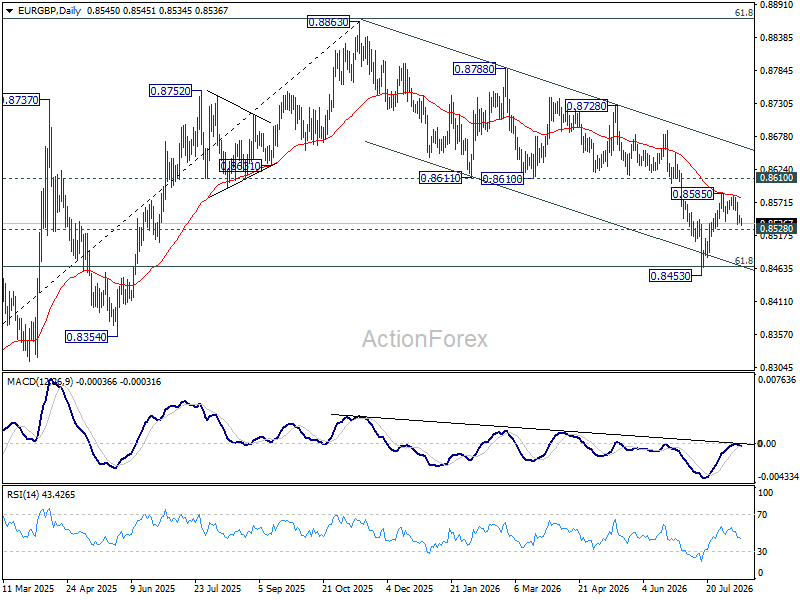
No change in EUR/GBP's outlook and intraday bias remains neutral. While rebound from 0.9453 might extend, strong resistance should be seen from 0.8610 support turned resistance to limit upside. On the downside, break of 0.8528 support will argue that the corrective rebound from 0.8453 has completed, and turn bias back to the downside for retesting this low.
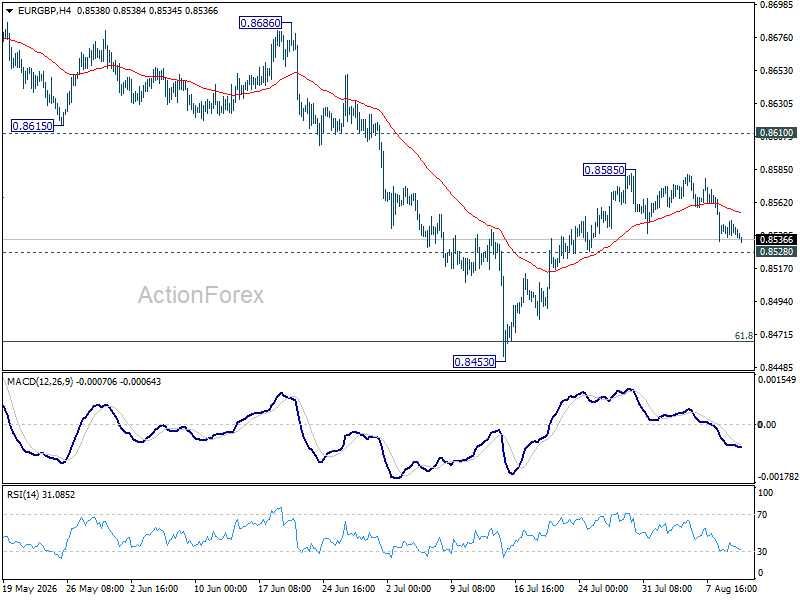
In the bigger picture, rise from 0.8221 (2024 low) should have completed at 0.8863, just ahead of 38.2% retracement of 0.9267 (2025 high) to 0.8221 at 0.8867. Deeper fall would be seen back to 0.8221. For now, outlook will be neutral at best as long as 0.8610 support turned resistance hold.
EUR/AUD Daily Outlook
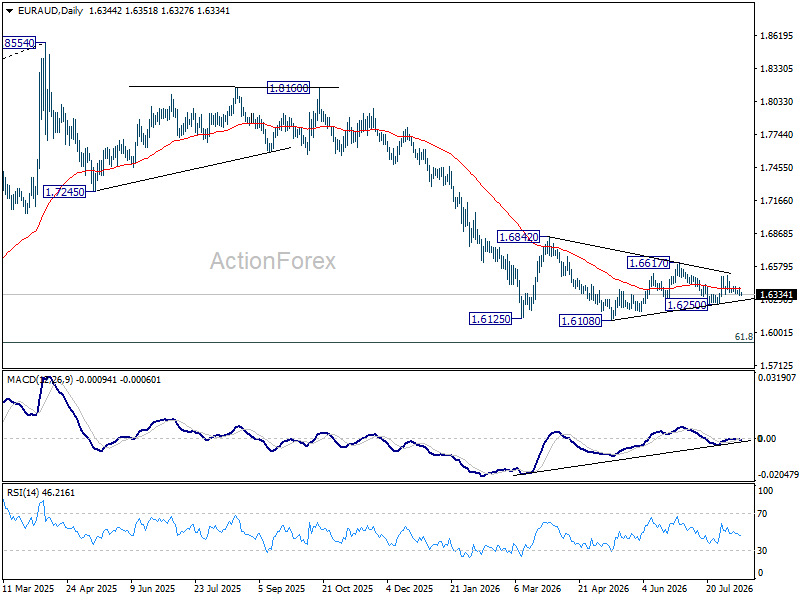
Intraday bias in EUR/AUD stays neutral and outlook is unchanged. Corrective pattern from 1.6108 (or 1.6125) is still extending. On the upside, above 1.6530 will target 1.6617 resistance first. On the downside, break of 1.6250 will bring deeper fall back to retest 1.6108 low.
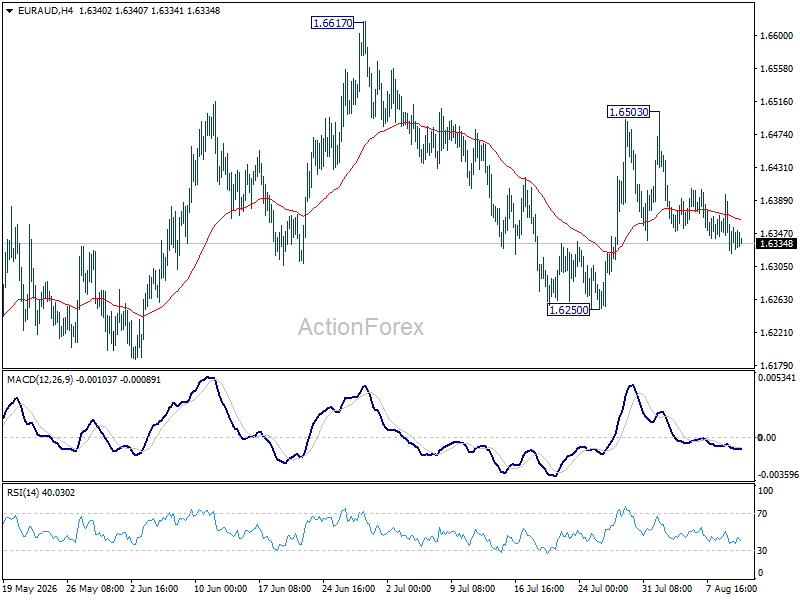
In the bigger picture, outlook will stay bearish as long as 1.6842 resistance holds. Fall from 1.8554 (2025 high) is expected to continue to 61.8% retracement of 1.4281 to 1.8554 at 1.5913. Decisive break there will pave the way back to 1.4281 (2022 low). However, firm break of 1.6842 should confirm medium term bottoming, and bring stronger rally.
EUR/CHF Daily Outlook
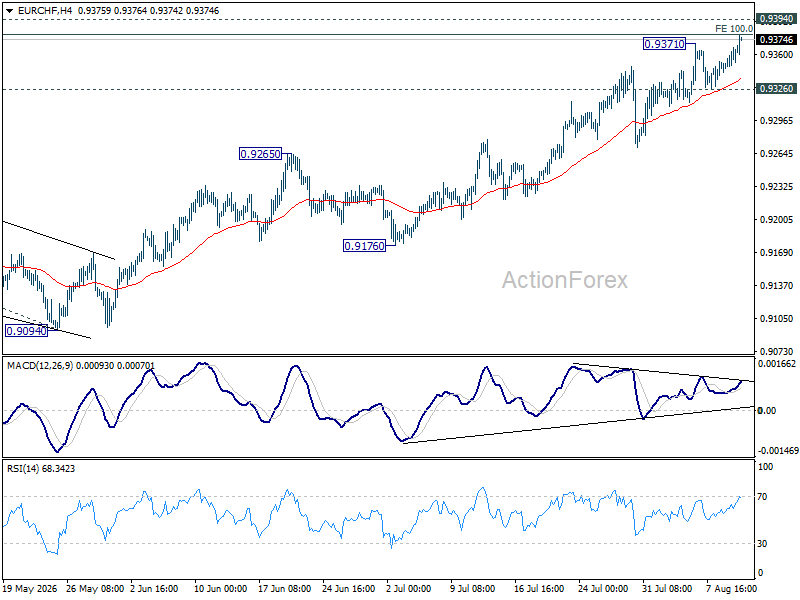
Intraday bias in EUR/CHF is back on the upside with break of 0.9371 temporary top. Decisive break of 100% projection of 0.8979 to 0.9264 from 0.9094 at 0.9379 will carry larger bullish implications, and extend the rise from 0.8979 to 138.2% projection at 0.9488. On the downside, below 0.9326 minor support will turn intraday bias neutral again.
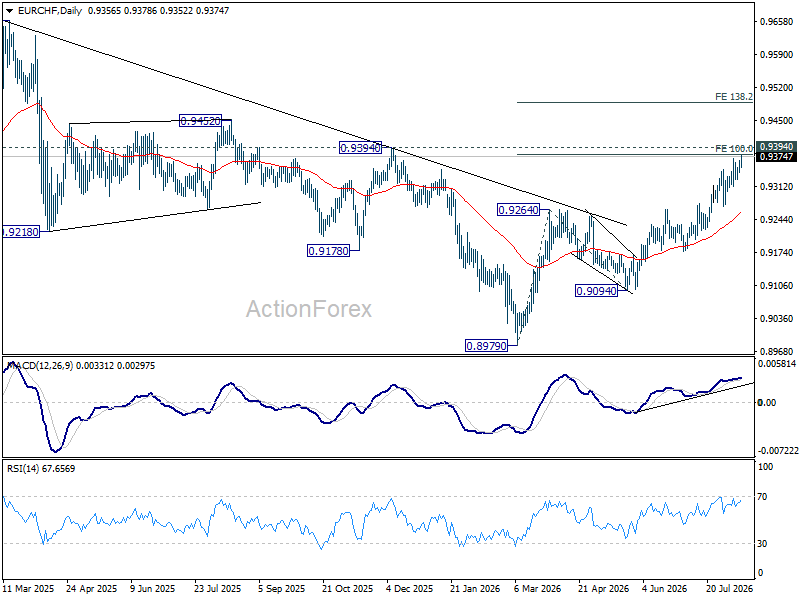
In the bigger picture, considering bullish divergence condition in W MACD, rise from 0.8979 medium term bottom should at least be reversing the fall from 0.9928, with prospect of developing into a medium term up trend. Firm break of 0.9394 resistance will add more credence to this case. For now risk will remain on the upside as long as 0.9094 support holds, in case of retreat.
BNB’s Rise Points to a Recovery in Crypto, Despite the Cloud Hanging Over BTC
Market Overview
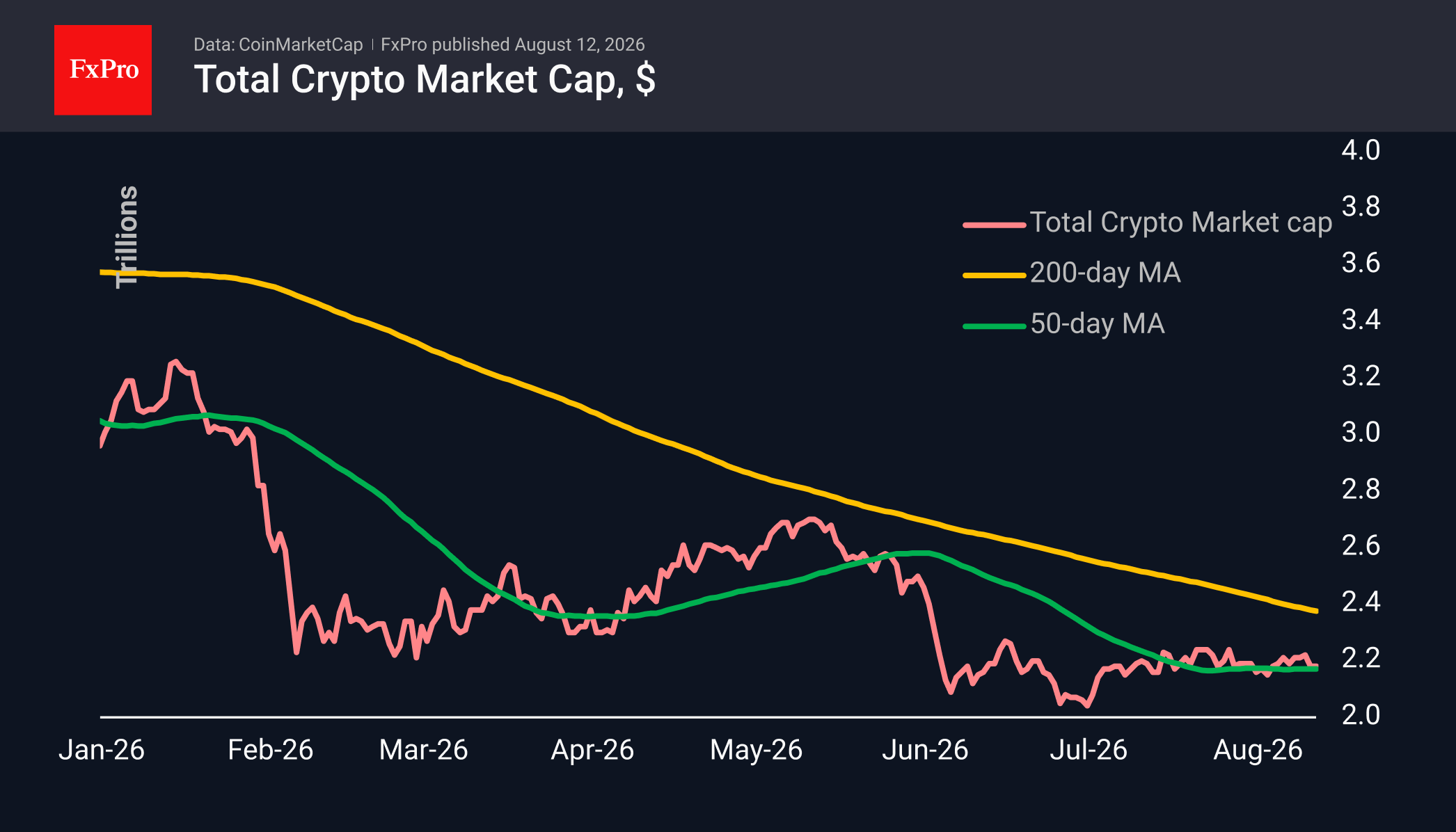
The crypto market capitalisation has remained virtually unchanged over the past 24 hours, hovering around $2.18T. Trading activity in crypto and equity markets is currently at its lowest due to the holiday season. This period also often lays the groundwork for trends in the coming quarters, as market participants reassess the situation ahead of the end of the US financial year in September.
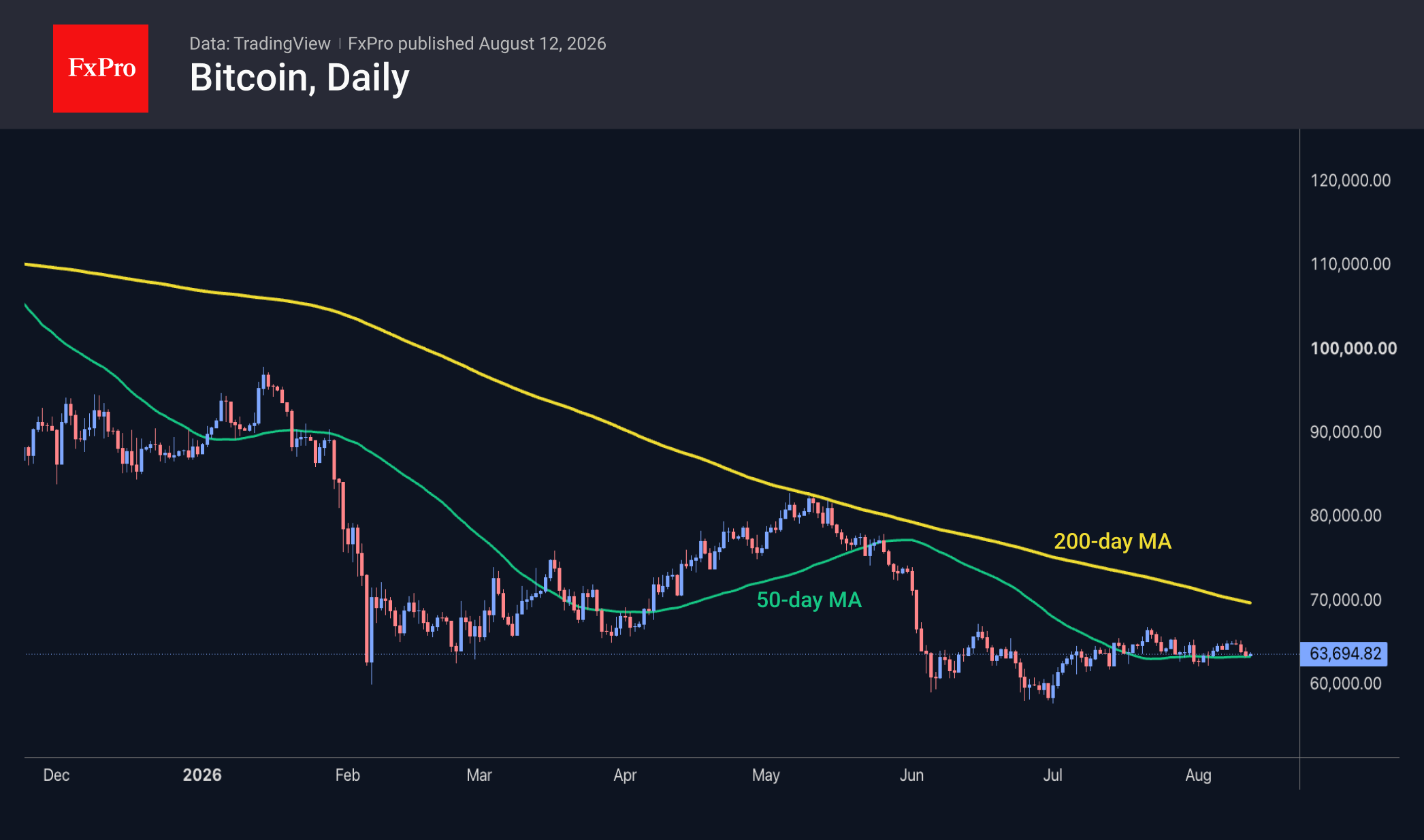
Bitcoin retreated to $63.3K late on Tuesday, where it found support at the 50-day moving average. The leading cryptocurrency has been unable to break away from this medium-term trend line, although the price has remained predominantly above it for almost a month. This line itself is almost horizontal, underscoring the market’s neutral sentiment. Fundamentally, the leading cryptocurrency’s growth is being hampered by a wave of selling from institutional investors, who are actively selling bitcoins to finance their transition to AI.
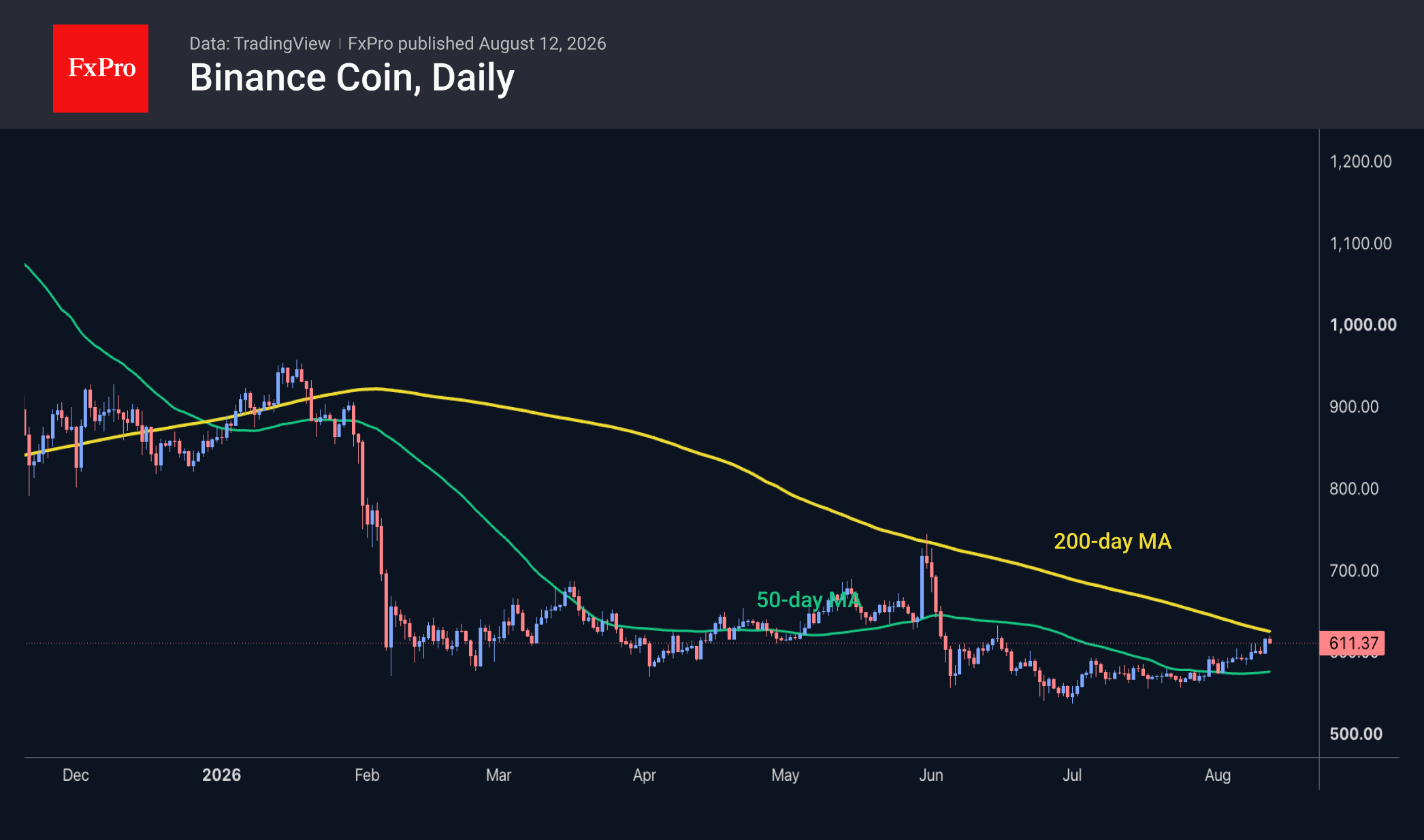
Binance Coin rose to $620, a two-month high, where it encountered resistance at the 200-day moving average, pulling back to $610 at the time of writing. We regard BNB as a proxy for trading activity in the cryptocurrency market, as it is the native token of the largest trading platform. This coin began August with an uptrend, but unlike Bitcoin, it has maintained this trend to date, steadily widening the gap relative to the 50-day moving average. Today, the 200-day moving average has acted as a barrier to growth, and we are now closely monitoring its subsequent test as an indicator for the entire market. Bitcoin’s role in this regard has been temporarily distorted by institutional selling.
News Background
Large addresses are building up their positions. The number of addresses with a balance of over 10,000 BTC has risen to 90 — a six-month high, according to Santiment. At the same time, balances in small wallets have been declining in August.
Meanwhile, CryptoQuant notes that the balance held by long-term Bitcoin holders continues to fall, despite several spikes in inflows into this category over recent months. This suggests that some holders are continuing to take profits.
Bitmine has reduced the scale of its Ethereum purchases by a third. Over the past week, the company purchased an additional 7,391 ETH, bringing the total amount of Ethereum in its reserves to 5.81 million ETH. To reach its target of purchasing 5 per cent of the Ethereum supply, the company needs to buy nearly 300,000 ETH.
Trump Media reported a net loss of $238 million for the second quarter, mainly due to unrealised losses on cryptocurrencies. The company intends to review its digital treasury strategy and allocate more resources to its core media business, including Truth Social, Truth+ and Truth. Fi.
Keel Infrastructure (formerly Bitfarms) has decommissioned all its US mining facilities in preparation to convert them into AI data centres. At the same time, the company has continued to sell off its Bitcoin reserves.
Standard Chartered has raised its forecast for Chainlink (LINK) to $200 by the end of 2030. The token’s growth potential is estimated at approximately 25 times its current level of around $8. The forecast is based on Chainlink’s potential role as a key infrastructure for tokenised assets.
The FxPro Analyst Team
DAX 40: Record Highs, Real Fundamentals, One Channel Left to Test
Germany's benchmark index just made history, breaking above 26,500 for the first time ever, extending a rally that has already delivered close to 10% over the past twelve months. The move came on fresh optimism around a potential resolution to the Iran conflict, though that optimism proved short-lived: President Trump's latest demands, that Tehran compensate for lives lost in recent attacks, have since added friction to already fragile diplomatic efforts around reopening the Strait of Hormuz, and the index has pulled back modestly from its peak.
Beneath the geopolitical noise, the underlying story remains genuinely constructive. Stronger-than-expected industrial production and export data have reinforced confidence in German manufacturing, while a wave of solid corporate earnings, alongside notable strength from SAP and Infineon, has kept sentiment firmly bullish. Roughly a third of this year's growth still owes to calendar effects and government stimulus in defence and infrastructure, a detail worth remembering, but private-sector momentum finally looks like it's stabilizing rather than collapsing.
The result: a record-breaking index now testing whether Middle East headlines can derail a rally built on genuinely improving fundamentals.
Technical Analysis of the DAX 40 (GDAXIm on FXOpen)
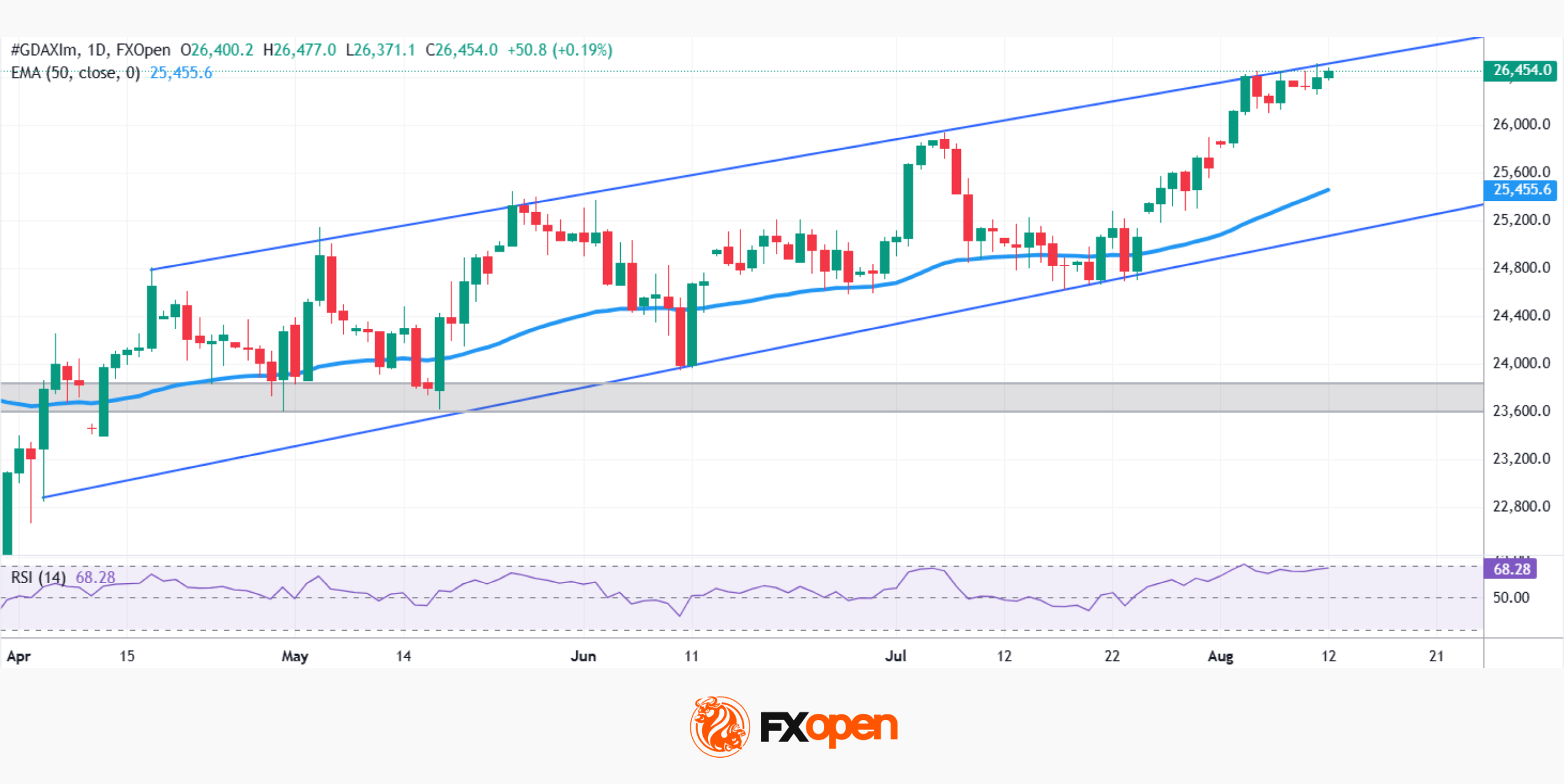
As the daily DAX 40 (GDAXIm on FXOpen) chart shows, the index remains firmly within a well-defined ascending channel that has guided price higher since April, with the index now testing the channel's upper boundary near current record highs. The 50-period EMA continues to trend higher well below price, reinforcing the strength of the broader uptrend, while the RSI sits at 67.83, comfortably bullish without yet flashing overbought extremes.
Bullish Scenario
Should buyers maintain momentum and break above the upper channel trendline, the index would confirm a genuine acceleration of the current trend, opening the door toward fresh uncharted territory beyond 26,800, with the EMA and lower channel boundary offering strong support on any pullback.
Bearish Scenario
Conversely, a rejection at the upper trendline could see price pull back toward the 50-period EMA near 25,450, or even the lower channel boundary, without necessarily threatening the broader bullish structure. Only a decisive break below the channel itself, and the 23,600-23,800 support zone that anchored April's advance, would put the medium-term uptrend genuinely at risk.
With price testing the top of a channel that has held for nearly five months, the DAX 40 (GDAXIm on FXOpen) faces a familiar question: does the trend simply extend once again, or is this finally where momentum starts to fade?
Trade global index CFDs with zero commission and tight spreads (additional fees may apply). Open your FXOpen account now or learn more about trading index CFDs with FXOpen.
This article represents the opinion of the Companies operating under the FXOpen brand only. It is not to be construed as an offer, solicitation, or recommendation with respect to products and services provided by the Companies operating under the FXOpen brand, nor is it to be considered financial advice.
Bitcoin Grinds Toward $60K as the CLARITY Act Catalyst Shifts to September 15
TL;DR: Bitcoin is drifting toward the psychologically important $60,000 level in a bearish holding pattern, with September 15's procedural cloture vote on the CLARITY Act setting up an asymmetric outcome — failure would be a clean negative signal, while success would only keep the legislative process moving.
Why the CLARITY Delay Isn't the Whole Story
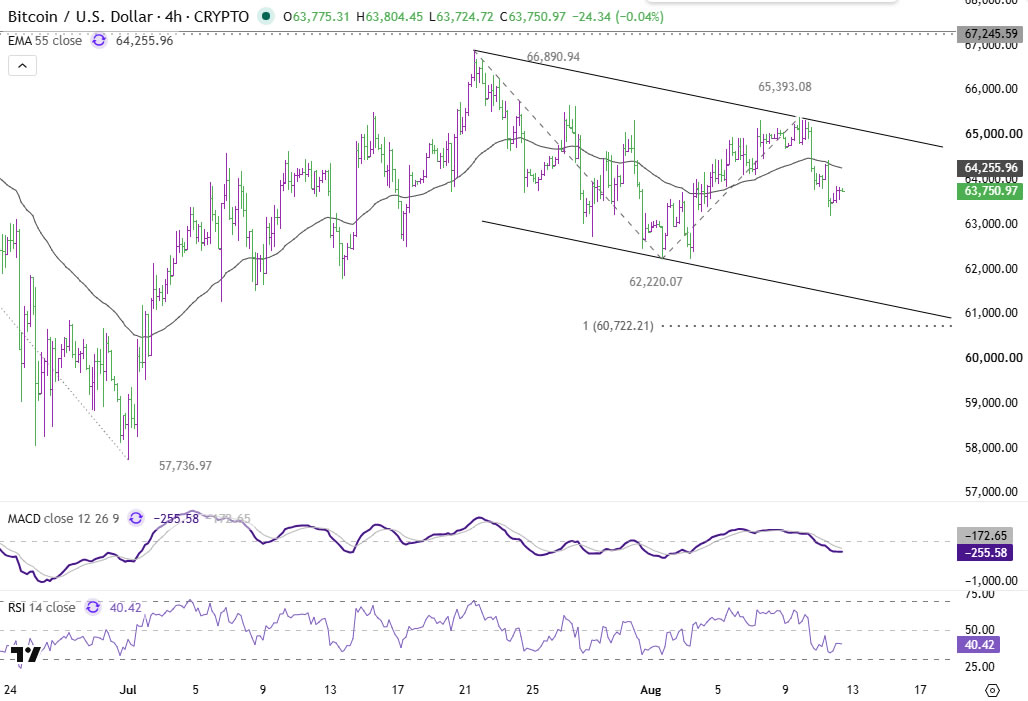
Bitcoin has spent the week grinding lower toward the low-63,000s. Momentum indicators are confirming the move rather than diverging against it — the 4H MACD remains negative and below its signal line, while RSI sits around 40.7 with no bullish divergence forming.
The retreat coincided with confirmation that the CLARITY Act would not get a Senate vote before August recess, and the timing invites an obvious interpretation: bulls may have positioned for progress on the bill's procedural track, only for the delay to take some of the momentum out of the rally.
That explanation is plausible, but it shouldn't be treated as settled. This has also been a volatile week across broader markets, with post-NFP Fed repricing, renewed Hormuz escalation lifting oil and Gold, and equities pulling back ahead of US CPI. Any of those forces could have contributed to crypto weakness just as readily as regulatory disappointment.
CLARITY Delay Is a Reasonable Factor, Not a Complete Explanation
Bitcoin's relationship with single-day catalysts has been inconsistent throughout this cycle. Unlike Gold and Silver, which reacted cleanly and immediately to last week's payroll shock, Bitcoin has often moved through slower, harder-to-attribute multi-session trends. That makes it difficult to isolate one headline as the sole driver.
The CLARITY delay is therefore best treated as a reasonable contributing factor, rather than proof Washington caused the selloff. Regulatory momentum mattered to the bullish narrative, and pushing the next meaningful Senate step into September removes one potential near-term catalyst. But a week of broad macro volatility doesn't provide enough evidence to conclude regulatory disappointment alone explains Bitcoin's decline.
What's less ambiguous is the technical picture: price is moving lower, momentum is still bearish, and there's no clear exhaustion signal yet.
ActionForex's Technical View on Bitcoin
Current structure argues for further downside before the next major regulatory catalyst arrives. The 100% projection of 66,890.94 to 62,220.07 from 65,393.08 lands at 60,722.21. That level gains additional significance because it sits just above the psychological $60,000 figure, where buying interest and stop positioning would naturally become more concentrated.
With the 4H MACD still negative and RSI not yet oversold, there's little technical evidence the decline has run its course. Unless Bitcoin can break out of the descending channel and recover above recent corrective highs, the 60,722–60,000 zone looks reachable. That doesn't necessarily imply a major bearish breakdown is already underway — it suggests Bitcoin is drifting toward an important support region while waiting for a stronger catalyst to determine whether the move extends.
September 15 Is the Next Clear Regulatory Test
That catalyst is now shifting toward September 15. But the date needs to be understood correctly: it's not expected to be a final passage vote on the CLARITY Act. It's a cloture vote on the motion to proceed — a procedural step that would allow Senate debate to begin.
That distinction matters because the two possible outcomes carry very different market implications. A failed cloture vote would be a clean negative signal, showing the Senate can't even gather sufficient support to move the legislation formally onto the floor. If Bitcoin were already trading around 60,722 or testing $60,000 at that point, failed cloture could provide a clear catalyst for a break lower.
A successful cloture vote would be constructive, but much less decisive.
Why Failure Could Hurt More Than Success Helps
A successful September 15 vote would restore legislative momentum and could support a relief rally. But it wouldn't settle the underlying disputes that have slowed the bill all year, including disagreements over ethics provisions, illicit-finance rules, and stablecoin treatment. Most importantly, successful cloture wouldn't mean the CLARITY Act has passed.
That creates an asymmetric setup: failed cloture could stop the process, while successful cloture only keeps the process moving. The downside implication is therefore cleaner than the upside one. A failed vote could challenge the assumption that meaningful crypto-market legislation is progressing through Congress at all. A successful vote would simply move debate to the next stage, leaving further amendments and an eventual passage vote still ahead — meaning any relief rally after successful cloture may struggle to become a genuine trend reversal without further legislative progress.
65,393–66,890 Is the First Upside Barrier
Technical structure reinforces that asymmetry. A positive September vote could help Bitcoin rebound, but the first meaningful hurdle would sit around the descending channel ceiling, then the recent resistance zone between 65,393 and 66,890.
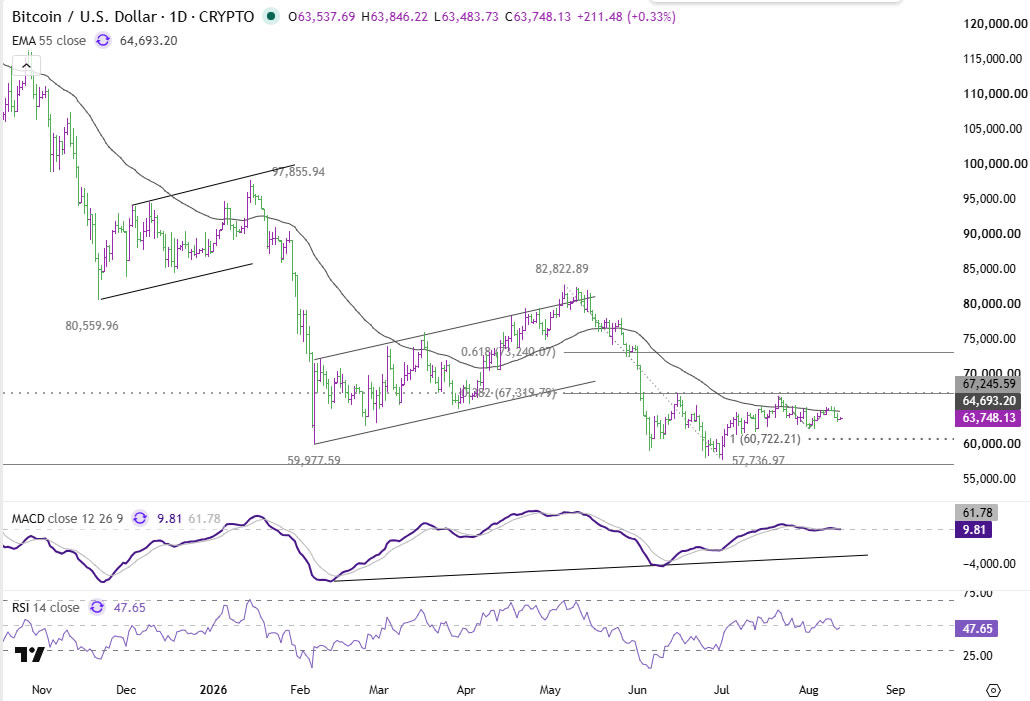
Beyond that, medium-term resistance is even more important. Bitcoin remains capped below the 67,245–67,319 cluster, including the 38.2% retracement of 82,822 to 57,736 at 67,319. Price has also repeatedly failed to sustain gains above the 55-day EMA.
Until those barriers are broken decisively, a successful cloture vote could generate a bounce without altering the broader bearish structure. For a more durable bullish reversal, Bitcoin would likely need both tangible progress on the CLARITY Act and a technical break through 67,245–67,319.
Bitcoin Is in a Bearish Holding Pattern
That leaves Bitcoin in an unusual position into mid-September. It's not yet making a decisive long-term bearish break, but neither is it simply moving sideways while awaiting Washington. Price is grinding lower inside a descending channel, momentum is still pointed down, and the next obvious technical target sits just above $60,000. The better description is a bearish holding pattern.
Regulatory disappointment may have contributed to this week's weakness, but the market hasn't yet provided enough evidence to make the CLARITY Act the sole explanation. What September 15 offers is something cleaner: a discrete event with a much more measurable impact on the legislative path.
Until then, downside risk remains dominant while Bitcoin stays below the channel ceiling and the broader 67,245–67,319 resistance cluster. The immediate question is whether Bitcoin reaches $60,722 before Washington gives bulls another catalyst. The bigger question is what happens if September 15 arrives and that catalyst fails.
Key Takeaways
- Bitcoin's decline coincided with the CLARITY Act's delayed Senate vote, but broader macro volatility (Fed repricing, Hormuz escalation, pre-CPI equity weakness) makes single-cause attribution unreliable.
- The 60,722 technical target sits just above the psychologically significant $60,000 level, with no oversold or divergence signal yet suggesting the decline has run its course.
- September 15 is a procedural cloture vote, not a final passage vote — a critical distinction that shapes the asymmetric risk into that date.
- A failed cloture vote would be a clean negative catalyst; a successful one would only restore momentum without resolving the bill's underlying disputes or guaranteeing passage.
- 65,393-66,890 and then the 67,245-67,319 cluster are the key upside barriers; clearing both would likely require tangible legislative progress, not just a successful cloture vote.
EUR/USD and GBP/USD Await a Fresh Impulse from Inflation Data
The euro and pound are holding their ground against the US dollar, although the momentum in European currencies has become more subdued following their previous gains. Market participants are reluctant to establish new positions ahead of the release of the July US inflation report, which could alter expectations for the Federal Reserve’s future policy. Recent labour market data is also encouraging caution: a weak ADP report and a decline in the ISM employment component have added to signs of a gradual cooling in the US labour market.
Today, the main focus will be on the US Consumer Price Index (CPI). According to forecasts, annual inflation may slow to 3.4% from 3.5%, while monthly prices are expected to rise by 0.1% after falling 0.4% a month earlier. Core CPI is forecast at 2.5% year-on-year and 0.2% month-on-month. Weaker-than-expected figures could strengthen expectations of monetary policy easing by the Fed and put additional pressure on the dollar. If inflation comes in above forecasts or proves more persistent, the US currency could receive fresh support. Final inflation figures for Germany and Italy will also be released in Europe, although their impact is likely to remain limited in the absence of significant deviations from preliminary estimates. Therefore, US inflation data is likely to be the main driver for EUR/USD and GBP/USD during today's session.
EUR/USD
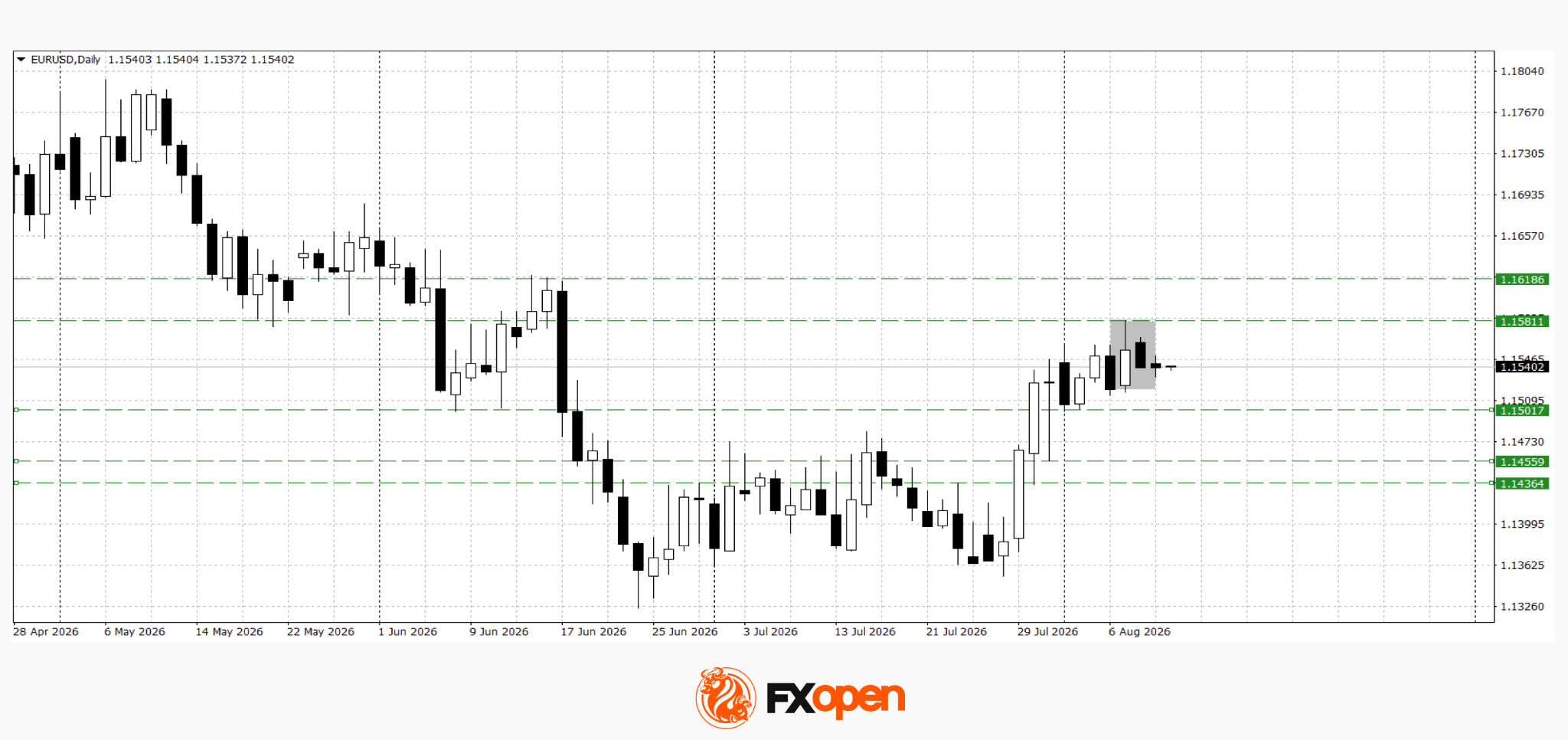
In recent trading sessions, EUR/USD has been moving within a relatively narrow range of 1.1500–1.1580. Technical analysis suggests the possibility of another test of the lower boundary, as a Dark Cloud Cover pattern has formed on the daily timeframe. If sellers manage to establish a position below 1.1500, the pair could resume its downward move towards 1.1430–1.1460. Conversely, weaker-than-expected US inflation data could push the price towards 1.1600–1.1620.
Key events for EUR/USD:
- today at 09:00 (GMT+3): German Consumer Price Index (CPI);
- today at 11:00 (GMT+3): Italian Harmonised Index of Consumer Prices (HICP);
- today at 15:30 (GMT+3): US Consumer Price Index (CPI).
GBP/USD
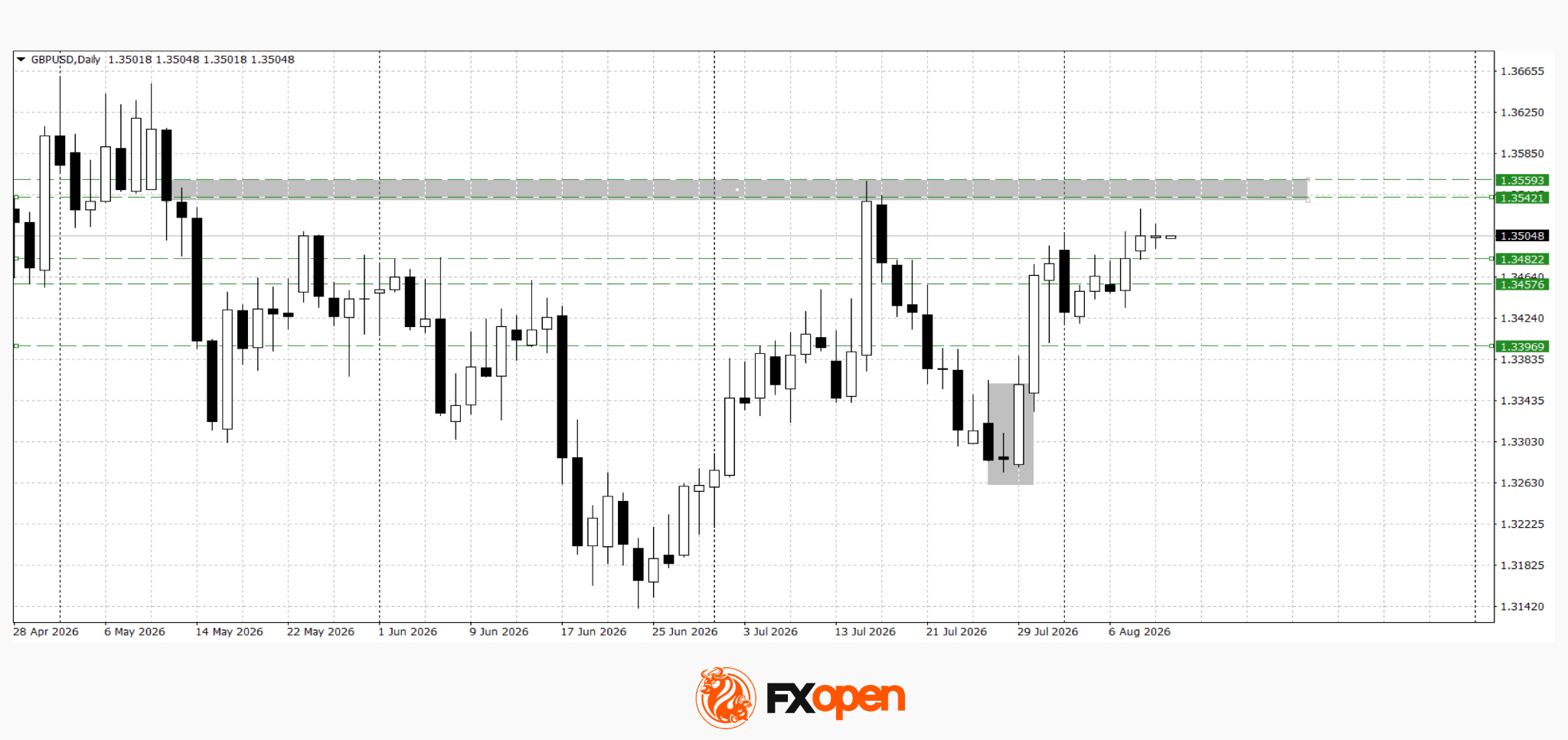
GBP/USD buyers managed to push the pair to a new local high around 1.3500. Technical analysis indicates the possibility of further gains towards 1.3540–1.3560 if the 1.3480–1.3500 area is established as support. Stronger-than-expected US inflation data could support the dollar and trigger another test of the 1.3400 level in GBP/USD.
Key events for GBP/USD:
- tomorrow at 09:00 (GMT+3): UK GDP;
- tomorrow at 14:00 (GMT+3): NI's monthly GDP tracker;
- tomorrow at 21:00 (GMT+3): US federal budget execution report.
Overall, EUR/USD and GBP/USD are holding their ground after their previous gains, but their next direction will largely depend on today's US inflation report. Weaker CPI data could strengthen expectations of Fed easing and put additional pressure on the dollar, creating room for further gains in European currencies. If inflation comes in above forecasts, however, the US currency could receive fresh support, increasing the likelihood of EUR/USD and GBP/USD returning to their nearest support levels.
Trade over 50 forex markets 24 hours a day with FXOpen. Take advantage of low commissions, deep liquidity, and spreads from 0.0 pips (additional fees may apply). Open your FXOpen account now or learn more about trading forex with FXOpen.
This article represents the opinion of the Companies operating under the FXOpen brand only. It is not to be construed as an offer, solicitation, or recommendation with respect to products and services provided by the Companies operating under the FXOpen brand, nor is it to be considered financial advice.
Fed’s Collins Open to September Hike as Cost Pressures Persist
Boston Fed President Susan Collins said she could support a rate increase in September if inflation fails to ease sufficiently, highlighting persistent cost-of-living pressures intensified by Iran war. Speaking in an interview with Financial Times on Wednesday, Collins said, “I do see the possibility that economic conditions in the coming months will require tighter policy, and I would be prepared to raise rates in that context.” She supported keeping rates unchanged in July and currently views monetary policy as only “slightly restrictive.”
Collins said inflation has continued to squeeze businesses and households across US Northeast, with price concerns surfacing in nearly every conversation with firms. Pressure is particularly acute for lower- and middle-income households, she said, with some struggling to “make ends meet” as elevated energy costs add to broader affordability problems.
While Collins expects inflation to continue declining gradually, she stressed that price growth has remained above Fed’s 2% target for more than five years, leaving policymakers with little room for complacency.
Her remarks reinforce Fed’s increasingly difficult September trade-off. Recent labor-market weakness has strengthened case for holding rates, but persistent inflation and renewed energy pressure could still justify further tightening if upcoming data disappoint. Collins is not currently a voting member of FOMC, but her willingness to contemplate a September hike adds to hawkish argument that current policy may not yet be restrictive enough to ensure inflation returns sustainably to target.
US CPI to Set the Tone
In focus today
Today's most important data release will be the US July CPI, where we forecast headline inflation at 0.2% m/m SA, 3.4% y/y (prior: -0.4% m/m, 3.5% y/y) and core inflation at 0.2% m/m SA, 2.5% y/y (prior: 0.0% m/m, 2.6% y/y). Inflation was broadly lower-than-expected in June, and markets are now pondering whether it marked the beginning of a trend, or just a one-off.
The remaining part of the calendar is relatively thin. We receive final headline inflation from Germany and Italy, as well as consumer confidence figures out of Norway.
Economic and market news
What happened overnight
In commodities, Brent crude yesterday briefly climbed above USD90/bbl before reversing course, as headlines from Pakistan suggested the US and Iran may be close to some form of deal. On the news, Brent crude fell back to around USD87/bbl. However, overnight fresh attacks on shipping renewed concerns over regional escalation. Reports of a suspected Houthi attack in the Bab el-Mandeb Strait and a US strike on a vessel in the Gulf of Oman have added to uncertainty causing Brent crude to climb back towards USD90/bbl. Although deal optimism is fading, any renewed diplomatic progress could quickly pull attention back towards last week's low near USD80/bbl.
What happened yesterday
In the US, the NFIB Small Business Optimism Index increased 2.4 points to 99.8 in July. Notably, labour market-related indicators strengthened, with more firms reporting job openings they were unable to fill, while three-month hiring and capex plans also moved higher. This contrasted with actual employment changes which remained low, in line with the earlier NFP data. Quality of labour was the most frequently cited "single most important problem", suggesting that forward-looking labour market indicators are improving despite recent weak realised data.
Equities: Global risk sentiment was on a weak footing yesterday with the oil price and the SoH being the key market driver ahead of today's US CPI. Early optimism after comments from Pakistan's defence minister suggesting progress towards reopening the strait briefly lifted risk appetite, with US futures 0.2% higher before open; however, the mood faded as Iran reiterated that the strait would remain closed and Trump maintained a hardline stance. Brent crude ended 2.6% higher and is trading at USD90/bbl this morning. S&P 500 ended 0.3% lower, with Nasdaq 0.6% lower. Energy was unsurprisingly at the top of the table, with communication services (dragged by Alphabet) lower. Overnight, Asian equities and US futures are mostly in green.
FI and FX: Major FX crosses were relatively steady yesterday. SEK and JPY lost a little ground while the USD recovered. News related to the Middle East and the oil market dominated with brief hints that a deal might draw closer. Oil prices remained elevated which underpinned the NOK. Bond yields dropped across the curve following equity market declines.
Gold Is Betting $90 Oil Won’t Force the Fed Back to Tightening. CPI Is the First Check.
TL;DR: Gold has kept climbing even as Brent rebounded from $70 toward $90, a divergence that reflects markets betting the Fed won't tighten again without proof oil is feeding into core inflation — and Wednesday's CPI is the first test of that bet.
Gold Is Defying the Oil Signal
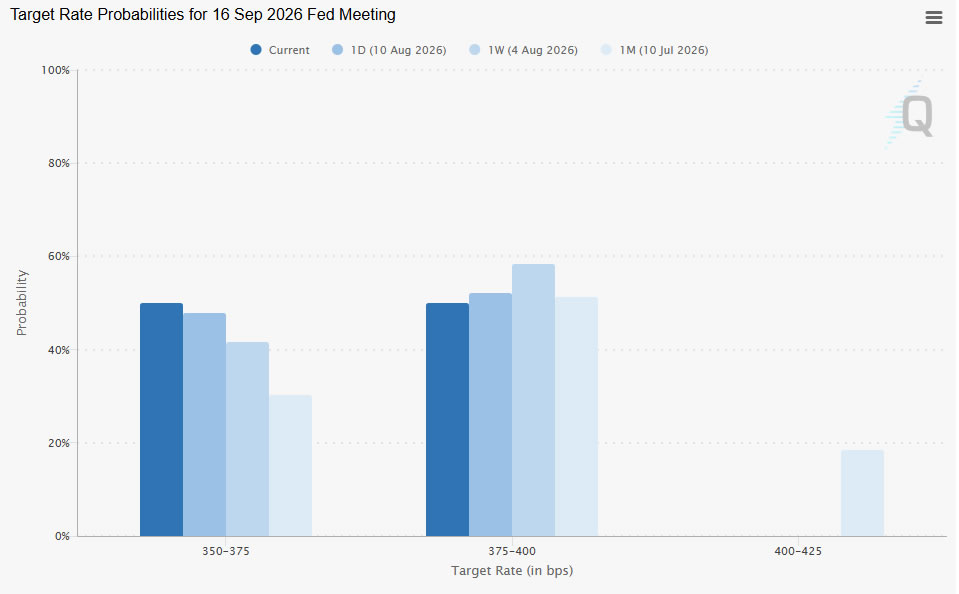
Gold heads into Wednesday's US CPI release with an unusual message from cross-asset markets. Brent has rebounded from around $70 in July to near $90 this week, yet Gold has continued to climb. At the same time, the 10-year Treasury yield is still contained below 4.75%, while markets put roughly even odds on a September Fed hold. Oil has surged, but rate markets haven't followed.
That matters because the relationship looked very different earlier this year. During the first Iran-war shock, higher oil translated much more directly into inflation fears, higher yields, and a more hawkish Fed outlook — Gold often struggled against that combination. This time, markets appear much less willing to assume another energy shock automatically means another round of tightening.
So Wednesday's CPI isn't simply an inflation release. It's the first test of a broader market bet: can oil rise toward $90 without forcing the Fed back toward tightening? Gold is currently trading as though the answer may be yes.
Core CPI Could Return All the Way to Pre-War Levels
| Jan'26 | Feb'26 | Mar'26 | Apr'26 | May'26 | Jun'26 | |
|---|---|---|---|---|---|---|
| Headline CPI (y/y) | 2.4 | 2.4 | 3.3 | 3.8 | 4.2 | 3.5 |
| Core CPI (y/y) | 2.5 | 2.5 | 2.6 | 2.8 | 2.9 | 2.6 |
Consensus expects headline CPI to slow from 3.5% to 3.4% y/y, while core inflation is forecast to edge down from 2.6% to 2.5%. The monthly progression shows how far both measures have traveled since the first oil shock:
A 2.5% core reading would be significant because it would complete a full round trip back to levels seen before the Iran war disrupted the inflation picture. Core CPI was 2.5% in January and February, then accelerated to 2.6% in March, 2.8% in April, and 2.9% in May, before easing back to 2.6% in June — a July reading of 2.5% would therefore suggest underlying inflation has effectively unwound the entire first-war acceleration.
If today's data meet consensus, markets would have strong evidence the first oil shock didn't permanently dislodge underlying inflation. But there's a catch.
Today's CPI Comes From a World That Has Already Changed
July inflation data were collected before the current Hormuz escalation reached its most acute phase. The latest tanker attacks, collapsing shipping crossings, the reparations standoff between Washington and Tehran, and Brent's push back toward $90 are largely early-to-mid-August developments — they sit mostly outside today's CPI window.
That means a clean 2.5% core reading wouldn't prove inflation has shrugged off the latest energy shock. It would prove something narrower, but still important: core inflation managed to return to pre-war levels during the calmer period between two oil shocks. That distinction is crucial because this second episode isn't identical to the first.
This Oil Shock Is Smaller — But Potentially More Persistent
The first Iran-war shock was violent and immediate. Brent surged toward $120, and March CPI recorded a 10.9% m/m jump in energy prices, the largest since September 2005. Gasoline posted its largest monthly increase since the series began in 1967.
The current move is less severe in magnitude — Brent has rebounded from around $70 to $90 rather than exploding toward $120. But the character of the disruption is different. This is increasingly a prolonged negotiation and shipping crisis, with confirmed tanker strikes, sharply reduced Hormuz crossings, and a widening diplomatic standoff, rather than simply a repeat of a fresh outright closure.
That creates a genuine open question for inflation: a violent energy spike can fade quickly if physical disruption is resolved, while a smaller but persistent increase in transportation, insurance, and energy costs could potentially bleed into underlying prices differently. Markets don't yet know which version they're dealing with.
August CPI Is Where the Hawkish Thesis Starts Getting Tested
That's why today's CPI is best treated as a baseline. The more consequential test comes with August CPI on September 11, because that release will begin incorporating the current rebound in energy prices. Even then, direct energy effects should show up in headline inflation sooner than in core — second-round pass-through through transportation, production costs, goods, and services can take longer. But August will still provide the first meaningful evidence on whether underlying inflation can remain anchored while Brent trades around $90.
That question goes directly to the hawkish argument advanced by officials such as Neel Kashkari, Lorie Logan, and Beth Hammack, as well as dissenting voices at the latest FOMC meeting. Their concern isn't simply that energy prices temporarily lift headline CPI — it's that prolonged energy and supply pressure eventually spreads into core inflation and forces the Fed to maintain or increase restraint.
The next comparison is therefore unusually clean: if core inflation stays around 2.5–2.6% even after the renewed oil shock begins entering data, it would provide strong evidence energy pressure is staying largely contained. If core starts accelerating again, hawks would have much stronger evidence that second-round effects are taking hold. Today tells markets where that experiment starts.
Weak Payrolls Have Raised the Bar for Another Hike
The Fed is also confronting a labor backdrop similar to the start of the year, when markets and policymakers were debating rate cuts. July payrolls contracted, while May and June employment were revised substantially lower. That has made another rate hike much harder to justify, particularly with policy already at 3.50–3.75%.
There's now a genuine reason for the Fed to eventually reduce restraint if labor deterioration continues. But inflation prevents an immediate pivot — core CPI around 2.5–2.6% is still above target, while renewed oil pressure creates another potential upside risk. The Fed therefore has little room to cut now, even as the case for additional hikes has weakened.
That leaves a fairly natural policy response if today's CPI lands close to consensus: hold and wait. That would be the baseline as the Fed assesses August NFP on September 4, then August CPI on September 11, before the September 15–16 FOMC meeting. That policy expectation is supportive for Gold — another hike becomes harder to justify, while weaker labor conditions keep eventual easing risk alive.
Gold Is Trading the Rate Market's Skepticism
Gold's rally therefore looks less like a pure geopolitical or inflation-fear trade and more like a bet on the rate market refusing to follow oil. Brent has surged, but Treasury yields haven't broken higher. Fed hike pricing has barely moved. Gold has strengthened anyway.
If markets genuinely believed $90 oil was about to restart a tightening cycle, those signals should look different. Instead, investors appear to be saying the Fed now needs evidence of actual pass-through into core inflation before it can justify more tightening — especially after labor-market deterioration. That gives Gold a relatively favorable setup into CPI: a benign reading doesn't need to prove the latest oil shock is harmless. It only needs to avoid giving hawks enough evidence to rebuild tightening expectations today.
ActionForex's Technical View on Gold
The technical problem is that Gold has already reached an important resistance zone. The rebound from 3,942.43 is pressing 4,417.62, the 161.8% projection of 3,942.43 to 4,203.21 from 3,995.82. At the same time, price is approaching the medium-term falling trendline that has defined the broader decline this year, making the reaction to CPI potentially sharper than usual.
As long as 4,317.72 support holds, the near-term outlook stays constructive. A core CPI reading around 2.5–2.6%, particularly if yields remain contained, should allow Gold to keep challenging current resistance. A decisive break would open room toward 4,575.31, the 38.2% retracement of the decline from 5,598.75 to 3,942.43.
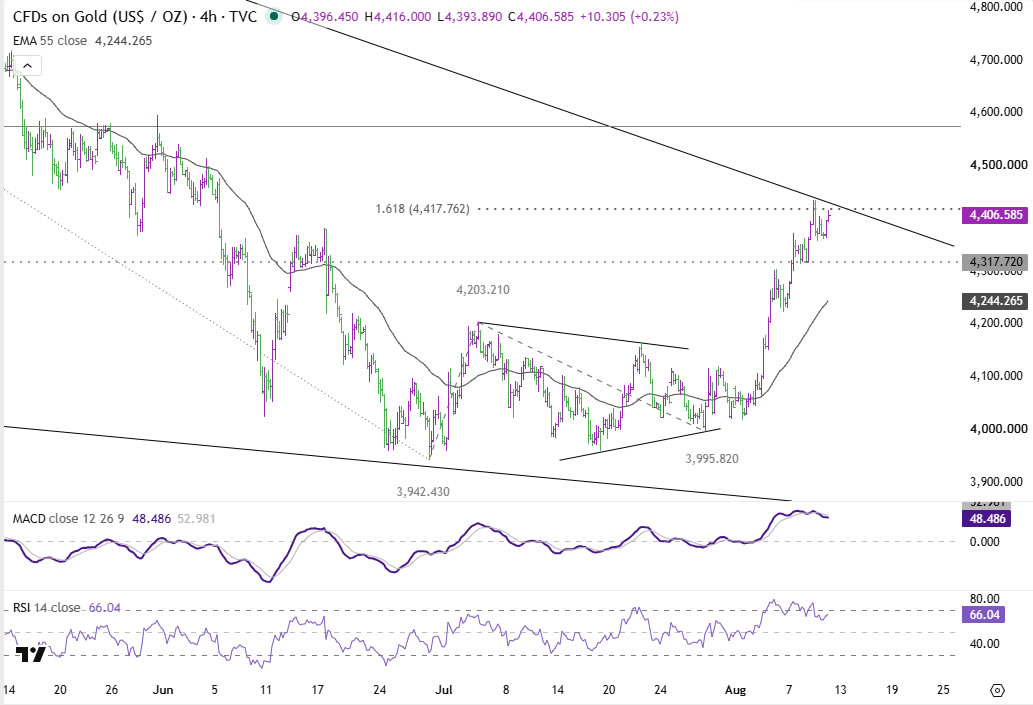
But positioning near resistance creates clear downside risk if inflation surprises substantially higher. A strong core CPI print could revive tightening expectations and trigger a sharp rejection. A break below 4,317.72 would indicate the rebound has lost near-term momentum, bringing a deep and swift pullback to the 55 4H EMA near 4,244.25 and possibly below.
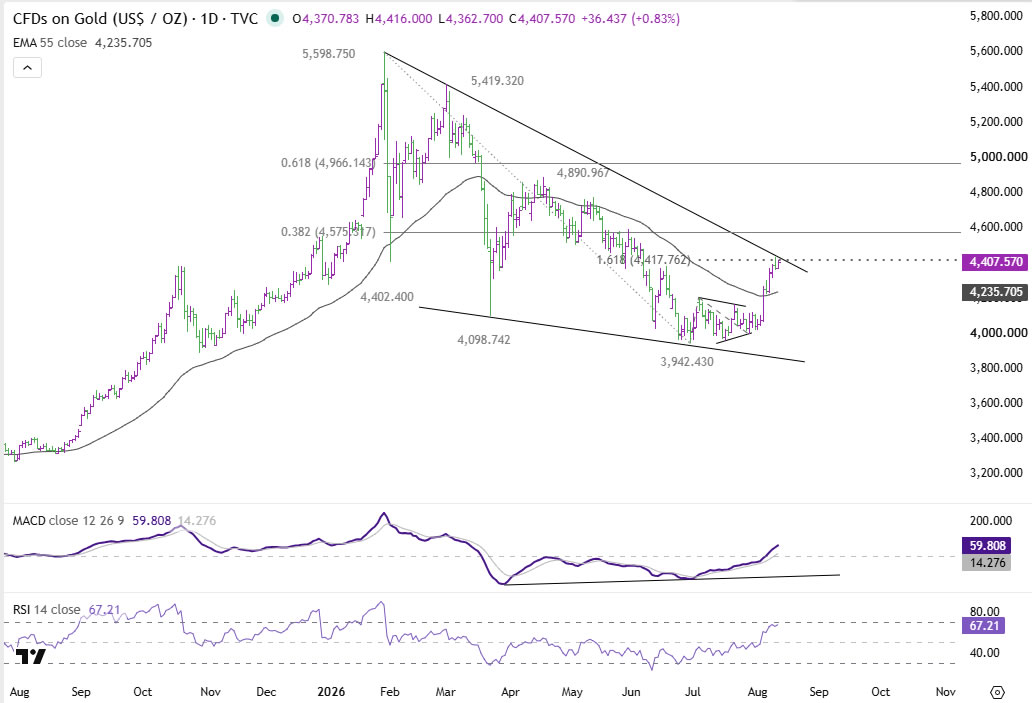
That makes the CPI outcome less symmetric than headline consensus suggests. A broadly expected reading keeps the existing Gold thesis intact; it probably takes a material upside surprise to seriously disrupt it.
Today Is the First Check. September Is the Bigger One.
Wednesday's CPI can tell markets whether underlying inflation returned to pre-war levels before the latest oil rebound. It can't yet tell them whether inflation will stay there. That's why Gold's current rally is fundamentally a bet on patience — markets are betting the Fed won't react to $90 oil alone without evidence that higher energy prices are once again contaminating core inflation.
A 2.5–2.6% reading today would reinforce that view and likely keep Gold's rebound alive, even if current resistance slows immediate upside. A substantial upside surprise would challenge it quickly. But the bigger verdict comes in September: today's July CPI decides whether Gold can keep betting against another Fed hike, while August CPI will begin deciding whether $90 oil eventually proves that bet wrong.
Key Takeaways
- Gold has climbed even as Brent rebounded from $70 to $90, a divergence from earlier this year when oil spikes reliably lifted yields and hurt Gold.
- A 2.5% core CPI print today would complete a full round trip back to pre-war inflation levels, but the data predates the most acute phase of the Hormuz escalation.
- August CPI on September 11 is the more consequential test, since it will be the first release to capture the current oil rebound's actual pass-through into prices.
- Weak payrolls and heavy downward revisions have raised the bar for another hike, but above-target core inflation still rules out an immediate Fed pivot to cuts.
- Gold faces resistance at 4,317.72-4,417.62; an in-line CPI print keeps the rebound intact toward 4,575.31, while a hot surprise risks a swift pullback to 4,244.25.