Sample Category Title
Fed’s Goolsbee sees war as “wrench” in rate cut plans
Chicago Fed President Austan Goolsbee highlighted the growing uncertainty facing policymakers, warning that the evolving Middle East conflict is complicating the outlook for monetary policy. Speaking to CNBC, he said “the most important thing is to figure out the through-line of what is happening,” noting that the situation is “fraught” as no one can confidently assess how long the conflict will last or how it will unfold.
While FOMC projections still point to rate cuts ahead, Goolsbee emphasized that his policy stance will depend heavily on inflation progress. He cautioned against repeating what he described as the “team-transitory mistake” of 2021, when inflation risks were underestimated. The current environment, shaped by an energy-driven shock, makes it more difficult to determine whether inflation will continue trending toward target.
Goolsbee said he remains “fairly optimistic” that rates could move lower by the end of 2026, but stressed that further evidence is needed. “We do need to see progress,” he said, adding that the war “definitely throws a wrench into the plans.”
Fed’s Miran sticks to cut call despite oil shock, cites labor market risks
Fed Governor Stephen Miran reiterated his dovish stance in remarks to Bloomberg TV, arguing that it is premature to reassess the policy outlook in response to surging oil prices. While acknowledging that inflation risks have become “a little more concerning,” Miran emphasized that policymakers should “wait for all the information to come in” before adjusting their baseline expectations.
Miran maintained that central banks should traditionally look through oil price shocks, signaling that his prior policy view remains intact. “It’s just still premature to have a clear view about what this is going to look like as you look 12 months out,” he said. His outlook continues to favor gradual rate cuts despite the recent rise in energy prices.
Importantly, Miran highlighted growing concerns around the labor market, arguing that unemployment risks are rising alongside inflation risks. He noted that the oil shock acts as both a negative supply and demand shock, weighing on economic activity. “The labor market still can use additional support,” Miran said, explaining his dissent at the last FOMC meeting in favor of a 25bps cut and reinforcing his call for further easing.
Crypto Market Reacted Positively to Shift in Sentiment
Market Overview
The crypto market continued to slide over the weekend as demand for risky assets decreased. This gloomy tone was reversed by Trump’s announcement that strikes on Iran’s energy sector would be halted, causing a sharp turnaround in market sentiment. It is important to note that, this time, cryptocurrencies are reacting very positively to good news and rather sluggishly to bad news. This change occurred in mid-March; before that, we saw only a moderate response to negative news, while potentially good news went almost unnoticed.
By Monday, the sentiment index had fallen into negative territory, dropping to 8. Currently, the situation in the crypto market does not appear as severe as it did at the end of February, when sentiment was at the same level.
Bitcoin is nearing $71K, having increased nearly 5% since Monday morning. Geopolitical news has been a strong influence, dispelling the gloom of recent days. Although BTC was at these levels not long ago, from a technical analysis standpoint, this marks a notable shift. This time, we are witnessing powerful upward momentum from the key 50-day moving average. A sustained move above it would indicate a trend reversal, supporting the shift in market reaction to news and the dynamics of the sentiment index. It would also signal a return to normality after a prolonged period of oversold conditions. However, cautious traders will likely prefer to wait for the price to stabilise above $75K—the recent peak and an important Fibonacci retracement level.
News Background
Crypto market participants remain cautious, showing no excessive activity, according to VanEck. Selling by long-term holders has slowed. Further market dynamics will depend on central bank policy and overall risk appetite.
CF Benchmarks has calculated that Bitcoin’s fair value is approximately $136,000, taking into account the growth of the global M2 money supply. However, under current conditions, BTC reacts more strongly to high Fed rates and market sentiment than to money supply growth.
Ethereum could reach its lowest point by the end of March, after which the market is expected to enter a recovery phase, according to BitMine CEO Tom Lee. In his view, a significant proportion of short-term traders have already exited the market, whilst long-term holders continue accumulating.
Following recent adjustments, Bitcoin’s mining difficulty dropped nearly 8% to 133.79 T. This is the second-largest decline since the start of the year. According to TheEnergyMag, only two of the 14 largest publicly traded US mining companies are mining BTC profitably.
Daily altcoin trading volumes on Binance, the largest crypto exchange, have fallen by 80% from their October peak, indicating waning investor interest, notes analyst Darkfost. Historically, such periods often present the most attractive entry opportunities.
USD/JPY Mid-Day Outlook
Daily Pivots: (S1) 158.08; (P) 158.74; (R1) 159.88; More...
USD/JPY is still extending consolidations below 159.88 and intraday bias stays neutral. Another falling leg could be seen, but downside should be contained by 38.2% retracement of 152.25 to 159.88 at 156.96 to bring rebound. On the upside, break of 159.88 will target a test on 161.94 high.
In the bigger picture, outlook is unchanged that corrective pattern from 161.94 (2024 high) should have completed with three waves at 139.87. Larger up trend from 102.58 (2021 low) could be ready to resume through 161.94. This will remain the favored case as long as 55 W EMA (now at 152.70) holds. Firm break of 161.94 will pave the way to 61.8% projection of 102.58 to 161.94 from 139.87 at 176.75.
USD/CHF Mid-Day Outlook
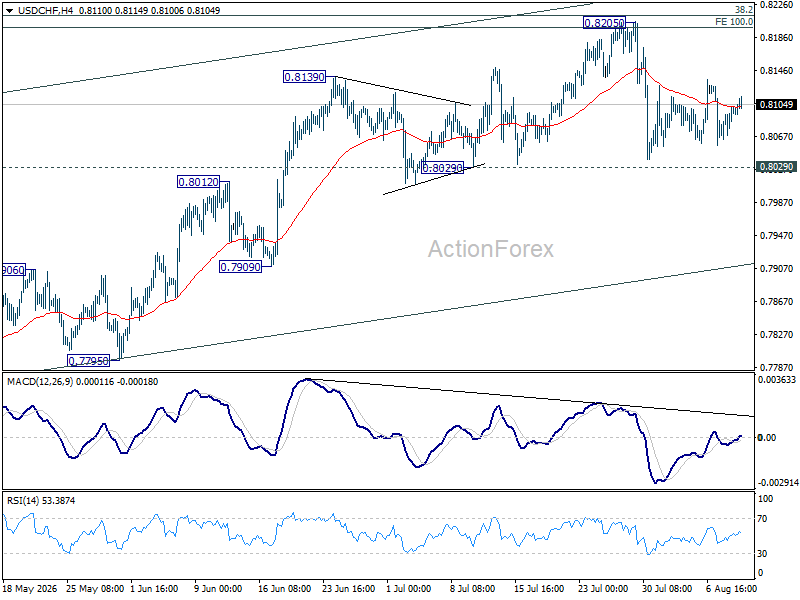
Daily Pivots: (S1) 0.7854; (P) 0.7880; (R1) 0.7905; More….
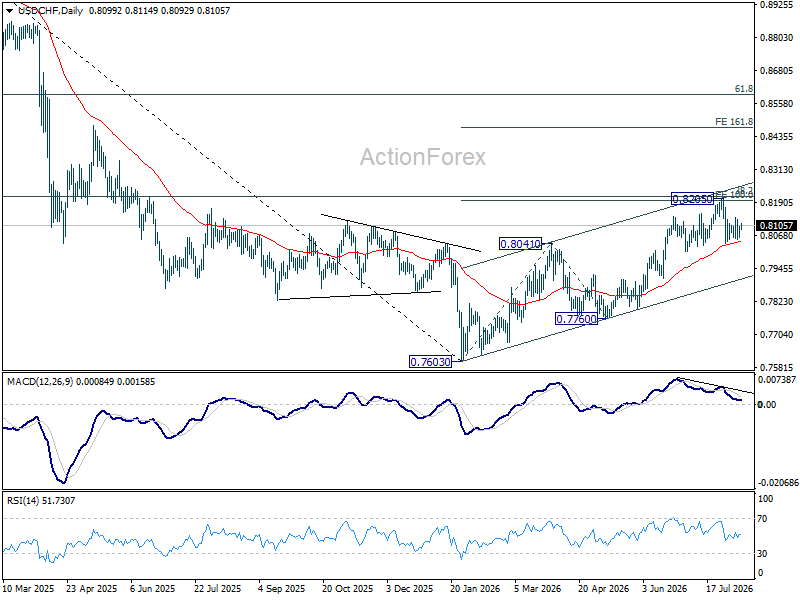
USD/CHF is still bounded in range trading below 0.7957 and intraday bias stays neutral. As noted before, rise from 0.7603 should be correcting whole decline from 0.9200. Above 0.7957 will target 38.2% retracement of 0.9200 to 0.7603 at 0.8213. This will remain the favored case as long as 0.7746 support holds.
In the bigger picture, a medium term bottom should be in place at 0.7603 on bullish convergence condition in D MACD. Rebound from there is seen as correcting the fall from 0.9200 only. However, decisive break of 55 W EMA (now at 0.8085) will suggest that it's probably correcting the larger scale down trend from 1.0146 (2022 high). On the other hand, rejection by the 55 W EMA will setup down trend resumption to 100% projection of 1.0146 (2022 high) to 0.8332 from 0.9200 at 0.7382 at a later stage.
GBP/USD Mid-Day Outlook
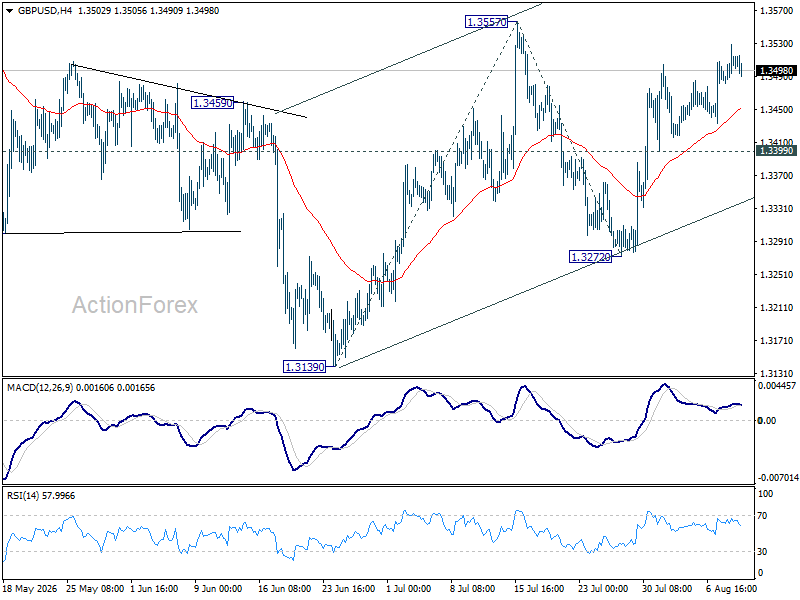
Daily Pivots: (S1) 1.3279; (P) 1.3362; (R1) 1.3426; More...
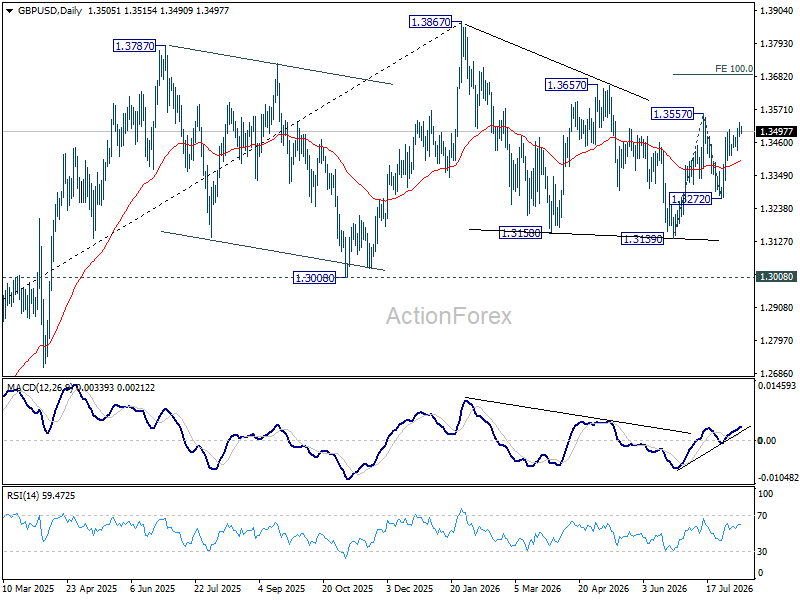
GBP/USD is still bounded in sideway trading and intraday bias stays neutral. Further decline is in favor with 1.3482 resistance intact. On the downside, below 1.3216 will resume the fall from 1.3867 to 1.3008 structural support. However, decisive break of 1.3482 will argue that the fall from 1.3867 has completed, and turn bias back to the upside for 61.8% retracement of 1.3867 to 1.3216 at 1.3618.
In the bigger picture, considering bearish divergence condition in both D and W MACD, a medium term top should be in place at 1.3867. Firm break of 1.3008 support will argue that fall from 1.3867 is at least correcting the rise from 1.0351 (2022 low) with risk of bearish reversal. That would open up further decline to 38.2% retracement of 1.0351 to 1.3867 at 1.2524. For now, medium term outlook will be neutral at best as long as 1.3867 resistance holds, or until further development.
EUR/USD Mid-Day Outlook
Daily Pivots: (S1) 1.1532; (P) 1.1565; (R1) 1.1605; More….
EUR/USD rebound from 1.1408 extended higher today but upside is still capped below 1.1666 cluster resistance (38.2% retracement of 1.2081 to 1.1408 at 1.1665). Intraday bias stays neutral and further decline remains in favor. On the downside, below 1.1408 will resume the fall from 1.2081 to 38.2% retracement of 1.0176 to 1.2081 at 1.1353. However, decisive break of 1.1666 will argue that the fall from 1.2081 has completed, and turn bias back to the upside for 61.8% retracement of 1.2081 to 1.1408 at 1.1824.
In the bigger picture, prior break of 55 W EMA (now at 1.1501) should confirm rejection by 1.2 key cluster resistance level. The whole up trend from 0.9534 (2022 low) might have completed as a three wave corrective rise too. Deeper fall is expected to long term channel support (now at 1.0528). Meanwhile, risk will stay on the downside as long as 1.2081 holds, even in case of strong rebound.
Markets Shift to ‘Trust but Verify’ Mode After Trump Pause Meets Iran Denial
Markets shifted into a “trust but verify” mode as sharp volatility unfolded following a sudden geopolitical pivot. Initial optimism surged after US President Donald Trump announced a pause in planned strikes against Iranian energy infrastructure, but gains were quickly tempered as Iran denied any direct or indirect talks, raising doubts over the credibility of the de-escalation narrative.
The initial trigger for the rally came from Trump’s statement that “very good and productive conversations” had taken place, leading to a decision to postpone “any and all military strikes” for a five-day period. The announcement marked a sharp reversal from the earlier 48-hour ultimatum that had threatened immediate escalation if the Strait of Hormuz was not reopened.
Markets reacted aggressively to the perceived de-escalation. Brent crude briefly plunged to as low as 96, reflecting a rapid unwinding of war risk premium. Gold rebounded sharply to 4,463 after nearly breaking through the key 4,000 psychological level, while US equity futures surged, with DOW futures at one point up around 1,300 points.
However, the relief rally proved short-lived. Iranian media reports quickly pushed back against the US narrative, stating there had been no direct or indirect communication with Washington. This introduced a critical layer of uncertainty, suggesting that the “productive conversations” cited by Trump may have involved only intermediaries rather than a genuine diplomatic breakthrough.
The market reaction to this credibility shock was swift. Oil prices reversed sharply, with Brent climbing back above 105, while equity futures surrendered roughly half of their earlier gains. The rapid reversal highlights how fragile sentiment remains, with positioning highly sensitive to headline risk.
At its core, the market is grappling with a widening credibility gap. While the pause in military action reduces immediate escalation risk, the absence of confirmed dialogue raises questions about whether a meaningful resolution is underway. This has left investors reluctant to fully embrace the relief rally.
Importantly, the underlying structural risks remain unchanged. The Strait of Hormuz continues to face severe disruption, a critical concern given that roughly 20% of global oil flows pass through the chokepoint. Until shipping conditions normalize, the energy shock—and its inflationary consequences—will continue to weigh on global markets.
Meanwhile, governments are already preparing for a prolonged crisis. In the UK, Prime Minister Keir Starmer convened an emergency “Cobra” meeting to address the economic fallout, including rising borrowing costs and cost-of-living pressures. This signals that the conflict is increasingly feeding into domestic policy responses across major economies.
In Asia, the situation is being viewed as a regional crisis. With around 80% of oil shipments through Hormuz destined for Asian markets, economies such as Japan and South Korea remain particularly vulnerable. This helps explain the persistent underperformance of Asia-linked assets and currencies.
In currency markets, the picture remains mixed but consistent with a cautious tone. Australian Dollar continues to lead losses, followed by New Zealand Dollar and Swiss Franc. Yen is the strongest performer, reflecting safe-haven demand, while Sterling and Dollar are also supported. Euro and Canadian Dollar are trading in the middle as markets await clearer signals.
For now, markets remain trapped between optimism and uncertainty. The pause in military action offers temporary relief, but without confirmation of genuine diplomatic progress, sentiment is likely to stay fragile. Until the situation in the Strait of Hormuz is resolved, markets are likely to remain highly reactive, with “trust but verify” defining the near-term outlook.
In Europe, at the time of writing, FTSE is up 0.19%. DAX is up 1.87%. CAC is up 1.43%. UK 10-year yield is down -0.053 at 4.887. Germany 10-year yield is down -0.054 at 2.998. Earlier in Asia, Nikkei fell -3.48%. Hong Kong HSI fell -3.54%. China Shanghai SSE fell -3.63%. Singapore Strait Times fell -2.17%. Japan 10-year JGB yield rose 0.054 to 2.323.
Gold rebounds on TACO-driven de-escalation as 4,000 support holds
Gold’s sharp selloff stalled at the 4000 support zone before rebounding on a sudden policy reversal from Washington. The TACO-driven pause in planned Iran strikes has eased immediate escalation risks, but with yields still elevated, the move may prove to be a temporary stabilization rather than a confirmed bottom. Read more.
EUR/USD Mid-Day Outlook
Daily Pivots: (S1) 1.1532; (P) 1.1565; (R1) 1.1605; More….
EUR/USD rebound from 1.1408 extended higher today but upside is still capped below 1.1666 cluster resistance (38.2% retracement of 1.2081 to 1.1408 at 1.1665). Intraday bias stays neutral and further decline remains in favor. On the downside, below 1.1408 will resume the fall from 1.2081 to 38.2% retracement of 1.0176 to 1.2081 at 1.1353. However, decisive break of 1.1666 will argue that the fall from 1.2081 has completed, and turn bias back to the upside for 61.8% retracement of 1.2081 to 1.1408 at 1.1824.
In the bigger picture, prior break of 55 W EMA (now at 1.1501) should confirm rejection by 1.2 key cluster resistance level. The whole up trend from 0.9534 (2022 low) might have completed as a three wave corrective rise too. Deeper fall is expected to long term channel support (now at 1.0528). Meanwhile, risk will stay on the downside as long as 1.2081 holds, even in case of strong rebound.
Gold rebounds on TACO-driven de-escalation as 4,000 support holds
Gold rebounded on a TACO-driven de-escalation after testing key support near 4,000, as a sudden shift in US policy stance halted the sharp selloff. Prices had earlier dropped to 4,098.54, putting the psychological 4,000 level at risk before recovering on headlines pointing to a temporary pause in escalation.
The reversal was triggered by US President Donald Trump’s announcement that the US would postpone military strikes on Iranian energy infrastructure. In a Truth Social post, Trump said the two sides had engaged in “very good and productive conversations” and that he had instructed a delay of “any and all military strikes… for a five day period,” signaling a shift away from immediate confrontation.
This marks a sharp pivot from the 48-hour ultimatum issued just a day earlier, where the US had threatened to “obliterate” Iranian power and energy facilities if the Strait of Hormuz was not reopened. The rapid change in tone—from escalation to negotiation—fits the pattern traders now describe as a “TACO” moment, where sudden policy reversals drive abrupt market moves.
From a macro perspective, the development has temporarily eased immediate geopolitical risk, prompting short covering in Gold. However, the underlying drivers of the recent decline remain intact. Rising yields and expectations of tighter monetary policy, fueled by energy-driven inflation, continue to weigh on non-yielding assets.
Technically, Gold has found support at a critical confluence zone. The 4,000 psychological level aligns closely with the 55 W EMA at 4,001.61, as well as the 38.2% retracement of 1,614.60 (2022 low) to 5,598.38 (Jan high) at 4,076.57. The ability to hold above this region suggests that a near-term bottom may be forming.
However, confirmation of stabilization requires a stronger recovery. A break above 38.2% retracement of 5,419.02 to 4,098.46 at 4,602.90, would indicate that downside momentum has been exhausted and that a more sustained rebound is underway.
If such a move materializes, Gold could extend gains toward 55 D EMA, currently around 4875.45. This would represent a recovery phase within the broader correction, supported by a stabilization in market sentiment and a pause in liquidation pressures.
Conversely, failure to build on the current rebound would leave Gold vulnerable to renewed downside. A decisive break below 4000 would signal that the correction is not yet complete, exposing deeper losses as macro pressures and positioning dynamics continue to dominate price action.
Gold Has Failed the Test
- Oil prices might be higher for longer.
- The gold bubble has burst.
The US dollar quickly recovered from the blow it took from central banks. The greenback recouped most of its losses against the majors. Despite regulators’ readiness to raise rates, the conflict in the Middle East shows no sign of ending. Donald Trump has issued a 48-hour ultimatum to Iran, threatening to bomb the country’s energy infrastructure if the Strait of Hormuz is not opened. However, Tehran is unlikely to bow to the US president’s demands.
The Middle East is increasingly resembling Ukraine. In February 2022, investors also expected the conflict in Eastern Europe to be short-lived. Their views then changed, and the US dollar rose by 15% over the next three months. Since the start of this war, the USD index has risen by just 2%. The potential for a rally in the US currency is still huge.
Oil prices are rising faster than they were four years ago. Meanwhile, Goldman Sachs has raised its forecast for the average Brent price to $85 per barrel in 2026 for the second time in two weeks. According to the bank, high prices are here to stay. It expects the Strait of Hormuz to maintain its throughput capacity at 5% of pre-war levels for six weeks. After that, it will take a month to restore oil transport volumes to their previous levels.
The US has lifted sanctions on Iranian oil, which, according to the Treasury Department’s estimates, will allow around 140 million barrels to be released onto the market, playing on the side of the bears. Iran is on the bull’s side right now, claiming it does not have as much oil stranded at sea as is commonly believed.
Gold has been the main casualty of the conflict in the Middle East, losing around 14% of its value so far. Gold is considered a safe-haven and a hedge against inflation, but recent geopolitics has increased inflation risks, pushing up the likelihood of rate hikes, not cuts, as before March. From another angle, Gold simply failed to pass the safe-haven test, falling victim to speculative trading. The rapid rise in the precious metal’s price in 2025 and early 2026 led to an overcrowded market, and now the conflict has burst the inflated bubble.