

Sample Category Title
EUR/AUD: Two Central Banks on Hold, One Triangle About to Break
Overnight, the RBA held its cash rate steady at 4.35%, as widely expected after June's inflation data came in softer than forecast at 3.8% headline. Yet the accompanying statement struck a notably cautious tone, warning that trimmed mean inflation remains elevated and largely unchanged from the March quarter, with oil and related commodities still trading above pre-conflict levels due to the ongoing Middle East crisis. With 55% of economists still expecting at least one further hike in 2026, the door to additional tightening remains firmly open.
The euro, meanwhile, holds a cautiously bullish tone after climbing to a seven-week high near $1.155 against the dollar. Eurozone Q2 growth of 0.4% offered support, though weaker retail activity and mixed inflation signals keep the ECB's own path uncertain, with policymakers maintaining a deliberately cautious stance ahead of their September 15-16 meeting and giving no firm commitment to further hikes.
The result: two central banks in genuine holding patterns, each leaving the door open to more tightening while waiting for clearer data to justify the next move.
Technical Analysis of EUR/AUD
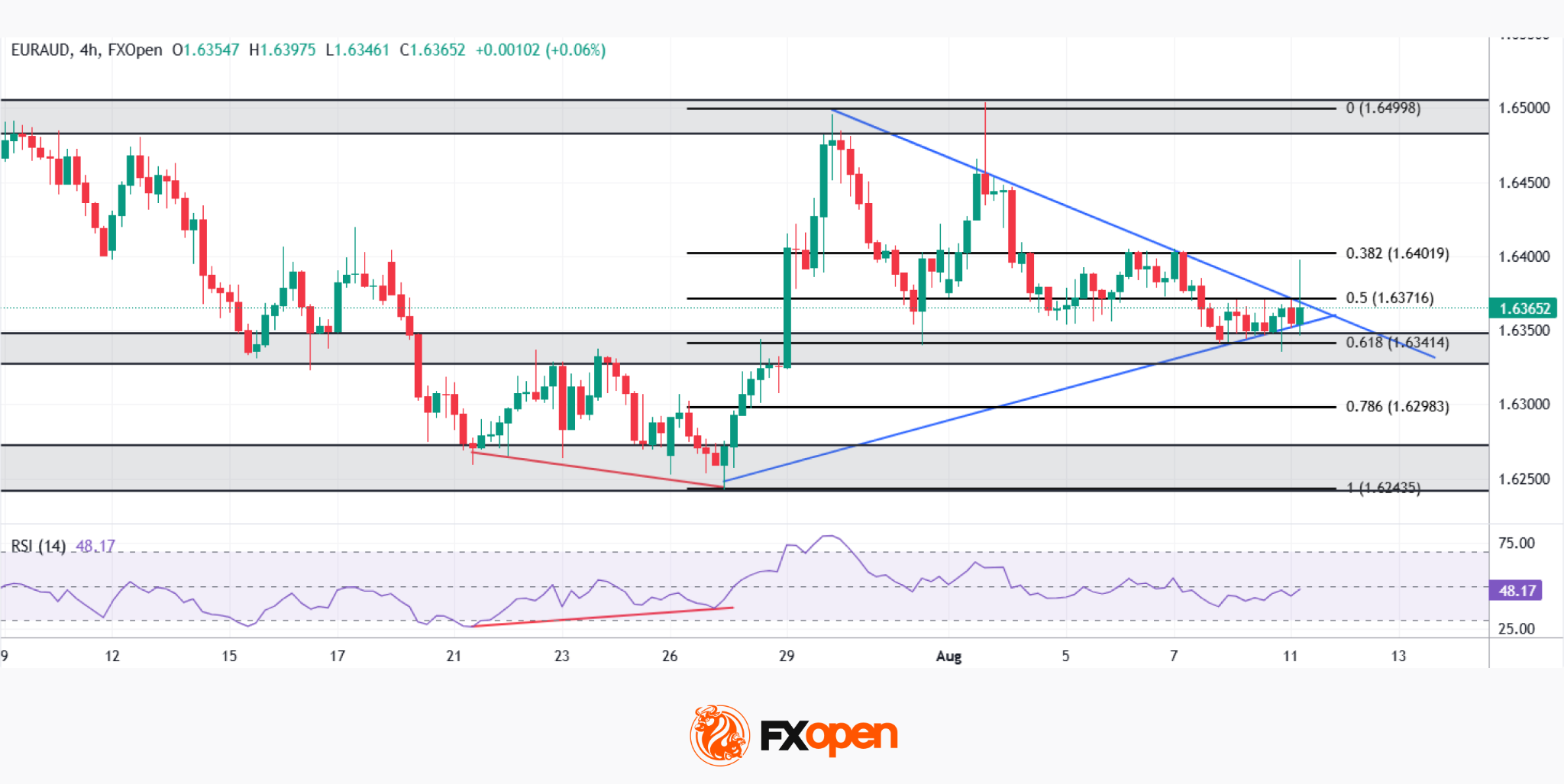
As EUR/AUD chart shows, the pair staged a strong rally from July's lows near 1.6243, a move that followed a bullish RSI divergence, where price carved a lower low while the RSI printed a higher low. Since topping near 1.6500 in late July, price has been compressing into a symmetrical triangle, with a descending trendline and an ascending trendline converging right around the 0.5-0.618 Fibonacci zone near 1.6342-1.6372.
Bullish Scenario
Should buyers defend the ascending trendline and break above the descending one, the path would open toward the 0.382 retracement near 1.6402, with a stronger move potentially targeting a retest of the 1.6500 highs if momentum builds.
Bearish Scenario
Conversely, a break below the ascending trendline and the 0.618 retracement near 1.6341 would expose the 0.786 level near 1.6298, with a deeper slide risking a retest of the 1.6243 low that anchored the entire July rally.
With price coiled right at the apex of this triangle, and the RSI sitting in neutral territory after cooling from its earlier divergence, EUR/AUD looks poised for a decisive break—will the euro extend its late-July strength, or does the Aussie reclaim the upper hand?
Trade over 50 forex markets 24 hours a day with FXOpen. Take advantage of low commissions, deep liquidity, and spreads from 0.0 pips (additional fees may apply). Open your FXOpen account now or learn more about trading forex with FXOpen.
This article represents the opinion of the Companies operating under the FXOpen brand only. It is not to be construed as an offer, solicitation, or recommendation with respect to products and services provided by the Companies operating under the FXOpen brand, nor is it to be considered financial advice.
Brent Is Following a Path of Demands Rather Than Commitments
- A deal to reopen the Strait of Hormuz is not inevitable.
- Oil prices are rising amid growing risks of an escalation of the conflict in the Middle East.
The US dollar continued to recover from losses caused by the jobs report, against a backdrop of rising geopolitical tensions in the Middle East with traders squaring positions ahead of key US inflation figures. Consumer prices are expected to rise by 0.1% and core CPI by 0.2% m/m, indicating a move towards the Fed’s target and lowering the risk of rate hikes. That could be another blow to the greenback.
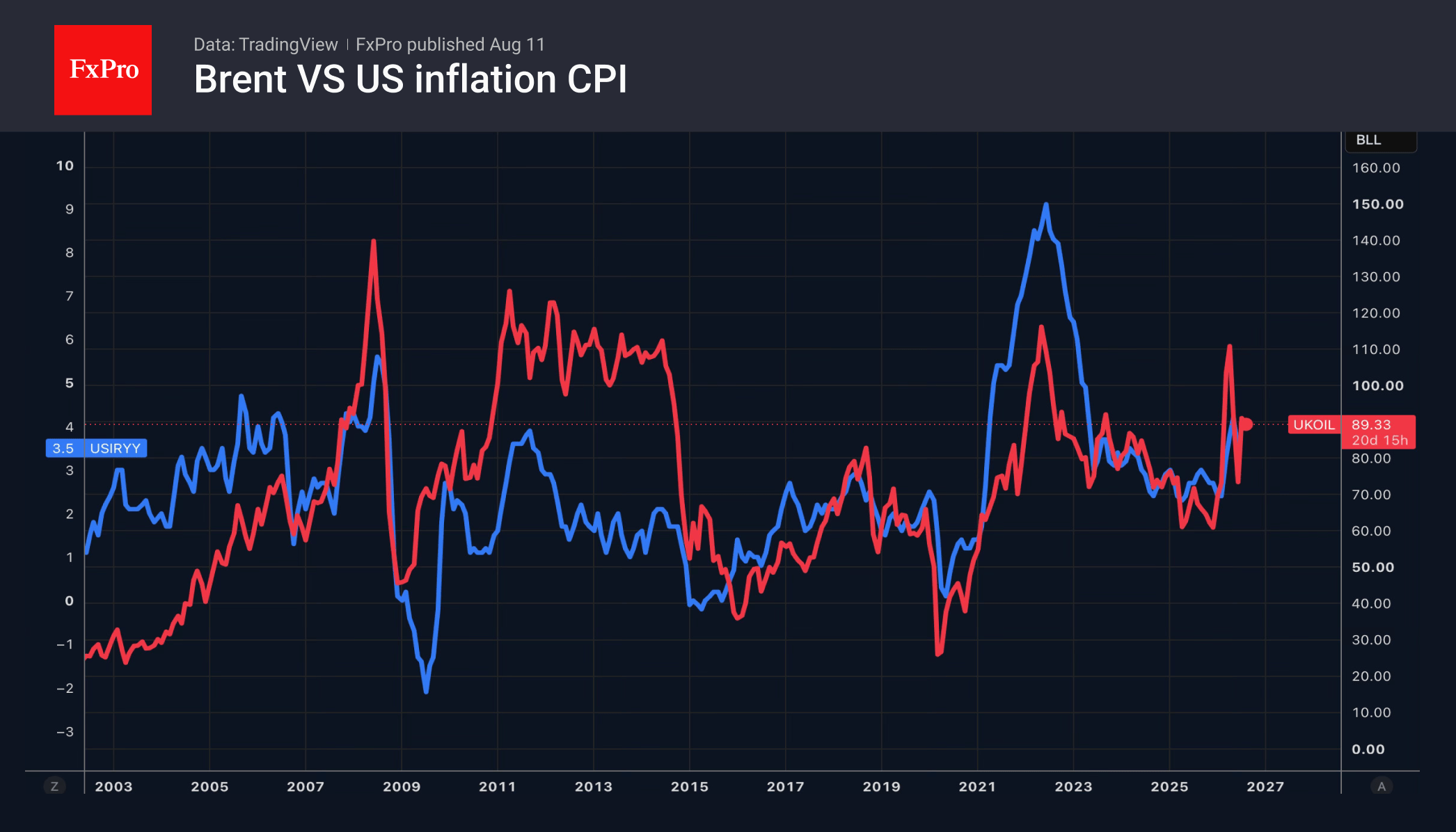
The conflict in the Middle East could cause a correction in consumer price trends. Previous forecasts by FOMC officials, who were banking on the federal funds rate remaining unchanged, assumed that the conflict would soon end. However, everything is heading towards a further escalation. Iran has demanded reparations, the withdrawal of US troops from the region, the lifting of sanctions and the return of frozen assets. In response, the US has set out its own onerous conditions. If the opposing sides continue to make new demands rather than commitments, the rally in Brent is likely to continue.
According to Capital Economics, North Sea crude will trade in the range of $80–90 per barrel, as a deal to reopen the Strait of Hormuz is not a foregone conclusion. Until there is a clear change to the status quo, Brent is set to consolidate. Meanwhile, drone attacks on oil infrastructure in Saudi Arabia and Libya are heightening the risk that the US will be forced to respond.
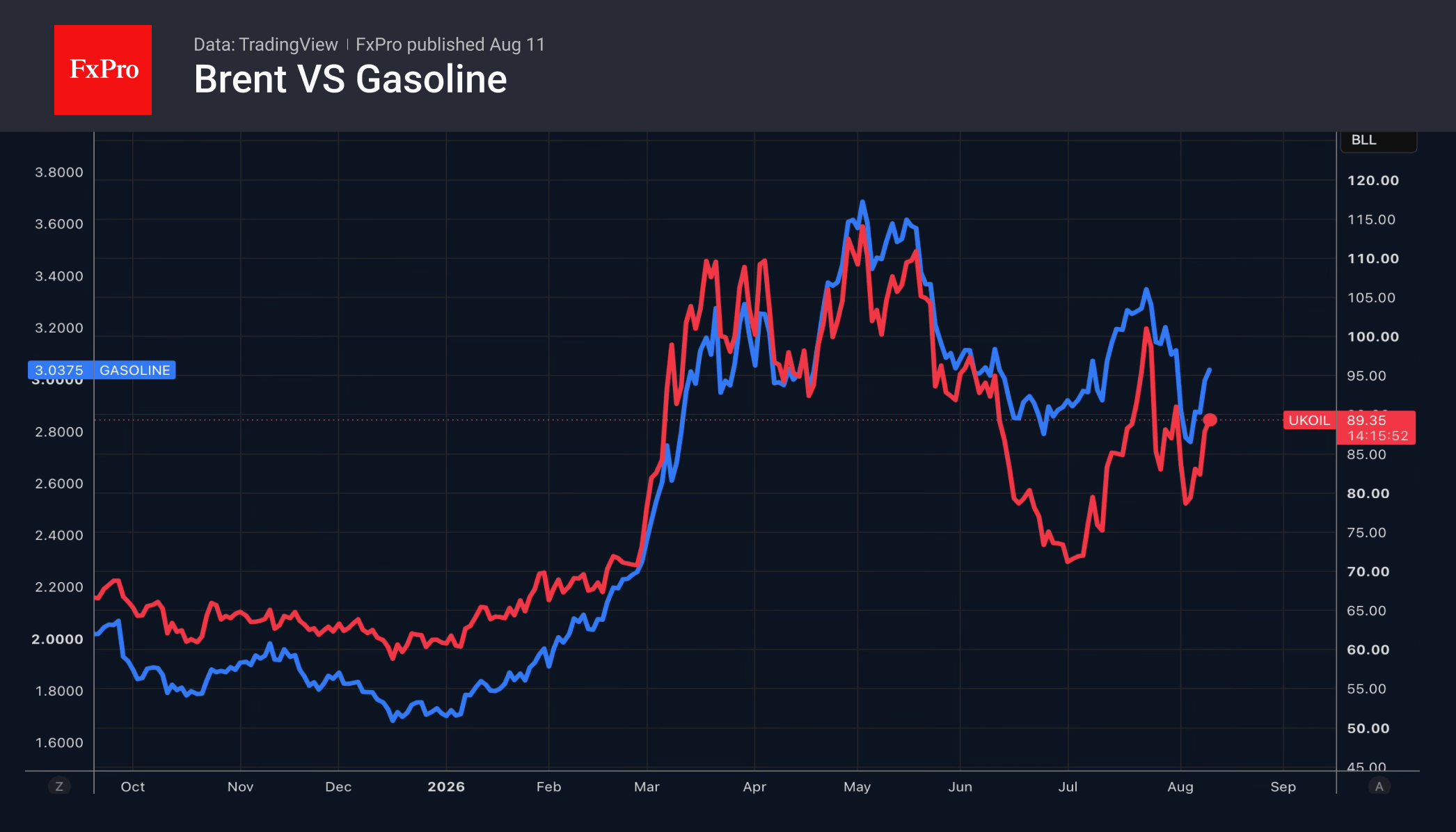
Brent’s fourth rise over the last five days is also driven by an increase in the intensity of Ukraine’s attacks on Russian oil refineries. This is pushing up petrol and diesel prices, boosting demand for crude oil and leading to higher futures prices.
The closure of the Strait of Hormuz, problems with the alternative oil supply route via the Red Sea, the gradual increase in Chinese demand and the reduction of global stocks to critical levels are creating a bullish market environment for crude oil. This heightens the risks of accelerating inflation in the US, pushes up Treasury bond yields, increases the likelihood of a federal funds rate hike and strengthens the US dollar.
The FxPro Analyst Team
Sterling’s Real Test Is June GDP — EUR/GBP Downside and GBP/CHF Upside in Focus
TL;DR: A hawkish BoE tailwind has lifted Sterling this week, but Thursday's June monthly GDP — not the flattering Q2 headline — will determine whether that hawkish drift can survive into September, with EUR/GBP downside and GBP/CHF upside both hanging on the answer.
Sterling Has a Hawkish BoE Tailwind — But Thursday Will Test It
Sterling has been mildly firmer against the Euro and Swiss Franc this week, helped in part by an increasingly hawkish tone inside the BoE. At the July 30 meeting, the MPC voted 6–3 to hold Bank Rate at 3.75%, with Megan Greene, Catherine Mann, and Huw Pill backing a hike to 4.00%. Governor Andrew Bailey remained cautious and played down expectations of an imminent move, but the direction of the voting pattern is hard to ignore.
Hawkish dissent has widened at every meeting this year:
- April: 8–1.
- June: 7–2.
- July: 6–3.
That's a more meaningful signal than a static minority repeatedly casting the same votes. It suggests the Committee is gradually moving closer to another hike, even if the majority isn't there yet. Put differently, the BoE is still holding, but hawkish pressure is building underneath that hold.
Oil Is Making the Policy Question More Urgent
The recent rise in oil adds urgency to that debate. The ECB has already tightened in response to energy-driven inflation pressure, while the BoE has so far stayed put. If crude remains elevated, higher energy costs will keep feeding into the UK inflation outlook and increase pressure on the MPC to prevent second-round effects from taking hold.
Still, the BoE cannot respond to oil in isolation. The key question is whether the domestic economy is strong enough to tolerate another increase. That's why Thursday's GDP data matter. Strong activity would give existing hawks more room to argue inflation risk deserves priority; a sharper slowdown would strengthen Bailey's and others' case for patience.
For Sterling, this relative policy backdrop matters most against currencies where central-bank divergence is clearer. EUR/GBP reflects whether the BoE can begin closing the gap with the ECB, while GBP/CHF has an even cleaner setup given expectations that SNB rates stay pinned near bottom for the foreseeable future.
Why Q2 GDP May Flatter the Underlying Picture
Headline Q2 GDP is expected to show 0.4% q/q growth, down from 0.6% in Q1 but still respectable given disruption from the Iran war. Yet that number may overstate underlying resilience.
Earlier in the quarter, manufacturers and clients front-loaded purchases to protect against expected price increases and supply disruption. S&P Global's May PMI commentary explicitly linked stronger output to that stockpiling behavior, while June data showed those effects fading. That means part of Q2 growth may simply have been activity pulled forward — so a 0.4% quarterly print can look healthy while masking a much weaker economy at quarter-end.
Why June Is the Number That Really Matters
That's why June monthly GDP may carry more information than the Q2 headline itself. June output is expected to fall -0.1% m/m, reversing May's 0.1% increase. By that point, much of the earlier front-loading had faded, making the monthly figure a cleaner read on how the economy was actually entering Q3.
If Q2 comes in around 0.4% but June contracts more sharply than expected, markets may conclude that resilience was temporary and dependent on stockpiling — giving BoE doves a stronger argument to resist tightening. If June instead holds up better than expected, the message would be much more supportive for Sterling, suggesting the economy retained momentum even after temporary war-related support faded, giving the hawkish bloc more room to expand in September.
So Thursday's real test isn't simply whether the UK grew in Q2 — it's whether the UK economy still had momentum once stockpiling stopped.
ActionForex's Technical View: EUR/GBP and GBP/CHF
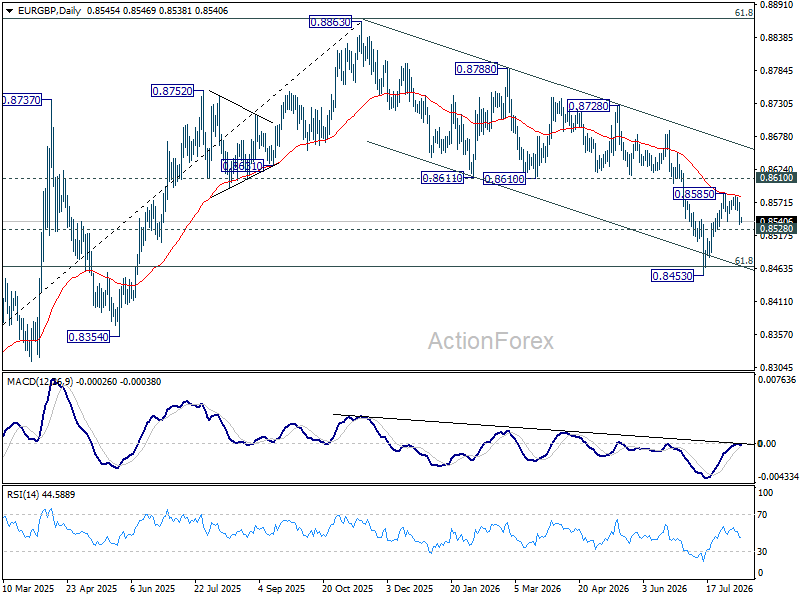
EUR/GBP has twice been rejected by the falling 55-day EMA, keeping the downtrend from 0.8863 intact. A break of 0.8528 minor support would suggest the rebound from 0.8453 has already run its course and bring a deeper fall back to retest 0.8453. A sustained break there would reopen the broader decline from 0.8863.
That technical setup would fit a stronger June GDP print particularly well. If the economy proves resilient enough to keep BoE hawks gaining ground, Sterling would have a clearer relative policy advantage against the Euro. On the other hand, a weak June print would weaken that argument and reduce pressure for another EUR/GBP leg lower.
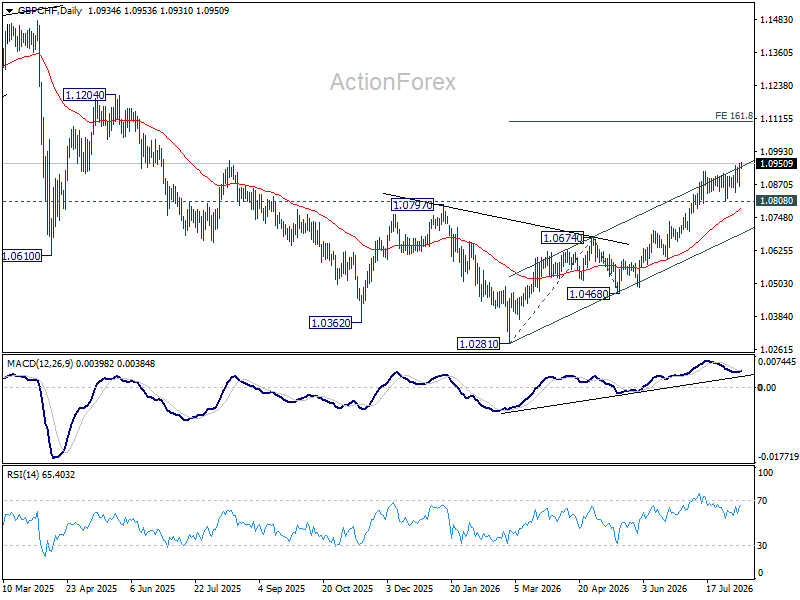
GBP/CHF may offer an even cleaner expression of Sterling strength because the SNB policy outlook is far less hawkish. The rally from 1.0281 is still in progress, although momentum has stalled near the rising channel ceiling. Further upside remains favored while 1.0808 support holds.
A decisive break through channel resistance would open scope for acceleration toward the 161.8% projection of 1.0281 to 1.0674 from 1.0468, at 1.1104. Loss of 1.0808 would instead argue the rally is entering a deeper correction.
Thursday Is Really About September
Q2 headline will get attention, but June could decide how markets frame the September BoE meeting. Three consecutive meetings of widening hawkish dissent show the Committee is drifting closer to tightening. Higher oil gives hawks more inflation ammunition — what they still need is evidence the economy can absorb another move.
A resilient June print would strengthen the case for EUR/GBP downside and GBP/CHF upside. A weak one would suggest Q2 strength was partly borrowed from earlier stockpiling, giving BoE doves stronger ground to push back.
Key Takeaways
- BoE hawkish dissent has widened at every meeting this year, from 8-1 in April to 6-3 in July, signaling gradual movement toward tightening even without a majority yet.
- Higher oil is adding inflation pressure the BoE can't ignore, but the Committee needs evidence the economy can absorb a hike before acting on it.
- June monthly GDP (forecast -0.1% m/m) matters more than the flattering 0.4% Q2 headline, since Q2 strength was partly inflated by stockpiling that faded by June.
- A resilient June print would support EUR/GBP downside toward 0.8453 and GBP/CHF upside toward 1.1104; a weak print would favor BoE doves and undercut both trades.
- Thursday's data matters most for how it shapes September BoE expectations, not for the Q2 headline number itself.
Corporations Are Returning Bitcoin to the Retail Investors
Market Overview
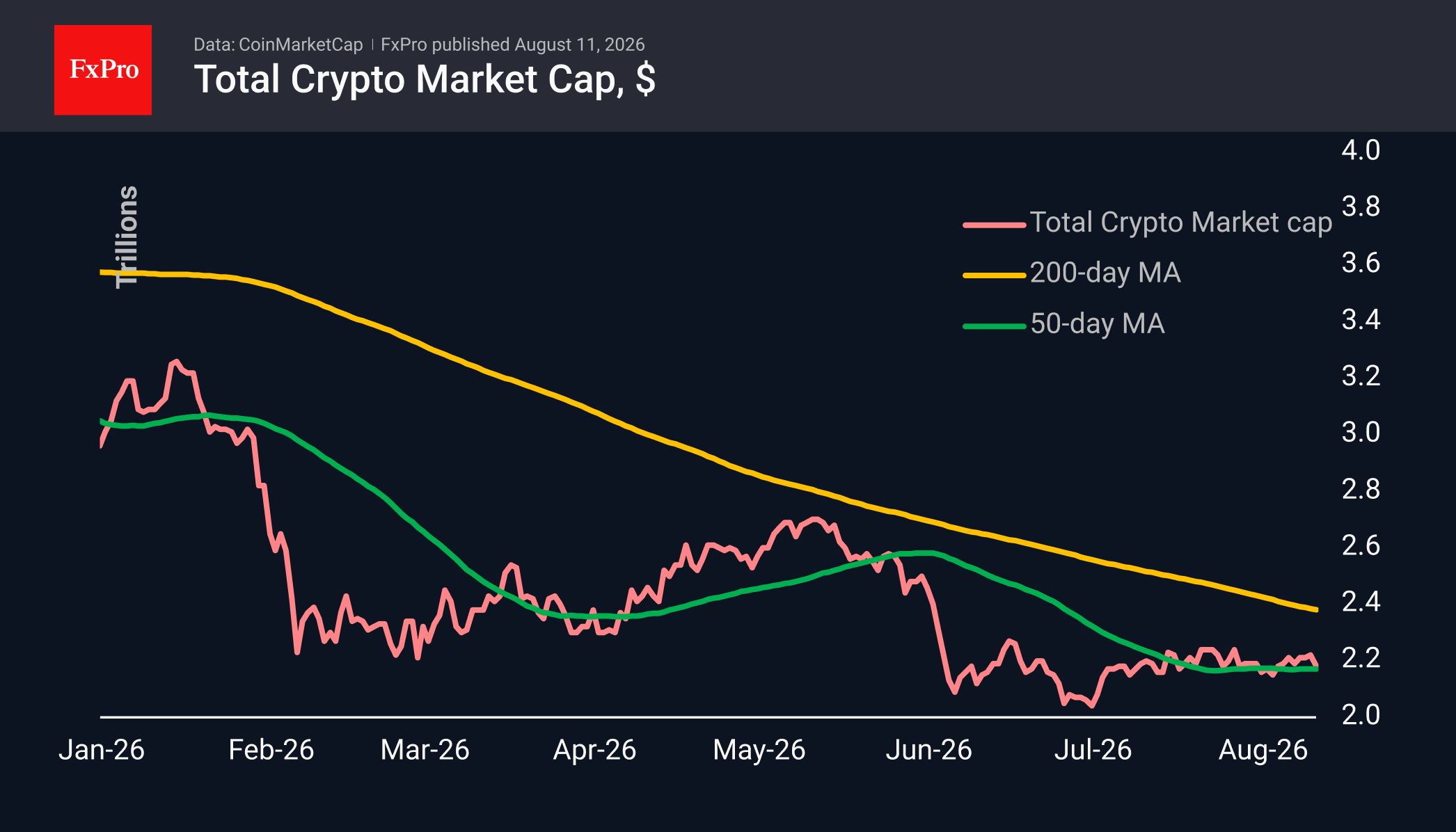
Over the past 24 hours, the crypto market has fallen by 2% to $2.18T, once again failing to establish a firm upward trend. Fundamental and psychological pressure on the market is being exerted by the shift towards AI among those companies which, in their desire to be at the forefront, had previously championed cryptocurrencies, from holders led by Strategy to miners such as MARA. Although there are buyers, it is clear that institutional investors are currently focused on selling the leading cryptocurrency to build up liquidity or switch to AI. At the start of the week, the cryptocurrency market was under widespread pressure, with the ratio of rising to falling coins at approximately 1:10. Gainers include Internet Computer (+4.6%), Chainlink (+2.5%) and Cosmos (+1.2%). The three worst-performing among the most liquid coins are Cardano (-5%), Zcash (-4.2%) and Aave (-4.1%).
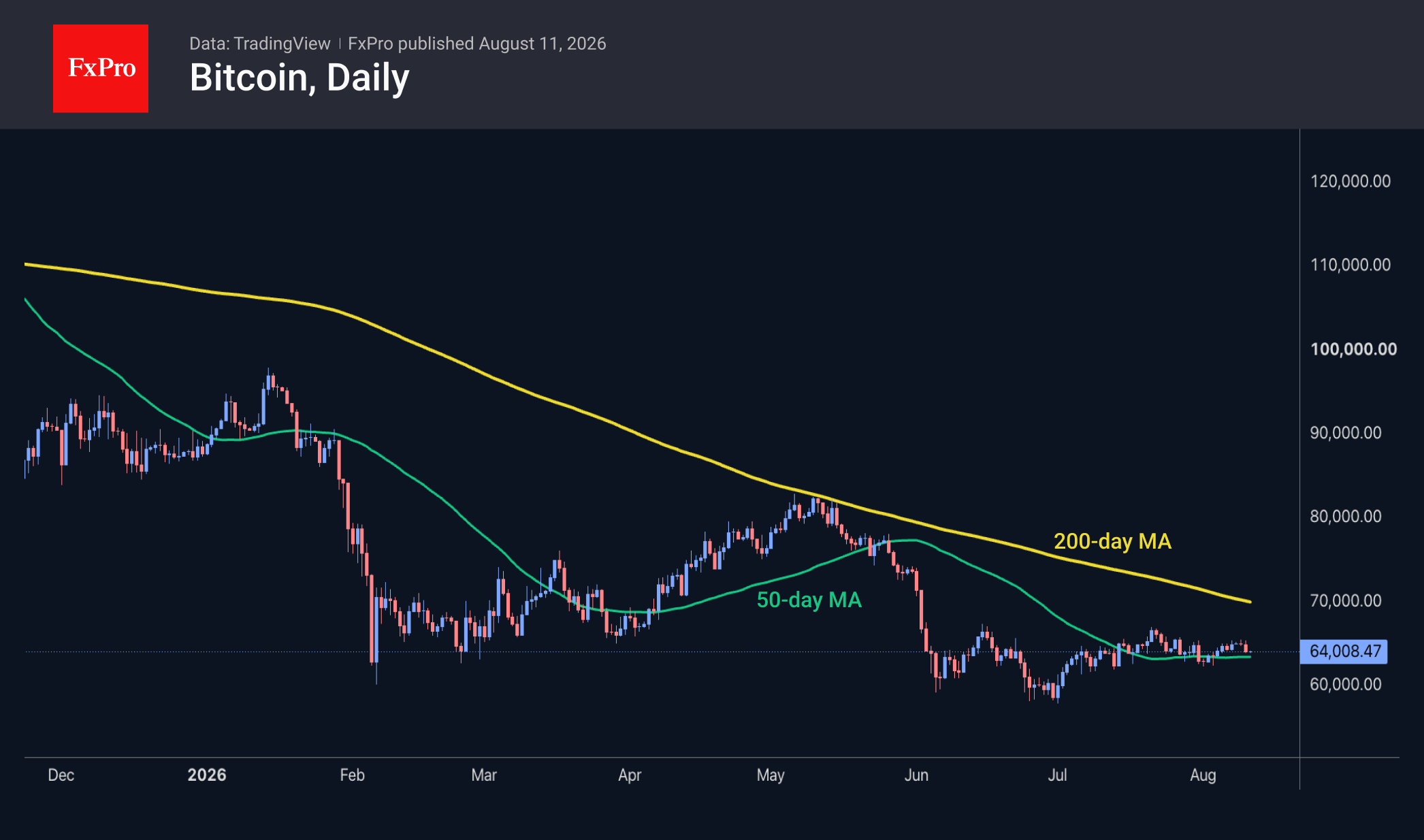
Bitcoin lost 2%, retreating to $64K. The price is trading just above the 50-day moving average, which has been moving almost horizontally for the past three weeks. This is clear evidence of a delicate balance of power, within which a transfer of value from businesses to investors is likely taking place. For the stock market, this often leads to losses for the latter. In cryptocurrencies, the opposite has historically been the case: retail investors created the hype, and at a certain point, it was beneficial for corporations’ image to join the trend. Now, corporations are keen to focus on other areas, which risks accelerating the liquidation of BTC positions in the coming weeks, but in the long term, it returns cryptocurrencies to their ideological roots.
News Background
Bitcoin has already approached the break-even point for short-term holders, according to analyst Darkfost. He states that the asset must offer a return that is attractive enough to encourage investors to hold their positions or enter the market, but not so high as to discourage them.
Cryptocurrency investment firm Grayscale has withdrawn its registration applications for ETFs based on Cardano, Hedera and Polkadot. Grayscale is still awaiting full approval for exchange-traded products based on Bittensor, Aave, BNB, NEAR and Zcash.
In the first half of the year, the miner MARA sold 23,093 BTC for approximately $1.6 billion. The proceeds were used to fund operations, support growth and manage liquidity.
Strategy sold 1,690 BTC ($108.6 million) last week. The proceeds were used to repurchase STRC preference shares. The dollar reserve increased by $650 million to $4.65 billion through the sale of MSTR shares. Strategy’s reserves fell to 840,447 BTC. Over the past six weeks, Strategy has sold a total of 6,916 BTC for $429.35 million.
Sweden’s H100 Group has increased its Bitcoin reserves to 3,506 BTC after completing the previously announced acquisition of NSD and receiving an additional 2,455.37 BTC.
The FxPro Analyst Team
Gold Rallies: Long-Awaited Rise and Growing Safe-Haven Demand
Gold rose to 4,400 USD per ounce on Tuesday, reaching a two-month high. Demand for the precious metal is growing rapidly, even amid heightened inflation risks and expectations of higher interest rates driven by elevated oil prices.
Chinese institutional investors continue to build positions in gold as a defensive asset amid heightened volatility in other markets. China’s gold-backed ETFs are recording their longest run of inflows in months.
The People’s Bank of China is also supporting the market. In July, the regulator increased its gold reserves by approximately 20 tonnes, following an increase of around 15 tonnes in June – the largest monthly addition since October 2023.
At the same time, uncertainty persists around a potential US–Iran agreement that could end the conflict and reopen the Strait of Hormuz. Investors are also awaiting key US inflation data this week, which could shift expectations for future Federal Reserve policy.
Technical Analysis
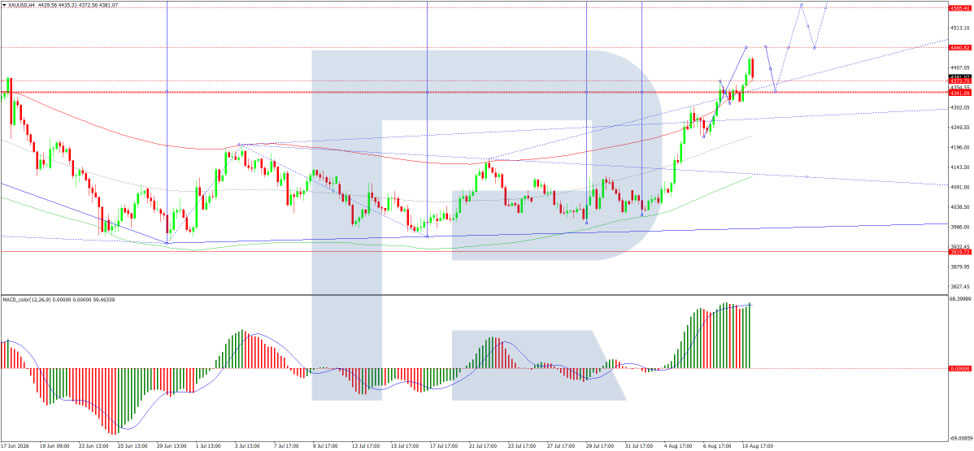
On the H4 XAU/USD chart, the market formed a consolidation range around the 4,341 USD level and, following an upside breakout, moved higher to 4,435 USD. A consolidation range is now forming below this level. A move lower towards 4,370 USD is expected next, with a possible extension to 4,340 USD. A further rise towards 4,575 USD is anticipated as the local upside target. The MACD indicator signals the early stages of bearish momentum, with its signal line above the centre line at recent highs and beginning to turn downwards.
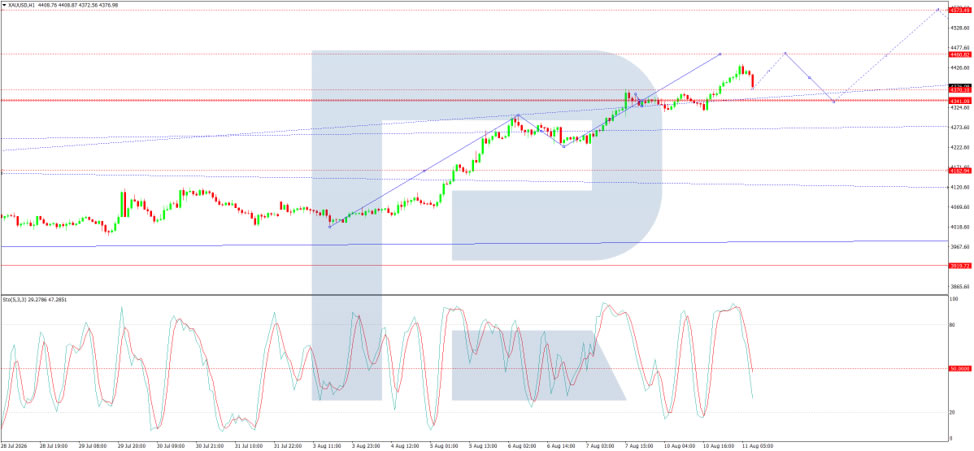
On the H1 chart, the market broke above the 4,371 USD level and moved higher to 4,435 USD, followed by a correction to test 4,371 USD from above. A broad consolidation range is forming around 4,371 USD. A move higher towards 4,460 USD is expected, followed by a decline to 4,371 USD. The Stochastic oscillator confirms this scenario, with its signal line below 50 and pointing downwards towards 20, indicating increasing short-term downside pressure.
Conclusion
Gold has rallied to a two-month high, driven by robust demand from Chinese institutional investors and the People’s Bank of China’s continued reserve accumulation. Despite rising inflation risks and expectations of higher interest rates, the metal’s appeal as a defensive asset has strengthened amid market volatility. Uncertainty over a potential US–Iran agreement and the outlook for the Strait of Hormuz, along with upcoming US inflation data, continues to keep markets on edge. Technically, gold may see a short-term pullback towards 4,340–4,370 USD before potentially resuming its uptrend towards 4,575 USD. The metal’s near-term direction will depend on geopolitical developments and US monetary policy expectations.
RBA Holds at 4.35%, Narrows Risk of Hikes
RBA on hold as expected, recognising the data has broken against its hawkish narrative. Base case clearly an extended period on hold, but RBA will hike if upside risks to inflation materialise.
- As widely expected, the RBA Monetary Policy Board (MPB) kept the cash rate on hold at 4.35% at its August meeting. The accompanying statement highlighted that the MPB is prepared to increase the cash rate from here, if upside risks to inflation materialise. This is more specific and narrower language than in May, when it was stated that the cash rate would be increased "if needed".
- The RBA has evidently concluded that the base case is that rates are on hold. Headline and trimmed mean inflation have both come in lower than the RBA expected in May, and the labour market and housing market are both weaker than it expected. Pass-through of higher energy prices came in quickly and in size – as we flagged at the time. But as we noted in our change of rate call, this pass-through has since tapered off, undershooting the RBA's expectations.
- This decision is a hold of a different character to June's meeting, where a hike was not even contemplated because the MPB was in "wait and see" mode ahead of the Q2 CPI. This month's decision involved consideration of a hike, but the base case forecasts, which show inflation below the target midpoint by 2028, did not really support such a decision.
- Softer inflation and labour market outcomes have strengthened the assessment that monetary policy is somewhat restrictive, a judgement the RBA had less confidence about earlier in the year. Still, the RBA is looking for a period of below-trend growth, and ultimately some spare capacity to build up, to engineer the reduction in inflation. Currently its forecasts show the economy to be on track to deliver that outcome.
- The MPB is not yet ready to rule out rate hikes, however, because it assesses that inflation risks are skewed to the upside. It is particularly concerned that pass-through from energy prices to other prices might continue, even though it has eased off a bit sooner than originally expected. Further escalation in the Middle East conflict might result in higher energy prices than forecast, and/or more pass-through. These are similar considerations to the ones that led us to flag that there was still some chance that the RBA hikes again this cycle, even though that is no longer our base case.
- The RBA still assesses the labour market to be somewhat tight, although it has eased recently. However, some of the measures the RBA typically relies on for this assessment have been affected by changes to the Labour Force Survey; measures that do not involve this survey such as capacity utilisation and business difficulty finding suitable labour provide a clearer easing signal. The SMP highlights underemployment as supporting the assessment that the labour market is still tight. As we have previously noted, other measures of underemployment published by the ABS have increased more sharply than the headline measure. The RBA's evolving assessment of labour market conditions will be a key driver of its inflation outlook, arguably more so than the housing market, which is also being affected by changes to taxation arrangements.
- The RBA's underlying analysis that capacity pressures are boosting inflation and constraining output growth remains in place. Although the RBA's assessment of potential output growth is a little higher than in recent quarters, the revision was driven solely by a revised outlook for population growth. The RBA's downbeat assumptions about trend productivity growth have not changed, despite extensive language in the SMP highlighting the boom in AI and data centre investment, which has been stronger than its forecasts recognised in May.
- Curiously, the SMP highlighted the inflationary risks posed by the AI boom pressuring construction capacity at home and semiconductor-related inflation globally, despite not factoring in any positive productivity spillover from the resulting investment. While productivity benefits would be expected to come through with a lag, how long this was expected to take was not addressed. We also find it curious that the SMP and Governor highlighted the contention for construction labour and other resources this involves, but the effects of this are only barely evident in its GDP forecasts. This implies a view that data centre construction must be crowding out other construction.
- We continue to expect the RBA to remain on hold through to mid next year. However, it will be a "hawkish hold" with the MPB slow to relax given its view that upside inflation risks predominate. While we believe that investors should allow for some risk of a hike later this year, it is not our base case. There are clearly upside risks to inflation, as the RBA has highlighted, but in our view downside risks as well.
Ethereum Analysis: Attempted Breakout from the Sideways Structure
Easing concerns over the situation in the Strait of Hormuz provided support for risk-sensitive assets. On 8 August, the Iranian side reported progress in talks with Oman over a possible new route through the strait, although the implementation of any agreement remains dependent on additional conditions. Reduced concerns over potential disruptions to energy supplies helped improve investor sentiment, although uncertainty surrounding the region continues to create the potential for increased volatility.
Technical Analysis of Ethereum
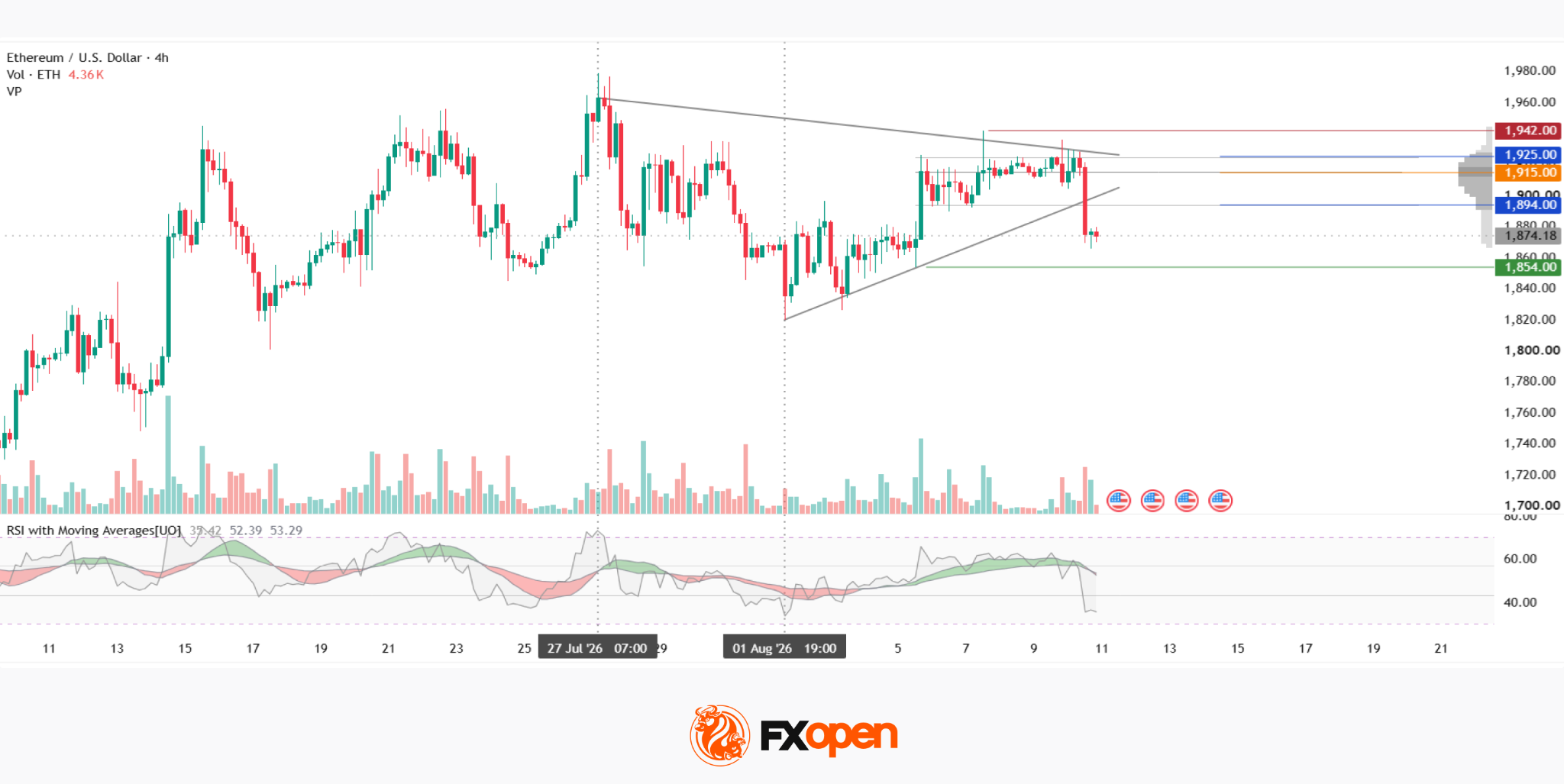
The ETH/USD technical picture shows that after peaking around $1,975 in late July, the price formed a pattern resembling a contracting triangle. The breakout occurred on 10 August, when a large red candle broke below both the triangle's lower boundary and the lower boundary of the current market profile at $1,894, creating the conditions for a downside move out of the pattern. As a result, the price moved into the zone between the lower profile boundary and the green support level at $1,854. Continued selling pressure could pave the way for a test of this area.
If the trend reverses and the price returns to the profile range, market participants should focus on the area comprising the POC at $1,915 and the upper profile boundary at $1,925. Above these levels lies the red resistance level at $1,942. It is also worth noting that the breakout was accompanied by an increase in volume, indicating stronger selling activity at that point. Following the decline, the RSI + MAs indicator shows readings of 32, 52 and 53. The oscillator has moved out of the neutral zone, while the moving averages remain some distance from crossing below its lower boundary.
Summary
Geopolitical developments surrounding the Strait of Hormuz remain one of the key factors influencing sentiment across the cryptocurrency market, while the breakout from the contracting triangle on 10 August pointed to increased selling pressure in the short term. Ethereum's further performance will depend on how the market responds to the latest news flow.
FXOpen offers the world's most popular cryptocurrency CFDs*, including Bitcoin and Ethereum. Floating spreads, 1:2 leverage — at your service (additional fees may apply). Open your trading account now or learn more about crypto CFD trading with FXOpen.
*Important: At FXOpen UK, Cryptocurrency trading via CFDs is only available to our Professional clients. They are not available for trading by Retail clients. To find out more information about how this may affect you, please get in touch with our team.
This article represents the opinion of the Companies operating under the FXOpen brand only. It is not to be construed as an offer, solicitation, or recommendation with respect to products and services provided by the Companies operating under the FXOpen brand, nor is it to be considered financial advice.
Sunrise Market Commentary
Markets
Core bonds sold off yesterday with the belly of the curve slightly underperforming in the US while European curves showed more of a bear flattening. Daily changes on the US curve varied between +4.7 bps (2-yr) and +6.4 bps (7-yr). The US 30-yr yield is again within reach of the multi-annual high reached end July (5.25% vs 5.28%) which raises the stakes for the Treasury's mid-month refinancing operation later this week (including 10-yr Notes & 30-yr Bonds). The 2-yr yield (4.25%) now fully reversed the initial decline on Friday's disappointing US payrolls report (4.23% to 4.15%). Recall that the US economy lost 23k jobs in July according to BLS data with May and June numbers being downwardly revised by a cumulative 103k. They prompted a rethink of September Fed rate hike bets. However, following the Pavlov reaction markets soon recovered in a clear sign that the inflation narrative is still way more important than the employment story. Cleveland Fed Hammack, one of three dissenters in favour of a rate hike at the July FOMC meeting, repeated her call that now is the time to act. In this respect, focus turns to July US CPI (Wednesday) and PPI (Thursday) data while the US/Iran stalemate keeps oil prices (Brent $88/b from $82 close last Friday) elevated. Iran still refuses direct talks with the US, upping its conditions for talks as president Trump moves away from military action towards renewed economic pressure. Trump on his part made sweeping new demands including casualty compensation. The European reference gas contract (Dutch TTF) rose from €55/MWh to €62 with Ukraine hitting a major oil refinery deep inside Russia. The main move on FX markets occurred in JPY-crosses where the yen succumbs to new selling pressure following the intervention relief at the end of July. USD/JPY moved from 157.50 to >159 as markets seem to want to test Treasury Secretary Bessent's pledge to do "whatever it takes" to support Japan in a way that helps the US economy, the US taxpayer and stabilizes the global economy. After the joint Japanese/US efforts, focus also turns to the Bank of Japan to give JPY more (interest rate) backing. BoJ governor Ueda last week accordingly explicitly stated that the policy rate would be raised soon after September while the pace of interest rate hikes could be accelerated if necessary. There was less action in other market pockets yesterday with EUR/USD holding a tight range near 1.1550 and main equity markets hovering sideways near recent (all-time) highs. Today's eco calendar is empty apart from US NFIB small business optimism, suggesting that yesterday's market themes will remain dominant.
News & Views
The Reserve Bank of Australia kept its policy rate unchanged at 4.35% this morning. Australian inflation remains too high with both domestic capacity pressures and the disruption to global oil supply keeping prices elevated. There are also indications that higher fuel prices are being passed through to prices of other goods and services. Inflation is not expected to return to the midpoint of the 2%-3% inflation band until late 2027 with upside risks around this projection. If these materialize, the RBA will increase its policy rate further. The RBA nevertheless acknowledges for the first time that monetary policy is currently somewhat restrictive, while also signaling that consumer spending growth is slowing gradually in response to three rate hikes earlier this year. It suggests that the bar to implement another rate hike is somewhat higher, with a preference to keep a wait-and-see stance. Momentum in the housing market has also shifted, with housing prices falling in some capital cities and new housing loans declining noticeably. Apart from tighter policy, an overhaul of property taxation (May Budget) and macroprudential measures are having their effect. Labor market conditions have eased more than expected, though leading indicators only point to some limited additional easing. Growth in business debt and investment is strong. New RBA forecasts still show weaker growth ahead, but a slightly more resilient economy. The inflation path is slightly lower. The Aussie dollar lost marginal ground after the decision with AUD/USD dipping from 0.7060 to 0.7040. The market implied probability of a final RBA rate hike around the turn of the year remains broadly unchanged at 50%-60%.
Oil Climbs on Renewed Uncertainty
In focus today
Today is very quiet in terms of data releases, with focus on the US NFIB Small Business Optimism Index for July. The index rose to a four-month high of 97.4 in June, supported by stronger expectations for business conditions and real sales. Following the weak July jobs report, it will be interesting to see whether small businesses have become more cautious.
Economic and market news
What happened overnight
In Australia, the Reserve Bank of Australia (RBA) maintained its cash rate at 4.35% this morning in line with consensus and market pricing. After three rate hikes during the spring, RBA is unlikely to tighten its policy rate further at the coming meetings.
What happened yesterday
In commodities, Brent crude climbed to USD87/bbl as hopes faded once again for a near-term resolution to the US-Iran conflict and the reopening of the Strait of Hormuz. Negotiations over the key shipping route have stalled, with President Trump's latest demands on war compensation adding further uncertainty to the prospect of a deal. The demands, which include calls for Iran to compensate those killed in wars, attacks and protests, came in response to Iran's demands over the weekend.
In the euro area, the August Sentix Investor Confidence increased for a fourth consecutive month, moving into positive territory at 0.9 (cons.: -0.5, prior: -3.1). The reading was the highest since the onset of the war in the Middle East. The improvement was driven mainly by a sharp rise in the current conditions assessment, while expectations also edged higher. The release suggests recovery momentum is continuing, although high energy costs and subdued order books remain headwinds.
In Norway, July core inflation surprised to the downside at 2.7% y/y, below our estimate and consensus at 2.9% as well as Norges Bank's June forecast of 3.3%. The downside surprise was mainly driven by a smaller-than-expected rebound in information and communication technology prices and slightly lower food prices. We now expect Norges Bank to stay on hold at 4.25% on Thursday, with a growing probability that rates have peaked.
In Denmark, headline inflation declined to 1.7% y/y in July from 1.9% in June, below our expectation of an unchanged reading. Base effects from food and energy prices pulled inflation lower, only partly offset by seasonal price increases for holiday centres and camping sites. The downside surprise was mainly driven by housing equipment and hotels. Food prices increased 1.6% m/m, above the July average, suggesting the recent price war has slowed.
Equities: Global markets had a quiet start to the week, with volatility indices low, but beneath the surface the message was less calm. Oil was the dominant macro variable for yesterday's moves. The S&P 500 closed basically flat, while Nasdaq was down 0.3%. However, the rotation was clearly towards the defensives. Energy benefited from the oil move and ended 4.6% higher in the US, while tech was down 1.1%. Nvidia fell after reports that they are working on a USD500bn AI funding package. Overnight, Asian equities are mostly in green and US futures are also pointing to a positive opening.
FI and FX: The biggest move yesterday was the JPY which saw a big drop. Consequently, USD/JPY rose above 159 and undid the effect of recent FX intervention efforts. The catalyst looked like a combination of the rise in oil prices and rising interest rates, i.e., the 2Y US swap rate rose back to around the level from Friday before the release of the jobs report. EUR/USD edged slightly lower yesterday as the broad USD gains weighed on the pair. NOK briefly bounced higher and short NOK rates dropped after the CPI release in Norway showed surprisingly low inflation easing expectations of more interest rate hikes from Norges Bank.
RBA Accepts Softer Inflation but Still Leaves Scope for One More Hike
RBA accepted that inflation has improved, but refused to turn that improvement into a declaration that rate hikes are finished. Cash rate was left unchanged at 4.35% unanimously, yet Board described policy as only “somewhat restrictive” and explicitly kept another increase on table, saying it could still raise rates “if upside risks materialise.” That is the clearest way to read Tuesday’s decision: softer inflation bought RBA time, not an all-clear.
New forecasts make that tension unusually visible. RBA cut June 2026 headline CPI forecast from 4.8% to 3.9% and December projection from 4.0% to 3.6%. Trimmed mean was lowered from 3.8% to 3.6% for June and from 3.5% to 3.3% for December. But Board did not carry that improvement forward aggressively. June 2027 headline inflation was revised up from 2.4% to 2.8%, with December raised from 2.4% to 2.6%. Trimmed mean was only marginally lowered from 3.1% to 3.0% for June 2027 and stayed at 2.6% for December. In other words, RBA believes current inflation picture is better than feared, but still does not trust disinflation enough to bring target return materially forward.
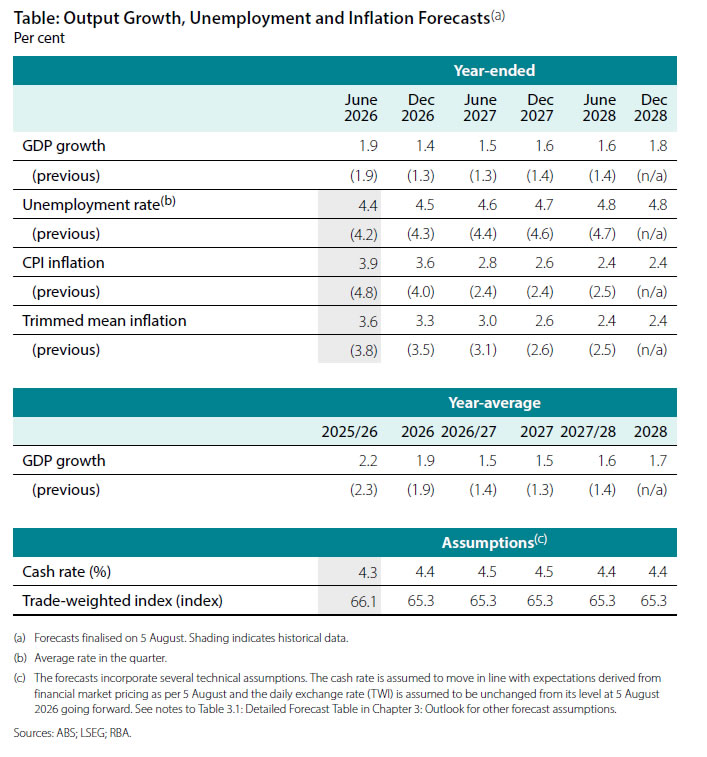
That explains why statement retained a tightening bias despite signs economy is responding. RBA said “headline inflation is still too high”, warned higher oil costs are feeding through to other prices, and noted inflation is not expected to return to around midpoint of target band until late 2027. Yet there is also clear evidence previous hikes are biting: consumer spending is slowing, housing prices have fallen in some capitals, new housing lending has weakened and labour conditions have eased more than expected. Unemployment forecasts were lifted from 4.2% to 4.4% for June 2026 and from 4.3% to 4.5% for December, even as later GDP forecasts were nudged higher.
The technical cash-rate assumption completes picture. RBA projections are built around a market path that rises toward 4.5%, meaning forecast convergence of inflation toward target is not based on 4.35% being held forever. That is a meaningful hawkish signal. RBA is saying current rate is restrictive enough to pause and watch, but not restrictive enough to declare victory.
For markets, that means tightening bias clearly survived Tuesday’s meeting. AUD bulls did not get a fresh hike signal, but AUD bears also did not get confirmation that peak rates are firmly in place.
Summary
RBA Decision
| Item | Decision / View |
|---|---|
| Cash rate | Held at 4.35% |
| Decision | Unanimous |
| Policy stance | “Somewhat restrictive” |
| Inflation assessment | “Still too high” |
| Tightening bias | Further hike possible if upside risks materialise |
| Technical cash-rate assumption | Rises toward 4.5% |
Key Forecast Revisions
| Forecast | August SoMP | Previous |
|---|---|---|
| CPI — Jun 2026 | 3.9% | 4.8% |
| CPI — Dec 2026 | 3.6% | 4.0% |
| CPI — Jun 2027 | 2.8% | 2.4% |
| CPI — Dec 2027 | 2.6% | 2.4% |
| Trimmed mean — Jun 2026 | 3.6% | 3.8% |
| Trimmed mean — Dec 2026 | 3.3% | 3.5% |
| Trimmed mean — Jun 2027 | 3.0% | 3.1% |
| Trimmed mean — Dec 2027 | 2.6% | 2.6% |
| Unemployment — Jun 2026 | 4.4% | 4.2% |
| Unemployment — Dec 2026 | 4.5% | 4.3% |
| Unemployment — Jun 2027 | 4.6% | 4.4% |
Key Takeaways
- RBA unanimously held cash rate at 4.35%, but tightening bias clearly survived.
- Board accepted softer near-term inflation, cutting June 2026 CPI forecast from 4.8% to 3.9% and trimmed mean from 3.8% to 3.6%.
- However, RBA did not translate softer inflation into a substantially faster return to target. June 2027 headline CPI was actually revised from 2.4% to 2.8%.
- Policy was described as only “somewhat restrictive”, rather than sufficiently restrictive, while Board explicitly retained option of raising rates again if upside risks materialise.
- Technical forecast assumption has cash rate moving toward 4.5%, reinforcing that projected disinflation is not based on 4.35% being held indefinitely.
- Labour outlook weakened, with unemployment forecasts raised across near-term horizon, confirming previous tightening is already slowing economy.
- Overall message is a hawkish hold: RBA accepted better inflation data but is not yet prepared to declare tightening cycle finished.