Sample Category Title
GBP/USD Analysis: Weak US Labour Market Data Pushes the Pair Higher
The pair gained momentum following the release of the US labour market report for July 2026 on 7 August. Non-farm employment fell by 23,000 jobs, compared with a forecast for an increase of 80,000 jobs among economists surveyed by Reuters. Employment data for May and June were also revised downwards, according to the Bureau of Labor Statistics. The dollar responded with broad-based weakness. Earlier, on 30 July, the Bank of England kept its interest rate at 3.75% by a six-to-three vote, with three members of the committee voting for a rate hike. The regulator’s decision also highlighted inflation risks associated with volatility in energy prices.
Technical Analysis of GBP/USD
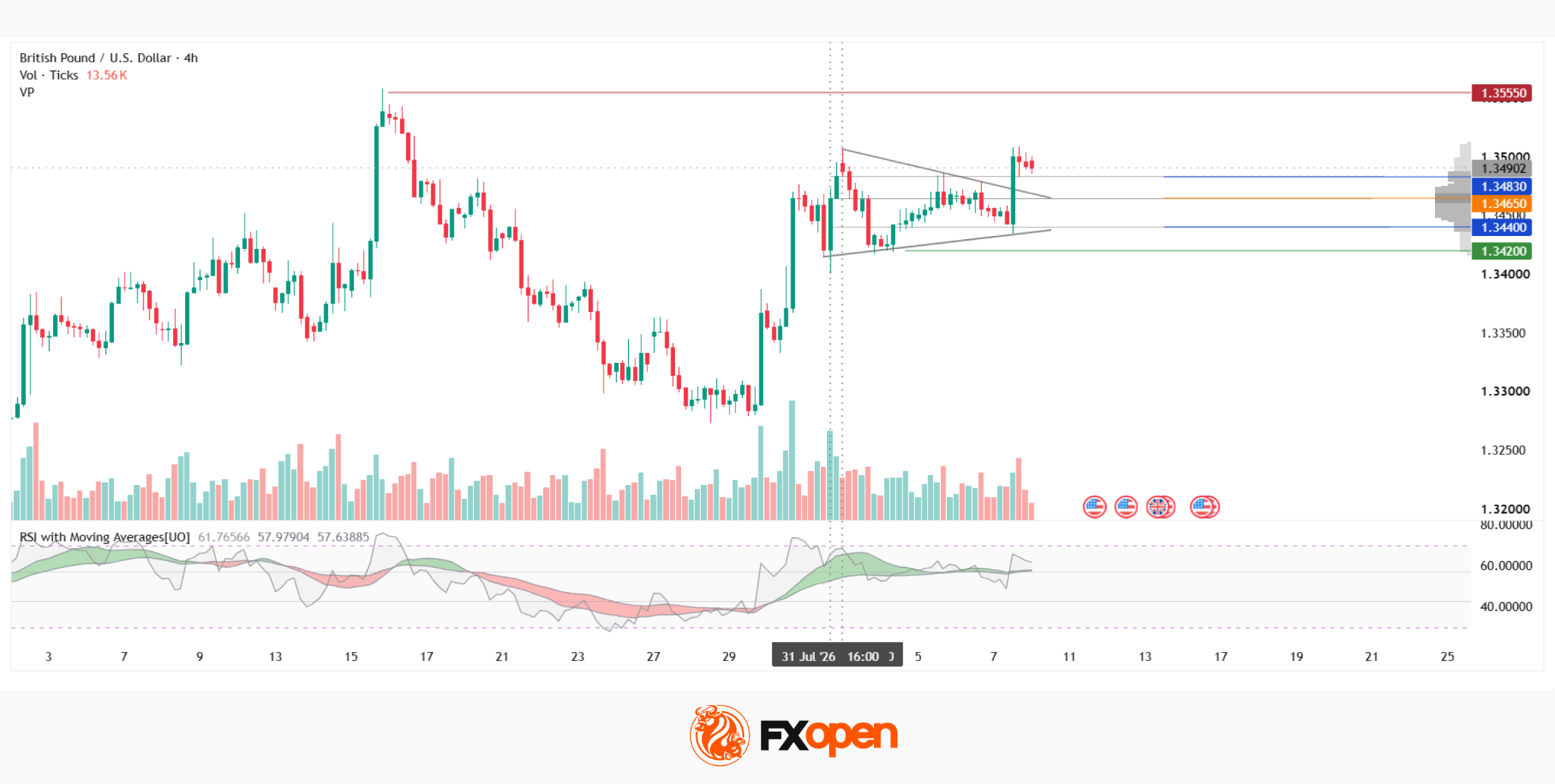
After a sharp rise from around 1.3280 towards 1.3500 in late July, the pair entered a narrowing range between the upper and lower boundaries of the current profile at 1.3483 and 1.3440, respectively. The two boundaries gradually converged, forming a pattern resembling a contracting triangle. The green impulse candle subsequently broke above the pattern’s upper boundary, while the price is attempting to establish itself above both the trendline and the profile boundary. If the bullish scenario develops, the price could move towards the red resistance level at 1.3555.
If the current breakout from consolidation proves to be false and the price returns inside the profile, the POC at 1.3465 and the lower profile boundary at 1.3440 will regain their importance for market participants. Below these levels lies the green support area at 1.3420. The RSI + MAs indicator shows three readings of 61, 57 and 57. All three values are above the neutral zone, while the moving averages are coloured green. It is also worth noting that vertical volume has declined compared with the late-July impulse.
Summary
The attempt to break above the triangle’s upper boundary could open the way towards a test of the red resistance area at 1.3555, but the sustainability and potential of the move may also depend on the flow of further US economic data.
Trade over 50 forex markets 24 hours a day with FXOpen. Take advantage of low commissions, deep liquidity, and spreads from 0.0 pips (additional fees may apply). Open your FXOpen account now or learn more about trading forex with FXOpen.
This article represents the opinion of the Companies operating under the FXOpen brand only. It is not to be construed as an offer, solicitation, or recommendation with respect to products and services provided by the Companies operating under the FXOpen brand, nor is it to be considered financial advice.
Weak NFP, Yet Lower Unemployment Rate
In focus today
In Norway, we expect core inflation to have risen to 2.9% in July, driven by a partial rebound in information and communication technology, as well as airline tickets. Lower food inflation should pull slightly in the opposite direction. If we are correct, core inflation would be 0.4pp lower than what Norges Bank assumed in the monetary policy report in June. In that case, we would expect Norges Bank to stay on hold on Thursday but retain a tightening bias.
In Denmark, July inflation data is due. Headline inflation has held steady at 1.9% y/y for the past two months, and we expect it to remain unchanged. Base effects from last year's elevated food and electricity prices may exert downward pressure, offset by seasonal upward pressure from the higher weighting of holiday centres and camping sites in July.
In the euro area, the Sentix Investor Confidence indicator is due. The index rose sharply in July, marking the third consecutive monthly improvement, driven by rising expectations. Today's release will provide a read on whether momentum continues.
The Swedish week starts today with the Production Value Index (PVI). The PVI is typically of particular interest ahead of the GDP indicator release, but with the strong Q2 GDP indicator already published, today's figures are unlikely to trigger significant market reaction.
Overnight, we expect the Reserve Bank of Australia (RBA) to maintain its cash rate unchanged at 4.35%, in line with consensus and market pricing. After three rate hikes during the spring, RBA is unlikely to tighten its policy rate much further in the coming meetings either.
Looking ahead, the main event this week is the Norges Bank monetary policy meeting on Thursday. On Wednesday, US inflation data will be in focus, followed on Thursday by UK Q2 GDP estimates. The week closes on Friday with the second release of euro area Q2 GDP, including details. Geopolitical developments in the Middle East and its spillover into commodities remain an ongoing point of attention throughout the week.
Economic and market news
What happened over the weekend
In the US, the July jobs report came in on the weak side with nonfarm payrolls coming in at -23k (cons: +80k, Danske: +70k) and cumulative revisions for May-June firmly negative at -103k. The unemployment rate nonetheless fell to 4.1% (cons: 4.2%, Danske: 4.2%). At the same time, the labour market participation rate declined to 61.4%, which is the weakest level since February 2021. We do not think this report is as unambiguously dovish as the initial moves in UST yields and USD FX implied, leaving the Fed in a difficult position balancing below-expectations job growth against a still-declining unemployment rate. Fed's Barkin offered initial commentary that acknowledged the weakness in the labour market data, while pointing to continued resilient corporate earnings.
In China, both consumer and producer price inflation eased more than expected in July. CPI fell to a six-month low of 0.5% y/y (cons.: 0.8%, prior: 1.0%), while PPI slowed to a three-month low of 3.5% y/y (cons.: 3.9%, prior: 4.1%). Lower oil prices and soft domestic demand were the primary drivers. While stronger fiscal spending has been pledged by top leaders on infrastructure projects, the impact on inflation is likely to be felt with a lag.
In Norway, manufacturing production fell 1.0% m/m in July, pulling the underlying three-month trend down to 0.7%. The slowdown was largely driven by oil-related industries, while mainland industries held more stable. Despite the monthly dip, manufacturing remains a relative bright spot in an economy where rate-sensitive sectors such as retail trade and construction continue to face headwinds.
In geopolitics, there were signs of progress towards an Iran-Oman shipping agreement on reopening the Strait of Hormuz, with Iranian Foreign Minister Araghchi confirming that talks with Oman are in their final stages. However, he was explicit that a deal would not automatically translate into a reopening of the waterway. Furthermore, Tehran tied a full reopening to further US concessions, including US force withdrawals, war damage compensation and sanctions relief.
Equities: Global risk sentiment ended last week on a strong note, even though the trigger was hardly unambiguously positive. Equities liked the decline in front-end yields on the back of the NFP report and were less focused on potential growth implications that the reading may have. The S&P 500 rose 0.6% on Friday, ending its best week since April with a weekly gain of around 3.6%. Nasdaq was up 1.2% on Friday and the Philadelphia Semiconductor Index rose 3%. The S&P 500 even reached a fresh record-high, which is striking given that the same week had included both AI capex concerns and a memory-chip sell-off, and what seemed most like Newton's cradle when it comes to geopolitics. Within equities, both cyclicals and defensives rose, yet the former outperformed the latter by 0.9pp on Friday. Materials, consumer disc and tech were at the top of the table rising about 1.3-1.5%, while Financials and Energy declined. Overnight, Asian equities are in green, with US futures mixed.
FI and FX: The USD took a hit on Friday and the US jobs report significantly disappointed expectations. The USD lost ground against the rest of G10 currencies. EUR/USD rose briefly to 1.1581 – the highest level in almost two months and USD/JPY temporarily fell below 157. Short-term US interest rates dropped along with the USD. The 2Y swap rate fell more than 6bp after the release of the jobs report and ended the day down around 3-4bp. Consequently, the market now discounts 11bp of hikes from the Federal Reserve at the next meeting in September. The Scandi currencies were broadly unchanged vis-à-vis the EUR on Friday, i.e. both EUR/SEK and EUR/NOK traded below the 11.00 mark. Short-term NOK interest rates fell slightly on Friday and ahead of the Norges Bank meeting this week dragged down by the drop in US interest rates.
EUR/USD Strengthens Further as Buyers Press Their Advantage
Key Highlights
- EUR/USD started a fresh increase above the 1.1520 resistance.
- A contracting triangle is forming with resistance at 1.1600 on the 4-hour chart.
- GBP/USD could gain pace if it clears the 1.3550 resistance.
- Gold prices climbed higher above $4,350 and might continue to rise.
EUR/USD Technical Analysis
The Euro formed a base above 1.1380 against the US Dollar. EUR/USD started a fresh increase above the 1.1450 and 1.1500 resistance levels.
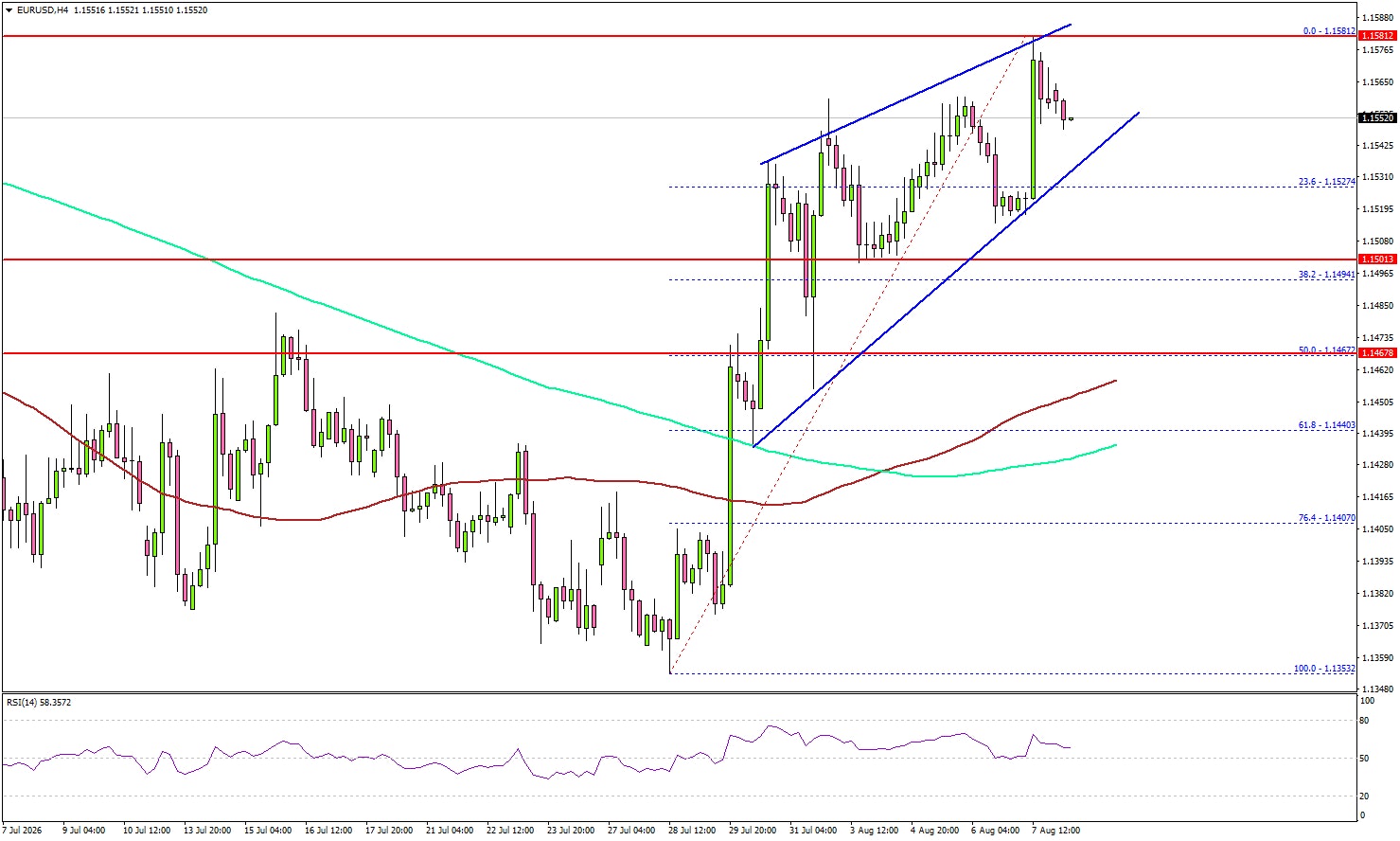
Looking at the 4-hour chart, the pair gained pace for a move toward 1.1580. A high was formed at 1.1581, and the pair is now consolidating gains above the 23.6% Fib retracement level of the upward move from the 1.1352 swing low to the 1.1581 high.
The pair is now well above the 100 simple moving average (red, 4-hour) and the 200 simple moving average (green, 4-hour). On the upside, the pair could face resistance near 1.1580.
The next major resistance might be 1.1600. There is also a contracting triangle forming with resistance at 1.1600. A close above 1.1600 could start another steady increase. In the stated case, the bulls could aim for a move to 1.1650.
Any more gains might open the doors for a test of 1.1685. If there is a downside correction, the pair might find bids near 1.1540. The next major support could be near 1.1500.
The main support might be 1.1465 and the 50% Fib retracement. A downside break and close below 1.1465 might send the pair toward 1.1400. Any more losses could open the doors for a test of 1.1350.
Looking at GBP/USD, the pair seems to be gaining pace above 1.3450 and might aim for a retest of the 1.3550 resistance.
Upcoming Key Economic Events:
- Euro Zone Sentix Investor Confidence for August 2026 - Forecast -3.2, versus -3.1 previous.
AUD/CAD Risks Deeper Correction if RBA Tightening Bias Doesn’t Survive
TL;DR: The RBA's Tuesday hold is a formality — what matters for AUD/CAD is whether its tightening bias survives, and the setup is asymmetric: preserving it offers limited support, while confirming the cycle has ended could trigger a deeper correction.
Why the Rate Decision Itself Won't Move Markets
The RBA is widely expected to leave the cash rate unchanged at 4.35% on Tuesday, making the decision itself largely a formality. After softer-than-expected Q2 inflation, Australia's Big Four banks now agree rates are likely to stay on hold through the rest of 2026, while broadly expecting the next move to be a cut sometime in 2027.
That pushes market focus away from the rate decision and toward a narrower question: how much of the RBA's tightening bias survives? For the Australian Dollar, the setup is asymmetric — keeping another hike theoretically alive may offer limited support, while clearer confirmation that the tightening cycle has ended could have a larger negative impact.
The First Signal: Policy Statement Language
The first signal will come from the policy statement. Every RBA statement this year has retained some version of the line that "the Board remains attentive to upside risks to inflation." Keeping that language would amount to a hawkish hold, but it would largely preserve existing policy optionality rather than make another hike materially more likely.
More consequential would be a shift toward language suggesting policy is sufficiently restrictive, or removal of explicit emphasis on upside inflation risks. Such a change would give markets their clearest indication yet that 4.35% is the peak rate.
The Bigger Signal: The Quarterly Statement on Monetary Policy
The more important signal should come from the quarterly Statement on Monetary Policy (SoMP). May forecasts had trimmed-mean inflation returning to the top of the 2–3% target band during 2027, but the Q2 reading subsequently undershot the RBA's own projection at 3.6%.
If August forecasts maintain that disinflation path or bring the return to target forward, despite starting from softer inflation, the Board would effectively be validating the improvement and strengthening the case that further tightening is unnecessary. Conversely, if the RBA pushes the return to target further out, it would suggest policymakers aren't yet prepared to fully trust the latest inflation moderation. The technical cash-rate assumption embedded in the forecasts will also be worth comparing with the previous SoMP, particularly to see how much easing is already incorporated into the projection path.
Why the Upside for AUD Is Limited
This leaves limited upside asymmetry for AUD. Even if the RBA preserves hawkish language, the current 4.35% rate is already clearly restrictive, making an extended hold more plausible than another increase. Markets therefore have little reason to rebuild meaningful hike expectations simply because the Board refuses to close the door.
By contrast, a softer inflation track or explicit peak-rate language would provide genuinely new information and allow attention to shift more decisively toward eventual easing.
Why This Matters for AUD/CAD
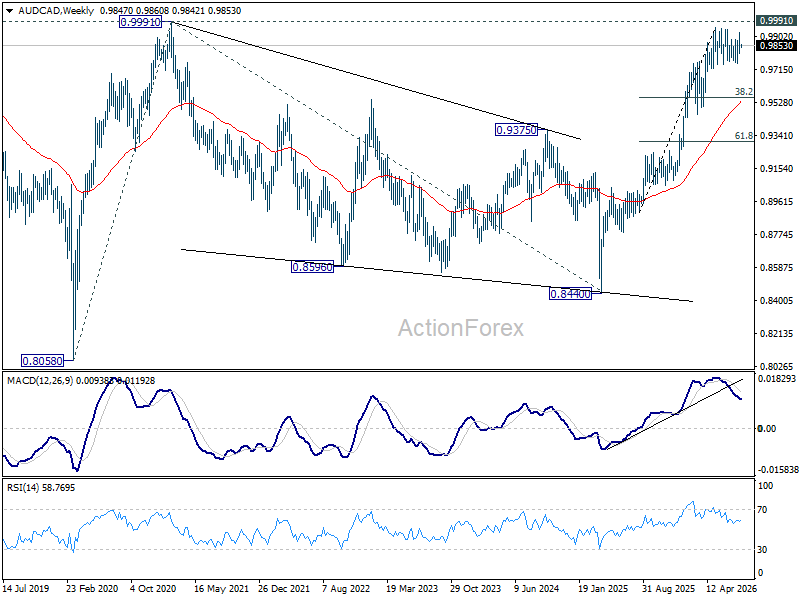
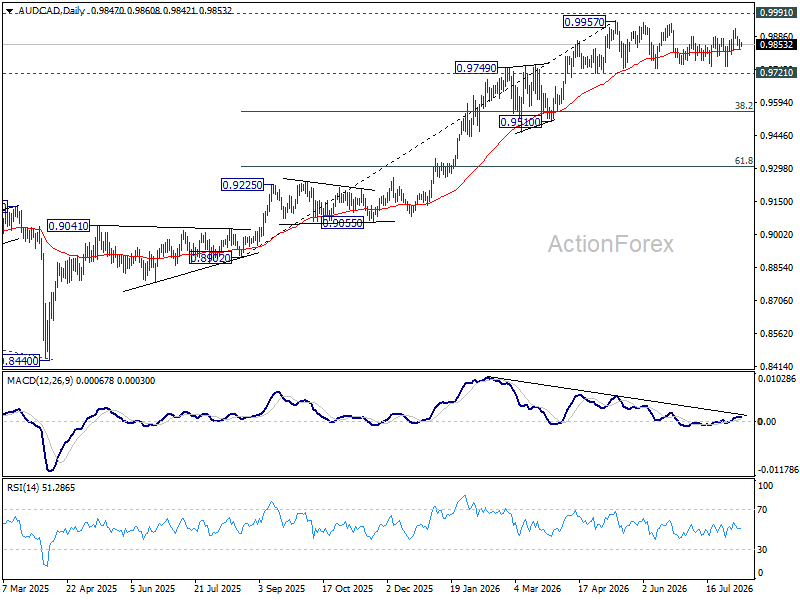
That asymmetry makes AUD/CAD particularly interesting. CAD received support from last week's stronger-than-expected Canadian employment report and could benefit further if the oil rebound extends. At the same time, AUD/CAD's uptrend from 0.8902 has clearly lost momentum, as reflected in both daily and weekly MACD, while the pair is close to major resistance at 0.9991 from the 2021 peak.
ActionForex's Technical View on AUD/CAD
Technically, a break of 0.9721 support would indicate the five-wave rally from 0.8902 is already correcting, bringing a deeper fall to the 38.2% retracement of 0.8902 to 0.9957, at 0.9555. That area is close to the fourth-wave low around 0.9510 and the 55-week EMA near 0.9536.
However, a decisive break of 0.9991 would invalidate the correction case and extend the broader uptrend instead.
For now, the RBA retaining its tightening bias may be enough to keep AUD/CAD supported in range; losing it could provide the catalyst for a deeper correction.
Key Takeaways
- Tuesday's RBA hold at 4.35% is a formality — the real signal is whether the tightening bias survives in the policy statement and SoMP forecasts.
- The key phrase to watch is "attentive to upside risks to inflation"; its removal would be the clearest signal yet that 4.35% is the peak rate.
- The quarterly SoMP matters more than the statement — whether the RBA maintains or delays its 2027 return-to-target path will show how much it trusts the Q2 inflation undershoot.
- The setup is asymmetric for AUD: preserving the tightening bias offers limited upside since another hike already looks unlikely, while losing it opens clearer downside.
- AUD/CAD is capped near 0.9991 resistance; a break of 0.9721 support opens a deeper correction toward 0.9555, while a break above 0.9991 would invalidate that case.
BoJ Opinions: Inflation Mission Changed to Preventing Inflation Overshoot
BoJ’s Summary of Opinions from July 30–31 meeting points to an important shift in policy thinking: debate is moving away from how to lift underlying inflation toward 2% and increasingly toward how to stop it from overshooting. One opinion captured change explicitly, saying focus of monetary policy has shifted from “lifting underlying CPI inflation to 2 percent” to “avoiding further upward deviation in underlying CPI inflation.” That does not mean immediate tightening is automatic, but it suggests reaction function is becoming more sensitive to upside inflation risks.
Case for holding policy steady in July rested largely on transmission lags rather than diminishing appetite for normalization. One member estimated that rate hikes take roughly one to one and a half years to weigh on inflation and economic activity, arguing that BoJ should first assess impact of previous increase. Yet several opinions simultaneously stressed that underlying CPI inflation is approaching, or becoming anchored around, 2%, while financial conditions remain accommodative. On that basis, members argued it remains appropriate to continue raising policy rate and reducing monetary accommodation as conditions warrant.
More hawkish part of discussion concerned pace and size of future hikes. One opinion said tightening could proceed “faster than market expectations” if economic activity, prices and financial conditions justify it. Another argued global environment has entered “a new phase” in which BoJ should respond more nimbly to overseas financial conditions and discuss size of a rate hike rather than adhering to a predetermined pace. Most forceful warning was that waiting carries its own risk: if inflation overshoots, BoJ could later be forced into “rapid and substantial” hikes, delivering what member described as a “double shock” to economy and households.
BoJ therefore appears to be moving from normalization driven by confidence in reflation toward normalization increasingly shaped by risk management against excessive inflation. Middle East developments, expansion in AI-related demand, foreign-exchange moves and rising medium- to long-term inflation expectations were all cited as factors requiring close attention. July hold should therefore not be read as retreat from tightening. If upside price risks strengthen while activity holds up, debate may shift quickly from whether BoJ hikes again to how fast — and by how much — it should move.
Key Takeaways
- BoJ’s policy debate is shifting from creating durable 2% inflation toward preventing inflation from overshooting.
- July hold reflected desire to assess lagged effects of previous hike, with one opinion estimating transmission takes around one to one and a half years.
- Several members still judged financial conditions accommodative and argued BoJ should continue raising policy rate as underlying CPI approaches 2%.
- One opinion warned pace of hikes could become “faster than market expectations” if economic activity, prices and financial conditions justify it.
- Debate is also broadening from timing to size of future hikes, with one member saying BoJ has entered a “new phase” requiring more nimble policy.
- Strongest hawkish argument was that waiting too long could force rapid and substantial hikes later, creating a “double shock” for economy and households.
- Middle East developments, AI-related demand, foreign-exchange moves and rising medium- to long-term inflation expectations are key upside risks to watch.
China Inflation Misses at 0.5% in July as Goods Prices Weaken, Services Hold Up
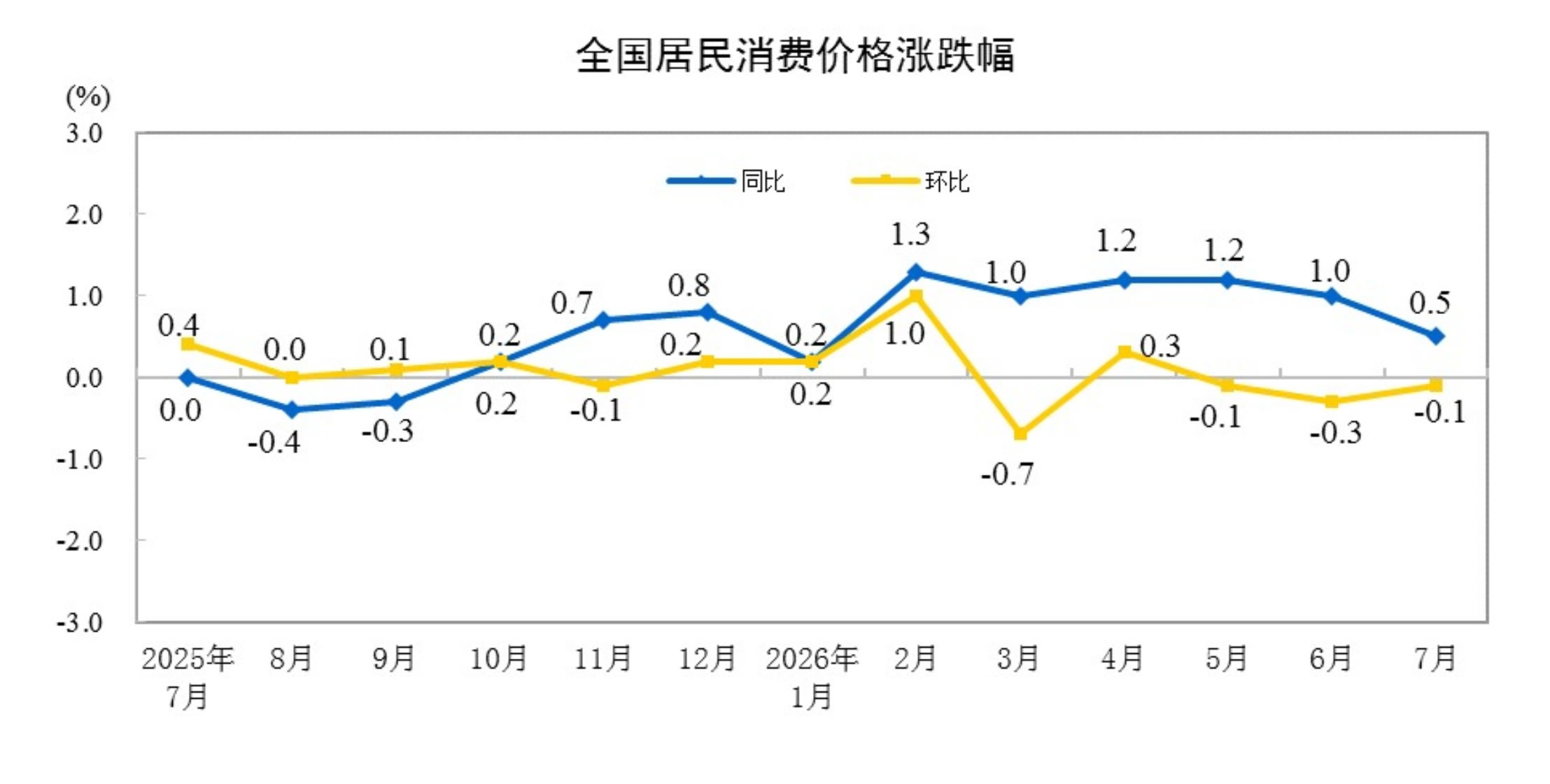
China’s consumer inflation slowed more than expected in July, but underlying breakdown was less uniformly weak than headline suggested. CPI eased from 1.0% to 0.5% y/y, below 0.8% consensus, while monthly CPI improved from -0.3% m/m to -0.1%, still missing expectations for a 0.2% increase. Food prices fell -1.5% y/y, while non-food inflation stood at 0.9%. Goods prices rose just 0.2% y/y, compared with a firmer 0.7% increase in services.
Monthly figures showed an even clearer split. Goods prices fell- 0.6% m/m, while services rose 0.4%, suggesting weakness was concentrated in merchandise rather than spreading evenly across economy. Food prices were unchanged overall, with pork rising 4.1% and fresh vegetables 1.3%, partly offset by a -3.8% drop in fresh fruit. Among non-food categories, education, culture and recreation rose 1.0%, while transportation and communication fell 2.2%.
Taken together, July data point to uneven rather than outright collapsing price pressure. Weak goods inflation and another negative monthly CPI reading still argue that domestic pricing power is limited, but resilience in services tempers a simple deflation narrative.
Alongside PPI slowing from 4.1% to 3.5% y/y, below 3.9% forecast, figures should leave Beijing room to support growth while keeping focus on whether services inflation can broaden into a more durable recovery in domestic demand.
Data Summary
| Indicator | Actual | Expected | Previous |
|---|---|---|---|
| CPI m/m | -0.1% | 0.2% | -0.3% |
| CPI y/y | 0.5% | 0.8% | 1.0% |
| PPI y/y | 3.5% | 3.9% | 4.1% |
Key Takeaways
- China CPI slowed from 1.0% to 0.5% y/y in July, undershooting 0.8% forecast, while monthly CPI improved from -0.3% to -0.1% but remained below expectations for a return to growth.
- Headline weakness was not broad-based. Goods prices rose just 0.2% y/y and fell 0.6% m/m, while services prices increased 0.7% y/y and 0.4% m/m.
- Food prices fell 1.5% y/y, although monthly food prices were unchanged. Pork prices rebounded 4.1% m/m, while fresh fruit prices dropped 3.8%.
- PPI inflation slowed from 4.1% to 3.5% y/y, also below 3.9% forecast, pointing to easing upstream price pressure.
- Overall picture is one of uneven reflation rather than outright deflation: weak goods pricing and softer producer inflation contrast with firmer services prices.
- Data leave Beijing room to support growth without creating an immediate inflation constraint.
USD/JPY in Focus After U.S.-Japan Intervention
The Dow Jones Index reached new record highs last week as strong company earnings and continued buying of AI-related stocks lifted market confidence. Reports that the Strait of Hormuz could reopen also helped improve sentiment and pushed oil prices lower. Gold moved sharply higher after U.S. employment data showed employers cut 23,000 jobs in July, much weaker than expected and a sign that the U.S. economy may be slowing.
The U.S. ISM Manufacturing PMI was stronger than expected, showing that the manufacturing sector is holding up better than many investors had expected. Markets also continued to watch the impact of the recent coordinated currency intervention by Japanese and U.S. authorities, the first joint intervention in 15 years, which supported the Japanese yen.
Japan's Cabinet also approved a plan to reduce the consumption tax on food products from 8% to 1% for two years starting in April 2027. The measure, proposed by Prime Minister Sanae Takaichi, is designed to help households cope with higher living costs and encourage consumer spending.
Markets This Week
U.S. Stocks
The Dow Jones Index surprised many traders by reaching new record highs as positive sentiment returned to the stock market. The trend has turned higher, with the 10-day moving average now rising. Previous resistance around 53,000 is expected to act as support, making buying on pullbacks the preferred strategy this week. Resistance levels are at 54,500, 55,000 and 56,000. Support is seen at 53,000, 52,500, 51,500, 51,000 and 50,000.
Japanese Stocks
The Nikkei 225 moved above its recent downtrend as buyers returned to the market. Even though the Japanese yen remained strong, investors no longer saw this as a major negative. Concerns about U.S. government finances also appeared to have already been priced into the market. Technical indicators have not yet confirmed a new uptrend, so the index may continue to trade in a range. For short-term traders, buying near support and selling near resistance may be the best strategy this week. Resistance is at 67,000, 68,000, 69,000 and 70,000. Support is at 64,000, 63,000, 62,000, 61,000 and 60,000.
USD/JPY
USD/JPY fell sharply to around 155 after the United States and Japan confirmed they had carried out a joint currency intervention. Buyers returned later in the week as traders continued to focus on the large interest rate difference between the U.S. and Japan. Even after weak U.S. jobs data caused an initial sell-off, USD/JPY quickly recovered, showing strong buying interest at lower levels. The pair may continue to move higher this week, although the falling 10-day moving average could slow gains later in the week. Resistance is at 159.00, 160.00, 161.00, 162.00, 164.00 and 165.00, while support is at 157.00, 156.00, 155.00 and 154.00.
Gold
Gold surged higher last week as lower oil prices, continued buying by central banks, and weaker-than-expected U.S. employment data increased demand for safe-haven assets. Gold has traded quietly for several weeks, and last week's strong move could be the start of a new uptrend. In the short term, however, the market is becoming overbought, so short-term traders may find better opportunities by selling rallies. Medium-term traders should be cautious about selling and may find better buying opportunities on pullbacks toward the rising 10-day moving average. Resistance is at $4,400, $4,500 and $4,600, while support is at $4,200, $4,150, $4,050, $4,000 and $3,950.
Crude Oil
WTI crude oil started the week lower after the United States and Iran resumed talks, reducing concerns about supply disruptions. Selling continued through most of the week as traders became more confident that tensions in the Middle East would not get worse. Oil prices are still likely to remain volatile, but selling near the 10-day moving average may be the better strategy this week. Resistance is at $80, $90, $95, $100 and $105, while support is at $75.00, $67.50, $65.00 and $60.00.
Bitcoin
Bitcoin tested the $65,000 resistance level last week as stronger U.S. stock markets improved confidence in risk assets. Buyers were not able to break above this level, but buying interest remains strong. A break above $65,000 this week could lead to more buying, so looking for buying opportunities may be the better strategy. Resistance is at $65,000, $75,000, $80,000, $85,000 and $90,000, while support is at $60,000, $55,000 and $50,000.
This Week’s Focus
- Monday: Japan Current Account
- Tuesday: Australia RBA Interest Rate Decision, U.S. Existing Home Sales
- Wednesday: Japan Reuters Tankan Index, U.S. CPI
- Thursday: Japan PPI, U.K. GDP and Industrial Production, E.U. Industrial Production, U.S. PPI
- Friday: E.U. GDP and Trade Balance, U.S. Retail Sales and Michigan Consumer Sentiment
Another busy week is expected as traders watch U.S. inflation data, with the CPI and PPI likely to have a big impact on all markets. Markets will also follow the ongoing U.S.-Iran talks and any progress on reopening the Strait of Hormuz. Other key events include U.S. Retail Sales and the Michigan Consumer Sentiment Index, while traders will also be watching to see if Japanese authorities carry out any further intervention to support the yen.
How to Trade CPI Inflation Data: USDjpy & Gold Trading Strategies
Knowing how to trade the Consumer Price Index (CPI), one of the most important measures for inflation, is an essential skill for all types of traders, no matter their level of expertise. The CPI report has the power to shape central bank monetary policies and can send ripples through international markets. This comprehensive guide offers useful tips on how to interpret the CPI data, anticipate central bank reactions and execute disciplined trades with clarity while minimizing risk.
Why CPI Matters More than any Other Inflation Release
To start with, the Consumer Price Index (CPI) measures how the prices consumers pay for certain goods and services change over time. It is considered a key metric of inflation for any nation’s economy and an important indicator of economic health. However, the most closely followed CPI report in the world, is the one published by the US, currently the world’s largest economy. The Federal Reserve, seasoned traders and adept investors, take the monthly results into consideration before making their next moves.
A rising or falling CPI can directly influence interest rate expectations, which subsequently impacts the USD, Treasury yields, gold and JPY carry trades. As soon as the report goes public, asset prices start experiencing rapid swings until the markets eventually adjust to a level dictated by whether the data is higher, lower or at the exact same level as forecasts.
Understanding CPI Like a Pro
When looking into the rise and fall of goods and services’ prices, two separate inflation measures come up – Headline inflation and Core inflation. These two figures differ in the products they monitor and even though they are both critical economic indicators, the Core CPI tends to carry more weight for the Fed.
Headline CPI
The Headline CPI rate reflects the total inflation within an economy. This raw figure encompasses all goods and services including highly volatile items, like food and energy products, the prices of which are often susceptible to seasonal changes and can shift irrespective of economic conditions. Their inclusion means the figure is more aligned with changes in real-world costs but also more easily influenced by short-term price swings.
Core CPI
Core inflation is a version of CPI that filters out the prices of food and energy – highly volatile categories that can easily be affected by non-economic factors such as the weather, geopolitical events and more. Omitting these key products leads to a clearer snapshot of underlying inflationary trends which can better guide monetary policy in achieving its primary objective – safeguarding medium-term price stability. That is why the Fed relies more on Core CPI to form its central bank policy.
How CPI Moves Markets
When it comes to market reaction, the CPI forecast matters more than the actual figure. What markets respond to is the difference between the consensus forecast and the actual results. As deviation grows, the reaction becomes more intense resulting in price fluctuation, extensive stop-loss activation and the formation of a strong intraday trend. Keep in mind that the forecast is already priced in, what shifts prices is the element of surprise.
When CPI data exceeds expectations, market participants expect the Fed to raise interest rates to cool inflation down. Higher rates make yield-returning assets like government bonds more attractive to investors domestically and abroad. This scenario tends to strengthen the US dollar causing major pairs like the USDJPY to rise. At the same time, non-yielding precious metals like gold and silver can lose their appeal, which can trigger selloffs and a price dive.
If CPI results come in lower than expected, markets tend to expect a more dovish approach from the Fed. This can send off an instant alarm signal across global markets. Lower interest rates can decrease demand for dollar-denominated securities which in return weakens the US dollar. This could intensify market risk sentiment, driving investors to safe-haven assets like the Japanese Yen (JPY) and precious metals like gold. The increased capital inflows into these two assets can cause gold to rally and the USDJPY to drop.
How CPI Interacts with Other Data
Within the economy, circular patterns are predominantly present – changes in one sector can spill over to other areas. The CPI has a strong correlation with other key indicators like the PPI, the NFP, Wage Growth, and Retail Sales. They are all caught within a dynamic, interconnected feedback loop. None of them moves alone; changes in one tend to trigger changes in the others.
PPI – Producer Price Index
The Producer Price Index measures the change in prices for wholesale goods, revealing changes in raw input costs. Unlike the CPI that tracks price changes paid by consumers, the PPI shows how prices change for producers. Both measures show inflation in a different but complementary way.
When producers see their input costs climb higher, they tend to increase product prices to cover the higher expenses. Thus, customers are often burdened with additional charges. In cases like these, a higher PPI can lead to a higher CPI.
Wage Growth & NFP
Wage growth indicates the rate at which average salaries grow over time. On the other hand, the non-farms payroll report shows how many jobs were added or removed from the US workforce in manufacturing, construction and goods within a month. Both reports are key indicators of economic health, can affect living standards and inflation, and are taken into consideration by the FOMC when making interest rate decisions.
How are these metrics in constant interplay with inflation? A significant increase in jobs and fast wage growth can be evidence of inflationary pressures. Employers who hire more staff and pay them higher salaries need to raise product and service prices to maintain their profitability at the same levels. At the same time, the employees have more spending power which in turn increases the demand for goods and drives prices in the broader market even higher. These conditions can lead to higher CPI rates and can urge the FOMC, the US Federal Reserve policymaking body, to increase interest rates.
In contrast, a drop in jobs and slow wage growth can be a sign of economic slowdown. As salaries show no change and hiring slows down, consumers have less money to spend. This can cause demand for goods and services to decline, pushing product prices and the CPI down. In an attempt to boost the economy, the Fed could lower interest rates.
Retail Sales
Retail Sales is another major economic barometer which shows the total amount of products purchased by consumers within a specific period. In the US, Retail Sales are published monthly and constitute a vital measure for the national economy in which consumer spending represents two thirds of the gross domestic product.
The monthly figure often moves alongside the CPI. High sales can point towards an expanding economy in which consumer confidence is increased and demand is strong – conditions that can lead to higher inflation and potentially tighter monetary policy. Alternatively, declining sales can indicate an economic downturn, decreased household spending and weak demand for goods and services. In this scenario, inflation usually drops, which might prompt the Fed to lower interest rates to help stimulate the economy.
The General Rule
The PPI, Wage Growth, NFP and Retail Sales reports moving in the same direction can reveal a strong economic cycle. High figures provide firm evidence for economic expansion, in which the CPI is expected to rise. Low numbers give a strong signal for a declining economy and a lower CPI rate. In synchronized conditions like these, the CPI trade becomes highly probable.
How CPI Guides the Fed & why USDJPY Reacts Violently
The Fed has a dual mandate: to maintain price stability with a target inflation rate of 2% and keep the labor market healthy. The U.S. economic body closely watches the CPI, the key inflation metric, to adjust its monetary policy.
A low or falling CPI can reflect slow market growth which can prompt the Fed to lower interest rates. This reduces borrowing costs, which promotes business investment, helps boost consumer spending and revitalizes financial markets. However, if CPI comes in higher than expected, it signals that the economy could be growing too fast. In response to higher inflation, the Federal Reserve could increase interest rates which makes borrowing more expensive. This means less money enters the economy, businesses development halts, consumers spend less and investing declines.
USDJPY showcases heightened sensitivity to inflation, and it is a popular currency pair with investors for this type of setup. Let’s break down the why. To begin with, interest rate differentials between the US and Japan can considerably affect USDJPY. As we’ve seen, when the CPI rate climbs higher, the Fed raises interest rates, and Treasury yields increase. This makes the government-issued securities attractive investment options for local and international investors, strengthening the U.S. dollar and pushing the USDJPY exchange rate higher.
Now, let’s consider the opposite scenario. When CPI data comes in lower than expected, the Fed employs a looser monetary policy to boost the economy. This includes lower interest rates and in effect lower Treasury yields. The reduced return on the U.S. government debt securities makes them a less desirable investment option and causes a drop in the USD, which in turn translates into a lower USDJPY exchange rate.
How Gold (XAUUSD) Reacts to CPI
Decoding the relationship between the CPI and the price of gold is crucial if you are looking to capitalize on inflation and its subsequent wave of effects on the precious metal. The first thing you need to be aware of is that gold tends to move in the same direction as CPI and has a moderately inverse correlation to U.S. Treasury yields. Let’s delve deeper into this financial interplay.
Historically, when CPI increases pushing the Fed towards lower interest rates and Treasury yields, the price of gold generally tends to climb higher. This can be attributed to gold’s status as a safe-haven asset. When inflationary pressures cause purchasing power to drop and economic growth has to be slowed down with a tighter monetary policy, investors move funds into gold to protect their capital.
In the reverse situation, when the CPI is relatively stable or declining, the price of gold tends to show more variable patterns of movement, usually leading to a substantial drop. This points to other factors interfering with gold prices, when inflationary pressures are low. The general trend is that a drop in CPI, followed by a decrease in interest rates and Treasury yields, tends to push the US dollar lower and gold higher. However, it is advisable that you consider CPI data within a broader economic framework to ensure your moves align with the overall global market conditions.
The CPI Playbook: USDJPY & Gold
After you get a grasp of the significance of the CPI, the way it interacts with other key economic reports and correlates with USDJPY and gold, you can start trading any inflation-caused chain of reactions with confidence. To increase your chances of a successful outcome, a step-by-step plan of action is essential. We present you with our own expert strategy guidebook based on tested game plans applied by experienced macro traders in global markets.
USDJPY – CPI Strategy
Step 1 – Pre-News Preparation:
- Mark key levels – Note down the previous day’s highs and lows for the Asian and New York trading sessions
- Identify liquidity pools – chart areas where a large volume of pending orders could be triggered. Search for equal highs or lows pointing to consolidation zones. These points gather institutional interest and can turn into magnets for price.
- Reduce your position size – volatility tends to rise around the release of the CPI report
Step 2 – First Reaction:
- Ignore the market’s first reaction – the first spike is market noise, driven by algorithmic trading
- Do not trade during the first 1-2 minutes – volatility surges around this time
Step 3 – Wait for Confirmation
- Look for a Directional Candle within the 5-minute to 15-minute timeframe. The candle should:
- have a large real body and small wicks, giving a clear signal that markets moved strongly in a specific direction.
- close near a key high or low level.
NOTE: Beware of immediate wick rejection. In this case the candle shows significant move towards a particular direction and then reverses to close near its opening price.
- Wait for a Confirmation Candle – this gives the final confirmation for the trend, and it should display the below characteristics:
- Increased trading volume – signaling a large number of traders are active
- Close near the price’s peak or bottom – depending on whether it is an uptrend or downtrend
- Larger size – it is usually bigger than the previous candles
- Alignment with the trend – it should be bullish for a bullish trend, bearish for a bearish trend
Step 4 – Execute Based on CPI Outcome
If the CPI rate comes in above forecasts, the USDJPY exchange rate will most likely increase.
- Check that liquidity is above pre-release highs to confirm the market is bullish
- Place a stop loss below the Confirmation Candle low
- Buy USDJPY
If CPI rate comes in below forecasts, the USDJPY exchange rate will most likely decline.
- Check that liquidity is below pre-release lows to confirm the market is bearish
- Place a stop loss above the Confirmation Candle high
- Sell USDJPY
Start Trading USDJPY
Gold (XAUUSD) – CPI Strategy
Before entering this trade, please note that Gold is more volatile than USDJPY.
Step 1 – Mark the Pre-News Range
- Identify the high and low levels formed 30 – 60 minutes before the release of the CPI report.
Step 2 – Ignore the First Reaction
- The first post-CPI spike is often a fakeout.
Step 3 – Wait for Clear Acceptance
- Study candles within the 5-minute or 15-minute timeframe to confirm “acceptance levels” – levels the price is trading within and that buyers and sellers don’t try to break away from
- If the price breaks the range and holds, there could be trend continuation – the price will most likely continue in the same direction after the first reaction.
- If the price rejects the breakout, a reversal could emerge – the price will most likely continue moving in the opposite direction.
- Look for a Directional Candle within the 5-minute to 15-minute timeframe. The candle should:
- have a large real body and small wicks, giving a clear signal that markets moved strongly in a specific direction.
- close near a key high or low level.
NOTE: Beware of immediate wick rejection. In this case the candle shows significant move towards a particular direction and then reverses to close near its opening price.
- Wait for a Confirmation Candle – this gives the final confirmation for the trend, and it should display the below characteristics:
a. Increased trading volume – signaling a large number of traders are active
b. Close near the price’s peak or bottom – depending on whether it is an uptrend or downtrend
c. Larger size – it is usually bigger than the previous candles
d. Alignment with the trend – it should be bullish for a bullish trend, bearish for a bearish trend
Step 4 – Execute Based on CPI Results
If the CPI rate comes in above forecasts, the price of gold will most probably drop.
- Check that liquidity is below pre-release lows to confirm the market is bearish
- Place a stop loss above the Confirmation Candle high
- Sell XAUUSD
If the CPI rate comes in below forecasts, the price of gold will most probably rise.
- Check that liquidity is above pre-release highs to confirm the market is bullish
- Place a stop loss below the Confirmation Candle low
- Buy XAUUSD
Risk Management – The Most Important Part
Before you enter the markets, there’s one thing you need to understand – not every trade can be a successful one. That is why an effective trading strategy incorporates more than just checking numbers and performing technical analysis to identify the best time to enter and exit a position. It also includes a well-organized risk management plan to contain losses in case the price moves against you. The financial markets can be affected by a number of factors outside the economic sphere, including global politics, breaking news announcements and even natural disasters. Any unpredicted, sudden changes can cause sharp price swings which can be detrimental to your account and even lead to wipe-outs.
A solid risk management strategy helps you prevent uncontrolled losses, protect your capital, reduce emotional trading, achieve consistency, improve discipline and aim for profitability in the long run. To be able to hit all these targets, you need to incorporate tested practices in your trading:
1. Never risk a large percentage of your capital per trade
Ideally, you do not want to be allocating more than 1% to 2% of your balance on a single CPI trade. This ensures you only risk a small portion of your trading funds, and a single loss cannot affect your trading in the long term.
2. Use Limit Orders
The release of a CPI report often triggers high volatility. This can cause trading volume to dry up briefly and increase the risk of slippage – the risk of orders not being executed at the requested level but getting filled at a worse price than expected. Setting limit orders and pre-defining the execution price helps you have better control over limiting losses. However, make sure you set your stops wide enough to allow for normal price fluctuations and retracements without forcing trades to be stopped out prematurely.
3. Reduce Position Size
Choosing the proper position size can protect your trade from the dangers of overexposure and changing financial conditions. To better determine the size of your position, take into consideration your risk tolerance, the post-CPI release market and the probability of your CPI trade based on your technical analysis.
4. Avoid Revenge Trading
When met with setbacks, impulse and emotion can very easily take over from logic. Many of you may have already fallen into the trap of revenge trading – trying to recover from losing trades fast, only to end up with even more hits on your balance. To avoid this pitfall, you need to step away from the trading platform after a loss, give yourself some time to assess the situation and return with a calm, clear and focused mindset.
The Final Overview
Understanding inflation and the economic effects of the CPI report is an advanced skill that can help you make more informed trading decisions and place higher-probability trades in markets whose inner workings you can now see more clearly. From explaining the importance of the US CPI, its interdependent relationship with other key economic indicators, the ways it can affect the decisions of the Federal Reserve and move the prices of USDJPY and gold to detailed step-by-step trading strategies for the globally popular assets, this article covers all you need to trade the CPI with precision and confidence.
Gold – Extended Recovery May Pause for Consolidation Before Resuming Above Daily Cloud
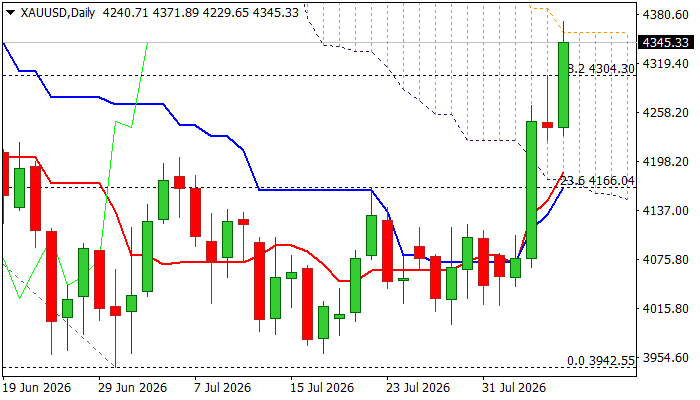
Gold resumes advance on Friday after bulls paused previous day and hit new seven- high ($4371), on track for the biggest weekly gain since the third week of January.
Disappointing US July labor data on Friday contributed to fading expectations for Fed rate hike in September that further boosted demand for the yellow metal, although, markets await release of US inflation report for July (due next week) to get more details about the monetary policy near-term outlook.
Fresh gains broke through important barrier at $4304 (Fibo 38.2% of $4889/$3942 descend) with weekly close above this level to confirm bullish signal and further strengthen near-term structure.
Bulls cracked next barrier at $4358 (daily Ichimoku cloud top) although may take a breather here, due to stretched daily studies and partial profit-taking at the end of the week, before resuming towards targets at target at $4390 (100DMA); $4400 (round-figure) and $4416 (50% retracement).
Dips should be limited and ideally contained by broken Fibo 38.2% barrier, to keep bulls intact.
Res: 4358; 4371; 4390; 4416
Sup: 4304; 4230; 4204; 4175
Gold Wave Analysis
Gold: ⬆️ Buy
– Gold broke resistance zone
– Likely to rise to resistance level 4400.00
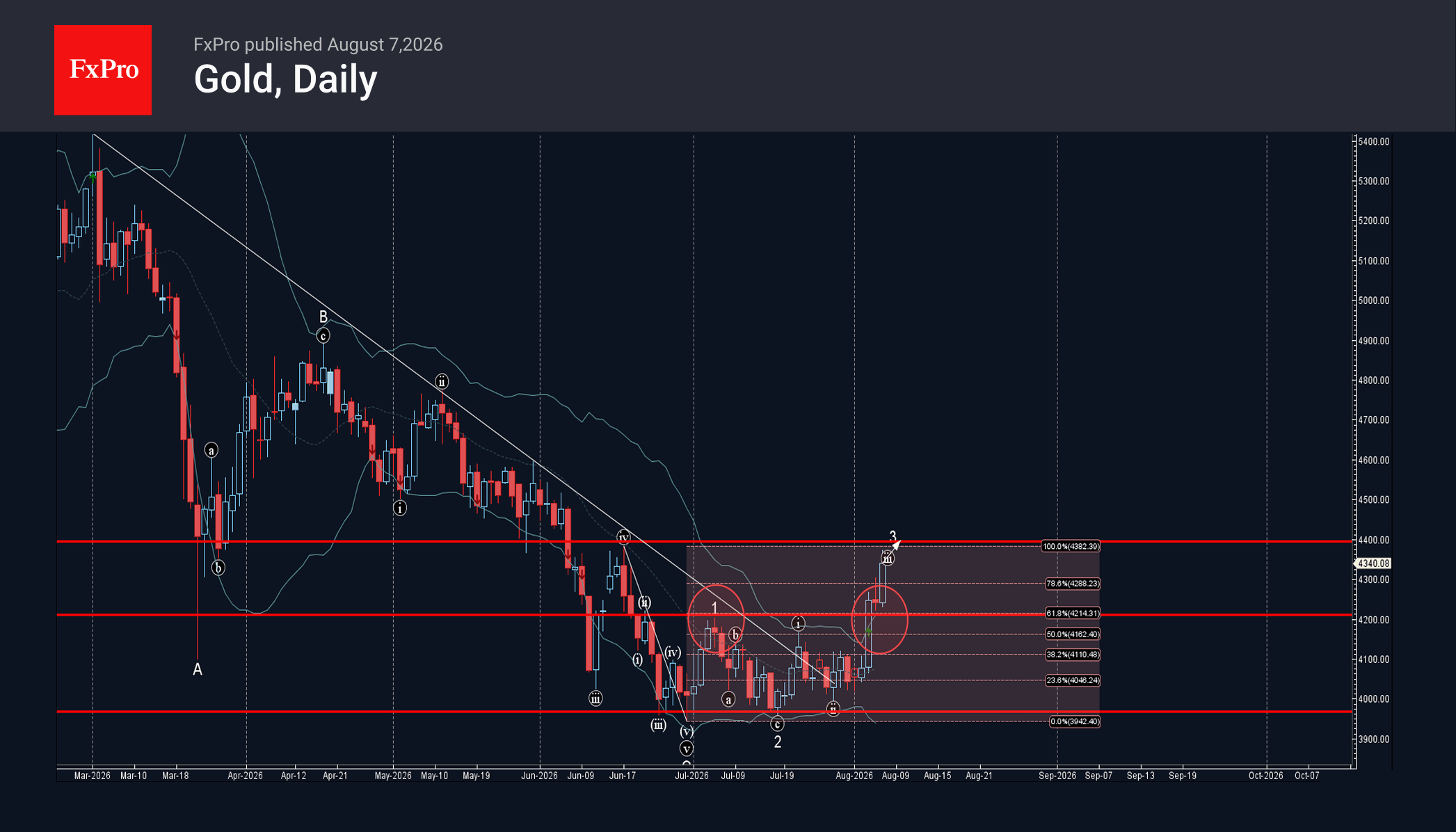
Gold recently reversed broke the resistance zone between the long-term resistance level 4210 (top of wave 1 from July) and the 61.8% Fibonacci correction of the downward impulse from June.
The breakout this resistance zone accelerated the active short-term impulse wave iii from the end of July.
Gold can be expected to rise further to the next resistance level 4400.00 (top of wave iv from June and the target for the completion of wave 3).