Sample Category Title
Canada’s Unemployment Rate Tumbles as Hiring Picks Up
- Canada’s economy added 75k jobs in July (+0.4% m/m), well above consensus expectations for a 20k gain. The monthly details skewed towards part-time jobs (+57.9k) versus full-time (38.6k), but pulling back over the past three months shows full-time positions have grown by 193k versus a 12.1k decline in part-time roles.
- The unemployment rate fell from 6.5% in June to 6.4% in July, its lowest level in two years. The improvement came alongside a 60.5k increase in the labour force, while the labour force participation rate edged up 0.1 percentage points to 65.1%.
- Employment gains were broad-based across industries, led by wholesale and retail trade (+21k), finance, insurance, real estate, rental and leasing (+18k), professional, scientific and technical services (+17k) and construction (+16k). Offsetting some of these gains were declines in public administration (-15k) and agriculture (-9.6k).
- Wage growth moderated in July, with average hourly wages up 2.8% year-on-year, down from 3.3% in June. Average hourly earnings reached $37.17 in July.
Key Implications
- Oh boy, another strong labour market report. Beyond just the jobs gains, the fall in the unemployment rate was encouraging given hiring outpaced a sizeable 61K gain in the labour force. This shows the economy was able to absorb more labour market slack in July. When coupled with the strong bounce-back in activity in the second quarter, some additional momentum on jobs in July is nice to see.
- The labour market is showing clear signs of recovery, but the 6.4% unemployment rate continues to signal an economy operating with some slack. Together with the prospect of new tariffs coming into effect on August 19th, the downside risks to the economy remain. We continue to expect the unemployment rate to gradually decline in the coming months as the economy deals with the volatility in energy prices and potentially more trade headwinds. Given this backdrop we expect the Bank of Canada to stay on hold for the rest of the year.
NFP Shock Sends Dollar Lower and Gold Above 4,300, but Geopolitical Risks Rise
Why weak payrolls broke the week's stalemate, and why Hormuz, Saudi warnings and US-China tensions mean the move isn't a simple green light for risk
- Hormuz talks are progressing, but reported Iranian draft terms, barring US and Israeli vessels and threatening restrictions on countries deemed to have harmed Iran, look far more conditional than a genuine reopening.
- Saudi Arabia signed a new defense pact with Pakistan and Turkey while warning of possible coordinated attacks from Iran-aligned groups, raising the risk that diplomatic progress and military escalation are running on separate tracks at once.
- The US imposed a new 15% duty on polysilicon imports, extending US-China strategic competition into solar, semiconductor and AI-infrastructure supply chains just as China's chip exports surged 117% year-over-year.
NFP Delivers the Shock Markets Were Waiting For
The US jobs report finally gave markets the catalyst they had been waiting for, sending the Dollar sharply lower and precious metals surging as traders scaled back expectations for another Fed rate hike. Nonfarm payrolls unexpectedly fell -23K in July, compared with expectations for an 85K increase, but the headline shock was only part of the story. May payroll growth was revised down from 129K to 63K and June from 57K to just 20K, wiping 103K from previously reported employment gains. Average hourly earnings also slowed from 0.3% to 0.1% month-over-month, adding to evidence that the labor market is losing momentum. The unemployment rate unexpectedly dipped from 4.2% to 4.1%, but the accompanying decline in participation from 61.5% to 61.4% made that improvement less reassuring.
July NFP Breakdown
- Headline NFP: -23K, against expectations for +85K
- May payrolls: revised down from 129K to 63K
- June payrolls: revised down from 57K to 20K (103K wiped from prior reports combined)
- Average hourly earnings: slowed from 0.3% to 0.1% m/m
- Unemployment rate: dipped to 4.1% from 4.2%, though participation fell from 61.5% to 61.4%
Why the Hawkish Case Just Got Harder
Markets responded by quickly cutting the probability of a September Fed hike to around 42%. That represents a significant challenge to the hawkish case put forward by several Fed officials this week. Kashkari argued that the Fed should begin raising rates gradually, while Musalem said policymakers should be prepared to surprise markets rather than allow prevailing pricing to dictate policy. But their argument partly rests on the economy and labor market being resilient enough to absorb additional tightening. Negative payroll growth, substantial downward revisions and softer wages raise that hurdle considerably. Inflation remains too high for the Fed to declare victory, particularly with energy risks unresolved, but the latest employment report strengthens the majority case for waiting rather than tightening pre-emptively.
Dollar Reaction Was Broad, and USD/JPY Is the Story to Watch
The Dollar reaction was broad. EUR/USD and AUD/USD broke to fresh highs for the week, while USD/JPY reversed much of its rebound and headed back toward 155. That move is particularly notable after last week's rare US-Japan intervention. As discussed ahead of payrolls, intervention had created an asymmetric setup: traders chasing USD/JPY toward 160 after strong data would have to contend with renewed intervention risk, while a data-driven fall toward 155 would face no equivalent official deterrent. July NFP delivered precisely that downside scenario.
The Canadian Dollar performed even better after Canada simultaneously reported a 75.1K employment surge against expectations for 17.8K, while unemployment fell from 6.5% to 6.4%. USD/CAD therefore faced pressure from both sides, weak US employment and unexpectedly strong Canadian hiring.
Gold and Silver Break Higher as Fed Hike Risk Fades
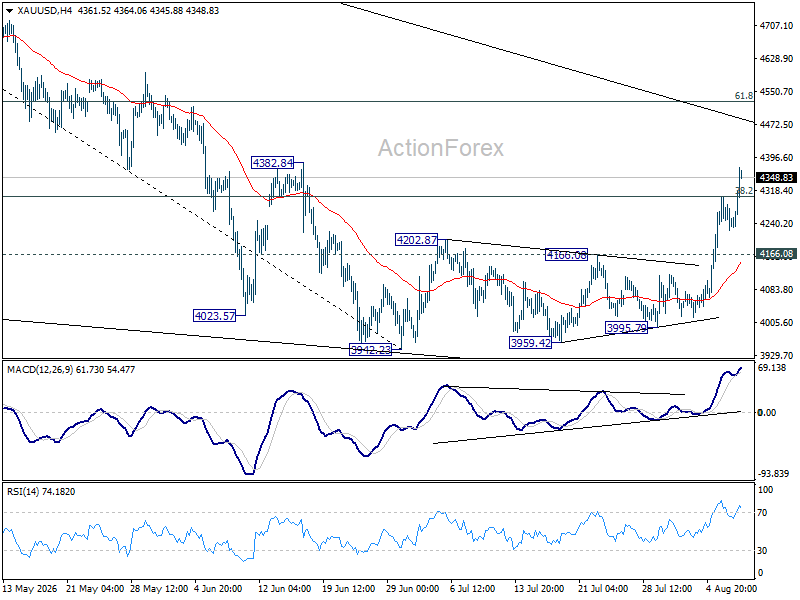
The reaction in precious metals was immediate. Gold decisively cleared 4,300, a level that had capped its rebound earlier this week, and accelerated above 4,350. Silver simultaneously surged toward $65. Both moves reinforce the case that recent precious-metals rallies are developing into something more substantial than corrective rebounds. Lower Fed hike expectations reduce pressure from real yields and the Dollar, while geopolitical uncertainty provides another layer of support.
Gold's break is particularly significant because 4,300 had represented the 38.2% retracement of the decline from 4889.24 to 3942.23, near 4303.98. Earlier attempts to clear that area had stalled as Treasury yields and Brent awaited confirmation of progress on reopening the Strait of Hormuz. NFP has now supplied a separate catalyst. If Gold can sustain the breakout, attention should increasingly shift toward medium-term trend line resistance around 4,500.
Key Technical Levels
- Gold: cleared 4,300 (the 38.2% retracement of the 4889.24-3942.23 decline, near 4303.98) and accelerated above 4,350
- Silver: surging toward $65
- Next resistance: medium-term trend line around 4,500
Equities Show Restraint: Good for Rates, Not Automatically Good for Risk
Equities delivered a more restrained response. Dow futures rose around 170 points, leaving the index within reach of another challenge to the record set earlier this week, but the reaction was nowhere near as forceful as the moves in Dollar or precious metals. That restraint is understandable. Weaker employment reduces the probability of additional Fed tightening, which supports valuations, but outright payroll contraction accompanied by substantial downward revisions also raises questions about underlying growth. Markets may therefore be approaching the point where bad economic news is still good for rates, but no longer automatically good for risk assets.
Hormuz Talks Progress, but the Details Complicate the Optimism
That caution is reinforced by increasingly complicated developments in the Middle East. Iran and Oman continue working toward an arrangement defining shipping routes through the Strait of Hormuz, but despite expectations earlier this week that an agreement could arrive quickly, no final deal has yet been announced. The latest reports suggest inbound traffic could travel through Iranian waters while outbound vessels use Omani waters. Yet the reported Iranian draft terms raise questions over how closely any arrangement would resemble a genuine normalization of shipping.
Under the apparent draft proposal, US and Israeli vessels would be barred from using the Strait, while countries deemed to have harmed Iran could face restrictions until compensation is paid. Such conditions would make the proposed arrangement substantially different from an unconditional reopening. It also remains unclear how the temporary framework would evolve into a durable settlement. Markets have spent much of the week pricing falling geopolitical risk through lower oil and stronger equities, but the details now matter more than general expectations of a deal.
Diplomatic Rhetoric Turns More Hostile
Diplomatic rhetoric is simultaneously becoming more hostile. Iran's chief negotiator accused US President Donald Trump of engaging in "theater diplomacy," highlighting conflicting accounts from Washington and Tehran over bilateral contacts. More importantly, progress over Hormuz is occurring alongside signs that regional military risks may be increasing rather than disappearing.
Saudi Warnings Add a New Escalation Risk
Saudi Arabia, Pakistan and Turkey signed a joint defense agreement in Mecca on Friday as Riyadh warned of possible coordinated attacks from Iran-aligned groups. A senior Saudi official said intelligence from Saudi Arabia, the US and other regional countries pointed to potential attacks from Iraqi militias to the north and Houthis in Yemen to the south, potentially targeting civilian and economic infrastructure including energy facilities, ports and airports.
Particularly important was the Saudi official's suggestion that possible attacks could reflect "a power struggle within Iran itself" and might be intended to derail negotiations that had otherwise been "heading in the right direction." If that assessment proves accurate, it complicates the assumption that diplomatic progress automatically translates into lower geopolitical risk. Negotiations over Hormuz could advance at the government level while other actors simultaneously attempt to undermine them through military escalation.
Two Middle East Stories on Separate Tracks
That creates two Middle East stories moving on separate tracks. One is diplomatic: Iran and Oman are trying to establish a framework that could restore more normal shipping through the Strait. The other is military: Gulf states are preparing for the possibility that regional attacks could intensify even while those negotiations continue. Brent's recent inability to extend decisively below $78 and subsequent rebound above $83 increasingly looks consistent with that uncertainty.
US-China Competition Intensifies on Another Front
Geopolitics is also moving beyond the Middle East. The Trump administration imposed a new 15% duty on polysilicon products on Thursday and introduced minimum prices for some related imports, explicitly framing the measure as an effort to protect US solar and semiconductor supply chains from Chinese competition. Polysilicon sits at the intersection of several strategic priorities, solar power, semiconductors, AI infrastructure and energy security, making the move another example of economic policy becoming inseparable from great-power competition.
The timing is notable given China's strong July trade figures. Chinese exports rose 23.9% year-over-year, beating expectations, while chip exports surged 117% as global AI infrastructure demand continued to power high-tech manufacturing. Washington's latest action therefore comes precisely as advanced technology becomes an increasingly important source of Chinese export growth. That suggests trade tensions are shifting further toward sectors viewed as strategically important rather than simply those generating large bilateral deficits.
What This Means Heading Into the Weekend
For markets, the immediate driver remains the US employment shock. The Dollar has broken lower, Gold has cleared $4,300, Silver is approaching $65 and September Fed hike expectations have retreated sharply. But heading into the weekend, weaker payrolls cannot be treated as a straightforward invitation to extend risk-on positions. The Hormuz agreement remains unfinished, regional military threats are increasing, and US-China strategic competition is intensifying. NFP has broken this week's market stalemate; whether those moves survive next week may depend increasingly on what happens outside the economic calendar.
Related Coverage
Jobs & Trade Data Deep Dives
- Read the full NFP breakdown showing how deep the downward revisions cut into prior job gains: US Non-Farm Payrolls Contract -23k. Revisions Expose Deeper Labor Market Weakness.
- See the full Canada jobs report, including why wage growth cooling to 2.8% still reduces pressure for more BoC support: Canada Jobs Surge 75K as Unemployment Falls to Two-Year Low.
- Read why China's export beat still raises sustainability questions once tariff front-loading fades: China Exports Rise 23.9% YoY as High-Tech Demand Defies Tariffs.
Frequently Asked Questions
Q: Why did equities react more cautiously than the Dollar and Gold to the NFP miss?
A: Weaker employment reduces the probability of additional Fed tightening, which normally supports valuations. But outright payroll contraction, combined with substantial downward revisions to May and June, also raises questions about underlying growth. Markets may be approaching the point where bad economic news is still good for rates but no longer automatically good for risk assets, which is why Dow futures rose a modest 170 points while the Dollar and precious metals moved far more forcefully.
Q: Why does USD/JPY's move back toward 155 matter after last week's intervention?
A: Last week's coordinated US-Japan intervention created an asymmetric setup: traders pushing USD/JPY back toward 160 on strong data would face renewed intervention risk, while a data-driven fall toward 155 would face no equivalent official deterrent. July's NFP delivered exactly that downside scenario, reversing much of USD/JPY's prior rebound with no offsetting pushback expected from Japanese authorities.
Q: Does progress on Hormuz shipping talks mean geopolitical risk is actually falling?
A: Not necessarily. Reported draft terms would bar US and Israeli vessels from the Strait and threaten restrictions on countries deemed to have harmed Iran until compensation is paid, conditions that make any arrangement substantially different from an unconditional reopening. At the same time, Saudi Arabia has warned of possible coordinated attacks from Iran-aligned groups, which a Saudi official suggested could reflect a power struggle within Iran aimed at derailing the negotiations. That means diplomatic progress and military escalation risk could be running on separate tracks simultaneously.
Key Takeaways
- NFP delivered a genuine shock: Headline payrolls fell -23K against expectations for +85K, while May and June were revised down by a combined 103K and wage growth slowed to 0.1% m/m.
- September Fed hike odds were cut to around 42%: The report significantly raises the hurdle for the hawkish case made by Kashkari and Musalem this week, since it rested on the economy being resilient enough to absorb more tightening.
- Dollar, Gold and Silver moved far more forcefully than equities: Gold cleared 4,300 and accelerated above 4,350, and Silver pushed toward $65, but Dow futures rose a more modest 170 points, since weak payrolls raise growth questions even as they support the case for a Fed pause.
- USD/JPY's reversal toward 155 fits last week's intervention asymmetry: A data-driven move lower carries no equivalent official deterrent to the one traders would face pushing the pair back toward 160.
- Hormuz progress comes with complicating conditions: Reported draft terms barring US and Israeli vessels and threatening restrictions on other countries look far more conditional than a genuine reopening, while Saudi Arabia's new defense pact and attack warnings suggest military risk could be rising even as talks continue.
- US-China tensions are extending into strategic technology supply chains: The new US polysilicon tariff lands just as China's chip exports surged 117% year-over-year, pointing to trade friction shifting toward strategically important sectors.
What to Watch Next
Whether this week's moves hold into next week may depend less on the economic calendar than on developments outside it: whether the Hormuz framework firms into something closer to an unconditional reopening, whether Saudi Arabia's escalation warnings materialize, and whether US-China tensions extend further into strategic technology sectors.
Canada Jobs Surge 75K as Unemployment Falls to Two-Year Low
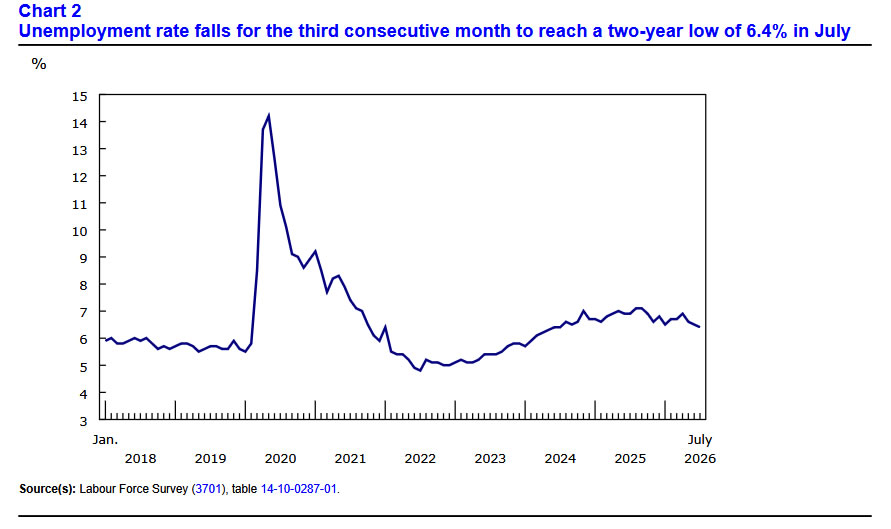
Canada's labor market delivered a strong upside surprise in July, with employment rising 75.1K, far above expectations of 17.8K and accelerating sharply from 18.2K in June. Employment rate edged up 0.1 percentage point to 60.9%, while unemployment rate unexpectedly fell from 6.5% to 6.4%, against expectations for no change. That was lowest unemployment rate since July 2024 and marked third consecutive monthly decline, with rate now down 0.5 percentage point since April.
Job gains were also spread across several important private-sector industries. Wholesale and retail trade added 21K positions, finance, insurance, real estate, rental and leasing gained 18K, professional, scientific and technical services added 17K, while construction employment increased 16K. Those gains were partly offset by declines of -15K in public administration and -9.6K in agriculture.
Wage pressures nevertheless continued to cool, with average hourly earnings growth slowing from 3.3% to 2.8% yoy.
Data Summary
| Indicator | Actual | Expected | Previous |
|---|---|---|---|
| Employment Change | +75.1K | +17.8K | +18.2K |
| Unemployment Rate | 6.4% | 6.5% | 6.5% |
| Employment Rate | 60.9% | — | 60.8% |
| Average Hourly Wages y/y | +2.8% | — | +3.3% |
Key Takeaways
- Canada added 75.1K jobs in July, more than four times expectations of 17.8K and sharply above June's 18.2K increase.
- Unemployment rate fell from 6.5% to 6.4%, reaching lowest level since July 2024. It has now declined for three consecutive months and by 0.5 percentage point since April.
- Employment rate increased from 60.8% to 60.9%, reinforcing strength of headline employment gain.
- Job creation was relatively broad, led by wholesale and retail trade (+21K), finance and real estate-related industries (+18K), professional and technical services (+17K), and construction (+16K).
- Public administration shed 15K jobs and agriculture lost 9.6K, providing some offset to private-sector strength.
- Wage pressures continued to moderate despite stronger hiring. Average hourly wage growth slowed from 3.3% to 2.8% y/y.
US Non-Farm Payrolls Contract -23k. Revisions Expose Deeper Labor Market Weakness
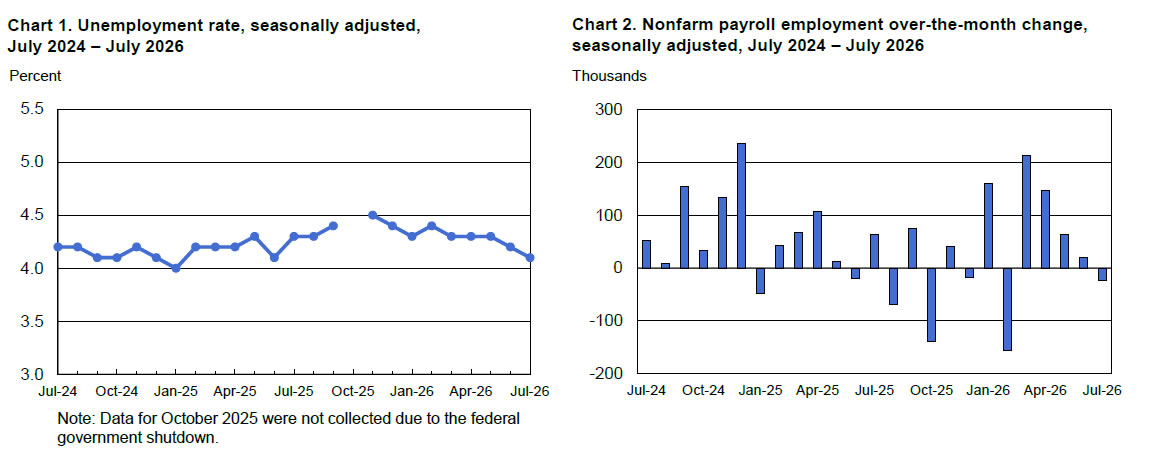
US labor market delivered a major downside surprise in July, with nonfarm payrolls falling -23K, far below expectations for an 85K increase. Weak headline was compounded by another round of substantial downward revisions: May payroll growth was cut from 129K to 63K, while June was revised from 57K to just 20K, leaving combined employment gains 103K lower than previously reported. July weakness was concentrated in local government education and retail trade, while health-care employment continued to trend higher. Taken together, latest figures suggest deterioration in hiring is considerably more pronounced than earlier estimates indicated.
Other parts of report were mixed, but did little to offset payroll disappointment. Unemployment rate unexpectedly fell from 4.2% to 4.1%, versus expectations for no change. But decline came alongside another drop in labor force participation from 61.5% to 61.4%. Participation has now fallen 0.7 percentage point since January, while employment-population ratio has declined 0.5 point over same period.
Meanwhile, average hourly earnings growth slowed sharply from 0.3% to 0.1% mom, missing expectations of 0.3%. Combination of weaker hiring, declining participation and softer wage growth paints a considerably less reassuring picture than lower unemployment rate alone would suggest.
Report should substantially raise hurdle for Fed to hike rates in September. This week's employment indicators had already sent conflicting signals, with weak ADP hiring and contracting ISM Services Employment offset by stronger manufacturing employment and historically low jobless claims. NFP now tilts balance decisively toward labor-market weakness, while softer wage growth reduces one source of inflation concern.
Data Summary
| Indicator | Actual | Expected | Previous |
|---|---|---|---|
| Nonfarm Payrolls | -23K | +85K | +20K |
| Unemployment Rate | 4.1% | 4.2% | 4.2% |
| Average Hourly Earnings m/m | +0.1% | +0.3% | +0.3% |
| Labor Force Participation Rate | 61.4% | — | 61.5% |
| May–June Combined Revision | -103K | — | — |
Key Takeaways
- Nonfarm payrolls unexpectedly fell 23K in July, badly missing expectations for an 85K increase and marking outright employment contraction.
- Weakness extended well beyond July. May was revised down from +129K to +63K and June from +57K to +20K, cutting previously reported employment growth by 103K combined.
- Unemployment rate unexpectedly fell from 4.2% to 4.1%, but this was accompanied by a decline in labor force participation from 61.5% to 61.4%.
- Labor force participation has now fallen 0.7 percentage point since January, while employment-population ratio has declined 0.5 point, making lower unemployment rate less reassuring.
- Average hourly earnings slowed from 0.3% to 0.1% mom, well below expectations of 0.3%, adding evidence that labor-related inflation pressure is easing.
- Employment declined in local government education and retail trade, while health-care employment continued to trend higher.
- Report significantly raises hurdle for a September Fed hike. Negative payroll growth, large downward revisions and softer wages challenge hawkish argument that labor market remains strong enough to comfortably absorb further tightening.
Chart Alert: Yen’s 3-Day Weakness Pauses at Key 158.55/USD Inflexion Level Ahead of NFP
Key takeaways
- USD/JPY rebound stalls: The 3-day rebound is losing momentum at the key 158.55 inflexion level, with technical signals pointing to bearish reversal risk.
- UST-JGB yield gap narrows: The 2-year yield spread has fallen to 2.64%, which could support renewed yen strength if the narrowing continues.
- NFP is the key catalyst: A break below 157.95 could expose 157.30 and 156.32, while a move above 158.55 could open the door to 159.45.
The recent three-month period of yen weakness from May 2026, which saw the JPY plummet to a 40-year low of 163.99 per US dollar on 23 July 2026, was “recused” by a two-day FX intervention that included a historical US-Japan joint effort on 30 July and 31 July that strengthened the yen to 155.23 on Monday, 3 August 2026.
However, the yen’s strength stalled, and USD/JPY staged a 3-day rebound of 2.08% (low to close), closing at 158.46 on Thursday, 6 August 2026, nearly giving up half of the gains seen in the yen from last week’s FX Intervention.
As speculators focus on long-term dynamics, such as geopolitical uncertainty from the US-Iran situation that can dampen Japan’s growth prospects, this, in turn, delays the Bank of Japan’s (BoJ) normalisation of its monetary policy stance of gradual interest rate hikes.
The UST-JGB yield gap is the next focus for traders
Fig. 1: 2-YR US Treasuries/JGBs yield spread with USD/JPY as of 7 Aug 2026 (Source: TradingView). The information presented is historical information, and past performance is not indicative of future performance.
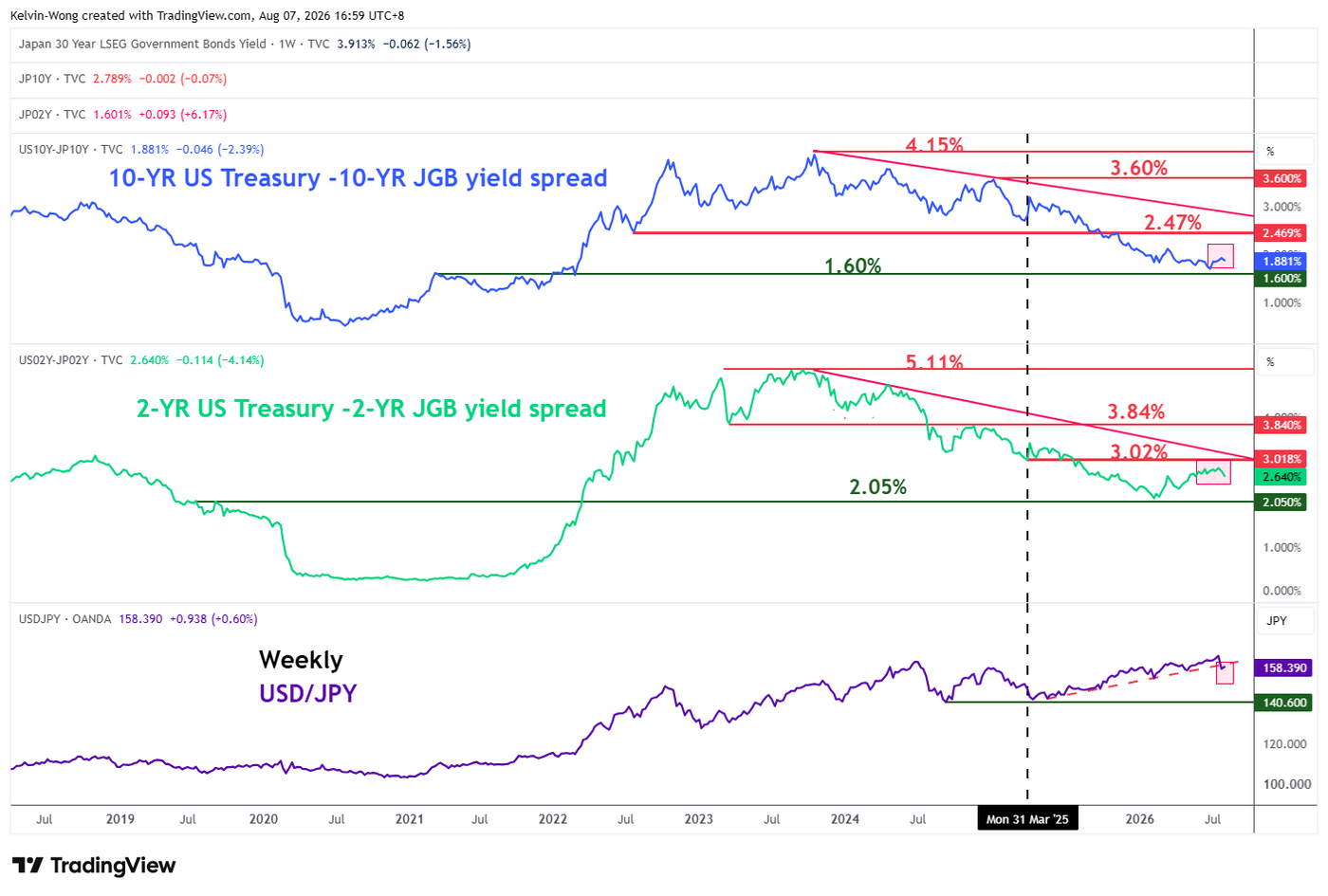
The rise of the USD/JPY (yen weakness) from 152.71 to July’s 40-year high print of 163.99 has been accompanied by a widening of the monetary policy sensitive 2-year yield spread between the US Treasury Notes (UST) and the Japanese Government Bonds (JGBs) from 2.12% to 2.82% over the same period (see Fig. 1).
Interestingly, the 2-year UST-JGB yield spread (gap) has started to reverse down (narrowed) right below a key medium-term resistance of 3.02% to now trade at 2.64% at this time of writing, which in turn reinforces a major bearish breakdown of the USD/JPY from its former ascending trendline support from April-May 2026.
Hence, a continuation of the narrowing of the 2-year UST-JGB yield spread towards 2.05% may see a revival of USD/JPY weakness, given a key risk event later at 8.30 pm SGT: the US non-farm payroll release for July (57K: June, consensus: 80K).
Let’s now decipher the potential short-term expectations (1 to 3 days) of USD/JPY from a technical analysis perspective.
USD/JPY – short-term bullish momentum is losing strength at inflexion point
Fig. 2: USD/JPY minor trend as of 7 Aug 2026 (Source: TradingView). The information presented is historical information, and past performance is not indicative of future performance.
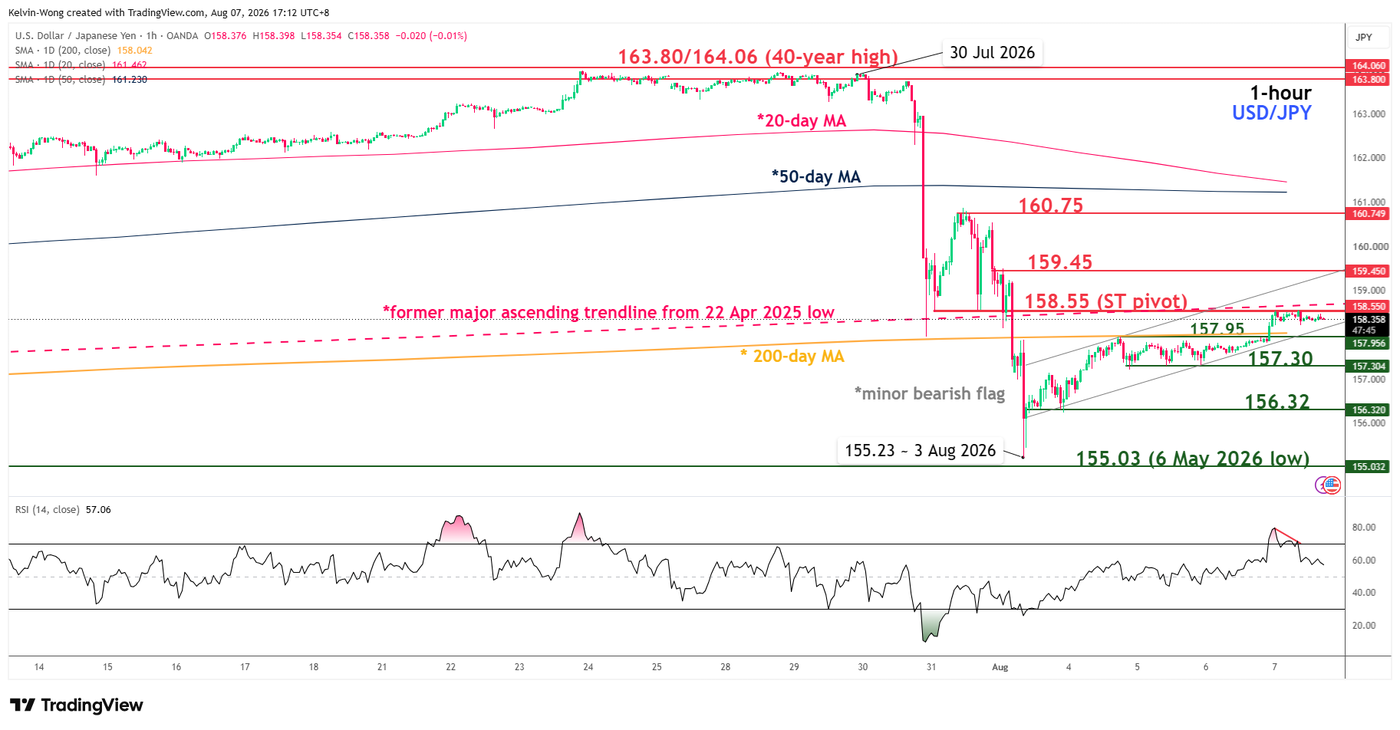
The 3-day rally in USD/JPY from Monday, 3 August 2026, to a low of 155.23 has reached an inflexion level of 158.55 defined by a confluence of elements (the former major ascending trendline from 22 April 2025 low, former minor swing low of 31 July 2026, and 38.2% Fibonacci retracement of prior down move from 30 July 2026 high to 3 August 2026 low).
In addition, the recent price action in USD/JPY is likely to have taken the form of a minor “bearish flag” configuration (dead cat bounce), suggesting a pause in an ongoing short-term downtrend, coupled with a bearish divergence in the hourly RSI momentum indicator at its overbought region (see Fig. 2).
Therefore, given that USD/JPY price action has pushed up to the inflexion level of 158.55 (current intraday high of 158.57 at this time of writing) amid bearish elements, USD/JPY may be due for an imminent minor bearish reversal.
A break below the potential downside trigger level of 157.95 (200-day moving average) may reinforce the bearish reversal scenario, exposing the intermediate supports of 157.30 and 156.32 in the first step.
On the other hand, clearance and an hourly close above the key short-term pivotal resistance at 158.55 would invalidate the bearish scenario, opening the door to a further potential squeeze up towards the medium-term resistance at 159.45.
The Dollar Wavers but Climbs
- Doubts over the effectiveness of the Iran-Oman deal are bolstering the greenback.
- USDJPY has recouped half of the losses incurred due to intervention.
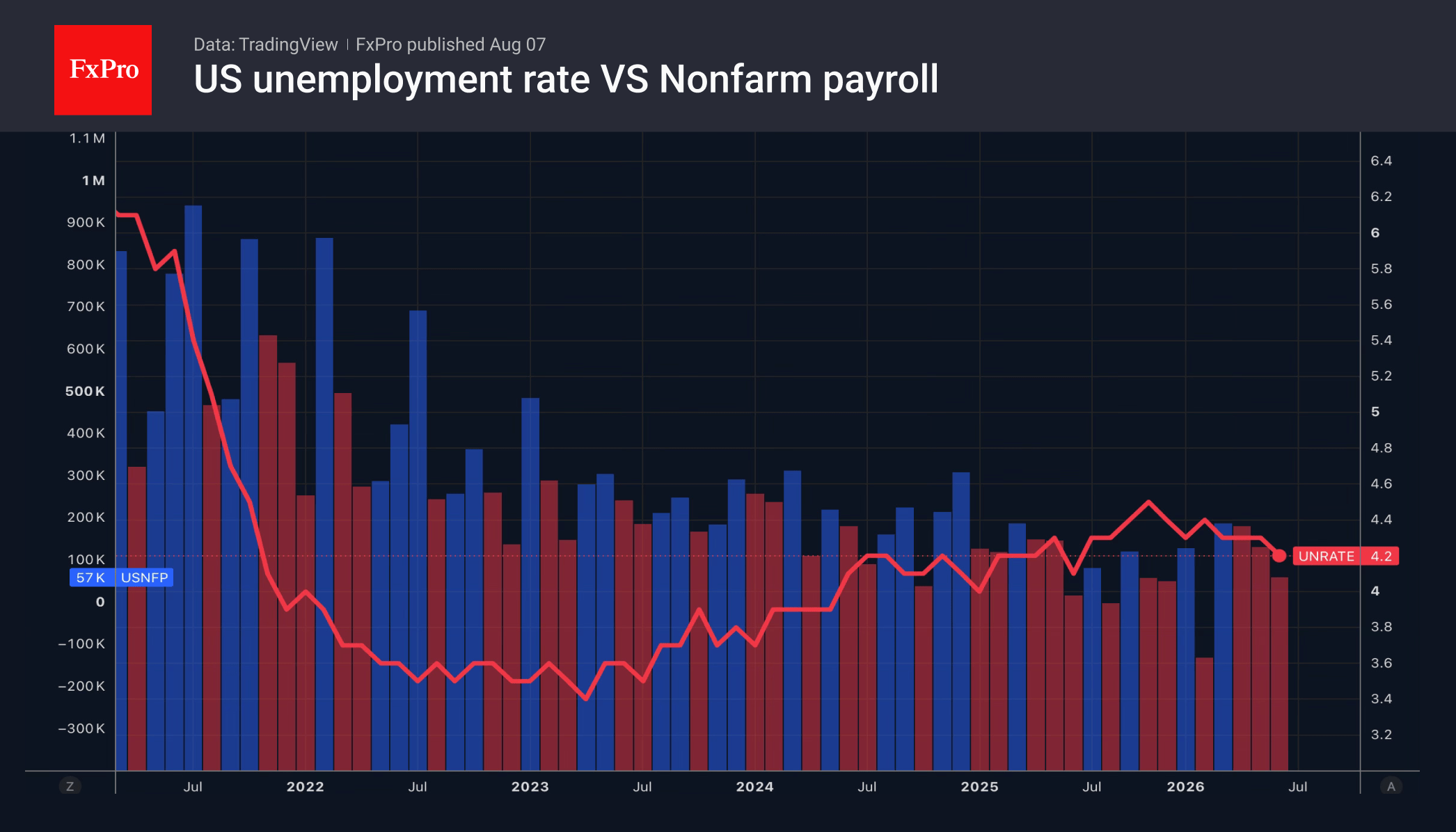
The US dollar posted its best daily performance in two weeks against a backdrop of heightened geopolitical risks and speculators closing out positions ahead of key US labour market data. Employment is expected to rise by 80K, with the unemployment rate to remain at 4.2%. The Fed prefers to prioritise the fight against inflation, so such figures are unlikely to alter the prospects of a rate hike in September. It would be a different matter if the actual figures deviated significantly from the forecast.
Brent has returned above $80 per barrel, as investors doubt the durability of the deal between Iran and Oman to reopen the Strait of Hormuz. Hardline figures in Tehran are demanding the removal of US and Israeli ships, as well as the lifting of sanctions and transit fees from unfriendly countries. It is doubtful that the US would agree to all this, which heightens the risks of a shift from de-escalation to escalation of the conflict, driving up oil prices and Treasury yields. At the same time, the S&P 500 is falling, creating the perfect backdrop for the US dollar.
The strengthening of the greenback against major global currencies has meant that USDJPY bulls have already recouped half of the losses incurred due to the coordinated currency intervention. Speculators are being aided by the wide spread between the Federal Reserve’s and the Bank of Japan’s interest rates, which is fuelling appetite for carry trades. Hedge funds are unfazed by the high-profile statements from officials in Washington and Tokyo regarding further intervention if necessary. However, as the US dollar approaches the ¥160 mark, the risks of such a scenario will increase.
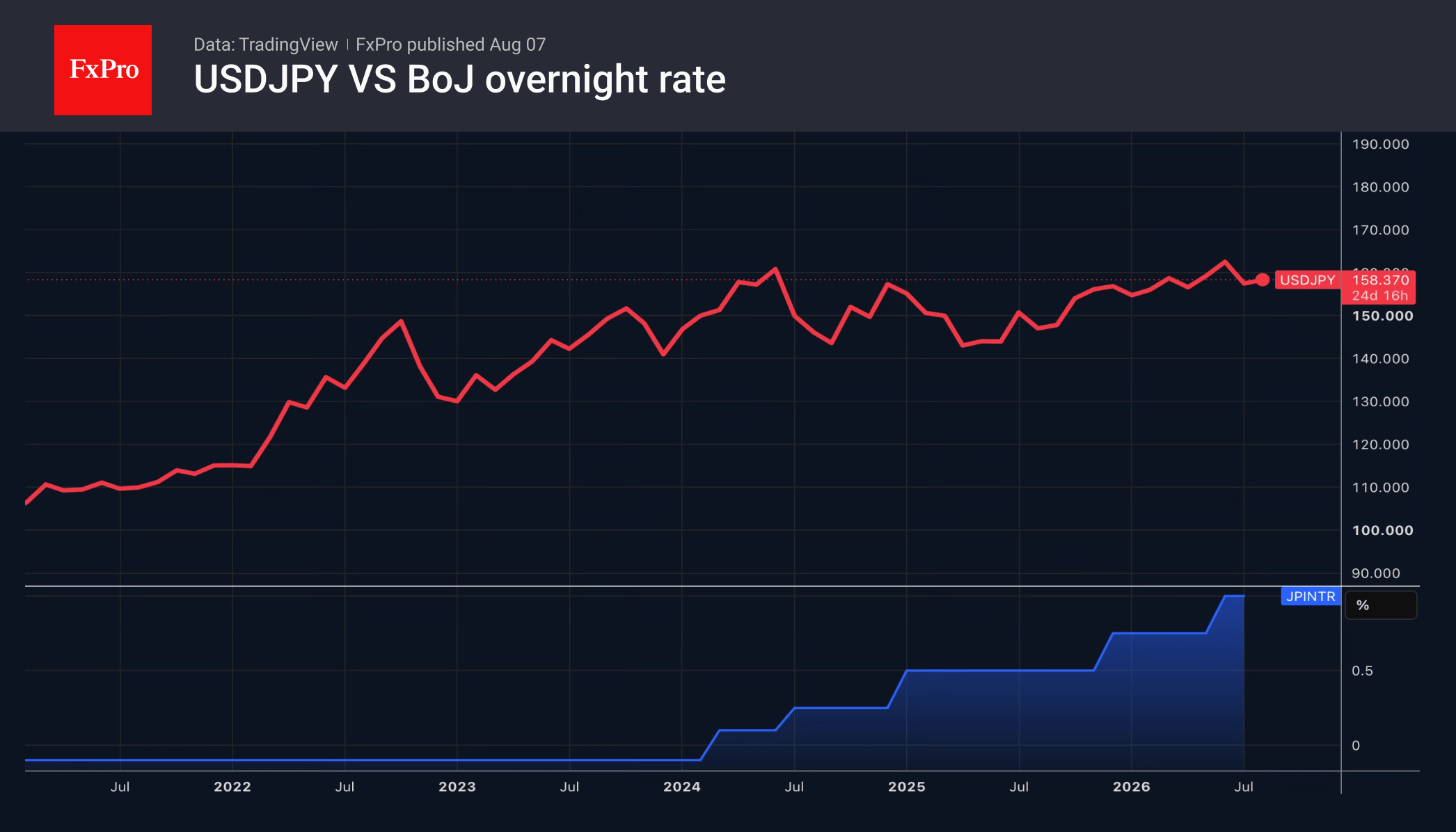
For USDJPY to consolidate at current levels, the Bank of Japan will need to take more decisive action. The forward market puts the odds of a monetary policy tightening by September at 60%; however, if Kazuo Ueda and his colleagues do not raise the overnight rate, this will trigger further yen sell-offs.
Rising geopolitical risks have caused only a temporary pullback in gold. When inflation is high and the Fed is reluctant to tighten monetary policy, the precious metal benefits from a favourable environment of falling real yields on US Treasury bonds. However, the US jobs report could change everything.
The FxPro Analyst Team
The Crypto Market Continues to Gather Momentum for a Breakout
Market Overview
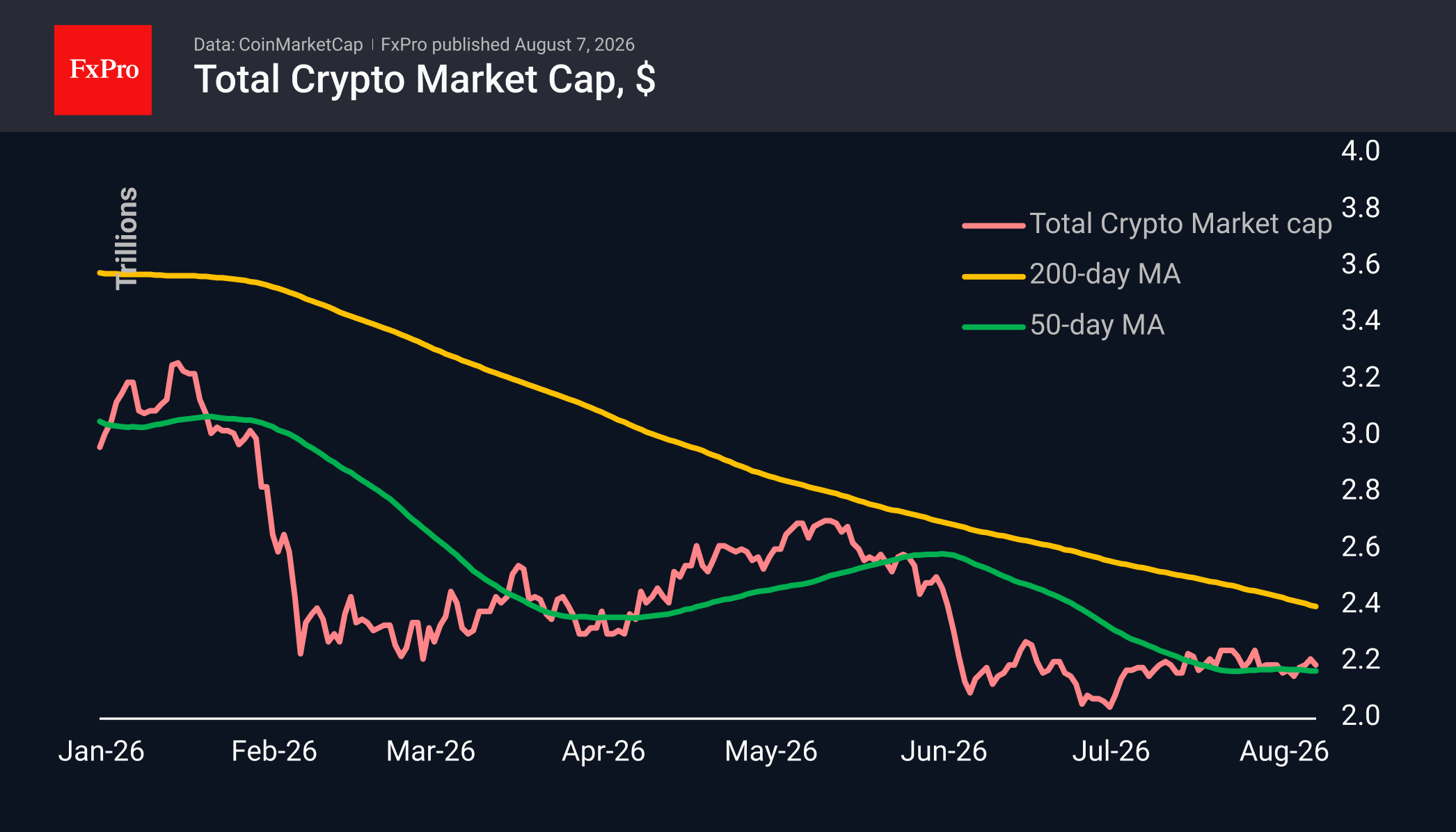
The crypto market capitalisation has returned to the $2.19T level, retreating into its previous trading range following a flight from risk assets on Thursday evening and the continuation of this trend on Friday morning. The market remains indecisive just above its 50-day moving average, as bearish momentum has already petered out and buyers have found no reason to act. Over the past 24 hours, leading cryptocurrencies have mostly fluctuated between -2.5% and +1.5%. The biggest gains came from Cardano (+7%) and Algorand (+3.2%), while Near (-4.8%) and Avax (-3.9%) led the declines.
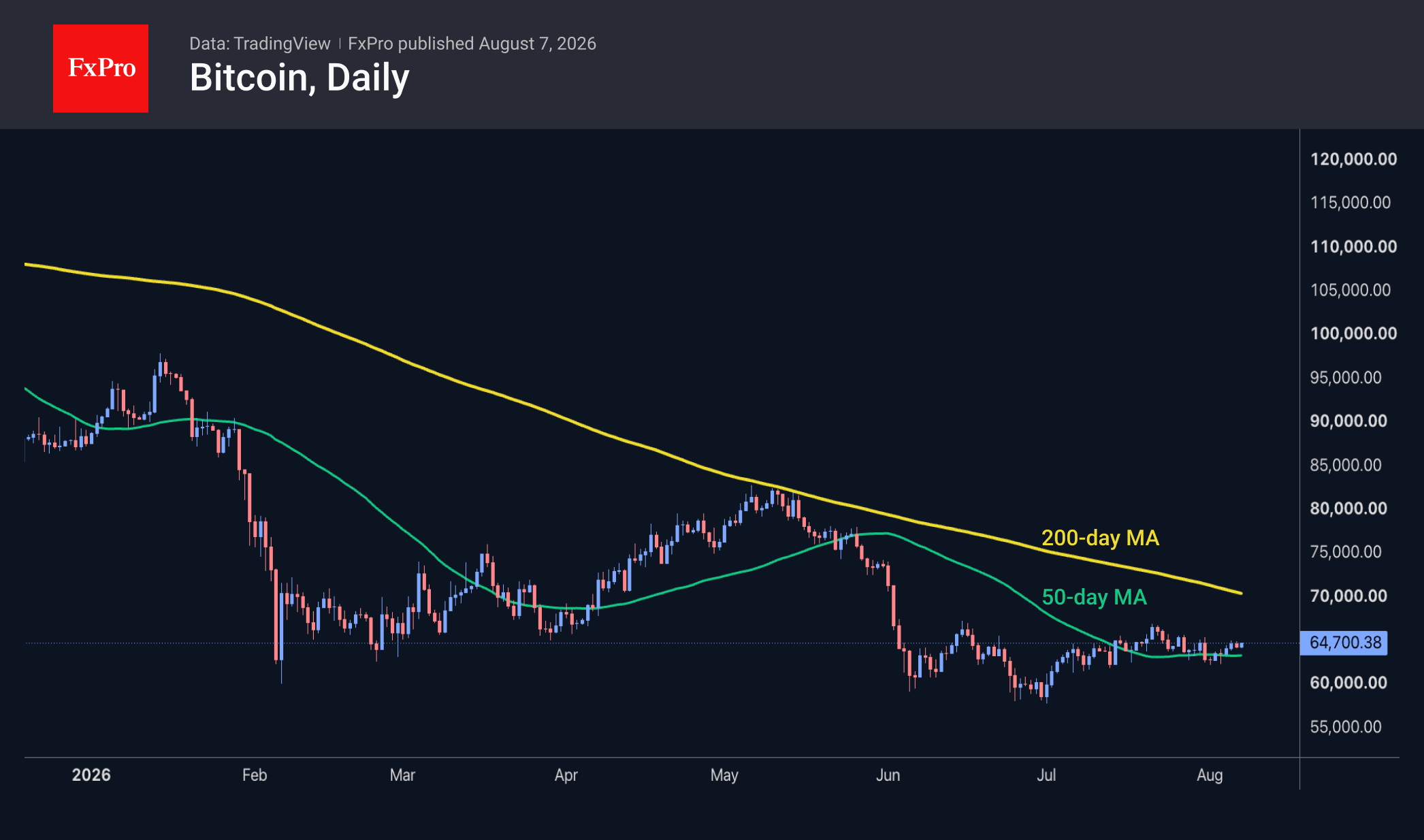
Bitcoin made another attempt yesterday to climb above $65K, but once again failed. The consolidation range has narrowed from $58K to $66K in June to just within $62K and $66K over the last 30 days. The good news here is the higher lower boundary, but without a break above recent highs, it is difficult to attract a wider audience of traders and convince them that the bear market is over. On the other hand, the longer the lull, the more dramatic the breakout from consolidation is likely to be. In this case, a breakout above $66K could prove to be a self-fulfilling prophecy, attracting those who have been on the sidelines for a long time.
News Background
Large holders of Bitcoin, Ethereum and XRP are building up their positions while prices remain close to or below the realised price, according to CryptoQuant. This reduces selling pressure and increasingly resembles the final phase of a bear market.
The current situation in Bitcoin should not be viewed as a ‘lull’, particularly given weak trading volumes and limited market depth, warns Tesseract Group. The decline in volatility is a reason to exercise caution regarding leverage.
Activity among small Bitcoin holders has risen sharply following the hack of Coldcard hardware wallets. The volume of transfers has reached a level not seen for almost four years, according to CryptoQuant. Increased activity on the Bitcoin network has historically often coincided with a BTC reversal, K33 Research points out.
A group of developers, informally known as the Bitcoin Red Team, used advanced AI models to identify 4,962 potential security issues across 390 projects related to the first cryptocurrency in just one day. Of these, 85 were classified as critical risk, with a further 635 classified as high risk.
The US Senate has reached an impasse over the CLARITY Act. Senate Majority Leader John Thune has yet to call a vote to end debate, raising the risk that the bill will be delayed until after the August recess. As a result, the chances of it passing this year have fallen to a record low.
The FxPro Analyst Team
US Dollar Index (DXY): Two Months of Consolidation, One NFP Away from a Breakout
The dollar heads into today's session with one of the most important catalysts of the summer on deck: the July Non-Farm Payrolls report, due at 12:30 PM UTC. Economists expect around 95,000 jobs added, down from June's already weak 57,000 print, with the unemployment rate seen ticking up to 4.4% from 4.3%.
The backdrop makes this release particularly consequential. At its July meeting, the Fed held rates steady at 3.50%-3.75%, but the tone was notably hawkish: three policymakers pushed for a hike rather than any discussion of cuts. That stance has kept the dollar broadly supported, even as recent JOLTS data pointed to cooling labor demand and futures markets trimmed the odds of a September hike to around 59%, down from 67% just days earlier.
Today's numbers will likely decide which narrative wins out. A stronger-than-expected print, particularly alongside firm wage growth, would reinforce the Fed's hawkish resolve and could send the dollar testing higher levels. A weaker report, especially with downward revisions to prior months, would revive rate-cut expectations and put fresh pressure on the greenback heading into the rest of August.
Technical Analysis of the DXY
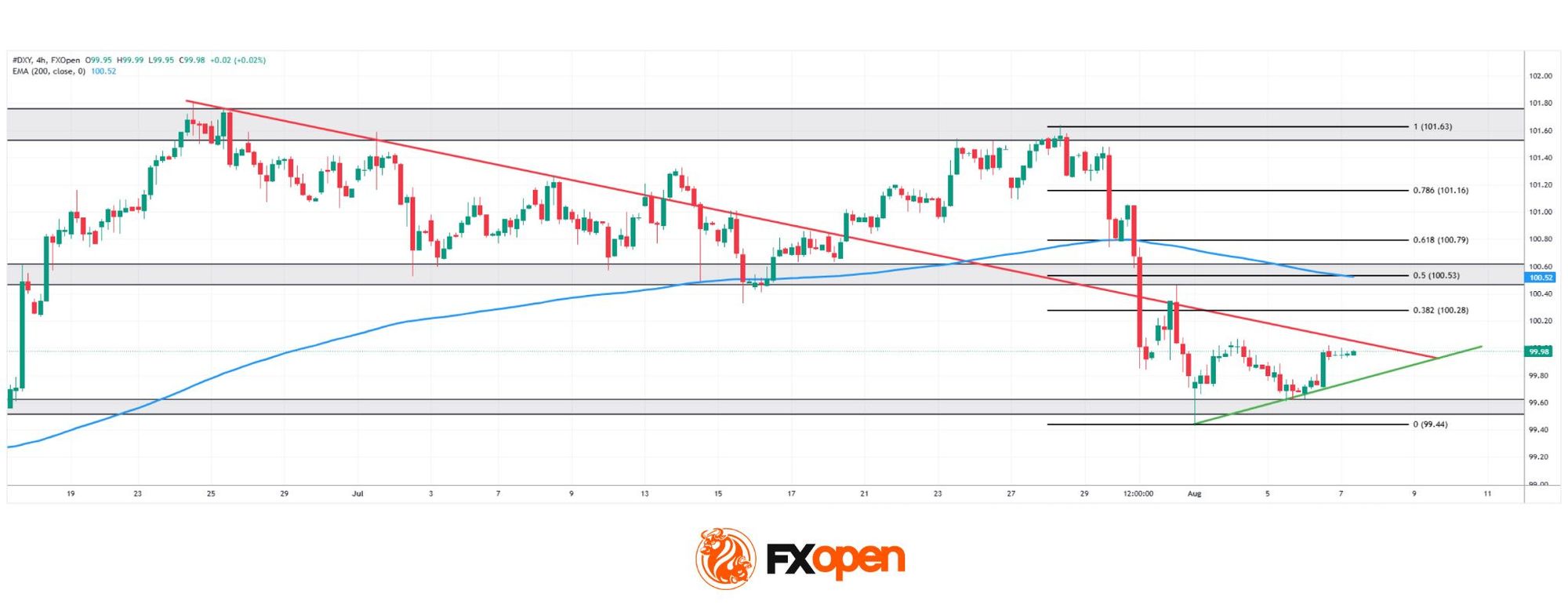
As the chart shows, the DXY has spent nearly two months consolidating after its 2026 recovery, currently squeezed between a descending trendline from late June's highs and a newly formed ascending trendline off early August's lows, with price also testing the confluence of the 0.382 Fibonacci retracement near 100.28.
Bullish Scenario
Should buyers break above the descending trendline and reclaim the 0.5 retracement near 100.53, where the 200-period EMA also sits, the path would open toward the 0.618 level around 100.79, with a stronger move potentially targeting the 0.786 retracement near 101.16 and the 101.63 highs beyond.
Bearish Scenario
Conversely, a break below the ascending trendline and the 99.60 support would expose the 0.0 Fibonacci level near 99.44, invalidating the recent recovery attempt and opening the door to a deeper pullback within the broader consolidation range.
With today's NFP report landing right at this technical crossroads, where two converging trendlines meet a key Fibonacci confluence, the DXY looks poised for a decisive break—will the dollar finally resolve two months of consolidation, or extend the standoff into next week?
Trade global index CFDs with zero commission and tight spreads (additional fees may apply). Open your FXOpen account now or learn more about trading index CFDs with FXOpen.
This article represents the opinion of the Companies operating under the FXOpen brand only. It is not to be construed as an offer, solicitation, or recommendation with respect to products and services provided by the Companies operating under the FXOpen brand, nor is it to be considered financial advice.
USD/JPY Holds Firm: Yen Loses Some Support
USD/JPY stood at 158.39 on Friday, with the Japanese yen giving back some of the gains made following the joint intervention by Tokyo and Washington. The renewed weakness has once again raised expectations of possible further action by the authorities.
The pullback has highlighted that currency interventions alone are insufficient to address the fundamental drivers of the yen’s weakness. Pressure on the currency is being driven by a wide interest rate differential, rising fiscal risks, and elevated energy and import costs.
An additional negative factor has been the strengthening of the dollar and the recovery in oil prices following renewed tensions around the Strait of Hormuz. Domestic data have also been weak, with Japanese household spending falling 3.3% in June, against expectations of 1.0% growth – pointing to subdued consumer demand.
Investors are now pricing in the possibility of a Bank of Japan rate hike in September. While the regulator left policy settings unchanged last week, markets continue to price in further tightening.
Technical Analysis
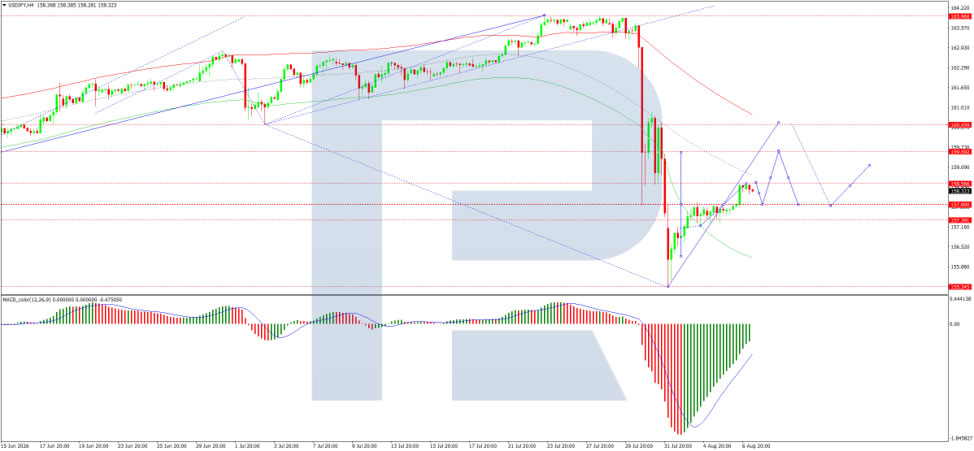
On the H4 USD/JPY chart, the market is forming a consolidation range around the 157.90 level, currently extending up to 158.56. A move lower towards 157.90 is expected today, followed by a move higher to 159.50. The MACD indicator supports this scenario, with its signal line below zero and pointing upwards.
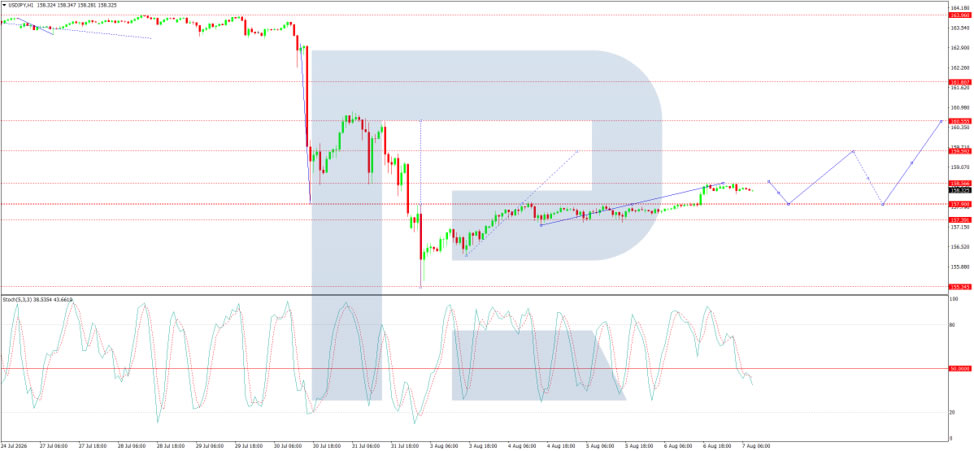
On the H1 chart, USD/JPY has completed an upward move to 158.56. A consolidation range is currently forming below this level. A move lower towards at least 157.90 is expected, followed by a move higher to 159.50. The Stochastic oscillator confirms this scenario, with its signal line below 50 and pointing downwards towards 20, indicating short-term downside pressure.
Conclusion
USD/JPY has regained some ground as the yen’s post-intervention gains fade, highlighting the limitations of currency intervention in addressing the fundamental drivers of yen weakness. Wide interest rate differentials, fiscal risks, high energy costs, and weak domestic spending continue to weigh on the currency. Renewed tensions around the Strait of Hormuz have pushed oil prices higher, while disappointing household spending data have added to concerns over sluggish consumer demand. Markets are now pricing in a potential Bank of Japan rate hike in September. Technically, USD/JPY may see a short-term pullback towards 157.90 before resuming its upward trajectory towards 159.50, with intervention risks remaining a key factor.
EUR/USD Daily Outlook
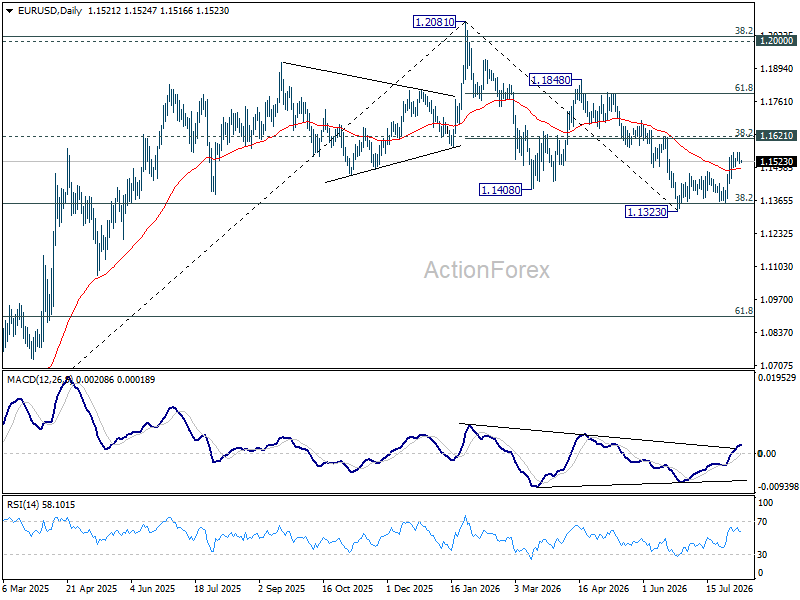
Intraday bias in EUR/USD remains neutral. On the upside, above 1.1559 will extend the rebound from 1.1323 to cluster resistance (38.2% retracement of 1.2081 to 1.1323 at 1.1613). Decisive break there will target 61.8% retracement at 1.1791. Nevertheless, break of 1.1454 minor support will turn bias back to the downside for 1.1323/1352 support zone instead.
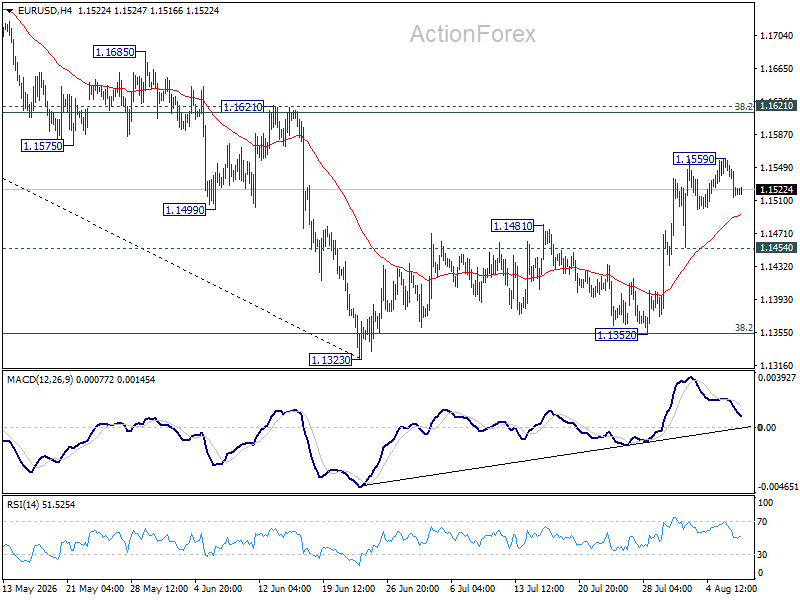
In the bigger picture, focus is staying on 38.2% retracement of 1.0176 to 1.2081 at 1.1353. Decisive break there will revive the case of medium term bearish trend reversal after rejection by 1.2 key cluster resistance level. Further fall should be seen to 61.8% retracement at 1.0904. Nevertheless, strong rebound from 1.1353, followed by break of 1.1621 resistance, will retain medium term bullishness.