

Sample Category Title
USD/CHF Daily Outlook
Daily Pivots: (S1) 0.9855; (P) 0.9903; (R1) 0.9972; More...
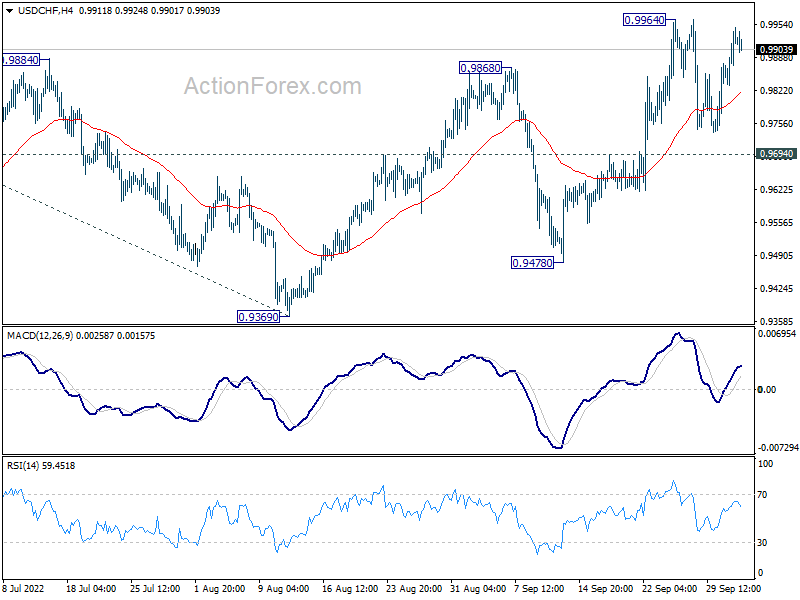
Intraday bias in USD/CHF remains neutral for the moment. Further rally is in favor as long as 0.9694 support holds. On the upside, above 0.9964 will resume the rally from 0.9369 to retest 1.0063 high. On the downside, however, break of 0.9694 support will extend the corrective pattern from 1.0063 with another falling leg, towards 0.9478 support first.
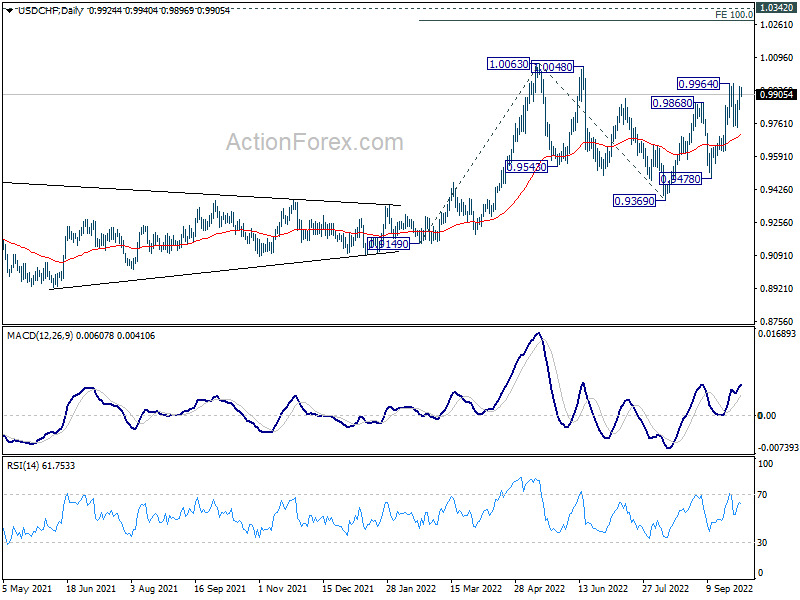
In the bigger picture, current development suggests that up trend from 0.8756 (2021 low) is still in progress. Sustained break of 1.0063 will target 100% projection of 0.9149 to 1.0063 from 0.9369 at 1.0283, and then 1.0342 (2016 high). For now, this will remain the favored case as long as 0.9369 support holds, even in case of deep pull back.
EUR/USD Daily Outlook
Daily Pivots: (S1) 0.9770; (P) 0.9808; (R1) 0.9862; More...
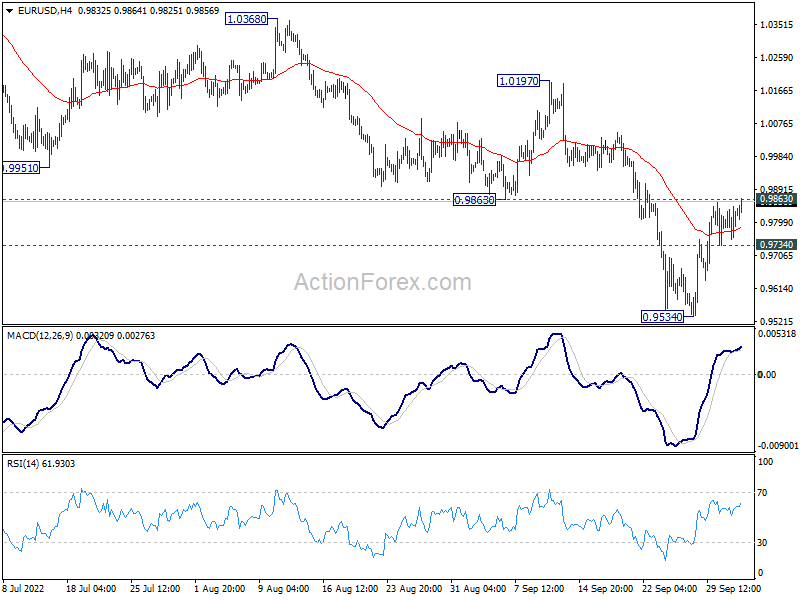
Intraday bias in EUR/USD remains neutral first. On the upside, firm break of 0.9863 support turned resistance will bring stronger rise to 55 day EMA (now at 1.0033). Considering bullish convergence condition in Daily MACD, sustained break there will raise the chance of medium term bottoming at 0.9534. On the downside, though, break of 0.9734 minor support will bring retest of 0.9534 low instead.
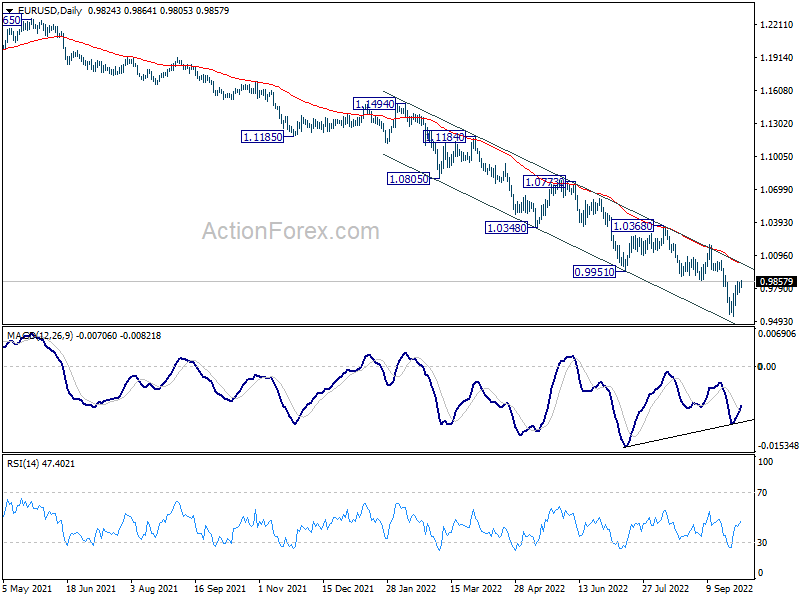
In the bigger picture, down trend from 1.6039 (2008 high) is still in progress. Next target is 100% projection of 1.3993 to 1.0339 from 1.2348 at 0.8694. In any case, break of 1.0197 resistance is needed to be the first sign of medium term bottoming. Otherwise, outlook will stay bearish even with strong rebound.
RBA Board Surprises with a 25 Basis Point Increase in the Cash Rate
Despite the surprise on this move we retain our forecast that the terminal rate in this cycle will be 3.6%, with a series of 25 basis point moves out to March 2023 (previously February 2023).
The Reserve Bank Board decided to increase the cash rate by 25 basis points to 2.60%.
This was a lower increase than we had expected and is justified by “The cash rate has been increased substantially in a short period of time. Reflecting this, the Board decided to increase the cash rate by 25 basis points this month as it assesses the outlook for inflation and economic growth in Australia.” We had anticipated one last move of 50bps.
The Governor noted to the House of Representatives Standing Committee on Economics on September 16, “at some point we’ll obviously not need to be increasing rates by 50 basis points at each meeting, and we’re getting closer to that point.” He clearly delivered on that observation despite a significant lift in global interest rates and the ambiguity as to whether that point had actually been reached.
The Board also changed the guidance from “The Board expects to increase interest rates further over the months ahead” (in September) to “The Board expects to increase interest rates further over the period ahead.” However, in an earlier paragraph the Statement refers to “FURTHER INCREASES are likely to be required over the period ahead” (my emphasis).
While the key theme from the September Statement, “the full effects of higher interest rates yet to be felt in mortgage payments” has been repeated in the October Statement strong emphasis has been given to the global economy.
In the key final paragraph, the Statement notes that “The Board… is closely monitoring the global economy, household spending and price-setting behaviour”. In the September Statement the “check list” of what it was monitoring was not clearly set out in the final paragraph. While the reference to the global economy was limited to “the outlook for global economic growth has deteriorated.”
However, the September Statement noted, “an important source of uncertainty continues to be the behaviour of household spending “– he points out the interaction of low Consumer Confidence; declining house prices on the one hand and people finding jobs; gaining more hours of work and receiving higher wages.
The September Statement also points to “The Board will continue to pay close attention to both the evolution of labour costs and the price setting behaviour of firms in the period ahead.”
There seems to a confidence building around Australia’s capacity to avoid a strong lift in wages growth. “Wages growth… remains lower than in other advanced economies where inflation is higher.”
That confidence is likely to be misplaced as we move further into 2022 and 2023.
Certainly, the argument about lower inflation does not align with the official forecasts. For example, the RBA is forecasting headline inflation to be 7.75% by end 2022 compared to the recent end year forecasts from the FOMC (Federal Open Market Committee) of 5.4% for the PCE (the current PCE is running at around 2 ppt’s below headline inflation).
Conclusion
Westpac has expected that the terminal rate in this cycle will be 3.6%. That involved a 50 basis point increase in October to be followed by three 25 basis point increases in November; December; and February.
Today’s decision does not change our view that the sequence of increases will revert to 25 basis point increases in November; December; and February.
However, it seems unlikely that slowing the pace of increase a month earlier than expected will mean a lower terminal rate.
We still expect the federal funds rate to peak at 4.625%, holding the AUD at around USD 0.65 over the course of 2022.
We do not share the RBA’s confidence around the containment of wage pressures and expect that economic growth will have to slow to 1% in 2023 to achieve an acceptable slowdown in inflation and wages growth.
By engineering this positive surprise with today’s decision the end result is likely that the tightening cycle will need to be extended into March when another update on wages growth will be received by the RBA.
Consequently,we retain our forecast that the cash rate will peak at 3.6% although now that the sequence of increases has slowed to 25 basis points per meeting the last increase is now likely to be March rather than February.
Technical Outlook and Review
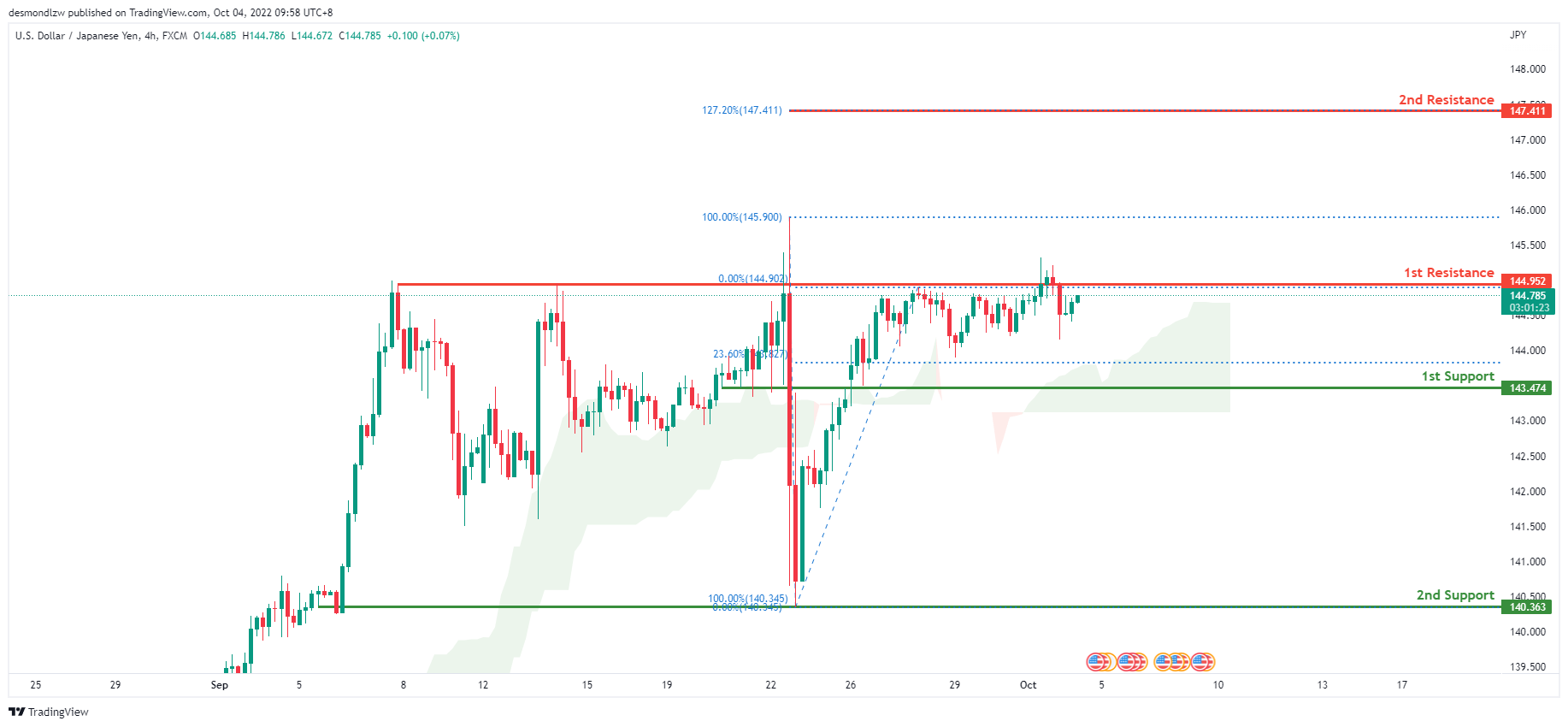
USD/JPY:
On the H4 chart, price is in a strong bullish trend. Furthermore, the price is above the ichimoku cloud, indicating that the market is bullish. Price broke through the 145 level overnight but failed to maintain the bullish momentum, closing below the 145 level. Price is expected to consolidate further around the first resistance level at 144.791, which is also the 145 key level and the 0% Fibonacci line.
Areas of consideration:
- H4 time frame, 1st resistance at 144.952
- H4 time frame, 1st support at 143.474
DXY:
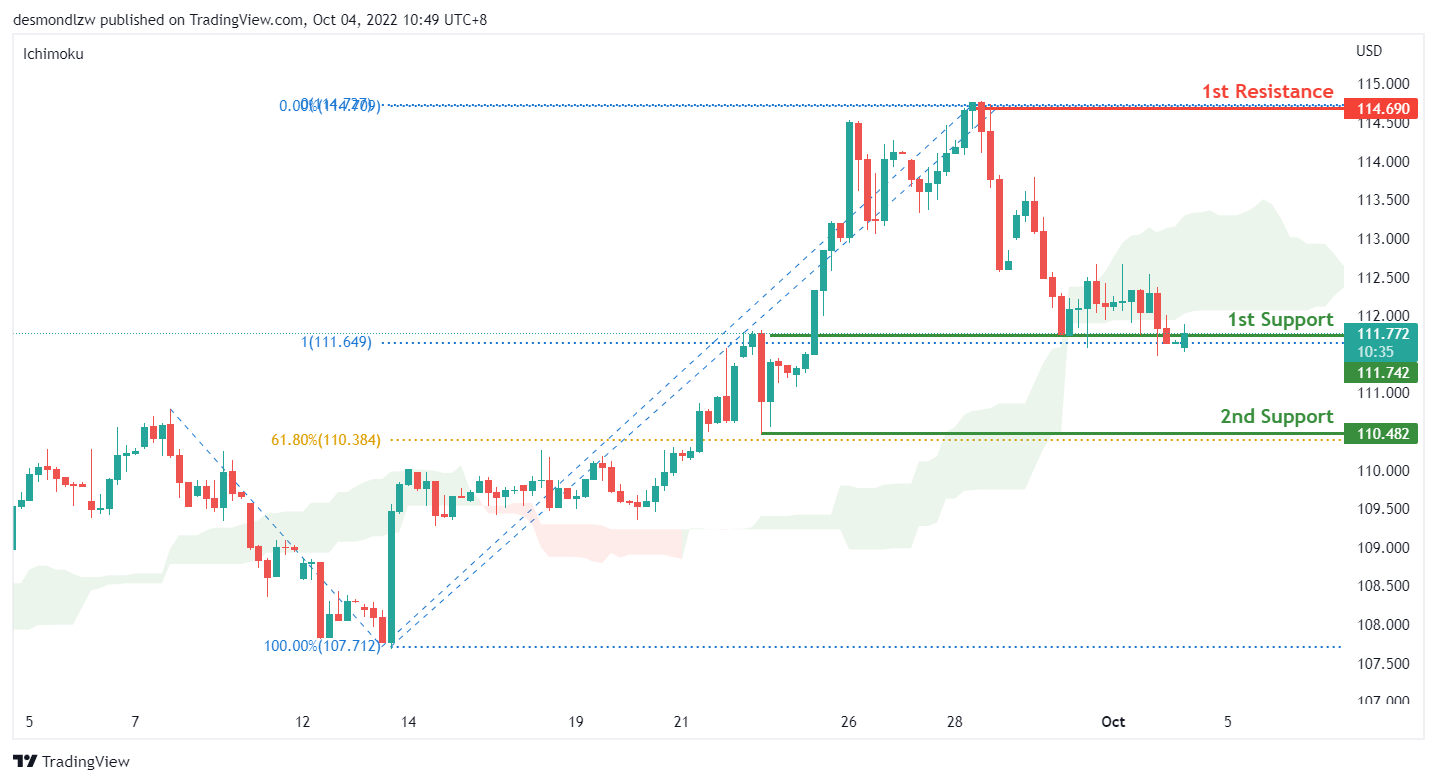
On the H4, price has broken lower from the ichimoku cloud and trades at the 1st support of 111.74 which is inline with the 100% fibonacci extension level leading to a bearish bias. If price breaks this support it could trade lower to test the 2nd support of 110.48 which is in line with the 61.80% fibonacci retracement level and the previous swing low from September 2022.
Areas of consideration:
- H4 time frame, 1st resistance at 114.69
- H4 time frame, 1st support at 111.77
- H4 time frame, 2nd support 110.48
EUR/USD:
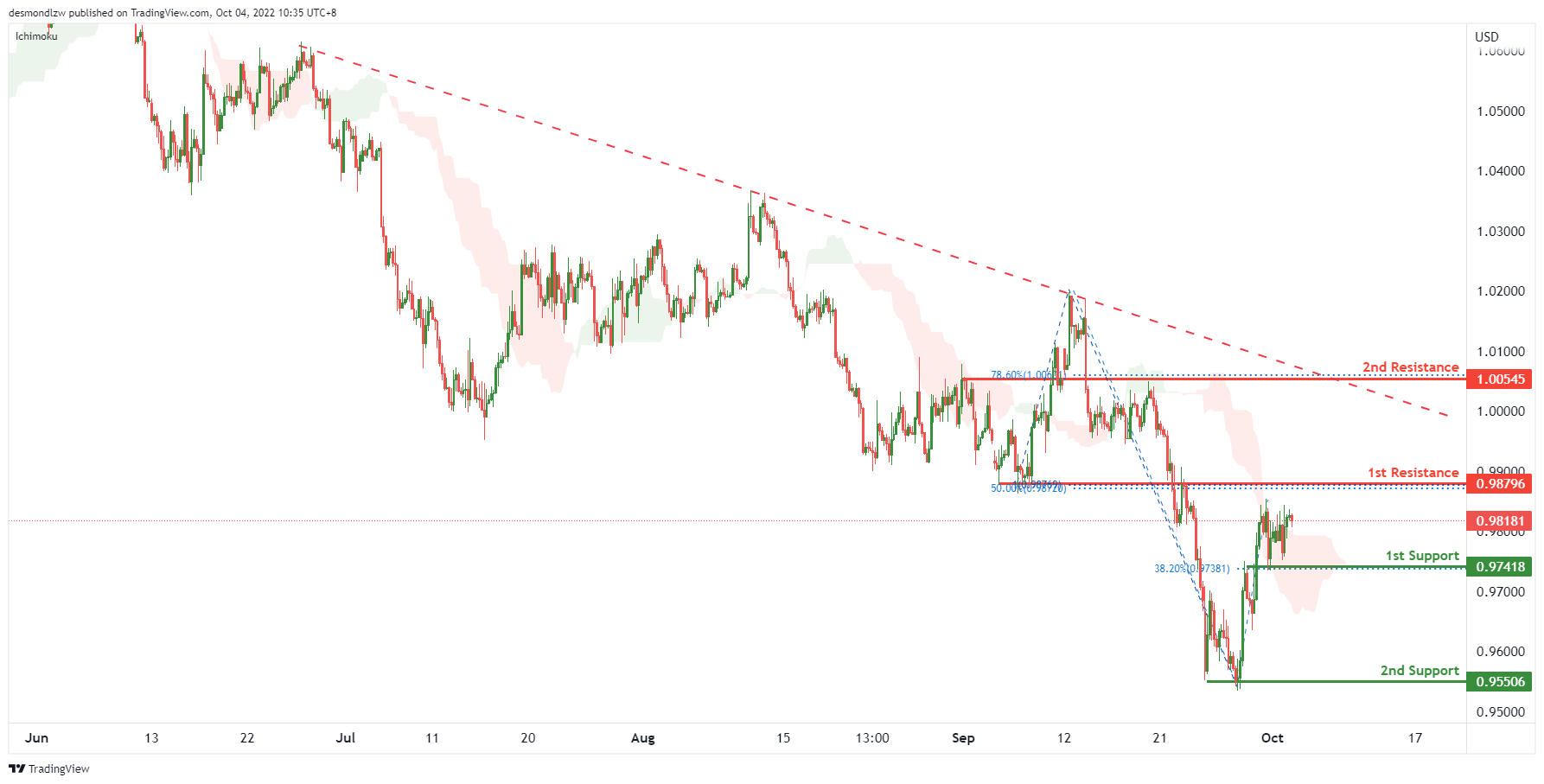
On the H4, price is moving within the descending trendline but in an ascending manner, with the price above ichimoku cloud,- we are slightly bullish biased. Price has bounced off the first support and is moving toward the first resistance at 0.98796 where the 100% projection and 50% retracement sits. If price breaks this level, it will test the second resistance at 1.00545, where the 78.6% fibonacci retracement sits. Alternatively, the overall bearish momentum could bring price back to test the first support at 0.97418 where the previous swing low and 38.2% retracement sits. If it breaks this level, we have a strong bearish confirmation to bring price down to 0.95506 where the swing low sits
Areas of consideration :
- H4 1st resistance at 0.98796
- H4 1st support at 0.97418
GBP/USD:
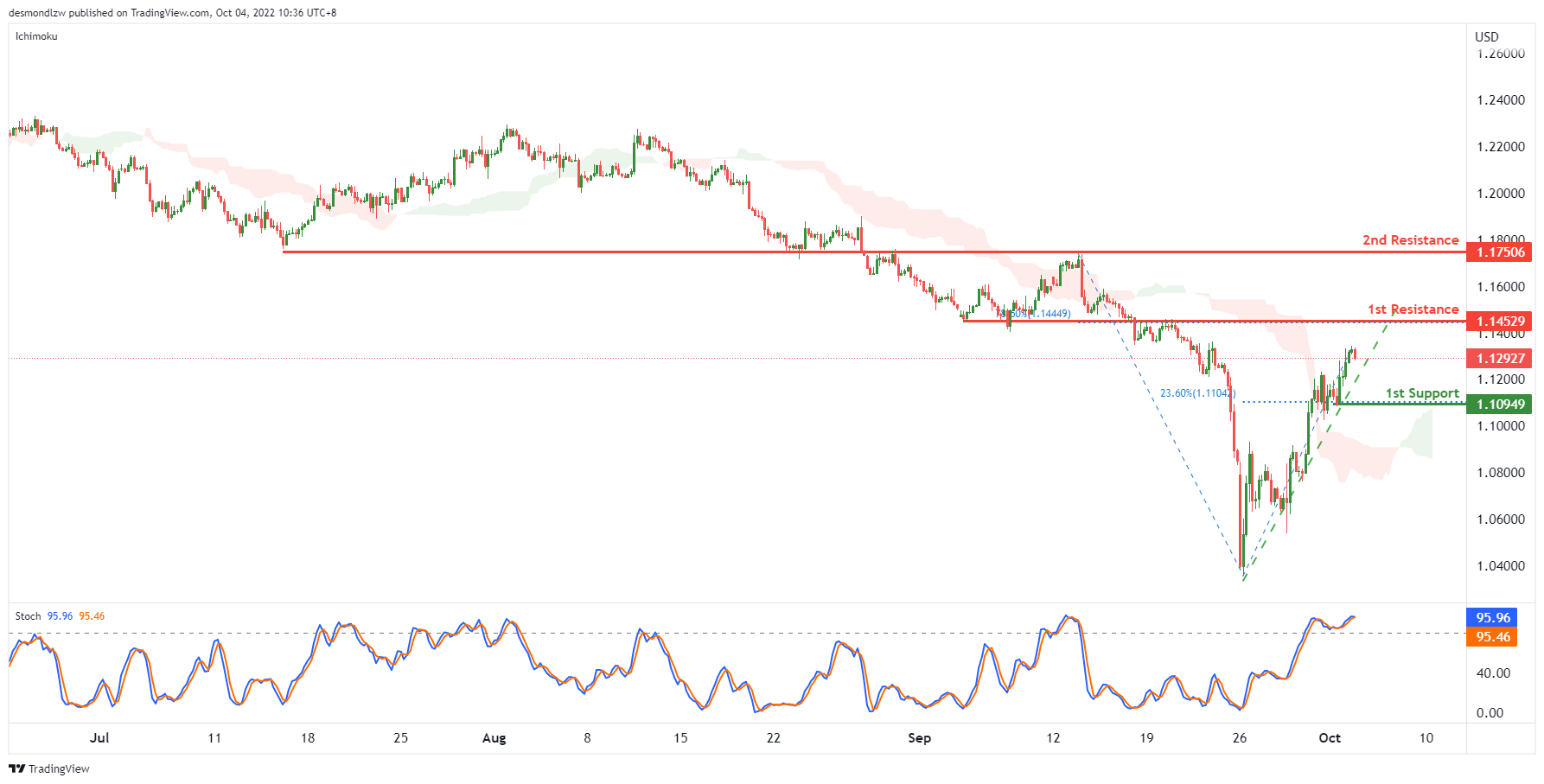
On the H4 time frame, prices have bounced off the support level and are moving in an ascending manner, we are slightly bullish. Price is moving toward the first resistance at 1.14529, where the 78.6% retracement and overlap resistance sits. If it breaks this level, its bullish momentum will bring price to second resistance at 1.17506 where the previous swing high and overlap resistance sit. Alternatively, price could pull back to test the first support at 1.10949, where the 23.6% retracement sits.
Areas of consideration:
- H4 1st resistance at 1.14529
- H4 1st support at 1.10949
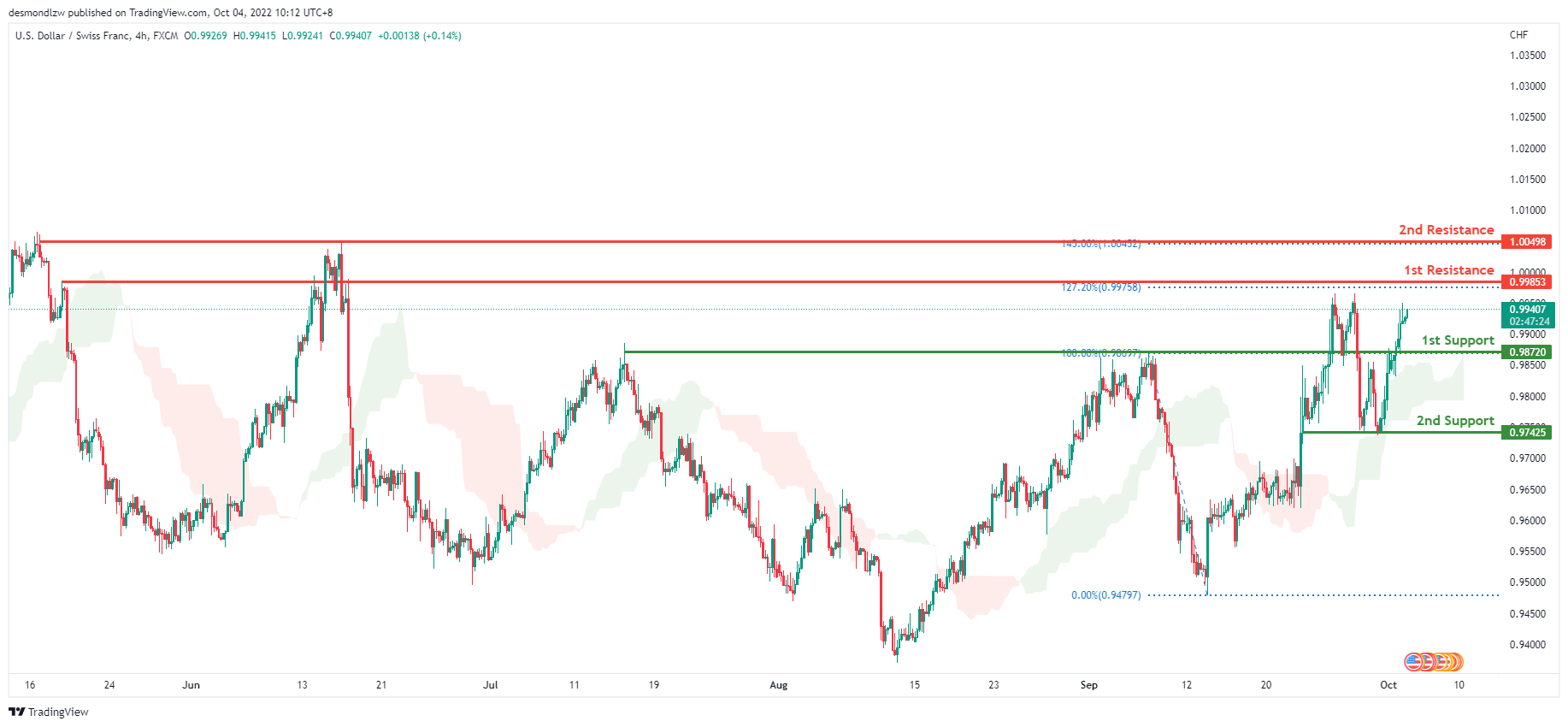
USD/CHF:
The price is in a strong bullish trend on the H4. In addition, price is above the Ichimoku cloud, indicating a bullish market. Price has reflected off the second support level at 0.97425, which contains the 38.2% and 50% Fibonacci lines. Price then proceeded to maintain its strong bullish momentum, breaking through the first support at 0.98720. Given the strong bullish momentum, price is expected to continue moving towards the first resistance level at 0.99853, where the 127.2% Fibonacci extension line is located.
Areas of consideration
- H4 1st support at 0.98720
- H4 1st resistance at 0.99853
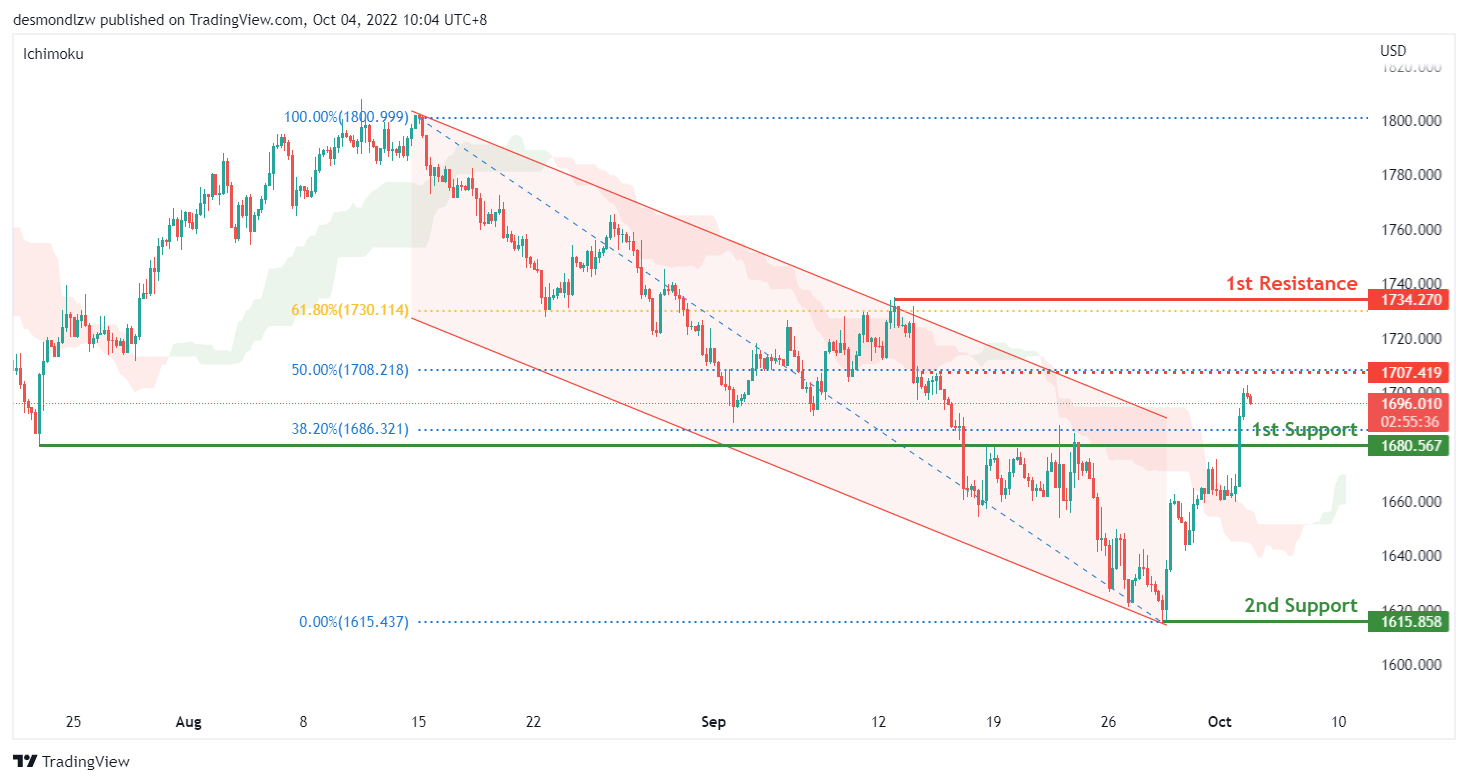
XAU/USD (GOLD):
On the H4, price is broke above the channel and the resistance turned support level of 1680.56, which is inline with the 38.2% fibonacci retracement level and swing low from July 2022. With price above the ichimoku cloud, we have a bullish bias that price could trade higher to the 1st resistance of 1734.27, which is in line with the 61.80% fibonacci retracement level. However, price may retrace towards the 1st support of 1680.56 first before trading higher with a risk level at 1707.41, which is the 50% fibonacci retracement level.
Areas of consideration:
- H4 time frame, 1st resistance at 1734.27
- H4 time frame, 1st support at 1680.56
- H4 time frame, 2nd support at 1615.85
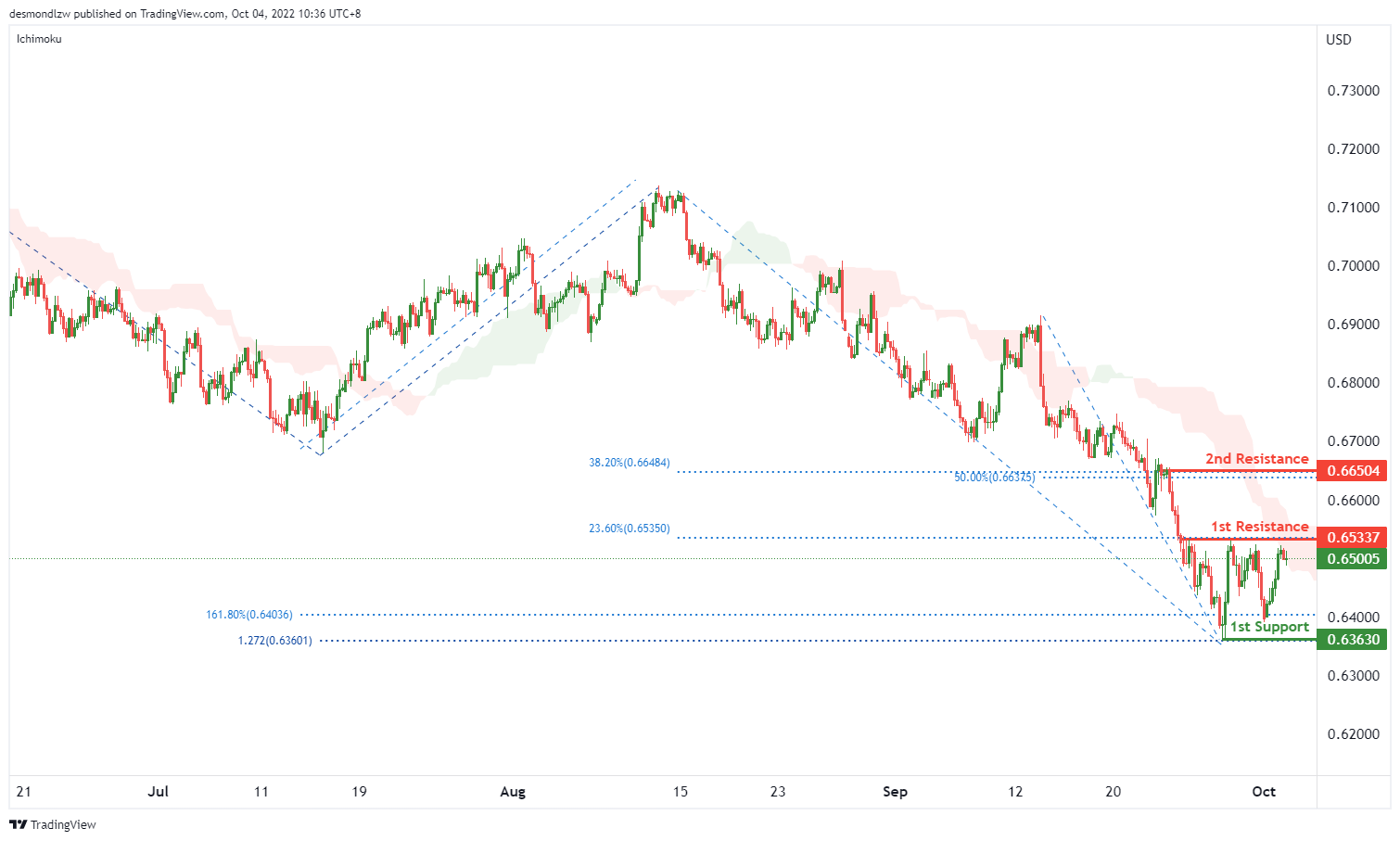
AUD/USD:
On the H4, with the price reversing from the 1st resistance, and the price is below ichimoku cloud, the price may drop form the 1st resistance at 0.65337, which is in line with the 23.6% fibonacci retracement to the 1st support at 0.63630, which is in line with the swing low, 161.8% fibonacci extension and 127.2% fibonacci projection. Alternatively, the price may break the 1st resistance,and rise to the 2nd resistance at 0.66504, where the pullback resistance, 50% and 38.2% fibonacci retracement are.
Areas of consideration
- H4, 1st resistance at 0.65337
- H4, 1st support at 0.63630
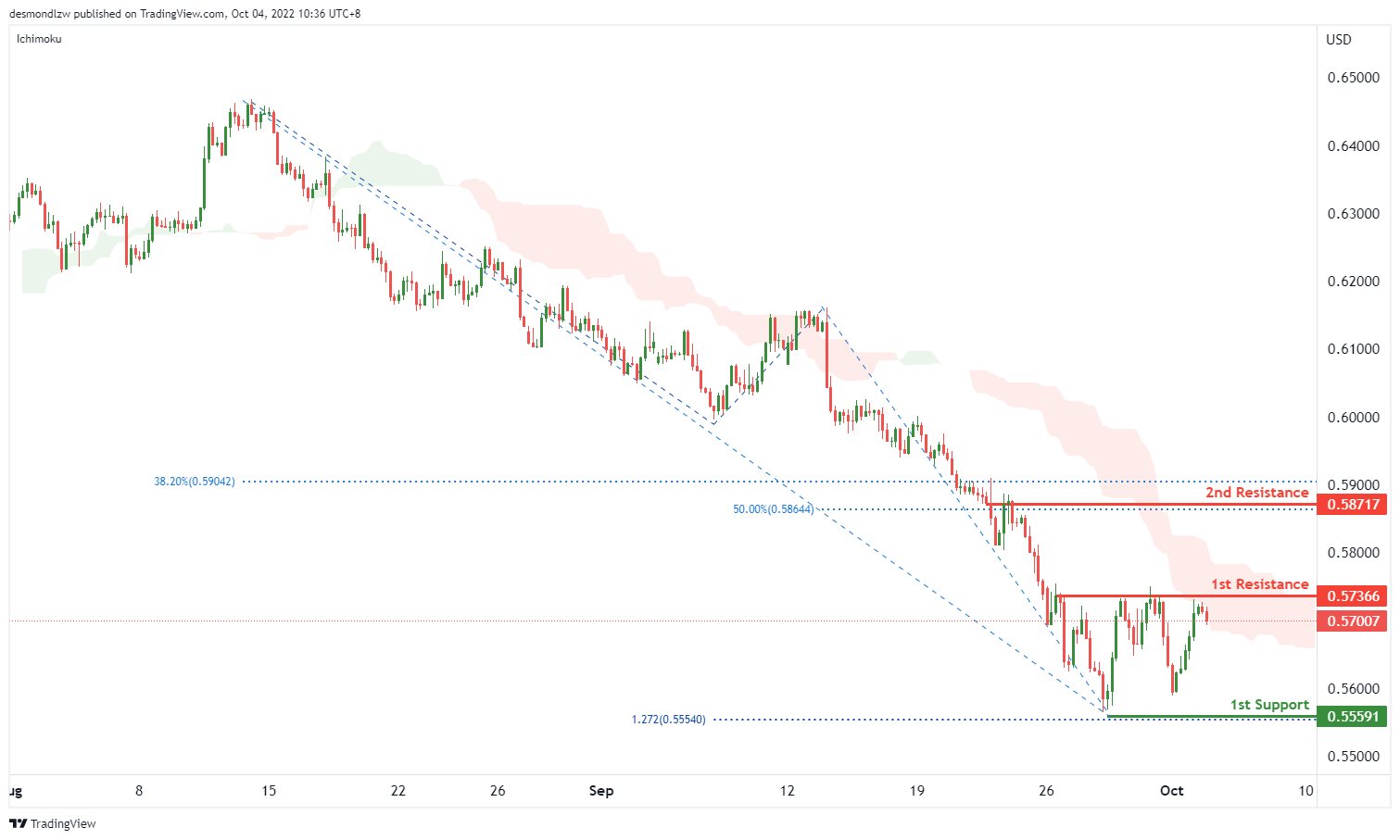
NZD/USD:
On the H4, with the price reversing from the 1st resistance, and the price is below ichimoku cloud, we have a bearish bias that the price may drop form the 1st resistance at 0.57366, where the swing highs are to the 1st support at 0.55591, where the swing low is. Alternatively, the price may break the 1st resistance and rise to the 2nd resistance at 0.58717, where the 38.2% and 50% fibonacci retracement are.
Areas of consideration:
- H4 time frame, 1st resistance at 0.57366
- H4 time frame, 1st support at 0.55591
USD/CAD:
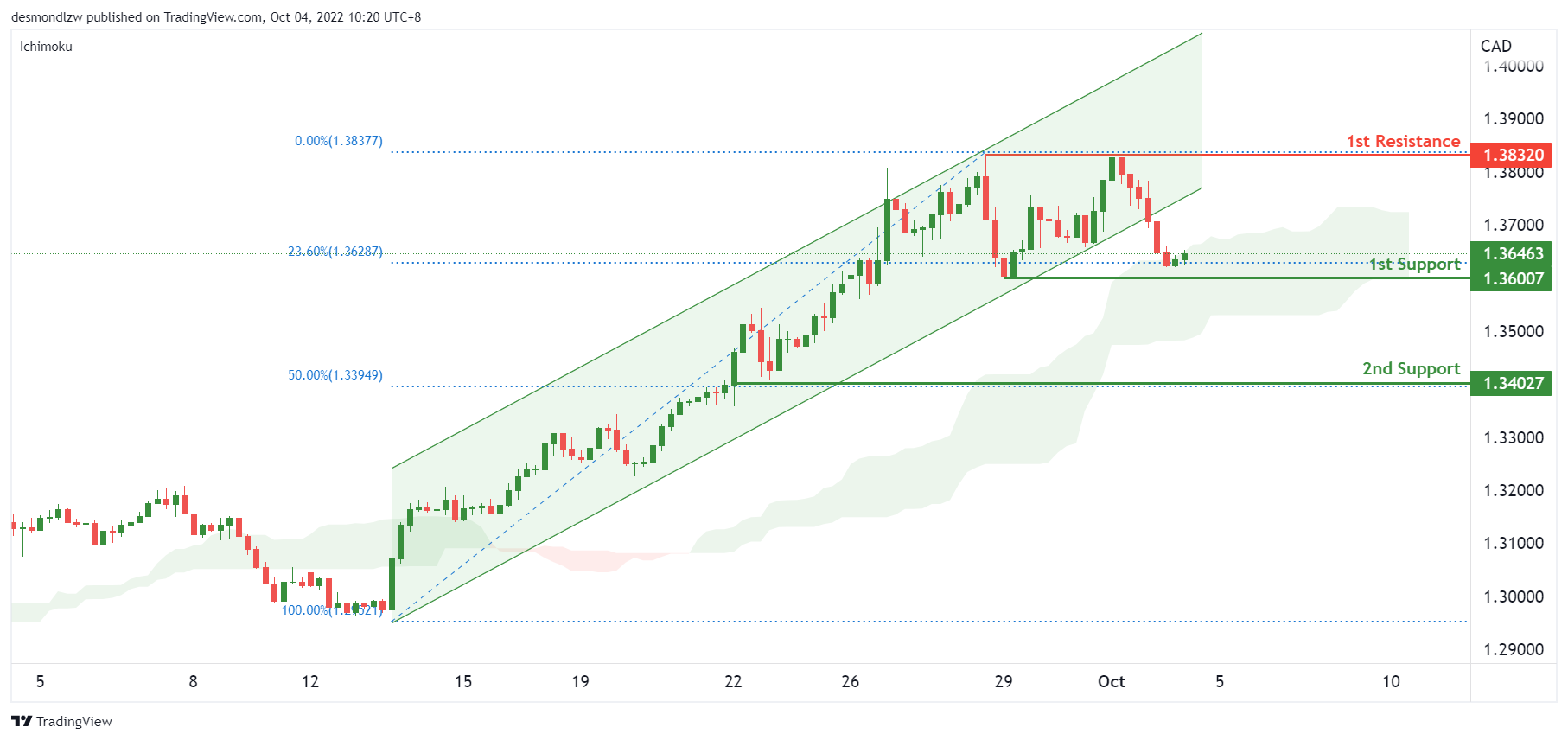
On the H4, the price broke lower from the ascending channel and is in the ichimoku cloud at the 1st support of 1.36 which is in line with the 23.60% fibonacci retracement level. We continue to have a bullish bias that price may rise to the 1st resistance at 1.3832, which is in line with the previous swing high from September 2020. Alternatively, price could fall to the 2nd support level of 1.34 which is in line with the 50% fibonacci retracement level.
Areas of consideration:
- H4 time frame, 1st resistance at 1.3832
- H4 time frame, 1st support at 1.36
- H4 time frame, 2nd support at 1.34
OIL:
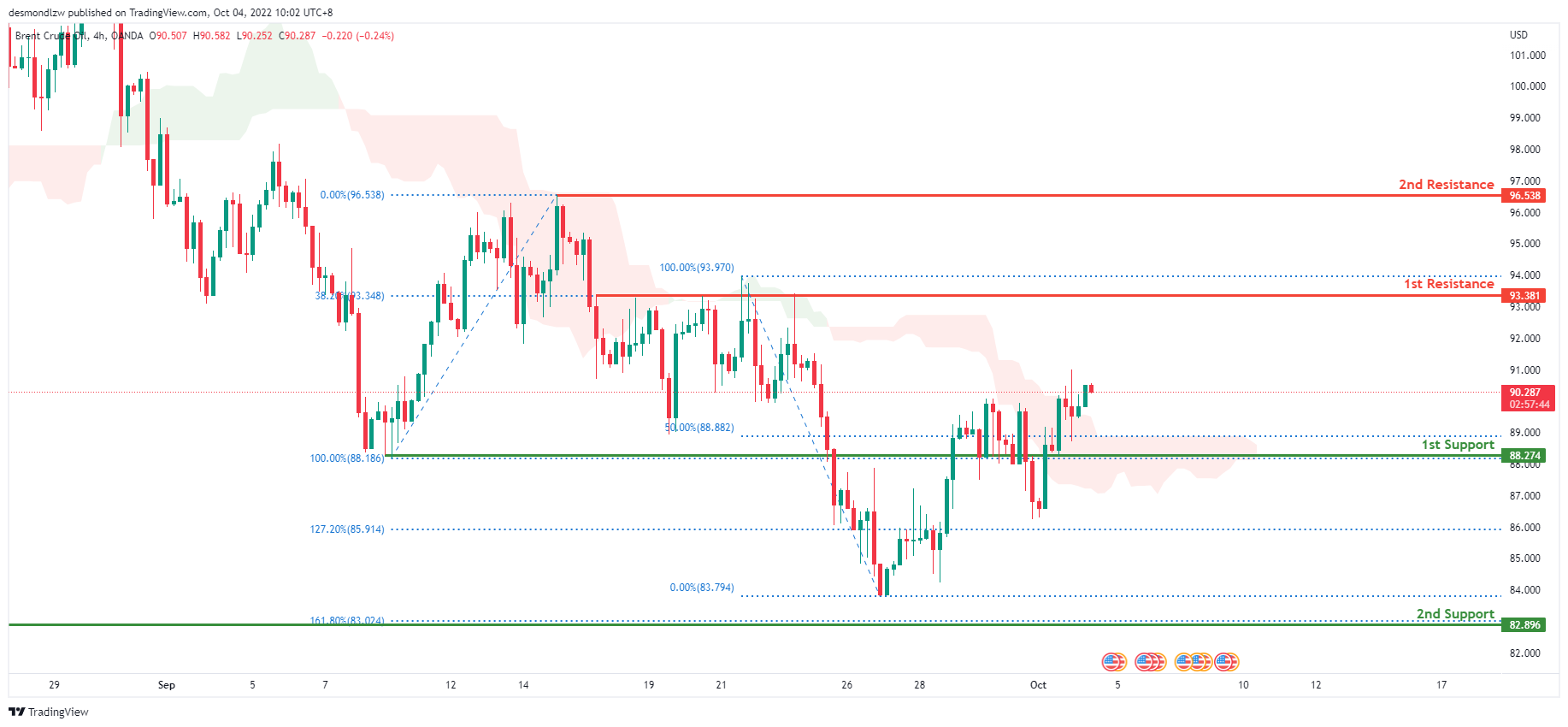
Oil is in a bearish trend on the 4-hour chart. However, price is now above the Ichimoku cloud, indicating that the market is bullish at the moment. Price has broken through the first support level, which has a 100% Fibonacci extension and served as the previous swing low, at 88.788. Price is expected to move towards the first resistance level, which is the 38.2% Fibonacci extension line at 93.381, given the current strong bullish momentum.
Areas of consideration:
- H4 time frame, 1st resistance at 93.381
- H4 time frame, 1st support at 88.366
Dow Jones Industrial Average:
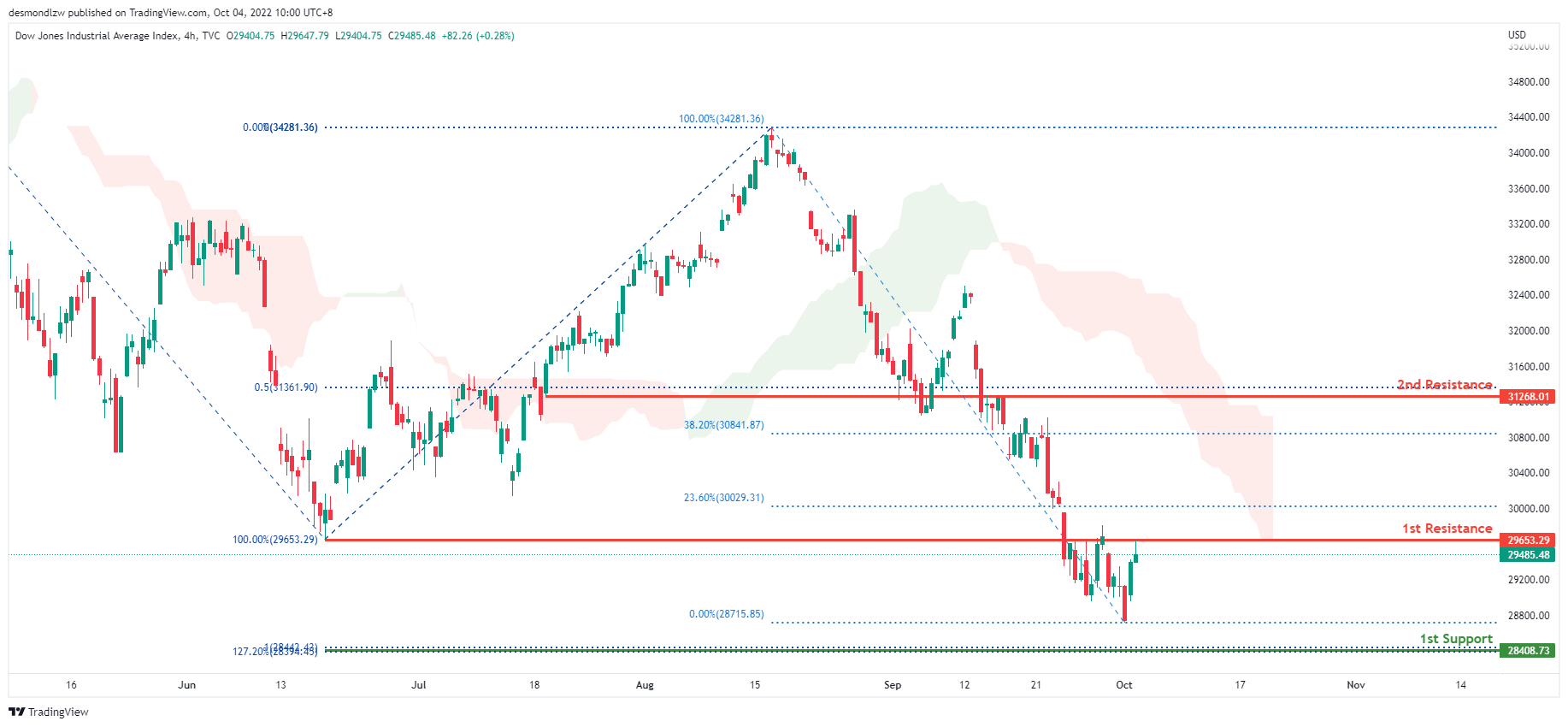
On the H4, the price is in a bearish trend. In addition, the price is below the ichimoku cloud, indicating a bearish market. Price has also broken through the first resistance level at 29653.29. This level contains the 100% Fibonacci line and the previous swing low. Overnight, price attempted but failed to break through the first resistance level. Price is expected to move towards the first support level at 28422.42, which contains the 100% Fibonacci projection line and the 127.2% Fibonacci extension line, given the current bearish momentum.
Areas of consideration:
- H4 time frame, 1st support at 28408.73
- H4 time frame, 1st resistance at 29653.29
DAX:
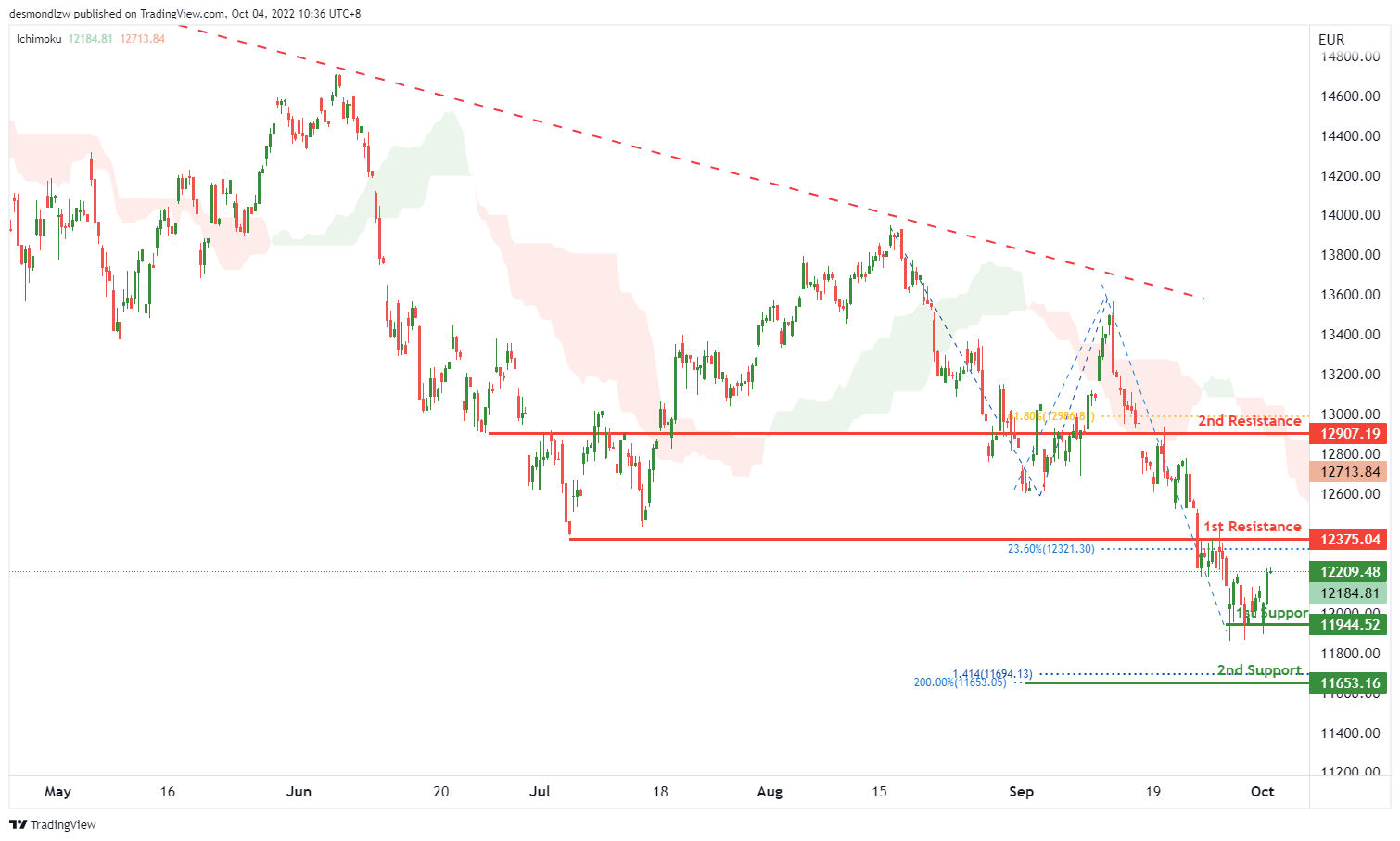
On the H4, with the price bouncing from the 1st support at 11944.52, the price may test the 1st resistance at 12375.04, which is in line with the overlap resistance and 23.6% fibonacci retracement. If the 1st resistance is broken, the price may rise to the 2nd resistance at 12907.19, where the 61.8% fibonacci retracement is. Alternatively, the price may drop back to the 1st support, if the 1st support is broken, we can expect the price to drop to the 2nd support at 11653.16, where the 141.4% fibonacci projection and 200% fibonacci projection are.
Areas of consideration:
- H4 time frame, 1st resistance at 12375.04
- H4 time frame, 1st support at 11944.52
ETHUSD:
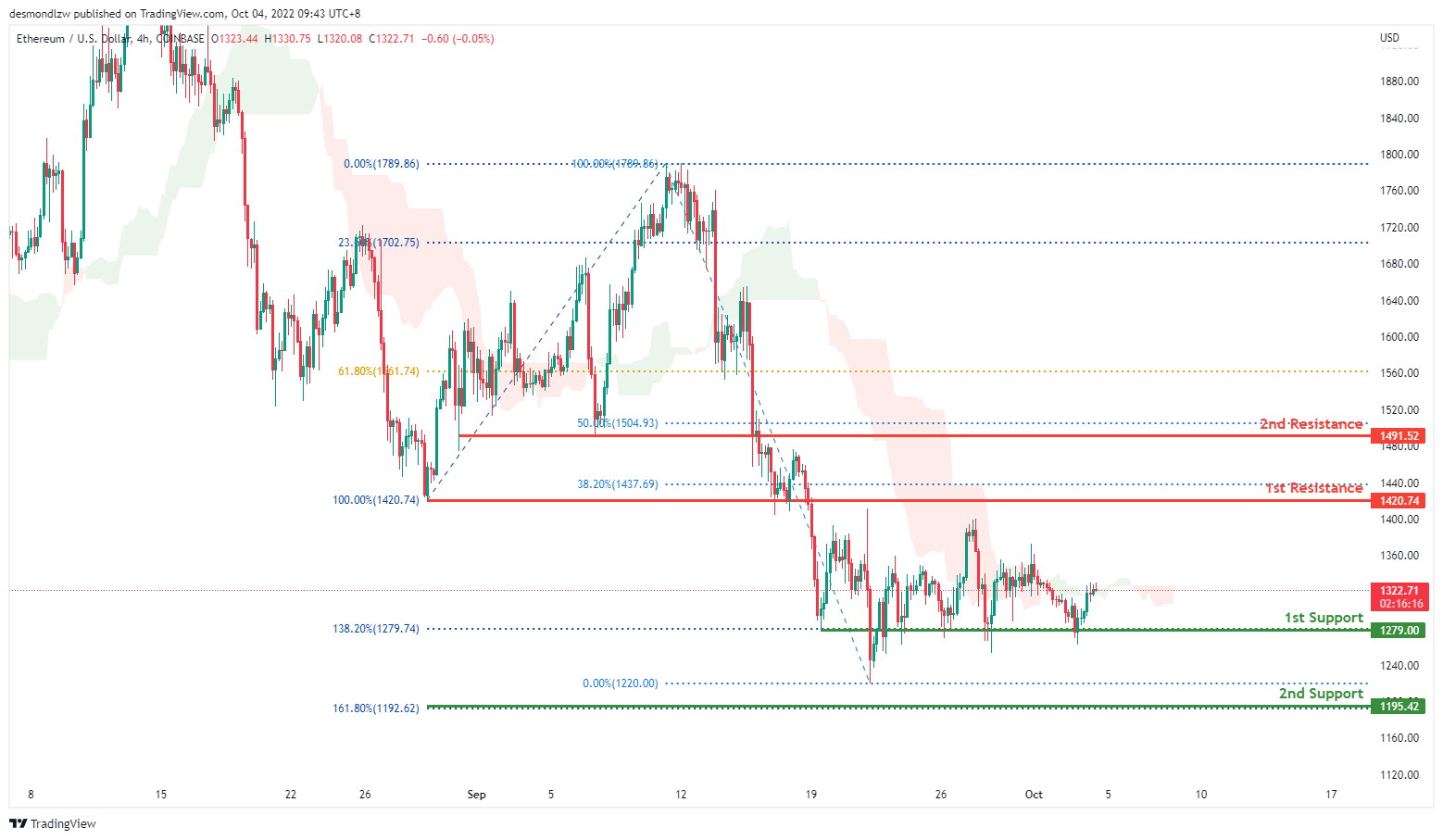
On the H4, the overall price of ETHUSD is very bearish. Price has been consolidating above the first support line at 1279.00 for the past two weeks, including Monday this week, which also happens to be the 138.2% Fibonacci line. Price has now closed above the Ichimoku cloud, indicating a possible trend change in the short term. Expect price to return to the first resistance line at 1420.74, which is the 100% Fibonacci and 38.2% Fibonacci line.
Areas of consideration:
- H4 time frame, 1st resistance of 1420.74
- H4 time frame, 1st support at 1279.00
BTCUSD:
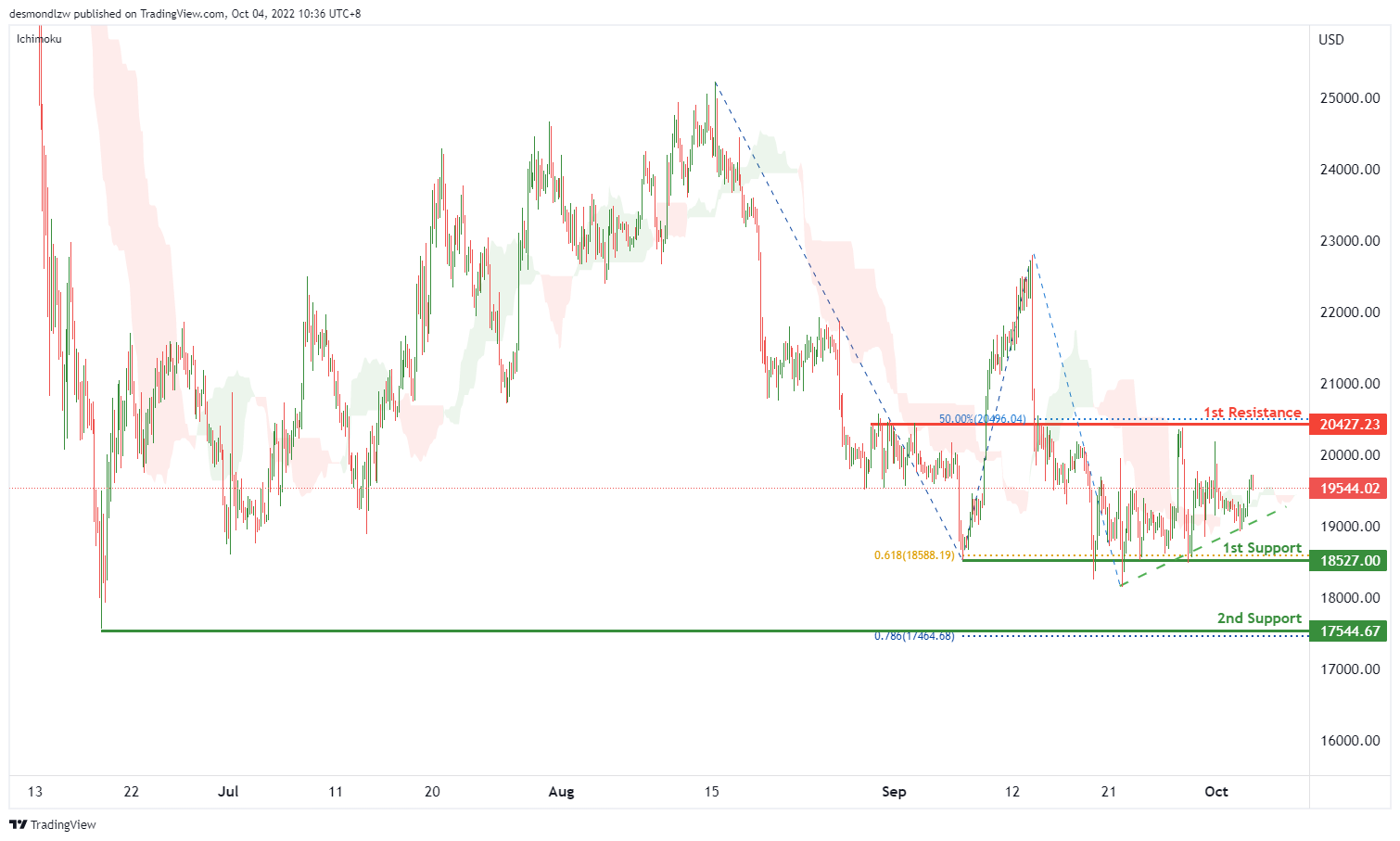
On the H4, price is consolidating and showing a short term ascending trendline. Currently the price is above the ichimoku cloud, the price may test the 1st resistance at 20427.23, where the overlap resistance and 50% fibonacci retracement are. Alternatively, the price may drop to the 1st support at 18527, which is in line with the swing lows and 61.8% fibonacci projection. If the 1st support is broken, the 2nd support could be at 17544.67, which is in line with the 78.6% fibonacci projection and swing low.
Areas of consideration:
- H4 time frame, 1st resistance at 20427.23
- H4 time frame, 1st support at 18527
S&P 500:
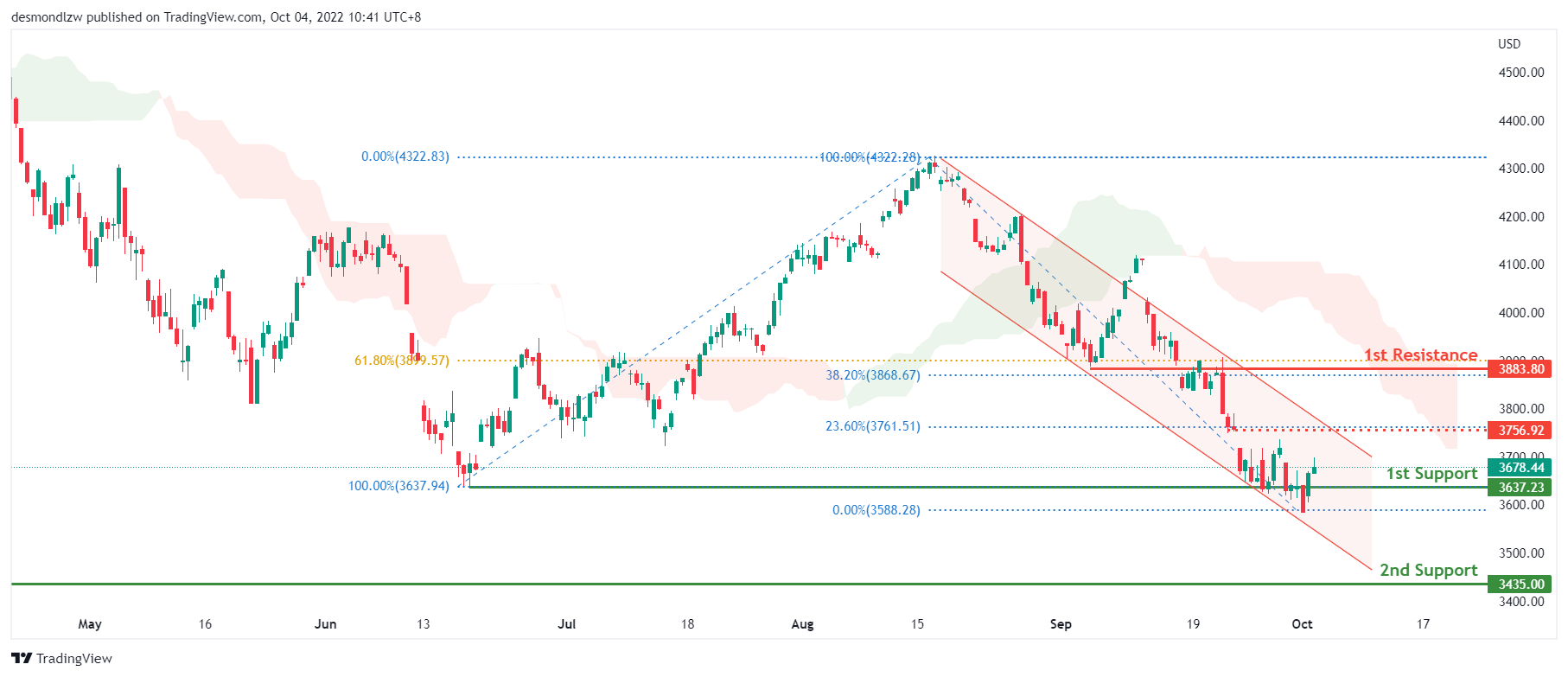
On the H4, with the price trading higher from 1st support of 3637 which is in line with the previous swing low of June 2022 but still within the descending channel and below the ichimoku cloud, we continue to have a bearish bias. However, price could retrace to the risk level of 3757 which is in line with the 23.60% fibonacci retracement level before trading lower again.
Areas of consideration:
- H4 time frame, 1st resistance at 3883.80
- H4 time frame, 1st support at 3637.23
- H4 time frame, 2nd support at 3435
GBP/USD Daily Outlook
Daily Pivots: (S1) 1.1159; (P) 1.1247; (R1) 1.1408; More...
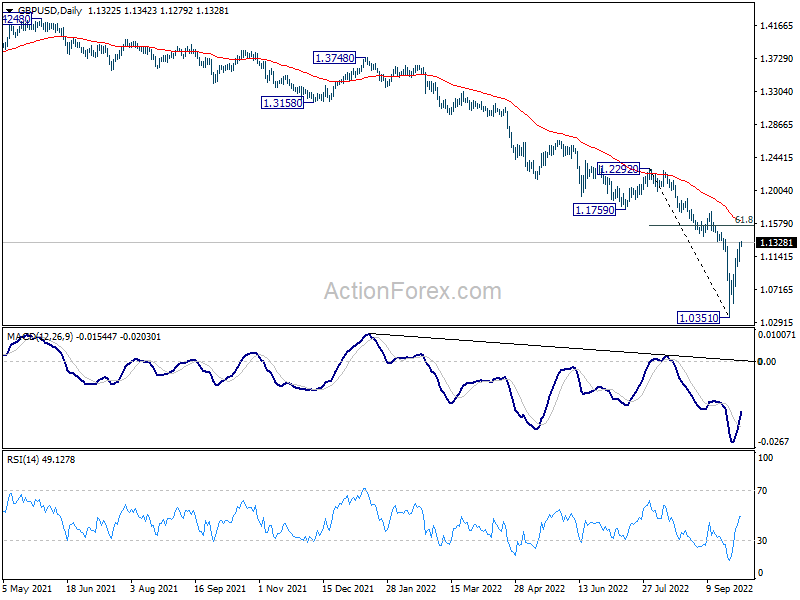
Intraday bias in GBP/USD stays on the upside at this point. Rise from 1.0351 short term bottom is in progress. Further rally would be seen to 61.8% retracement of 1.2292 to 1.0351 at 1.1551. Strong resistance could be seen around 55 day EMA (now at 1.1614) to limit upside on first attempt. On the downside, below 1.1023 minor support will turn intraday bias neutral first.
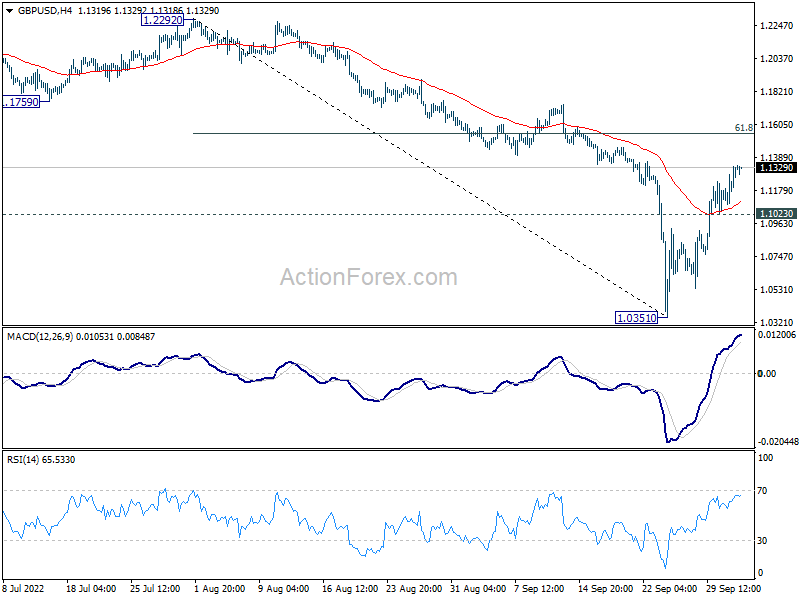
In the bigger picture, fall from 1.4248 (2018 high) is resuming long term down trend from 2.1161 (2007 high). Next target is 100% projection of 2.1161 to 1.3503 from 1.7190 at 0.9532. There is no scope of a medium term rebound as long as 1.1759 support turned resistance holds.
Aussie Dips after RBA, Pound Marches On
Australian Dollar dips broadly today after RBA delivered a smaller than expected rate hike. But the selloff in Aussie is so relatively limited. New Zealand Dollar follows lower, ahead of tomorrow's RBNZ rate decision. RBNZ is expected to hike by 50bps, but now it's not totally certain given that tightening is already "mature". Sterling is so far the stronger on today as rebound is making progress. Dollar and Euro are mixed while Yen and Swiss Franc are on the softer side.
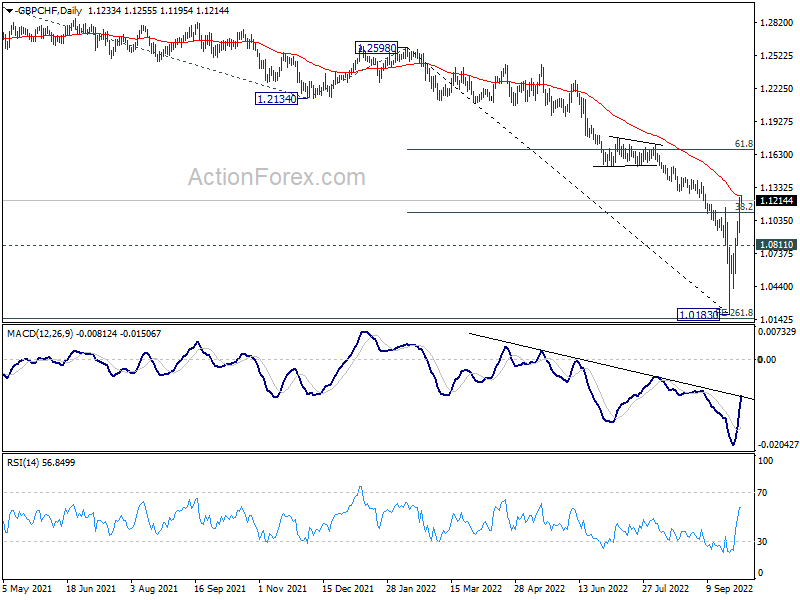
Technically, GBP/CHF powered through 38.2% retracement of 1.2598 to 1.0183 at 1.1106 yesterday. It's now pressing 55 day EMA. Sustained break there will pave the way to 61.8% retracement at 1.1675. Such development would help lift Sterling elsewhere, including pushing GBP/USD back through prior support turned resistance at 1.14 handle.
In Asia, at the time of writing, Nikkei is up 2.86%. Japan 10-year JGB yield is down -0.0128 at 0.231. Singapore Strait Times is up 0.82%. China and Hong Kong are on holiday. Overnight DOW rose 2.66%. S&P 500 rose 2.59%. NASDAQ rose 2.27%. 10-year yield dropped -0.153 to 3.651.
RBA hikes by only 25bps, maintain tightening bias
RBA raises the cash rate target by only 25bps to 2.60%, smaller than expectation of a 50bps hike. Tightening bias is maintained as the board "expects to increase interest rates further over the period ahead". The size and timing of future hikes will continued to be determined by incoming data and the board's assessment of inflation and labor market outlook.
In the accompanying statement, RBA said inflation is expected to "further increase" over the coming months. CPI would be around 7.75% over 2022, a little above 4% over 2023, and around 3% over 2024. The economy is "continuing to grow solidly" with national income boosted by a "record level of the terms of trade". Labor markets is "very tight". Wages growth is "continuing to pick up" but "remains lower than in other advanced economies" with high inflation.
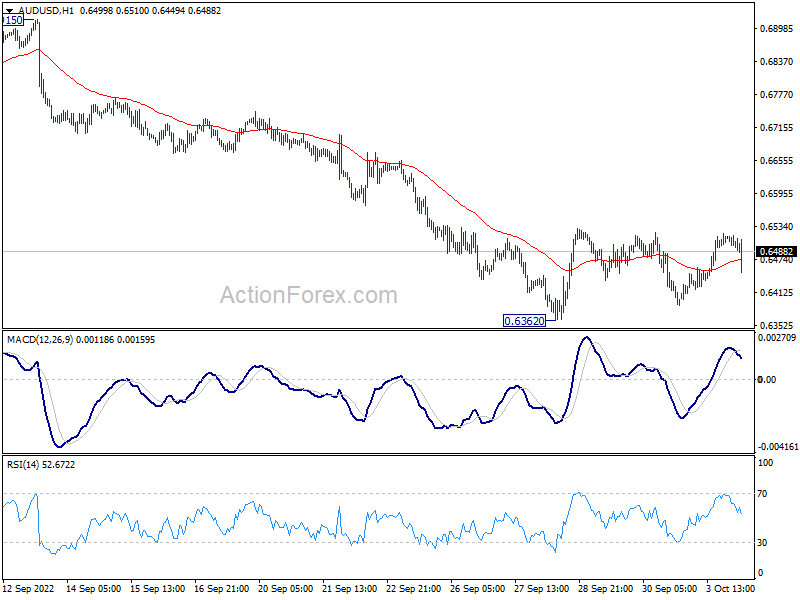
AUD/USD dips slightly after the smaller than expected rate hike, but there is no follow through selling. Consolidation pattern from 0.6362 is still in progress with bearish bias for downside breakout at a later stage.
BoE Mann: Premature to judge how mini-budget affect monetary policy trajectory
BoE MPC member Catherine Mann said yesterday that it's "premature" to judge the extent of UK Prime Minister Liz Truss's budget is going to affect "monetary policy trajectory decisions".
"I people don't have to spend their money on heating their apartments, or homes, they are now we're in a position to redirect some of that spending on to other goods and services," she added. "So it's that ability to redirect expenditures on goods and services, that becomes an important consideration for the monetary policy trajectory."
Mann also expressed her concern that inflation expectations are "drifting" away from BoE's anchor. "I do see increasingly embedded inflation, I do see inflation expectations drifting, I do see a sterling depreciation spillover and I do see daylight between real incomes and real consumption possibilities," she said.
Fed Williams: Our job on inflation is not yet done
New York Fed President John Williams said yesterday, "Clearly, inflation is far too high, and persistently high inflation undermines the ability of our economy to perform at its full potential. Tighter monetary policy has begun to cool demand and reduce inflationary pressures, but our job is not yet done."
He expects inflation to ease to 3% next year, and move "close to our 2% goal in the next few years". "To help rein in demand to levels consistent with supply—and therefore bring inflation down—monetary policy needs to do its job," Williams said. "The FOMC is taking strong actions toward that end."
On the data front
New Zealand NZIER business confidence rose from -65 to -42 in Q3. Australia AiG performance of manufacturing index rose from 49.3 to 50.2 in September. Japan Tokyo CPI core rose from 2.6% yoy to 2.8% yoy in September, matched expectations.
Looking ahead, Eurozone PPI and US factor orders will be featured.
GBP/USD Daily Outlook
Daily Pivots: (S1) 1.1159; (P) 1.1247; (R1) 1.1408; More...
Intraday bias in GBP/USD stays on the upside at this point. Rise from 1.0351 short term bottom is in progress. Further rally would be seen to 61.8% retracement of 1.2292 to 1.0351 at 1.1551. Strong resistance could be seen around 55 day EMA (now at 1.1614) to limit upside on first attempt. On the downside, below 1.1023 minor support will turn intraday bias neutral first.
In the bigger picture, fall from 1.4248 (2018 high) is resuming long term down trend from 2.1161 (2007 high). Next target is 100% projection of 2.1161 to 1.3503 from 1.7190 at 0.9532. There is no scope of a medium term rebound as long as 1.1759 support turned resistance holds.
Economic Indicators Update
| GMT | Ccy | Events | Actual | Forecast | Previous | Revised |
|---|---|---|---|---|---|---|
| 21:00 | NZD | NZIER Business Confidence Q3 | -42 | -65 | ||
| 21:30 | AUD | AiG Performance of Mfg Index Sep | 50.2 | 49.3 | ||
| 23:30 | JPY | Tokyo CPI Core Y/Y Sep | 2.80% | 2.80% | 2.60% | |
| 23:50 | JPY | Monetary Base Y/Y Sep | -3.30% | 0.60% | 0.40% | |
| 00:30 | AUD | Building Permits M/M Aug | 28.10% | 9.00% | -17.20% | -18.20% |
| 03:30 | AUD | RBA Interest Rate Decision | 2.60% | 2.85% | 2.35% | |
| 09:00 | EUR | Eurozone PPI M/M Aug | 4.90% | 4.00% | ||
| 09:00 | EUR | Eurozone PPI Y/Y Aug | 43.20% | 37.90% | ||
| 14:00 | USD | Factory Orders M/M Aug | 0.30% | -1.00% |
Fed Williams: Our job on inflation is not yet done
New York Fed President John Williams said yesterday, "Clearly, inflation is far too high, and persistently high inflation undermines the ability of our economy to perform at its full potential. Tighter monetary policy has begun to cool demand and reduce inflationary pressures, but our job is not yet done."
He expects inflation to ease to 3% next year, and move "close to our 2% goal in the next few years". "To help rein in demand to levels consistent with supply—and therefore bring inflation down—monetary policy needs to do its job," Williams said. "The FOMC is taking strong actions toward that end."
BoE Mann: Premature to judge how mini-budget affect monetary policy trajectory
BoE MPC member Catherine Mann said yesterday that it's "premature" to judge the extent of UK Prime Minister Liz Truss's budget is going to affect "monetary policy trajectory decisions".
"I people don't have to spend their money on heating their apartments, or homes, they are now we're in a position to redirect some of that spending on to other goods and services," she added. "So it's that ability to redirect expenditures on goods and services, that becomes an important consideration for the monetary policy trajectory."
Mann also expressed her concern that inflation expectations are "drifting" away from BoE's anchor. "I do see increasingly embedded inflation, I do see inflation expectations drifting, I do see a sterling depreciation spillover and I do see daylight between real incomes and real consumption possibilities," she said.
RBA hikes by only 25bps, maintain tightening bias
RBA raises the cash rate target by only 25bps to 2.60%, smaller than expectation of a 50bps hike. Tightening bias is maintained as the board "expects to increase interest rates further over the period ahead". The size and timing of future hikes will continued to be determined by incoming data and the board's assessment of inflation and labor market outlook.
In the accompanying statement, RBA said inflation is expected to "further increase" over the coming months. CPI would be around 7.75% over 2022, a little above 4% over 2023, and around 3% over 2024. The economy is "continuing to grow solidly" with national income boosted by a "record level of the terms of trade". Labor markets is "very tight". Wages growth is "continuing to pick up" but "remains lower than in other advanced economies" with high inflation.
AUD/USD dips slightly after the smaller than expected rate hike, but there is no follow through selling. Consolidation pattern from 0.6362 is still in progress with bearish bias for downside breakout at a later stage.
(RBA) Statement by Philip Lowe, Governor: Monetary Policy Decision
At its meeting today, the Board decided to increase the cash rate target by 25 basis points to 2.60 per cent. It also increased the interest rate on Exchange Settlement balances by 25 basis points to 2.50 per cent.
The Board is committed to returning inflation to the 2–3 per cent range over time. Today's increase in interest rates will help achieve this goal and further increases are likely to be required over the period ahead. The cash rate has been increased substantially in a short period of time. Reflecting this, the Board decided to increase the cash rate by 25 basis points this month as it assesses the outlook for inflation and economic growth in Australia.
As is the case in most countries, inflation in Australia is too high. Global factors explain much of this high inflation, but strong domestic demand relative to the ability of the economy to meet that demand is also playing a role.
A further increase in inflation is expected over the months ahead, before inflation then declines back towards the 2–3 per cent range. The expected moderation in inflation next year reflects the ongoing resolution of global supply-side problems, recent declines in some commodity prices and the impact of rising interest rates. Medium-term inflation expectations remain well anchored, and it is important that this remains the case. The Bank's central forecast is for CPI inflation to be around 7¾ per cent over 2022, a little above 4 per cent over 2023 and around 3 per cent over 2024.
The Australian economy is continuing to grow solidly and national income is being boosted by a record level of the terms of trade. The labour market is very tight and many firms are having difficulty hiring workers. The unemployment rate in August was 3.5 per cent, around the lowest rate in almost 50 years. Job vacancies and job ads are both at very high levels, suggesting a further decline in the unemployment rate over the months ahead. Beyond that, some increase in the unemployment rate is expected as economic growth slows.
Wages growth is continuing to pick up from the low rates of recent years, although it remains lower than in other advanced economies where inflation is higher. Given the tight labour market and the upstream price pressures, the Board will continue to pay close attention to both the evolution of labour costs and the price-setting behaviour of firms in the period ahead.
Price stability is a prerequisite for a strong economy and a sustained period of full employment. Given this, the Board's priority is to return inflation to the 2–3 per cent range over time. It is seeking to do this while keeping the economy on an even keel. The path to achieving this balance is a narrow one and it is clouded in uncertainty.
One source of uncertainty is the outlook for the global economy, which has deteriorated recently. Another is how household spending in Australia responds to the tighter financial conditions. Higher inflation and higher interest rates are putting pressure on household budgets, with the full effects of higher interest rates yet to be felt in mortgage payments. Consumer confidence has also fallen and housing prices are declining after the earlier large increases. Working in the other direction, people are finding jobs, gaining more hours of work and receiving higher wages. Many households have also built up large financial buffers and the saving rate still remains higher than it was before the pandemic.
Today's further increase in interest rates will help achieve a more sustainable balance of demand and supply in the Australian economy. This is necessary to bring inflation back down. The Board expects to increase interest rates further over the period ahead. It is closely monitoring the global economy, household spending and wage and price-setting behaviour. The size and timing of future interest rate increases will continue to be determined by the incoming data and the Board's assessment of the outlook for inflation and the labour market. The Board remains resolute in its determination to return inflation to target and will do what is necessary to achieve that.