Sample Category Title
Gold Price Moved into a Positive Zone above $1,645
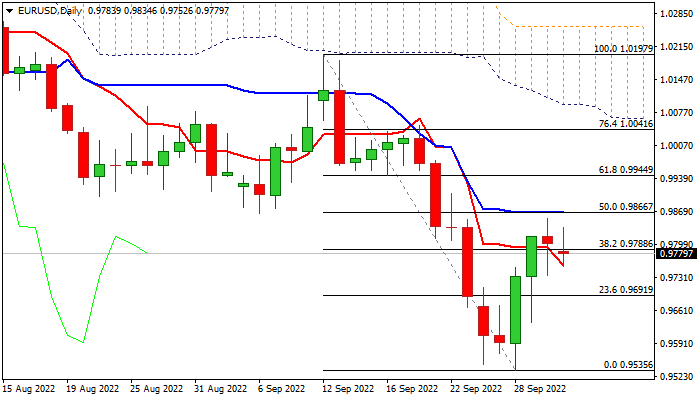
Gold price started a fresh upward move from the $1,615 zone against the US Dollar. The price climbed above the $1,645 resistance zone to move into a positive zone.
The pair even climbed above the $1,660 level and the 50 hourly simple moving average. A high was formed near $1,675 before the price corrected gains. On the downside, the price now trading near a bullish trend line with support at $1,662 on the hourly chart.
The next major support is near the $1,658 level, below which the price might decline towards the $1,650 support level in the near term. Any more losses might call for a test of $1,632 on FXOpen.
On the upside, the first major resistance is near the $1,672 level. The next main resistance could be near the $1,675 level, above which the price could start another steady increase.
EUR/USD: Euro Loses Traction But More Evidence Needed to Signal Recovery Stall
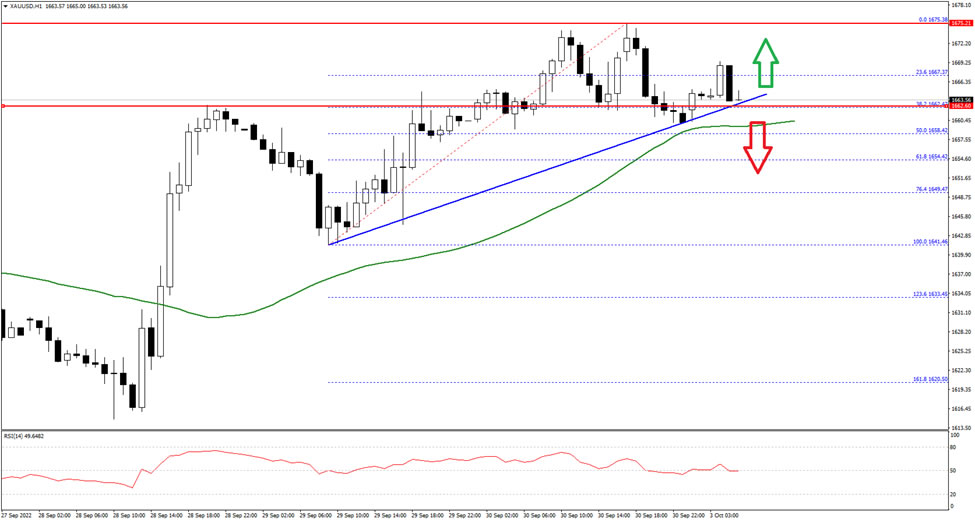
The Euro remains at the back foot on Monday, weighed by weak EU PMI data and higher oil prices, as well as bloc’s record inflation, while last Friday’s bearish Doji candle generates initial warning that three-day recovery might be over.
Monday’s action is holding in red, although still without clear direction, as fresh bears pressure initial support at 0.9755 (daily Tenkan-sen), with break here to generate initial negative signal, which will be confirmed by extension and close below pivotal support at 0.9732 (Fibo 38.2% of 0.9535/0.9853).
Overbought stochastic on daily chart and momentum holding deeply in the negative territory, support bearish near-term scenario.
Monthly drop of 2.5% in September (the fourth consecutive month in red) signals that bears are firmly in play, although last week’s bullish close suggests that bears may hold in extended consolidation before continuing.
Res: 0.9834; 0.9853; 0.9866; 0.9907.
Sup: 0.9755; 0.9732; 0.9694; 0.9657.
USDJPY Pauses Near 145.00 Mark; Bias Titled to the Upside
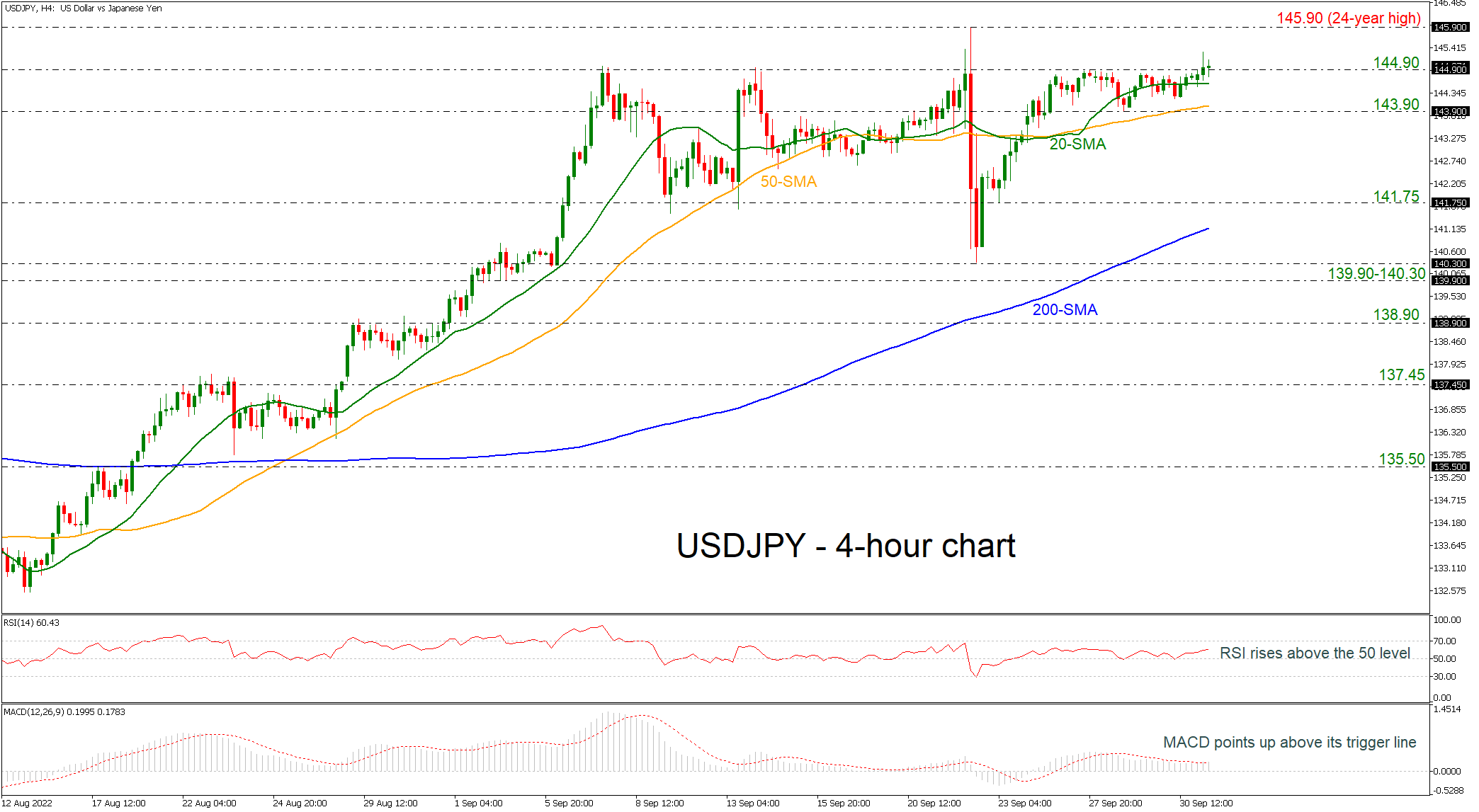
USDJPY is struggling to gain the strong positive momentum after its fast rebound from the 140.30 support level. However, the market is holding above the 20- and 50-period simple moving averages (SMAs) with the technical indicators confirming the recent bullish bias. The RSI is heading north, approaching the overbought region, while the MACD is surpassing its trigger line in the positive zone.
A close above the 144.90 barrier will brighten the broader outlook, pushing the price towards the 24-year high of 145.90. Beyond that, the rally may gear up to the 147.00 psychological mark, registered in June 1998.
Should selling forces strengthen, the 20-period SMA at 144.55 will come under the spotlight before hitting the 50-period SMA at 144.05 and the 143.90 support, taken from the latest lows. Moving lower, the 141.75 barrier could next add some footing ahead of the 200-period SMA at 141.12.
In brief, USDJPY is facing a weakening bullish bias, where a drop below the near-term SMAs is expected to enhance selling interest.
Japanese Yen Tiptoes at 145 Line
USD/JPY has edged higher at the start of the week, trading at 145.10 in the European session.
Tokyo Core CPI next
Japan’s Tankan indices for Q3 were mixed and the yen had a muted response. Manufacturing dropped to 8, down from 11 in Q1 and missing the consensus of 11 points. Services ticked higher to 14, up from 13 and just above the forecast of 13 points. Later in the day, Japan releases a key inflation gauge, Tokyo Core CPI. The index is expected to rise to 2.8% in August, up from 2.4% in July.
Inflation in Japan has risen to 3%, much lower than other major economies but a huge change after years of deflation. The Bank of Japan has been keeping an eye on inflation, but Governor Kuroda has said he will not change the Bank’s ultra-loose policy until wages rise and it’s clear that inflation is not transient. Sound familiar? Fed Chair Powell and ECB President Lagarde dismissed high inflation as transient but were forced to tighten policy as inflation never let up.
The BoJ has been very firm with its yield curve control, keeping JGB yields at low levels. With US Treasury yields moving higher, the US/Japan rate differential has widened, and the yen has fallen sharply. The Ministry of Finance (MOF) stepped in with an intervention in September, after the yen hit 145.90. The dramatic move sent the yen higher, but only for a few days. USD/JPY has been trading close to the 145 line and has pushed just above it today. With the US dollar continuing to rally, it seems likely that the yen will continue to lose ground. It will be interesting to see if the Ministry of Finance intervenes again to prop up the yen. If it does, we can expect some volatility from the Japanese yen.
USD/JPY Technical
- There is resistance at 144.81 and 146.06
- USD/JPY has support at 143.21 and 141.88
GBP/USD: Break of Pivotal Fibo Barrier to Open Way for Further Advance
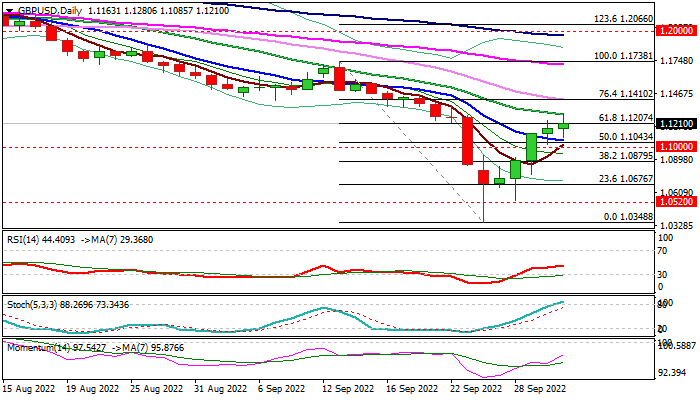
Cable extends advance into fifth straight day on Monday and extends above pivotal 1.12 zone (round-figure / Fibo 61.8% of 1.1738/1.0348), underpinned by the news that Britain would reverse plans to cut the highest rate of income tax, the part of the larger package of financial measures the government announced last month.
Improving daily studies on north-heading 14-d momentum and 5/10DMA’s in bullish setup, offer support, adding to stronger bullish signals on long tailed weekly and monthly candles, which point to a bear-trap under psychological 1.10 support and generate initial reversal signals.
Fresh bulls need a daily close above broken 1.1207 Fibo barrier (61.8%) to confirm positive signal and maintain bullish stance for attack at 1.1410 (Fibo 76.4% of 1.1738/1.0348 bear-leg).
Solid support at 1.1055 (10DMA) should keep the downside protected and guard pivotal 1.10 level, loss of which would sideline bulls.
Res: 1.1286; 1.1364; 1.1410; 1.1460.
Sup: 1.1085; 1.1055; 1.1000; 1.0930.
RBA Interest Rate Decision: Another 50bps?
Normally, higher rates would be seen as good for the banking sector. So there is understandably some concern about the financial markets since Australian banking shares are down considerably despite a broad consensus that the RBA will raise rates tomorrow (or late tonight, depending where you are on the globe).
There is a global issue, and it might give the RBA a little pause. Rumors circulated on Sunday that a "major bank" was "on the brink" of collapse. This sent global banking shares down. It was also reported that the BOE was looking at Credit Suisse, given the shake up in global markets. The sudden moves in the pound and yen have made things particularly difficult for banks.
What it means for the RBA
The one thing that could significantly disrupt central banks' plans with regards to monetary policy is the risk of failure of a major bank. That would be equivalent to a "Lehman Brothers" event, but on a global scale. Even if it isn't a bank in the country, the loss of confidence in the financial industry could shake policy, and force central banks to inject liquidity.
However, it's just rumors at this point. Putting that aside, the RBA is broadly expected to raise rates by 50bps, and continue tightening. There is a discrepancy with the projections, though. 97% of Australian economists forecast 50bps, but only 75% of international economists do.
What it means for the markets
In the scheme of practical effects, the solid consensus implies that the rate hike is fully priced in. What level of uncertainty there is around the outlook. A recent survey by Bloomberg showed that a majority of international economists believe this is the last "outsized" hike by the RBA, and that only 25bps will be forthcoming at the next meeting.
Australian economists aren't so sure, with more betting on stronger action by the Reserve Bank. They point to inflation still rising and data remaining strong (if the housing situation isn't considered). Another point brought up is that the RBA could go for a one-and-a-half hike, since it is at an "unusual" rate that isn't a multiple of 0.25. Thus, there is a growing call for a "consensus" hike of 40bps at the next meeting, splitting the difference between 25 and 50.
It's not all up to them
As for the currency, the major obstacle is that the Fed keeps raising rates faster than any of the other majors. Even the most hawkish scenario for the RBA leaves the interest rate gap widening. And with inflation still rising in Australia, while US inflation (at least on the headline) is receding, then the real spread is getting even wider.
A post rate rally in the case that Lowe gives clear indications that more than 25bps is likely at the next meeting, might sputter out quite quickly. If the RBA fails to be as hawkish as the Australian economists expect, then the currency could slide even further.
USD/JPY Outlook: Bulls Look for Retest of New 24-Year Peak
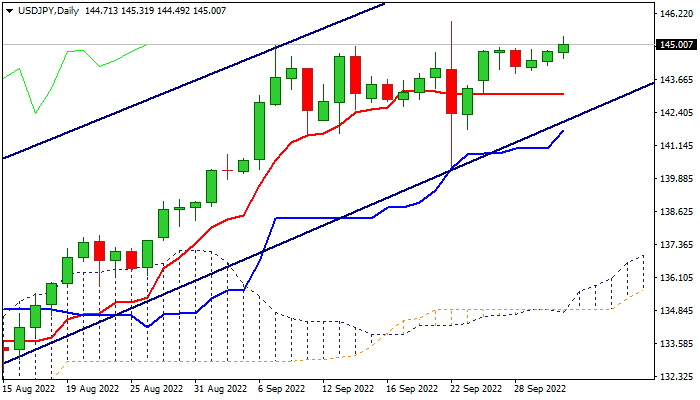
The USDJPY is standing at the front foot in early Monday and probed again through 145 barrier, following last week’s bullish close (the seventh straight weekly gains) and monthly advance of 4.1% in September that marked the second consecutive strong monthly rally.
Near-term action moved to the upper side of three-week range, after bulls hit new 24-year high (145.90) but were strongly rejected there, with subsequent pullback finding firm ground just above psychological 140 support (also Fibo 38.2% of 130.39/145.90 rally), with dip being contained by rising daily Kijun-sen.
The dollar remains firm, supported by strong fundamentals (hawkish Fed / safe-haven flows) and expected to attack again the new peak, violation of which would signal bullish continuation and expose 1998 top at 147.68.
Although technical studies on daily chart are overall bullish, weakening bullish momentum and overbought stochastic warn that the action may hold in extended consolidation before bulls resume.
Extended dips should find a solid support at daily Tenkan-sen (143.12) to keep dip-buying strategy in play.
Res: 145.31; 145.90; 146.40; 147.21.
Sup: 144.15; 143.90; 143.12; 142.46.
Gold Guards Latest Rebound; More Obstacles Ahead
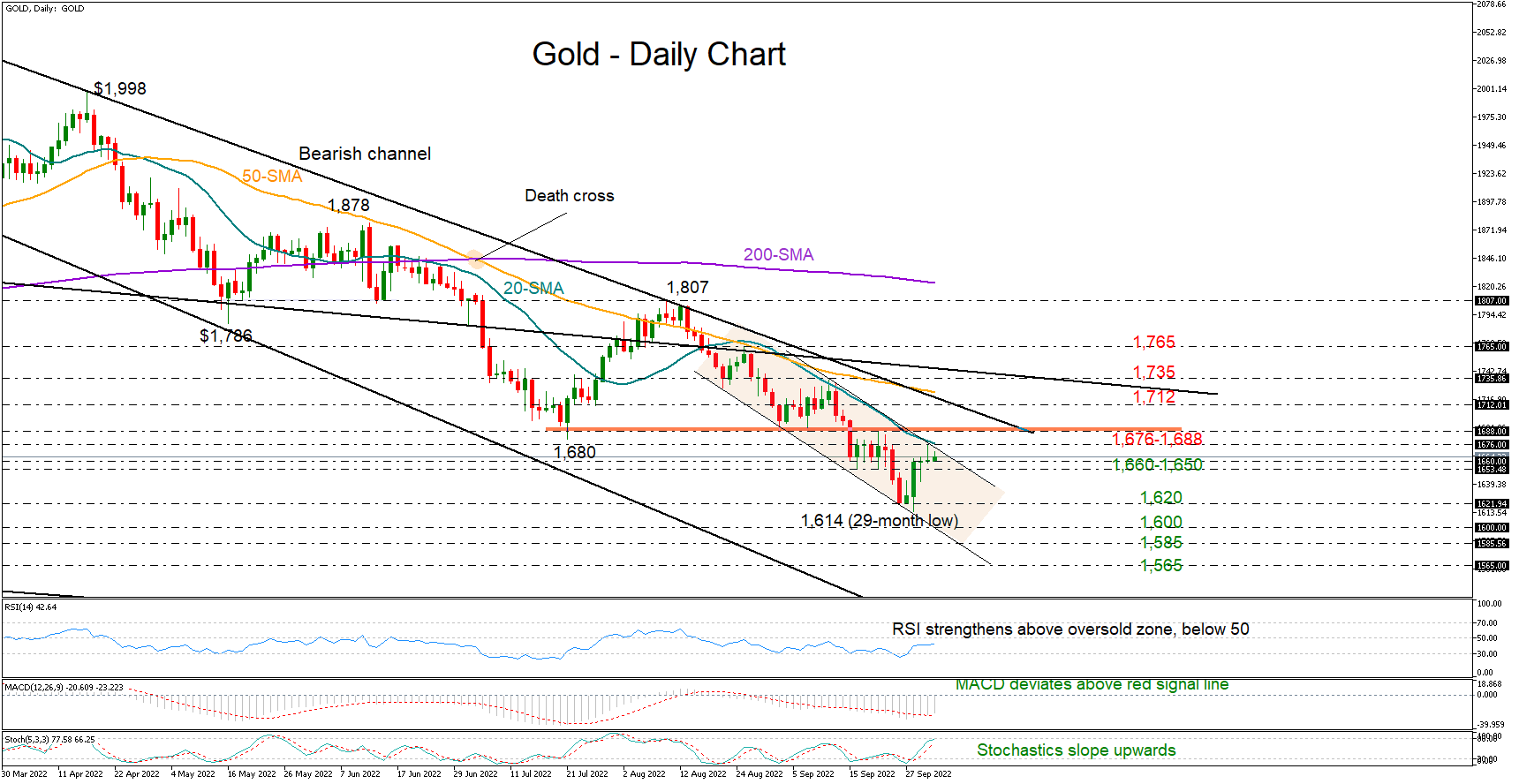
Gold continued to face mild bullish pressures during Monday’s early European trading hours, despite remaining compressed within the tight range of 1,660–1,676.
Although the broad negative trajectory shows no sign of abating, the momentum indicators are reflecting persisting buying presence. Particularly, the RSI has overcome its previous highs after exiting the oversold territory and is currently sloping upwards to meet its 50 neutral mark. The Stochastics are in a positive mood as well, but close to their 80 overbought level, while the MACD is gradually deviating above its red signal line.
However, the way higher may not be easy for bullion. The 1,676–1,688 region could immediately curb any upside pressures, delaying any recovery towards the channel’s upper boundary currently seen around 1,712. Then, the bulls will need to pierce through the 1,735 level, which overlaps with the constraining line drawn from the 2,079 record high, in order to meet the 1,765 barrier.
On the downside, a close below the 1,660–1,650 region could produce a quick decline towards the key 1,620 mark, which the bears could not successfully claim last week. Slightly lower, traders will look for a rebound near the bottom of the shorter-term bearish channel seen within the 1,600–1,585 zone. The 1,565 barricade taken from the first half of 2020 could next attract attention.
All in all, the precious yellow metal, although still within a bearish territory, is trying to tilt the short-term bias in favor of the buyers. Yet, there are a couple of tough obstacles nearby, which may easily ruin any progress.
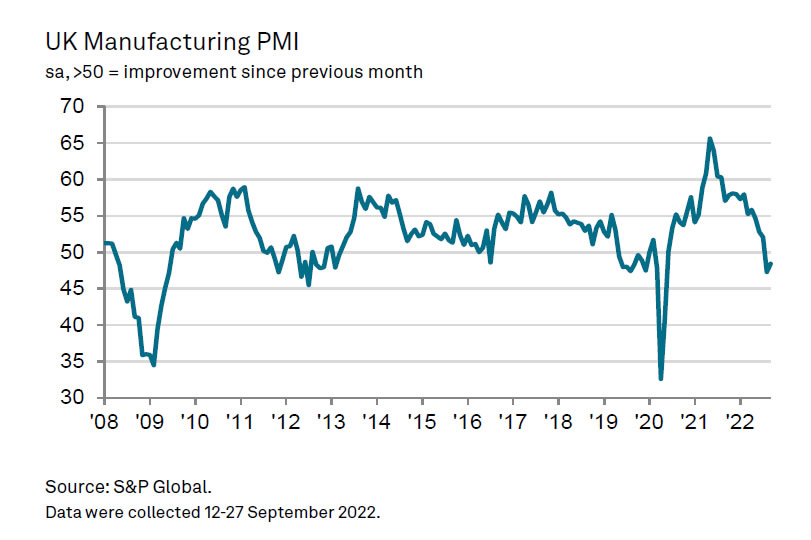
UK PMI manufacturing finalized at 48.4, goods producing sector a drag on GDP
UK PMI Manufacturing was finalized at 48.4 in September, up from August's 47.3. S&P Global said output and new orders fell further. New export business declined. Input costs and output price inflation accelerated.
Rob Dobson, Director at S&P Global Market Intelligence, said: "The downturn in UK manufacturing continued at the end of the third quarter, meaning the goods producing sector looks set to have acted as a drag on GDP. Manufacturers have once again cut back production as new order intakes declined for the fourth successive month.
"Factories are reporting tough market conditions both at home and abroad. Disappointingly, exports continue to fall despite the more competitive exchange rate.
"There was also less positive news on the price front, with rates of inflation in input costs and selling prices both picking up in September, linked in part to import costs rising due to the weaker pound.
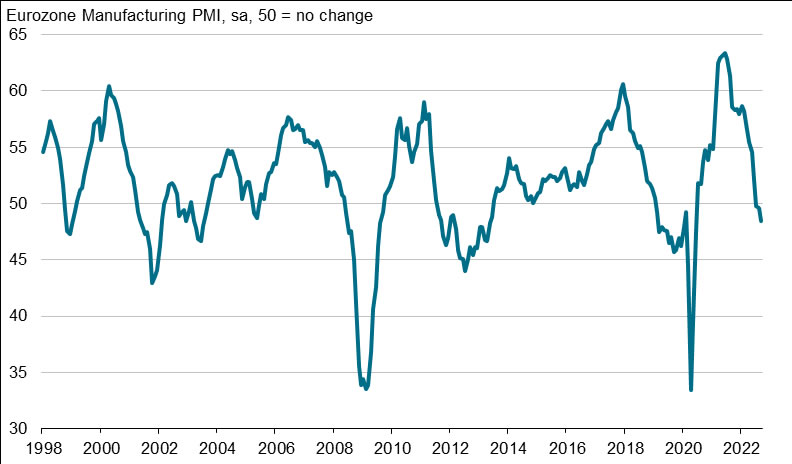
Eurozone PMI manufacturing finalized at 48.4, ugly combination of recession and inflation
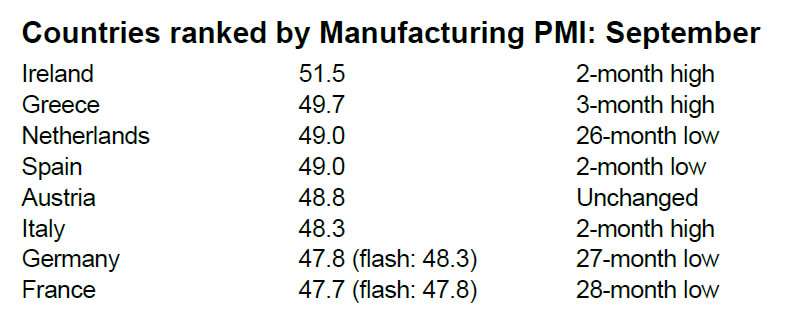
Eurozone PMI Manufacturing was finalized at 48.4 in September, down from August's 49.6. That's also a 27-month low. Looking at some member states, France PMI Manufacturing was finalized at 47.7, a 28-month low. Germany was finalized at 47.8, a 27-month low. Greece (49.7), the Netherlands (49.0), Spain (49.0), Austria (48.8) and Italy (48.3) were all in contraction, while Ireland (51.5) was in expansion.
Chris Williamson, Chief Business Economist at S&P Global Market Intelligence said: "The ugly combination of a manufacturing sector in recession and rising inflationary pressures will add further to concerns about the outlook for the eurozone economy... Excluding the initial pandemic lockdowns, eurozone manufacturers have not seen a collapse of demand and production on this scale since the height of the global financial crisis in early-2009.