Sample Category Title
NZDUSD Analysis
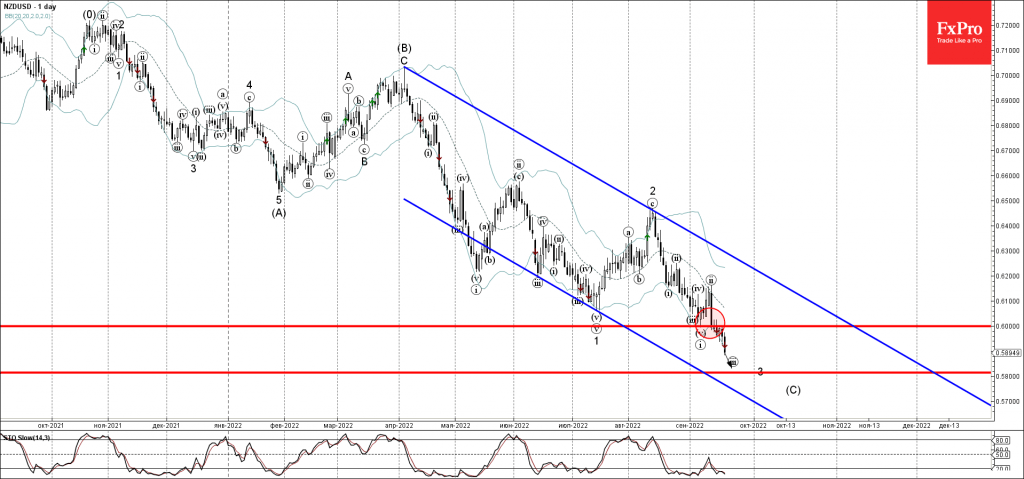
- NZDUSD broke round support level 0.6000
- Likely to fall to support level 0.5800
NZDUSD currency pair recently broke below the round support level 0.6000 (which stopped the earlier minor impulse wave (i) at the start of this month).
The breakout of the support level 0.6000 accelerated the active impulse waves 3 and (iii) – which belong to the sharp downward impulse sequence (C) from April.
Given the strong daily downtrend, NZDUSD can be expected to fall further toward the next support level 0.5800 (forecast price for the completion of the active impulse wave 3).
Eco Data 9/21/22
[php_everywhere instance="1"]
Will the SNB Rock the Swissie with a Huge 100 bps Rate Hike?
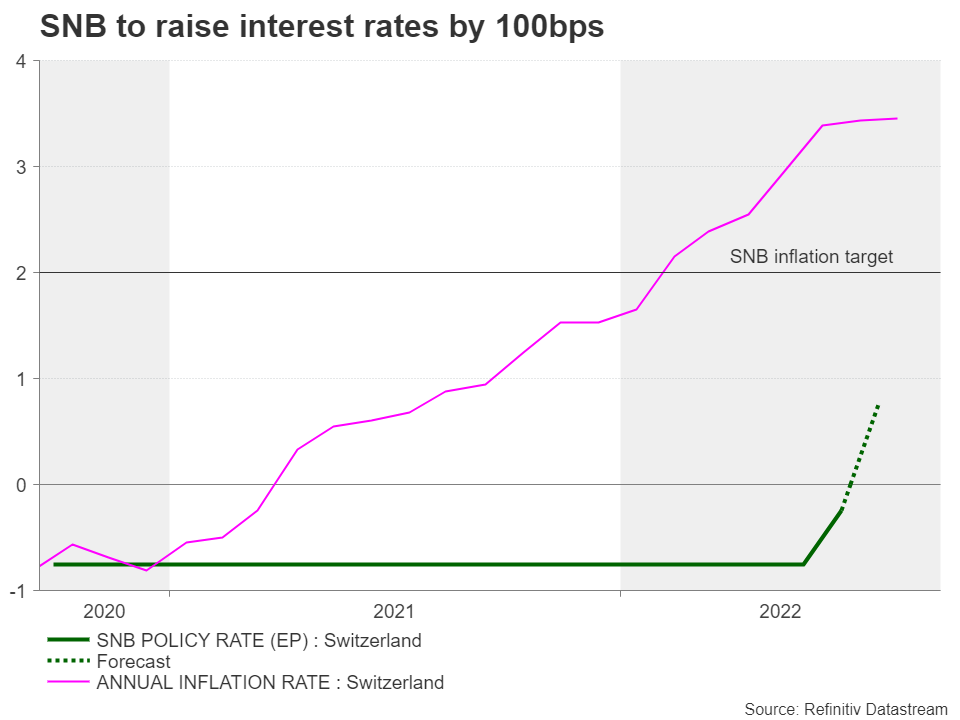
The Swiss National Bank is expected to step up its fight against inflation when it sets its benchmark interest rate on Thursday at 07:30 GMT. The consensus points to a full percentage point increase and policymakers may have a good reason to listen to investors and boost the already strong swissie.
Currency advantage
Excluding the US dollar, the Swiss franc has been outperforming other major currencies since the start of the year, beating the euro and the pound by 6% and 10% respectively. Given that the eurozone market accounts for 55% of Swiss exports, a strengthening currency would normally motivate some negative verbal intervention from SNB policymakers to balance the unwanted appreciation in FX markets and keep products competitive abroad.
Circumstances, however, are different now. Inflation keeps trending at multi-decade highs around the globe in the face of post-pandemic supply constraints and the war in Ukraine, and a dynamic currency is something every nation would desperately like to own as a sort of defence mechanism to high imported prices. Another explanation for the relatively milder inflation is the different technologies used in Switzerland to generate electricity. Only 1.0% of the Swiss electricity relies on oil and natural gas, while almost 60% depends on hydroelectric and 35% on nuclear power.
Super-sized rate hike likely
Nevertheless, with the headline CPI further distancing above the central bank’s 2.0% target, unlocking a three-decade high of 3.5% in August, the SNB will probably fasten its tightening plans after delivering a surprising 50 bps rate hike in June ahead of the European Central Bank.
Commenting at the Jackson Hole, the SNB chief admitted that inflation has become a broad-based phenomenon and increases in consumer prices are now more easily acceptable. What was even more striking, is that he unexpectedly opened the case for a full percentage point rate increase at a time when the Fed chair was downplaying a similar action in the US, with futures markets currently providing a probability of almost 70% for such a scenario.
Why investors might be right to be hawkish
Well, although this type of aggressive action has been rare so far among major central banks, with the Bank of Canada and Riksbank being the only to move forward with a quadruple-sized rate hike, one might wonder why such a scenario would not materialize in Switzerland as well.
Monetary divergence has been a major booster for currencies this year, and the SNB is still lacking behind the ECB and other major peers, as global inflation is not expected to ease anytime soon. Hence, a bold increase in borrowing costs could narrow the gap between the Swiss and Eurozone 10-year bond yields, helping the Swiss franc to secure some footing against the euro.
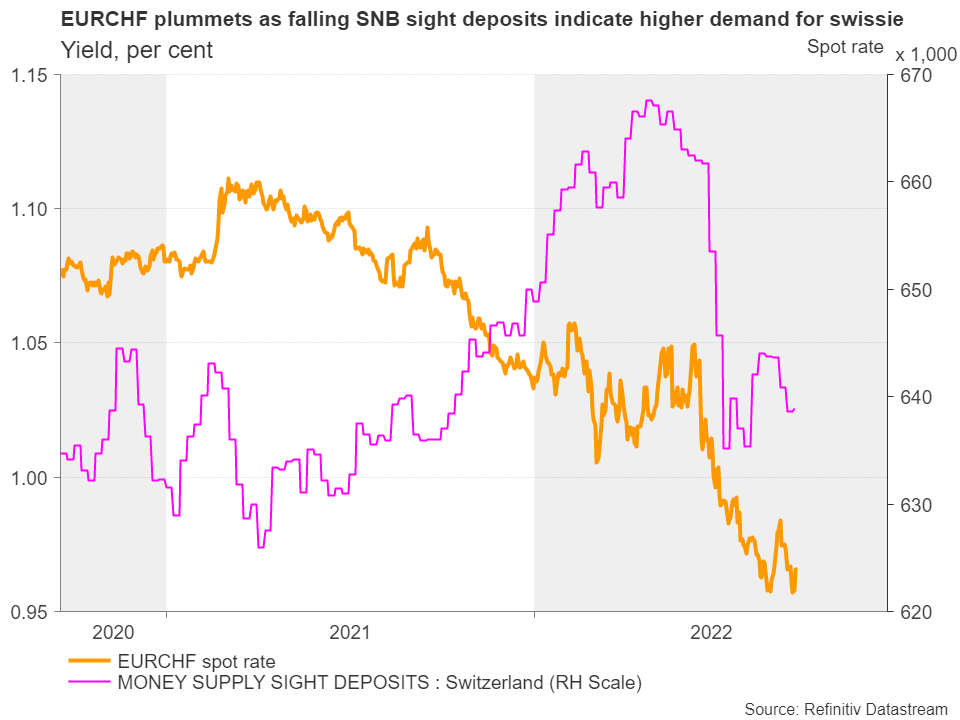
Of course, the central bank could intervene in FX markets to protect the swissie. The strong correlation between the falling SNB sight deposits and the steep downfall in euro/swissie, if not accidental, suggests that the central bank has already proceeded with intervention. In any case, that could be another evidence that an overvalued swissie is not causing headaches to the SNB anymore.
As regards the outlook for the economy, the latest release from the State Secretariat for Economic Affairs (SEKO) revised its GDP projections to the downside. The expert group is now seeing a 2.0% expansion for 2022 and 1.1% for 2023 from 2.6% and 1.9% respectively, citing the tense energy situation in the eurozone, which could consequently result in production stoppages and weigh on the Swiss export business.
That said, growth is not a priority in the central bank world and the latest data releases are far from concerning at the moment, showing a strong trade surplus, a tight labor market, and a persisting recovery in retail sales following the plunge in April. Hence, a hawkish policy announcement cannot be ruled out.
Swiss franc outlook
Turning to FX markets, the Swiss franc could advance in the wake of an extraordinary 100bps rate hike and signals of additional bigger moves, especially against the battered yen, which is suffering from the BoJ’s stubborn dovish stance. Euro/swissie could be interesting to watch too, as the pair is trying to return above the 2015 trough of 0.9649. A hawkish rate decision could leave the pair below the 20-day simple moving average (SMA) at 0.9683, bringing the double bottom pattern around 0.9580 under examination. Breaking lower, the focus would turn to the 0.9500 psychological mark.
Alternatively, a more conservative 75 bps rate increase could disappoint investors, helping the pair to crawl up to the 50-day SMA at 0.9725, unless the central bank uses a strong verbal intervention to cancel any selling pressures in the currency. If not, the recovery could get congested higher near the 0.9828 barrier. If not, the bulls would head for the 0.9950 - 1.000 resistance region.
EUR/GBP: Reversal Pattern is Forming on Daily Chart
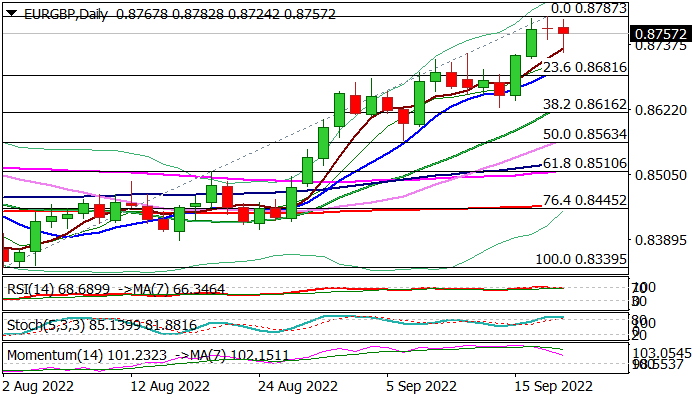
Daily chart shows initial signs of fatigue of the larger uptrend, as bullish momentum is fading and stochastic is reversing from overbought territory.
Also, evening Doji star pattern is forming on daily chart, which would, if completed, generate initial reversal signal.
The Euro was deflated on Tuesday by news regarding Ukrainian conflict and data that showed record EU’s current account deficit.
All eyes are on Fed’s policy meeting, which started today and the decision will be announced tomorrow, with prevailing expectations for 0.75% hike, but jumbo 1% increase is also in play, though with significantly lower percentage of support.
Fresh easing dented initial support at 0.8730 (rising 5DMA) but requires further verification on extension through 10DMA/ 200WMA (0.8701) and Fibo 23.6% of 0.8339/0.8787 (0.8681) to weaken near-term structure and open way for deeper pullback towards key supports at 0.8625/16 (Sep 14 through / Fibo 38.2%).
Res: 0.8787; 0.8800; 0.8850; 0.8880
Sup: 0.8724; 0.8701; 0.8681; 0.8625
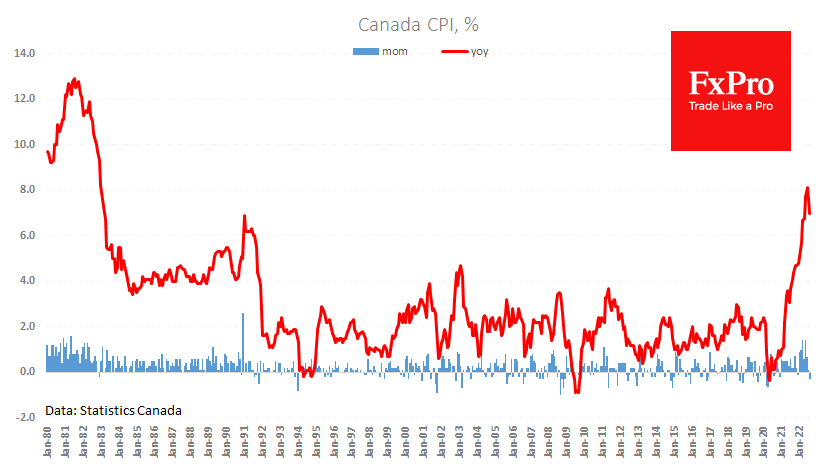
Slower Inflation Has Weakened the CAD
Canadian consumer prices fell 0.3% in August, the first decline this year and the strongest since May 2020. The annual rate of price growth fell from 7.6% to 7.0%.
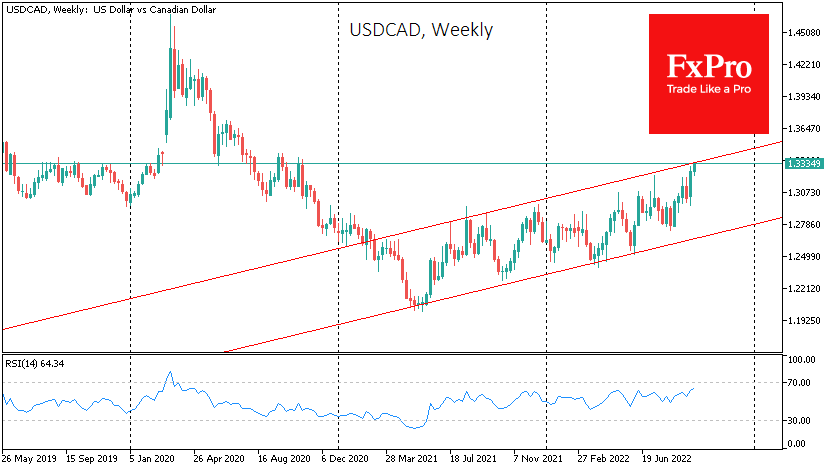
The USDCAD pair turned sharply higher a week ago after briefly touching the 50-day moving average and returning to below 1.30. Since then, the pair has added around 2.5%, yesterday climbing to the highs from October 2020 above 1.3340.
USDCAD has been moving upward since last June, enjoying periodic corrections as opposed to the much more one-sided weakening of the euro, yen, and pound against the dollar. The USDCAD is now trading near the upper boundary of this corridor, where we should expect a showy battle between bulls and bears.
A consolidation above 1.3350 might be the first step towards acceleration in the pair, and a rapid slowdown in inflation plays in favour of this scenario.
However, traders and investors should be prepared for another local reversal, as has been the case many times over the past 15 months.
Now Inflation Surprises in Europe Can Help the Euro
Inflation in Germany continues its hike far beyond the charts. The deceleration of the monthly price growth rate in May and June proved deceptive, followed by a surge of 5.3% for July and 7.9% for August. The annual rate of producer price growth soared to 45.8% from 37.2% a month earlier, contrasting with the expected slowdown to 37.1%.
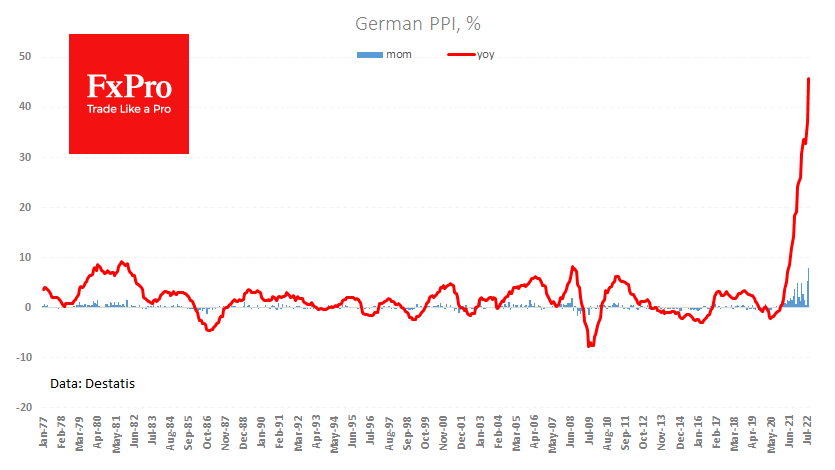
However, over the last couple of months, the ECB’s stance has drastically changed from trying to “talk up inflation” to unprecedented (for euro-area history) rate hikes of 50 and then 75 points over the last two meetings.
From a currency market perspective, high inflation figures are not weighing on the euro but can support it, as the ECB has moved on from contemplation to data-driven moves.
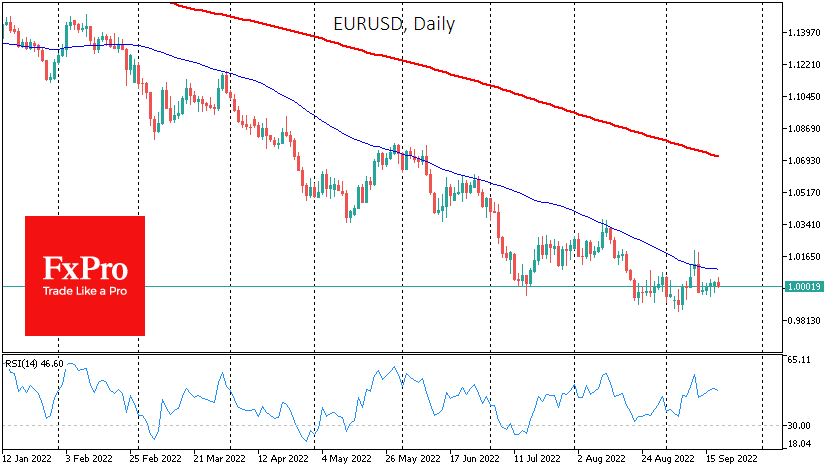
The euro cannot yet boast of the same reaction to the inflation reports as the dollar did a week earlier. However, the EURUSD closed the previous four sessions with gains, mainly benefiting from the demand during the New York trading session.
The pair appears to have decided to stay close to parity, finding support for the third consecutive month of declines. However, breaking the downtrend now requires more than just technique, but a lower rate hike in the US and a simultaneous acceleration in Europe.
USD/CAD Jumps as Canadian CPI Falls
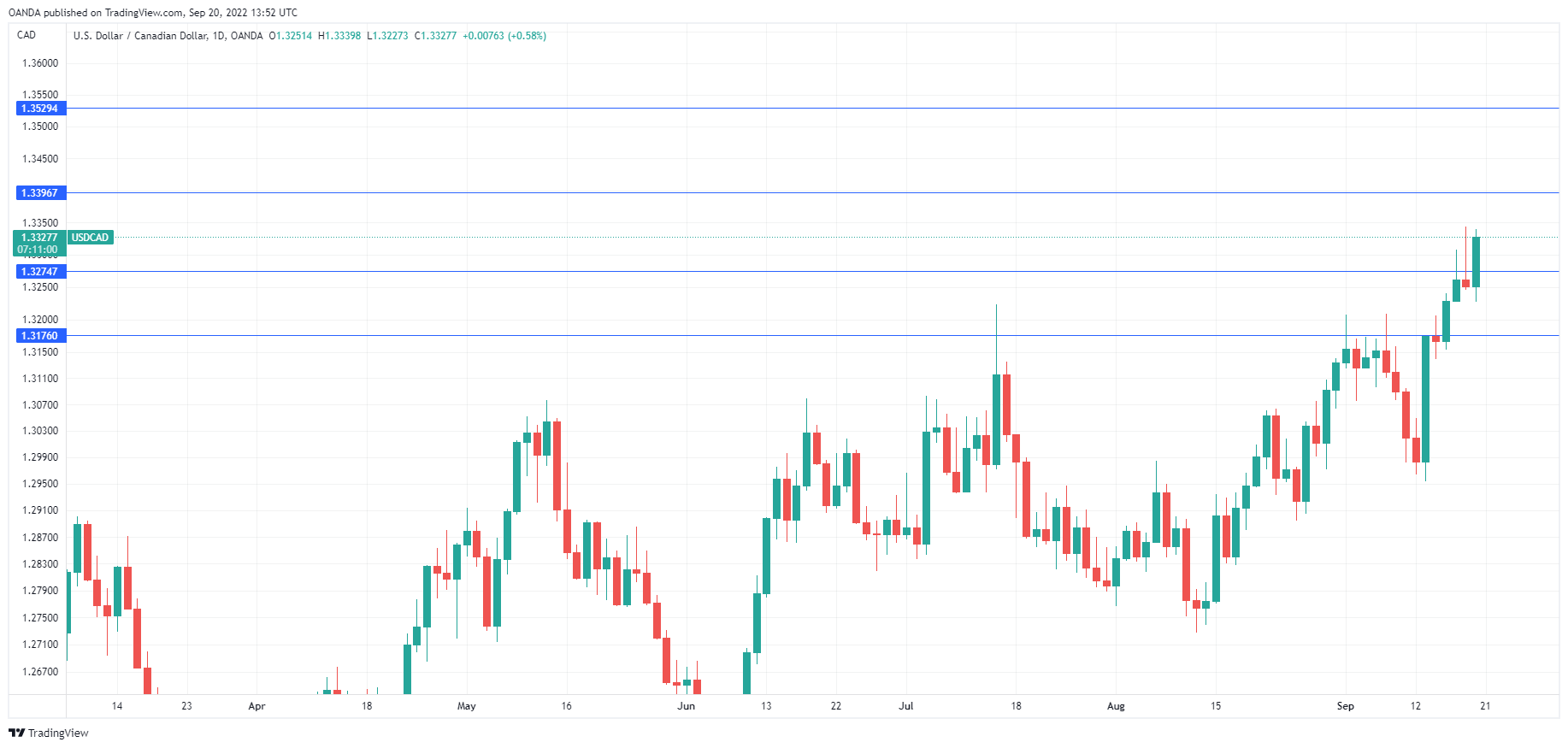
The Canadian dollar is sharply lower today. In the North American session, USD/CAD is trading at 1.3329, up 0.59% on the day.
Canada’s inflation surprises to the downside
Canada’s August inflation report fell to 7.0%, down sharply from 7.0% in July and below the consensus of 7.3%. This marks a second straight decline. On a monthly basis, inflation fell 0.3%, the first decline since December 2021, which was early in the Covid pandemic. All three measures of core inflation eased in August. The inflation report appears to indicate that inflation has finally peaked, which has sent the Canadian dollar sharply lower. The news was not all good, as food prices continue to accelerate and hit their highest level since 1981.
The Bank of Canada can take the lion’s share of the credit if inflation has indeed peaked, with an aggressive rate-hike cycle that has lifted the benchmark rate to 3.25%. The BoC has pressed the rate pedal to the floor, arguing that front-loading and then easing up is the most effective way to battle inflation. The Bank delivered a 75bp increase earlier this month, and today’s inflation news provides the BoC with room to lower rates. The markets have priced in a 50bp at the October meeting, followed by a modest 25bp hike in December. That would lift rates to an even 4.00%, which would be the highest since 2008, during the GFC.
The Federal Reserve, which meets tomorrow, is poised to raise rates by 0.75%, with an outside chance of a massive full-point hike. The Fed could lead to further losses for the Canadian dollar, especially if Fed guidance is hawkish. After falling behind the inflation curve, the Fed has embarked on a sharp rate-tightening cycle, which has raised concerns that the US economy will sustain a hard landing and tip into a recession.
USD/CAD Technical
- There is resistance at 1.3397 and 1.3529
- USD/CAD has support at 1.3274 and 1.3175
Sunset Market Commentary
Markets:
Today’s story is a quite straight-forward one. Accelerating Japanese inflation numbers (3% Y/Y) showed during Asian trading hours that there’s no escaping the inflation trends. Even if the Bank of Japan is expected to remain in denial on Friday. German producer price inflation set the tone in the early stages of European dealings. PPI accelerated in August from 5.3% M/M to 7.9% M/M while consensus hoped for a slowdown to 2.4% M/M. The Y/Y figure jumped from 37.2% Y/Y to 45.8% Y/Y. In case you wondered, Germany’s business model is dead. Energy was the main driver with a 20.4% M/M increase. PPI less energy rose by 0.4% M/M and 13.8% Y/Y. The Swedish Riksbank completed the hattrick by kicking off this week’s central bank mania with a larger-than-expected 100 bps rate hike, from 0.75% to 1.75%. It’s telling that one of the central bank’s with the most dovish DNA opts for an almost unmatched move. The opening paragraph said it all: “Inflation is too high. It is undermining households’ purchasing power and making it more difficult for both companies and households to plan their finances. Monetary policy now needs to be tightened further to bring inflation back to the target.” Updated and increased inflation forecasts (7.8% this year and 5.1% next for CPIF) warrant an increase of the expected policy rate peak from >=2% to >=2.5%. It’s also telling that the Swedish krona failed to profit from the outsized rate hike. On the contrary, EUR/SEK pushed beyond the 10.81 YTD high. A vote of no confidence in the (too low) policy rate peak? In any case a warning shot to other central banks coming up.
The global core bond sell-off continued unabatedly. US yields increase by 4 bps (2-yr) to 8 bps (30-yr). German yields add around 13 bps across the curve. The fact that the very long end of the curve underperforms compared to previous today could be a reflection of higher-expected policy rate peaks. The sell-off on the bond markets pulls main European and US stock markets over 1% lower. The dollar thrives in this kind of market climate with EUR/USD back at 0.9970. Sterling performs relatively well at EUR/GBP 0.8750. News Headlines
Headline Canadian inflation slowed more than expected in August. Inflation declined 0.3% M/M slowing the Y/Y measure from 7.6% in July to 7.0%. Some of the ‘core’ inflation measures (Core median 4.8%, Core trim 5.2%) also printed lower than expected. Energy prices declined 6.4% M/M as did prices of goods, easing for the second consecutive month (-0.8% M/M). Services inflation still rose albeit a modest 0.1% M/M. Food prices gained 0.8% M/M and were the largest positive contributor in monthly terms. The softer than expected inflation report is fueling the debate as to whether the Bank of Canada will finally be able to slow the pace of rate hikes. It already raised the policy rate to 3.25% (+0.75% in September), bringing it above what it sees as a neutral level. The Canadian 2y yield today eases 5 bps against the broader uptrend in yields. The loonie stays under pressure with USD/CAD regaining the 1.33 barrier, near the YTD weakest level of the Canadian currency against the USD.
Eco data in Poland published today painted a mixed picture. Average wages in August were reported at -2.7% M/M and 12.7% Y/Y, down from 15.8 Y/Y in July. Wage growth was weaker than expected, but the series is notoriously volatile. Employment growth declined 0.1% M/M to 2.4% Y/Y (unchanged from July). Production rose 0.7% M/M to be up 10.9% Y/Y, while a further decline was expected. Producer price inflation was materially stronger than expected at 0.8% M/M and 25.5% Y/Y and the July figure was upwardly revised, too. After raising the policy rate by 0.25% to 6.75% earlier this month, the MPC of the National Bank of Poland ponders whether it can bring the tightening cycle to an end. Markets still take into account the possibility of one or two 0.25 bps ‘fine-tuning hikes’. The zloty today weakens to trade at EUR/PLN 4.726.
BoE Decision a Close Call to Speed Up Rate Hikes as Worries Mount
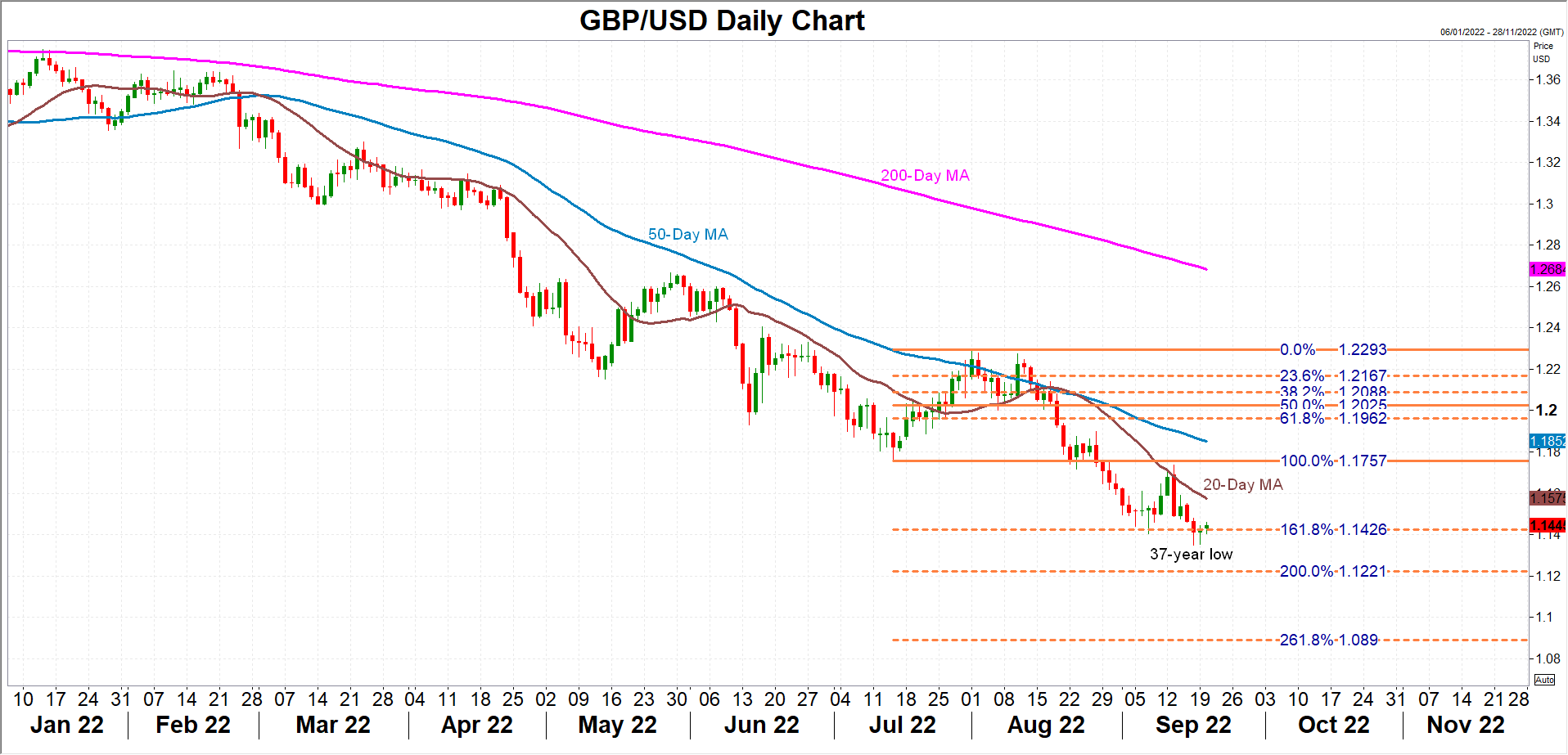
The Bank of England will announce its September policy decision a week later than planned on Thursday (11:00 GMT) after the meeting had to be postponed until after the funeral of the late Queen Elizabeth II. As life in Britain returns to normal following a 10-day mourning period, policymakers are faced with the grim reality of a darkening economic outlook at a time when inflation is hovering around 10%. Markets are betting that the BoE might have to accelerate its tightening pace for the second straight meeting as the pound licks its wounds near 37-year lows.
Recession fears are growing
After a strong recovery from the pandemic slump that lasted till the first quarter of 2022, the UK economy is now teetering on the brink of a recession. The soaring cost of living, driven mainly by higher fuel prices, has squeezed household incomes, hurting spending in a consumer-led economy. Businesses are also struggling from higher energy bills as well as from rising borrowing costs, while the political uncertainty at such a critical time hasn’t exactly been reassuring for investors. Even the tight labour market is showing some signs of cooling off.
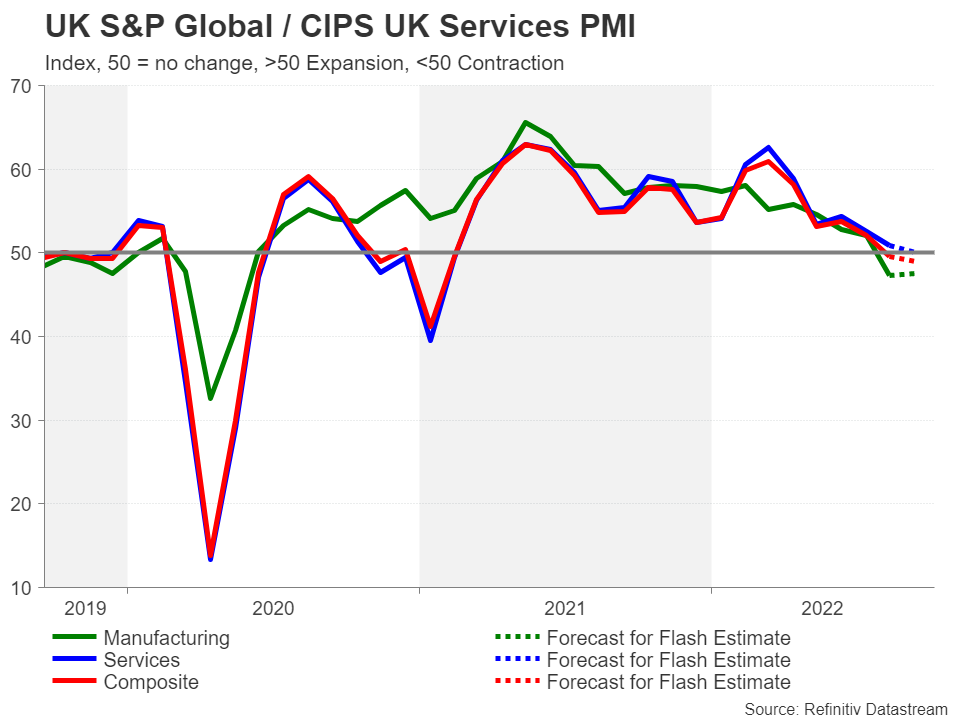
GDP fell marginally in the second quarter and the likelihood of another contraction in Q3 has risen following the Queen’s death, as the nation came to a standstill. The latest flash PMI estimates are due on Friday and are expected to show that business activity declined for the second month in a row in September. This puts the Bank of England in the unenviable position of having to hike interest rates when the economy could already be in technical recession.
Will there be any relief from high energy prices?
But the bigger dilemma now for policymakers is whether they should tighten the monetary policy screws even more quickly. Although there was relief when the headline rate of inflation moderated slightly to 9.9% in August, it’s likely to rise again in the coming months as the energy price cap set by the UK electricity regulator will increase by 80% from October.
It’s not entirely doom and gloom, however, as both oil and gas prices have significantly come off their recent highs and unless a fresh geopolitical crisis unfolds, it’s quite likely that energy prices have peaked. Given the aforementioned and the BoE’s overly cautious attitude to this tightening cycle to begin with, it’s hard to envision there would be a majority within the Monetary Policy Committee (MPC) to hike interest rates by 75 basis points.
Halting the pound’s depreciation
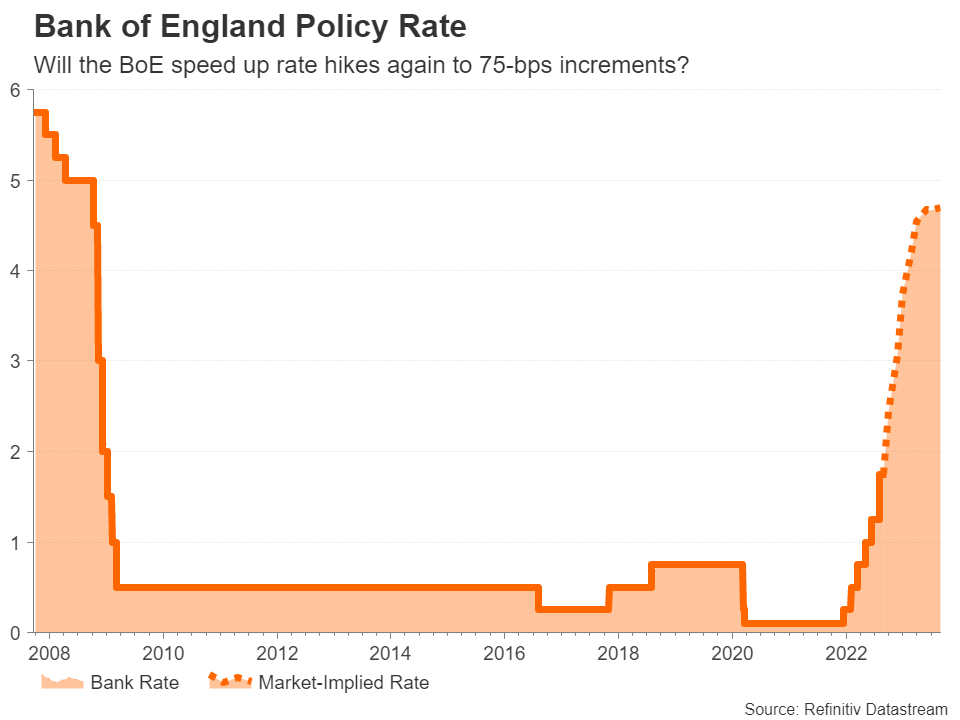
Last time, the Bank doubled its pace, hiking by 50 bps, and economists think they will repeat that in September. Markets on the other hand are about 75% convinced for a 75-bps increment. It’s possible that the recent jumbo-sized hikes from the Fed and the European Central Bank have strengthened the case for the MPC hawks.
But there is another reason why the Bank might be more inclined to surprise with a larger move on Thursday – the plunging pound. The British currency has been in freefall for much of the year, losing 15% of its value against the US dollar. A weak exchange rate is undesirable during periods of high inflation as it exacerbates inflationary pressures by making imports more expensive.
Could a steep rate hike spur a rebound?
If the MPC does not disappoint the hawkish expectations, sterling could bounce off the current support region of the 161.8% Fibonacci extension of the July-August downleg around $1.1426 and make a dash for the 20-day moving average at $1.1575. A stronger rebound could see the previous peak of $1.1738 being tested.
However, should the Bank raise rates by only 50 bps, or a 75-bps increase is accompanied by a not-so-hawkish statement, there would be little to stop the pound from dropping to fresh multi-decade lows. The 200% and 261.8% Fibonacci extensions of $1.1221 and $1.0890, respectively, would be the obvious targets to the downside.
Nervousness ahead of the mini budget
But the Bank of England decision is not going to be the only thing investors will be watching this week. On Friday, the UK’s new chancellor, Kwasi Kwarteng, will set out the government’s fiscal plans in an emergency mini budget. Kwarteng is expected to unveil further details around Prime Minister Liz Truss’ energy package as well as announce tax cuts, thought to be in the region of £30 billion.
Although a pro-growth budget would normally be seen as positive for the pound, investors are worried that Truss’ radical policies will fuel already high borrowing just as the yields on UK government bonds are surging. The whole plan revolves around the idea that tax cuts will pay for themselves by boosting growth. But that rarely turns out to be the case and fiscal discipline down the line seems inevitable from traders’ perspective, hence, the underwhelming response in sterling.
EURAUD Meets Resistance at Cloud Top; Bullish Bias Weakens
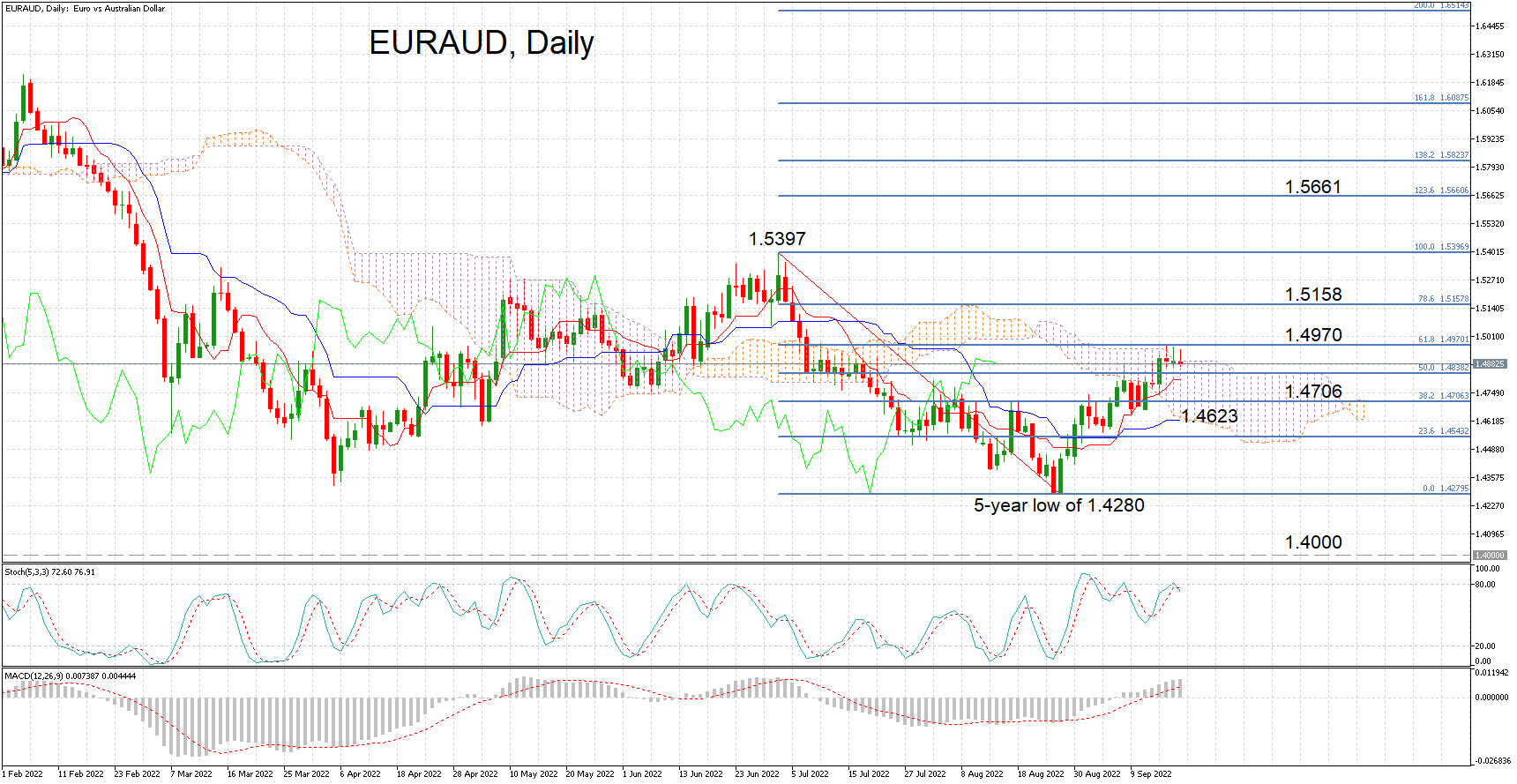
EURAUD has lost some upward momentum over the last three days as the rebound from August’s five-year trough hit a wall at the top of the Ichimoku cloud. This region also coincides with the 61.8% Fibonacci retracement of the July-August downtrend at 1.4970.
Looking at the momentum indicators, the setback appears to be just a pause for breath at this point. The stochastics are only slightly dipping downwards despite the bearish crossover of the %K and %D lines, while the MACD histogram continues to climb above zero and is positively aligned with its red signal line. More importantly, price action remains confined near the cloud top.
If the bulls are able to regain the upper hand and push the price above the 61.8% Fibonacci, the next test will be the 78.6% Fibonacci of 1.5158, followed by the July top of 1.5397. Surpassing this peak would shift the spotlight to the 123.6% Fibonacci extension of 1.5661, after which further gains would see the short-to-medium-term picture becoming bullish.
However, if EURAUD loses further steam and drops inside the cloud, there could be support in the 1.4700 region, which lies slightly below the 38.2% Fibonacci. The Kijun-sen line at 1.4623 near the cloud’s lower surface could be important too and if breached, the August low of 1.4280 could be the next stop. Below this point, sellers would likely focus their attention on the psychologically crucial support point of 1.4000.
To sum up, if the latest rebound is able to resume soon, there is potential for a more sustainable uptrend. But if the pair pulls back towards the August trough, the current neutral outlook would be at risk of turning bearish.