Sample Category Title
RIP Cable
Markets
RIP cable. GBP/USD in early European trading slipped below the 1.1412 support (2020 low). At 1.138, the currency pair is trading at its weakest level since 1985. It’s a long way still, but from a technical point of view there’s little to prevent cable from revisiting the all-time low at 1.052. Sterling faced selling pressures for some time already but this morning’s ugly August retail sales (-1.6% m/m, -5.4% y/y) were the straw that broke the camel’s back. It’s basically the cost-of-living crisis in numbers. The pound also loses out vs an otherwise lackluster euro. EUR/GBP broke above the 0.8721/31 resistance levels (previous 2022 high/2021 correction high). Momentum faded a bit after hitting an intraday day peak of 0.877 but the pair is still changing hands at 0.875 at the time of writing. The neckline of the 2020 triple top formation at 0.886 marks the next reference on the technical charts. Next week’s delayed Bank of England meeting will be an interesting once. Markets have more or less abandoned the idea of a 75 bps hike and instead assume a second consecutive 50 bps hike. That’s reasonable given the abysmal eco data this week but still very high inflation. Whether that’ll support the pound, especially against the USD, is debatable. UK financial markets are closed on Monday for Mourning Day. For the Queen and, perhaps, sterling.
Other data today included final European HICP, which was adjusted upwards in the monthly figure (0.6% m/m). Following the release of this report, US consumer confidence (U. of Michigan) is still due. ECB’s Lagarde in a speech said they “absolutely want to avoid second-round effects” while Finnish governor Rehn saw a case for frontloading the tightening cycle. Core bond yields continue their trip north. The 2y European swap yield adds 4 bps, extending yesterday’s break above the 2011 peak. Today’s move means that the 2y and 10y segment now have also inverted. German yields jump 1.2 bps (30y) to 6.4 bps (2y). Yields in the US gain up to 6.2 at the very long end. The 2y rises 3.9 bps to 3.9% and is closing in on the psychological 4%. The dollar remains in the driver’s seat amid ongoing equity risk off (up to -1.6% on WS). The S&P500 extends losses after losing support from the upward sloping trendline yesterday. DXY rips above 110 again. EUR/USD gently drifts south to 0.996. The Japanese yen is the only G10 currency able to stand up against the USD. USD/JPY eases slightly to 143.15. EUR/JPY falls to 142.67. Maybe next week’s BoJ meeting looming made investors wary of a sneaky move to close some shorts. Earlier this week the central bank performed a rate check, usually the last warning shot before actual (but not certain) FX interventions.
News Headlines
Core inflation (net of food and energy prices) in Poland as published by the National Bank of Poland today accelerated further by 0.8% M/M and 9.9% in August (was 0.6% M/ and 9.3% in July). All other core CPI measures (net of administered prices, 15% trimmed mean, net of most volatile prices) were higher than in July both in M/M and Y/Y terms. Earlier this month the statistical office already reported headline inflation at 0.8% M/M and 16.1% Y/Y. Within the national bank of Poland, MPC members are still divided whether inflation is close to the peak, allowing the NBP bring the rate hike cycle to an end or whether some additional further hikes are needed. Polish short-term yields are easing slightly today (2-y swap -10 bps) but most of this move already occurred before the release. The zloty today strengthened slightly to EUR/PLN 4.715.
The central Bank of Russia today as expected further reduced its policy rate from 8.0% to 7.5%. Comments from the central bank after the decision suggest that rate cuts might be coming to an end. Amongst others even some tightening might be needed to bring inflation back to the 4.0% target in 2024 if the fiscal deficit continues to widen. Inflation in August stood at 14.3% and the central bank expects it to finish the year in between 11-13%. The ruble today continued to trade in within a tight consolidation pattern (currently USD/RUB 60.45 area).
Gold Isn’t Saving Investors from Inflation
On Thursday, September 15, XAUUSD lost its major support, which used to limit the downside since April 2020. The decline happened amid expectations of more aggressive Federal Reserve interest rate hikes due to higher-than-expected US inflation.
Why is gold falling?
Investors treat gold as a hedge against inflation. A rise in inflation or inflationary expectations increases investors’ interest in purchasing gold and drives up its price. In contrast, disinflation or a drop in inflationary expectations does the opposite.
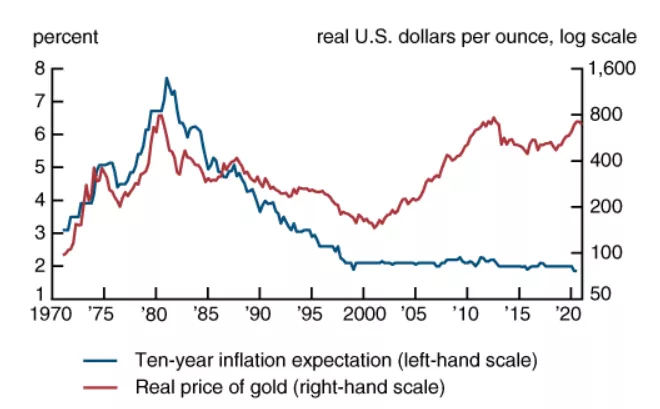
Gold and inflation expectation. Source: Chicagofed
However, we can notice that since the 2000s, the gold price has been rising while the inflation expectations were steadily low. It was caused by the Fed monetary policy, according to which the Federal Reserve has been printing USDs to support the economy. As a result, the amount of USD in circulation increased parabolically, pushing gold prices to new highs.
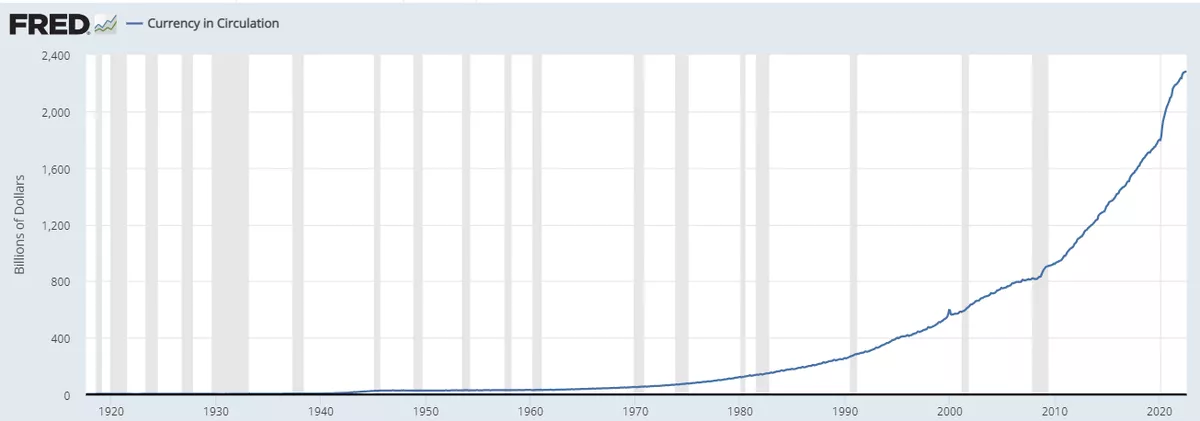
USD in circulation. Source: FRED
Moreover, gold is sensitive to expected long-term real interest rates. Since metal is a long-duration durable asset, its price has a strong inverse relationship with the long-term real interest rate. A rise in expected real rates should drive down the price of gold.
Therefore, central banks' rate hikes and the Fed's quantitative tightening (QT) monetary policy make gold one of the most unpopular assets among big investors. Holding the metal doesn't provide any dividends or payouts, while big hedge funds have to show a profit to investors. Therefore, smart money prefers short-term government bonds to gold, as yields skyrocketed to 15-year highs.
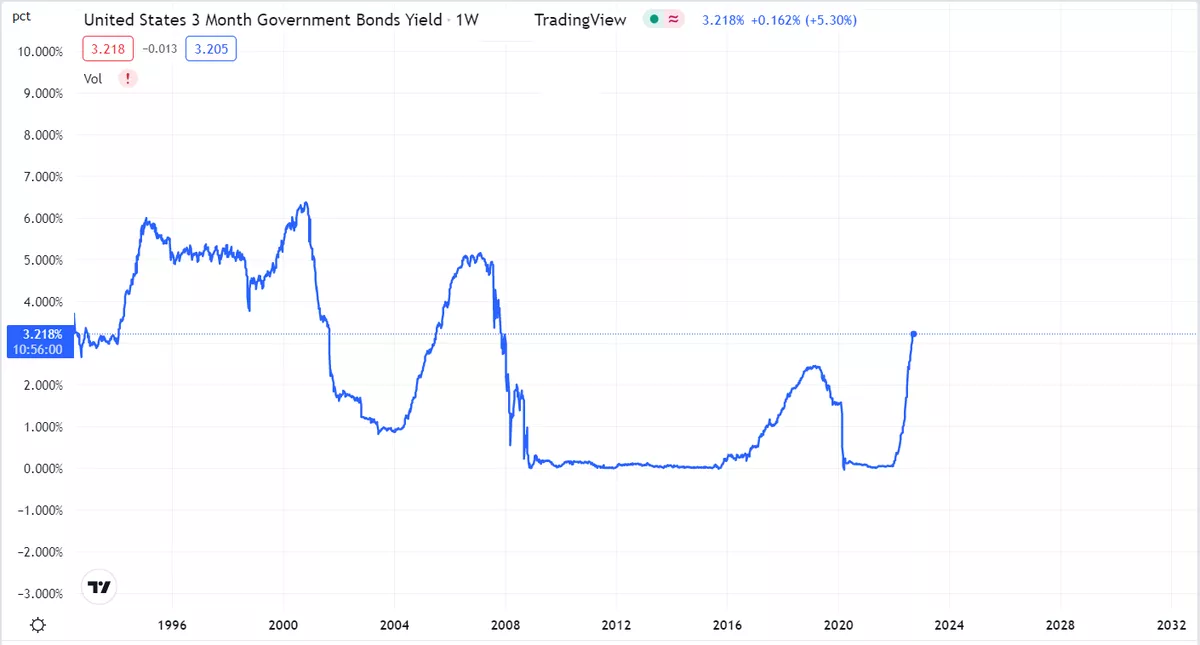
US 3-month Government Bond Yield. Source: Tradingview
What to expect?
While the consensus is a 75-basis-point hike on September 21, some Fed members call for a 100-basis-point increase. The gold market reflects such a prospect. As a result, an actual rate hike by 75 bps may be a positive surprise for the yellow metal.
XAUUSD, weekly chart
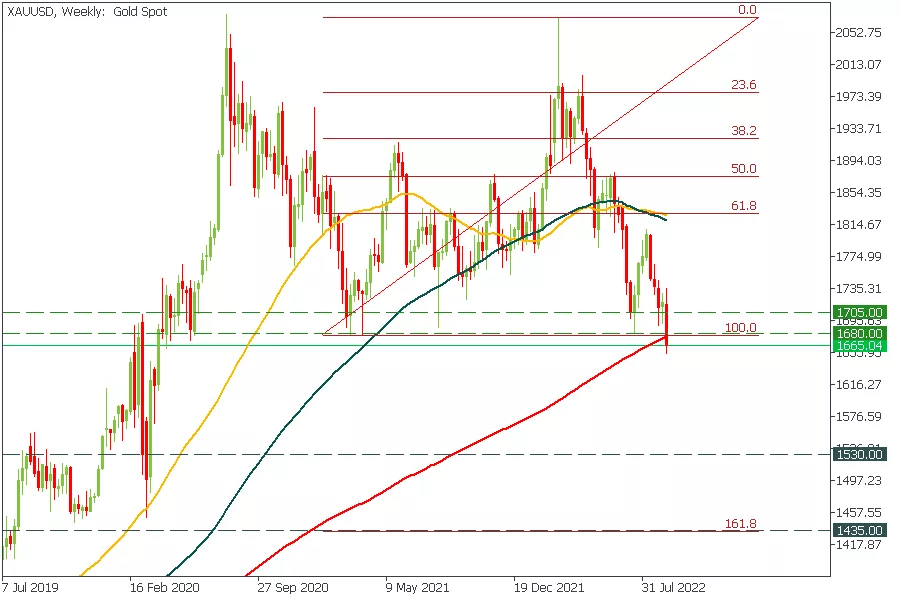
After the breakout, primary support levels for XAUUSD are 1530.00, the horizontal level from May 2012, and 1435.00, 161.80 Fibonacci level. The range between 1680 and 1705 acts as the massive resistance for the price since the breakout.
In the short term, the price might increase inside the resistance range to confirm the breakout. However, I expect a massive decline towards the support levels in the middle term.
New Zealand Dollar Extends Losses
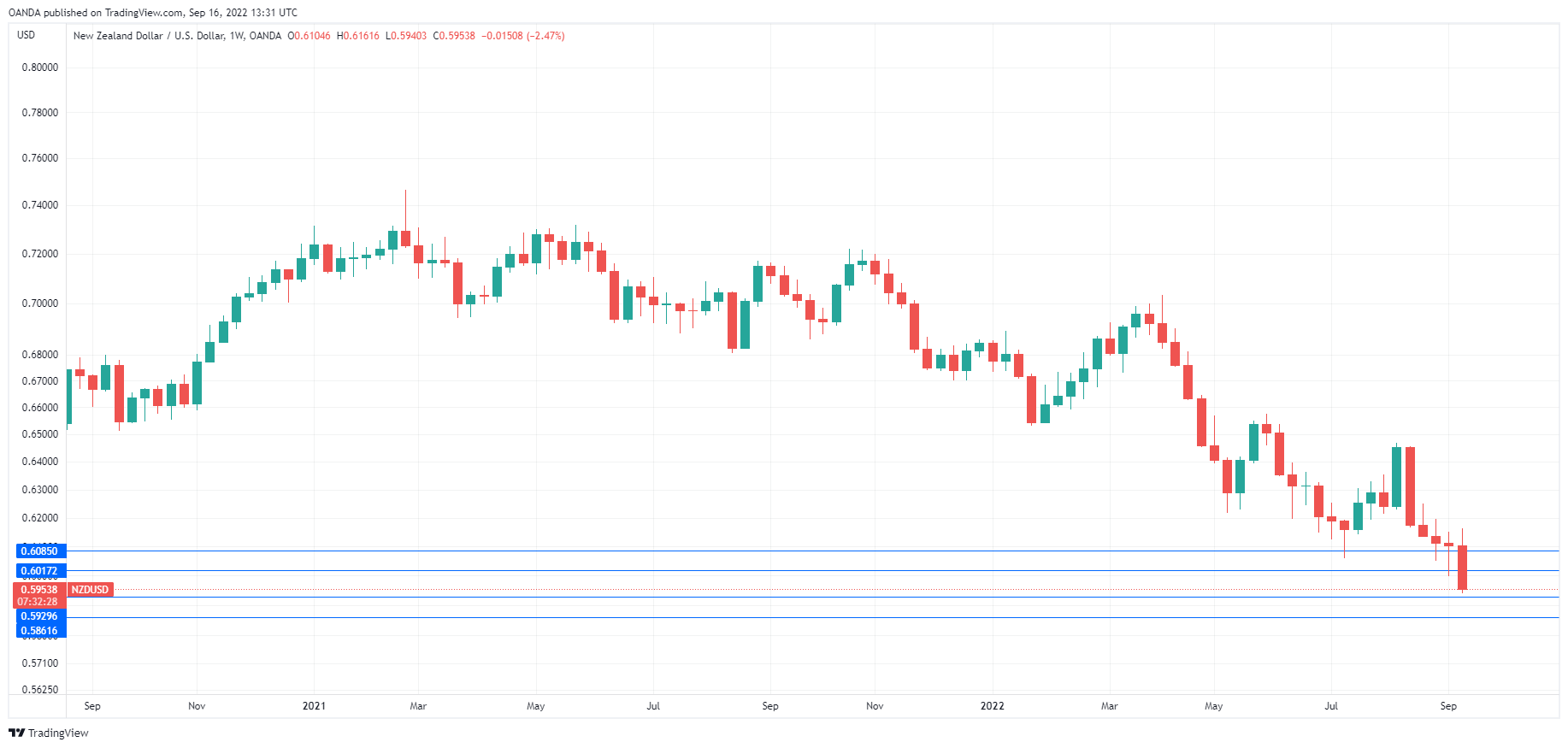
The New Zealand dollar remains under pressure, as NZD/USD is having a dreadful week, down 2.47%. In the North American session, NZD/USD is trading at 0.5950, down 0.27%.
NZ Manufacturing PMI surprises to the upside
It has been a solid week for New Zealand data, but that hasn’t helped the New Zealand dollar, which has fallen to its lowest level since May 2020. Earlier today, New Zealand’s manufacturing PMI for August improved to 54.9, up from 53.5 in July and above the consensus of 52.5. This marked the highest level since July 2021 and manufacturing has now expanded for a fifth month running, with readings above the neutral 50.0 level. This is in contrast to global manufacturing, which has been struggling and slowed to 50.3 in August, down from 51.1 in July.
Earlier in the week, New Zealand posted a stronger-than-expected GDP report for Q2. The economy climbed 1.7%, reversing the 0.2% decline in the first quarter. The upswing in growth was driven by the government’s easing of Covid restrictions. The gain in GDP removed any fear of a technical recession, which is defined as two consecutive quarters of negative growth.
Now that New Zealand’s economy is flexing its muscles, what does that mean for the Reserve Bank of New Zealand? The central bank was almost spot on with its GDP forecast at the August meeting, predicting a gain of 1.8%. At the meeting, the Bank projected that the cash rate would peak at 4.1% in mid-2023. The GDP release is not expected to change that stance, with the Bank likely to raise rates by 50bp in the October and November meetings, which would bring the cash rate to an even 4.0%.
With central banks raising interest rates in order to combat inflation, the World Bank has warned that the global economy may tip into a recession. The World Bank report noted that the three largest economies, the US, China and the eurozone were all slowing sharply, and even a “moderate hit to the global economy” could result in a global recession.
NZD/USD Technical
- NZD/USD is testing resistance at 0.6017. Next, there is resistance at 0.6085
- There is support at 0.5929 and 0.5861
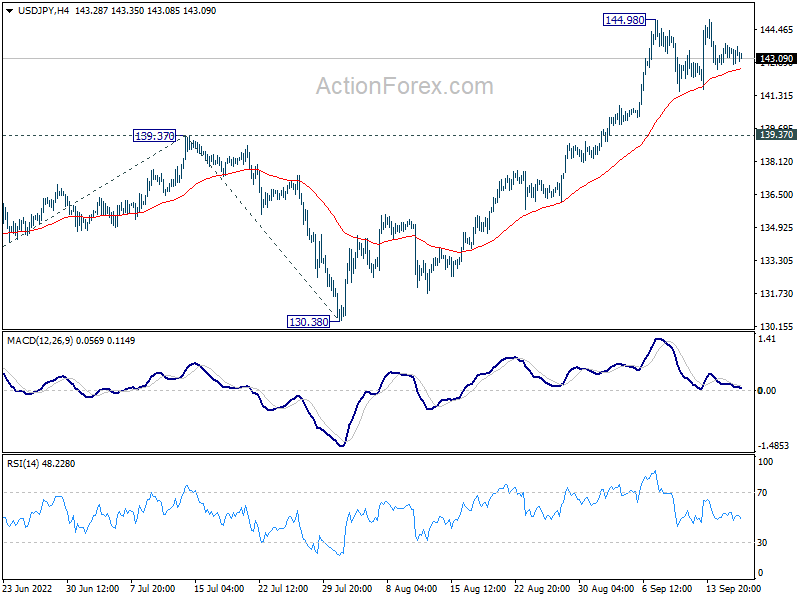
USD/JPY Mid-Day Outlook
Daily Pivots: (S1) 142.94; (P) 143.37; (R1) 143.94; More...
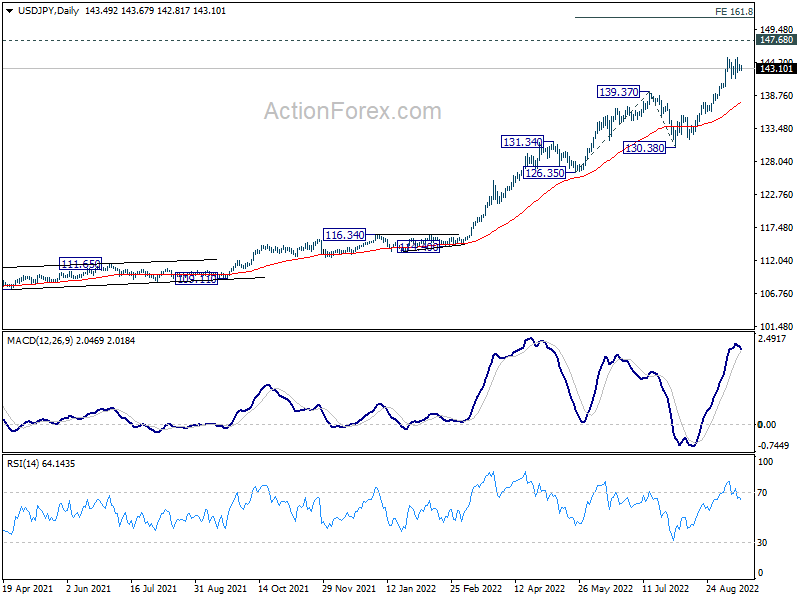
Intraday bias in USD/JPY stays neural as consolidation from 144.98 is still extending. . On the upside, break of 144.98 will resume larger up trend to 147.68 long term resistance. Break there will target 161.8% projection of 126.35 to 139.37 from 130.38 at 151.44 next. While deeper retreat cannot be ruled out, downside should be contained by 139.37 resistance turned support.
In the bigger picture, up trend from 101.18 is still in progress, as part of the whole up trend from 75.56 (2011 low). Further rise should be seen to 147.68 (1998 high). For now, break of 130.38 support is needed to be the first indication of medium term topping. Otherwise, outlook will stay bullish even in case of deep pull back.
USD/CHF Mid-Day Outlook
Daily Pivots: (S1) 0.9568; (P) 0.9605; (R1) 0.9654; More
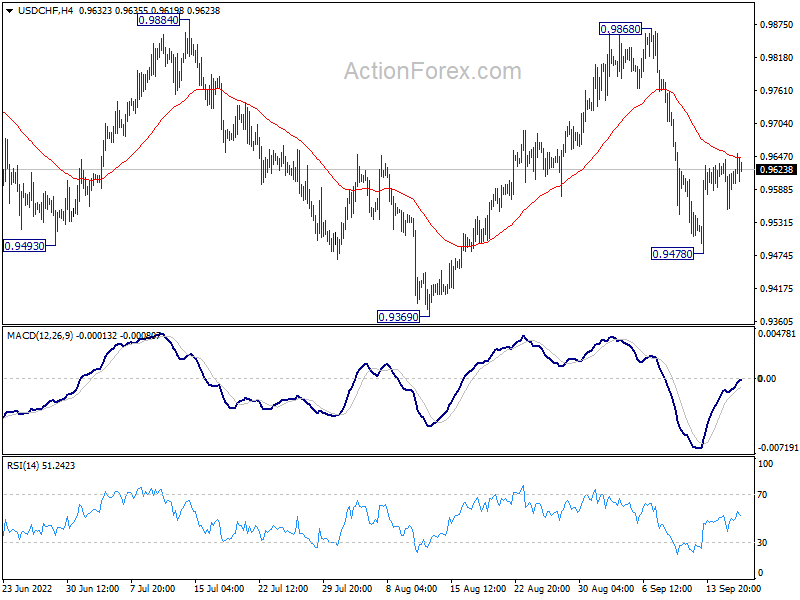
Intraday bias in USD/CHF stays neutral for the moment. On the upside, firm break of 4 hour 55 EMA (now at 0.9644) will target 0.9868 resistance first. Further break there will argue that larger up trend is ready to resume through 1.0063. On the downside, below 0.9478 will extend the fall from 0.9868 towards 0.9369 support. Overall, corrective pattern from 1.0063 could extend further as long as 0.9868 resistance holds.
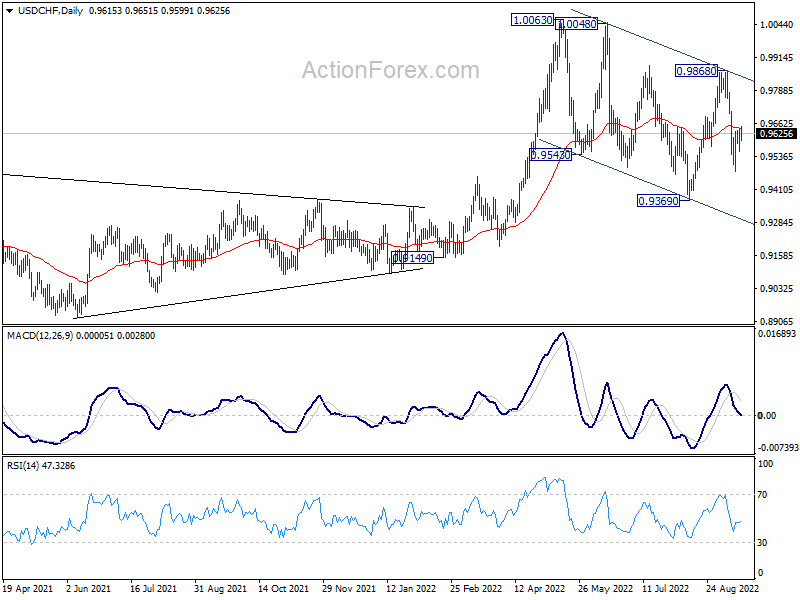
In the bigger picture, current development suggests that up trend from 0.8756 (2021 low) is still in progress. Sustained break of 1.0063 will target 100% projection of 0.9149 to 1.0063 from 0.9369 at 1.0283, and then 1.0342 (2016 high). For now, this will remain the favored case as long as 0.9369 support holds, even in case of deep pull back.
EUR/USD Mid-Day Outlook
Daily Pivots: (S1) 0.9963; (P) 0.9991; (R1) 1.0025; More...
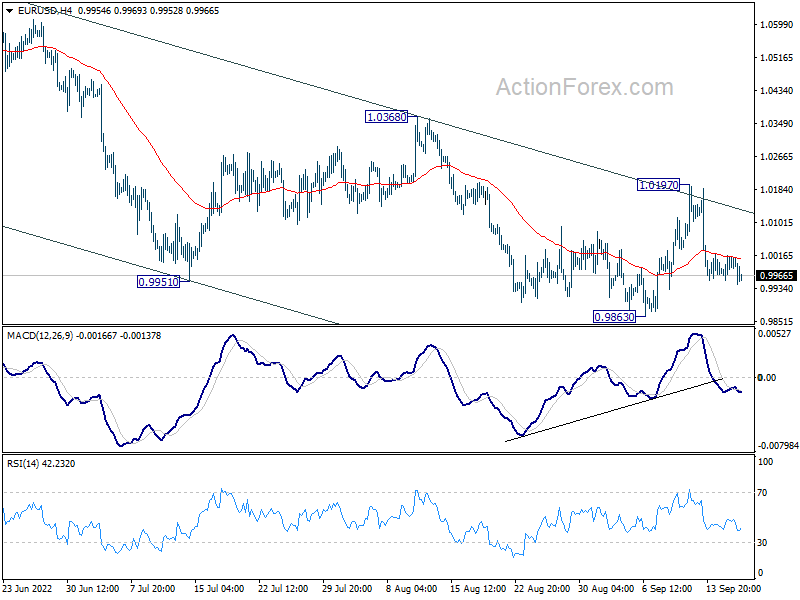
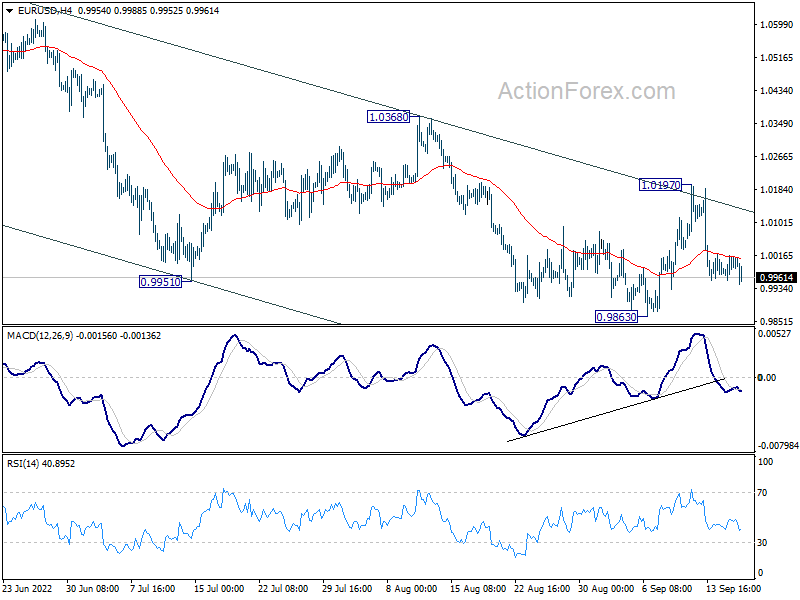
No change in EUR/USD's outlook and intraday bias stays mildly mildly on the downside for retesting 0.9863 low. Firm break there will resume larger down trend. On the upside, break of 1.0197 resistance will now raise the chance of larger trend reversal, and target 1.0368 resistance.
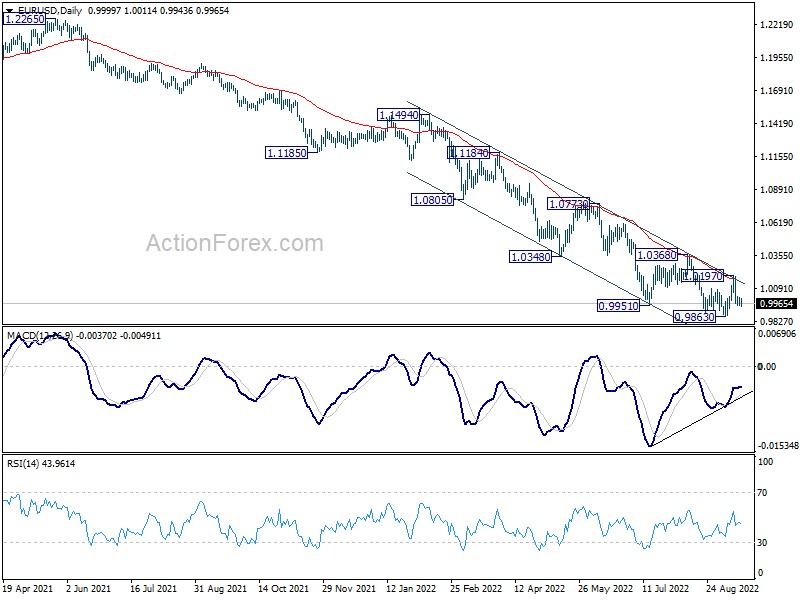
In the bigger picture, down trend from 1.6039 (2008 high) is still in progress. Next target is 100% projection of 1.3993 to 1.0339 from 1.2348 at 0.8694. In any case, outlook will stay bearish as long as 1.0368 resistance holds, in case of strong rebound. However, firm break of 1.0368 will confirm medium term bottom at 0.9863 already.
GBP/USD Mid-Day Outlook
Daily Pivots: (S1) 1.1434; (P) 1.1495; (R1) 1.1529; More...
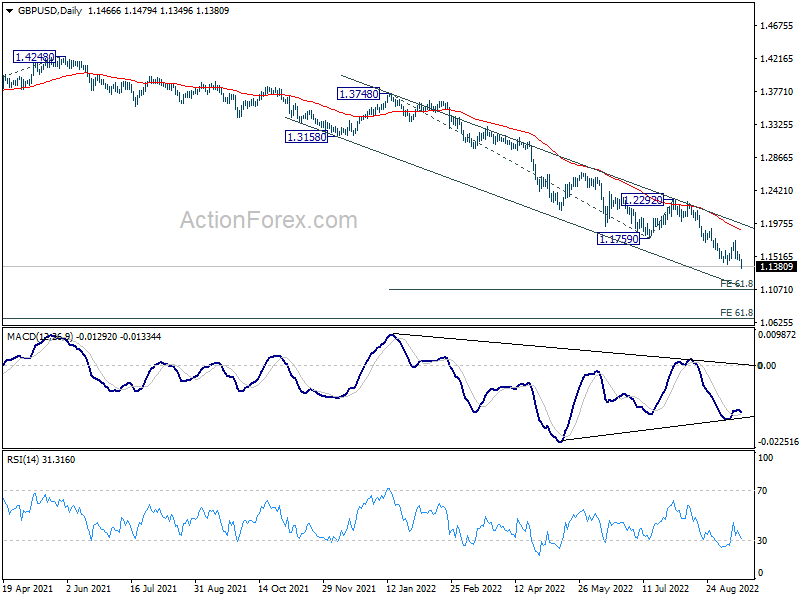
Break of 1.1404/9 support zone indicates down trend resumption in GBP/USD. Intraday bias is back on the downside for 61.8% projection of 1.3748 to 1.1759 from 1.2292 at 1.1063. On the upside, break of 1.1737 resistance is needed to indicate short term bottoming. Otherwise, outlook will remain bearish in case of recovery.
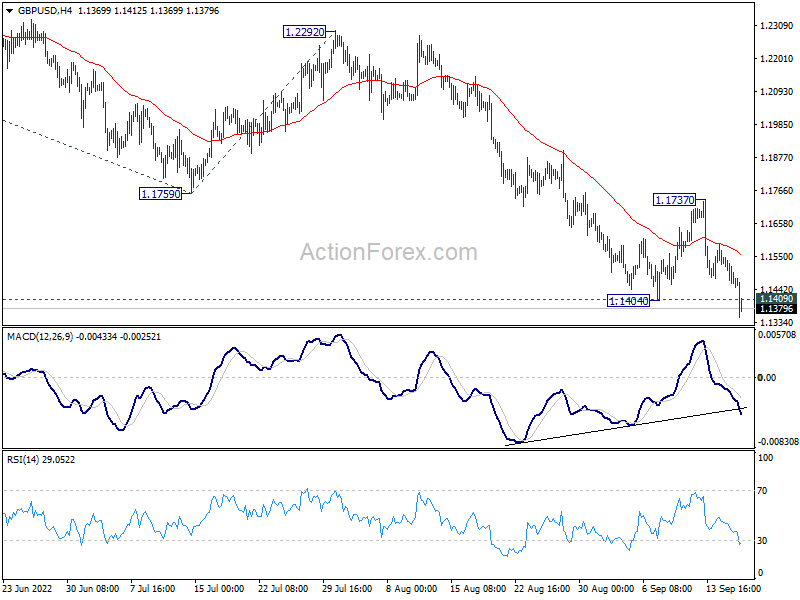
In the bigger picture, based on current momentum, fall from 1.4248 (2018 high) is probably resuming long term down trend from 2.1161 (2007 high). Sustained break of 1.1409 will target 61.8% projection of 1.7190 (2014 high) to 1.1409 (2020 low) from 1.4248 (2021 high) at 1.0675. This will remain the favored case for now as long as 1.2292 resistance holds.
Sterling Hits 37-Yr Low, Dollar Staying Strong
Selloff in Pound catches most currency related headlines today, as it slumped to a 37-year low against Dollar. The decline came after data showed retail sales contracted in both volume and value term in August, indicating that inflation was already biting into spending. In the background, the UK economic is already in recession. Still for now, commodity are even worse for the week. Dollar is the biggest winner, followed by Swiss Franc and Yen. The final picture will depend on development in risk sentiment in the last few hours.
Technically, EUR/USD is so far resilient. But being capped below 4 hour 55 EMA, risk remains mildly on the downside for the near term. Retest of 0.9863 is in favor. Break there will resume larger down trend, and align the outlook with GBP/USD.
In Europe, at the time of writing, FTSE is down -0.32%. DAX is down -1.73%. CAC is down -1.49%. Germany 10-year yield is down -0.006 at 1.763. Earlier in Asia, Nikkei dropped -1.11%. Hong Kong HSI dropped -0.89%. China Shanghai SSE dropped -2.30%. Singapore Strait Times rose 0.01%. Japan 10-year JGB yield dropped -0.0001 to 0.257.
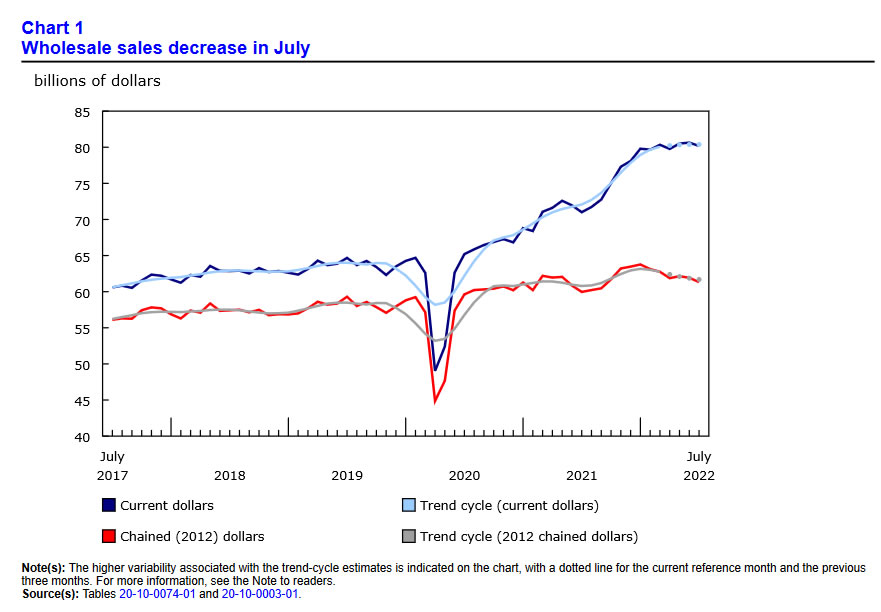
Canada wholesale sales dropped -0.6% mom in Jul, led by personal and household goods
Canada wholesale sales dropped -0.6% mom in July to CAD 80.2B, worse than expectation of -0.4% mom. That followed two consecutive months of record-high sales in May and June.
Declines in the personal and household goods subsector led the losses for July, followed by the building material and supplies, and the motor vehicle and motor vehicle parts and accessories subsectors. Sales fell in five of seven subsectors, which represented 63% of wholesale sales.
ECB de Guindos hopes recent depreciation in Euro is reversed in near future
ECB Vice President Luis de Guindos told a Portuguese newspaper Expresso, "the slowdown of the economy is not going to 'take care' of inflation on its own."
"The slowdown of the economy will reduce demand pressures, which will lower inflation," he added. "But, simultaneously, we have to act from the monetary policy standpoint to keep inflation expectations anchored and avoid second-round effects."
"We need to continue the normalization of monetary policy," he said. "More hikes might come in the next few months -- how many times and by how much will depend fundamentally on the data -- and we underscore our full determination to make inflation converge toward our definition of price stability"
"Further depreciation of the euro could be detrimental to inflationary pressures. On the contrary, if the euro stopped depreciating, this could be positive and support the fight against inflation. I hope that the recent depreciation trend is reversed in the near future", he also noted.
Eurozone CPI finalized at 9.1% yoy in Aug, core CPI at 4.3% yoy
Eurozone CPI was finalized at 9.1% yoy in August, up from 8.9% yoy in July. A year earlier, the rate was only 3.0% yoy. CPI core (all item ex-energy, food, alcohol and tobacco) was finalized at 4.3%, up from prior month's 4.0% yoy. The highest contribution to the annual Eurozone inflation rate came from energy (3.95%), followed by food, alcohol & tobacco (2.25%), services (1.62%) and non-energy industrial goods (1.33%).
EU CPI was finalized at 10.1%, up from 9.8% a month ago. The lowest annual rates were registered in France (6.6%), Malta (7.0%) and Finland (7.9%). The highest annual rates were recorded in Estonia (25.2%), Latvia (21.4%) and Lithuania (21.1%). Compared with July, annual inflation fell in twelve Member States and rose in fifteen.
UK retail sales volume dropped -1.6% mom in Aug, sales value also down -1.7% mom
UK retail sales volume dropped -1.6% mom, -5.4% yoy in August, worst than expectation of -0.6% mom, -4.2% yoy. Ex-fuel sales volume dropped -1.6% mom, -5.0% yoy, versus expectation of -0.7% mom, -3.4% yoy.
Retail sales value also dropped -1.7% mom while ex-fuel sales value dropped -1.4% mom. On a year earlier, headline sales value rose 5.4% yoy while ex-fuel sales value rose 3.7% yoy.
RBA Lowe: Rate at 2.35% is still too low
RBA Governor Philip Lowe told the House of Representatives Standing Committee on Economics, interest rate at 2.35% is "still too low". He added that over the longer term, the cash rate "should at least average the mid point of the inflation target", which is 2.5%, if not a bit higher. Also, an average interest rate of about 3% was "possible", and we'll cycle around some number between 2.5 and 3.5."
Lowe also warned that the longer inflation stays above 3%, "the more difficult it's going to become" for Australians. If that. happens "then we have higher interest rates and a recession, which is damaging. "So we've got two difficult kind of positions at the moment: some pain now and hopefully real wages start rising again next year against the risk of not doing anything, just sitting on our hands and having inflation stay higher."
NZ BusinessNZ manufacturing rose to 54.9, improving tone around underlying growth
New Zealand BusinessNZ Performance of Manufacturing Index rose slightly from 53.5 to 54.9 in August. Production rose from 50.8 to 54.6. Employment rose from 52.9 to 53.6. New orders rose from 50.8 to 59.2. Finished stocks rose from 48.7 to 50.8. Deliveries rose from 50.1 to 53.7.
BNZ Senior Economist, Craig Ebert stated " that manufacturing production, in general, was holding its own in Q2, rather than drooping, was portrayed in the PMI readings for April May and June. And in July and August the PMI has moved on to suggest an improving tone around underlying growth."
GBP/USD Mid-Day Outlook
Daily Pivots: (S1) 1.1434; (P) 1.1495; (R1) 1.1529; More...
Break of 1.1404/9 support zone indicates down trend resumption in GBP/USD. Intraday bias is back on the downside for 61.8% projection of 1.3748 to 1.1759 from 1.2292 at 1.1063. On the upside, break of 1.1737 resistance is needed to indicate short term bottoming. Otherwise, outlook will remain bearish in case of recovery.
In the bigger picture, based on current momentum, fall from 1.4248 (2018 high) is probably resuming long term down trend from 2.1161 (2007 high). Sustained break of 1.1409 will target 61.8% projection of 1.7190 (2014 high) to 1.1409 (2020 low) from 1.4248 (2021 high) at 1.0675. This will remain the favored case for now as long as 1.2292 resistance holds.
Economic Indicators Update
| GMT | Ccy | Events | Actual | Forecast | Previous | Revised |
|---|---|---|---|---|---|---|
| 22:30 | NZD | Business NZ PMI Aug | 54.9 | 52.7 | ||
| 02:00 | CNY | Retail Sales Y/Y Aug | 5.40% | 3.20% | 2.70% | |
| 02:00 | CNY | Industrial Production Y/Y Aug | 4.20% | 4.00% | 3.80% | |
| 02:00 | CNY | Fixed Asset Investment (YTD) Y/Y Aug | 5.80% | 5.60% | 5.70% | |
| 06:00 | GBP | Retail Sales M/M Aug | -1.60% | -0.60% | 0.30% | 0.40% |
| 06:00 | GBP | Retail Sales Y/Y Aug | -5.40% | -4.20% | -3.40% | -3.20% |
| 06:00 | GBP | Retail Sales ex-Fuel M/M Aug | -1.60% | -0.70% | 0.40% | |
| 06:00 | GBP | Retail Sales ex-Fuel Y/Y Aug | -5.00% | -3.40% | -3.00% | |
| 08:00 | EUR | Italy Trade Balance (EUR) Jul | -0.36B | -1.50B | -2.17B | -2.51B |
| 09:00 | EUR | Eurozone CPI Y/Y Aug F | 9.10% | 9.10% | 9.10% | |
| 09:00 | EUR | Eurozone CPI Core Y/Y Aug F | 4.30% | 4.30% | 4.30% | |
| 12:30 | CAD | Wholesale Sales M/M Jul | -0.60% | -0.40% | 0.10% | |
| 14:00 | USD | Michigan Consumer Sentiment Index Sep P | 59.8 | 58.2 |
ECB de Guindos hopes recent depreciation in Euro is reversed in near future
ECB Vice President Luis de Guindos told a Portuguese newspaper Expresso, "the slowdown of the economy is not going to 'take care' of inflation on its own."
"The slowdown of the economy will reduce demand pressures, which will lower inflation," he added. "But, simultaneously, we have to act from the monetary policy standpoint to keep inflation expectations anchored and avoid second-round effects."
"We need to continue the normalization of monetary policy," he said. "More hikes might come in the next few months -- how many times and by how much will depend fundamentally on the data -- and we underscore our full determination to make inflation converge toward our definition of price stability"
"Further depreciation of the euro could be detrimental to inflationary pressures. On the contrary, if the euro stopped depreciating, this could be positive and support the fight against inflation. I hope that the recent depreciation trend is reversed in the near future", he also noted.
Canada wholesale sales dropped -0.6% mom in Jul, led by personal and household goods
Canada wholesale sales dropped -0.6% mom in July to CAD 80.2B, worse than expectation of -0.4% mom. That followed two consecutive months of record-high sales in May and June.
Declines in the personal and household goods subsector led the losses for July, followed by the building material and supplies, and the motor vehicle and motor vehicle parts and accessories subsectors. Sales fell in five of seven subsectors, which represented 63% of wholesale sales.