Sample Category Title
AUD/USD Tests Major Support
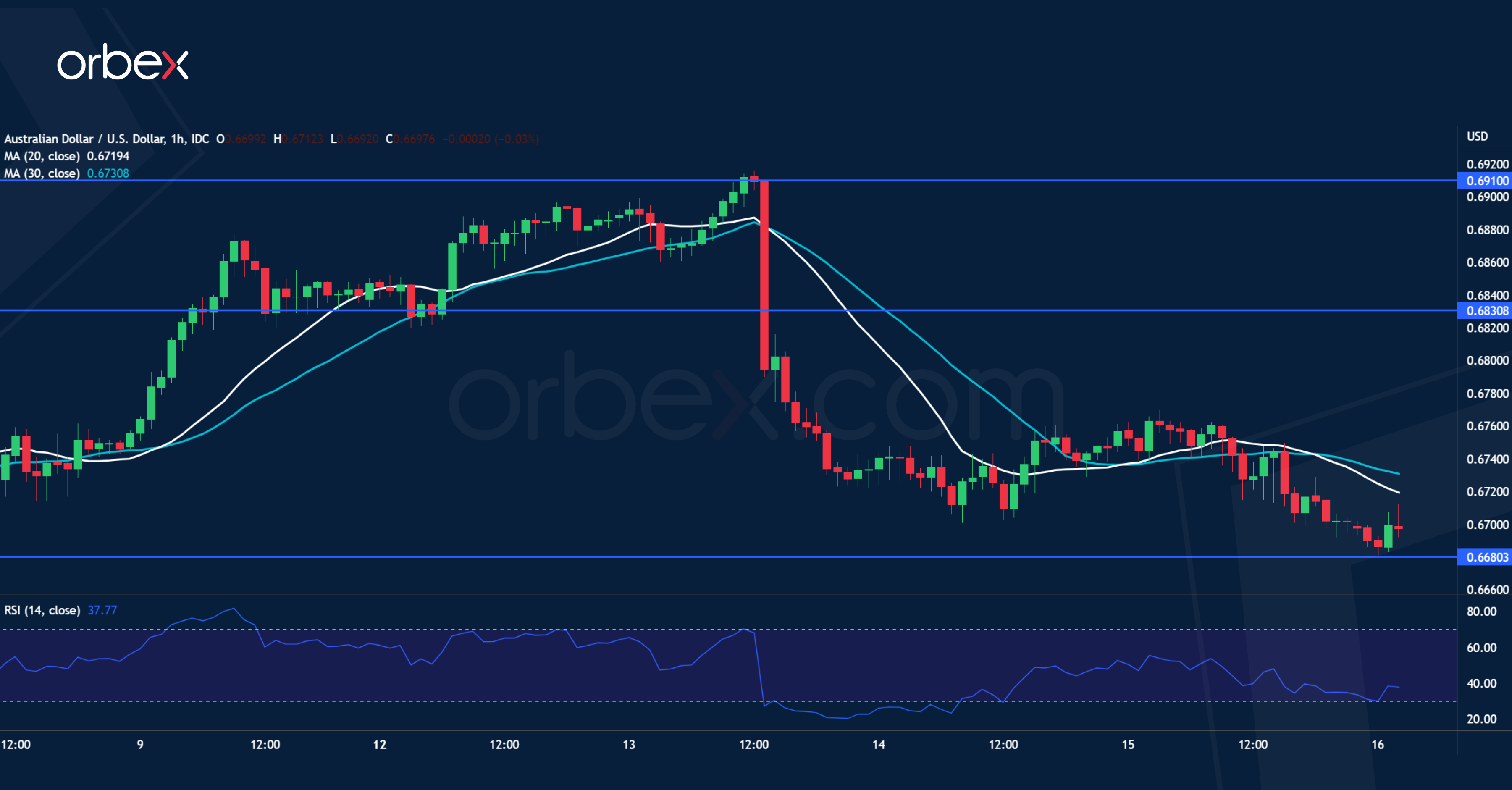
The Australian dollar struggles as August’s unemployment rate shows an uptick. The bounce hit resistance at 0.6910 over the 30-day moving average. A steep drop is a sign of liquidation and a lack of commitment from the buy side. The RSI’s oversold condition has led to some buying in the demand area near July’s lows (0.6680). If the pair fails to hold onto this critical level, a bearish breakout would extend losses to 0.6500 and resume the downtrend in the medium-term. The support-turned-resistance at 0.6830 is a fresh hurdle.
USD/CHF Attempts to Rebound
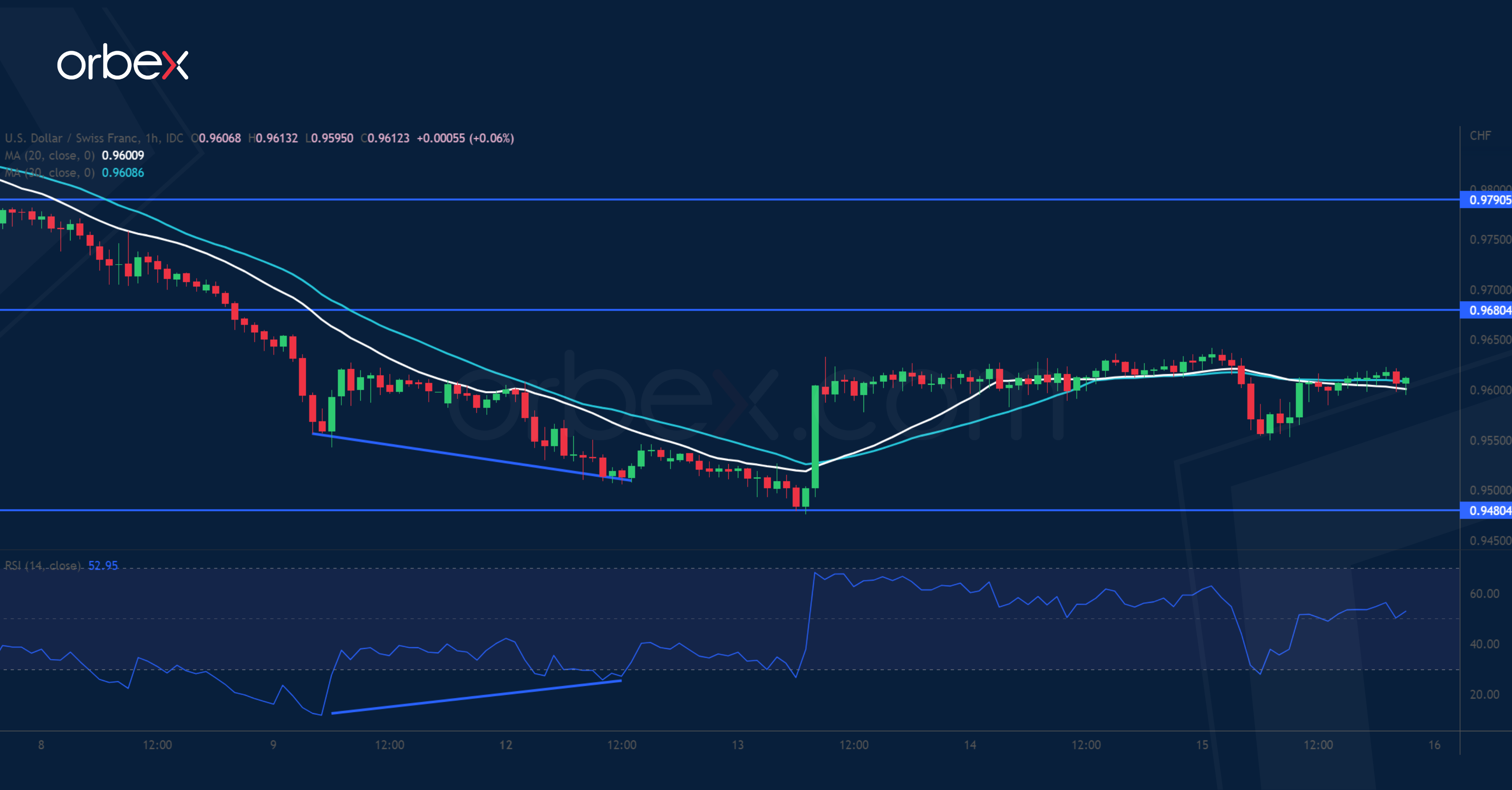
The US dollar recovers supported by rising Treasury yields. A previous failure to clear the July peak at 0.9870 has put a halt to the dollar’s rally, possibly triggering a consolidation phase. The latest correction found support over 0.9480 while a bullish RSI divergence showed a loss of momentum in the sell-off. A follow-up break above 0.9620 is an encouraging sign but the bulls need to lift the former support at 0.9680 before a recovery could gain traction. Otherwise, the greenback may slide to the daily support at 0.9400.
Ether Lost Support But Not the Advantage, Yet
Market picture
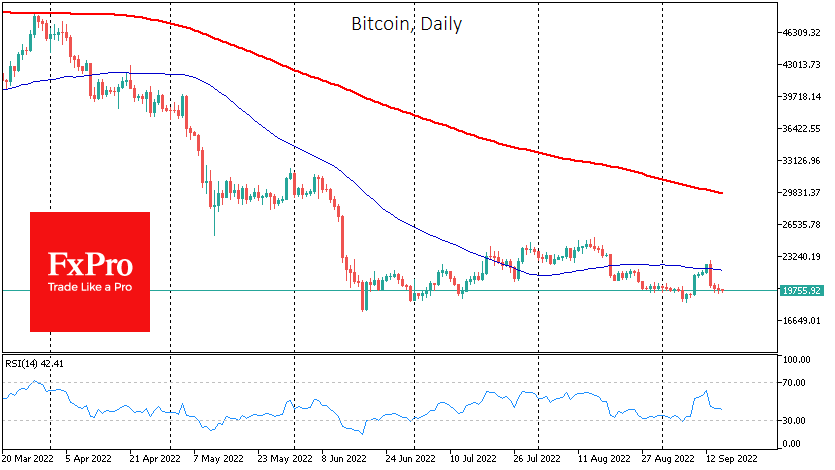
Bitcoin has lost 1.6% over the last 24 hours to $19,777 amid renewed pressure on risk-sensitive assets. BTC remains just under the critical $20K round level, where it got support for the past three months.
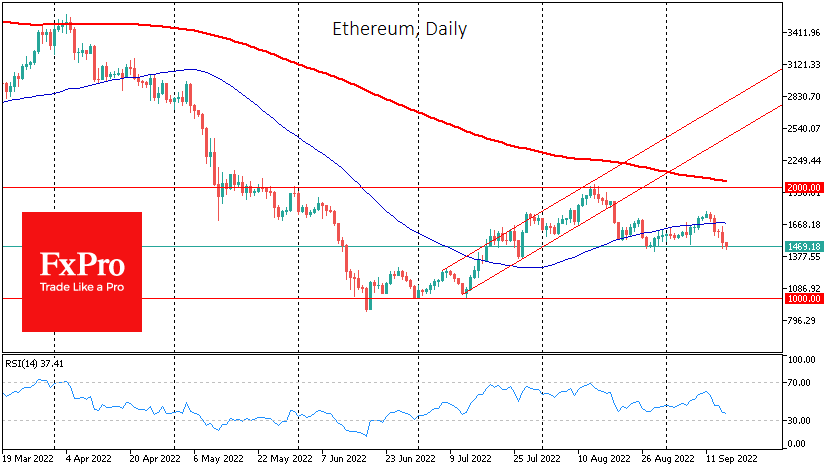
Ethereum lost the speculative support it received before the move to PoS. Over the last day, Ether lost 8.6%, more than three times more than the 2.6% reduction in overall crypto capitalisation. Weakness of this kind is an almost inevitable consequence of a previous period of overperformance, much of the gains of which have yet to be erased. Trading at $1500, Ether is now almost 50% above the area of the June-July lows, while Bitcoin has rolled back to its lows of that period.
News background
Tether and Bitfinex technical director Paolo Ardoino said the move to PoS will not help the second cryptocurrency catch up to Bitcoin. The Merge will not lower transaction fees or make ETH more decentralised, nor will it increase network capacity. Ethereum cannot compete with BTC as a form of money because it has no maximum issue limit.
According to Santiment, more than 45% of Ethereum nodes launched after The Merge update are managed by just two addresses, raising concerns crypto community concerns about centralisation.
According to Chainalysis, developing countries are leading the world in cryptocurrency adoption. Vietnam and the Philippines lead the rankings due to the popularity of cryptocurrency and NFT gaming projects. Of the developed countries, only the US and China are in the top 10, ranking fifth and 10th, respectively.
World Bank Warned for a “Devastating” Recession Next Year
Markets
Curve flattening/inversion remained the ‘by default’ option on EMU and US interest rate markets. Both EMU and US 2-y yields touched multi-year highs as markets assume that the Fed and the ECB have no choice but to continue their front-loading game. At the same time, US markets don’t completely give up the idea that there is a case for the Fed to contemplate cutting the rates by end of next year. It’s unlikely that the Fed will support that idea.
US data were mixed. Retail sales grew modestly in August. July sales were downwardly revised. Weekly jobless claims (213k) remain low and suggest demand for labour remains solid. If the Fed wants to tame inflation via a moderation in demand, there is still some work to do.
US yields rose between 6.6 bps (2-y) and 0.8 bps (30-y). The move was again fully the result of a higher real yield (10-y +8.6 bps to 1.02%). EMU (swap) yields rose 1.3 bps (10-y) to 9.2 bps (2-y). The 30-y measure eased slightly (-1.5 bps). The EMU two year yield surpassed the 2011 peak closing north of 2.50%.
ECB policy makers (except for Portuguese member Centeno) all admitted that decisive action is needed to bring inflation and inflation expectations back to more acceptable levels, supporting the ruling market trend. A persistent rise in real yields with CB’s tightening at risk of pushing the economy into recession (Cfr World Bank infra) is keeping equities in the defensive.
US indices again lost up to 1.43% (Nasdaq). Both the S&P and the Nasdaq are at risk of slipping below last technical support (at 3809 and 11545 respectively) which, if so, would open the way for a return to the June lows. The dollar remains strong (DXY close 109.74) but for now fails to force a new break higher. Markets pondering the chances of interventions in the likes of Japan and SK and EMU interest rates at least following (or even exceeding) moves in the US for now results in some kind short term (fragile) equilibrium. EUR/USD even closed marginally stronger at parity.
This morning, Asian equites remain under pressure losing op to 1.0%/1.5%. Chinese August eco data including production, retails sales and unemployment all printed better than expected, but didn’t help to change investors’ mood. The yuan weakens further north of USD/CNY 7.0. USD/JPY is trading little changed near 143.4. US yields are still drifting higher.
Later today, the final EMU August inflation and US consumer confidence of the University of Michigan probably take center stage. Final CPI data usually are no market mover, but an upward revision (if any) might only reinforce the rise in short-term yields. In the Michigan consumer confidence survey, the market focus shifted from the activity-related subseries to inflation expectations. The later are expected to confirm recent topping pattern. Even so, we don’t expect it the really affect pre-Fed market positioning in a profound way. The dollar for now is holding a consolidation pattern, but recent/cycle highs stay within reach.
News Headlines
South Korea is reviewing contingency plans to stabilize the South Korean won. USD/KRW tested a 13-year high (low for the won) at 1400 in Asian dealings this morning. At the start of the year, the SK currency was trading below 1200. Finance minister Choo Kyung-ho joined peers in Japan in stepping up verbal interventions. He told parliament that the ministry is closely monitoring the market situation and said authorities would take measures if necessary. The Bank of Kora recently warned that the won’s fall has been too fast relative to economic fundamentals. The central bank raised rates by 25 bps to 2.5% in August and signaled more tightening. However, the aggressive US Fed path still favours the dollar over the won with the former also under pressure from ballooning/record trade deficits amid surging energy and commodity prices.
The World Bank warned for a “devastating” recession next year as central banks raise rates at a speed not seen in decades. It called on monetary authorities in big economies to coordinate their actions in order to reduce the overall amount of tightening. At the same time, more action is needed to boost production to ease price pressures rather than all the focus being on curbing spending. The World Bank said core inflation was still likely to run above 5% next year, adding that if this persuaded central banks to become even more aggressive, global economic growth would drop to just 0.5% in 2023.
Equities Under Pressure on Hawkish Fed Expectations
US railroad companies and the unions representing their workers reached a tentative agreement early Thursday to prevent a rail strike in the US. Unions have to vote now.
The deal includes a pay increase of 7% this year, as well as retroactive increases for the previous two years, and two more raises in 2023 and 2024 of 4% and 4.5%. Plus, an annual $1,000 ‘service recognition bonus.’ (I am not sure Powell was enchanted to hear the salary rises, when he fights so hard to bring inflation down, but hush!)
Of course, avoiding a rail strike is good news, but not good enough to give a smile to investors. The markets remain too focused on inflation.
The S&P 500 closed the session more than 1% lower, and just a point above the critical 3900 support. The fact that the US retail sales, and last week’s jobless claims – which both hinted that the US economy remains relatively resilient to the Federal Reserve (Fed) rate hikes - didn’t help keeping the Fed hawks at bay.
US sales at restaurants and bars last month beat last year's August by a strong 10.9%. And sales, overall, rose by a solid 18.5% for the first eight months of the year compared to the same period last year. Those are not the numbers that you want to hear if you are called Jerome Powell, and you are trying to cool down demand to cool down inflation.
As a result, the US 2-year yield spiked to 3.90%, the highest levels since 2007, as strong data further spurred the hawkish Fed expectations. The mortgage rates in the US toped 6% for the first time in 14 years. The US dollar consolidated a touch below the 110 level, the higher yields sent the equities lower, and gold dived to $1660 per ounce.
We will likely close this week on a sour note. Next on the economic calendar are the final European CPI read, which will confirm that inflation spiked to 9.1% in August, and the University of Michigan Consumer Sentiment, which will hopefully not print a significantly positive number, because the Fed hawks got strong enough the week before the Fed decision.
Rectifying a beginner’s mistake
Good news for inflation is, recession worries will likely continue weighing on energy prices, and pull at least some pressure off the Fed’s shoulders.
Yesterday, the barrel of American crude took a good 4% dive. But this time, it wasn’t just the recession talk, it was because the Americans rectified a beginner’s mistake that they have made earlier this week, saying that they will refill their strategic oil reserves if prices fall below $80 per barrel.
Obviously, if you want to refill your reserves at a good price, you don’t tell the world your intension to start buying at say, $80, because if you do so, smart people will also position with you, and build a support near the $80, to make sure that the price doesn’t go below that level. So, if you are the US, and you want to see oil prices come down, you just… keep it shut, and say, as they did yesterday, that there is no particular price trigger to refill the US reserves, and the purchasing won’t happen before the end of fiscal year 2023.
Natural gas futures also sold off in the US on news that the rail strike would be averted, as a potential strike would’ve threatened the deliveries of other energy sources, like coal for example. The European nat gas futures were also slightly down.
The mix of strong US dollar, and soft oil sent the USDCAD to above 1.3250. The EURUSD struggles near parity, as Cable keeps pushing lower below 1.15.
It’s nothing to do with the markets, but let’s have a quick laugh before we go: Vladimir Putin and Xi Jinping said they could ‘inject stability and positive energy to a world in chaos’.
Hallelujah.
Recession Pricing Drives Deeper Curve Inversion
Market movers today
The US releases consumer confidence from University of Michigan for September. It has rebounded a bit in recent months from low levels. Focus will also be on the inflation expectations index on 5-10 year horizon, which reached 3.1% a couple of months ago but has since fallen back to 2.9%. It still suggests inflation expectations are anchored.
In the euro area we get final CPI for August, which provides more details on sub-components. It will likely confirm that a peak in underlying inflation pressures is not yet in sight.
UK releases Retail Sales.
The 60 second overview
Markets: After taking a breather on Wednesday, risk markets returned to a negative mode on Thursday. The S&P500 index fell to three-month lows with tech and growth-related stocks underperforming and the rise in short-dated yields deepened the curve inversion. In the euro area, the EUR 2y30y spread is trading at 46bp, levels similar to June 2008 just three months before the Lehman crash.
Fed preview: In our Research US: Fed preview - Fast pace hiking cycle continues, 16 September, we repeat our call for a 75bp hike by the Fed next week. The market is more upbeat and sees a possibility of a 100bp hike. In our view, recent inflation data does not warrant such a large hike, and the fact that real yields are rising and financial conditions have tightened, implies Fed's hawkish post-Jackson Hole communication is working as intended. While we keep our call of the third consecutive 75bp hike next week, we also find a chance of a fourth 75bp hike in November, and potentially a fifth 75bp hike in December, and a terminal rate well above 4% next year likely. We currently forecast a total of 125bp of hikes for rest of the year but we plan to review our forecast after next week's FOMC meeting.
Russia-China relations: Presidents Vladimir Putin and Xi Jinping met in Uzbekistan yesterday, the first in-person meeting for the two after Russia launched its attack on Ukraine in February. In a sign that the war is creating some fractions in the friendship between the two nations, Putin acknowledged China's 'concerns' about the war in Ukraine. China continues to provide diplomatic support for Russia but the post-meeting comments alleviated concerns that China would step up its support and potentially face US sanctions as a result. While fostering closer economic and strategic ties with Russia, China seems determined to withhold material support to Russia and opposes any escalation that might further destabilize the world economy.
Equities generally lower for another day, as growth cyclicals continue to weigh on indices. Inflation (and not recession) continues to be the main theme for markets. Yield sensitive sectors such as tech or real estate continue to underperform while banks and health care beats. With banks outperforming it is clear that investors are still believing in a muddling-through scenario in terms of growth. Interestingly, mainly large cap growth (FANMAG) is selling off, while small caps are faring better. S&P500 -1.1%, Nasdaq -1.4%, Dow -0.6% and Russell 2000 -0.7%. Risk-off mode continuing into this session according to US futures and Asian markets. The digesting of the US CPI print is the best explanation for the market narrative, while macro data yesterday was overall supporting both camps.
FI: Market attention was all on the 75bp pass-through taking effect Wednesday as we got the first release of the €STR fixing (which showed a full transmission as €STR rose 74.5bp), while the repo market is yet to show full transmission, and speculation arise if that may even come. GC repo rates still need to show another 10-20bp of pick-up for a full transmission. The suspension of the government deposit cap of 0% did not seem to have alleviated the concerns of pass-through.
FX: Cyclically sensitive currencies continue to trade on the back-foot while the USD has been a clear recent winner. That said, the EUR has kept up well in recent sessions with EUR/USD still hovering around parity. EUR/NOK has approached 10.20 while EUR/SEK is back above 10.70. GBP has also traded poorly as of late with EUR/GBP back above the 0.87 mark.
Credit: Investment grade credit markets were in a wait-n-see mode on Thursday and Itrax main widened just slightly (0.9bp) to close at 107.6bp. The high yield market, as measured by Itrax Xover, was somewhat more volatile and widened 7.2bp to close at 531.6bp.
EUR/USD Daily Outlook
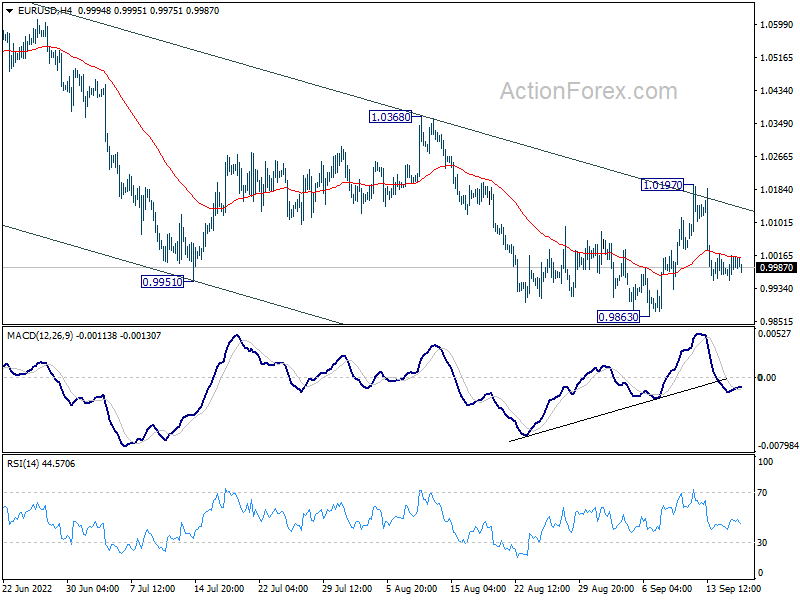
Daily Pivots: (S1) 0.9963; (P) 0.9991; (R1) 1.0025; More...
Intraday bias in EUR/USD stays mildly on the downside for retesting 0.9863 low. Firm break there will resume larger down trend. On the upside, break of 1.0197 resistance will now raise the chance of larger trend reversal, and target 1.0368 resistance.
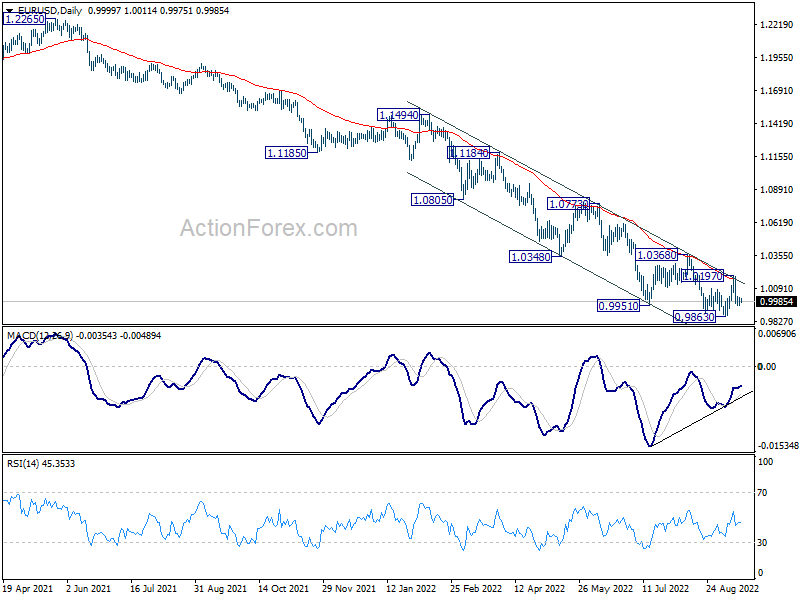
In the bigger picture, down trend from 1.6039 (2008 high) is still in progress. Next target is 100% projection of 1.3993 to 1.0339 from 1.2348 at 0.8694. In any case, outlook will stay bearish as long as 1.0368 resistance holds, in case of strong rebound. However, firm break of 1.0368 will confirm medium term bottom at 0.9863 already.
GBP/USD Daily Outlook
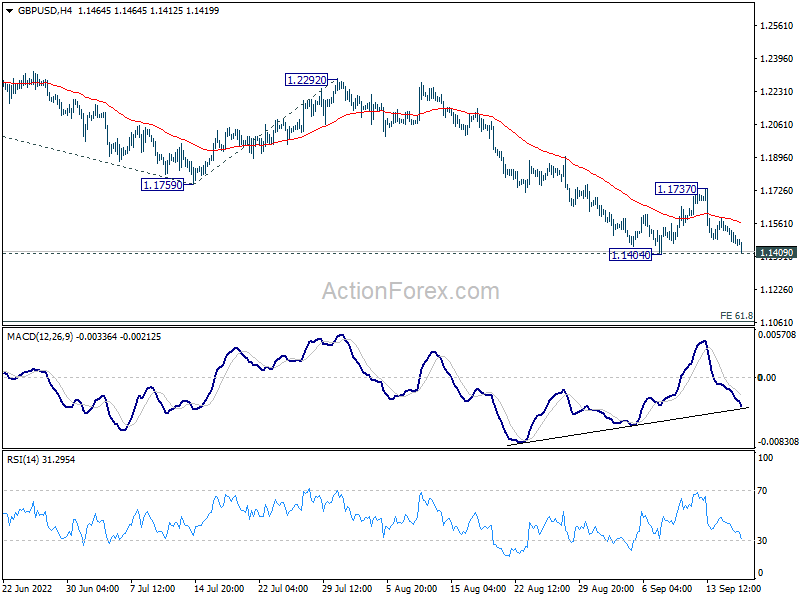
Daily Pivots: (S1) 1.1434; (P) 1.1495; (R1) 1.1529; More...
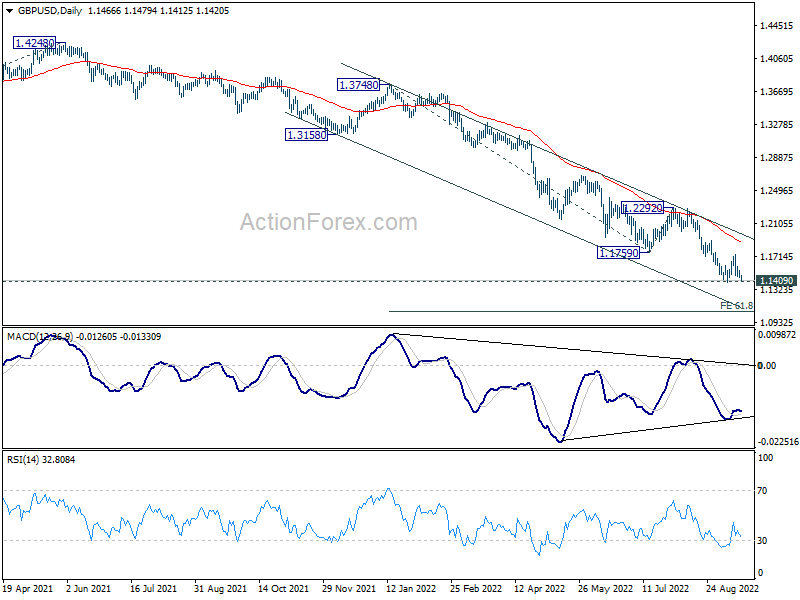
Intraday bias in GBP/USD remains neutral first, with near term outlook staying bearish. On the downside, decisive break of 1.1404/9 will resume larger down trend. Next target is 61.8% projection of 1.3748 to 1.1759 from 1.2292 at 1.1063. On the upside, above 1.1737 minor resistance will resume the rebound from 1.1404 to 55 day EMA (now at 1.1871).
In the bigger picture, based on current momentum, fall from 1.4248 (2018 high) is probably resuming long term down trend from 2.1161 (2007 high). Sustained break of 1.1409 will target 61.8% projection of 1.7190 (2014 high) to 1.1409 (2020 low) from 1.4248 (2021 high) at 1.0675. This will remain the favored case for now as long as 1.2292 resistance holds.
USD/CHF Daily Outlook
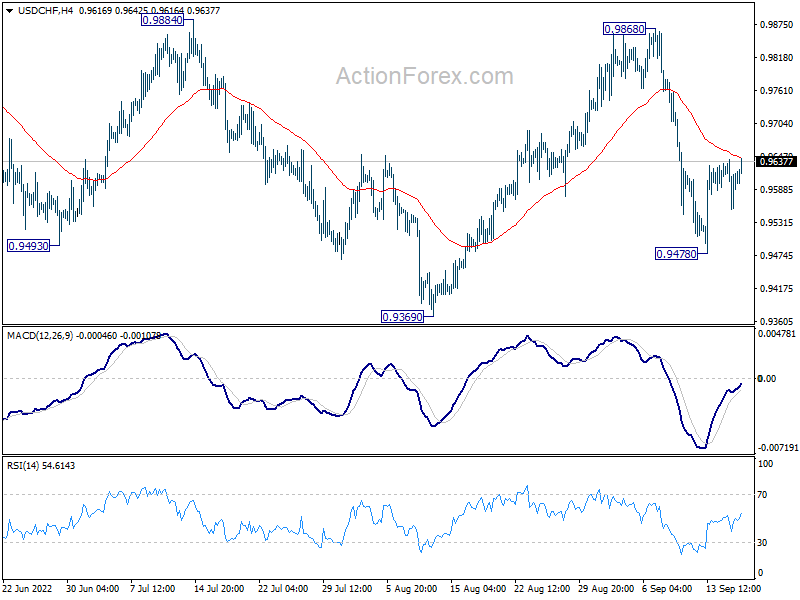
Daily Pivots: (S1) 0.9568; (P) 0.9605; (R1) 0.9654; More
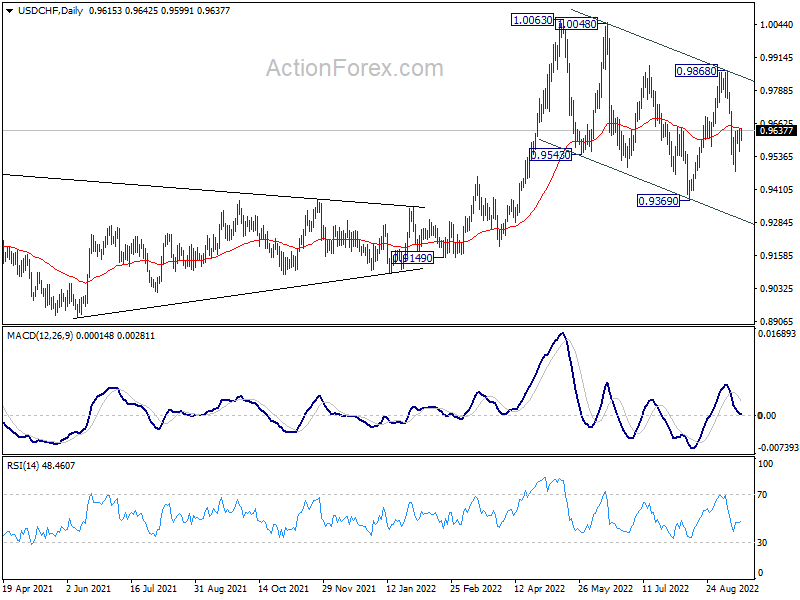
Intraday bias in USD/CHF remains neutral at this point. On the upside, firm break of 4 hour 55 EMA (now at 0.9644) will target 0.9868 resistance first. Further break there will argue that larger up trend is ready to resume through 1.0063. On the downside, below 0.9478 will extend the fall from 0.9868 towards 0.9369 support. Overall, corrective pattern from 1.0063 could extend further as long as 0.9868 resistance holds.
In the bigger picture, current development suggests that up trend from 0.8756 (2021 low) is still in progress. Sustained break of 1.0063 will target 100% projection of 0.9149 to 1.0063 from 0.9369 at 1.0283, and then 1.0342 (2016 high). For now, this will remain the favored case as long as 0.9369 support holds, even in case of deep pull back.
USD/JPY Daily Outlook
Daily Pivots: (S1) 142.94; (P) 143.37; (R1) 143.94; More...
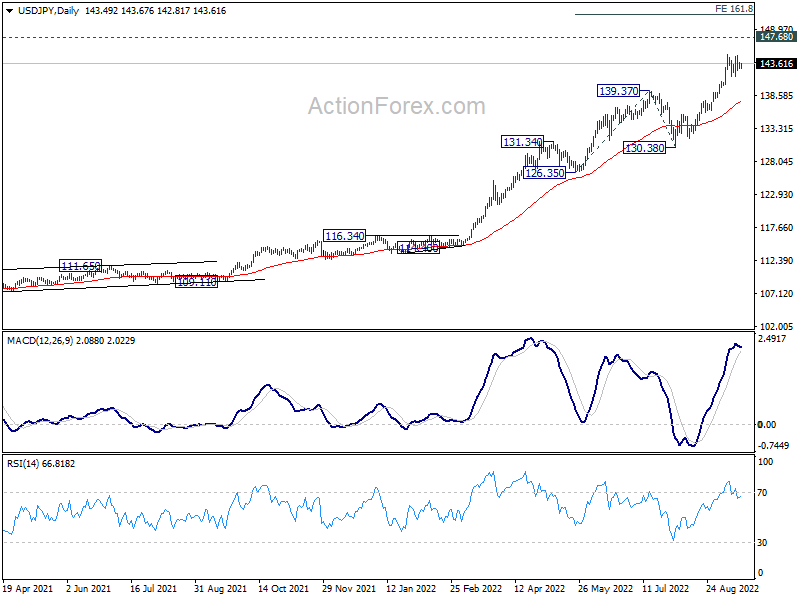
Intraday bias in USD/JPY remains neutral and outlook stays bullish. On the upside, break of 144.98 will resume larger up trend to 147.68 long term resistance. Break there will target 161.8% projection of 126.35 to 139.37 from 130.38 at 151.44 next. While deeper retreat cannot be ruled out, downside should be contained by 139.37 resistance turned support. On the upside, break of 144.98 will resume larger up trend to 147.68 long term resistance. Break there will target 161.8% projection of 126.35 to 139.37 from 130.38 at 151.44 next.
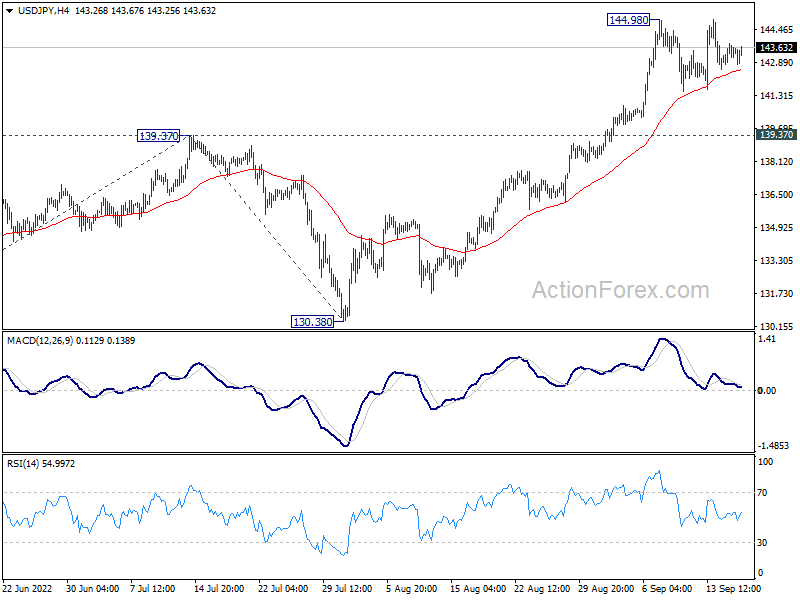
In the bigger picture, up trend from 101.18 is still in progress, as part of the whole up trend from 75.56 (2011 low). Further rise should be seen to 147.68 (1998 high). For now, break of 130.38 support is needed to be the first indication of medium term topping. Otherwise, outlook will stay bullish even in case of deep pull back.