Sample Category Title
Gold Wave Analysis
- Gold under bearish pressure
- Likely to fall to support level 1650.00
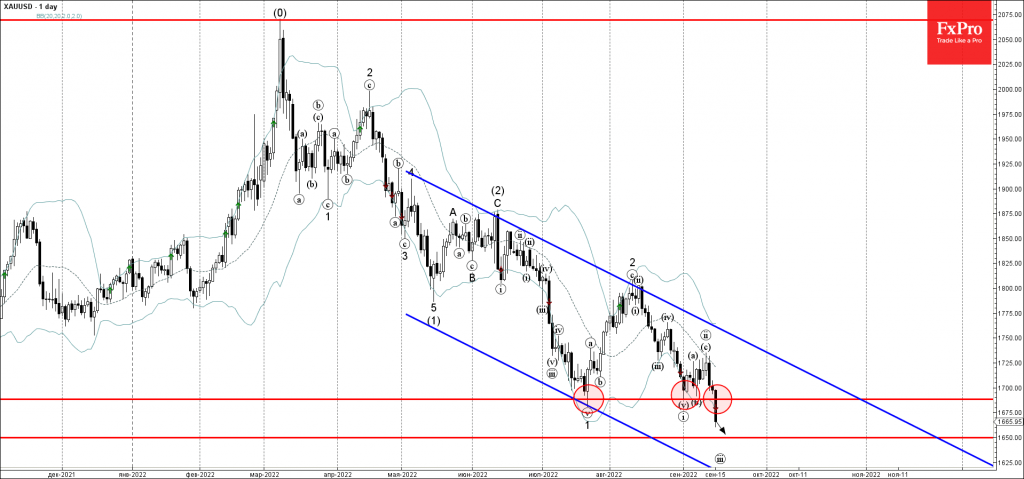
Gold under the bearish pressure after the price broke the pivotal support level 1690.00 (which has been reversing Gold from the middle of July).
The breakout of the support level 1690.00 continues the clear multi-month downtrend that can be seen on the daily Gold charts.
Gold can be expected to fall further in the active impulse waves (iii), 3 and (3) toward the next support level 1650.00.
NZDJPY Wave Analysis
- NZDJPY reversed from resistance level 87.30
- Likely to fall to support level 85.00
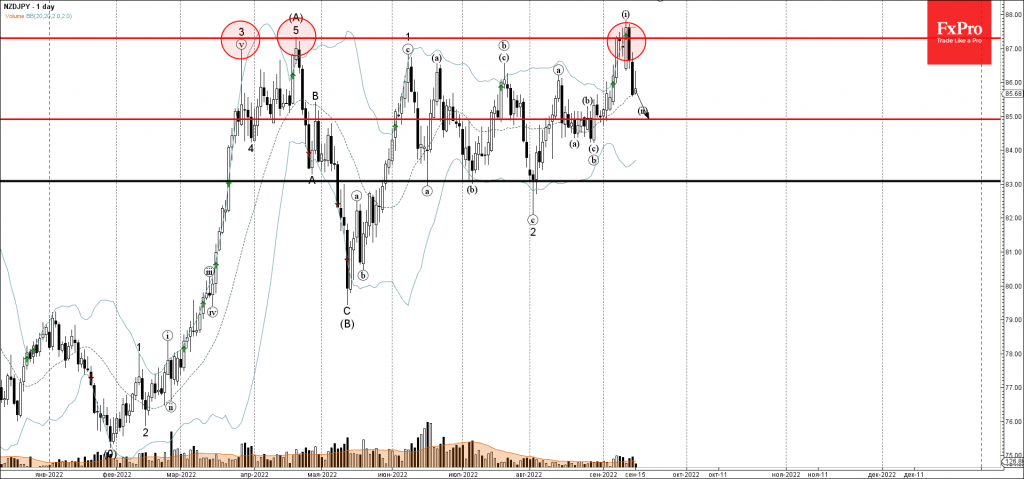
NZDJPY currency pair recently reversed down from the key resistance level 87.30 (which has been reversing the price from the end of March), standing above the upper daily Bollinger Band.
The downward reversal from the resistance level 87.30 started the active short-term correction (ii).
NZDJPY can be expected to fall further toward the next support level 85.00 (target for the completion of the active wave (ii).
Eco Data 9/16/22
[php_everywhere instance="1"]
Yen: What Just Happened (and What’s Coming)?
The yen has been, of course, on a wild ride lately. But there were some surprise moves yesterday which need some explaining, since they could shed some light on whether or not the USDJPY has hit a ceiling. There are some important implications for the future of the yen, and something traders need to be very careful about (hint: make sure stops are in place).
The lead-up
The yen has been weakening generally because the BOJ isn't raising rates while other central banks are. The BOJ isn't likely to raise rates in the foreseeable future, which makes the currency ripe for carry trading. On Tuesday, the USDJPY spiked higher after US CPI figures came out, because of speculation of an even stronger move by the Fed at the upcoming meeting.
After the data, through the rest of the session, the pair drifted higher until it hit the 144.90 level, and then pulled back. That's when currency watchers noted that the BOJ had conducted a "rate check", and further announced a "doorstop" statement later in the day. The pair then pulled back rather dramatically, dropping over 180 pips in the course of a few hours.
What is a "rate check"?
The important thing isn't the check itself, but that it's something the BOJ does before it intervenes in the currency. Basically, the BOJ calls around to different banks asking what the exchange rate is. Presumably this is in preparation to take action, or to warn Japanese banks that action is likely.
That's why there was a reaction, but not a major move in the currency just yet. That it happened just as the pair was about to hit the 145.00 somewhat implies that's the level Japanese authorities will hold the line. That doesn't mean the market won't go above it marginally, or for brief periods. In fact, it would be expected that the market would "test" Japanese authorities to see if they actually will go through with intervention.
What does intervention mean?
It's been a couple of decades since the last time the currency pair moved up to similar levels, prompting a response from authorities. In that case, the pair got up to 147.00 and there was joint action from the US and Japan.
The BOJ does conduct the operation, but it's at the direction of the Ministry of Finance, who "pay" for the move. Basically, the BOJ will buy yen on the market in a very large volume, enough to push the exchange rate down by several thousand pips all at once. The move is not pre-announced, and can happen more than once. The idea is precisely to keep the market from trying to push the pair up by "burning" out many of the long positions, and threatening to repeat at any moment.
That's why if you are trading with yen pairs over the next several weeks, as the USDJPY remains close to the 145.00, it's a very good idea to make sure your stops are in place and your portfolio is ready for a sudden, large move in the currency. But, remember, if the market behaves as the BOJ and MOF expect, then it's also quite possible that no intervention happens.
Sunset Market Commentary
Markets
ECB members over the past 24 hours did little or nothing to counter the post US CPI inflation bond sell-off. On the contrary, they seem to embrace it and added fuel to the fire. ECB Kazaks (Latvia) thinks that the ECB will continue raising rates beyond February 2023. That’s at least another 4 rate hikes coming. Kazaks makes Lagarde’s maximum (more than 2, less than 5) a minimum. ECB Holzmann (Austria) talked a lot about could have been’s and should have been’s when it comes the start of the tightening cycle. After reminiscing, he concluded that inflation is set to accelerate even more with stagflation the potential outcome for Europe. Strong inflation is the reason why the ECB reacted, and reacted strongly and will continue to react in the future. ECB Makhlouf (Ireland) stressed that raising rates is absolutely necessary as EMU inflation is undesirably high. Vice ECB-president de Guindos mentioned the weak single currency as additional source of inflation. Determined action in needed to anchor price expectations even as growth will slow substantially. ECB Centeno (Portugal) was today’s exception to the rule, advocating predictable, small, steps, in the tightening cycle. Markets clearly turned a deaf ear to Centeno’s (minority) view. The core bond sell-off continued. German yields added up to 7.3 bps (2-yr) in a bear flattening move. EMU money markets for the first time discount a 2.75% ECB policy rate peak mid next year. We stick with our view that this is too conservative. The EU 2y-5y swap part of the curve inverts today for the first time since 2008. The front end of the US yield curve underperforms as well with yields rising by 2.7 bps (30-yr) to 6.6 bps (2-yr). The bond sell-off spills over to stock markets again with European indices losing up to 1% and main US gauges opening around 0.5% weaker. The dollar holds strong on FX markets, trading near this week’s highs. EUR/USD is changing hands around 0.9985. Sterling weakened in the wake of the publication of the Bank of England’s quarterly inflation survey (see below). EUR/GBP touched the 0.87 big figure. Key resistance stands at 0.8721. We stick with the view that it’s only a matter of time when this ceiling gets pierced.
News Headlines
The Bank of England published the results of its quarterly survey of public attitudes to inflation. The survey was conducted between 5 and 8 August. The median answer from respondents asked on current inflation rose from 6.1% at the May survey to 7.6% in August. Actual UK August headline inflation as published yesterday printed at 9.9% (from 10.1% in July). Respondents see inflation for the coming year at 4.9% (from 4.6%). However, expectations for the twelve months thereafter eased back to 3.2% from 3.4% in the May survey. 75% of respondents (was 70% in May) expect rates to rise over the next 12 months. Asked to make an assessment on the way the BOE is ‘doing its job to set to interest rates to control inflation’ the net satisfaction balance dropped to -7.0% from -3.0% in May. The -7% reading was the lowest on record.
Swedish outgoing Prime Minister Andersson resigned the centre-left coalition which was defeated in elections by a group of right wing parties this weekend. The head of the Moderate’s party, Ulf Kristersson, is now expected to start negotiations to form a new government involving its Moderate party, Christian Democrats, the Liberals and the Swedish Democrats even as the latter far right party overcame the Moderates as the second biggest party. It is possible that Kristersson will try to form a minority government that will have to rely on the support of one or two of the other right-wing parties in Parliament. Sweden will take the rotating leadership from the EU form January next year.
Eurozone Trade Deficit Calls for a Stronger Euro
According to a new Eurostat publication, the eurozone’s seasonally adjusted foreign trade deficit widened to 40bn in July. Since last October, the region has found itself in the unfamiliar role of a net importer. That is a notable reversal after about ten years of exports significantly exceeding imports. From 1999 to 2012, exports and imports held together even in the crisis period of 2008-2009.
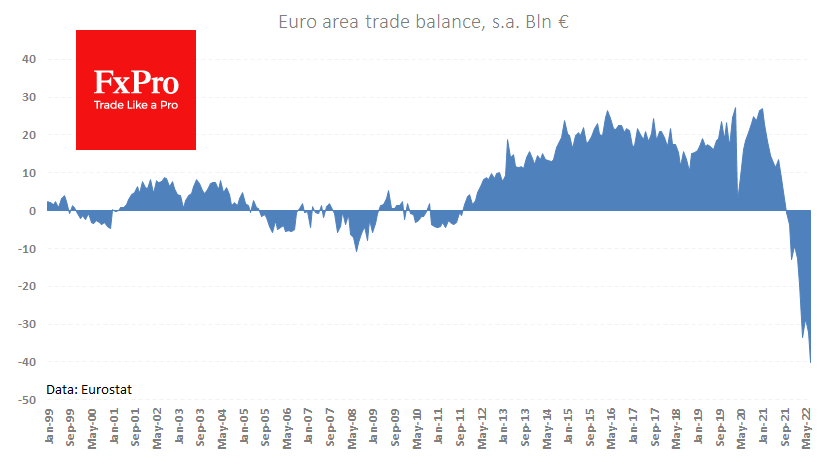
Following a series of energy shocks, imports have been growing faster than exports for the last 18 months, in 10 of which there is a ballooning deficit. It is interesting that during this whole time, i.e., since the start of 2021, the EURUSD has been systematically falling.
In the case of Europe, it is not yet possible to say that a currency depreciation improves foreign trade performance, it is instead the opposite. The falling Euro is inflating energy import bills.
We are also seeing signs of a peak in exports, which have been falling for the past two months despite the import jump. The reason on the surface is the loss of competitiveness of the region’s goods, as energy costs Europe more than some competing regions, such as the US.
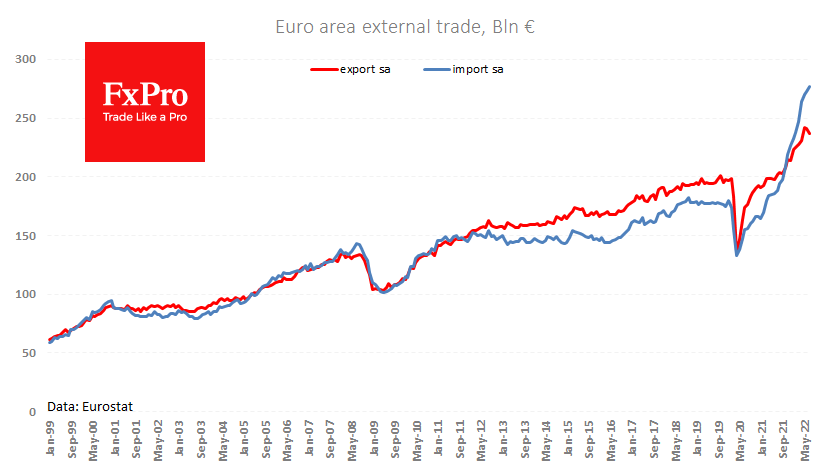
Surging energy prices are responsible for a rise in EU imports from Norway (+151% between January and July) and Russia (+70%). Still, there is also an increase in the trade deficit with China of over 100 billion and sizeable increases in imports from the UK and India, suggesting a weaker competitive position of European goods.
The latter should be a wake-up call for eurozone monetary authorities, as soft policies are now working against the economy by depreciating the single currency and inflating import costs.
It may sound a bit unusual, but the eurozone should adopt the policies of emerging economies, which are fighting the economic crisis by supporting the national currency and trying to keep capital in.
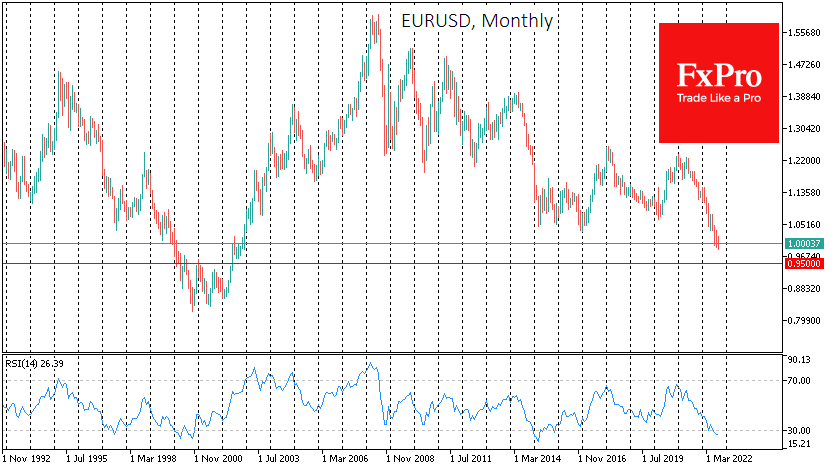
More and more ECB officials may share this thought, so the resolution to raise rates we saw last week might be a long-term shift rather than a passing episode. If that is the case, we should expect a tightening of the monetary authority’s tone and more overt moves to protect the Euro from declining.
However, traders and investors should be aware that such political shifts will not be able to reverse the exchange rate in one go. At best, a slowdown in the Euro depreciation can become the case in the coming months, not days. That said, we believe a EURUSD initial decline towards 0.95 is likely before the Euro gains a solid footing.
US: Retail Sales Continued to Grow as Sales at Car Dealers Outperformed
Retail sales were up 0.3% month-on-month (m/m) in August – above the consensus forecast (-0.1% m/m) – and higher than the flat reading in July.
Sales at autos & parts dealers were the major contributor to today's gains, with a 2.8% m/m rebound from July's 2.0% m/m decline.
Excluding autos, retail sales were down 0.3% m/m in August, below the consensus expectations for a flat reading.
Sales at gasoline stations were down by 4.2% m/m, reflecting the 10.6% pullback in gas prices. Adjusted for prices, sales were up 7.1% m/m. Meanwhile, sales at building materials retailers were up 1.1% m/m in August, but excluding prices they declined by 0.3% m/m as reflecting cooling housing activity.
Excluding the above categories, the "control group", used in calculating personal consumption expenditures, was flat on the month in August - lower than the 0.5% m/m expected by the consensus. July's reading was also revised down to 0.4% m/m, from 0.8% m/m reported previously.
- Nominal growth was reported by miscellaneous stores retailers (+1.6% m/m), food services & drinking places (+1.1% m/m), department stores, food & beverage stores (+0.5% m/m), sporting goods (+0.5% m/m), hobby, book & music stores (+0.5% m/m) and clothing & accessory stores (+0.4% m/m).
- The one category that weighed on growth in August was non-store retailers (-0.7% m/m), which stepped down from a stellar growth in July, outweighing all the other gains.
Key Implications
Strong demand for cars drove today's stronger-than-expected reading. Putting autos aside, retail sales declined. When adjusted for inflation, sales ex autos were down 1.2% month-on-month. Some of the weakness was offset by stronger real sales at apparel stores as consumers opened their wallets to prep their kids for school. Still, it seems more and more obvious that consumers are pivoting to prioritizing essentials, with our estimate of real discretionary spending contracting an average of -0.1% m/m over the past three months.
Today's stronger than expected reading only reinforces the Fed's hawkish stance. Today's data excludes almost all services consumption (except spending on restaurants) which should be relatively more resilient than spending on non-essential goods. We now expect real goods spending to come in at a healthy 0.3% month-on-month, tracking 1.4% quarter-on-quarter (annualized).
EUR/USD Mid-Day Outlook
Daily Pivots: (S1) 0.9949; (P) 0.9986; (R1) 1.0017; More...
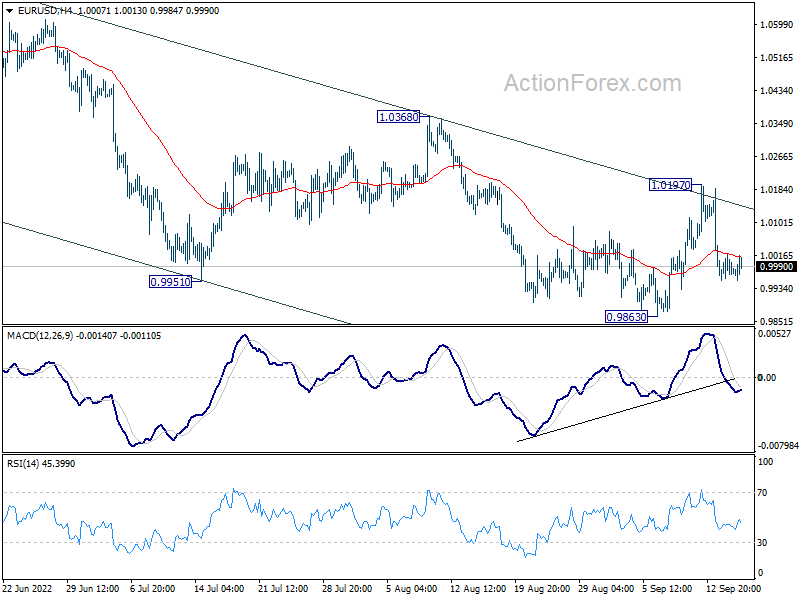
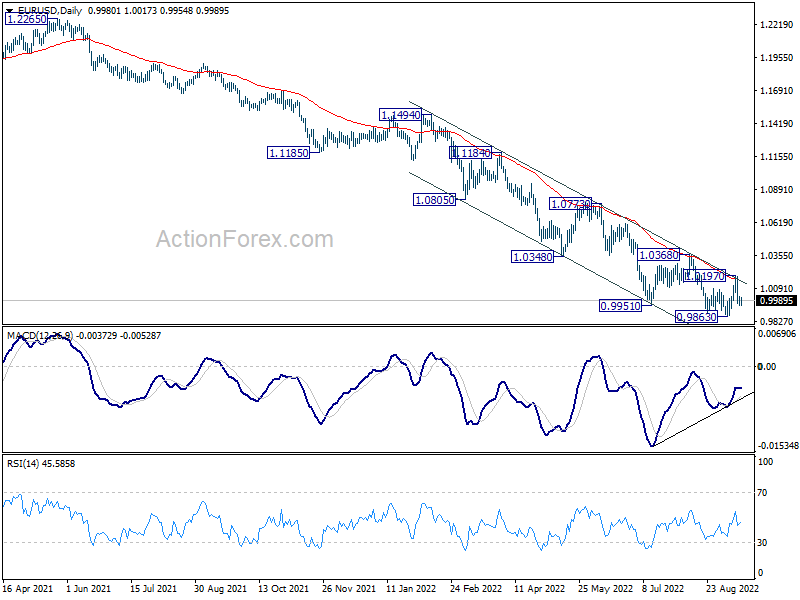
Intraday bias in EUR/USD stays mildly on the downside at this point. Deeper fall could be seen to retest 0.9863 low first. Firm break there will resume larger down trend. On the upside, break of 1.0197 resistance will now raise the chance of larger trend reversal, and target 1.0368 resistance.
In the bigger picture, down trend from 1.6039 (2008 high) is still in progress. Next target is 100% projection of 1.3993 to 1.0339 from 1.2348 at 0.8694. In any case, outlook will stay bearish as long as 1.0368 resistance holds, in case of strong rebound. However, firm break of 1.0368 will confirm medium term bottom at 0.9863 already.
GBP/USD Mid-Day Outlook
Daily Pivots: (S1) 1.1483; (P) 1.1537; (R1) 1.1593; More...
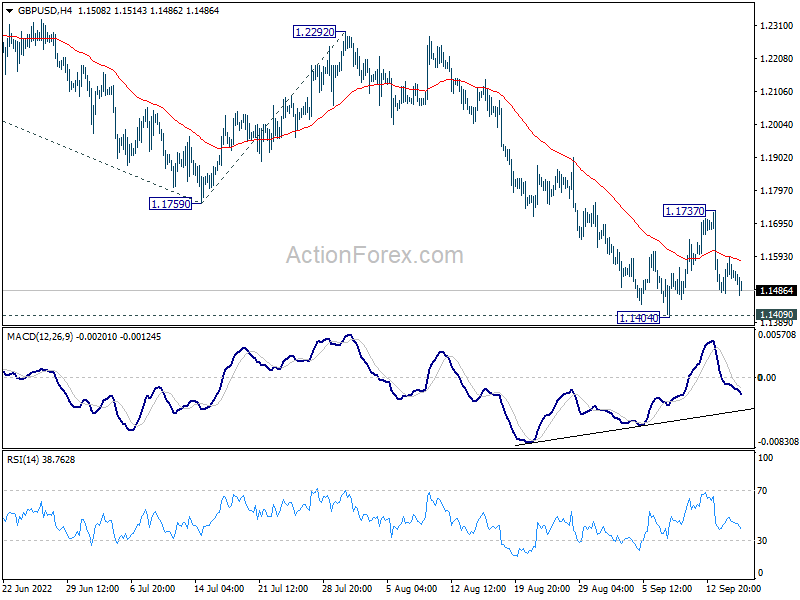
Intraday bias in GBP/USD stays neutral and outlook remains bearish. On the downside, decisive break of 1.1404/9 will resume larger down trend. Next target is 61.8% projection of 1.3748 to 1.1759 from 1.2292 at 1.1063. On the upside, above 1.1737 minor resistance will resume the rebound from 1.1404 to 55 day EMA (now at 1.1904).
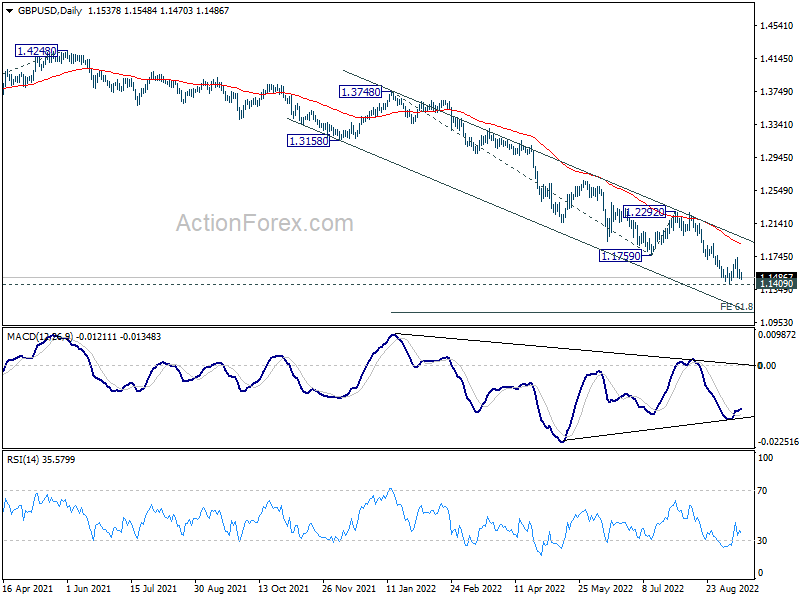
In the bigger picture, based on current momentum, fall from 1.4248 (2018 high) is probably resuming long term down trend from 2.1161 (2007 high). Sustained break of 1.1409 will target 61.8% projection of 1.7190 (2014 high) to 1.1409 (2020 low) from 1.4248 (2021 high) at 1.0675. This will remain the favored case for now as long as 1.2292 resistance holds.
USD/CHF Mid-Day Outlook
Daily Pivots: (S1) 0.9596; (P) 0.9617; (R1) 0.9644; More
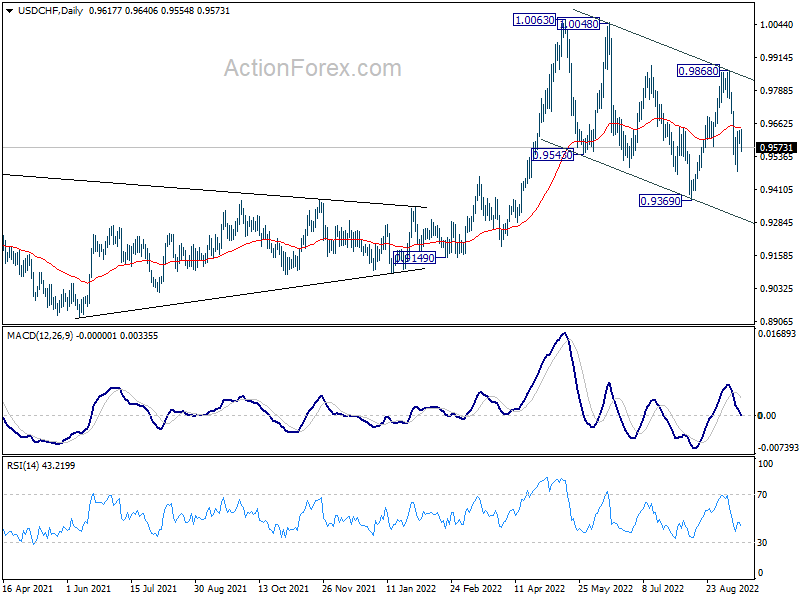
Intraday bias in USD/CHF stays neutral for the moment. The pair is still in corrective pattern from 1.0063. Below 0.9478 will extend the fall from 0.9868 towards 0.9369 support. On the upside, firm break of 4 hour 55 EMA (now at 0.9654) will target 0.9868 resistance first. Further break there will argue that larger up trend is ready to resume through 1.0063.
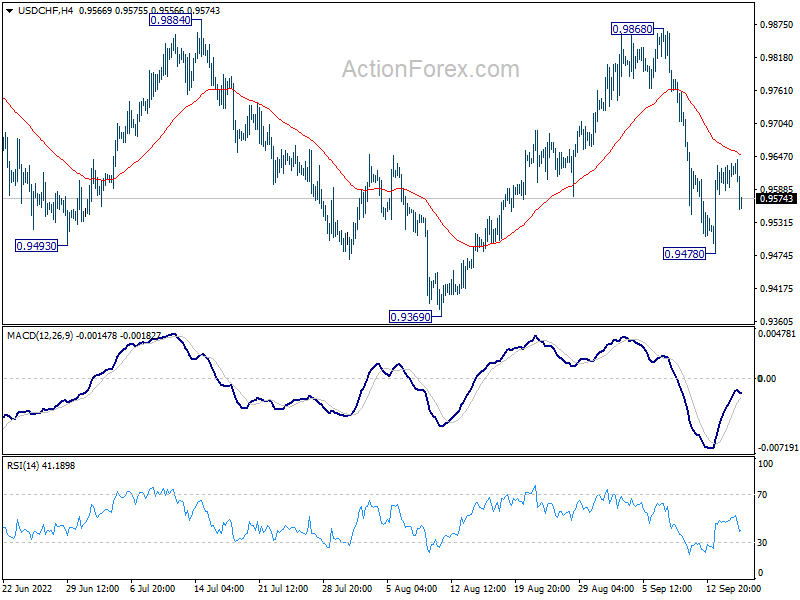
In the bigger picture, current development suggests that up trend from 0.8756 (2021 low) is still in progress. Sustained break of 1.0063 will target 100% projection of 0.9149 to 1.0063 from 0.9369 at 1.0283, and then 1.0342 (2016 high). For now, this will remain the favored case as long as 0.9369 support holds, even in case of deep pull back.