Sample Category Title
Euro Leads Sterling and Swiss Franc Higher, Gold Reversing
Euro leads Sterling and Swiss Franc higher today, and stays firm so far. The common currency was apparently lifted by hawkish comments from ECB official over the weekend. Sterling shrugs off slightly worse than expected GDP and production data. Dollar and Yen are currently the weakest ones. Commodity currencies are mixed for now, with Canadian as the softer one.
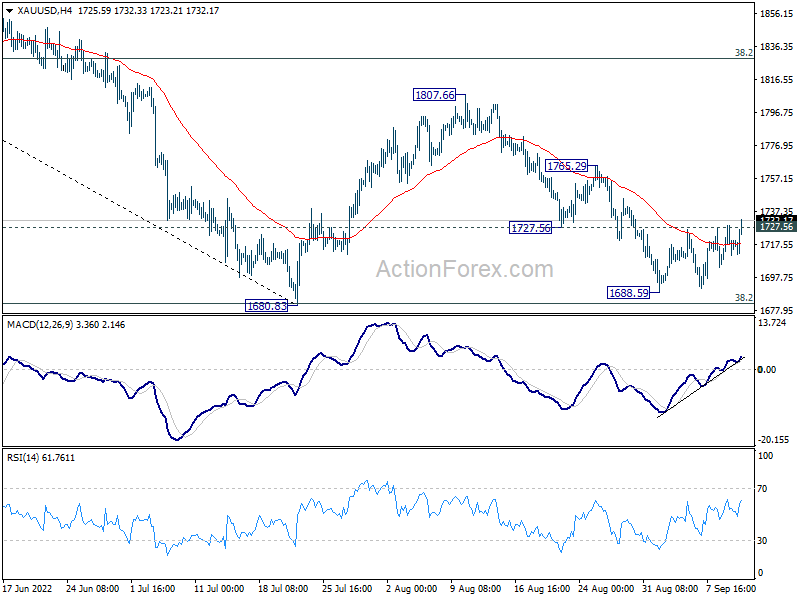
Technically, Gold's break of 1727.56 support turned resistance suggests that fall from 1807.66 has completed at 1688.59. That came after defending 1680 long term support cluster. Rise from 1688.59 could either be the third leg of the pattern from 1680.83, or part of an up trend. In either case, further rise is now in favor to 1765.29 resistance first. Break will affirm near term bullishness and target 38.2% retracement of 2070.06 to 1680.83 at 1825.51.
In Europe, at the time of writing, FTSE is up 1.31%. DAX is up 1.65%. CAC is up 1.33%. Germany 10-year yield is down -0.0459 at 1.655. Earlier in Asia, Nikkei rose 1.16%. Japan 10-year JGB yield rose 0.0001 to 0.251. Singapore Strait Times rose 0.36%. Hong Kong and China were on holiday.
UK GDP grew 0.2% mom in July, services up but production and construction down
UK GDP grew 0.2% mom in July, below expectation of 0.3% mom. Services grew 0.4% mom. Production dropped -0.3% mom. Construction also contracted -0.8% mom. For the three months to July, GDP was flat compared with the previous three months.
Also released, industrial production came in at -0.3% mom, 1.1% yoy, versus expectation of 0.4% mom, 2.0% yoy. Manufacturing production was at 0.1% mom, 1.1% yoy, versus expectation of 0.6% yoy. Goods trade deficit narrowed from GBP -22.8B to GBP -19.4B, versus expectation of GBP -23.2B.
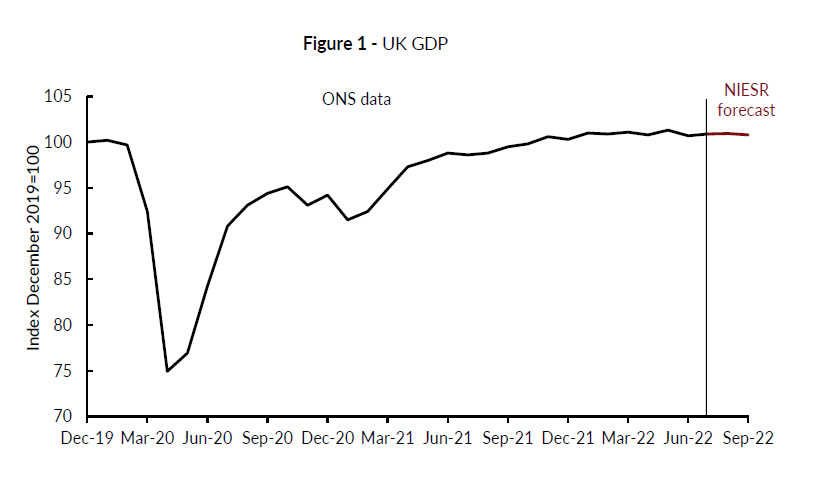
NIESR: UK GDP to contract -0.1% in Q3, remains in recession
NIESR projects UK GDP to contract -0.1% in Q3, with growth slowing as inflation maintains its drag on consumer demand and confidence.
"GDP grew by 0.2 per cent in July following the large fall of 0.6 per cent in June. This was stronger than we had expected and was driven by a rise in services, particularly consumer-facing services, with production and construction continuing to fall. That said, GDP in the three months to July was flat relative to the previous three months and we think the UK economy remains in recession." Stephen Millard Deputy Director for Macroeconomic Modelling and Forecasting, NIESR.
EUR/USD Mid-Day Outlook
Daily Pivots: (S1) 0.9991; (P) 1.0052; (R1) 1.0108; More...
Intraday bias in EUR/USD remains on the upside as rebound from 0.9863 is extending. Sustained trading above 55 day EMA (now at 1.0169) raise the chance of larger trend reversal, and target 1.0368 resistance. On the downside, below 1.0031 minor support will turn bias back to the downside for retesting 0.9863 low.
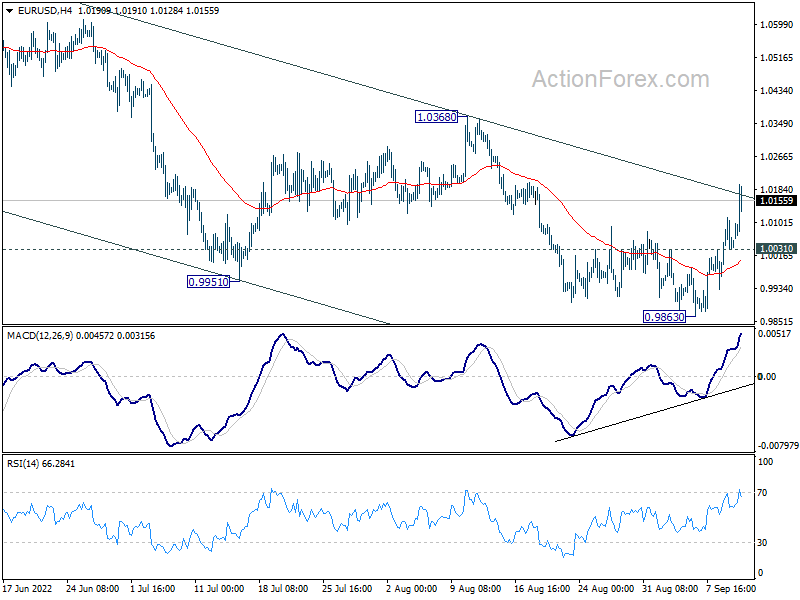
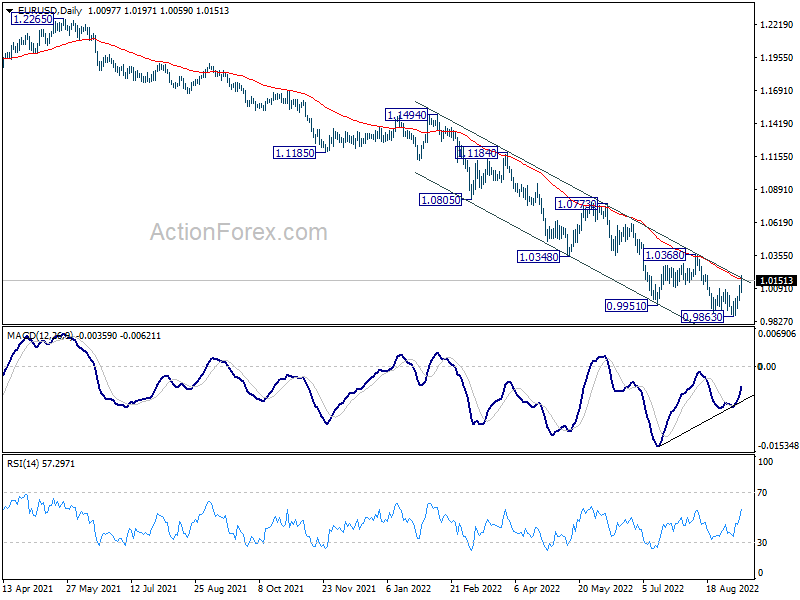
In the bigger picture, down trend from 1.6039 (2008 high) is still in progress. Next target is 100% projection of 1.3993 to 1.0339 from 1.2348 at 0.8694. In any case, outlook will stay bearish as long as 1.0368 resistance holds, in case of strong rebound. However, firm break of 1.0368 will confirm medium term bottom at 0.9863 already.
Economic Indicators Update
| GMT | Ccy | Events | Actual | Forecast | Previous | Revised |
|---|---|---|---|---|---|---|
| 06:00 | JPY | Machine Tool Orders Y/Y Aug | 10.70% | 5.50% | ||
| 06:00 | GBP | GDP M/M Jul | 0.20% | 0.30% | -0.60% | |
| 06:00 | GBP | Industrial Production M/M Jul | -0.30% | 0.40% | -0.90% | |
| 06:00 | GBP | Industrial Production Y/Y Jul | 1.10% | 2.00% | 2.40% | |
| 06:00 | GBP | Manufacturing Production M/M Jul | 0.10% | 0.60% | -1.60% | |
| 06:00 | GBP | Manufacturing Production Y/Y Jul | 1.10% | 1.70% | 1.30% | |
| 06:00 | GBP | Index of Services 3M/3M Jul | -0.20% | -0.80% | -0.40% | |
| 06:00 | GBP | Goods Trade Balance (GBP) Jul | -19.4B | -23.2B | -22.8B | |
| 08:00 | EUR | Italy Industrial Output M/M Jul | 0.40% | 0.00% | -2.10% | -2.00% |
| 10:22 | GBP | NIESR GDP Estimate Aug | -0.30% | 0.00% |
NIESR: UK GDP to contract -0.1% in Q3, remains in recession
NIESR projects UK GDP to contract -0.1% in Q3, with growth slowing as inflation maintains its drag on consumer demand and confidence.
"GDP grew by 0.2 per cent in July following the large fall of 0.6 per cent in June. This was stronger than we had expected and was driven by a rise in services, particularly consumer-facing services, with production and construction continuing to fall. That said, GDP in the three months to July was flat relative to the previous three months and we think the UK economy remains in recession." Stephen Millard Deputy Director for Macroeconomic Modelling and Forecasting, NIESR.
UK Inflation to Accelerate; What Does this Mean for the Pound?
The UK has been in the spotlight recently, with Liz Truss becoming the nation’s new prime minister last Monday, and Queen Elizabeth passing away on Thursday. Although the BoE gathering – initially scheduled for Thursday – was postponed for next week due to the queen’s death, pound traders have good reason to stay in front of their screens this week as well, as on Wednesday at 06:00 GMT, UK inflation data for August is coming out.
UK inflation expected to accelerate further
After surging into the double digits in July, the headline UK CPI is forecast to have ticked up to 10.2% year-over-year from 10.1%, with the core rate expected to rise as well. Although this suggests that energy-related effects are not the sole driver, they remain a major one despite Britain importing only around 4% of its gas from Russia. The UK’s largest supplier is Norway, and with European nations now having to fill the gap created by Russian supply shortages from there, Norwegian gas prices have soared as well.
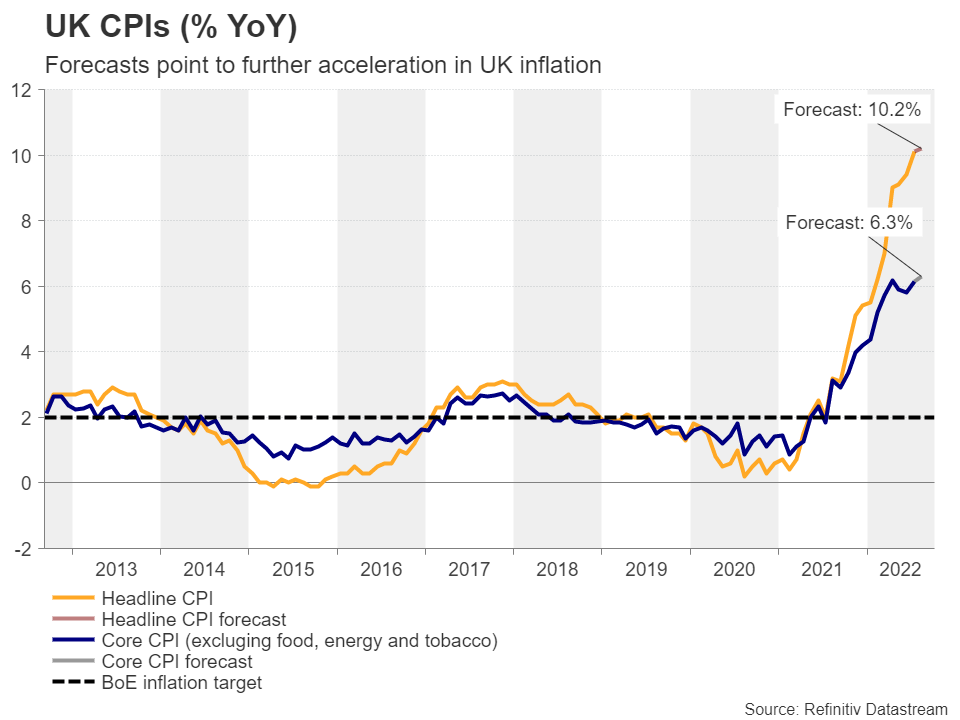
Another driver behind the sky-high UK inflation may have been the British pound itself. Although BoE officials have turned more aggressive at their latest gathering, they continue being very vocal in expressing their concerns with regards to the domestic economy, projecting that the UK economy will slip into recession by the end of this year and stay in such a state until the end of next year. Those fears combined with disappointing data have been translated into a tumbling pound.
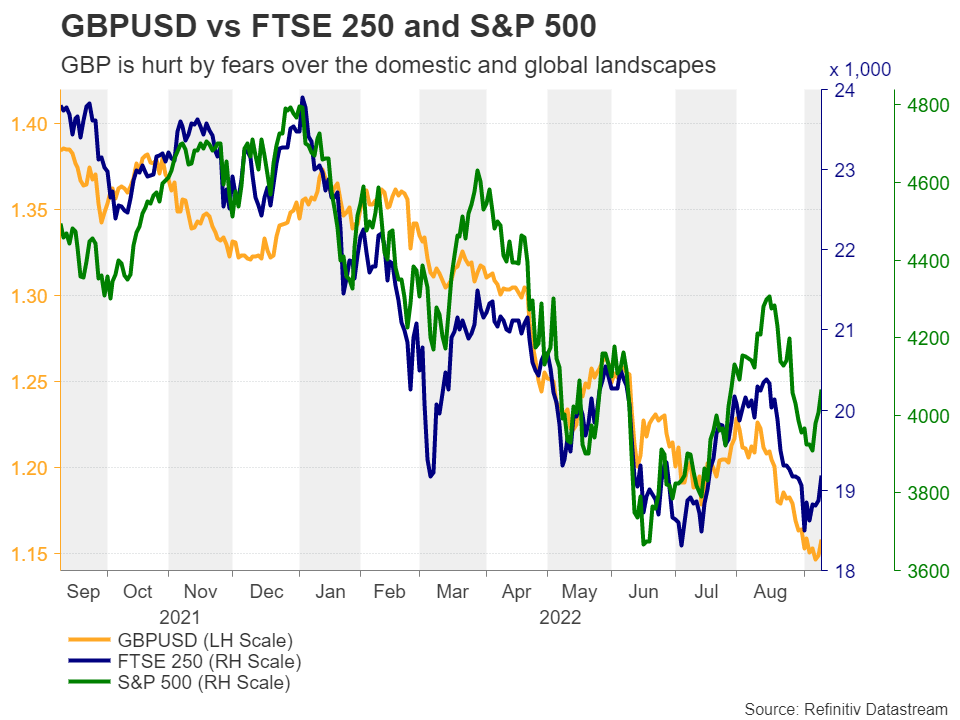
But the pound has not only fallen victim to the domestic economic performance, but also to fears regarding the global landscape. Due to the UK’s twin deficit, the currency has developed risk-linked characteristics, meaning that the tightening of monetary policy worldwide is adding extra pressure.
Will the BoE act more forcefully?
At its latest gathering, the BoE decided to strengthen its efforts to fight inflation, raising its benchmark rate by 50bps, and signaling willingness to act more forcefully if needed.
Therefore, accelerating inflation could add to speculation of a more aggressive BoE. Following Liz Truss’s plans that could prove to be inflationary, investors have raised the whole implied rate path, now expecting rates to peak at around 4.5% next September. As for next week’s meeting, they assign a 70% chance for a 75bps hike, with the remaining 30% pointing to 50bps.
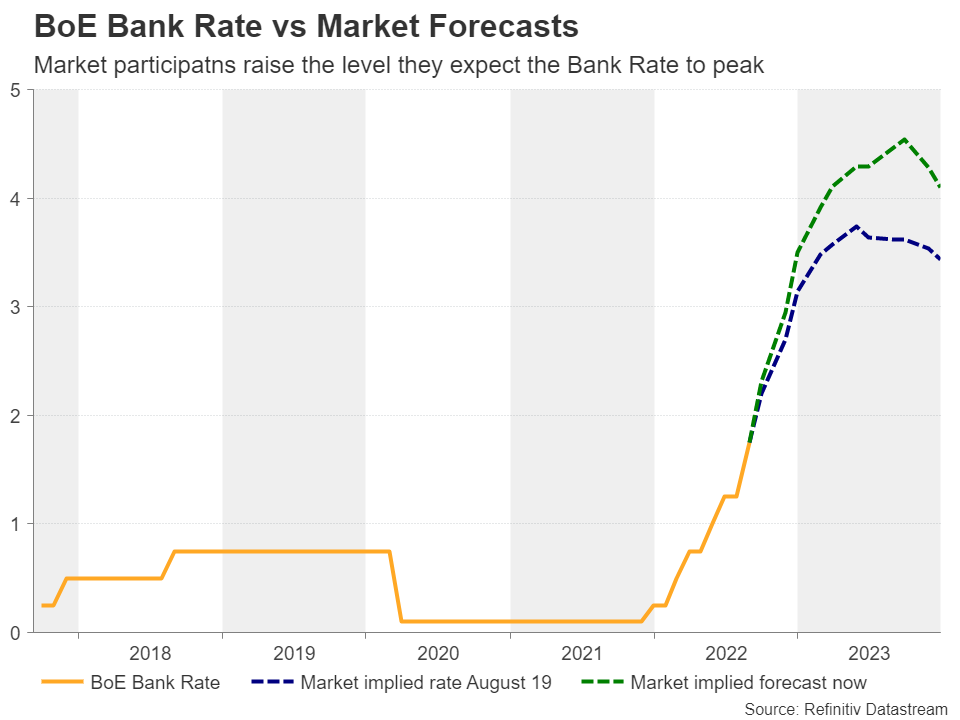
However, by raising the implied path so abruptly, investors may now be more subject to disappointment. Even if the BoE hikes by 75bps next week, it may proceed slower than expected thereafter. After all, just last week, several policymakers pushed against aggressive hike expectations, with MPC member Tenreyro noting that they should be going slowly when there is a lot of uncertainty.
Short-term gains for pound, but more pain in longer run
Accelerating inflation could encourage traders to add to their BoE hike bets and thereby allow the pound to extend its latest recovery. Pound/dollar could move back above the 1.1760 zone, marked by the inside swing low of July 14, and perhaps climb to the 1.2000 round figure.
However, the pair would still be trading below a downtrend line, with the price structure still being of lower lows and lower highs. The recession risks, a potentially widening budget deficit – due to Truss’s plan to fund her policies through public borrowing – and higher risk of the BoE disappointing, could result in another round of selling, and another test back down to the 1.1400 territory.
A break lower would take the pair into territories last tested in 1985 and may see scope for declines towards the psychological zone of 1.1000, the break of which could carry more bearish implications, perhaps allowing declines towards the lows of February and March of that year, at around 1.0550.
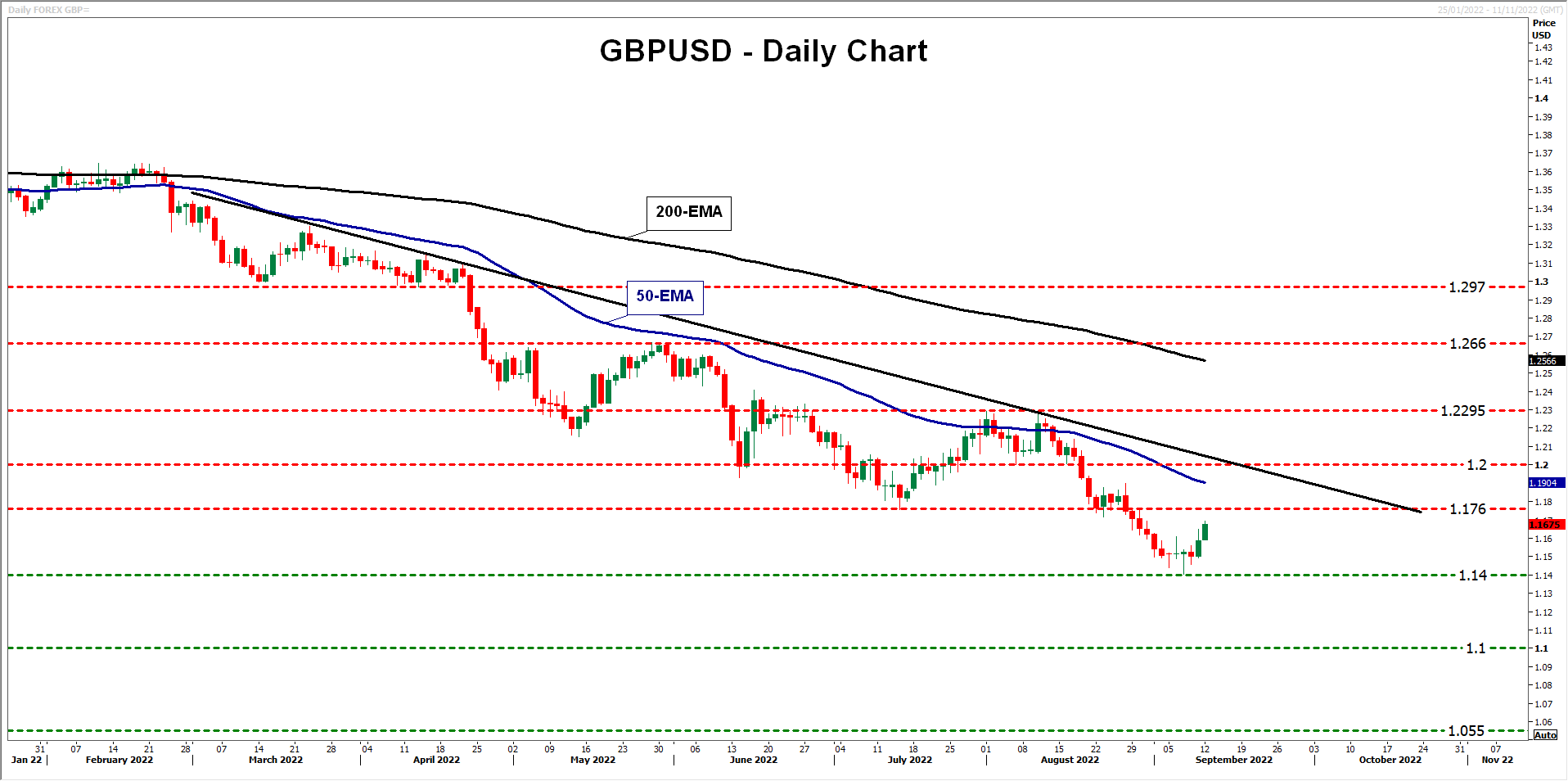
In order for a bullish reversal to start materializing, a recovery back above 1.2295 may be needed, accompanied by upbeat UK economic data. This would confirm a higher high on the daily cart and perhaps pave the way towards the high of May 31, at 1.2660. If that zone doesn’t hold either, its break could extend the rally towards the 1.2970 territory, marked by the inside swing low of April 13.
AUD/USD: Aussie Strengthens on Fresh Risk Appetite But Key Barrier Still Resists
Risk-sensitive Aussie dollar continues to benefit from improved sentiment that lifted stocks and deflated dollar.
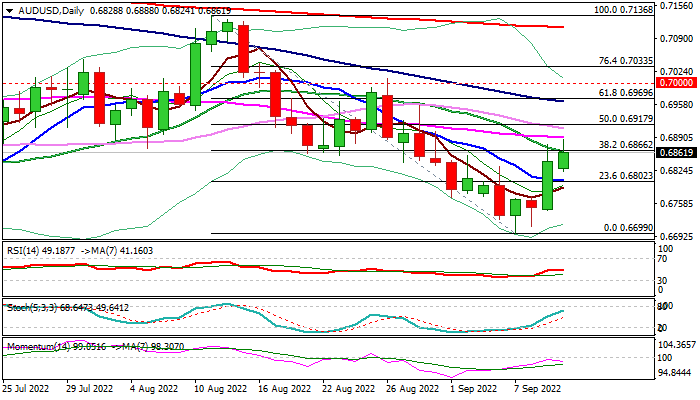
Fresh advance in early Monday extends last Friday’s 1.2% rally (the biggest daily gain since Aug 10) and probe again through pivotal barrier at 0.6866 (Fibo 38.2% of 0.7136/0.6899 / 20DMA).
Sustained break here will generate fresh positive signal in addition to Friday’s bullish engulfing pattern that would open way for further correction through 55DMA (0.6891) and test of next key levels at 0.6911/17 (daily cloud base / daily Kijun-sen).
Despite improved conditions, caution is still required as bearish momentum is strengthening again on daily chart after recent ascend failed to break into positive territory that warns of possible recovery stall, initial signal of which could be expected on repeated failure to close above 0.6866 pivot.
Near-term bias is expected to remain with bulls as long as action stays above broken 10DMA (0.6804) though the downside would remain vulnerable while 0.6866 barrier resists attacks.
Res: 0.6866; 0.6891; 0.6917; 0.6956
Sup: 0.6824; 0.6804; 0.6791; 0.6744
EUR/USD: Fresh Bulls May Face Increased Headwinds from the Base of Thick Daily Cloud
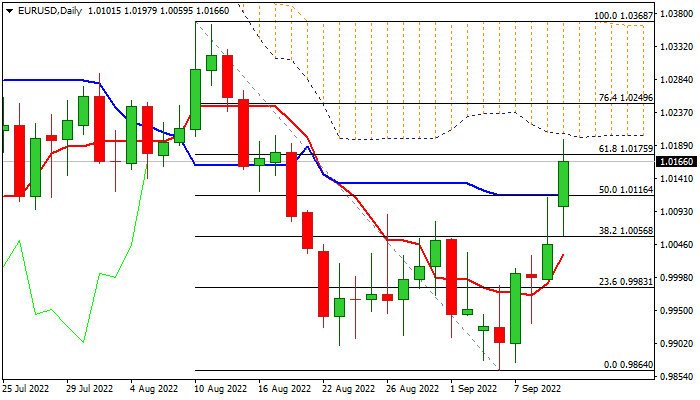
The Euro advanced nearly 1% in early Monday, following a start of week’s trading by gap-higher opening, underpinned by renewed risk appetite.
Monday’s rally generated bullish signals on surge through pivotal Fibo levels at 1.0116/75 (50% and 61.8% retracement of 1.0368/0.9864 respectively) while fresh bulls currently pressure next key barrier at 1.0201 (base of thick daily cloud).
Rising bullish momentum on daily chart underpins the action, which may face increased headwinds from cloud base and possibly pause for consolidation.
Daily close above broken Fibo 50% barrier at 1.0116, reinforced by daily Kijun-sen, is required to keep bulls in play.
Firm break of cloud base would generate bullish signal for further recovery and possible test of key short-term resistances at 1.0368 (Aug 10 lower high / top of daily Ichimoku cloud).
Alternatively, return and close below 1.0116 would weaken near-term structure and signal that bulls run out of steam.
Res: 1.0175; 1.0201; 1.0249; 1.0268
Sup: 1.0116; 1.0082; 1.0056; 1.0023
GBP/USD: Sterling Rises on Renewed Risk Appetite, Break of Key Barriers Needed to Signal Recovery
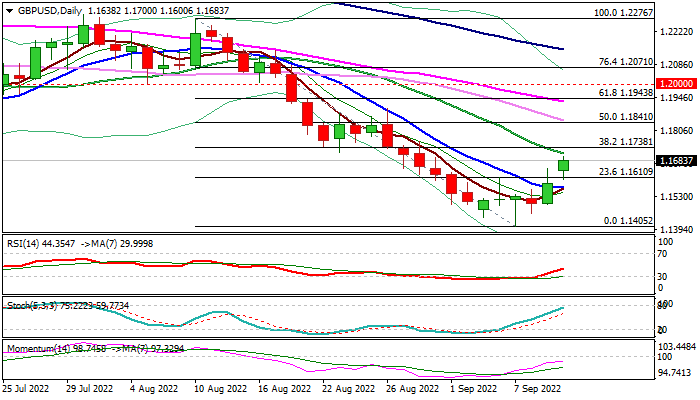
Cable cracked 1.17 barrier and hit two-week high on Monday, following a gap-higher opening on renewed risk appetite.
Fresh bulls extend last Friday’s rally, which despite facing headwinds, managed to generate initial bullish signal on marginal close above 10DMA (1.1568).
Improved sentiment is pound’s main driver at the beginning of the week, but rally looks for more support to accelerate recovery.
Daily techs are still fragile as momentum indicator is holding in negative territory and stochastic is approaching the border of overbought territory.
Renewed strength faces pivotal barriers at 1.1712/38 (falling 20DMA / Fibo 38.2% of 1.2276/1.1405 descend), with clear break here to generate stronger bullish signal and open way for further recovery.
Fundamentals are supportive, as report released earlier today showed UK economy grew by 0.2% in July, although at slower than expected pace, after contracting by 0.6% previous month.
Traders focus on UK and US inflation reports as key events this week.
US inflation in the US is expected to ease further in August (y/y 8.1% f/c vs 8.5% in July) though core inflation is likely to rise further (y/y 6.1% f/c vs 5.9% in July).
On the other side, inflation in UK is expected to rise to 10.2% in August from 10.1% previous month).
Both figures will contribute to the decisions of the US Federal Reserve and Bank of England, which both meet next week and expected to maintain aggressive stance in regards to their monetary policies.
Res: 1.1712; 1.1738; 1.1760; 1.1841.
Sup: 1.1610; 1.1568; 1.1552; 1.1497.
Risk Rebound Continues
European stocks are off to a positive start on Monday, following a relatively muted day in Asia amid bank holiday closures in China, Hong Kong and South Korea.
UK growth continues to struggle
The UK economy grew slightly less than expected in July, with growth supported by consumer-facing services on the back of the Women's EUROs and the Commonwealth Games. With the additional bank holiday this month, the economy could be facing a small technical recession, albeit one that won't be nearly as bad as was expected prior to the cap on energy bills. There's a lot more data to come this week which should show consumer spending slipping as inflation remains above 10% and the labour market still strong.
Yen slips once more
The Japanese yen is slipping again at the start of the week despite continuous warnings from officials about the movements in the currency. While they continue to stress the urgency with which they view the unjustified moves, they've so far shown themselves to be all talk and no action so the warnings are increasingly falling on deaf ears.
US inflation data eyed on Tuesday
There'll be a heavy focus on the US this week as traders await CPI data on Tuesday. The release comes following another flurry of hawkish Fed speak. It seems policymakers were keen to reinforce their hawkish position ahead of the blackout period - which we're now in - potentially with an eye on that data point. They'll have no opportunity to react to the release ahead of the meeting and there was perhaps a feeling that a softer reading could see market expectations slip which they clearly want to avoid. It will be interesting to see how traders now respond as we've seen how keen they are to hop aboard the "dovish pivot" train before.
Oil higher despite demand concerns
Oil has recovered earlier losses to trade around 1% higher on the day. Crude could extend its winning run to three sessions if it holds on, recovering from the lows which came on the back of lower global growth expectations and Covid lockdowns in China. Those restrictions could see annual Chinese demand fall for the first time in 20 years in a further sign of the struggles facing the world's second largest economy.
While the focus may be on the demand side at the minute, we can't ignore OPEC+ and its recent warnings about volatile price action and the disconnect with fundamentals. The group sent a warning shot earlier this month and may be tempted to send another prior to the October meeting. The recovery in the price may be supported by that, alongside a broader improvement in risk appetite in the markets and a weaker dollar.
Gold's cautious recovery
Gold is continuing to enjoy a small recovery, albeit one that is not without resistance. Since hitting a bottom earlier this month, it's been a stuttered rebound in gold which perhaps highlights the hesitance to get behind it in the markets. The dollar has pared gains in recent days which has helped gold to add to those gains but even now it's seeing strong resistance around $1,730 which was previously a key level of support. We could see it overcome that if the dollar continues to trend lower but that ultimately depends on the US inflation data tomorrow.
Bitcoin enjoying a strong rebound
The recovery in Bitcoin since the end of last week has been very strong, with the rally topping 4% again today. Whether it's the expectation of a dovish shift, a weaker dollar or just an improvement in broader risk appetite, something is giving cryptos a big boost and that's helped bitcoin hit its highest level since it went into freefall on 19 August. Things may be looking up in the short term, although once more, that may well depend on the inflation data.
China’s Disinflation Could Put Pressure on the Yuan
China is at the other end of the spectrum, while the developed world is facing the highest inflation rate in two generations. The published CPI and PPI data for August marked another drop in inflationary pressures and fell well below expectations.
The consumer price index slowed from 2.7% to 2.5% y/y against an expected acceleration to 2.8%. The producer price index fell from 4.2% to 2.3%, substantially below the expected 3.2%. However, it is worth realising that such disinflation results from weak economic growth limited by multiple waves of lockdowns.
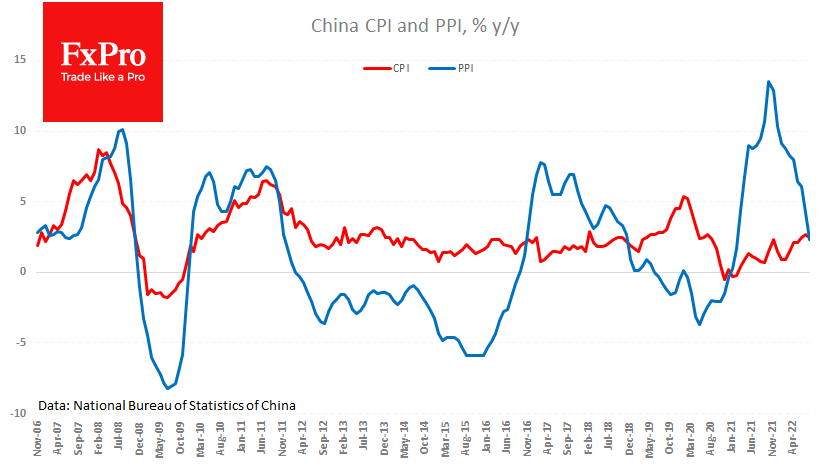
Suppressed inflation due to limited consumer demand leads to expectations of further stimulus through bailout programmes, monetary policy easing and attempts to weaken the exchange rate. And this is terrible news for the renminbi, which could come under even greater pressure.
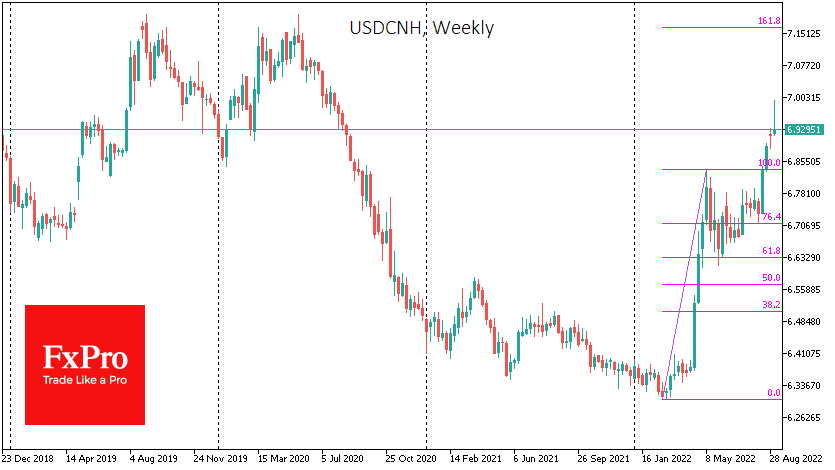
Earlier in the week, the USDCNH stopped at 7.0, pulling back to 6.933 at the time of writing. Likely, we see a tactical break by the bulls near the round level, coinciding with the dollar’s pullback in forex. Potentially, USDCNH could move up to the 7.15 area, repeating the highs of 2019 and 2020, which would help strengthen export competitiveness from China, bringing GDP growth closer to the target.
The Crypto Market has Taken a Step Up But Has Not Yet Fly
Market picture
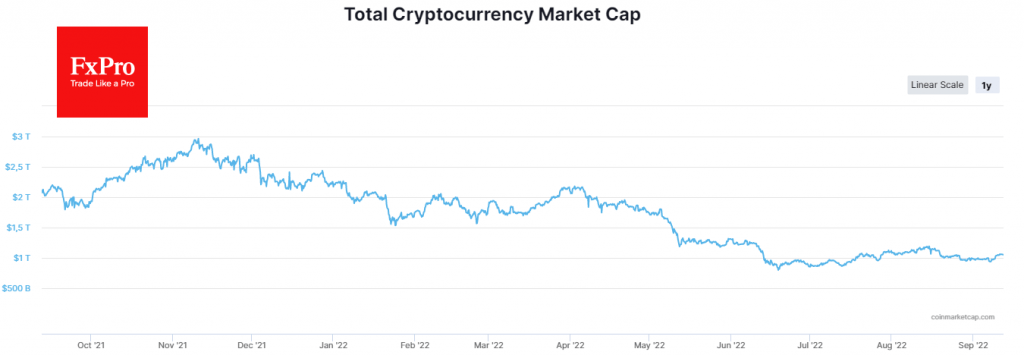
Bitcoin has added 10% in the past seven days, trading at $21.7K. Ethereum jumped 10.3% to $1730. Top-10 altcoins add between 1.5% (Polkadot) and 9% (Solana).
Total cryptocurrency market capitalisation, according to CoinMarketCap, rose 7.9% for the week to $1.06 trillion. The Cryptocurrency Fear and Greed Index is at 25 starting the week, near the upper end of the “extreme fear” area.
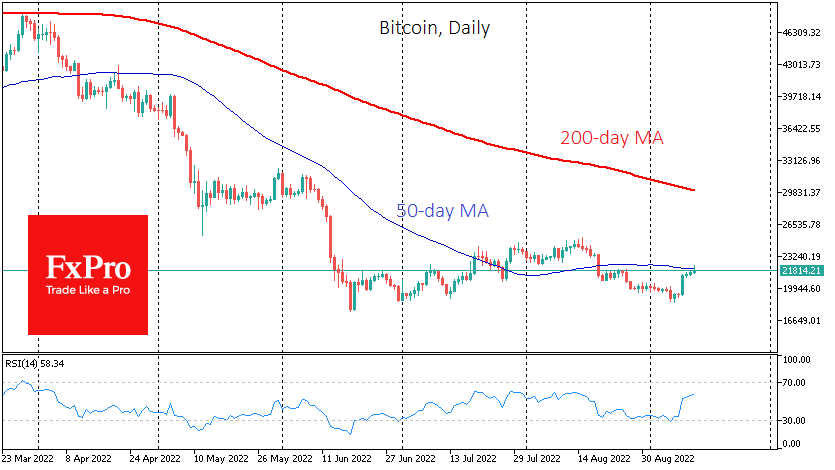
Bitcoin showed substantial gains on Friday and avoided correction sentiment over the weekend. As a result, the coin is again testing the 50-day moving average, where fluctuations have become very small.
The market has removed excessive oversold from the BTCUSD but has yet to make a decisive move upwards. A strong move above the 50-day average could end the bear market.
Even so, it is unlikely that current buyers can expect quick multiples gains. A prolonged bear market (like the one we are now in) is usually followed by a protracted period of cautious and uneven price growth. Moreover, the bulls have not yet brought the price back above the 200-week average, which is now near $23.2K.
News background
MicroStrategy has applied to sell up to $500 million worth of shares to buy bitcoins.
US lawmakers and regulators are discussing strict measures on bitcoin mining because of its large carbon footprint. This is according to a White House Office of Science and Technology Policy report.
US SEC head Gary Gensler said cryptocurrencies should be considered securities. Still, the agency is willing to share the “reins of regulation” of the industry with the Commodity Futures Trading Commission (CFTC).
British Prime Minister Liz Truss said the new government aims to make the UK “the world’s dominant crypto hub”.
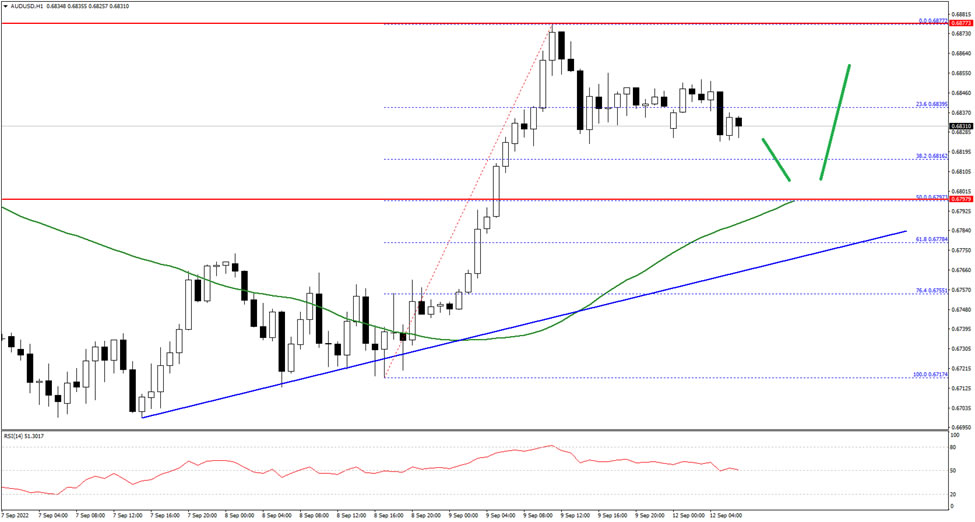
AUD/USD Started a Minor Decline Below $0.6850
The Aussie Dollar started a recovery wave and climbed above the 0.6750 resistance zone against the US Dollar. The AUD/USD pair was able to clear the 0.6800 resistance zone.
There was a clear move above the 0.6850 zone and the 50 hourly simple moving average. The pair traded as high as 0.6877 and is currently correcting gains. There was a minor decline below the 0.6850 level.
An immediate support is near the 0.6800 level and a key bullish trend line on the hourly chart. The next key support is near the 0.6780 level. A downside break below the 0.6780 support could lead the pair towards the 0.6720 support.
An immediate resistance on the upside is near 0.6875 on FXOpen. If there is an upside break above the 0.6875 level, the pair could rise steadily towards the 0.6920 level in the near term. The main resistance now sits near the 0.6950 level.