Sample Category Title
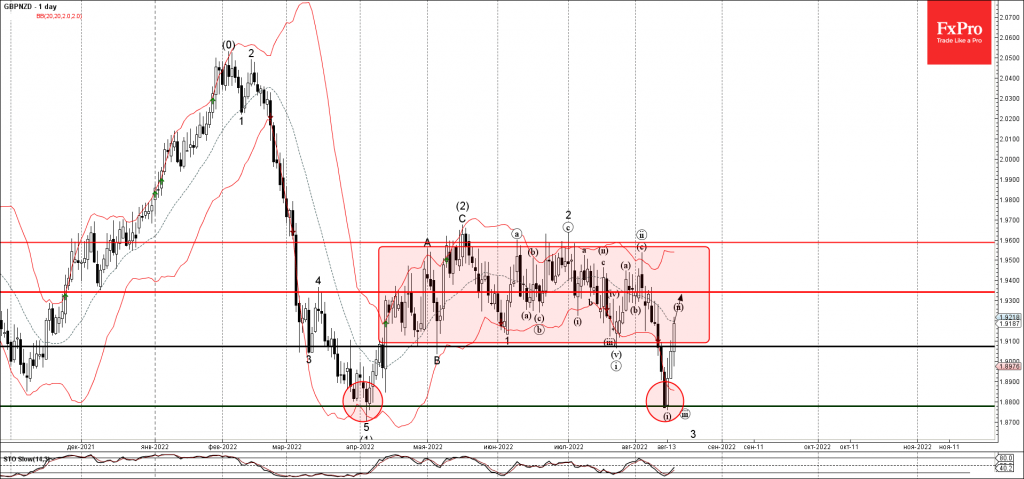
GBPNZD Wave Analysis
- GBPNZD broke key resistance level 1.9100
- Likely to rise to resistance level 1.9270
GBPNZD recently broke above the key resistance level 1.9100 (former lower boundary of the sideways price range inside which the pair has been trading from the middle of April).
The breakout of the resistance level 1.9100 accelerated the active short-term ABC correction (ii).
Given the bullish sterling sentiment seen today, GBPNZD can be expected to rise further toward the next resistance level 1.9270 (middle of the aforementioned sideways price range and the target for the completion of the active wave (ii)).
Eco Data 8/18/22
[php_everywhere instance="1"]
UK Inflation Unexpectedly Reached Double Digits (First Time Since 1982) in July
Markets:
A dramatic sell-off in core bonds marked today’s market action. A number of smaller events culminated an impressive move. Yesterday’s earnings by US retailers Wallmart and Home Depot set things in motion. They beat consensus, putting away most pessimistic growth scenarios. Today’s US retail sales flatlined for the headline numbers, but were more upbeat for the underlying trend (excluding auto and gas; +0.7% M/M). The retail sales control group, proxy for consumption in GDP calculations, even accelerated to 0.8% M/M. The data confirm the resilience of the US consumer amid galloping inflation.
This morning’s RBNZ meeting was a second eye-catcher. The New Zealand central bank, frontrunner amongst major central banks, hiked its policy rate as expected by 50 bps to 3%, but also signaled a more hawkish policy rate path ahead. This includes a higher policy rate peak (>=4%) and a longer period of time with a restrictive policy rate (first rate penciled in early 2025). The RBNZ meeting is a warning shot for investors betting that weak growth would soon sideline centrale banks in their inflation crusade.
Finally, and probably most importantly, UK inflation unexpectedly reached double digits (first time since 1982) in July. The data print put the onus back on price pressure following the July recession scare. Recall that the Bank of England accelerated its tightening cycle with a first 50 bps rate hike with BoE governor Bailey adding that markets shouldn’t take this for granted as becoming the new standard. Eco data would decide on the magnitude of future moves. Well, they have decided. Also taking into account yesterday’s decent UK labour market report. A similar sound came from the ECB and Fed gatherings.
We might see hawkish FOMC Minutes tonight against the background of the gloomy economic outlook. At least three Fed governors downplayed the possibility of pausing the rate hike cycle or thinking about 2023 policy rate cuts following last week’s US CPI print. US inflation decelerated more than expected, from 9.1% Y/Y to 8.5% Y/Y.
UK Gilts underperformed German Bunds and US Treasuries. The UK yield curve bear flattens with yields adding 24.5 bps (!) (2-yr) to 15.2 bps (30-yr). The UK 2-yr yield surged above the June peak, currently trading near 2.4%. UK money markets put the policy rate peak around 3.75% (currently 1.75%!) by May next year. German yields copy the yield move, though daily changes are “limited” to +14.2 bps at the front end and +6.8 bps at the very long end. The German 10-yr yield easily surpassed 1%, breaking out the downward corrective trend channel in place since mid-June and changing the technical picture. The US yield curve becomes more inverse with yields adding 8.6 bps (2-yr) to 4.9 bps (30-yr).
Sterling failed to profit from the interest rate advantage with EUR/GBP higher at 0.8425 in a technically insignificant move. EUR/USD in a same vein trades stable near 1.0160. Stock markets get a flashback to the tough ride ahead of June. The core bond sell-off spills into weaker equity markets with Europe losing up to 1.5% (German Dax) and main US indices ceding up to 1% (Nasdaq).
News Headlines:
Polish and Hungarian growth decoupled in the second quarter of the year. Hungarian GDP beat consensus by growing by 1.1% Q/Q (6.5% NSA Y/Y) whereas Polish GDP was weaker-than-expected, declining by 2.3% Q/Q (5.3% Y/Y). Neither country published details yet, but we expect net exports to be a huge drag for both. Poland is now probably headed for a technical recession. Other factors at play are likely the conflict in Ukraine and disappointing inflows from EU funds. Today’s surge in core bond yields continues to weigh on CEE currencies. EUR/HUF temporary approached 410 before falling back towards 405. The Polish zloty was local outperformer earlier this week, but can’t escape the laws of gravity this time. EUR/PLN rises from 4.67 to 4.70.
Aussie Slides Below 70
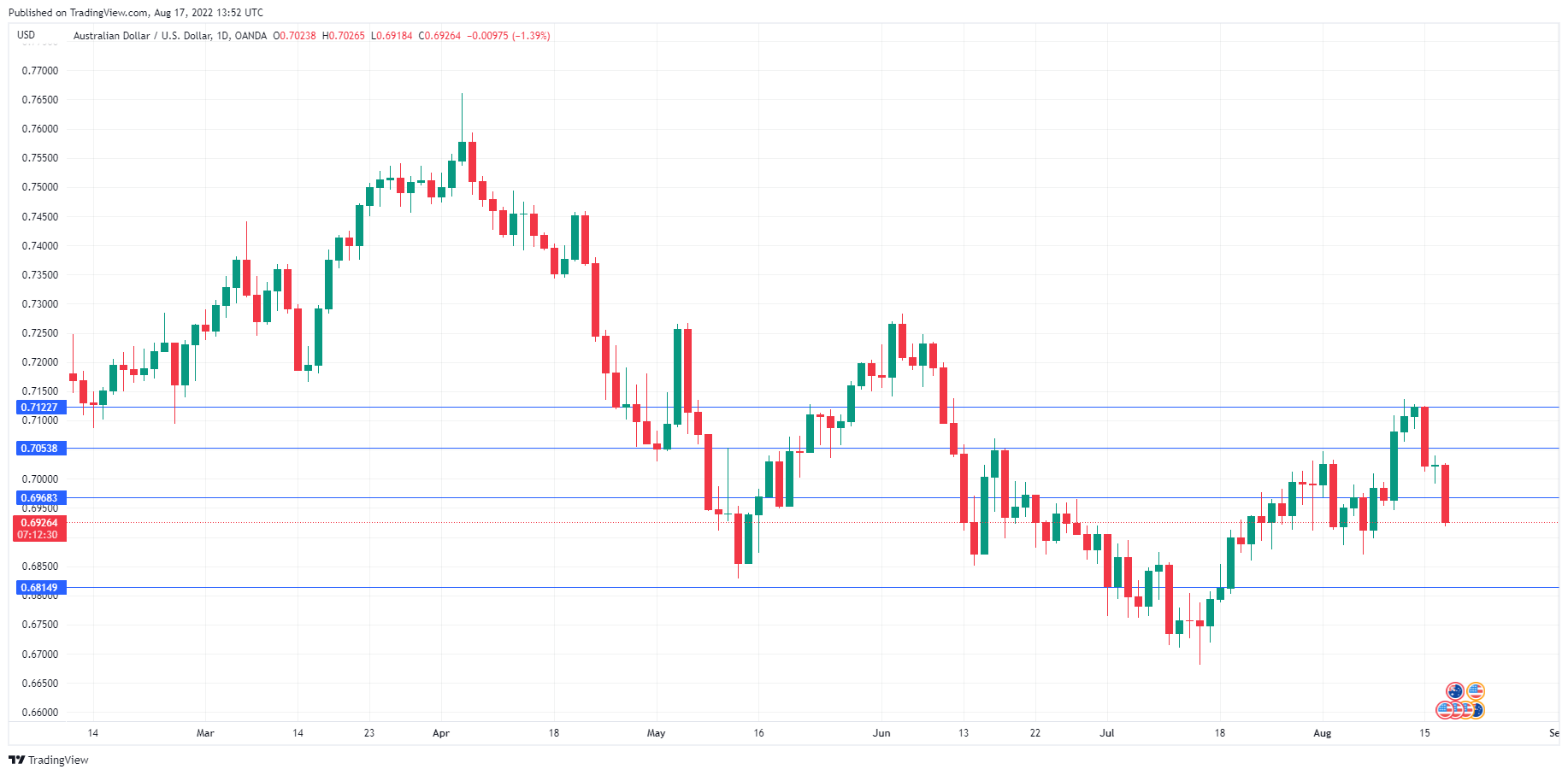
The Australian dollar is taking it on the chin today. In the North American session, AUD/USD is trading at 0.6925, down 1.30% on the day.
China’s weakness weighing on Aussie
The Australian dollar is having a miserable week, down 2.76%. This has wiped out almost all of last week’s gains of 3.05%, as the Aussie continues to show strong volatility.
This week’s woes have been driven by developments in China. The People’s Bank of China surprised the markets by lowering its 1-year MLF loans to 2.75%, down from 2.85%. The spike in Covid cases and the worsening property crisis have resulted in a decline in credit growth, and the PBOC has loosened policy in response to the deteriorating economic conditions. A sneeze in China can result in a nasty cut for Australia, as the Asian giant is Australia’s number one trading partner. Fears of a significant slowdown in China have sent commodity prices lower, including iron ore, a key Australian export.
Earlier today, Australian wage growth rose to 2.6% YoY in the second quarter, short of the estimate of 2.7% (2.4% prior). The RBA considers wage growth an important indicator of the resilience of inflation, and a lower-than-expected reading lends support to the argument that the RBA might ease up on the size of future rate increases. This has also weighed on the Australian dollar today.
The Federal Reserve has been consistent in its message that inflation is far from beaten and additional rate hikes are coming. But is anyone listening? Since the surprising inflation report which showed a decline in CPI, the markets have been holding onto the idea that the Fed will reverse directions next year, which has sent the US dollar sharply lower. The Fed minutes will be released later today, and it’s likely that the tone of the minutes will be hawkish. It will be interesting to how investors respond, and the minutes should be treated as a market-mover for the US dollar.
AUD/USD Technical
- There is resistance at 0.7053, followed by a monthly resistance line at 0.7122
- AUD/USD has support at 0.6968 and 0.6902
Japan CPI Inflation to Come in Hotter
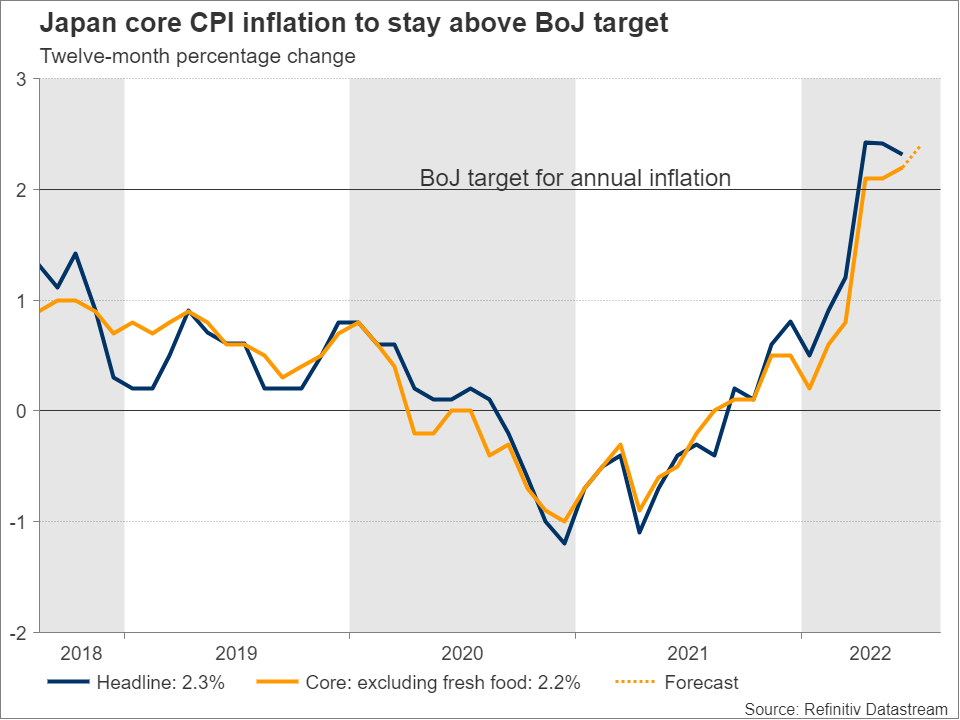
After an upbeat GDP report, July’s CPI inflation will take center stage on Friday at 00:30 GMT, likely testing the central bank’s policy commitment to an ultra-easy strategy for another month as growth in consumer prices, although gradual, is expected to stage another pickup. Despite that, the data may not be enough to change the yen’s short-term neutral status.
Japan's inflation to hit a new 8-year high
Central bank policy meetings have been so much agony for nothing in Japan lately. The unstoppable inflation, which is positively charged by supply jitters and the Ukrainian war, forced global central banks, even the dovish ones such as the ECB, to switch to the tightening phase sooner than later. The dove king BoJ, however, has been shrugging off investors’ growing expectations for a hawkish shift, stubbornly holding interest rates at a record low of -0.1% and its yield curve control steady back in July.
Well, despite anxiety thriving about when the central bank will change course, its stance looks reasonable for now. After years of missing the inflation target, policymakers are finally seeing consumer prices rising by more than 2.0% y/y over the past three months under a stimulative policy. Apparently for the wrong reason, as the drivers are more external than internal, but the wait is worth it since the pace of expansion is still relatively anemic when compared to those in other key advanced economies. Particularly, analysts expect the core nationwide CPI to have extended June’s climb to 2.4% y/y in July from 2.2% previously, the highest since December 2014.
Fundamentals still fragile
Economic growth is another area that requires caution amid a mixed batch of data. Encouragingly, Monday’s GDP data showed the economy returning to its pre-pandemic size in the second quarter, expanding by an annualized rate of 2.2% on the back of private consumption, which shot up following the lifting of covid curbs.
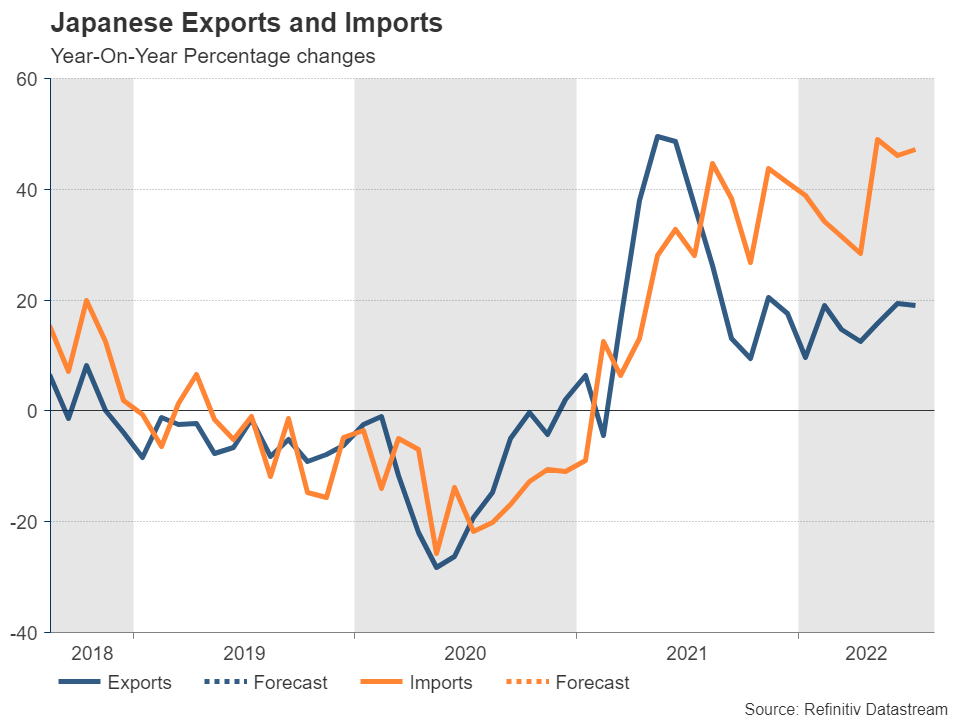
However, more evidence will be needed to prove that the modest recovery might develop into something more sustainable, especially as the trade deficit gets wider on the back of rising imports and outages in China’s power plants weigh on Japanese factories. Besides, in their latest commentary, policymakers appeared worried that consumer spending may slow down again in the third quarter because of the rising cost-of-living and a potential new covid wave given two months of declines in consumer sentiment.
What are the odds for a policy shift?
Apparently, maintaining the current super accommodative strategy is challenging, especially as Japanese overseas banking operations are facing some risks from higher US interest rates and potential losses from a possible recession in the US, which makes the BoJ more cautious to hike rates. The deputy governor Masayoshi Amamiya, who is considered a strong candidate to replace Kuroda when his term ends next April, has already cautioned that the central bank must always think of appropriate means to exit stimulus, while the new board members Hajime Takata and Naoki Tamura are already shifting the balance in favor of an exit plan.
Nevertheless, the major game changer for the BoJ is wage growth. Particularly, policymakers would like to see wages rising at a faster pace than inflation to support consumption. However, the outlook is rather uncertain at the moment following the decline of 1.8% y/y in real wages, which was the biggest annual contraction in nearly two years.
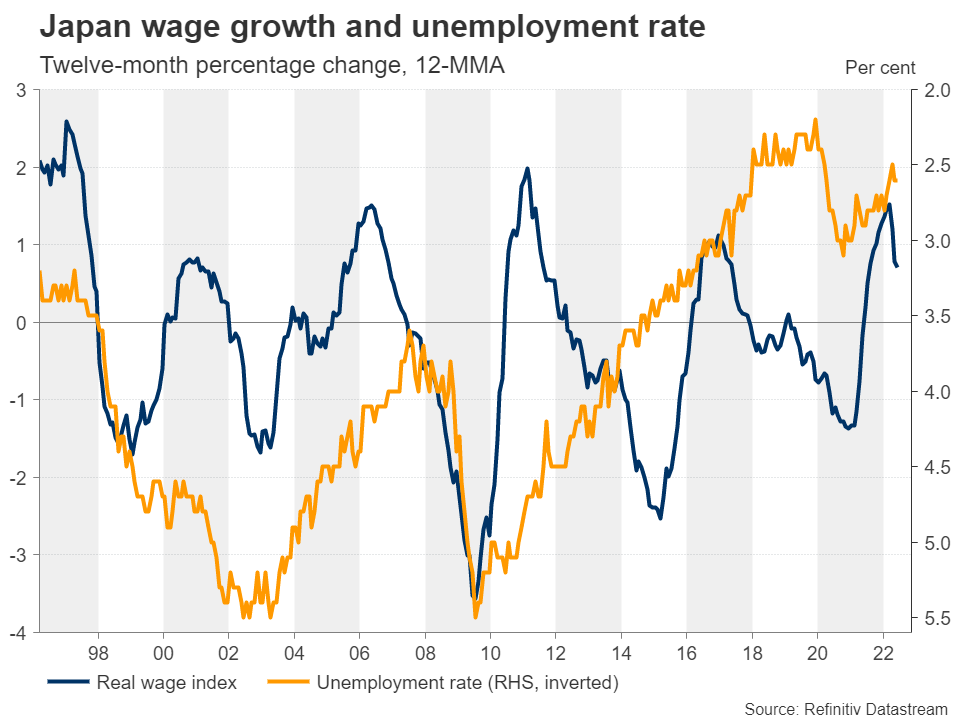
In the meantime, the odds are very low for an immediate policy change according to the futures market, which are convinced interest rates will not change this year. A tweak in the yield curve control could be more likely if inflation sharpens in the coming months and recession risks prove not as severe to halt the tightening cycle in the US and therefore the long depreciation in the yen.
USD/JPY
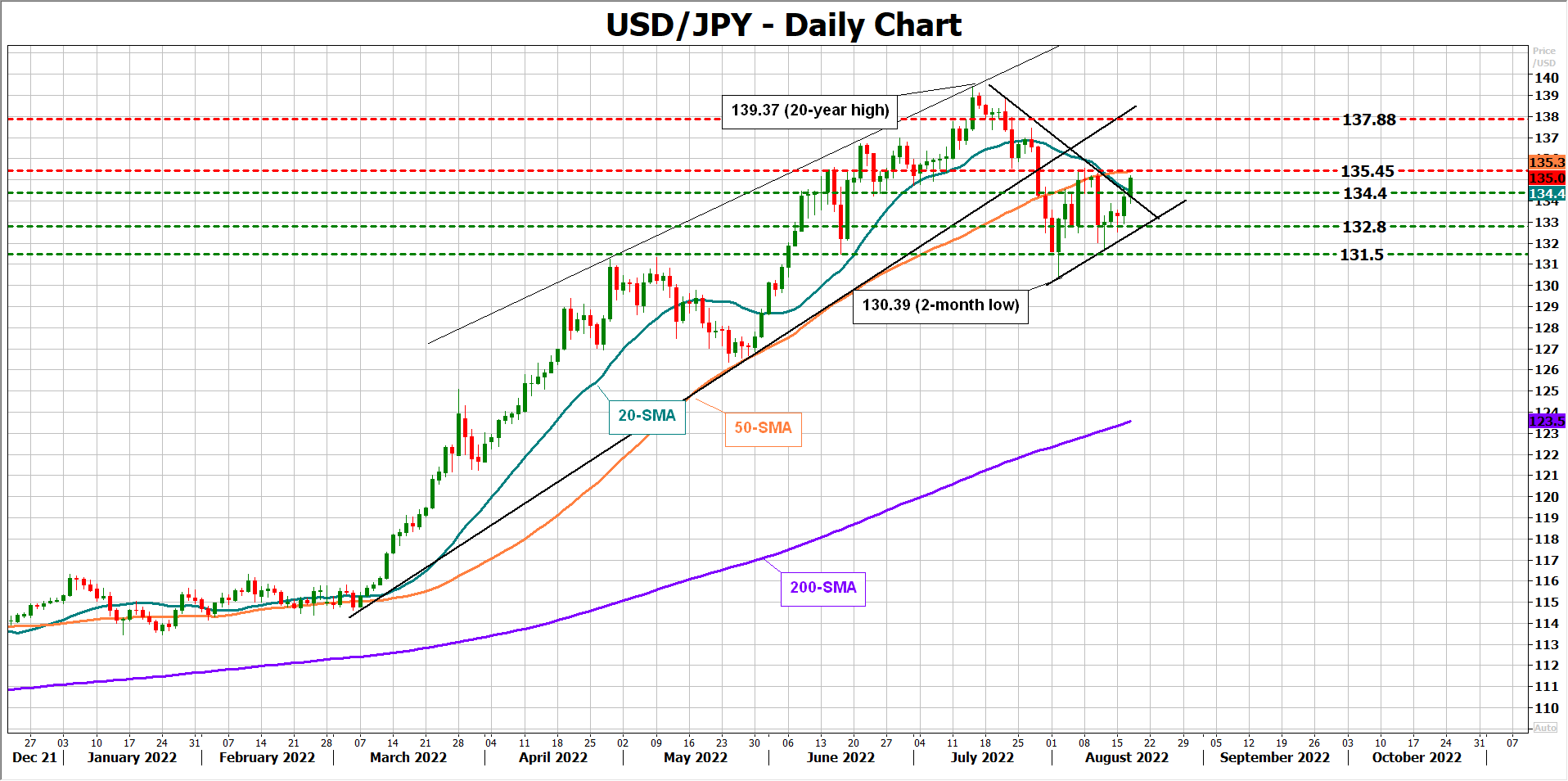
Hence, the yen’s battle against the safe-haven dollar could be tough if the BoJ stays out of the tightening camp. As regards the reaction to Friday's inflation readings, unless a significant upside surprise takes place, the yen may barely gain any momentum. Resistance is currently detected near the 50-day simple moving average (SMA) at 135.45. If the pair breaks that ceiling, it may speed up to 137.88.
On the downside, the 132.80 area has been an important support so far this month. Therefore, an extension beneath that and under the tentative short-term ascending trendline may push for a close below 131.50 with scope to reach the two-month low of 130.38.
US: Retail Sales Lose Steam in July
Retail sales were flat month-on-month (m/m) in July – a notch below the consensus forecast (+0.1% m/m) – and decelerating from June's reading, which was revised down to 0.8% m/m from 1.0% m/m reported earlier.
Sales at autos & parts dealers dropped 1.6% m/m from June's downwardly revised rate of 0.5% (+0.8% m/m, previously). Excluding autos, retail sales were up 0.4% m/m in July, above the consensus forecast of -0.1% m/m.
Sales at gasoline stations were down by 1.8% m/m, reflecting the 7.7% pullback in gas prices. Adjusted for prices, sales were up at 6.4% m/m. Meanwhile, sales at building materials retailers were up 1.5% in July.
The "control group", which excludes the most volatile components and is used in calculating personal consumption expenditures (and GDP), was up in July gaining 0.8% m/m - two tenths of a percentage points higher than expected by the consensus. July's reading was revised down to 0.7% m/m from 0.8% m/m reported previously.
Within the group, the biggest contributors to growth were sales at non-store retailers (+2.7% m/m), miscellaneous stores retailers (+1.5% m/m), furniture & electronics/appliance stores (+0.3% m/m), and health & personal care stores (+0.4% m/m). Food services & drinking places – the only service category in today's report – was up by 0.1% m/m, but it declined by 0.5% m/m in real terms.
The only two categories in the red were department stores (-0.7% m/m) and clothing & accessory stores (-0.6% m/m).
Key Implications
That’s more like it. Moderation in retail sales momentum has been expected as consumers continue to shift their attention to services spending. Price-adjusted, retail sales came in flat, which points to PCE growth of somewhere around 0.5-0.7% (annualized) in the third quarter.
Lower prices at the pump contributed to softer growth in today's report, despite freeing up some money to be spent elsewhere. Consumers directed their attention to bargains during Amazon's "biggest Prime Day Event ever", which, with $3 billion in sales, contributed handsomely to headline growth this month. Despite softness in the housing market, sales at building materials and equipment stores came in at one percent in real terms suggesting that consumers continue devote a sizeable share of spending to home improvements.
Like July's CPI reading, today's release suggests things are moving in the right direction, but it's still too early for the Fed to pivot away from the hiking cycle. We maintain the view that a 50 basis point hike will be considered enough in September but will have more clarity after the August jobs and inflation data give us a better understanding of whether the recent moderation has more legs.
New Zealand Dollar Slides after RBNZ Hike
RBNZ delivers another 0.50% hike
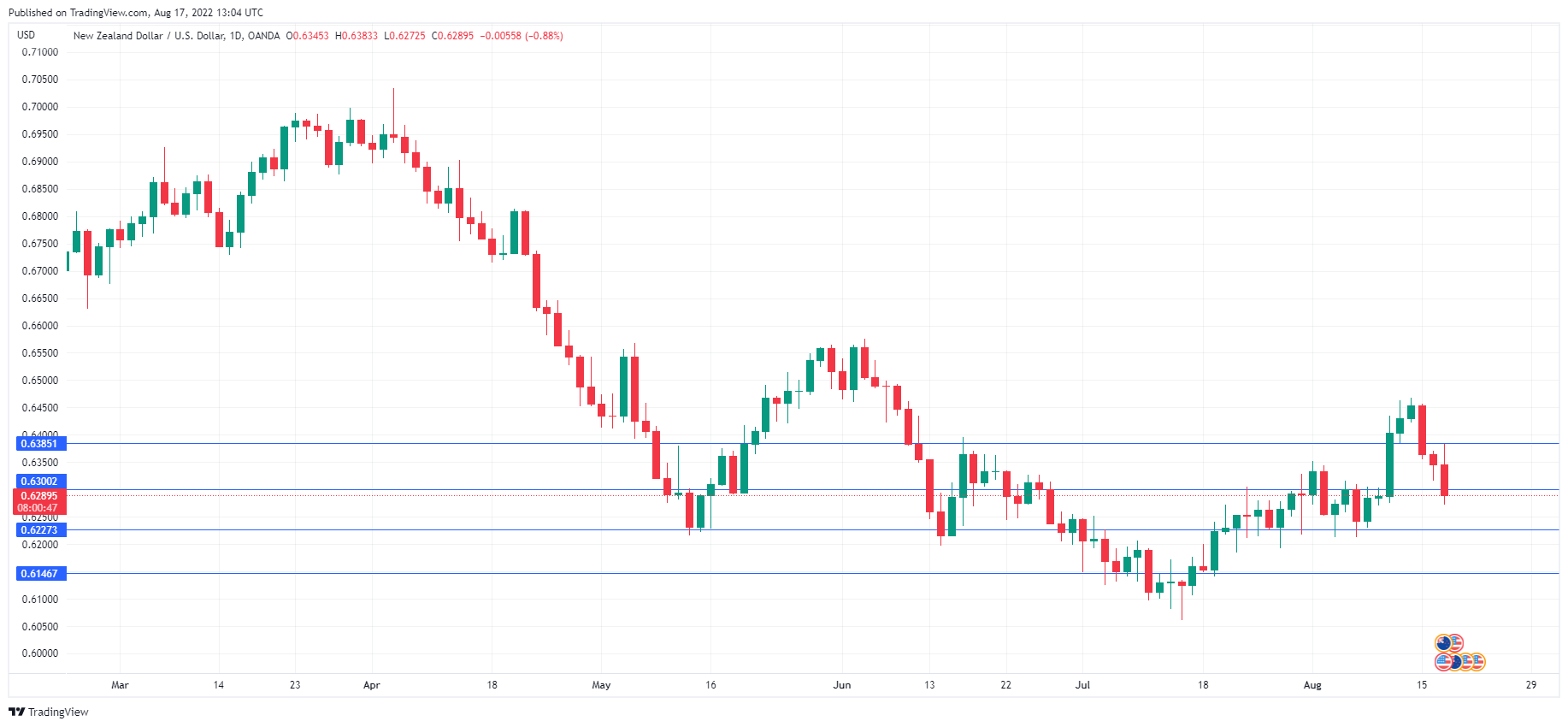
The New Zealand dollar has taken a tumble today. In the European session, NZD/USD has declined by 0.88% and is trading at 0.6289. We continue to see plenty of volatility from the New Zealand dollar. Last week, the currency rose 3.33%, but has pared those gains this week and is down 2.47%.
The RBNZ dutifully raised interest rates by 0.50%, for a fourth straight time. This brings the cash rate to an even 3.00%. However, the New Zealand dollar has responded with sharp losses, as the central bank’s inflation and unemployment forecasts have been revised upwards. In its monetary statement, the RBNZ said it expected inflation to start to drop from the current level of 7.3%, but said that inflation will not fall below 3% until June 2024. As well, unemployment is expected to rise to 5% in 2025. In May, the central bank projected inflation would drop under 3% in September 2023 and inflation would rise to 4.7% in 2025.
The central bank holds its next meeting in October. Governor Orr flatly ruled out any predetermination as to what the RBNZ would do. Still, short of a spectacular turnaround in inflation, odds are that the Bank will deliver another 0.50% hike, as its primary focus is to ensure that inflation does not become entrenched. There is the danger that the sharp rate tightening could cause a recession, but that is a price the RBNZ is willing to pay.
The Federal Reserve is doing its best to convey the message that inflation is far from beaten and additional rate hikes are coming. Since the surprising inflation report which showed a decline in CPI, the markets have been holding onto the idea that the Fed will reverse directions next year, which has sent the US dollar sharply lower. The Fed minutes will be released later today, and I expect the Fed to continue to drum out its hawkish stance. Will investors finally buy into the Fed’s hawkish message or ignore what they don’t want to hear? Stay tuned – the dollar could show some volatility after the release of the minutes.
NZD/USD Technical
- NZD/USD is testing support at 0.6300. Below, there is support at 0.6227
- There is resistance at 0.6385 and 0.6495
EUR/USD Mid-Day Outlook
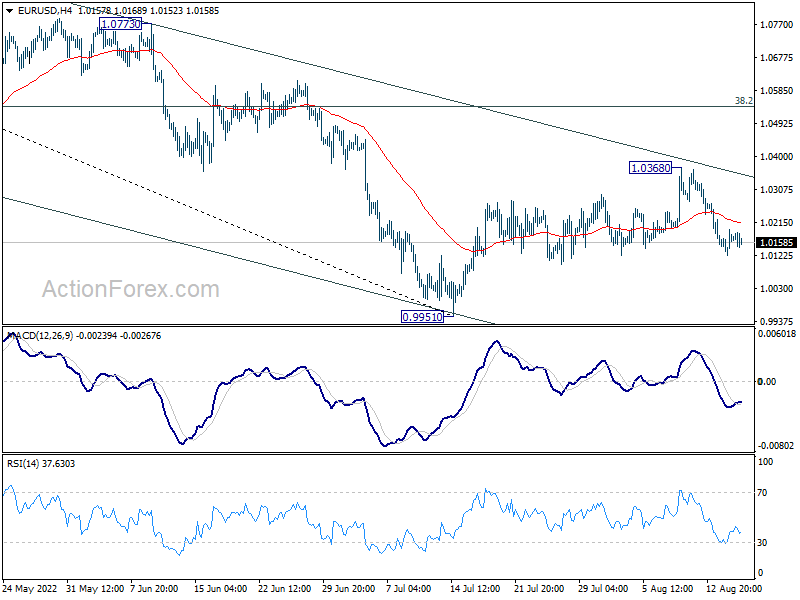
Daily Pivots: (S1) 1.0131; (P) 1.0163; (R1) 1.0203; More...
Intraday bias in EUR/USD remains mildly on the downside despite loss of downside momentum. Rebound from 0.9951 should have completed at 1.0368 after rejection by 55 day EMA, as well as falling channel resistance. Deeper fall would be seen to retest 0.9951 low. Firm break there will resume larger down trend. For now, risk will stay on the downside as long as 1.0368 resistance holds, in case of recovery.
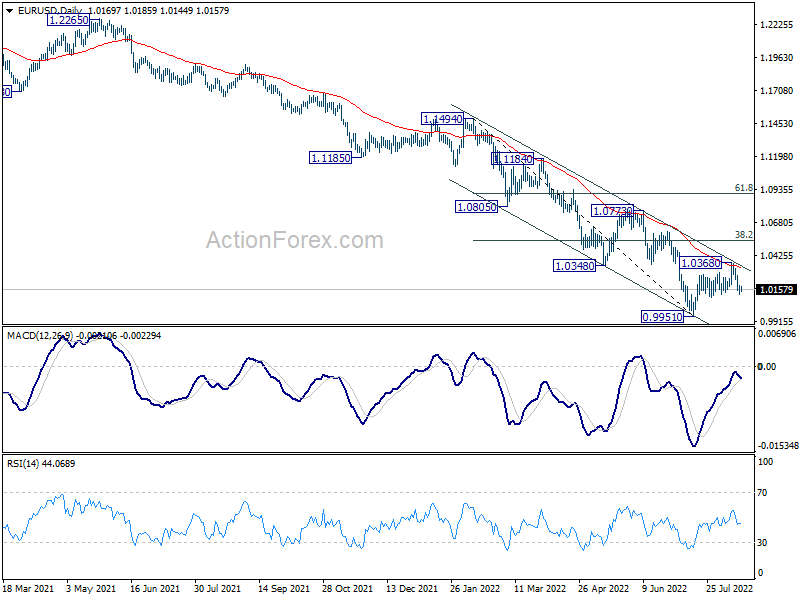
In the bigger picture, down trend from 1.6039 (2008 high) is still in progress. Next target is 100% projection of 1.3993 to 1.0339 from 1.2348 at 0.8694. In any case, outlook will stay bearish as long as 1.0773 resistance holds, in case of strong rebound.
GBP/USD Mid-Day Outlook
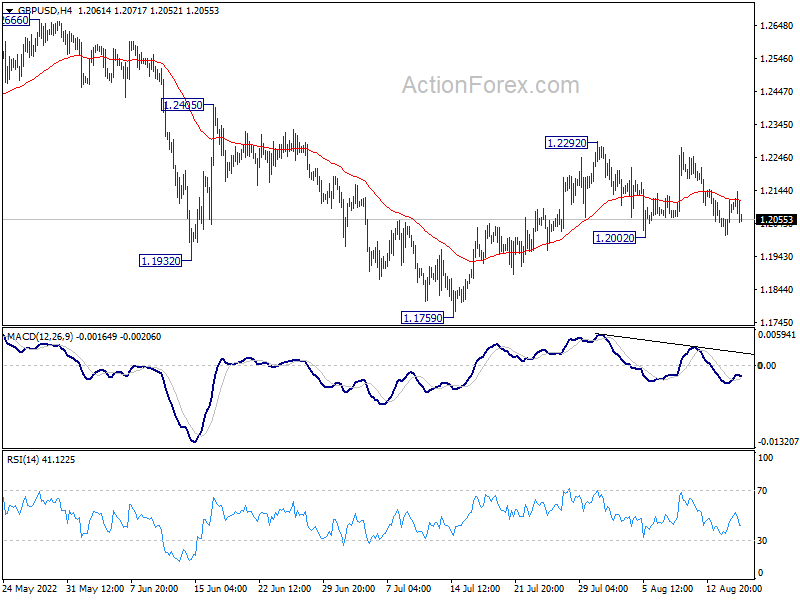
Daily Pivots: (S1) 1.2031; (P) 1.2075; (R1) 1.2141; More...
Range trading continues in GBP/USD and intraday bias remains neutral. On the downside, break of 1.2002 minor support will argue that rebound from 1.1759 has completed, after rejection by 55 day EMA. Intraday bias will be back on the downside for retesting 1.1759 low first. Break there will resume larger down trend. On the upside, above 1.2922 will resume the rebound from 1.1759 towards 1.2666 resistance.
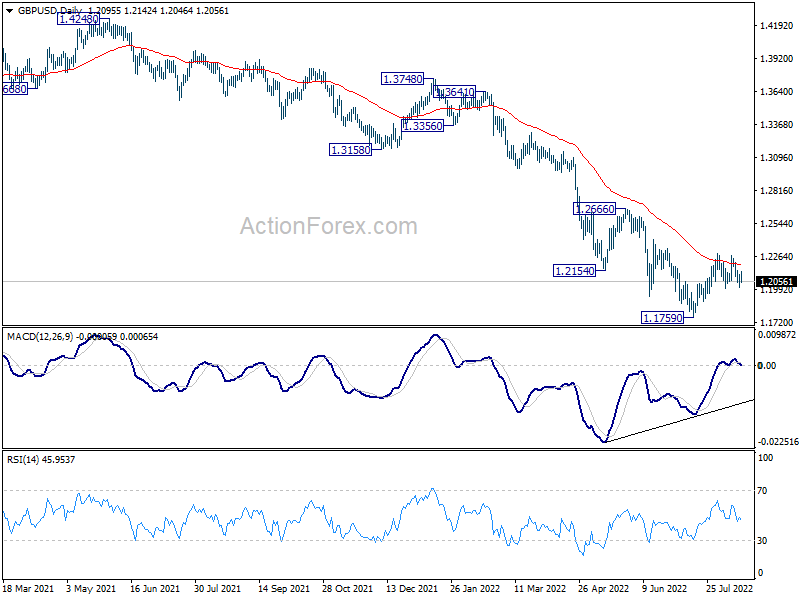
In the bigger picture, fall from 1.4248 (2018 high) could be a leg inside the pattern from 1.1409 (2020 low), or resuming the longer term down trend. Deeper decline is expected as long as 1.2666 resistance holds. Next target is 1.1409 low. However, firm break of 1.2666 will bring stronger rise back to 55 week EMA (now at 1.2897).
USD/CHF Mid-Day Outlook
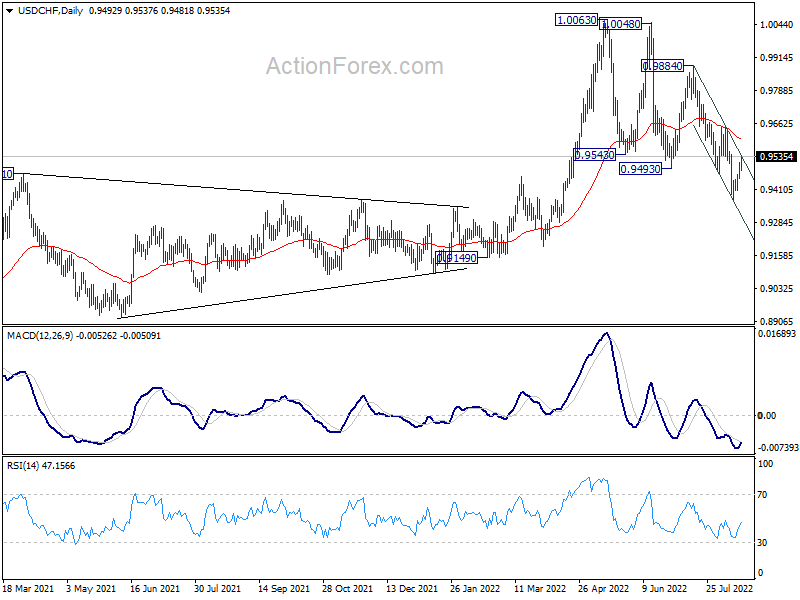
Daily Pivots: (S1) 0.9461; (P) 0.9488; (R1) 0.9522; More...
Intraday bias in USD/CHF stays neutral at this point. Recovery from 0.9369 should be limited well below 0.9648 resistance to bring another fall. On the downside, break of 0.9369 will resume larger decline from 1.0063 towards 0.9149 support next. However, firm break of 0.9648 will turn bias back to the upside for 0.9884 resistance instead.
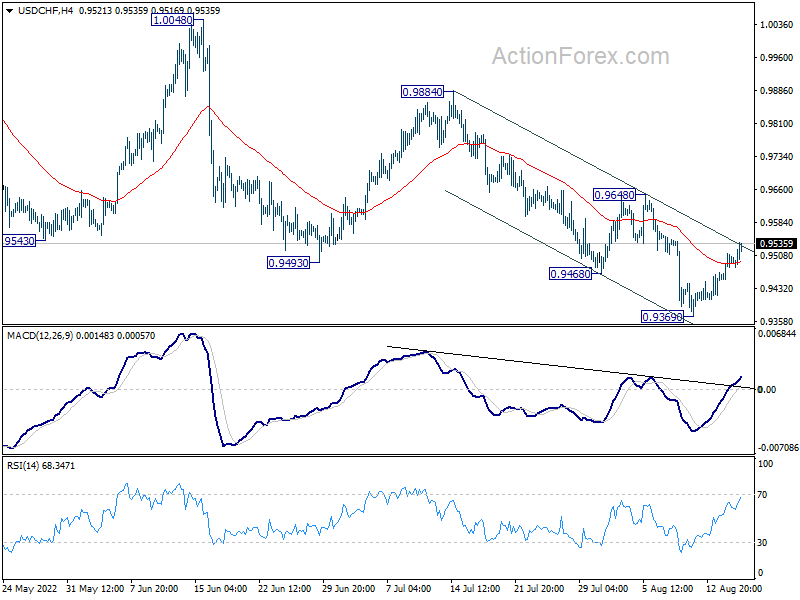
In the bigger picture, break of 0.9471 support turned resistance argues that medium term up trend from 0.8756 has completed with three waves up to 1.0063. Long term sideway pattern might have started another falling leg. Deeper decline would now be in favor as long as 0.9648 resistance holds, to 0.9149 structural support. Sustained break there could pave the way back to 0.8756.