

Sample Category Title
US: Small Business Confidence Records Modest Improvement in July
The NFIB's small business optimism index rose 0.4 points to 89.9 in July. This was better than the consensus forecast, which expected the index to drop modestly from June's level. Pulling back the lens, the index is down 9 points from the end of last year and is still at one of the lowest levels in the survey's nearly 50-year history.
Beneath the headline, four of the ten subcomponents rose on the month and six declined. The share of firms expecting the economy to improve was the biggest mover, rising 9 points from June's record low level to -52% in July (still one of the lowest readings in the survey's history). Plans to increase inventories and 'expected credit conditions' also improved moderately on the month.
Most of the other sub-indicators declined on the month, with earnings trends (-7 points to -26%) leading the charge.
Labor market indicators were mixed. Job openings eased a touch, falling one point to 49% – not far off from the historical high of 51% recorded recently. On the other hand, coming on the heels of a 7-point decline in the month prior, the share of businesses planning increase employment rose one point to 20%.
With inflation remaining the top concern, labor quality concerns continued to play second fiddle (-2 points to 21%). Workers were still relatively hard to come by (57% reported few or no qualified applicants to their job openings, down three points on the month). The share of firms increasing compensation came in flat at 48%, while those planning to do so fell three points to 25%. Similarly, the share of firms planning to raise average selling prices ahead fell 12 points to 37%.
Key Implications
Optimism among America's small businesses remains downbeat, with the NFIB index drifting mildly higher on the month but remaining well below historical norms in July. Despite this, labor market metrics suggest that there's still plenty of appetite among businesses to hire workers. Job openings are not far off from their all-time high, while plans to increase employment are elevated and near pre-pandemic levels. This is in stark contrast to expectations about an improvement in the economy and the belief that now is a good time to expand, which remain near their all-time lows.
With concerns regarding inflation taking center stage over the last few months, hiring challenges, though still a pressing issue, are playing second fiddle. Labor quality concerns remain elevated, but have come off the boil recently, and the share of businesses planning to raise compensation has also eased. Meanwhile, the share of firms planning to raise prices ahead also pulled back noticeably last in July. These are added factors that supports the notion of some easing in inflationary pressures ahead.
USD/JPY Mid-Day Outlook
Daily Pivots: (S1) 134.41; (P) 134.99; (R1) 135.62; More...
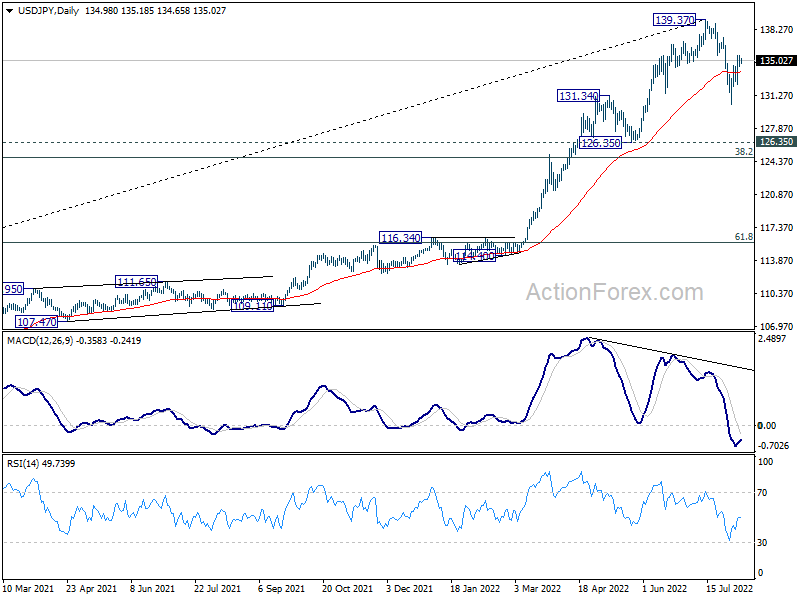
USD/JPY is losing some upside momentum but retreat is so far shallow. Intraday bias stays on the upside and rise from 130.38 should target a test on 139.37 high. Strong resistance could be seen there to limit upside, to bring another fall, as the third leg of the consolidation pattern from 139.37. On the downside, below 132.50 minor support will resume the fall from 139.37 towards 126.35 structural support.
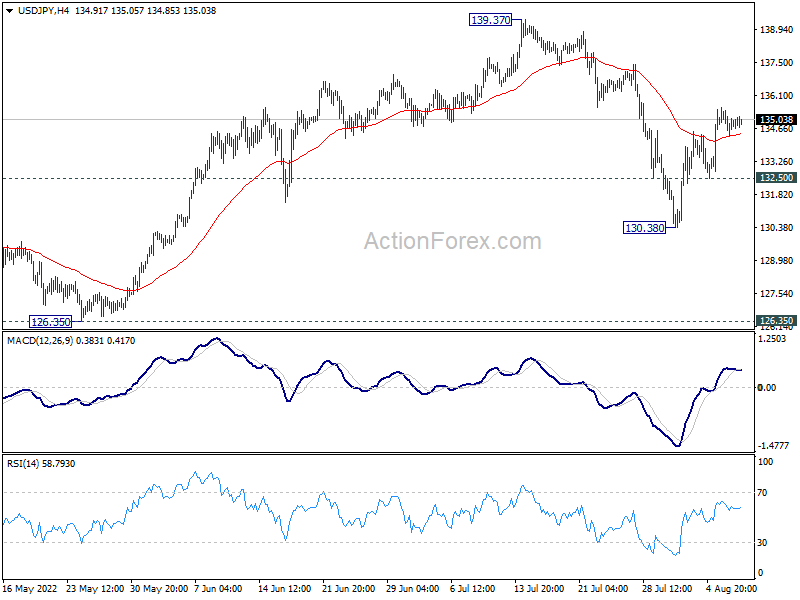
In the bigger picture, fall from 139.37 medium term top is seen as correcting whole up trend from 101.18 (2020 low). While deeper decline cannot be ruled out, outlook will stays bullish as long as 55 week EMA (now at 121.84) holds. Long term up trend is expected to resume through 139.37 at a later stage, after the correction finishes.
USD/CHF Mid-Day Outlook
Daily Pivots: (S1) 0.9503; (P) 0.9573; (R1) 0.9625; More...
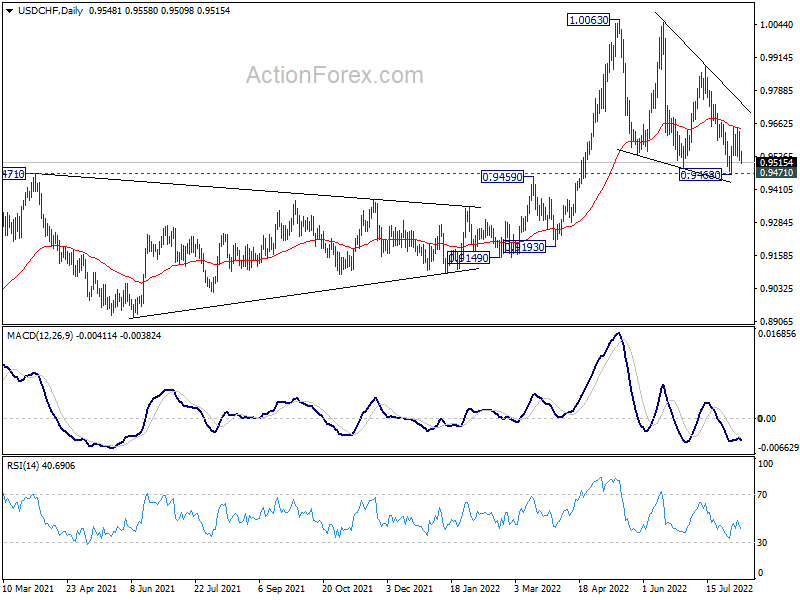
Range trading continues in USD/CHF and intraday bias remains neutral first. On the upside, break of 0.9650, and sustained trading above 55 day EMA (now at 0.9647) will raise the chance that corrective pattern from 1.0063 has completed. Further rally should then be seen to 0.9884 resistance next. However, decisive break of 0.9471 support will carry larger bearish implication.
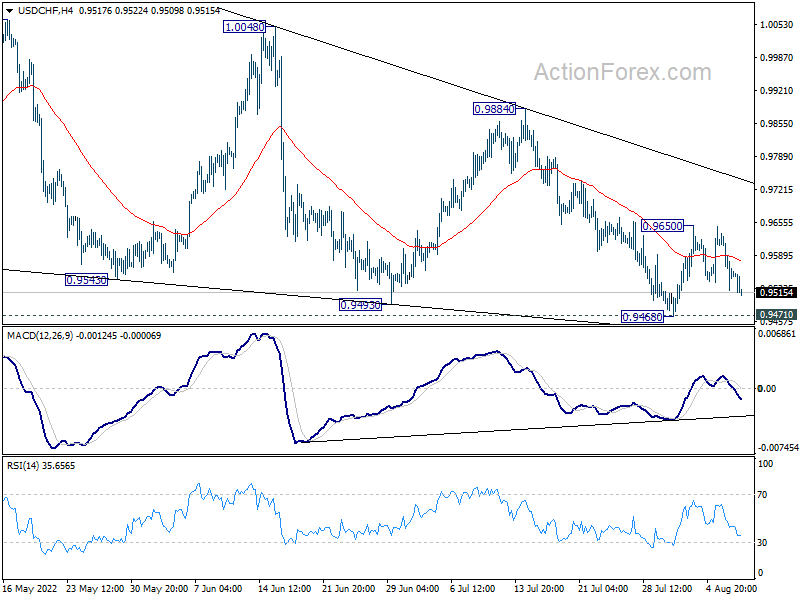
In the bigger picture, medium term up trend from 0.8756 (2021 low) is still in progress. On resumption, next target is 1.0342 (2016 high). Sustained break there will resume long term up trend from 0.7065 (2011 low). This will remain the favored case as long as 0.9471 resistance turned support holds. However, firm break of 0.9471 will raise the chance that such up trend is over.
GBP/USD Mid-Day Outlook
Daily Pivots: (S1) 1.2039; (P) 1.2088; (R1) 1.2129; More...
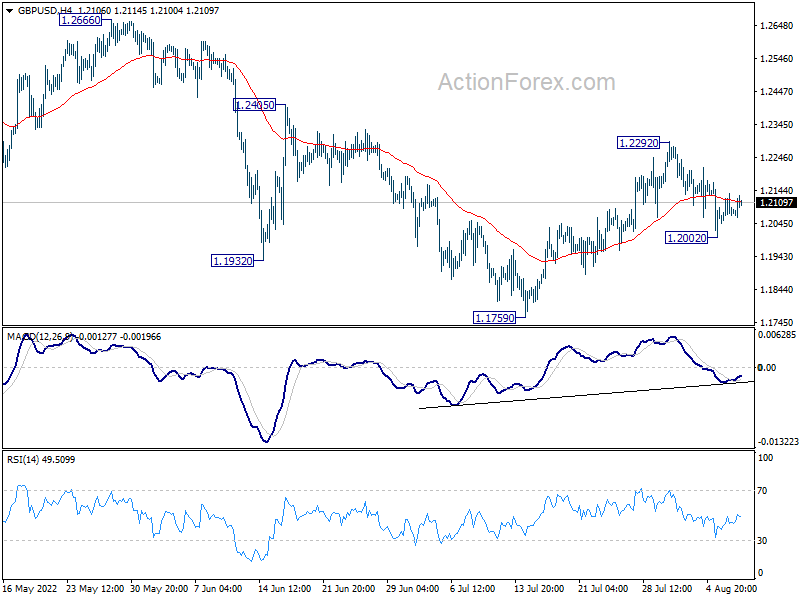
Intraday bias in GBP/USD is turned neutral with current recovery. Outlook is unchanged that rebound from 1.1759 should have completed after hitting 55 day EMA. On the downside, below 1.2022 will bring deeper fall to retest 1.1759 low. On the upside, break of 1.2292 will invalidate this view and resume the rebound towards 1.2405 resistance instead.
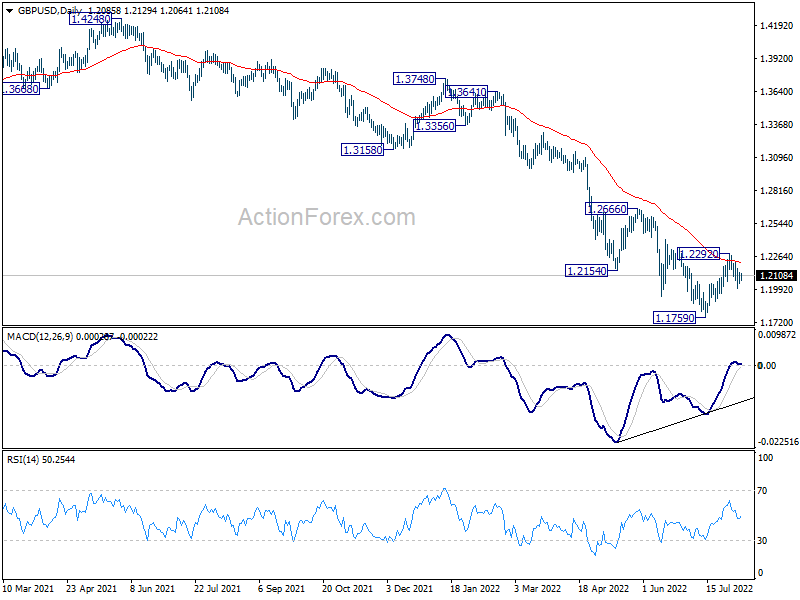
In the bigger picture, fall from 1.4248 (2018 high) could be a leg inside the pattern from 1.1409 (2020 low), or resuming the longer term down trend. Deeper decline is expected as long as 1.2666 resistance holds. Next target is 1.1409 low. However, firm break of 1.2666 will bring stronger rise back to 55 week EMA (now at 1.2925).
EUR/USD Mid-Day Outlook
Daily Pivots: (S1) 1.0161; (P) 1.0192; (R1) 1.0224; More...
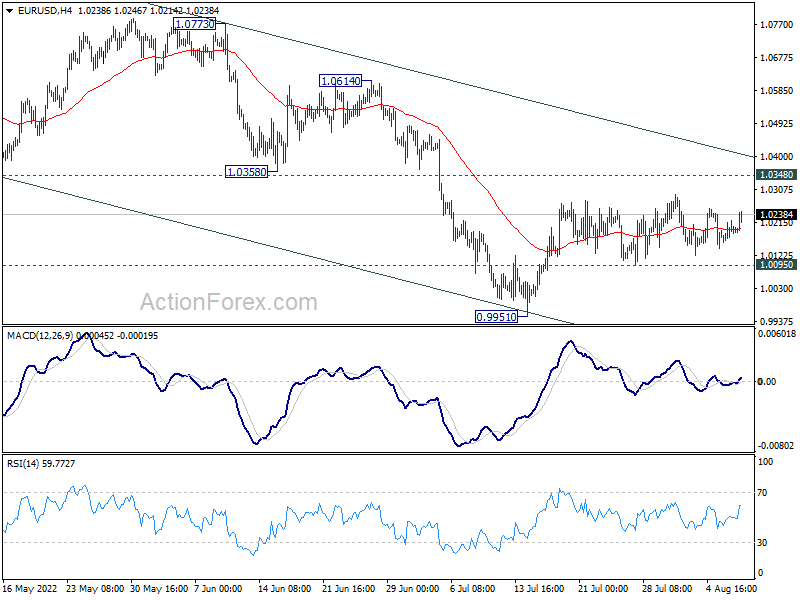
EUR/USD recovers mildly today but stays in established range. Intraday bias remains neutral first. On the downside, break of 1.0095 minor support will argue that larger down trend is ready to resume. Intraday bias will be back to the downside for retesting 0.9951 low first. For now, outlook will stay bearish as long as 1.0348 support turned resistance holds, even in case of another rise.
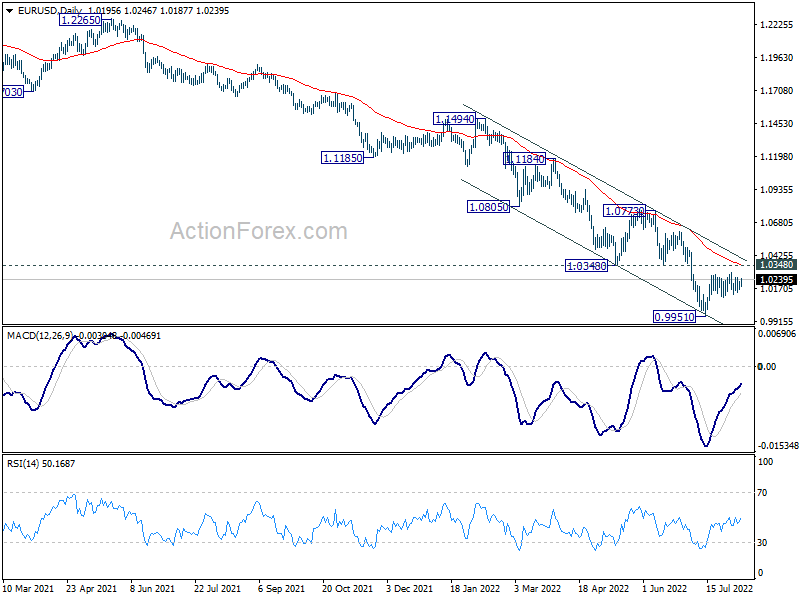
In the bigger picture, down trend from 1.6039 (2008 high) is still in progress. Next target is 100% projection of 1.3993 to 1.0339 from 1.2348 at 0.8694. In any case, outlook will stay bearish as long as 1.0773 resistance holds, in case of strong rebound.
Euro Rises Slightly in Dull Markets, Dollar Mixed
Euro rises slightly as market sentiments are flip-flopping today. Sterling and Swiss Franc are also trading higher. On the other hand, commodity currencies turn soft with Aussie paring most of recent gains. Dollar and Yen are mixed for now. IN other markets, Silver is trading firmer but Gold is still range bound. WTI crude oil is recovering while cryto-currencies turn south. Stocks are mixed with US futures pointing to a flat open.
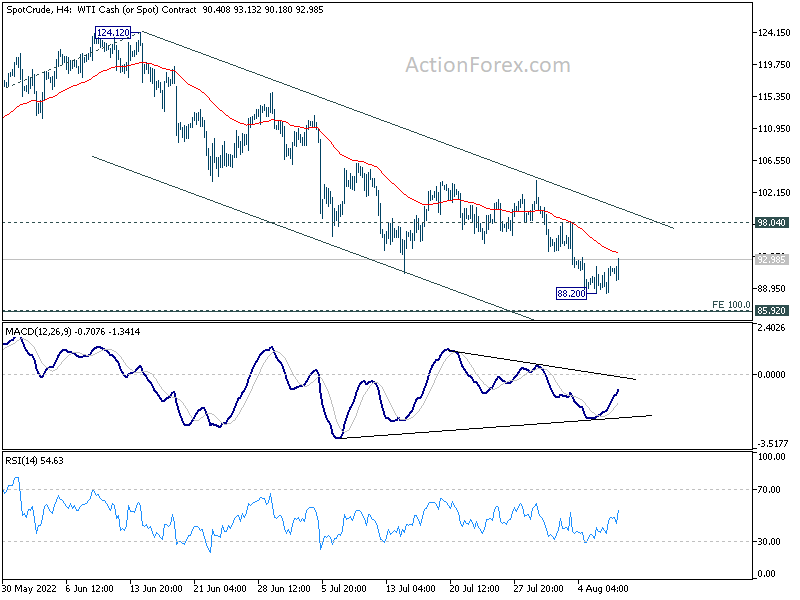
Technically, the condition is there for WTI crude oil to stage a sustainable rebound considering bullish convergence condition in 4 hour MACD. Yet, it will have to overcome 4 hour 55 EMA (now at 93.81) first. Then ideally, there should be some up side acceleration through 98.04 resistance. Otherwise, chances are for another dip through 88.20 low before WTI forms a solid bottom.
In Asia, at the time of writing, FTSE is up 0.09%. DAX is down -0.96%. CAC is down -0.34%. Germany 10-year yield is up 0.051 at 0.949. Earlier in Asia, Nikkei dropped -0.88%. Hong Kong HSI dropped -0.21%. China Shanghai SSE rose 0.32%. Singapore Strait Times dropped -0.36%. Japan 10-year JGB yield dropped -0.0111 at 0.167.
BoE Ramsden: It's more likely than not to raise rates further
BoE Deputy Governor Dave Ramsden said in a Reuters interview, "for me personally, it's more likely than not that we will have to raise Bank Rate further.
"But I haven't reached a firm decision on that," he added. "I'm going to look at the indicators, look at the evidence as we approach each upcoming meeting."
"I'm certainly not ruling out a situation where when we look at the risk to the economy, having been raising Bank Rate, at some point we then have to start lowering it quite quickly," he said. "I can imagine situations, yes, where we'll carry on... with a pace of QT in the background."
Australia Westpac consumer sentiment dropped to 81.2 in Aug
Australia Westpac Consumer Sentiment Index fell -3% to 81.2 in August. The reading was on par with the lows of the Covid and Global Financial Crisis. Also, there was a cumulative decrease of -22.9% from recent peak made in November 2021.
Economic conditions for the 12 months dropped from 80.3 to 73.9. Economic conditions for the next five years dropped from 91.6 to 90.7. Unemployment expectations index dropped from 109.8 to 103.4. House price expectations index dropped from 104.9 to 97.1.
Regarding RBA's next meeting on September 6, Westpac expects the central bank to hike by another 50bps to 2.35%, leaving the cash rate in "neutral range". It expects RBA to then scale back the increase to 25bps per meeting until February 2023.
Australia NAB business confidence rose to 7, conditions rose to 20
Australia NAB Business Confidence rose from 2 to 7 in July. Business Conditions rose from 14 to 20. Trading conditions rose from 19 to 27. Profitability conditions rose from 13 to 17. Employment conditions rose from 11 to 17.
"Businesses are continuing to report that conditions are really strong," said NAB Group Chief Economist Alan Oster. "While some of the real time data we look at is showing signs of softening, there are no signs of that in the survey with demand at a really high level. Importantly, the strength is showing up across the board in terms of industries and across the country."
"Confidence bounced back in July, which was something of a surprise," said Oster. "Inflation and rising interest rates are clouding the outlook, and there are growing concerns about the global economy, but businesses seem to have a fairly positive outlook at the moment. Forward orders are also fairly strong at +10 index points which also supports the outlook."
EUR/USD Mid-Day Outlook
Daily Pivots: (S1) 1.0161; (P) 1.0192; (R1) 1.0224; More...
EUR/USD recovers mildly today but stays in established range. Intraday bias remains neutral first. On the downside, break of 1.0095 minor support will argue that larger down trend is ready to resume. Intraday bias will be back to the downside for retesting 0.9951 low first. For now, outlook will stay bearish as long as 1.0348 support turned resistance holds, even in case of another rise.
In the bigger picture, down trend from 1.6039 (2008 high) is still in progress. Next target is 100% projection of 1.3993 to 1.0339 from 1.2348 at 0.8694. In any case, outlook will stay bearish as long as 1.0773 resistance holds, in case of strong rebound.
Economic Indicators Update
| GMT | Ccy | Events | Actual | Forecast | Previous | Revised |
|---|---|---|---|---|---|---|
| 23:50 | JPY | Money Supply M2+CD Y/Y Jul | 3.40% | 3.30% | 3.30% | |
| 01:30 | AUD | NAB Business Confidence Jul | 7 | 1 | ||
| 01:30 | AUD | NAB Business Conditions Jul | 20 | 13 | ||
| 06:00 | JPY | Machine Tool Orders Y/Y Jul P | 5.50% | 17.10% | ||
| 10:00 | USD | NFIB Business Optimism Index Jul | 89.9 | 89.5 | 89.5 | |
| 12:30 | USD | Nonfarm Productivity Q2 P | -4.60% | -4.50% | -7.30% | |
| 12:30 | USD | Unit Labor Costs Q2 P | 10.80% | 9.50% | 12.60% |
NZDJPY Wave Analysis
- NZDJPY broke resistance level 84.70
- Likely to rise to resistance level 86.40
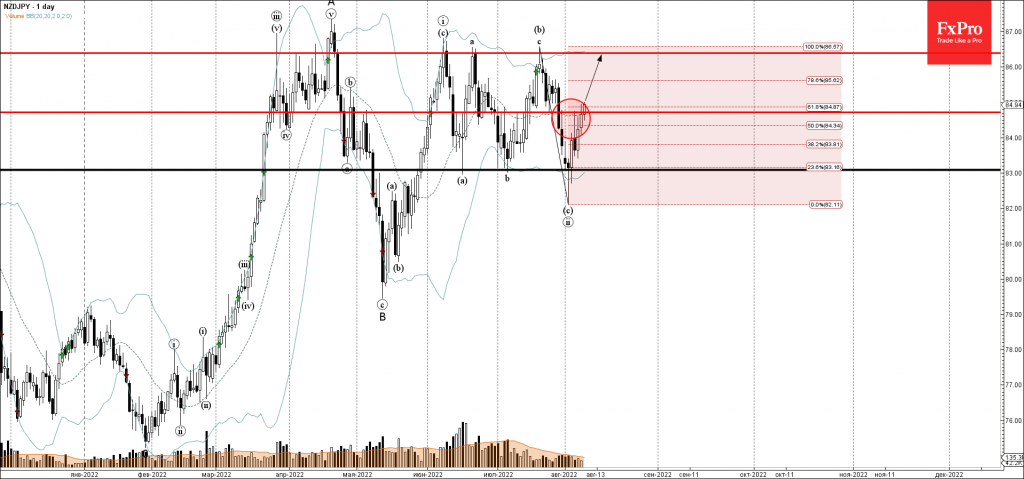
NZDJPY today broke the resistance level 84.70 (top of the earlier Shooting Star from the start of this month) intersecting with the 681% Fibonacci correction of the downward impulse (c) from July.
The breakout of the resistance level 84.70 should accelerate the active short-term impulse wave (iii), which belongs to wave C from May.
Given the clear daily uptrend, NZDJPY can be expected to rise toward the next resistance level 86.40 (which has been reversing the price from March).
WTI Wave Analysis
- WTI reversed from support level 88.00
- Likely to rise to resistance level 92.30
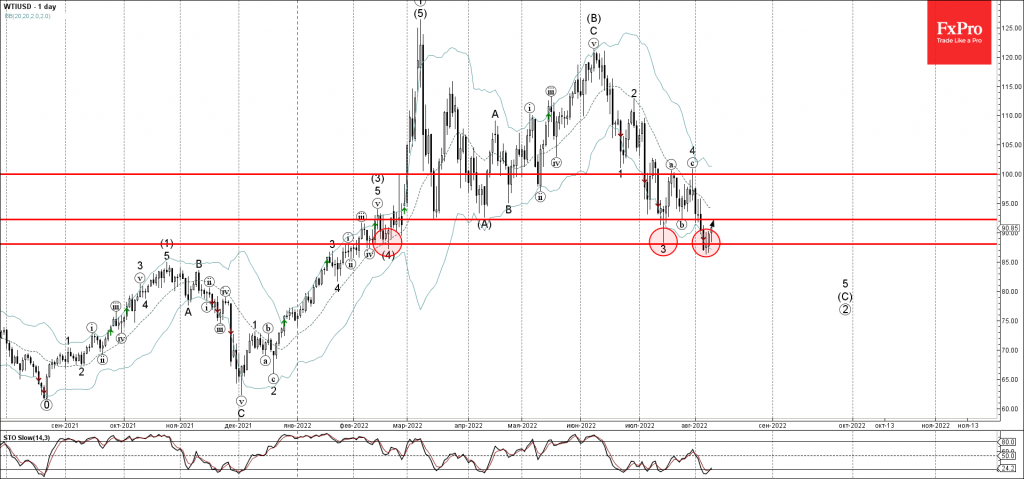
WTI crude oil recently reversed up from the key support level 88.00 (low of the previous wave 3, which has been reversing the price from the start of February) intersecting with the lower daily Bollinger Band.
The upward reversal from the support level 88.00 created the daily Japanese candlesticks reversal pattern Morning Star Doji.
Given the clear daily uptrend, WTI crude oil can be expected to rise toward the next resistance level 92.30.
Pound Edges Higher, Markets Eye US Inflation
The British pound has posted slight gains today. GBP/USD is trading in the European session at 1.2106, up 0.21% on the day.
The economic calendar has been light so far this week. On Capitol Hill, the Biden Administration racked up a badly-needed victory ahead of the mid-terms, passing a domestic spending bill which covers climate change, health costs, and corporate taxes. The bill has the interesting name of the Inflation Reduction Act. It would be great if that meant that US inflation, which hit 9.1% in June, must lower itself or else be in breach of the law, but I doubt that US lawmakers have such capabilities.
We could see a reduction in inflation as soon as Wednesday, with the release of July’s inflation report. Headline CPI is expected to fall to 8.7%, down from 9.1%, while core CPI is forecast to rise to 6.1%, up from 5.9%. If the headline reading is higher than expected, it will put pressure on the Fed to raise rates by 0.75% in September and the dollar should respond with gains. Conversely, a soft reading from the headline or core releases would ease the pressure on the Fed and could send the dollar lower.
BRC sends grim warning despite stronger retail sales
In the UK, BRC Retail Sales rebounded with a gain of 1.6% YoY in July, after a 1.3% in June. The BRC noted that despite the positive release, retailers are struggling with falling sales volumes, as inflation has hit 9.1% and is expected to hit double-digits. The BRC added that consumer confidence remains weak and the rise in energy bills in October will worsen the cost of living crisis.
The UK releases GDP for Q2 on Friday, and the markets are braced for a downturn. GDP is expected to slow to 2.8% YoY, down from 8.7% in Q1. On a quarterly basis, GDP is projected at -0.2%, following a 0.8% gain in Q1. If GDP is weaker than expected, a fall in the pound is a strong possibility.
GBP/USD Technical
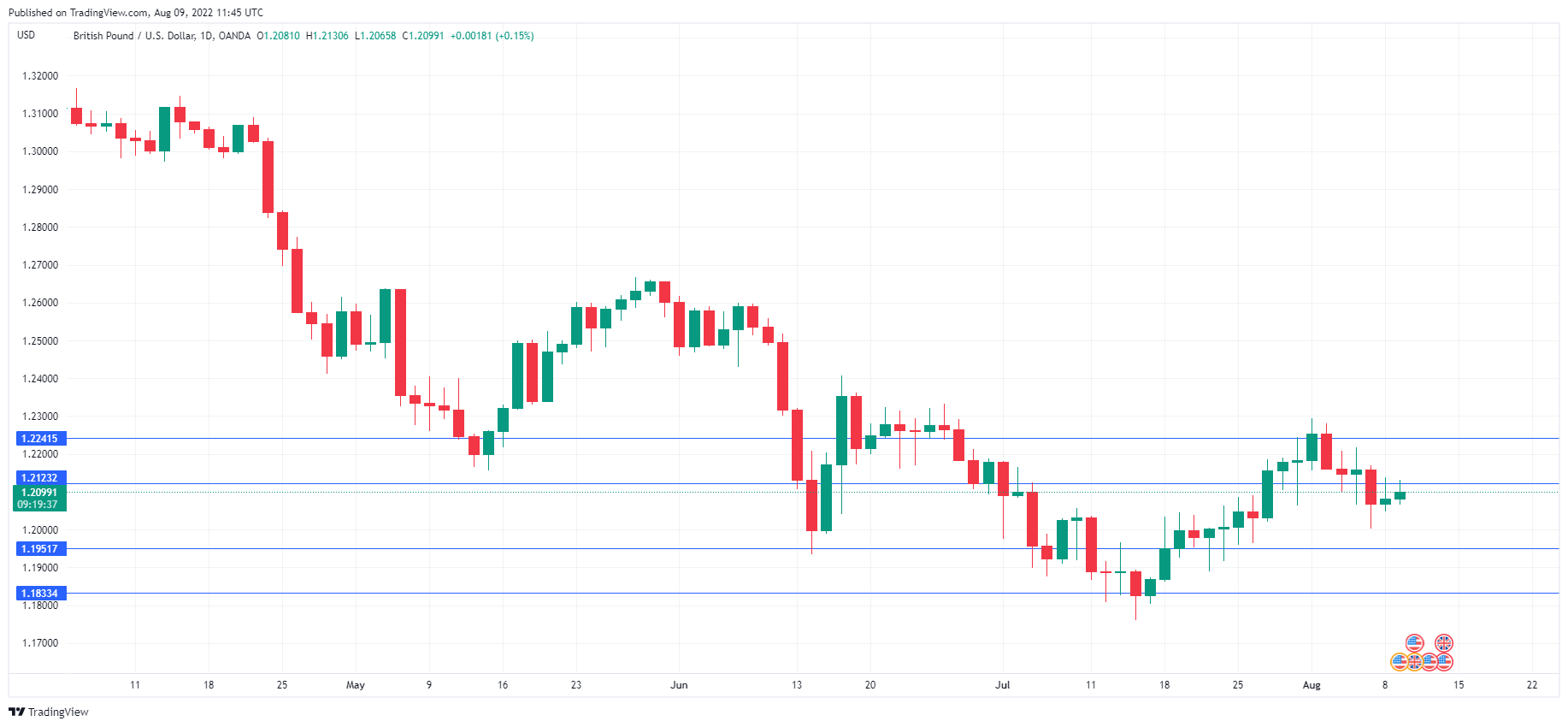
- GBP/USD is testing resistance at 1.2123. Next, there is resistance at 1.2241
- There is support at 1.2061 and 1.1951
July US CPI: Has Inflation Peaked (Again)?
Tomorrow's data could not only be the most important this week, but for the whole month. As we anticipated in Friday's NFP podcast, there is a lot riding on US inflation data. That is particularly the case after the Fed promised to take a data-dependant approach. And of course inflation is the most important of that data.
The issue for traders is that there are a bunch of moving parts which could all push the market to react in different directions. On the one hand, the media is likely to focus on the headline figure, because that's what's most important to consumers. But the market cares more about what the Fed will do at their next meeting, so the focus will likely be on core inflation. And the kicker? Well, both of these numbers are expected to go in opposite directions.
Some factors to keep in mind
Before jumping into the expected results, there is some context that needs to be taken into account. First, the Fed is on its unofficial summer break, and won't meet again until late September. That means we'll get August inflation numbers before the meeting, which could modify some of the outlook for monetary policy. Thus, the market reaction could fade a little as investors assess the possibility of a correction a month from now.
The other factor relates to the headline CPI. The prices that are used to make the calculation are sampled at different times of the month. Fuel costs have been one of the driving factors in inflation, and they went down through the course of July. But fuel price sampling happens at the start of the month, so this headline inflation number is likely not to capture the full effect of the price change.
What to look out for
Another thing to keep in mind is that the market is likely to care more about the "faster" data. That is month-over-month comparisons that show where things are going right now. Particularly looking for some effect from the Fed's aggressive tightening. Rates have been rising since March, so there has been time for the effects to start filtering into the market.
Headline CPI change is expected to seriously hit the breaks in July, with monthly change of 0.2% compared to 1.3% in June. That is expected to contribute to the forecast for July annual inflation to step back to 8.7% from 9.1% prior.
What does it mean?
Of course this isn't the first time there has been a pull-back in inflation for one month. So, it doesn't necessarily mean a peak has been reached. But after Friday's NFP, it could contribute to hope that it might have, and there will be anticipation for next month's number to start showing a trend.
On the core side, things aren't so rosy. Monthly core inflation is expected to slow down, but not by nearly as much to 0.5% from 0.7% prior. Where the problem could be is with annual core inflation expected to rise to 6.1% from 5.9% prior. That could leave us in a situation where the headlines will be talking about lower inflation, but the Fed keeps pushing for higher rates to deal with core inflation.