Sample Category Title
US Inflation: Is the Elusive Peak Finally Here?
Following last week’s blistering jobs report out of the United States, investors will be turning their attention to Wednesday’s July inflation figures as bets of a 75-basis-point rate hike in September are back on. However, this time round, the CPI data, due at 12:30 GMT, might break with recent tradition and point to some cooling of price pressures. But what would a soft inflation report mean for the Federal Reserve? The US dollar’s post-NFP bounce back could be undone if the numbers show that inflation has likely peaked.
Is the US in recession or not?
A technical recession is defined as two consecutive quarters of contraction in economic output. So if the GDP data is to be believed, the American economy is already in recession. However, other indicators such as for consumption and employment suggest that the economy is still growing. Even forward-looking data like the PMI surveys point only to a slowdown and not a full-blown recession and the Fed seems to agree.
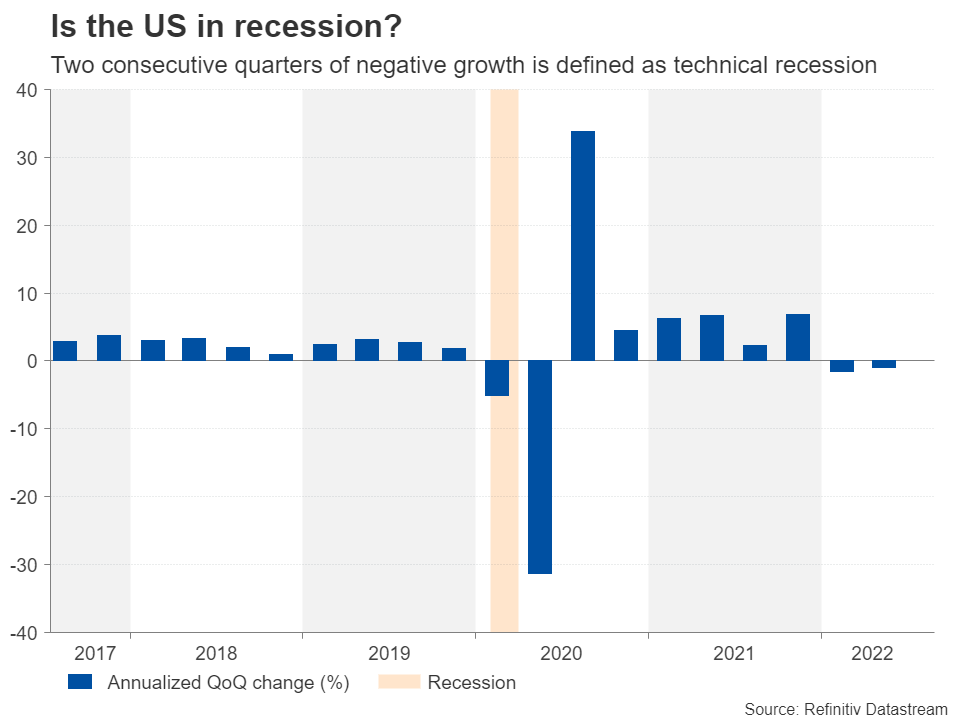
Fed policymakers have been downplaying the GDP estimates, highlighting the strong jobs growth and signalling the markets that there’s still a lot of work to be done to bring inflation under control. The latest nonfarm payrolls figures seem to back the Fed’s argument as the labour market added an astonishing 528k jobs in July, pushing the unemployment rate down to a new post-pandemic low of 3.5%. Perhaps, slightly more unnerving is the fact that wage growth also appears to be heating up again, having moderated somewhat after March.
Rate hike expectations are edging up again
Unsurprisingly, market expectations for a more aggressive Fed were bolstered after the jobs data, with investors lifting the odds for a 75-bps rate increase in September to 65% from around 40% before. However, there’s a risk those expectations will be pared back again if the CPI numbers confirm the prediction that inflation has likely topped out.
Amidst all the talk of recession and investors’ fear of overtightening by central banks, there’s been some glimmer of hope on the inflation front. The price components of the PMIs have come down substantially from their peaks, driven not only by the recent pullback in the major commodity prices, but also by the easing of supply constraints.
Have prices peaked?
It will probably take some time for the ebb in inflationary pressures to fully filter through the economy but where there is less of a lag is gasoline prices. Oil’s steady decline since the middle of June is now starting to make its way through at the pump across America. Apart from fuel, the other big generators of inflation in post-pandemic America have been rents and used car prices. There is increasing evidence that the former is on the way down and there are some signs that the used-vehicle market is normalizing too. Hence, the risk to the CPI readings seems tilted to the downside.
The consumer price index is forecast to have risen by 0.2% month-on-month in July – the slowest pace in almost a year, which would translate to a drop in the annual rate from 9.1% to 8.7%. However, there may be some bad news when it comes to underlying inflation. The core measure of CPI is expected at 6.1% y/y, which would mark a slight acceleration from the prior month’s rate of 5.9%, though the month-on-month rate is seen moderating from 0.7% to 0.5%.
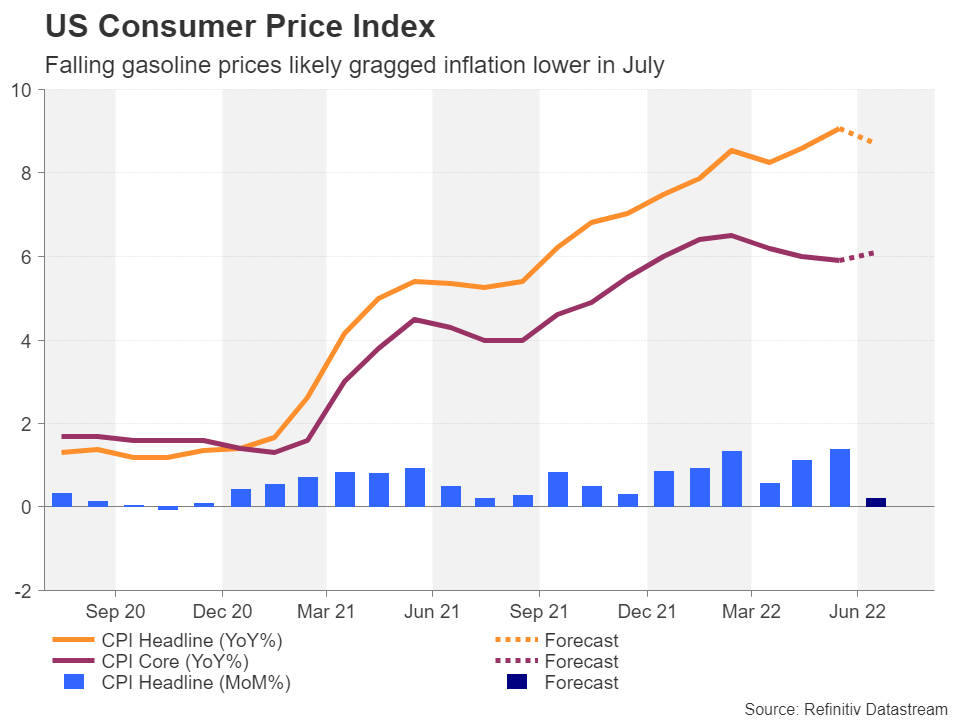
Producer prices are also showing signs of having peaked. PPI for final demand due Thursday is expected to fall from 11.3% to 10.4% y/y, while PPI excluding food and energy is forecast to have declined from 8.2% to 7.6% y/y.
Dollar’s bounce has hit a wall
If there is a surprise miss in the headline CPI print, the dollar’s latest rebound against the Japanese yen would be at risk of faltering. The pair is already struggling after being capped by the 50-day moving average (MA) in the 135-yen region. Renewed selling pressure could push the dollar back down to the August trough of 130.39 yen.
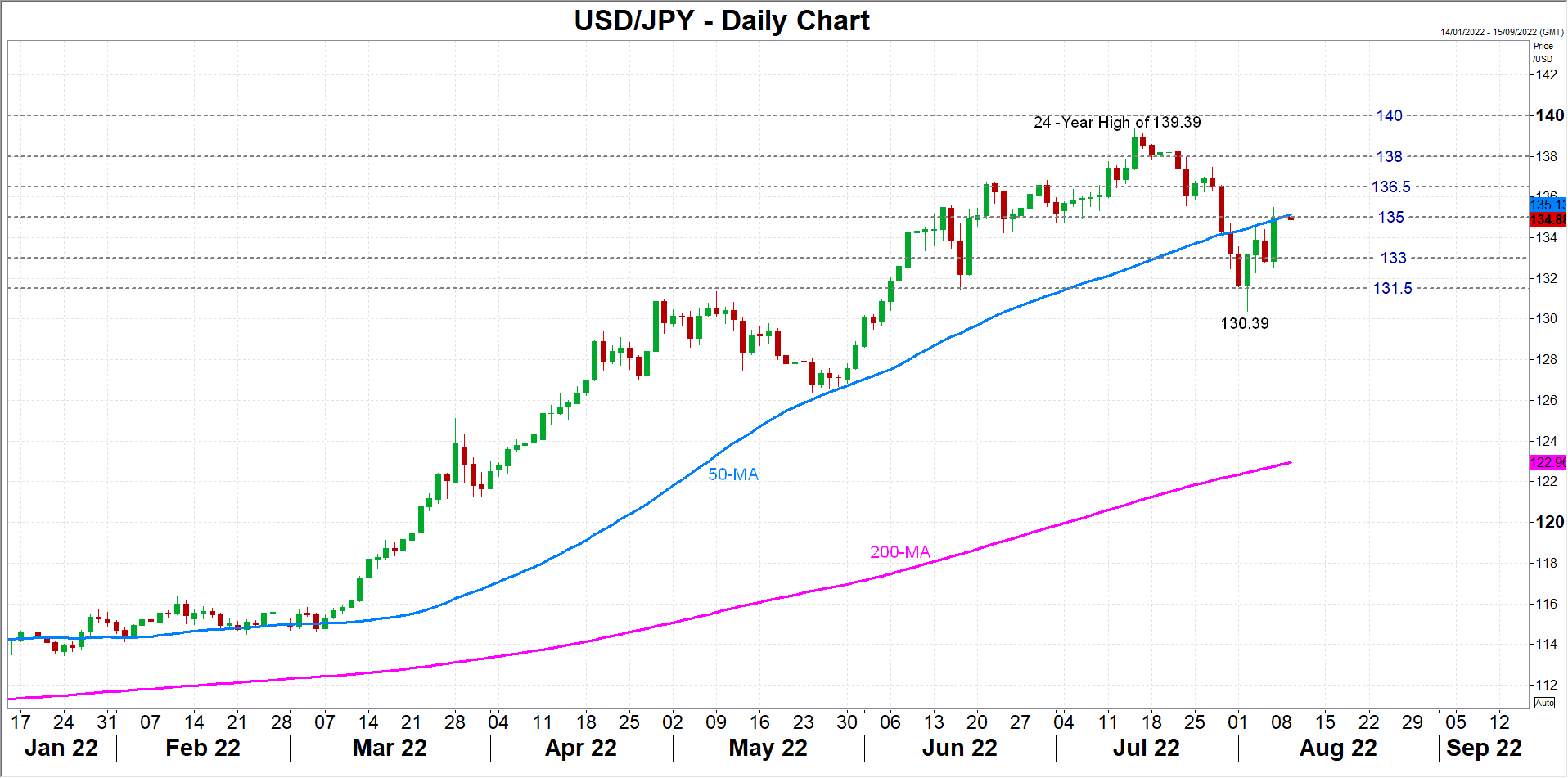
However, a stronger-than-expected set of inflation data that comes hot on the heels of the stellar jobs report could help the pair break above the 50-day MA and have another attempt at hitting the 140 level, which it failed to do in July when the rally stopped at 139.39.
Inflation expectations matter too
If the CPI and PPI numbers fail to provide much clarity on where Fed policy is headed, investors will get another chance to gauge price pressures on Friday from the University of Michigan’s consumer sentiment survey. Last month, consumers’ one- and five-year inflation expectations measured by the survey eased slightly, adding to the growing momentum behind the view that the US is past peak inflation. A lot is riding on the August readings to confirm the downward trend in inflation expectations.
Aussie Rally Takes Breather
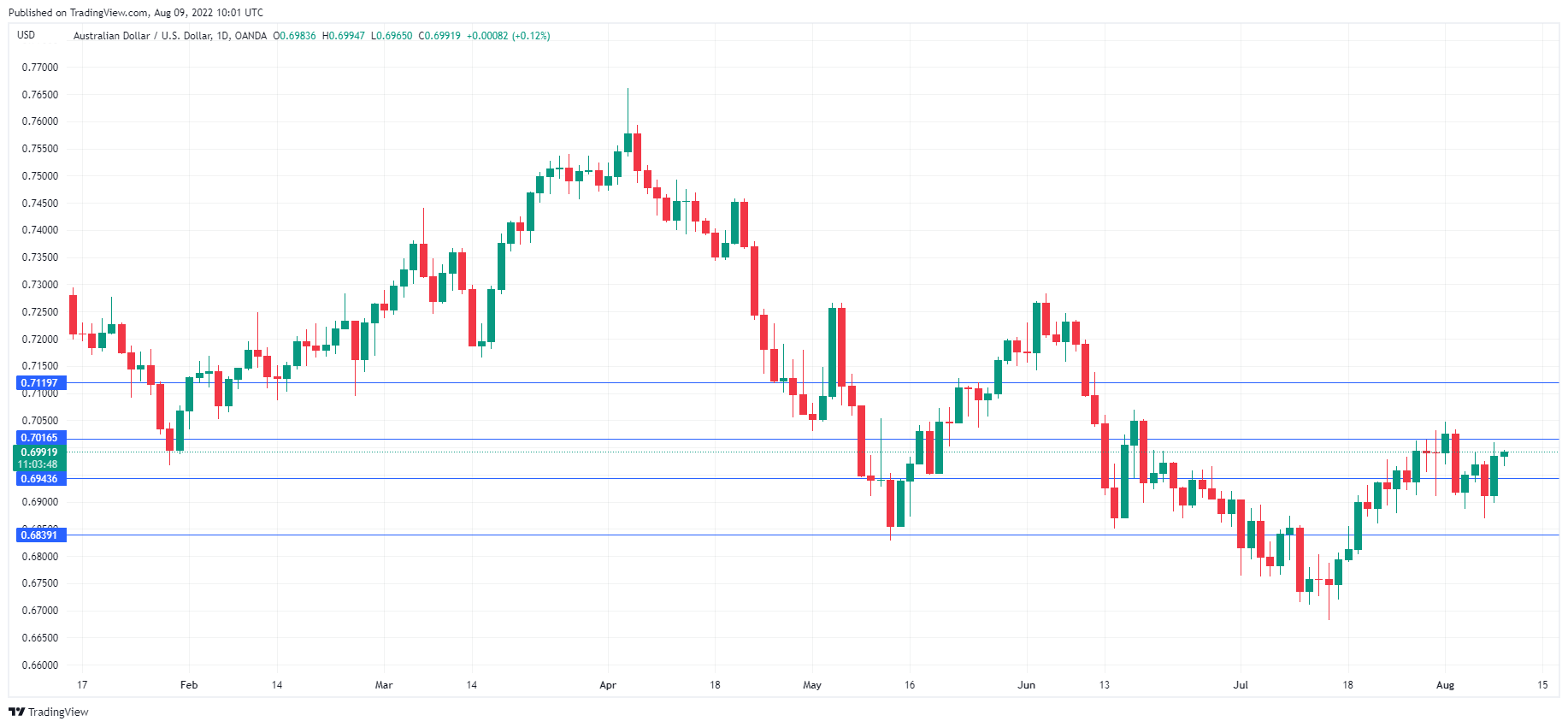
In the European session, the Australian dollar is trading at 0.6991, up 0.10% on the day. This follows massive gains on Monday, when AUD/USD soared 1.04% and briefly pushed above the symbolic 70 level.
The US dollar’s recent rally has fizzled, but don’t count Uncle Sam out. US Treasury yields have been dropping, which is indicative of investor demand for safety. There is plenty of uncertainty in the air about the US economy, and heated debates about whether the economy is in a recession or not are not contributing to greater confidence in the economic outlook.
Markets eye US inflation report
Wednesday’s US inflation report could have a strong impact on the currency markets. Headline CPI is expected to fall to 8.7%, down from 9.1%, while core CPI is forecast to rise to 6.1%, up from 5.9%. If the headline reading is higher than expected, it will boost the case for the Fed to raise rates by 0.75% in September and the dollar should respond with gains. Conversely, a soft reading from the headline or core releases would ease the pressure on the Fed and could send the dollar lower.
In Australia, confidence releases were a mix. Westpac Consumer Sentiment for August posted a second straight decline of 3%. Consumer confidence has dropped for nine consecutive months, declining some 22.9% during that time. There was better news from the NAB Business Confidence index for July, which jumped to 7, up from 2 points. Business Conditions climbed to 20, up from 13 prior. The indicator points to broad-based strength in business conditions, despite the global slowdown and weaker domestic activity due to higher rates. As well, purchase and labour costs and retail prices rose, which points to higher inflation and another hike from the RBA in September, likely of 0.50%.
AUD/USD Technical
- There is weak resistance at 0.7016, followed by resistance at 0.7120.
- 0.6943 has switched to support. Below, there is support at 0.6839
BoE Ramsden: It’s more likely than not to raise rates further
BoE Deputy Governor Dave Ramsden said in a Reuters interview, "for me personally, it's more likely than not that we will have to raise Bank Rate further.
"But I haven't reached a firm decision on that," he added. "I'm going to look at the indicators, look at the evidence as we approach each upcoming meeting."
"I'm certainly not ruling out a situation where when we look at the risk to the economy, having been raising Bank Rate, at some point we then have to start lowering it quite quickly," he said. "I can imagine situations, yes, where we'll carry on... with a pace of QT in the background."
Silver and Palladium Broke Up. Will Gold Follow?
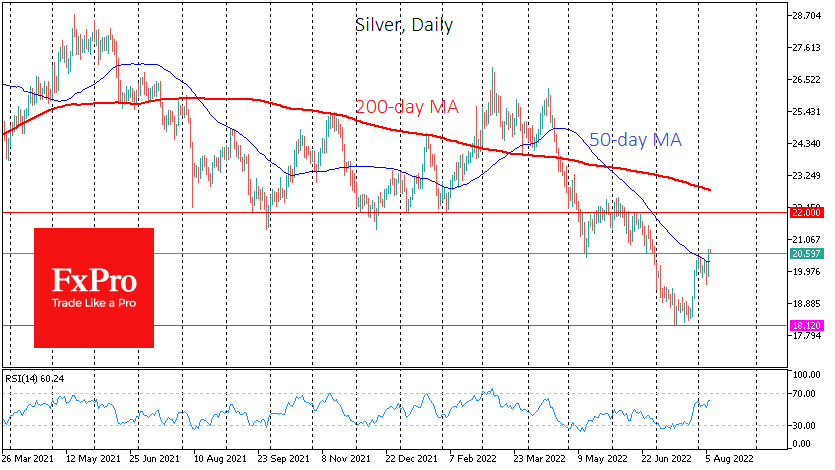
The precious metals are recapturing critical levels one after another, claiming a reversal to the upside after a two-year bearish trend. Silver made quite a move up on Monday, gaining over 4%. Palladium closed the day up 5.3%, and at one point, it was up 6%.
Silver managed to break above the 50-day moving average, which used to be an effective resistance since the beginning of the month and made a six-week high. More positive vibes for investors are likely to come from a quick return above $20.
At current levels near $20.60, silver has approached the support area of May, which could now move into resistance. If the bulls don’t fight back sufficiently here, the price could jump quite quickly to $22, the area of the rebound highs of June. This is already the critical turning point in the last eight years, where a battle between long-term investors with opposing views is about to occur.
Palladium rose on Monday to $2250, the high since May, developing the uptrend of the last two months. Confident buying pushed palladium above the 200-day average yesterday, although sellers have stepped near it over the past four months. This looks like a fundamental change for long-term investors in confirmation of the upward trend since June.
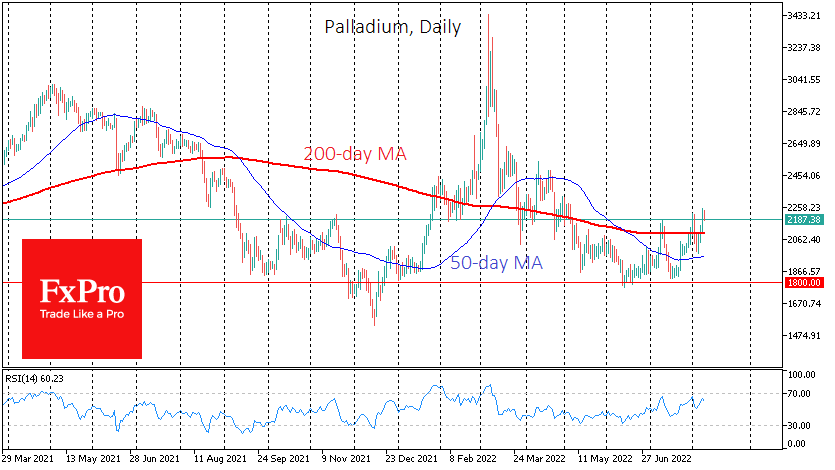
So far, silver and palladium are now showing more bullish signals, while gold remains anchored at the 50-day moving average and below the local lows of May and June. However, gold is often in slightly earlier stages of market cycles as a more liquid instrument.
Bitcoin’s Third attempt to take 24,000
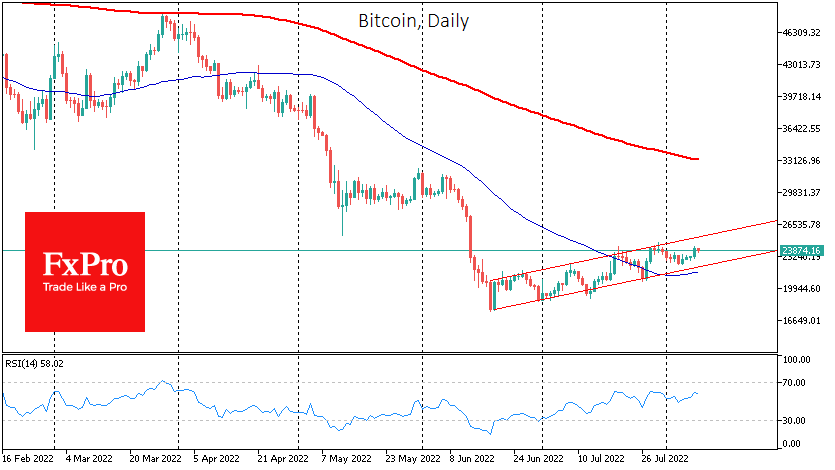
Bitcoin rose 3.5% to $24,100 on Monday and retreated slightly from the highs to 23900 on Tuesday morning. Ethereum is trading near $1780, adding 3.5% in the last 24 hours. Top altcoins have gained between 0.2% (BNB) and 5% (Polkadot).
The total capitalisation of the crypto market, according to CoinMarketCap, rose 1.9% to $1.13 trillion overnight.
Bitcoin on Monday tested the area of the previous month’s highs around $24K, from where it had previously rolled back twice. Sellers’ pressure increased somewhat near the earlier highs following a moderate correction in stock indices, but the general consolidation trend with an upward bias persists for now.
News background
Ethereum co-founder Vitalik Buterin said the network’s impending move to PoS in September could boost the popularity of cryptocurrencies for everyday payments. According to him, the popularity of payments has fallen since 2018 due to high transaction fees.
Last week, BlackRock entered a partnership with Coinbase, under which BlackRock customers will be able to trade cryptocurrencies. Famous online analyst InvestAnswers believes the inflow of cryptocurrency funds from this investment company’s clients could push the BTC price to $773K.
According to Messari, investments in the crypto industry reached $30.3bn in the first half of 2022, more than the entire year 2021. According to Coin ATM Radar, around 15 cryptocurrencies are set up worldwide daily, with the total number exceeding 39K.
Singapore-based cryptocurrency lending platform Hodlnaut suspended withdrawals and other crypto-asset transactions, saying it needed to “focus on stabilising liquidity”. The World Gold Council noted integrating blockchain into the gold industry’s production processes could increase transaction transparency and consumer confidence.
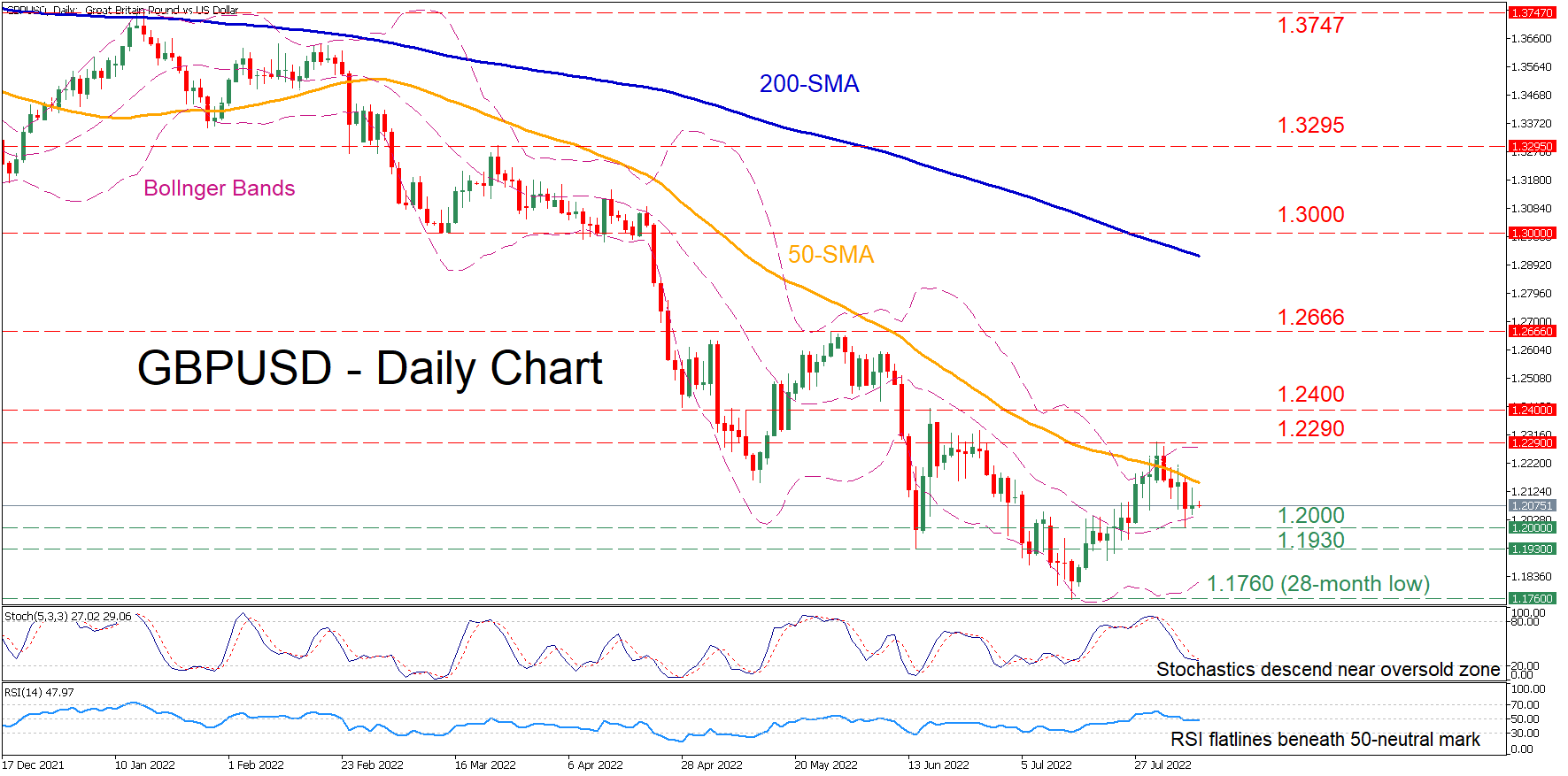
GBPUSD Capped by 50-day SMA as Rebound Falters
GBPUSD has been in a prolonged downtrend since the beginning of the year, creating a clear structure of lower highs and lower lows. Although the pair managed to faintly bounce back after its downfall halted at the 28-month low of 1.1760, the price has been repeatedly held down by the 50-day simple moving average (SMA) in the last few daily sessions.
The momentum indicators reflect a cautiously negative tone. Specifically, the stochastic oscillator is descending near its 20-oversold area, while the RSI remains below its 50-neutral mark after its recent slump.
To the downside, bearish moves could initially stall at the recent low of 1.2000, which is also considered a crucial psychological mark. Sliding beneath that floor, the spotlight could turn to the June support of 1.1930. A violation of the latter may open the door for the 28-month low of 1.1760.
Alternatively, should the price jump above its 50-day SMA, immediate resistance could be encountered at the recent peak of 1.2290. Conquering this barricade, the bulls might aim for 1.2400 before the May high of 1.2666 comes under examination. Even higher, the pair could ascend to test the 1.3000 psychological mark.
Overall, GBPUSD’s short-term picture is likely to deteriorate even further as the descending 50-day SMA appears to be a tough resistance barrier for the bulls. For the recent rebound to resume, the price needs to decisively cross above the 1.2290 ceiling.
EURJPY Bullish Correction Still at Risk
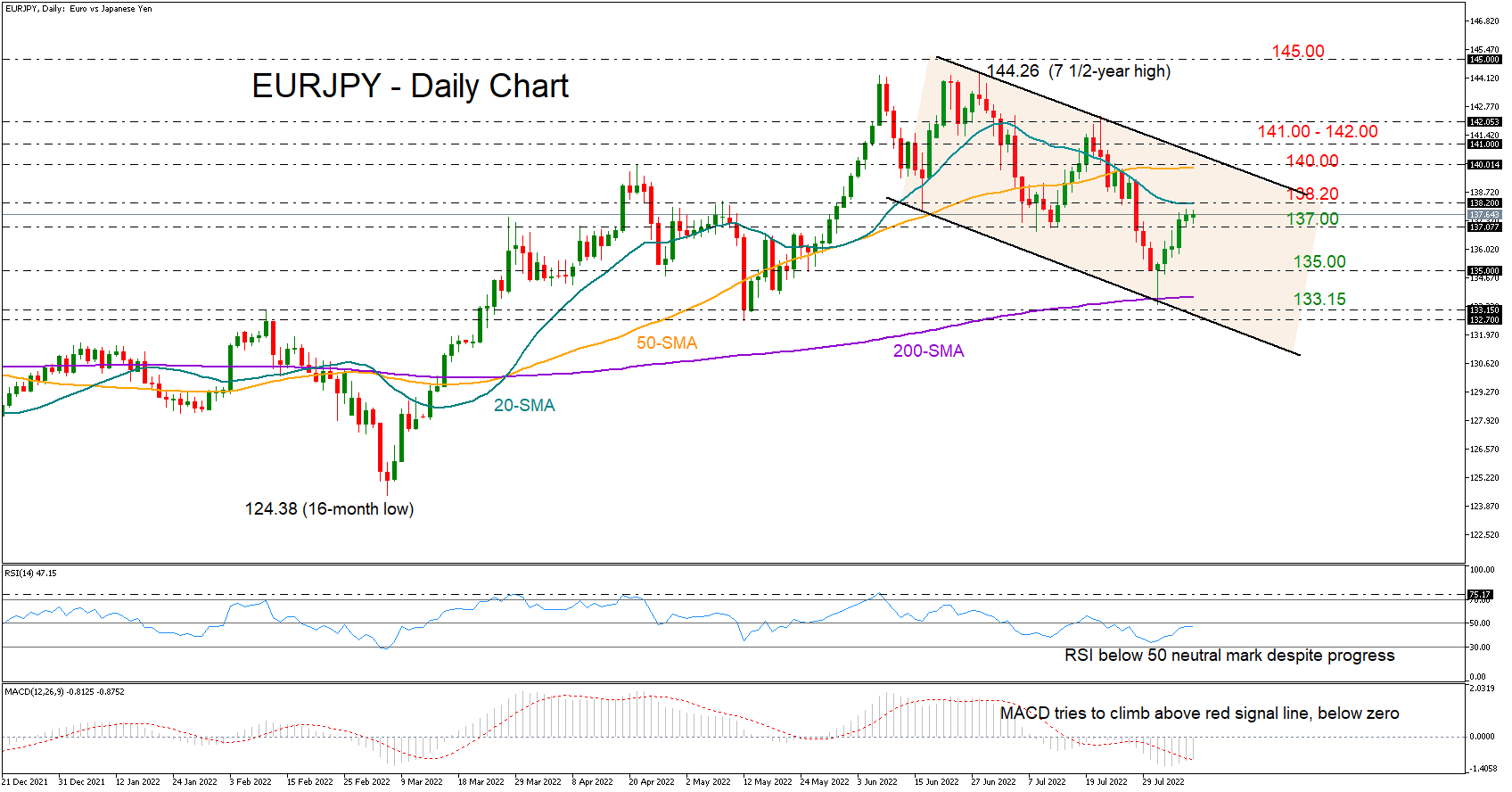
EURJPY has been in the green every single day since the plunge to an almost three-month low of 133.39 and the creation of a bullish hammer candlestick last week, rising gradually up to 137.91 on Monday.
The short bullish sequence, however, has not shifted the bias clearly on the positive side yet, as the RSI remains below its 50 neutral mark and the MACD is still trying to overcome its red signal line in the negative area.
The 20-day simple moving average (SMA) is currently viewed as the primary threat to the recovery at 138.20. If it successfully rejects the bulls, pressing the price below 137.00, the spotlight will shift back to the 135.00 support region, where the pair found a strong footing last week. Another violation at this point could retest the key constraining zone around 133.15 and the lower boundary of the bearish channel around 132.70.
In the event the pair climbs above the 20-day SMA, the bullish wave could pick up steam towards the 50-day SMA and the channel’s upper trendline at 140.00. A close above that wall would question the short-term bearish trajectory, though only a rally above the 141.00 and 142.00 psychological marks could clear the way towards the 7½-year high of 144.26.
Summarizing, despite the latest bullish correction, EURJPY has not entirely eliminated negative risks while trading within a downward-sloping channel. For that to happen the pair will need to cross above the 20-day SMA at 139.19 and then speed above the channel to upgrade the short-term outlook.
Markets Mixed as Spotlight Shines on US CPI
Asian shares struggled for direction this morning as concerns about inflation and the outlook for economic growth weighed on sentiment. Overnight, Wall Street’s main indices were mostly flat with a sales warning from Nvidia dragging down the tech sector. In Europe, stocks are expected to open lower due to the growing caution ahead of the US inflation report on Wednesday.
Looking at currencies, king dollar has retreated from recent highs while EUR/USD is trading around the sticky 1.02 level. Gold seems to be waiting for a fresh fundamental spark while oil prices are under pressure as OPEC’s monthly report and EIA data loom.
On the data front, Australian consumer sentiment slumped in August thanks to the horrible combination of soaring inflation, rising interest rates, and gloomy outlook on living costs. This marks the ninth consecutive month that sentiment has stayed negative.
Will US inflation report spark fireworks?
The main risk event and potential market shaker this week will be the latest US inflation figures published on Wednesday. After accelerating by 9.1% in June, markets are forecasting a cooling in July annual inflation to 8.7%. Should expectations match reality, this could be a breath of fresh air for financial markets and fuel optimism around inflation plateauing. Given how markets remain obsessive and incredibly reactive to any topic relating to rising prices, explosive levels of volatility could be on the cards.
If US consumer prices defy market expectations by rising again, this is likely to reinforce expectations around the Fed hiking rates by another 75 basis points in September. According to Bloomberg, traders are currently pricing in this scenario with around a 74% probability.
Alternatively, if the inflation report meets or misses expectations, this could raise hopes over consumer prices peaking. Such a development could encourage the Fed to step back from its aggressive approach toward hiking rates, which could send the dollar tumbling and Treasury yields declining.
Commodity spotlight – Gold
Gold was able to recover from last Friday’s selloff after the strong jobs report cooled recession fears and fortified expectations for more aggressive Fed rate hikes. Bulls wasted little time in clawing back the post-NFP losses yesterday with prices trading around $1785.50 as of writing.
Although buyers have been in the driving seat for the past three weeks, the pending US CPI report could shift the balance of power between bulls and bears. A strong inflation report could deal zero-yielding gold a heavy blow as aggressive rate hike bets jump. Alternatively, a weak report may provide the precious metal an opportunity to push higher.
Looking at things from a technical perspective, there are a couple of tough resistance levels that bulls may face down the road. The first one is around $1785 where the 50-day SMA resides and $1830, a key point just below the 100 and 200-day Simple Moving Average. If bears end up dominating the scene, prices may sink back towards $1752 and $1724.
Lacking Direction
Equity markets are lacking any real direction in Asia and that appears to be carrying into the European session as well.
Europe is seeing minor losses on the open, offsetting some of the small gains in choppy trade at the start of the week. This follows a similarly choppy session in the US on Monday as the Dow flirted with exiting correction territory and the Nasdaq bear market territory.
We may have reached a point in which investors need to decide whether they truly buy into the recovery/no recession narrative or not. That is what appears to have fueled the recovery we've seen in equity markets despite the fact that inflation hasn't even started falling, central banks are still hiking aggressively and recession is on the horizon for many.
It's time to decide whether this is just a substantial bear market rally or a genuine view that the economic outlook is far less downbeat than many fear. If equity markets are going to push on from here, it must be based on the latter which I'm sure many would welcome but perhaps more through hope than expectation.
Don't get me wrong, the US in particular still has plenty of reason to be encouraged. The data on Friday highlighted once more just how hot the labour market still is and the consumer is still in a very healthy position. But there are pockets of weakness as well and unless inflation starts to subside, those areas of strength will start to crack.
The inflation data on Wednesday could effectively set the mood for the rest of the summer. That seems quite dramatic but if we fail to see a drop in the headline rate, considering the acceleration we're expected to see in the core, it could really take the wind out of the sails of stock markets as it would be very difficult for the Fed to then hike by anything less than 75 basis points in September.
Of course, there will be one further labour market and inflation report before the next meeting which will also have a big role to play. But the July data will be very difficult to ignore. If the rally is going to continue, we may need to see a deceleration in the headline rate at a minimum, perhaps even a surprise decline at the core level as well. It's no wonder we're seeing so much caution this week.
Oil edges lower as Vienna talks conclude
Oil prices are marginally lower on Tuesday after recovering slightly at the start of the week. All of the talk of recession has caught up with crude prices over the summer, forcing a substantial correction that will be welcomed by those looking on in horror as they fill their cars.
The question is how sustainable $90 oil is when the market remains very tight and OPEC+ is only willing to make small moves in order to address it. It's comforting to know that Saudi Arabia and the UAE have spare capacity in case of emergency but I'm sure most would rather they actually use some of it considering many countries are facing a cost-of-living recession.
Nuclear deal talks in Vienna have concluded, with the EU suggesting a final text will now be put forward for the US and Iran to either agree on or reject. I'm not sure traders are particularly hopeful considering how long it's taken to get to this point and with there still reportedly being points of contention. An agreement could ease further pressure on oil prices, the extent of which will depend on how quickly the country could then flood the market with additional crude.
Gold eyeing CPI data for breakout catalyst
Gold continues to trade around its recent highs ahead of Wednesday's inflation report, with a softer dollar on the back of lower yields on Monday supporting the rally once more. The yellow metal continues to see significant resistance around $1,780-1,800 and we may continue to see that in the run-up to the CPI release. A softer inflation number tomorrow, particularly on the core side, could be the catalyst for a breakout to the upside while a stronger number could put $1,800 out of reach for the foreseeable future.
Bitcoin rallies losing momentum
Bitcoin is not generating the same momentum in its rallies in recent weeks, as it continues to run into strong resistance on approach to $25,000. In much the same way that US stock markets are lingering around potentially important levels ahead of the inflation data, we could see bitcoin behaving in a similar manner. A weaker inflation reading could be the catalyst it needs to break $25,000 and set its sights on the $28,000-32,000 region once more, where it hasn't traded since the early part of the summer.
Daily Technical Analysis
EUR/USD
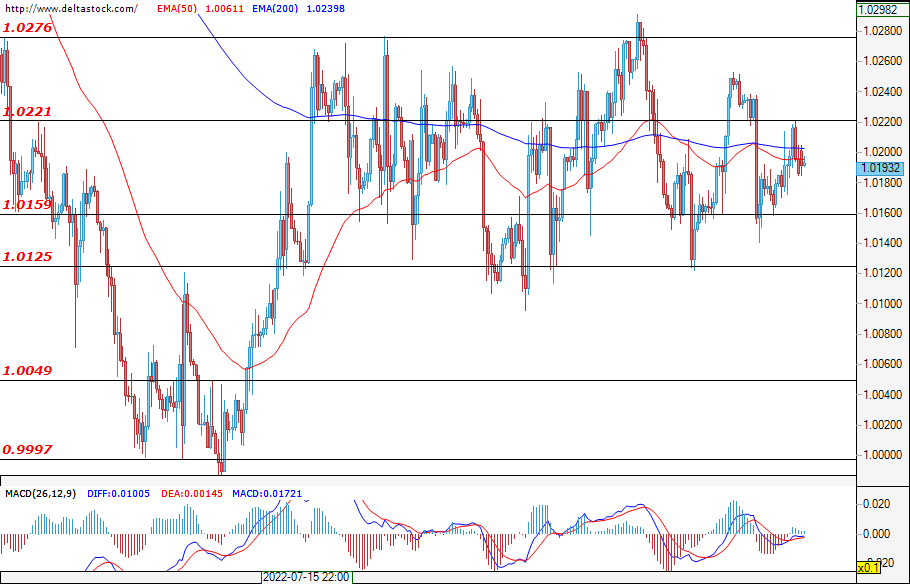
The first day of the week passed calmly for the European currency. We saw a slight decline in the early hours of the day, but after the opening of the European session, we saw trading activity ramp up around the 1.0160 support, after which the currency pair began a slow and painful rise. In the first hours of the European session, we saw an upside surge, which was then corrected, but later in the day, the euro managed to reach a daily high of 1.0221, at which point the gains were capped. Today, there is a lack of data that could potentially help the pair to sustain its growth. For now, the pair remains locked in a range and we could talk about a trend only after a confirmed breach of either border of the range.
USD/JPY
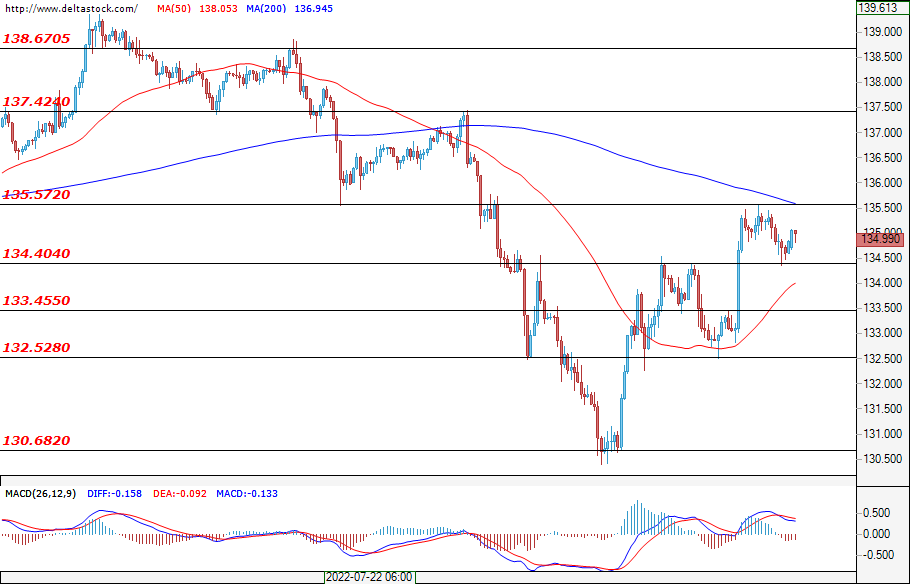
Тhe Ninja was in low volatility territory on Monday. The day started calmly, with no big moves even at the opening of the European session. At the U.S. open, however, the dollar extended its decline and we saw the pair bouncing off the 134.40 support and managing to end the day at about 50 pips higher than the mentioned key level. In the early hours of today, we saw the release of a set of macroeconomic data, but so far there has been no reaction to it on behalf of traders. Whether the dollar will be able to recover against the yen remains to be seen in the coming days. However, if the dollar performs poorly, then a further decline in the currency pair is not excluded.
GBP/USD
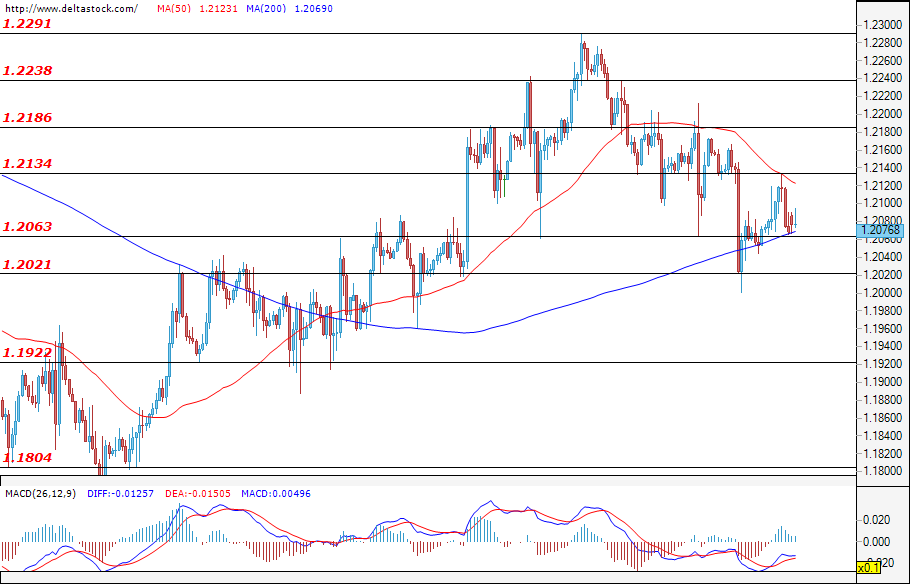
Monday was a choppy day for the Cable. Initially starting with a slight rise, the opening of the London stock exchange fuelled it further and the pair reached the resistance at 1.2134, from which it entered a downwards spiral and erased all of its gains by the end of the day. In doing so, the day ended at almost the same values as it had started. Today, there is a lack of macroeconomic data that is expected to give the currency pair a clear direction. Whether the GBP/USD will be able to secure its long-term recovery will depend on the strength of the dollar. If it continues to be weak, then this will allow the sterling to seek new highs, but if we see a strengthened U.S. currency, then this could lead to a prolonged decline in the GBP/USD.
EUGERMANY40
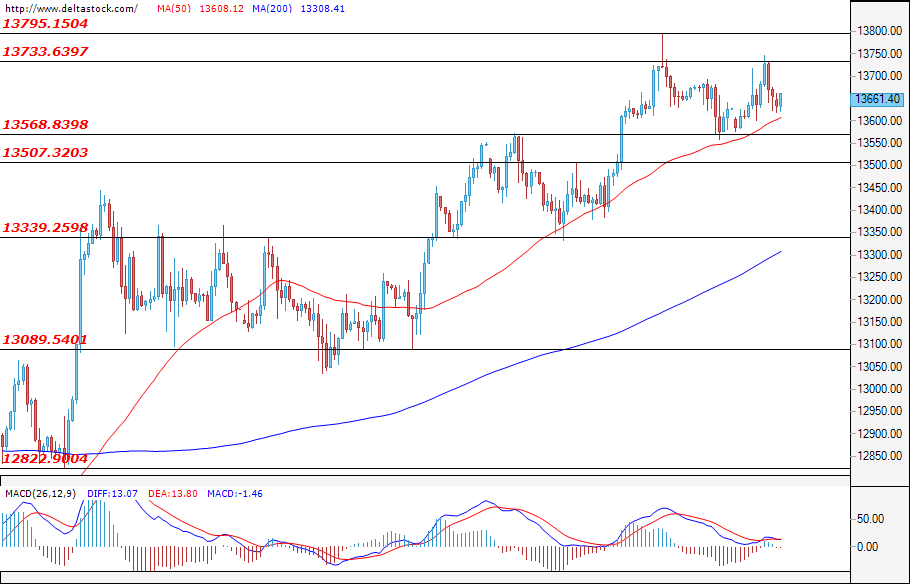
The German index opened the day with a small downward gap and managed to fill it up within the next few hours. As the European session opened, we saw a slight downward correction, but after the increased trading activity around the 13600 support, the EUGERMANY40 managed to climb to a daily high of 13747, but failed to breach the previous week's high. There are no major events today to give the index a boost, but its correlation with the U.S. indices seems to be high, and so they may dictate the German index’s direction today as well.
US30
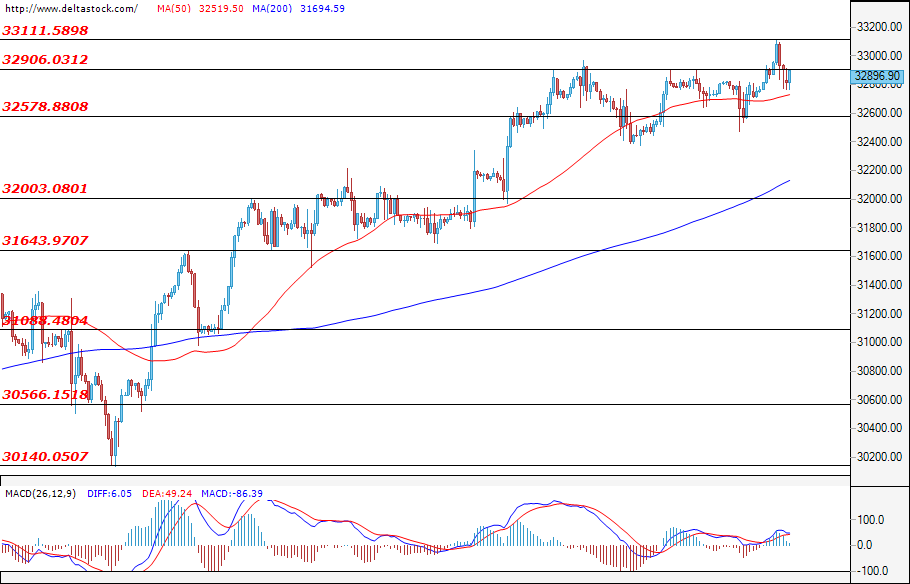
The blue-chip index extended its growth on Monday. In the early hours, we saw the start of an upward movement, which around the opening of the U.S. stock exchange managed to reach a new monthly high of 33111. However, there the bears found good entry prices and some of the growth was corrected as the day managed to close at around 32896. Today, whether the rise in the US30 will continue will depend on whether the dollar will extend its decline. However, if we see a strengthening of the dollar, then this could lead to a correction in the index, despite the absence of important macroeconomic data for the U.S.