

Sample Category Title
Week Ahead – US Inflation Report to Cast Light on Fed’s Path
Another decisive week for global markets lies ahead. The main event will be the latest CPI report from the United States, which will reveal whether inflation has finally started to cool off. That’s what business surveys and commodity prices suggest, setting the stage for a retracement in the almighty dollar.
Recession blues
Market participants are playing a cat and mouse game, constantly shifting back and forth between worrying about inflation or growth. When incoming data points to a resilient economy, the pendulum swings towards inflation and traders price in faster rate increases. When the data disappoints, recession concerns dominate and Fed tightening gets priced out.
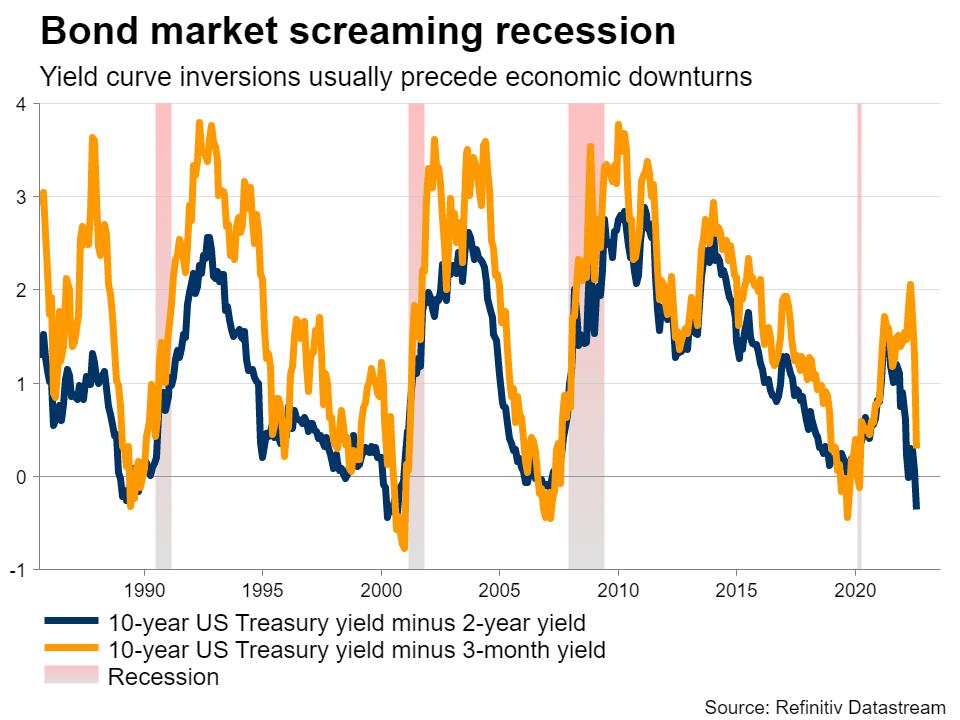
Recession fears were winning this battle until recently. A storm of leading indicators such as business surveys, inventories, housing, consumer confidence, and an inverted yield curve were all warning that a downturn is imminent. This led to a sharp decline in US yields, which helped bring the Japanese yen back from the dead.
But the dollar didn’t really lose its shine, despite the repricing around the Fed. This resilience boils down to safe haven flows and a lack of alternatives. Europe for instance is in even worse shape - it will probably be at the epicenter of any global recession, as the energy crisis bites consumers.
It’s difficult to see this ‘strong dollar’ dynamic changing until the economic outlook for the rest of the world improves and capital starts flowing out of America. The decline in oil prices is a good start, but is not enough. Markets might need to see a ceasefire in Ukraine before the trend can reverse, and that doesn’t seem close.
That being said, we could see a retracement in the dollar’s ferocious rally on Wednesday, if the upcoming dataset confirms that inflation has started to lose its punch. The yearly CPI rate is expected to have declined to 8.9% in July from 9.1% previously, while the monthly rate is forecast at 0.3% from a stunning 1.3% previously.
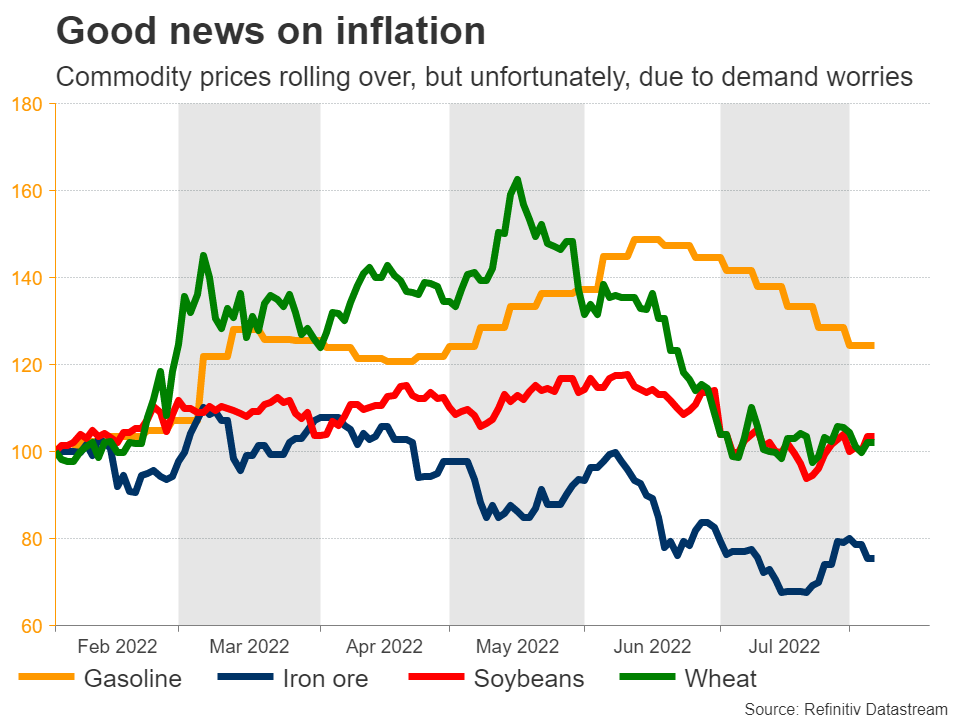
Adding credence to these forecasts, business surveys like the S&P Global composite PMI showed that companies raised their selling prices at the slowest pace since March last year as demand faltered. Commodity markets agree, with everything from gasoline to food prices rolling over lately.
Money markets are currently pricing in around even odds on whether the Fed will raise rates by 50 or 75 bps in September. A softer than expected inflation print could tip the scales towards 50bps and consequently inflict some damage on the dollar. That said, even if euro/dollar climbs all the way up to 1.0550, some 300 pips away, the downtrend would still be in effect.
Data on producer prices will follow on Thursday, ahead of the University of Michigan’s consumer sentiment survey on Friday.
UK growth eyed
Crossing into the United Kingdom, preliminary GDP growth data for the second quarter will be released on Friday. At its meeting this week, the Bank of England projected a contraction of 0.2% for this quarter, even as it raised interest rates by 50bps.
Despite the rate increase, sterling suffered in the aftermath because the BoE’s overall message was quite gloomy. The economic forecasts were apocalyptic, pointing to five consecutive quarters of negative GDP growth starting in the fourth quarter of this year.
Markets interpreted that as a signal that the tightening cycle might be cut short. If such a prolonged recession materializes, the demand destruction would probably be enough to curtail inflation without the need for much higher rates.
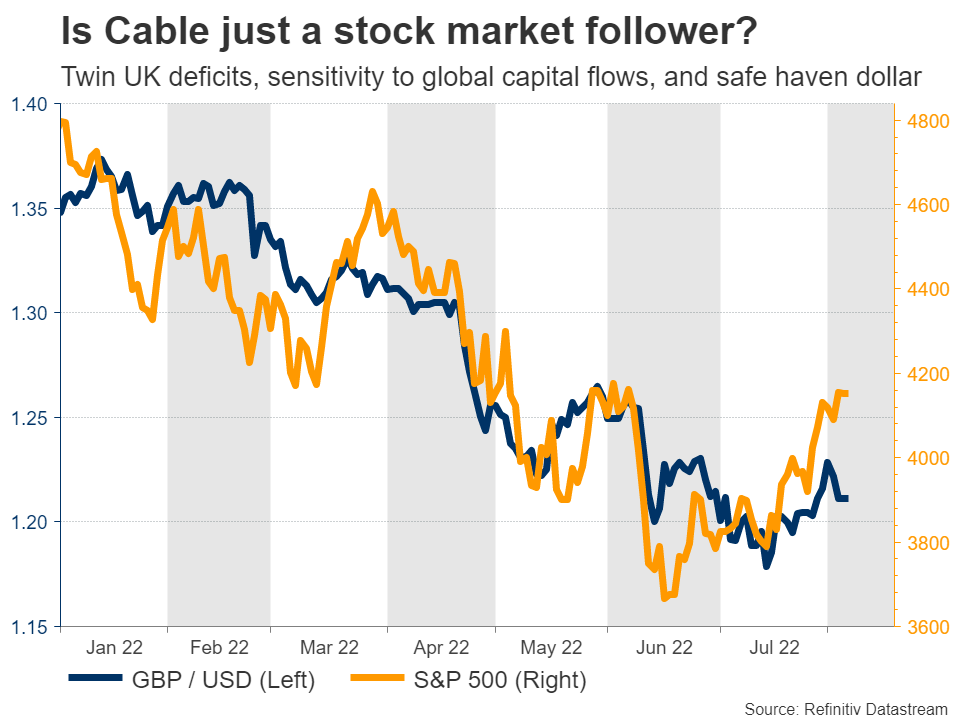
Looking ahead, the most crucial element for the pound might be how global risk sentiment evolves. Traders already have a good idea of what the BoE will do for the rest of the year - raise rates but at a measured pace. What is less certain is how the stock market will fare, a factor that sterling is very sensitive to.
China eyes trade data
In the world’s second-largest economy, trade data for July will be released over the weekend, ahead of inflation stats on Wednesday. This was a month characterized by looser pandemic restrictions, and that might be reflected in the numbers.
Overall though, it’s difficult to be optimistic about the Chinese economy. The government continues its strict approach of tightening restrictions whenever there is a virus outbreak and the property sector is in freefall, with liquidity drying up and a ‘mortgage revolt’ as homeowners refuse to pay loans on unfinished houses.
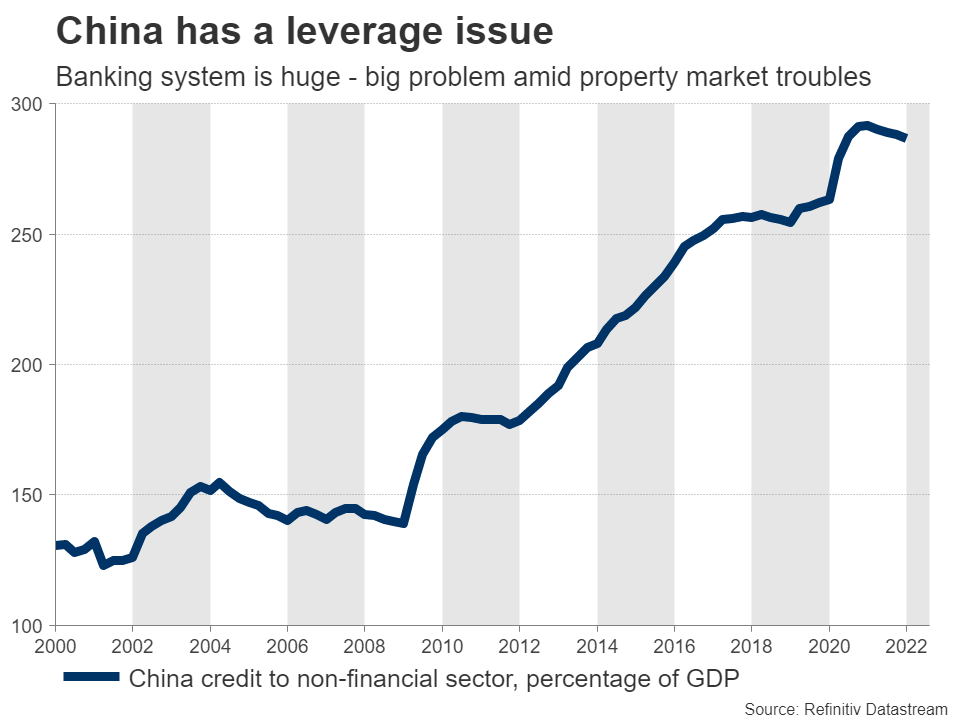
It doesn’t take much imagination to envision this crisis spilling over into the banking sector, which is tremendously leveraged at almost 300% of GDP. That’s without even including shadow banking. Consumer confidence is already at record lows, reflecting these troubles.
By extension, it’s difficult to be bullish on the Australian dollar - a nation whose entire economic model relies on China absorbing its commodity exports. Even though the Reserve Bank is raising interest rates, the threat of Chinese commodity demand rolling over is much greater - a risk that has hammered iron ore prices.
July US Jobs Report Obliterated Even the Most Optimistic Expectations
Markets
Crushed it! The July US jobs report obliterated even the most optimistic expectations. Employment grew by 528k, accelerating from an upwardly revised 398k in June and more than double the 250k consensus. Sectors producing the biggest increases were education & health (+122k), professional business services (+89k) and leisure & hospitality (+96k). After shedding 6k in June, the government again added 57k jobs. The unemployment ticked lower to 3.5%, equaling levels seen before the pandemic which, in turn, were the lowest since the late sixties. The decline came together with an unexpected drop in the participation rate from 62.2% to 62.1%. This is probably the opposite of what the Fed would like to see. Fewer people available on the labour market means employers fishing for people in a smaller pond which puts upward pressure on wages. These grew by 0.5% m/m to be up 5.2% y/y, both surpassing expectations of 0.4% and 4.9% respectively. It’s nothing but a stellar report and it sure doesn’t suggest the US economy is in recession. Money markets were still doubting Fed intentions even after the recent hawkish comments. But after today’s report, they ramp up rate hike bets for the September Fed meeting with the probability of a third straight 75 bps move rising to 75%. Total additional tightening expected for the remainder of the cycle (which markets see running until 2023Q1) jumps from 110 bps to 130 bps, give or take. The US yield curve bear flattens with changes going from 9.1 bps (30y) to 17.5 bps (2y). The 10y yield (2.81%) seeks a weekly close above the 2.72% support level. European yields add to their earlier pre-payrolls report in sympathy. German yield changes vary between 6.4 bps (30y) to 10.2 bps (5y). Swap yields rise even a tad more. BoE Chief Economist Pill had some dovish comments in store today, weighing on Gilt yields. He cautioned against assuming a 50 bps hike in September and was already talking about rates dropping near 2% if inflation drops (it doesn’t and even has yet to peak). But US knock-on effects even bring UK yields in positive territory for the day with advances from 9.6 to 11.7 bps across the curve.
The US dollar obviously didn’t miss the strong report and ditto yield rise. It’s the star performer in the G10 area. On a trade-weighted basis, DXY surges from 105.7 to 106.7. EUR/USD erases yesterday’s gain – which felt unnatural anyway – to be back at 1.016 at the time of writing. There are no technical implications though. USD/JPY is testing the 135 resistance. Sterling remains in the defensive post-BoE. EUR/GBP extends yesterday’s advance to 0.844. We note some spillover effects coming from GBP/USD though. The pair drops to the mid 1.20/1.21
News Headlines
China suspended communication channels with the US military as well as climate talks between the two biggest economies in the world. It does so in response to US House Speaker Pelosi’s visit to Taiwan earlier this week. In addition, The Chinese foreign ministry said Beijing would also no longer co-operate on a range of other legal issues. China said it would take countermeasures but the ones already announced were initially targeted Taiwan directly. These included banning imports and exports of certain products. It has also sent multiple groups of warplanes and warships to operate in the area of the Taiwan Strait.
Canadian employment unexpectedly declined by 30.6k in July, more or less equally distributed between full-time and part-time jobs. The back-to-back decline defied expectations for a 15k increase. In June, the 43.2k drop to a large extent was because of people leaving the labour market. The jury is still out whether this was the case again in July with the participation rate easing to 64.7% from 64.9%, or the effect of monetary tightening kicking in. The unemployment rate stabilized at 4.9%. With at the same time a stellar US jobs report being published, USD/CAD soared to 1.297, up from 1.286.
EUR/USD Mid-Day Outlook
Daily Pivots: (S1) 1.0183; (P) 1.0219; (R1) 1.0282; More...
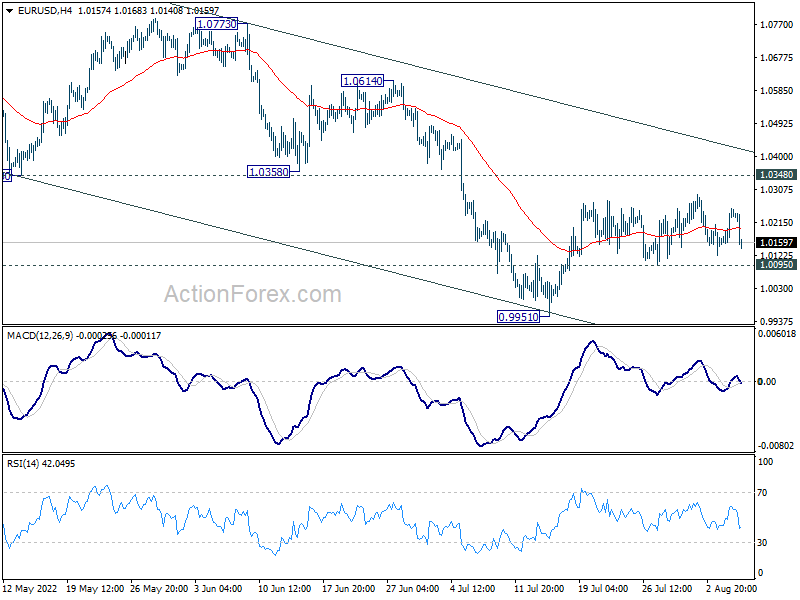
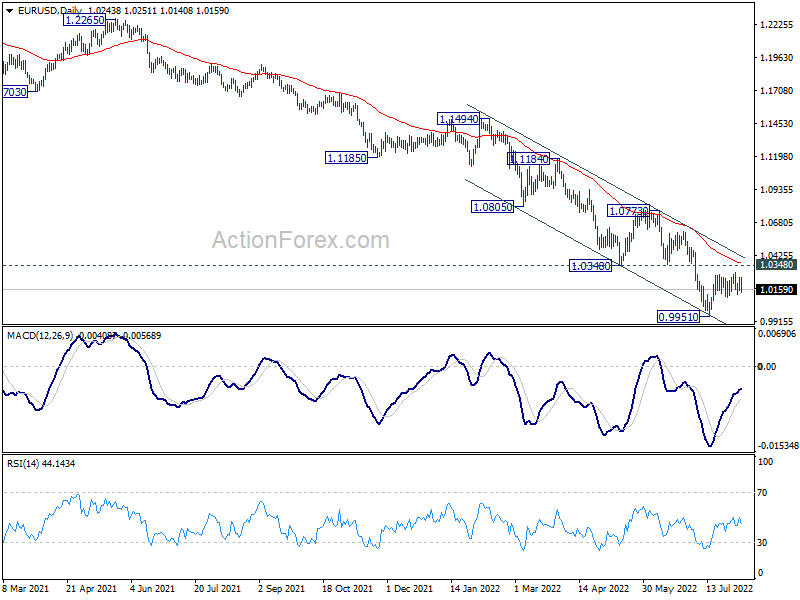
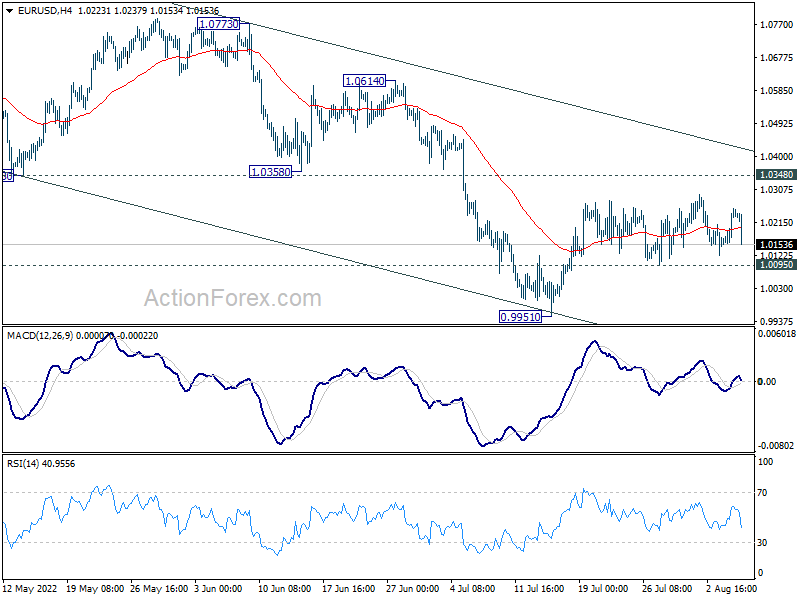
EUR/USD is still bounded in range and intraday bias remains neutral first. With 1.0095 minor support intact, further rise is still mildly in favor. Rebound from 0.9951 will target 1.0348 support turned resistance. Break there will target channel resistance at 1.0432. On the downside, break of 1.0095 minor support will turn bias back to the downside, and bring retest of 0.9951 low instead.
In the bigger picture, down trend from 1.6039 (2008 high) is still in progress. Next target is 100% projection of 1.3993 to 1.0339 from 1.2348 at 0.8694. In any case, outlook will stay bearish as long as 1.0773 resistance holds, in case of strong rebound.
GBP/USD Mid-Day Outlook
Daily Pivots: (S1) 1.2080; (P) 1.2146; (R1) 1.2225; More...
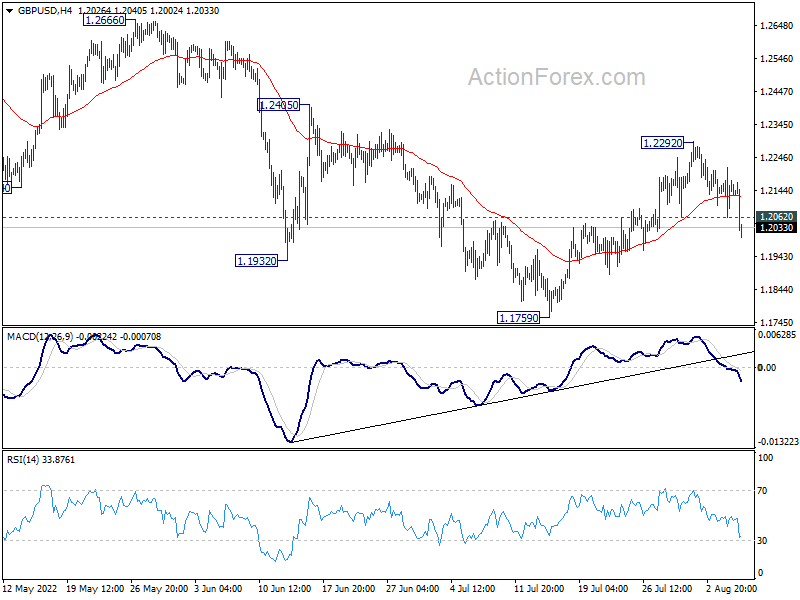
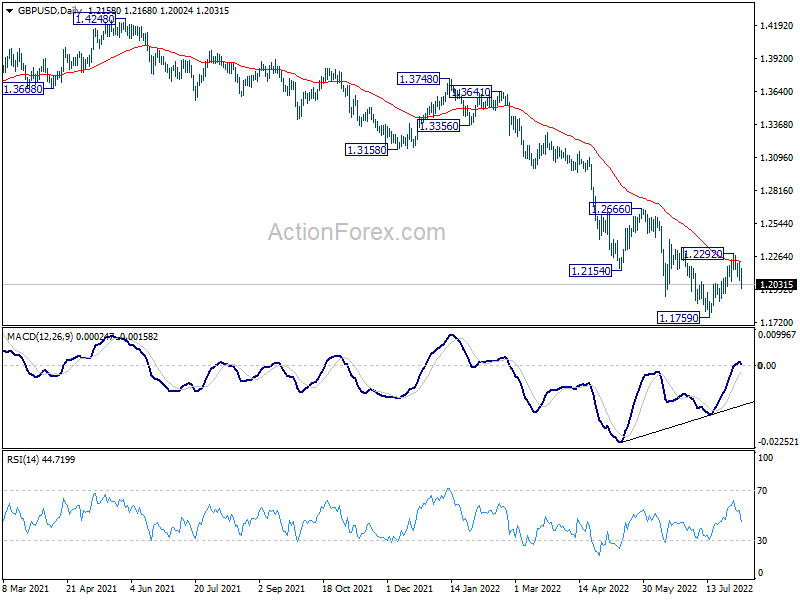
GBP/USD's break of 1.2062 suggests that corrective rebound form 1.1759 has completed at 1.2292, after hitting 55 day EMA. Intraday bias is back on the downside for retesting 1.1759 low first. Firm break there will resume medium term down trend. For now, risk will stay on the downside as long as 1.2292 resistance holds, in case of recovery.
In the bigger picture, fall from 1.4248 (2018 high) could be a leg inside the pattern from 1.1409 (2020 low), or resuming the longer term down trend. Deeper decline is expected as long as 1.2666 resistance holds. Next target is 1.1409 low. However, firm break of 1.2666 will bring stronger rise back to 55 week EMA (now at 1.2957).
USD/CHF Mid-Day Outlook
Daily Pivots: (S1) 0.9522; (P) 0.9572; (R1) 0.9601; More...
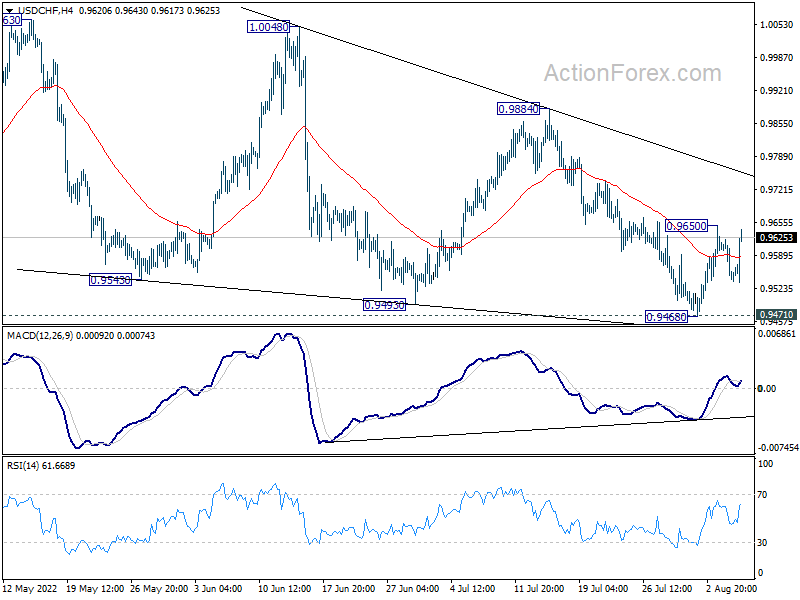
Intraday bias in USD/CHF remains neutral at this point. On the upside, break of 0.9650, and sustained trading above 55 day EMA (now at 0.9650) will raise the chance that corrective pattern from 1.0063 has completed. Further rally should then be seen to 0.9884 resistance next. However, decisive break of 0.9471 support will carry larger bearish implication.
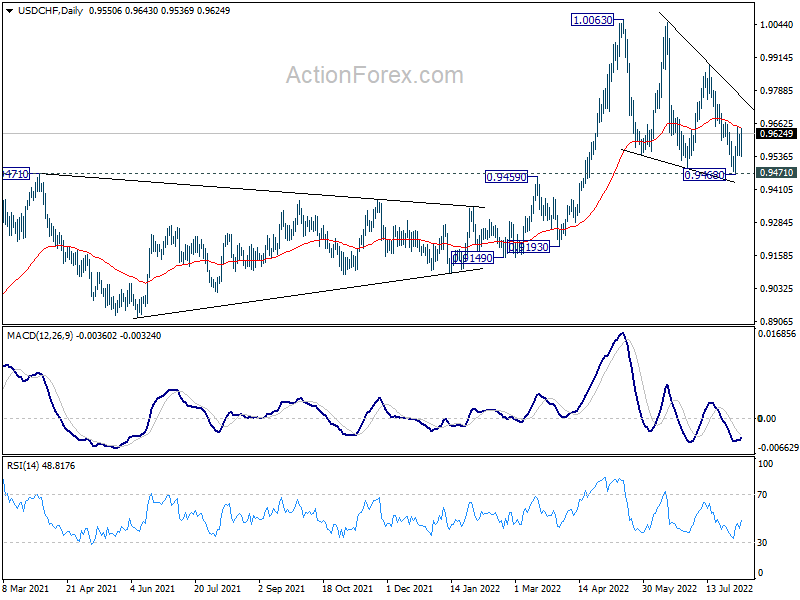
In the bigger picture, medium term up trend from 0.8756 (2021 low) is still in progress. On resumption, next target is 1.0342 (2016 high). Sustained break there will resume long term up trend from 0.7065 (2011 low). This will remain the favored case as long as 0.9471 resistance turned support holds. However, firm break of 0.9471 will raise the chance that such up trend is over. Sustained trading below 55 week EMA (now at 0.9424) could bring deeper medium term fall back to 0.9149 support and below.
July Payrolls Assuage Any Fear that the U.S. Economy is in Recession
The U.S. economy added 528k jobs in July, coming in well above the consensus forecast of 250k. Revisions to the prior two months were also positive, adding 28k jobs from previously reported May/June figures. U.S. payrolls have now surpassed their pre-pandemic level.
Employment gains were again widespread, with education & health care (+122k), leisure & hospitality (+96k) and professional & business services (+89k) leading the charge. Outside of these industries, hiring remained robust in transportation & warehousing (+21k), information (+13k) as well as wholesale (+11k) and retail (+22k) trade. Goods producing industries (+69k) also recorded hefty gains, with construction (+32k), manufacturing (+30k), and mining & logging (+7k) all adding jobs in July. Hiring in across the public sector (+57k) was also higher, after having recorded a modest decline the month prior.
The unemployment rate declined by a tenth of a percentage point to at 3.5% – returning to its pre-pandemic level. Based on the household survey, employment was up 179k, while the labor force fell by 63K. As a result, the participation rate fell by a 0.1pp to 62.1%
Average hourly earnings rose by 0.5% month-on-month to $32.27. On a year-over-year basis, wage growth held steady at 5.2%.
Key Implications
Woah! This morning's reporting should almost certainly assuage any fears that the U.S. economy is in a recession. While payrolls had been showing some signs of slowing in recent months, July data shows a complete reversal in that trend and flies in the face of other labor market metrics (initial jobless claims and job openings), which have suggested that the labor market was cooling.
While we don’t want to sound like a broken record, it's important to emphasize that these gains are not sustainable! The participation rate has moved sideways this year (and even ticked lower in July), implying the lack of labor supply will soon be a binding constraint on hiring.
With the FOMC dropping its forward guidance and moving to a data dependent "meeting-by-meeting assessment", today's report will do nothing to dissuade policymakers from further tightening monetary policy in the months ahead. Indeed, we heard from several Fed speakers over the past week, and all struck a decisively hawkish tone – likely in response to markets misreading Powell's press conference last week as coming across more dovish. In response to the Fed speak and this morning's job numbers, market pricing for more rate hikes by year-end have come up. Moreover, futures markets have sharply sold-off following after the jobs report and we’re seeing a deeper inversion in 10Y2Y spread, now having widened to 40bps.
Canada Sheds Jobs in July for Second Straight Month
The Canadian labour market shed 30.6k positions in July. Losses were spread among full-time (-13.1k) and part-time (-17.5k) positions.
Public sector employment was responsible for the bulk of the decline as it shed 51k positions. However, private sector employment also dropped (-13.8k). In contrast, self-employment jumped by 34.2k positions.
Even with the headline drop in employment, the was unemployment rate was unchanged at 4.9% - matching an historic low – as the labour force fell by 27k and the participation rate declined by 0.2 ppts to 64.7%. Meanwhile, the number of people unemployed long-term declined by 23k, marking the third consecutive drop.
By industry, job losses were concentrated in the services sector, where employment fell by 53k. Losses were spread across several industries, including wholesale and retail trade (-27k), healthcare and social assistance (-22k) and educational services (-18k). In contrast, employment in the goods producing sector was up 23k in June, lifted by manufacturing (+7k) and construction (+8k).
On a geographic basis, the bulk of the national jobs decline took place in Ontario, were employment fell by 27k positions. Elsewhere, the report noted a significant decline in PEI (-2.3k positions) and little change in all other provinces.
Lastly, total hours worked declined 0.5% month-on-month while average hourly earnings were up 5.2% year-on-year, matching June's pace.
Key Implications
That's two in a row in terms of weak headline jobs prints, and employment has now averaged an 11k decline over the past three months. This is consistent with our view that economic growth will soften in the second half of the year. The details skewed to the softer end in July, as full-time employment accounted for a larger share of the overall jobs decline than in June, and hours worked also fell. The latter is particularly notable as it could signal a soft print for monthly GDP, following flat growth in May and a sub-trend gain in June (based on Statcan's preliminary estimate).
Taking some sting away from the report is the fact that full-time employment only modestly retraced May's huge gain in June and July, and is still-up at healthy 4.7% year-on-year. In addition, wage growth continues to be robust (which will provide some offset to household incomes from inflation).
Although the jobs market and underlying economic growth is softening, the Bank of Canada remains determined to rein in sky-high inflation and keep expectations anchored. As such, we expect them to take their policy rate above neutral, with it ending the year at 3.25%.
GBP/USD Slides as Nonfarm Payrolls Surges
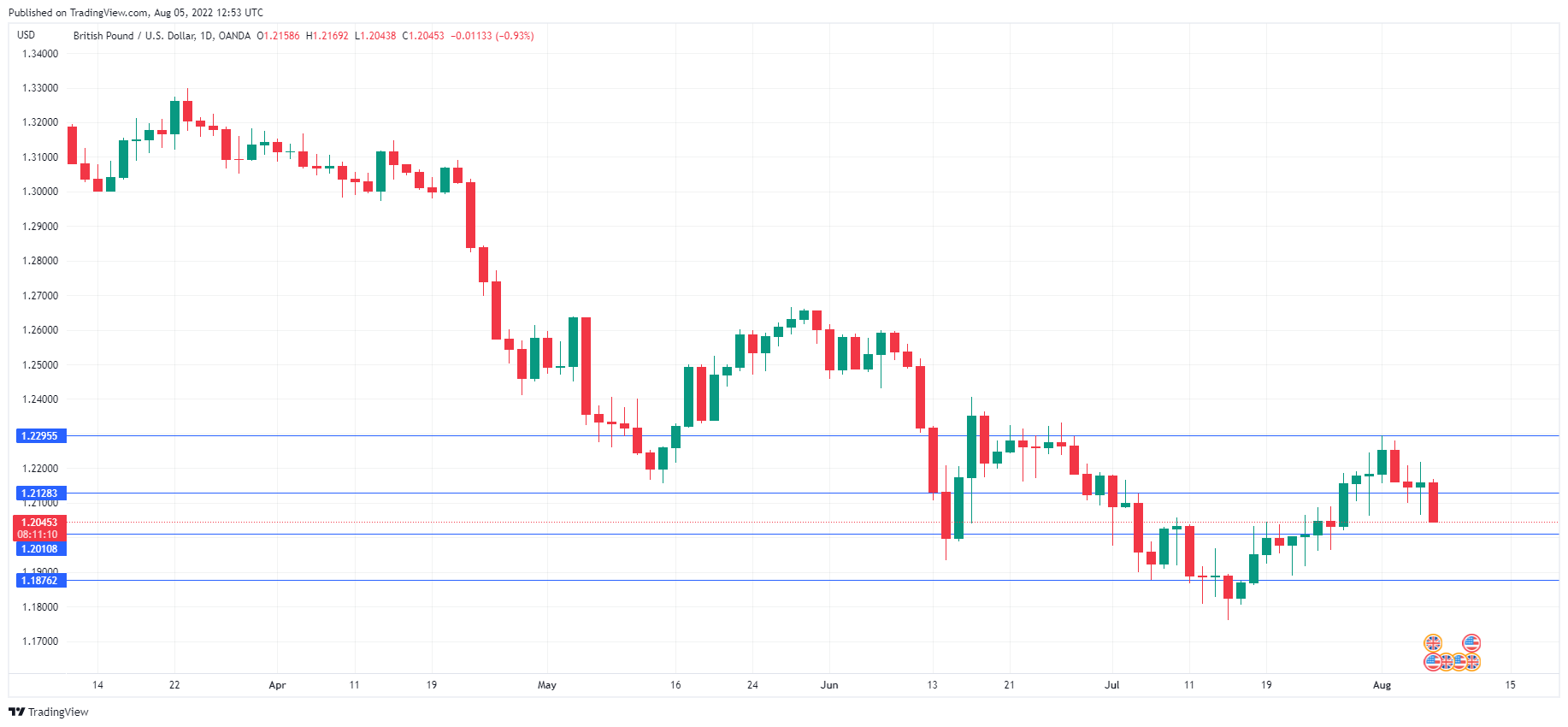
The British pound is falling sharply in the North American session, after a massively strong US nonfarm payment release. GBP/USD is trading at 1.2040, down 0.98% on the day.
US Nonfarm Payrolls smashes higher
It wasn’t so long ago that US nonfarm payrolls was one of the most anticipated events on the economic calendar and often had a significant impact on the movement of the US dollar. That has changed in the new economic landscape of red-hot inflation and central banks raising interest rates practically every month. The markets seem more absorbed with new inflation records and the threat of recession, which may make for more catchy headlines than labor market statistics.
Today, however, NFP demonstrated its ability to be a market-mover. The July gain of 528 thousand crushed the estimate of 250 thousand and follows the June release of 372 thousand. The US dollar has responded with strong gains against the majors, as a strong labour market will enable the Fed to remain hawkish with its rate moves.
BoE delivers with a 50bp hike
The BoE was widely expected to raise rates by 50bp, and the central bank did exactly that. The MPC vote was 8-1 in favour, with one member voting for a 25bp hike. This split shows that Governor Bailey appears to have the MPC members in line, which should bolster Governor Bailey’s credibility. With inflation hitting 9.4% in June and no sign of a peak, the BoE has been accused of raising a white flag with regard to inflation. The 50bp increase, the biggest in 30 years, is an important step in fighting inflation, which has hit 9.4% and shows no signs of peaking. Even with this hike, the Bank Rate is at 1.75%, well behind the Federal Reserve, the central banks of Canada and New Zealand and others.
The BoE’s rate increase was accompanied by a stark warning of a prolonged recession, and the pound responded with losses. The pound managed to recover these losses but it is clear that the currency isn’t getting any support from the BoE’s rate moves, with such a huge gap between inflation levels and current rates.
Investors were also less than impressed as the BoE said that it might ease up on raising rates in the coming months. Governor Bailey has said he would be forceful in combating inflation, but the message that the central bank doesn’t plan to be forceful with its forward guidance is weighing on the pound.
GBP/USD Technical
- GBP/USD is testing resistance at 1.2128. Next, there is resistance at 1.2295
- There is support at 1.2010 and 1.1876
USD/JPY Mid-Day Outlook
Daily Pivots: (S1) 132.31; (P) 133.37; (R1) 133.97; More...
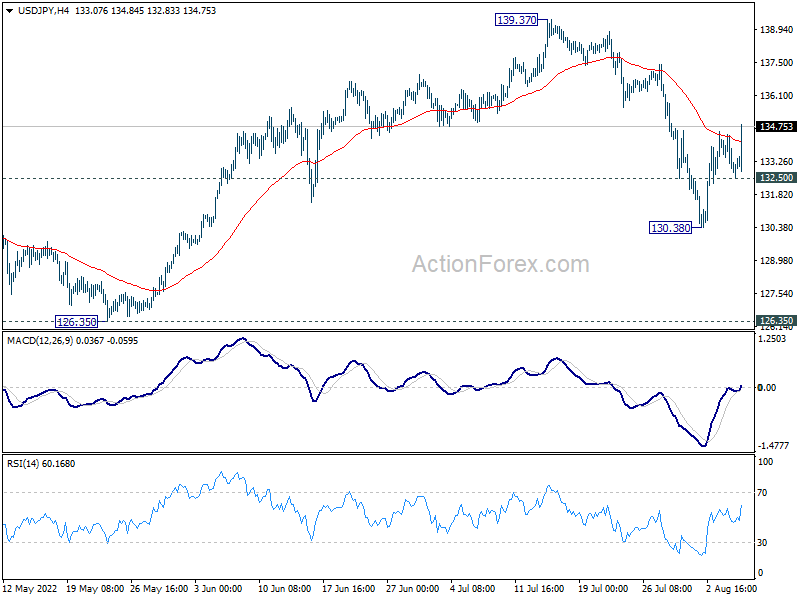
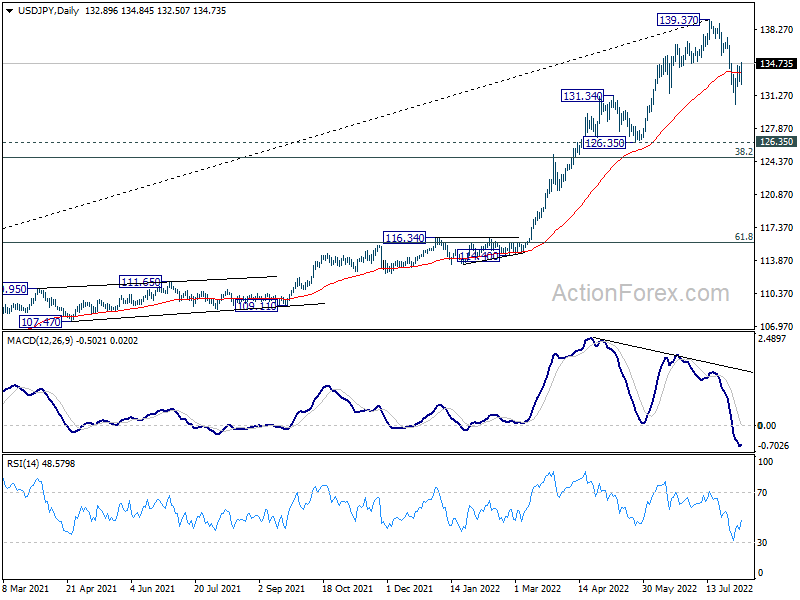
USD/JPY's rebound from 130.38 resumes after brief retreat. Break of 134.58 resistance suggests that correction from 139.37 has completed. Intraday bias is back to the upside for retesting 139.37 high. On the downside, below 132.50 minor support will resume the correction from 139.337 through 130.38 instead.
In the bigger picture, a medium term top should be in place at 139.37, on bearish divergence condition in daily MACD. Fall from there could be correcting whole up trend from 101.18 (2020 low). While deeper decline cannot be ruled out, outlook will stays bullish as long as 55 week EMA (now at 121.84) holds. Long term up trend is expected to resume through 139.37 at a later stage, after the correction finishes.
Dollar Soars Broadly after All-Round Strong NFP
Dollar soars broadly, together with benchmark treasury yields, after an all around strong non-farm payroll report. At the same times US futures tumble, apparently on expectations Fed's tightening pace will continue with such healthy job market. The greenback is now the strongest one for the week and the question is, whether it could break through some key near term levels before weekly close.
Technically, the most important level to monitor is 1.0095 minor support in EUR/USD. Firm break there will argue that medium term down trend is ready to resume through 0.9951 low. GBP/USD has already made progress on breaking 1.20623 minor support. USD/JPY also breaks 134.58 minor resistance. These two are both Dollar positive developments.
In Europe, at the time of writing, FTSE is down -0.34%. DAX is down -0.34%. CAC is down -0.71%. Germany 10-year yield is up 0.070 at 0.873. Earlier in Asia, Nikkei rose 0.87%. Hong Kong HSI rose 0.14%. China Shanghai SSE rose 1.19%. Singapore Strait Times rose 0.40%. Japan 10-year JGB yield dropped -0.0125 to 0.163.
US NFP grew 528k in Jul, unemployment rate down to 3.5%, strong wage growth
US non-farm payroll employment grew strongly by 528k in July, well above expectation of 250k. That's also much higher than the average gain of 388k over the prior 4 months. Total non-farm employment has also reached its pre-pandemic level.
Unemployment rate dropped from 3.6% to 3.5%, better than expectation of 3.6%. Participation rate dropped -0.1% to 62.1%.
Average hourly earnings rose 0.5% mom in July, above expectation of 0.3% mom.
Canada employment dropped -30.6k in Jul, unemployment rate unchanged at 4.9%
Canada employment dropped -30.6k in July, much worse than expectation of 25.0k growth. Services-producing jobs dropped -53k or -0.3% while goods-producing jobs rose 23k or 0.6%.
Unemployment rate was unchanged at 4.9%, below expectation of 5.0%, but matched the historic low reached in June. Total hours worked were down -0.5%. Average hourly wages was up 5.2% yoy.
BoE Bailey: Businesses concerned about hiring, not raising prices
BoE Governor Andrew Bailey said at the Today Programme that the real risks is import inflation from energy and food becomes "embedded". As firms are not struggling to raise prices, inflation would be comes worse when its embedded.
"The first thing they (businesses) want to talk to me about is that businesses have trouble hiring people, and that is still going on. They're also saying to us actually they're not finding it difficult to raise prices at the moment. That can't go on," he said.
Bailey also said the interest rates are not going to go back to pre-2008 financial crisis levels. Additionally, "we don't think that the rolling back of QE and the sale of assets is going to have a big impact on market interest rates".
BoE Pill: We need flexibility on rates according to circumstances
BoE Chief Economist Huw Pill told Bloomberg Television, the BoE is not "behind the curve" on tightening.
But he added that investors should not assume there will be another 50bps rate hike in September. "Given the uncertainties we face, I think we need flexibility either to go further, or to stay where we are, and the pace at which we go further to be varied according to circumstances," he said.
Australia AiG services rose to 51.7, two-speed sector emerges
Australia AiG Performance of Services rose 2.9 pts to 51.7 in July. Sales jumped 7.4 to 49.3. However, employment dropped -2.9 to 52.4. New orders rose 1.7 to 50.6. Supplier deliveries rose 5.9 to 47.6. Input prices rose 5.3 to 74.3. Selling prices dropped -3.8 to 63.4.
Innes Willox, Chief Executive of Ai Group, said: "We are seeing a 'two-speed' services sector emerge as businesses contend with labour shortages and rising interest rates. Business & property and personal services grew dramatically in July, while retail & hospitality and logistics fell dramatically. Chronic labour shortages and a super-charged winter spike in absenteeism are large and growing challenges for labour-intensive service industries. And rising interest rates are dampening consumer sentiment, casting a shadow over consumer-facing sectors."
USD/JPY Mid-Day Outlook
Daily Pivots: (S1) 132.31; (P) 133.37; (R1) 133.97; More...
USD/JPY's rebound from 130.38 resumes after brief retreat. Break of 134.58 resistance suggests that correction from 139.37 has completed. Intraday bias is back to the upside for retesting 139.37 high. On the downside, below 132.50 minor support will resume the correction from 139.337 through 130.38 instead.
In the bigger picture, a medium term top should be in place at 139.37, on bearish divergence condition in daily MACD. Fall from there could be correcting whole up trend from 101.18 (2020 low). While deeper decline cannot be ruled out, outlook will stays bullish as long as 55 week EMA (now at 121.84) holds. Long term up trend is expected to resume through 139.37 at a later stage, after the correction finishes.
Economic Indicators Update
| GMT | Ccy | Events | Actual | Forecast | Previous | Revised |
|---|---|---|---|---|---|---|
| 22:30 | AUD | AiG Performance of Services Index Jul | 51.7 | 48.8 | ||
| 23:30 | JPY | Labor Cash Earnings Y/Y Jun | 2.20% | 1.90% | 1.00% | |
| 23:30 | JPY | Overall Household Spending Y/Y Jun | 3.50% | 1.50% | -0.50% | |
| 05:00 | JPY | Leading Economic Index JunP | 100.6 | 101.2 | 101.2 | |
| 06:00 | EUR | Germany Industrial Production M/M Jun | 0.40% | -0.20% | 0.20% | |
| 06:45 | EUR | France Trade Balance (EUR) Jun | -13.1B | -12.3B | -13.0B | -12.9B |
| 08:00 | EUR | Italy Industrial Output M/M Jun | -2.10% | -0.30% | -1.10% | |
| 12:30 | USD | Nonfarm Payrolls Jul | 528K | 250K | 372K | 398K |
| 12:30 | USD | Unemployment Rate Jul | 3.50% | 3.60% | 3.60% | |
| 12:30 | USD | Average Hourly Earnings M/M Jul | 0.50% | 0.30% | 0.30% | 0.40% |
| 12:30 | CAD | Net Change in Employment Jul | -30.6K | 25.0K | -43.2K | |
| 12:30 | CAD | Unemployment Rate Jul | 4.90% | 5.00% | 4.90% | |
| 14:00 | CAD | Ivey PMI Jul | 60.3 | 62.2 |