Sample Category Title
Daily Technical Analysis
EUR/USD
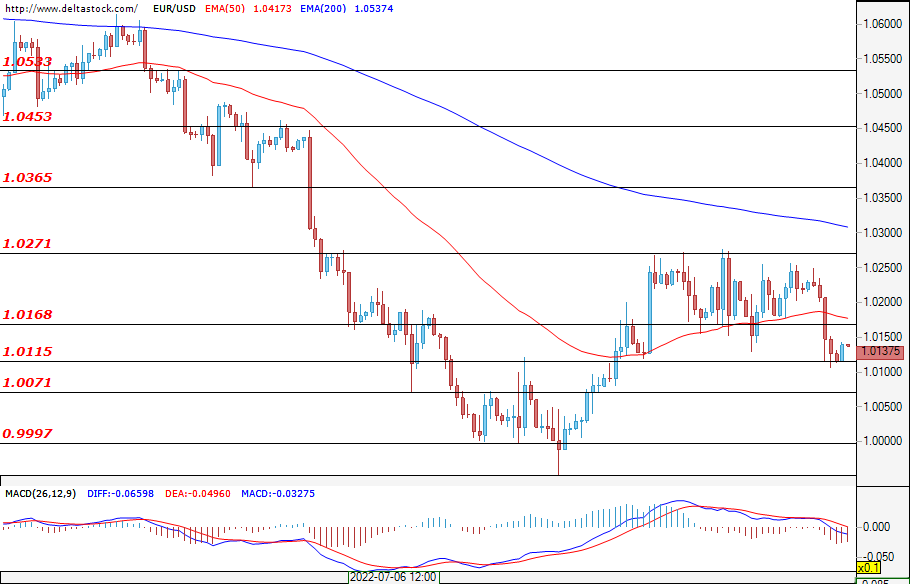
Today's trading session started calmly for the single European currency. Neither the bears, nor the bulls manage to take advantage. At the time of writing the analysis, the first major support would be at 1.0115. If the bulls manage to gain a preponderance, they will have to deal with the resistance at 1.0168, with the main obstacle being the level at 1.0271. There is a lot of macroeconomic news today that could cause a strong move in the currency pair, but investors' eyes will most likely be on the Federal Interest Rate decision news at 18:00 GMT and Powell’s press conference shortly after that, at 18:30 GMT. Given the present levels of inflation, a 1 percent increase should not be ruled out, despite current expectations for a 75 bps hike. Whatever the outcome, volatility will continue to be high and strong moves either direction can be expected.
USD/JPY
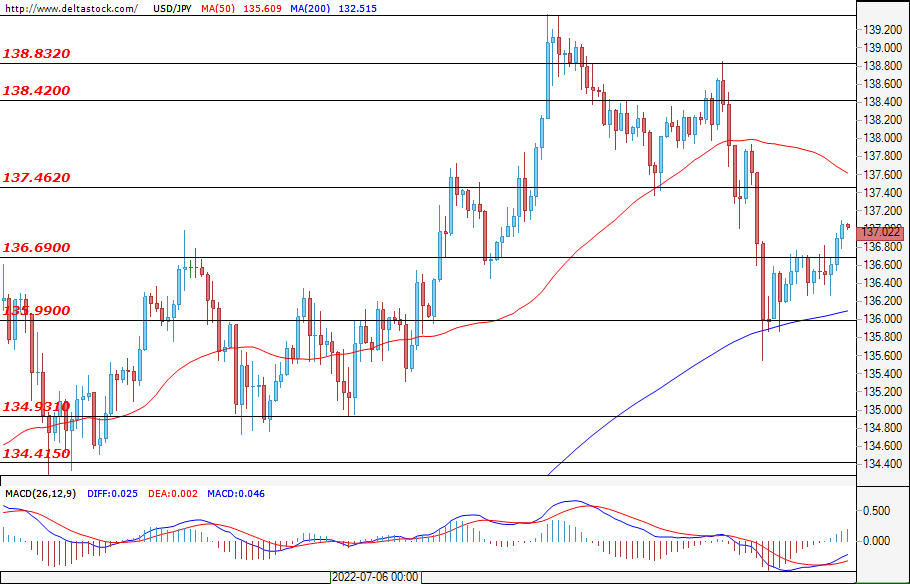
With the Ninja, the trading session began ambitiously for the bulls and, at the time of writing the analysis, they are headed for the first key resistance at 138.42. If the bears manage to reverse the first market moves of the day, they would most likely reach support at 136.69. A breach of the aforementioned level would increase the odds for a deeper sell-off towards the psychological support at 136.00.
GBP/USD
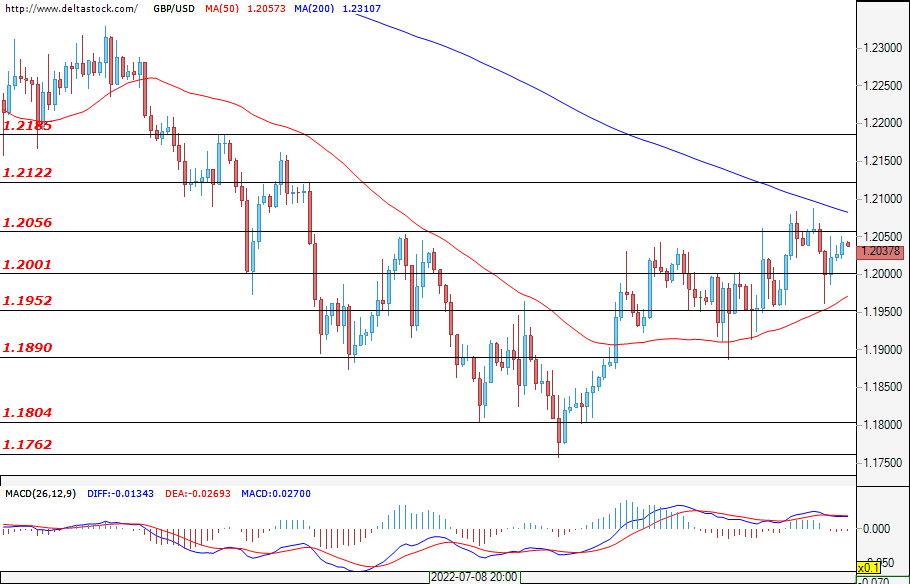
Over the last ten days, we are witnessing a consolidation in the range for the Sterling - 1.190 - 1.205. If the bulls succeed in breaking the range, the next resistance in front of them would be at 1.212. If, on the other hand, the bears manage to make a breakthrough, the next key support for them would be at 1.1952.
EUGERMANY40
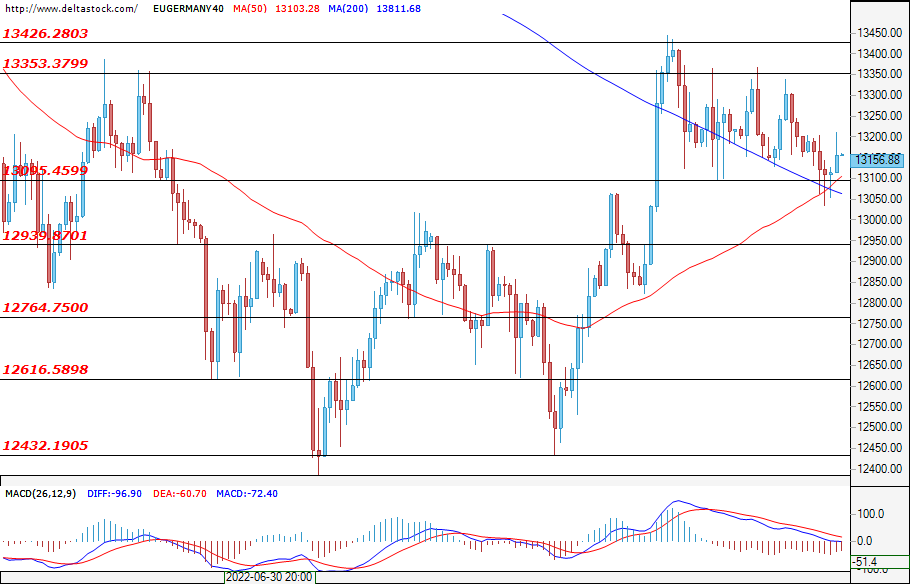
At the beginning of the trading session for the German index, we witnessed a "high start" for the bulls. EUGERMANY40 started the trading session around 40 points higher. However, their momentum slowed after that. If the bears manage to reverse the market sentiment, they will most likely have to deal with the support at 13095 first and then the support at 12940. If we do not see big moves in the index during today's trading session, the consolidation will continue between 13095-13350, which we have been observing in recent days. Today, the correlation with the U.S. indices is likely to persist and volatility will increase once the Fed releases its interest rate decision at 18:00 GMT.
US30
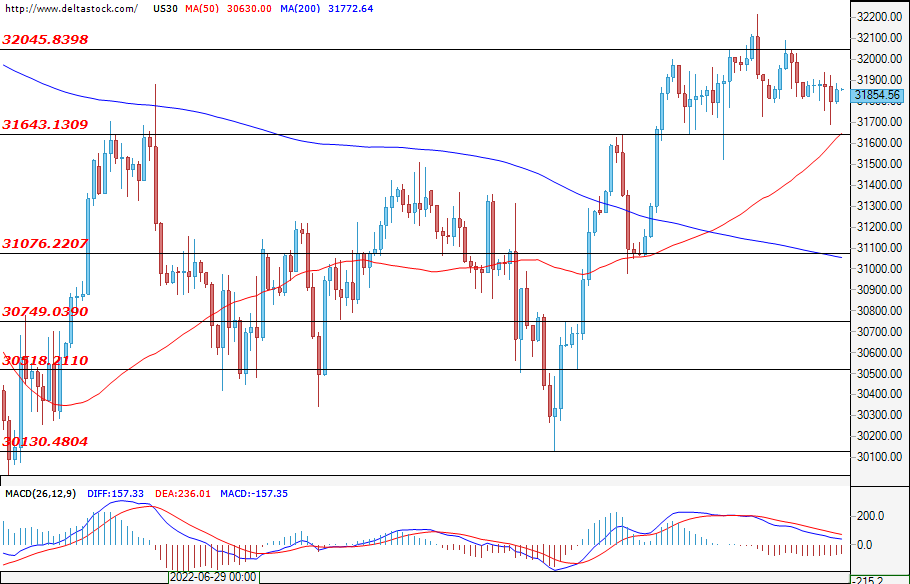
The trading session for the U.S. blue chips began without sharp movements. However, it appears unlikely that this will be the case throughout today's trading session. Strong moves are likely to be triggered by macroeconomic news: Durable Goods Orders (12:30 GMT) and Crude Oil Stocks (14:00 GMT), with the strongest effect probably being the Fed Interest Rate Decision (18:00 GMT). If this news turns out to be positive for the bears, they will face the support at 31640. On the other hand, if the bulls manage to take advantage of the news, they will meet the resistance at 32045.
Markets Poised to React to Fresh Fed Guidance
A 75-basis point hike by the Fed today is already well-telegraphed; anything else would be a surprise.
Looking beyond today’s FOMC decision, markets are currently expecting another 100bps of hikes before 2022 draws to a close, with the Fed Funds rate reaching a year-end peak of 3.4%.
If Chair Powell signals today that policymakers are sticking with their “pedal to the metal” approach in quelling multi-decade high inflation, readying even more jumbo-sized hikes in the pipeline, that might send the US dollar into another rampage across the FX universe, while shoving spot gold into the sub-$1700 domain. That would also potentially result in more carnage for risk assets.
Ramped-up fears that the Fed’s ongoing rate-hike cycle may ultimately spell the next US recession could drag the S&P 500 back into bear market territory, on the notion that corporate earnings will wilt in the next economic winter.
XAG/USD: Shortly We May See a Rise in the Reactionary Wave (X)
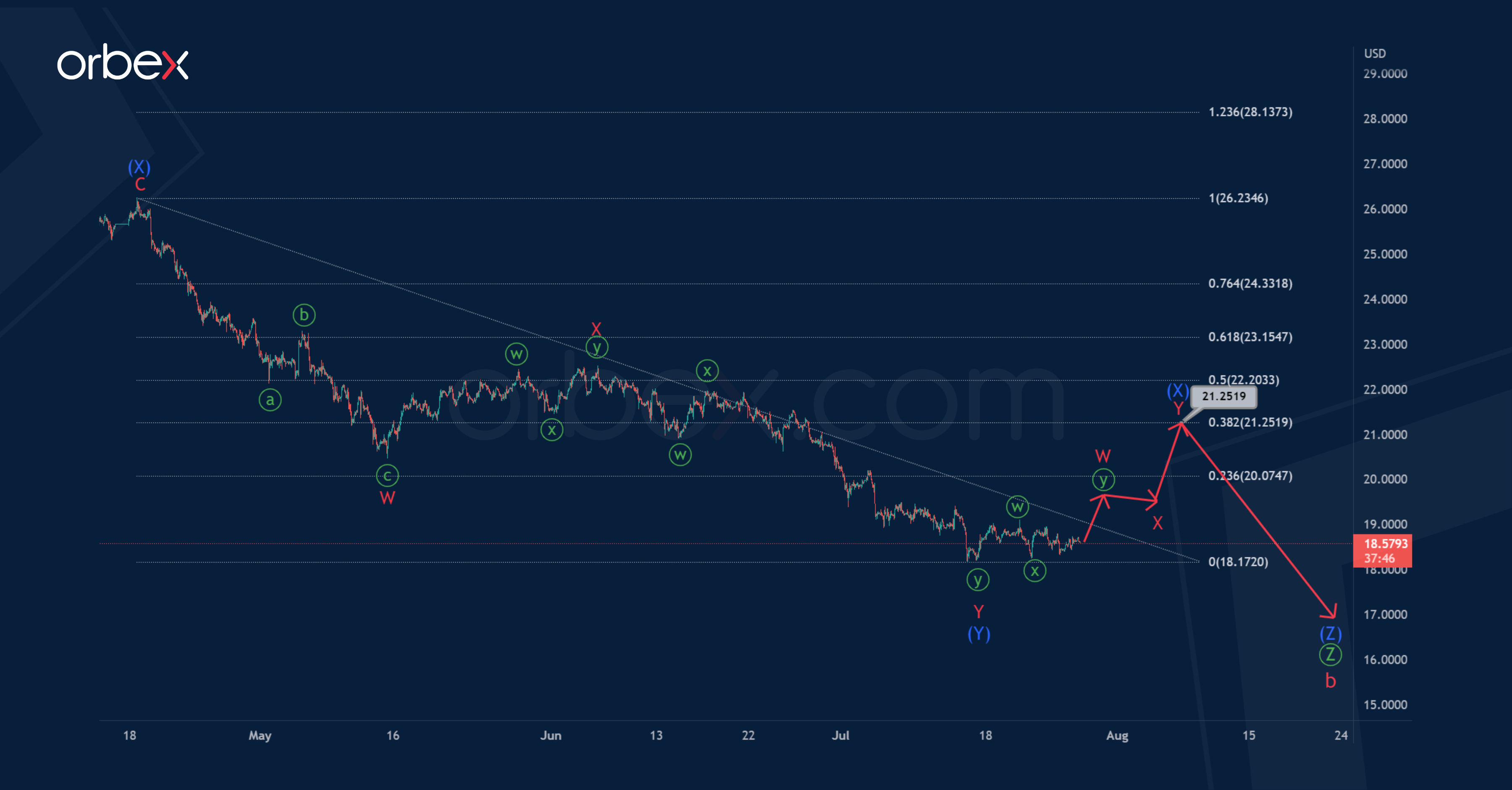
The XAGUSD pair, as in previous trading weeks, seems to be forming a correction wave b of the cycle degree, which is part of a large zigzag.
Apparently, correction b is a primary triple zigzag Ⓦ-Ⓧ-Ⓨ-Ⓧ-Ⓩ. The first four parts of it have already been fully completed, now we see the construction of the last wave Ⓩ.
Most likely, the wave Ⓩ will be an intermediate triple zigzag (W)-(X)-(Y)-(X)-(Z). It seems that the formation of the actionary intermediate wave (Y) has come to an end, it has taken the form of a double zigzag W-X-Y. Thus, growth could begin in the intermediate intervening wave (X).
It can be assumed that the wave (X) will end in the form of a minor double zigzag near 21.259. At that level, it will be at 38.2% along the Fibonacci lines of sub-wave (Y).
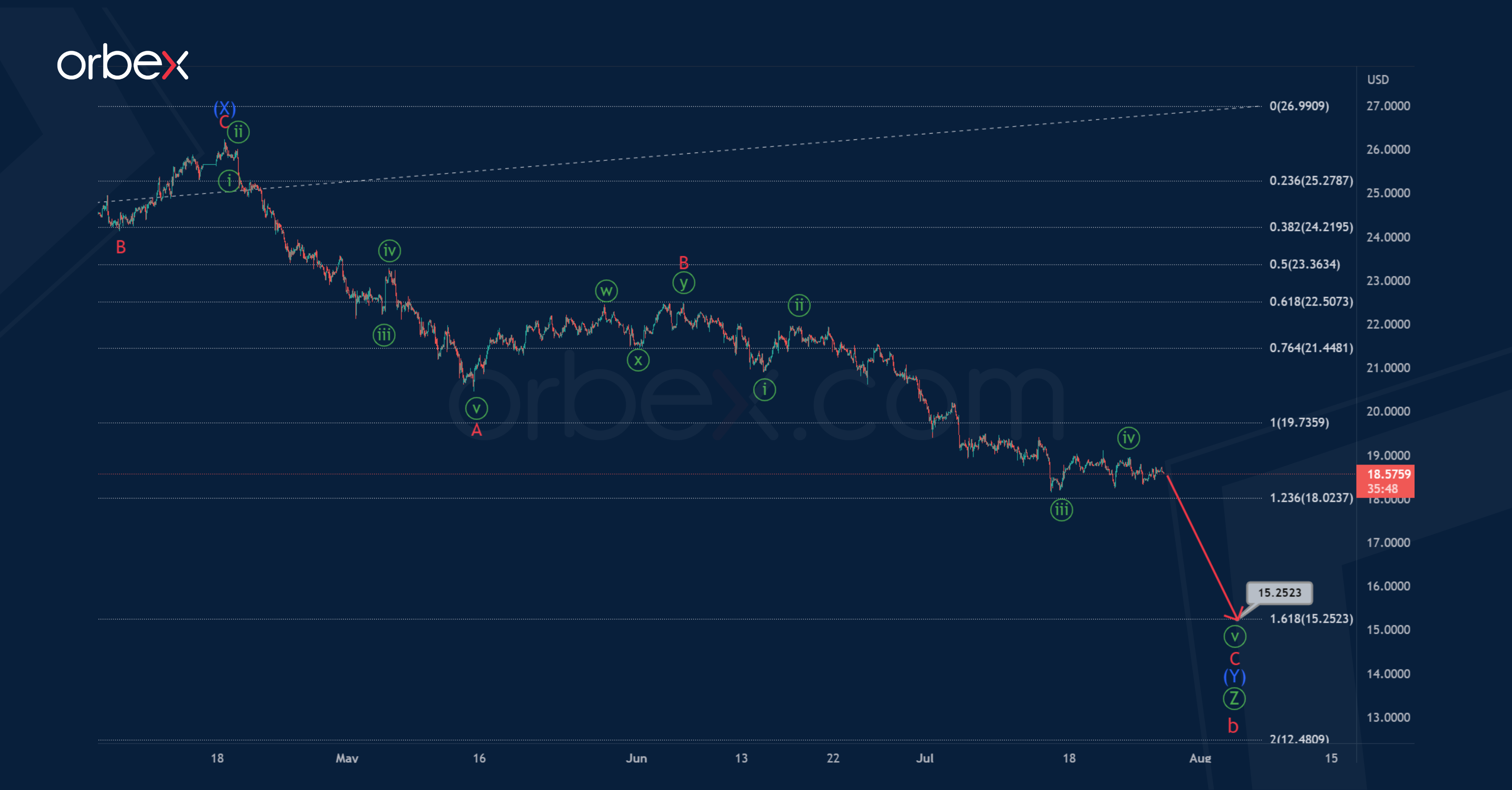
Alternatively, it is assumed that the bearish primary wave Ⓩ may end in the form of a double zigzag (W)-(X)-(Y).
Most likely, the market is now in the final part of the actionary wave (Y), or rather in its final minor sub-wave C.
Perhaps wave C will end in the form of an impulse consisting of minute sub-waves.
To end this impulse, a final sub-wave is needed. The end of this impulse is possible near 15.252. At that level, primary wave Ⓩ will be at 161.8% of actionary wave Ⓨ.
XAU/USD Drifts Lower
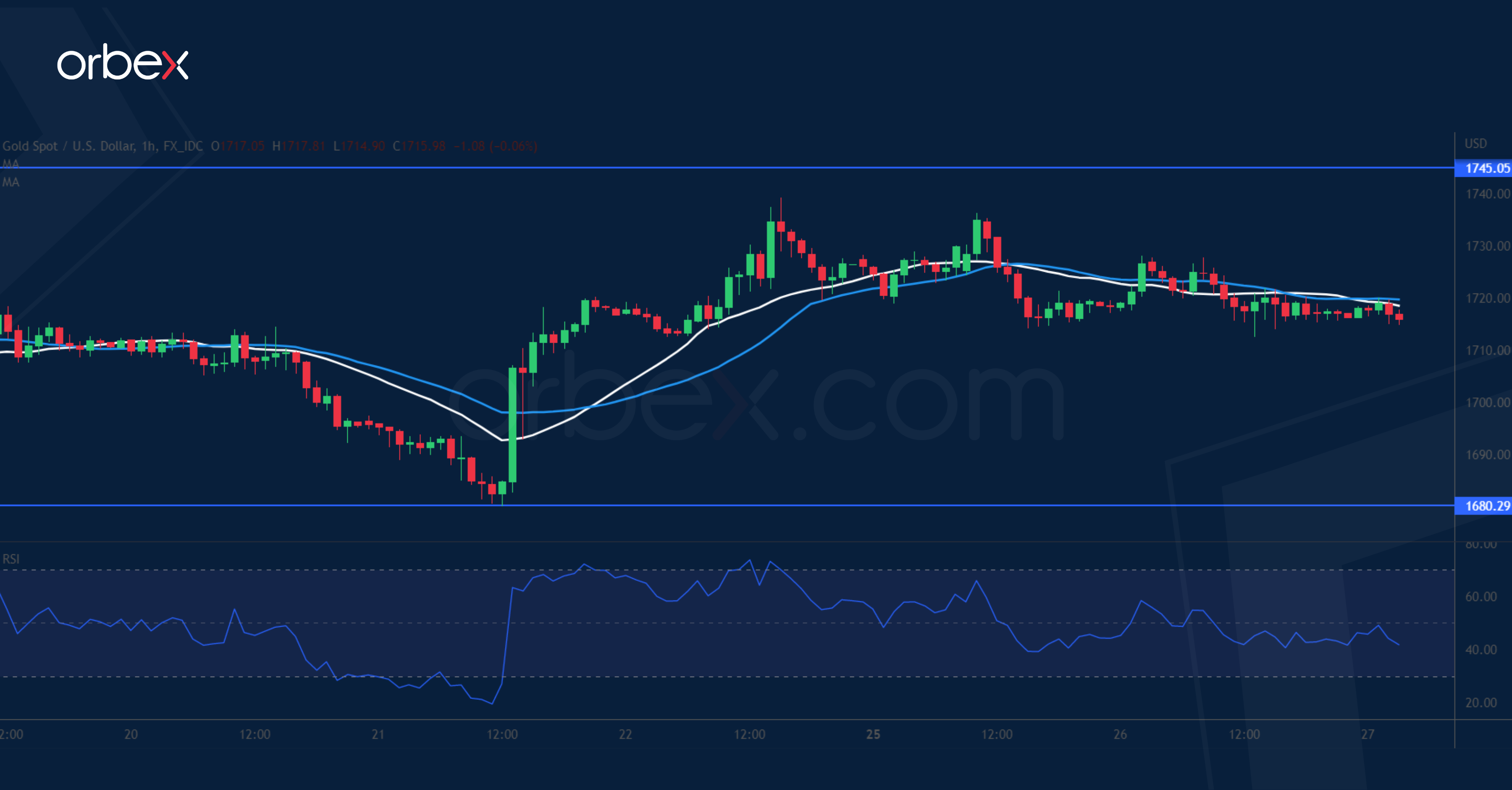
Gold stalls as the US dollar climbs back across the board. The bulls are striving to keep the price afloat as bullion hits last year’s lows at 1680. After the RSI hit oversold, the latest surge seems to come from profit- taking as the bears get out of a directional trade. The precious metal met its first resistance at 1745 which lies on the 20-day moving average. The bulls will need to push past this key hurdle before a recovery could gain a foothold. Otherwise, gold could be vulnerable to a new round of sell-off below 1600.
GBP/USD Tests Support
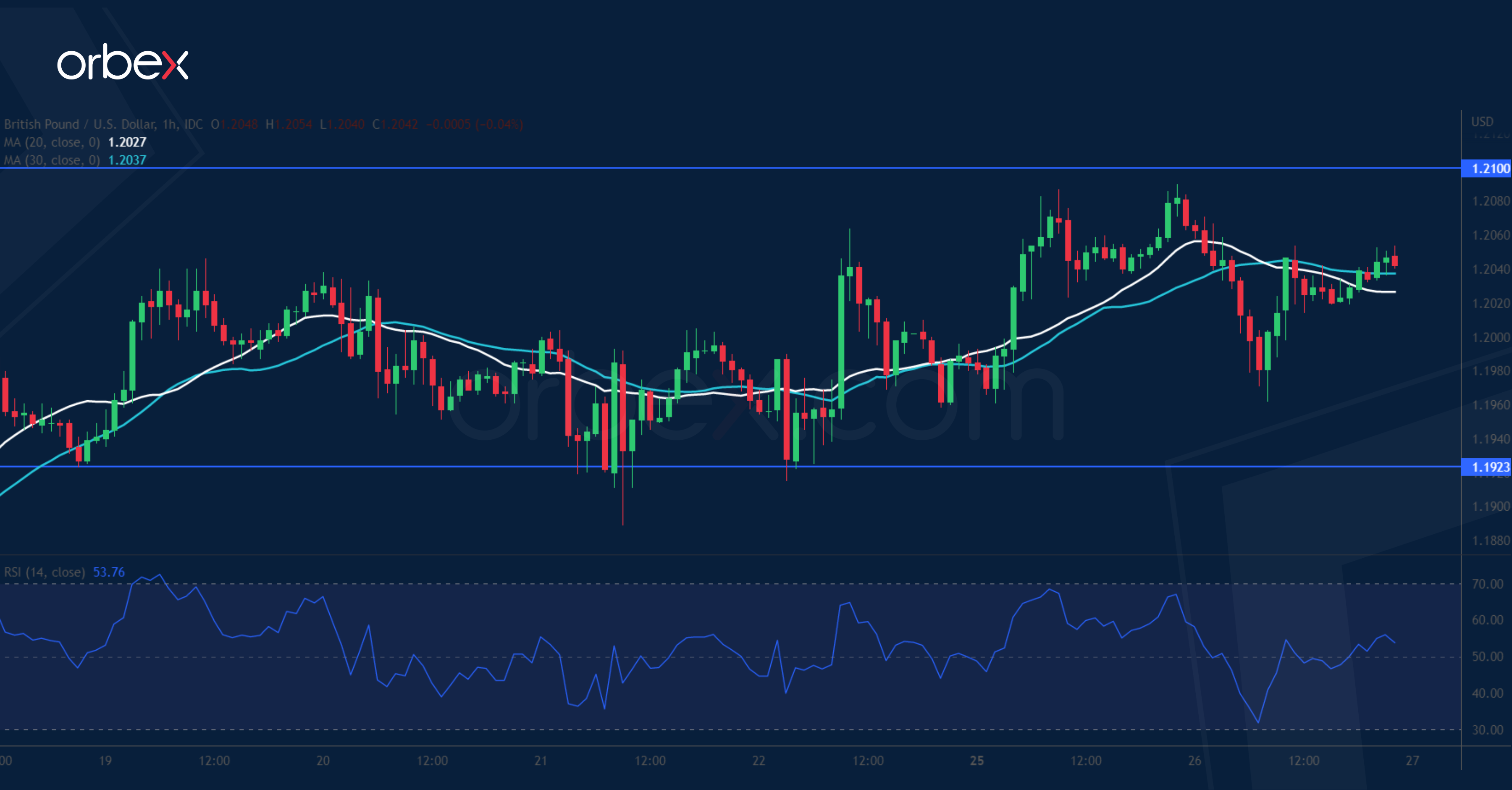
Sterling struggles as the market bets on a cautious 25 bp rate hike by the BoE at its next meeting. Sentiment remains downbeat and the bears may see rebounds as opportunities to sell. The latest one came to a halt in the supply area (1.2100) which coincides with the 30-day moving average. A bullish breakout could trigger momentum buying and send the pair to the daily resistance at 1.2300. A pullback may bring the price to 1.1920, the first level to gauge buyers’ resolve. A deeper correction would make the pound revisit 1.1770.
AUD/USD Seeks Support
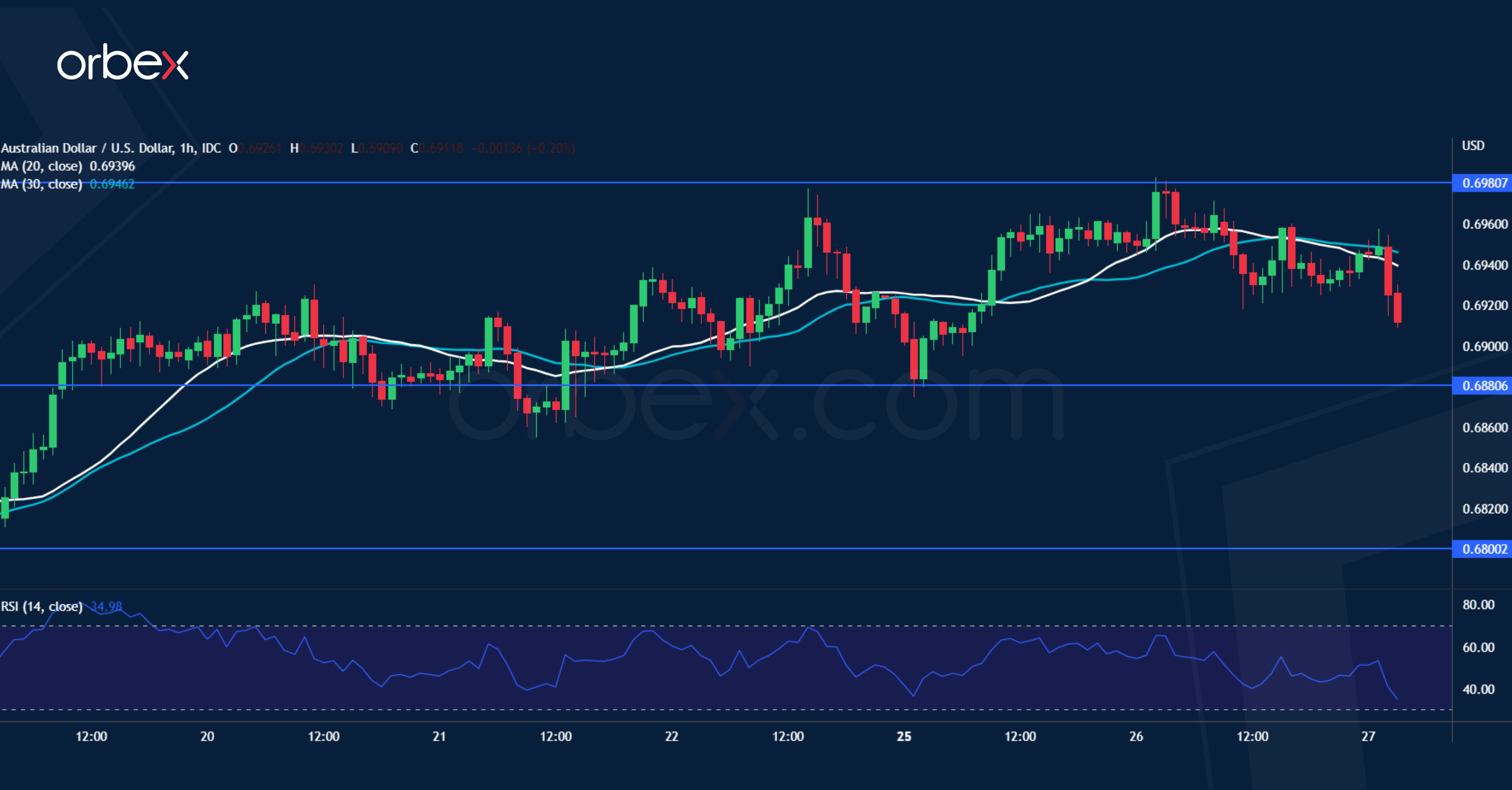
The Australian dollar weakened after the CPI fell short of expectations in Q2. A rally above the supply zone around 0.6960 forced more sellers to cover their bets and took the heat off the aussie. 0.6980 is the immediate resistance and a bullish breakout could extend the rally above the daily resistance at 0.7060. But first, the pair needs to consolidate its recent gains to build up momentum. 0.6880 is a fresh support. Further down, 0.6800 at the base of the breakout is a key level to keep the current rebound intact.
Investors Increasingly Consider a (Sharp) Recession, Especially in Europe, as Unavoidable
Markets
The news on Russia scaling back gas supplies through Nord Stream 1 to just 20% remained the dominating trading theme yesterday. Investors increasingly consider a (sharp) recession, especially in Europe, as unavoidable. The dark mood was compounded by yet again downwardly revised IMF growth forecasts (cfr. infra). Stocks in Europe and on WS shed 0.8% and 0.7-1.9% respectively. German yields fell 6.4 bps in the 2y to >9 bps further down the curve. The 10y lost the 1% level. US yields initially joined the downtrend before bottoming in early US dealings. The curve eventually bear flattened with changes between 1 and 3.9 bps even though eco data wasn’t very rosy. House prices rose less than expected. Combined with disappointing new home sales it underscored the cooling market. Consumer confidence (Conference Board) in July eased more than expected as well, to 95.7, down from 98.7. It’s the weakest reading since February last year. Moves on FX markets were classic risk-off. The yen, Swiss franc and dollar secured the top three. EUR/CHF hit an all-time closing low of 0.974. EUR/USD lost more than a percent to 1.012 and EUR/JPY forfeited more than a full big figure to 138.51. But even sterling won against the weak euro, even sterling. EUR/GBP slid to 0.8412. Meanwhile, the pound follows debates between UK PM candidates Truss and Sunak with the former suggesting to lower the taxes Sunak has raised in order to plug the gaping hole in public finances.
Markets in Asia trade mixed even as some US bellwether companies (Microsoft, Alphabet) produced bumper earnings. Nervousness going into the Fed meeting tonight is palpable. We, and markets, expect the US central bank to hike by 75 bps to bring the policy rate to 2.25/2.50%, i.e. the neutral level. But more importantly will be Powell’s message about the pace going forward. A slew of poor economic data (confidence indicators, housing) argues for slowing down. However, a still strong (but notoriously lagging) labour market and way too high inflation suggest otherwise. There is a large amount of data to be published going into the next meeting, including GDP numbers tomorrow and two more inflation prints. Powell may therefore refrain from guiding markets explicitly and stress the importance of being data-dependent. Keeping all options open and going meeting-by-meeting is probably the best one can do to not to rock the boat on markets. In any case we don’t think the Fed chair will already hint at the end of the cycle let alone rate cuts the way markets foresee for the end of this year and mid next year respectively. As such we believe US interest rates to be well supported, especially at the front end of the curve. This should also keep the dollar in favour of investors, especially against the likes of the euro which has a worse set of problems to deal with.
News Headlines
Inflation in the second quarter in Australia jumped 1.8% Q/Q to be 6.1% higher compared to the same period last year. The Q2 yearly rise was the fastest pace since 2001 and compared to 2.1% Q/Q and 5.1% Y/Y in Q1. The Reserve Bank of Australia aims to keep inflation within a 2-3% range. The Q2 rise in headline inflation was slightly slower than market expectations. Underlying inflation (trimmed mean) accelerated further by 1.5% Q/Q to 4.9% Y/Y (from 3.7%). Even as inflation is well above the RBA target and might rise even further later this year, markets are positioned of a 50 bps rate hike at the August 2 RBA meeting rather than a super-sized 75 bps step. The 2-y Australian government bond yield this morning dropped 11 bps to 2.60%. The Aussie dollar slipped from the 0.6960 area to the 0.6920 area immediately after the release, but the setback eased soon as the US dollar is losing some momentum overall.
The IMF further the cut the global growth forecast as increasingly gloomy developments are materializing. Several shocks have hit a world economy that was already weakened by the pandemic. High inflation worldwide is resulting in tighter financial conditions. China faced a worse-than-anticipated slowdown due to COVID- 19 outbreaks and lockdowns and further negative spillovers from the war in Ukraine are weighing on global activity. The IMF reduced 2022 growth in the baseline scenario to 3.2%, 0.4%pt lower compared to April. Global inflation has been revised up to reach 6.6% in advanced economies and 9.5% in emerging market and developing economies. The IMF only expects global output growth of 2.9% on 2023 as monetary policy is expected to slow activity. Risk to the outlook are overwhelming tilted to the downside.
USD/CAD Daily Outlook
Daily Pivots: (S1) 1.2835; (P) 1.2868; (R1) 1.2919; More...
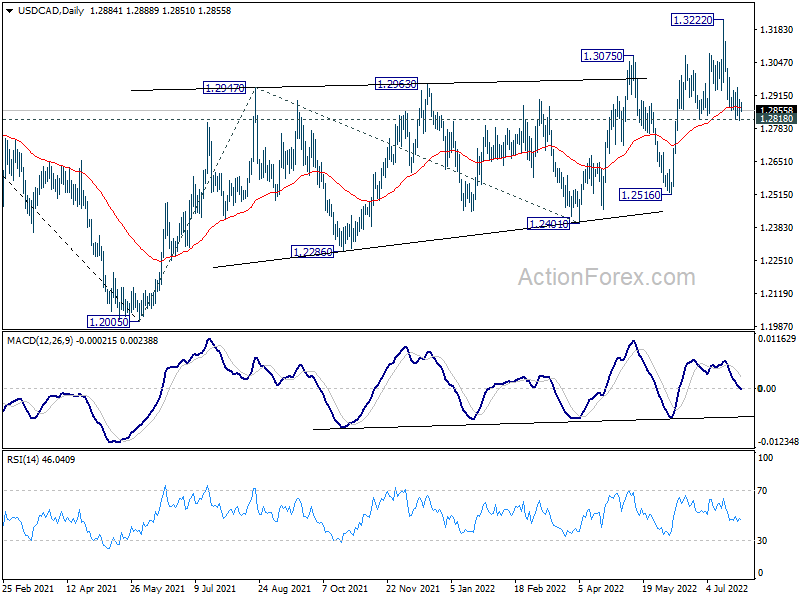
Intraday bias in USD/CAD remains neutral at this point. On the downside, firm break of 1.2818 support will bring deeper fall back to 1.2516 key support. This will also raise the chance of near term bearish reversal. On the upside, above 1.2988 minor resistance will reinforce near term bullishness, and turn bias back to the upside for retesting 1.3222 instead.
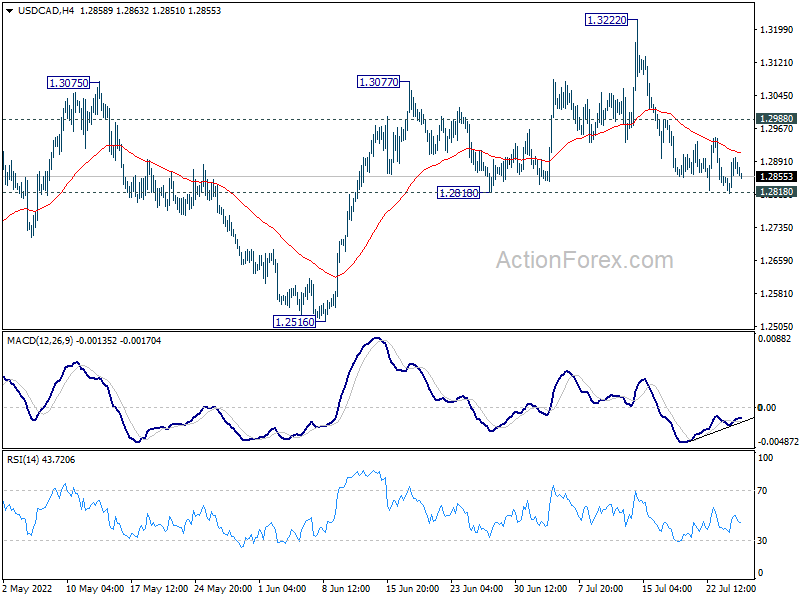
In the bigger picture, down trend from 1.4667 (2020 high) should have completed at 1.2005, after defending 1.2061 long term cluster support. Rise from there should target 61.8% retracement of 1.4667 to 1.2005 (2021 low) at 1.3650. This will remain the favored case now as long as 1.2516 support holds.
EUR/USD Resilient, But Vulnerable ahead of FOMC
Dollar is trading with a soft tone today, as focus turns to FOMC rate decision. Another 75bps hike is widely expected and Chair Jerome Powell is not expected to deliver any dramatic comments. Traders would likely come back after the event risk is cleared. In the currency markets, Euro is staying under much pressure on gas crisis but Sterling and Swiss Franc are not bothering too much. Commodity currencies are losing some upside momentum, but remain the relatively stronger ones.
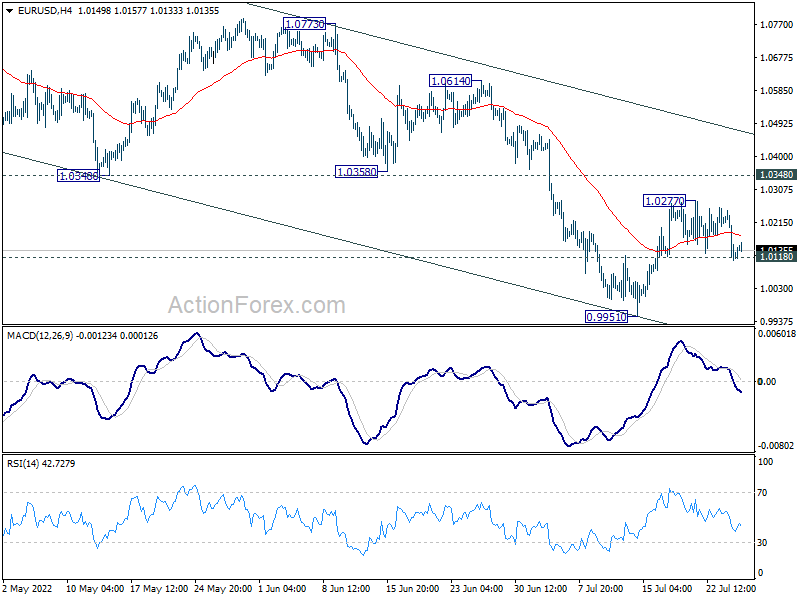
Technically, 1.0118 minor support in EUR/USD is the main focus today. It's so far resiliently holding on to the level despite broad based Euro selloff. But firm break there will argue that rebound from 0.9951 has completed. More importantly, larger down trend would likely be ready to resume through 0.9951 low. This time, if happens, EUR/USD should trade below parity for a longer while before bottoming and reclaiming the psychological level.
In Asia, Nikkei rose 0.22%. Hong Kong HSI is down -1.04%. China Shanghai SSE is up 0.13%. Singapore Strait Times is up 0.02%. Japan 10-year JGB yield is down -0.0058 at 0.204. Overnight, DOW dropped -0.71%. S&P 500 dropped -1.15%. NASDAQ dropped -1.87%. 10-year yield dropped -0.033 to 2.787.
Australia CPI surged to record 6.1% yoy, but below expectations
Australia CPI rose 1.8% qoq in Q2, blow expectation of 1.9% qoq. For the 12-month period, CPI accelerated from 5.1% yoy to 6.1% yoy, below expectation of 6.3% yoy. RBA trimmed mean CPI came in at 1.5% qoq, 4.9% yoy, versus expectation of 1.5% qoq, 4.7% yoy.
The quarterly increase was the second highest since the introduction of the Goods and Services Tax (GST), following on from a 2.1% increase in Q1. The annual rise was the highest since the introduction of GST.
"Annual trimmed mean inflation was the highest since the series commenced in 2003 and annual goods inflation was the highest since 1987, as the impacts of supply disruptions, rising shipping costs and other global and domestic inflationary factors flowed through the economy," said Head of Prices Statistics at the ABS, Michelle Marquardt.
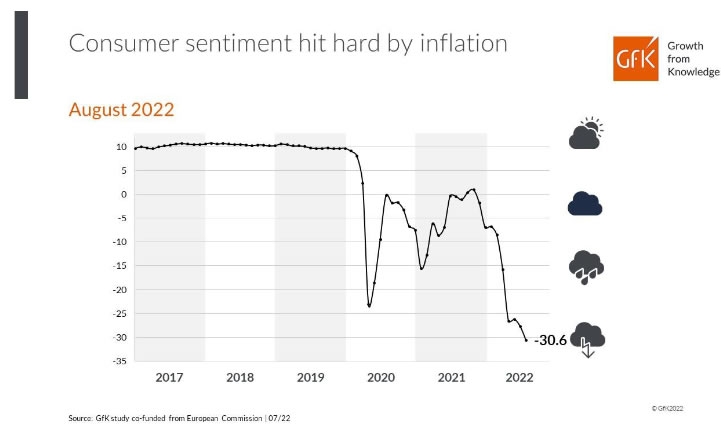
Germany Gfk consumer sentiment hit another rock bottom at -30.6
Germany Gfk consumer sentiment for August dropped from -27.7 to -30.6, below expectation of -28.2. That's another record low since the start of the series in 1991. In July, economic expectations dropped from -11.7 to -18.2. Income expectations dropped from -33.5 to -45.7. Propensity to buy dropped from -13.7 to -14.5.
"In addition to concerns about disrupted supply chains, the war in Ukraine and soaring energy and food prices, there are now worries about sufficient gas supplies for businesses and households next winter. This is currently causing consumer sentiment to hit rock bottom," explains Rolf Bürkl, GfK consumer expert. "Especially as a tight supply of natural gas is likely to add to the pressure on energy prices and thus inflation."
Fed to hike another 75bps again, some previews
Fed is widely expected to raise interest rates by 0.75% today, for the second time in a row, to bring the federal funds rate target rate to 2.25-2.50%. More tightening is expected afterwards, as most FOMC members believed that interest rates have enter into "restrictive" region to curb inflation, which is already at multi-decade high.
The questions are on the pace of tightening beyond the neutral range, its impact on economic activity, and risks of recession as a result. Fed Chair Jerome Powell will be grilled for these questions. But a concrete answer is unlikely for now. The next rate-setting meeting on September 21 is nearly two months away. Two sets of prices, jobs and activity data will be published during the time, and before the new economic projections. The situation is so uncertain for Powell to tell the markets anything meaningful.
Here are some previews on Fed:
- FOMC Preview – Assessing the Balance of Risk for Traders
- Fed to Likely Hike by 75 bps But May Still Weigh 100-bps Option
- FOMC Meeting Preview: Traders Looking for 75bps, Powell's Presser Key
- All Eyes on Bond Yields ahead of FOMC
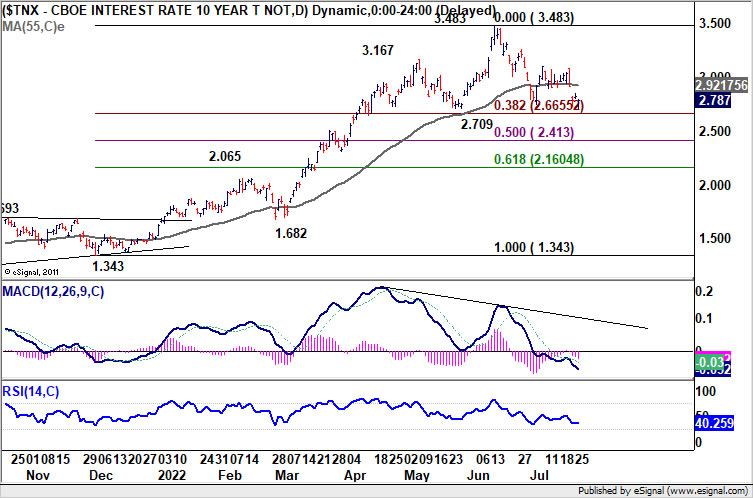
As for market reaction, a major focus is on 10-year yield. It's so far still sitting comfortably above a key support zone of 2.709 and 38.2% retracement of 1.343 to 3.483 at 2.665. There is prospect of a rebound to flatten the yield curve of 2-year (3.053%) to 10-year (2.787%). But a firm break below 2.709 could signal a flush into bonds, which could send 10-year yield towards 50% at 2.413, and below. That will threaten the curve of 3-month (2.507) to 10-year yield, which will be a big warning.
Elsewhere
Swiss ZEW expectations and Eurozone M3 money supply will be released in European session. US will release goods trade balance, whole sales inventories, durable goods orders and pending home sales.
USD/CAD Daily Outlook
Daily Pivots: (S1) 1.2835; (P) 1.2868; (R1) 1.2919; More...
Intraday bias in USD/CAD remains neutral at this point. On the downside, firm break of 1.2818 support will bring deeper fall back to 1.2516 key support. This will also raise the chance of near term bearish reversal. On the upside, above 1.2988 minor resistance will reinforce near term bullishness, and turn bias back to the upside for retesting 1.3222 instead.
In the bigger picture, down trend from 1.4667 (2020 high) should have completed at 1.2005, after defending 1.2061 long term cluster support. Rise from there should target 61.8% retracement of 1.4667 to 1.2005 (2021 low) at 1.3650. This will remain the favored case now as long as 1.2516 support holds.
Economic Indicators Update
| GMT | Ccy | Events | Actual | Forecast | Previous | Revised |
|---|---|---|---|---|---|---|
| 01:30 | AUD | CPI Q/Q Q2 | 1.80% | 1.90% | 2.10% | |
| 01:30 | AUD | CPI Y/Y Q2 | 6.10% | 6.30% | 5.10% | |
| 01:30 | AUD | RBA Trimmed Mean CPI Q/Q Q2 | 1.50% | 1.50% | 1.40% | |
| 01:30 | AUD | RBA Trimmed Mean CPI Y/Y Q2 | 4.90% | 4.70% | 3.70% | |
| 06:00 | EUR | Germany Gfk Consumer Confidence Aug | -30.6 | -28.2 | -27.4 | |
| 08:00 | CHF | CHF ZEW Expectations Jul | -72.7 | |||
| 08:00 | EUR | Eurozone M3 Money Supply Y/Y Jun | 5.50% | 5.60% | ||
| 12:30 | USD | Goods Trade Balance (USD) Jun P | -103.2B | -104.3B | ||
| 12:30 | USD | Wholesale Inventories Jun P | 2.00% | 1.80% | ||
| 12:30 | USD | Durable Goods Orders Jun | -0.50% | 0.80% | ||
| 12:30 | USD | Durable Goods Orders ex Transportation Jun | 0.40% | 0.70% | ||
| 14:00 | USD | Pending Home Sales M/M Jun | 0.50% | 0.70% | ||
| 14:30 | USD | Crude Oil Inventories | -1.5M | -0.4M | ||
| 18:00 | USD | Fed Interest Rate Decision | 2.50% | 1.75% | ||
| 18:30 | USD | FOMC Press Conference |
Germany Gfk consumer sentiment hit another rock bottom at -30.6
Germany Gfk consumer sentiment for August dropped from -27.7 to -30.6, below expectation of -28.2. That's another record low since the start of the series in 1991. In July, economic expectations dropped from -11.7 to -18.2. Income expectations dropped from -33.5 to -45.7. Propensity to buy dropped from -13.7 to -14.5.
"In addition to concerns about disrupted supply chains, the war in Ukraine and soaring energy and food prices, there are now worries about sufficient gas supplies for businesses and households next winter. This is currently causing consumer sentiment to hit rock bottom," explains Rolf Bürkl, GfK consumer expert. "Especially as a tight supply of natural gas is likely to add to the pressure on energy prices and thus inflation."