

Sample Category Title
AUD/USD Daily Report
Daily Pivots: (S1) 0.6787; (P) 0.6818; (R1) 0.6871; More...
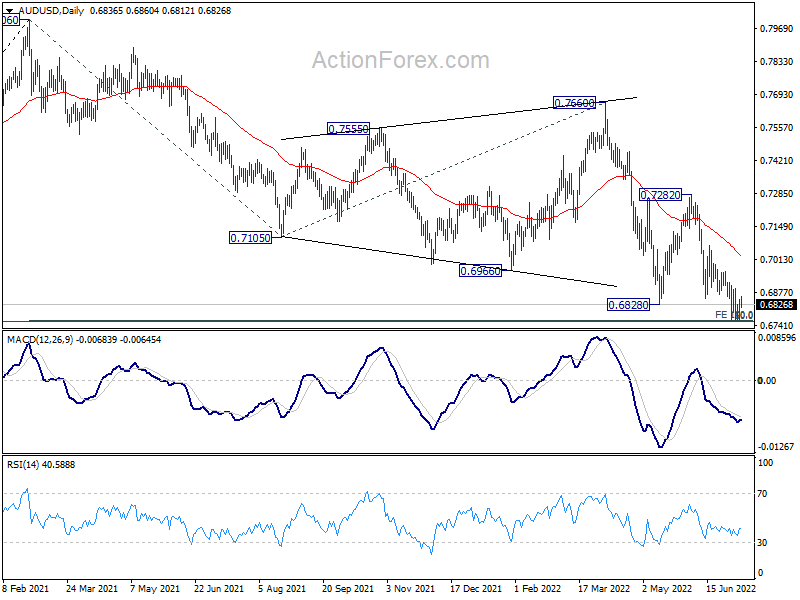
Range trading continues in AUD/USD and intraday bias remains neutral. Strong support could still be seen from 0.6756/60 cluster support to complete the whole correction from 0.8006, and bring rebound. On the upside, above 0.6918 resistance will indicate short term bottoming, and turn bias back to the upside for 0.7282 resistance. However, sustained break of 0.6756/60 will carry larger bearish implication and target 0.6461 fibonacci level next.
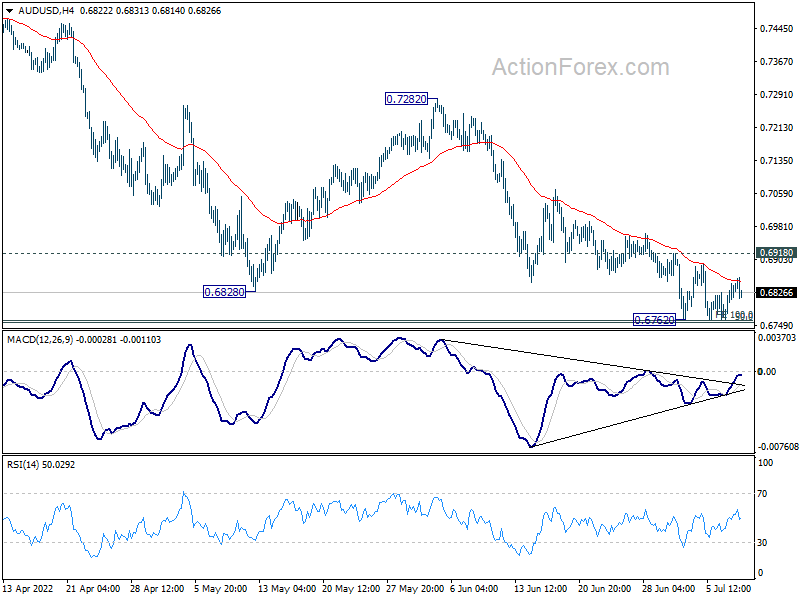
In the bigger picture, price actions from 0.8006 are seen as a corrective pattern to rise from 0.5506 (2020 low). Strong support is expected from 50% retracement of 0.5506 to 0.8006 at 0.6756 to complete the pattern. This coincides with 100% projection of 0.8006 to 0.7105 from 0.7660 at 0.6760. However firm break of 0.6756/60 will raise the chance of bearish reversal and target 61.8% retracement at 0.6461.
EUR/USD Daily Outlook
Daily Pivots: (S1) 1.0130; (P) 1.0175 (R1) 1.0207; More...
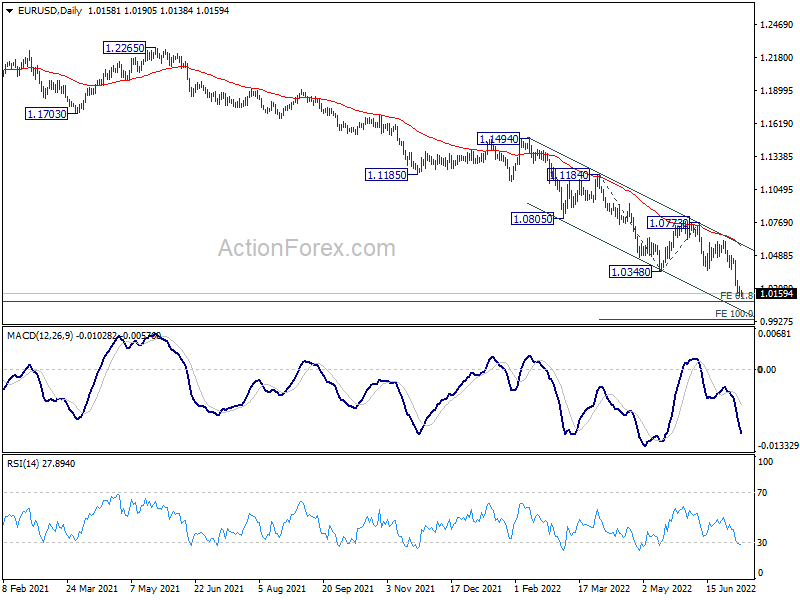
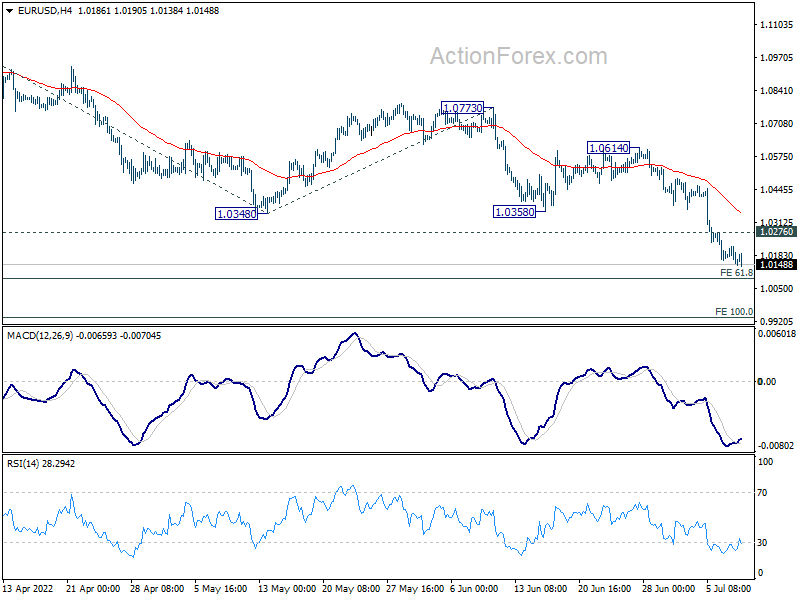
Intraday bias in EUR/USD stays mildly on the downside despite some loss of downside momentum. Current down trend should target 1.0090 long term projection level. Break there will target 100% projection of 1.1184 to 1.0348 from 1.0773 at 0.9937, which is close to parity. On the upside, above 1.0276 minor resistance will turn intraday bias neutral and bring consolidations first. But recovery should be limited below 1.0614 resistance to bring another fall.
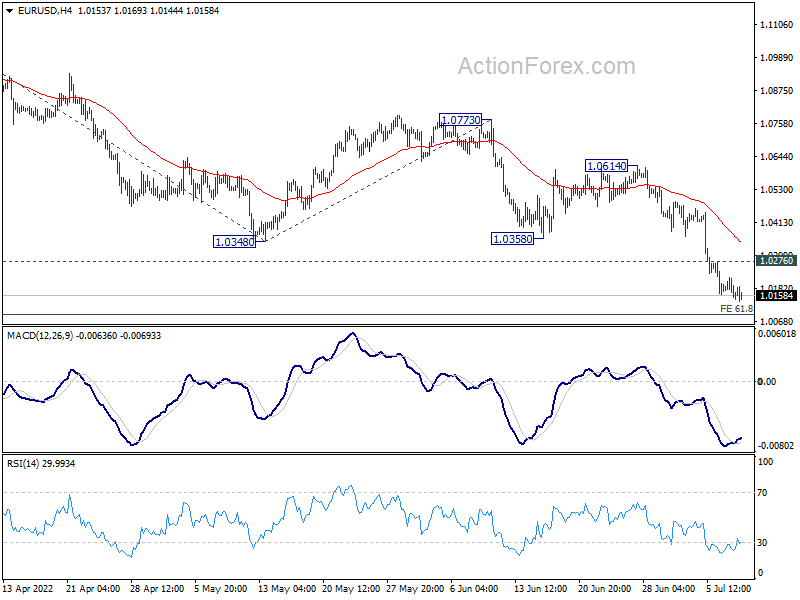
In the bigger picture, the break of 1.0339 long term support (2017 low) indicates resumption of whole down trend from 1.6039 (2008 high). Next target is 61.8% projection of 1.3993 to 1.0339 from 1.2348 at 1.0090. Sustained break there will pave the way to 100% projection at 0.8694. In any case, outlook will stay bearish as long as 1.0786 resistance holds, in case of recovery.
GBP/USD Daily Outlook
Daily Pivots: (S1) 1.1945; (P) 1.1987; (R1) 1.2066; More...
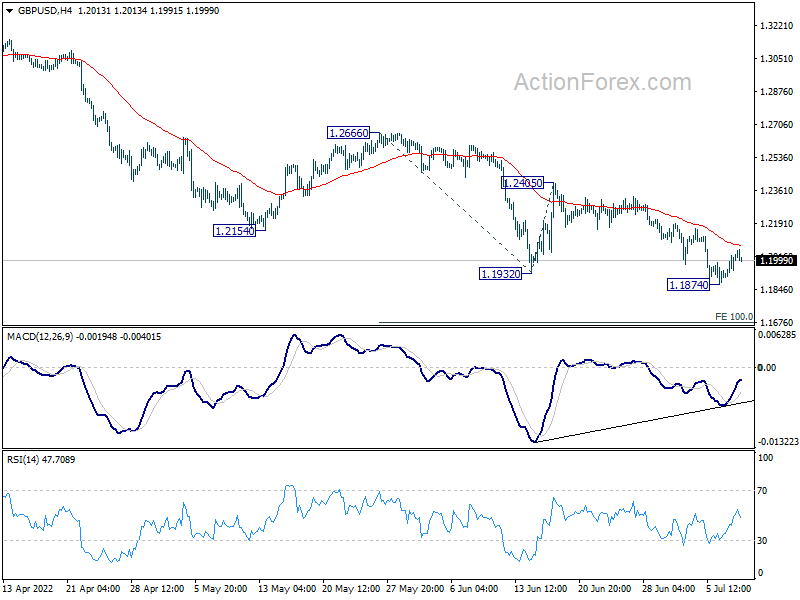
Intraday bias in GBP/USD remains neutral for consolidation above 1.1874. Outlook stays bearish as long as 1.2405 resistance holds. On the downside, break of 1.1874 will resume larger down trend to t 100% projection of 1.2666 to 1.1932 from 1.2405 at 1.1671. Break there will target 1.1409 long term support.
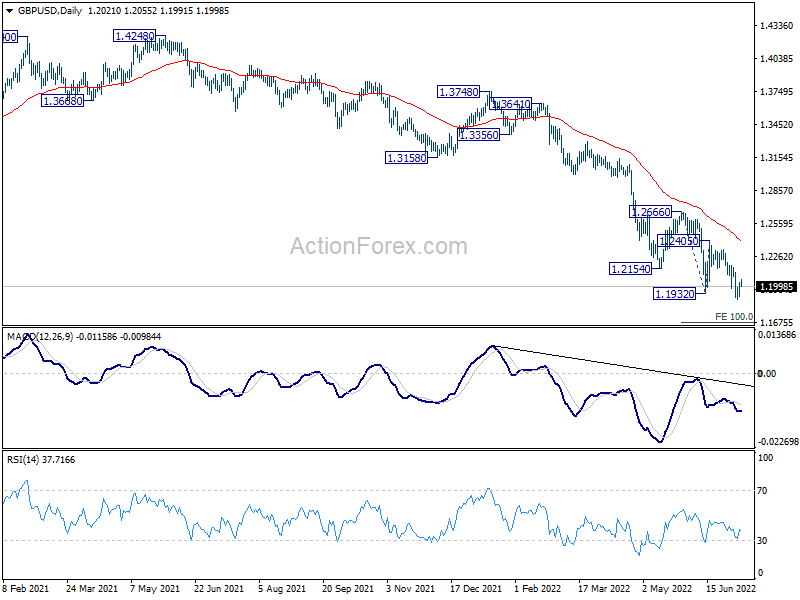
In the bigger picture, fall from 1.4248 (2018 high) could be a leg inside the pattern from 1.1409 (2020 low), or resuming the longer term down trend. Deeper decline is expected as long as 1.2666 resistance holds. Next target is 1.1409 low. However, firm break of 1.2666 will bring stronger rise back to 55 week EMA (now at 1.3103).
USD/JPY Daily Outlook
Daily Pivots: (S1) 135.62; (P) 135.92; (R1) 136.29; More...
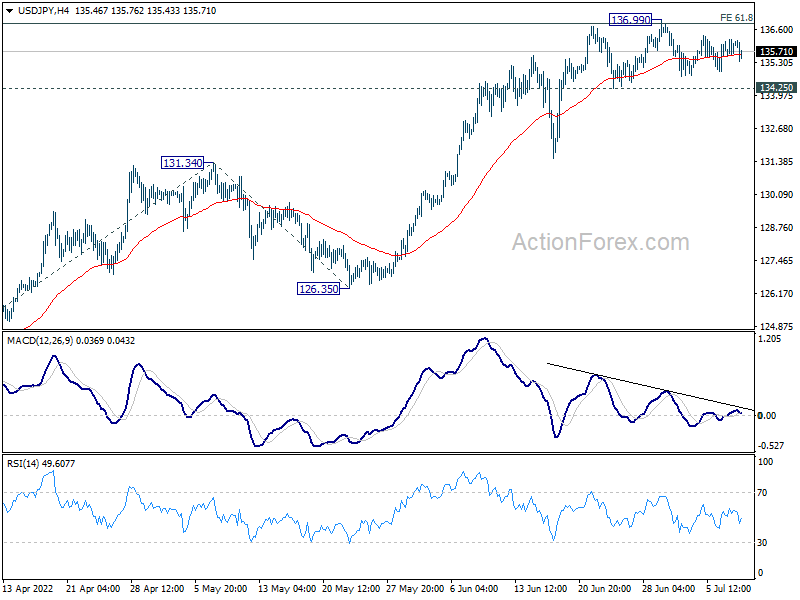
Range trading continues in USD/JPY and intraday bias remains neutral. On the downside, break of 134.25 support will confirm short term topping at 136.99. Considering bearish divergence condition in daily MACD, 136.99 might be a medium term top too. Intraday bias will be back on the downside for 131.34 support resistance turned support. Nevertheless, firm break of 136.99 will resume larger up trend to 100% projection of 114.40 to 131.34 from 126.35 at 143.29.
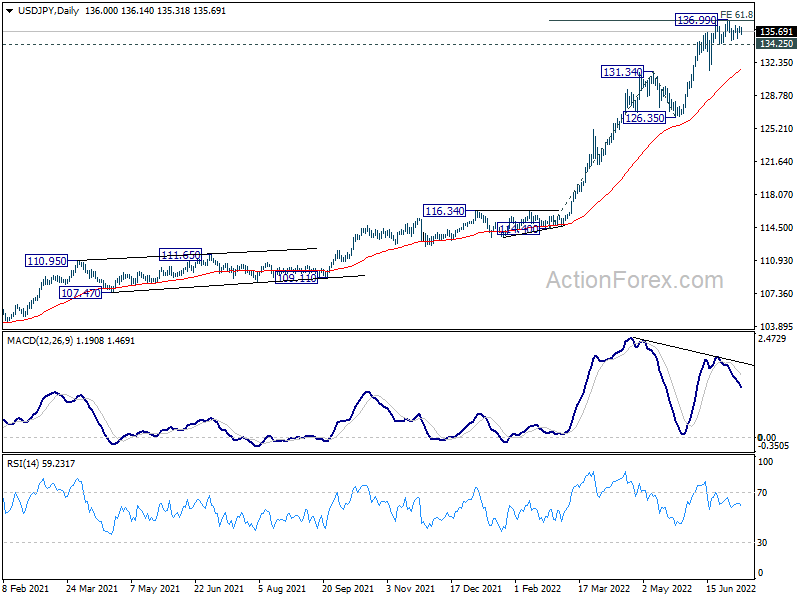
In the bigger picture, current rally is seen as part of the long term up trend from 75.56 (2011 low). Next target is 100% projection of 75.56 (2011 low) to 125.85 (2015 high) from 98.97 at 149.26, which is close to 147.68 (1998 high). This will remain the favored case as long as 126.35 support holds.
Fed Members Waller and Bullard Repeated Their Call for a 75 bps Hike
Markets
‘Reflation’ in the current context probably isn’t the right term. Even so, the risk rebound that started Tuesday in the US, continued. Eco data remain a bit inconclusive (jobless claims, trade data, challenger job cuts), but especially US data were recently good enough for investors to see the glass again half full. US equites gained between 1.12% (Dow) and 2.28% (Nasdaq). The Eurostoxx 50 even rebounded 2%. Fed members Waller and Bullard repeated their call for a 75 bps hike at this month’s meeting and at the same time downplayed the risk of a US recession. Markets yesterday accepting this analysis only illustrates the change in sentiment since early this week. Question is how long it will take for uncertainty on growth to return. Whatever the driver, core yields extended their rebound off key technical levels that started earlier this week. US yields rose between 1.2 bps (2-y) and 6.6 bps (10-y and 30-y). The rise was mainly driven by higher inflation expectations. This move was supported by a bottoming in commodities (oil, copper, wheat). European/German yields followed the broader ‘reflation’ trend (2-y + 17 bps, 10-y + 11.2 bps,.30-y outperformed + 2.9 bps). The risk rebound for now didn’t cause any meaningful correction in the dollar. The DXY stayed near the cycle top (107 area). USD/JPY hovered around 136. USD resilience went hand-in-hand with persistent euro weakness. EUR/USD lost further ground (close 1.016). Sterling outperformed. The ‘end’ of the political crises and BoE members flagging a 50 bps August rate hike apparently trigger a sterling short squeeze. EUR/GBP tumbled from the 0.8540 area to close at 0.8450.Sentiment in Asia remains constructive even as gains are more modest compared to the US and Europe yesterday (Topix +0.9%). Investors are pondering the potential positives of Chinese plans to support growth via additional infrastructure spending. US yields open little changed. The dollar is holding strong (DXY 107.1). Later today, US payrolls are expected to show a slowdown in hiring from 390k to about 270k. Still solid, but slower employment growth maybe shouldn’t be that negative for risk sentiment and might support the recent rebound in equites and, to a lesser extent, in core yields. In theory, this might slow the USD rebound. However, especially EUR/USD recently didn’t show any signs of improvement. A rebound of the single currency looks difficult as long as the ‘war-on energy’ with Russia persists.
News Headlines
The latest UK jobs report (June) from KPMG and REC (recruitment & employment confederation), compiled by S&P Global, suggests that the labour market is showing signs that we’re past the post-pandemic hiring spree. Overall demand for workers remains high, but increased at the slowest pace since March 2021. A similar trend is visible in permanent staff placements and temp billings. On the supply side, there’s a new steep drop in availability of staff with a generally low unemployment rate, fewer foreign workers, robust demand and hesitancy to switch roles in the increasingly uncertain economic climate as main drivers. The imbalance between supply and demand pushed the rate of starting pay again higher in June (well above average), though the rate of salary inflation slightly moderated.The National Bank of Poland continued its tightening cycle with a smaller-than-expected 50 bps rate hike (6% to 6.5%). It will remain data-dependent for upcoming meetings and pledges to take all necessary actions in order to ensure macroeconomic and financial stability, including above all to reduce the risk of inflation remaining elevated. FX interventions to prevent the (weaker) zloty from interfering with policy tightening remain a possibility. The NBP updated its growth and inflation forecasts. Inflation is now expected to be 13.2-15.4% this year, 9.8-15.1% next year and 2.2%-6% in 2024, assuming an unchanged policy rate. These data represent significant upward revision for this year and next compared to March. Annual growth is predicted at 3.9%-5.5% this year, 0.2-2.3% next year and 1%-3.5% in 2024. The 2023 numbers faced a big downward shift compared to March. The Polish zloty managed to limit losses in a positive risk climate despite the smaller hike. EUR/PLN touched 4.8 for the first time since March. Polish zloty swap rates dropped 30-35 bps in the 5-10y segment of the curve with the wings underperforming.
The ECB Non-Sense, the US Jobs, and the Fragile Market Optimism
Global equities had a strong session yesterday; most European and US indices gained, leaving many investors wondering though, why the market is pushing higher while the recession talks are surging.
The most plausible explanation is the good old ‘bad news is good news’ rhetoric: prospects for global growth slowed to an extent to allow the Federal Reserve (Fed) doves show up their nose again
However, two Fed members said yesterday that they would back a 75bp hike in next FOMC meeting, but dismissed the economic downturn fears (?!)
The S&P500 rebounded 1.5%, as Nasdaq rallied more than 2%. The 2-10-year portion of the US yield curve remained inverted, however, and the volatility remains relatively high, meaning that gains could reverse anytime.
Today, the US will reveal the latest jobs data. For more than a year, the inflation data stole the spotlight to the jobs data and drove the Fed expectations. And as the number of job openings remain above 11 million jobs, there is reason to think that if people want to get a job, they could get one. Therefore, the jobs data will certainly not be decisive in Fed’s decision process for the near future.
But, with the recession talk taking the center stage, investors are increasingly focused on the jobs figures. The US economy is expected to have added more than 250’000 jobs in June, which is a strong number for pre-pandemic times, and the unemployment rate is seen stable at 3.6%.
A strong read could bring forward two ideas. 1: The idea that the US economy could soft-land despite the tighter Fed policy, or 2. the idea that the Fed would allow itself to get more aggressive to fight inflation.
A meaningfully lower than expected NFP read, on the other hand, could confirm that 1. the slowdown began, and the jobs market may not be rate-hike-proof, or 2. the Fed could soften its tone if it concludes that the economy is not strong enough to shoulder back-to-back big rate hikes, after all.
In both cases, there is a large room for market interpretation; it’s difficult to predict what direction the market would take.
We will, however, see whether Jerome Powell, who believes that the US jobs market remains strong enough to withstand the rising rates, is right, or is he again falling behind the curve.
Euro meltdown
The US dollar index consolidates at 20-year high levels and continues pressuring its G10 and EM peers lower. The EURUSD slipped to 1.0150, as the euro bears remain in charge of the market despite the hawkish European Central Bank (ECB) minutes.
The minutes showed that “there was agreement that gradualism should not necessarily be interpreted as slow action in small steps’. It’s objectively non-sense. But, what we retain from the ECB minutes yesterday is that, there could eventually be a 50bp hike at this month’s meeting and that the central bankers’ brains are fuming.
It is likely that the euro bears continue pushing for a further fall to parity against the greenback until we see the colour of the 50bp hike, as a bigger than expected ECB hike should also come hand in hand with a convincing antifragmentation tool. But the antifragmentation tool could see political and legal constraints. And the disbelief that the ECB is able to come up with something to avoid a debt crisis and raise the rates is what will continue keeping the euro under pressure and get the bulls to ignore the hawkish ECB statements.
Tragedy in Japan
To start we have some breaking news from Japan, where it appears that former Japanese Prime Minister Shinzo Abe has been shot while making a speech in the city of Nara. Mr Abe is being rushed to hospital as I write apparently. As we wait for more details to unfold, there have been some noticeable impacts on Japanese markets. The Nikkei 225 has unwound all its early rally, falling to unchanged. Meanwhile, some Yen haven buying is going through forex markets, pushing USD/JPY down 0.40% to 135.40. Still, it's only money, and my thoughts are with Mr Abe and his family at this time.
Elsewhere, we saw recession fears ebb on Wall Street overnight once again, with stock markets racing to price in a lower terminal Fed Funds rate because of slower growth, or as I call it, any desperate reason to buy the dip. It came despite a sharp rally in oil markets, where there really is a genuine reason to buy the dip, and despite two Fed officials calling for a 0.75% rate hike this month, pushing US yields slightly higher.
I won’t try to overanalyse it, needless to say, today’s lower terminal Fed Funds buying excuse can just as quickly become tomorrow's recession/inflation sell-everything move. Readers should resist the temptation to get caught up in the day-to-day noise, it's an easy way to end up crossing spreads, and get whipsawed, and it is clear that the US equity market has no idea which way the tree will fall either.
One point of volatility this evening is the US Non-Farm Payroll data. The street is forecasting an additional of 268,000 jobs, down from last month’s blockbuster 390,000 print, but still pretty decent. Unemployment is expected to remain steady at 3.650%. The back-month revisions may drive volatility more than the headline and trying to predict the market reaction ahead of time is usually a lose-lose situation, as is trading it in the 30 minutes after the release as the gnomes go crazy. Given the complacency around the path of Fed rate hikes this week, in the context of an apparently looming recession, my best guess is that a high number will provoke a stock market sell-off. The logic is we were wrong about fewer Fed rate hikes, and better sell equities, especially the Nasdaq. Conversely, a lower number which would point to a slowing economy likely means the gnomes of Wall Street will decide they were right about fewer rate hikes, so buy everything, especially the Nasdaq. Obviously, a recession isn’t a conducive environment for equities either, but why let the detail get in the way of the preferred story?
Other news doing the rounds this morning is that China is considering allowing local governments to bring forward CNY 1.5 trillion ($220 billion) worth of bond issuance from their 2023 quotas, into H2 2022. The bonds, which are mostly used to fund infrastructure, would give a healthy dose of stimulus to try and get the Chinese economy back on track to meet those ever-distant 2022 growth goals. In the short term, that should be a positive for China markets, although the price action on Mainland and Hong Kong equity markets is underwhelming. If true, I would say that it isn’t a sea-change approach from China, more an accounting smoke and mirrors. NPV-ing next year's infrastructure spending into this year would be a nice short-term boost, but if they don’t also increase the 2023 bond issuance quotas as well, net-net, it’s a zero-sum game.
The rest of the day's calendar in Asia is dull, with a recovery in Japanese Household Spending rightly forgotten after the Abe news. Malaysian Industrial Production and Indonesian Consumer Confidence are unlikely to move the needle. Taiwan Industrial Production will only be interesting if the trade balance retreats sharply, raising Asia slowdown concerns. Europe’s data releases are also strictly tier-2 as well, leaving markets to follow the US overnight lead to some degree, or headline watch until the US Non-Farm data is released tonight.
Asian stocks follow Wall Street higher
Wall Street shrugged off some hawkish rhetoric from the FOMC members’ rent-a-crowd overnight, myopically sticking to a recession equals lower rates equals buy stocks mantra. With nothing else to shake that tree, I can’t blame them for their enthusiasm. The buy-the-dippers piled into the growth trade, despite oil and US yields rising. The S&P 500 rallied by 1.50%, with the Nasdaq leaping by 2.28%, and the Dow Jones gaining 1.12%. In Asia, some profit-taking is occurring, pushing futures on all three indexes down by around 0.20%.
In Asia, the Abe shooting wiped out the early rally by the Nikkei 225, which is now unchanged on the day. South Korea’s Kospi has also given back some gains but remains 0.85% higher. Mainland China has barely reacted to either Wall Street overnight, or the China bond issuance story. The Shanghai Composite and CSI 300 are up just 0.20%, while Hong Kong’s Hang Seng Index is just 0.40% higher.
Elsewhere, regional Asia is also booking modest gains as markets appear to be more cautious ahead of the US Non-Farm data tonight and the usual weekend event risk. Singapore is 0.30% higher, with Taipei rising by 0.75%, Kuala Lumpur by 0.50%, and Jakarta by 0.70%. Bangkok is flat while Manila has outperformed again, jumping higher by 1.55%. A slight recovery by resource prices overnight, and a strong Wall Street session, see Australia’s All Ordinaries rising by 0.60%, while the ASX 200 has added 0.35%.
European markets had another day of outsized gains overnight as oil prices slumped, the Norwegian oil strike was averted, and a slumping Euro boosts the Eurozone’s export prospects. Oil’s sharp reversal higher in New York will limit those ambitions today for Europe, and I am expecting just a modestly positive open as they also wait for the US data. UK equities rose on PM Johnson’s resignation yesterday, but it seems more like a protest vote, and not a structural turn in sentiment.
US Dollar consolidates overnight
The US Dollar consolidated its gains overnight, ranging against DM and Asian currencies. The dollar index was almost unchanged at 107.09, where it remains in Asia. There is barely any movement in Asian forex markets today either, as the region happily slips into wait-and-see mode ahead of the weekend and tonight’s US Data. Overall, the technical picture remains constructive for the dollar index though, although the daily relative strength index (RSI) is flirting with overbought territory, suggesting a temporary downward correction is possible. Having broken out of a 5-year triangle at 102.50 in April, its longer-term target remains in the 1.1700 area. More immediate resistance is at 107.25 and 110.00. Support is at the 1.0585 breakout point, and then 1.0500, followed by 1.0350 and 102.50.
EUR/USD edged 0.23% lower to 1.0160 overnight, where it remains in Asia, as currency markets took a rest from the volatility of the week. Since breaking a multi-year support line at 1.0850 in April, Euro has looked consistently weak, the recovery rally failing ahead of 1.0850 in a technical analysis nirvana. An oversold RSI could allow for a more extended recovery, with resistance at the 1.0300 and the 1.0350 breakout, followed by 1.0600. Support is just below at 1.0150 and then 1.0000.
GBP/USD rallied by 0.85% to 1.2025 overnight as BoJo finally said Bibi. Johnson’s resignations promise more turmoil ahead as there is no obvious candidate amongst the conservatives with a haircut to replace him. As such, I expect Sterling's strength to be as fleeting as a UK cabinet appointment. Immediate support is at 1.1880 and 1.1800, with 1.1400 the medium-term target. Resistance is at 1.2100 and 1.2200.
USD/JPY was steady at 136.00 overnight as US yields firmed slightly. The Abe shooting this morning pushed USD/JP lower to 135.35, but it is already recovering, rising to 135.65. Despite the tragedy of these events, I do not expect them to provide anything but temporary strength. The US/Japan rate differential remains the primary driver of USD/JPY. USD/JPY has resistance at 136.65 and 138.00, with support at 134.25 and 132.00.
AUD/USD and NZD/USD rose mechanically with investor sentiment overnight, both booking decent gains to 0.6840 and 0.6180. AUD/USD has nearby resistance at 0.6850, and NZD/USD at 0.6200. Support is at 0.6760 and 0.6125 respectively.
Asian currencies are treading water today ahead of the weekend and the US data this evening. The overnight session was non-committal, the US Dollar consolidating gains although the Philippine Peso has fallen to 56.00 to the dollar. The juice will be on South Korean, Philippine, Indian, and Indonesian central banks to signal more vigorous rate-hiking ahead, with no sign that the FOMC will blink. Today is likely to be a dull session.
Oil rallies sharply overnight
Oil had another hugely volatile session overnight, with Brent crude and WTI rallying by over 4.0%, reversing the losses of Wednesday. That came despite a huge increase by US official Crude Inventories by 8.235 million barrels. That was a slightly misleading headline though, with the increase aided by disruptions in US refineries. Notably, gasoline inventories slumped by 2.5 million barrels as well. With US refining capacity running at an unrealistic 94.50%, any disruption will impact refined products and backstop WTI, in particular.
Brent crude finished 4.50% higher at 104.25 a barrel, while WTI rallied by 4.15% to $102.20 a barrel. Oil’s rally actually started yesterday as the $100.00 Brent crude proved an irresistible temptation for Asian physical buyers. The slump in US gasoline inventories helped the process along by highlighting how tight supplies remain, especially in the refined categories. Asia has continued buying the dip today as well, perhaps cognisant of weekend headline risk. Brent crude has risen 0.75% to $105.00, with WTI adding 0.50% to $102.80 a barrel.
Brent crude has resistance at $106.00 and then its 2022 trendline breakout at $108.85, followed by the 100-day moving average (DMA) at 110.50. It has traced a double bottom at $98.60, followed by the 200- day moving average (DMA) at $96.35 a barrel. WTI has resistance right here at $102.00 and then it's 100-DMA at $107.16 a barrel. Support is at $96.60, $95.00, and then its 200-DMA at $93.50 a barrel.
Gold is sideways in Singapore
Without much movement in the currency space overnight, gold remained almost unchanged at $1740.50 an ounce, trading in a narrow range. Asia is equally dull, gold edging lower to $1740.00 an ounce.
Since breaking $1780.00, gold’s technical picture has deteriorated rapidly, and it is clear it remains at the mercy of the US Dollar's direction. The only positive note to be seen is that its RSI has fallen into oversold territory, allowing for a modest corrective rally to occur. Despite a couple of sessions of sideways trading, gold remains anchored at the bottom of its range and only a miracle slump by the US Dollar this evening is likely to move it off the seafloor.
Gold has resistance at $1780.00, $1785.00, and $1820.00, its downward trendline. Support is at $1720.00, followed by $1675.00. Failure of longer-term support at $1675.00 sets in motion a much deeper correction, potentially reaching $1500.00 an ounce.
USD/CHF Daily Outlook
Daily Pivots: (S1) 0.9699; (P) 0.9724; (R1) 0.9766; More...
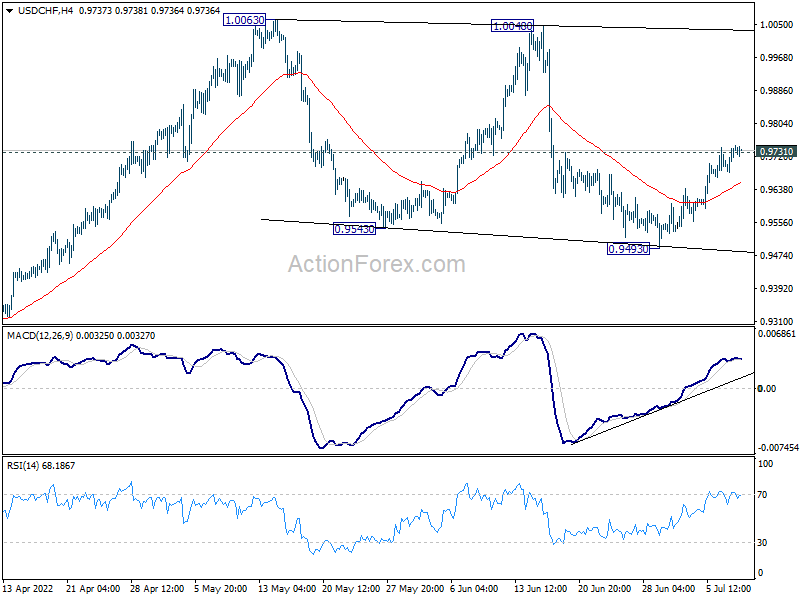
No change in USD/CHF's outlook as focus remains on 0.9731 minor resistance. Sustained break there will argue that the consolidation from 1.0063 has completed and bring stronger rally back to retest 1.0063 high. However, another fall below 0.9493 will dampen this view and target 0.9459 resistance turned support.
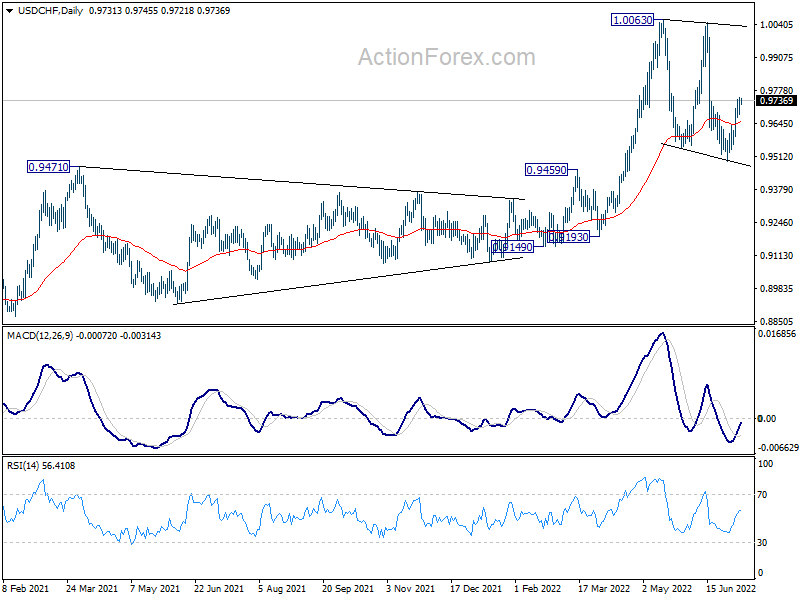
In the bigger picture, down trend from 1.0342 (2016 high) should have completed with three waves down to 0.8756 (2021 low) already. Rise from 0.8756 is likely a medium term up trend of its own. Next target is 1.0237/0342 resistance zone. This will remain the favored case as long as 0.9471 resistance turned support holds. However, sustained break of 0.9471 will extend long term range trading with another falling leg.
Dollar Firm in Steady Markets, Awaits NFP
Overall markets are relatively quiet in Asian session today. There is little reaction to the tragic news that former Japanese Prime Minister Shinzo Abe was shot and gravely injured. Dollar and Yen remain the strongest ones for the week while Euro is the runaway loser, followed by Sterling by a distant. Focuses will now turn to job data from the US and Canada.
Technically, EUR/USD appears to be losing some downside momentum. There are two fibonacci projection levels from here to parity that could set a bottom for the pair. But a break of 1.0276 minor resistance is needed to be the first sign of bottoming. Meanwhile, reactions to NFP could be wild and they're two-way. So beware.
In Asia, at the time of writing, Nikkei is up 0.77%. Hong Kong HSI is up 0.07%. China Shanghai SSE is up 0.17%. Singapore Strait Times is up 0.15%. Overnight, DOW rose 1.12%. S&P 500 rose 1.50%. NASDAQ rose 2.28%. 10-year yield rose 0.095 to 3.008.
Fed Waller: Definitely support another 75bps in Jul, probably 50bps in Sep
Fed Governor Christopher Waller said yesterday, "we need to move to a much more restrictive setting" and do that "as quickly as possible."
"I'm definitely in support of doing another 75 basis point hike in July, probably 50 in September, and then after that we can debate whether to go back down to 25s," he added.
"Inflation is a tax on economic activity, and the higher the tax the more it suppresses economic activity," Waller warned. "If we don't get inflation under control, inflation on its own can place us in a really bad economic outcome down the road."
Fed Bullard continues to advocate getting to 3.5% this year
St. Louis Fed President James Bullard "I think it would make a lot of sense to go with the 75 at this juncture", referring to the rate hike in this month's FOMC meeting.
"I've advocated and continue to advocate getting to 3.5% this year, then we can see where we are and see how inflation's developing at that point," he added.
On the economy, Bullard said, there is a "a good chance of a soft landing." "At this point, it appears that the GDI (gross domestic income) measure is more consistent with observed labor markets, suggesting the economy continues to grow."
On the data front
Japan bank lending dropped -0.5% yoy in Jun, below expectation of 0.9% yoy. Current account surplus narrowed to JPY 0.01T, below expectation of JPY 0.16T.
Looking ahead, France trade balance and Italy industrial output will be released in European session. But main focuses will be on US non-farm payroll and Canada employment later in the day.
More on NFP and Canada:
- NFP Preview: 75bps Hike Likely Even if Jobs Disappoint
- Dollar Re-Energized ahead of Fed Minutes, NFP Report Amid Recession Jitters
- NFP This Week Will Test Dollar's Year-Long Trend
- Canadian Jobs Data Eyed after Loonie's Sharp Sell-off
- Canadian Dollar Eyes Job Data in Canada, US
USD/CHF Daily Outlook
Daily Pivots: (S1) 0.9699; (P) 0.9724; (R1) 0.9766; More...
No change in USD/CHF's outlook as focus remains on 0.9731 minor resistance. Sustained break there will argue that the consolidation from 1.0063 has completed and bring stronger rally back to retest 1.0063 high. However, another fall below 0.9493 will dampen this view and target 0.9459 resistance turned support.
In the bigger picture, down trend from 1.0342 (2016 high) should have completed with three waves down to 0.8756 (2021 low) already. Rise from 0.8756 is likely a medium term up trend of its own. Next target is 1.0237/0342 resistance zone. This will remain the favored case as long as 0.9471 resistance turned support holds. However, sustained break of 0.9471 will extend long term range trading with another falling leg.
Economic Indicators Update
| GMT | Ccy | Events | Actual | Forecast | Previous | Revised |
|---|---|---|---|---|---|---|
| 23:50 | JPY | Bank Lending Y/Y Jun | -0.50% | 0.90% | 0.70% | |
| 23:50 | JPY | Current Account (JPY) May | 0.01T | 0.16T | 0.51T | |
| 05:00 | JPY | Eco Watchers Survey: Current Jun | 55 | 54 | ||
| 06:45 | EUR | France Trade Balance (EUR) May | -12.5B | -12.2B | ||
| 08:00 | EUR | Italy Industrial Output M/M May | -1.10% | 1.60% | ||
| 12:30 | CAD | Net Change in Employment Jun | 20.0K | 39.8K | ||
| 12:30 | CAD | Unemployment Rate Jun | 5.20% | 5.10% | ||
| 12:30 | USD | Nonfarm Payrolls Jun | 250K | 390K | ||
| 12:30 | USD | Unemployment Rate Jun | 3.60% | 3.60% | ||
| 12:30 | USD | Average Hourly Earnings M/M Jun | 0.30% | 0.30% | ||
| 14:00 | USD | Wholesale Inventories May F | 2.00% | 2.00% |
Fed Bullard continues to advocate getting to 3.5% this year
St. Louis Fed President James Bullard "I think it would make a lot of sense to go with the 75 at this juncture", referring to the rate hike in this month's FOMC meeting.
"I've advocated and continue to advocate getting to 3.5% this year, then we can see where we are and see how inflation's developing at that point," he added.
On the economy, Bullard said, there is a "a good chance of a soft landing." "At this point, it appears that the GDI (gross domestic income) measure is more consistent with observed labor markets, suggesting the economy continues to grow."