Sample Category Title
Week Ahead – Summer Remains Volatile
A strong nonfarm payroll report has paved the way for the Fed to deliver another 75 basis-point rate hike at the June 27th policy meeting. An overheating economy and hot inflation will keep the Fed focused on aggressively fighting inflation. Recession fears eased after the June payrolls impressed and wage growth remained strong. The Fed has the all-clear signal to hike rates aggressively and that will lead to a sharp deceleration with the economic data by the end of the summer.
The upcoming week will have a chorus of Fed speak, a couple key rate decisions, massive Chinese data, and President Biden’s trip to the Middle East. Fed’s Williams, Barkin, Waller, and Bostic will likely provide more insight as to how aggressive the Fed may have to be over the next few policy meetings. The Bank of Canada and Reserve Bank of New Zealand each have rate decisions that are expected to deliver half-point rate increases. China’s second quarter GDP is expected to show the economy contracted due to Shanghai’s lockdown. President Biden’s trip to the Middle East could also weigh heavily on energy markets as he makes a push for the Gulf nations to pump more crude.
Summer doldrums are not happening anytime soon as Wall Street has yet to see the inflation peak. Financial markets are getting close to pricing in how high the Fed will take interest rates, but volatility will remain elevated until that happens.
Country
US
Wall Street will pay close attention to the latest inflation report which should keep the pressure on the Fed to tighten rates aggressively. CPI is expected to remain hot with an 8.8% annual gain in June following an 8.6% rate in the prior month. The start of earnings season will also draw extra attention as the banks will provide their latest assessment of the US economy and the consumer. It will be a busy week for Fed speak as Williams talks about Libor on Monday, Barkin discusses recession on Tuesday, Waller speaks on Thursday and Bostic talks on Friday. The Fed will also release the Beige Book on Wednesday.
UK
The Boris Johnson show has come to an end. The colorful, often irreverent prime minister has seen his popularity plummet and he resigned on Thursday after massive resignations in his Conservative party.
Johnson said he plans to remain prime minister until the fall, when a successor is named. However, given his humiliating departure, there are members of the Conservatives and the opposition who have called for his immediate replacement. The political meltdown could cause some volatility in the UK financial markets in the coming weeks.
BoE Governor Andrew Bailey will testify before the UK’s Treasury Committee on Monday. Lawmakers are sure to quiz Bailey on surging inflation and the cost-of-living crisis in the UK.
On Wednesday, the markets will get treated to a data dump. GDP is expected to remain flat but no one would be surprised if it declined by 0.1% MoM in May, following a 0.3% contraction in April. Industrial Production has also struggled, with a consensus estimate of a flat reading for May, after a -0.6% reading in April.
EU
EU sanctions against Russia over its invasion of Ukraine have raised fears of an energy crunch in Europe come winter. The Nord Stream 1 pipeline, the primary channel for Russian gas exports to Europe, will close on Monday for two weeks for annual maintenance. However, there are fears that Moscow might not reopen the pipeline, which could send natural gas prices soaring.
Germany
On Tuesday, Germany releases ZEW Economic Sentiment. The index has been in deep-freeze for months, with a June reading of -28.0. This is expected to worsen to -40.0 in July.
We’ll get a look at German CPI on Wednesday. Inflation has been soaring in the eurozone’s largest economy, but is expected to remain unchanged in June at 7.6% YoY.
China
It is a heavy week for data in China but initial risks lie over the weekend with covid zero as cases rise in Shanghai. Any moves to tighten restrictions over the weekend will see China equities move sharply lower on Monday.
Over the weekend, China releases June Inflation, but unless it leaps higher to near 3.0%, its impact will be slight. Monday sees New Yuan Loans and if they fall sharply, that will undo much of the positive new for equities of China bringing forward local government infrastructure bond issuance today.
China’s Balance of Trade Wednesday should be a non-event, but Friday’s House Price Index, Retail Sales, Fixed Asset Investment, Industrial Production and most especially GDP contraction will definitely cause some volatility. An ongoing recovery from the covid zero lockdowns is priced into the data now, so the risk is that the data series underperforms. That could see short-term weakness in China equities, although longer-term, it likely brings China closer to a wider stimulus effort. That would be good for equities and commodities.
India
With the INR hovering near record lows versus the US Dollar, as India’s current account position deteriorates, and cost of living surges, this week’s data dump carries higher than normal risk. Additionally, India is seeing record foreigner outflows from its stock market.
India releases Industrial production and Inflation on Tuesday. IP has downside risks, Infl. upside risks which will weigh on equities and the INR. WPI index releases Thursday have upside risk as well which will have markets pricing in harder RBI rate hikes, equities negative. India’s Balance of Trade on Friday has downside risks on a weak number for both the INR and equity markets as the stagflation noise returns to the country.
Australia
The Australian Dollar is hovering just on monthly lows as global investor sentiment turns south, only a continuation of this week’s Wall Street recovery is likely to avoid further weakness.
Australia releases Business and Consumer Confidence this week, but the Employment data on Thursday is most important. It is usually good for decent intraday volatility in forex and equities. That said, the data recently for Australia has been very good, so a series of weak prints could have an outsized negative impact on the AUD and local equities, with the RBA in hawkish mode.
New Zealand
The RBNZ announces its next policy decision on Wednesday, although no statement or new projections. A 0.50% hike to 2.50% is priced into the market and 0.25% would cause a sharp selloff by the NZD. In a similar vein, 0.75% would be a huge surprise and is probably good for a 150 point NZD/USD rally.
Inflation and GDP data the following week (its only released quarterly quite incredibly) potentially risks more volatility than the RBNZ decision itself.
Japan
Japan is reeling from the Abe shooting today, but any negative impact on the Yen and Nikkei will be short-lived. Japan has Upper House elections on Sunday, which the LDP will now hold comfortably following today’s tragic incident.
Japan Machinery Orders Monday, and PPI Tuesday should move higher as Japan coattails China and its own covid recovery. Bullish equities at the periphery, however Industrial Production on Thursday has downside risks.
USD/JPY remains near 136.00 despite US yields falling the past week. Given USD/JPY’s near 100% correlation to the US/Japan rate differential, a sharp move lower by either the US 2 or 10-year yield tonight or next week risks exposing a very long USD/JPY market to aggressive downside correction, potentially targeting 132.00.
Singapore
Singapore releases GDP on Thursday ,(3.70% exp YoY) and Non-Oil Exports on Friday (12.40% exp YoY). Typically they will have a very binary outcome on local stock markets. Lower number, lower Straits Times Index. Higher number, higher Straits Times Index.
The risks are rising that the MAS will announce a surprise tightening in either July or early August (before the scheduled October date), which would see a sudden rally by the Singapore Dollar as the MAS manages monastery policy via the currency.
Markets
Energy
Energy traders will have a lot to keep their eye on next week as President Biden makes a trip to the Middle East and as the Nord Stream 1 pipeline is scheduled to shut for maintenance. Both the oil and natural gas markets could remain very tight and fears are rising that Russia may signal they might not reopen the key natural gas channel for Europe.
Recession fears will continue to weigh on the crude demand outlook, but the oil market is still looking tight given the supply risks from a wide range of suppliers to Europe.
Gold
Gold’s plunge may not be over if the short-end of the Treasury curve continues to rise. The gold market has been beaten up and the pain won’t end until most of Wall Street is confident in pricing in Fed tightening.
Cryptos
Bitcoin’s best week since March will either be a dead cat bounce or possibly the beginning of a stabilization period. Selling exhaustion may have settled in but until the fundamentals remotely improve for Bitcoin skepticism with any rebound will remain elevated.
Saturday, July 9
Economic Data/Events:
- China aggregate financing, money supply, new yuan loans
- ECB’s Schnabel speaks on a central banking and “greening of the economy” panel
- China’s two-day online Caixin Summer Summit begins
Sunday, July 10
Economic Events:
- ECB’s Stournaras speaks on a multilateralism panel at the Recontres Economiques
- Japan holds elections for the upper house of parliament. PM Kishida’s ruling coalition is expected to win a majority according to polls.
Monday, July 11
Economic Data/Events:
- China FDI
- Denmark CPI
- Japan money stock, machinery orders
- New Zealand card spending
- Norway CPI
- Fed’s Williams speaks on Libor at a conference co-hosted by the New York Fed and the UK Financial Conduct Authority.
- BOE Gov Bailey appears before the UK’s Treasury Committee.
- CFS-IMFS special lecture by Bundesbank President Nagel on “Digital Euro — Chances and Risks.”
- BOJ Gov Kuroda speaks at a branch managers’ meeting.
- Sweden’s Riksbank publishes minutes from its June 29 meeting.
- Nord Stream 1 gas pipeline closes for annual maintenance through July 21.
Tuesday, July 12
Economic Data/Events:
- Australia household spending, business confidence
- Germany ZEW survey expectations
- India industrial production, CPI
- Japan PPI
- Mexico international reserves, industrial production
- New Zealand net migration
- South Africa manufacturing production
- South Korea money supply
- ECB’s Villeroy speaks at Europlace International Financial Forum in Paris.
- BOE Gov Bailey discusses the economic landscape at an OMFIF event in London.
- US Treasury Secretary Janet Yellen attends events in Tokyo
Wednesday, July 13
Economic Data/Events:
- US CPI
- President Biden begins 4-day trip to Middle East
- Fed releases Beige Book
- Germany, Spain, France CPI
- Australia consumer confidence
- Canada (BOC) rate decision: Expected to raise rates by 50bps to 2.00%
- BOC releases quarterly monetary policy report and Gov Macklem holds post-rate decision conference
- China trade, medium-term lending
- Eurozone industrial production
- New Zealand food prices, home sales
- RBNZ rate decision: Expected to raise rates by 50bps to 2.50%
- BOJ to announce outright purchase amount of government securities
- South Africa retail sales
- UK industrial production, monthly GDP
- EIA Crude Oil Inventory Report
Thursday, July 14
Economic Data/Events:
- Earnings Season begins with JPMorgan and Morgan Stanley
- US PPI, Initial Jobless Claims
- Australia unemployment, consumer inflation expectations
- India trade, wholesale prices
- Japan industrial production, capacity utilization
- Kazakhstan retail trade
- Philippines overseas remittances
- Singapore GDP
- Sweden CPI, unemployment rate
- Turkey industrial production
- UK RICS house prices
- ECB’s Centeno speaks at a parliamentary hearing in Lisbon.
- Hungary’s central bank Deputy Governor Virag speaks at an online book presentation.
Friday, July 15
Economic Data/Events:
- US business inventories, industrial production, University of Michigan consumer sentiment, Empire manufacturing, retail sales
- Fed’s Bostic speaks
- China GDP, Industrial Production, Retail Sales, Surveyed Jobless Rate, Fixed Assets, liquidity operations
- Poland GDP
- Canada existing home sales
- Eurozone new car registrations
- Japan tertiary index, department store sales
- New Zealand PMI
- South Korea export and import price index
- Thailand forward contracts, foreign reserves
- G20 finance ministers and central bankers meet
- ECB’s Rehn speaks on the economy and inflation at the SuomiAreena 2022 in Pori, Finland.
- Bank of Italy releases its quarterly economic bulletin.
Sovereign Rating Updates:
- Spain (Moody’s)
- Ireland (DBRS)
Week Ahead – US Inflation on the Menu, BoC and RBNZ to Raise Rates
The summer calm will have to wait a little longer as the coming week is filled with crucial events. Canada and New Zealand are geared to raise interest rates, although their currencies are ultimately at the mercy of global recession risks. In China, it’s a close call whether the economy contracted in Q2. Most importantly, US inflation might finally be losing its punch.
The dollar show
The US dollar rally went into overdrive this week, leaving a trail of destruction across the FX market. Concerns that the global economy is sleepwalking into a recession as interest rates are raised at full speed and government spending is rolled back are pushing nervous investors into the safety of the reserve currency.
Meanwhile, every other major currency has been dismantled. The euro has been demolished by the energy crisis, which has deprived it of its main weapon - an enormous trade surplus. The yen has been devastated by the Bank of Japan’s refusal to consider higher rates, while the British pound has transformed into a mirror image of stormy stock markets.
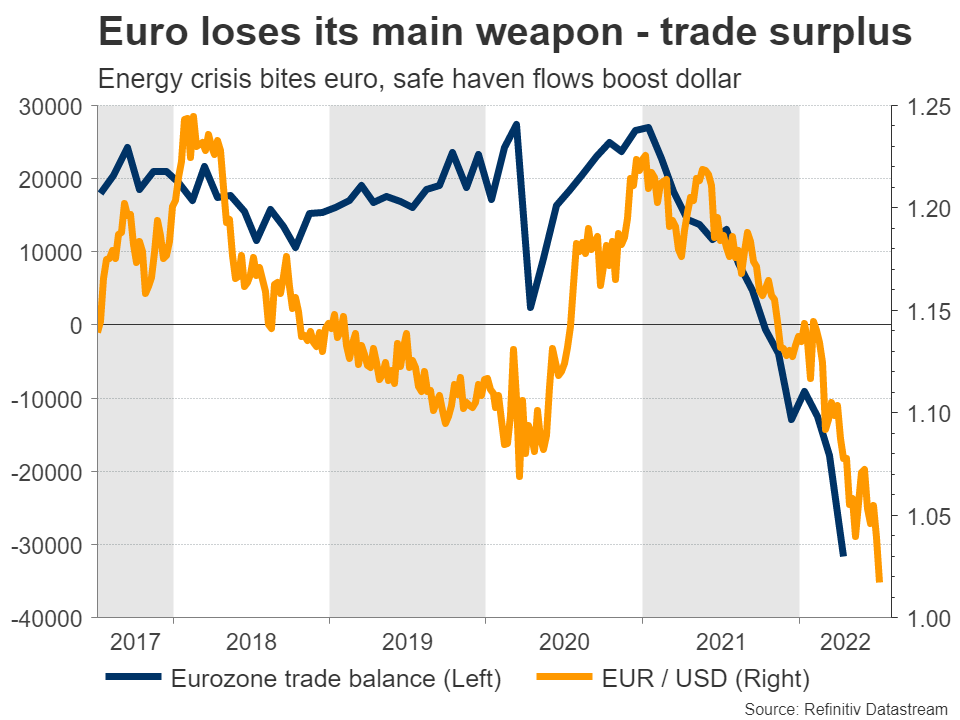
Admittedly, it’s been a case of ‘all news is good news’ for the dollar lately. When markets worry about runaway inflation, Fed tightening bets gain momentum and higher Treasury yields propel the dollar higher. And when traders panic about a recession, safe-haven flows eclipse everything else.
There are two elements that can change this dynamic - either more energy supply comes back online and lower prices provide relief to the euro and yen, or US inflation cools down and the Fed can take its foot off the brakes. This puts even more emphasis on the upcoming data on Wednesday.
Inflation as measured by the CPI is anticipated to have risen to 8.7% in June from 8.6% previously. However, there is scope for a softer number considering business surveys like the S&P Global PMI, which showed that companies raised their selling prices at the slowest pace in almost a year. The rollover in commodity prices adds credence to this view.
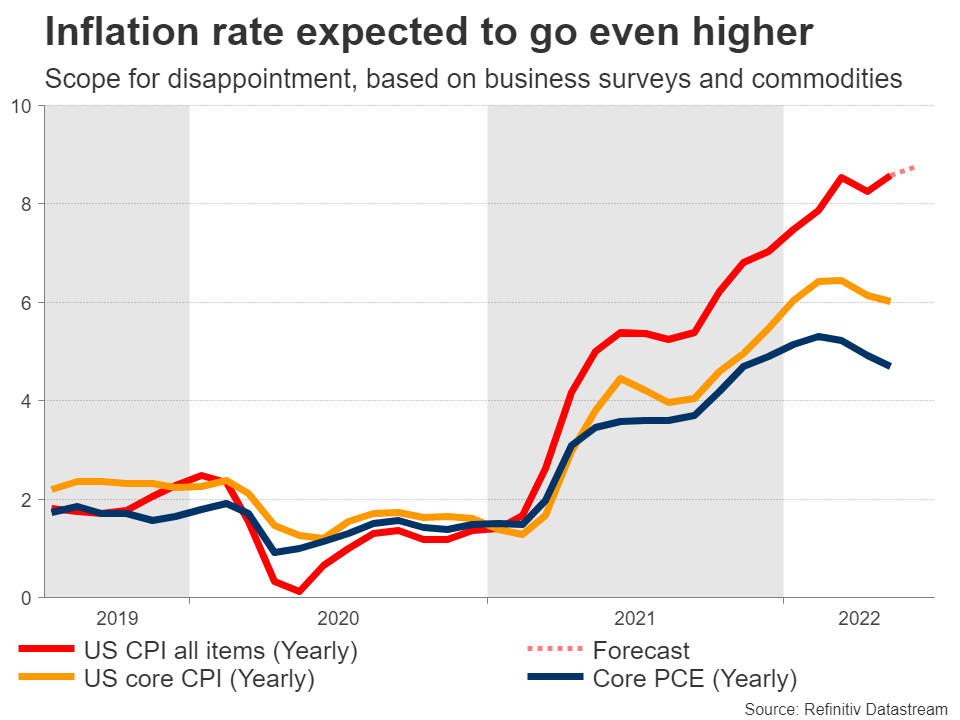
Retail sales for the same month are out on Friday and although they are expected to have bounced back in monthly terms, it is the yearly rate that tells the story. It stands at 8.1%, below the inflation rate, indicating that real consumption has been steamrolled by the cost of living crisis.
BoC - In the Fed’s shadow
In neighboring Canada, the central bank is expected to copy the Fed and raise interest rates by 75 basis points on Wednesday. The move is almost fully priced into money markets, following a string of encouraging labor market data and the BoC’s own business survey that reflected mounting inflation worries.
Since the rate hike is essentially a done deal, the market reaction will mostly boil down to the tone of the press conference and the updated economic forecasts. A rate hike of equal size is already priced in for September, so the stakes are high.
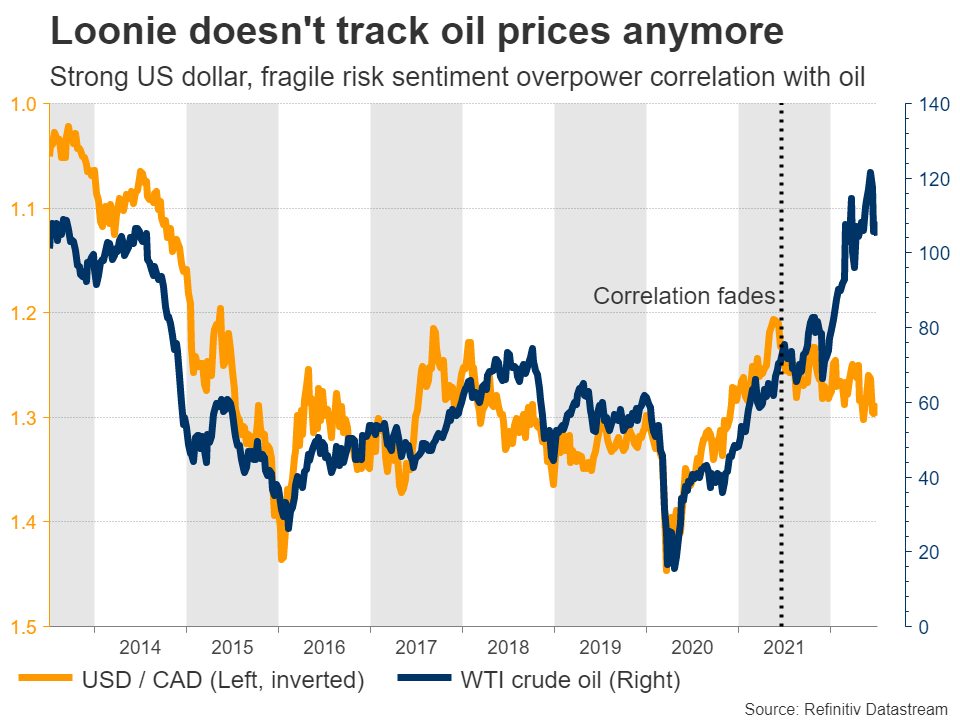
Overall, there’s reason to be cautious on the loonie. Investors assume the BoC will out-hike the Fed this year, which may be unrealistic considering how quickly the air is coming out of the nation’s ‘bubbly’ housing market. Separately, if the currency couldn’t gain ground with oil prices up 35% this year, what happens if prices extend their latest drop?
RBNZ - A steady hand
New Zealand’s economy continues to hum along. The unemployment rate is at a record low, consumption remains healthy, and various surveys suggest inflation is raging.
There are some worrisome spots too. Consumer and business confidence has taken a sharp hit lately while the housing market is cooling. Higher rates have clearly dampened demand, but this is what the RBNZ wanted to achieve in the first place.
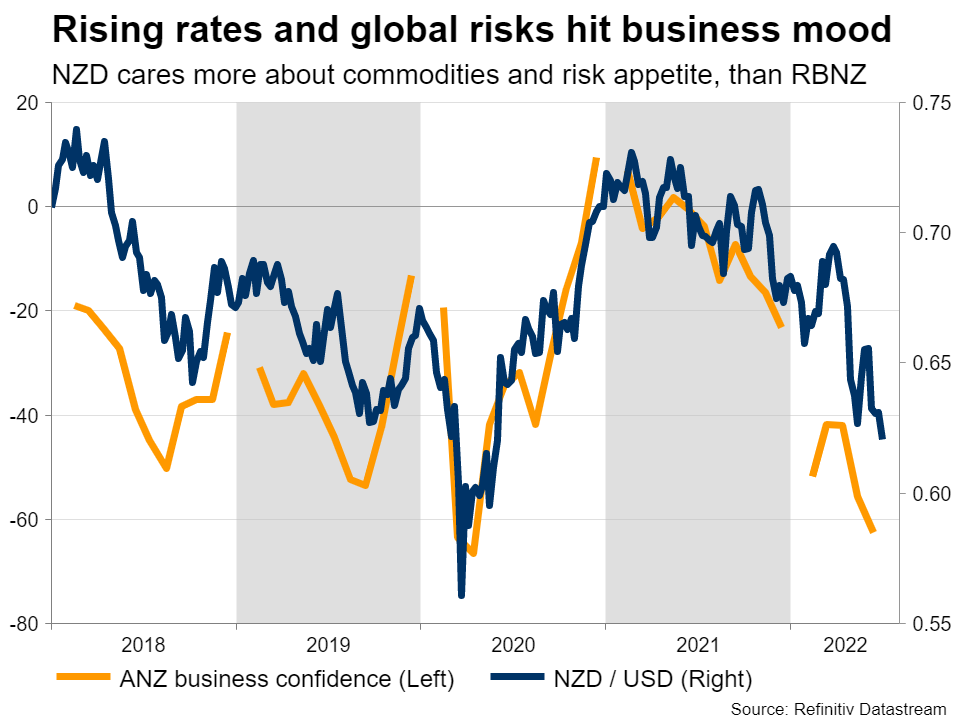
Hence, there’s no real reason for the Reserve Bank to deviate from its strategy of raising rates in 50bps increments when it meets on Wednesday, which is also what the market has priced in - both for this meeting and next month. The bar for a hawkish surprise is therefore high, unless the officials want to put a 75bps move on the table.
As for the kiwi, what the RBNZ does is secondary to how global forces evolve. Recession worries are currently dominating, putting pressure on risk sentiment and commodity prices, both negative for the kiwi. Any relief rallies are likely to remain shallow in this regime, until nerves around global growth calm down.
China - Economic contraction?
Over in China, the ball will get rolling with inflation stats for June over the weekend ahead of trade data on Wednesday, culminating with economic growth numbers for the second quarter on Friday.
Several cities went into strict lockdowns during this quarter, and the collapse in demand was evident in retail sales, which contracted sharply in April and May. It was a similar story in business surveys and industrial output, thanks to the struggling property sector. This begs the question - did the overall economy contract in Q2?
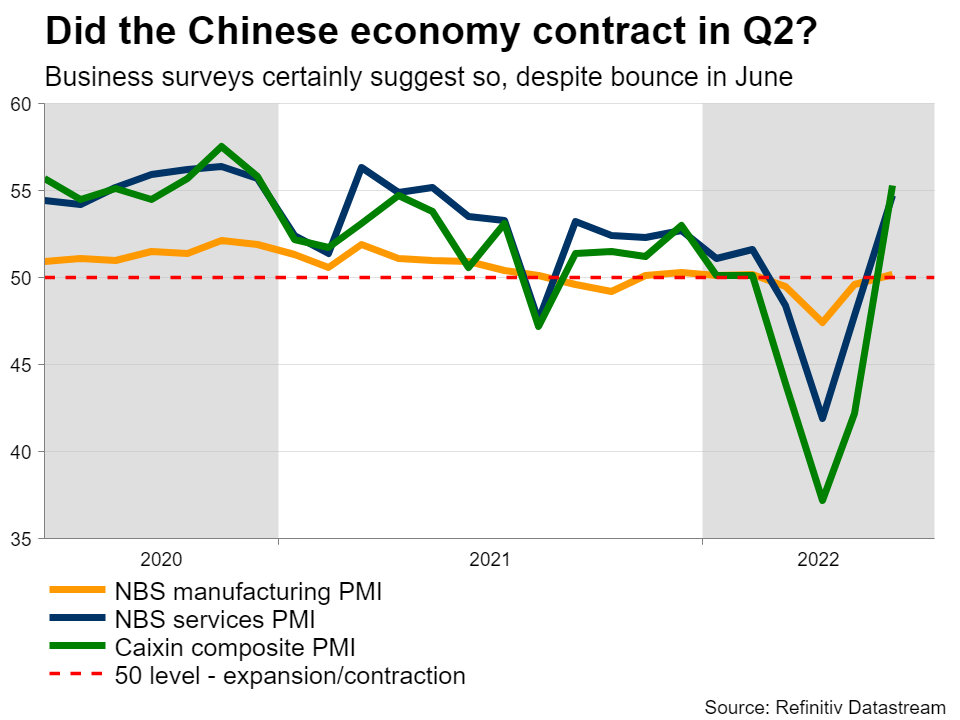
It’s a close call, because most of the evidence for June points to a solid recovery as the lockdowns were lifted to close the quarter. This could be a key piece of the puzzle for global risk sentiment, with the capacity to impact equity markets and commodity currencies such as the Australian dollar.
Speaking of the aussie, Australia’s jobs report for June will be released on Thursday.
Finally in the UK, monthly GDP stats for May are out on Wednesday. That said, sterling pays more attention to stock markets these days. Politics will be in the spotlight too as the ruling Conservative party scrambles to select a replacement for outgoing Prime Minister Johnson.
Bank of Canada to Aggressively Hike Interest Rates
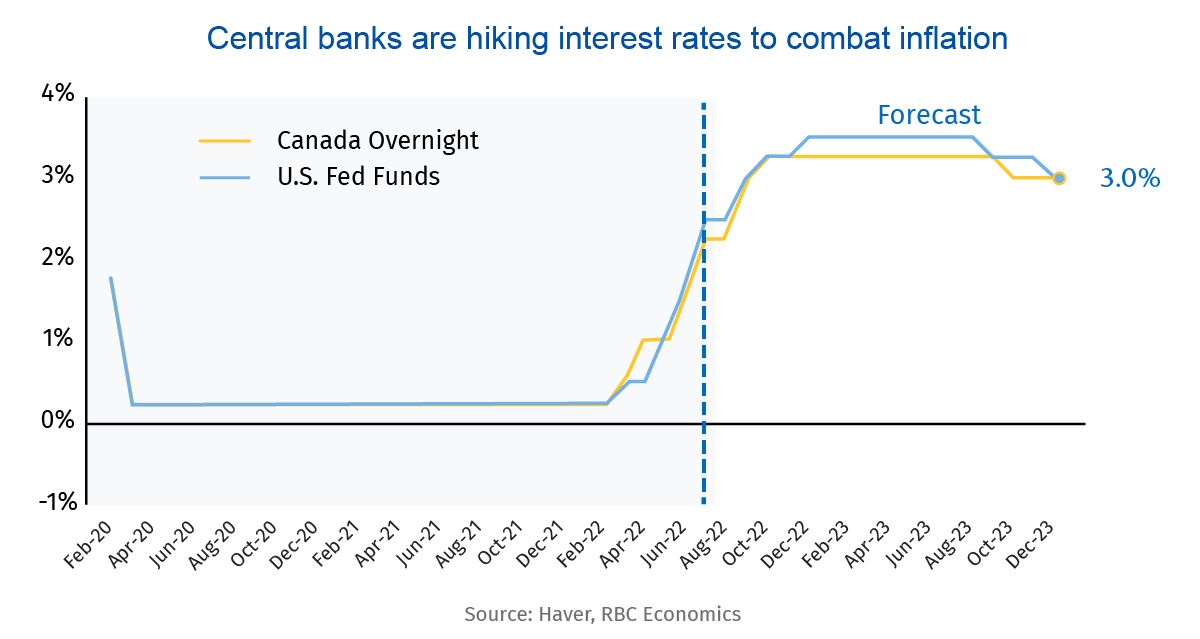
Canada’s central bank isn’t done raising interest rates. RBC (and markets) expect a 75 basis point increase when the BoC announces its next decision on Wednesday. That would be the largest single rise since the 1990s. May CPI growth at 7.7% (year-over-year) is running well above the bank’s April forecast of 5.8% in the second quarter. And 60% of the prices tracked by the measure are growing above the BoC’s 1% to 3% target range by our count. Worryingly, those higher price readings are beginning to seep into longer run inflation expectations. Most businesses and consumers still expect inflation to moderate toward pre-shock levels beyond the next 2 to 3 years—but the share expecting it to last longer is edging higher. An unhinging of longer-run inflation expectations from the BoC’s targets would disrupt decades of effective inflation-targeting monetary policy. It would also require much larger and more damaging interest rate hikes to reverse.
Against that backdrop, we expect the economic growth risks from hiking rates too aggressively in the near-term will be overshadowed by the medium-term cost of not doing enough. The overnight rate remains too low at 1.5%. And the 75 basis point hike we expect this week would still leave it towards the lower end of the bank’s estimate of its ‘neutral’ range. We expect the central bank to continue on a more aggressive hiking path with another 75 basis point increase in September.
The housing market is already reacting to higher borrowing costs, with home sales in June dipping as much as 30% to 40% compared to a year ago in key markets like Toronto and Vancouver. Consumer demand for other goods and services should gradually follow and start to trend lower toward the end of this year. This pattern is being repeated abroad and is helping to ease supply chain snarls. We continue to believe inflation is close to its peak, but won’t shift to more sustainable levels until demand slows more significantly. Once that happens, expect the BoC and other central banks to again push rates lower—though this likely won’t play out until the economy undergoes a modest contraction next year.
Week ahead data watch:
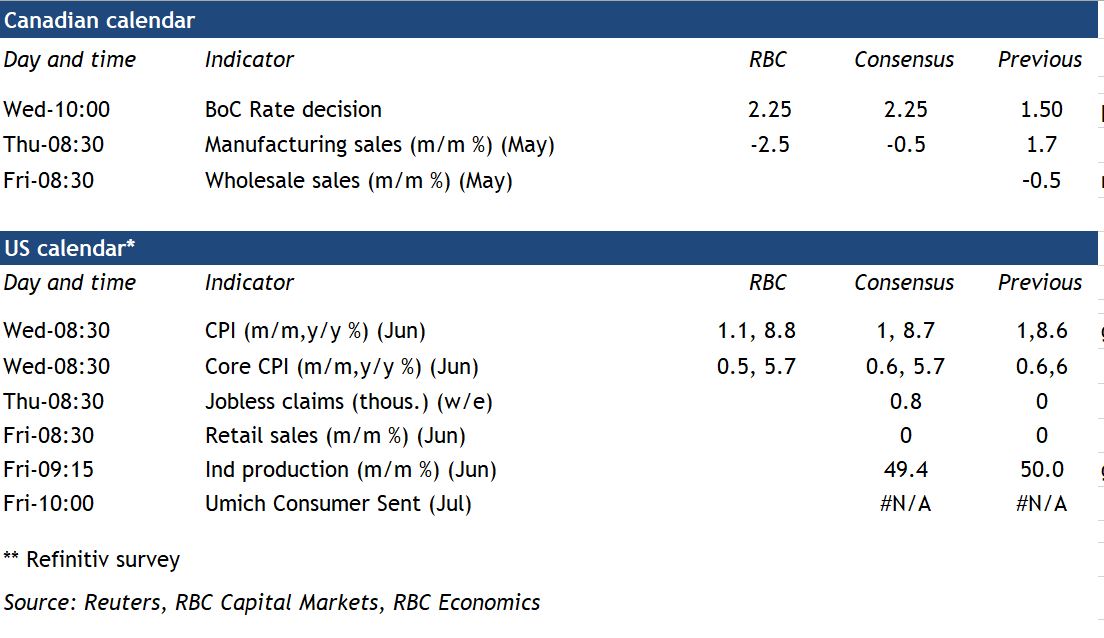
U.S. CPI likely ticked higher to 8.8% in June on the back of surging food and gas prices. Rent prices have been rising faster over the past year should continue to support growth in core prices, given its high relative weight.
Manufacturing sales fell by 2.5% in May, according to StatCan’s preliminary estimate. The decline in volume was probably larger as the auto sector weakened, offset by higher petroleum and coal prices.
Sunset Market Commentary
Markets
A temporary EUR-setback in early European trading disturbed an otherwise calm run-up to the June payrolls report. EUR/USD set a new intraday/cycle/two decade low around 1.0070. There was quite some buzz on details from energy rationing measures in Germany, but the general principle – stage two of the gas emergency plan – was already decided on end last month. Germany (and Europe) now await an anxious period between July 11 and July 21, when Nord Stream 1 is shut down for scheduled maintenance. The billion dollar question is whether gas will flow again after July 21 or not. From a market point of view, it could have a bigger impact than the ECB’s first policy rate hike this cycle (and in over a decade) a day earlier. Anyway, June payrolls beat consensus with net job growth coming in at 372k vs 265k consensus. A 74k downward revision to the previous two month’s cumulative numbers downplays the upward surprise. The unemployment rate stabilized at the cycle low of 3.6%, but there was a setback in the labour force participation rate (62.2% from 62.3%). Wage growth printed near bang in line with expectations at 0.3% M/M and 5.1% Y/Y. It’s telling about financial market fragility these days that such “average” payrolls outcome generated a rather outsized move. Especially US Treasuries sold off. We understand the logic that this print removed any remaining doubt on the Fed’s determination to move on with back-to-back jumbo 75 bps rate hikes. As Atlanta Fed Bostic reacted after the labour market report: “we can move by 75 bps without damaging the economy.” He did warn that he was starting to see the first signs of economic slowdown. The US yield curve bear flattens at the moment of writing with yields rising by 5.5 bps (30-yr) to 10 bps (2-yr). UST’s massively underperform German Bunds with the German yield curve even bull steepening somewhat. Yields lose 4.1 bps (2-yr) to 0.5 bps (30-yr). Interestingly, the dollar failed to revisit the intraday highs despite this massive relative yield advantage. EUR/USD keeps its nerve around 1.0150. Stock markets and risk sentiment give no guidance either, trading near flat on the day. We end our recap with a little follow-up on EUR/GBP’s downside break out of the upward sloping trend channel earlier this week: there was none. The pair changes hands around 0.8460.
News Headlines
Hungarian inflation quickened from 10.7% to 11.7% on a monthly pace of 1.5%. That was a little more than the 11.5% analyst consensus. MNB-calculated core inflation (ex non-processed food, energy, pharmaceutical products and services with regulated prices) shot up again by 1.9% m/m to 13.8%. Both are the highest readings since 1998 and leave the central bank zero scope to slowdown the pace of monetary tightening. It hinted at doing so a few weeks ago, after which the Hungarian forint went into a tailspin, boosting (imported) inflation even further. EUR/HUF hit new record low in the 415-417 area over the past few days. Seeking to floor the currency, Budapest yesterday raised its weekly deposit rate by a stunning 200 bps to 9.75% but it’s impact was minimal. EUR/HUF fell towards 403. The pair holds on to those levels after some intraday volatility post-CPI.
Canadian net employment fell by 43.2k in June. Expectations were for a 22.5k increase. The decline mainly occurred in the part time sector (-39.1k). The unemployment rate hit a new all-time low at 4.9% though was accompanied by an unexpected and large retreat in the participation rate from 65.3% to 64.9%. In absolute numbers, some 100k people left the labour market, the biggest one-month drop outside the pandemic. It adds to an already scarce labour supply and helped wage growth shot up from 4.5% to 5.3% y/y. The Canadian labour market remains extremely tight. The Bank of Canada started to tighten monetary policy in recent months, citing excess demand and inflation way above target. Today’s payrolls report leaves the BoC no option but to stay on that path. Markets priced in a 75 bps hike for the meeting on Thursday. There’s a more than 50% chance discounted for a 100 bps move. Canadian swap yields rise 3-6.4 bps. USD/CAD advances to just north of 1.30 because of strong US payrolls published at same time.
Another Solid U.S. Payroll Report in June
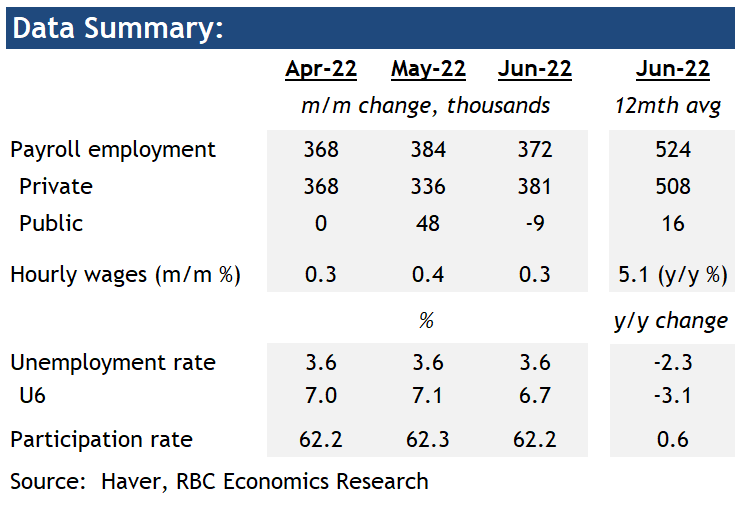
- Payroll employment rose by 372k; labour shortages still acute, evident by low unemployment rate at 3.6%
- Growth in wages from pre-pandemic soon to be outpaced by inflation, lowering real spending power
- Slowing consumer demand and Fed rate hikes to push unemployment rate higher in 2023
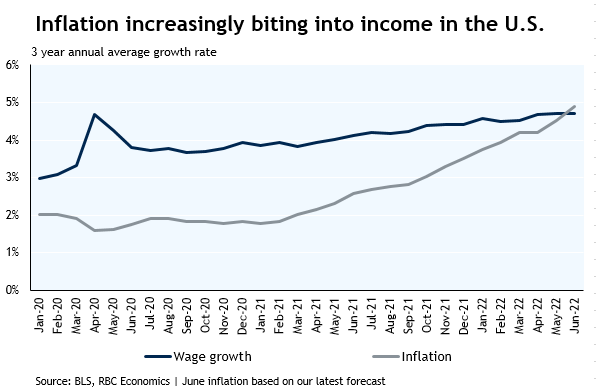
U.S. payrolls added 372k jobs in June. That was similar to the pace in the prior two months and brought the overall shortfall in employment from pre-pandemic to just over half a million. Employment continued to grow in high-contact service industries including leisure and hospitality (+67k), but was also higher in professional and business services (+74k). The unemployment rate held at 3.6% for a fourth consecutive month but the labour force participation rate at 62.2% remained over a full percent below levels immediately pre-pandemic, thanks to a slower comeback of workers aged 55 and over. Heightened demand for workers means businesses have to compete with higher wages to attract and retain talent from a shrinking labour force, adding to pressure that’s already been accelerating over the past months.
On a year on year basis average hourly earnings grew 5.1% in June, a tick lower than the 5.3% in May but still elevated comparing to rates pre-pandemic (annual wage growth was 3.3% in 2019.) The increase was also particularly elevated in leisure and hospitality (+9.2%). Up to May, growth in wages relative to pre-pandemic was still outpacing the rise in consumer prices, but just slightly. It would not take a large upside surprise in future inflation readings to close that gap. Indeed, rising inflation is increasingly biting into consumers’ spending power, pushing their confidence lower and inflation expectations higher. There is still substantial momentum in labour markets through this summer, facilitated by rebound in close contact service sectors. But with the Fed hiking rates aggressively in the near-term, we expect labour market conditions to start softening later this year, and the unemployment rate to rise more significantly in 2023.
Canada Sheds Jobs in June, Although Details Better
The Canadian labour market shed 43k positions in June. Of some (cold) comfort was the fact that nearly all of the losses (39.1k) were in part-time positions, with full-time employment down a more modest 4k positions.
Self-employment was down 59.2k positions, private sector hiring was up 16.6k, and public sector employment was little changed in June.
Even with the headline drop in employment, the unemployment rate fell 0.2 ppts to 4.9%, as the labour force declined by 97.5k and the participation rate slid from 65.3% to 64.9%. Tight markets are prompting accelerating wage growth, with average hourly earnings up 5.2% year-on-year versus 3.9% in May.
By industry, job losses were concentrated in the services sector, where employment fell by 76k. Losses were spread across several industries, with the largest decline occurring in retail trade (-58k). However, there were also losses in healthcare and social assistance (-20k), educational services (-14k), and information, culture and recreation (-14k). In contrast, employment in the goods producing sector was up 33k in June, lifted by manufacturing (+26k) and construction (+23k).
On a geographic basis, the report noted job losses in Quebec (-27k) and Newfoundland and Labrador (-4.3k), while being little changed in Ontario. On the flipside, employment increase in Manitoba (+4k) and PEI (+1.6k).
Lastly, total hours worked increased 1.3% month-on-month.
Key Implications
June's soft employment print (coupled with last week's flash estimate for a decline in GDP during May), signals that Canadian economic momentum is softening. This is consistent with our view that growth will ease in the second half of this year. That said, details of the report were more encouraging, as hours worked climbed significantly during the month. In addition, the unemployment rate fell to a new low of 4.9%. A very tight job market is prompting stronger wage growth, which will go some way towards offsetting the erosion in real incomes by inflation.
For the Bank of Canada, today's report (which featured a weak headline, but better details) is unlikely to sway their aggressive stance, particularly with job markets so tight and wages accelerating rapidly. Policymakers are resolute in their determination to rein in inflation and prevent expectations from becoming further unanchored. As such, we still expect them to hike by 75 bps at their next policy meeting on July 13th.
CAD Dips on Weak Canadian Job Data
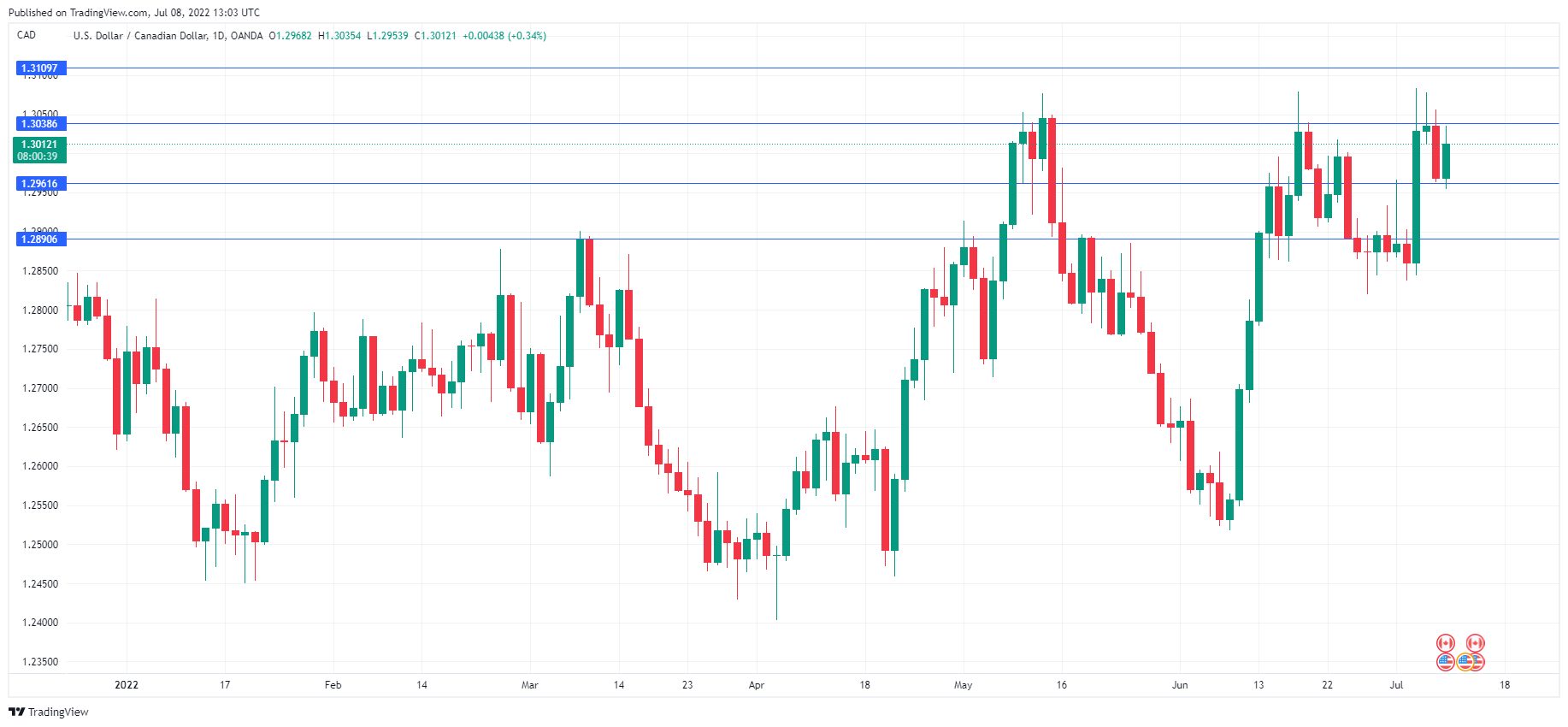
USD/CAD is back above the 1.3000 line on Friday, after weak Canadian job numbers and a strong US nonfarm payroll report.
US nonfarm payrolls outperforms
The week is wrapping up on a busy note, as Canada and the US both released employment reports for June. Canada’s numbers were a disappointment. Employment fell by 43.2 thousand, nowhere near the forecast of a 23.5 thousand gain. There was a silver lining as the unemployment rate fell to an impressive 4.9%, down from 5.1% in May (5.1% exp.).
In the US, nonfarm payrolls was much stronger than expected, with a gain of 381 thousand. This was higher than the May gain of 336 thousand and crushed the estimate of 240 thousand. Wage growth and the unemployment rate were unchanged, at 3.6% and 0.3%, respectively. We’ll have to wait for the markets to digest the impressive NFP release – if investors feel that the Fed will opt for a 50bp increase rather than another 75bp move, it would likely put pressure on the US dollar.
The Bank of Canada will be in the spotlight next week, as the BoC holds a rate meeting on Wednesday. The BoC is expected to continue its aggressive rate-hike cycle, but it’s uncertain if the increase will be 50bp or a supersize 75 bp, following the Federal Reserve’s lead. The benchmark rate is currently at 1.5% and the BoC has said that it views the “neutral” range at 2-3%, so higher rates are clearly on the way – it’s just a question of how much and how fast.
With inflation running at 7.7%, a four-decade high, the BoC will keep hiking until it sees the elusive inflation peak. The economy appears resilient enough to absorb further hikes. Growth has been boosted by high oil prices and the labour market remains robust.
USD/CAD Technical
- 1.3038 is under pressure in resistance. Above, there is resistance at 1.3109
- USD/CAD has support at 1.2961 and 1.2890
Euro Nearing Parity with Dollar
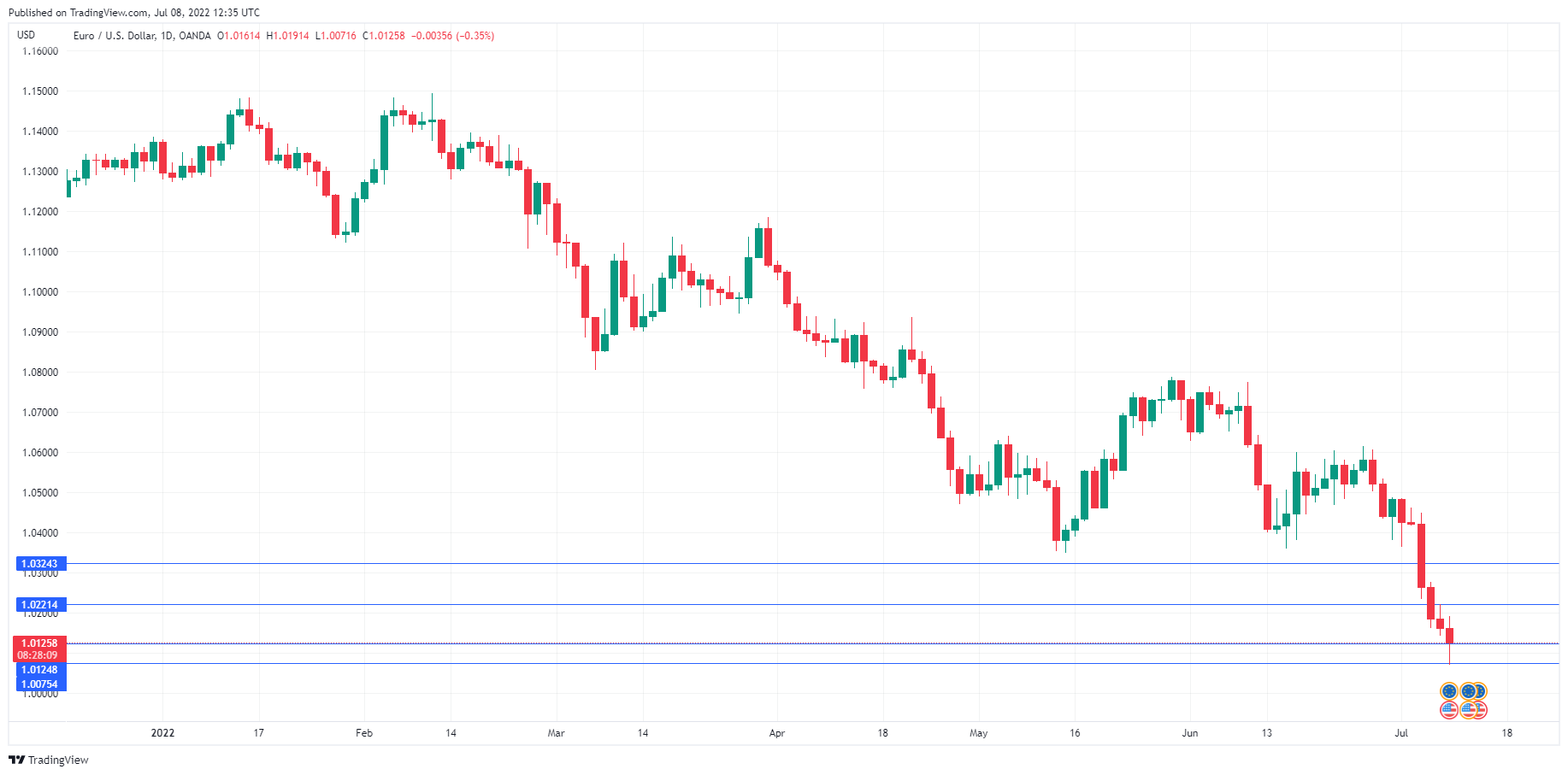
It continues to be a miserable July for EUR/USD, which has declined 3.12%. The euro continues to deliver fresh 20-year lows, dropping to 1.0071 late in the Asian session. The euro has since recovered most of today’s losses, but the psychologically-important parity line is getting closer by the day, as the euro continues to stumble. On the economic front, US nonfarm payrolls outperformed, with a reading of 381 thousand, well above the consensus of 240 thousand.
The ECB released the minutes of its June meeting on Thursday, with investors hunting for clues about the lift-off hike at the July meeting. The minutes didn’t provide any new insights, which could be a disappointment but shouldn’t really be all that surprising. The July 21st meeting will be live, with a modest 25bp increase being the most likely scenario, with another rate hike to follow in September. Still, the ECB has not shut the door on a larger hike at the upcoming meeting, and we have recently seen higher-than-expected moves by the Federal Reserve and other central banks.
Lagarde & Co. will be keeping a close eye on next week’s inflation reports out of Germany and France, the two largest economies in the eurozone. If inflation remains unchanged or dips lower, it will provide ammunition for the doves who are content with a 25bp move. Conversely, a rise in inflation will put pressure on the ECB to respond with a 50bp increase.
Another factor in the rate decision could be the exchange rate. A weak euro is attractive for exports but also contributes to inflation. The euro hasn’t been at parity with the US dollar since 2002, and some ECB members may feel that the central bank’s credibility is on the line if the euro continues to slide and falls below parity.
EUR/USD Technical
- EUR/USD tested support at 1.0124 and 1.0075 in the Asian session
- There is resistance at 1.0221 and 1.0324
EUR/USD Mid-Day Outlook
Daily Pivots: (S1) 1.0130; (P) 1.0175 (R1) 1.0207; More...
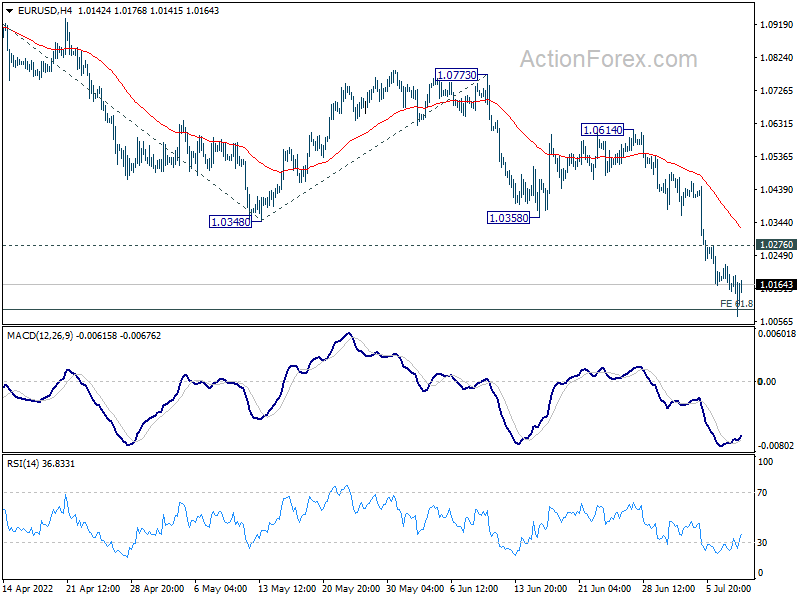
EUR/USD falls to as low as 1.0070 so far and met 1.0090 long term projection level. Intraday bias stays on the downside. Firm break of 1.0090 will target 100% projection of 1.1184 to 1.0348 from 1.0773 at 0.9937, which is close to parity. On the upside, above 1.0276 minor resistance will turn intraday bias neutral and bring consolidations first. But recovery should be limited below 1.0614 resistance to bring another fall.
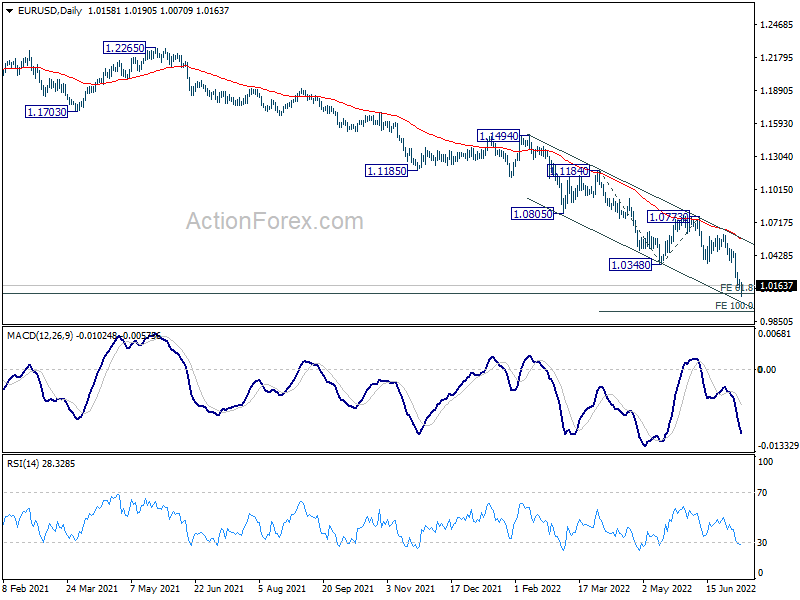
In the bigger picture, the break of 1.0339 long term support (2017 low) indicates resumption of whole down trend from 1.6039 (2008 high). Next target is 61.8% projection of 1.3993 to 1.0339 from 1.2348 at 1.0090. Sustained break there will pave the way to 100% projection at 0.8694. In any case, outlook will stay bearish as long as 1.0786 resistance holds, in case of recovery.
GBP/USD Mid-Day Outlook
Daily Pivots: (S1) 1.1945; (P) 1.1987; (R1) 1.2066; More...
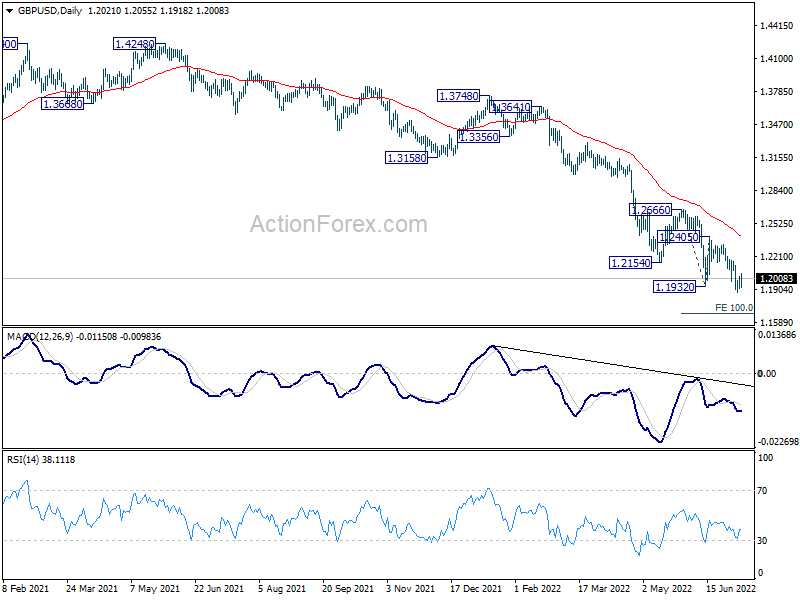
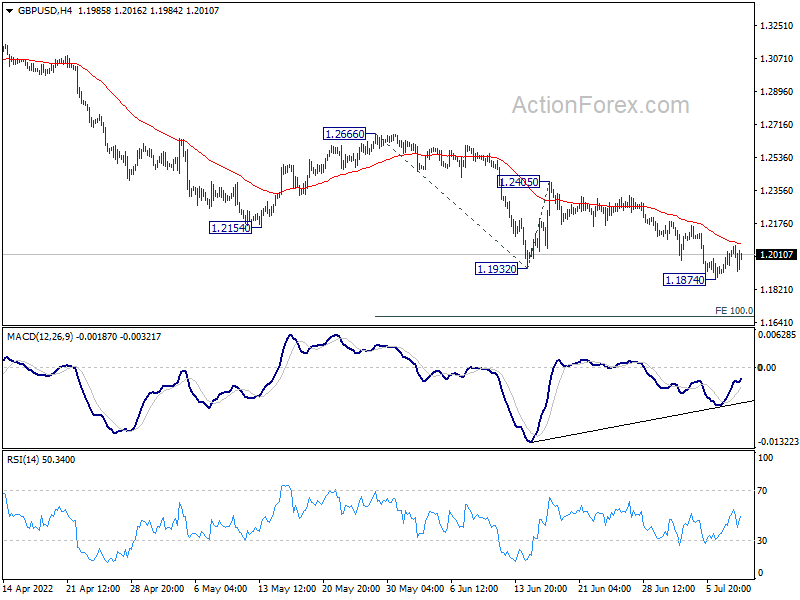
Intraday bias in GBP/USD stays neutral, and more consolidations could be seen above 1.1874. Outlook stays bearish as long as 1.2405 resistance holds. On the downside, break of 1.1874 will resume larger down trend to t 100% projection of 1.2666 to 1.1932 from 1.2405 at 1.1671. Break there will target 1.1409 long term support.
In the bigger picture, fall from 1.4248 (2018 high) could be a leg inside the pattern from 1.1409 (2020 low), or resuming the longer term down trend. Deeper decline is expected as long as 1.2666 resistance holds. Next target is 1.1409 low. However, firm break of 1.2666 will bring stronger rise back to 55 week EMA (now at 1.3103).