

Sample Category Title
SNB Suddenly Hikes Interest Rate, Ttriggering Franc Rally
In a surprise decision, the Swiss National Bank raised its key rate by 50 points to -0.25%, the first increase in the country in 15 years. The SNB commented on the decision that it does not rule out further rises.
The main reason cited was to fight inflation, which reached 2.9% y/y in May. Inflation around Switzerland (in the Euro-region) is more than double, but rates have not been raised there. Therefore, analysts and traders did not expect to see policy tightening in Switzerland today.
The hawkish surprise caused the USDCHF to fall more than 2% to 1.013, subsequently pulling back to 1.018.
It is fair to say that the SNB is acting pre-emptively by actively raising the rate now in order not to raise it longer and higher later. The Fed, the ECB and the BoJ are getting their share of criticism for not doing the same.
However, traders and investors should be cautious. The SNB has warned that it will remain active with currency interventions that could contain the strengthening of the franc.
However, the last point is highly controversial. A rate hike and strengthening the national currency vs. competitors both suppress inflation, so FX activity from the SNB is likely to reduce volatility but not reverse the market.
Over the last half-century, monetary and fiscal policy has helped the franc methodically strengthen against the euro and the Dollar. Recent actions by the SNB suggest that this historical trend will continue, bringing the EURCHF steadily below parity before the end of the year.
Sunset Market Commentary
Markets
This morning, there was hope that chair Powell’s clarification on the Fed’s normalization path could bring some ST consolidation after recent sharp repositioning. Especially Powell’s remark that 75 bps hikes won’t become the new normal gave investors some comfort. Unfortunately, the hope survived for only a few hours. The trigger? For an important part the Swiss National Bank! The SNB unexpectedly raised its policy rate by a staggering 50 bps to -0.25% (cfr. infra). If even Switzerland with still subdued inflation needs to step in, what should then be the reaction function of other countries running three- or fourfold Swiss inflation? The sell-off in European and US bond markets resumed. Especially German/EMU yields (more than) reversed yesterday’s easing, all touching new cycle peak levels. Yields are currently off intraday top levels, but still rising between 20/16 bps (5-y/2-y) and 13 bps (30-y). Interestingly, Intra-EMU spreads narrow further as the ECB prepares a new instrument to avoid fragmentation (10-y spread Italy vs Germany -14bps). US yields are rising between 16 bps (5/10-y) and 10 bps (2-y) in a very volatile market. US data brought further evidence that taming inflation will come with a cost for growth. US housing starts and permits tumbled sharply (14.4% M/M and 7.0% M/M). The Philly Fed business activity index dropped to the lowest level since May 2020 (-3.3). UK yield rises today even outpace the US and EMU. The BOE raised its policy rate by 25 bps to 1.25% but signals bolder steps ahead if inflation spirals further out of control (2-y + 27bps!!!).The prospect of further CB tightening and a slowdown in demand/growth again pushed equities off a cliff. The EuroStoxx50 (-2.7%) is nearing/testing the 3451/3359 support area (top July 2020/50% retr). US indices are losing op to 2.8% (Nasdaq). Brent oil eases to $117p/b, but European gas prices are rising sharply (+24%) on supply disruptions from Russia.On FX, the dollar doesn’t profit from the risk-off (due to bigger interest rate rise outside to US?). At least part of the intraday US setback occurred after the US data. DXY drops to 104.55 area after touching 105.78 post Fed yesterday. EUR/USD reversed early losses below 1.04 to trade near 1.045. The Swiss franc gained sharply on the SNB decision with EUR/CHF trading below 1.24 from 1.04+ levels this morning. In volatile trading sterling gains against the euro (EUR/GBP 0.8545) and the dollar (1.224) as markets see the BOE being forced to provide additional interest rate support in H2. In Hungary, forint weakness also ‘forced’ the MNB to (unexpectedly) raise the weekly deposit rate by 50 bpn to 7.25%. The forint temporarily strengthened, but EUR/HUF currently again nears the 400 barrier. News HeadlinesThe Swiss National Bank (SNB) unexpectedly raised its policy rate by 50 bps to -0.25%. There are signs that inflation is spreading to goods and services that are not directly affected by external factors. SNB governor Jordan mentions the threat of second-round effects becoming entrenched if inflation remains above 2% longer. Further increases cannot be ruled out if necessary to stabilize inflation. The SNB is also prepared to conduct FX interventions if a weak(er) CHF interferes with the SNB’s tightening aim. The policy statement for the first time in a while doesn’t refer to the franc as being highly valued. Assuming an unchanged policy rate over the next three years, Swiss inflation is forecast to reach 2.8% this year, 1.9% in 2023 and 1.6% in 2024. The near term Swiss economic outlook remains positive (2.5% growth in 2022), but is subject to large risks (energy supply, global supply bottlenecks,…).The Bank of England conducted a fifth consecutive 25 bps rate hike (to 1.25%) in a 6-3 vote, with dissenters arguing in favour of a 50 bps rate increase. The MPC will continue to take actions needed to return inflation to the 2% target. The scale, pace and timing of future increases will reflect economic and especially inflationary developments. If needed, the BoE will react forcefully. CPI inflation if expected to be over 9% during the next few months and to rise to slightly above 11% in October after an additional large increase in the Ofgem price cap (energy prices). The more worrying development is inflation pressures coming from the tight labour market and from pricing strategies of firms. Q2 growth forecasts (-0.3% Q/Q) are a tad softer than in the May Monetary Policy Report after a disappointing April. Labour market indicators continue to point to a tight UK labour market.
EUR/USD Mid-Day Outlook
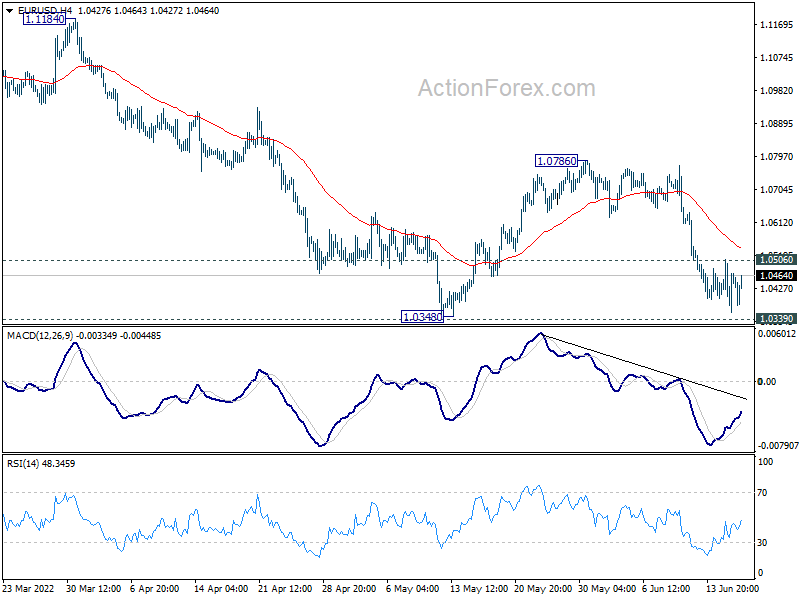
Daily Pivots: (S1) 1.0368; (P) 1.0438 (R1) 1.0517; More...
Intraday bias in EUR/USD remains mildly on the downside for retesting 1.0339 low. Decisive break there will resume larger down trend. Next target is long term projection level at 1.0090. On the upside, above 1.0506 minor resistance will delay the bearish case and turn intraday bias neutral again.
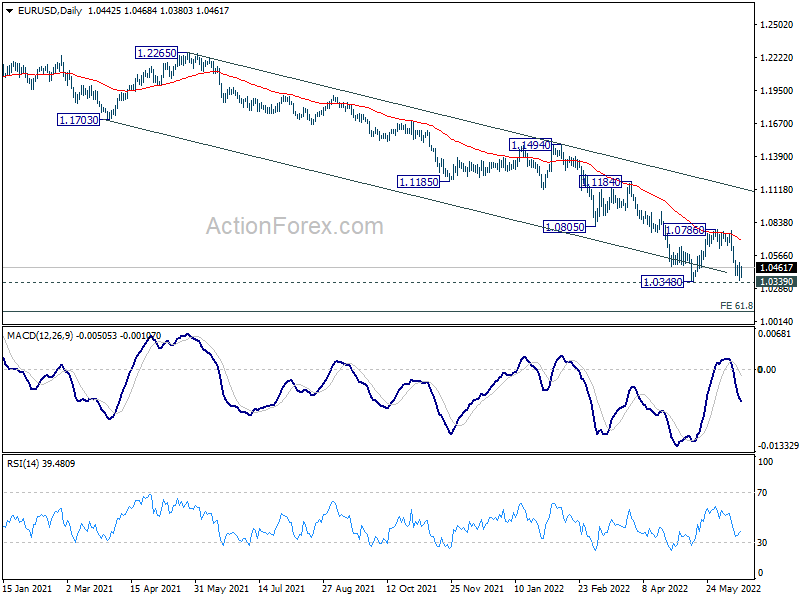
In the bigger picture, focus stays on 1.0339 long term support (2017 low). Decisive break there will resume whole down trend from 1.6039 (2008 high). Next target is 61.8% projection of 1.3993 to 1.0339 from 1.2348 at 1.0090. However, firm break of 1.0805 support turned resistance will delay this bearish case, and bring stronger rebound first.
GBP/USD Mid-Day Outlook
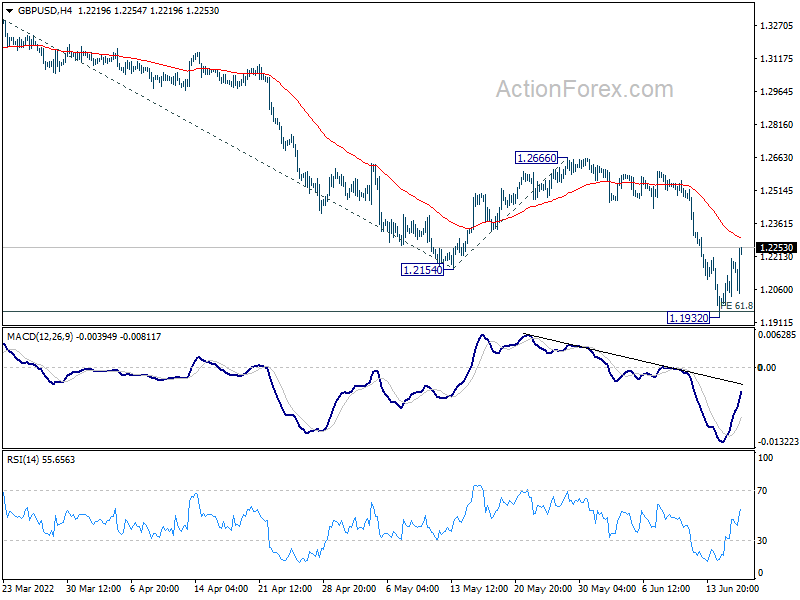
Daily Pivots: (S1) 1.2040; (P) 1.2123; (R1) 1.2255; More...
GBP/USD is staying in consolidation above 1.1932 and intraday bias remains neutral. Outlook stays bearish with 1.2666 resistance intact. On the downside, sustained break of 61.8% projection of 1.3297 to 1.2154 from 1.2666 at 1.1960 will extend larger down trend to 100% projection at 1.1523 next.
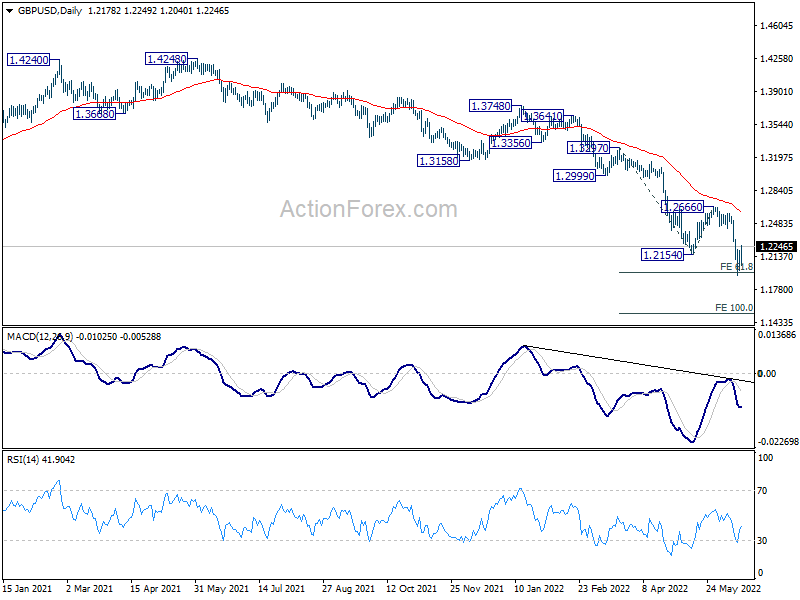
In the bigger picture, fall from 1.4248 (2018 high) could be a leg inside the pattern from 1.1409 (2020 low), or resuming the longer term down trend. Deeper decline is expected as long as 1.2666 resistance holds. On resumption, next target is 1.1409 low.
USD/JPY Mid-Day Outlook
Daily Pivots: (S1) 133.01; (P) 134.31; (R1) 135.10; More...
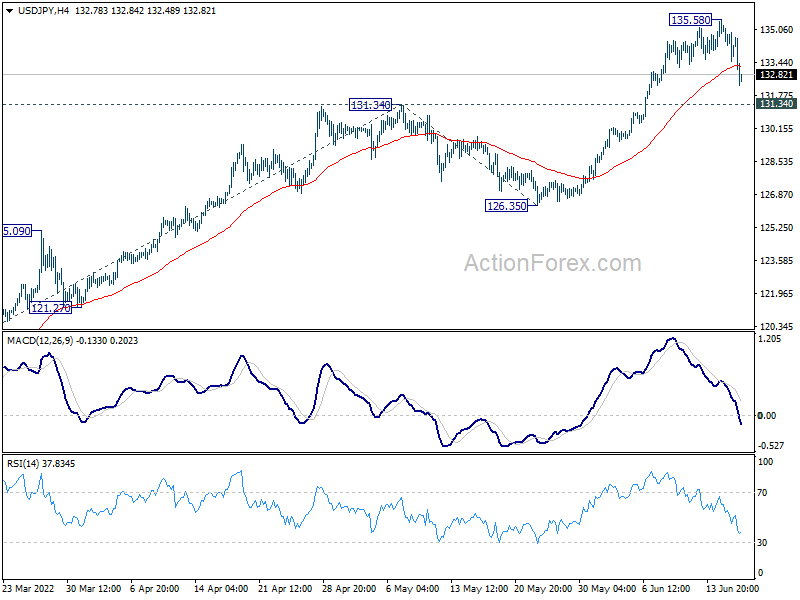
Intraday bias in USD/JPY remains neutral and consolidation from 135.58 is extending. Further rally is expected as long as 131.34 resistance turned support holds. Above 135.58 will resume larger up trend to 61.8% projection of 114.40 to 131.34 from 126.35 at 136.81. Firm break there will target 100% projection at 143.29. However, firm break of 131.34 will bring deeper pull back to 55 day EMA (now at 128.36).
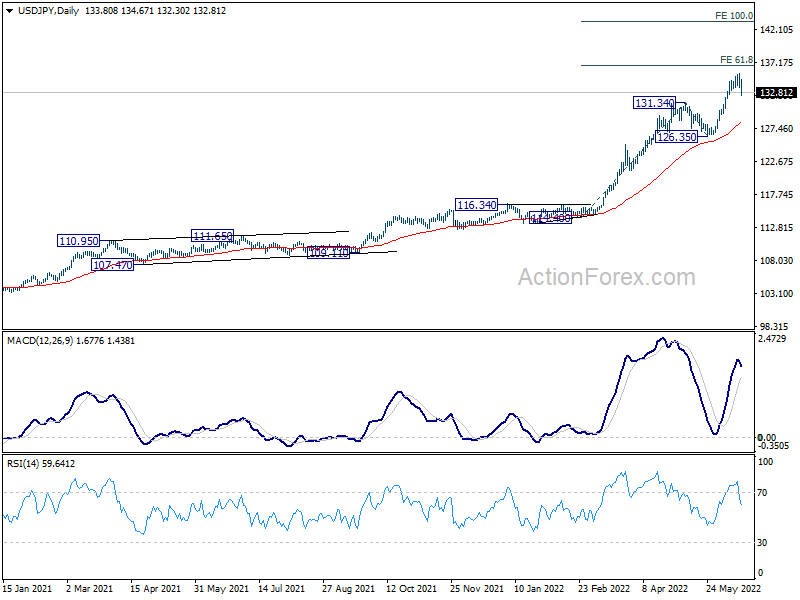
In the bigger picture, current rally is seen as part of the long term up trend from 75.56 (2011 low). Next target is 100% projection of 75.56 (2011 low) to 125.85 (2015 high) from 98.97 at 149.26, which is close to 147.68 (1998 high). This will remain the favored case as long as 126.35 support holds.
Pound Falls, Recovers after BoE
BoE raises rates by 0.25%
The Bank of England raised rates by 0.25% today. The rate hike, the fifth in a row, brings the Bank Rate to 1.25%. The markets were not all that impressed with the BoE, as there had been hopes that the Bank might flex some muscle and raise rates by 0.50%. The modest 0.25% move indicates caution (some would argue undue caution) by Bailey& Co., and the pound fell over 100 points in the European session before recovering. This follows a banner day for the currency yesterday, when the pound shot up 1.48% in response to the Federal Reserve rate hike.
It’s worth noting that the Monetary Policy Committee (MPC) vote was 6-3, with the three dissenting members voting for a 0.50% hike. This indicates that there is considerable support at the MPC for more aggressive action, which could mean larger rate hikes if inflation doesn’t ease. The MPC statement noted that the Bank remains “particularly alert to indications of more persistent inflationary pressures, and will if necessary act forcefully in response”.
The MPC gets high marks for flowery prose, but the end result was despite soaring inflation, members couldn’t muster more than a modest 0.25% rate increase. The BoE has essentially raised the white flag in the battle against inflation, as it has projected that inflation will top 10 per cent and has warned of a recession. The road ahead for the UK economy will be bumpy – GDP fell by 0.3% in April after a 0.1% decline in March, the first back-to-back contractions since March 2020, at the start of the Covid pandemic. The OECD has forecast that the UK economy will grow by 3.6% this year, but will stagnate in 2023, which would make it the worst-performing G-7 economy in 2023.
Federal Reserve serves 0.75% hike
There were no surprises from the Federal Reserve, which raised rates by 0.75%, to a target range of 1.50-1.75%. The Fed downgraded its US growth forecasts for 2022 and 2023, but insisted that there would be no recession. Some analysts would beg to disagree, but the financial markets were relieved, as Fed Chair Powell said he didn’t expect 0.75% rate hikes to become common. Risk sentiment jumped on the perception that the Fed rate hike will help curb inflation, and GBP/USD was sharply higher after the Fed announcement.
GBP/USD Technical
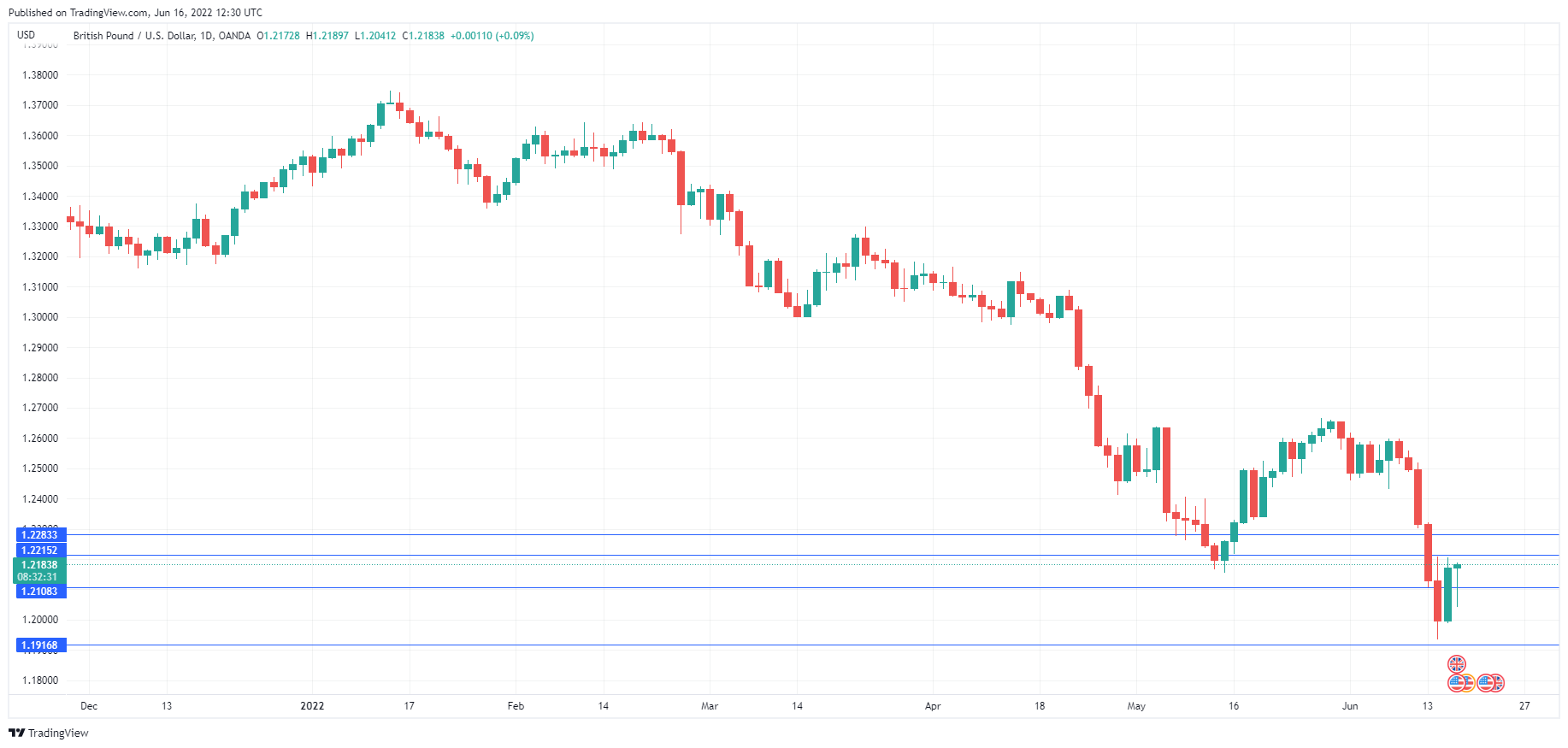
- GBP/USD tested support at 1.2108 earlier today. Below, there is support at 1.1916
- There is resistance at 1.2215 and 1.2283
USD/CHF Mid-Day Outlook
Daily Pivots: (S1) 0.9899; (P) 0.9974; (R1) 1.0017; More...
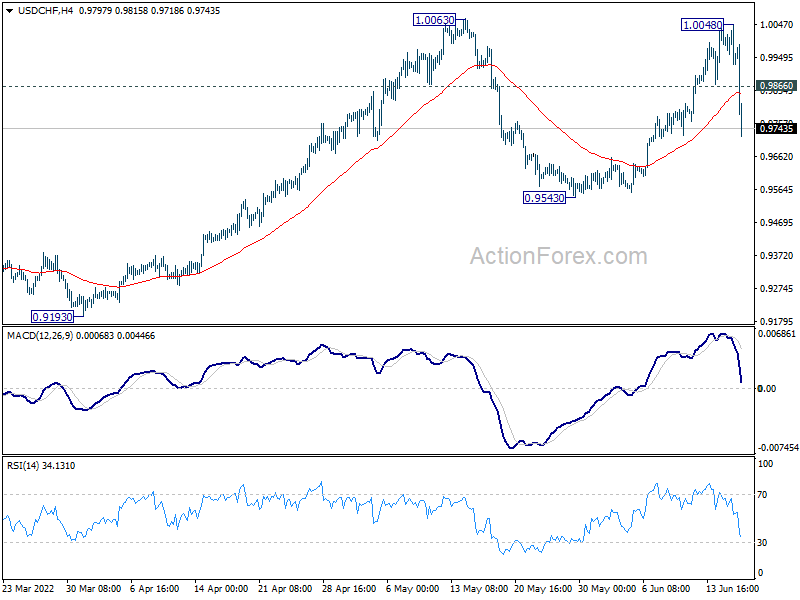
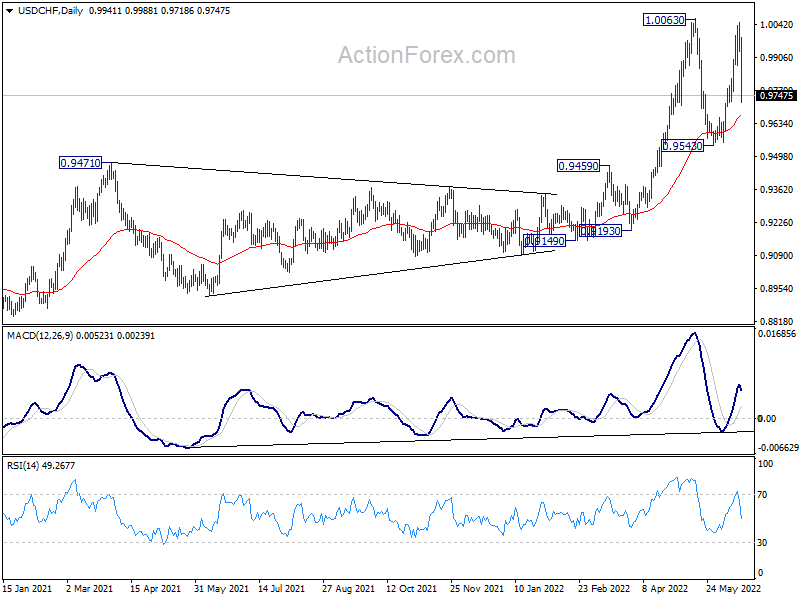
USD/CHF's steep decline suggests that rebound from 0.9543 has completed at 1.0048, after rejection by 1.0063 resistance. Intraday bias mildly on the downside for 0.9543 support. Such fall is seen as the third leg of the corrective pattern from 1.0063. Strong support should be seen at around 0.9543 to contain downside to bring rebound. On the upside, above 0.9866 minor resistance will turn bias back to the upside for retesting 1.0063 resistance.
In the bigger picture, down trend from 1.0342 (2016 high) should have completed with three waves down to 0.8756 (2021 low) already. Rise from 0.8756 is likely a medium term up trend of its own. Next target is 1.0237/0342 resistance zone. This will remain the favored case as long as 0.9471 resistance turned support holds. However, sustained break of 0.9471 will extend long term range trading with another falling leg.
Swiss Franc Skyrockets after SNB Rate Hike, Sterling Firmer after BoE
Swiss Franc surges sharply higher today after surprised rate hike by SNB. Sterling also rises on BoE rate hike with hawkish voting. Yen is following closely on risk aversion but Dollar is lagging slightly behind. The greenback is still digesting post FOMC position adjustments. Risk-off sentiment sends commodity currencies lower, as led by Aussie. But Euro is also weak as pressured by selling against Pound and Franc.
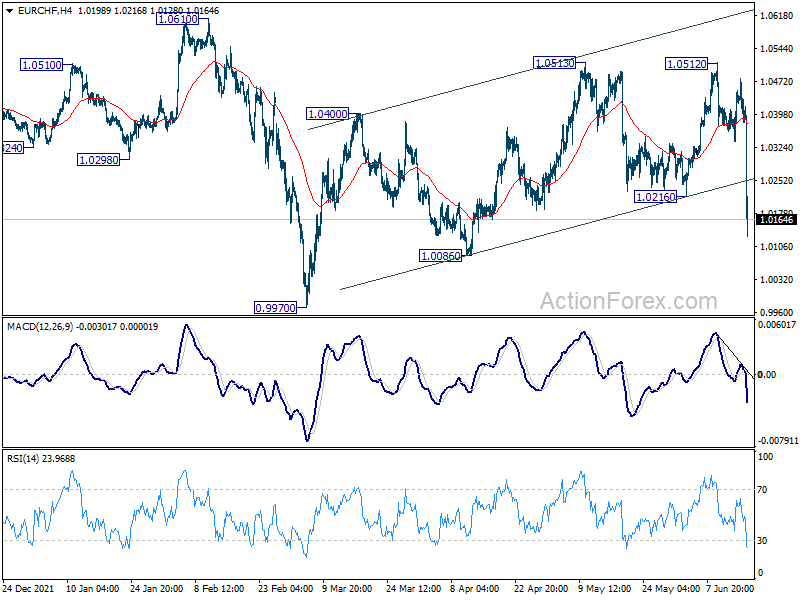
Technically, Euro is one again displaying some notable weakness. The break of 1.0216 support in EUR/CHF raises the chance of revisiting 0.9970 low. Focus will now be on 0.8484 support in EUR/GBP. Firm break there will suggest near term bearish reversal, after rejection by 0.8697 medium term fibonacci level. Meanwhile, decisive break of 1.0339 key support in EUR/USD will confirm down trend resumption.
In Europe, at the time of writing, FTSE is down -2.57%. DAX is down -2.49%. CAC is down -1.81%. Germany 10-year yield is up 0.162 at 1.805. Earlier in Asia, Nikkei rose 0.40%. Hong Kong HSI dropped -2.17%. China Shanghai SSE dropped -0.61%. Singapore Strait Times dropped -0.27%. Japan 10-year JGB yield rose 0.0148 to 0.270.
US initial jobless claims dropped to 229k, slightly below expectations
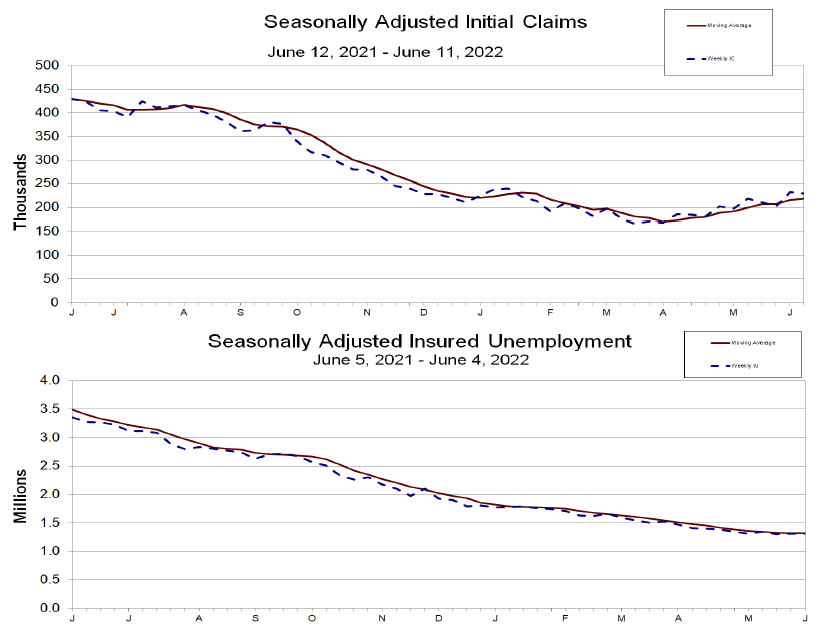
US initial jobless claims dropped -3k to 229k in the week ending June 11, slightly better than expectation of 230k. Four-week moving average of initial claims rose 3k to 219k. Continuing claims rose 3k to 1312k in the week ending June 4. Four-week moving average of continuing claims dropped slightly by -750 to 1317.5k, lowest since January 10, 1970, when it was 1311k.
Housing starts dropped to 1.55m annualized in May, below expectation of 1.71m. Building permits dropped to 1.695m, below expectation of 1.79m. Philly Fed manufacturing survey dropped from 2.6 to 5.5 in June, below expectation of 5.5.
BoE hikes by 25bps, three members want 50bps
BoE raises the Bank Rate by 25bps to 1.25%. The decision was not unanimous, with three members (Catherine Mann, Michael Saunders and Jonathan Haskel) voted for a 50bps hike. The MPC said it will take necessary actions to return inflation to 2% target. The scale, pace and timing of further rate hikes will reflect the assessment of economic outlook and inflation pressures.
Nevertheless, it emphasized, "the Committee will be particularly alert to indications of more persistent inflationary pressures, and will if necessary act forcefully in response."
BoE also said GDP was weaker than expected in April, and it expect GDP to fall by -0.3% in Q2 as a while, weaker than anticipated at in the May Monetary Policy Report. CPI inflation's rise to 9% was "close to expectations" at the time of the May report. CPI is expected to be over 9% "during the next few months" and rise to "slightly above 11% in October.
SNB surprisingly hikes 50bps, adopts tightening bias
SNB surprises the markets by raising the sight deposit rate by 50bps to -0.25% today, "to counter increased inflationary pressure". It also adopts a tightening bias and said, "it cannot be ruled out that further increases in the SNB policy rate will be necessary in the foreseeable future to stabilise inflation in the range consistent with price stability over the medium term." SNB also maintains the willingness to intervene in the currency markets if necessary.
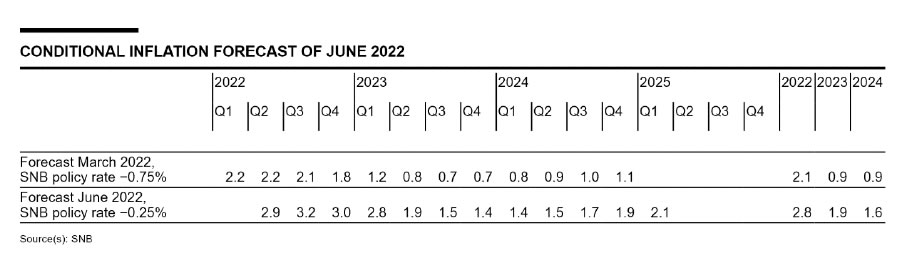
Even with higher interest rates, the conditional inflation forecasts were also raised across forecast horizon. Inflation is projected to peak at 3.2% in Q3, then slow to below 1.4% in Q4 2023, then rise back to 2.1% in Q1 2025. Average inflation is forecasts to be at 2.8% in 2022, 1.9% in 2023, and 1.6% in 2024, upgraded from 2.1%, 0.9% and 0.9% respectively.
As for the economy, SNB still expected 2.5% GDP growth in 2022 while unemployment is "likely to remain low". However, "if the energy supply in Europe were to be adversely affected, this could have a serious impact on the Swiss economy. The global supply bottlenecks and further increases in commodity prices could also slow growth. Furthermore, a resurgence of the coronavirus pandemic cannot be ruled out."
SNB Jordan: Swiss Franc no longer highly valued
SNB Chairman Thomas Jordan said in the post-meeting pressing conference, "the new inflation forecast shows that further increases in the policy rate may be necessary in the foreseeable future."
"In the current environment, price increases were being passed on more quickly, and are also being more readily accepted, than was the case until recently," he said. "There is the threat of second-round effects becoming entrenched if inflation remains above 2% for a long period."
Jordan also noted that the Franc's strength on safe-haven flow helped dampen the impact on higher fuel and food import prices. But that was less the case following recent decline. "Thus the inflation imported from abroad has increased," he said. "Another consequence of this depreciation coupled with significantly higher inflation abroad is that the franc is no longer highly valued."
Australia employment rose 60.6k in May, strong growth in hours worked
Australia employment rose 60.6k in May, better than expectation of 25.0k. Full-time jobs rose 69.4k while part-time jobs dropped -8.7k. Unemployment rate was unchanged at 3.9%, above expectation of 3.8%. Participation rate rose 0.3% to 66.7%. Monthly hours worked rose 0.9% mom or 17m.
Bjorn Jarvis, head of labour statistics at the ABS, said: "The increase in May 2022 was the seventh consecutive increase in employment, following the easing of lockdown restrictions in late 2021. Average employment growth over the past three months (30,000) continues to be stronger than the pre-pandemic trend of around 20,000 people per month.
"In addition to the continuing trend of increasing employment, we have continued to see relatively stronger growth in hours worked. This is something we also saw this time last year, before the Delta outbreak."
New Zealand GDP fell -0.2% qoq in Q1, primary industries drove contraction
New Zealand GDP contracted -0.2% qoq in Q1, much worse than expectation of 0.6% qoq.
StatsNZ said: "Primary industries drove the decrease in GDP, down 1.2 percent in the quarter. Goods producing industries also experienced a slight decline, down 0.1 percent.
"The service industry group, which makes up approximately two thirds of the economy, remained flat. This result reflects falls in some industries being offset by rises in others."
USD/CHF Mid-Day Outlook
Daily Pivots: (S1) 0.9899; (P) 0.9974; (R1) 1.0017; More...
USD/CHF's steep decline suggests that rebound from 0.9543 has completed at 1.0048, after rejection by 1.0063 resistance. Intraday bias mildly on the downside for 0.9543 support. Such fall is seen as the third leg of the corrective pattern from 1.0063. Strong support should be seen at around 0.9543 to contain downside to bring rebound. On the upside, above 0.9866 minor resistance will turn bias back to the upside for retesting 1.0063 resistance.
In the bigger picture, down trend from 1.0342 (2016 high) should have completed with three waves down to 0.8756 (2021 low) already. Rise from 0.8756 is likely a medium term up trend of its own. Next target is 1.0237/0342 resistance zone. This will remain the favored case as long as 0.9471 resistance turned support holds. However, sustained break of 0.9471 will extend long term range trading with another falling leg.
Economic Indicators Update
| GMT | Ccy | Events | Actual | Forecast | Previous | Revised |
|---|---|---|---|---|---|---|
| 22:45 | NZD | GDP Q/Q Q1 | -0.20% | 0.60% | 3.00% | |
| 23:50 | JPY | Trade Balance (JPY) May | -1.93T | -1.70T | -1.62T | -1.58T |
| 01:00 | AUD | Consumer Inflation Expectations Jun | 6.70% | 5.00% | ||
| 01:30 | AUD | Employment Change May | 60.6K | 25.0K | 4.0K | 4.4K |
| 01:30 | AUD | Unemployment Rate May | 3.90% | 3.80% | 3.90% | |
| 07:30 | CHF | SNB Interest Rate Decision | -0.25% | -0.75% | -0.75% | |
| 11:00 | GBP | BoE Interest Rate Decision | 1.25% | 1.25% | 1.00% | |
| 11:00 | GBP | MPC Official Bank Rate Votes | 9--0--0 | 9--0--0 | 9--0--0 | |
| 12:30 | CAD | Wholesale Sales M/M Apr | -0.50% | 0.50% | 0.30% | |
| 12:30 | USD | Initial Jobless Claims (Jun 10) | 229K | 230K | 229K | |
| 12:30 | USD | Housing Starts May | 1.55M | 1.71M | 1.72M | |
| 12:30 | USD | Building Permits May | 1.695M | 1.79M | 1.82M | |
| 12:30 | USD | Philadelphia Fed Manufacturing Survey Jun | -3.3 | 5.5 | 2.6 | |
| 14:30 | USD | Natural Gas Storage | 92B | 97B |
US initial jobless claims dropped to 229k, slightly below expectations
US initial jobless claims dropped -3k to 229k in the week ending June 11, slightly better than expectation of 230k. Four-week moving average of initial claims rose 3k to 219k.
Continuing claims rose 3k to 1312k in the week ending June 4. Four-week moving average of continuing claims dropped slightly by -750 to 1317.5k, lowest since January 10, 1970, when it was 1311k.
S&P500 Could Fall to 3,500 Before Fed Softens its Approach
The Fed raised the rate by 75 points, something it has not done in 28 years. Such a move had already been priced in. In fact, on the eve of the announcement, the markets had even factored a small probability of a 100-point move.
The Fed did not go against the markets but did not add fuel to the expectations, creating a “sell the facts” reaction. However, there are considerable doubts about the sustainability of yesterday’s rebound in equities and the Dollar’s retreat.
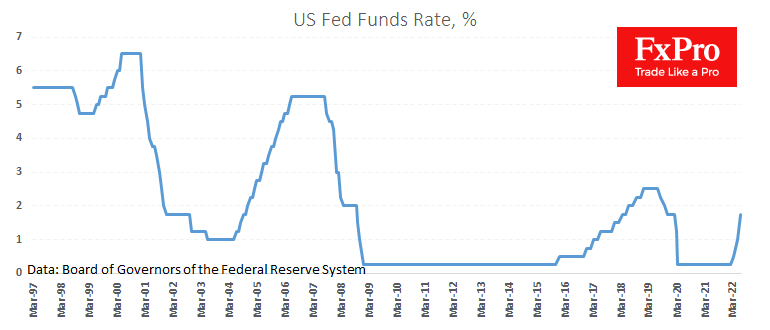
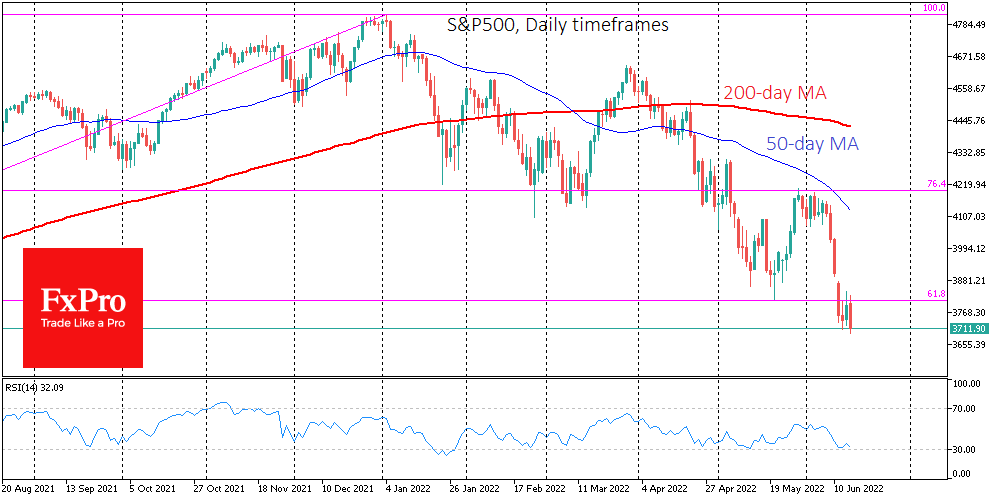
In trading in Europe, the Dollar largely regained its losses after the FOMC, and the equity market erased the rebound. Today’s market reaction looks like a prologue to further downward impulse in the coming days, justified by tighter financial conditions from the world’s biggest central banks and worsening macroeconomic forecasts.
Thus, the Fed raised its year-end forecast for the unemployment rate to 3.7%, ruling out a further decline from current levels. GDP growth for 2022 was revised from 2.8% to 1.7%, and such a rate is expected for 2023.
Among the potentially positive things for the markets is the assurance that yesterday’s move was exceptional and that FOMC intends to hike by another 50-points at the end of the July meeting.
It is also essential for markets to understand where the Fed intends to stand. Average forecasts from FOMC members suggest a level of 3.75%, which is 200 points above the current rate and 150 points below the peak that the futures market set up for the day before.
Despite the reassurances of Powell, the markets can hardly go through a period of 50-point hikes at a time with quantitative easing without losses, which is tightening financial conditions on both sides.
The rally in the Dollar and the decline in equity prices in response to such policies could bring the final point of fiscal tightening closer. Still, in the coming days or weeks, markets have a high chance of adjusting to the new reality.
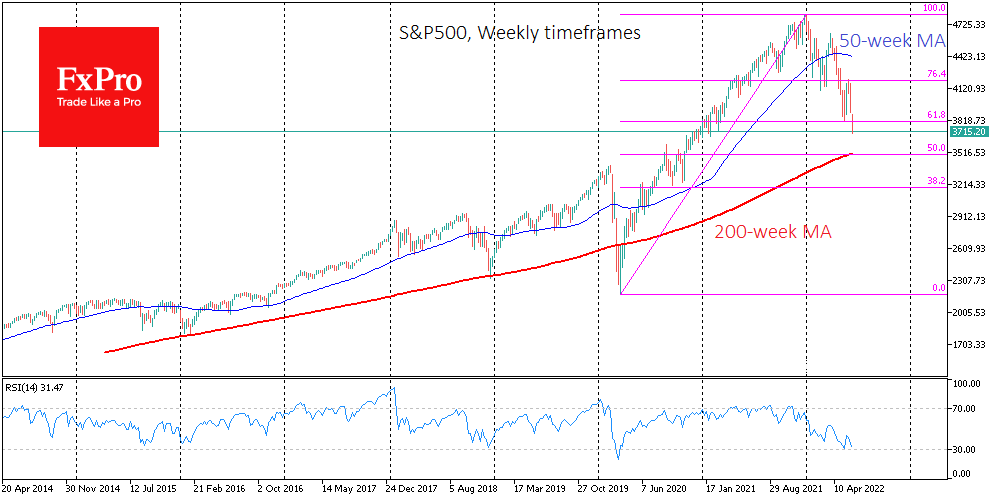
The S&P500 futures are down to 3700, taking the market another couple of steps closer to 3500, a significant long-term trendline. Unless markets go into free-fall mode, near 3500, where the 200-week moving average passes, markets could find support, as they did in 2016 and 2018. A free-fall regime for the S&P500 below this line, in our view, could force the Fed to urgently soften its approach.