

Sample Category Title
Yen Falls Broadly after BoJ Stands Pat, Swiss Franc Staying Strong
Yen trades broadly lower today after BoJ left monetary policy unchanged, including keeping the 10-year JGB yield cap. Selling is not too fierce for now on mixed sentiment in the Asian markets. But if global stocks stage a pre-weekend rebound, the decline in Yen could quickly intensify. Meanwhile, Swiss Franc is still the strongest one for the week after SNB's rate hike yesterday. Commodity currencies are broadly lower, led by Canadian,
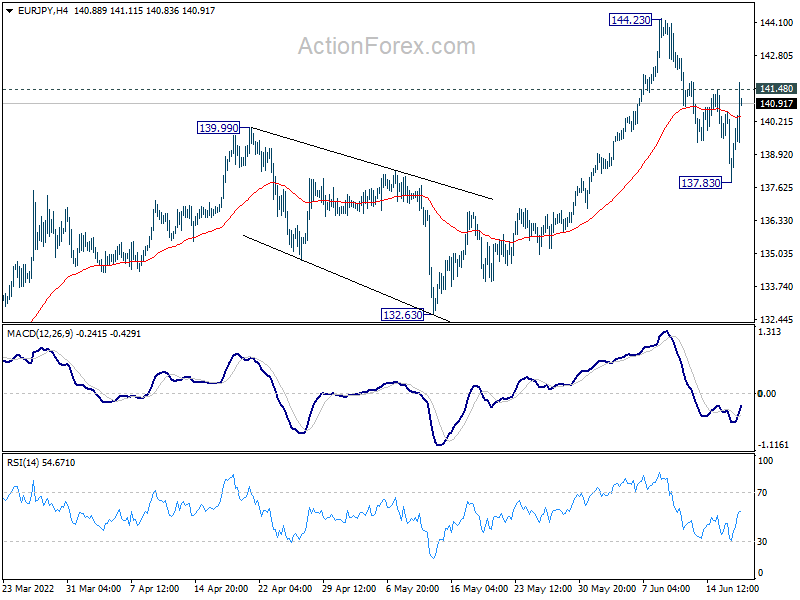
Technically, both EUR/JPY and GBP/JPY breached minor resistance levels at 141.48 and 165.14. The development suggests that near term pull back could be finished, and stronger rise could be in favor. The question is, if that happens, whether that would be accompanied by stronger rebound in EUR/USD and GBP/JPY. Let's see.
In Asia, at the time of writing, Nikkei is down -1.45%. Hong Kong HSI is up 1.35%. China Shanghai SSE is up 0.96%. Singapore Strait Times is down -0.48%. Japan 10-year JGB yield is down -0.0138 at 0.257. Overnight, DOW dropped -2.42% to 29927, losing 30k handle. S&P 500 dropped -3.25%. NASDAQ dropped -4.08%. 10-year yield dropped -0.088 to 3.307.
BoJ leaves rate unchanged at -0.1%, keeps 0.25% 10-yr yield cap
BoJ left short-term policy interest rate unchanged at -0.10%, and 10-year JGB target at around 0% under the yield curve control. It will continue to defend the 0.25% 10-year JGB yield cap, by offering to purchase it at the rate on every business day through fixed-rate purchase operations.
The decision was made by 8-1 vote. Goushi Kataoka dissented again, pushing for further strengthening monetary easing by lowering short- and long-term interest rate.
The central bank also said "it is necessary to pay due attention to developments in financial and foreign exchange markets and their impact on Japan's economic activity and prices."
CHF/JPY resumes up trend towards 140
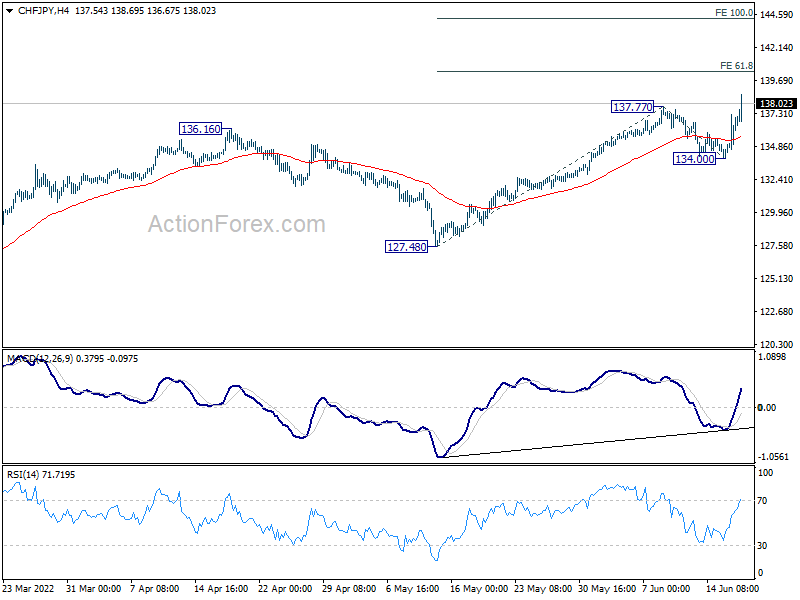
CHF/JPY's up trend resumes this week on diverging monetary policy of SNB and BoJ. SNB surprised the markets by announcing a 50bps rate hike yesterday, and indicated that more is coming. However, BoJ just kept policy unchanged today, with yield cap maintained at 0.25% too. At the same time, risk aversion is supporting both, making things even.
For the new term, outlook in CHF/JPY will stay bullish as long as 134.00 support holds. Next target is 61.8% projection of 127.48 to 137.77 from 134.00 at 140.35, and then 100% projection at 144.29.
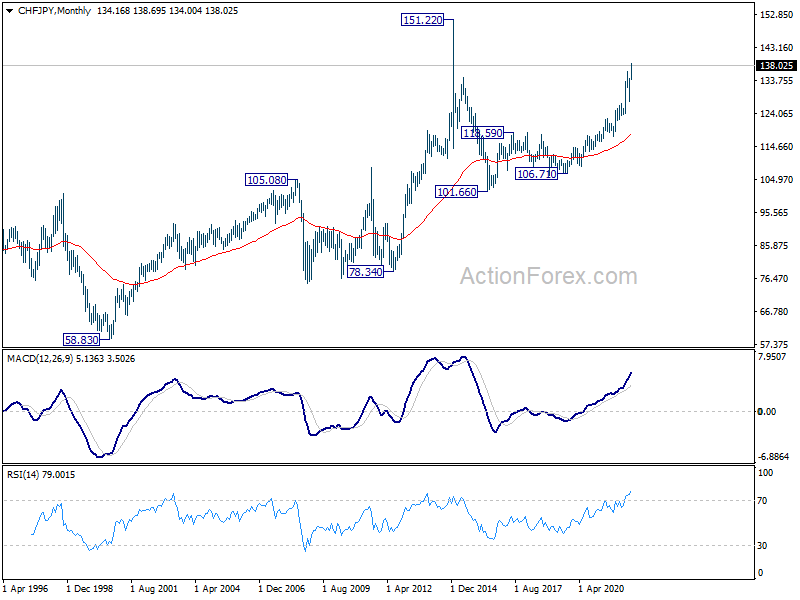
Also, note that CHF/JPY is extending a healthy long term up trend that started at 101.66, still in acceleration mode. 2015 high at 151.22 is a feasible target is policy of SNB and BoJ continues to diverge.
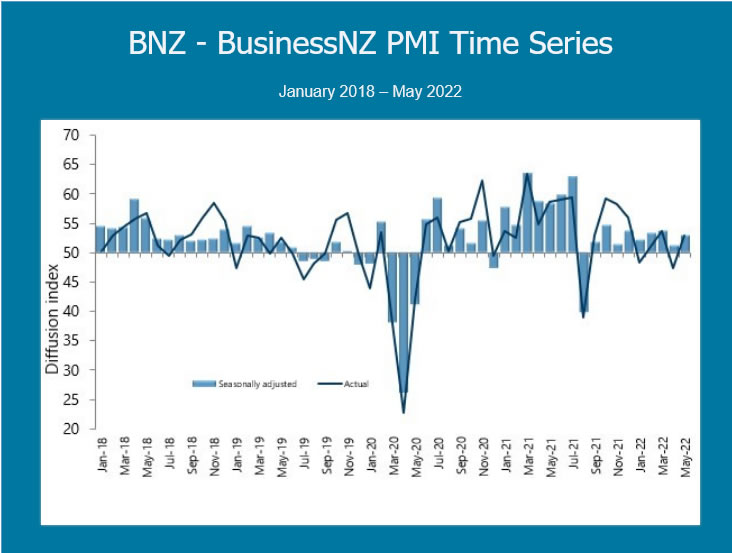
New Zealand BusinessNZ manufacturing rose to 52.9, excess demand abating
New Zealand BusinessNZ Performance of Manufacturing index rose from 51.2 to 52.9 in May. Production rose from 49.4 to 52.8. Employment rose from 49.8 to 53.0. New orders dropped from 55.2 to 53.0. Finished stocks dropped from 54.0 to 53.1. Deliveries rose from 49.7 to 55.4.
BNZ Senior Economist, Craig Ebert stated that "The net result of the sub-index values was the inference that excess demand alleviated during May. New orders are perhaps the cleanest representation of demand, while deliveries speak more to the supply side. To the extent excess demand is abating, so too will be core inflation pressure".
Looking ahead
Italy trade balance and Eurozone CPI final will be release in European session. Canada will release IPPI and RMPI while US will release industrial production later in the day.
EUR/USD Daily Outlook
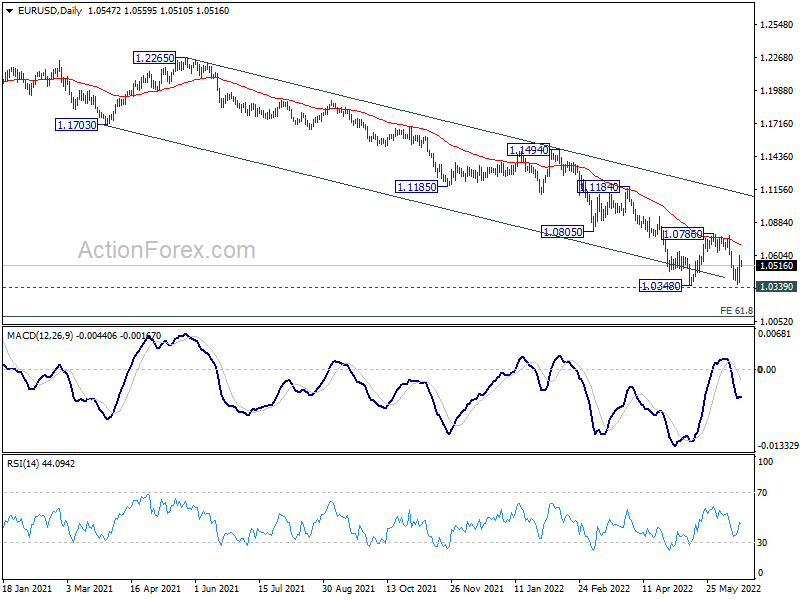
Daily Pivots: (S1) 1.0422; (P) 1.0511 (R1) 1.0642; More...
Intraday bias in EUR/USD is turned neutral first as it recovered ahead of 1.0339/48 support zone. Outlook will stay bearish as long as 1.0786 resistance holds. Sustained break of 1.0339/48 will resume larger down trend. Next target is long term projection level at 1.0090.
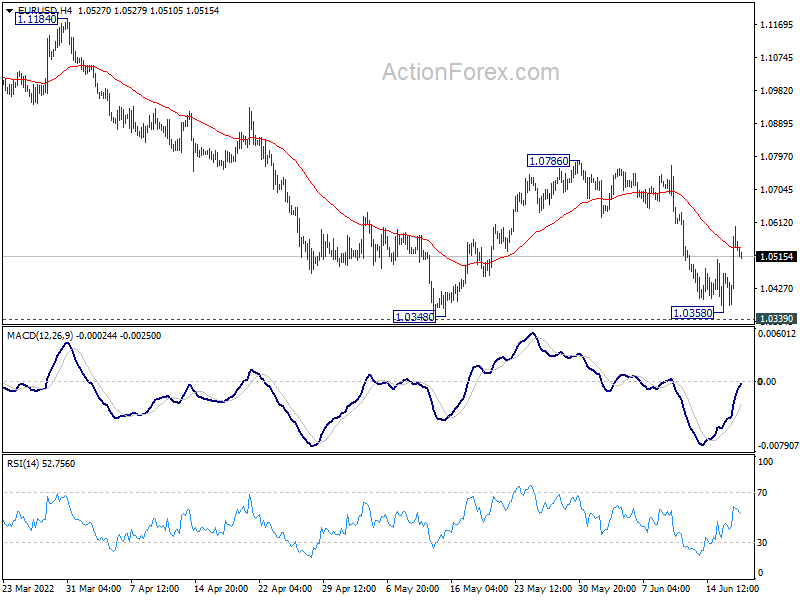
In the bigger picture, focus stays on 1.0339 long term support (2017 low). Decisive break there will resume whole down trend from 1.6039 (2008 high). Next target is 61.8% projection of 1.3993 to 1.0339 from 1.2348 at 1.0090. However, firm break of 1.0805 support turned resistance will delay this bearish case, and bring stronger rebound first.
Economic Indicators Update
| GMT | Ccy | Events | Actual | Forecast | Previous | Revised |
|---|---|---|---|---|---|---|
| 03:00 | JPY | BoJ Interest Rate Decision | -0.10% | -0.10% | -0.10% | |
| 08:00 | EUR | Italy Trade Balance (EUR) Apr | -2.26B | -0.08B | ||
| 09:00 | EUR | Eurozone CPI Y/Y May F | 8.10% | 8.10% | ||
| 09:00 | EUR | Eurozone CPI Core Y/Y May F | 3.80% | 3.80% | ||
| 12:30 | CAD | Industrial Product Price M/M May | 0.10% | 0.80% | ||
| 12:30 | CAD | Raw Material Price Index May | 1.70% | -2.00% | ||
| 13:15 | USD | Industrial Production M/M May | 0.40% | 1.10% | ||
| 13:15 | USD | Capacity Utilization May | 79.20% | 79.00% |
CHF/JPY resumes up trend towards 140
CHF/JPY's up trend resumes this week on diverging monetary policy of SNB and BoJ. SNB surprised the markets by announcing a 50bps rate hike yesterday, and indicated that more is coming. However, BoJ just kept policy unchanged today, with yield cap maintained at 0.25% too. At the same time, risk aversion is supporting both, making things even.
For the new term, outlook in CHF/JPY will stay bullish as long as 134.00 support holds. Next target is 61.8% projection of 127.48 to 137.77 from 134.00 at 140.35, and then 100% projection at 144.29.
Also, note that CHF/JPY is extending a healthy long term up trend that started at 101.66, still in acceleration mode. 2015 high at 151.22 is a feasible target is policy of SNB and BoJ continues to diverge.
New Zealand BusinessNZ manufacturing rose to 52.9, excess demand abating
New Zealand BusinessNZ Performance of Manufacturing index rose from 51.2 to 52.9 in May. Production rose from 49.4 to 52.8. Employment rose from 49.8 to 53.0. New orders dropped from 55.2 to 53.0. Finished stocks dropped from 54.0 to 53.1. Deliveries rose from 49.7 to 55.4.
BNZ Senior Economist, Craig Ebert stated that "The net result of the sub-index values was the inference that excess demand alleviated during May. New orders are perhaps the cleanest representation of demand, while deliveries speak more to the supply side. To the extent excess demand is abating, so too will be core inflation pressure".
BoJ leaves rate unchanged at -0.1%, keeps 0.25% 10-yr yield cap
BoJ left short-term policy interest rate unchanged at -0.10%, and 10-year JGB target at around 0% under the yield curve control. It will continue to defend the 0.25% 10-year JGB yield cap, by offering to purchase it at the rate on every business day through fixed-rate purchase operations.
The decision was made by 8-1 vote. Goushi Kataoka dissented again, pushing for further strengthening monetary easing by lowering short- and long-term interest rate.
The central bank also said "it is necessary to pay due attention to developments in financial and foreign exchange markets and their impact on Japan's economic activity and prices."
Technical Outlook and Review
DXY:
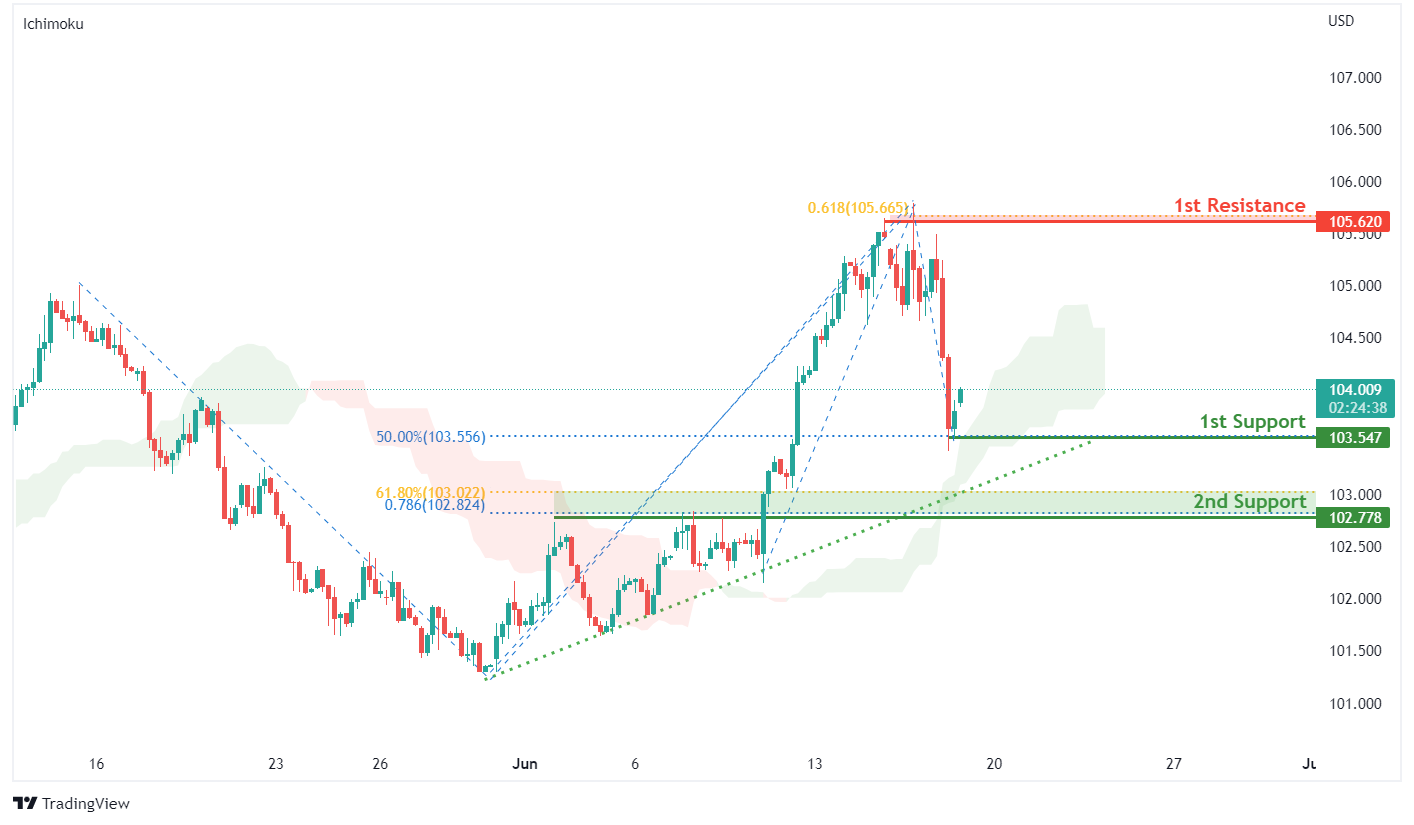
On the H4, with prices moving above the ichimoku indicator and along the ascending trendline, we have a bullish bias that price will rise to our 1st resistance at 105.620 where the 61.8% fibonacci projection and swing high resistance are from our 1st support at 103.547 in line with the horizontal swing low support and 50% fibonacci retracement. Alternatively, price may break 1st support structure and head for 2nd support at 102.778 where the horizontal overlap support, 61.8% fibonacci retracement and 78.6% fibonacci projection are.
Areas of consideration:
- H4 time frame, 1st resistance at 105.620
- H4 time frame, 1st support at 103.547
XAU/USD (GOLD):
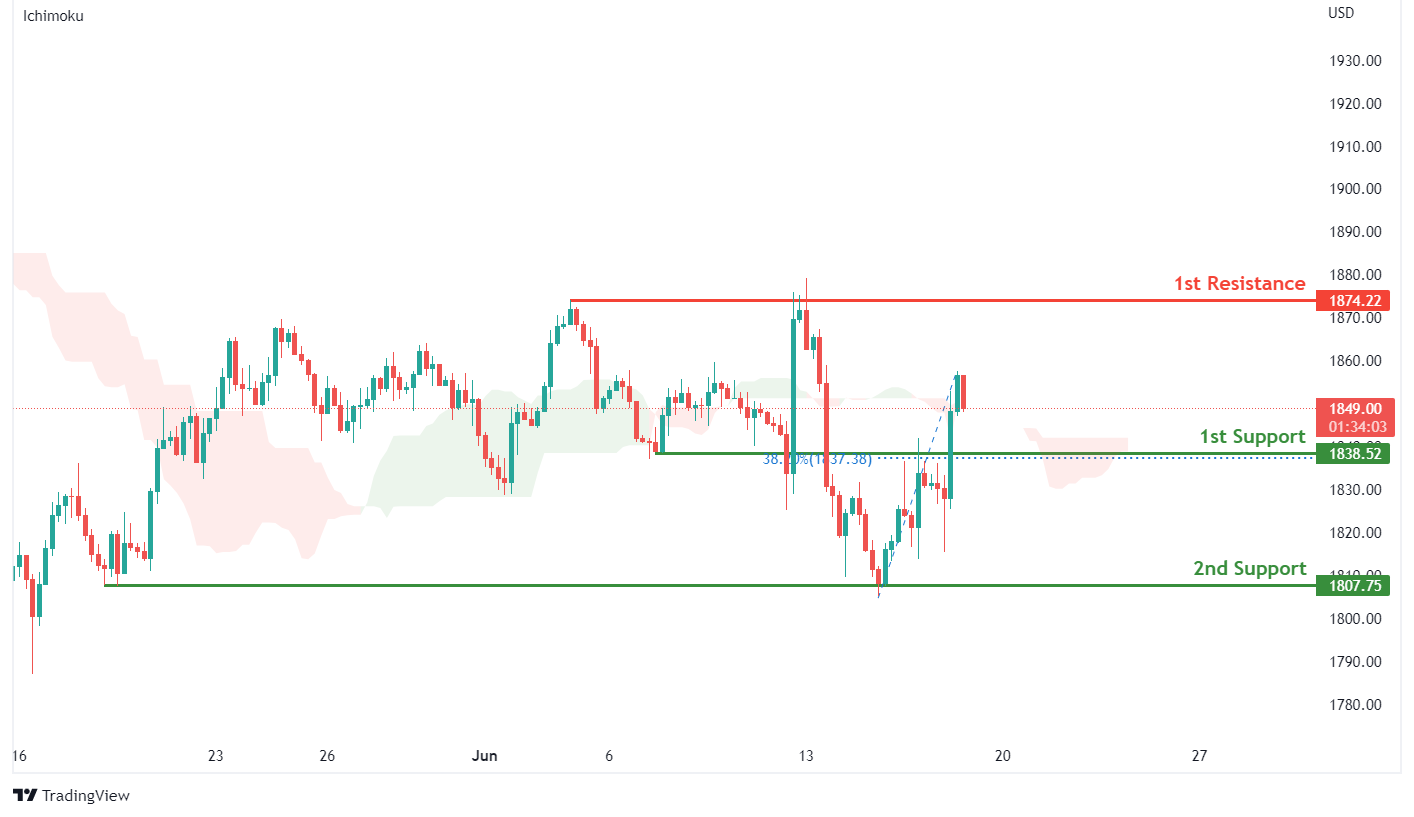
On the H4, with prices bouncing off the ichimoku indicator, we have a bullish bias that prices will rise from our 1st support at 1838.52 where the horizontal pullback support and 38.2% fibonacci retracement are to our 1st resistance at 1874.22 in line with swing high resistance. Alternatively, price may break 1st support structure and head for 2nd support at 1807.75 in line with swing low support.
Areas of consideration:
- H4 time frame, 1st Resistance at 1874.22
- H4 time frame, 1st Support at 1838.52
GBP/USD:
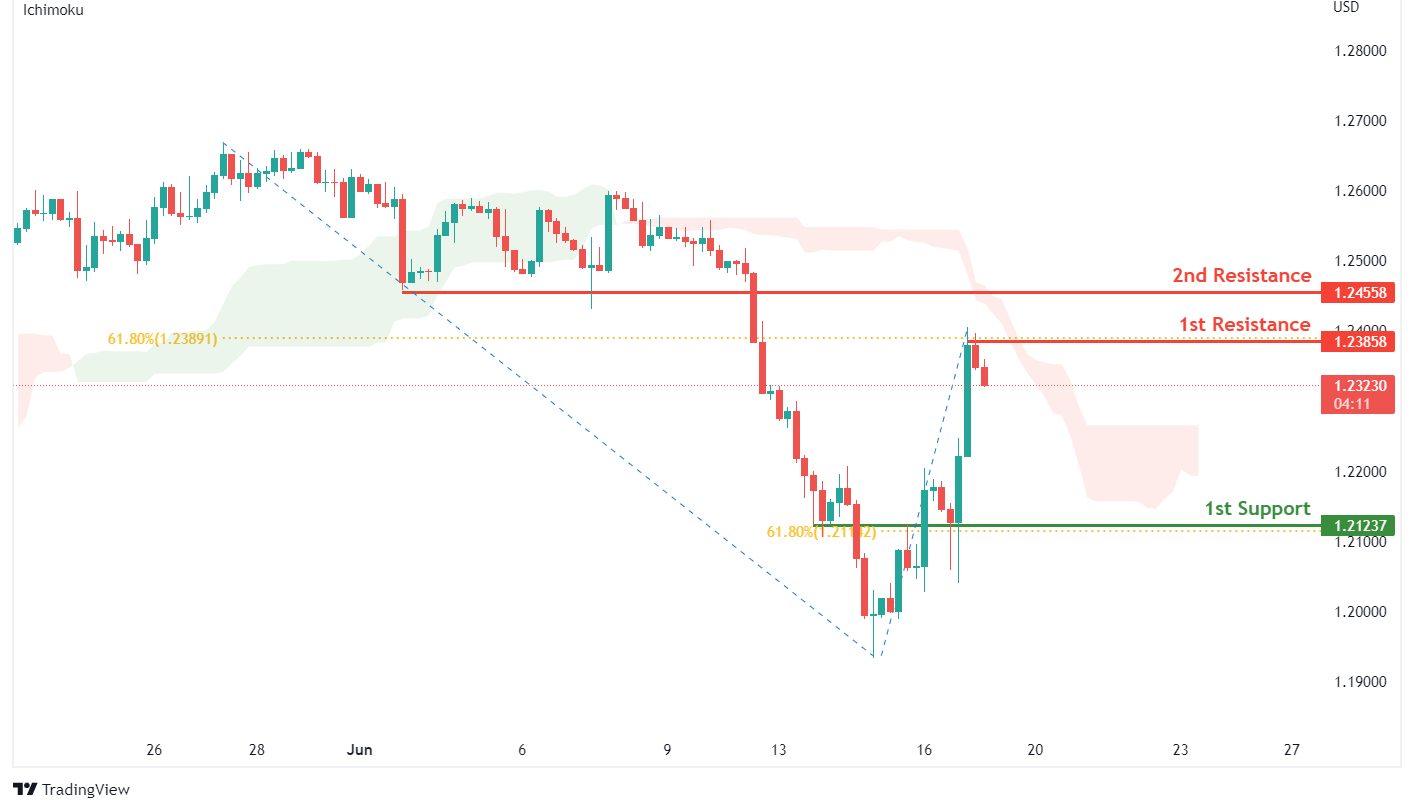
On the H4, with prices moving below the ichimoku indicator, we have a bearish bias that price will drop from our 1st resistance at 1.23858 where the horizontal swing high resistance and 61.8% fibonacci retracement are to our 1st support at 1.21237 in line with the 61.8% fibonacci retracement and overlap support. Alternatively, price may break 1st resistance structure and head for 2nd resistance at 1.24558 where the horizontal overlap resistance is.
Areas of consideration:
- H4 1st resistance at 1.23858
- H4 1st support at 1.21237
USD/CHF:
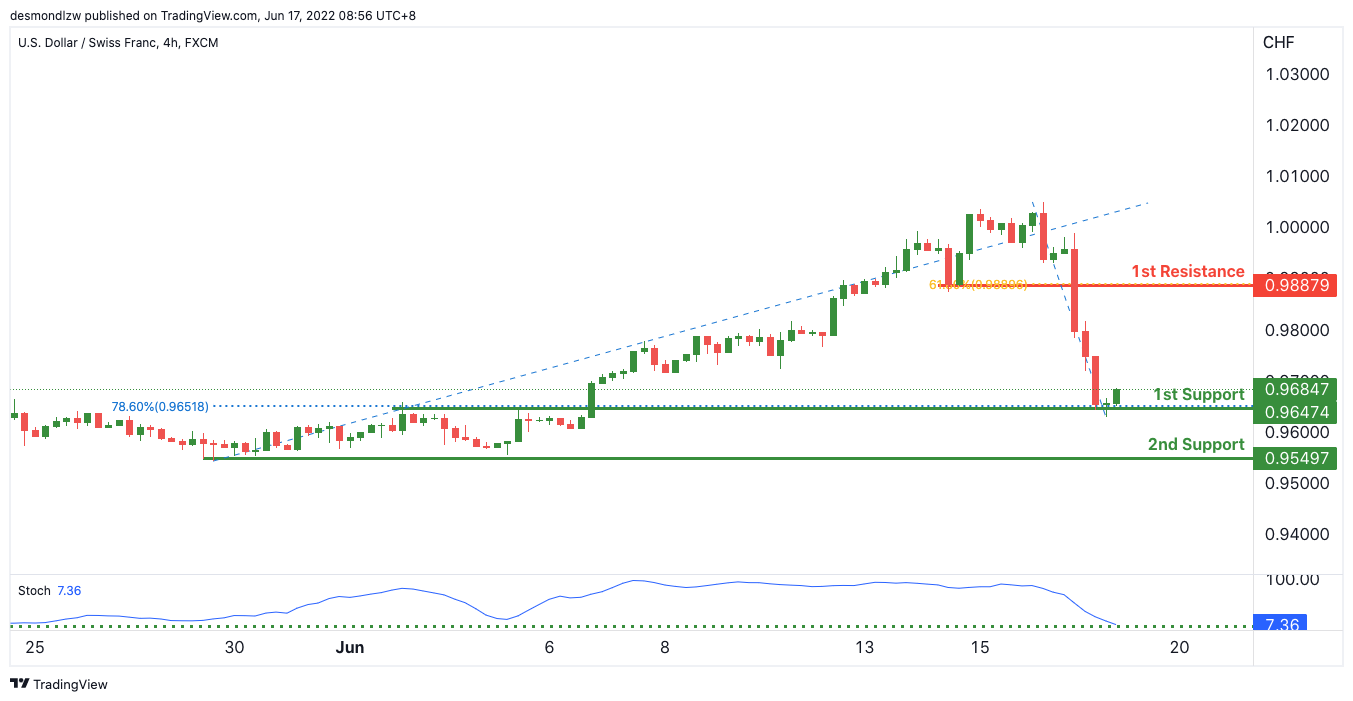
On the H4, with price expected to bounce off the stochastics indicator, we have a bullish bias that price will rise from our 1st support at 0.96474 where the horizontal swing low support and 50% Fibonacci retracement is to our 1st resistance at 123.12 in line with the horizontal swing high support. Alternatively, price may break structure and head for 2nd support where the horizontal swing low support is.
Areas of consideration
- 1st support level at 0.98769
- 1st resistance level at 0.99786
EUR/USD :
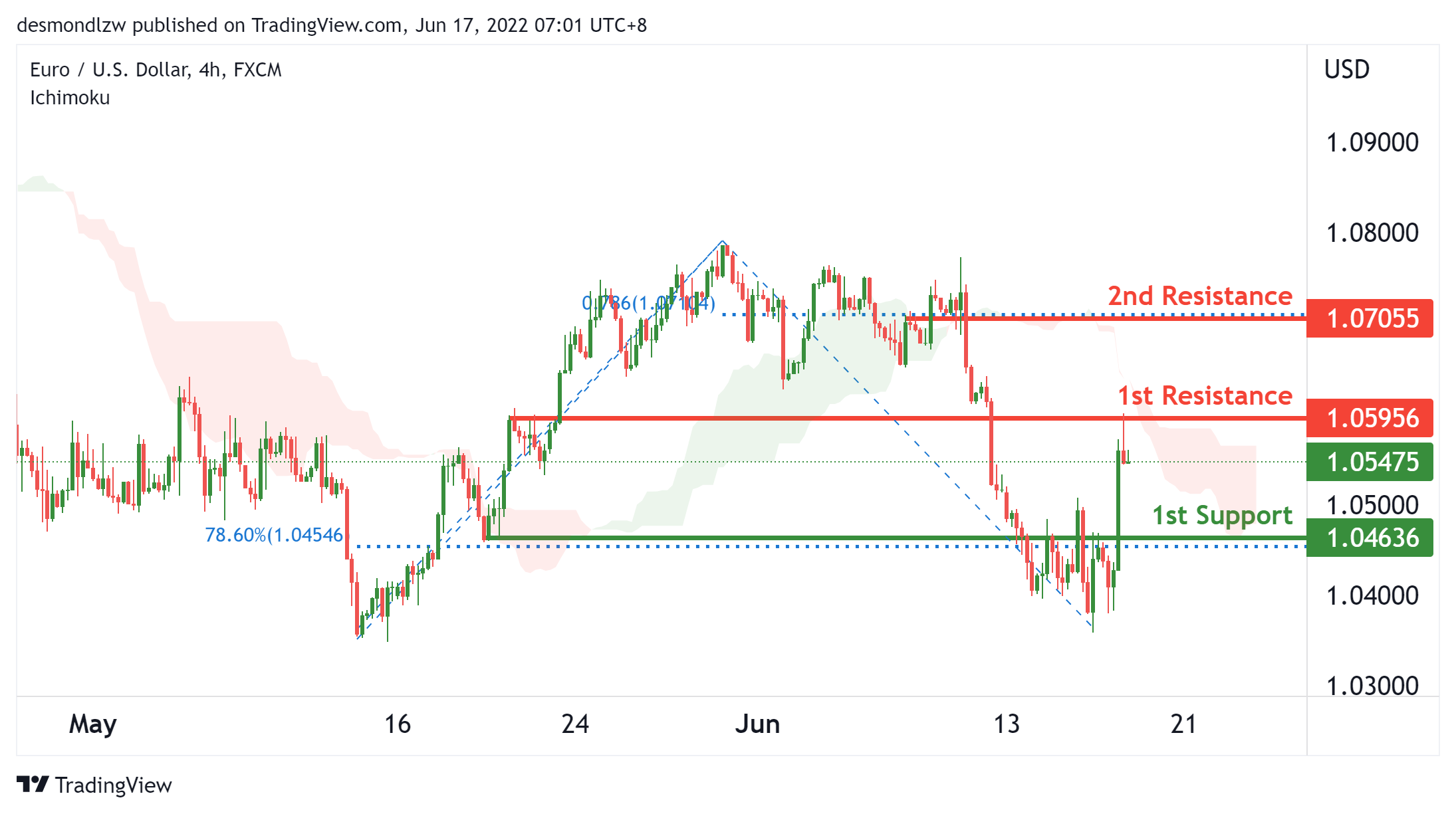
On the H4, with price moving below the ichimoku cloud, we have a bearish bias that price will drop from the 1st pullback resistance at 1.05956 to the 1st overlap support at 1.04636 in line with the 78.6% fibonacci retracement. Alternatively, price may rise from the 1st resistance to the 2nd resistance at 1.07055 in line with the 78.6% fibonacci projection.
Areas of consideration :
- H4 1st resistance at 1.05956
- H4 1st support at 1.04636
USD/JPY:
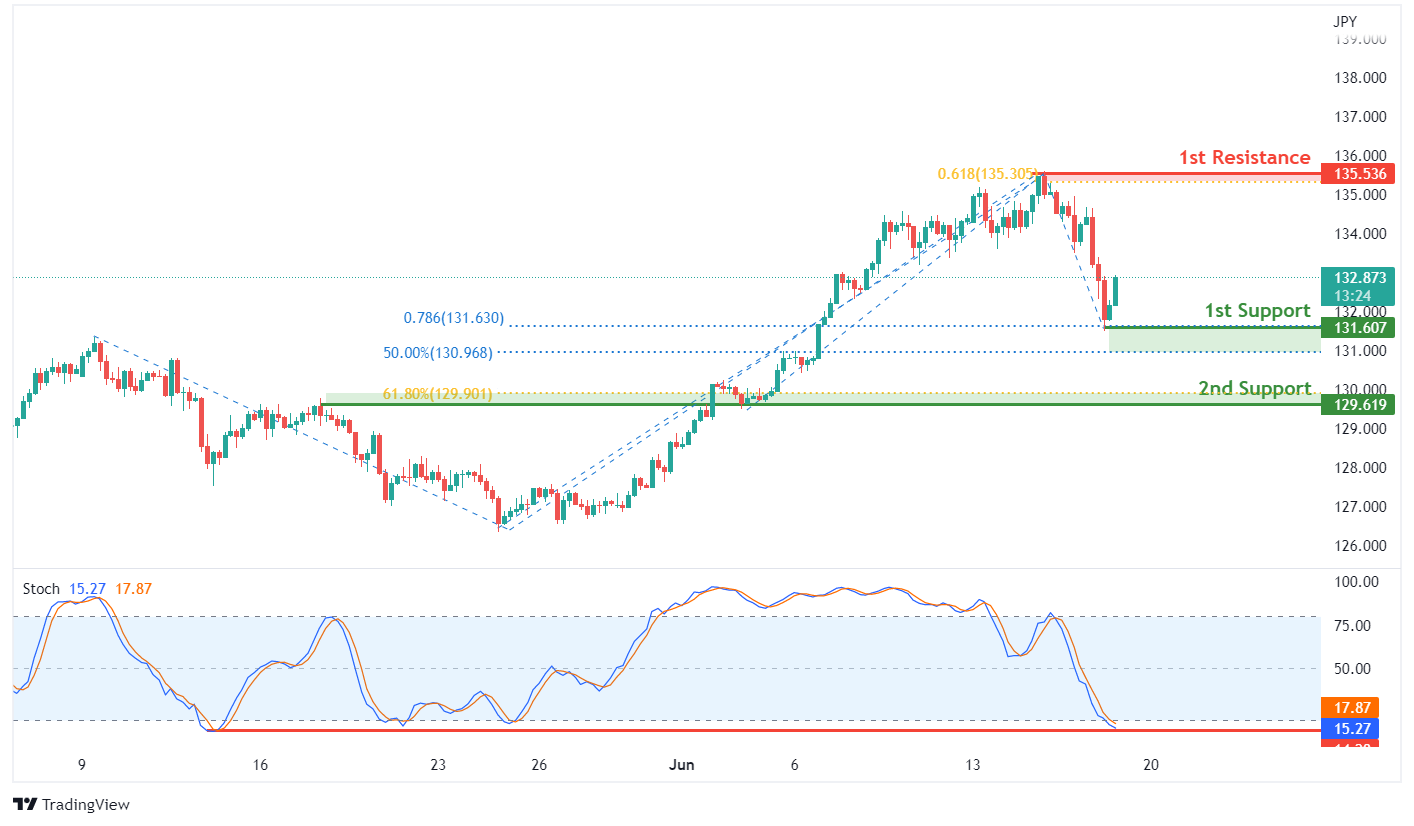
On the H4, with price expected to bounce off stochastic indicator, we have a bullish bias that price will rise from our 1st support at 131.607 where the horizontal swing low support, 78.6% fibonacci projection and 50% fibonacci retracement are to our 1st resistance at 135.536 in line with the swing high resistance and 61.8% fibonacci projection. Alternatively, price may break 1st support structure and head for 2nd support at 129.619 where the horizontal overlap support and 61.8% fibonacci retracement are.
Areas of consideration:
- H4 time frame, 1st resistance at 135.536
- H4 time frame, 1st support at 131.607
AUD/USD:
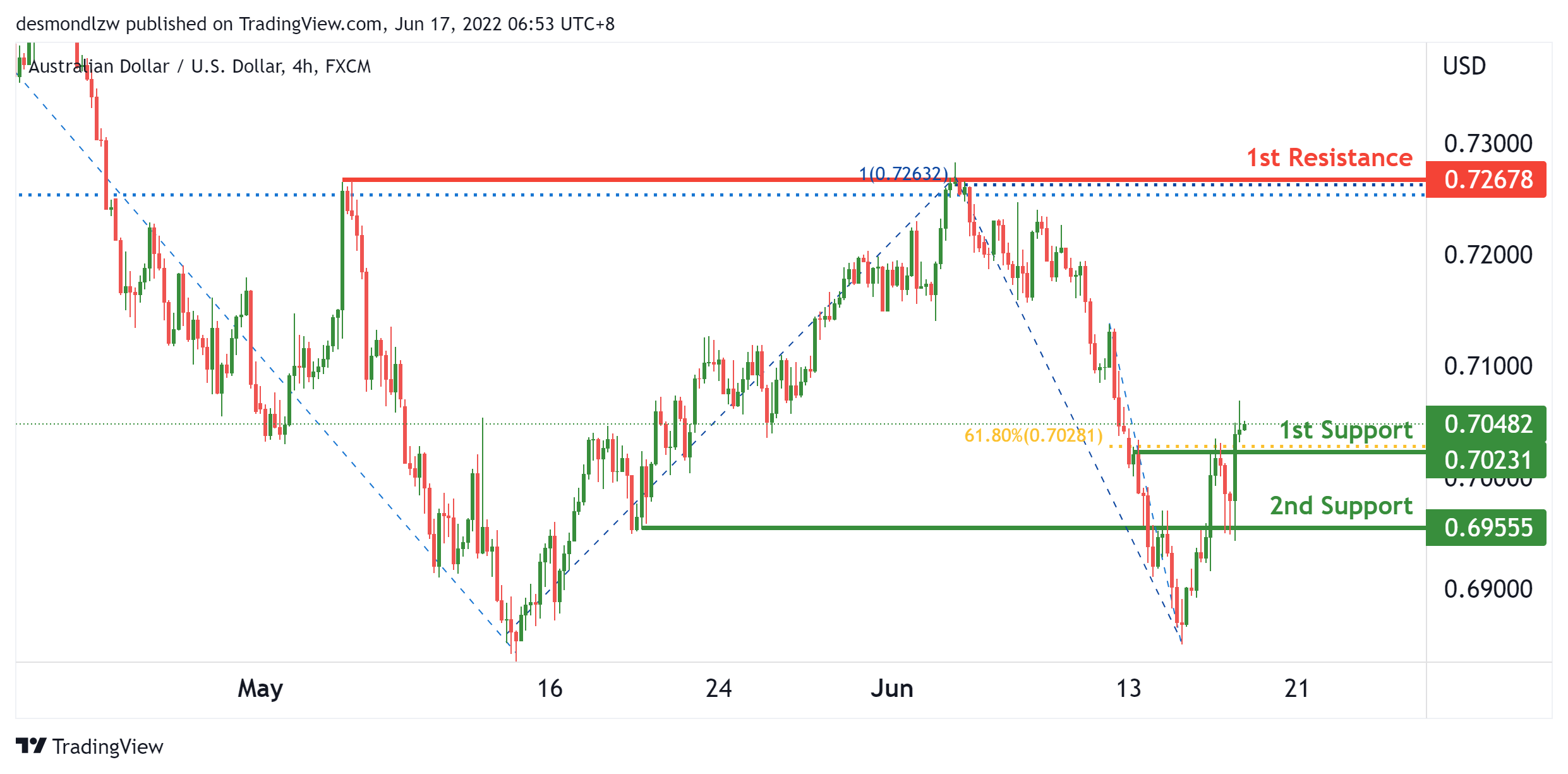
On the H4, price has recently reversed off the 2nd support at 0.69555 and we have a bullish bias that price will rise from the 1st overlap support at 0.70485 in line with the 61.8% fibonacci retracement to the 1st resistance at 0.72678 in line with the 100% fibonacci projection and 50% fibonacci retracement. Alternatively, price may reverse off the 1st support and drop back down to the 2nd support in line with the multiple horizontal swing lows.
Areas of consideration
- H4 1st resistance at 0.72678
- H4 1st support at 0.70485
NZD/USD:
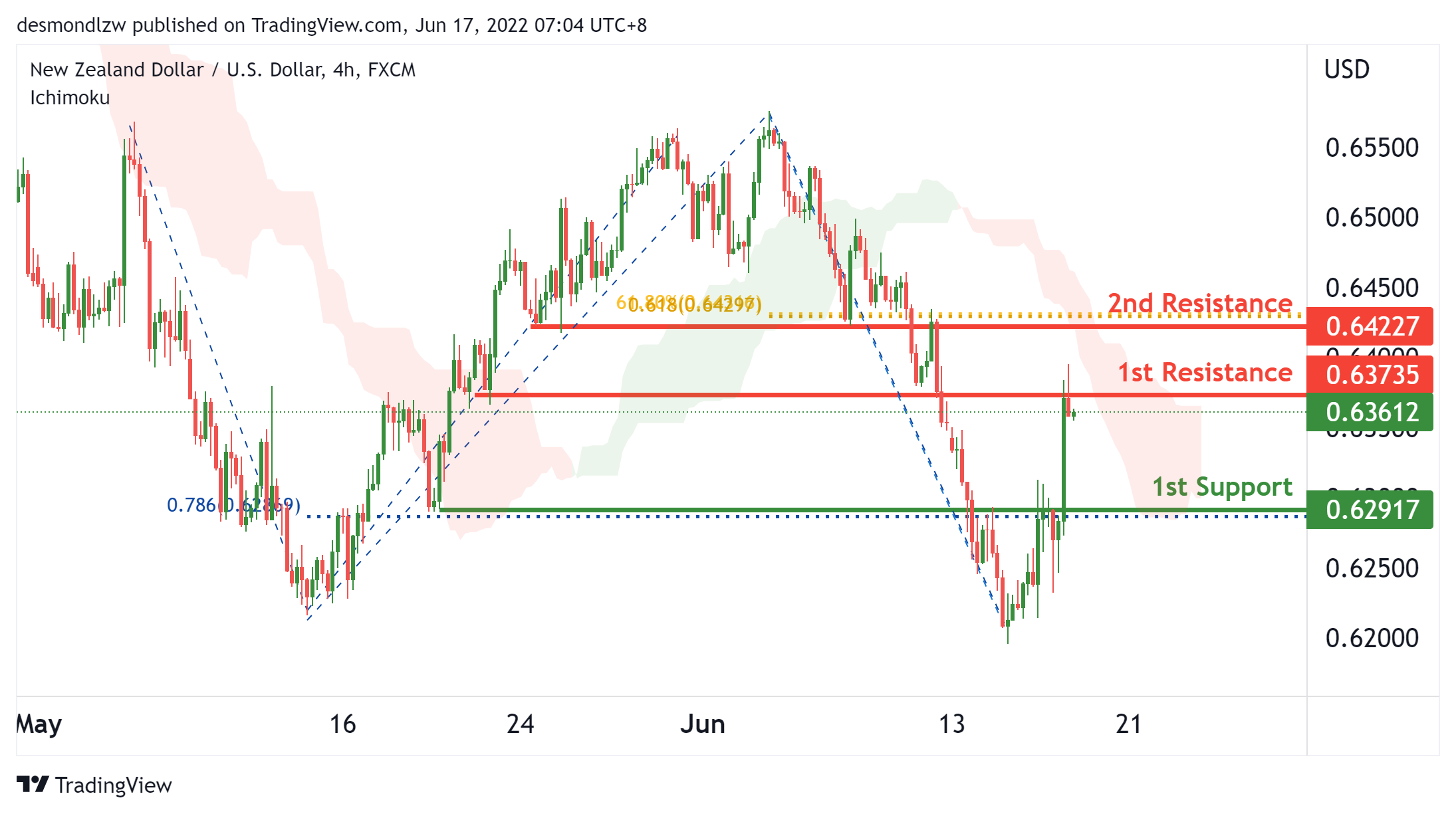
On the H4, with price moving below the ichimoku cloud, we have a bearish bias that price will drop from the 1st resistance at 0.63735 in line with the overlap resistance to the 1st support at 0.62197 at the 78.6% fibonacci projection and overlap support. Alternatively, price may break the 1st resistance structure and rise to the 2nd resistance at 0.64227 in line with the 61.8% fibonacci retracement, 61.8% fibonacci retracement and overlap resistance.
Areas of consideration:
- H4 time frame, 1st support at 0.62197
- H4 time frame, 1st resistance at 0.63735
USD/CAD:
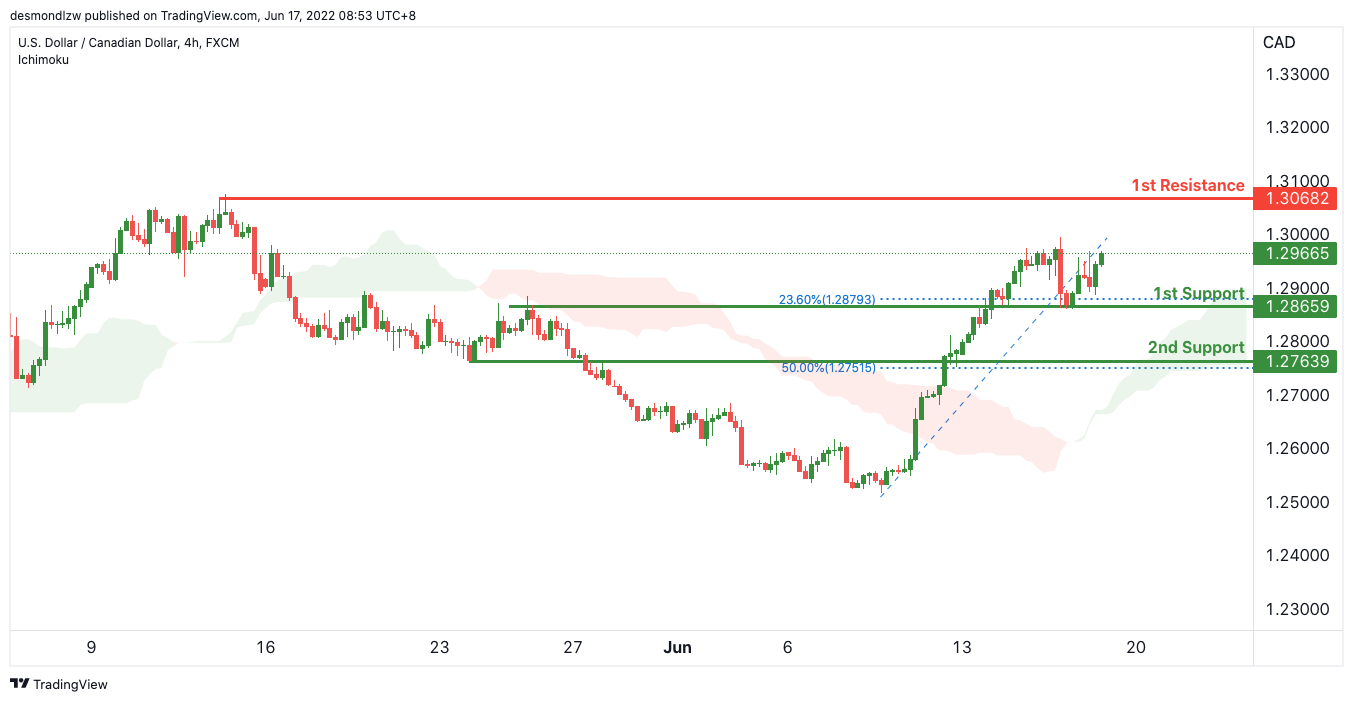
On the H4, with expected to reverse off the stochastics indicator, we have a bearish bias that price will drop to our 1st support at 1.27639 in line with the horizontal pullback support from our 1st resistance at 1.29710 where the pullback resistance and 78.6% Fibonacci retracement is. Alternatively, price may break structure and head for our 2nd resistance in line with the horizontal swing high resistance.
Areas of consideration:
- H4 time frame, 1st resistance at 1.29019
- H4 time frame, 1st support at 1.27639
OIL:
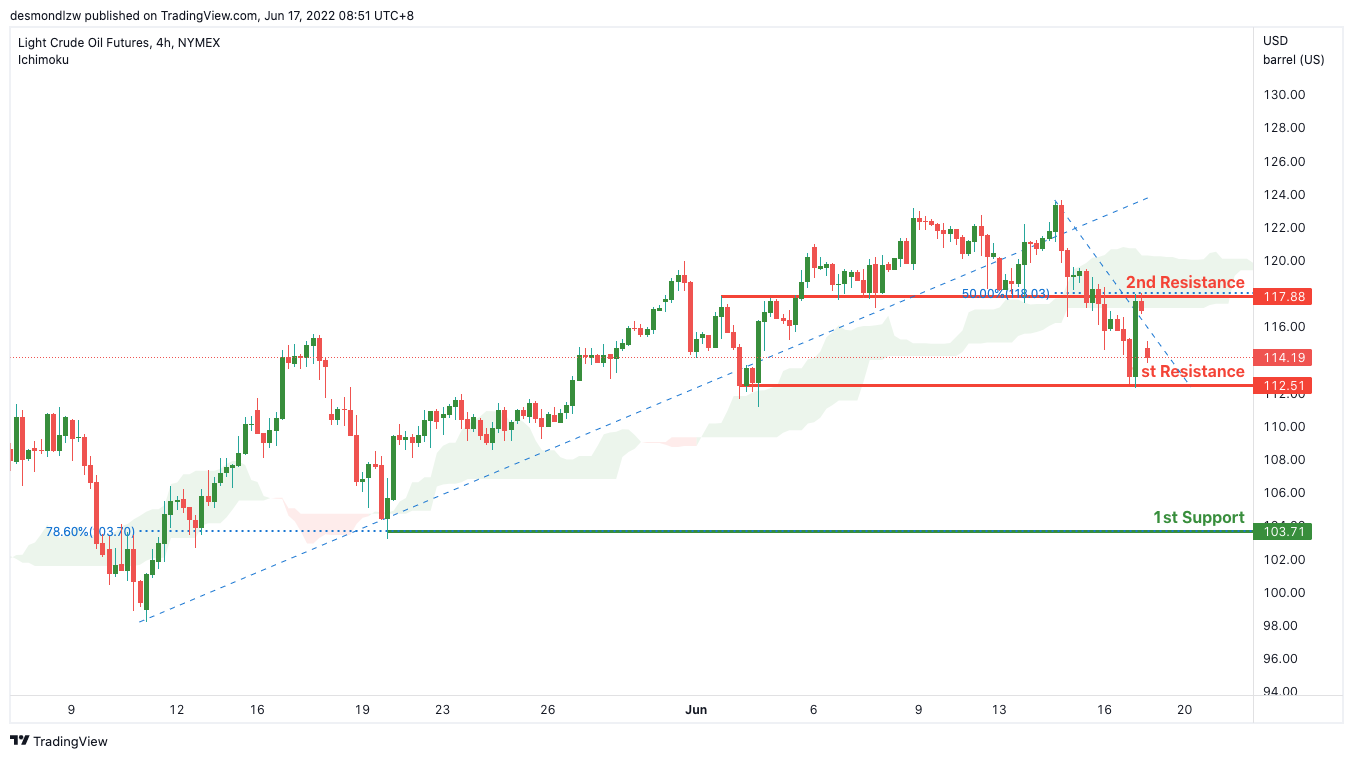
On the H4, with price moving above the ichimoku cloud, we have a bullish bias that price will rise from our 1st support at 117.14 where the horizontal swing low support and 50% Fibonacci retracement is to our 1st resistance at 123.12 in line with the horizontal swing high support. Alternatively, price may break structure and head for 2nd support where the horizontal swing low support is.
Areas of consideration:
- H4 time frame, 1st resistance of 123.12
- H4 time frame, 1st support of 117.14
Dow Jones Industrial Average:
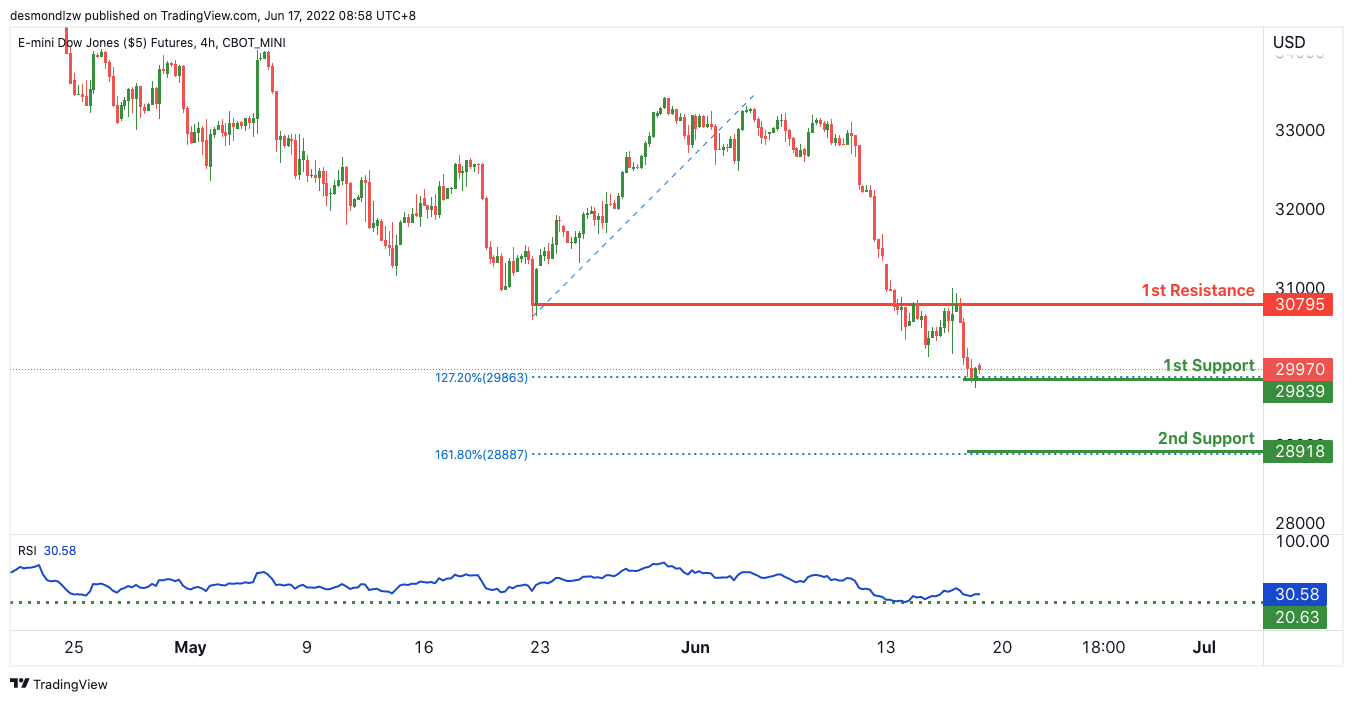
On the H4, with price expected to bounce off the stochastics indicator, we have a bullish bias that price will rise from our 1st support at 30568 where the horizontal swing low support and 61.8% Fibonacci projection is to our 1st resistance at 32592 in line with the horizontal pullback support. Alternatively, price may break structure and head for 2nd support where the 78.6% Fibonacci projection is.
Areas of consideration :
- H4 time frame, 1st resistance at 32587
- H4 time frame, 1st support at 30568
Cliff Notes: Confidence Lost
Key insights from the week that was.
In Australia this week, the material divergence between business and consumer confidence was again highlighted. First to be released, the May NAB business survey reported a moderate deterioration in conditions and confidence; however, conditions remained well above average and confidence modestly so. Notably, the strength in conditions remains broad-based across the mainland states and industry, with construction the sole exception by sector given labour and material shortages. Also of significance, forward orders continued to increase at pace in May, labour demand remained strong and capacity utilisation was reported to be at historic highs. All in all, Australia’s business sector remains in good health, and the outlook for employment and investment positive. For those keen to know more about this theme, tune in to our latest Market Outlook in conversation podcast.
Amongst Australian consumers however, confidence looks to have been lost, June’s 4.5% decline in Westpac-MI Consumer Sentiment taking it to a level it has only been at or below during major economic dislocations over the survey’s 46-year history. As detailed by Chief Economist Bill Evans this week, the June survey depicts a slump in sentiment driven by historic and rising inflation, the abrupt policy response and a general loss of confidence in the outlook.
Unsurprisingly, views on family finances are materially below long-run average levels, as is consumers’ belief in whether now is a good ‘time to buy a major household item’. Contrasting these outcomes with households’ strong expectations of the labour market emphasises job loss is not the concern, but rather anxiety over declining purchasing power. Accelerating wages growth as evinced by the NAB business survey’s labour cost measure, RBA liaison and this week’s higher-than-expected minimum wage decision will help alleviate some of this concern, but not all. At least employment should remain an enduring positive, May’s employment print coming in materially higher than expectations at a strong 61k, driving the employment to population ratio to yet another record high.
With respect to investment, risk aversion is acute, with just over 64% of consumers nominating debt repayment or capital protected investment options as the wisest place for savings – in line with the extreme high of 65.5% seen during the GFC. ‘Time to buy a dwelling’ shows a similar degree of concern around housing, the index reaching a new post-GFC low in June. While the majority of households still expect prices to rise, these expectations are cooling rapidly now that prices have begun to fall and as interest rates rise.
The other key release for Australia this week was the migration data for May. Arrivals and departures rose at a slower pace in the month to be above a third of pre-pandemic levels at 651.1k and 664.0k respectively. April’s strength in short-term visitor arrivals (up to 235k), accompanied by a 27% lift in tourism-related services exports in April’s trade account, indicates that the international border reopening is starting to have a material impact on the Australian economy. It was also promising to see temporary work and student visa applications soar in March/April, suggesting that if grants continue to flow at this pace, the pick-up in visa arrivals can play a crucial role in alleviating the issue of labour undersupply.
Moving offshore to New Zealand. GDP came in a touch below Westpac’s flat expectation for Q1, a 0.2% quarterly decline instead reported. COVID-19 disruptions were a key factor behind the result, so a rebound is expected in Q2, circa 1.0%. Furthermore, despite the Q1 result, the New Zealand economy is still running above its non-inflationary potential, requiring the RBNZ to hold to its plan to tighten policy aggressively. Our team remain of the view that a peak cash rate of 3.50% will be seen at year end. Full detail on the GDP Q1 release and outlook can be found in our New Zealand team’s bulletin.
Further afield, outcomes for the west and east were polar opposite this week. Following last Friday’s historic US CPI print of 8.6%yr – a fresh multi-decade high, driven by broad-based price pressures for energy and food related to Russia’s invasion of Ukraine as well as domestic capacity constraints – and a very weak June reading for University of Michigan consumer sentiment, financial markets took on a decidedly risk-off posture and progressively priced in a 75bp June hike by the FOMC. The Committee delivered on this expectation and also emphasised their determination to bring inflation back to target in the medium-term, upgrading their forecast for the fed funds rate at year end to 3.4%, circa 175bps higher than the June level. An initial positive response from the market was short lived, with further significant falls in US equities seen overnight.
The crux of the matter is that, while the FOMC are confident they can hike interest rates aggressively and only bring GDP growth back to trend, the market is increasingly troubled by the probability of recession. Prior to the CPI report and this week’s developments, we had anticipated US domestic demand would decelerate to trend in 2022 and below it in 2023. With the FOMC now set to be more aggressive – we now forecast a 3.375% peak fed funds rate at year end instead of 2.625% -- we concur with the mood of the market, anticipating US growth will stall in 2023.
It is worth emphasising that risks are squarely against the US, with GDP having contracted in Q1 on weaker inventory accrual and imports and potentially being set for a flat result in Q2 given a marked deterioration in growth in domestic demand. In our view, the cumulative impact of declining real incomes, tight financial conditions and very soft consumer confidence risk a prolonged period of growth well below trend. While the FOMC is likely to hold to its determined position regarding inflation to end-2022, policy will then be on hold until rate cuts begin. Our best assessment of the scale and timing of these cuts is 125bps beginning Q4 2023 and running to Q4 2024. Assuming the labour market remains relatively intact in the interim, moving the fed funds rate back to a broadly neutral level should be enough to bring GDP growth back to trend by late-2024.
Over in the UK, the Bank of England are similarly determined to bring inflation to target, but also face significant risks with respect to growth. The Bank of England decided to raise the bank rate by 25bps to 1.25% in June and implement a hawkish shift in guidance, now stating they will “act forcefully” if necessary versus May’s softer agreement on “some degree of further tightening”. Their long-term view looks largely unchanged, but in the near-term the Committee now expect inflation to be higher (a peak slightly above 11% in October) and growth to contract by 0.3% in Q2. The mixed run of recent UK data makes it difficult to judge the extent to which households are feeling the pain of inflation, but nevertheless, concerns about broadening price pressures and persisting supply issues are clearly front of mind. We now expect a 50bp hike in August, followed by 25bp hikes in September and November, bringing the bank rate to 2.0% by year end.
Finally to China. In May, industrial production, fixed asset investment and retail sales all beat the market’s expectations and most improved on their April outcomes. This is despite the Shanghai lockdown remaining in full effect through the month and many other cities also being impacted by shorter-term restrictions. Also out during the past week, the May credit data showed that the above improvement in activity was not a one off, with aggregate financing now up 12% year-to-date in 2022. A broad-based acceleration in local government and business investment therefore looks to be in train; the recent reduction in borrowing costs for consumers should also help this momentum spread to residential construction, albeit with a lag.
While Shanghai’s recent experience and authorities continued strong stance against the virus will weigh on consumption near term, in coming months the testing regime is likely to be accepted as a new – hopefully temporary – normal given households desire to return to a free social and work life. As we continue to highlight, the progressive removal of domestic restrictions on activity combined with a continuation of stringent international travel restrictions and encouragement to buy Chinese made goods will not only keep Q2 growth positive but also maximise the longevity and scale of the growth cycle to come, in stark contrast to the west.
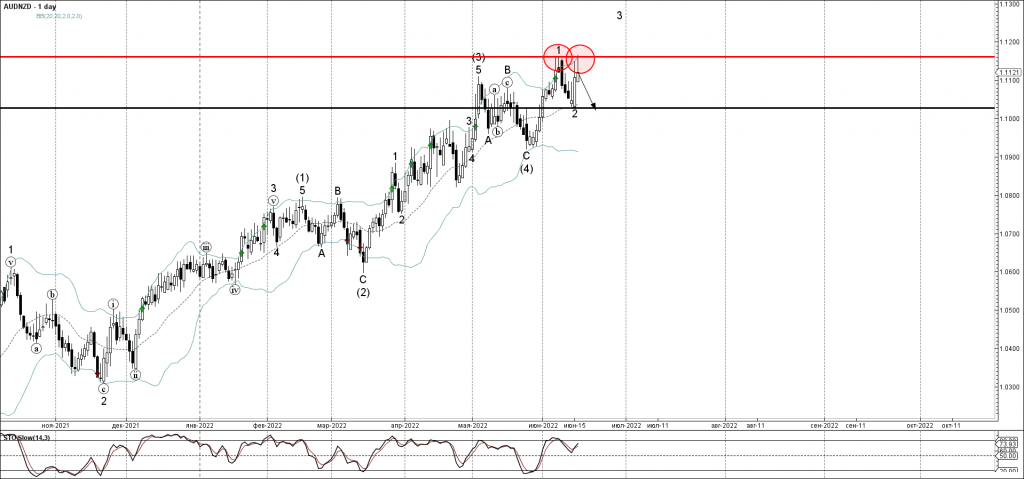
AUDNZD Wave Analysis
- AUDNZD reversed from resistance level 1.1160
- Likely to fall to support level 1.1030
AUDNZD currency pair just reversed down from the key resistance level 1.1160 (top of the previous impulse wave 1 from the start of May).
The resistance level 1.1160 was further strengthened by the upper daily Bollinger Band.
AUDNZD currency pair can be expected to fall further toward the next support level 1.1030 (low of wave 2 from the middle of June).
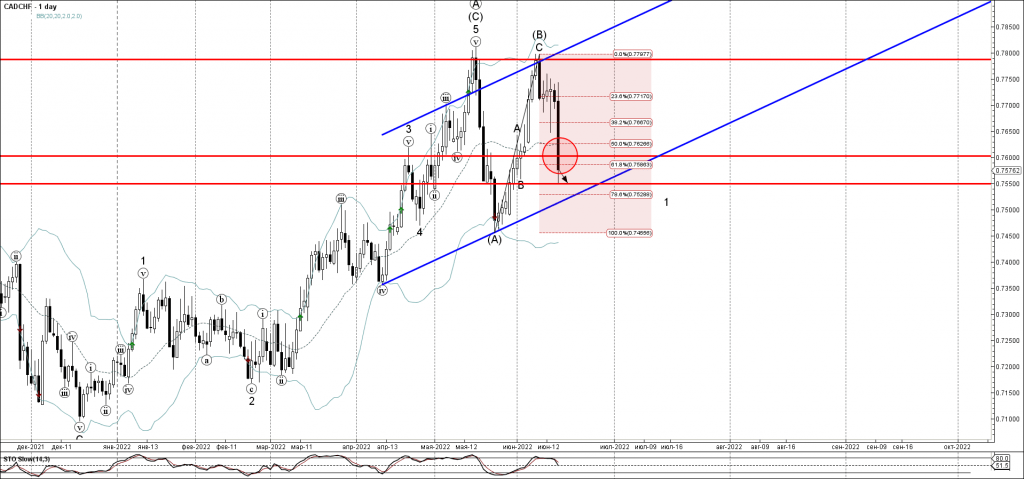
CADCHF Wave Analysis
- CADCHF broke support level 0.7600
- Likely to fall to support level 0.7550
CADCHF currency pair recently broke the key support level 0.7600 and the 61.8% Fibonacci correction of the upward wave (B) from May.
The breakout of the support level 0.7600 should accelerate the active impulse waves 1 and (C).
CADCHF currency pair can be expected to fall further toward the next support level 0.7550 (low of wave B from the start of June).
Eco Data 6/17/22
[php_everywhere instance="1"]
Is a Recession Now Inevitable?
Equity markets are experiencing another day of pain on Thursday as central banks continue to signal a willingness to sacrifice the economy in order to get inflation under control.
Central banks are full of surprises this week whether it's the Fed accepting a recession as the cost of price stability, the SNB raising rates by 50 basis points out of nowhere, the ECB holding an emergency meeting or the BoE seemingly crossing its fingers and hoping 11% inflation goes away on its own. What will the BoJ bring after a busy week in the bond markets?
The SNB hike was arguably the most surprising of the lot, with the consensus before being that they would stand pat and resist further strengthening the currency which has been boosted by safe-haven flows. Not only did it not, but it also hiked beyond all expectations and appears to have warmed to the idea of a strong franc. I'd be more amazed at the shift if the SNB under Thomas Jordan didn't have a history of sudden u-turns without warning.
Perhaps the most surprising thing about the BoE today was how underwhelming the policy response was. At a time when the central bank announced that inflation is now expected to peak above 11% in October, it also raised interest rates by a measly 25 basis points and didn't show a particular willingness to accelerate the tightening to combat those price pressures.
Of course, every economy is different and the MPC is clearly of the view that inflation will come down naturally over time, referencing the fact that energy and core goods account for around 80% of the inflation overshoot.
It seems quite the gamble though and one that could prove disastrous if it doesn't pay off but once more, markets and the central bank are taking drastically different views on the outlook for rates. The BoE appears ready to slow things down while markets are expecting multiple super-sized hikes in the coming months. Central banks haven't fared too well against the markets this year and it's hard to make a case for the BoE this time around.
Another central bank that's having a hard time is the BoJ which has been forced to fiercely defend its yield curve control policy tool this week. It's swimming against a vicious tide and conditions are becoming more treacherous by the day. Governor Kuroda has stood firm against any suggestion the policy should be tweaked but could the BoJ have one more surprise in store for us?
IEA offers a bleak outlook for crude
Oil prices are relatively flat on Thursday, after once again edging lower earlier in the session. Crude has been paring gains in recent days after a huge run higher over the previous month but prices are still extremely high. Risks remain tilted to the upside even as recession risks take some of the heat out of the market.
The good news just keeps coming in the oil market, with the IEA reporting today that it expects record global oil demand next year paired with supply struggling to keep pace as Russia is forced to shut in more wells and other producers are constrained by capacity. In other words, the market will remain extremely tight and prices high. A recession may ridiculously be the only hope for balance in the market and lower prices. Although refining capacity won't even hit pre-Covid levels next year which will continue to boost prices at the pump.
Gold recovery may not have legs
A volatile week in gold has seen it break through the bottom of the recent range only to recover a little around $1,800. A stronger dollar remains a major headwind for the yellow metal and in these conditions, it's hard to imagine it falling out of favour. Yields are continuing to rise and central banks are hiking aggressively in a desperate attempt to rein in inflation. It doesn't bode well for gold even in these risk-averse markets.
Another blow on the way for bitcoin?
Bitcoin HODLers must be getting a little nervous at this point despite their unwavering belief in the future of the cryptocurrency. The short-term outlook is pretty bleak for bitcoin and even recent headlines haven't been in its favour. With central banks everywhere raising rates and risk appetite taking a beating on a regular basis, the bullish case is getting weaker by the day. And a break of $20,000 could be the next major blow.