Sample Category Title
British Pound Pares Post-BoE Gains
Pound jumps after BoE rate hike
The pound had a wild day on Thursday, trading in a 350-point range. Sterling traded in a 300-point range overnight, with markets not quite sure to make of the BoE’s 0.25% rate increase. In the end, the pound received a thumbs-up and posted a gain of 1.45%. The rate hike, which was the fifth in a row, was indeed modest, but investors liked that the BoE signalled that more rate hikes were on the way. As well, the MPC’s split 6-3 decision (3 members voted for a 0.50% hike) no doubt sent a signal that the BoE could provide a hawkish pivot if inflation does not peak. The BoE has warned of a recession and has forecast that inflation will top 11%, making it difficult to feel reassured by the central bank, but it appears that with the MPC unanimously voting to raise rates at the meeting, investors had something to feel positive about.
The US dollar has shown that it can recover quickly and the risk for the pound remains tilted to the downside, with dark clouds hovering above the UK economy. GDP fell by 0.3% in April after a 0.1% decline in March, the first back-to-back contractions since March 2020, at the start of the Covid pandemic. The OECD has forecast that the UK economy will grow by 3.6% this year, but will stagnate in 2023, which would make it the worst-performing G-7 economy in 2023.
In a week of dramatic central bank decisions, the Federal Reserve won the highlight of the week. The Fed delivered a 0.75% salvo, the first since 1994, bringing rates to a target range of 1.50-1.75%. The Fed downgraded its US growth forecasts for 2022 and 2023, but insisted that there would be no recession. Some analysts would beg to disagree, but the financial markets were relieved, as Fed Chair Powell said he didn’t expect 0.75% rate hikes to become common. The move is a clear signal that the Fed plans to use all available tools to wrestle down inflation, which has hit a 40-year high.
GBP/USD Technical
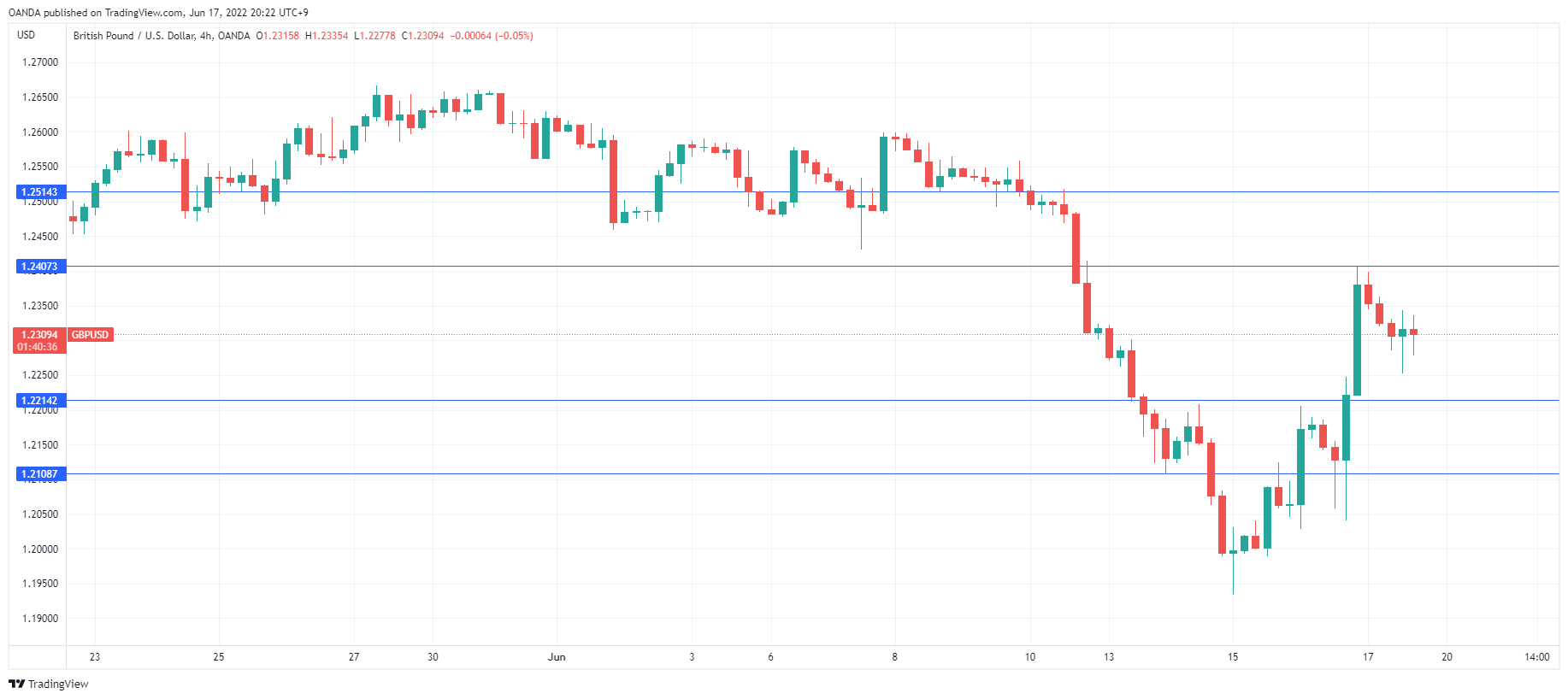
- GBP/USD has support at 1.2215 and 1.2016
- There is resistance at 1.2407 and 1.2514
USD/JPY Outlook: Returns to Strength after Shallow Pullback
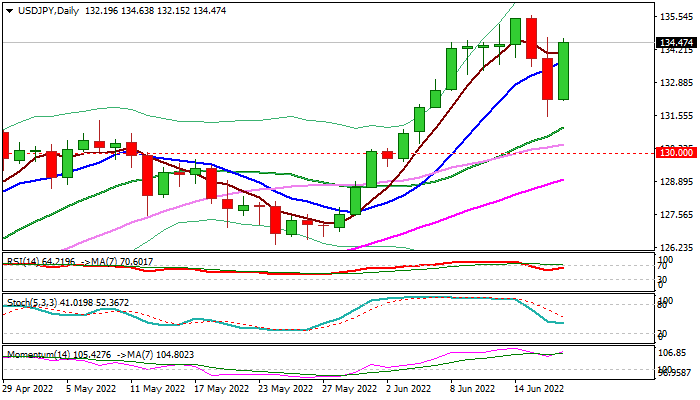
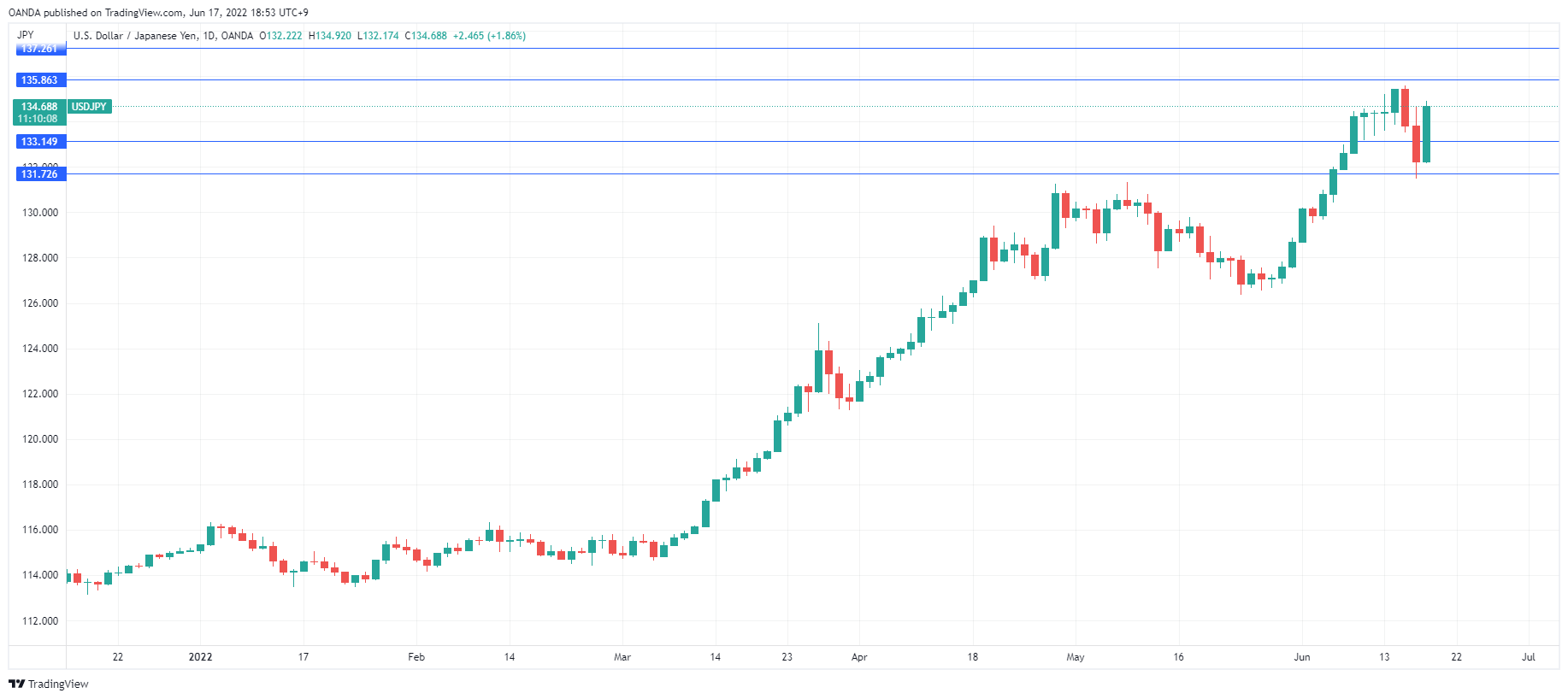
The dollar regained traction and bounced on Friday, after two-day pullback from new highest since 1998 was contained by Fibo support at 132.05 (38.2% of 126.36/135.57 upleg.
The sentiment for yen was soured by today’s Bank of Japan’s decision to keep their monetary policy unchanged that would further widen the gap between hawkish Fed and neutral BoJ.
Strong bullish acceleration in early Friday has already retraced 76.4% of 135.57/131.49 pullback, suggesting that corrective phase is likely over.
Daily tech returned to full bullish setup and underpin the action for attack Wednesday’s peak at 135.57, violation of which would open way for further advance towards Fibo projections at 136.13 and 138.00.
On the other side, overbought conditions and fading bullish momentum on weekly chart, along with formation of weekly Doji candle, require caution.
Broken 10DMA offers initial support at 133.78, followed by pivotal supports at 131.49 (correction low) and 131.05 (20DMA) loss of which would weaken near-term structure.
Res: 135.16; 135.57; 136.13; 138.00.
Sup: 134.00; 133.78; 132.75; 131.49.
EUR/USD Outlook: Near-Term Risk Shifts Lower after Thick Daily Cloud Capped Recovery
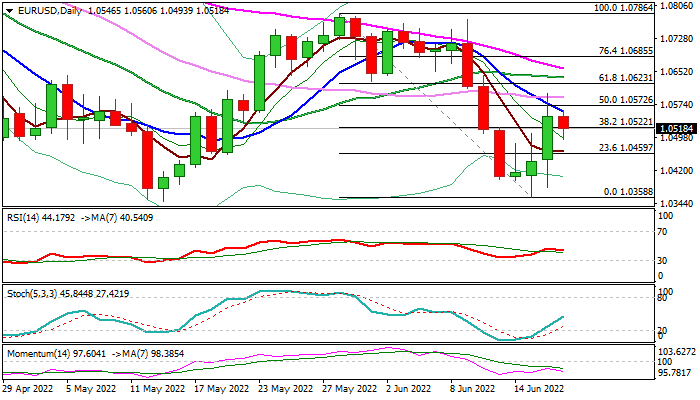
The Euro turned to red on Friday after recovery on Wed/Thu was capped by the base of thick daily cloud (spanned between 1.0566 and 1.0767)) and dollar returns to strength after hawkish Fed and BoJ remaining on hold.
The action remains heavily weighed by daily cloud and bearish studies on daily chart, with Thursday’s bull-trap on Fibo barrier (50% of 1.0786/1.0358) and 10DMA (1.0572) adds to negative signals.
Near-term action looks for repeated close below falling 10DMA to confirm negative stance, with extension through 5DMA (1.0466) to further weakens the structure and increase risk of fresh attack at key supports at 1.0349 (2022 low) and 1.0340 (2017 low), loss of which would open way for stronger bearish acceleration.
Alternative scenario would require rebound and close within daily cloud to ease immediate downside risk.
Res: 1.0566; 1.0591; 1.0623; 1.0638.
Sup: 1.0493; 1.0466; 1.0380; 1.0349.
Bitcoin Will Test Historical Patterns
Bitcoin was down 4.9% on Thursday, ending around $20.7K and trading near $20.8K at the start of the day on Friday. Ethereum lost 6.4% in the last 24 hours, returning to the $1100 area. Altcoins in the top 10 fell in price from 2.9% (BNB) to 8.8% (Polkadot).
Total crypto market capitalisation, according to CoinMarketCap, sank 3.5% overnight to $903bn. Bitcoin’s dominance index fell 0.3 points to 44.0%. The Cryptocurrency Fear and Greed Index was up 2 points to 9 by Friday.
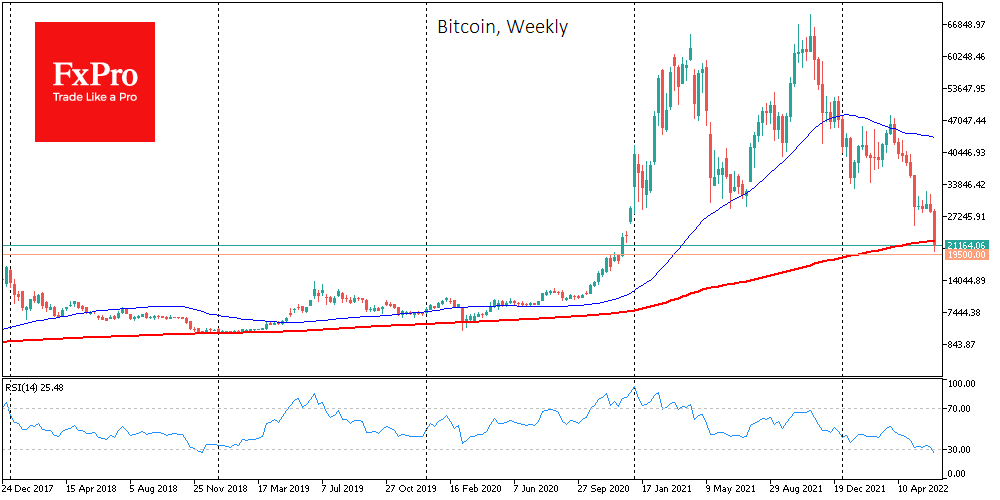
Although we did not see any new intraday lows, Bitcoin closed Thursday with a tenth consecutive day of declines. New lows in stock indices contributed mainly to this.
Bitcoin could be uncharted territory in a few days when historical patterns stop working.
The bearish focus remains on the circular $20,000 level, the former peak of 2017. At no time in past down cycles has BTC fallen below the high of the previous bull cycle. Closing the week below $22.3K would also be unique, as it would be the first close below the 200-week average. Bitcoin has previously fallen below this curve more than once but quickly regained some ground, finding ample demand from long-term investors amid a deep and quick sell-off.
The latest issue to attract investors’ attention has been the uncertainty surrounding Singapore-based cryptocurrency fund Three Arrows Capital (3AC). The hedge fund could be the subject of a new scandal amid growing speculation about its possible bankruptcy.
Commodity Futures Trading Commission (CFTC) Commissioner Christy Goldsmith Romero called on the US Congress to close the cryptocurrency regulation gap and compared the collapse in the crypto-asset market to the 2008 financial crisis.
Yen Falls Back Down after BoJ Balks
The Japanese yen continues to post strong swings this week and is up sharply on Friday. USD/JPY is trading at 134.67 in Europe, up 1.86% on the day.
BoJ maintains yield curve control
It’s been a busy week, with the markets still digesting some dramatic moves by central banks. The Fed and SNB delivered massive salvos in their fight against inflation, and the BoE continues to tighten, albeit at a more modest pace. The week wrapped up with the Bank of Japan policy decision earlier in the day. These meetings are usually on the dull side, with the central bank merely reaffirming its ultra-loose policy, with the occasional tweak. Today’s meeting was closely watched, however, as the BOJ’s yield curve stance has been under pressure and there was speculation that the BoJ might retreat and release the cap of 0.25% on 10-year JGBs.
In the end, the BoJ did not blink or budge, maintaining its policy for yield curve control and QE. The BOJ reaffirmed it will continue its policy of rock-bottom rates, even though other major central banks are tightening policy, as we saw this week with the Fed, BOE and SNB. Governor Kuroda has insisted that monetary easing remain in place, given Japan’s slow recovery from the Covid-19 pandemic. With inflation barely at 2%, the central bank’s target, Kuroda can afford to continue his loose policy and tenaciously defend the BoJ’s yield curve.
The BoJ didn’t adjust policy today but it was noteworthy that the policy statement added the exchange rate to its list of risks, something we haven’t seen in previous statements. The yen hit a 24-year low at 135.60 earlier this week and could fall even further. The Bank is sending a message that it is monitoring the exchange rate, but I question whether this will deter the markets from continuing to test the yen – previous jawboning from the BoJ and Ministry of Finance didn’t succeed in stemming the yen’s slide, and we could well be on our way to a 140 yen if the US/Japan rate differential continues to widen.
USD/JPY Technical
- USD/JPY is testing resistance at 133.14. Above, there is resistance at 1.3585
- There is support at 131.72
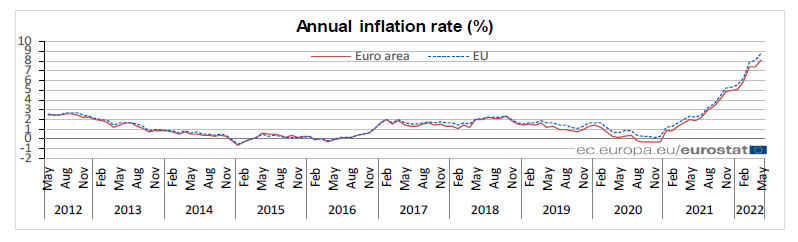
Eurozone CPI finalized at 8.1% yoy in may, core CPI at 3.8% yoy
Eurozone CPI was finalized at 8.1% yoy in May, up from April's 7.4% yoy. All-items excluding energy rose from 4.1% yoy to 4.6% yoy. All-item excluding energy, food, alcohol and tobacco rose from 3.5% yoy to 3.8% yoy. Energy prices accelerated from 37.5% yoy to 39.1% yoy. Food, alcohol and tobacco prices accelerated from 6.3% yoy to 7.5% yoy.
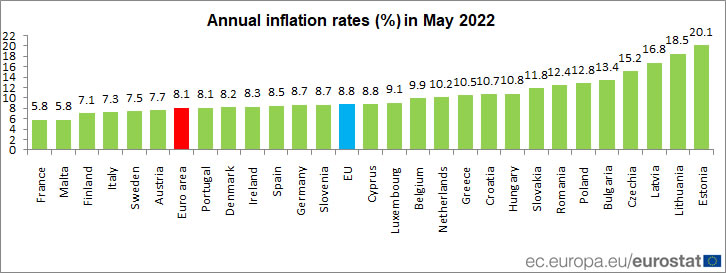
EU CPI was finalized at 8.8% yoy, up from April's 8.1% yoy. The lowest annual rates were registered in France, Malta (both 5.8%) and Finland (7.1%). The highest annual rates were recorded in Estonia (20.1%), Lithuania (18.5%) and Latvia (16.8%). Compared with April, annual inflation fell in one Member State and rose in twenty-six.
BoJ Kuroda: 10-yr JGB yields above 0.25% would diminish effect of monetary easing
BoJ Governor Haruhiko Kuroda said in the post-meeting press conference, "the recent rapid weakening of the yen is raising uncertainty over the outlook and making it hard for companies to draw up business plans so it is negative and undesirable for the economy."
"We will have to closely watch developments in financial and currency markets and their impact on the economy and prices," he added.
Kuroda also added, "policy tightening is not appropriate at this point." And he warned, "if the 10-year JGB yield exceeds 0.25%, that would diminish the effect of our monetary easing."
GBP/USD Outlook: Cable Remains Volatile and Looks for Clearer Direction Signals
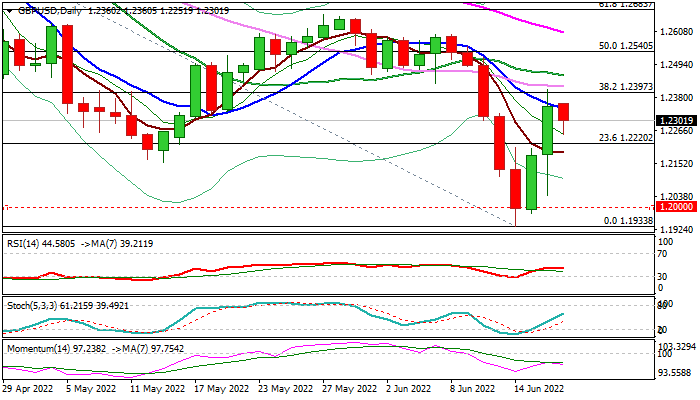
Cable eases in early Friday, following strong rebound in past two days which lost traction at the first strong obstacle at Fibo 38.2% of 1.3147/1.1933 descend, denting initial signal of reversal.
Sterling was boosted by BOE’s rate hike by 25 basis points to 1.25% (the fifth rate increase since December) and hawkish shift in central bank’s expectations, but remains highly volatile.
Cable remains supported by BOE’s action and strong headwinds that bears faced at psychological1.20 support, but overall strong dollar continues to weigh.
Daily studies remain bearishly aligned, as negative momentum remains strong and MA’s are in bearish setup, though initial positive signal is developing on formation of long-tailed Doji or possible hammer candlestick and bear-trap under 1.20 level.
Look for clearer direction signals, which would be generated on drop and close below 5 DMA (1.2191) that would weaken near-term structure and risk renewed attack at 1.20 zone, or sustained break above Fibo 38.2% barrier at 1.2397 which would signal further advance.
Res: 1.2397; 1.2420; 1.2456; 1.2540.
Sup: 1.2220; 1.2191; 1.2155; 1.2099.
GBP/JPY Daily Outlook
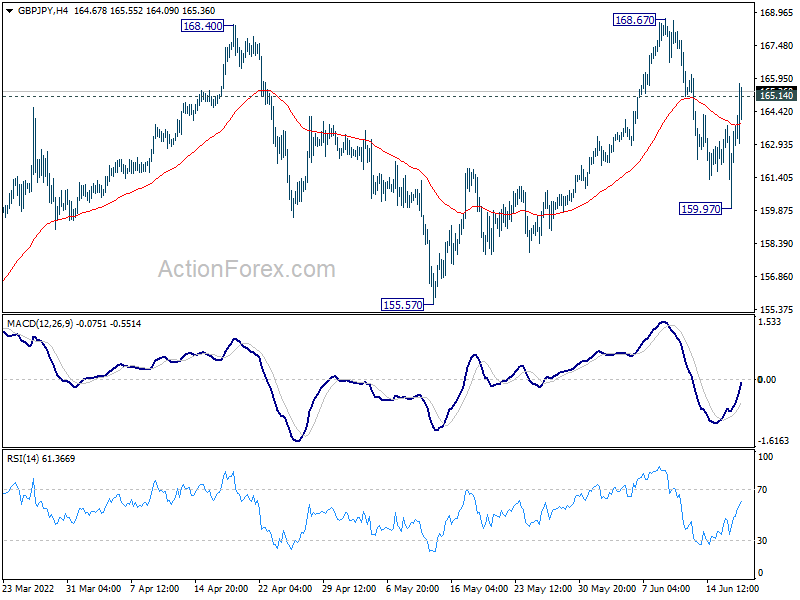
Daily Pivots: (S1) 160.92; (P) 162.36; (R1) 164.71; More...
Break of 165.14 minor resistance suggests that pull back from 168.76 has completed at 159.97. Intraday bias is back on the upside for retesting 168.67. Firm break there will resume larger up trend. On the downside, below 159.97 will extend the correction from 168.67 towards 155.57 support.
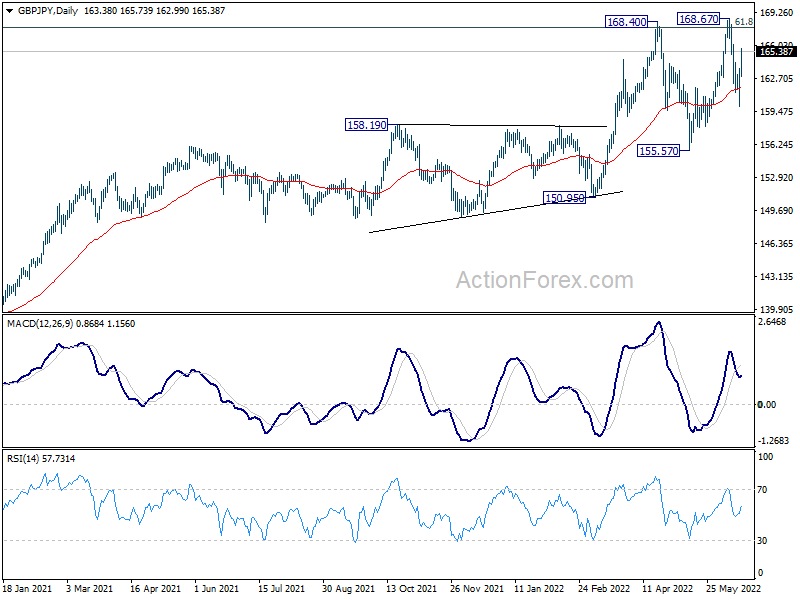
In the bigger picture, up trend from 123.94 (2020 low) is still in progress. Sustained break of 61.8% retracement of 195.86 (2015 high) to 122.75 (2016 low) at 167.93 will be a long term bullish signal, and could pave the way back to 195.86 high. This will now remain the favored case as long as 155.57 support holds, even in case of deep pull back.
EUR/JPY Daily Outlook
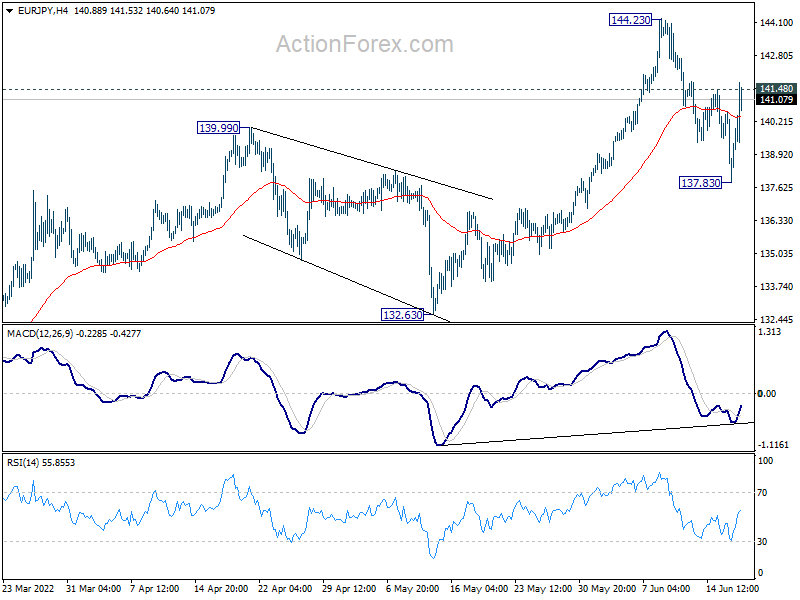
Daily Pivots: (S1) 138.02; (P) 139.31; (R1) 140.79; More....
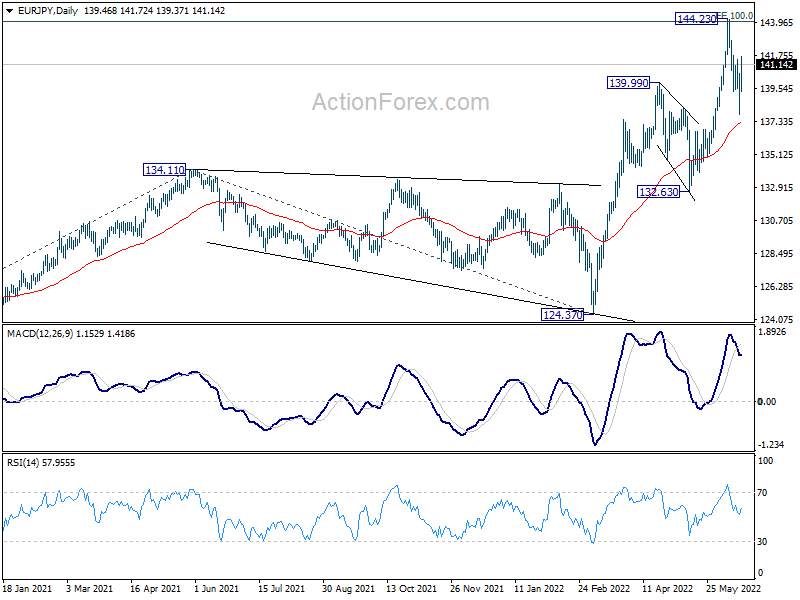
Breach of 141.48 minor resistance suggests that pull back from 144.23 has completed at 137.83. Intraday bias is back on the upside for retesting 144.23 first. Firm break there will resume larger up trend. On the downside, below 137.83 will turn bias back to the downside to extend the correction from 144.23.
In the bigger picture, up trend from 114.42 (2020 low) is in progress. Such rise is seen as the third leg of the pattern from 109.30 (2016 low). Sustained trading above 100% projection of 114.42 to 134.11 from 124.37 at 144.06 will indicate upside acceleration and target 149.76 long term resistance (2014 high). In any case, outlook will now remain bullish as long as 132.63 support holds, in case of deep pull back.