Sample Category Title
Sunset Market Commentary
Markets
It has been quite the roller coaster ride the past week. Sometimes it takes months to get to the same number of huge, surprising, market-moving events. From the ECB’s firm commitment to hike policy rates by 25 bps in July and likely accelerate to 50 bps from September, over the renewed US inflation acceleration which prompted a last-minute 75 bps Fed rate hike to the Swiss National Bank’s 50 bps rate hike shocker which leaves ECB policy rate as the lowest in town. Not to mention the Bank of England’s fifth consecutive 25 bps rate hike which will likely morph into a 50 bps rate hike path from August onwards or the Hungarian National Bank’s silent retreat in letting the base rate prime again over the 1-week depo rate (lifted by 50 bps yesterday to defend the forint around EUR/HUF 400). The icing on the cake would have been a U-turn by the Bank of Japan this morning, but governor Kuroda and his colleagues remain the sole defenders of an ultra-easy monetary policy setting for now. Even Japanese inflation is on the rise though, proving that Kuroda’s Peter Pan approach to central banking is working: “the moment you doubt whether you can fly, you cease forever to be able to do it”. The BoJ’s verbal interventions against JPY, together with the Ministry of Finance, only work against them. USD/JPY is on course to revisit the cycle high at 135. Put your money where your mouth is.
This week’s core bond sell-off smells like a short term exhaustion move with markets now discounting aggressive tightening cycles. Especially in the US, but also in Europe. We argue in favour of a consolidation period with next inflation numbers at least a fortnight away and central bank meetings out of the way. Economic activity can in the mean time bring the growth/inflation dilemma back to the fore. In such context, we think that stock markets will have a tough time to recover some of this week’s heavy losses. Medium term, we hold our view that both core bonds and stocks are in a sell-on-upticks pattern. It could take the sting out of the peripheral spread widening as well together with the ECB’s promise to come up with some back-up bond buying programme to avoid an unwarranted market fragmentation amongst EMU sovereigns. The dollar set a new multiyear high on a trade-weighted basis, north of 105, but couldn’t hold onto gains. If our consolidation scenario turns out right, we could be up for some sideways dollar trading as well. For DXY, we’re looking at a range between roughly 101.50 and 105.50. For EUR/USD – which didn’t set a new recovery low by the way – that’s 1.0350 to 1.08. EUR/GBP yesterday attempted to escape the upward trend channel in place since mid-April, but failed. We hold our sterling-negative bias longer term.
News Headlines
Polish CPI excluding food and energy prices rose 1.0% M/M to be up 8.5% Y/Y. This compares to 1.7% M/M and 7.7% Y/Y in April. The figure was close to expectations. The series excluding the most volatile prices (1.3% M/M and 10.4% Y/Y) and the measures excluding administered prices (1.9% M/M and 14.0% Y/Y) still printed substantially higher. Earlier this month, the Polish Statistical office already reported the headline inflation at 1.7% and 13.9%. The NBP has an inflation target of 2.5% with a tolerance band of +/- 1.0%. After the June 8 policy meeting, NBP governor Glapinski suggested that the NBP might be coming closer to the end of the rate hike cycle. However, other MPC members indicated that it is probably too early. Money market rates still see room for the Polish policy rate to be raised toward the 8% area (from 6% currently). The zloty regained modest ground today (EUR/PLN 4.70).
The European Commission today recommended that Ukraine and Moldova can become candidate to join the EU. The move still is only a first step in a long procedure that will take years as the countries will have to work to comply with a long list of EU regulation. To formally become a candidate, both countries also need unanimous approval from all the member countries at next week’s EU summit. With respect to the candidacy of Georgia, the Commission said that the country still should make further reforms to be ready to receive the same status.
EUR/USD Mid-Day Outlook
Daily Pivots: (S1) 1.0422; (P) 1.0511 (R1) 1.0642; More...
Intraday bias in EUR/USD remains neutral for the moment. Outlook will stay bearish as long as 1.0786 resistance holds. Sustained break of 1.0339/48 will resume larger down trend. Next target is long term projection level at 1.0090..
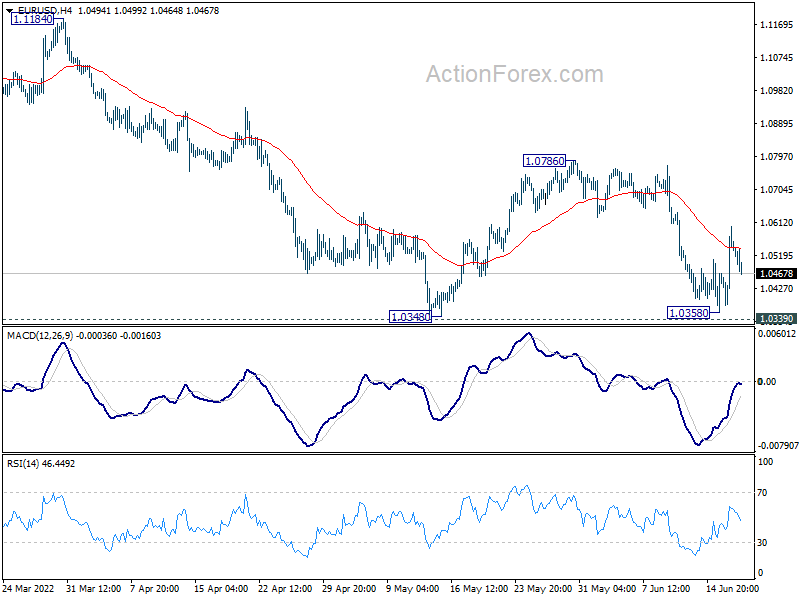
In the bigger picture, focus stays on 1.0339 long term support (2017 low). Decisive break there will resume whole down trend from 1.6039 (2008 high). Next target is 61.8% projection of 1.3993 to 1.0339 from 1.2348 at 1.0090. However, firm break of 1.0805 support turned resistance will delay this bearish case, and bring stronger rebound first.
GBP/USD Mid-Day Outlook
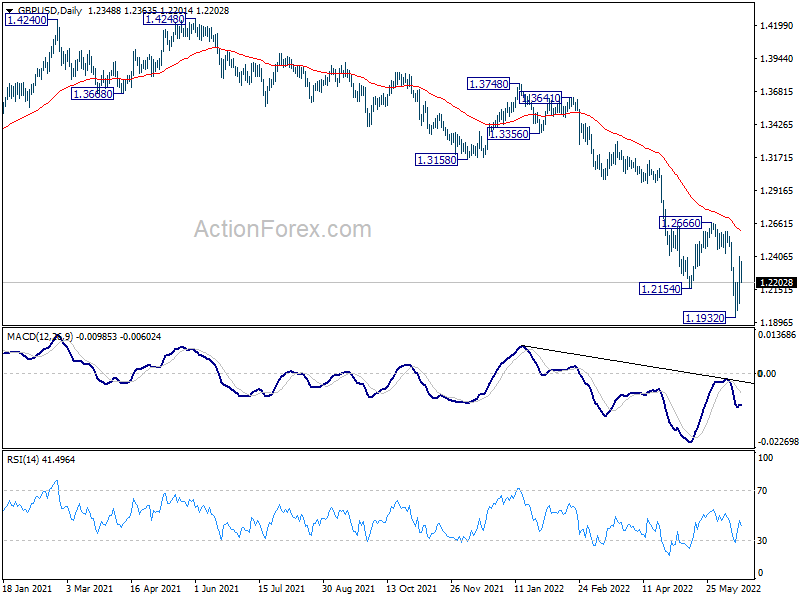
Daily Pivots: (S1) 1.2126; (P) 1.2266; (R1) 1.2491; More...
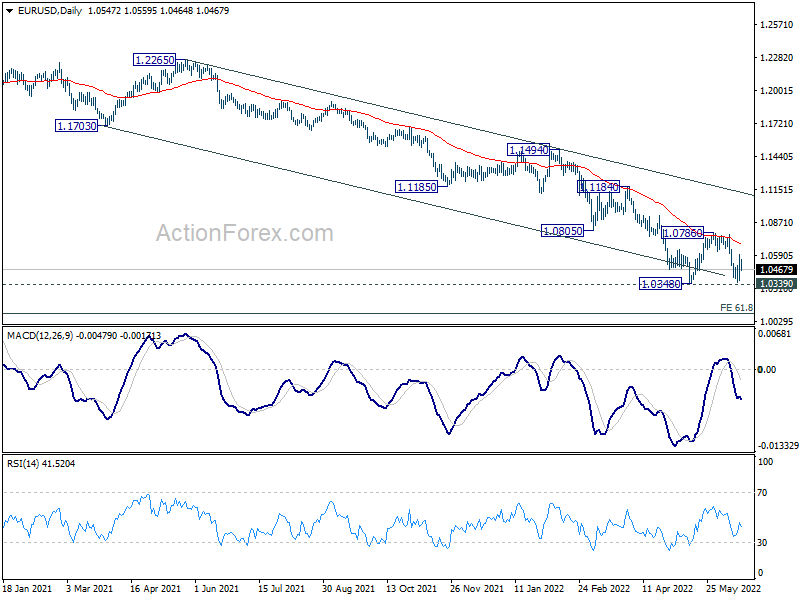
Range trading continues in GBP/USD and intraday bias remains neutral. Outlook stays bearish with 1.2666 resistance intact. On the downside, break of 1.1932 will resume larger down trend from 1.4248. However, firm break of 1.2666 will suggest medium term bottoming and bring stronger rebound back towards 1.3158 support turned resistance.
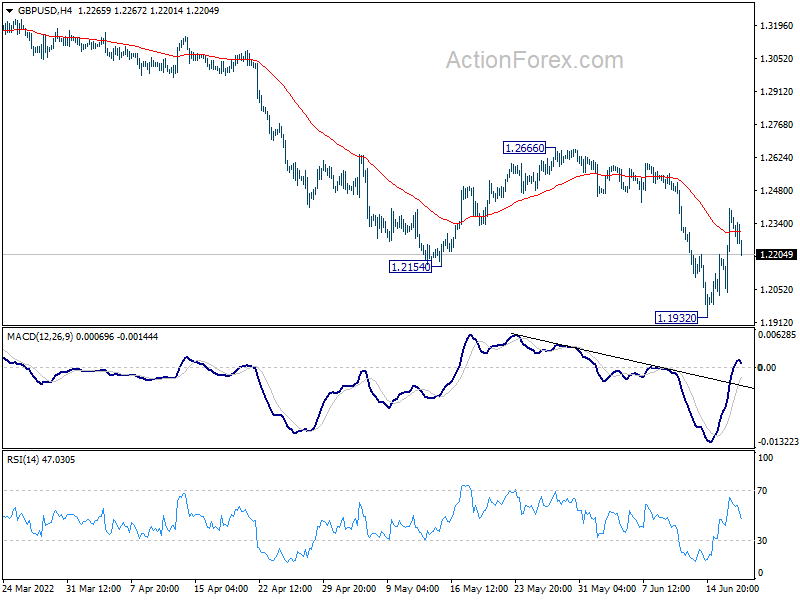
In the bigger picture, fall from 1.4248 (2018 high) could be a leg inside the pattern from 1.1409 (2020 low), or resuming the longer term down trend. Deeper decline is expected as long as 1.2666 resistance holds. Next target is 1.1409 low. However, firm break of 1.2666 will bring stronger rise back to 55 week EMA (now at 1.3175).
USD/CHF Mid-Day Outlook
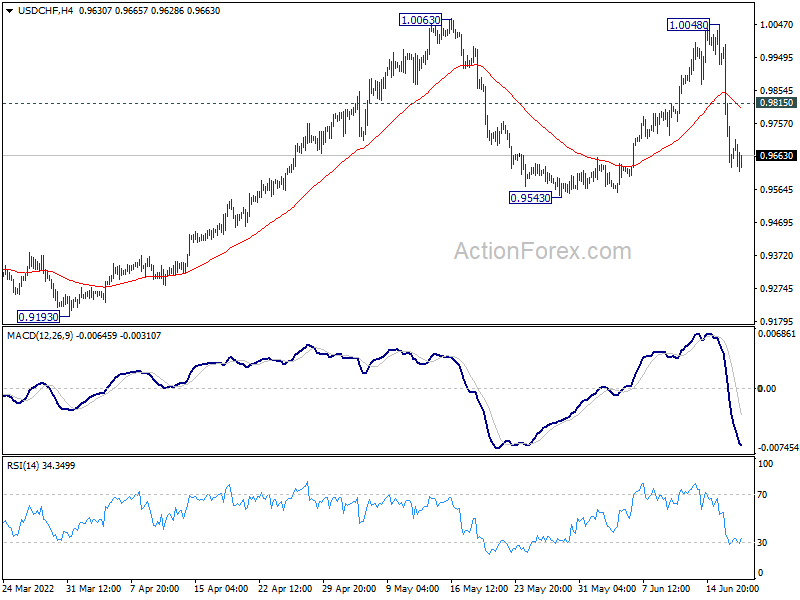
Daily Pivots: (S1) 0.9535; (P) 0.9762; (R1) 0.9894; More...
Intraday bias in USD/CHF remains on the downside and deeper decline could be seen to 0.9543 support. It's viewed as the third leg of the corrective pattern from 1.0063. Strong support should be seen at around 0.9543 to contain downside to bring rebound. On the upside, above 0.9815 minor resistance will turn bias back to the upside for retesting 1.0063 resistance.
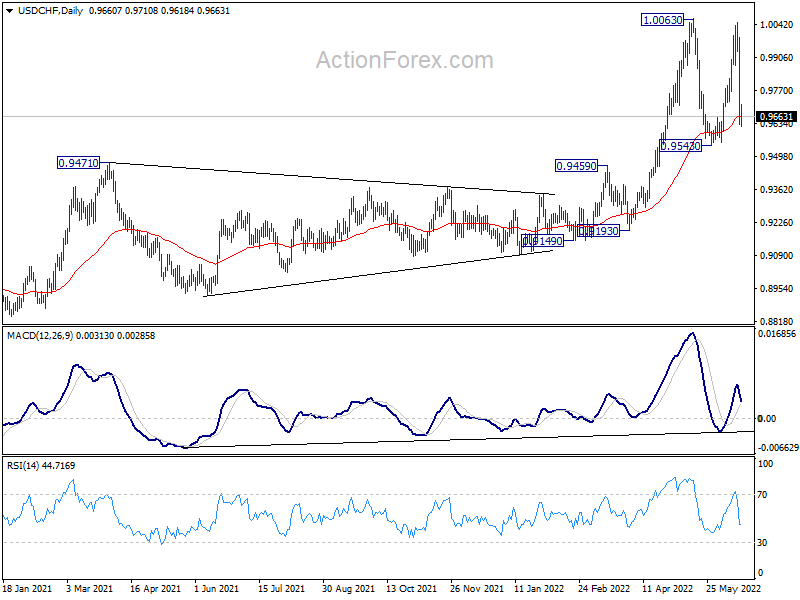
In the bigger picture, down trend from 1.0342 (2016 high) should have completed with three waves down to 0.8756 (2021 low) already. Rise from 0.8756 is likely a medium term up trend of its own. Next target is 1.0237/0342 resistance zone. This will remain the favored case as long as 0.9471 resistance turned support holds. However, sustained break of 0.9471 will extend long term range trading with another falling leg.
USD/JPY Mid-Day Outlook
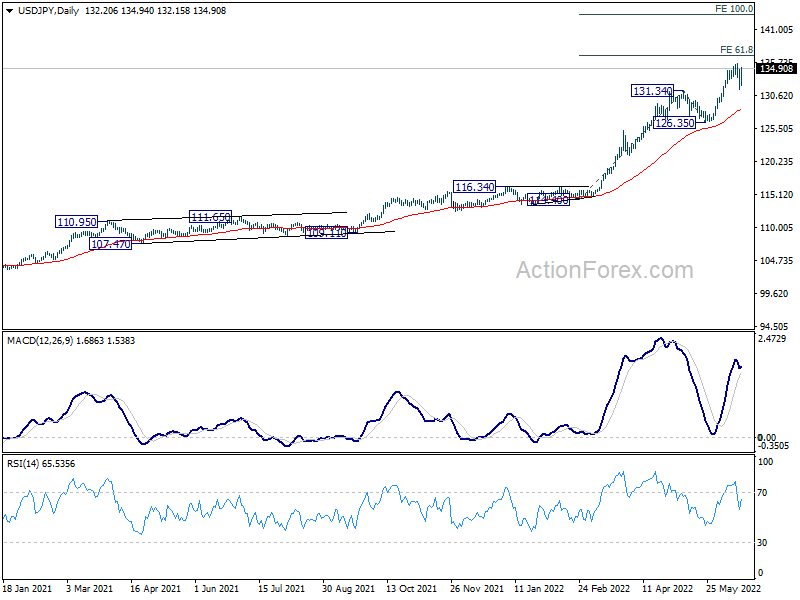
Daily Pivots: (S1) 130.93; (P) 132.81; (R1) 134.11; More...
USD/JPY is still bounded in range below 135.58 and intraday bias remains neutral. Outlook stays bullish as long as 131.34 resistance turned support holds. Above 135.58 will resume larger up trend to 61.8% projection of 114.40 to 131.34 from 126.35 at 136.81. Firm break there will target 100% projection at 143.29. However, firm break of 131.34 will bring deeper pull back to 55 day EMA (now at 128.34).
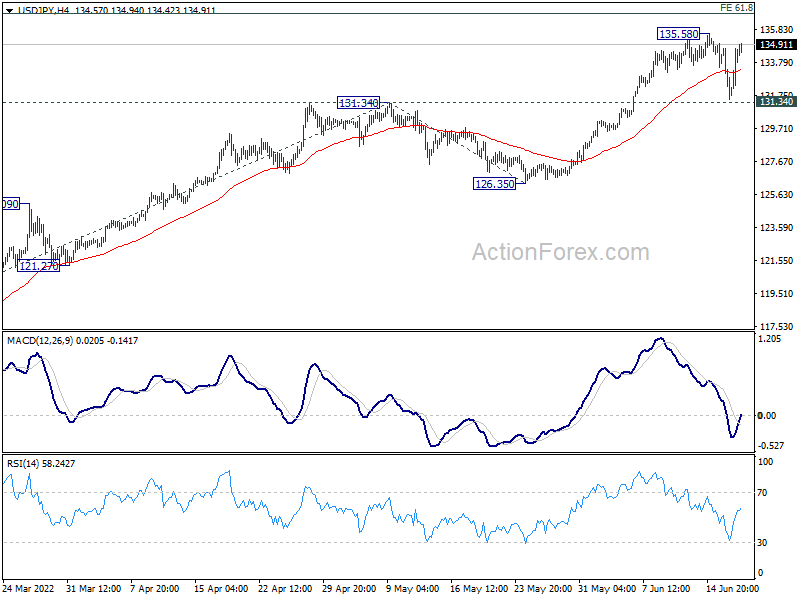
In the bigger picture, current rally is seen as part of the long term up trend from 75.56 (2011 low). Next target is 100% projection of 75.56 (2011 low) to 125.85 (2015 high) from 98.97 at 149.26, which is close to 147.68 (1998 high). This will remain the favored case as long as 126.35 support holds.
USD/CAD Mid-Day Outlook
Daily Pivots: (S1) 1.2882; (P) 1.2927; (R1) 1.2992; More...
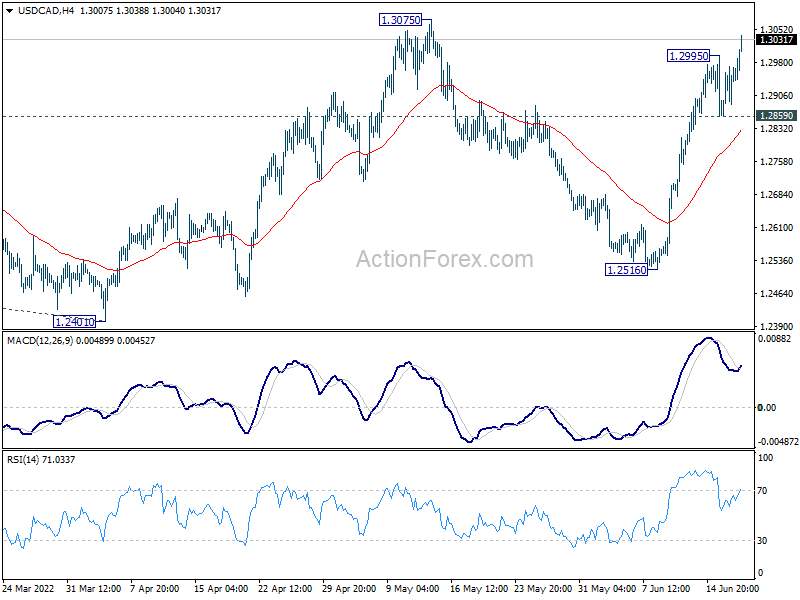
USD/CAD's rally resumed after brief consolidation and intraday bias is back on the upside. Firm break of 1.3075 will resume medium term rally and sustained trading above 1.3022 fibonacci level will carry larger bullish implications. Next target is 100% projection of 1.2005 to 1.2947 from 1.2401 at 1.3343. On the downside, below 1.2859 minor support will turn bias neutral again first.
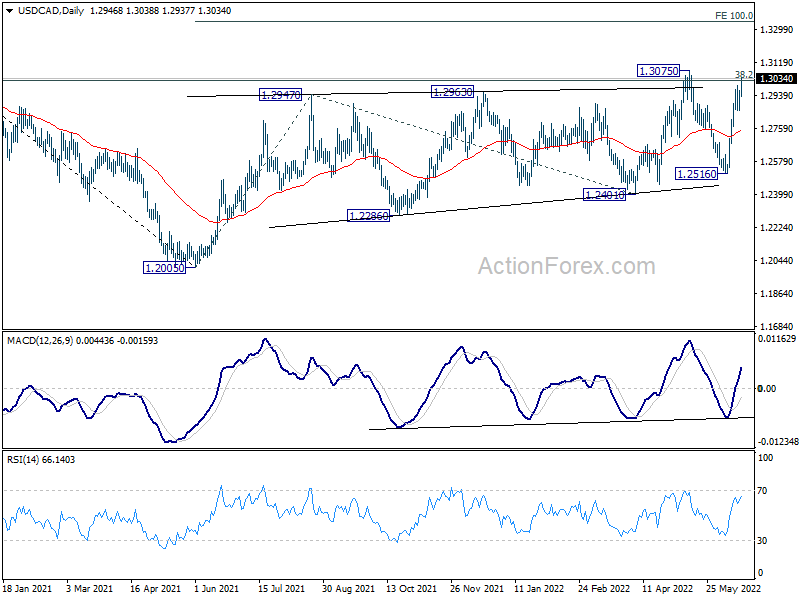
In the bigger picture, focus stays on 38.2% retracement of 1.4667 (2020 high) to 1.2005 (2021 low) at 1.3022. Sustained break there should confirm that the down trend from 1.4667 has completed after defending 1.2061 long term cluster support. Further rise would then be seen towards 61.8% retracement at 1.3650. However, rejection by 1.3022 will maintain medium term bearishness.
Swiss Franc to End the Week as Strongest, Dollar Staying Second
Swiss Franc remains the strongest one for the week and stays firm into US session. Dollar is also regaining some ground, as the second best. On the other than, commodity currencies are the worst performing one, as led by Canadian. In other markets, European indexes are mildly in black while US futures are nearly flat. Trading might turn quiet ahead of a long weekend in the US.
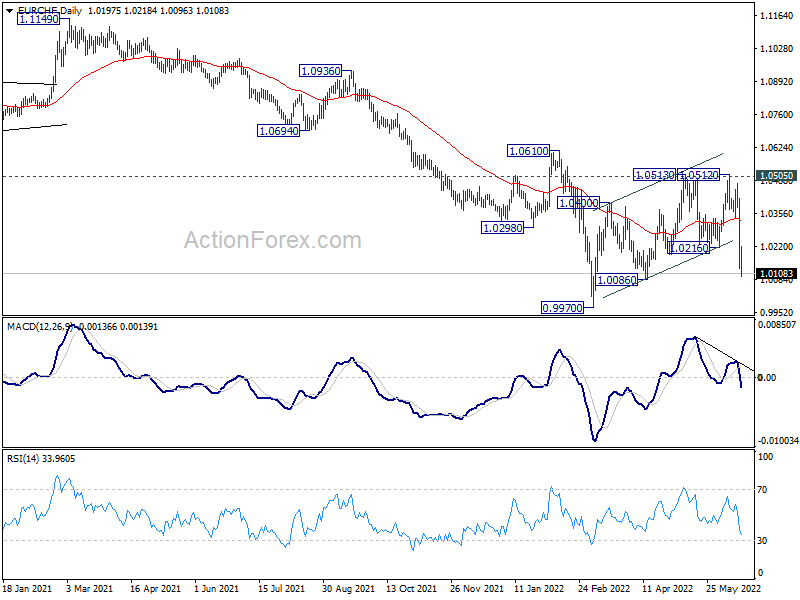
Technically, EUR/CHF is getting close to 1.0086 support. Firm break there will raise the chance of larger down trend resumption through parity and 0.9970 low. The question is, if that happens, whether it would be accompanied by more broad based decline is Euro. In particular, EUR/USD is still in favor to break through 1.0339 low at a later stage.
In Europe, at the time of writing, FTSE is up 0.51%. DAX is up 0.49%. CAC is up 0.45%. Germany 10-year yield is down -0.027 at 1.689. Earlier in Asia, Nikkei dropped -1.77%. Hong Kong HSI rose 1.10%. China Shanghai SSE rose 0.96%. Singapore Strait Times rose 0.02%. Japan 10-year JGB yield dropped -0.0377 to 0.233.
BoE Pill: There's a conditionality for forceful policy actions
BoE Chief Economist Huw Pill told BloombergTV that in yesterday policy decision statement, "the word 'forcefully' - which clearly is the word the market is focused on, you focused on, and has a meaning - it's also important to see that that was put in the context of 'if necessary we will act forcefully', and so there's a conditionality there."
"If we do see greater evidence that the current high level of inflation is becoming embedded in pricing behavior by firms, in wage setting behavior by firms and workers, then that will be the trigger for this more aggressive action," he added.
But he also indicated that the statement had "a certain level of flexibility because it had to encompass those different views... we were trying to emphasise is that that flexibility also applies to what the decisions are. I don't think it's all about August. We talked about the pace, timing and scale of future decisions."
Eurozone CPI finalized at 8.1% yoy in may, core CPI at 3.8% yoy
Eurozone CPI was finalized at 8.1% yoy in May, up from April's 7.4% yoy. All-items excluding energy rose from 4.1% yoy to 4.6% yoy. All-item excluding energy, food, alcohol and tobacco rose from 3.5% yoy to 3.8% yoy. Energy prices accelerated from 37.5% yoy to 39.1% yoy. Food, alcohol and tobacco prices accelerated from 6.3% yoy to 7.5% yoy.
EU CPI was finalized at 8.8% yoy, up from April's 8.1% yoy. The lowest annual rates were registered in France, Malta (both 5.8%) and Finland (7.1%). The highest annual rates were recorded in Estonia (20.1%), Lithuania (18.5%) and Latvia (16.8%). Compared with April, annual inflation fell in one Member State and rose in twenty-six.
BoJ leaves rate unchanged at -0.1%, keeps 0.25% 10-yr yield cap
BoJ left short-term policy interest rate unchanged at -0.10%, and 10-year JGB target at around 0% under the yield curve control. It will continue to defend the 0.25% 10-year JGB yield cap, by offering to purchase it at the rate on every business day through fixed-rate purchase operations.
The decision was made by 8-1 vote. Goushi Kataoka dissented again, pushing for further strengthening monetary easing by lowering short- and long-term interest rate.
The central bank also said "it is necessary to pay due attention to developments in financial and foreign exchange markets and their impact on Japan's economic activity and prices."
BoJ Kuroda: 10-yr JGB yields above 0.25% would diminish effect of monetary easing
BoJ Governor Haruhiko Kuroda said in the post-meeting press conference, "the recent rapid weakening of the yen is raising uncertainty over the outlook and making it hard for companies to draw up business plans so it is negative and undesirable for the economy."
"We will have to closely watch developments in financial and currency markets and their impact on the economy and prices," he added.
Kuroda also added, "policy tightening is not appropriate at this point." And he warned, "if the 10-year JGB yield exceeds 0.25%, that would diminish the effect of our monetary easing."
New Zealand BusinessNZ manufacturing rose to 52.9, excess demand abating
New Zealand BusinessNZ Performance of Manufacturing index rose from 51.2 to 52.9 in May. Production rose from 49.4 to 52.8. Employment rose from 49.8 to 53.0. New orders dropped from 55.2 to 53.0. Finished stocks dropped from 54.0 to 53.1. Deliveries rose from 49.7 to 55.4.
BNZ Senior Economist, Craig Ebert stated that "The net result of the sub-index values was the inference that excess demand alleviated during May. New orders are perhaps the cleanest representation of demand, while deliveries speak more to the supply side. To the extent excess demand is abating, so too will be core inflation pressure".
USD/CAD Mid-Day Outlook
Daily Pivots: (S1) 1.2882; (P) 1.2927; (R1) 1.2992; More...
USD/CAD's rally resumed after brief consolidation and intraday bias is back on the upside. Firm break of 1.3075 will resume medium term rally and sustained trading above 1.3022 fibonacci level will carry larger bullish implications. Next target is 100% projection of 1.2005 to 1.2947 from 1.2401 at 1.3343. On the downside, below 1.2859 minor support will turn bias neutral again first.
In the bigger picture, focus stays on 38.2% retracement of 1.4667 (2020 high) to 1.2005 (2021 low) at 1.3022. Sustained break there should confirm that the down trend from 1.4667 has completed after defending 1.2061 long term cluster support. Further rise would then be seen towards 61.8% retracement at 1.3650. However, rejection by 1.3022 will maintain medium term bearishness.
Economic Indicators Update
| GMT | Ccy | Events | Actual | Forecast | Previous | Revised |
|---|---|---|---|---|---|---|
| 03:00 | JPY | BoJ Interest Rate Decision | -0.10% | -0.10% | -0.10% | |
| 09:00 | EUR | Italy Trade Balance (EUR) Apr | -3.67B | -2.26B | -0.08B | -0.23B |
| 09:00 | EUR | Eurozone CPI Y/Y May F | 8.10% | 8.10% | 8.10% | |
| 09:00 | EUR | Eurozone CPI Core Y/Y May F | 3.80% | 3.80% | 3.80% | |
| 12:30 | CAD | Industrial Product Price M/M May | 1.70% | 0.10% | 0.80% | |
| 12:30 | CAD | Raw Material Price Index May | 2.50% | 1.70% | -2.00% | |
| 13:15 | USD | Industrial Production M/M May | 0.20% | 0.40% | 1.10% | 1.40% |
| 13:15 | USD | Capacity Utilization May | 79.00% | 79.20% | 79.00% | 78.90% |
WTI Oil Outlook: Worries of Economic Slowdown Weigh on Oil Prices
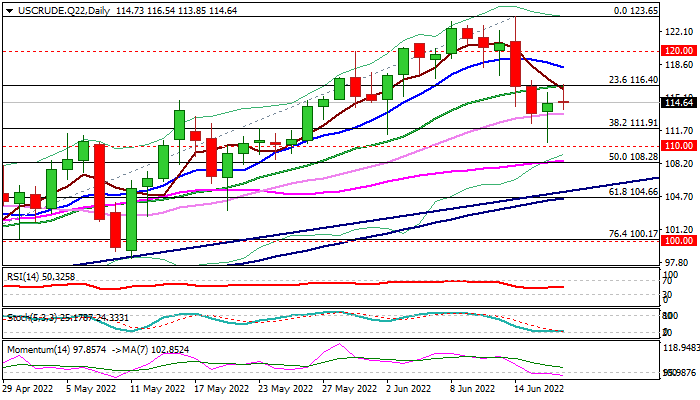
WTI oil edged higher on Friday following strong downside rejection on Thursday, but the structure remains fragile, due to demand concerns, fueled by worries that recent rate hikes by major central banks and particularly aggressive Fed, would lead to economic slowdown.
The fundamentals remain key oil price drivers but focus has turned from supply which was affected by the war in Ukraine, towards the actions of central banks and raising fears that major economies are sliding into recession.
Technical picture on daily chart is mixed, as larger bullish structure has been dented by loss of positive momentum (14-d momentum indicator is heading south and about to break into negative territory), with negative signals being reinforced with expectations for strong weekly loss that would also complete Doji reversal pattern on weekly chart.
Friday’s close below 20DMA (116.40)would keep immediate bias with bears, but extension below 111.91 (cracked Fibo 38.2% of $92.92/$123.65) is need to confirm bearish near-term stance and open way for deeper drop towards $110.00 (psychological) and $108.28 (50% retracement).
Only bounce and close above 10DMA (118.31) would sideline downside risk and unmask $120 pivot.
Res: 115.47; 116.40; 117.03; 118.31.
Sup: 113.05; 111.91; 110.41; 110.00.
BoE Pill: There’s a conditionality for forceful policy actions
BoE Chief Economist Huw Pill told BloombergTV that in yesterday policy decision statement, " the word 'forcefully' - which clearly is the word the market is focused on, you focused on, and has a meaning - it's also important to see that that was put in the context of 'if necessary we will act forcefully', and so there's a conditionality there."
"If we do see greater evidence that the current high level of inflation is becoming embedded in pricing behavior by firms, in wage setting behavior by firms and workers, then that will be the trigger for this more aggressive action," he added.
But he also indicated that the statement had "a certain level of flexibility because it had to encompass those different views... we were trying to emphasise is that that flexibility also applies to what the decisions are. I don't think it's all about August. We talked about the pace, timing and scale of future decisions."
EUR/USD Technical Analysis 17th June 2022
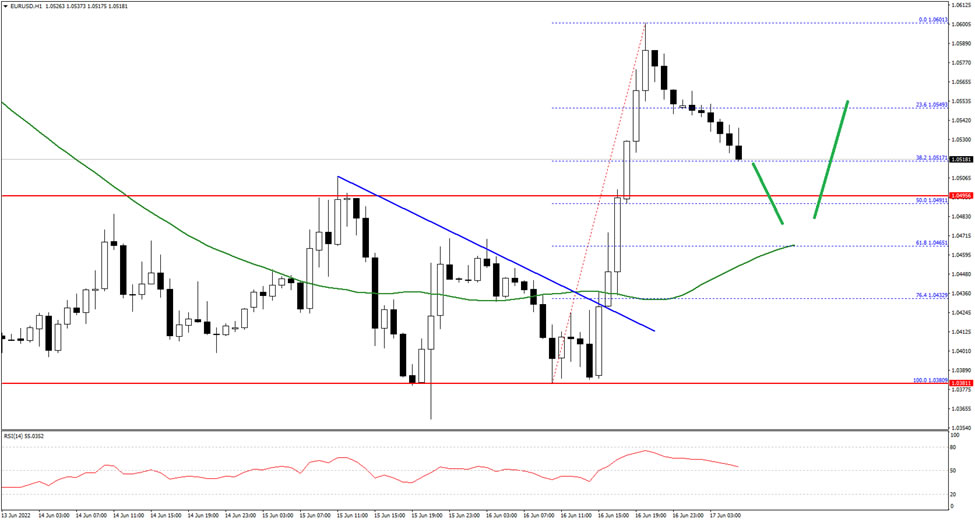
The Euro started a decent increase from the 1.0380 support zone against the US Dollar. The EUR/USD pair traded above the 1.0420 resistance to start an upward move.
There was a clear move above a key bearish trend line with resistance near 1.0435 on the hourly chart. The pair settled above the 1.0450 level and the 50 hourly simple moving average. It traded as high as 1.0601 and is currently correcting gains.
An immediate support is near the 1.0520 level on FXOpen. The next key support is near 1.0500, below the pair could decline towards the 1.0450 level in the near term. Any more losses might send the pair towards the 1.0400 level.
On the upside, the next major resistance is near the 1.0580 level. A break above the 1.0580 and 1.0600 resistance levels could start another increase. In the stated case, it could even surpass 1.0650.