

Sample Category Title
S&P 500 rose as traders covered on Fed news
US stocks closed higher overnight even though FOMC delivered an "uncommon" mega hike of 75bps. Fed Chair Jerome Powell also indicated at the post-meeting press conference that "either a 50 basis point or a 75 basis point increase seems most likely at our next meeting" while "ongoing rate increases will be appropriate."
The recovery in stocks is more seen as a "sell-on-rumors-cover on news" move. Fed delivered what the markets have expected and the selloff was already done earlier in the week. Also, some would give a nod to Fed's determination to combat inflation and create the conditions for a soft-landing, even though it's a big challenge.
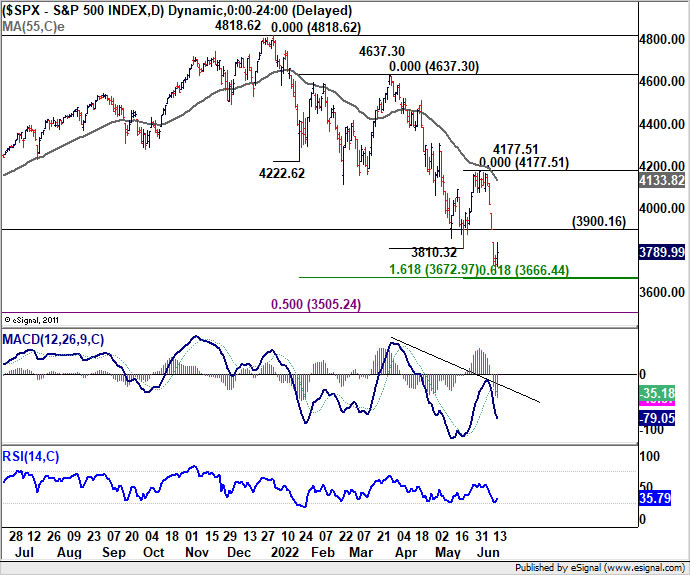
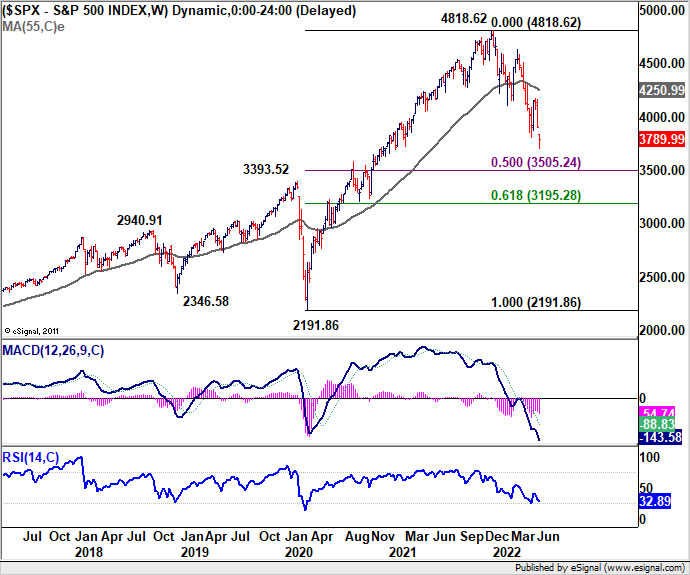
The condition for a stronger rebound in S&P 500 is there, give that it's close to 3666.44/3672.97 cluster projection (61.8% projection of 4637.30 to 3810.32 from 4177.51 at 3666.44, 161.8% projection of 4818.62 to 4222.62 from 4637.30 at 3672.97). Yet, SPX will need to break through the top end of the latest gap at 3900.16 to indicate stabilization first. Otherwise, risk will remain heavily on the downside. Deeper fall into support zone between 3195.28 and 3505.24 (61.8% and 50% retracement of 2191.86 to 4818.62) is too early to be ruled out at this point.
Elliott Wave View: Dips in USD/CAD should find buyers
USD/CAD 45 minutes chart below shows that the pair has ended 3 wave pullback from June 15 high in wave 2. The pullback unfolded as double three Elliott Wave structure and ended at 1.3482 low. Afterwards, the pair resumed higher in wave 3. Up from 1.3482 low, wave ((i)) ended at 1.3559 high. Wave ((ii)) pullback ended at 1.3525 low. The pair then extended higher in wave ((iii)), which ended at 1.3666 high. The internal subwave of wave ((iii)) unfolded as 5 waves impulse Elliott Wave structure in lesser degree. The pullback in wave ((iv)) then unfolded as a triangle and ended at 1.3632 low. From there, the pair pushed higher in wave ((v)) which ended at 1.3715 high. This final move completed wave 3 in higher degree and ended cycle from June 23 low.
The pair is currently doing a pullback in wave 4 to correct the cycle from June 23 low. The correction is unfolding as a double three structure. Down from wave 3 high, the pair ended wave ((w)) at 1.3642 low. Wave ((x)) bounce ended at 1.3705 high. Wave ((y)) is currently in progress. While above 1.3482 low, expect the dips to find support in 7 or 11 swings for more upside. The 100 -161.8% extension of wave ((w))-((x)) where wave ((y)) can potentially end is at 1.3586 – 1.3631 area and shown with a blue box. That area, if reached later, can see a reaction for 3 waves bounce at least.
USD/CAD 45 Minutes Elliott Wave Chart
Technical Outlook and Review
DXY:
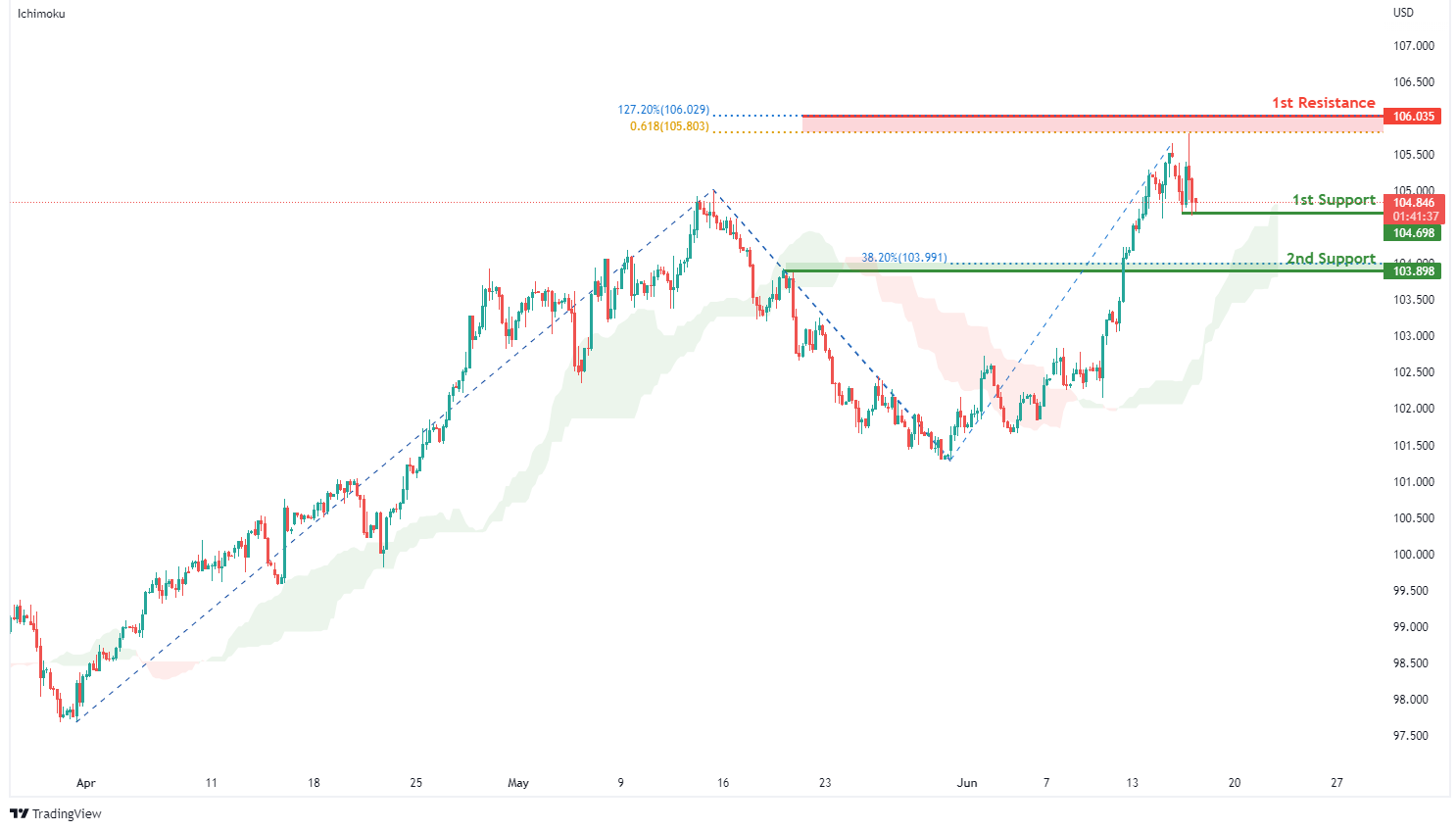
On the H4, with prices moving above the ichimoku indicator, we have a bullish bias that price will rise to our 1st resistance at 106.035 where the 127.2% fibonacci extension and 61.8% fibonacci projection are from our 1st support at 104.698 in line with the horizontal overlap support. Alternatively, price may break 1st support structure and head for 2nd support at 103.898 where the horizontal pullback support and 38.2% fibonacci retracement are.
Areas of consideration:
- H4 time frame, 1st resistance at 106.035
- H4 time frame, 1st support at 104.698
XAU/USD (GOLD):
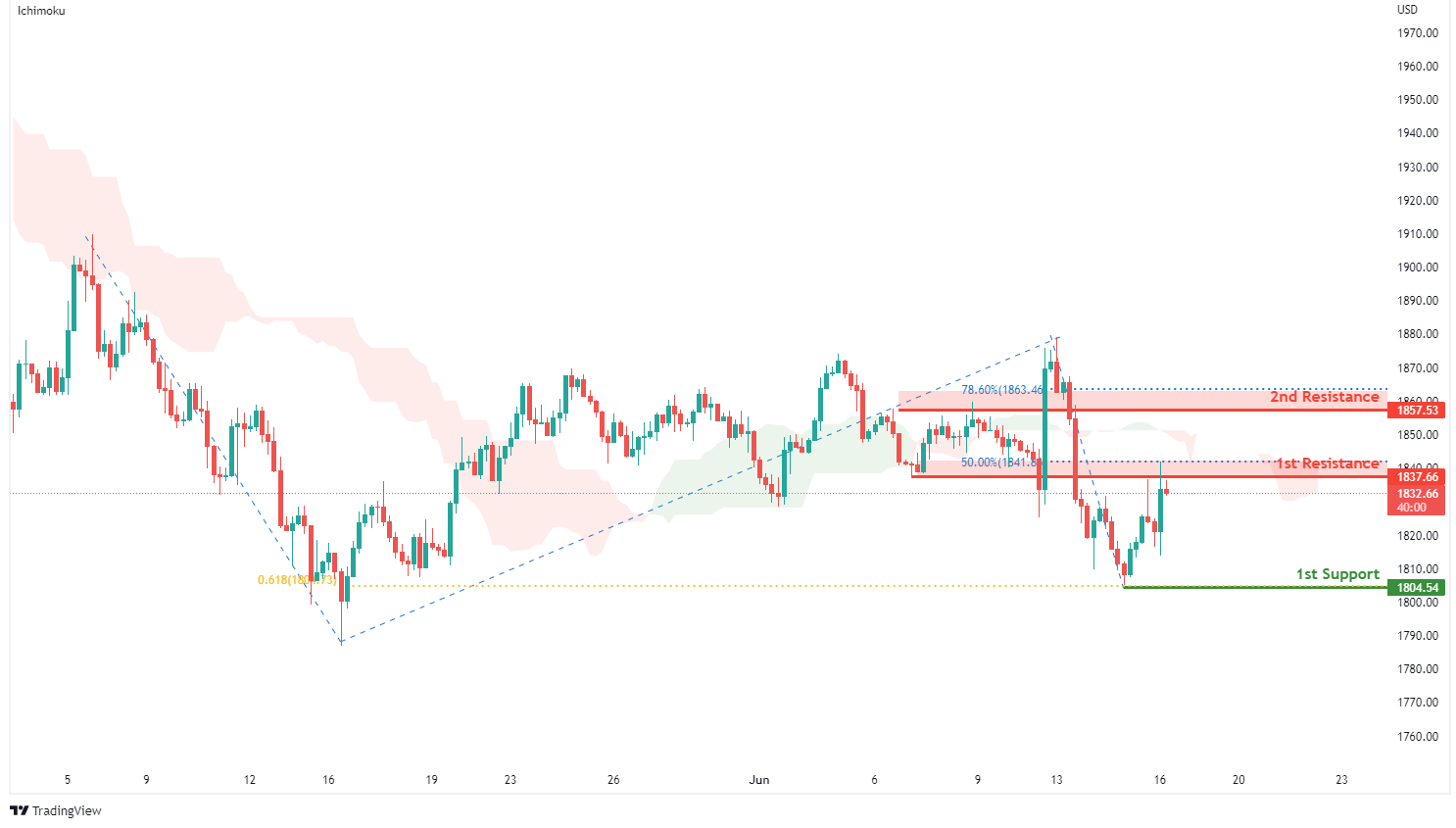
On the H4, with prices moving below the ichimoku indicator, we have a bearish bias that prices will drop from our 1st resistance at 1837.66 where the horizontal pullback resistance and 50% fibonacci retracement are to our 1st support at 1804.54 in line with swing low support and 61.8% fibonacci projection. Alternatively, price may break 1st resistance structure and head for 2nd resistance at 1857.53 in line with overlap resistance and 78.6% fibonacci retracement.
Areas of consideration:
- H4 time frame, 1st Resistance at 1837.66
- H4 time frame, 1st Support at 1804.54
GBP/USD:
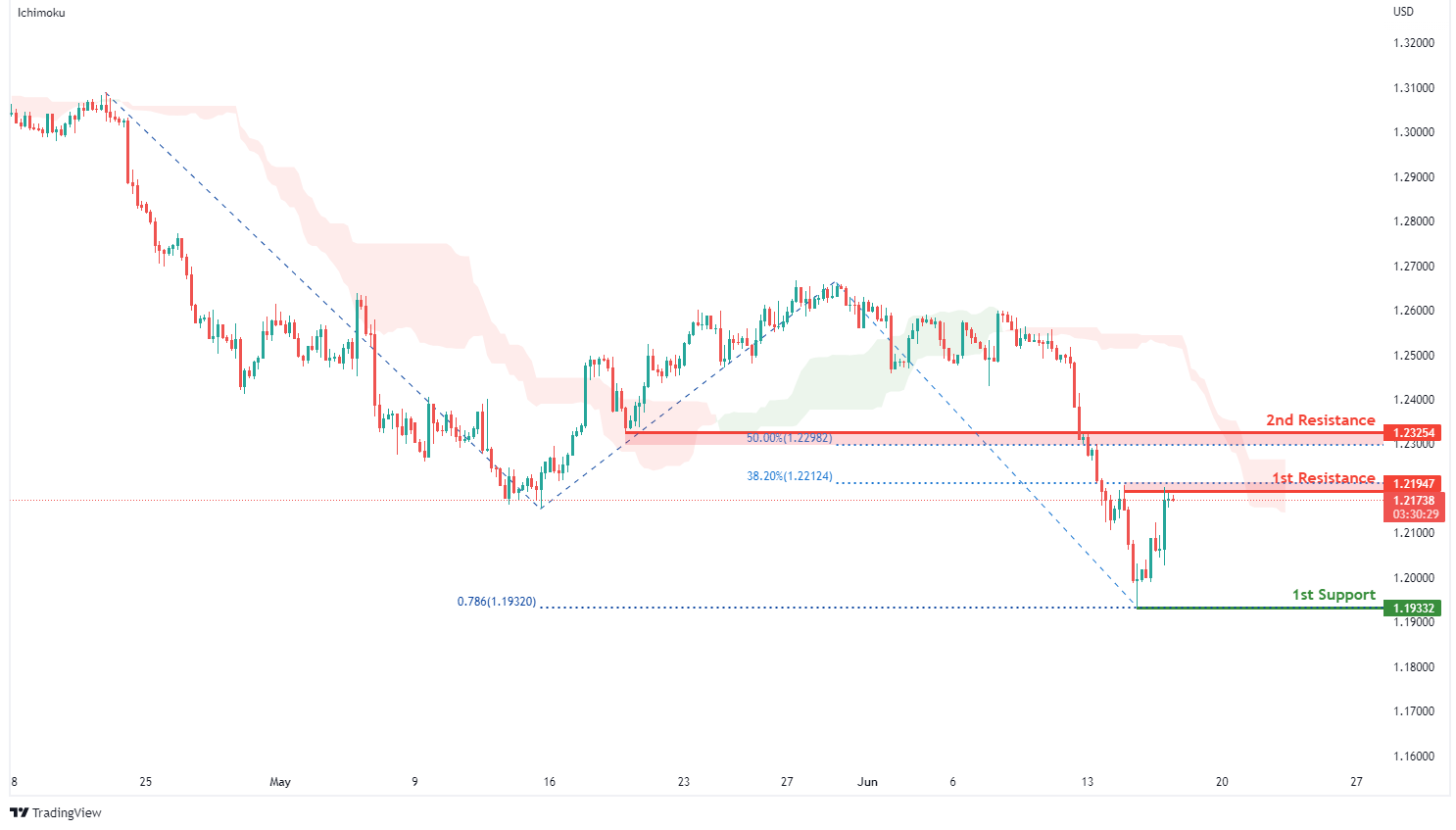
On the H4, with prices moving below the ichimoku indicator, we have a bearish bias that price will drop from our 1st resistance at 1.21947 where the horizontal swing high resistance and 38.2% fibonacci retracement are to our 1st support at 1.19332 in line with the 78.6% fibonacci projection and swing low support. Alternatively, price may break 1st resistance structure and head for 2nd resistance at 1.23254 where the horizontal pullback resistance and 50% fibonacci retracement are.
Areas of consideration:
- H4 1st resistance at 1.21947
- H4 1st support at 1.19332
USD/CHF:
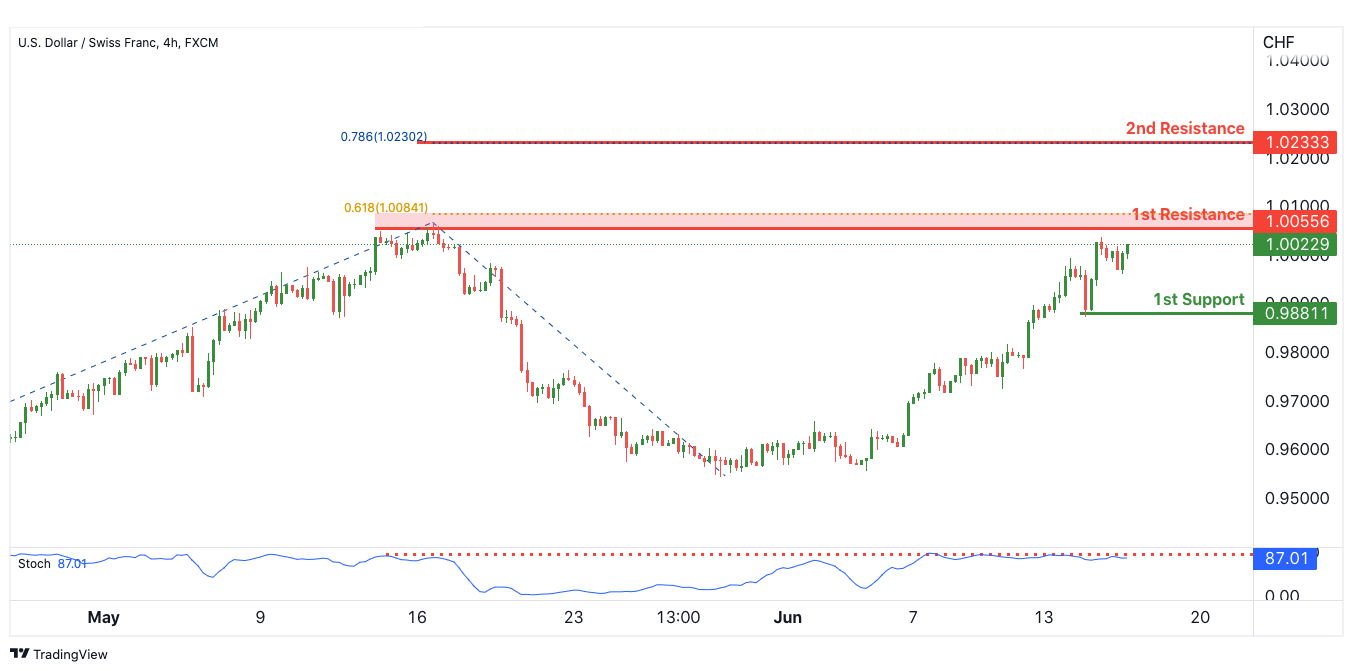
On the H4, with price expected to reverse off the stochastic indicator, we have a bearish bias that price will drop to our 1st support in line with the horizontal pullback support from our 1st resistance is where the pullback resistance is. Alternatively, price may break structure and head for our 2nd resistance in line with the horizontal swing high resistance and 78.6% Fibonacci projection.
Areas of consideration
- 1st support level at 0.98769
- 1st resistance level at 0.99786
EUR/USD :
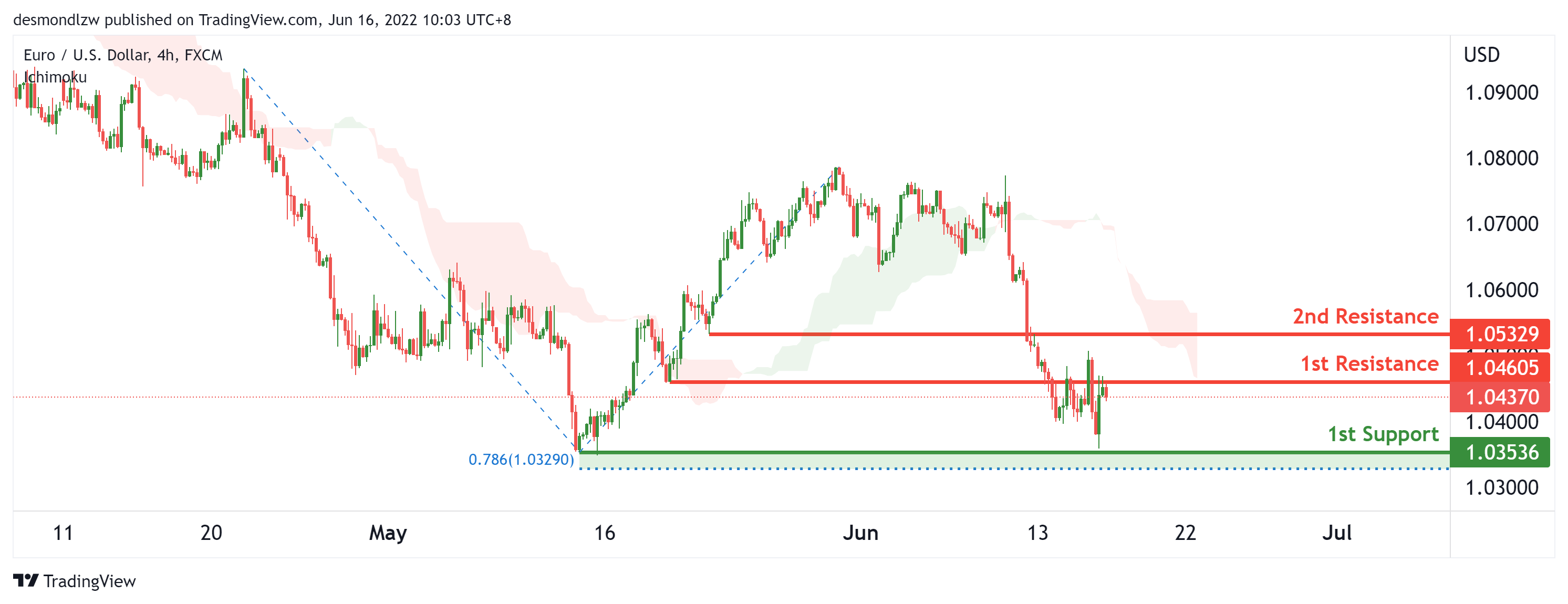
On the H4. with price moving below the ichimoku cloud, we have a bearish bias that price will continue to drop from our 1st resistance at 1.04605 in line with the pullback resistance to the 1st support at 1.03536 in line with the 78.6% fibonacci projection and horizontal swing low support. Alternatively, price may break the 1st resistance structure and rise to the 2nd resistance at 1.05329 in line with the pullback resistance.
Areas of consideration :
- H4 1st resistance at 1.04605
- H4 1st support at 1.03536
USD/JPY:
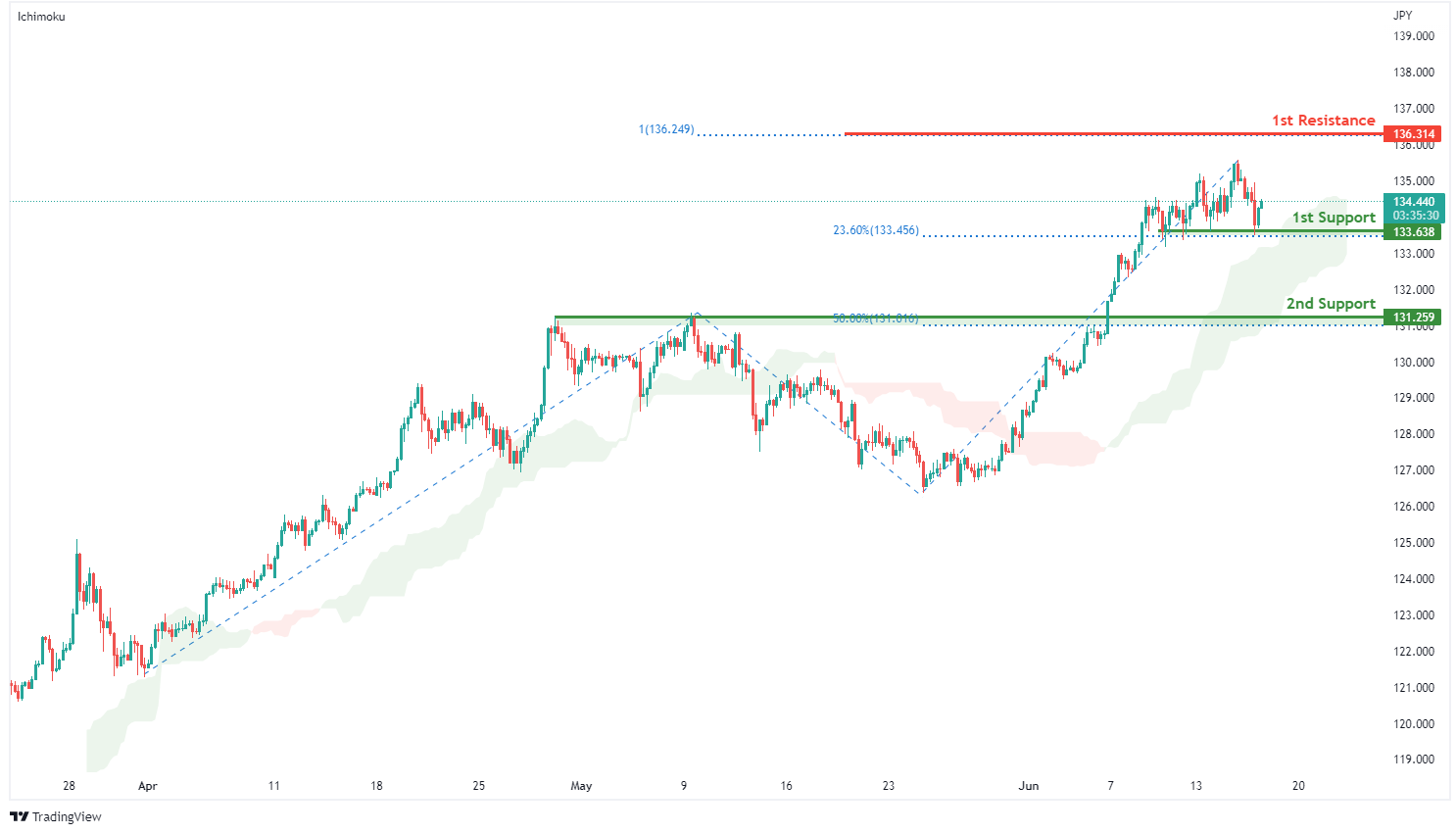
On the H4, with prices moving above the ichimoku indicator, we have a bullish bias that price will rise from our 1st support at 133.638 where the horizontal swing low support and 23.6% fibonacci retracement are to our 1st resistance at 136.314 in line with the 100% fibonacci projection. Alternatively, price may break 1st support structure and head for 2nd support at 131.259 where the horizontal overlap support and 50% fibonacci retracement are.
Areas of consideration:
- H4 time frame, 1st resistance at 136.314
- H4 time frame, 1st support at 133.638
AUD/USD:
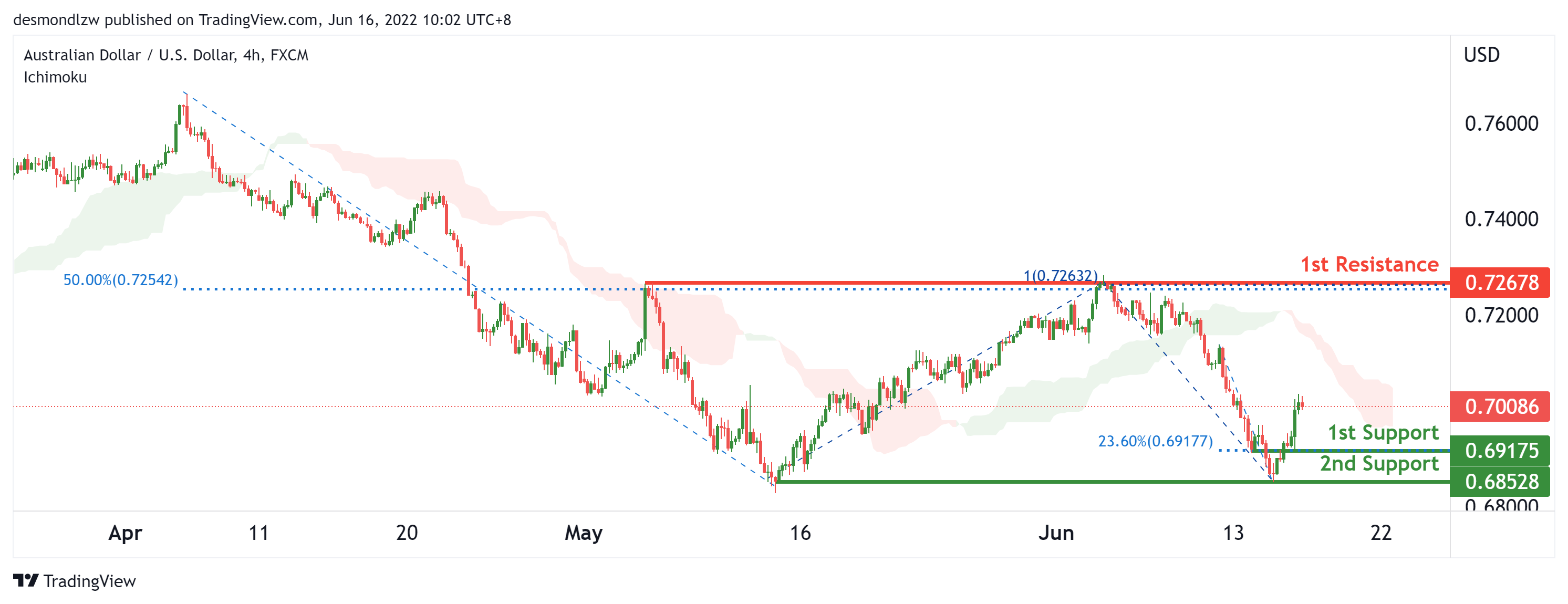
On the H4, price has recently reversed off the 2nd support at 0.68528 and we have a bullish bias that price will rise from the 1st support at 0.69175 in line with the 23.6% fibonacci retracement to the 1st resistance at 0.72678 in line with the 100% fibonacci projection and 50% fibonacci retracement. Alternatively, price may reverse off the 1st support and drop back down to the 2nd support in line with the multiple horizontal swing lows.
Areas of consideration
- H4 1st resistance at 0.72678
- H4 1st support at 0.69175
NZD/USD:
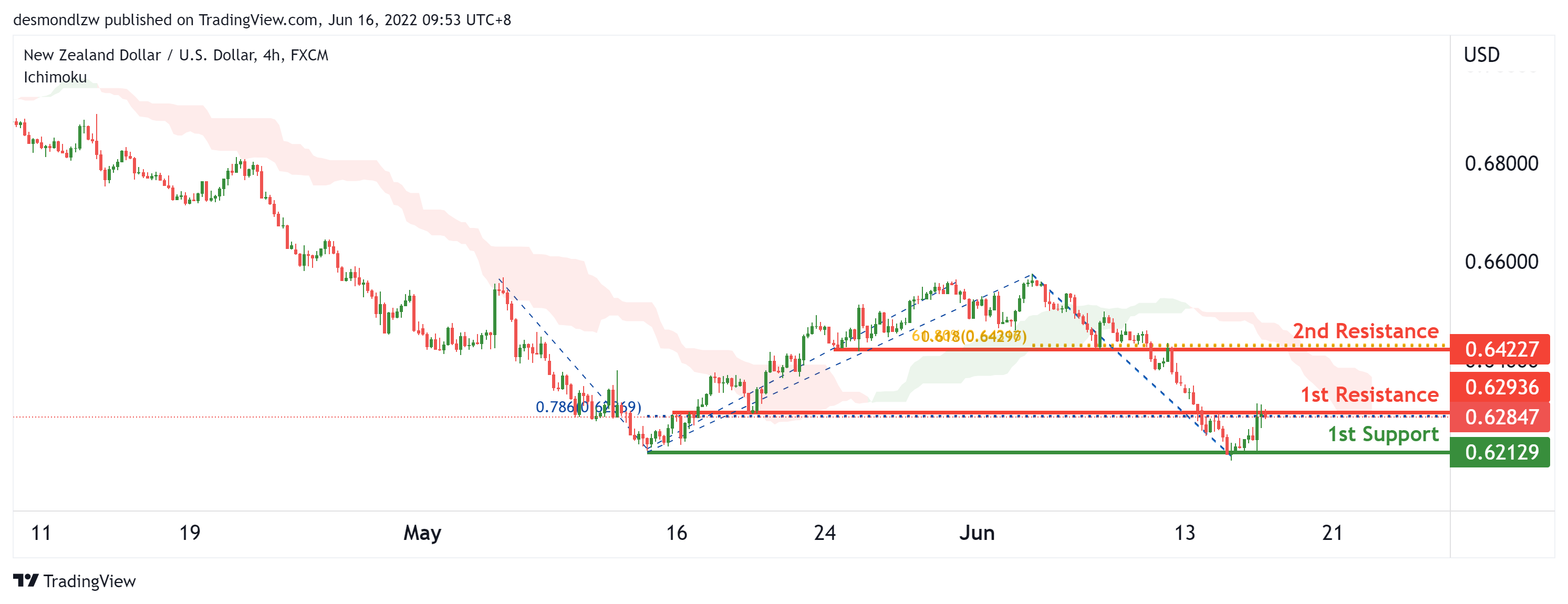
On the H4, with price moving below the ichimoku cloud, we have a bearish bias that price will drop from the 1st resistance at 0.62847 in line with the overlap resistance and 78.6% fibonacci projection to the 1st support at 0.62129 at the multiple swing lows. Alternatively, price may break the 1st resistance structure and rise to the 2nd resistance at 0.64227 in line with the 61.8% fibonacci retracement, 61.8% fibonacci retracement and overlap resistance.
Areas of consideration:
- H4 time frame, 1st support at 0.62129
- H4 time frame, 1st resistance at 0.62847
USD/CAD:
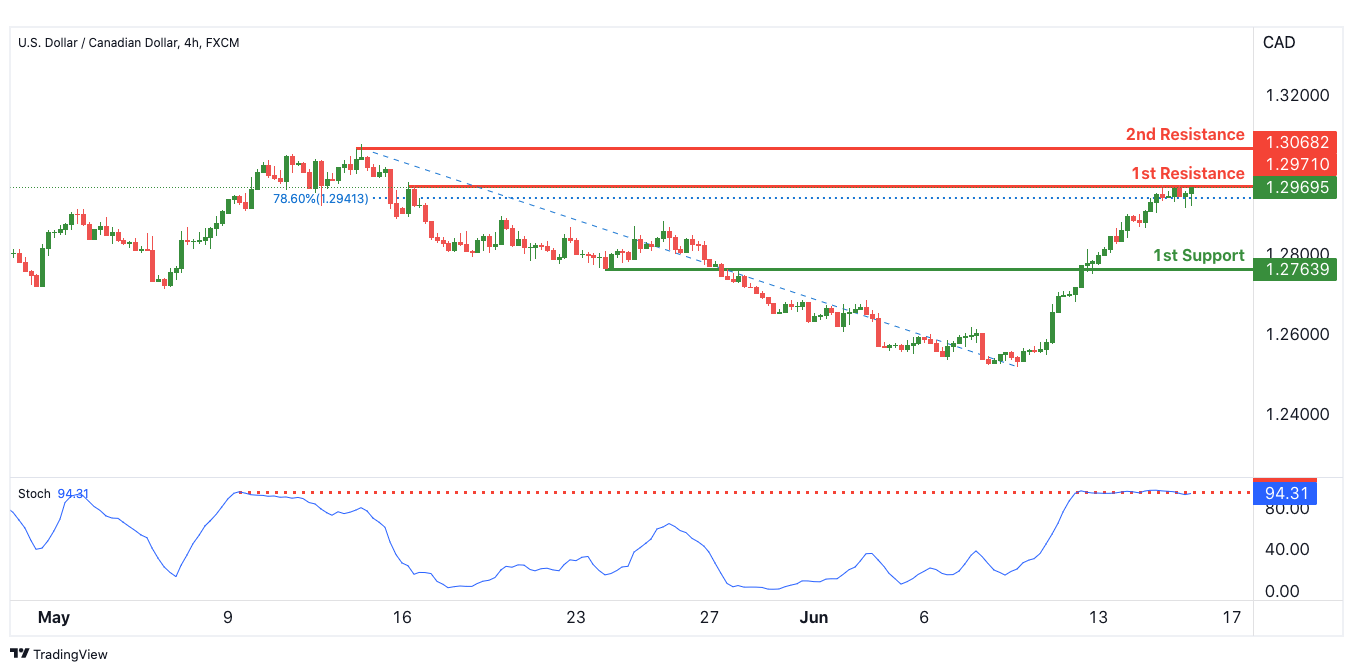
On the H4, with expected to reverse off the stochastics indicator, we have a bearish bias that price will drop to our 1st support at 1.27639 in line with the horizontal pullback support from our 1st resistance at 1.29710 where the pullback resistance and 78.6% Fibonacci retracement is. Alternatively, price may break structure and head for our 2nd resistance in line with the horizontal swing high resistance.
Areas of consideration:
- H4 time frame, 1st resistance at 1.29019
- H4 time frame, 1st support at 1.27639
OIL:
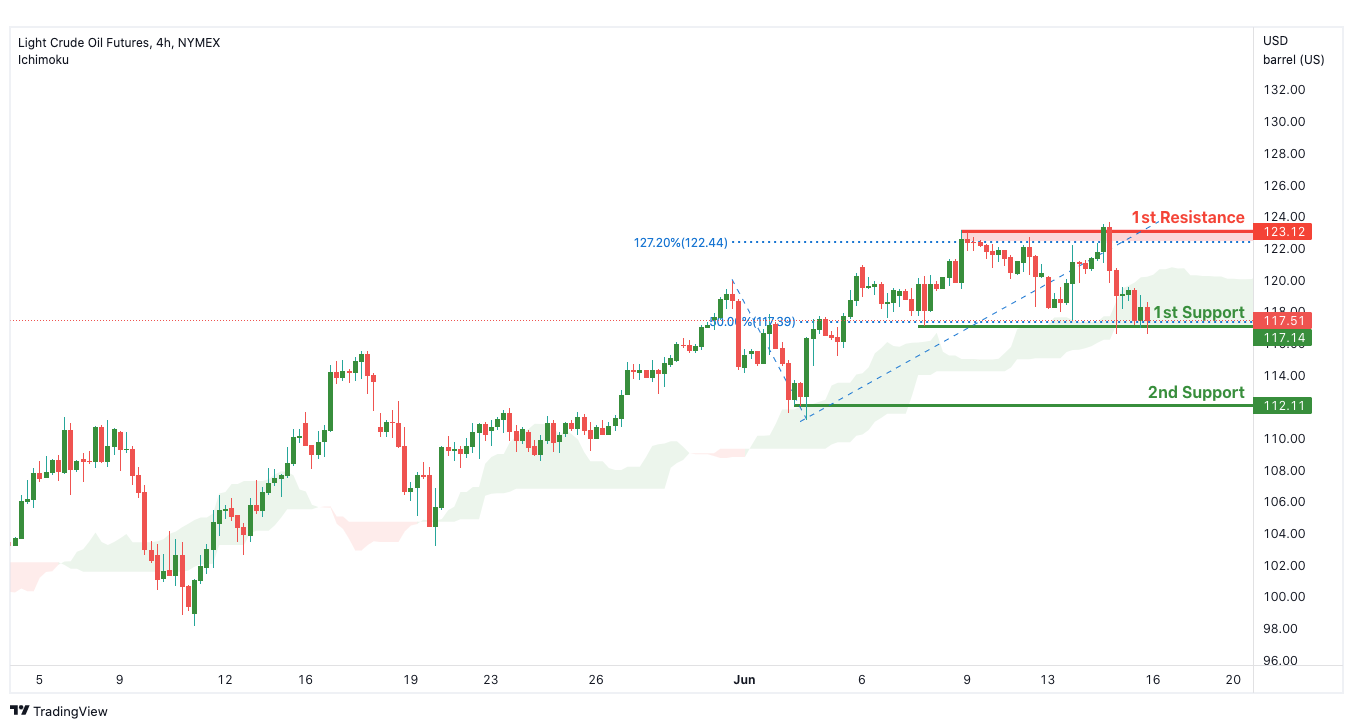
On the H4, with price moving above the ichimoku cloud, we have a bullish bias that price will rise from our 1st support at 117.14 where the horizontal swing low support and 50% Fibonacci retracement is to our 1st resistance at 123.12 in line with the horizontal swing high support. Alternatively, price may break structure and head for 2nd support where the horizontal swing low support is.
Areas of consideration:
- H4 time frame, 1st resistance of 123.12
- H4 time frame, 1st support of 117.14
Dow Jones Industrial Average:
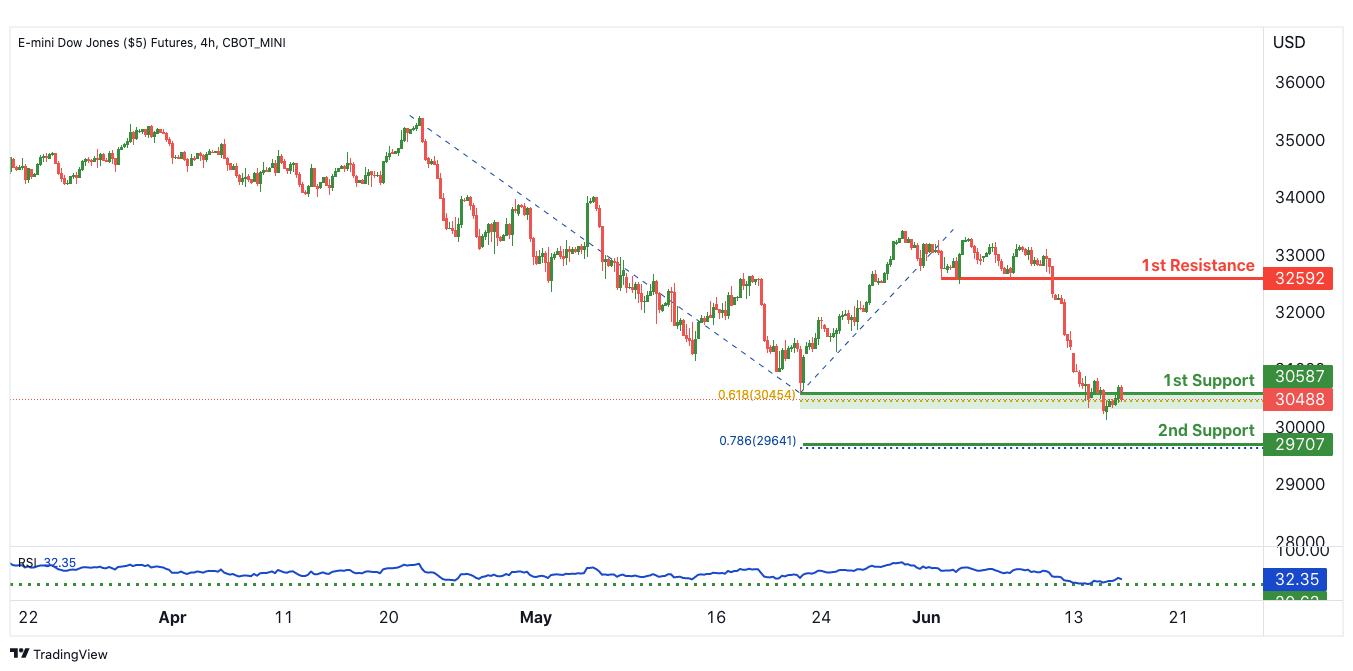
On the H4, with price expected to bounce off the stochastics indicator, we have a bullish bias that price will rise from our 1st support at 30568 where the horizontal swing low support and 61.8% Fibonacci projection is to our 1st resistance at 32592 in line with the horizontal pullback support. Alternatively, price may break structure and head for 2nd support where the 78.6% Fibonacci projection is.
Areas of consideration :
- H4 time frame, 1st resistance at 32587
- H4 time frame, 1st support at 30568
June FOMC: Barreling Toward Restrictive Policy
Summary
The 75 bps rate hike by the FOMC today—the largest in 27 years—demonstrates the Committee’s growing concern over inflation as well as its increased commitment to restore price stability. The move takes the fed funds rate to a range of 1.50-1.75%, which is still below the Committee’s estimated range of neutral.
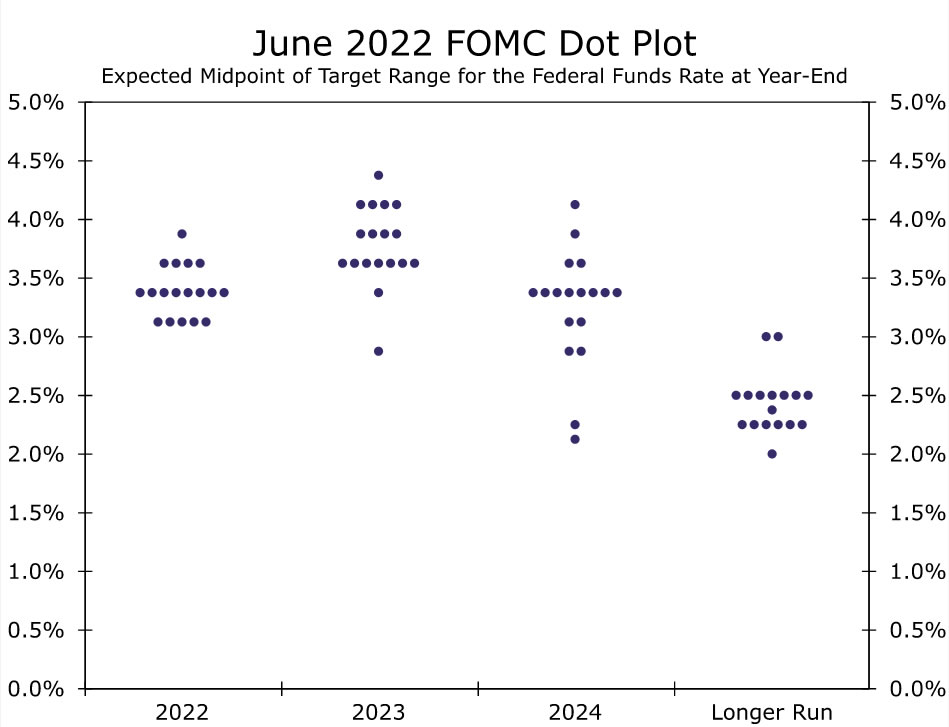
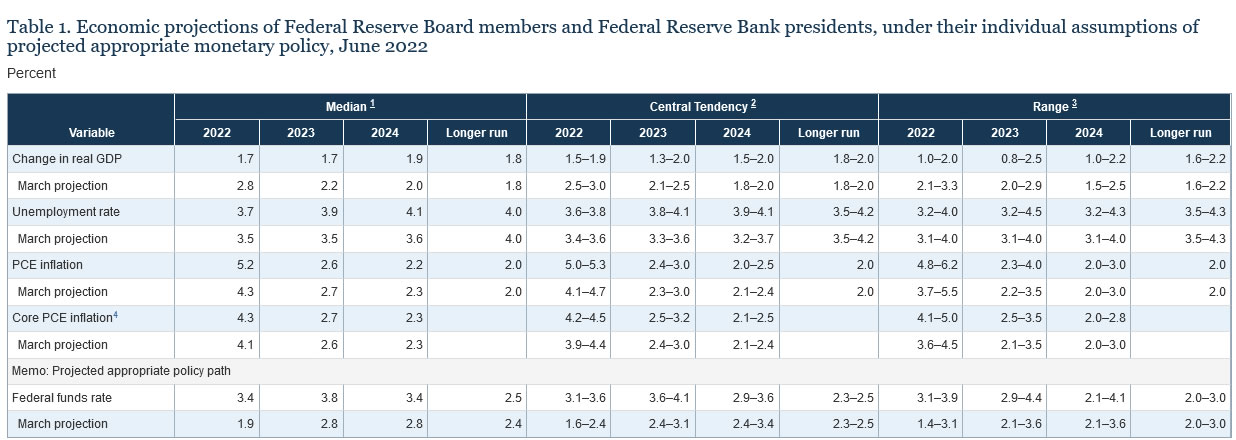
The statement and updated Summary of Economic Projections (SEP) showed the FOMC is prepared to continue to tighten policy at a historically aggressive pace. The median estimate for the fed funds rate at year-end rose to 3.375%, implying another 175 bps of tightening before the year is over.
Despite aiming to move policy into restrictive territory by year-end, the SEP continues to paint a rather optimistic picture of the economy ahead. GDP growth next year is expected to slow only slightly below trend, while inflation falls back to 2-3% and the unemployment rate rises modestly enough to where it remains within its "longer-run" neutral range. In our view, it will take a more material slowdown in economic growth to bring core inflation back to the FOMC's 2% target and more damage is likely to be inflicted to the labor market.
Historic Inflation Requires a Historic Response
Growing alarm over inflation led the Federal Open Market Committee (FOMC) to deliver its biggest rate increase in 27 years at today's meeting. Specifically, the FOMC voted to raise the fed funds rate 75 bps, bringing the target range to 1.50-1.75%. In the post-meeting release, the Fed underscored its focus on inflation by adding the statement that "the Committee is strongly committed to returning inflation to its 2% objective." Yet, the Fed appears to be increasingly aware that this objective will not be quick or easy. The statement removed the line that "the Committee expects inflation to return to its 2 percent objective and the labor market to remain strong", a tacit admission that reining in inflation will likely inflict some pain on the labor market.
The historically large rate hike comes as inflation shows no signs of abating soon. Following the last FOMC meeting in early May, Chair Powell pledged to be nimble if price pressures did not ease as anticipated. Since then, both the April and May CPI reports came in hotter than expected, with "peak" inflation increasingly likely to still be ahead. At the same time inflation concerns have intensified, the labor market has remained on fire. Job growth surprised to the upside in the two employment reports since the FOMC's last meeting, and labor demand is still exceptionally strong. However, not all Committee members were on board with such an aggressive and, up until a few days ago, unanticipated response. Kansas City Fed President Esther George, historically one of the more hawkish members of the Committee, dissented in favor of a smaller 50 bps hike.
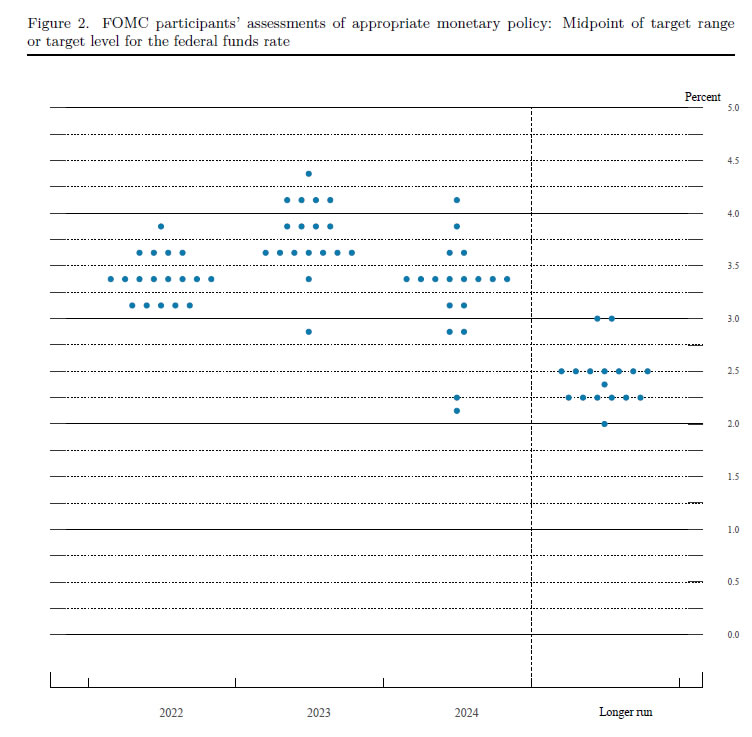
The statement released by the Committee at today's meeting made clear that "ongoing increases in the target range [for the federal funds rate] will be appropriate." The median projection in the dot plot was for the federal funds rate to finish 2022 at 3.375% which would suggest 175 bps of additional tightening at the remaining four FOMC meetings of the year. This could imply the FOMC reverts back to 50 bps for most of the remaining meetings of the year or opts for another 75 bps in July and then steadily ramps the pace back down to 50 bps and then 25 bps.
For 2023, the median dot for year-end was 3.75%. It is important to bear in mind that the projections for the dot plot are for the year-end federal funds rate. Thus, it is possible some participants expect the rate to peak somewhat higher than 3.75% at some point next year before reversing course. Regardless, it is clear that the baseline expectation on the Committee is for the bulk of the rate hikes to occur in 2022. In 2024, the median projection falls slightly to 3.375%, in line with inflation that continues to gradually normalize.
Although it did not play a major role in the statement or Chair Powell's press conference, the Fed's balance sheet began to decline this month and will continue to do so for the foreseeable future. The Federal Reserve will allow up to $30 billion worth of Treasury securities to roll off the central bank's balance sheet each month from June through August. The Fed will also allow up to $17.5 billion worth of mortgage-backed securities to roll off the balance sheet per month. The FOMC's plan is then to increase the size of the monthly caps to $60 billion and $35 billion, respectively, beginning in September, and to maintain the monthly caps at those levels for an indefinite period of time.
In the post-meeting press conference, Chair Powell made clear that the Committee does not expect 75 bps rate hikes to be "common." That said, his comments made clear that another 75 bps rate hike could come in July depending on how the data evolve over the next six weeks. This suggests to us the July 13 CPI release for June will be critical to the Committee's decision on the fed funds rate at the next meeting. Chair Powell once again reiterated that the Committee needs to see "compelling" evidence that inflation is rolling over before it feels comfortable taking its foot off the brake.
Starting to—But Not Fully—Fessing Up to Pain Ahead
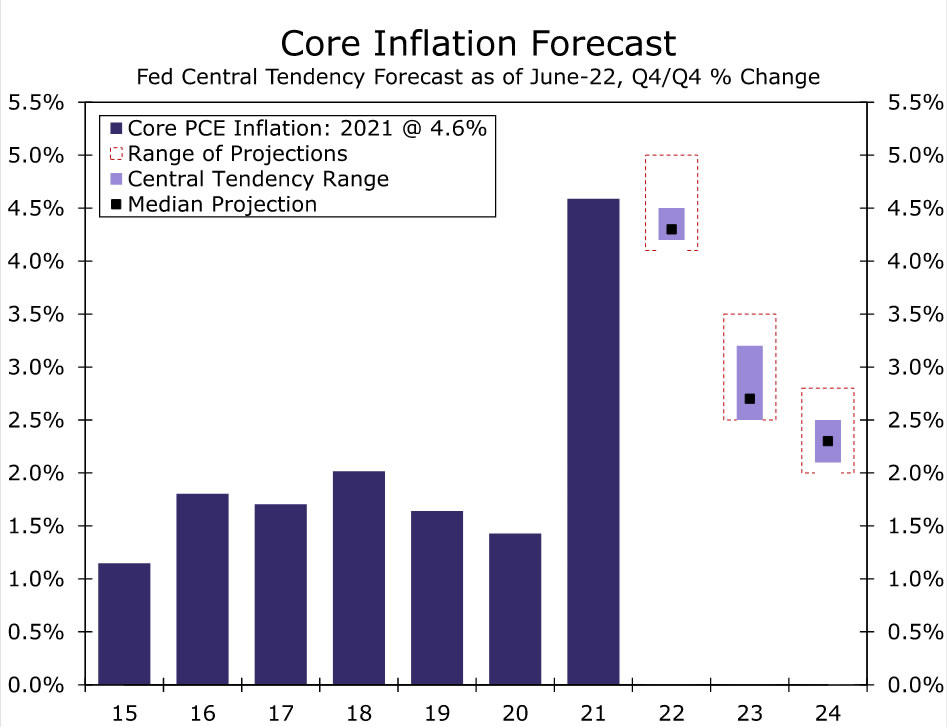
We believe the SEP paints a more realistic but still overly optimistic picture of the bumpy road ahead for the economy as the Fed aims to restore price stability compared to the March projections. Inflation is still expected to run at an elevated rate over the next year-and-a-half, consistent with the more aggressive policy path outlined by the dot plot. The median estimate for headline PCE inflation in Q4 was revised up to 5.2% from 4.3%, while core PCE expectations were bumped up to 4.3%. While inflation is expected to recede over 2023, Committee members look for inflation to remain noticeably above target; the median estimate puts headline PCE at 2.6% in Q4:2023 and core at 2.7%, both little changed from the March projections. Notably, no Committee members expect core inflation to fall back below 2% through 2024.
Meanwhile, officials expect the tighter policy to have only a modestly more dampening effect on economic growth. The median estimate for GDP Q4/Q4 GDP growth in 2022 was downwardly revised to 1.7% from 2.8% in the March projections. GDP forecasts for 2023 were also pared down, but at 1.7% show the FOMC expects the economy to grow closely in line with its longer-run rate of 1.8%. This slowdown in economic growth was reflected in the projections for the unemployment rate. The median forecast for the unemployment rate shows a steady rise from 3.7% at the end of this year to 3.9% at the end of 2023 and 4.1% at the end of 2024. An unemployment rate of 4.1% is not far off the Committee's "longer-run" neutral estimate of 4.0%, and it is indicative of a very soft landing for the economy, or "masterful performance" in the words of Federal Reserve Governor Waller. That said, unemployment that is increasing by more than half a percentage point as a base case scenario highlights the potential risks of a harder landing. In our view, it will take a more material slowdown in economic growth to bring core inflation back to the FOMC's 2% target.
Taking a step back, we believe today's 75 bps rate hike marks an important inflection point in U.S. monetary policy. Numerous Fed officials have stated previously that monetary policy should be nimble in response to new developments and that the FOMC will do whatever it takes to reduce inflationary pressures. Prior to last Friday's CPI report, consensus expectations were firmly anchored to a 50 bps rate hike. But after the inflation data came in hotter than expected, it appears the Committee nimbly adjusted course in real time. Ultimately, the difference between 50 and 75 bps is somewhat small, but today's hike boosts the Fed's credibility and demonstrates that the door is open for similar adjustments at future meetings. This suggests to us a much more sensitive reaction function from the FOMC, and similar upside inflation surprises in the future very well may be met with equally aggressive upside surprises for the federal funds rate.
Fed Research – Review: Big Rate Hikes Until Inflation Pressure Eases
Key takeaways
- As expected, the Fed hiked the target range by 75bp to 1.50-1.75% and left the QT programme unchanged.
- Fed Chair Jerome Powell mentioned that the Fed can hike by another 75bp in July but that we should not expect a series of 75bp rate hikes. This sounds very similar to the May meeting when Powell mentioned that the committee was not "actively considering" 75bp. As long as inflation remains high, the Fed is forced to deliver.
- We change our Fed call now expecting the Fed to hike by 75bp in July and 50bp in September, November and December. If we are right, the Fed funds target range would be 3.75-4.00% by year-end (vs. Fed dot of 3.375% and market pricing of 3.5%).
- We still see risks skewed towards faster and more tightening given the inflation outlook. Our base case is that the US falls into a recession in Q2 23 but the faster hiking pace increases the risk that it starts earlier.
- FX: We expect the Fed to underpin our forecast for seeing EUR/USD towards parity in 12M.
- FI: We see upside risks to our UST 10yr yield target of 3.50% in 3-6M.
Eco Data 6/16/22
[php_everywhere instance="1"]
FOMC Hikes Policy Rate by 75 Basis Points, Signals Many More to Come
The Federal Reserve Open Market Committee (FOMC) lifted the federal funds rate to the 1.5% to 1.75% range and announced a continuation of its balance sheet runoff.
The Fed updated its language to reflect greater economic momentum, stating that "overall economic activity appears to have picked up after edging down in the first quarter. Job gains have been robust in recent months, and the unemployment rate has remained low. Inflation remains elevated, reflecting supply and demand imbalances related to the pandemic, higher energy prices, and broader price pressures."
The Fed's Summary of Economic Projections was updated from March:
- The median projection for real GDP growth was downgraded in 2022 (1.7% from 2.8%). The forecast for 2023, 2024, and the longer run came in at 1.7%, 1.9%, and 1.8% (from 2.2%, 2.0%, and 1.8%), respectively.
- The median unemployment rate forecast 3.7% (3.5%) for 2022, 3.9% (3.5%) for 2023, and 4.1% (3.6%) in 2024. The longer-run estimate of the unemployment rate stayed the same at 4.0%.
- On inflation, the median estimate for core PCE was assumed to be 4.3% in 2022, 2.7% in 2023, and 2.3% in 2024.
- The median projection for the fed funds rate was lifted to 3.4% in 2022, 3.8% in 2023, and 3.4% in 2024. The long-run neutral rate was assumed to be 2.5%.
All of the members of the FOMC voted in favor of the decision, except Esther George who preferred a 50 basis point hike.
Key Implications
The Fed put the pedal to the metal on its rate hiking cycle, as inflation shows no signs of abating. Fed members upgraded their outlook for near-term inflation, which coincided with a big increase in their expectations for the path of the fed funds rate over this year and next.
This decision was expected by markets, but the increase in members' willingness to hike rates well beyond neutral over the next few meetings is undoubtedly hawkish. This closely aligns with market pricing over the rest of 2022, justifying the level of U.S. Treasury yields, which have converged around the 3.5% level.
Fed chair Powell press conference live stream
https://www.youtube.com/watch?v=Azr9FRuFED0
Fed hikes by 25bps, forecasts rate at 3.4% by end of 2022
Fed hikes by 75bps to 1.50-1.75%. Esther George dissented and voted for a 50bps hike only. Fed said that it's "highly attentive to inflation risks" in the statement. Also, Fed now forecasts interest rate to be at 3.4% by the end of this year, sharply higher than prior estimate of 1.9%. Also, in the new dot plot, all members penciled in rate hikes to 3.125% and above by the end of 2022.
In the new median economic projections, federal funds rate is forecast to be at:
- 3.4% by the end of 2022 (up from 1.9%)
- 3.8% by the end of 2023 (up from 2.8%)
- 3.4% by the end of 2024 (up from 2.8%)
GDP growth is forecast to be at:
- 1.7% in 2022 (down from 2.8%)
- 1.7% in 2023 (down from 2.2%)
- 1.9% in 2024 (down from 2.0%)
PCE inflation is forecast to be at:
- 5.2% in 2022 (up from 4.3%)
- 2.6% in 2023 (down from 2.7%)
- 2.2% in 2024 (down from 2.2%)
Core PCE inflation is forecast to be at:
- 4.3% in 2022 (up from 4.1%)
- 2.7% in 2023 (up from 2.6%)
- 2.3% in 2024 (unchanged).
Unemployment rate is forecast to be at:
- 3.7% in 2022 (up from 3.5%)
- 3.9% in 2023 (up from 3.5%)
- 4.1% in 2024 (up from 3.6%)
(FED) Federal Reserve Issues FOMC Statement
Overall economic activity appears to have picked up after edging down in the first quarter. Job gains have been robust in recent months, and the unemployment rate has remained low. Inflation remains elevated, reflecting supply and demand imbalances related to the pandemic, higher energy prices, and broader price pressures.
The invasion of Ukraine by Russia is causing tremendous human and economic hardship. The invasion and related events are creating additional upward pressure on inflation and are weighing on global economic activity. In addition, COVID-related lockdowns in China are likely to exacerbate supply chain disruptions. The Committee is highly attentive to inflation risks.
The Committee seeks to achieve maximum employment and inflation at the rate of 2 percent over the longer run. In support of these goals, the Committee decided to raise the target range for the federal funds rate to 1‑1/2 to 1-3/4 percent and anticipates that ongoing increases in the target range will be appropriate. In addition, the Committee will continue reducing its holdings of Treasury securities and agency debt and agency mortgage-backed securities, as described in the Plans for Reducing the Size of the Federal Reserve's Balance Sheet that were issued in May. The Committee is strongly committed to returning inflation to its 2 percent objective.
In assessing the appropriate stance of monetary policy, the Committee will continue to monitor the implications of incoming information for the economic outlook. The Committee would be prepared to adjust the stance of monetary policy as appropriate if risks emerge that could impede the attainment of the Committee's goals. The Committee's assessments will take into account a wide range of information, including readings on public health, labor market conditions, inflation pressures and inflation expectations, and financial and international developments.
Voting for the monetary policy action were Jerome H. Powell, Chair; John C. Williams, Vice Chair; Michelle W. Bowman; Lael Brainard; James Bullard; Lisa D. Cook; Patrick Harker; Philip N. Jefferson; Loretta J. Mester; and Christopher J. Waller. Voting against this action was Esther L. George, who preferred at this meeting to raise the target range for the federal funds rate by 0.5 percentage point to 1-1/4 percent to 1-1/2 percent. Patrick Harker voted as an alternate member at this meeting.