Sample Category Title
Platinum Wave Analysis
- Platinum reversed from support level 920.00
- Likely to rise to resistance level 960.00
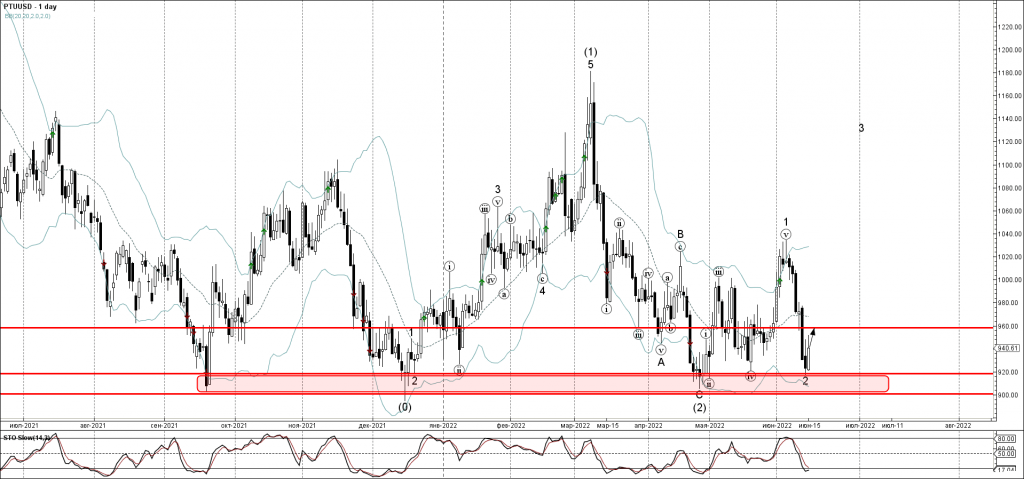
Platinum recently reversed up from the support level 920.00 (which is the upper border of the support zone which has been reversing the price from the middle of September, the lower boundary stands at 900.00).
The upward reversal from the support level 920.00 stopped the previous minor retracement 2 from the start of June.
Given the oversold daily Stochastic, Platinum can be expected to rise further toward the next round resistance level 960.00.
AUDUSD Wave Analysis
- AUDUSD reversed from support level 0.6850
- Likely to rise to resistance level 0.7000
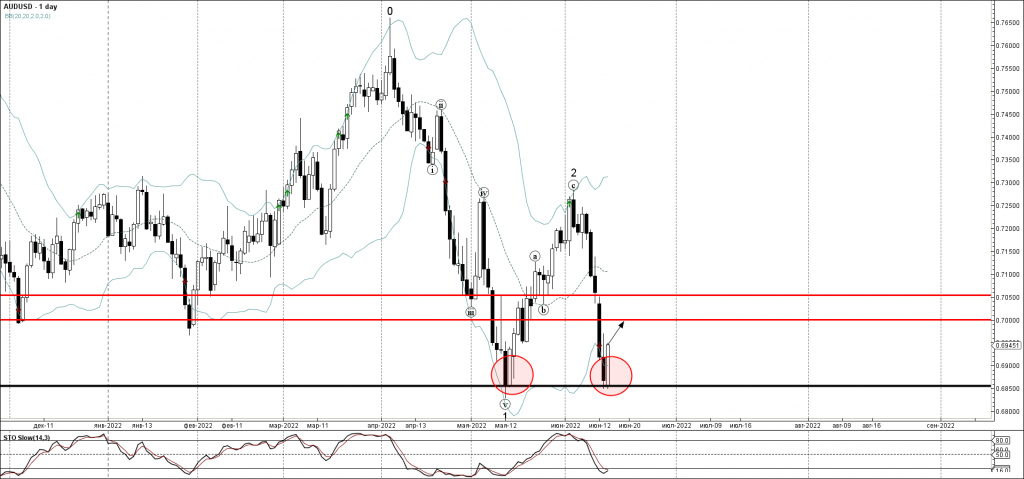
AUDUSD currency pair recently reversed up from the key support level 0.6850 (which stopped the earlier sharp downward impulse wave 1 in the middle of May).
The upward reversal from the support level 0.6850 is likely to create the daily Japanese candlesticks reversal pattern Bullish Engulfing – a strong buy signal for this currency pair.
Given the oversold daily Stochastic, AUDUSD can be expected to rise further toward the next round resistance level 0.7000.
BoJ to Keep its Foot on the Gas Despite Yen Collapse
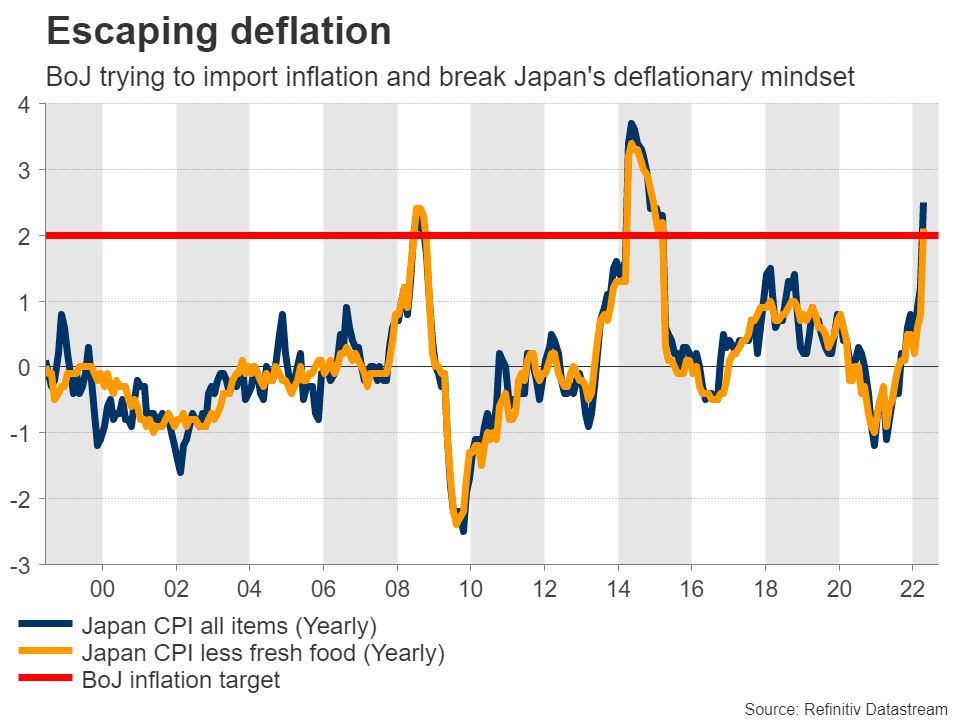
The Bank of Japan will conclude its latest meeting early on Friday. No policy shifts are on the cards, even though inflation has reached its elusive 2% target. This spells more pain for the yen, which has been slaughtered by rising yields abroad and a trade shock stemming from energy prices. On the bright side, the sharp downtrend seems to be entering its final phase.
Pedal to the metal
The Bank of Japan is now the only major central bank in the world that is not even thinking about raising interest rates. That’s because there isn’t much inflation to fight. The yearly CPI rate recently crossed above the BoJ’s 2% target but most of that boils down to soaring energy and food costs.
Supply shocks don’t have a lasting impact on inflation. What the BoJ wants to see is organic price pressures generated domestically, with people enjoying higher wages and spending more on goods and services.
Japan has been trapped in deflation for decades now and the BoJ is trying to use this supply shock to its advantage. If policymakers stay patient and manage to import enough inflation from abroad, that could help break the deflationary mindset that’s been embedded in Japanese society and kickstart the economy.
But this process requires the yen to suffer. The BoJ continues to keep a ceiling on Japanese yields, keeping them pegged around 0%. With yields in the rest of the world going through the roof, interest rate differentials have widened, crushing the yen.
Nothing yet
A parade of BoJ officials made it very clear lately that no policy changes are on the menu this week. The fact that they felt it was necessary not even to allow market participants to speculate about any potential changes says everything. They won’t lift a finger.
Instead, the spotlight will be on any signals that a move is possible in the next few meetings. A shift seems inevitable later in the year, but it is unlikely that the BoJ will open that door for now. It would defeat the purpose of trying to shock Japanese consumers back into expecting inflation.
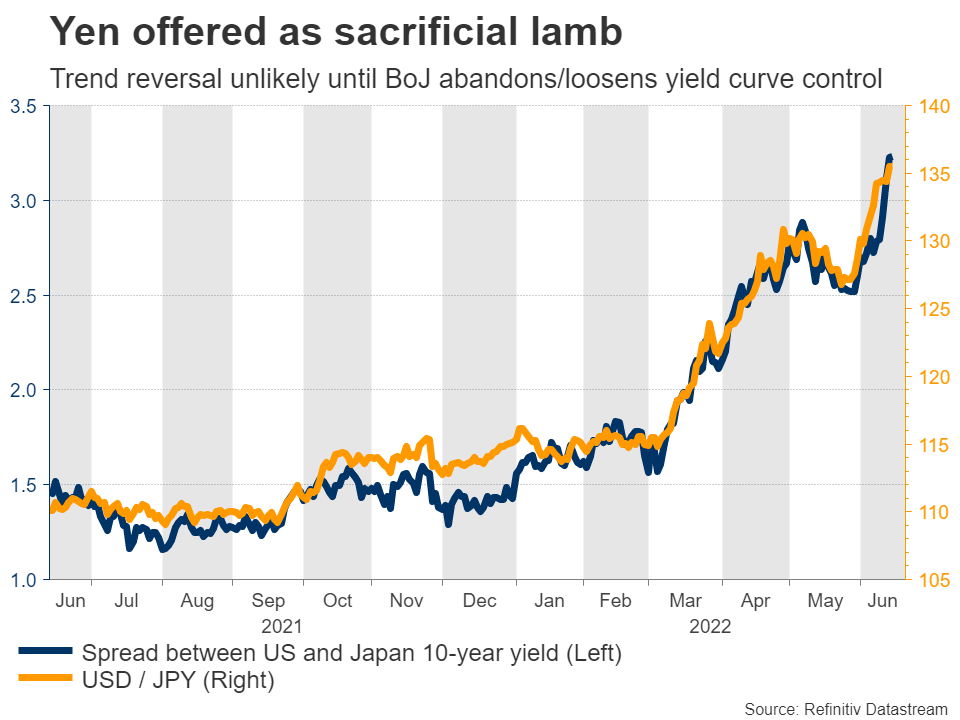
When the BoJ does change tune, the first step would be to either relax its yield curve control strategy by raising the ceiling on Japanese yields, or abandon it altogether. However, this might be a story for September or beyond.
Yen outlook
As for the yen, there’s probably some more pain left as the BoJ bides its time, but the sharp downtrend seems to be approaching its bottom.
The yen’s collapse has turned into a political issue in Japan, putting enormous pressure on the government to intervene in the FX market to stop the bleeding. Government officials have resisted so far, aware that FX intervention would contradict the BoJ’s efforts to revive inflation. But with inflation already running above 2% and rising, patience is running out.
BoJ Governor Kuroda probably has a few more months to attempt his inflation experiment. If foreign yields or energy prices keep rising in the meantime, the yen could surrender more ground. In this scenario, dollar/yen could pierce above the recent two-decade high of 135.50 and aim for the 140.0 psychological region.
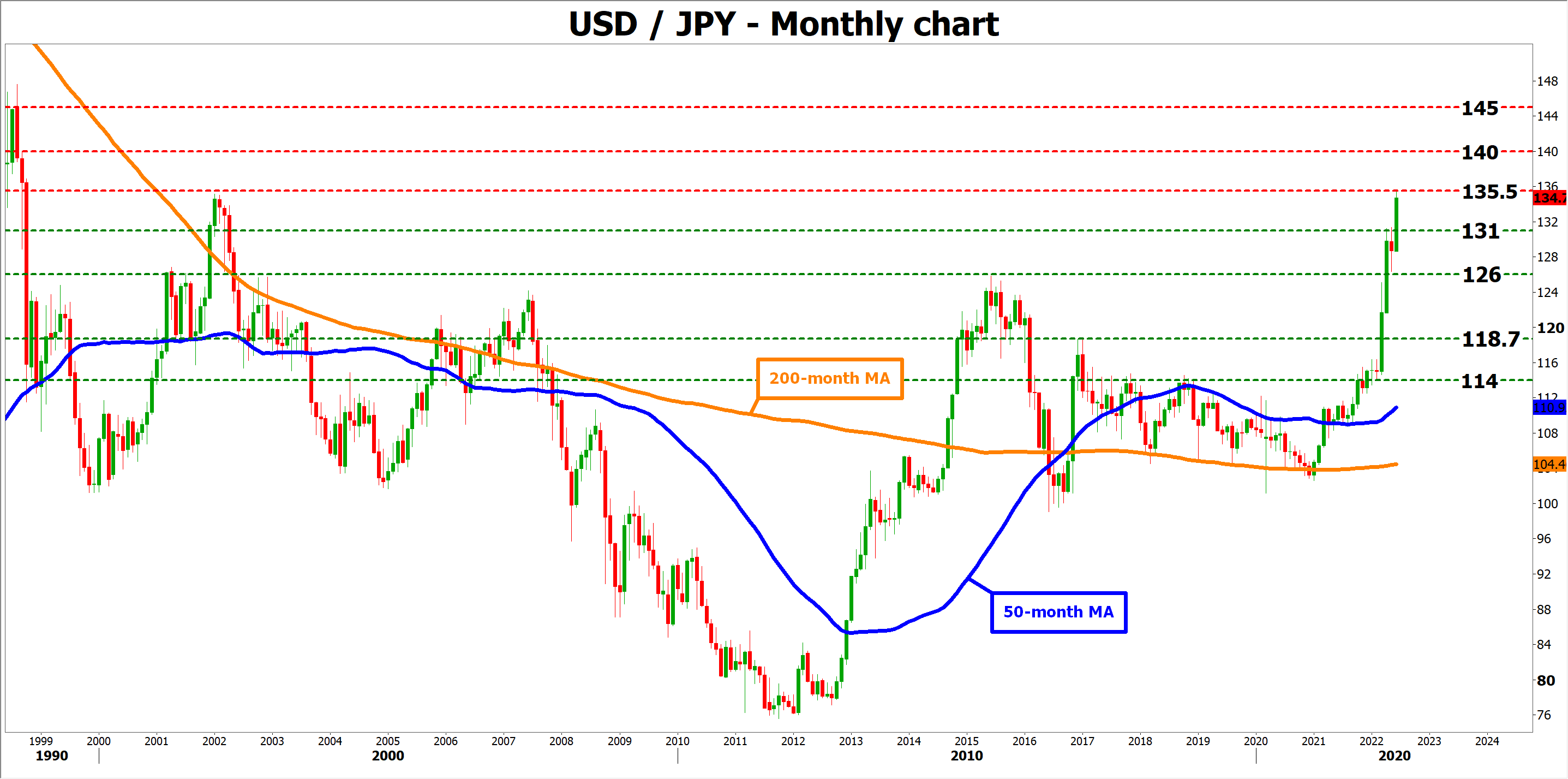
Now on the flipside, any signs that the BoJ is ready to loosen yield curve control or raise interest rates would probably mark a trend reversal. In this case, dollar/yen could fall back below 131.0 and aim for the 126.0 zone.
Keep a close eye on inflation. If it breaches 3% or higher heading into September, it would be a solid signal that the BoJ is about to turn the ship around.
Pound Jumps ahead of Fed, BoE Meetings
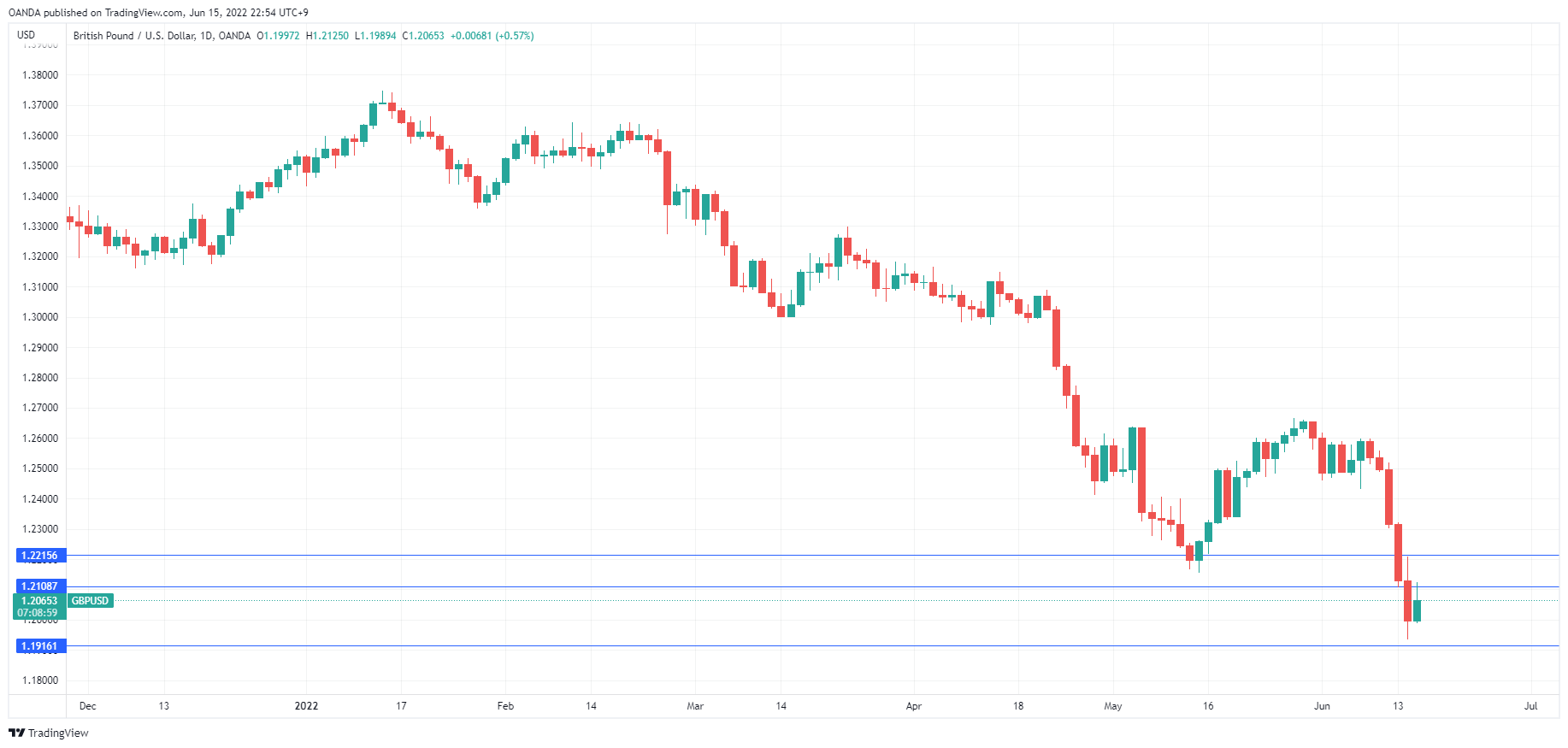
The British pound is in positive territory on Wednesday. This follows an abysmal 5-day slide which saw the pound fall as much as 600 points. In the North American session, GBP/USD is trading at 1.2060, up 0.53% on the day.
FOMC expected to deliver 75-bp salvo
All eyes are on the Federal Reserve, with the FOMC rate decision later today. The Fed is clearly under pressure as inflation surges with no peak in sight – CPI accelerated to 8.6% in April, up from 8.3% in March. This was the highest inflation rate since 1981. The Fed’s aggressive stance may shift into overdrive, with a 75-bp hike priced in by the markets at almost 100%. Just a few days ago, the most likely scenario was a 50-bps increase, but hawkish winds are blowing, and a 75-bp move will likely elicit a sharp response from the financial markets. Investors will also be closely monitoring the rate statement and Fed Chair Powell’s press conference. I would not be surprised to see the US dollar cash in with strong gains following today’s meeting.
The Fed finds itself in a tough spot as it struggles to combat inflationary pressures, which are now more than four times higher than the Fed’s inflation target of 2 per cent. The price for the Fed’s aggressive rate-hike cycle could well be a recession, but Fed policy makers clearly prefer a (hopefully) short recession rather than inflation expectations becoming unanchored. The big question is will the Fed manage to guide the US economy to a soft landing as it continues to aggressively raise rates.
BoE expected to hike by 25bp
After the Fed is done, attention will shift to the Bank of England, which holds its policy meeting on Thursday. The likely scenario is that the cautious BoE will raise rates by a modest 25 bps, but we could see a larger hike if the Fed is overly hawkish at its meeting. With unemployment in the UK at a low level of 3.7%, the BoE has room to be more aggressive with its monetary policy. As for the British pound, a 0.25% hike won’t be of much help. If the BoE surprises with a larger rate increase, the pound would likely respond with gains.
GBP/USD Technical
- GBP/USD faces resistance at 1.2108 and 1.2215
- There is support at 1.1916. This is followed by 1.1772, a major support level.
Yesterday’s Oil and Gas Crash is the First Sign of a Break in the Energy Uptrend
Oil and gas took a massive hit during the New York trading session. Oil and gas fell sharply for different reasons, but in both cases, we could witness a bearish energy reversal after more than fivefold price gains from the macrocycle lows of April 2020.
Natural gas was momentarily losing over 20% on Tuesday on reports that Freeport LNG is set to get its terminal back online within 90 days. It is speculated that a full recovery is not expected until the end of the year, but gas futures have managed to cut losses from 20% to 18%, trading at $7.26 at the time of writing.
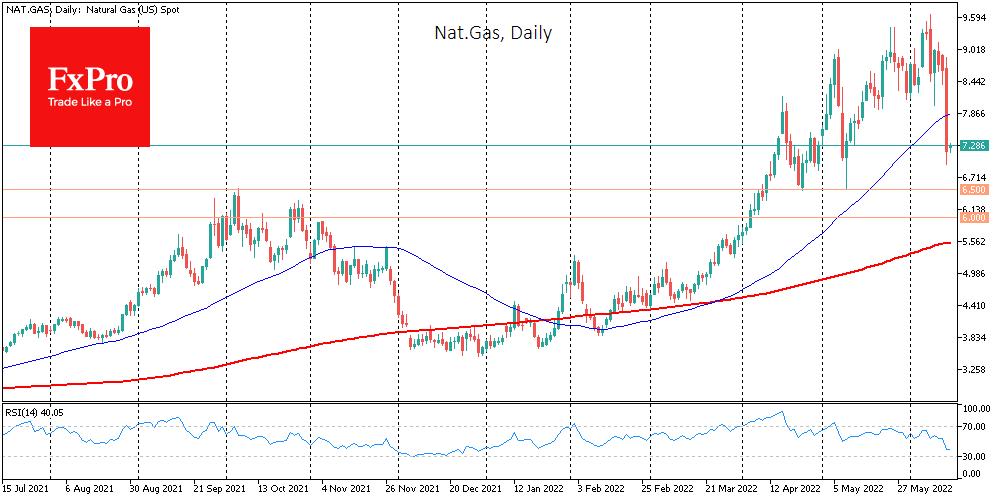
It’s counter-intuitive, but the gas price peaked on the day the Freeport LNG fire was announced on June 8, and from a peak at $9.6, the price has fallen by a quarter. If we do see a reversal, it would not be surprising if gas loses ground rapidly down to 6.5 or even 6.0 before the bears make their first attempts to lock in profits.
Oil is also turning around. Brent is in its fifth trading session showing a downtrend with a sequence of increasingly lower lows and highs. Yesterday morning, we saw bulls’ efforts to break the trend run into furious selling as the price lost 5% or almost $6 in less than five hours.
In early March, we had already seen that oil was looking too expensive for buyers in the market and economy, causing a demand shock and triggering a correction. Fresh data from the IEA highlights that global inventory rose in April for the first time in almost two years. However, OPEC+ is increasingly falling short of quotas, and US production has stagnated near 11.9m BPD for the last ten weeks.
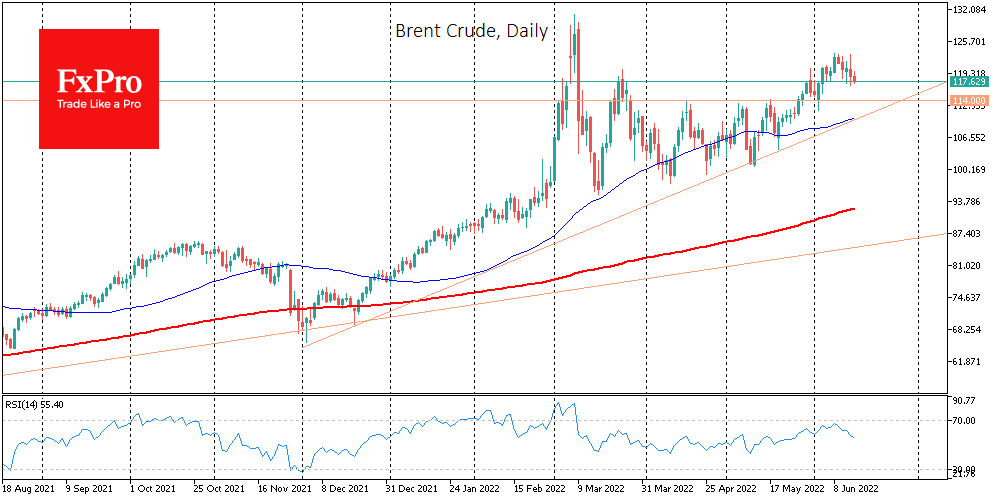
Our estimate is that we will see the end of a multi-month rally in oil strengthen if Brent consolidates below $114. That would be a drop from the beginning of the month and a dip below the locally significant level, which was resistance in April and May and support in early June.
An even more reliable signal for the bears’ victory would be a consolidation below $110, where the 50-day moving average now passes. That could open a direct and unexpectedly fast road to the area of $100 by the end of August. However, we expect it to stay in the $100-120 range for the rest of the year.
Sunset Market Commentary
Markets
European markets were put immediately on edge even before the official open. Financial media reported that the ECB would hold an emergency meeting to discuss “current market conditions”. Investors concluded this meant addressing the steep rise in yields/spreads for heavily indebted countries, including Italy. The massive drop in the 10y Italian yield of more than 40 bps ahead of the meeting’s outcome suggested they were expecting something way more than promising “PEPP reinvestment flexibility” announced at the regular meeting last week. In a sign that widening spreads became an issue for the common currency once again, the euro staged a small rebound towards EUR/USD 1.05. Alas, it became a tale of over-promising and under-delivering. The ECB simply announced that “it will apply flexibility in reinvesting redemptions coming due in the PEPP portfolio, with a view to preserving the functioning of the monetary policy transmission mechanism.” Regarding any new anti-fragmentation instrument, the ECB gave its staff instructions to hurry up its completion a bit. European bond markets, both core and peripheral, pared some of the early morning gains shortly after the statement was released in a sign of disappointment. However, the sharp recovery resumed soon thereafter with the move coinciding with the publication of May US retail sales. The headline figure printed negative for the first time in five months (-0.3% m/m), core gauges rose less than expected and the April readings were revised downwardly. German Bund yields slip 17.2-20 bps in the 2-5y bucket. Tenors further out shed 15 bps (10y) with the very long end underperforming (30y: -5.8 bps). Peripheral spreads vs. Germany’s 10y yield tank between 10 (Spain and Portugal) over 22 bps (Italy) to 27 bps (Greece). US yields nosedive between 6.2 bps (30y) to 11.6 bps (5y) lower ahead of the Fed policy meeting. EUR/USD forfeited all gains to trade slightly lower in the low 1.04 area even as risk sentiment is not at all bad (stocks trade 1-2%+ higher). EMU/US interest rate differentials may be at play here. Sterling shrugs of news that the EU is resuming legal action against the UK over the implementation of the NI protocol while simultaneously launching a second case on matters regarding custom checks. It follows Johnson’s bill to unilaterally amend the protocol earlier this week. EUR/GBP eases from above 0.87 to 0.863 currently. Cable tries to safeguard the 1.20 big figure.
With the ECB having laid an egg, we can now turn to what was supposed to be the one and only focal point today: tonight’s Fed policy meeting. Newspaper reports on Tuesday paved the way for a 75 bps hike instead of the 50 bps hinted at by the Fed at the previous meeting. Such a big move last happened in 1994. We believe chair Powell will rubberstamp another 75 bps hike in July unless the inflation outlook improves materially. In essence this would confirm current market expectations and should thus not come as a big surprise. The dot plot will probably already be outdated if only because it won’t reflect tonight’(and July’s) bigger-than-previously announced rate hike. Governor estimations of the neutral rate (2.4% previously) is worth looking into though. Raising it de facto means the Fed expects the high inflationary environment to stick around for longer. Powell’s tone may prove all-important for US bond markets and the dollar. Keep a close eye at EUR/USD. 1.035 is extremely close. A break lower brings parity back on the radar …
News Headlines
Bulgaria’s government of Prime minister Kiril Petkov will face a no confidence vote in Parliament next week. The vote was filed by the Gerb party of Center-right former Prime Minister Borissov and comes after the junior party left the coalition government last week. As reason of the no confidence vote, the opposition mentions the government’s failure in its economic and fiscal policy, including the government’s ability to address surging inflation. Today, Bulgaria reported May inflation figures at 1.2% M/M and 15.6 % Y/Y (from 14.4 in April), the highest level since 1998. Political uncertainty can complicate the country’s plan to join the euro in 2024.
AUD/USD: Bears Taking a Breather, Awaiting Fresh Signal from Fed’s Decision
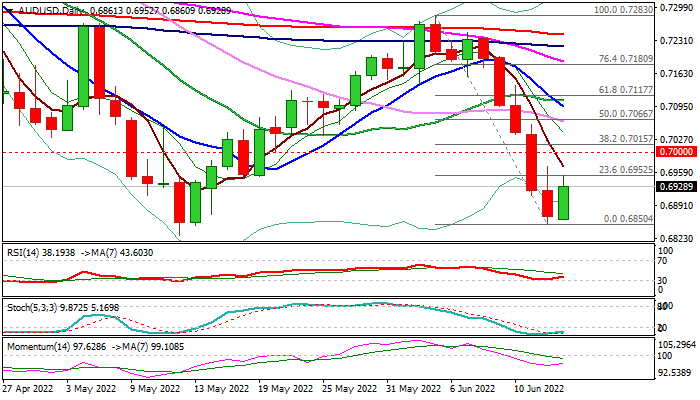
The AUDUSD rebounds on Wednesday after five straight days of steep fall, as revived risk sentiment gave fresh boost to Aussie.
Oversold daily techs and potential formation of bullish engulfing pattern today, may act as initial reversal signal, though recovery needs a clear break through pivotal 0.70 zone (psychological / Fibo 38.2% of 0.7283/0.6850 bear-leg) to generate firmer bullish signal.
Larger picture remains firmly bearish that may signal limited recovery, while sharp change in bets over today’s Fed decision (most of analysts now expect 0.75% hike instead of previous 0.5% consensus that would lift the US dollar and end a brief recovery attempt.
Bears eye 2022 low (0.6828) loss of which would open way for test of pivotal Fibo support at 0.6758 (50% retracement of 0.5509/0.8007 rally) and spark stronger bearish acceleration on break.
Res: 0.6970; 0.7000; 0.7015; 0.7066.
Sup: 0.6850; 0.6828; 0.6758; 0.6647.
US: Retail Sales Lose Momentum in May
Retail sales lost some momentum in May, falling 0.4% month/month (m/m), weaker than the modest gain markets were expecting. Sales in the prior two months were also revised down.
As expected, sales at autos & parts dealers fell by 3.5% m/m. But, autos weren't the only durable goods category to slow. Sales at furniture (-0.9% m/m) and electronics and appliance stores (-1.3% m/m) both fell.
Sales at gasoline stations were on the rise again in May, up 4.0% m/m, driven entirely by prices, with estimated real sales looking flat in May.
Sales in the "control group", which excludes motor vehicles & parts, gasoline stations and building materials, and are used in calculating personal consumption expenditures (and GDP), were flat on the month.
Sales gains were pretty soft across the board, clothing up only 0.1% m/m, building materials and garden supplies up 0.2% m/m, and sales at non-store retailers reversing (-1.0% m/m) after a healthy gain in April. When deflated by their CPI category, most of these areas saw sales declines in real terms.
One exception was sales at restaurants and bars, which rose 0.7% m/m. That is a solid gain, but comes after three months of even heartier gains as consumers flock back to in-person dining.
Key Implications
We have long expected retail spending to slow as consumers shift towards services, but May's retail report was still weaker than expected. Retail sales really only capture the goods side of spending, while it is spending on services like concert tickets and long-awaited vacations that we expect to boost consumer spending in the near-term. The slowing in retail momentum is expected and reflects the normalization in goods spending after huge gains earlier in the pandemic.
Inflation is elevating nominal retail numbers, so the weakness was more pronounced in real terms. The retail report always grabs headlines, but it won't be holding on to them long today, with the FOMC set to deliver it's rate decision at 2pm. With market expectations ratcheting up to a 75 basis point hike in the past two days, attention is even more heightened than usual.
USD/JPY Mid-Day Outlook
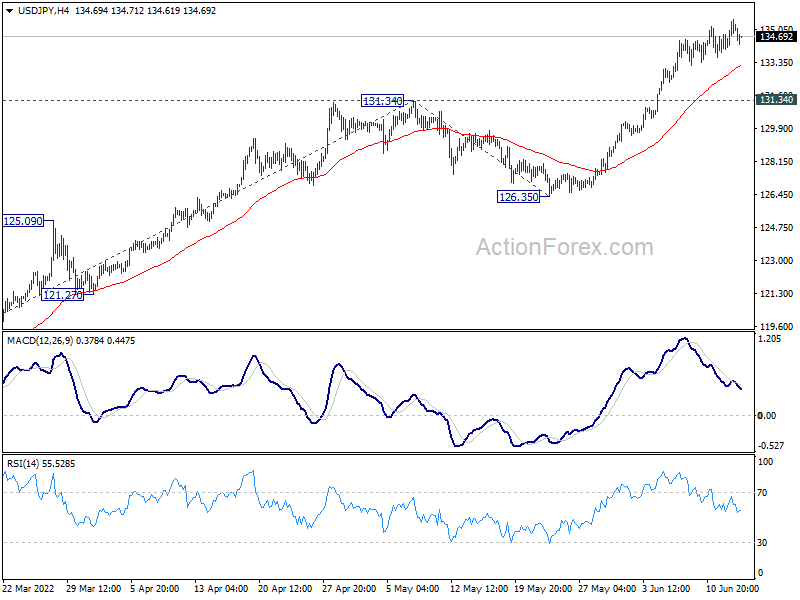
Daily Pivots: (S1) 134.41; (P) 134.93; (R1) 135.99; More...
USD/JPY continues to lose upside momentum as seen in 4 hour MACD. But further rally is expected as long as 131.34 resistance turned support holds. Current up trend should target 61.8% projection of 114.40 to 131.34 from 126.35 at 136.81. Firm break there will target 100% projection at 143.29.
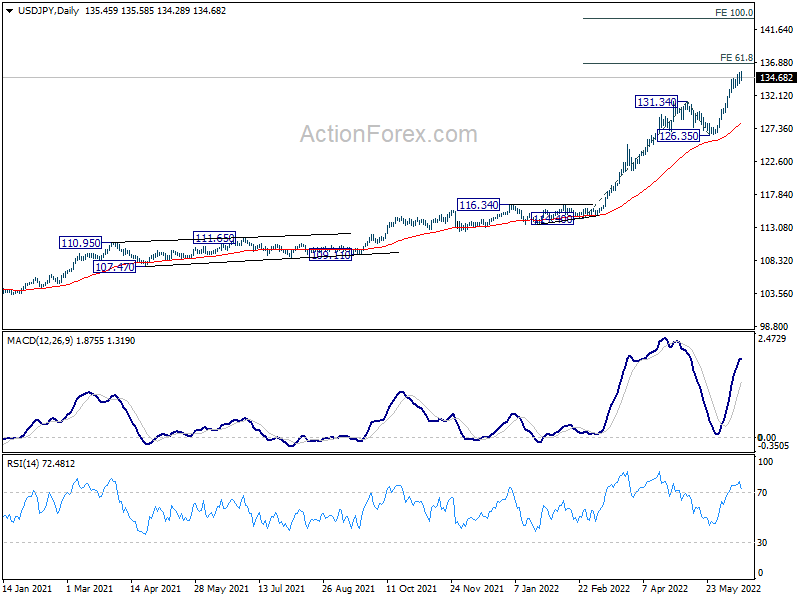
In the bigger picture, current rally is seen as part of the long term up trend from 75.56 (2011 low). Next target is 100% projection of 75.56 (2011 low) to 125.85 (2015 high) from 98.97 at 149.26, which is close to 147.68 (1998 high). This will remain the favored case as long as 126.35 support holds.
USD/CHF Mid-Day Outlook
Daily Pivots: (S1) 0.9916; (P) 0.9976; (R1) 1.0079; More...
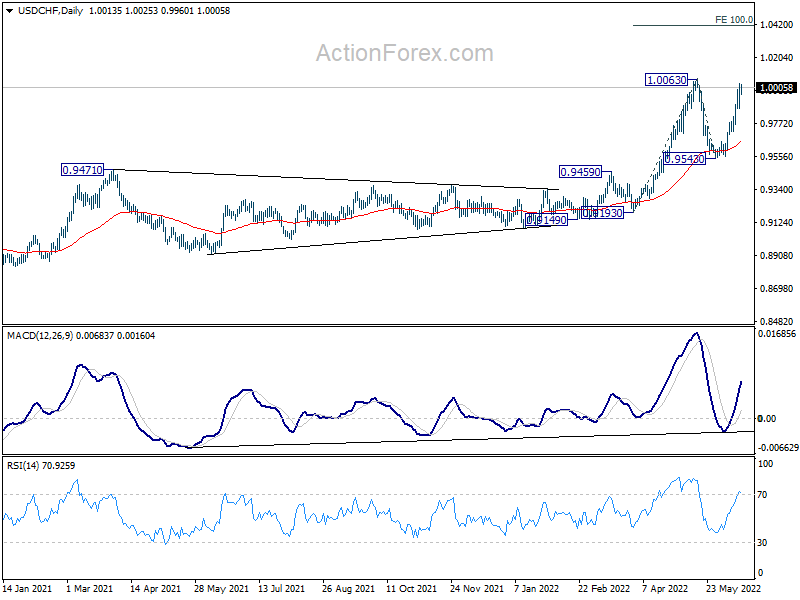
Intraday bias in USD/CHF stays on the upside for 1.0063 resistance. Firm break there will resume larger up trend. Next target is 100% projection of 0.9193 to 1.0063 from 0.9543 at 1.0413. On the downside, below 0.9872 minor support will delay the bullish case and turn intraday bias neutral first.
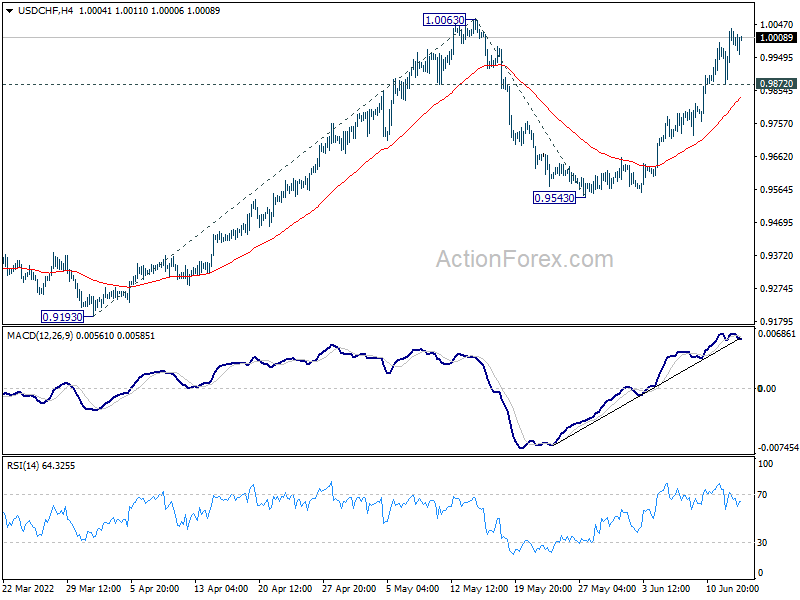
In the bigger picture, down trend from 1.0342 (2016 high) should have completed with three waves down to 0.8756 (2021 low) already. Rise from 0.8756 is likely a medium term up trend of its own. Next target is 1.0237/0342 resistance zone. This will remain the favored case as long as 0.9471 resistance turned support holds. However, sustained break of 0.9471 will extend long term range trading with another falling leg.