

Sample Category Title
Sunset Market Commentary
Markets
Sterling isn’t having its best day. Cable touched its lowest level since March 2020 at 1.2064 and is extensively testing final support (1.2081; 76% retracement on 2020/2021 rally) before the March 2020 low at 1.1412. EUR/GBP rallies from 0.8578 at the open to currently 0.8650 (testing September 2021 high at 0.8658). The pair at last manages to take out the tough resistance zone around the 0.86 big figure. EUR/GBP 0.8699/0.8721 (38% retracement on 2020/2022 decline; Apr 2021 high) lines up as the next topside hurdle. The perfect storm for the UK currency has been in the making for quite some time now. The cost-of-living crisis is a global issue, but UK households were amongst the first to be heavily exposed, eg by the lifting of the energy price cap in April. More of the same will follow in October. This morning’s UK labour market report was strong, but media focused on the big drop in real wages. UK wages rose by 4.1% YoY in April with CPI inflation running at 9% Y/Y. The biggest fall in real disposable income on record (since 2001) doesn’t bode well for the UK economic outlook. A second item at play for sterling weakness is that the drop in real wages complicates the picture for the Bank of England. Especially as governor Bailey and co are an outlier when it comes to their focus. Especially at the Fed, but now also at the ECB, tackling inflation and reanchoring inflation expectations primes even as it comes at an economic cost. The Bank of England is more balanced and doesn’t want to overdo it when it comes to policy normalization in order not to suffocate the economy. It shows in today’s outperformance of UK Gilts against for example German Bunds. We admit that the BoE is already further advanced in its rate hike cycle, but the relative dynamic will start playing in GBP’s disadvantage going forward. Even if the BoE on Thursday conducts its fifth consecutive rate hike and even as GBP money markets take into account a 3.25% policy rate peak early next year. The final accident in the making the UK government’s solo approach when it comes to overturning parts of the Northern Ireland Protocol from the Withdrawal Agreement. The government yesterday published a bill with four unilateral proposals to override the Protocol. The publication of the bill (which still needs approval in Lower and Upper House) was immediately met with fury in Brussels with the European Commission revamping legal action against the UK. The government’s plans by the way don’t only infuriate the EU, but also part of Johnson’s own Tories and the election-winning Irish Republicans of Sinn Fein in Northern Ireland. On other markets, we’ve seen some consolidation: the dollar is a tad softer, stocks try to regain some ground (but lack strength) while the Bund and the Note future are stuck near the sell-off lows. News Headlines
Swedish inflation hit 7.3% y/y in May. It’s the highest reading in 31 years and was a sharp increase from the 6.4% seen in April. Monthly dynamics came in at a red-hot 1%. CPIF, the Riksbank’s preferred inflation gauge using a fixed interest rate quickened from 6.4% to 7.2% y/y with all but one category showing (strong) monthly price gains. Both measures surprised to the upside (7%). Excluding energy, core CPIF rose to 5.4%, from 4.5%. Today’s numbers raise the odds for the Riksbank to hike by bigger moves than the inaugural 25 bps back in April. Markets consider such a move a done deal at the very least for the June 30 meeting (50 bps) but that has been the case even before the inflation print. EUR/SEK briefly fell (SEK strengthened) to 10.52 before paring gains immediately. The currency pair is currently changing hands around 10.63.
OPEC expects substantially lower oil demand growth next year as inflation and the (geopolitical) conflicts will hold a tight grip on the world economy. According to preliminary projections, oil consumption would expand by 1.8mln barrels a day, down from the 3.4mln anticipated for this year. To fulfill this demand while also compensating for lost (Russian) output, the oil cartel last earlier this month announced a quicker-than-planned removal of pandemic-era production curbs in July and August. Oil prices continued to rise though, and today is no exception. Brent is adding more than 2% to $124.4/b.
Bearish Signals in Gold Set Up a Drawdown Potentially to $1630
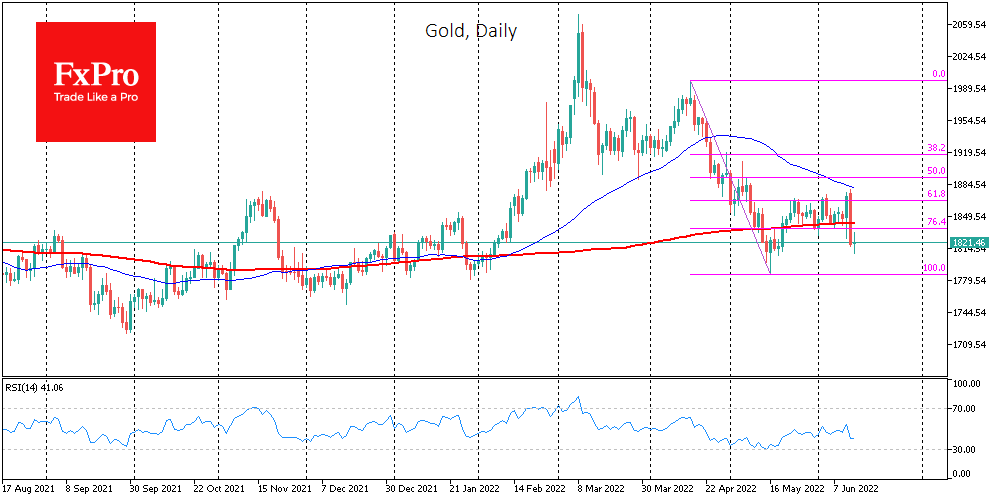
Gold lost about 3% on Monday alone and touched $1809 at the start of trading on Tuesday.
Yesterday’s sell-off provided us with four medium-term bearish signals on the daily timeframes.
First, the daily candlestick completely absorbed Friday’s bullish momentum, clearly showing the strength of the bears.
Secondly, gold’s recovery stalled on the approach of the 50-day moving average. The strong reversal indicates that the medium-term trend remains bearish.
Third, in a decisive move, gold has moved below its 200-day moving average, a significant long-term trend signal that works well in gold. A consolidation below this line is a prologue to a further downtrend. Knowing this, investors often increase selling on such a signal, intensifying the fall in the coming days after a consolidation below this line.
Fourth, gold’s recovery this week stalled near the 61.8% Fibonacci retracement level from the April peak to the May low.
Further near-term targets for the bears look like the $1790 area. If risk-off sentiments prevail in the global markets at those levels, gold may quickly return to the area of $1730-1770, where it found buyers’ support in the second half of last year.
If we move up to the weekly timeframes, a potential final sell-off is seen in the 200-week moving average at $1630, which is also a 50% retracement of the 2018-2020 rise triggered by the soft monetary policy.

GBP/USD: Psychological 1.20 Support Comes in Focus
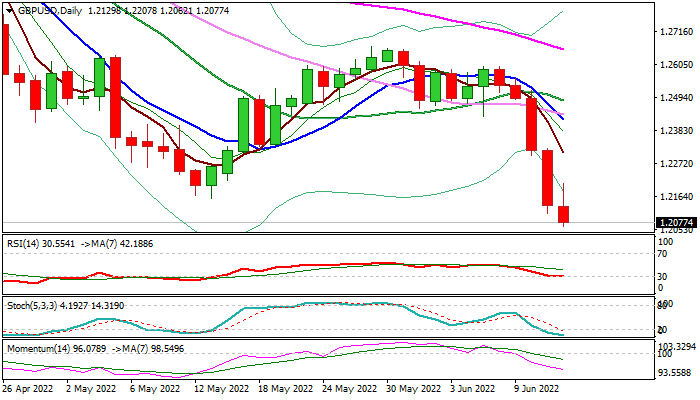
Cable extends its steep fall into fifth straight day and dented pivotal Fibo support at 1.208 (76.4% of larger 1.1409/1.4249 Mar 2020/May 2021 rally), after fresh bearish signal was generated on Monday’s close below former 2022 low at 1.2155.
Near-term focus shifts towards psychological 1.20 support and Sep 2019 low at 1.1958, which guard Mar 2020 spike low at 1.1409, but overstretched daily studies suggest the action may pause for consolidation before larger bears resume.
Former key support at 1.2155 reverted to strong resistance, which should ideally keep the upside protected.
Res: 1.2155; 1.2207; 1.2276; 1.2301.
Sup: 1.2034; 1.2000; 1.1958; 1.1899.
Bitcoin Tumbles to 18-Month Low as Persistent Inflation Terrorizes Markets
The world’s largest cryptocurrency by market capitalization, Bitcoin, has been experiencing a vast sell-off since the beginning of the week, losing more than 25% before recovering some lost ground. Moreover, the broader crypto space has been following Bitcoin’s path amid increasing concerns over slowing global growth and a potential recession as major central banks tilt towards more aggressive tightening to combat rising inflation. In the last couple of days, two crypto trading platforms temporarily halted withdrawals and transfers, exacerbating the downfall and reminding investors that systemic risks in the crypto ecosystem are lingering.
Inflation remains the name of the game
Since the beginning of 2022, cryptocurrencies have been moving in tandem with equity markets, exhibiting a higher positive correlation with tech stocks. During that period, risky assets have been facing continuous downside pressures as investors appear to be moving towards defensive assets in the face of persistently high inflation and recession fears. The latest blow to risky assets was dealt on Friday by the May US CPI print, which came out hotter than expected at 8.6% year-on-year, debunking the peak inflation narrative.
Following that news, investors increased their bets over an upcoming 75 basis points rate hike at the July meeting, inflicting devastating damage in equity and crypto markets. More precisely, the tremendous selling interest caused the cryptocurrency market’s capitalization to plunge below $1 trillion for the first time since January 2021.
Unregulated nature poses an additional threat
As turbulence rippled through the crypto space in the past few days, leading cryptocurrency exchanges were forced to temporarily pause some of their features amid increasing market volatility. On Monday, Celsius, a popular crypto lending platform, announced that it had halted all crypto and money withdrawals, alongside swaps and transfers between different accounts, which lead to its own token CEL losing more than 50% on the news. Furthermore, another famous crypto exchange, Binance, ceased Bitcoin withdrawals for more than 30 minutes, attributing this move to technical issues, with rumors suggesting that this action was taken due to the ongoing crypto bloodbath.
In addition, crypto exchange companies have been increasingly stating that they plan to proceed with layoffs to curtail their operating costs. Specifically, last week, both BlockFi and Crypto.com reported that they would cut 20% and 5% of their staff respectively as the dramatic shift in macroeconomic conditions has been largely weighing on the broader tech sector. The aforementioned developments paint a gloomy picture for the outlook of the crypto space, which combined with the regulatory woes and the recent Terra collapse have significantly deteriorated investors’ sentiment towards cryptocurrencies.
Bitcoin collapses to fresh 18-month low
The recent sell-off in crypto markets caused Bitcoin's price to fall to a fresh 2022 low, which is also an 18-month low, before bouncing back slightly.
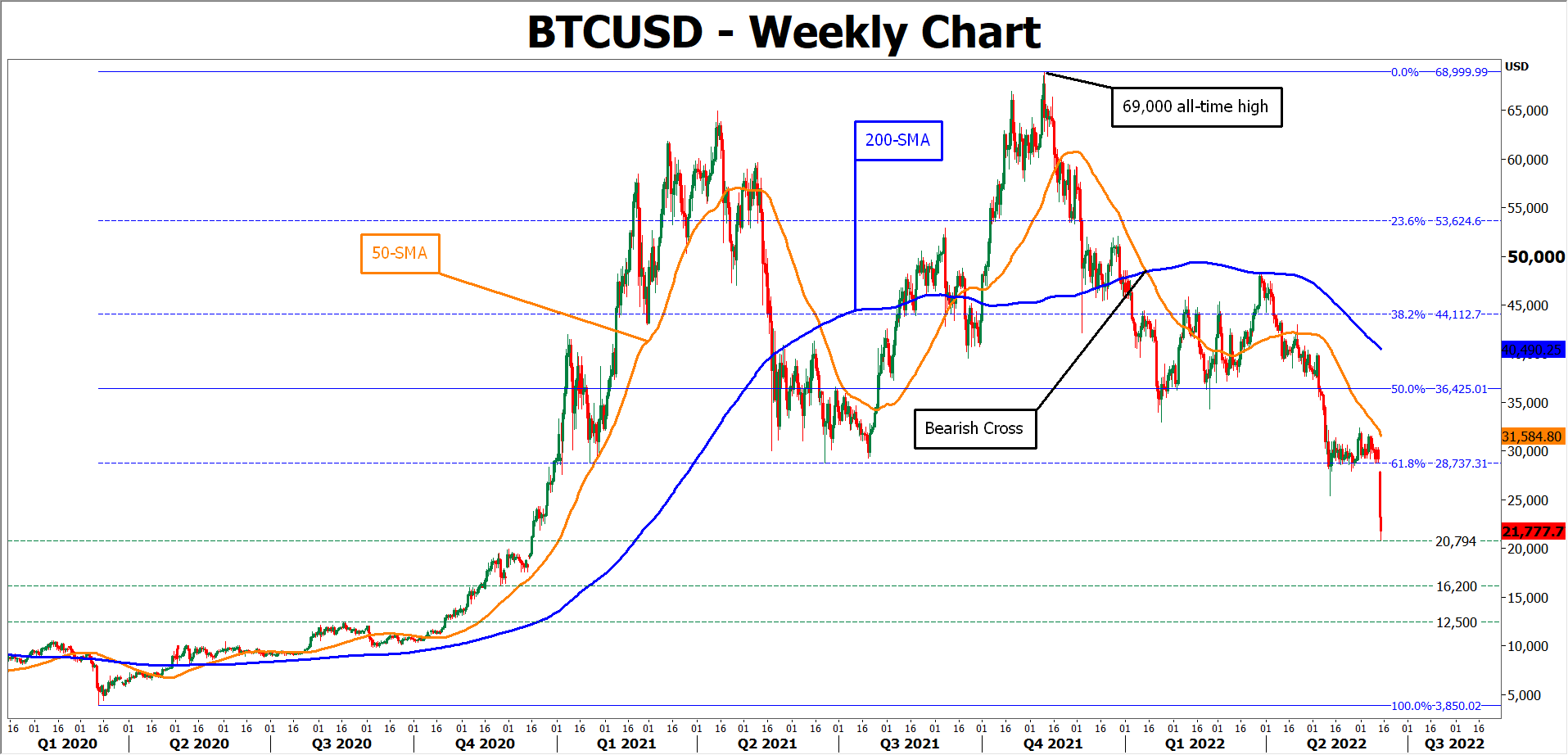
Should negative momentum strengthen and the price dives beneath the recent low of $20,794, the November 2020 support region of $16,200 could act as the first line of defense. Further downside moves could then stall at the August 2020 resistance of $12,500.
To the upside, bullish actions could propel the price towards the $28,737 level, which is the 61.8% Fibonacci retracement of the 3,850-68,999 upleg. Higher, the 50% Fibo of $36,425 may prove a tough obstacle for the bulls to overcome.
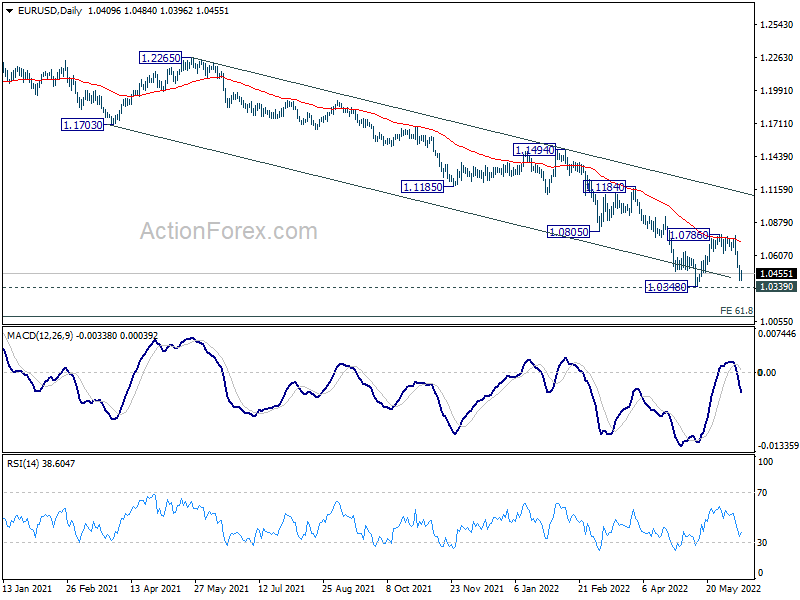
EUR/USD Mid-Day Outlook
Daily Pivots: (S1) 1.0366; (P) 1.0443 (R1) 1.0486; More...
A temporary low is formed at 1.0396 in EUR/USD and intraday bias is turned neutral first. Risk stays on the downside as long as 1.0786 resistance holds. Below 1.0396 will target 1.0039 long term support. Decisive break there will resume larger down trend. Next target is long term projection level at 1.0090.
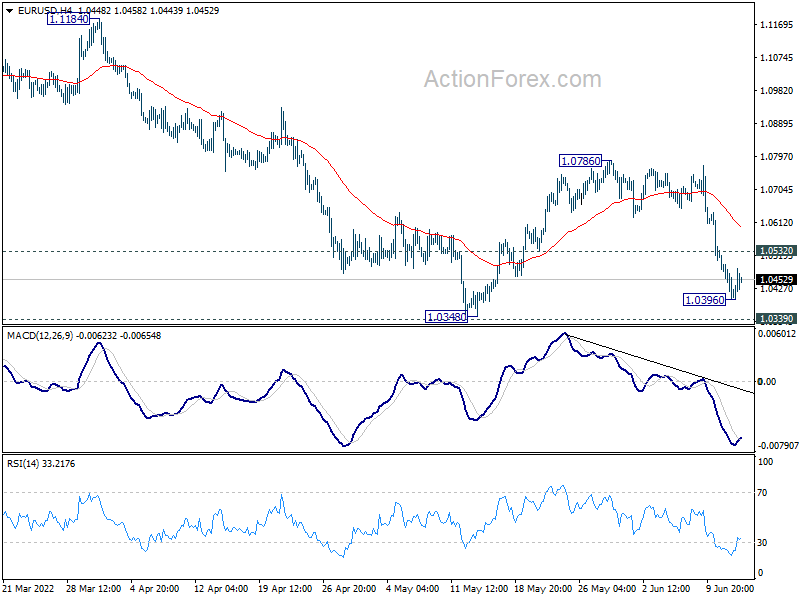
In the bigger picture, focus stays on 1.0339 long term support (2017 low). Decisive break there will resume whole down trend from 1.6039 (2008 high). Next target is 61.8% projection of 1.3993 to 1.0339 from 1.2348 at 1.0090. However, firm break of 1.0805 support turned resistance will delay this bearish case, and bring stronger rebound first.
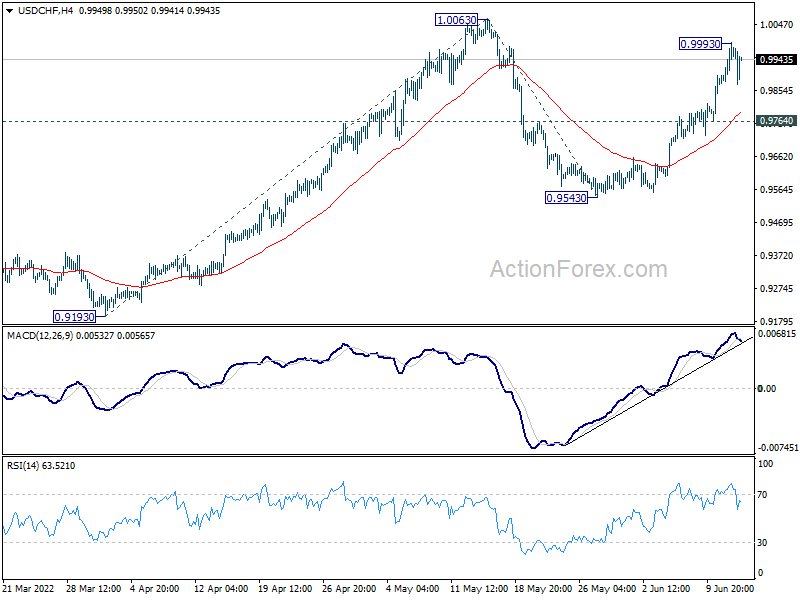
USD/CHF Mid-Day Outlook
Daily Pivots: (S1) 0.9898; (P) 0.9946; (R1) 1.0019; More...
Intraday bias in USD/CHF remains neutral for consolidation below 0.9993 temporary top. On the upside, above 0.9993 will target 1.0063 resistance. Firm break there will resume larger up trend. Next target is 100% projection of 0.9193 to 1.0063 from 0.9543 at 1.0413. On the downside, below 0.9764 minor support will extend the corrective pattern from 1.0063 with another falling leg, and turn intraday bias to the downside.
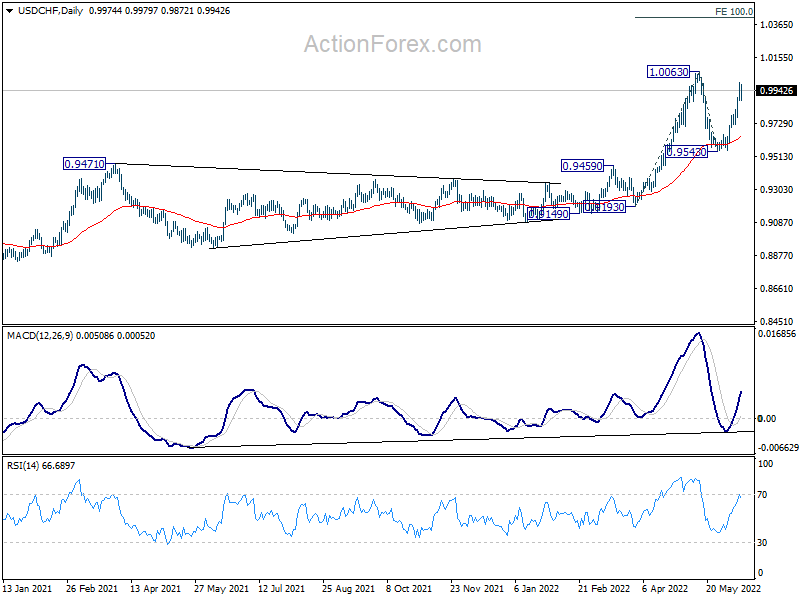
In the bigger picture, down trend from 1.0342 (2016 high) should have completed with three waves down to 0.8756 (2021 low) already. Rise from 0.8756 is likely a medium term up trend of its own. Next target is 1.0237/0342 resistance zone. This will remain the favored case as long as 0.9471 resistance turned support holds. However, sustained break of 0.9471 will extend long term range trading with another falling leg.
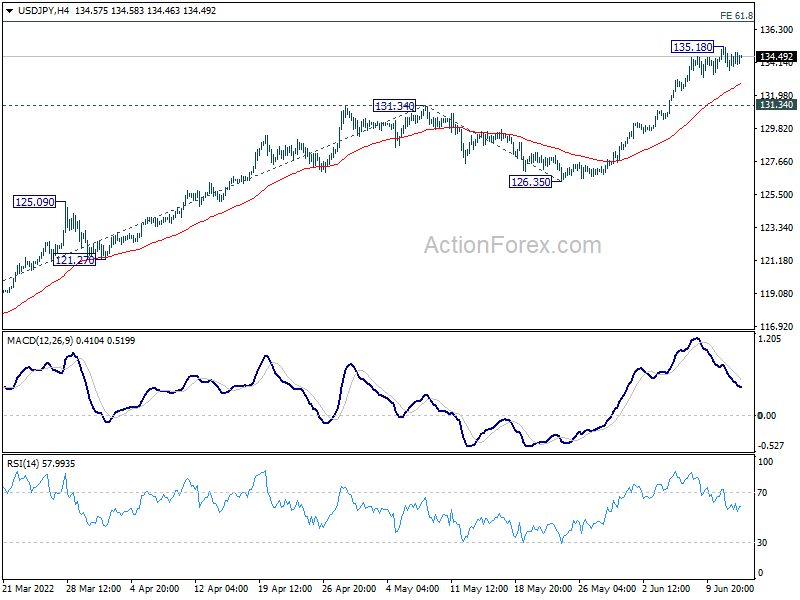
USD/JPY Mid-Day Outlook
Daily Pivots: (S1) 133.61; (P) 134.41; (R1) 135.21; More...
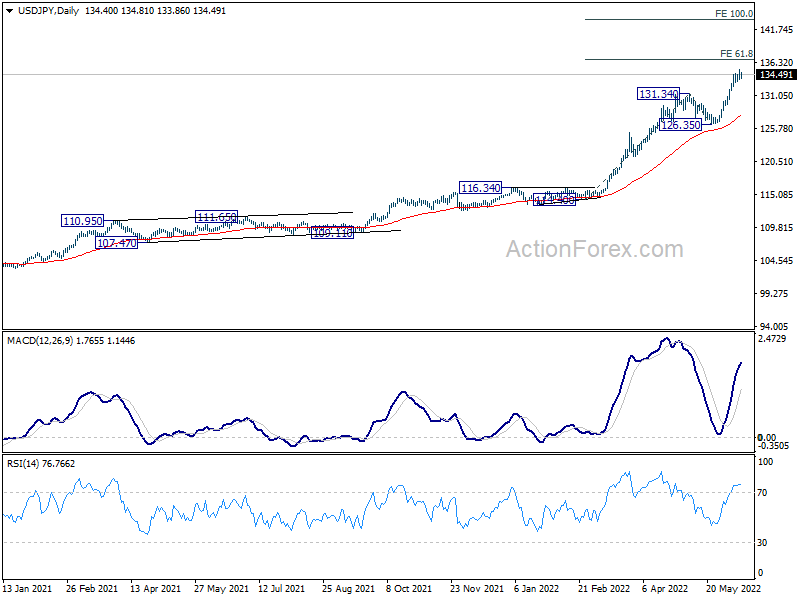
USD/JPY is staying in consolidation from 135.18 and intraday bias remains neutral. Downside of retreat should be contained by 131.34 resistance turned support to bring another rally. On the upside, break of 135.18 will resume larger up trend to 61.8% projection of 114.40 to 131.34 from 126.35 at 136.81. Firm break there will target 100% projection at 143.29.
In the bigger picture, current rally is seen as part of the long term up trend from 75.56 (2011 low). Next target is 100% projection of 75.56 (2011 low) to 125.85 (2015 high) from 98.97 at 149.26, which is close to 147.68 (1998 high). This will remain the favored case as long as 126.35 support holds.
GBP/USD Mid-Day Outlook
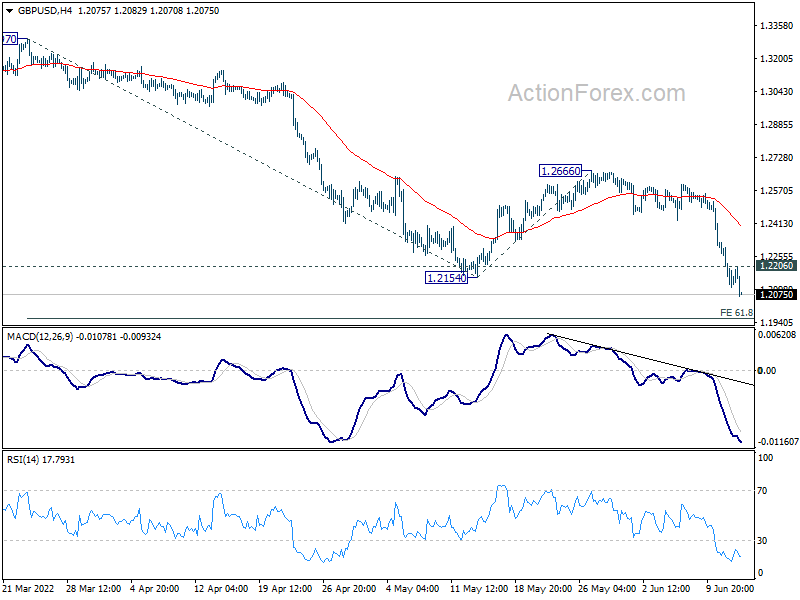
Daily Pivots: (S1) 1.2051; (P) 1.2188; (R1) 1.2269; More...
GBP/USD's down trend is still in progress. Intraday bias remains on the downside for 61.8% projection of 1.3297 to 1.2154 from 1.2666 at 1.1960. Break there will target 100% projection at 1.1523 next. On the upside, above 1.2206 minor resistance will turn intraday bias neutral and bring consolidations first, before staging another decline.
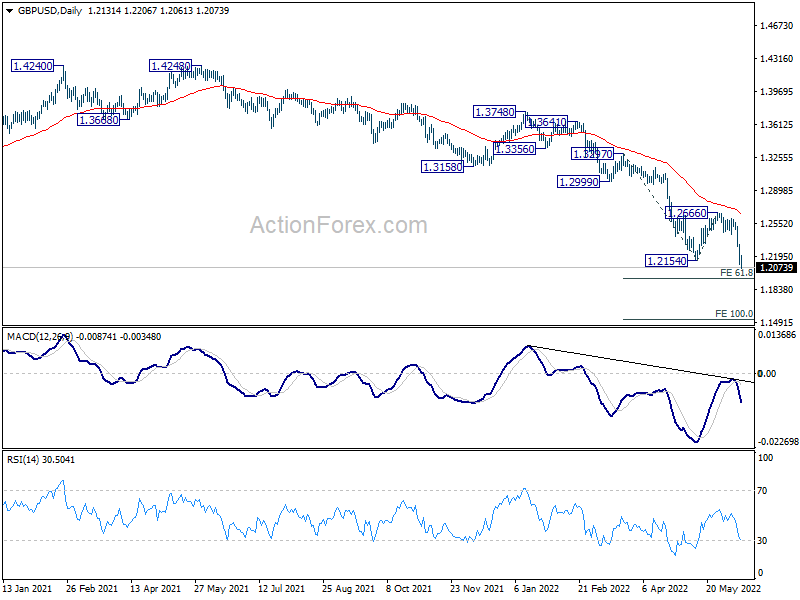
In the bigger picture, fall from 1.4248 (2018 high) could be a leg inside the pattern from 1.1409 (2020 low), or resuming the longer term down trend. Deeper decline is expected as long as 1.2666 resistance holds. On resumption, next target is 1.1409 low.
EUR/GBP Mid-Day Outlook
Daily Pivots: (S1) 0.8542; (P) 0.8568; (R1) 0.8604; More...
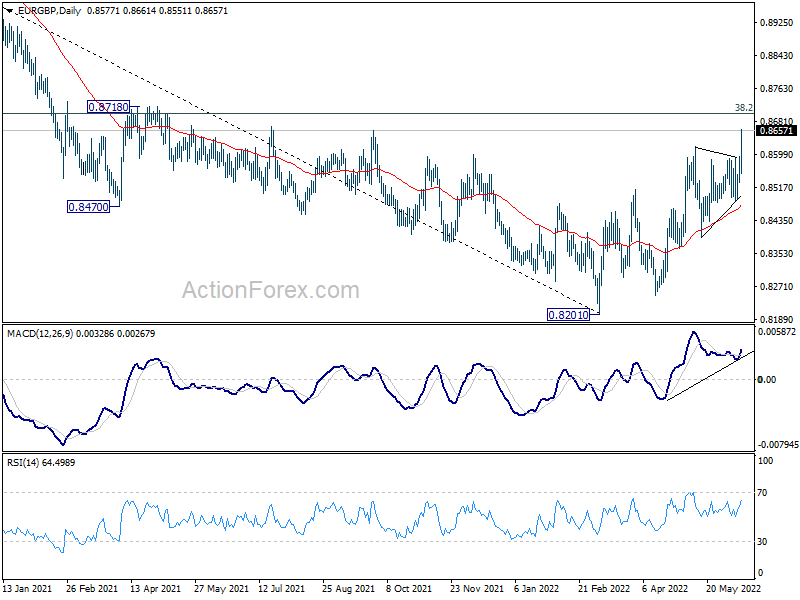
EUR/GBP's strong break of 0.8617 resistance confirms resumption of rise from 0.8201. Intraday bias is now on the upside for 0.8697 medium term fibonacci level. Sustained break there will carry larger bullish implication and target next fibonacci level at 0.9003. On the downside, below 0.8593 minor support will turn intraday bias neutral first. But outlook will stay bullish as long as 0.8484 support holds.
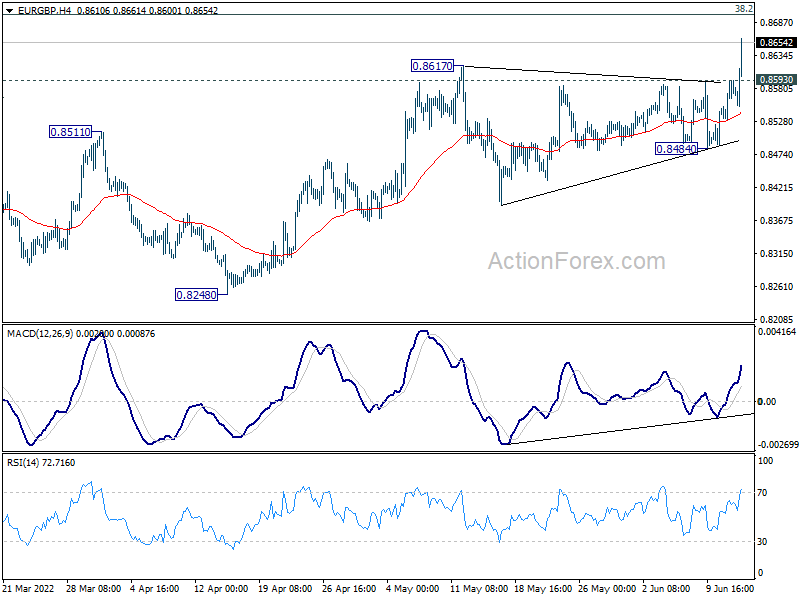
In the bigger picture, rise from 0.8201 medium term bottom could could either be a correction to the down trend from 0.9499 (2020 high), or a medium term up trend itself. Sustained break of 38.2% retracement of 0.9499 to 0.8201 at 0.8697 will affirm the latter case, and pave the way to 61.8% retracement at 0.9003.
Sterling Selloff Resumes, Dollar Power Continues
Sterling's selloff resumes today, after job data added to expectation that BoE would lag far behind Fed in tightening. Weak market sentiment sends commodity currencies lower. Thanks to buying against the Pound, Euro is so far the strongest one for today, leading Dollar, Yen and Swiss Franc. But still, Euro is far behind the greenback for the week. Overall, investor might start to turn cautious during the later part of today, as four central bank decisions lies ahead, starting with tomorrow's FOMC.
Technically, the selloff in the Pound is finally making some progress with EUR/GBP breaking through 0.8617 resistance firmly. A break through 1.1969 support in GBP/CHF would seal the bearish case for Sterling. Such development could push GBP/USD even deeper through 1.2 handle with downside acceleration.
In Europe, at the time of writing, FTSE is down -0.29%. DAX is down -0.18%. CAC is down -0.67%. Germany 10-year yield is up 0.025 at 1.662. Earlier in Asia, Nikkei dropped -1.32%. Hong Kong HSI closed flat. China Shanghai SSE rose 1.02%. Singapore Strait Times dropped -0.97%. Japan 10-year JGB yield rose 0.0013 to 0.256.
US PPI rose 0.8% mom, 10.8% yoy in May
US PPI for final demand rose 0.8% mom in May, matched expectations. For the 12-month period, PPI rose 10.8% yoy, down from April's 10.9% yoy, below expectation of 10.9% yoy. PPI less food, energy and trade services rose 0.5% mom, 6.8% yoy.
From Canada, manufacturing sales rose 1.7% mom in April, below expectation of 2.1% mom.
Germany ZEW rose to -28 in Jun, less pessimistic but still deep in negative
Germany ZEW Economic Sentiment rose from -34.3 to -28.0 in June, slightly below expectation of -27.5. Current Situation Index rose from -36.5 to -27.6, above expectation of -31.0.
Eurozone ZEW Economic Sentiment rose from -29.5 to -28.0, below expectation of -24.3. Current Situation Index rose 8.6 pts to -26.4.
"Financial market experts are less pessimistic about the economy. However, the economy is still exposed to numerous risks, such as the effects of the sanctions against Russia, the unclear pandemic situation in China and the gradual change of course in monetary policy. So although expectations have improved, they are still deep in negative territory," comments ZEW President Professor Achim Wambach on current expectations.
Also from Germany, CPI was finalized at 0.9% mom, 7.9% yoy in May.
UK payrolled employees rose 90k in May, unemployment rate unchanged at 3.8% in Apr
UK payrolled employees rose 90k, or 0.3% mom in May. Claimant count dropped -19.7k, versus expectations of -42.5k. Median monthly pay rose 5.4% yoy to GBP 2076.
In the three months to April, unemployment rate was unchanged at 3.8%. Economic inactivity rate dropped -0.1% to 21.3%. Average earnings including bonus rose 6.8% over the year, below expectation of 7.6%. Average earnings excluding bonus rose 4.2% over the year, above expectation of 4.0%.
RBA Lowe: Interest rate will get to 2.5% at some point
In an interview, RBA Governor Philip Lowe said, "Australians need to prepare for higher interest rates". He expects inflation to get to 7% by the end of the year, and "we need to be able to chart a course back to 2 to 3 per cent inflation".
Lowe said, "it's reasonable that the cash rate gets to 2½ per cent at some point... How fast we get to 2½ per cent, and indeed whether we get to 2½ per cent, is going to be determined by events."
He expects inflation to peak at around 7% in the December quarter this year. Inflation will "clearly be coming down" into the second half of next year.
Australia NAB business confidence dropped to 6 in May, conditions dropped to 16
Australia NAB business confidence dropped from 10 to 6 in May. Business conditions dropped from 19 to 16. Looking at some details, trading conditions dropped from 27 to 24. Profitability conditions dropped from 21 to 17. Employment conditions rose from 11 to 12.
"Lower confidence in May likely reflects a range of risks on the horizon," said NAB Group Chief Economist Alan Oster. "Businesses are facing a new environment of higher inflation, rising interest rates, and risks to global growth. However, confidence is still at a fairly robust level all things considered."
EUR/GBP Mid-Day Outlook
Daily Pivots: (S1) 0.8542; (P) 0.8568; (R1) 0.8604; More...
EUR/GBP's strong break of 0.8617 resistance confirms resumption of rise from 0.8201. Intraday bias is now on the upside for 0.8697 medium term fibonacci level. Sustained break there will carry larger bullish implication and target next fibonacci level at 0.9003. On the downside, below 0.8593 minor support will turn intraday bias neutral first. But outlook will stay bullish as long as 0.8484 support holds.
In the bigger picture, rise from 0.8201 medium term bottom could could either be a correction to the down trend from 0.9499 (2020 high), or a medium term up trend itself. Sustained break of 38.2% retracement of 0.9499 to 0.8201 at 0.8697 will affirm the latter case, and pave the way to 61.8% retracement at 0.9003.
Economic Indicators Update
| GMT | Ccy | Events | Actual | Forecast | Previous | Revised |
|---|---|---|---|---|---|---|
| 01:30 | AUD | NAB Business Confidence May | 6 | 10 | ||
| 01:30 | AUD | NAB Business Conditions May | 16 | 20 | ||
| 04:30 | JPY | Industrial Production M/M Apr F | -1.50% | -1.30% | -1.30% | |
| 06:00 | GBP | Claimant Count Change May | -19.7K | -42.5K | -56.9K | -65.5K |
| 06:00 | GBP | ILO Unemployment Rate (3M) Apr | 3.80% | 3.60% | 3.70% | |
| 06:00 | GBP | Average Earnings Including Bonus 3M/Y Apr | 6.80% | 7.60% | 7.00% | |
| 06:00 | GBP | Average Earnings Excluding Bonus 3M/Y Apr | 4.20% | 4.00% | 4.20% | |
| 06:00 | EUR | Germany CPI M/M May F | 0.90% | 0.90% | 0.90% | |
| 06:00 | EUR | Germany CPI Y/Y May F | 7.90% | 7.90% | 7.90% | |
| 09:00 | EUR | Germany ZEW Economic Sentiment Jun | -28 | -27.5 | -34.3 | |
| 09:00 | EUR | Germany ZEW Current Situation Jun | -27.6 | -31 | -36.5 | |
| 09:00 | EUR | Eurozone ZEW Economic Sentiment Jun | -28 | -24.3 | -29.5 | |
| 10:00 | USD | NFIB Business Optimism Index May | 93.1 | 93.1 | 93.2 | |
| 12:30 | USD | PPI M/M May | 0.80% | 0.80% | 0.50% | 0.40% |
| 12:30 | USD | PPI Y/Y May | 10.80% | 10.90% | 11.00% | 10.90% |
| 12:30 | USD | PPI Core M/M May | 0.50% | 0.60% | 0.40% | 0.20% |
| 12:30 | USD | PPI Core Y/Y May | 8.30% | 8.60% | 8.80% | |
| 12:30 | CAD | Manufacturing Sales M/M Apr | 1.70% | 2.10% | 2.50% | 3.50% |