

Sample Category Title
EUR/JPY Daily Outlook
Daily Pivots: (S1) 135.57; (P) 136.18; (R1) 136.81; More....
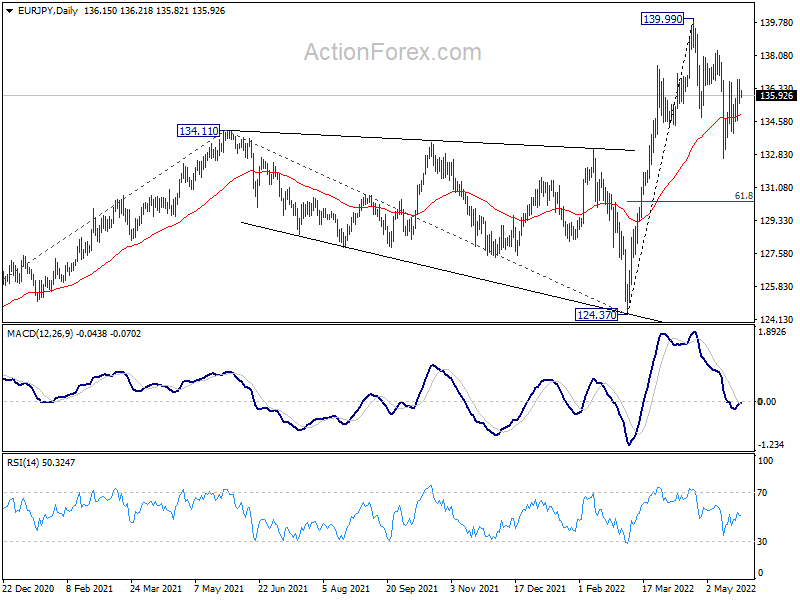
EUR/JPY is staying in the corrective pattern from 139.99 and intraday bias remains neutral first. On the downside, break of 132.63 will resume the fall and target 61.8% retracement of 124.37 to 139.99 at 130.33. On the upside, break of 138.33 will indicate that the correction has completed, and bring retest of 139.99 high next.
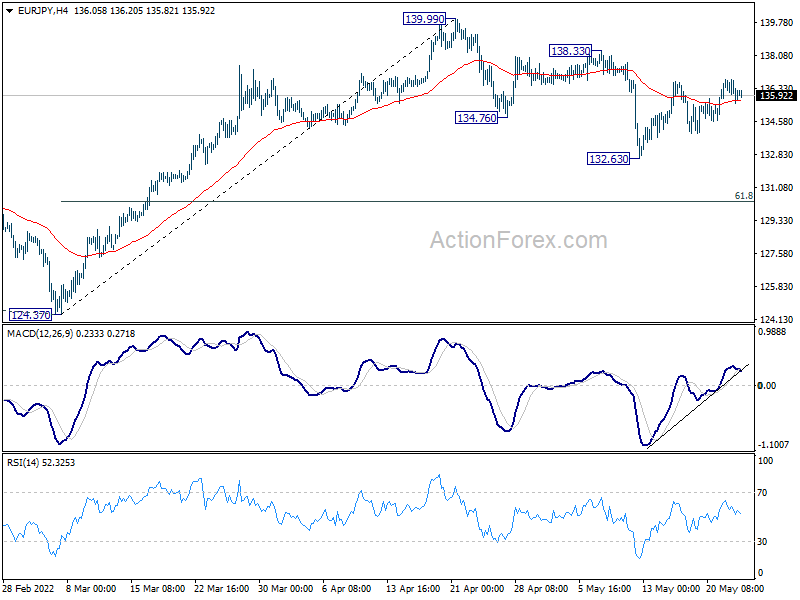
In the bigger picture, up trend from 114.42 (2020 low) is in progress. Such rise is seen as the third leg of the pattern from 109.30 (2016 low). Next target will be 100% projection of 114.42 to 134.11 from 124.37 at 144.06. In any case, outlook will now remain bullish as long as 124.37 support holds, in case of deep pull back.
EUR/GBP Daily Outlook
Daily Pivots: (S1) 0.8501; (P) 0.8544; (R1) 0.8608; More...
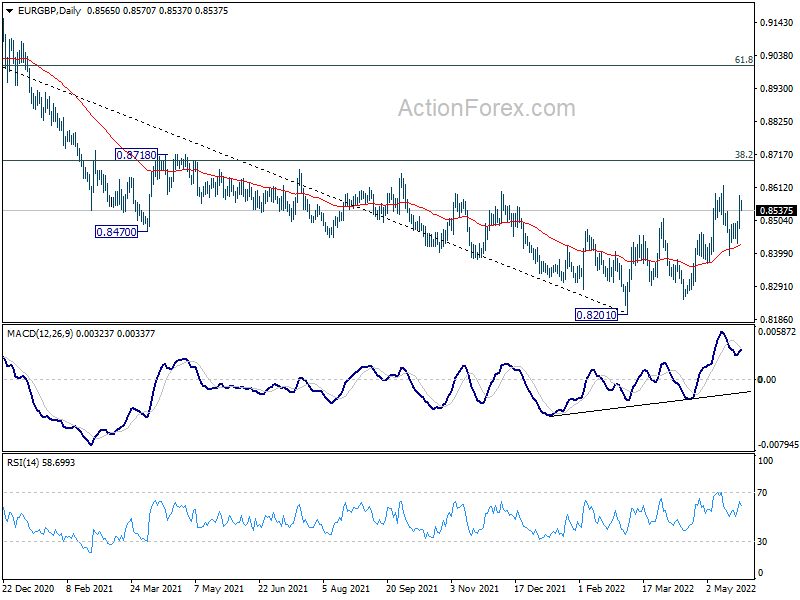
Intraday bias in EUR/GBP remains neutral for the moment. As long as 0.8365 support holds, further rally is still in favor. On the upside, break of 0.8617 will resume rise from 0.8201 medium term bottom to 0.8697 medium term fibonacci level. However, break of 0.8365 will dampen this bullish view, and turn bias back to the downside instead.
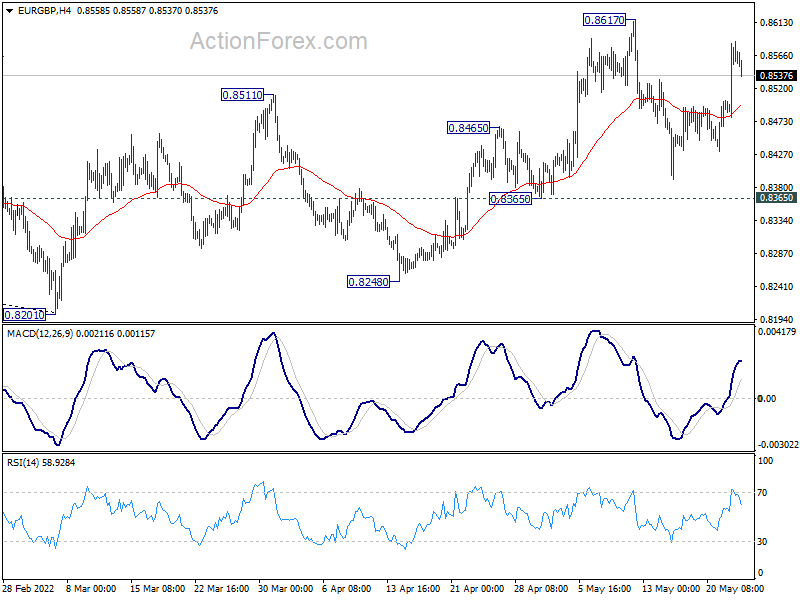
In the bigger picture, a medium term bottom could be in place at 0.8201, on bullish convergence condition in daily and weekly MACD. Rise from there could either be a correction to the down trend from 0.9499 (2020 high), or a medium term up trend itself. In either case, further rise should be seen to 38.2% retracement of 0.9499 to 0.8201 at 0.8697. Sustained break there will target 61.8% retracement at 0.9003.
EUR/AUD Daily Outlook
Daily Pivots: (S1) 1.5026; (P) 1.5113; (R1) 1.5190; More...
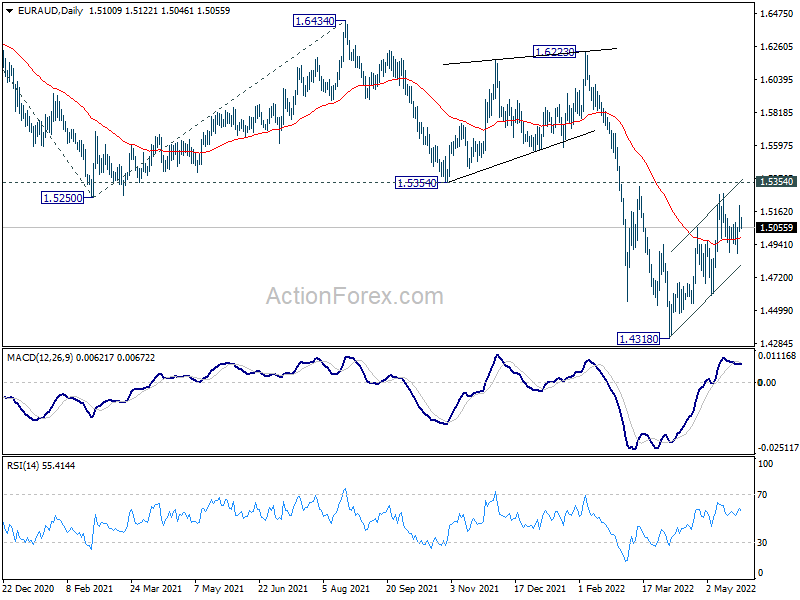
Intraday bias in EUR/AUD remains neutral for the moment. On the downside, break of 1.4882 support will reaffirm that case that corrective rebound from 1.4318 has completed at 1.5277, ahead of 1.5354 resistance. Intraday bias will be back on the downside for 1.4597 support first. Break there will bring retest of 1.4318 low. For now, risk will stay on the downside as long as 1.5277 resistance holds.
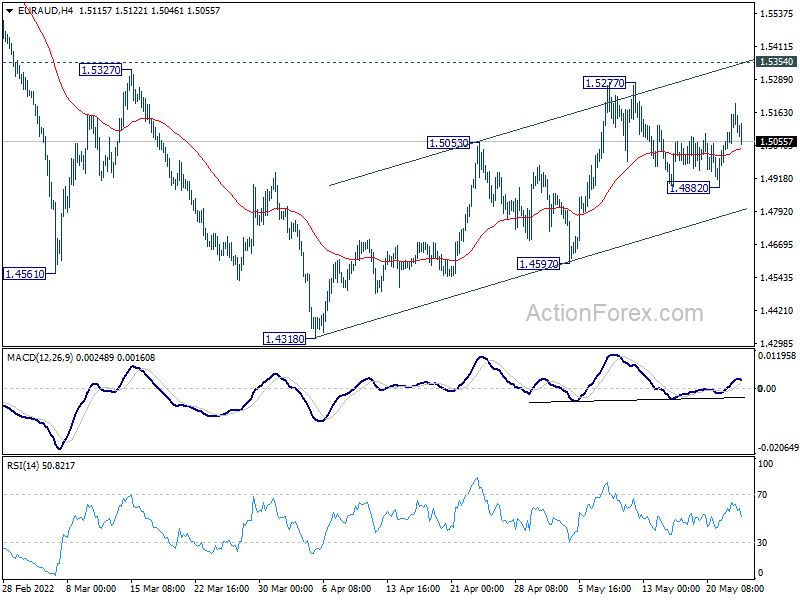
In the bigger picture, as long as 1.5354 support turned resistance holds, larger down trend form 1.9799 (2020 high) is still expected to continue. On resumption, next target is 61.8% projection of 1.9799 to 1.5250 from 1.6434 at 1.3623, which is close to 1.3624 long term support (2017 low). However, firm break of 1.5354 will indicate medium term bottoming and bring stronger rally back to 1.6434 key resistance.
NZD Surges on Hawkish RBNZ Hike, Euro Losing Momentum
New Zealand Dollar rises broadly today after an hawkish RBNZ rate hike, which suggests that interest rate could peak higher than earlier projected. Australian and Canadian Dollars are also generally firmer. On the other hand, Euro is starting to lose some upside momentum again, struggling to ECB driven rally. Swiss Franc and Sterling are soft too. Dollar and Yen are mixed, awaiting next guidance from overall risk sentiment.
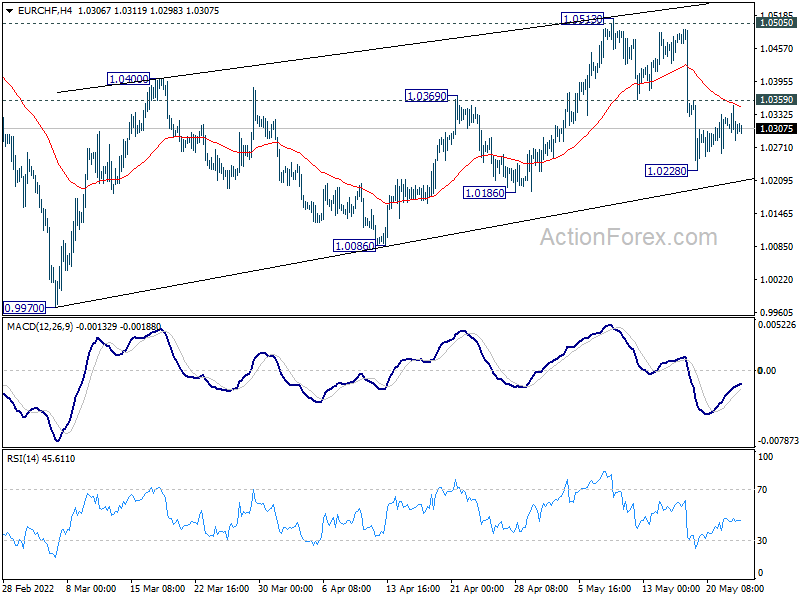
Technically, the next move in Euro is worth a note. While EUR/USD extended the rebound from 1.0348 short term bottom, there was no decisive buying elsewhere. Even against the weak Sterling, EUR/GBP is capped below 0.8617 temporary top. EUR/JPY is held well below 137.33 minor resistance. EUR/CHF is also limited below 1.0359 minor resistance. Selling in Euro could come back, especially in crosses, should EUR/USD's rebound falters.
In Asia, at the time of writing, Nikkei is up 0.12%. Hong Kong HSI is up 0.64%. China Shanghai SSE is up 0.58%. Singapore Strait Times is down -0.21%. Japan 10-year JGB yield is down -0.021 at 0.211. Overnight, DOW rose 0.15%. S&P 500 dropped -0.81%. NASDAQ dropped -2.35%. 10-year yield dropped -0.099 to 2.760.
RBNZ hikes by 50bps, rate projected to peak at 3.9%
RBNZ raised the Official Cash Rate by 50bps to 2.00% as widely expected. The central bank now projects OCR to peak at 3.9% in Q2 of 2023, before moving down slightly starting from Q3 2024.
In the statement, RBNZ said: "The Committee viewed the projected path of the OCR as consistent with achieving its primary inflation and employment objectives without causing unnecessary instability in output, interest rates and the exchange rate. Once aggregate supply and demand are more in balance, the OCR can then return to a lower, more neutral, level."
Also in the new forecasts, GDP would grow 5.4% in 2022, then slow to 3.2% in 2023, 1.3% in 2024, and 1.2% in 2025. CPI would average 6.9% in 2022, then slow to 4.4% in 2023, 2.5% in 2024, and 2.0% in 2025. Unemployment rate is projected to be at 3.2% in 2022, then gradually climb to 3.8% in 2023, 4.4% in 2024, and 4.7% in 2025.
NZD/USD rising towards 0.6527/8 cluster resistance
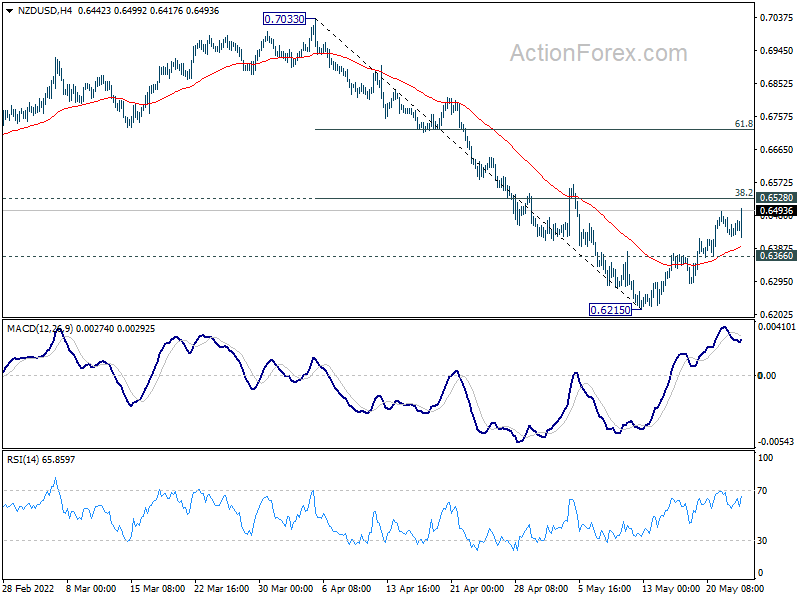
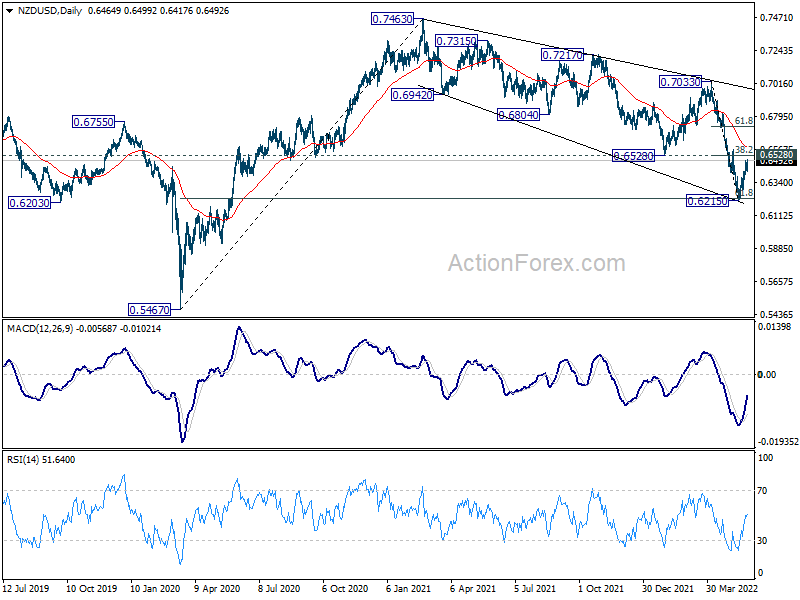
NZD/USD rises slightly after RBNZ rate hike, as rebound from 0.6215 short term bottom extends. Immediate focus is now on 0.6528 cluster resistance (38.2% retracement of 0.7033 to 0.6215 at 0.6527).
Sustained break of 0.6527/8 will raise the chance that whole corrective pattern from 0.7463 has completed at 0.6215. That came after drawing support from 61.8% retracement of 0.5467 to 0.7463 at 0.6229. In this case, further rally would be seen to 61.8% retracement of 0.7033 to 0.6215 at 0.6721.
However, rejection by 0.6527/8 will retain near term bearishness. Break of 0.6366 minor support will bring retest of 0.6215 low.
Japan government concerned of re-spread of coronavirus in China and Ukraine war
In May's Monthly Economic Report, Japan's government maintained that the economy "shows movement of picking up". Private consumption, business investment and industrial production have "shown movement of picking up". Exports were still "almost flat".
Employment assessment was upgrade slightly to "shows movement of picking up" rather than just in "some components. Consumer prices "have been rising recently", with "moderately" dropped.
The government also warned that "full attention should be given to the downside risks due to supply-side constraints, rising raw material prices and fluctuations in the financial and capital markets while there are concerns regarding the effects of the re-spread of the Novel Coronavirus in China and lengthening the state of affairs of Ukraine".
Looking ahead
Germany Gfk consumer confidence and Q1 GDP final will be released in European session, together with Swiss Credit Suisse economic expectations. Later in the day, US will release durable goods orders and FOMC minutes.
EUR/AUD Daily Outlook
Daily Pivots: (S1) 1.5026; (P) 1.5113; (R1) 1.5190; More...
Intraday bias in EUR/AUD remains neutral for the moment. On the downside, break of 1.4882 support will reaffirm that case that corrective rebound from 1.4318 has completed at 1.5277, ahead of 1.5354 resistance. Intraday bias will be back on the downside for 1.4597 support first. Break there will bring retest of 1.4318 low. For now, risk will stay on the downside as long as 1.5277 resistance holds.
In the bigger picture, as long as 1.5354 support turned resistance holds, larger down trend form 1.9799 (2020 high) is still expected to continue. On resumption, next target is 61.8% projection of 1.9799 to 1.5250 from 1.6434 at 1.3623, which is close to 1.3624 long term support (2017 low). However, firm break of 1.5354 will indicate medium term bottoming and bring stronger rally back to 1.6434 key resistance.
Economic Indicators Update
| GMT | Ccy | Events | Actual | Forecast | Previous | Revised |
|---|---|---|---|---|---|---|
| 01:30 | AUD | Construction Work Done Q1 | -0.90% | 1.00% | -0.40% | 0.60% |
| 02:00 | NZD | RBNZ Interest Rate Decision | 2.00% | 2.00% | 1.50% | |
| 06:00 | EUR | Germany Gfk Consumer Confidence Jun | -25.6 | -26.5 | ||
| 06:00 | EUR | Germany GDP Q/Q Q1 F | 0.20% | 0.20% | ||
| 08:00 | CHF | Credit Suisse Economic Expectations May | -51.6 | |||
| 12:30 | USD | Durable Goods Orders Apr | 0.60% | 1.10% | ||
| 12:30 | USD | Durable Goods Orders ex Transport Apr | 0.60% | 1.40% | ||
| 14:30 | USD | Crude Oil Inventories | -2.2M | -3.4M | ||
| 18:00 | USD | FOMC Minutes |
Technical Outlook and Review
DXY:
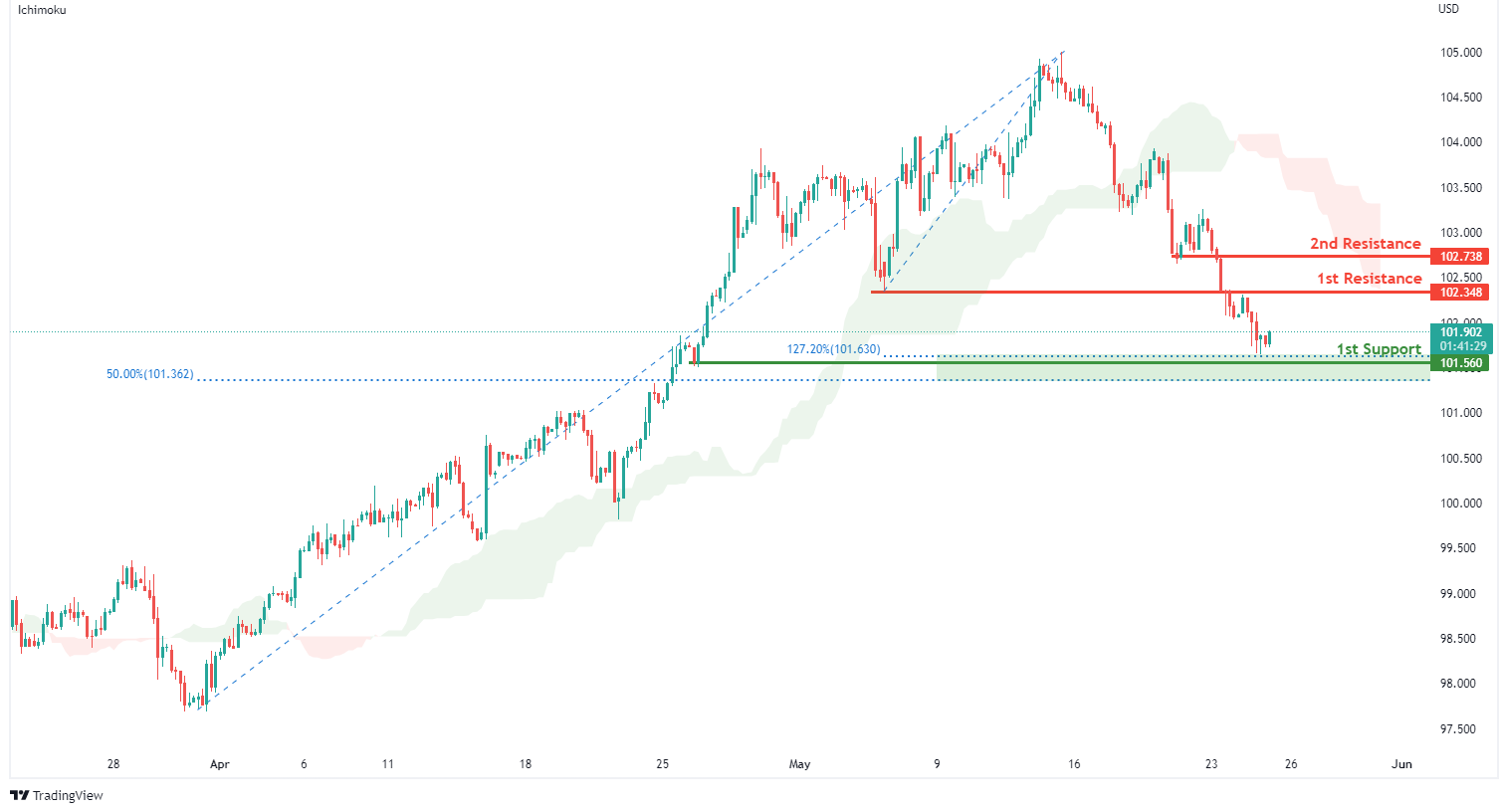
On the H4, with prices below the ichimoku indicator, we have a bearish bias that price will drop to our 1st support at 101.560 where the horizontal swing low support, 127.2% Fibonacci extension and 50% Fibonacci retracement are from our 1st resistance at 102.348 in line with the horizontal pullback resistance. Alternatively, price may break 1st resistance structure and head for 2nd resistance at 102.738 where the horizontal pullback resistance is.
Areas of consideration:
- H4 time frame, 1st resistance at 102.348
- H4 time frame, 1st support at 101.560
XAU/USD (GOLD):
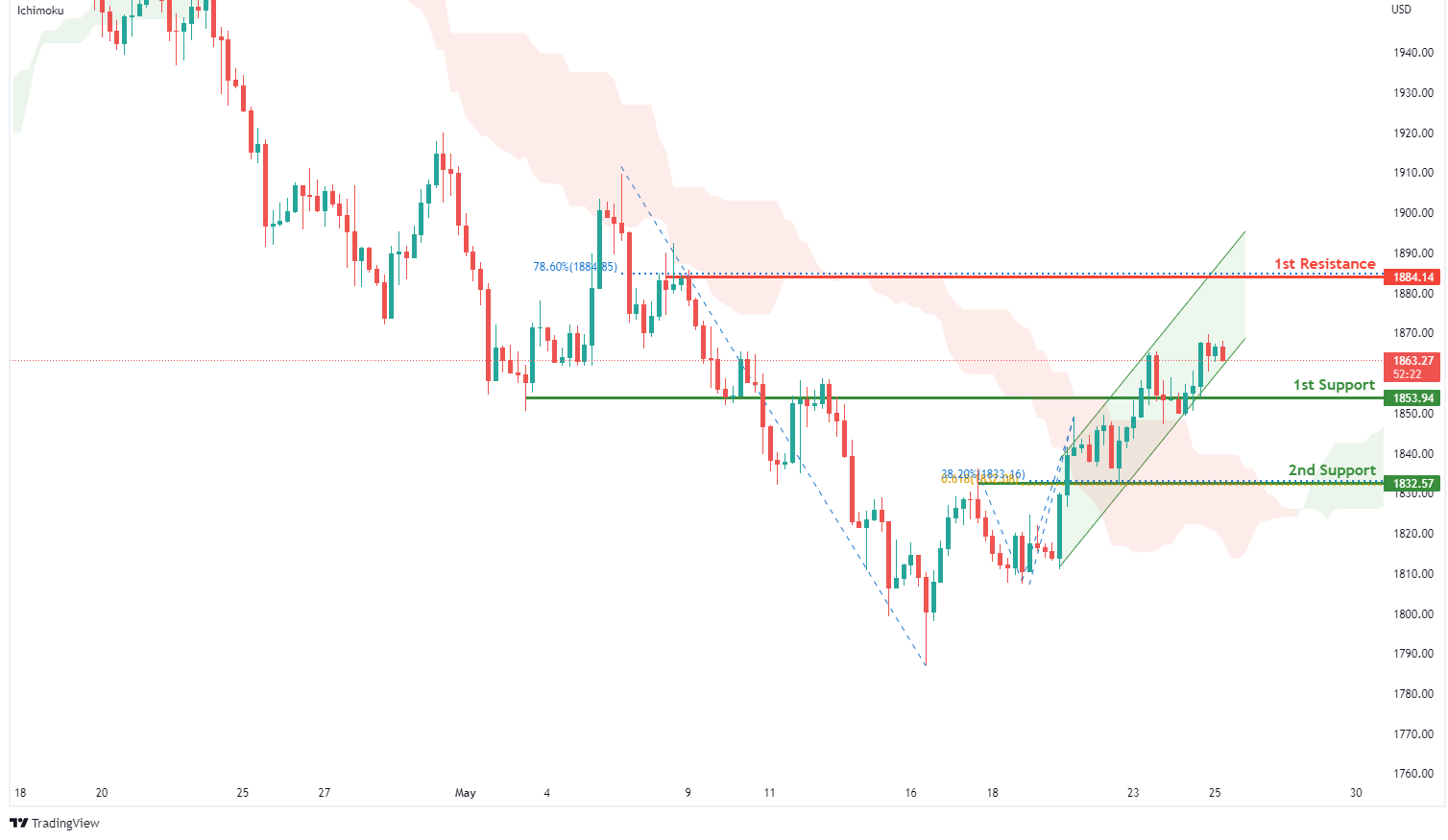
On the H4, with prices moving above the ichimoku cloud, we have a bullish bias that price will rise from our 1st support at 1853.94 where the horizontal overlap support is to our 1st resistance at 1884.14 in line with the horizontal swing high resistance and 78.6% Fibonacci retracement. Alternatively, price may break 1st support structure and head for 2nd support at 1832.57 where the horizontal overlap support, 38.2% fibonacci retracement and 61.8% fibonacci projection.
Areas of consideration:
- H4 time frame, 1st Resistance at 1884.14
- H4 time frame, 1st Support at 1853.94
GBP/USD:
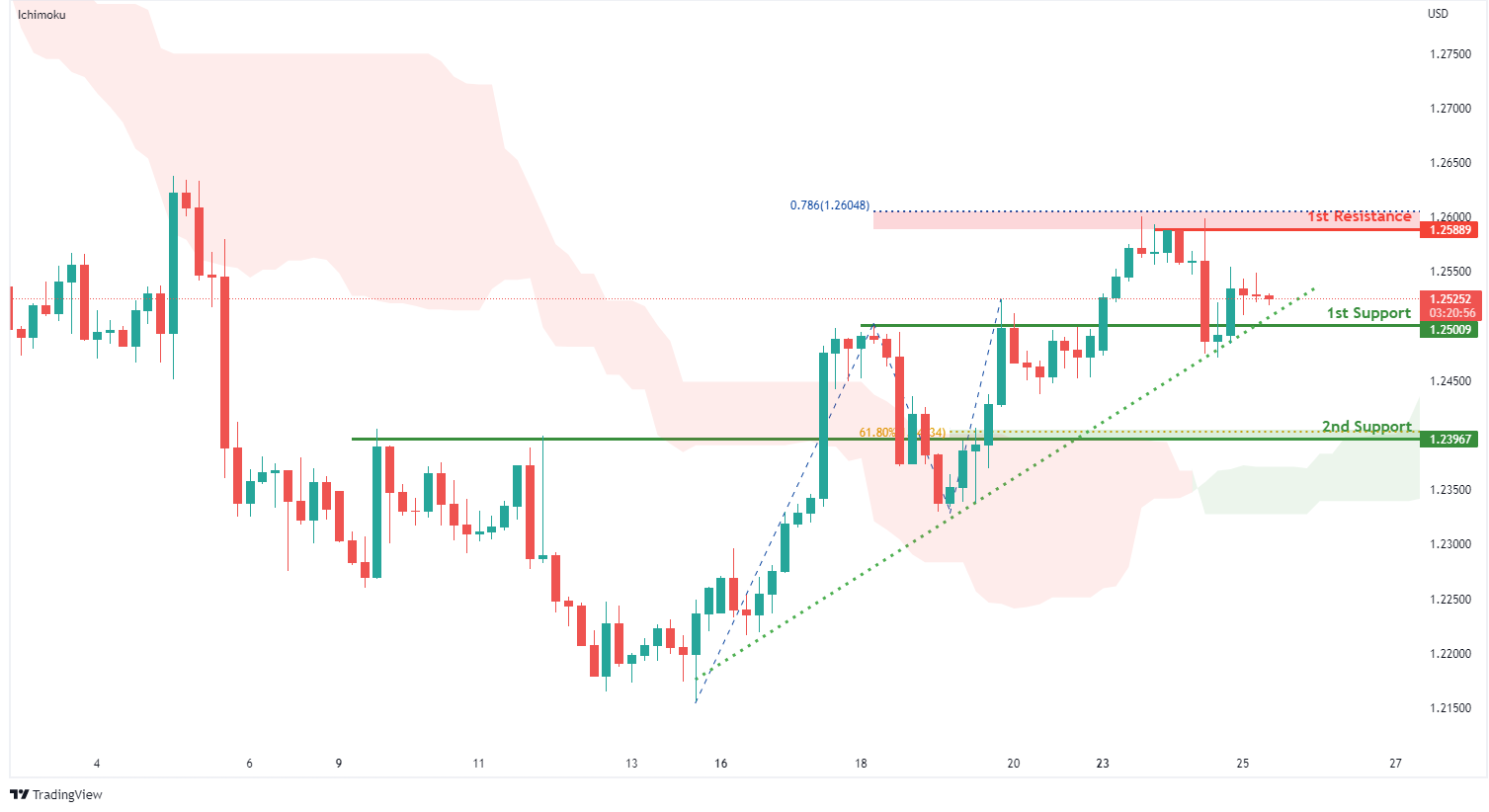
On the H4, with price moving above the ichimoku indicator, we have a bullish bias that price will rise from our 1st support at 1.25009 where the horizontal overlap support is to our 1st resistance at 1.25889 in line with the 78.6% Fibonacci projection. Alternatively, price may break 1st support structure and head for 2nd support at 1.23967 where the horizontal overlap support and 61.8% Fibonacci retracement are.
Areas of consideration:
- H4 1st resistance at 1.25889
- H4 1st support at 1.25009
USD/CHF:
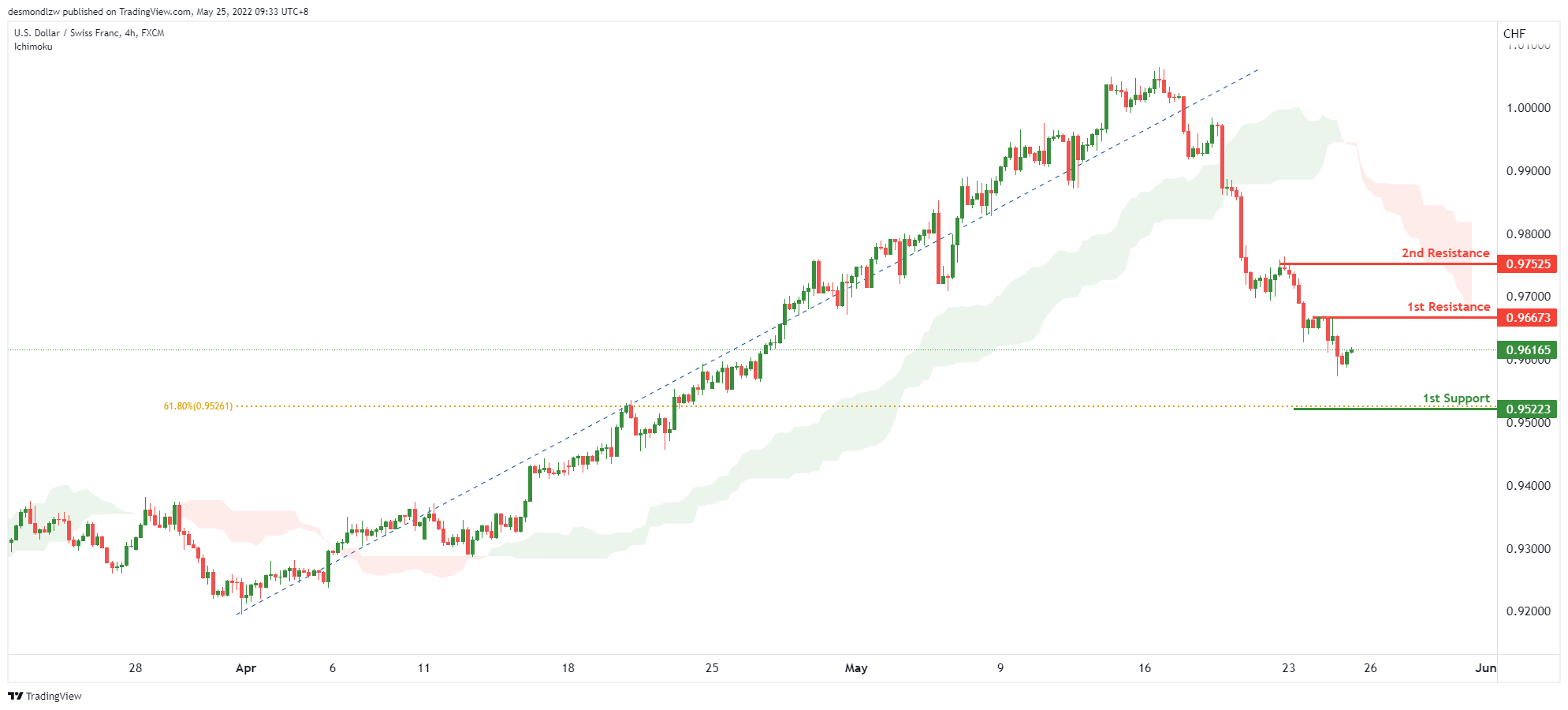
On the H4, with price moving below the ichimoku cloud, we have a bearish bias that price will drop to our 1st support at 0.95223 where the 61.8% Fibonacci retracement is from our 1st resistance at 0.96673 in line with the pullback resistance. Alternatively, price may break 1st resistance structure and head for 2nd resistance at 0.97525 where the swing high resistance is.
Areas of consideration
- 1st support level at 0.95223
- 1st resistance level at 0.96673
EUR/USD :
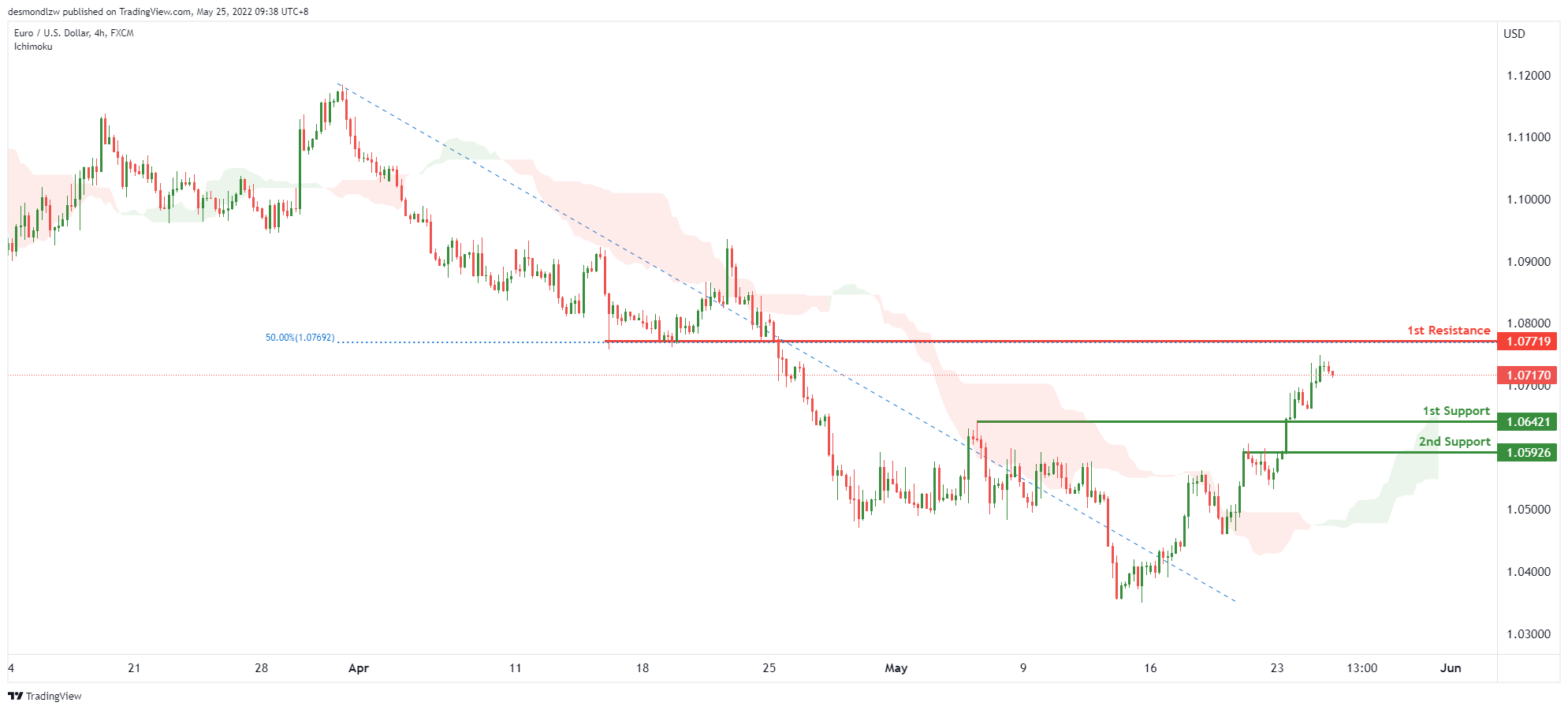
On the H4, with price moving above the ichimoku cloud, we have a bullish bias that price will rise to our 1st resistance at 1.07719 where the 50% Fibonacci retracement is from our 1st support at 1.06421 in line with the pullback support. Alternatively, price may break 1st support structure and head for 2nd support at 1.05926 where the horizontal pullback support is.
Areas of consideration :
- H4 1st resistance at 1.07719
- H4 1st support at 1.06421
USD/JPY:
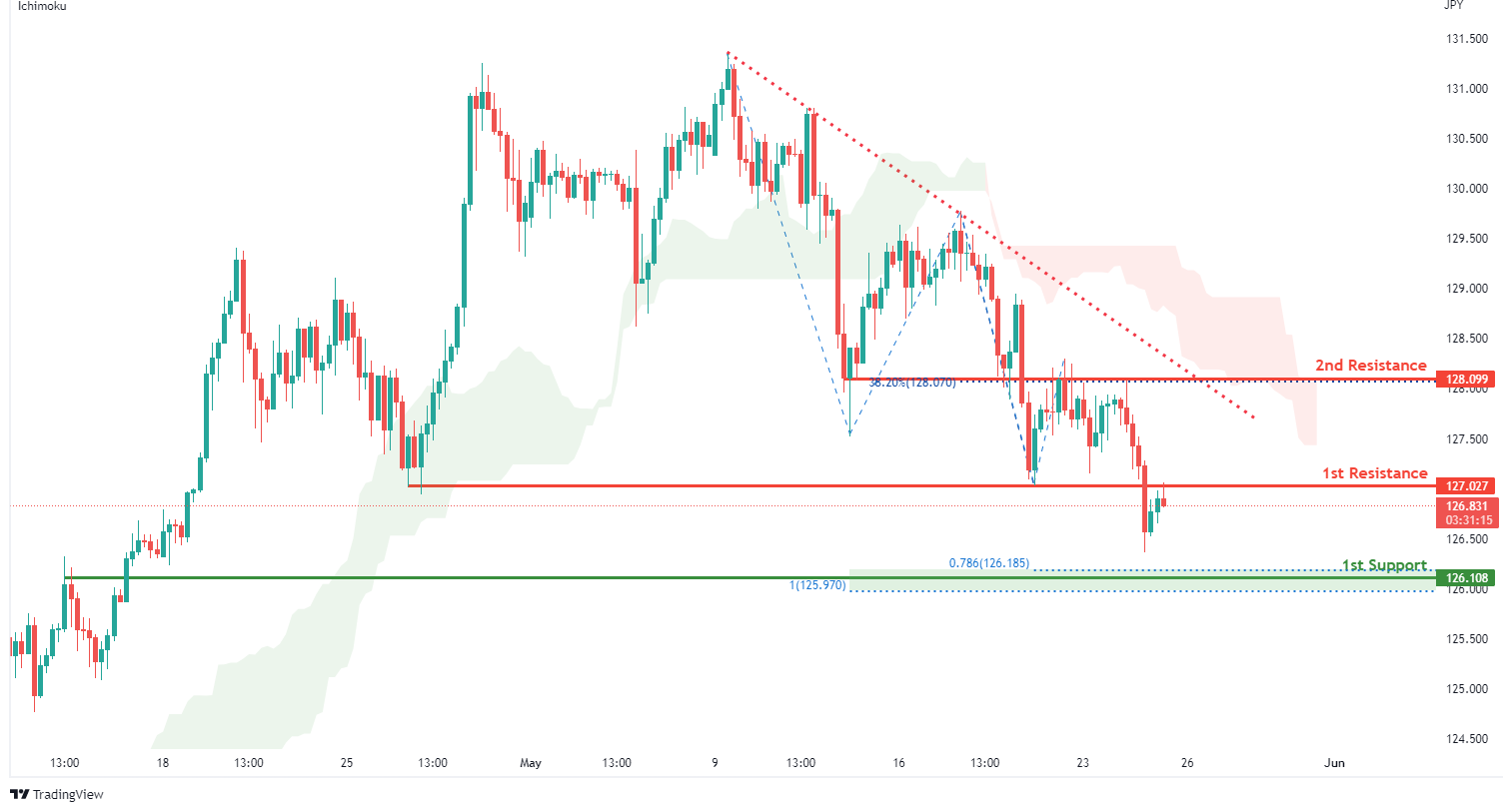
On the H4, with prices moving below the ichimoku indicator, we have a bearish bias that price will drop from our 1st resistance at 127.027 where the horizontal overlap resistance is to our 1st support at 126.108 in line with the 78.6% Fibonacci projection, pullback support and 100% fibonacci projection. Alternatively, price may break 1st resistance structure and head for 2nd resistance at 128.099 where the horizontal overlap resistance and 38.2% Fibonacci retracement are.
Areas of consideration:
- H4 time frame, 1st resistance at 127.027
- H4 time frame, 1st support at 126.108
AUD/USD:
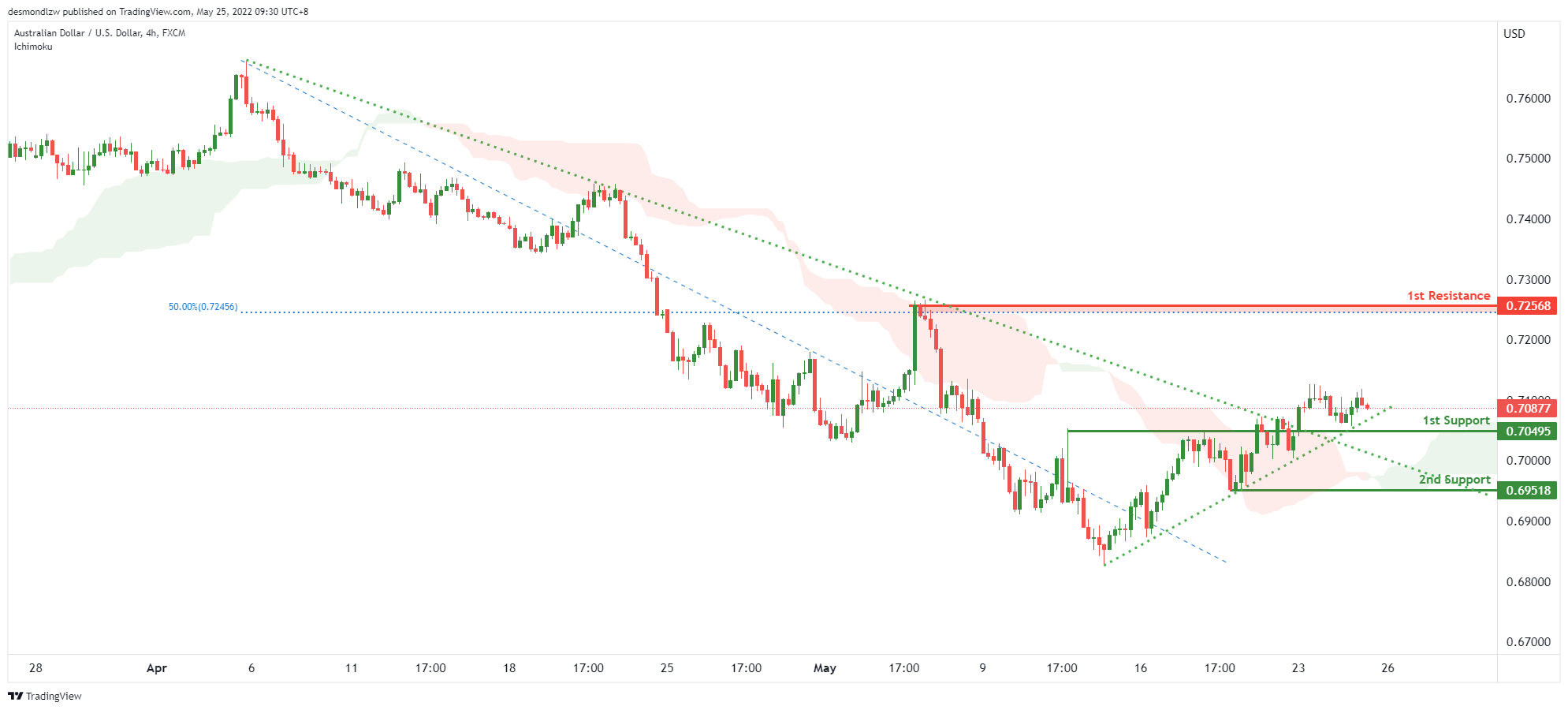
On the H4, with price moving above the ichimoku cloud and price breakout from the descending trendline, we have a bullish bias that price will rise to our 1st resistance at 0.72568 where the 50% Fibonacci retracement is from our 1st support at 0.70495 in line with the horizontal pullback support. Alternatively, price may break structure and head for 2nd support at 0.69518 where the horizontal pullback support is.
Areas of consideration
- H4 1st resistance at 0.72568
- H4 1st support at 0.70495
NZD/USD:
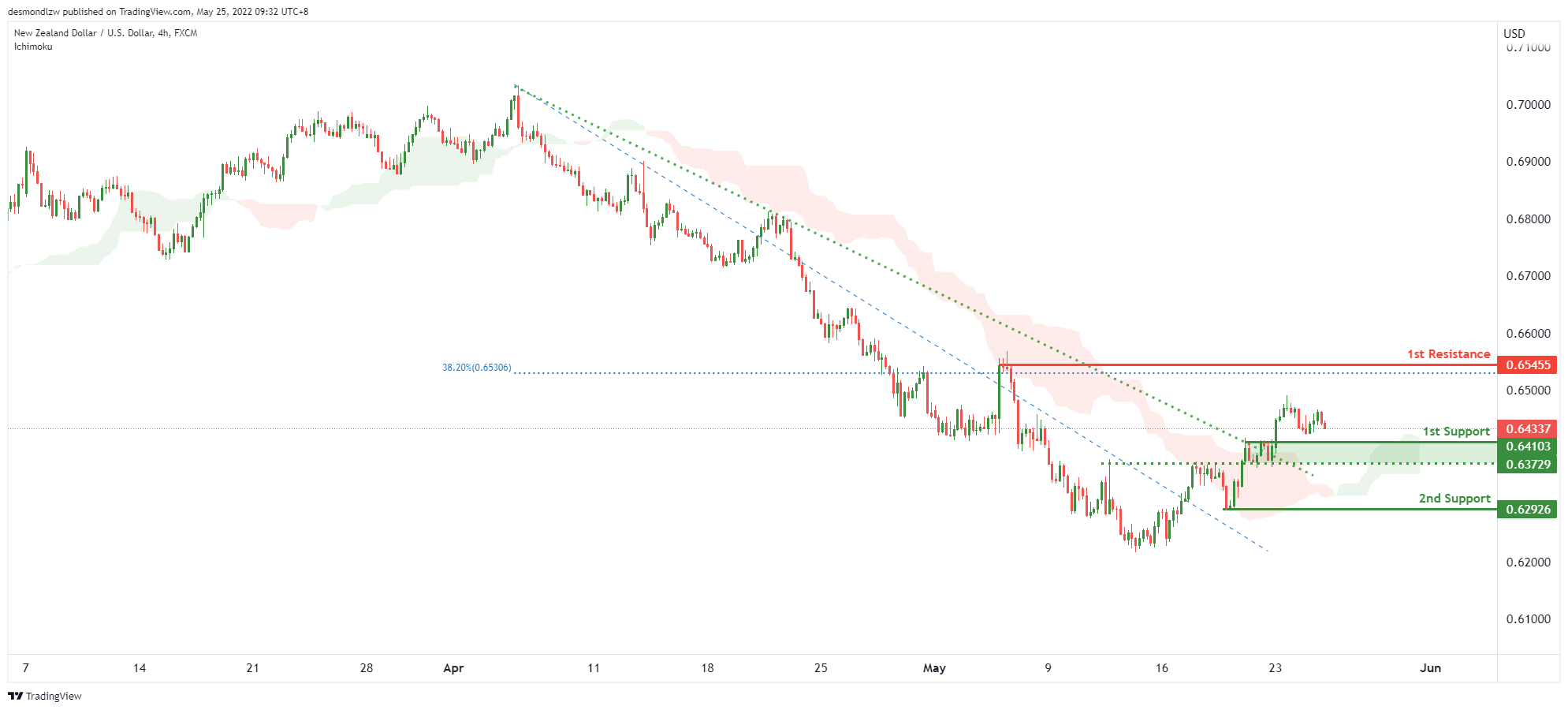
On the H4, with price moving above the ichimoku cloud, we have a bullish bias that price will rise to our 1st resistance at 0.65455 where the 38.2% Fibonacci retracement and swing high resistance are from our 1st support at 0.64103 in line with the pullback support. Take note of intermediary support at 0.63729 where the overlap support is. Alternatively, price may break structure and head for 2nd support at 0.62926 where the swing low support is.
Areas of consideration:
- H4 time frame, 1st support at 0.64103
- H4 time frame, 1st resistance at 0.65455
USD/CAD:
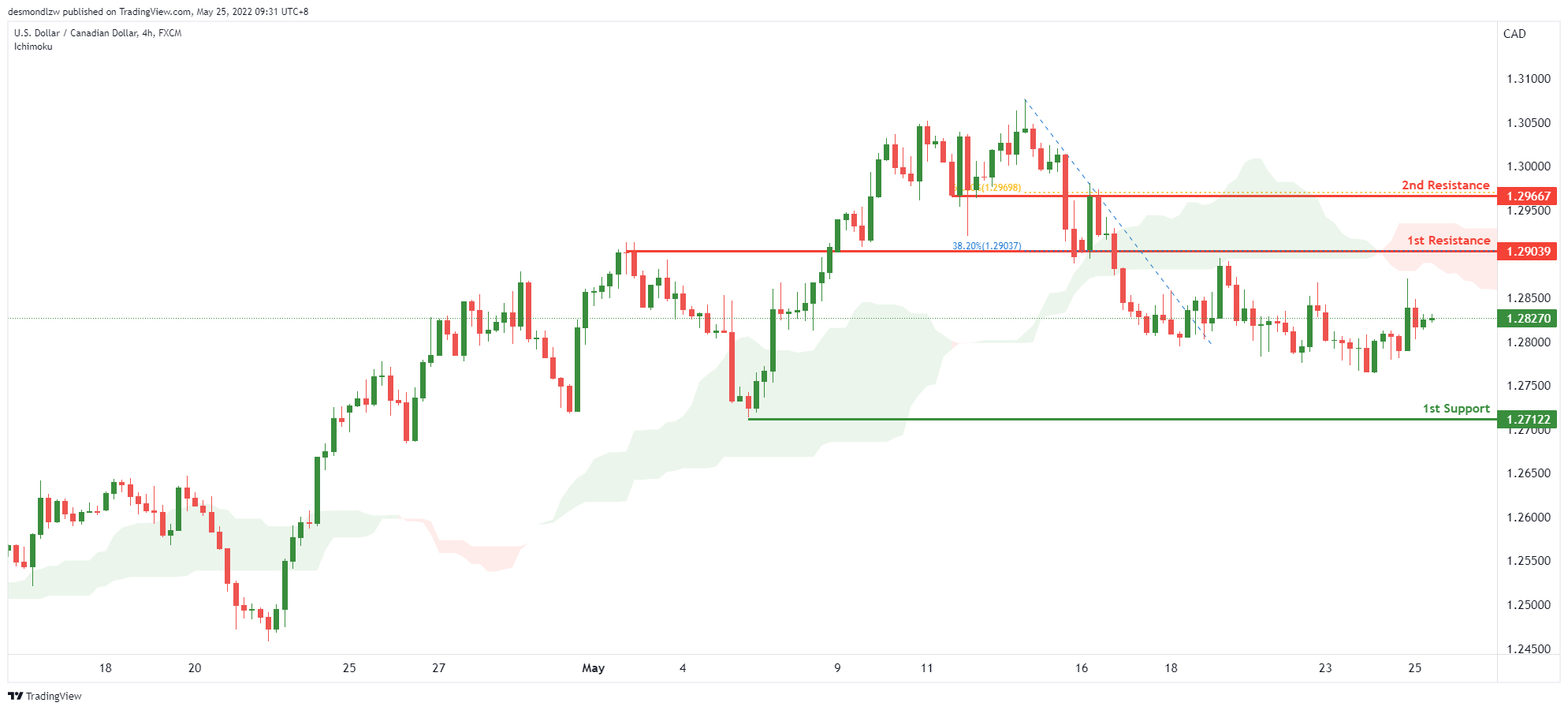
On the H4, with price moving below the ichimoku, we have a bearish bias that price will drop from our 1st resistance at 1.29039 where the horizontal overlap resistance and 38.2% Fibonacci retracement is to our 1st support at 1.27122 in line with the swing low support. Alternatively, price may break 1st resistance structure and head for 2nd resistance at 1.29667 where the horizontal overlap resistance and 61.8% Fibonacci retracement are.
Areas of consideration:
- H4 time frame, 1st resistance at 1.29039
- H4 time frame, 1st support at 1.27122
OIL:
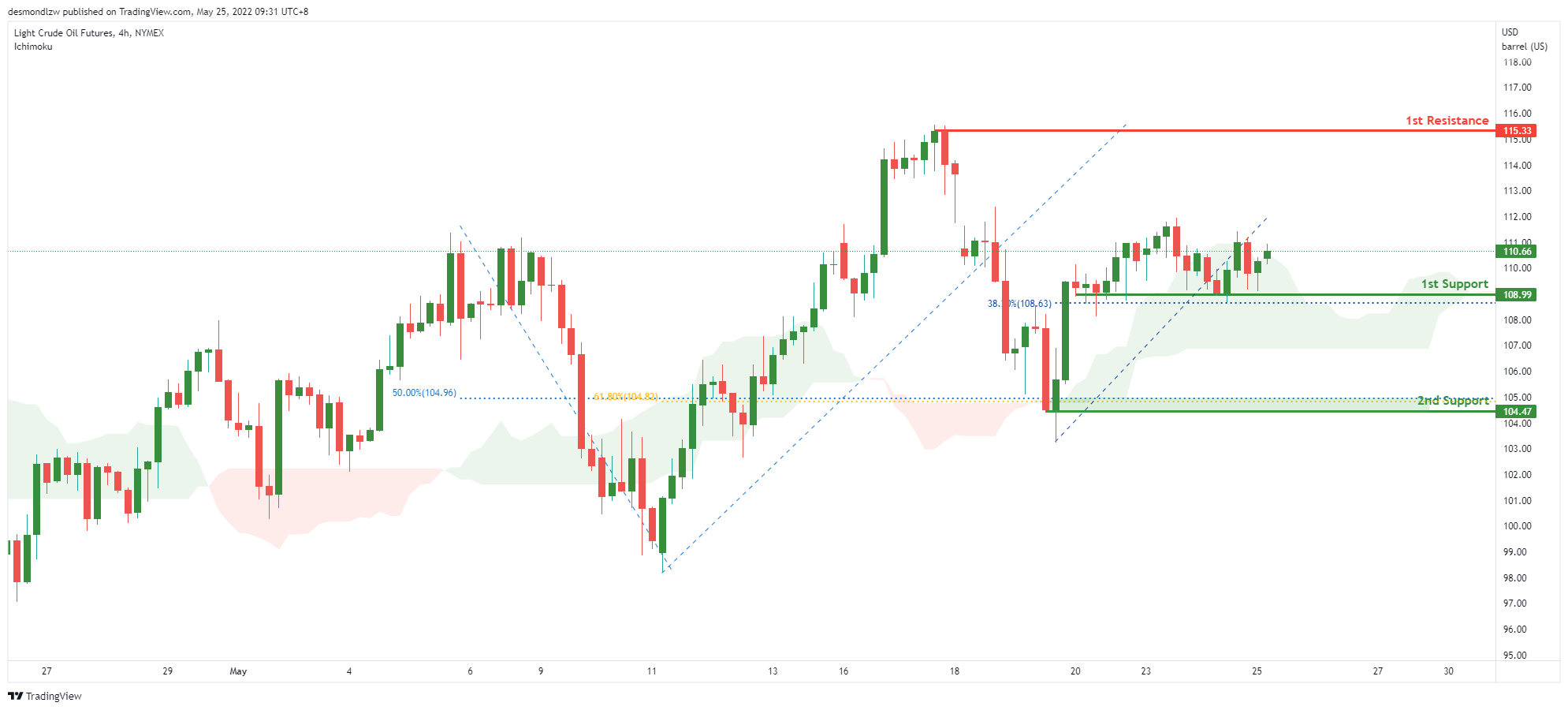
On the H4, with price expected to bounce off the ichimoku cloud, we have a bullish bias that price will rise to our 1st resistance at 115.33 where the swing high resistance is from our 1st support at 108.99 in line with the swing low support, 38.2% fibonacci retracement and 61.8%% fibonacci retracement. Alternatively, price may break 1st support structure and head for 2nd support at 104.47 where the horizontal swing low support, 50% fibonacci retracement and 61.8%% fibonacci retracement is.
Areas of consideration:
- H4 time frame, 1st resistance of 115.33
- H4 time frame, 1st support of 108.99
Dow Jones Industrial Average:
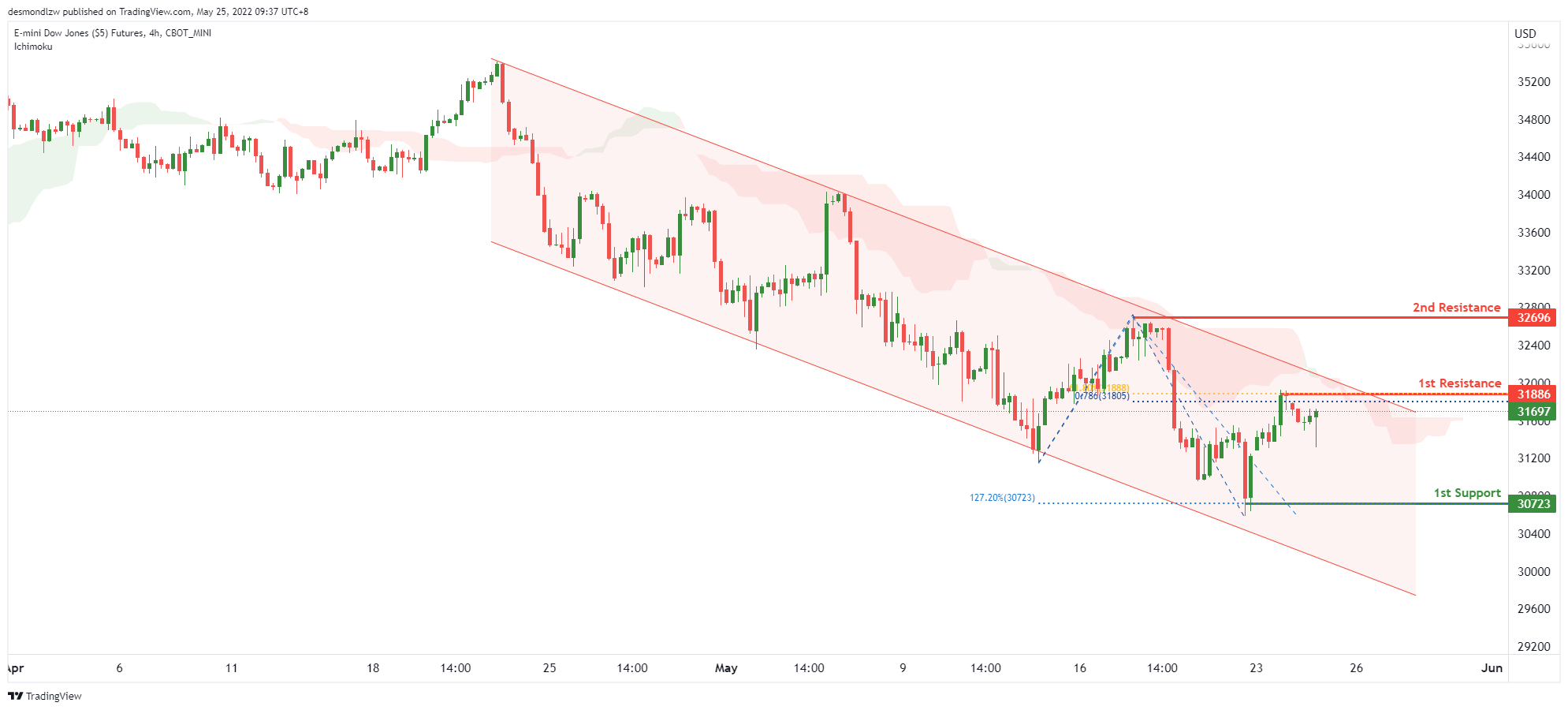
On the H4, with price moving below the ichimoku indicator, we have a bearish bias that price will drop to our 1st support at 30723 where the 127.2% Fibonacci extension and swing low support from our 1st resistance at 31886 in line with the horizontal swing high resistance 78.6% fibonacci projection and 61.8% fibonacci retracement. Alternatively, price may break 1st resistance structure and head for 2nd resistance at 32696 where the horizontal swing high resistance is.
Areas of consideration :
- H4 time frame, 1st resistance at 31886
- H4 time frame, 1st support at 30723
Elliott Wave View: Rally in Silver May End Soon
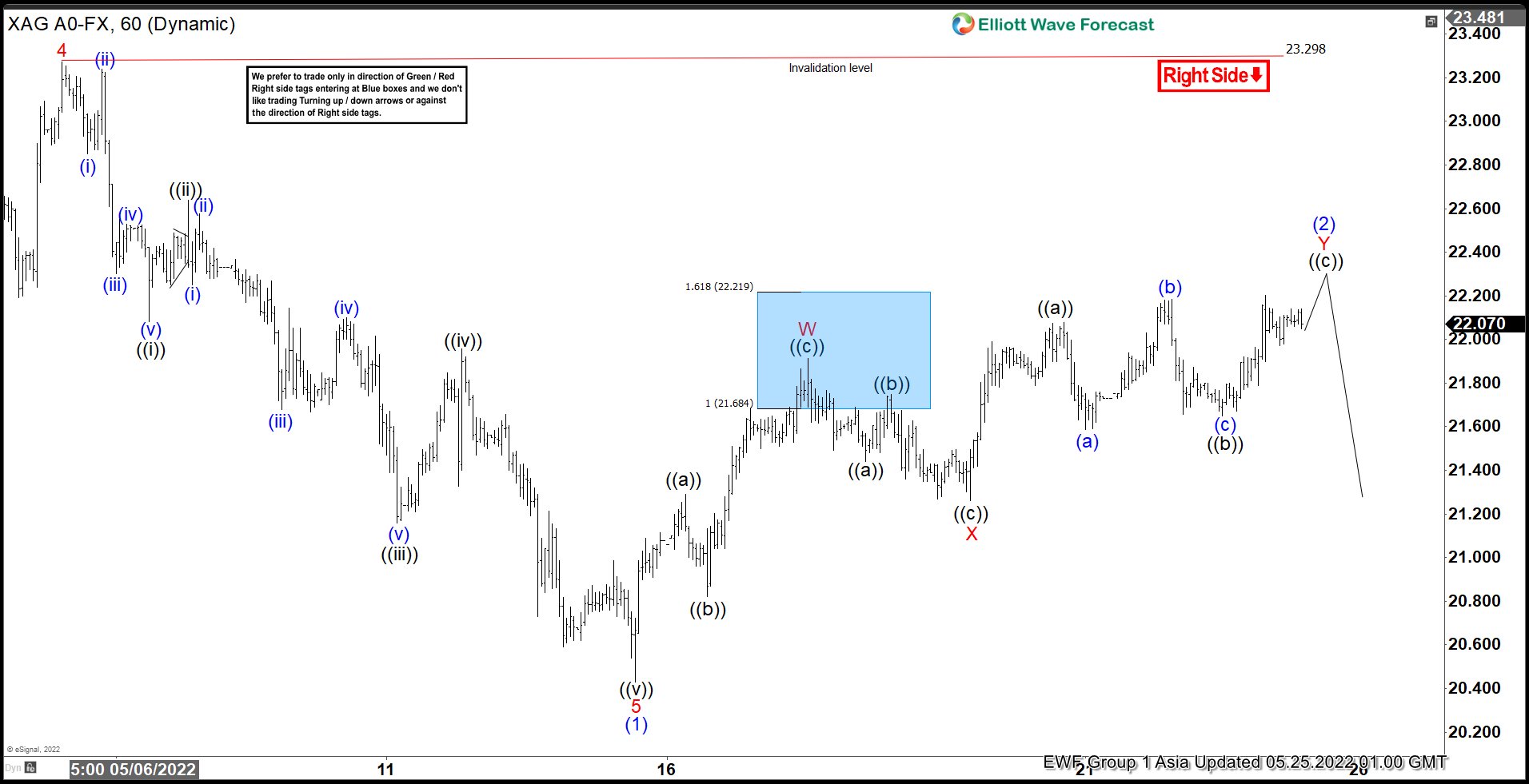
Short Term Elliott Wave View in Silver (XAGUSD) suggests cycle from 3/8/2022 high ended as a 5 waves impulse structure at 20.42. This impulse wave lower ended wave (1). Wave (2) corrective rally is now in progress as a double three Elliott Wave Structure. Rally from wave (1) began the first leg of a zig zag correction. Wave ((a)) ended at 21.29 and a pullback in wave ((b)) ended at 20.82. Silver then resumed higher in wave ((c)) and ended at 21.92 as wave W in higher degree.
Down from wave W high on May 17, wave ((a)) ended at 21.44 and bounce in wave ((b)) ended at 21.75. Then the metal extends lower in wave ((c)) towards 21.26 which completed the connector as wave X. Rally from wave X is a zig zag correction to complete wave Y and wave (2). Wave ((a)) of Y formed an impulse and ended at 22.08. Correction in wave ((b)) made a irregular flat correction ending at 21.64. Next push higher we are calling a motive wave as wave ((c)) to complete wave Y and the whole structure as wave (2) correction. This last leg higher should complete one more high above 22.20 where Silver should turn lower again or at least see 3 waves pullback.
Silver (XAGUSD) 60 Minutes Elliott Wave Chart
First Impressions: RBNZ Monetary Policy Statement, May 2022
The Reserve Bank lifted the OCR by 50 basis points as widely expected, and signalled further large moves to come. While it’s a more assertive profile than we expected from the RBNZ today, it’s in line with our forecast of how 2022 will ultimately play out.
RBNZ Monetary Policy Statement, May 2022
- The Reserve Bank increased the OCR by 50 basis points to 2%. This was widely expected by forecasters and was fully priced by financial markets.
- The real interest was always going to be in the RBNZ’s projections for future OCR moves, and this proved to be more aggressive than we expected from them at this point.
- The RBNZ projects the OCR to reach a peak of close to 4% by the second half of next year, with most of those increases being front-loaded. That includes an implied OCR of 3.5% by the end of this year.
- This is a substantial upgrade to the OCR track compared to the 3.4% peak in the February MPS (and which was broadly endorsed in the April policy review).
- The RBNZ emphasised that this would be a temporary peak in the OCR, rather than a permanently higher level.
- The intention is to keep monetary policy ‘tight’ for long enough to bring demand and supply into better alignment, before returning interest rates to more sustainable long-term levels.
- The RBNZ expects inflation to remain elevated for a while, not returning to within the 1-3% target range until the end of 2023.
- Concern about inflation expectations, and the perceived need to reassert the 2% midpoint of the inflation target, have been an ongoing and escalating theme of recent RBNZ statements.
- We recently revised our OCR forecasts to include four consecutive 50bp rate hikes between April and August, on the way to a peak of 3.5% by the end of this year. The RBNZ’s projections effectively endorse this profile.
- Where we differ from the RBNZ’s view is in the need for the OCR to keep rising into 2023, by which time the main drivers behind inflation are likely to be looking much less ominous.
Full RBNZ statement
Monetary conditions tighten by more and sooner
The Monetary Policy Committee today increased the Official Cash Rate (OCR) to 2.0 percent. The Committee agreed it remains appropriate to continue to tighten monetary conditions at pace to maintain price stability and support maximum sustainable employment. The Committee is resolute in its commitment to ensure consumer price inflation returns to within the 1 to 3 percent target range.
Consistent with the economic outlook and risks ahead, monetary conditions need to act as a constraint on demand until there is a better match with New Zealand’s productive capacity. A larger and earlier increase in the OCR reduces the risk of inflation becoming persistent, while also providing more policy flexibility ahead in light of the highly uncertain global economic environment.
The level of global economic activity is generating rising inflation pressures, exacerbated by ongoing supply disruptions driven by both COVID-19 persistence and the Russian invasion of Ukraine. The latter continues to cause very high prices for food and energy commodities.
The pace of global economic growth is slowing. The broad-based tightening in global monetary and financial conditions is acting to slow spending growth, accentuated by the high costs of basic food and energy staples. European geopolitical uncertainty is also weighing heavily on business confidence and investment intentions worldwide. Likewise, COVID-19 restrictions in significant regions of China are exacerbating supply chain disruptions and adding cost and complexity to trade.
In New Zealand, underlying strength remains in the economy, supported by a strong labour market, sound household balance sheets, continued fiscal support, and a strong terms of trade. The reduction in COVID-19 health-related restrictions is also enabling increased economic activity, including hospitality and tourism.
However, headwinds are strong. Heightened global economic uncertainty and higher inflation are dampening global and domestic consumer confidence. Asset prices, in particular house prices, have also declined, reflecting in part higher mortgage interest rates and increased supply of housing.
On balance, a broad range of indicators highlight that productive capacity constraints and ongoing inflation pressures remain prevalent. Employment remains above its maximum sustainable level, with labour shortages now the major constraint on production. The Reserve Bank’s core inflation measures are above 3 percent.
The Committee agreed to continue to lift the OCR at pace to a level that will confidently bring consumer price inflation to within the target range. The Committee viewed the projected path of the OCR as consistent with achieving its primary inflation and employment objectives without causing unnecessary instability in output, interest rates and the exchange rate. Once aggregate supply and demand are more in balance, the OCR can then return to a lower, more neutral, level.
Japan government concerned of re-spread of coronavirus in China and Ukraine war
In May's Monthly Economic Report, Japan's government maintained that the economy "shows movement of picking up". Private consumption, business investment and industrial production have "shown movement of picking up". Exports were still "almost flat".
Employment assessment was upgrade slightly to "shows movement of picking up" rather than just in "some components. Consumer prices "have been rising recently", with "moderately" dropped.
The government also warned that "full attention should be given to the downside risks due to supply-side constraints, rising raw material prices and fluctuations in the financial and capital markets while there are concerns regarding the effects of the re-spread of the Novel Coronavirus in China and lengthening the state of affairs of Ukraine".
NZD/USD rising towards 0.6527/8 cluster resistance
NZD/USD rises slightly after RBNZ rate hike, as rebound from 0.6215 short term bottom extends. Immediate focus is now on 0.6528 cluster resistance (38.2% retracement of 0.7033 to 0.6215 at 0.6527).
Sustained break of 0.6527/8 will raise the chance that whole corrective pattern from 0.7463 has completed at 0.6215. That came after drawing support from 61.8% retracement of 0.5467 to 0.7463 at 0.6229. In this case, further rally would be seen to 61.8% retracement of 0.7033 to 0.6215 at 0.6721.
However, rejection by 0.6527/8 will retain near term bearishness. Break of 0.6366 minor support will bring retest of 0.6215 low.
RBNZ hikes by 50bps, rate projected to peak at 3.9%
RBNZ raised the Official Cash Rate by 50bps to 2.00% as widely expected. The central bank now projects OCR to peak at 3.9% in Q2 of 2023, before moving down slightly starting from Q3 2024.
In the statement, RBNZ said: "The Committee viewed the projected path of the OCR as consistent with achieving its primary inflation and employment objectives without causing unnecessary instability in output, interest rates and the exchange rate. Once aggregate supply and demand are more in balance, the OCR can then return to a lower, more neutral, level."
Also in the new forecasts, GDP would grow 5.4% in 2022, then slow to 3.2% in 2023, 1.3% in 2024, and 1.2% in 2025. CPI would average 6.9% in 2022, then slow to 4.4% in 2023, 2.5% in 2024, and 2.0% in 2025. Unemployment rate is projected to be at 3.2% in 2022, then gradually climb to 3.8% in 2023, 4.4% in 2024, and 4.7% in 2025.