Sample Category Title
Sunset Market Commentary
Markets
All eyes were on PMI business confidence for May today. In a context where concerns about growth going forward rise by the day, they provide much-appreciated guidance. For Europe, the fall-out of the war, high inflation and general uncertainty remains contained. The composite PMI eased from 55.8 to 54.9. Underneath though, the sectoral divergence gets increasingly apparent. While the manufacturing gauge held up well (from 55.4 to 54.4), the figure was boosted by lengthening supplier deliveries amid material shortages, supply chain disruptions and the raging war. Output barely recovered from a near-stagnant 50.7 in April to 51.2 and new orders declined for the first time since June 2020. Services sector activity on the other hand came in at a still-solid 56.3. It is continues enjoying the effects from Covid measures having ended. Services companies are hiring like there’s no tomorrow to handle strong order inflow and get rid of backlogs. On a darker note though, the general private sector outlook (12m ahead), edged to the lowest since 1.5 years. In both sectors, prices charged rose at the second-fastest pace ever. Input price pressures, while still high, eased further, providing a bit of hope for prices being at or near the peak. On financial markets, the euro was the biggest beneficiary of today’s PMI outcome. EUR/USD was already rising towards the 1.07 big figure going into the release after ECB president Lagarde in Davos reiterated intentions to start raising policy rates in July and shelve negative rates in September. The PMIs provided the final push beyond 1.07. Core bond yields were much less impressed, perhaps weighed down by the negative risk sentiment and some nuances by Lagarde and Villeroy. Lagarde said the ECB is in no rush to hike and said a 50 bps move is not the consensus at this point. Her comments were later repeated by Villeroy but countered by Austria’s Holzmann. German yields changes vary from -3 bps (5y) to -0.5 bps (30y). The 10y struggles to keep the symbolic 1%. USTs outperform with yields losing between 5.9 and 8.4 bps across the curve. UK Gilts were the absolute outperformer though. The front end tanks more than 13 bps following the publication of PMI’s (see headline below). They came days after UK retail sales last Friday soothed some market concerns about inflation-squeezed British consumers. The poor reading refuels the debate, both within markets and within the Bank of England, on how far the current hiking cycle can/will go. Sterling gets a beating. EUR/GPB surges beyond 0.85 to 0.857 currently. Cable (GBP/USD) aborts the test of 1.26 abruptly to change hands at 1.2485.News Headlines
UK private sector growth slowed to the weakest since the winter of 2021 as the cost living crisis heavily weighs on consumer demand, PMIs showed today. The composite index sharply declined to 51.8 from 58.2. The decline was mainly due to a sharp setback in services activity (51.8 from 58.9). The manufacturing PMI fell from 55.8 to 54.8. However, output in the sector also slowed to 51.8. Private sector orders slowed for the third consecutive month. Employment growth remains robust, but some business are starting to reduce costs by not replacing voluntary leavers. Input costs hit a survey record, driven by the service sector. Business expectations also eased to the lowest level in two years. The prospect of an accelerated slowdown despite persistent high cost growth trigged a sharp decline in UK yields with the 2-y easing about 13 bps as the BoE struggles to find a balance. Sterling declined sharply both against the euro and the dollar (cf supra).
Czech May confidence data today showed a divergent picture between consumers and businesses. Business confidence improved further from 103.8 to 107, the highest level since 2008! The improvement was mainly due to more favorable developments in industry and trade. Services confidence stabilized while sentiment in construction declined. Consumer confidence meanwhile declined further from 81.3 to 75.8, the lowest level since 2012. Compared to the previous month, the number of respondents worrying about their own financial and overall economic situation and rising unemployment increased. The Czech koruna shivered immediately after the release but currently trades little changed near EUR/CZK 24.64.
US PMI composite dropped to 53.8, growth spurt has lost further momentum
US PMI Manufacturing dropped from 59.2 to 57.5 in May. PMI Services dropped from 55.6 to 53.5. PMI Composite dropped from 56.0 to 53.8.
Chris Williamson, Chief Business Economist at S&P Global Market Intelligence said:
"The early survey data for May indicate that the recent economic growth spurt has lost further momentum. Growth has slowed since peaking in March, most notably in the service sector, as pent up demand following the reopening of the economy after the Omicron wave shows signs of waning. Companies report that demand is coming under pressure from concerns over the cost of living, higher interest rates and a broader economic slowdown.
"Manufacturers in particular also report that capacity continues to be constrained by supply shortages, though these bottlenecks showed further encouraging signs of easing.
"Despite all of the headwinds facing businesses, the survey data remain indicative of the economy growing at an annualised rate of 2%, which is also supporting stronger payroll growth. However, cost pressures have risen to a new survey high which, alongside the encouraging output and employment numbers, will fuel further speculation about the need for further imminent aggressive rate hikes."

Dollar Index: Improved Risk Sentiment Keeps Dollar Under Pressure for Deeper Correction
The dollar index fell to one-month low on Tuesday, in extension of Monday’s 0.85% drop, under increased pressure from renewed risk appetite.
Hawkish comments from ECB’s President Lagarde that the European Central Bank is likely to start raising interest rates in the third quarter, added to improved risk sentiment and further weighed on the greenback.
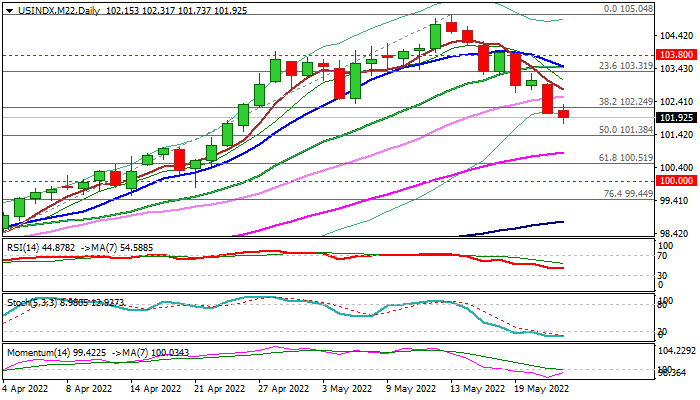
The dollar is in corrective phase from new multi-year high at 105.04 (the highest since 2002) and generated fresh bearish signal on Monday’s break through pivotal Fibo support at 102.24 (38.2% retracement of 97.72/105.04 ascend), which looks for confirmation on sustained break lower.
Bears eye next target at 101.38 (50% retracement), with stronger acceleration to risk drop towards strong support at 100.51 (Fibo 61.8% of 97.72/105.04 / top of ascending daily cloud).
Daily studies turned into bearish mode, as 14-d momentum moved into negative territory and converged 10/20DMA’s are about to form a bear-cross, with weekly indicators heading south after reversing from overbought territory, adding to negative signals.
Also, monthly studies are overbought and the index is on track for a monthly close in red after strong rally in past two months (up 6.6%), with bearish monthly candle with long upper shadow, which also signals a bull-trap above key 103.80 resistance, warning that larger bulls have lost traction.
On the other side, fundamentals are expected to remain dollar’s key driver, as fears of escalation of the conflict in Ukraine, and concerns about many developed economies are facing recession, keep investors cautious and ready to accelerate migration into safety at any time that would limit dollar’s correction
Res: 102.24; 102.96; 103.31; 103.47
Sup: 101.73; 101.38; 100.87; 100.51
USD/JPY Mid-Day Outlook
Daily Pivots: (S1) 127.34; (P) 127.70; (R1) 128.25; More...
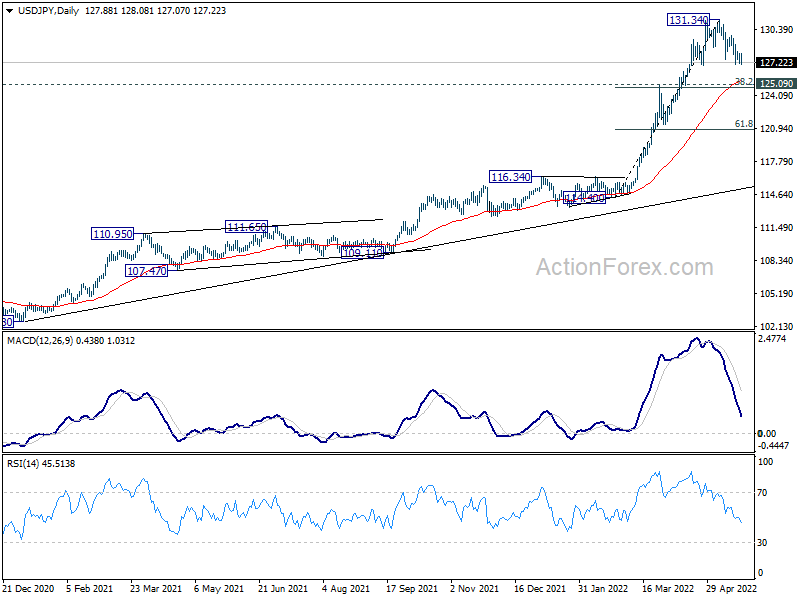
USD/JPY's correction from 131.34 is still in progress. Deeper fall could be seen to 125.09 cluster support (38.2% retracement of 114.40 to 131.34 at 124.86). But strong support is expected from there to contain downside to bring rebound. On the upside, break of 129.77 minor resistance will suggest that the correction is finished and bring retest of 131.34.
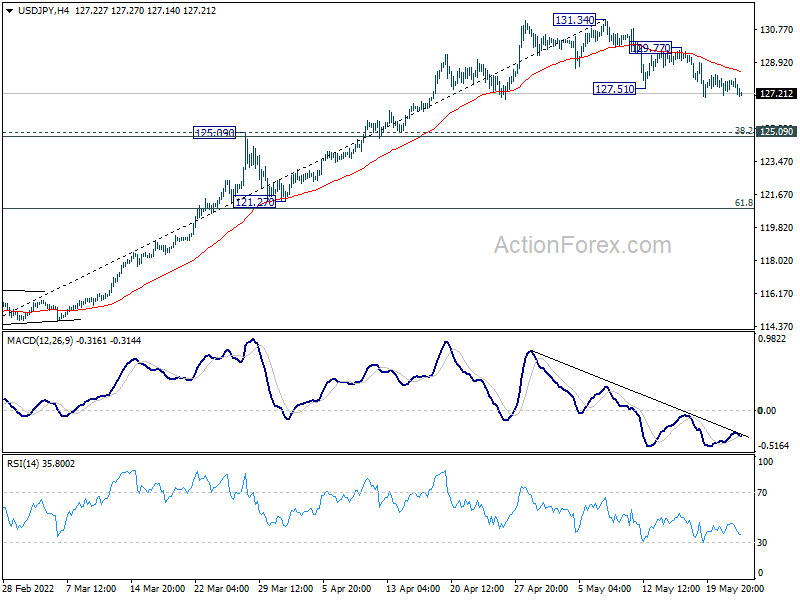
In the bigger picture, current rally is seen as part of the long term up trend form 75.56 (2011 low). Sustained trading above 61.8% projection of 75.56 (2011 low) to 125.85 (2015 high) from 98.97 at 130.04 will pave the way to 100% projection at 149.26, which is close to 147.68 (1998 high). For now, this will remain the favored case as long as 121.27 support holds.
USD/CHF Mid-Day Outlook
Daily Pivots: (S1) 0.9607; (P) 0.9679; (R1) 0.9728; More...
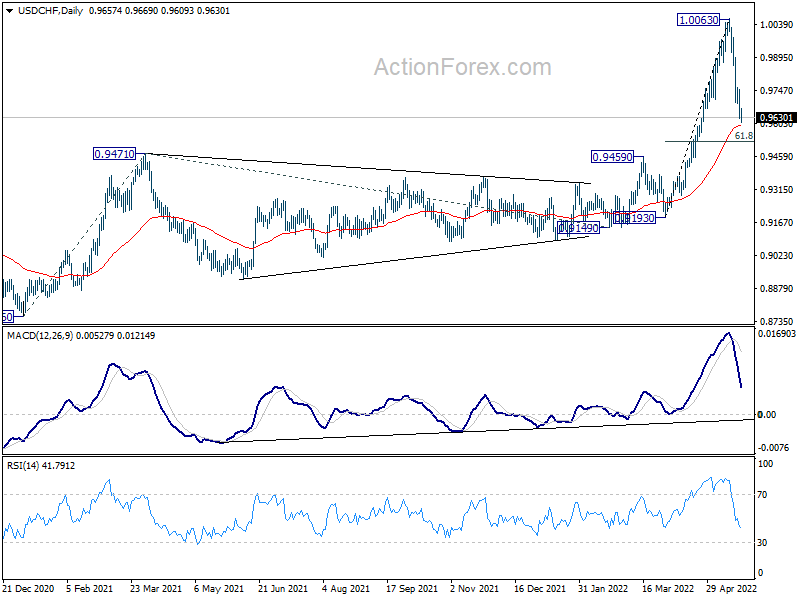
USD/CHF's fall form 1.0063 is still in progress. Intraday bias stays on the downside for 55 day EMA (now at 0.9595) and below. But downside should be contained by 61.8% retracement of 0.9193 to 1.0063 at 0.9525 to bring rebound. On the upside, above 0.9763 minor resistance will turn bias back to the upside for recovery.
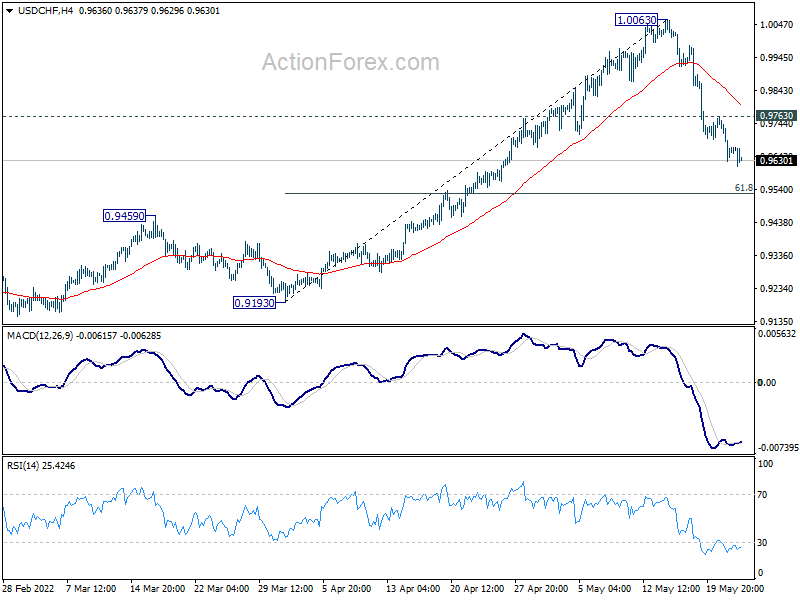
In the bigger picture, down trend from 1.0342 (2016 high) should have completed with three waves down to 0.8756 (2021 low) already. Rise from 0.8756 is likely a medium term up trend of its own. Next target is 161.8% projection of 0.8756 to 0.9471 from 0.9149 at 1.0306, which is close to 1.0342 (2016 high). This will remain the favored case as long as 0.9459 resistance turned support holds.
EUR/USD Mid-Day Outlook
Daily Pivots: (S1) 1.0602; (P) 1.0650 (R1) 1.0739; More...
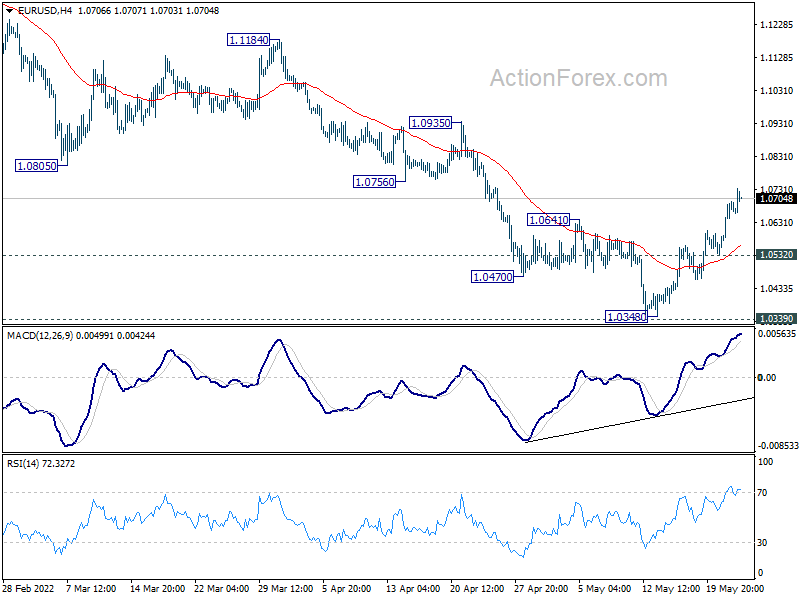
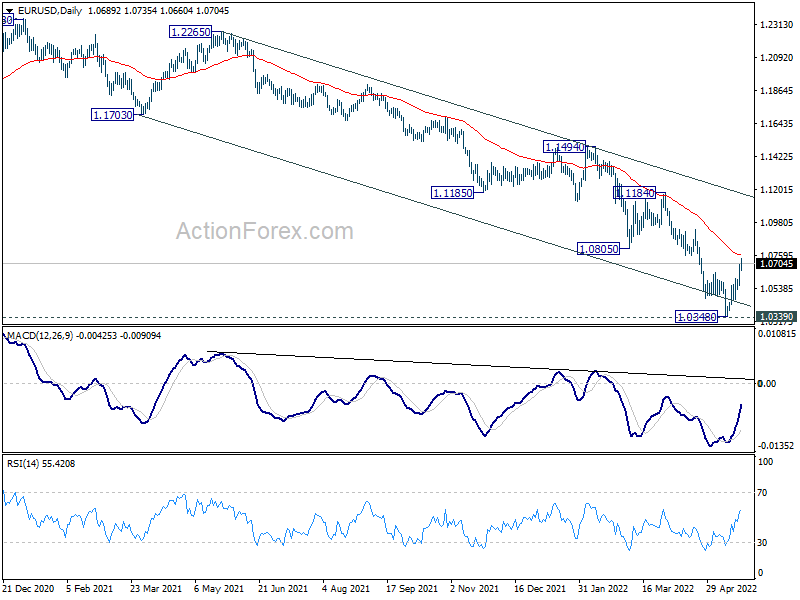
EUR/USD's rise from 1.0348 short term bottom is still in progress. Intraday bias remain son the upside. Firm break of 55 day EMA (now at 1.0760) will target 1.0935 resistance next. On the downside, however, below 1.0532 minor support will turn intraday bias back to the downside for retesting 1.0348 low instead.
In the bigger picture, focus stays on 1.0339 long term support (2017 low). Decisive break there will resume whole down trend from 1.6039 (2008 high). Next target is 61.8% projection of 1.3993 to 1.0339 from 1.2348 at 1.0090. However, firm break of 1.0805 support turned resistance will delay this bearish case and bring medium term corrective rebound first.
GBP/USD Mid-Day Outlook
Daily Pivots: (S1) 1.2509; (P) 1.2555; (R1) 1.2633; More..
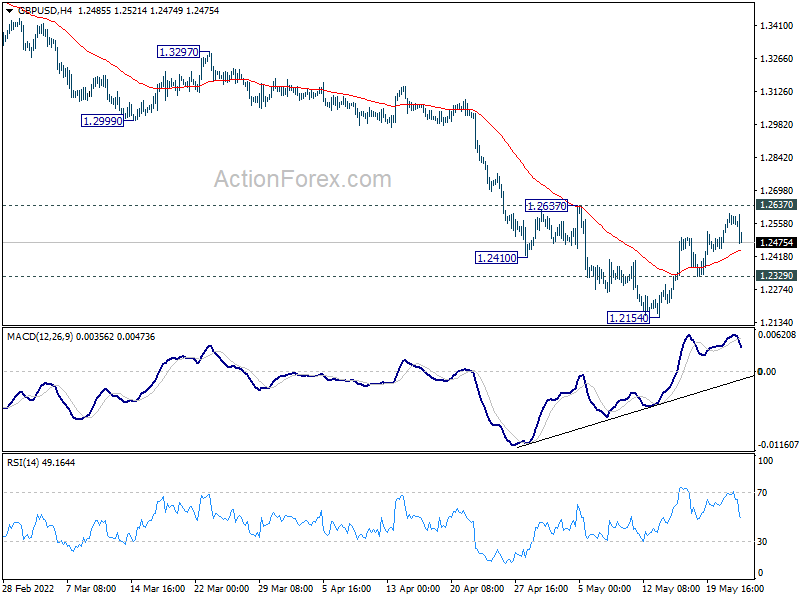
GBP/USD is staying in range of 1.2329/2637 and intraday bias remains neutral at this point. Considering bullish convergence condition in 4 hour MACD, break of 1.2637 will confirm short term bottoming at 1.2154. Intraday bias will be turned back to the upside for 55 day EMA (now at 1.2775). On the downside, below 1.2329 minor support will retain near term bearishness and bring retest of 1.2154 first. Break there will resume larger down trend from 1.4248.
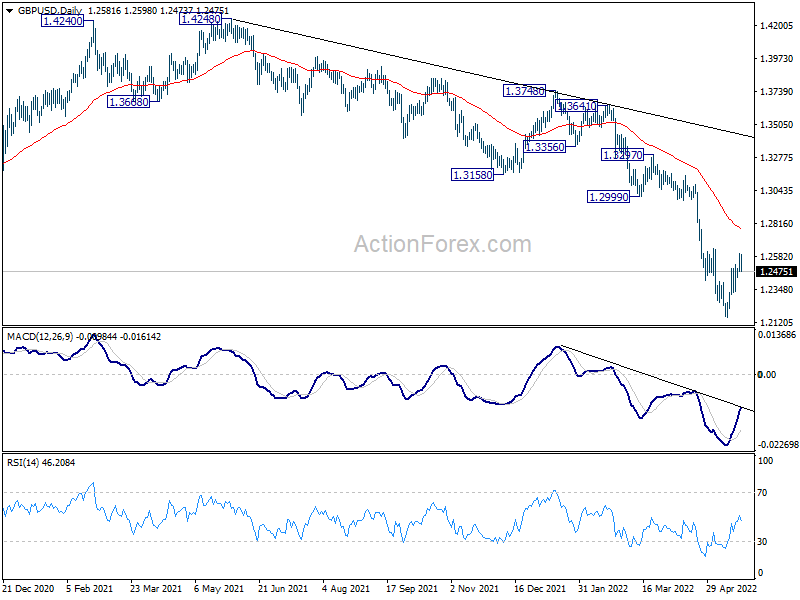
In the bigger picture, based on current momentum, fall from 1.4248 (2018 high) at least at the same degree as the rise from 1.1409 (2020 low). That is, fall from 1.4248 could be a leg inside the pattern from 1.1409, or resuming the longer term down trend. In either case, deeper decline is expected as long as 1.2999 support turned resistance holds. Next target is 1.1409 low.
Sterling Dives on Recession Fear, Euro Firm on Rate Talks
Sterling fall broadly today after much worse than expected PMI data raises concerns of recession ahead. On the other hand, Euro jumps as ECB officials continued to talk up July rate hike, while PMI data were solid. Still, the best performer today so far is Yen, which is supported by receding risk-on sentiment. Dollar is also trying to regain some ground. For the same reason, Aussie and Kiwi are turning softer.
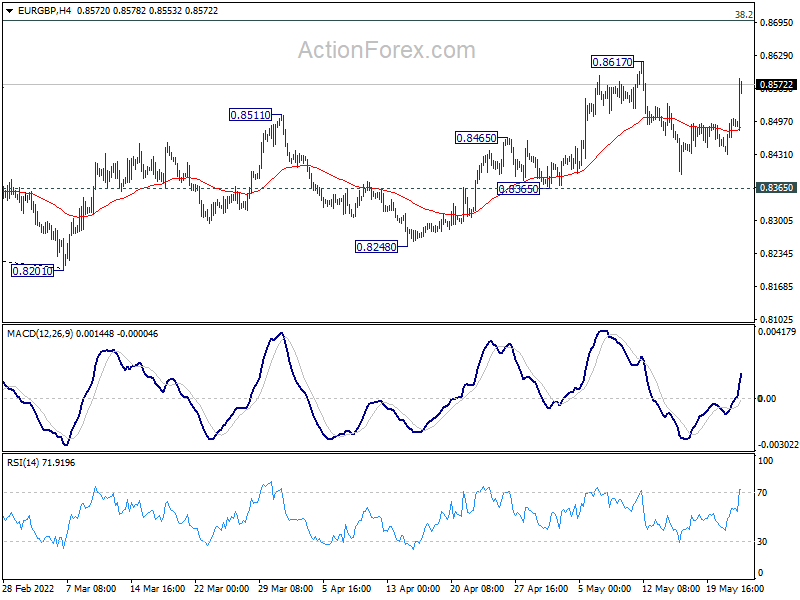
Technically, it looks like Euro and Sterling are diverging, which is in-line with the broader case that EUR/GBP is in medium term reversal. Immediate focus is now on 0.8617 resistance in the cross. Firm break there will extend the rebound from 0.8210 to 38.2% retracement of 0.9499 to 0.8201 at 0.8697. This level will be crucial in determining the underlying momentum in EUR/GBP.
In Europe, at the time of writing, FTSE is down -0.08%. DAX is down -0.85%. CAC is down -0.93%. Germany 10-year yield is down -0.012 at 1.005. Earlier in Asia, Nikkei dropped -0.94%. Hong Kong HSI dropped -1.75%. China Shanghai SSE dropped -2.41%. Singapore Strait Times dropped -0.58%. Japan 10-year JGB yield dropped -0.0084 to 0.232.
UK PMI manufacturing dropped to 54.6, services collapsed to 51.8
UK PMI Manufacturing dropped from 55.8 to 54.6 in May, below expectation of 55.1, hitting a 16-month low. PMI Services dropped sharply from 58.9 to 51.8, well below expectation of 57.3, a 15-month low. PMI Composite dropped from 58.2 to 51.8, also a 15-month low.
Chris Williamson, Chief Business Economist at S&P Global Market Intelligence said:
"The UK PMI survey data signal a severe slowing in the rate of economic growth in May, with forward-looking indicators hinting that worse is to come. Meanwhile, the inflation picture has worsened as the rate of increase of companies' costs hit yet another all-time high. The survey data therefore point to the economy almost grinding to a halt as inflationary pressure rises to unprecedented levels.
"The tailwind from the reopening of the economy has faded, having been overcome by headwinds of soaring prices, supply delays, labour shortages and increasingly gloomy prospects. Companies cite increasingly cautious moods among households and business customers, linked to the cost-of-living crisis, Brexit, rising interest rates, China's lockdowns and the war in Ukraine.
"There are some signs that the rate of inflation could soon peak, with companies reporting price resistance from customers, and it is likely that the slowing in demand will help pull prices down in coming months. However, the latest data indicate a heightened risk of the economy falling into recession as the Bank of England fights to control inflation."
ECB Lagarde: We're moving very likely into positive at the end of Q3
In a Bloomberg TV interview, ECB President Christine Lagarde said, "we're moving (deposit rate) very likely into positive territory at the end of the third quarter."
"When you're out of negative (rates) you can be at zero, you can be slightly above zero. This is something that we will determine on the basis of our projections and ... forward guidance," she explained.
Still, Lagarde emphasized the graduality and ECB's policy adjustments. "I don't think we are in a situation of surging demand at the moment," Lagarde said. "It's definitely an inflation that is driven by the supply side of the economy."
Separately, Governing Council member Francois Villeroy de Galhau, said that "a 50 basis-point hike is not part of the consensus at this point, I am clear... Interest rate hikes will be gradual."
On the other hand, another Governing Council member Robert Holzmann said that a 50bps rate hike in July would be appropriate, and ending the year with positive rate is extremely important.
Eurozone PMI composite dropped to 54.9, beleaguered manufacturing offset by buoyant service
Eurozone PMI Manufacturing rose dropped from 55.5 to 54.4 in May, below expectation of 54.9, hitting an 18-month low. PMI Services dropped from 57.7 to 56.3, below expectation of 57.5. PMI composite dropped from 55.8 to 54.9.
Chris Williamson, Chief Business Economist at S&P Global Market Intelligence said:
"The eurozone economy retained encouragingly resilient growth in May, as a beleaguered manufacturing sector was offset by a buoyant service sector.... Thanks to buoyant demand for services, particularly from households, the PMI data are consistent with the economy growing at a solid quarterly rate of 0.6% so far in the second quarter....
"Although there are signs that inflationary pressures could be peaking, with input cost inflation down for a second successive month and supply constraints starting to be less widely reported, inflationary pressures remain elevated at previously unprecedented levels. Such high price pressures, accompanied by the reassuringly resilient GDP growth signalled by the surveys, looks set to tilt policymakers at the ECB towards a more hawkish stance."
Germany PMI Manufacturing rose from 54.6 to 54.7 in May. PMI Services dropped from 57.6 to 56.3. PMI Composite rose from 54.3 to 54.6.
France PMI Manufacturing dropped from 55.7 to 54.5 in May. PMI Services dropped from 58.9 to 58.4. PMI Composite dropped from 57.6 to 57.1.
Japan PMI manufacturing dropped to 53.2 in May, services rose to 51.7
Japan PMI Manufacturing dropped slightly from 53.5 to 53.2 in May, below expectation of 53.8. PMI services rose from 50.7 to 51.7. PMI Composite ticked up from 51.1 to 51.4.
Usamah Bhatti, Economist at S&P Global Market Intelligence, said:
""Private sector firms reported that the reduced impact of COVID-19 had lifted services activity, most notably in the tourism sector as pandemic-related restrictions were eased further. That said, the renewed introduction of lockdown measures across China and economic sanctions placed on Russia amid the Ukraine war had exacerbated supply chain disruptions, with greater reports of material shortages and severe delivery delays.
"As a result, there was a further intensification in price pressures across the private sector, as firms reported series-record rises in both input and output prices. Moreover, uncertainty regarding the outlook for price and supply conditions dampened business confidence, which was at its softest since August 2021."
Australia PMI composite dropped to 52.5 in Apr, still a solid expansion
Australia PMI Manufacturing dropped from 58.8 to 55.3 in May. PMI Services dropped from 56.1 to 53.0. PMI Composite dropped from 55.9 to 52.5. All are 4-month lows.
Jingyi Pan, Economics Associate Director at S&P Global Market Intelligence said:
"The expansion of the Australian economy continued in May at a solid pace... Although manufacturing output was affected by issues of COVID-19 disruptions and poor weather conditions, manufacturing demand remained robust, which had been a reassuring sign.
"Persistent supply chain constraints continue to pose challenges for firms in the private sector, both in terms of input acquisition and price fluctuations. Anecdotal evidence also suggested that firms are concerned with the rising interest rate outlook and the effect on their businesses, all of which are worth monitoring moving ahead."
New Zealand retail sales dropped -0.5% qoq in Q1, ex-auto sales flat
New Zealand retail sales volume (with price effects removed) dropped -0.5% qoq in Q1, much worse than expectation of 0.4% qoq. Ex-auto sales volume was flat, below expectation of 0.4% qoq. Total value of retail sales rose 0.5% qoq.
12 of the 16 regions showed higher sales values. By region, the largest changes in sales values were in: Auckland – up 3.6% (NZD 387m); Waikato – up 4.2% (NZD 109m); Canterbury – up 1.9% (NZD 70m); Wellington – up 2.3% (NZD 63m).
GBP/USD Mid-Day Outlook
Daily Pivots: (S1) 1.2509; (P) 1.2555; (R1) 1.2633; More..
GBP/USD is staying in range of 1.2329/2637 and intraday bias remains neutral at this point. Considering bullish convergence condition in 4 hour MACD, break of 1.2637 will confirm short term bottoming at 1.2154. Intraday bias will be turned back to the upside for 55 day EMA (now at 1.2775). On the downside, below 1.2329 minor support will retain near term bearishness and bring retest of 1.2154 first. Break there will resume larger down trend from 1.4248.
In the bigger picture, based on current momentum, fall from 1.4248 (2018 high) at least at the same degree as the rise from 1.1409 (2020 low). That is, fall from 1.4248 could be a leg inside the pattern from 1.1409, or resuming the longer term down trend. In either case, deeper decline is expected as long as 1.2999 support turned resistance holds. Next target is 1.1409 low.
Economic Indicators Update
| GMT | Ccy | Events | Actual | Forecast | Previous | Revised |
|---|---|---|---|---|---|---|
| 22:45 | NZD | Retail Sales Q/Q Q1 | -0.50% | 0.40% | 8.60% | 8.30% |
| 22:45 | NZD | Retail Sales ex Autos Q/Q Q1 | 0.00% | 0.40% | 6.80% | |
| 23:00 | AUD | Manufacturing PMI May P | 55.3 | 58.8 | ||
| 23:00 | AUD | Services PMI May P | 53 | 56.1 | ||
| 00:30 | JPY | Manufacturing PMI May P | 53.2 | 53.8 | 53.5 | |
| 06:00 | GBP | Public Sector Net Borrowing (GBP) Apr | 17.8B | 17.8B | 17.3B | 13.9B |
| 07:15 | EUR | France Manufacturing PMI May P | 54.5 | 55.1 | 55.7 | |
| 07:15 | EUR | France Services PMI May P | 58.4 | 58.6 | 58.9 | |
| 07:30 | EUR | Germany Manufacturing PMI May P | 54.7 | 54.1 | 54.6 | |
| 07:30 | EUR | Germany Services PMI May P | 56.3 | 57.2 | 57.6 | |
| 08:00 | EUR | Eurozone Manufacturing PMI May P | 54.4 | 54.9 | 55.5 | |
| 08:00 | EUR | Eurozone Services PMI May P | 56.3 | 57.5 | 57.7 | |
| 08:30 | GBP | Manufacturing PMI May P | 54.6 | 55.1 | 55.8 | |
| 08:30 | GBP | Services PMI May P | 51.8 | 57.3 | 58.9 | |
| 13:45 | USD | Manufacturing PMI May P | 57.9 | 59.2 | ||
| 13:45 | USD | Services PMI May P | 55.3 | 55.6 | ||
| 14:00 | USD | New Home Sales Apr | 750K | 763K |
Rising Euro, Recovery from Oversold Helping Gold
Gold has added for the fifth consecutive trading session – the longest streak since early April. Intraday yesterday gold reached $1865, having retreated to $1860 now.
Although Gold’s prolonged rise in early April turned into a sell-off of almost three times the amplitude and duration, there are signs that we see the beginnings of a more sustainable move this time around.
In early May, the daily gold charts developed an oversold RSI. The recovery from oversold conditions supports the local demand for Gold.
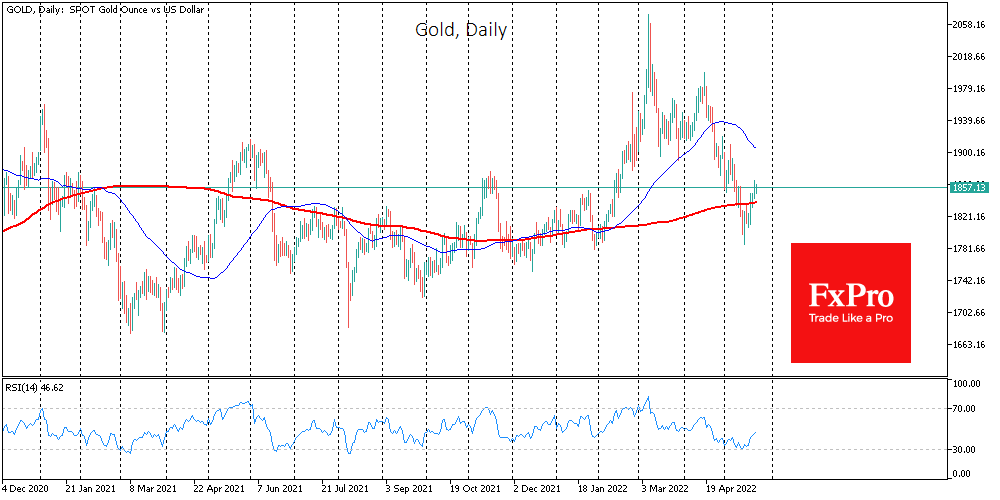
A return above the 200-day moving average by Gold is also playing on the bulls’ side locally. A dip below could well be seen as a false breakout. A recovery above the significant trendline, the 200-day average, acts as additional psychological support.
A third important reason to buy Gold is the strengthening of the Euro. Since early April, a strong positive correlation between Gold and the EURUSD exchange rate has been well established. This correlation was broken earlier in the year by the events in Ukraine and before that by the substantial divergence in the monetary policy of the Fed and the ECB.
Nevertheless, it is easy to see that the Euro and Gold are moving together over the longer term in quiet times. Perhaps we are now seeing the beginning of a medium-term correction of the Euro thanks to increasingly hawkish signals from the ECB.
The nearest important test of the bulls’ intentions could be the $1875 area – the November highs. If it succeeds, investors and traders should keep an eye on the dynamic at $1910, where the bulls’ attack stopped at the beginning of May this year and at the end of May 2021.
New Zealand Dollar Rally Fizzles
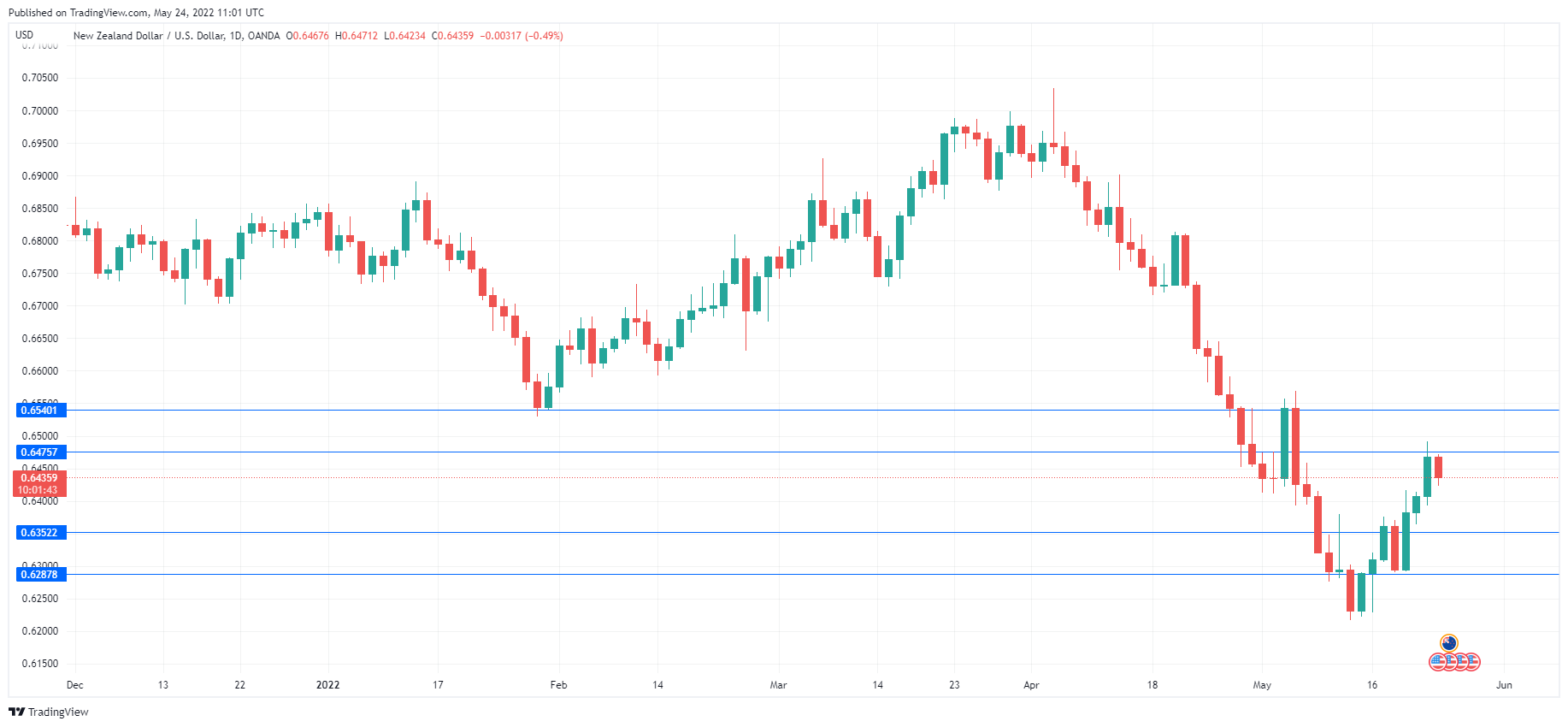
The New Zealand dollar has reversed directions after a solid 3-day rally. In the European session, NZD/USD is trading at 0.6432, down 0.55% on the day.
China jitters weigh on NZ dollar
New Zealand’s number one trading partner is China, and it’s no exaggeration to say that when China sneezes, New Zealand catches a cold. China has tenaciously implemented a zero-tolerance policy for Covid, which has meant lockdowns that have confined millions of residents.
Unsurprisingly, this has dampened growth in the world’s number two economy. The Covid restrictions were in full force in April, and UBS has projected that China’s economy plunged by 8.0% in Q2 and has downgraded China’s 2022 GDP to 3.0%, down sharply from 4.2%. Investors should not assume that China’s economy will re-energize once the Covid restrictions are eased – UBS is warning that China does not have a clear exit strategy from its current stringent Covid policy, which will hamper a recovery. The downgrade in China’s GDP (JP Morgan also lowered its forecast from 4.3% to 3.7%) has soured sentiment towards the New Zealand dollar.
Over in New Zealand, retail sales for Q1 came to a screeching halt. The headline figure declined by 0.5%, down from 8.3% in Q4 2020, while core retail sales came in at zero, down from 6.8%. The weak numbers have contributed to today’s New Zealand dollar’s descent.
The Reserve Bank of New Zealand will be in the spotlight on Wednesday when it holds a policy meeting. The central bank is expected to raise rates by 50-bps for a second straight month. This would bring the cash rate to 2.0%, which is considered a “neutral” stance. It’s noteworthy that the cash rate hasn’t been at the neutral level since 2015, so the RBNZ is moving into rarified air. The RBNZ will likely continue its rate-tightening cycle to 3.0% in order to curb spiralling inflation, and at tomorrow’s meeting, the Bank will likely state that more hikes are on the way.
NZD/USD Technical
- NZD/USD has support at 0.6352 and 0.6287
- There is resistance at 0.6475 and 0.6540