Sample Category Title
Germany PMI manufacturing rose to 54.7, services dropped to 56.3
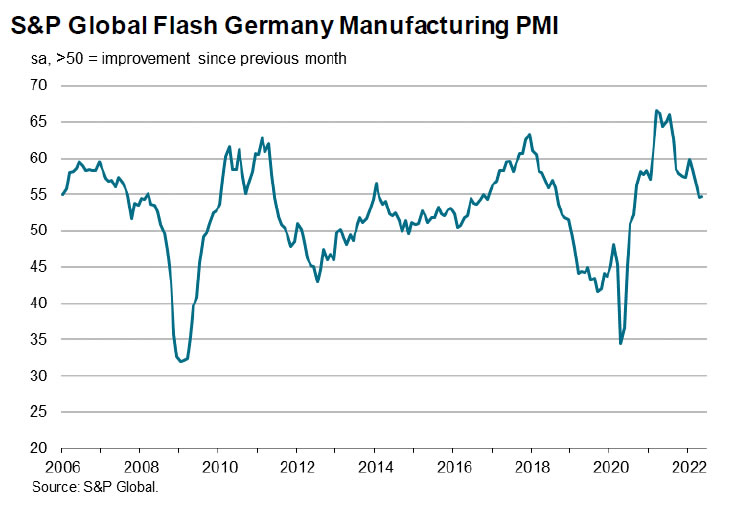
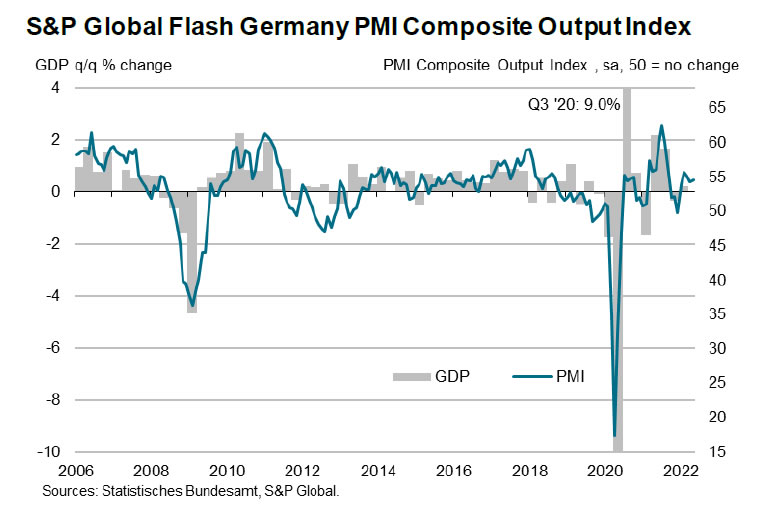
Germany PMI Manufacturing rose from 54.6 to 54.7 in May. PMI Services dropped from 57.6 to 56.3. PMI Composite rose from 54.3 to 54.6.
Phil Smith, Economics Associate Director at S&P Global Market Intelligence said:
"A post-lockdown recovery in services activity continues to provide a strong tailwind for the German economy... Even manufacturing saw a slightly better performance in terms of production levels in May.... Business confidence towards the outlook remains subdued, with heightened uncertainty, sharply rising prices and supply chain disruption all starting to impact demand and representing risks to the outlook in the goods-producing sector in particular."
France PMI manufacturing dropped to 54.5 in May, services dropped to 58.4
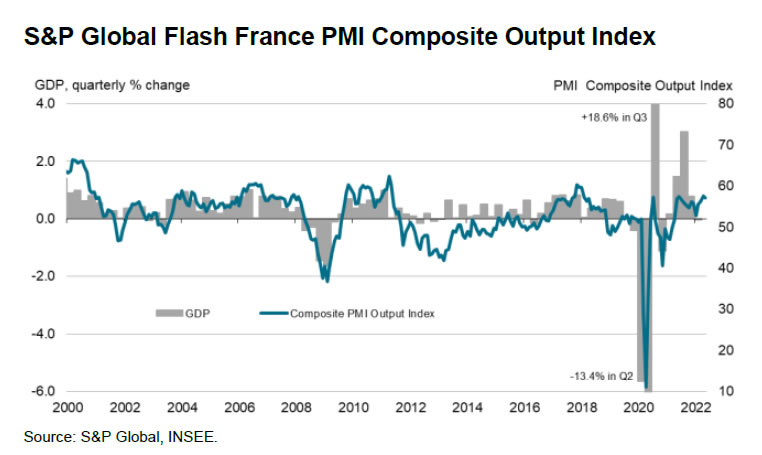
France PMI Manufacturing dropped from 55.7 to 54.5 in May. PMI Services dropped from 58.9 to 58.4. PMI Composite dropped from 57.6 to 57.1.
Joe Hayes, Senior Economist at S&P Global Market Intelligence said:
"The French economy is showcasing a remarkable degree of resilience amid mounting economic headwinds. Overall business activity rose sharply in May and at a rate that was only slightly weaker than April's multi-year high.... we saw further evidence of a two-speed economy emerging within France as a resilient service sector continues to mask sluggishness across the manufacturing industry.
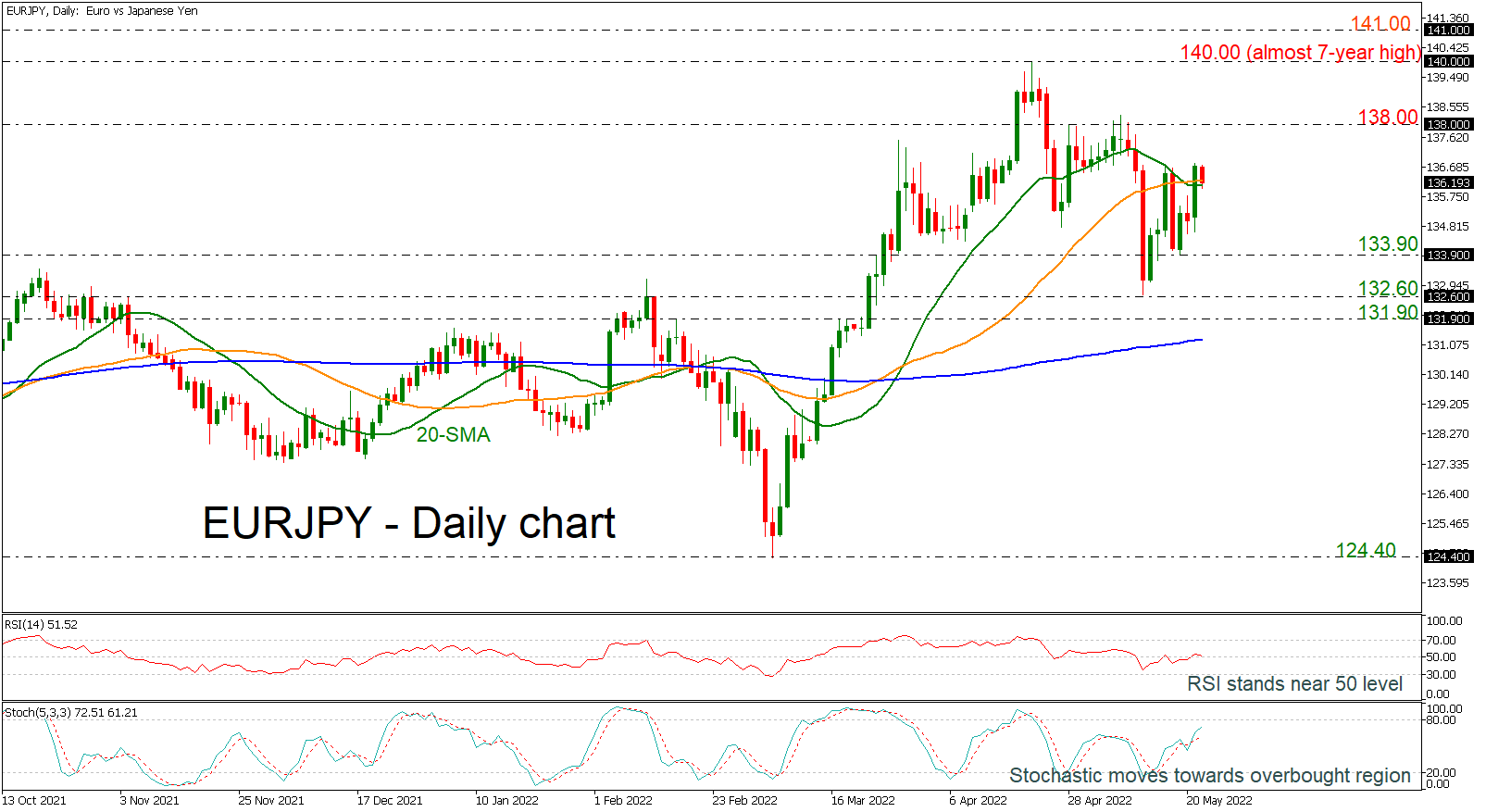
EURJPY Finds Some Rest Near the Short-Term SMAs
EURJPY is holding above the bullish crossover within the 20- and 40-day simple moving averages (SMAs) but the current momentum is negative. The RSI indicator is pointing downwards around the neutral threshold of 50; however, the stochastic oscillator is approaching the overbought territory, showing some signs for more increases.
If the market manages to pick up speed, the 138.00 psychological number could offer nearby resistance ahead of the almost seven-year high of 140.00. A significant close above the latter would break the June 2015 peak of 141.00, raising chances for further gains.
Should prices decline, immediate support could be found around the 133.90 barrier before resting near the 131.90-132.60 zone. Then a leg below that level, the pair could meet the 200-day SMA currently at 131.25.
Summarizing, EURJPY has been in a bearish correction mode since April 21. If the price surpasses the previous top of 140.00 it would endorse the long-term bullish outlook.
Will EUR/USD be Able to Hold North of the 1.0642 Resistance?
Markets
Markets’ mood/reaction function continue switching sides from day to day. Last week, uncertainty that policy tightening could kill growth, triggered hefty equity selling and a pause in the core yields’ rally. Yesterday, investors saw the glass again half full hoping a recession could be avoided. The trigger wasn’t that obvious. President Biden indicating the US might reconsider the import levies on Chinese goods maybe helped. German Ifo business confidence was better than expected but had limited direct impact on markets. Still, US and European equities gained between 1.40% (EuroStoxx 50) and almost 2.0% (Dow).
The risk-on this time coincided with a substantial rebound in core yields. In Europe, the focus was on a blog of President Lagarde at the ECB website. Lagarde concluded that the era of inflation structurally undershooting the target probably ended, allowing the ECB to start policy normalisation. She rubberstamped the scenario of ending APP early Q3 with a rate lift-off in June and the ECB exiting negative rates at end of Q3.
For markets, this brings clarity on the start of ECB normalisation. Even so, this scenario was largely discounted. It’s also a bit strange for the ECB president to bring this guidance a week before the publication of EMU inflation data and frontrunning new staff forecasts at June 9 meeting. Didn’t the ECB advocate data dependency? In this respect, the move probably also aims to sooth the debate on bigger ECB steps.
The first reaction on EMU interest rate markets was modest, but EMU yields later followed the broader trend. The German yields finished 7-8 bps higher across the curve. The US curve steepened with the 2-y rising 2.7 bps and longer maturities rising 6.5/7 bps.
The (trade-weighted) dollar remained in correction mode. DXY dropped a full big figure to close in the low 102 area. Even as the ECB blog was a bit ambiguous, it propelled EUR/USD above the 1.0642 short term top (close 1.0691). EUR/GBP followed at similar trajectory closing near the 0.85 big figure.This morning, sentiment in Asia again turns more cautious despite China announcing a 33 points package to support the economy. Asian equities are ceding between 0.70% (Nikkei) and 1.5% (Chinese indices). The dollar regains a few ticks. Treasury yields decline slightly.
Later today, the PMI’s will provide an update on the health of the economy in EMU, the UK and the US. For Europe, the composite PMI is expected to ease from 55.8 to 55.1. Maybe the message of the PMI’s shouldn’t be that negative. Recent data on current activity weren’t that bad. Markets will also look out for signs of price pressures reaching some kind of peak.
Even so, global sentiment will remain an important driver for trading. Equity futures suggest that yesterday’s equity rebound still might turn into a new sell-on upticks move. This might cap a further rise in core yields, confirming recent consolidation pattern on (EMU and US) interest rate markets.
On FX, we look out whether the dollar correction continues. Will EUR/USD be able to hold north of the 1.0642 resistance? If so, the 1.0758/1.0806 area (previous lows) will become next reference on the charts.
News Headlines
The Federal Reserve’s overnight reverse repurchase facility hit a new milestone, with banks and money market funds parking more than $2tn on Monday for the first time. It’s a sign of a still massive amount of excess liquidity even as the Fed started raising rates and will shrink the balance sheet from next month on. Technical elements are at work too. US Treasury bills are a popular alternative for cash but Treasury has cut issuance in recent months as solid tax collections and a drop in government spending have reduced the need thereof. Increased competition for T-bills increases its prices, lowers yields and makes investors look for other (safe) options, such as the Fed’s RRP.
Snap Plunge Hits Sentiment, Euro Gains
The US stocks rebounded on Monday. Banking stocks rallied as JP Morgan’s CEO Jamie Dimon said that the ‘storm clouds’ may dissipate. JP Morgan shares jumped more than 6%.
Also, Joe Biden said that the US could ditch the tariffs imposed on Chinese imports to help easing the pressure on consumer prices. The S&P500 gained 1.86% and Nasdaq recover 1.59%.
Yet, Monday gains will likely remain short-lived, as the Snap shares plunged 30% in the afterhours trading after the company warned that it will miss revenue and earnings, and will slow hiring. And the bad news from Snap pulled Meta 7% lower in the after-hours.
As a result, the US futures point at a negative start. It’s like we are coming back to reality after a sunny day in the markets.
ECB finally gets there
At a blog post, European Central Bank (ECB) President Christine Lagarde revealed that she ‘expects net purchases under the APP program to end very early in the third quarter’, which would allow the ECB to raise rates at the July meeting, and exit negative rates by the end of third quarter.
That was something that many euro traders were expecting patiently since months! For now, the ECB policy tightening will likely remain gradual. The latest news suggest that the ECB would raise rates by 25bp in July and September meetings.
It’s a breath of fresh air for the euro bulls. The EURUSD flirted with the 1.07 level yesterday. The combination of a broadly softer US dollar, and the hawkish ECB comments gave a material boost to the single currency
But more importantly, yesterday could be the pivot point for the ECB, and hence the euro, as the ECB finally throws in the towel faced with such a rise in inflation, and that is fundamentally supportive of an extension of gains toward the 1.10 mark against the greenback.
And of course, the fact that we could soon call the end of the dollar rally is also a supportive factor for the EURUSD outlook, which now turns neutral from negative.
And speaking of the dollar
The US dollar index has been toppish since last week. The next technical targets stand at 101 level, the minor 23.6% Fibonacci retracement on last year’s rally, and 99, the major 38.2% Fibonacci retracement which should distinguish between the actual rally, and a bearish medium-term reversal. I don’t expect the dollar to flip to a negative trend so soon, as the Fed will certainly remain more hawkish than the other major central banks. It’s just that the others will also stop turning a blind eye on the inflation problem. And that should slow the dollar appreciation. That’s it.
The softer dollar and the cool down in the US yields help gold consolidate gains. The yellow metal advanced to $1865 per ounce yesterday, and sees support near the $1850 level for a further advance toward the $1875/1880 range.
Crude oil is softer this morning, but we will certainly see dipbuyers within the $105/110 range, and Bitcoin is below the $30K. The selloff certainly has to do more with the overall risk-off mood this morning, rather than Christine Lagarde’s view that ‘the cryptocurrencies are worth nothing’. But the fact that she wants them regulated may have had a certain impact on the mood, still.
Central Bankers (ECB and Fed) Want to Move Early
Market movers today
The main event today is the flash PMI releases in the euro area and the US. On both sides of the Atlantic, we expect continued resilience in service sector activity, but look out for further signs of weakness on the manufacturing side given supply disruptions and rising prices.
New homes sales in the US may attract some attention as it may indicate whether the rise in mortgage rates are hurting housing activity.
Overnight, the New Zealand central bank (RBNZ) will publish its monetary policy decision. We expect RBNZ to deliver another 50bp, as they will likely prefer to keep front-loading the rate hikes amid continuing rise in local inflation expectations.
The 60 second overview
This morning, we have seen a decline in the Asian stock markets given the negative impact on the economy from the lockdown in China. UBS and JPMorgan downgraded their GDP forecasts for the Chinese economy. In Hong Kong, the equity market fell as Hong Kong is expected to continue with the hotel quarantine until at least through July. Hence, we have also seen US and European equity futures sliding this morning together with a modest decline in the oil price while US Treasury yields fell a few bp in Asian trade this morning.
Several Fed speakers have supported the current pricing of Federal Reserve moving fast. Fed's Esther George stated that the Federal Reserve needs to raise the policy rate to 2% by August while further tightening is determined by how the inflation would "cool off" as "the inflation we are now experiencing is obviously both too high and too broad to dismiss".
Today, we also have ECB's Villeroy speaking and after yesterday's comments from Lagarde, in which she pre-committed to a 25bp move in July and back to positive territory by Q3, then there will be even more focus on other ECB comments and whether they want to move faster as we have seen in the US.
Equities: Equities were higher yesterday with one industry, banks, standing out, rising 3% globally. The outperformance in banks yesterday more or less entirely driven by JPM lift of NII guidance. This should hardly come as surprise after yields have been sky rocketing and credit demand has been soaring in 2022. Nonetheless, this shows how some relatively small positive news can move the markets in times with high fear/scepticism among investors. In US Dow +2.0%, S&P 500 +1.9%, Nasdaq +1.6%, Russell 2000 +1.1%.
Wall Street has not carried over to Asia this morning were markets are led lower by China. US and European futures are lower this morning with growth/tech names dragging down in as Snap came with a substantial guidance downgrade after the market close yesterday.
FI: Yesterday, Bunds moved back above 1% on the back of the comments from ECB's Lagarde, in which she stated that the first move from ECB would come in July after the net purchases had ended in June. Yields increased across the curve and the spread between the periphery and Germany once again tightened. Finally, the Bund ASW-spread also tightened.
FX: Scandies were top performers yesterday, where JPY and USD were the biggest losers. EUR/USD climbed towards 1.07, EUR/NOK traded around the 10.25 level and EUR/SEK around the 10.50 level.
Credit: Mirroring the slight improvement in risk appetite the iTraxx EUR CDS index tightened 4bp to close at 96bp, while iTraxx Crossover tightened by 16bp to close at 472bp. Besides the flurry of new primary covered bond issues, financial issuers were also active in other parts of the funding structure yesterday with Credit Suisse issuing opco senior and Societe Generale raising senior preferred funding, both in dual-tranche formats.
Nordic macro
The Swedish National Debt Office releases a new funding forecast. 1) The borrowing requirement since the previous report has been about SEK 6bn lower than forecast during the Feb-Apr period, however, with a decreasing trend, 2) Roughly SEK 30bn more stimulus than assumed by the Debt Office has been proposed by the Government, the business cycle losing steam, rates moving higher and potentially bigger outflows from the tax account are all factors suggesting the Debt Office will have to cut the budget surplus forecast from just shy of SEK 140bn to some 60bn in 2022 and a smaller cut for 2023 to SEK 70bn, 3) we expect auction volumes to increase to SEK 3bn for nominal bonds and SEK 0.75bn for linkers after summer while some FX bonds may also be necessary to keep presence in in foreign markets, 4) net bonds supply after Riksbank QE, however, is only expected to rise moderately (nominal and likers to SEK 14bn and SEK 6bn respectively in H2).
GBP/JPY Daily Outlook
Daily Pivots: (S1) 159.94; (P) 160.47; (R1) 161.54; More...
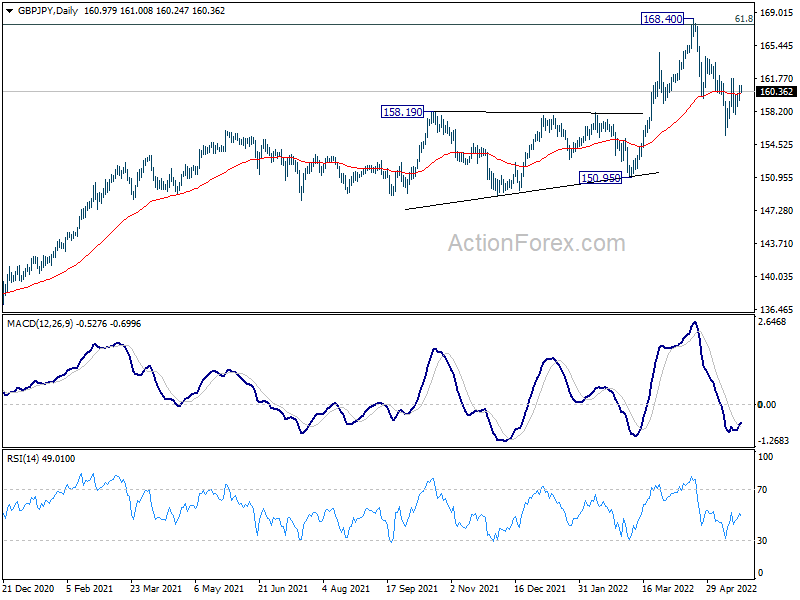
Intraday bias in GBP/JPY remains neutral and outlook is unchanged. On the downside, break of 155.57 will extend the correction towards 150.96 key structural support. Nevertheless, on the upside, firm break of 162.16 will indicate that the correction has completed, and bring retest of 168.40 high next.
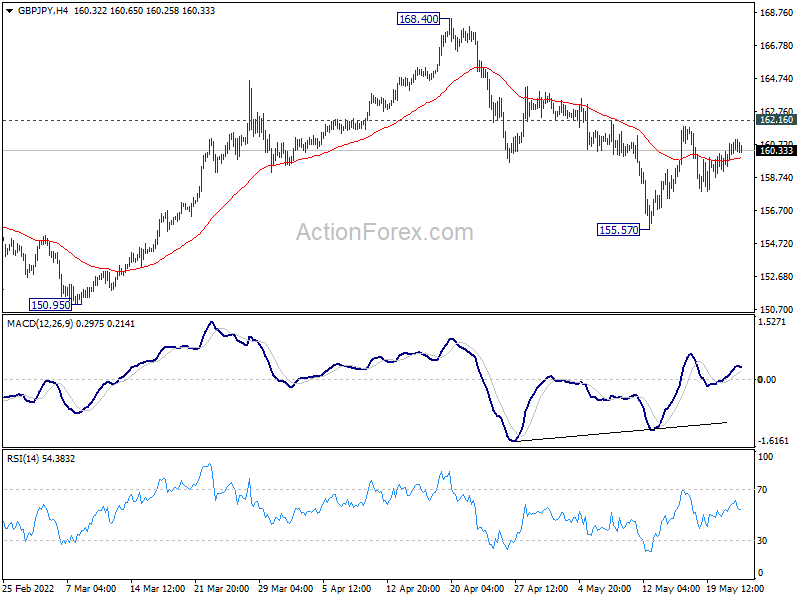
In the bigger picture, up trend from 123.94 (2020 low) is still in progress. Sustained break of 61.8% retracement of 195.86 (2015 high) to 122.75 (2016 low) at 167.93 will be a long term bullish signal, and could pave the way back to 195.86 high. This will now remain the favored case as long as 150.95 support holds, even in case of deep pull back. However, firm break of 150.95 will indicate rejection by 167.93, and bearish trend reversal.
EUR/JPY Daily Outlook
Daily Pivots: (S1) 135.34; (P) 136.07; (R1) 137.48; More....
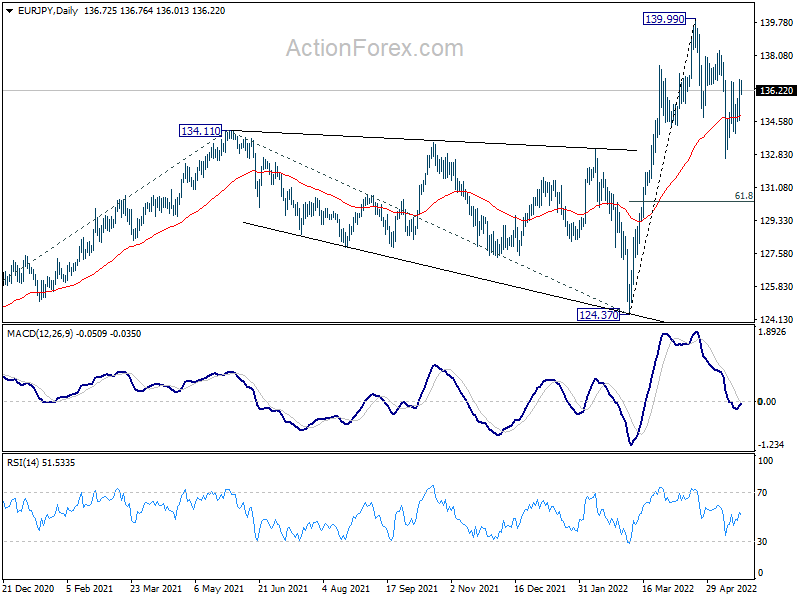
Intraday bias in EUR/JPY remains neutral and outlook is unchanged. Corrective pattern from 139.99 could still extend lower. On the downside, break of 132.63 will resume the fall and target 61.8% retracement of 124.37 to 139.99 at 130.33. On the upside, break of 138.33 will indicate that the correction has completed, and bring retest of 139.99 high next.
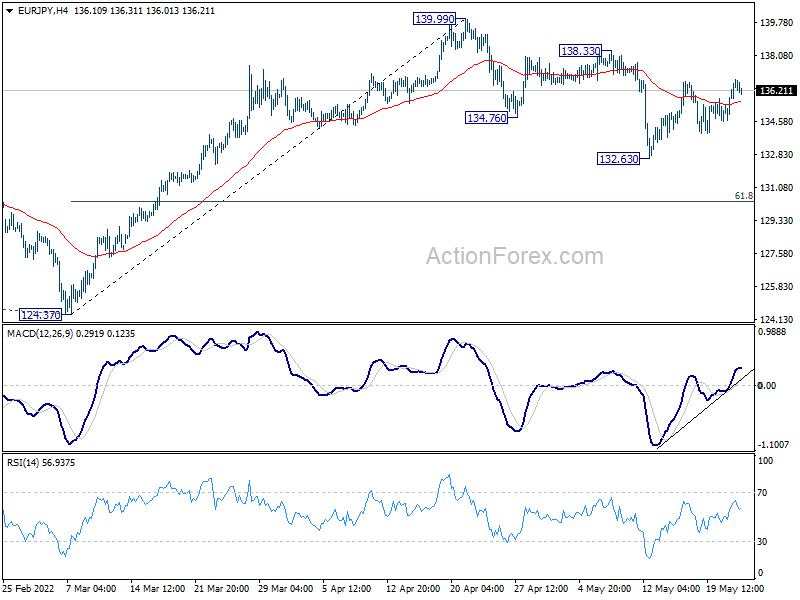
In the bigger picture, up trend from 114.42 (2020 low) is in progress. Such rise is seen as the third leg of the pattern from 109.30 (2016 low). Next target will be 100% projection of 114.42 to 134.11 from 124.37 at 144.06. In any case, outlook will now remain bullish as long as 124.37 support holds, in case of deep pull back.
EUR/GBP Daily Outlook
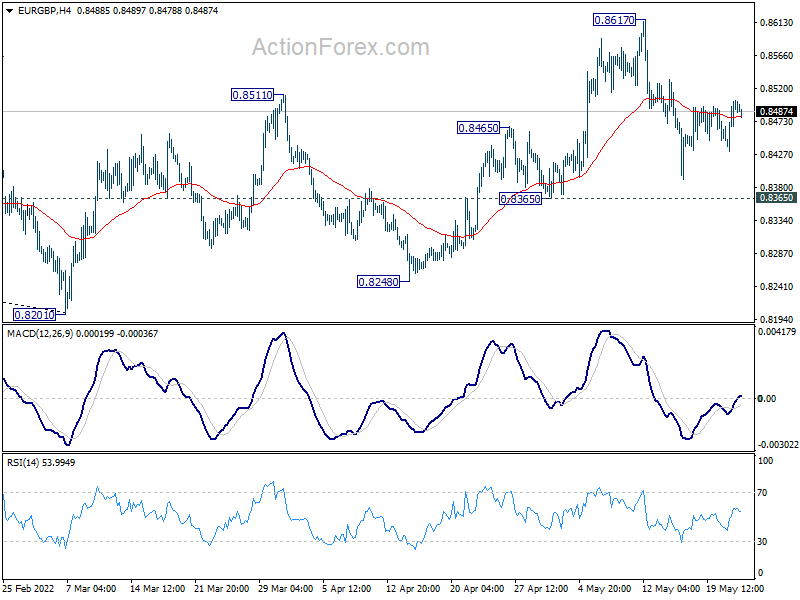
Daily Pivots: (S1) 0.8450; (P) 0.8477; (R1) 0.8521; More...
Outlook in EUR/GBP is unchanged and intraday bias remains neutral first. Further rise will remain in favor as long as 0.8365 support holds. On the upside, break of 0.8617 will resume rise from 0.8201 medium term bottom to 0.8697 medium term fibonacci level. However, break of 0.8365 will dampen this bullish view, and turn bias back to the downside instead.
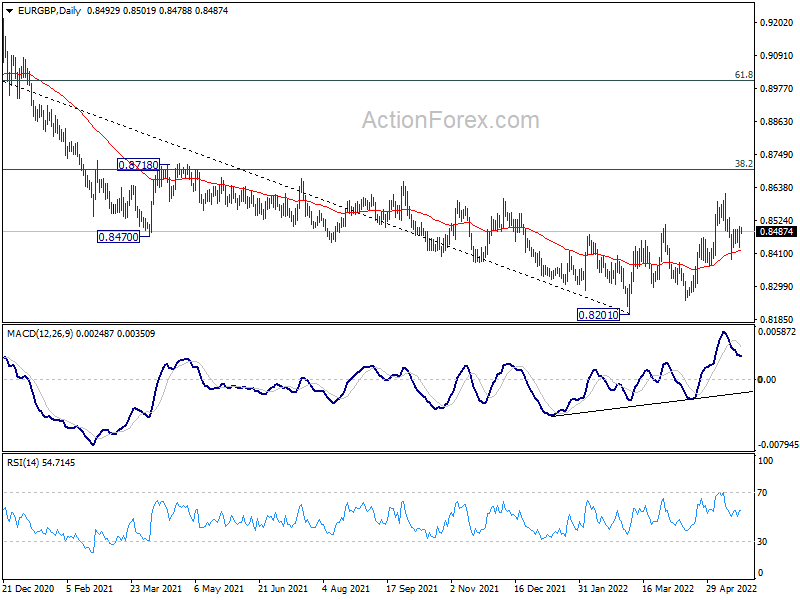
In the bigger picture, a medium term bottom could be in place at 0.8201, on bullish convergence condition in daily and weekly MACD. Rise from there could either be a correction to the down trend from 0.9499 (2020 high), or a medium term up trend itself. In either case, further rise should be seen to 38.2% retracement of 0.9499 to 0.8201 at 0.8697. Sustained break there will target 61.8% retracement at 0.9003.
EUR/AUD Daily Outlook
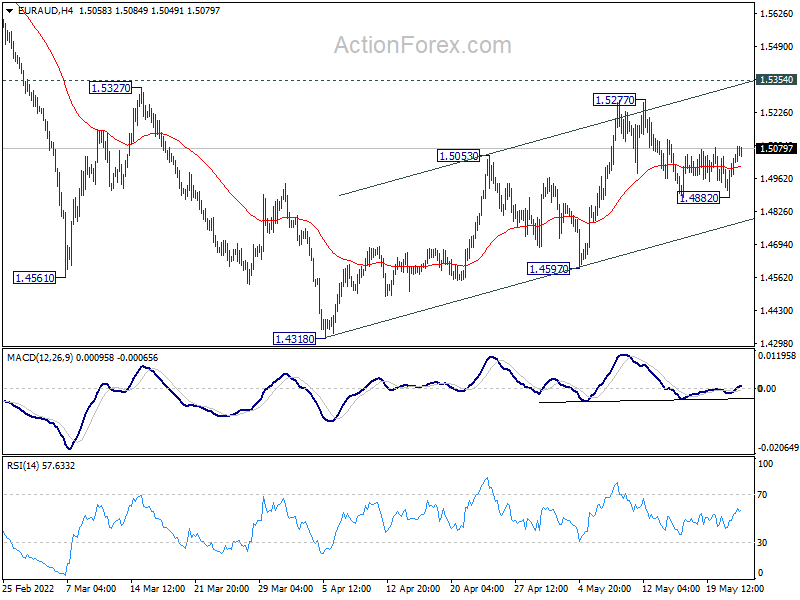
Daily Pivots: (S1) 1.4930; (P) 1.4994; (R1) 1.5103; More...
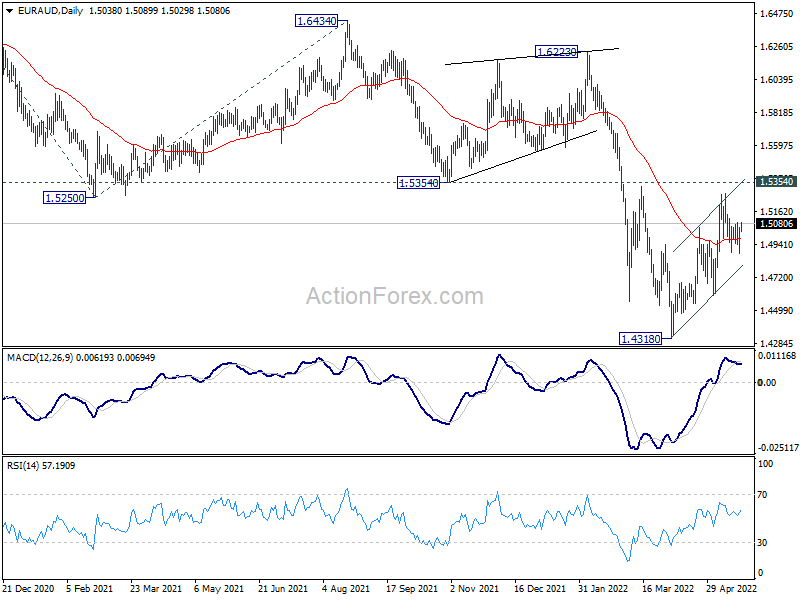
Intraday bias in EUR/AUD stays neutral at this point. Corrective rebound from 1.4318 should have completed with three waves up to 1.5227, ahead of 1.5354 resistance. Below 1.4885 will target 1.4597 support first. Break there will bring retest of 1.4318 low. For now, risk will stay on the downside as long as 1.5277 resistance holds.
In the bigger picture, as long as 1.5354 support turned resistance holds, larger down trend form 1.9799 (2020 high) is still expected to continue. On resumption, next target is 61.8% projection of 1.9799 to 1.5250 from 1.6434 at 1.3623, which is close to 1.3624 long term support (2017 low). However, firm break of 1.5354 will indicate medium term bottoming and bring stronger rally back to 1.6434 key resistance.