Sample Category Title
New Zealand Dollar Extends Gains
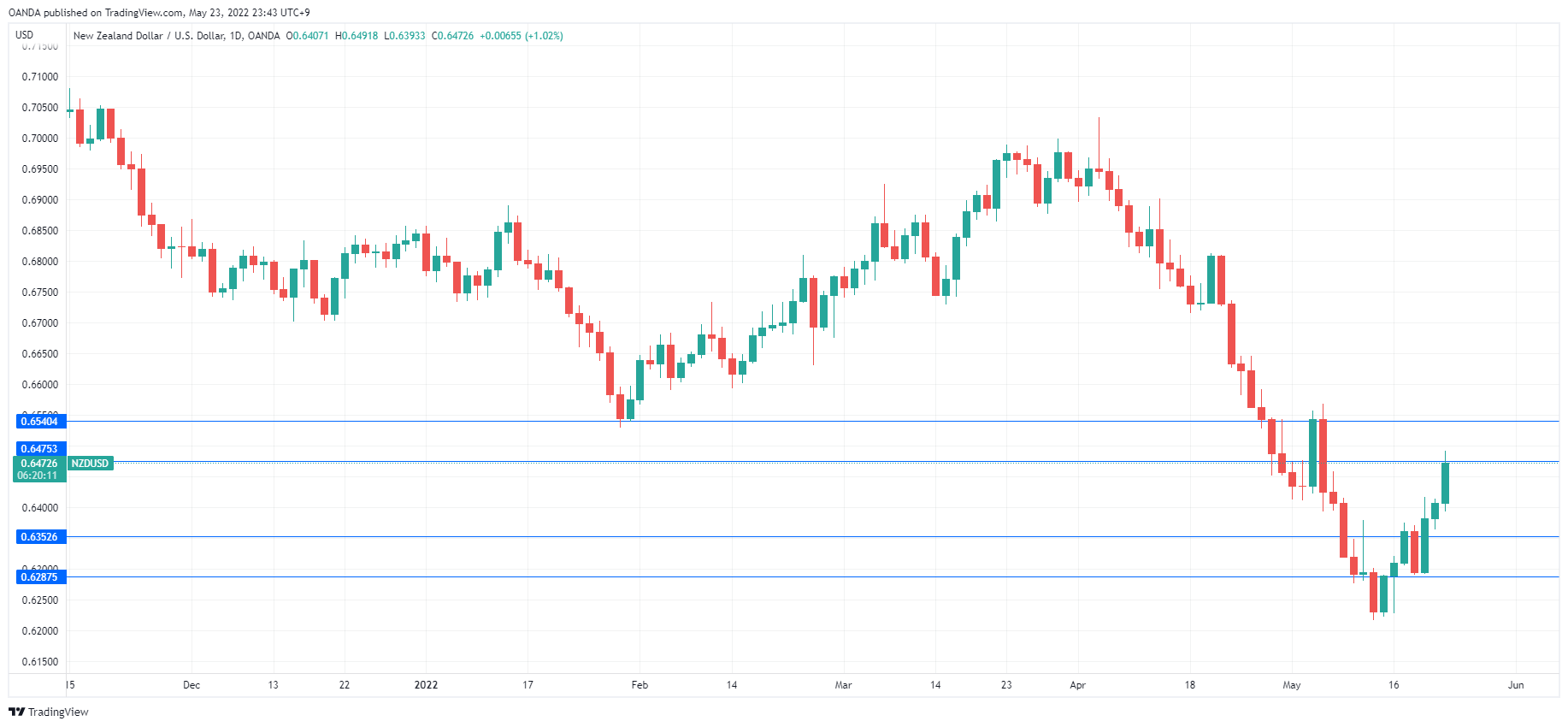
The New Zealand dollar continues to gain ground after posting a strong week. NZD/USD has jumped 1.04% today and is trading at 0.6472.
New Zealand dollar ends rough slide
After a massive 7-week slide, which saw a decline of some 550 points, NZD/USD rebounded last week with a gain of 1.88%. The rally has continued on Monday, as the US dollar has fallen out of favour with investors.
Still, I don’t want to sing the praises of the New Zealand dollar too loudly, as this sharp upward swing is really a story of the US dollar. The US economy has been performing well, but there are growing fears that the economy is headed into a recession and the Fed’s aggressive rate cycle is more than the economy can handle. Fed Chair Powell has assured the markets that he can guide the economy to a soft landing. It wasn’t all that long ago that the same Powell was assuring the markets that inflation was transient, and by the time he “retired the T-word”, it was painfully clear that the Fed was way behind the inflation curve.
With the Fed signalling that it will deliver supersize 0.50% rate hikes at June and July meetings, it promises to be an interesting summer. Any signs that the economy is close to a recession could upset the Fed’s plans, which could translate into volatility in the financial markets.
The Reserve Bank of New Zealand meets on Wednesday and is widely expected to hike rates by 0.50% and provide guidance for further 0.50% increases. Prior to the meeting, New Zealand releases Retail Sales for Q1. Consumer spending has been strong, hitting 8.6% in Q4 2021. Another solid increase will put further pressure on the RBNZ to act aggressively and would be bullish for the New Zealand dollar.
NZD/USD Technical
- NZD/USD is testing resistance at 0.6475. Above, there is resistance at 0.6540.
- There is support at 0.6352 and 0.6287
ECB Villeroy: July rate hike a done deal on growing consensus
ECB Governing Council member Francois Villeroy de Galhau said at the World Economic Forum, "if you look at President Lagarde's statement this morning, the deal is probably done because there is a growing consensus" on a July rate hike. He added that Eurozone growth remained resilient. the main short term problem was inflation.
Villeroy apparent referred to a blog post by ECB President Christine Lagarde. She said in the post of the expectation that net asset purchases under the APP to "end very early in the third quarter". "This would allow us a rate lift-off at our meeting in July, in line with our forward guidance," she said.
BoE Bailey prepared to hike again on assessment at each meetings
BoE Governor Andrew Bailey said in a speech, "monetary policymakers can and must take the actions needed to return inflation to target over a period that avoids unnecessary volatility in the economy".
"The job of the Bank of England is to return inflation to target at a time when a very large headwind from external shocks, and an internal shock from a fall in the labour force, are reducing real incomes but risk leading to persistence in domestic wage and price setting, so-called second round effects," he said.
"We have raised the official rate four times so far and have made clear that in order to bring inflation down to target we are prepared to do so again based on the assessment at each of our meetings," he added.
US 500 Index’s Downside Bearing Curbed as Buyers Step In
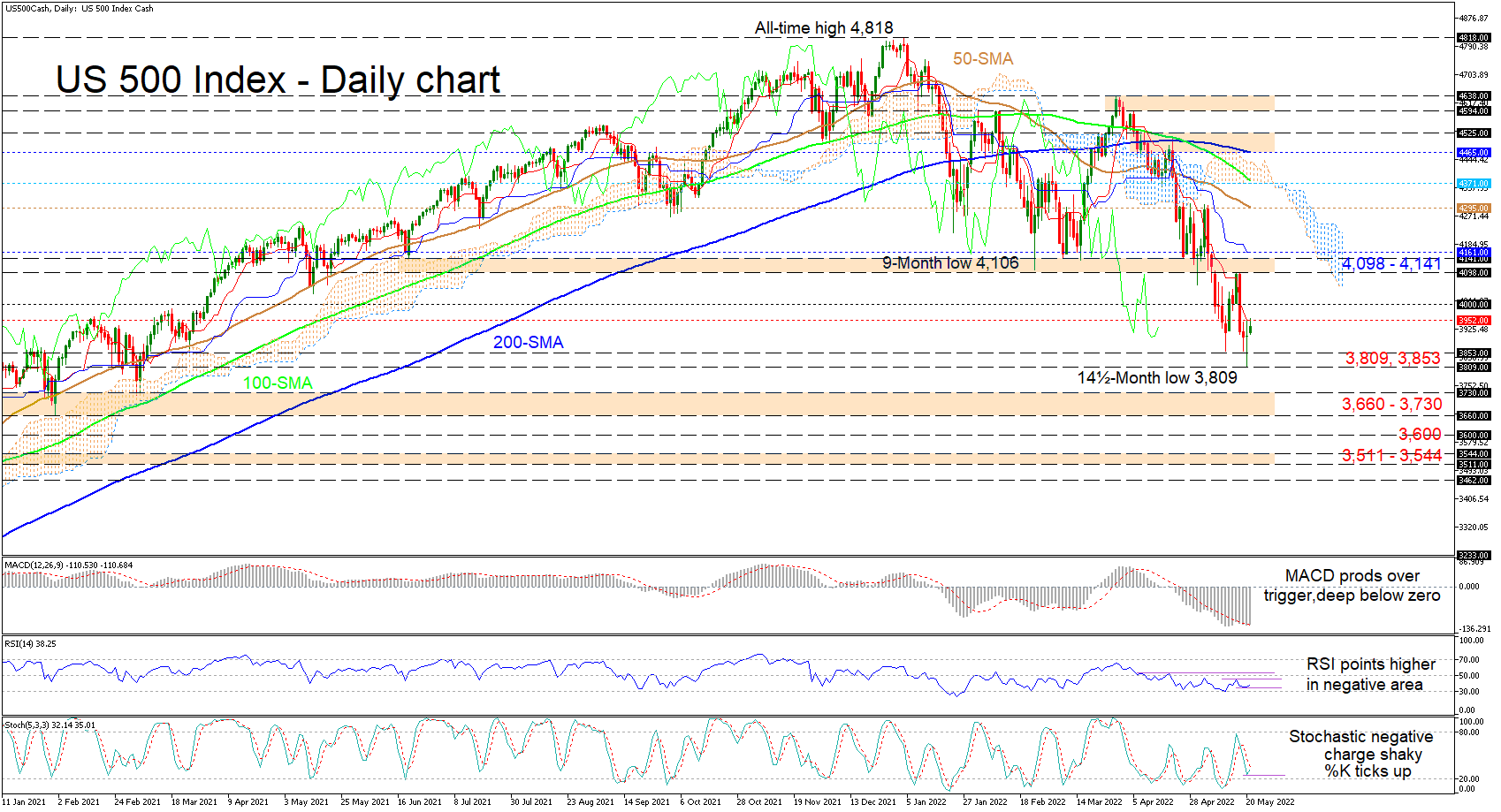
The US 500 stock index (Cash) is trading near the red Tenkan-sen line at 3,952 following an increase in risk appetite around a recorded 14½-month low of 3,809. The rolling over of the 200-day simple moving average (SMA) is feeding a dampening picture in the index, while the bearish 50- and 100-day SMAs are endorsing the decline from the end of March.
The Ichimoku lines are signalling a pause in negative forces, while the short-term oscillators are reflecting the fading in negative momentum since last Friday’s session of trading. The MACD, far south from the zero threshold, has nudged a tad above its red trigger line, while the RSI has turned higher near the 30 oversold barrier. Moreover, the stochastic %K line which has improved, confirms the renewed pickup in sentiment but has yet to confirm that a risk-off bias has evaporated.
In the positive scenario, the red Tenkan-sen line at 3,952 and the 4,000 handle could provide preliminary upside friction towards bullish gains in the index. However, clearing the latter hurdle may set up a test of the tough 4,098-4,141 resistance section. Piloting even higher, the next upside constraints could transpire from the early May highs that currently coincide with the 50-day SMA at 4,295 ahead of buyers eyeing the Ichimoku cloud’s lower band at 4,371 coupled with the 100-day SMA.
Alternatively, if the index remains heavy, durable support could commence from the 3,853 barrier and the 3,809 fresh trough. If the bearish trend strengthens, the price may weigh on the 3,660-3,730 support barricade that took shape around early January 2021. If selling interest endures, the 3,600 low from mid-December 2020 could step up ahead of the 3,511-3,544 support band that extends back to November 2020.
Summarizing, the US 500 index is sustaining a bearish trajectory despite the freshly found footing in the price. For downside risks to abate, the price would need to float above the 4,098-4,141 obstacle.
Sunset Market Commentary
Markets
There was no ECB decision/press conference scheduled for today. However, in a blog on the ECB website, President Lagarde flagged a path for ECB normalization that is more specific than the info often provided at a regular policy meeting. Lagarde didn’t need the ‘approval’ of new staff forecasts to conclude that monetary policy entered a different environment than before the pandemic with an almost permanent undershoot of the inflation target. Three shocks have changed the landscape. OPEC not meeting its production targets and the consequences of the war in Ukraine sharply raised energy and food prices. Supply and demand shocks during the pandemic led to record high goods inflation. The reopening of the economy now causes a rotation back to the services sector with new bottlenecks, raising inflation. The ECB concludes that the disinflationary dynamics are unlikely to return, even as the economy is not facing a straightforward situation of excess aggregate demand. If inflation stabilizes over the medium term, progressive normalization of interest rates to the neutral rate is appropriate. Lagarde didn’t specify the neutral rate, but we assume it to be near 1.5%. Given the uncertain context, normalization will still be guided by gradualism, optionality and flexibility. For near future, Lagarde rubberstamped the scenario of APP to be finished very early in Q3 with an interest rate lift-off in July and an exit from negative interest rates by the (end of) the third quarter. The reiteration of the principle of gradualism probably wants to ease speculation on a 50 bps lift-off, at least for now. With respect to flexibility, the blog also says that the ECB, if needed, might deploy new tools to prevent that normalization would lead to a fragmentation in monetary policy.
The immediate reaction of EMU interest rates to the blog was modest. German yields are rising between 4-3 bps (2-5/10-y sector) and 5 bps (5 y). July and September rate hikes were already largely discounted. Even so, this concrete guidance puts a solid floor for ST rates. Next week’s EMU May inflation is next important reference e.g. to potentially reopen the debate on the need of a 50 bps hike (if it would be materially higher than expected). Uncertainty on growth, as said, is an important reason for the ECB to advocate gradualism. In this respect, German IFO business climate unexpectedly improved from 91.9 to 93.0. Companies especially were more satisfied with current business (99.5 from 97.3). Expectations hardly improved (86.9). A broader reality check will be provided by the PMI’s tomorrow. In a risk-on context, the US curve bear steepens with the 2-y rising 2.5 bps and the 10/30 y sector gaining 3.5 bps. Both US and EMU equities on average are gaining about 0.75% to 1%+ (US).
Of late the dollar gradually eased off peak levels reached earlier this month. This trend continues. The DXY index currently tests first support at 102.33. USD/JPY stabilizes near 127.80. Next to some USD softness, the ECB guidance finally propelled EUR/USD (currently 1.0655) above the 1.0642 resistance (May 5 top). If confirmed, it would indicate pressure on the single currency is easing. EUR/GBP rallied from the 0.84/35 area to currently trade near 0.8470. Also worth mentioning, EUR/CHF (1.0285) didn’t join the broader euro rebound as SNB’s Maechler said the SNB won’t hesitate to hike rates if necessary. News Headlines
Belgium successfully raised the high end of the range on offer (€3.8bn) at today’s regular OLO auction. It tapped OLO’s 74 (€1.26bn 0.8% Jun2025), 94 (€1.76bn 0.35% Jun2023) and 80 (€0.8bn 2.15% Jun2066). Bid-to-cover averaged 1.73, in line with last month’s 1.71. The Kingdom is now halfway through this year’s €41.2bn OLO funding needs. In other Belgian news, business confidence dipped slightly more than expected, from 2.4 to 1.8. Loss of confidence was the most apparent in trade, where demand expectations dropped sharply. In the building industry, all the underlying components contributed to the decline in confidence, from demand forecasts and the current level of order books to the trend in orders over changes in use of equipment. Trade and building industry was only partially compensated by a marginal confidence increase in the manufacturing and business-related services industry, both on the account of improved demand (expectations).
GBP Rally as a Signal that the Worst of the Markets is Over
GBPUSD is trading near 1.2560, having added 3.3% to the monthly lows of May 13. We see a smooth recovery in the Pound from those lows, which is also in line with some easing of risk pull in global markets.
The 0.65% strengthening of GBPUSD on Monday morning looks like a signal that the recovery in risk demand has moved from a corrective bounce after oversold levels but is getting on a more serious track, bringing the pair back to the levels of the beginning of the month.
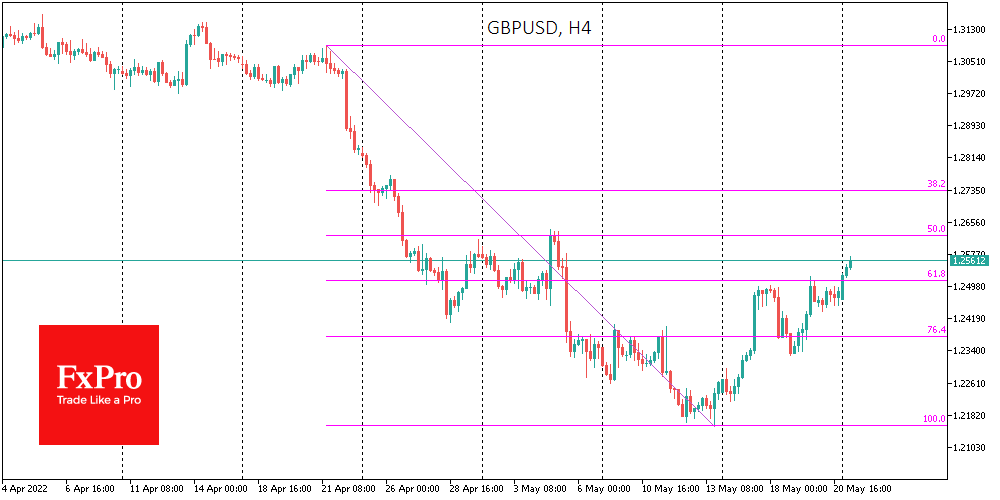
Interestingly, the Pound is giving even stronger signals of risk demand recovery than Bitcoin or the US stock indices, where we saw new multi-month lows inside on Friday afternoon.
The performance of GBPUSD as one of the most liquid yet risk-sensitive currency pairs points to a return of buyers that has gone further than a formal oversold correction after a three-week-long sell-off.
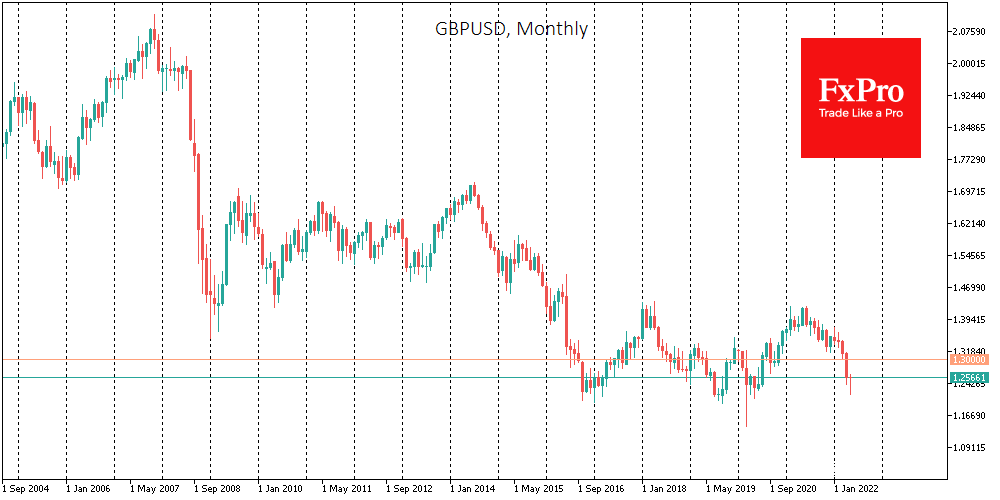
The currency market often acts as a leading indicator of a reversal of established trends, and we are likely to see one such signal from the British currency. A recovery in risk demand in the markets and GBPUSD reaching 1.2750 as early as this week could be an additional confirmation signal that forex was the first to recover from the bearish pressure.
However, it won’t be possible to fully say that markets have digested the crisis of recent months until the GBPUSD consolidates above 1.3000, a level that has become the informal line separating the most acute periods of market fear from attempts to recover to normalcy over the past six years.
SNB Maechler will not hesitate to tighten if inflation doesn’t come down
SNB Board member Andrea Maechler told Swiss newspaper Bilan, "if the inflation we expect does not come down in the medium term to a range between 0% and 2%, we will not hesitate to tighten policy."
The central bank's response to inflation "will depend on both inflation dynamics and the economic outlook in Switzerland and abroad", she said. "We have always said, as soon as we will be able to lift the negative interest rate, we will. We do not know however when we will be able to do so."
When asked if SNB would follow ECB in rate hikes, she said, "our goal is to conduct a monetary policy that is appropriate for the Swiss economy to ensure price stability in the medium term."
EUR/USD on Its Way to Recovery
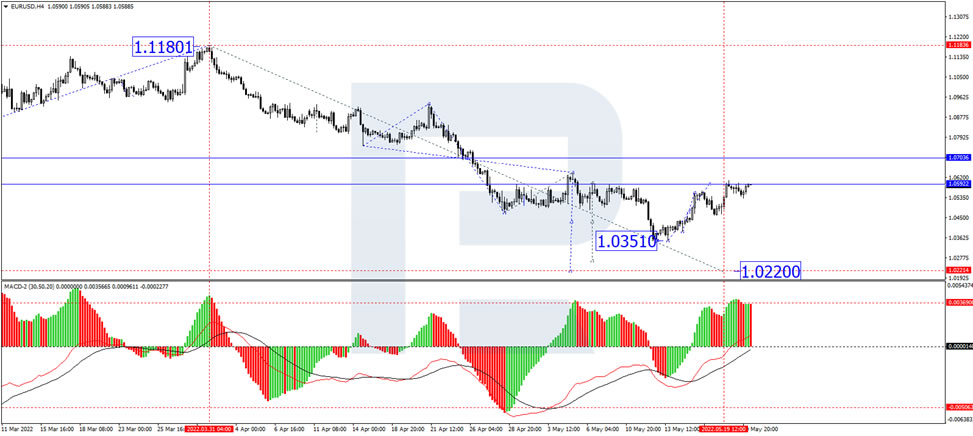
The major currency pair remains optimistic and intends to continue its recovery. On Monday 23 May, EUR/USD is trading at 1.0590; investors are trying to buy.
After the previous meeting of the US Fed, market concerns about the regulator’s future fiscal moves smoothed a little bit. It’s clear that the Fed will continue raising the benchmark interest rate quite aggressively, but that’s all. This allows to reduce investors’ interest in the “greenback” and helps other traded currencies to correct.
This week is not going to ring a lot of important statistics for EUR/USD. Still, market players should pay attention to reports on the Durable Goods Orders and the Q1 GDP from the US. The ECB Financial Stability Review might also be interesting. Moreover, heads of European and American regulators are scheduled to speak.
As a rule, the last week of the month is not very rich in macroeconomic statistics and allows investors to prepare for the numbers to be published early in the upcoming month.
In the H4 chart, after rebounding from 1.0350 and then completing the correction at 1.0590, EUR/USD is expected to consolidate near the highs. Later, the market may break the range to the downside and resume falling with the target at 1.0300. From the technical point of view, this scenario is confirmed by MACD Oscillator: its signal line is moving below 0 and may continue falling to update the lows.
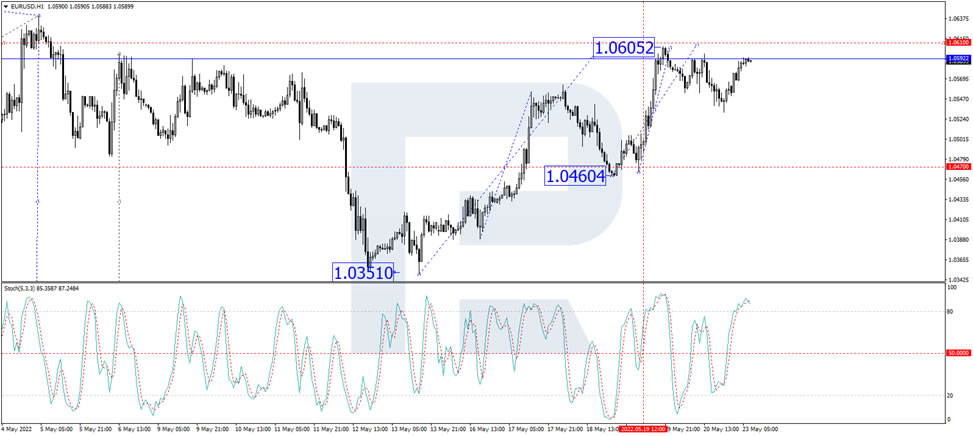
As we can see in the H1 chart, having completed the ascending wave at 1.0600 along with the correction down to 1.0460, EUR/USD is growing towards 1.0610. Later, the market may fall to return to 1.0460 and break it. After that, the instrument may continue trading downwards with the target at 1.0300. From the technical point of view, this idea is confirmed by the Stochastic Oscillator: after reaching 80, its signal line is expected to fall to break 50 and then continue its decline towards 20.
USD/JPY Mid-Day Outlook
Daily Pivots: (S1) 127.55; (P) 127.92; (R1) 128.32; More...
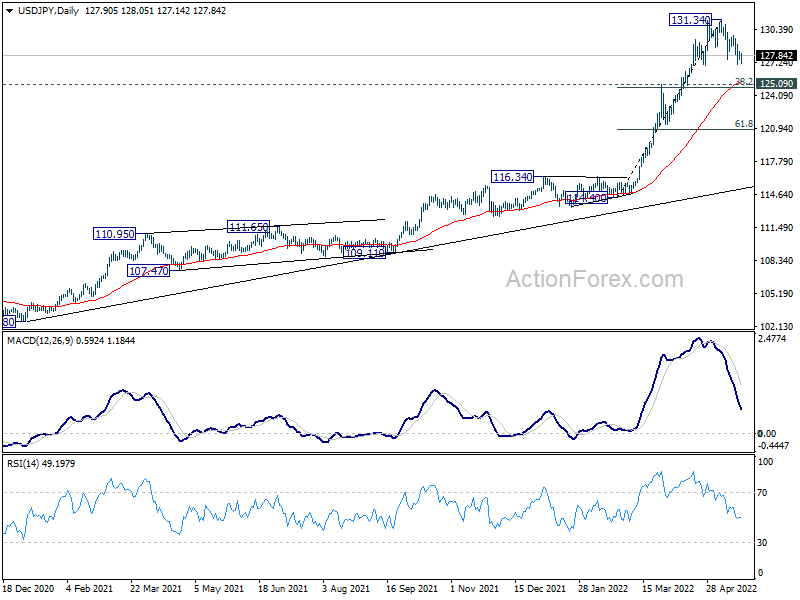
No change in USD/JPY's outlook and intraday bias remains on the downside. Correction from 131.34 short term top would extend to 125.09 cluster support (38.2% retracement of 114.40 to 131.34 at 124.86). But strong support is expected from there to contain downside to bring rebound. On the upside, break of 129.77 minor resistance will suggest that the correction is finished and bring retest of 131.34.
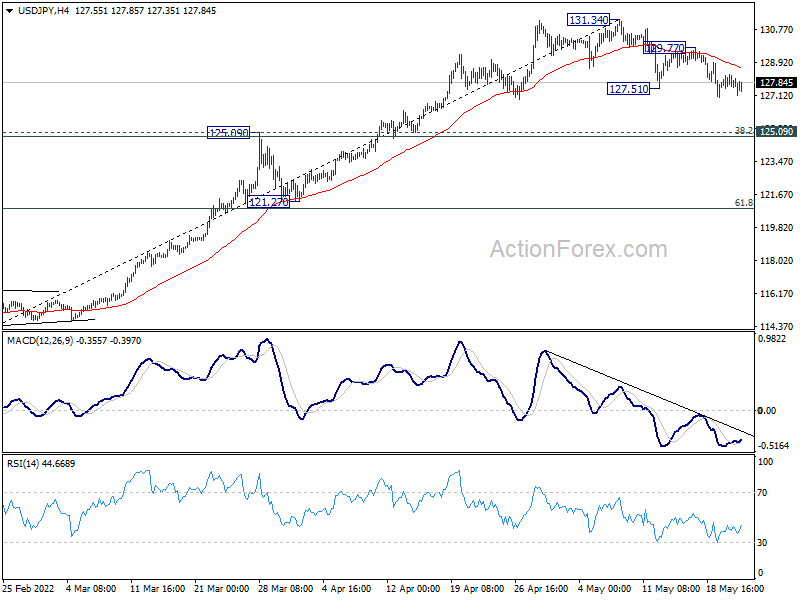
In the bigger picture, current rally is seen as part of the long term up trend form 75.56 (2011 low). Sustained trading above 61.8% projection of 75.56 (2011 low) to 125.85 (2015 high) from 98.97 at 130.04 will pave the way to 100% projection at 149.26, which is close to 147.68 (1998 high). For now, this will remain the favored case as long as 121.27 support holds.
USD/CHF Mid-Day Outlook
Daily Pivots: (S1) 0.9704; (P) 0.9734; (R1) 0.9774; More...
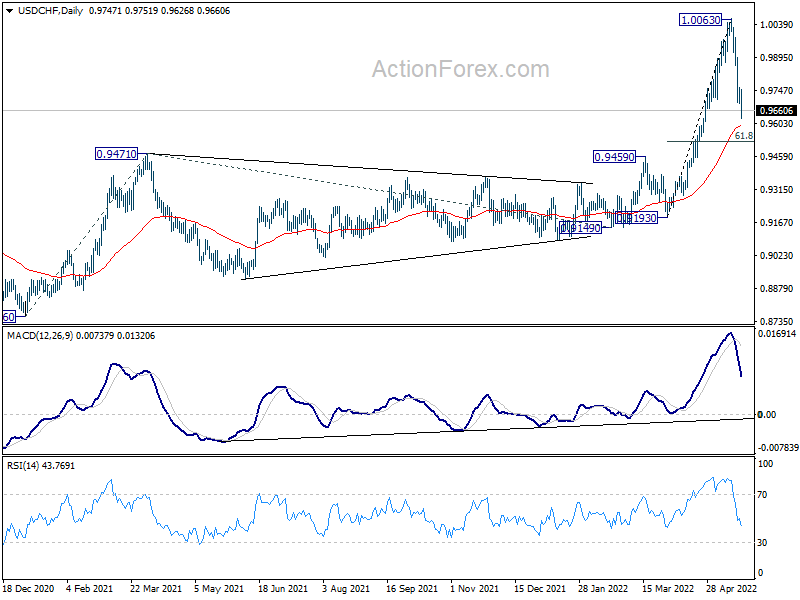
USD/CHF's fall from 1.0063 extends lower today and intraday bias stays on the downside for 55 day EMA (now at 0.9589) and below. But downside should be contained by 61.8% retracement at 0.9525 to bring rebound. On the upside, above 0.9763 minor resistance will turn bias back to the upside for recovery.
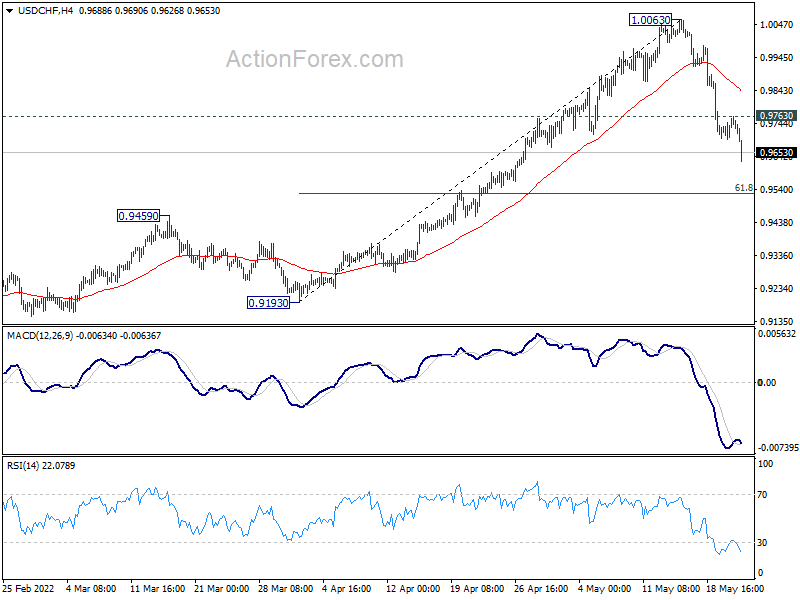
In the bigger picture, down trend from 1.0342 (2016 high) should have completed with three waves down to 0.8756 (2021 low) already. Rise from 0.8756 is likely a medium term up trend of its own. Next target is 161.8% projection of 0.8756 to 0.9471 from 0.9149 at 1.0306, which is close to 1.0342 (2016 high). This will remain the favored case as long as 0.9459 resistance turned support holds.