Sample Category Title
Platinum Elliott Wave Outlook
Precious metals and other commodities continue their bullish run as a result of inflationary pressure and war in Ukraine. In this article, we will take a look at Platinum. Platinum is considered as a precious metal. However, unlike gold, Platinum has industrial application. 75% of the worlds’ supply of gold is used in coins, bars and jewelry. Meanwhile, 65% of the world’s supply of Platinum is used for industrial and automotive applications. Only four countries have major platinum mining activities. South Africa has the most platinum deposits and accounts for 80% of global reserves. Below is a technical outlook of the metal.
Platinum Monthly Elliott Wave Chart
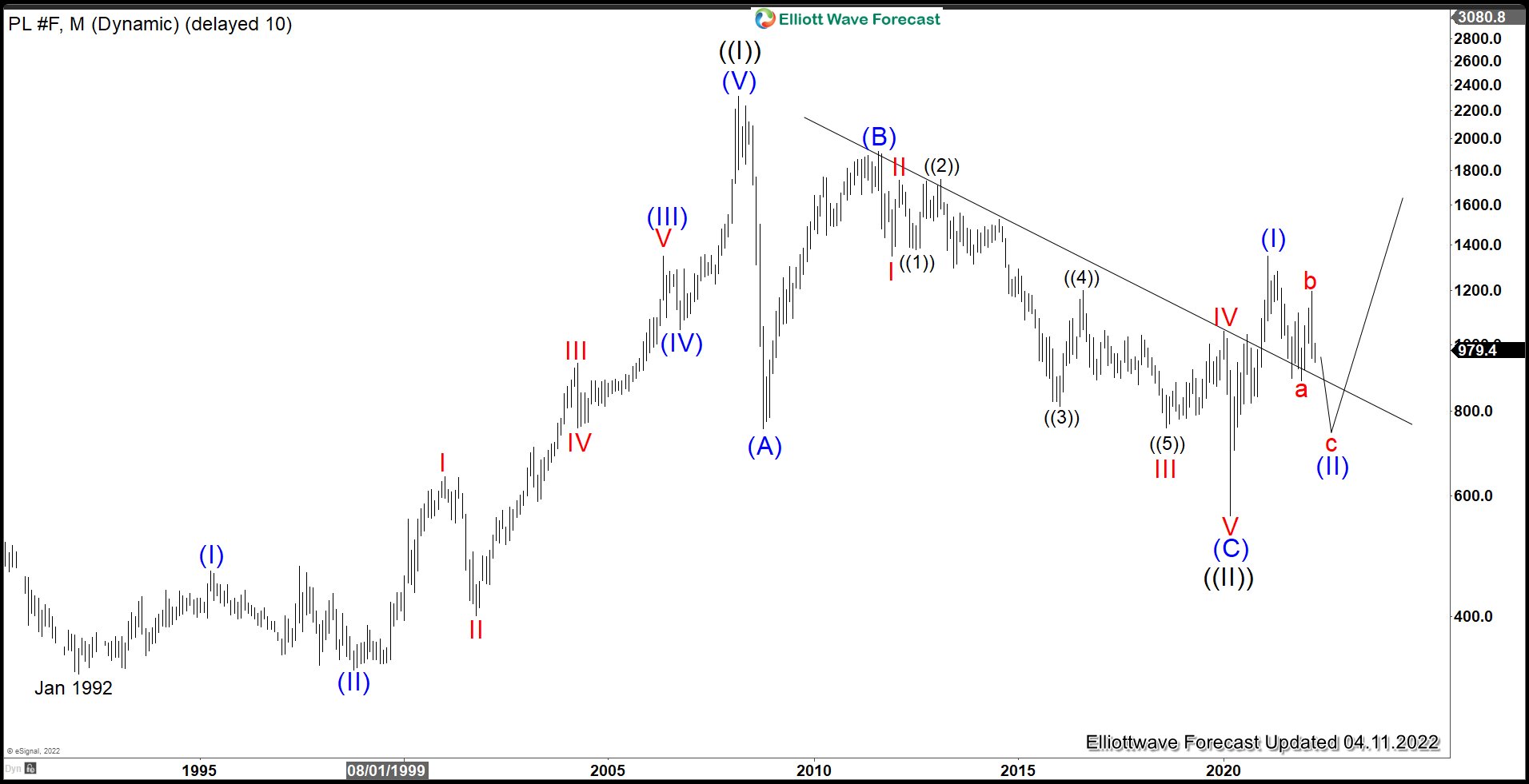
Monthly Elliott Wave outlook above suggests the rally from January 1992 ($329) ended Grand Super Cycle wave ((I)) at $2308. Up from January 1992 low, wave (I) ended at $466, and pullback in wave (II) ended at $334. The metal then resumes higher in wave (III) towards $1347 and pullback in wave (IV) ended at $1053. Final leg higher wave (V) of ((I)) ended at $2308 on March 2008. The metal then corrected for 11 years in wave ((II)) which ended on March 2020 low at $562. It has turned higher again in wave ((III)). Up from wave ((II)) low, wave (1) ended at $1348. Wave (II) is in progress as a zigzag to correct cycle from March 2020 low before the metal resumes higher again.
Platinum Daily Elliott Wave Chart
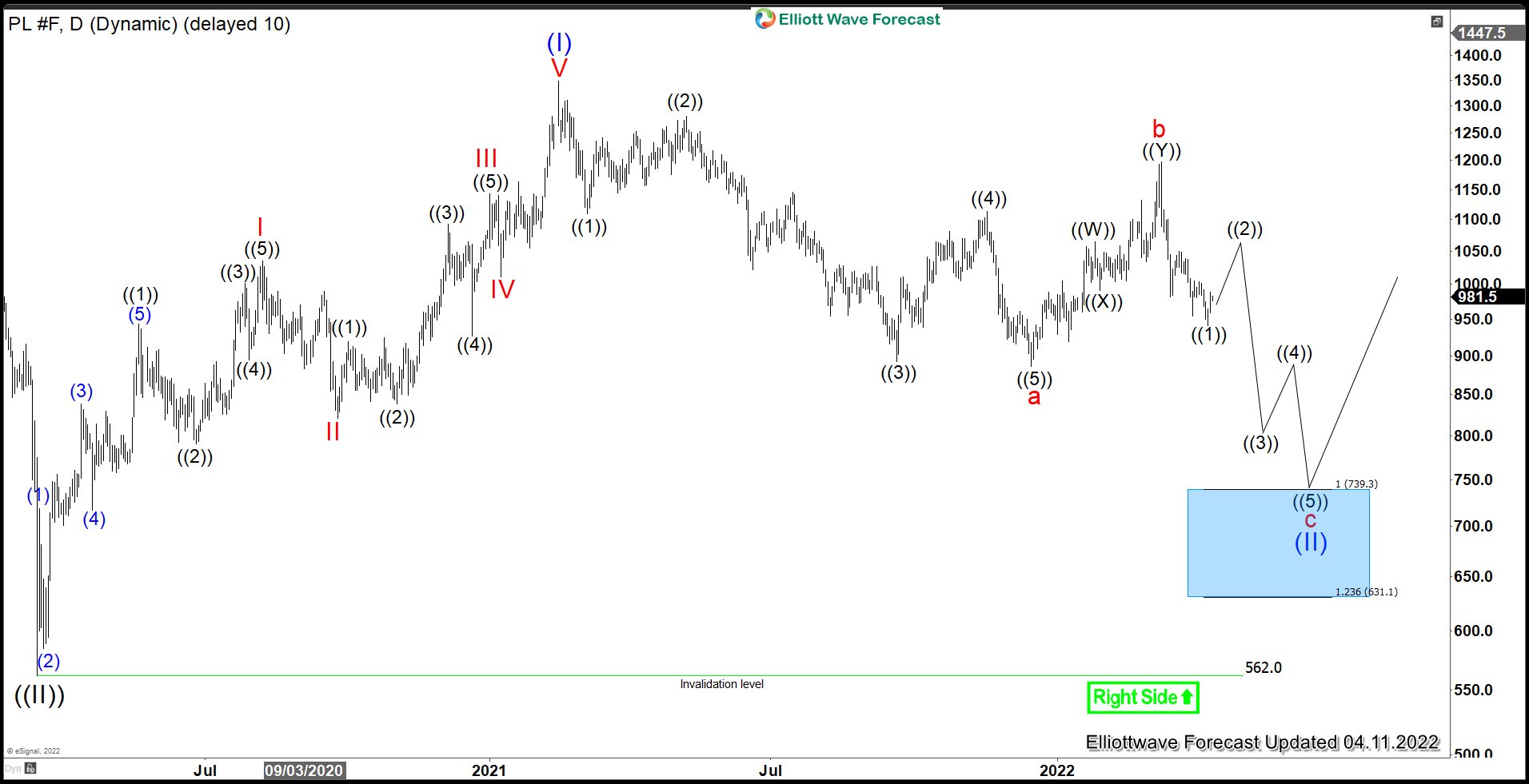
The daily Elliott Wave chart above shows more details of the monthly chart. Per the count above, we can’t rule out another leg lower in wave c to end wave (II). This will be a correction to the cycle from March 2020 low. the potential support will be at 100% – 123.6% Fibonacci extension of wave a which comes at $631 -$739 as denoted with the blue box. This area, if reached, should see buyers and the metal can then resume to new high.
Platinum Daily Alternate Elliott Wave Chart
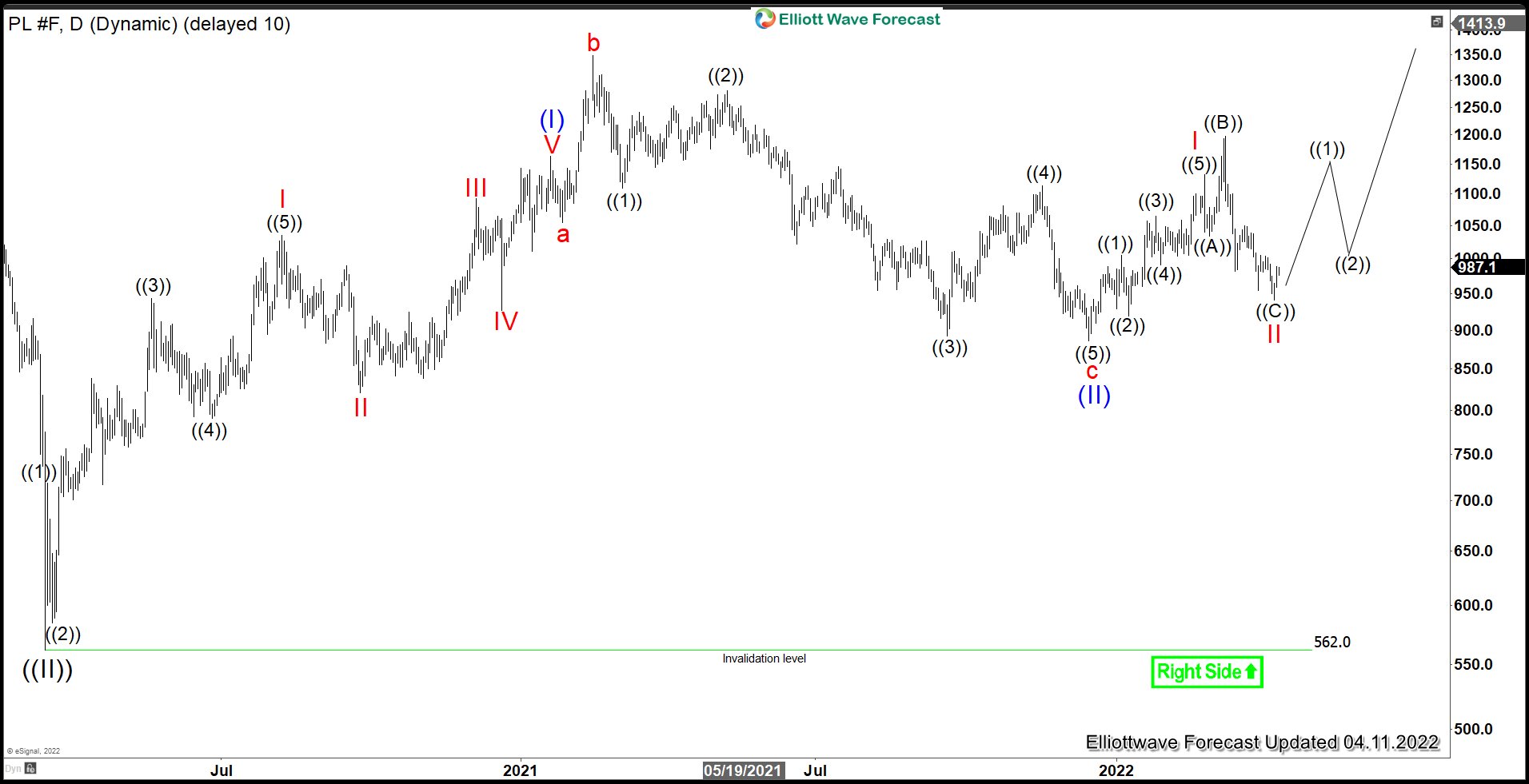
The daily chart above shows an alternate chart if Platinum does not make a new low below December 15, 2021 at $886. In the alternate scenario above, we can count wave (II) completed at $886 as an expanded flat. In this scenario, the metal should continue to see further upside without breaking below $886. Either way, March 2020 low is a major low in the metal and it should see further upside in coming years.
Elliott Wave View: S&P 500 (SPX) Turning Lower
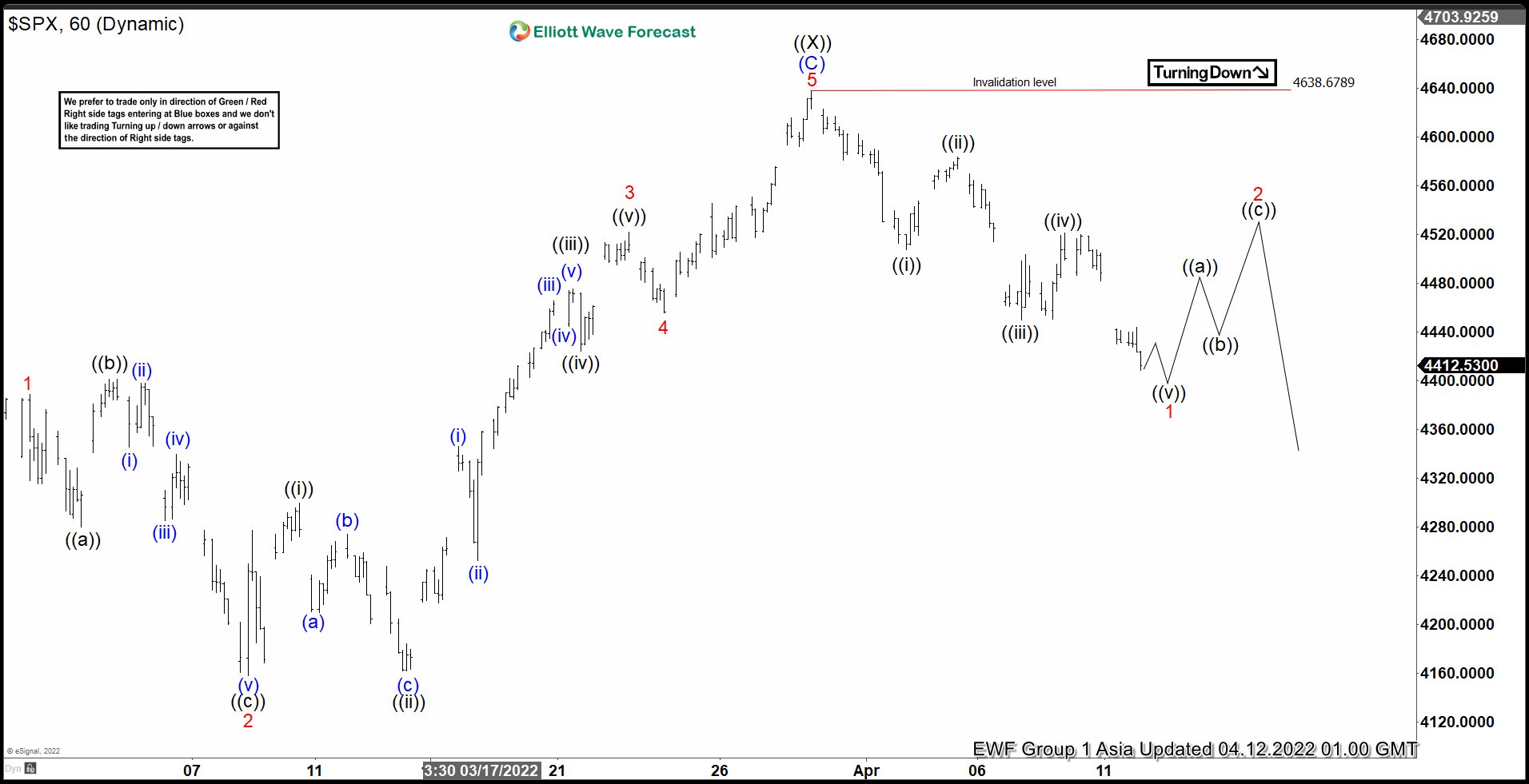
Short term Elliott Wave view in S&P 500 (SPX) suggests that the decline from January 4, 2022 is unfolding as a double three Elliott Wave structure. Down from January 4 peak, wave ((W)) ended at 4222.62 and wave ((X)) ended at 4638.67. Internal of wave ((X)) unfolded as an expanded Flat structure. Up from wave ((W)), wave (A) ended at 4595.3, wave (B) ended at 4153, and wave (C) higher ended at 4637.3. This completed wave ((X)) in higher degree.
The Index has since turned lower in wave ((Y)). Down from wave ((X)), the decline shows a 5 swing in the form of a diagonal. Wave ((i)) ended at 4507.57 and rally in wave ((ii)) ended at 4583.5. Index then resumes lower in wave ((iii)) to 4450.04, and rally in wave ((iv)) ended at 4521.16. Expect wave ((v)) to end soon which should complete wave 1. Afterwards, Index should rally in wave 2 to correct cycle from March 30 peak before it resumes lower again. Near term, as far as pivot at 4638.67 high stays intact, expect rally to fail in the sequence of 3, 7, or 11 swing for further downside.
$SPX 60 Minutes Elliott Wave Chart
USD/JPY: BoJ Intervention vs Godzilla US Yields
USD/JPY soared to new heights on Monday as the Bank of Japan pledged overnight to keep interest lows against the backdrop of rising US bond yields. The latest swing higher put USD/JPY within a whisker of breaking through the June 2015 high of 125.85. Eisuke Sakakibara, a former top currency diplomat, identified the 130 as a potential level where the Bank of Japan may intervene to support the yen in a recent Reuters article.Doing so, however, would require the Bank of Japan to use some of its c. $1.38 trillion of currency reserves and consent from the rest of the G7 counterparts, most notably the US.
Even if the Bank of Japan were to intervene, there is no guarantee of success. Traders are more apt to test the central bank’s resolve in light of its commitment to keep monetary policy ultra accommodative. Meanwhile, any verbal rather than direct intervention risks keeping USD/JPY down only temporarily. The last time the Bank of Japan directly intervened to prop up the yen was back in 1998 during the Asian financial crisis. Japan’s export driven economy has historically left the Bank of Japan to take a more hands off approach in the face of yen weakness.
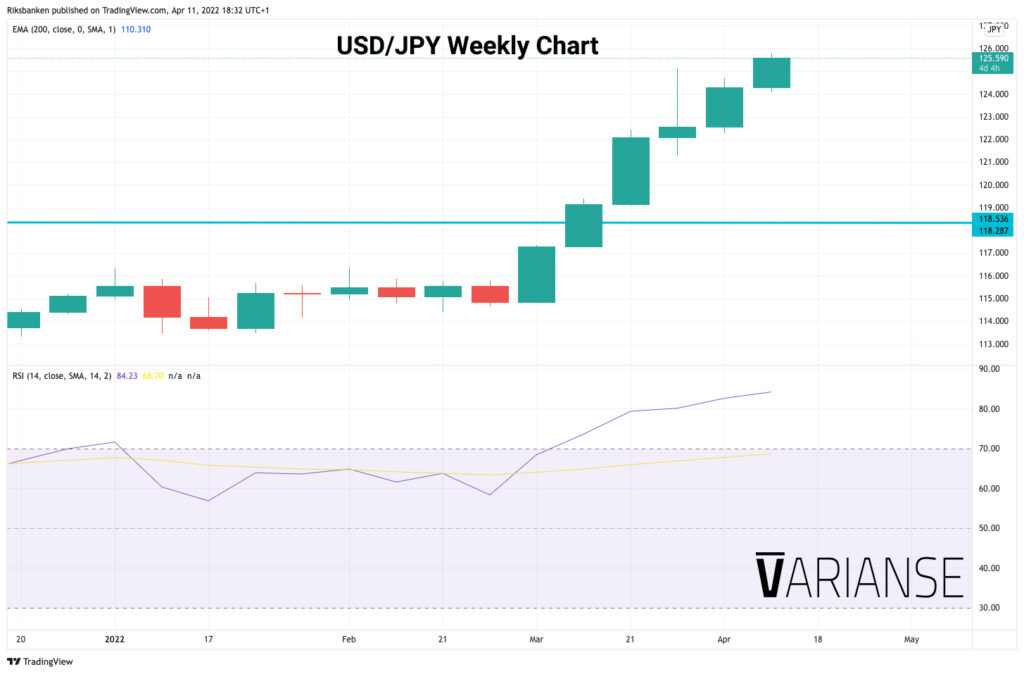
Nevertheless, the rise of the USD/JPY over recent weeks has been relentless. Back in late March, we were quick to highlight that the further above USD/JPY moved from the December 2016 swing high of 118.667 the bigger risk of a structural shift in the currency pair’s valuation. The market has moved far beyond that level now. That said, we’ve yet to see even a corrective move on the weekly timeframe as USD/JPY has soared higher, whilst we await confirmation of a new higher low on the daily chart. Traders should ponder those facts, and the risk of central bank intervention, and adjust any long position sizing accordingly.
Equally, traders with the guts to contemplate short positions should take consideration of the correlation between US yields and USD/JPY. The Bank of Japan’s commitment to ultra-accommodative policy really makes the yen’s performance more about what happens to US yields than what happens to those in Japan. Safer to look for confirmation that US yields may have topped out rather than solely relying on intervention from the Bank of Japan. The Bank of Japan truly faces a Godzilla challenge in terms retracing the yen’s losses in the face of ever higher US yields.
Eco Data 4/12/22
[php_everywhere instance="1"]
Will the Bank of Canada Opt for a 50-bps Rate Hike at its April Meeting?
The Bank of Canada announces its next monetary policy decision on Wednesday (14:00 GMT) and the odds of a double rate hike are very high. The Canadian economy has been going from strength-to-strength after emerging from the first lockdown in 2020, with a few bumps along the way. Like its southern neighbour, the United States, inflation is too high and the labour market is tightening fast. This gives policymakers little excuse to stay cautious. But how much more hawkish can the BoC get and can the Canadian dollar regain positive momentum, having retreated sharply from five-month highs versus the greenback?
Inflation has jumped to 30-year high
There can be no doubt that Canada’s economy is in pretty good shape right now. Demand for its main export – oil and energy products – is exceptionally strong thanks to the war in Ukraine, consumption is rebounding from the Omicron curbs, the housing market is booming, and the labour market is looking increasingly tight. The unemployment rate plunged to a new post-pandemic low of 5.3% in March.
The side effect of all this of course is that inflation is surging. Canada’s consumer price index stood at a 30-year high of 5.7% year-on-year in February and will likely rise further in the coming months as price pressures from higher energy and commodity prices, as well as from ongoing supply disruptions, are unlikely to fade quickly.
A 50-bps move is on the cards
Although the Bank of Canada was the first major central bank to begin exiting its pandemic-era stimulus last year, it only began raising interest rates in March when it lifted the overnight rate by 25 basis points to 0.50%. However, the BoC might be making up for lost time in April as there is growing speculation that policymakers will move more aggressively at the upcoming meetings.
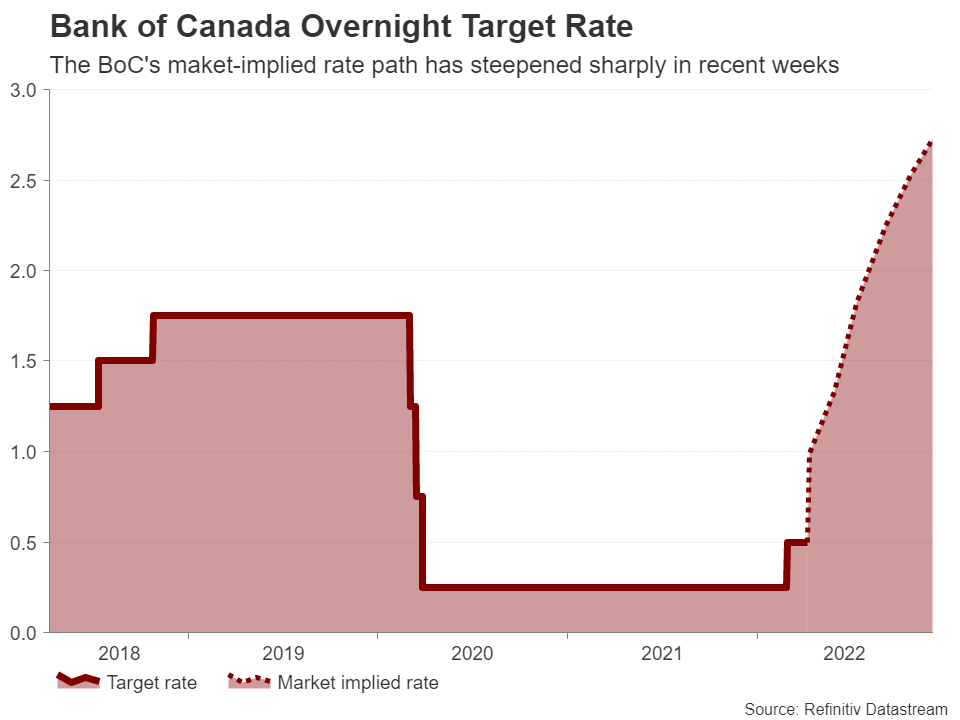
Market pundits have priced in about a 95% probability that the BoC will raise rates by 50 bps in April. That suggests there could be only limited gains for the loonie if the Bank meets those expectations, but the risk for a selloff is high if policymakers disappoint by hiking by just 25 bps.
Loonie eyes updated guidance on rates
But more significantly for the local dollar, investors will be seeking clues on the rate path for the rest of the year in the quarterly set of economic projections that are due the same day, as well as in Governor Tiff Macklem’s press conference. Rate hike expectations for December 2022 have shot up to almost 225 bps during March, as the Ukraine crisis unfolded and raw material prices spiralled higher. That implies that aside from the April meeting, the BoC will probably need to increase rates by 50 bps in at least two other meetings this year.
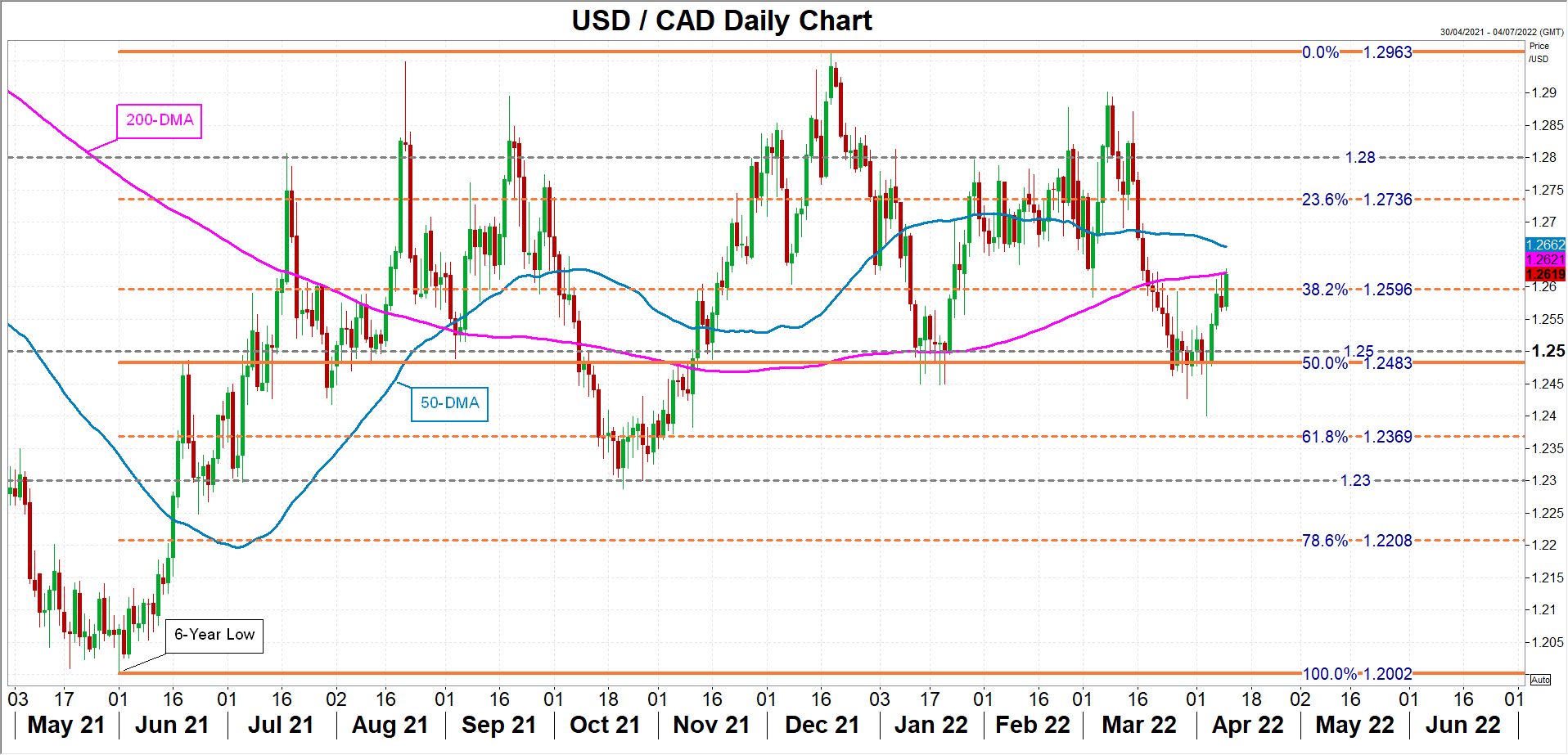
If the Bank signals a nearly as steep a rate path as what investors expect, dollar/loonie could restore its short-term downtrend, to re-test the 50% Fibonacci of the June-December 2021 upleg at 1.2483 before aiming for the 61.8% Fibonacci of 1.2369. Further gains towards the 1.23 level are possible if oil prices recover from their current lows and the Federal Reserve doesn’t make any further hawkish shifts.
Will the BoC shy away from bolder action?
However, if the BoC follows in the footsteps of the Bank of England rather than the Fed and is reluctant to commit itself to a very aggressive tightening cycle, dollar/loonie could extend its latest bounce back. The pair has just climbed towards its 200-day moving average in the 1.26 region. Another attempt higher could be met with resistance at the 50-day moving average not too far higher near 1.2660. Breaking above this barrier would open the way for the psychologically important 1.28 mark.
In the bigger picture, though, it might be difficult for the loonie to break out of its neutral range. Although Canada’s economy isn’t very exposed to Western sanctions against Russia so it is unlikely to suffer much, expectations of a hawkish BoC are being countered by a retreat in oil prices. Even if crude oil were to resume its rally, the elevated geopolitical risks might hold back stronger gains, while the threat of higher inflation squeezing consumers in the future poses another downside risk.
France Outperforms after Weekend Election
European stocks are slipping again at the start of what is likely to be another very lively week in financial markets.
That has very much become the norm this year for obvious reasons but this week has an interesting mix of central bank decisions, the start of earnings season and major data releases which will keep us all on our toes. And then of course there's China, where restrictions are causing concern, property firms are back in the spotlight and policymakers could unleash some support after bold promises a few weeks ago.
Considering what's to come, it's no surprise that it's actually been a relatively timid start to the week. Compared to what we've become accustomed to, of course. Interestingly, the CAC is the only major index in the green after the weekend's first-round election, which saw Emmanuel Macron and Marine Le Pen progress to the second round in a couple of weeks.
The run-off between the two candidates is looking to be far closer than five years ago when Macron scooped two-thirds of the vote. While there is still plenty that could not bring themselves to vote for Le Pen as we saw in 2017, her softened image appears to have swayed others and while pols still favour Macron, some fall within the margin of error that makes Le Pen a realistic victor this time around.
While that would no doubt be bad news for Europe, it seems markets aren't particularly concerned if today's trading is anything to go by. Some have chosen to compare a Le Pen victory to Brexit and Trump, two events that were deemed to be a negative for stock markets before the vote but did not turn out to be so over time. Perhaps lessons have been learned.
Oil slides amid Chinese restrictions
Oil is off around 3% on the day, with Brent back below $100 and hitting its lowest level in almost four weeks. There has been a big effort to alleviate the pressures in the oil market in recent weeks which has no doubt helped but it's the lockdowns in China that are driving the latest declines.
The country's zero-Covid policy is naturally having a dampening effect on demand which is aiding the rebalancing efforts. Of course, this is just a temporary demand hit so the upside risks to the price remain but it is offering some reprieve for now. How widespread the restrictions become and for how long will determine the sustainability and severity of the declines.
Gold pares gains after facing resistance once more
Gold is up a little on the day but has given back the bulk of its gains from earlier in the session. Once again the yellow metal has run into resistance around the same region it did a few weeks ago and a recovering dollar has also weighed on it around those levels.
If it can break beyond here - an impressive feat considering we're still seeing yields rising - then $2,000 becomes the next big test. Whether it's inflation fears or risk aversion driving the move, we're certainly seeing gold coming back into favour. Not that it ever really fell out of favour, even as risk appetite returned and interest rate expectations were ramped up considerably.
Further pain ahead for bitcoin?
Bitcoin is getting hit hard again on Monday, losing more than 4% and coming close to $40,000 where it could see some support. A break of this level could be a psychological blow. From a technical perspective, it would also mean a break of the 50 fib level - 2022 lows to highs - which could also be a negative signal. It will be interesting to see if these levels attract dip buyers as the breakout two weeks ago looked to be a very bullish move. But it's all been downhill since then.
ECB ‘Half Measures’ Unlikely to Stop Euro’s Bleeding
The European Central Bank will conclude its next meeting at 11:45 GMT on Thursday, and with inflation running wild, it will likely signal that a rate increase is on the menu soon. Ending asset purchases in July followed by a rate increase in September seems like the most likely endgame. However, markets have already priced an even more aggressive tightening pace, so such signals might not be enough to rescue the battered euro.
Stagflationary breeze
The ECB has a crisis on its hands. Eurozone inflation is running at 7.5% per year, which is the fastest clip since the euro came into existence. And this may not be the peak. Supply chains are still a mess with the recent lockdowns in China while the invasion of Ukraine has sent commodity prices rocketing higher, so more inflation is probably in the pipeline.
The problem is that economic growth is losing steam. This means the ECB cannot raise interest rates with brute force to fight this inflationary spiral. Consumers are being forced to spend more on necessities like food and energy, which limits their ability to consume everything else. Coupled with the slowdown in China that will restrain European exports, economic data over the next few months could be ugly.
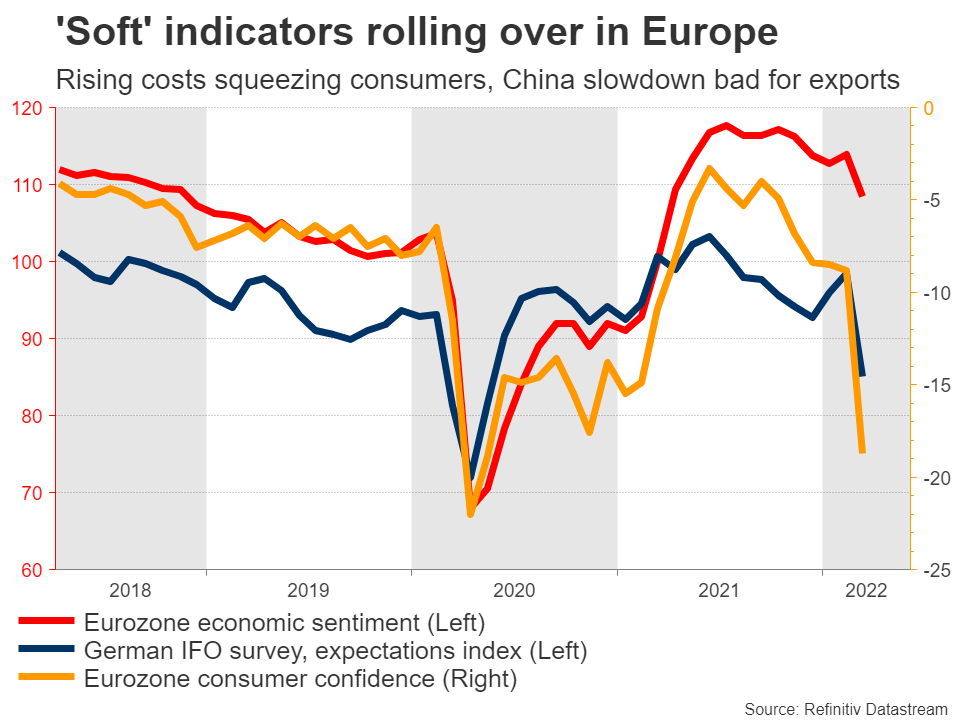
Business and consumer confidence readings have already cratered and even though governments have rolled out support measures to cushion the impact, there is still a clear risk of recession in Europe.
Slow and steady
In this environment, the ECB is essentially trapped. It needs to tighten policy to control inflation, but if it steps on the brakes too hard, it would increase recession risks even further. That’s not a gamble the officials want to take.
Hence, the only realistic option is to raise interest rates in a very careful manner. The ECB has to strike the right balance, tightening neither too fast nor too slow.
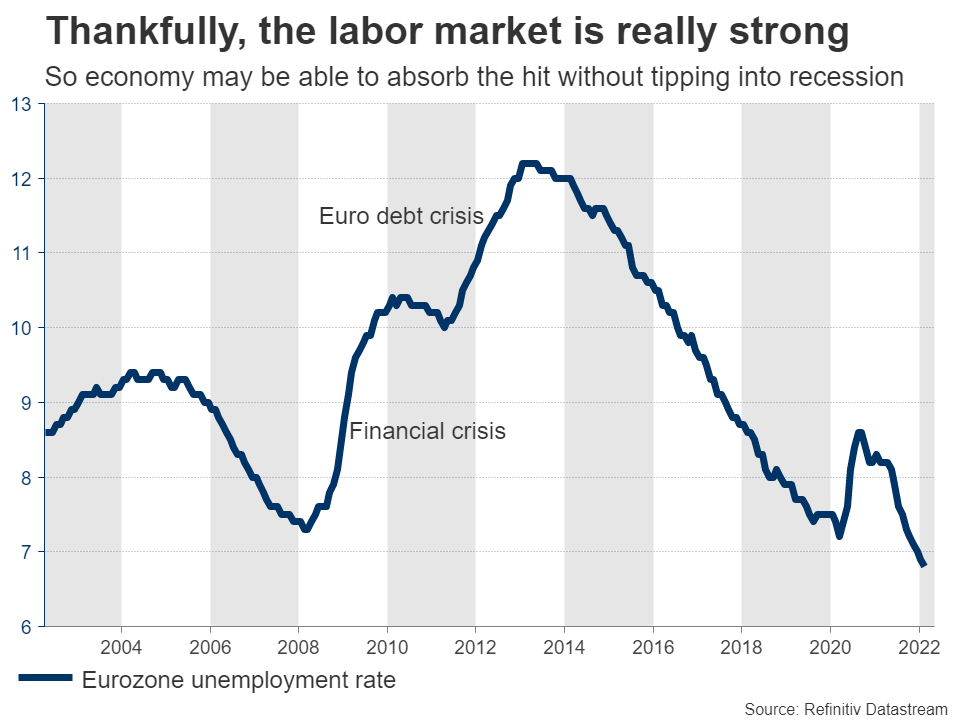
On the bright side, the labor market was very strong before the Ukraine crisis. The unemployment rate hit a record low in February, so there is some optimism that the economy can absorb the hit without falling apart.
No relief for the euro?
All told, the ECB is about to hike rates for the first time in a decade. While it won’t commit to a specific meeting this week, it is becoming clear that September is a realistic time for liftoff. Asset purchases could end in July, the earliest possible date according to the forward guidance.
But for the euro, this might not be enough to stop the bleeding. Money markets have already priced in 73 basis points of rate increases for this year, which amounts to three quarter-point hikes. The first move is fully priced for September and market pricing also implies a 60% probability for a ‘double’ hike of 50 basis points at that meeting.
This is a tall bar for the ECB to overcome. Therefore, even though the central bank is moving in a more hawkish direction, its speed might not be enough to satisfy euro traders.
Euro/dollar has been trending lower for more than a year and if the ECB only delivers ‘half measures’ this week, that’s unlikely to change. A disappointment could see the pair test the 1.0835 region again.
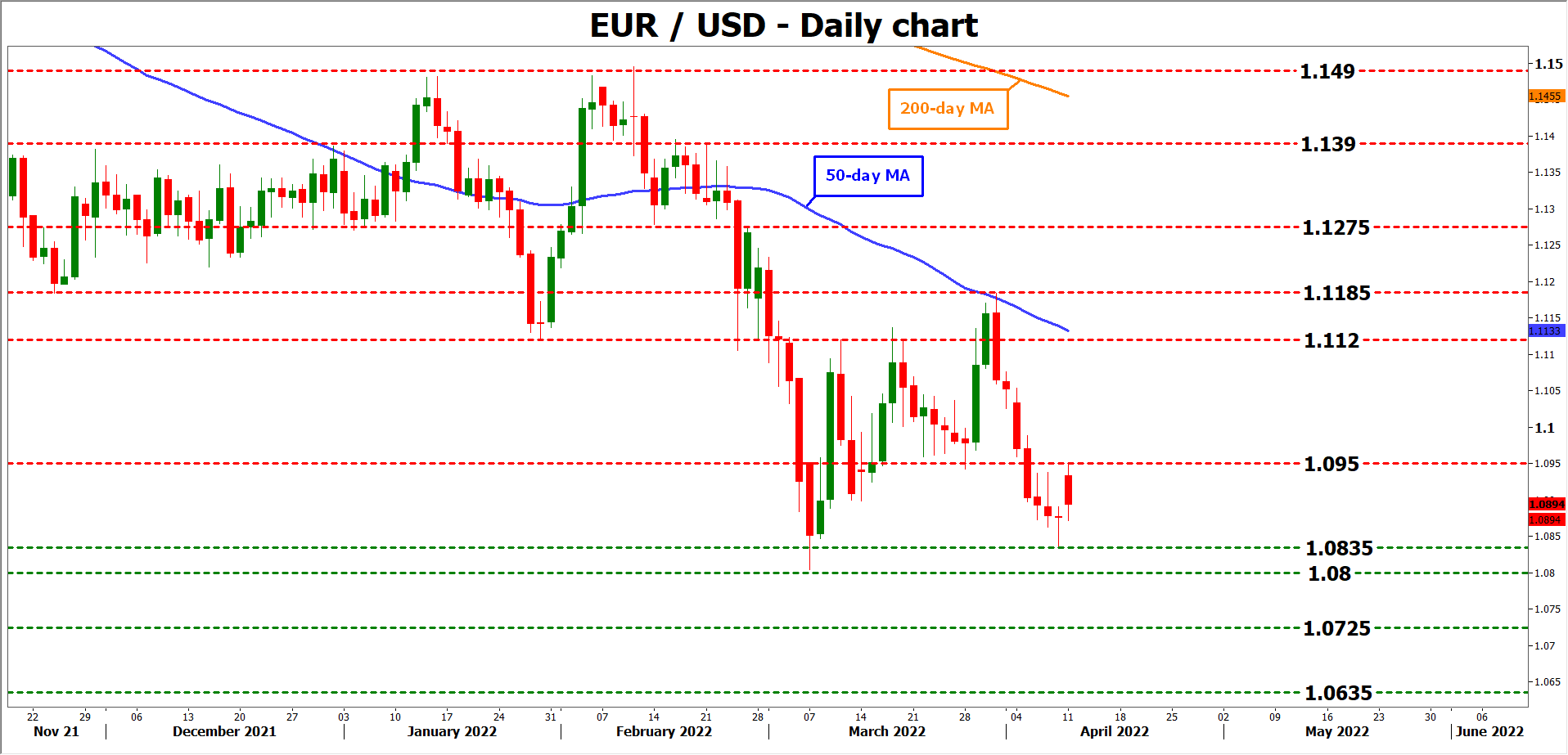
If the ECB wants to save the euro, it needs to signal that rates can be raised earlier, possibly over the summer. This is a low-probability outcome as it would violate its own forward guidance, but not impossible given the inflation dynamics. In this scenario, euro/dollar could shoot higher, perhaps towards the 1.1120 zone.
Of course, for the euro to stage a sustainable rally, the growth outlook needs to improve first. That’s unlikely to happen until there’s a ceasefire in Ukraine and the French presidential election is out of the way.
French Election a Historic Test for the Euro
Politics is once again temporarily becoming the main driver for the single currency. EURUSD returned to 1.0925 on Monday, gaining 0.8% from Friday’s lows on reports that incumbent Macron is ahead of far-right Le Pen and will potentially get even more votes in the second round on April 24th as the majority of those voting for alternative candidates lean towards Macron.
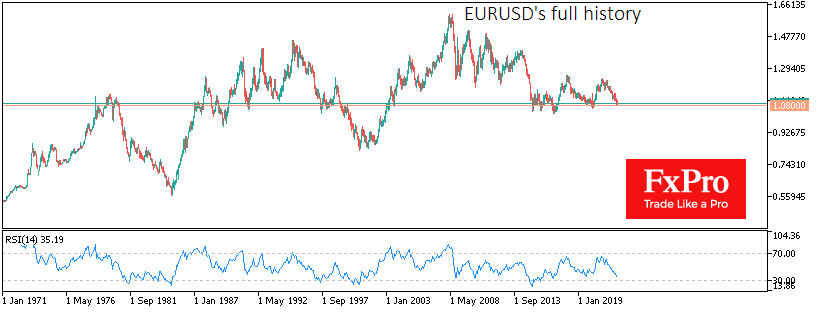
The lowering of political risks is attracting buyers of the single currency as EURUSD fell late last week to 1.0850 – near the lows of March and a support area in the pair between February and May 2020.
In 1997, the EURUSD (then still non-cash) was gaining support near this level, but a return to 1.08 two years later triggered a capitulation. The EURUSD sell-off then had only halted two years later after the single currency had lost a quarter of its value and only after ECB interventions.
The French elections and the events in Ukraine have enough potential to trigger a historic euro move away from that line.
A strong pullback under 1.0800 opens the direct road to 1.05 (pandemic lows), but it may only be the first step in a long-term slide of the single currency towards 0.8500.
The opposite is also true: the political détente in the coming weeks may fundamentally change the attitude towards the single currency, making purchases attractive in the long term from the current levels.
Investors and traders should pay close attention to the EURUSD in the coming weeks because the following dynamics will be decisive for the number one currency and the entire forex market for many months.
Sunset Market Commentary
Markets
The new week starts the way it ended last Friday: with a new bond sell-off. The trend of higher yields is definitely not new but received new impetus from the Fed and ECB Meeting minutes last week. Both highlighted the fact that monetary hawks are either firmly behind (Fed) or are in the process of taking over the steering wheel (ECB). The fact that the economic calendar is semi-backloaded with US CPI due tomorrow and the ECB meeting on Thursday did not keep markets sidelined as they usually do. Quite the opposite actually: it seems that bond markets are frontrunning. They do have a point though, especially with respect to the ECB. We wouldn’t be surprised if the outcome of the April meeting showed a further shift to the hawkish side of the spectrum. Core bonds slide with German Bunds underperforming US Treasuries. Yields rise 8.3 bps (2y) to 10 bps (30y), steepening the curve with moves mainly driven by real rates. The 10y yield (+9.8bps) is attacking the 2018 high of 0.80%. A break higher paves the way towards the 2015 resistance area around 1%. European swap yields add 5.3-8.3 bps. The 2y is testing the 2013 resistance of 0.78% with euro area money markets raising their ECB bets by the day. They currently discount two 25 bps hikes and counting by October. The US curve bear steepens too in an offshoot of the rapid quantitative tightening pace (targeting the longer end) as suggested by last week’s Minutes ($95bn per month). Changes range from 3.1 bps (2y) to 6.3 bps (30y). The 10y reference finds itself in the resistance zone of 2.76%-2.80%.
The Japanese yen on FX markets catches the eye. Minor risk-off is not even close of an enough support against the surge in core bond yields. EUR/JPY convincingly surpasses 136 and is on track for the highest close since early 2018. USD/JPY crushes the 125 handle it tested end of March (125.48) to trade at the highest level since mid-2015. The Norwegian krone is second to last in the G10 club (see below). The euro opened strong this morning. It enjoyed a minor relief/stop-loss rally after Macron held the upper hand over Le Pen in Sunday’s first round of the presidential elections. They will face each other in the second round on April 24 in a repeat of the 2017 elections. The race to the Elysée however is much tighter than it was back then. The common currency in the meantime pared some of those early gains, especially against the USD. EUR/USD trades flat at 1.088 after having touched an intraday high of 1.095. EUR/GBP was a copy paste; gapping higher above 0.84 at the open only to give up on all gains. Sterling itself is relatively well bid too, despite disappointing industrial production figures this morning.News Headlines
Of late most inflation releases surprised to the upside. Norwegian March inflation was the exception to the rule. Both headline and core inflation printed softer than expected. Headline inflation rose 0.6% m/m to be up 4.5% y/y. Core inflation rose a modest 0.3% m/m, leaving the y/y figure unchanged at 2.1%. The Norges Bank started a gradual rate hike cycle in December. In its March policy report, the NB indicated to hike quarterly with a next step at the June meeting. It forecasted the policy rate to reach 2.5% at the end of next year. Broader inflationary pressures, however, raised questions whether the NB also should consider faster policy normalisation. Today’s soft core inflation serves as a counterargument. The Norwegian krone, which recently profited from a higher oil price and expectations of higher interest rate support, corrects modestly. EUR/NOK rebounded from the 9.48 area just before the CPI release to 9.5475 currently.
At the other end of the inflation spectrum, Czech CPI again accelerated to a pace faster than expected. Prices rose 1.7% M/M to be up 12.7% Y/Y. Costs of transportation rose 7.1% M/M, domestic fuels rose 21.7%. Costs related to housing, which has a weight of 26.7% in the basket, had risen 17.6% Y/Y. The CNB raised its policy rate 50 bps to 5.0% at the end March meeting. With risks for inflation to rise even somewhat further in the coming months, another bold rate hike at the next meeting (May 5) is likely. The Czech krona gained modestly today with EUR/CZK trading at 24.42.
Euro Gets Slight Lift from French Vote
The euro clawed its way back to the 1.09 line on Monday but has retreated. EUR/USD fell 1.57% last week and hasn’t had a winning session in the month of April.
It’s Macron vs. Le Pen, again
The first round of the French presidential election is over, and it will be a repeat run-off (final round) between President Emmanuel Macron and Marine Le Pen of the far-right. The two candidates ran against each other in the 2017 election, which Macron easily won. This time, however, it is shaping up to be a much closer race. Macron is slightly ahead, but Le Pen has been closing the gap and there is a sizeable amount of the electorate that is unhappy with Macron’s performance. The runoff takes place in two weeks, and election polls will likely have an impact on the euro’s movement. Le Pen is a fierce euro-sceptic and if she appears to be gaining in the polls, it will be bearish for the euro.
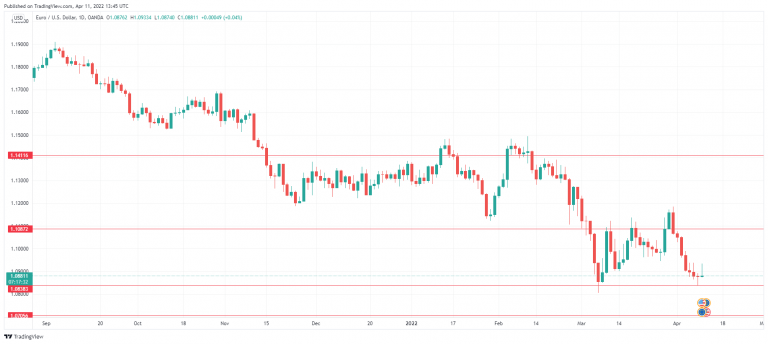
The ECB holds a policy meeting on Thursday, and a dovish stance from the central bank won’t do any favours for the struggling euro, which is down 1.52% in April. EUR/USD dropped to 1.0836 on Friday, putting pressure on the 1.0800 line, which has held since May 2020. If 1.08 fails, the euro could take a tumble all the way to 1.06.
Germany releases the ZEW Economic Sentiment index on Tuesday. The index swooned in March, falling from +54.3 to -39.3. The magnitude of the slide was stunning, and the markets are braced for even worse, with a consensus of -48.4 for April. The driver behind the sour mood is the war in Ukraine, which together with sanctions against Russia is having a sharply negative effect on the German economy. Inflation is expected to continue to accelerate, which is adding to the pessimistic outlook. The Eurozone ZEW Economic Sentiment is projected to show similar numbers, and soft ZEW releases could spell trouble for the euro.
EUR/USD Technical
- There is resistance at 1.1008 and 1.1141
- 1.0838 is a weak support line. Below, there is support at 1.0705