Sample Category Title
Pound Tests 1.3000 Again, Risks Falling to 1.2600
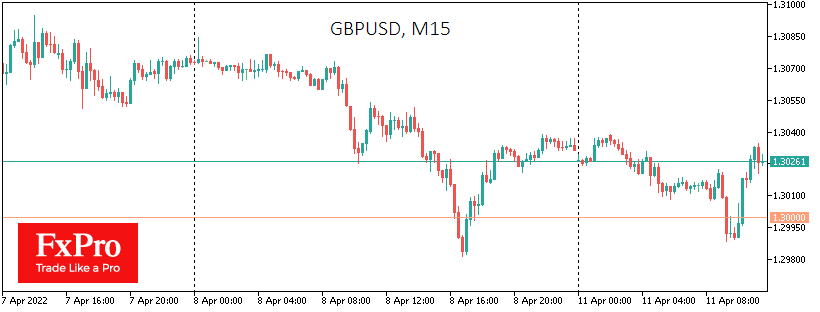
The British pound returned to the $1.3000 area, a significant circular level from which the British currency bounced in the middle of last month. The bulls continue to hold for the second consecutive trading session. The intraday charts clearly show buying impulses when going under the psychologically crucial round level.
A fresh batch of UK statistics sets the mood that the local rebound might be temporary. The economy added 0.1% in February compared to 0.8% a month earlier and was twice as weak as expected. Industrial production fell by 0.6% compared to an expected 0.3% increase. This demonstrates the damage to business activity in sectors that are often one step ahead of the economic cycle.
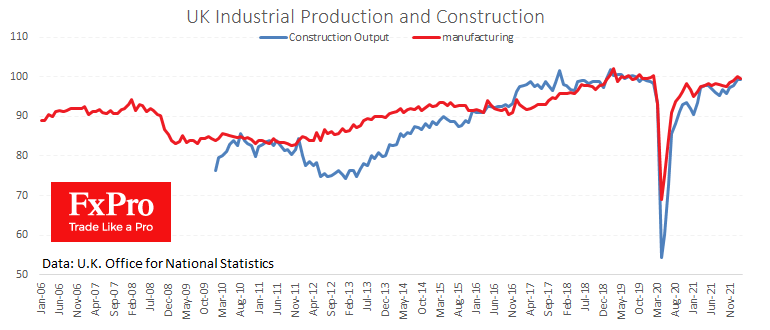
A sharp slowdown in the economy will reduce the room for monetary policy tightening by the Bank of England.
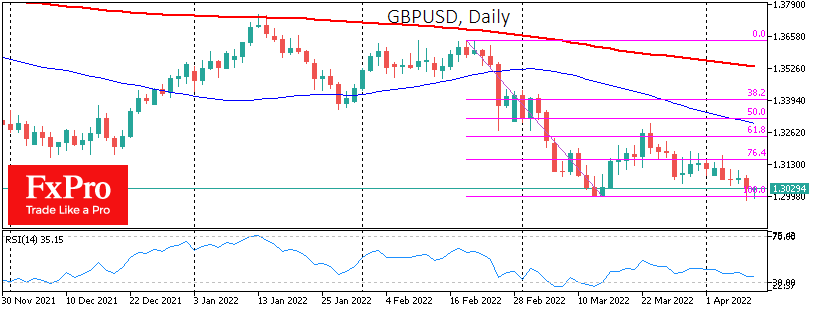
The decline in stock markets also plays into the hands of pound sellers, which positively correlates with demand for risky assets. GBPUSD went into a spike on events around Ukraine, losing more than 4.5% from late February to the lows of March. The subsequent rebound failed to gain traction, stalling near the 61.8% level of the initial decline. A consolidation under 1.3000 potentially paves the way to 1.26 (161.8% level).
Bitcoin Can Retreat to March Lows Following the Stocks
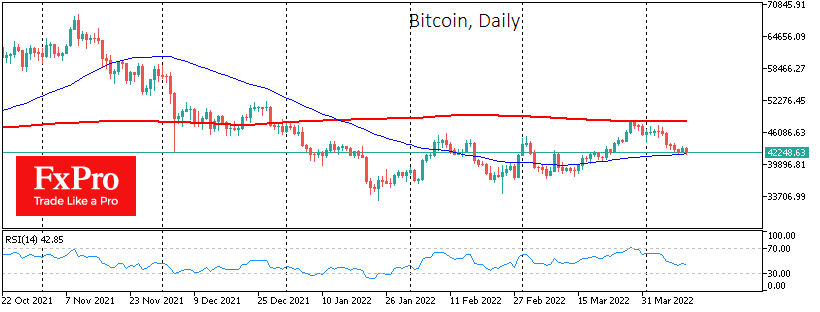
At the start of Monday, Bitcoin’s price temporarily fell below $42K, losing more than 3.5% from Sunday’s peak value. This is clear evidence of a tug-of-war between bullish retail traders and professional bidders who sold risky assets in response to pressure on stock prices.
In total, BTC has been losing 1% over the past 24 hours and 8.5% over the week. Ethereum is down 2% and 9% in the last 7 days, and top altcoins fell in price by 1.3% (Dogecoin) and up to 7.4% (Terra).
According to CoinMarketCap, the total capitalization of the crypto market decreased by 2% to 1.95B in a day. This clearly reflects the increased pressure on weaker altcoins due to the curtailment of risk demand. The share of bitcoin in the capitalization of the entire crypto market is now 41.3% (+0.6 points in 7 days and +0.3 in a day).
By the start of the day on Monday, the crypto-currency fear and greed index had lost 2 points to 32, settling in the fear territory.
The crypto market is again increasing its correlation with the dynamics of stocks, or rather, it is guided by the high-tech Nasdaq index. This relationship is easily explained by the fact that in both cases, investors are betting on a progressive idea and not on a stable income.
The original plan, in which cryptocurrencies would become an alternative haven for capital outside of the traditional banking system, has not been tested by the military events in Ukraine. As it turns out, crypto exchanges value the idea of legally earning commissions on transactions and on the placement of tokens much more than the original off-system and apolitical approach.
Thus, the cryptocurrency market is increasingly becoming a platform for the assets of ever-smaller projects in the technology sector. There is nothing wrong with this in the long run, but right now, such a direct correlation with stocks can do a disservice. Against the backdrop of tightening monetary policy, stocks are under increased pressure. Amid deteriorating sentiment, bitcoin dropped to a 50-day moving average near $42K. Fixing below this level may open a direct path to the area of March lows near $38K.
CHF/JPY upside breakout as Yen selloff intensifies
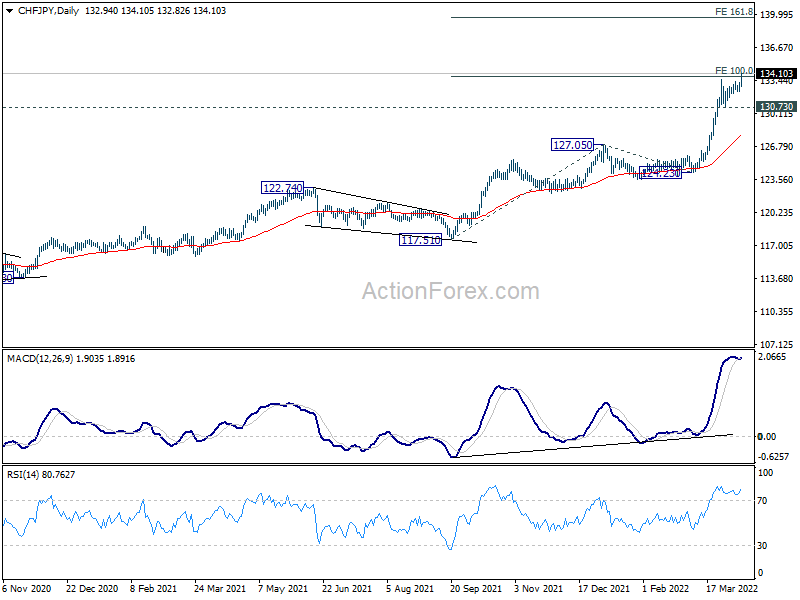
Yen selloff steps up a gear today and even CHF/JPY breaks through short term top at 133.53 to resume its long term up trend. For now, short term outlook will remain bullish as long as 130.74 support holds. There is prospect of upside acceleration to next target at 161.8% projection of 117.51 to 127.05 from 124.23 at 139.66.
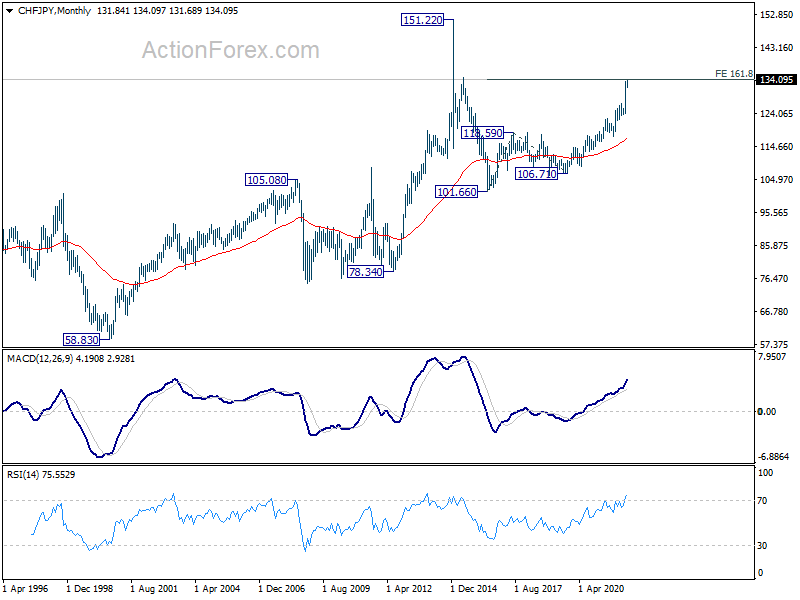
More importantly, as seen in the monthly chart, CHF/JPY is now trying to break through 161.8% projection of 101.66 to 118.59 from 106.71 at 134.10. Sustained trading above this level could set up the for medium term upside acceleration towards 151.22 (2014 spike high).
AUD/USD Pair Entered a Bearish Zone Below $0.7500
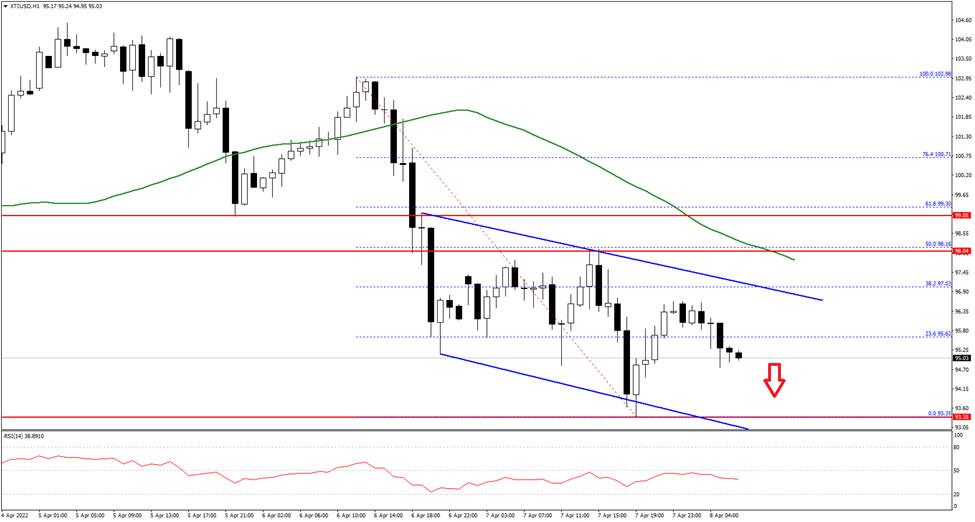
The Aussie Dollar started a fresh decline from well above the 0.7550 level against the US Dollar. The AUD/USD pair traded below the 0.7500 support to enter a bearish zone.
The pair even traded below the 0.7465 level and the 50 hourly simple moving average. It traded as low as 0.7419 and is currently correcting losses. It is facing hurdle near a connecting trend line at 0.7450 on the hourly chart. The next key resistance on the upside is near the 0.7470 level.
If there is an upside break above the 0.7470 level, the pair could rise steadily towards the 0.7520 level in the near term. Any more gains could send the pair towards 0.7550 on FXOpen.
An immediate support on the downside is near the 0.7420 level. The next key support is near the 0.7400 level. A clear break below the 0.7400 support could lead the pair towards the 0.7350 support.
Investors on the Defensive as US 10-Year Yields Hit a Three-Year High
After a positive start to the week, US equity futures took a hit as bond yields rose across the curve, indicating that the recovery from last week's selloff will prove to be hard.
The sharp increase in yields over the past several days reflects investors' perception of how hawkish the Federal Reserve is turning and another sign that interest rates may begin to go higher, by 50 basis points instead of 25, at its next meeting.
US 10-year yields rose six basis points in Asia trade, almost reaching 2.78%. The benchmark has traded above 3% only twice in the past decade, and very few saw this coming in 2022. Meanwhile, real interest rates are fast approaching positive territory, with the US 10-year TIPS trading at -0.11% at the time of writing.
This is definitely a very challenging time for investors. The fight against inflation is and will remain the number one factor moving markets, and this week sees a lot of fresh data to digest.
US inflation released on Tuesday is expected to have risen by 8.5% over the past year, 0.6% above the previous 40-year high of 7.9% in February. March inflation figures will begin to reflect the impact of the Russia/Ukraine war on prices and given there're no signs of this war ending soon, they are likely to remain elevated. The Fed can’t do anything to control inflation produced by sanctions on Russia or the supply bottlenecks with the new Chinese lockdowns. But, policymakers have no alternative but to turn more aggressive on policy tightening as inflation becomes out of control.
Like in the US, Britons are struggling with rising inflation. It may even be worse in the UK as a higher cap on energy prices will be introduced this month. The UK CPI release on Wednesday will be closely watched to anticipate the Bank of England's next move.
While the Bank of Canada and Reserve Bank of New Zealand are both expected to raise rates this week, the ECB is likely to hold fire. However, will the European central bank end bond purchases earlier or stick to the third quarter? That could provide a signal as to when the ECB is ready to lift rates.
In theory, this environment of rising interest rates is positive for the financial sector, especially for banks. However, they are likely to show profits reduced by more than 30% in the first quarter given the drop in M&A activity, IPO listings, and trading. Higher interest rates are still good for retail banking if it does not lead to a recession, so it will be interesting to watch the earnings announcements from the big US banks this week.
EURUSD Erases Positive Gap; Signals Mixed
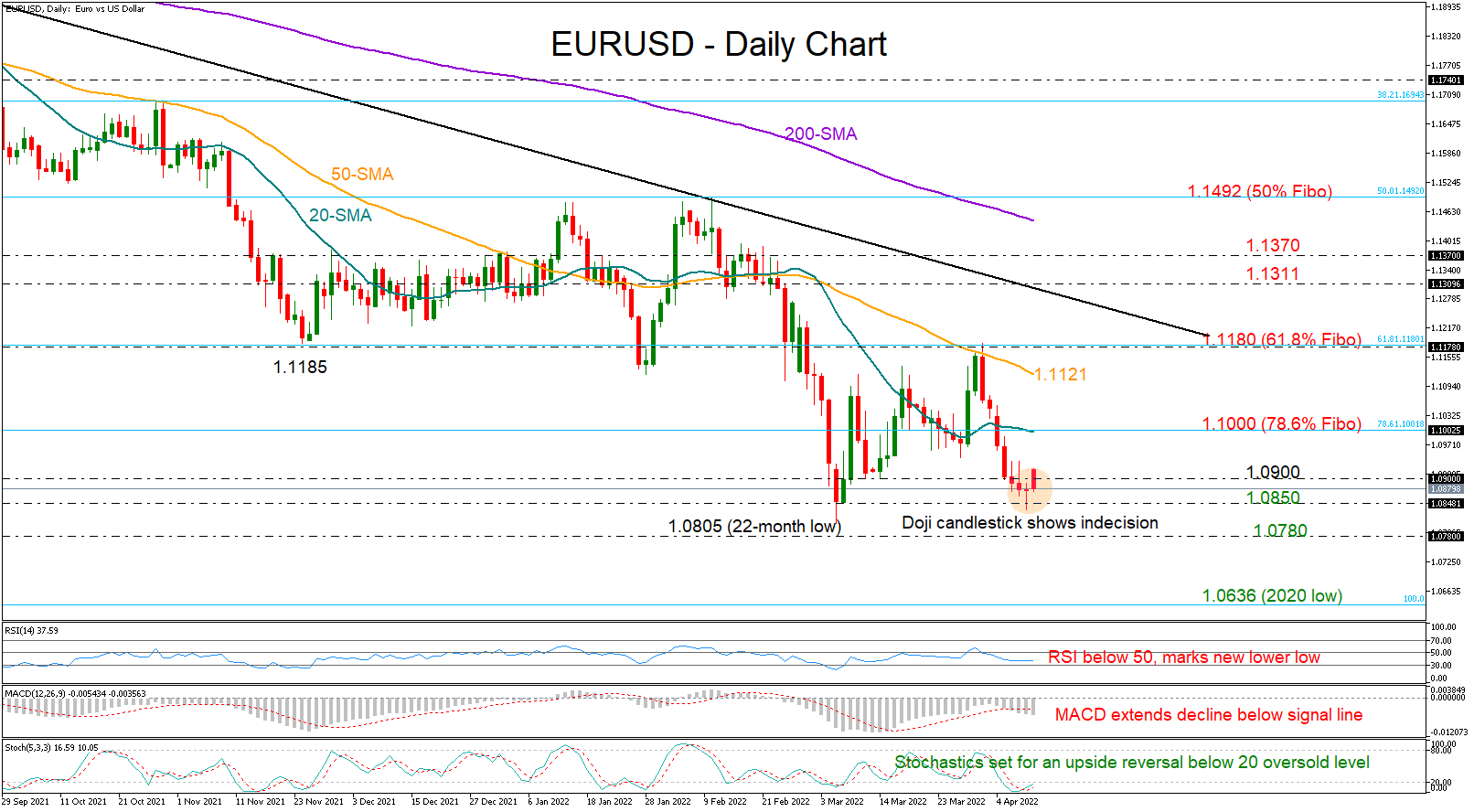
EURUSD opened with a positive gap slightly above the 1.0900 level on Monday after a bearish week, but gains proved short-lived, with the price inching back below that number to turn negative on the day.
Technical signals are mixed. The RSI and the MACD have further extended their decline below their neutral thresholds. On the other hand, the Stochastics seem to have found a bottom in the oversold zone, suggesting a potential upside reversal in the price. Friday’s doji candlestick could also be a sign that the recent sell-off is losing steam, though that alone is considered a neutral signal unless a large green candlestick follows that setting.
Overall, the current market structure does not look very encouraging. A close below the nearby support of 1.0850 could see an extension towards the 1.0780 handle, while deeper, a tougher battle could take place near the 2020 low of 1.0636.
In the bullish scenario, where the pair swiftly recovers today’s setback, the price could push towards the 20-day simple moving average (SMA) and the 1.1000 mark. This is where the 78.6% Fibonacci 1.0636 – 1.2348 upleg is positioned. If that wall collapses, the rally could speed up to the 50-day SMA currently at 1.1121, or even higher to the important 61.8% Fibonacci of 1.1180. Additional gains from here would mark new higher highs in the very-short-term picture, likely strengthening buying forces up to the tentative descending trendline seen at 1.1275.
In the long-term timeframe, the market is preserving a downward trajectory and only a significant increase above 1.1492 would upgrade the outlook to neutral.
Summarizing, EURUSD is sending a mixture of signals. However, as long as it keeps trading below 1.0900, downside risks will outweigh upside ones.
GBPUSD moves sideways ahead of UK data dump
The Australian dollar remained under pressure after the country’s prime minister called for a new election in May. Scott Morrison will face off with Anthony Albanese, the leader of the center-left Labor Party. The campaign has focused mostly on the rising inflation in the country and defense. While Morrison is trailing in polls, analysts expect that the results will be close. The announcement came a few days after the Reserve Bank of Australia (RBA) delivered its interest rate decision. The bank now expects that rates will start rising in June. Analysts expect a 0.25% rate hike and two more later this year.
The euro was little changed as investors reflected on the French election. In the national election, Emmanuel Macron faced off with Marine le Pen, the right-wing politician. Results revealed that Macron had won by 27%. He was followed by Marin Le Pen, the far-right candidate who got 23% of the total vote. This means that the two will face-off on April 24 to determine the next French president. The euro also went sideways as investors focused on this week’s interest rate decision by the European Central Bank.
The British pound was little changed ahead of the upcoming important economic data from the United Kingdom. The Office of National Statistics (ONS) will publish the latest GDP numbers. Economists expect the data to show that the country’s economic growth slowed in February as inflation continued to be a contentious issue. The other important numbers the ONS will publish are industrial and manufacturing production. Further, the ONS will release the latest UK jobs and inflation numbers later this week.
GBPUSD
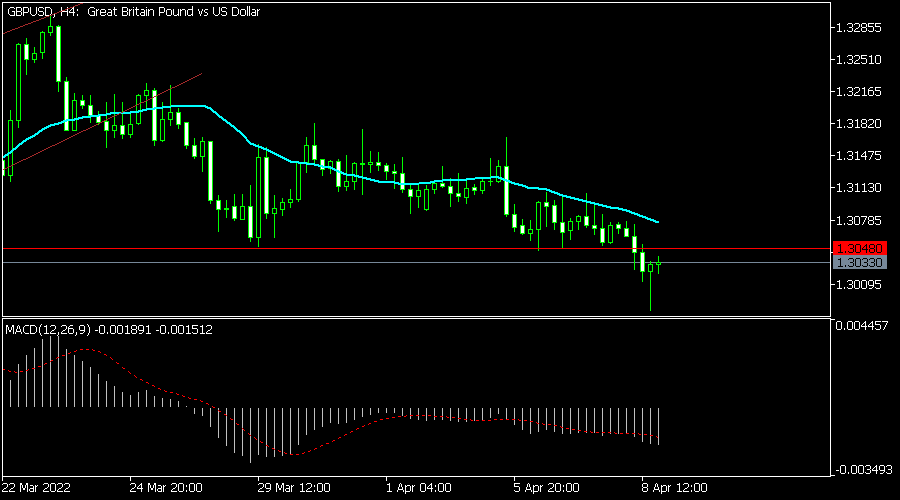
The GBPUSD moved sideways as investors waited for the upcoming data by from the UK. The pair is trading at 1.3033, which is slightly above last week’s low of 1.2090. On the 4H chart, it remains slightly below the 25-day and 50-day moving averages. It has also moved slightly below the important resistance level at 1.3050, which was at the lowest point on March 28. Therefore, the pair will likely have a bearish breakout in the coming days as investors target the next key support at 1.2980.
NZDUSD
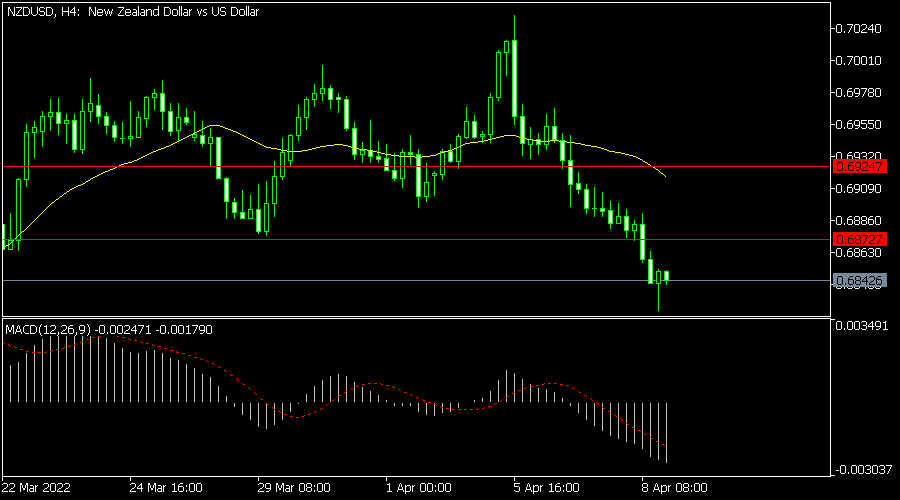
The NZDUSD pair declined to a low of 0.6840, which was the lowest level since March 18 as investors focused on the upcoming RBNZ decision. It moved below the 25-day and 50-day moving averages and the key support at 0.6827. The MACD and the Relative Strength Index (RSI) have all continued dropping. Therefore, the pair will likely keep falling ahead of the RBNZ decision later this week.
EURUSD
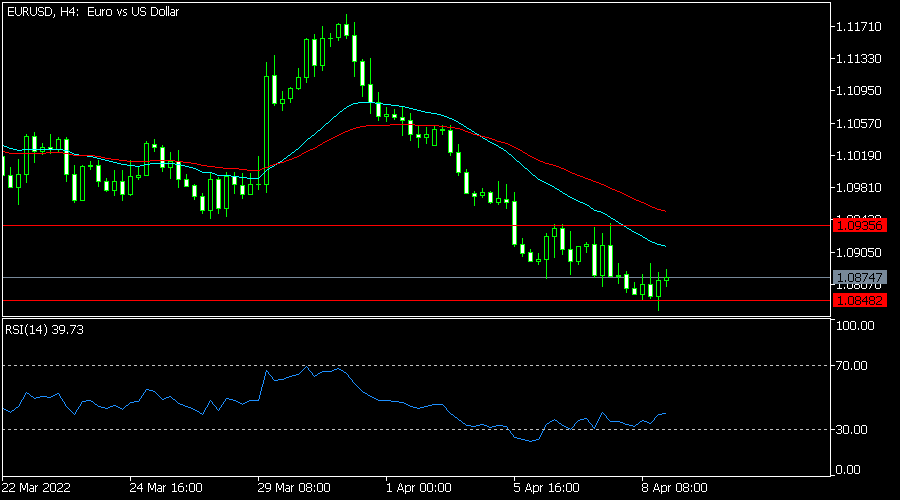
The EURUSD pair was in a tight range on Monday morning. It is trading at 1.0875, which is slightly above last week’s low of 1.0846. On the four-hour chart, the pair has moved below the short and long-term moving averages while the RSI has formed a bullish divergence pattern. Therefore, the pair will likely resume the downward trend as investors reflect on the French election.
China’s Covid Spike Weighs on Asia Markets
On Friday, US equities limped into a non-descript finish to the week as inflation fears were compounded by growth fears, notably from China. The S&P 500 fell 0.27%, the Nasdaq tumbled by 1.34%, while the Dow Jones booked a 0.40% gain as investors rotated into value for the weekend. Those same China fears, as the omicron situation darkened there over the weekend, have sent futures on all three major indexes over 0.55% lower in Asian trading.
A similar story is playing out across Asia today, compounded by China’s property developer nerves. The Nikkei 225 fell 0.75%, and South Korea’s Kospi eased 0.35% lower. Mainland China markets are under heavy pressure, the Shanghai Composite tumbling by 1.75%, with the CSI 300 in full retreat, falling by 2.35%. Hong Kong has also taken fright, the Hang Seng dropping by 2.40%.
In regional markets, Singapore is 0.65% lower, Kuala Lumpur is rather surprisingly, unchanged, and Jakarta has climbed 0.65%. The rally in Jakarta has been driven by GoTo’s IPO commencing trading, with its stock climbing 23% on debut. Elsewhere, Bangkok is down 0.45%, and Manila is 0.10% lower. The rise in platinum group metals prices seems to be providing some support to Australian markets, with the ASX 200 and All Ordinaries unchanged. However, the prospect of multiple 0.50% RBNZ rate hikes, starting this week, has sent the NZX 50 0.90% lower.
Nothing around Eastern Europe or the French presidential election will give European equities anything to cheer about this afternoon. Nor will the upcoming ECB meeting with lower risks of hiking offset by what is likely to be darkening growth projections from the ECB.
US dollar holds onto gains
The US dollar has a choppy session on Friday, the dollar index spiking to 100.19 before retreating to finish just 0.10% higher at 99.84. In Asia, an uncertain outlook on multiple fronts has lifted it 0.10% higher to 99.93. US yields, notably long-dated ones, continue to grind higher and will backstop and fall by the greenback. It remains on track to test resistance at 100.50 later this week.
EUR/USD probed 1.0850 on Friday before rallying to finish unchanged at 1.0875. There are plenty of dark clouds on the horizon for Europe this week and any rally towards 1.0950 is likely to be brief. If the Austrian PM makes some peace in our time progress with Vladimir Putin, a relief rally is once again possible. Multi-year support at 1.0800 remains ominously close with risks skewed to the downside. A dovish ECB will compound the negative outlook for the euro. Failure signals more losses to 1.0600 and 1.0300 initially. Resistance is now at 1.1200, with longer-term resistance at 1.1300.
Sterling tested support at 1.3000 on Friday but managed to close just above it. A daily close under 1.3000 signals another round of losses targeting 1.2850 and 1.2700.
USD/JPY left 0.50% higher in Asia as a Bank of Japan official remained dovish on monetary policy and said it could be eased if required. With the US/Japan rate differential soaring, USD/JPY has climbed to 124.90 today and a test of the 125.00 resistance seems imminent, followed by 125.80. Expect more “BOJ speak” above 125.00 initially. That said, any drop to 123.50 should find plenty of keen dip buyers.
AUD/USD and NZD/USD both fell on Friday as China and global growth risks deepened. NZD/USD, fell 0.65% to 0.6847, and has fallen another 0.25% to 0.6830 today. The NZD/USD faces a deeper downside this week if the RBNZ policy decision is not a 0.50% hike, and the statement is perceived as not hawkish enough. AUD/USD appears to be suffering some nerves today after a May election date was announced, with a change in government looking likely at this stage. A deteriorating China situation will weigh heavily on both antipodeans additionally this week.
Asian currencies weakened on Friday in New York time finally and fell again in Asia as USD/CNY rises 0.20% to 6.3720. Fears around China’s growth outlook, and not rising US yields, are driving the weakness. USD/KRW has risen by 0.30%, USD/TWD by 0.35%, USD/SGD by 0.20% and USD/PHP by 0.75%, despite upcoming hawkish BOK and MAS policy decisions this week. It appears Asian currencies will move in lockstep with China’s Covid situation this week.
Congruent Rise in both US and EMU Interest Rates Still Favours Dollar
Markets
On Friday, selling on bond markets simply continued in the wake of the hawkish messages provided by the minutes of the Fed and ECB March meetings published earlier last week. Persistent high inflation is putting the hawks in the driver’s seat. In a weekly perspective, the prospect of an early start of an accelerated Fed balance sheet roll-off (a pace of $95 bln p/m already in summer) bear steepened the US yield curve. Friday, the steeping trend eased, but bond selling continued with yields rising between 6.2 bps (2-y) and 1.9 bps (30-y).
The internal debate in March also caused investors to look forward to this week’s ECB policy meeting for further signs that the central bank might be ‘forced’ to frontload its interest rate lift-off, probably to Q3. The European swap curve on Friday bear flattened with yields rising between 9.25 bps (2-y) and 5.3 bps for the 10-y. The 30-y yield was little changed.
The congruent rise in both US and an EMU interest rates for now still favours the dollar. The greenback’s interest rate advantage remains impressive and the conviction rate on the Fed’s anti-inflation intentions clearly remains much higher than the ECB’s. The event risk of the first round of the French elections also didn’t help the euro. EUR/USD closed a disappointing week at 1.0877. The TW dollar (DXY) temporarily surpassed 100, but closed just below. Sterling both underperformed the euro and the dollar with EUR/GBP rebounding from the low 0.83 area to close near 0.835.The bond market sell-off resumes in Asia this morning causing a further risk-off sentiment on regional equity markets. China price data (PPI 8.3% and CPI 1.5%) also surprised on the upside. At the same time, massive lockdowns in the likes of Shanghai have to be extended, raising further concerns on growth, but also on broader supply chain issues. US yields are again rising up to 7 bps+. The Australian 10-y yield surpassed the 3.0% barrier this morning.
Today’s eco calendar is mostly focused on CPI data in smaller countries. In the US, we keep an eye at $46 bln 3Y auction. Fed speakers remain a wildcard. Later this week, the US March CPI (Tuesday) is expected to accelerate to 8.4% Y/Y. US retail sales (Friday) might give an indication whether inflation is eroding consumers’ spending. In Europe, investors look out for more concrete guidance on the ECB lift-off and on the pace of rate hikes as Lagarde & co meet on Thursday. UK inflation (Wednesday) might challenge recent ‘soft’ BoE communication.
At least for now the rise in global yields doesn’t look like taking a breather. The 10-y EMU swap Friday surpassed the 2015 top (1.3725), a clear indication that interest rate markets have entered a new era. The US 10-y yield is near the 2.80%, the last barrier ahead of the key 3.25% 2018 top. Also keep an eye at the US 10-y real yield (-0.11%) which is nearing positive territory. T
he French election outcome clearly isn’t a game-changer for the euro. The dollar remains in pole position. USD/JPY is revisiting the 125 barrier. For EUR/USD (1.0885), the 1.0806 YTD low remains at risk.
News Headlines
The French presidential elections of 2022 are 2017 all over again. Incumbent president Macron in the first round on Sunday secured about 27% of the votes. His closest contester, Marine Le Pen from the far-right won some 24%. Both are now headed into the run-off vote on Sunday, April 24. Some of the candidates, including the Republican Valerie Pecresse and Green leader Jadot endorsed Macron. They both got around 5% of the votes. The biggest question mark however, is what voters for Melenchon from the far-left will do. He came in third (21%) and told not to vote for Le Pen but didn’t back Macron either. The euro briefly rallied to EUR/USD 1.096 in Asian trading but pared gains quickly thereafter.
Officials familiar told Bloomberg the European Central Bank is crafting another crisis tool to deploy should yields in weaker economies rise considerably caused by shocks outside the control of individual governments. The ECB announced in December last year that PEPP would soon phase out. By allowing for geographical flexibility in the PEPP reinvestment phase, temporarily raising amounts bought under the APP and keep that programme alive at least until early 2023, it cushioned the blow in particular for the likes of Italy. Since then a lot has changed. The Ukraine war lifted uncertainty and APP could stop as soon as Q3 this year. Peripheral yield (spread) only briefly dropped after the news on Friday got public.
Gold Consolidates Above Short-Term SMAs; Neutral Bias
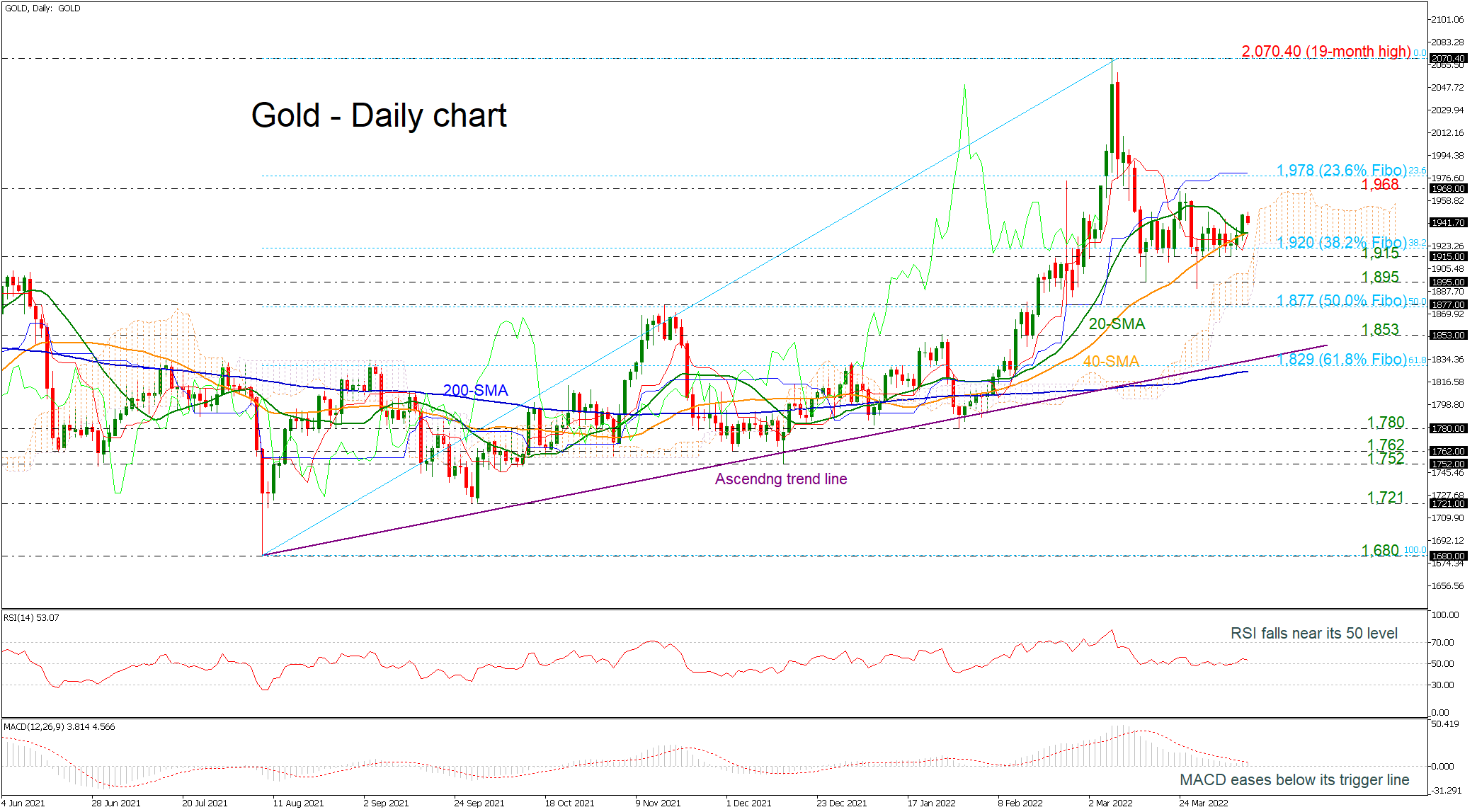
Gold is successfully surpassing the 20- and 40-day simple moving averages (SMAs), which were ready to create a bearish crossover; however, the latest upward move drive the SMAs higher. The price appeared to be neutral over the last month and it is now consolidating within 1,920, which is the 38.2% Fibonacci of 1,680-2,070.40 and the 1,968 resistance.
The RSI indicator is slightly pointing down in the positive territory, while the MACD is losing momentum below its trigger line.
Immediate resistance to further gains would likely come from the 1,968 barrier. This is also near the 23.6% Fibonacci of 1,978, which holds near the blue Kijun-sen line of the Ichimoku indicator. If there is a break above this area, further resistance could be met around the 19-month high of 2,070.40.
If, however, the upside momentum were to lose steam and if the pair were to reverse lower, support would initially come from the 20- and 40-day SMAs at 1.933. Slipping below this line could take prices towards the 38.2% Fibonacci of 1,920 and the 1,915 support. Failure to hold inside the short-term trading range,would switch the focus back to the downside and attention would increasingly turn to the 1,895 barrier and the 50.0% Fibonacci of 1,877.
In the more medium-term picture, the bullish outlook recently shifted to a neutral one and is likely to stay neutral as long as prices remain within 1,915-1,968.