Sample Category Title
Daily Technical Analysis
EUR/USD
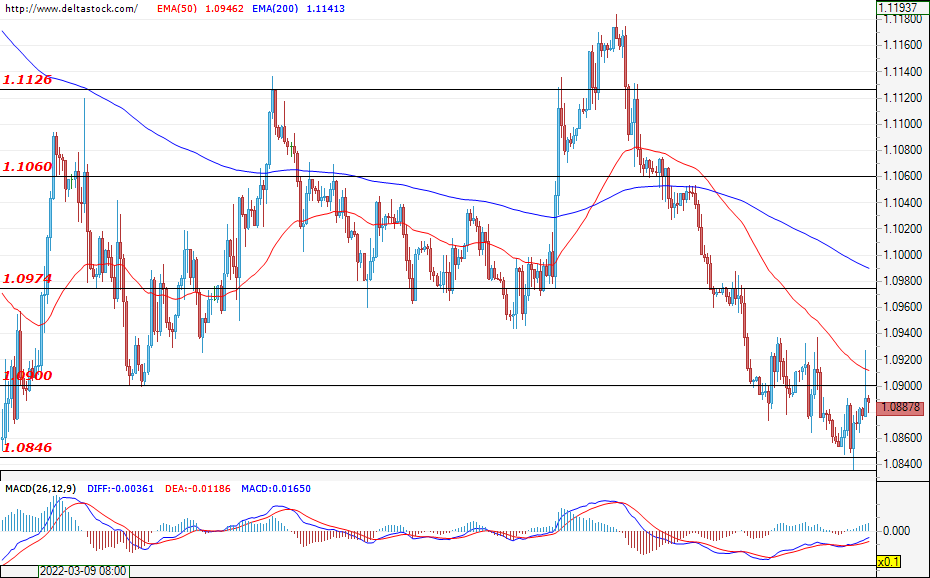
In the early hours of today’s trading session, the euro recovered part of its recent losses, but the bears re-entered the market and the pair quickly returned below the resistance at 1.0900. The support at 1.0850 has so far managed to hold off the bearish pressure, but the overall market sentiment remains negative. A confirmed breach of the aforementioned support level would probably extend the sell-off towards the psychological level at 1.0800, which could be considered as a signal that the downtrend is intact. In case of positive news regarding the war between Russia and Ukraine, the trend could change its direction and the bulls might return to the market. If that’s the case, then their first resistance is expected to be the level of 1.0970. The important news for this week, which is also expected to have an impact on the market, is the interest rate of the European Central Bank (Thursday; 11:45 GMT) as well as the announcement of the CPI data for the U.S. (Tuesday; 12:30 GMT).
USD/JPY
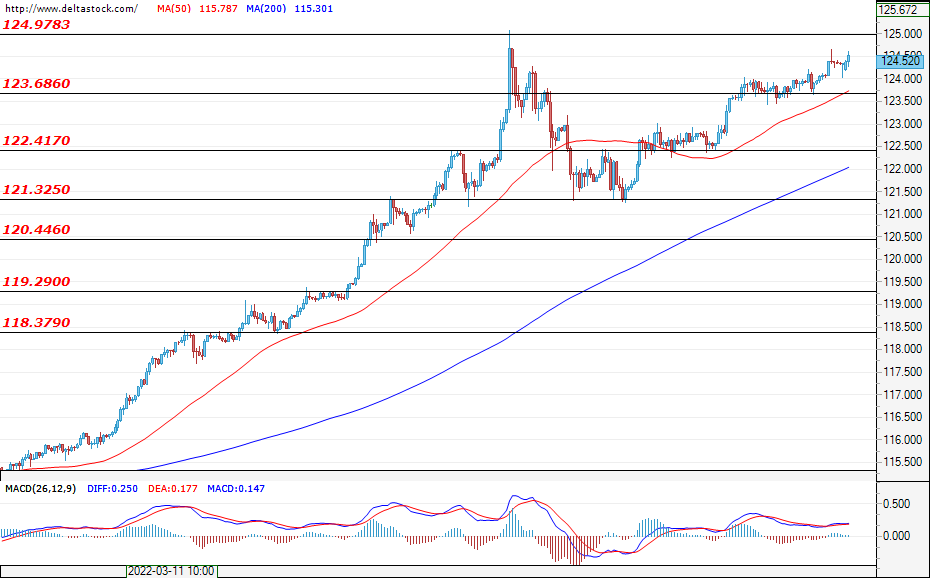
The support at 123.70 appeared to be an obstacle for the sellers, and at the time of writing, the currency pair is headed towards a test of the critical resistance at 125.00, where a breach could easily lead the pair towards the next resistance lying at 126.00. If the bullish momentum fades and the bears enter the market and violate the zone at 123.70, then the decline could deepen towards the support level at 122.40.
GBP/USD
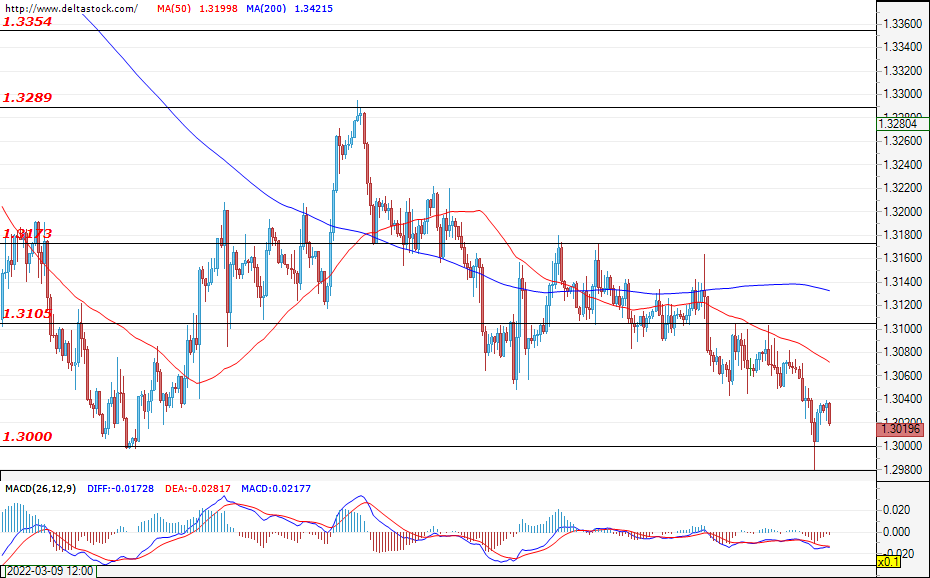
The sterling lost some ground against the dollar, and during the early hours of today`s trading, the pair is headed for a test of the support zone at 1.3000. A successful violation of this psychological level of support would strengthen the negative expectations for the future path of the GBP/USD for a move towards the levels at around 1.2900. If the bearish momentum fades and the bulls re-enter the market, then their first target would be the zone at 1.3100, followed by the resistance at 1.3170. However, only a successful breach of the higher level at 1.3170 would paint a more bullish picture for the Cable.
EUGERMANY40
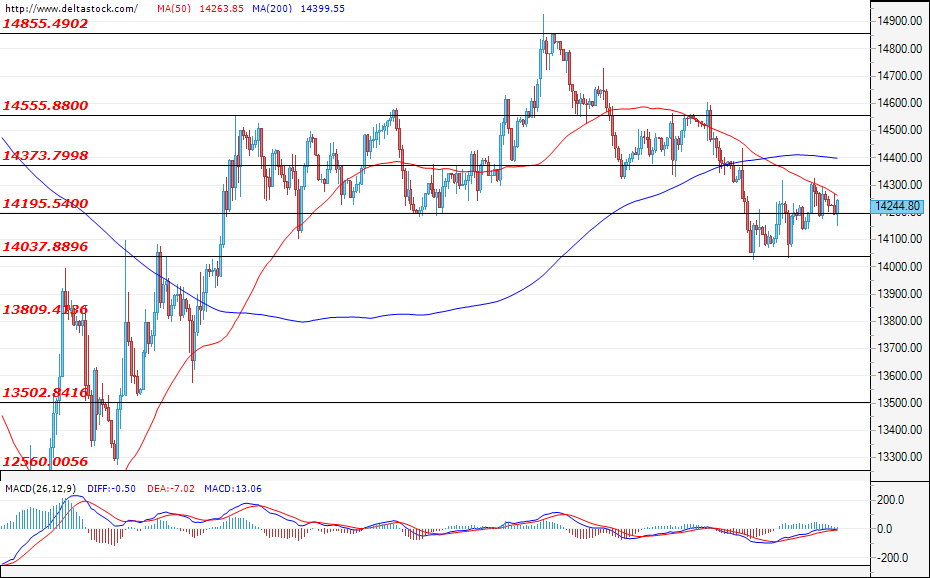
The German index failed to test the resistance at 14370, but still remained above the support at 14037. Keeping in mind the precarious situation in Ukraine and if the bulls fail to breach the resistance at 14370, then the bears may again prevail. If this happens and they violate the support at 14040, then we could witness a sell-off towards the next major level at 13800. This week, volatility can be expected around the publication of the ZEW data on economic expectations (Tuesday; 09:00 GMT).
US30
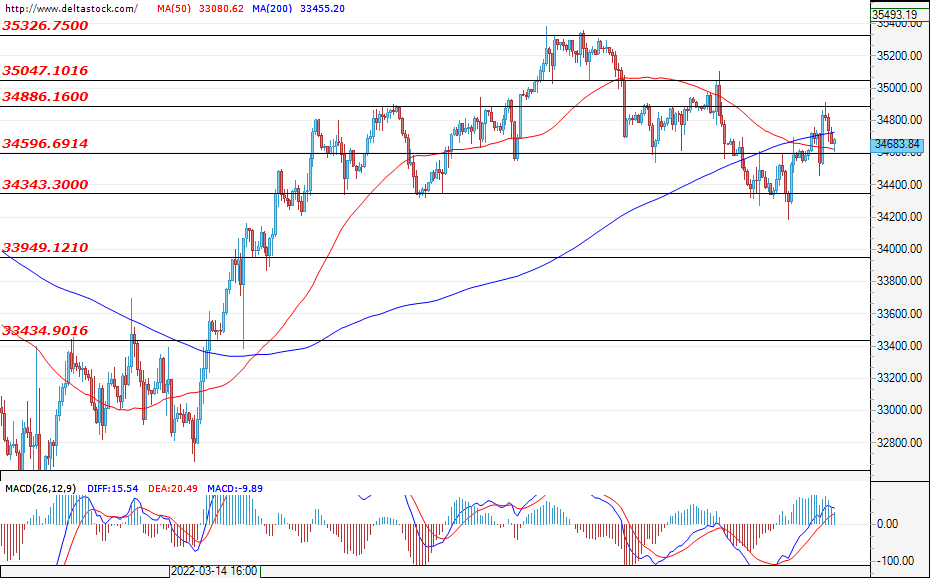
The resistance level at 34890 withheld the bullish attack and the U.S. blue-chip stock index erased part of its recent gains. A successful breach of the support at 34350 could easily continue the sell-off and lead to a test of the next target at 34000. If the bulls re-enter the market, then a successful attack on the mentioned resistance at 34890 and a breach of the resistance at 35050 could strengthen the positive expectations for the future path of the index and could lead to a more sustained rally. This week, higher volatility can be expected around the publication of the economic news, mentioned in the EUR/USD analysis.
GER 40 Seeks Support
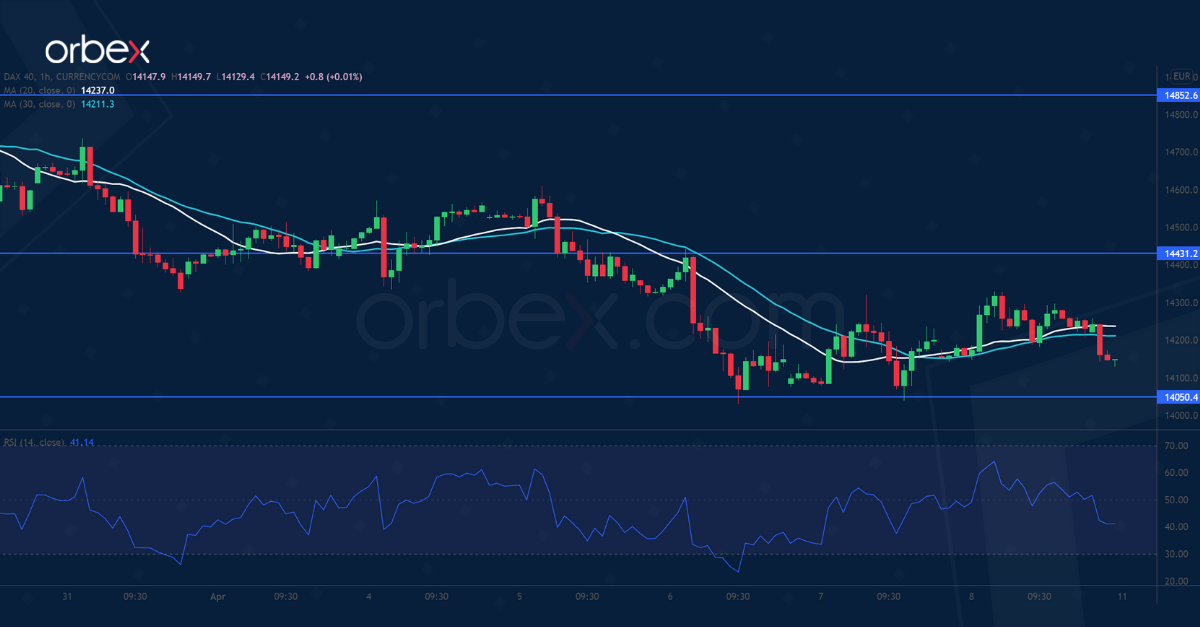
The Dax 40 struggles on concerns about the economic costs of war in Ukraine. A bullish MA cross on the daily chart suggests steadied sentiment in the medium-term after a V-shaped rebound.
The bulls may see the pullback as an opportunity to accumulate. They will need to clear February’s sell-off point at 15500 before the uptrend could resume.
On the intraday level, a drop below 14200 prompted buyers to exit, making 14430 a fresh resistance. A break below 14050 may cause a deeper correction towards 13600.
EUR/CAD Struggles to Rebound
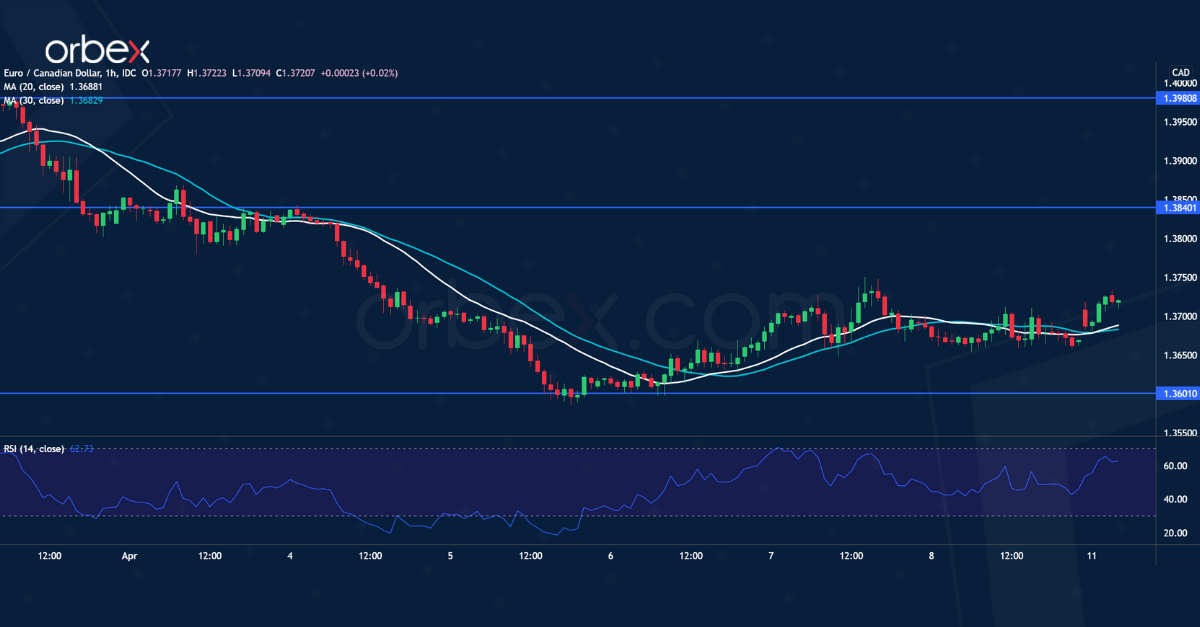
The Canadian dollar strengthened after a drop in the jobless rate in March. The RSI’s double-dip in the oversold area has attracted some buying interest.
A break above the demand-turned-supply zone around 1.3700 has improved the short-term mood. The origin of the previous sell-off at 1.3840 is a major resistance, as it sits on the 20-day moving average, making it a congestion area.
A bullish close could pave the way for a meaningful rebound. Failing that, a retreat back below 1.3600 may resume the downtrend.
USD/JPY Consolidates Gains
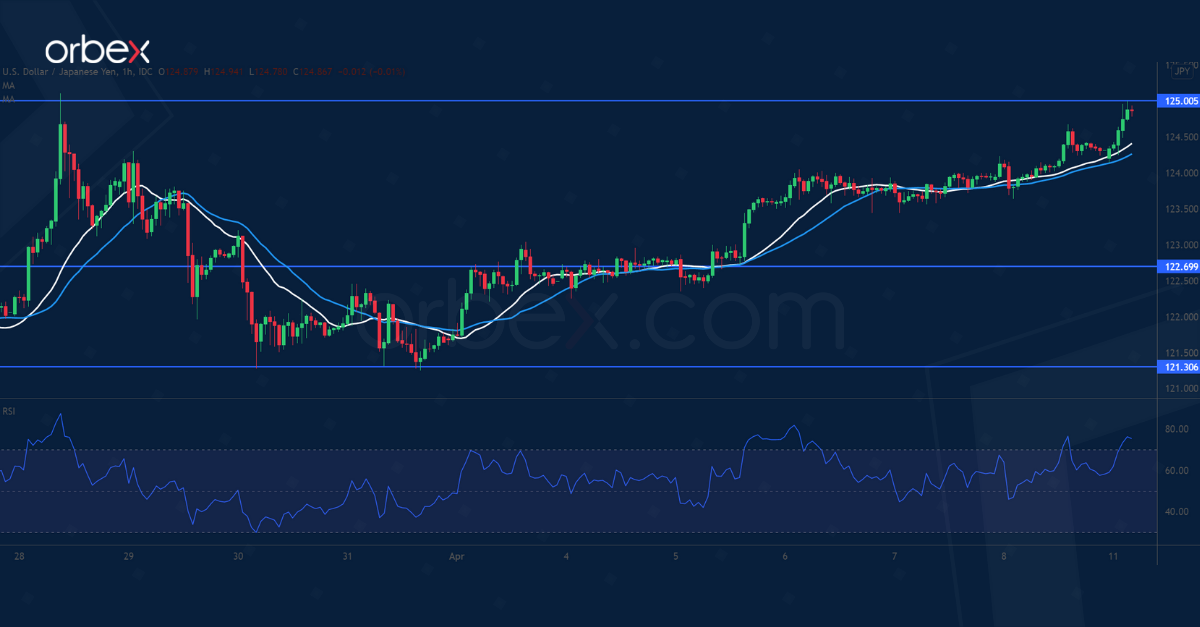
The US dollar rallies as the 10-year Treasury yield hits a three-year high. Price action has been treading water after it bounced off 121.30.
The RSI shot back into the overbought area and could limit the upward momentum. Sentiment remains bullish but subdued volatility suggests a lack of volume. The recent peak at 125.00 is a major hurdle and its breach could resume the rally.
On the downside, a break below 122.70 could lead to an extended consolidation. 121.30 is a critical floor to keep the short-term rally intact.
Market Sigh as Macron Secures First Round
Market movers today
This morning Norwegian and Danish CPI inflation data are due out. In Denmark, we expect inflation rose further to 5.2% y/y in March from 4.8% in February. In Norway, we expect core inflation rose to 2.3% y/y, which is slightly below what Norges Banks anticipated in its March monetary policy report. For both, see more in the Nordic section.
Also this morning, the British monthly GDP estimate in February is due out. The data is from before the Russian invasion and hence not so important from a market perspective.
We have some FOMC speeches in the afternoon. We expect the policymakers to repeat that the Fed is about to front-load rate hikes.
On Thursday, we expect the ECB to keep the door open for a September rate hike, see ECB Preview: Lagarde to bring September into play - we revise our ECB call, 8 April.
The 60 second overview
French election: Incumbent President Macron topped the first round of the presidential election and will face far-right Nationally Rally candidate Marine Le Pen in the run-off on 24 April. While Macron's first round lead (28%) over Le Pen (24%) was bigger than he managed in 2017, polls point to a much narrower race for the second round (53-47%). With Macron's re-election far from assured, markets will keep a close eye on polls in the coming two weeks. While most other presidential contenders have encouraged their supporters to vote for Macron in the run-off, the upcoming TV debate could play a decisive role in swaying voters.
Inflation: Chinese CPI and PPI inflation figures for March surprised on the upside this morning as COVID has worsened supply chain bottlenecks. PPI inflation remains high but decreased to 8.3% from 8.8% in February. CPI inflation increased to 1.5% from 1.2% in February. Despite the increase, Chinese inflation is muted due to weak domestic demand and lack of pricing power as well as low food price inflation.
Equities: Equities marginally higher Friday but once again driven by the value defensive universe. The stagflation trade took equities lower by 1% last week but defensive outperformed value by almost 6% and value outperformed by almost 3%. On Friday Dow +0.5%, S&P 500 -0.2%, Nasdaq -1.2% and Russell 2000 -0.3%. Massive moves is yields continuing this morning taking both European and US futures lower. Markets in Asia lower as well with China tech leading the declines.
FI: European rates ended higher across the board on Friday led by the front end, with EGB spreads being rather mixed, amid a strong curve flattening move. 2y Germany rose 5bp to +0.04%. 10s30s eur swap flattened 2bp to -21bp on Friday.
FX: While last week was characterised by a general strengthening of USD and a drop in EUR/USD the single currency did mark a slight relief rally after Macron's comfortable win yesterday. EUR/USD has moved back above 1.09 while both EUR/SEK and EUR/NOK are hovering around multi-months lows around 10.25 and 10.45, respectively.
Credit: Credit markets ended the week on a somewhat mixed note, although tilting to the bearish side, particularly within the high yield space. Itraxx main held roughly firm, widening a mere 0.5bp to close at 77.1bp, while Xover was 4.5bp wider, closing the day at 370bp.
Nordic macro
In Denmark, we get March CPI inflation and we expect it increased further to 5.2% from 4.8% in February. The increase is based on three factors. Firstly, oil prices caused sky rocketing petrol and in particular diesel prices in March. Secondly, the tobacco fee was increased by DKK5 on a 20-pack of cigarettes in January. We have not seen any actual price increase on cigarettes yet and expect it will come with the March and the April figures. Thirdly, we expect the inflation contribution from food prices to pick up following a surge in prices in the beginning of the year and a continued pressure from increasing prices on raw materials.
In Norway, core inflation has surprised to the upside in recent months but is still only marginally above the 2% target. Given stronger global inflationary pressures and higher wage growth, it is likely to continue to climb. Part of the surprise in February was a bigger impact on prices for food and other imported goods, such as furniture. To some extent, this was probably a result of one-off price adjustments, and we expect these effects to fade in March. We nevertheless expect the upward trend in imported inflation to continue, and so we expect core inflation to rise to 2.3% y/y. This would be slightly lower than Norges Bank anticipated in its March monetary policy report and should therefore pour cold water on market expectations of more than three further 25bp rate increases this year.
Inflation Fears
On Sunday, the results from the first round of the French presidential election showed that Emmanuel Macron obtained 27% of votes, closely followed by the right-wing Marine Le Pen, who got 24% support.
The latest polls show that Macron could lead 54 to 46% in the final round of the election and negotiate a second term in Elysée – although a narrowing gap in favour of Le Pen, who is known to have a clear sympathy for Russia, could dampen the investor mood as we approach the final election scheduled on April 24th.
In the FX
The EURUSD gapped higher at the open as an early reaction to the French first round results that favoured a final Macron victory, but the pair rapidly paired gains to sink below the 1.09 level.
The US dollar index remains strong at the start of a week which will probably print a further advance in both consumer and producer prices.
Due Tuesday, the US CPI index is expected to print a fresh multi-decade high of 8.5%, while the producer price index is expected to advance to 10.5% in March from 10% printed a month ago on Wednesday.
The Fed’s war declaration against inflation has been very clear in the latest FOMC minutes, making the wait for this week’s inflation data tense.
The dollar index traded above the 100 mark on Friday, as the US 10-year yield came close to the 2.80% for the first time in three years. The tense geopolitical environment combined with the hawkish Fed expectations keep the greenback sustained at the current levels especially before the most feared inflation data.
In China
Inflation in China rose to a 3-month high of 1.5% in March on the back of higher transport costs triggered by the war in Ukraine. The factory fate prices eased less to 8.3%, giving some chills to those who are craving to see some easing in the US and European inflation figures as well.
Equity futures & oil down
European and US equity futures kicked off the week on a bearish note, as the barrel of US lost 2.5% at the time of writing.
The stronger negative momentum could encourage a further slide toward the $88/90 area, to meet the 100-DMA and the major 61.8% Fibonacci retracement on December to March rally. However, the risk of a sudden jump remains high - approaching the $90 mark, as the slowdown in Chinese demand and the release of US strategic reserves are short term factors that won’t reverse the worry of a tight supply and rising long-term demand trend.
Banks to the earnings confessional
Earnings season kicks off, with big US banks due to announce their first quarter results this week. Despite the prospects of rising yields, which is normally positive for the banks, the US big banks could see their profits fall sharply in the Q1 from a year ago, when the trading revenues were soaring amid the short squeeze frenzy.
Recession worries, on the other hand, weigh on loan growth prospects and explains why the SPDR’s financial fund is down by more than 10% this year. The net income for the six biggest American banks is expected to fall about 35% from a year ago, also including the major deceleration in activity in March due to the war in Ukraine.
GBP/JPY Daily Outlook
Daily Pivots: (S1) 161.44; (P) 161.86; (R1) 162.19; More...
Intraday bias in GBP/JPY remains neutral, and further rally is expected with 158.04 support intact. On the upside, break of 164.61 will resume larger up trend to long term fibonacci level at 167.93. However, firm break of 158.19 will turn bias to the downside and bring deeper pull back.
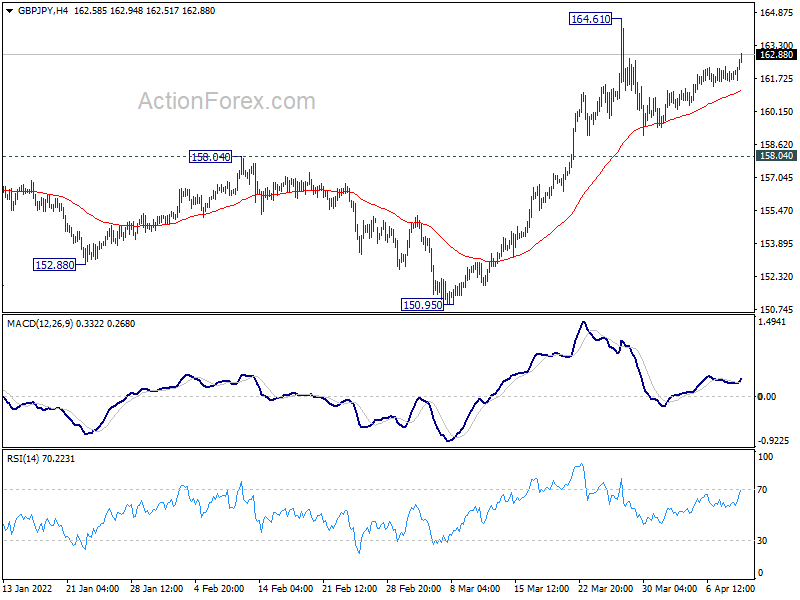
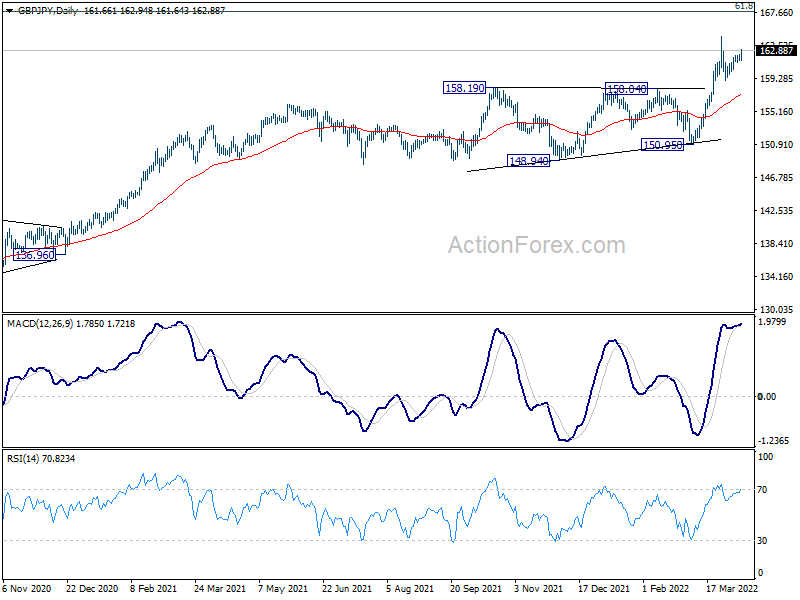
In the bigger picture, up trend from 123.94 (2020 low) is still in progress, and notable support from 55 week EMA affirms medium term bullishness. Next target is 61.8% retracement of 195.86 (2015 high) to 122.75 (2016 low) at 167.93. Sustained break there will be a long term bullish signal. This will now remain the favored case as long as 150.95 support holds.
EUR/JPY Daily Outlook
Daily Pivots: (S1) 134.38; (P) 134.94; (R1) 135.46; More....
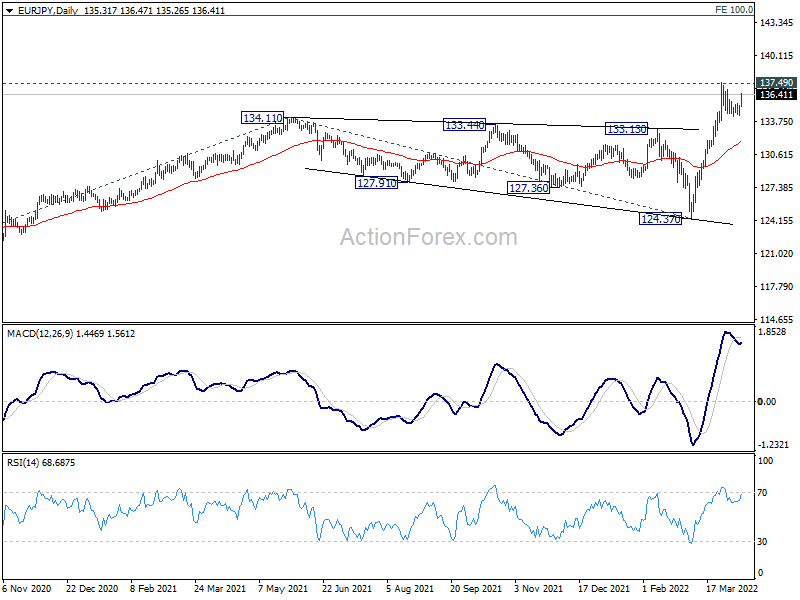
Intraday bias in EUR/JPY remains neutral for the moment. Further rally is expected with 133.70 support intact. On the upside, sustained break of 137.49 resistance will resume larger up trend for 144.06 projection level next. However, firm break of 133.70 will turn bias back to the downside for deeper pull back.
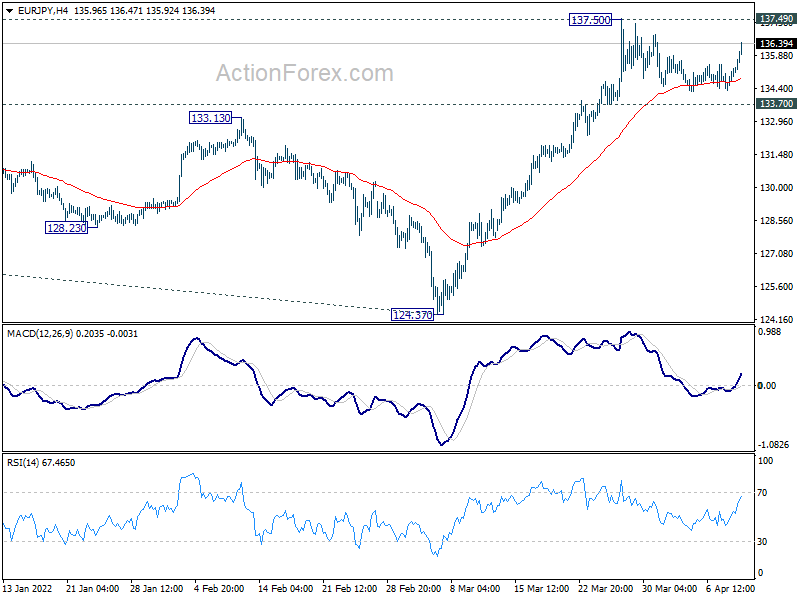
In the bigger picture, up trend from 114.42 (2020 low) is in progress. Sustained break of 137.49 (2018 high) will resume larger pattern from 109.30 (2016 low). Next target will be 100% projection of 114.42 to 134.11 from 124.37 at 144.06. In any case, outlook will now remain bullish as long as 124.37 support holds, in case of deep pull back.
EUR/GBP Daily Outlook
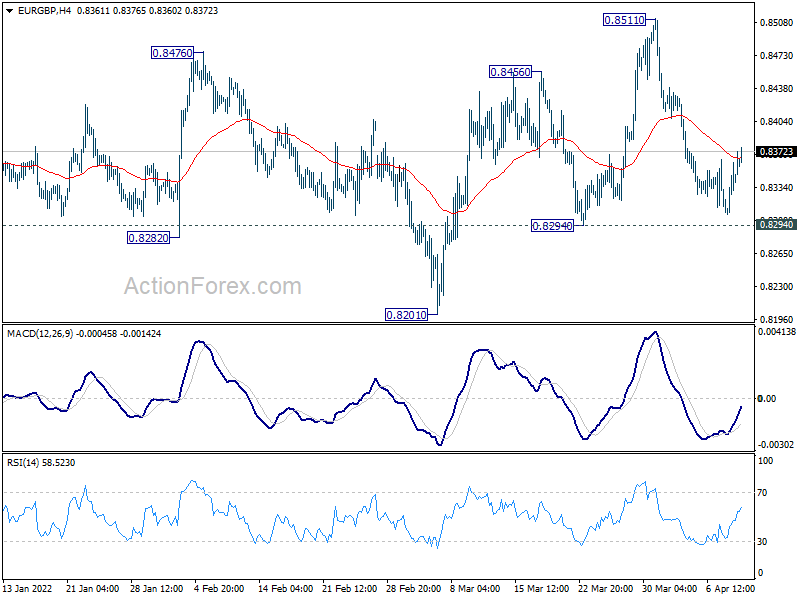
Daily Pivots: (S1) 0.8314; (P) 0.8338; (R1) 0.8367; More...
Intraday bias in EUR/GBP remains neutral for the moment. On the downside, break of 0.8294 will argue that rebound from 0.8201 has completed at 0.8511, and revive near term bearishness. Intraday bias will be back on the downside for retesting 0.8201 low. On the upside, however, break of 0.8511 will reaffirm that 0.8201 is a medium term bottom, and target 0.8697 medium term fibonacci level next.
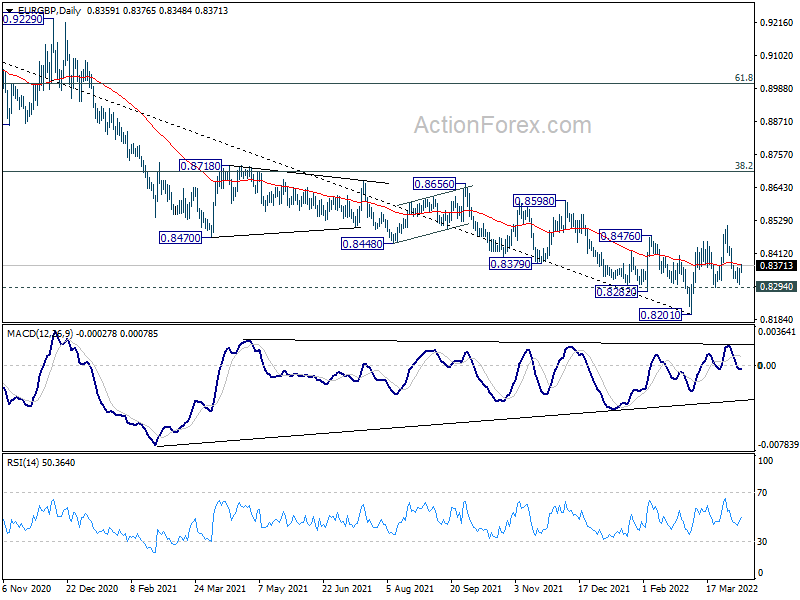
In the bigger picture, a medium term bottom should be in place at 0.8201, on bullish convergence condition in daily and weekly MACD. Rise from there could either be a correction to the down trend from 0.9499 (2020 high), or a medium term up trend itself. In either case, further rise should be seen to 38.2% retracement of 0.9499 to 0.8201 at 0.8697. Sustained break there will target 61.8% retracement at 0.9003. This will remain the favored case as long as 0.8294 support holds.
EUR/AUD Daily Outlook
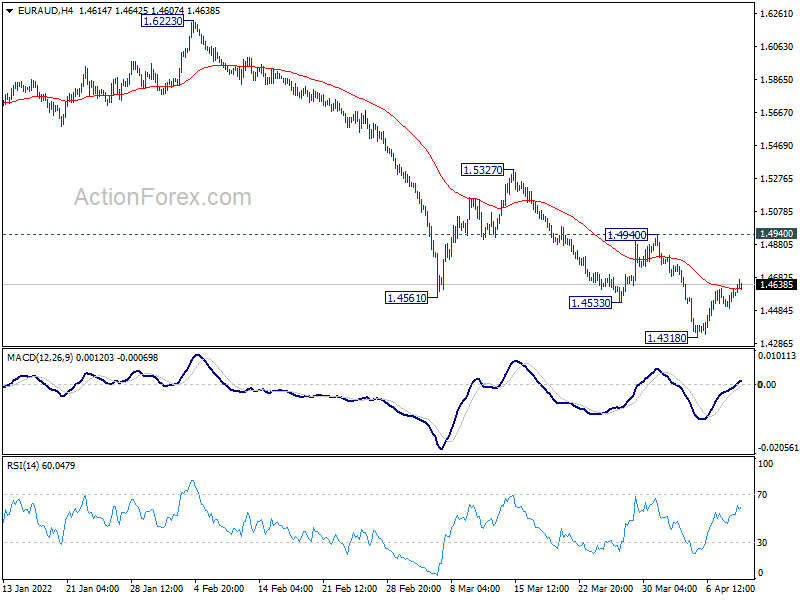
Daily Pivots: (S1) 1.4514; (P) 1.4562; (R1) 1.4625; More...
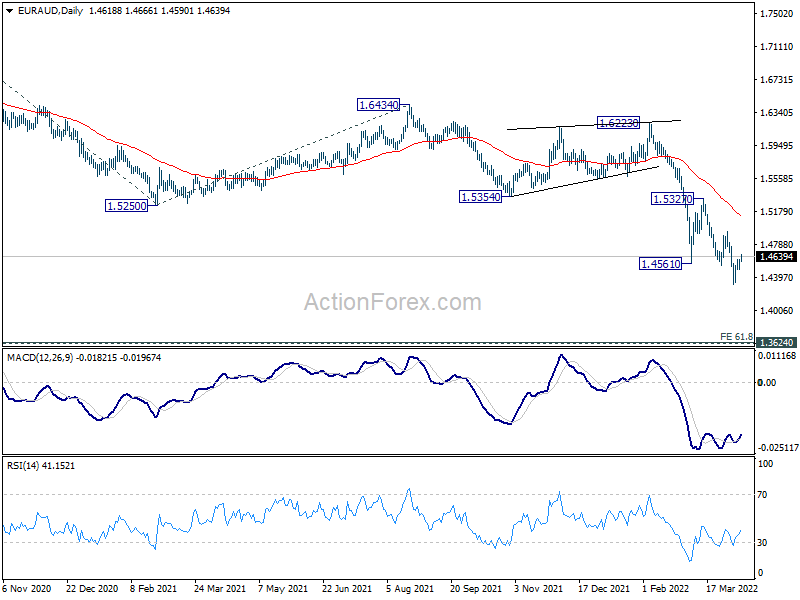
Intraday bias in EUR/AUD remains neutral for the moment. But outlook will remain bearish as long as 1.4940 resistance holds. On the downside, break of 1.4318 will resume larger down trend to 1.3624 long term support next. On the upside, however, firm break of 1.4940 will indicate short term bottoming and turn bias back to the upside for 1.5327 resistance instead.
In the bigger picture, fall from 1.9799 is seen as a long term impulsive move. Next target is 61.8% projection of 1.9799 to 1.5250 from 1.6434 at 1.3623, which is close to 1.3624 long term support (2017 low). Some support could be seen there to bring interim rebound. But overall, break of 1.5354 support turned resistance is needed to be the first sign of medium term bottoming. Otherwise, outlook will stay bearish in case of recovery.