Sample Category Title
GBP/USD Mid-Day Outlook
Daily Pivots: (S1) 1.2986; (P) 1.3033; (R1) 1.3084; More...
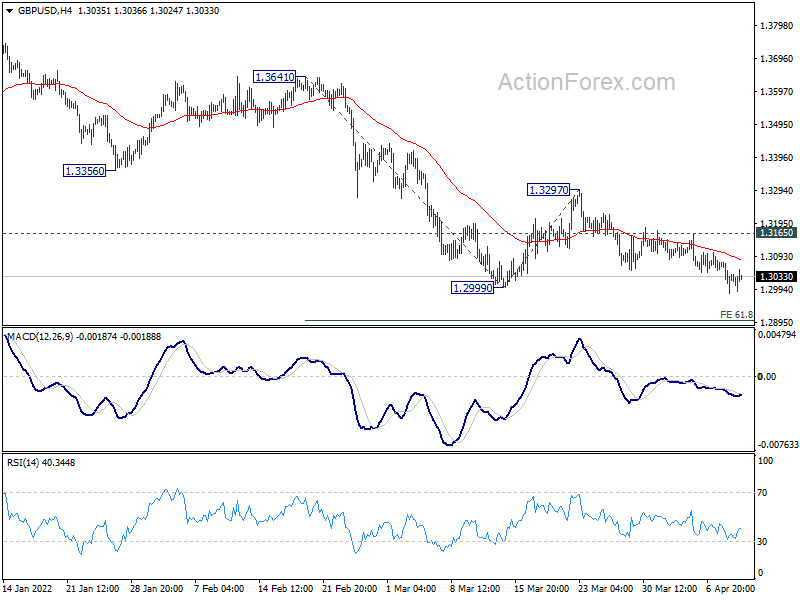
Intraday bias in GBP/USD remains on the downside and outlook is unchanged. Current down trend from 1.4248 is in progress. Next target is 61.8% projection of 1.3641 to 1.2999 from 1.3297 at 1.2900. On the upside, break of 1.3165 resistance is needed to indicate short term bottoming. Otherwise, outlook will remain bearish in case of recovery.
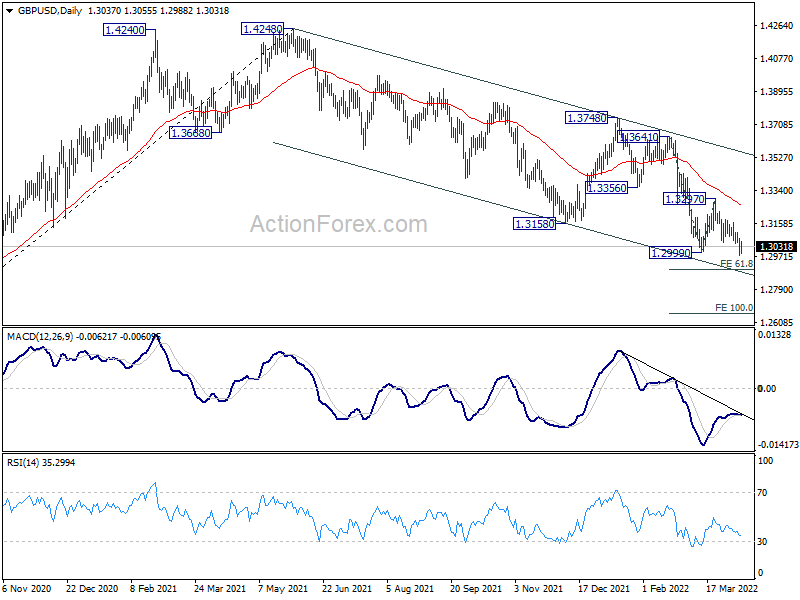
In the bigger picture, rise from 1.1409 (2020 low) has completed at 1.4248. Decline from 1.4248 could still be a corrective move, or it could be the start of a long term down trend. In either case, deeper decline would be seen back to 61.8% retracement of 2.1161 to 1.1409 at 1.2493. In any case, break of 1.3748 resistance is needed confirm completion of the fall from 1.4248, or outlook will stay bearish.
USD/CHF Mid-Day Outlook
Daily Pivots: (S1) 0.9321; (P) 0.9348; (R1) 0.9368; More....
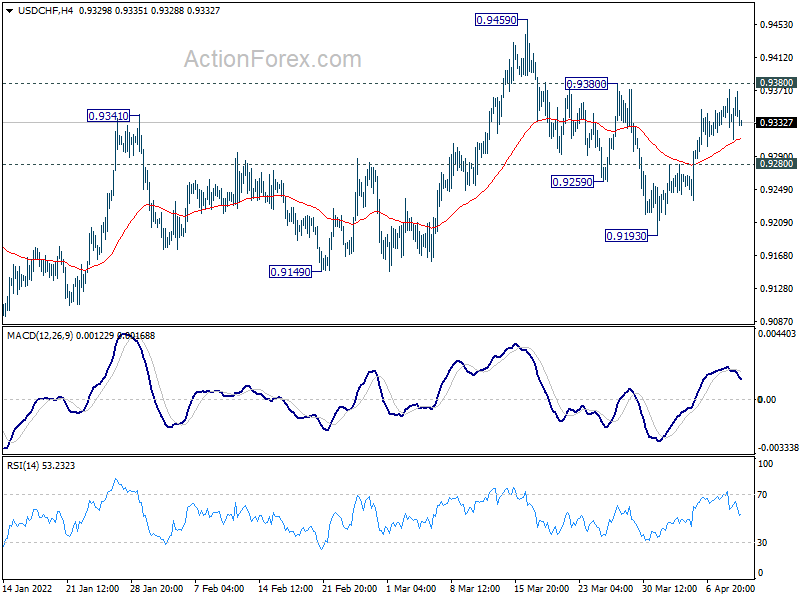
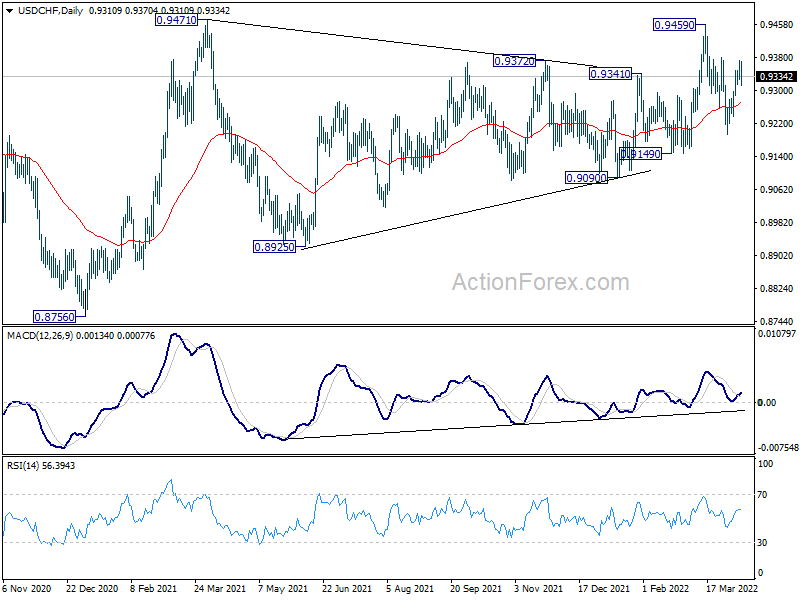
USD/CHF retreat ahead of 0.9380 resistance and intraday bias remains neutral. On the upside, firm break of 0.9380 should confirm that fall from 0.9459 has completed with three wave down to 0.9193. Such development will revive near term bullishness and turn bias back to the upside for 0.9459 and then 0.9471 resistance. On the downside, below 0.9280 minor support will turn bias to the downside for 0.9193 support next.
In the bigger picture, medium term outlook will be neutral at best as long as 0.9471 resistance holds. Larger down trend could still extend through 0.8756 (2021 low). However, firm break of 0.9471 will argue that whole down trend form 1.0342 (2016 high), has completed with waves down to 0.8756. A medium term up trend should be set up to target 1.0237/0342 resistance zone.
USD/JPY Mid-Day Outlook
Daily Pivots: (S1) 123.74; (P) 124.21; (R1) 124.75; More...
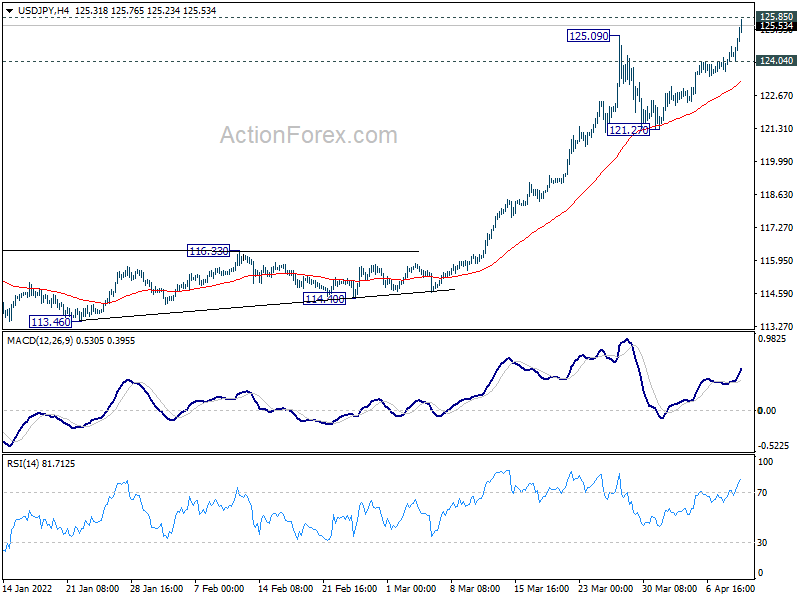
USD/JPY's break of 125.09 resistance confirms resumption of larger up trend from 102.58. Intraday bias is now on the upside. Decisive break of 125.86 long term resistance will pave the way to 130.04 long term projection level next. On the downside, below 123.44 minor support will turn intraday bias neutral first. But outlook will stay bullish as long as 121.27 support holds.
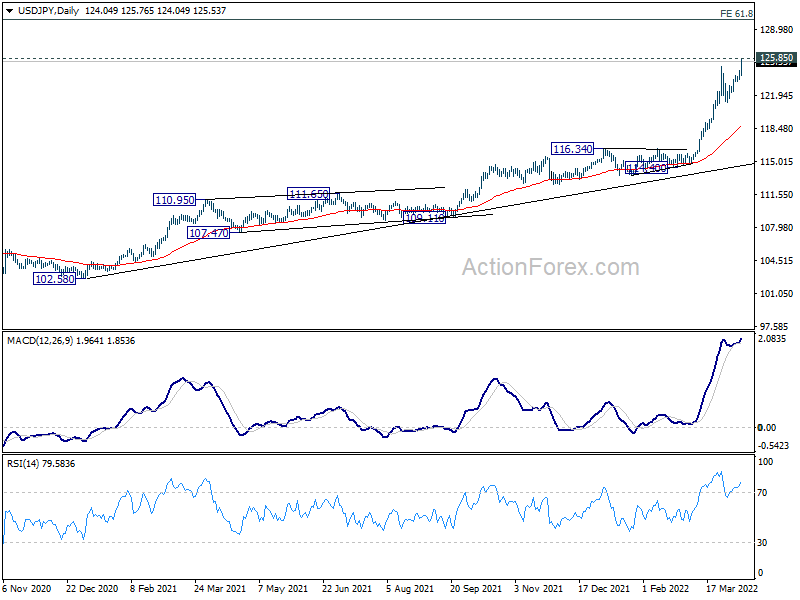
In the bigger picture, up trend from 98.97 (2016 low) is in progress for retesting 125.85 (2015 high). Sustained break there will confirm long term up trend resumption. Next target will be 61.8% projection of 75.56 (2011 low) to 125.85 (2015 high) from 98.97 at 130.04. This will now remain the favored case as long as 116.34 resistance turned support holds.
Yen Selling Steps Up a Gear on Rising Treasury Yields
Yen's selloff intensifies today, following extended rally in major benchmark treasury yields. US 10-year yields breaks 2.75% handle for the first time since March2 019. Germany 10-year bund yield also breaches 0.8% handle. On the other hand, Japan 10-year JGB yield is staying comfortably below BoJ's 0.25% cap. Euro and Dollar are currently the strongest one for today. Sterling is not performing too badly despite GDP miss. Commodity currencies are following risk-off sentiments lower.
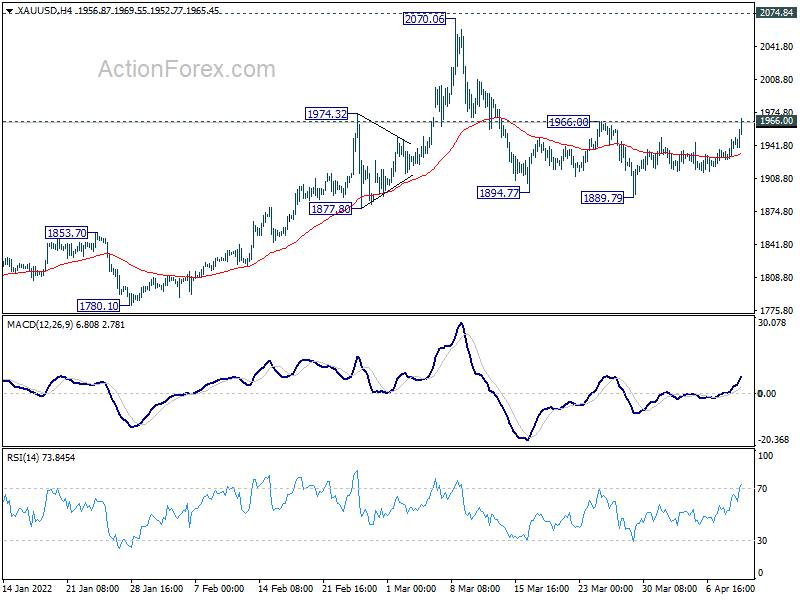
Technically, USD/JPY's break of 125.09 resistance confirms long term up trend resumption. Now, it's the time for EUR/JPY to break through 137.49 resistance, and for GBP/JPY to break through 164.61 resistance to alight the outlook. Meanwhile, Gold's break of 1966.00 resistance now argues that correction from 2070.06 has completed at 1889.79. It could try to head back to 2000 handle if risk aversion picks up.
In Europe, at the time of writing, FTSE is down -0.66%. DAX is down -0.87%. CAC is up 0.26%. Germany 10-year yield is up 0.092 at 0.799. Earlier in Asia, Nikkei dropped -0.61%. Hong Kong HSI dropped -3.03%. China Shanghai SSE dropped -2.61%. Singapore Strait Times dropped -0.58%. Japan 10-year JGB yield rose 0.0081 to 0.239.
CHF/JPY upside breakout as Yen selloff intensifies
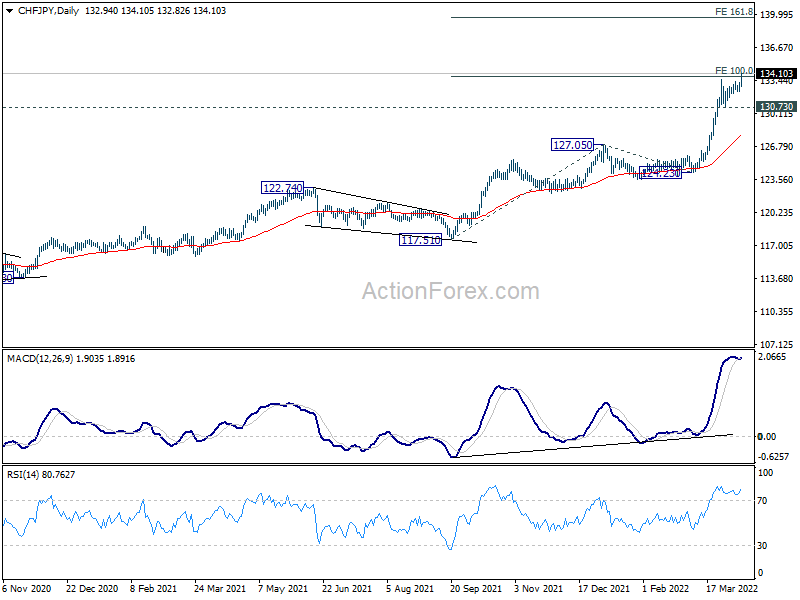
Yen selloff steps up a gear today and even CHF/JPY breaks through short term top at 133.53 to resume its long term up trend. For now, short term outlook will remain bullish as long as 130.74 support holds. There is prospect of upside acceleration to next target at 161.8% projection of 117.51 to 127.05 from 124.23 at 139.66.
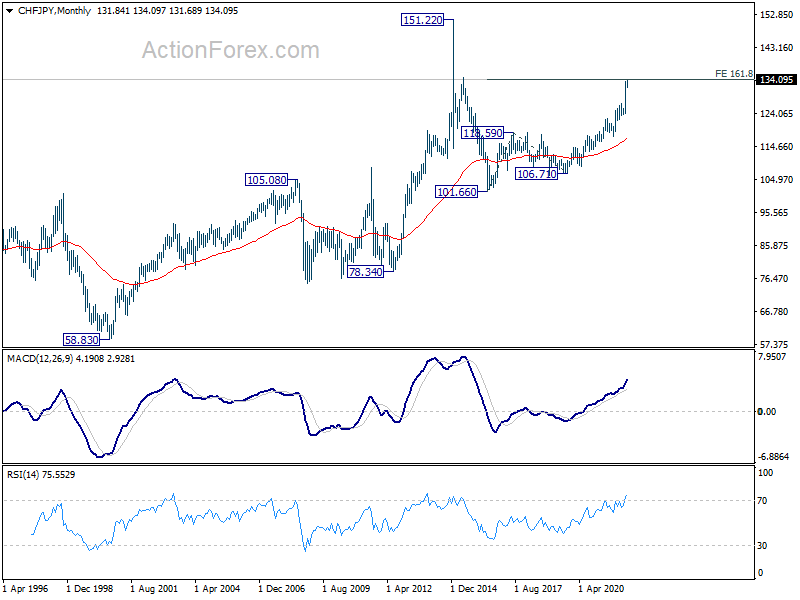
More importantly, as seen in the monthly chart, CHF/JPY is now trying to break through 161.8% projection of 101.66 to 118.59 from 106.71 at 134.10. Sustained trading above this level could set up the for medium term upside acceleration towards 151.22 (2014 spike high).
UK GDP grew only 0.1% mom in Feb, production contracted
UK GDP grew 0.1% mom only in February, below expectation of 0.3% mom. Services was the main contributor to growth, up 0.2% mom. But that was offset by -0.6% mom contraction in production, and -0.1% mom in construction.
Overall monthly GDP was 1.5% above its pre-coronavirus level in February 2020. Services was 2.1% above that level while construction was 1.1% above. However, production was -1.9% below.
Also published, manufacturing production came in at -0.4% mom, 3.6% yoy, versus expectation of 0.4% mom, 2.5% yoy. Industrial production came in at -0.6% mom, 1.6% yoy, versus expectation of 0.4% mom, 1.4% yoy. Goods trade deficit narrowed to GBP -20.6B, larger than expectation of GBP -16.8B.
BoJ Kuroda: Economy to continue to recover despite rising commodity prices
BoJ Governor Haruhiko Kuroda said in the quarterly branch manager meeting, "Japan's economy has picked up as a trend, although some weakness has been seen in part, mainly due to the impact of COVID-19."
"As downward pressure on service consumption and the impact of supply shortages diminish, a pickup in overseas demand, accommodative monetary policy, and the government's economic stimulus will likely help the Japanese economy recover despite being affected by rising commodity prices," he added.
Kuroda also cautioned that "extremely high uncertainties" remain over how the crisis in Ukraine will impact commodity prices and the Japanese economy. But he also indicated that commodity inflation is unlikely to trigger a change in the central bank's ultra-loose policy, because it wouldn't last long.
China PPI slowed to 8.3% yoy, CPI rose to 1.5% yoy in Mar
China PPI slowed from 8.8% yoy to 8.3% yoy, but still beat expectation of 7.9% yoy. However, the monthly rise of 1.1% mom in PPI was the fastest in five months, driven by surges in oil prices and non-ferrous metals.
CPI accelerated from 0.9% yoy to 1.5% yoy in March, above expectation of 1.2% yoy. Core CPI, excluding food and energy, rose 1.1% yoy, unchanged from February's reading. Prices of some food like flour, vegetable oil, fresh vegetables and eggs rose and were "affected by the rise in international prices of wheat, corn and soybeans and the domestic [coronavirus] outbreaks", noted senior NBS statistician Dong Lijuan.
USD/JPY Mid-Day Outlook
Daily Pivots: (S1) 123.74; (P) 124.21; (R1) 124.75; More...
USD/JPY's break of 125.09 resistance confirms resumption of larger up trend from 102.58. Intraday bias is now on the upside. Decisive break of 125.86 long term resistance will pave the way to 130.04 long term projection level next. On the downside, below 123.44 minor support will turn intraday bias neutral first. But outlook will stay bullish as long as 121.27 support holds.
In the bigger picture, up trend from 98.97 (2016 low) is in progress for retesting 125.85 (2015 high). Sustained break there will confirm long term up trend resumption. Next target will be 61.8% projection of 75.56 (2011 low) to 125.85 (2015 high) from 98.97 at 130.04. This will now remain the favored case as long as 116.34 resistance turned support holds.
Economic Indicators Update
| GMT | Ccy | Events | Actual | Forecast | Previous | Revised |
|---|---|---|---|---|---|---|
| 01:30 | CNY | CPI Y/Y Mar | 1.50% | 1.20% | 0.90% | |
| 01:30 | CNY | PPI Y/Y Mar | 8.30% | 7.90% | 8.80% | |
| 06:00 | GBP | GDP M/M Feb | 0.10% | 0.30% | 0.80% | |
| 06:00 | GBP | Manufacturing Production M/M Feb | -0.40% | 0.40% | 0.80% | 0.90% |
| 06:00 | GBP | Manufacturing Production Y/Y Feb | 3.60% | 2.50% | 3.60% | 5.30% |
| 06:00 | GBP | Industrial Production M/M Feb | -0.60% | 0.40% | 0.70% | |
| 06:00 | GBP | Industrial Production Y/Y Feb | 1.60% | 1.40% | 2.30% | 3.00% |
| 06:00 | GBP | Index of Services 3M/3M Feb | 0.10% | 0.90% | 1.00% | 0.80% |
| 06:00 | GBP | Goods Trade Balance (GBP) Feb | -20.6B | -16.8B | -26.5B | |
| 13:00 | GBP | NIESR GDP Estimate Mar | 1.00% | 1.00% |
Dollar/Yen Sails Past 125
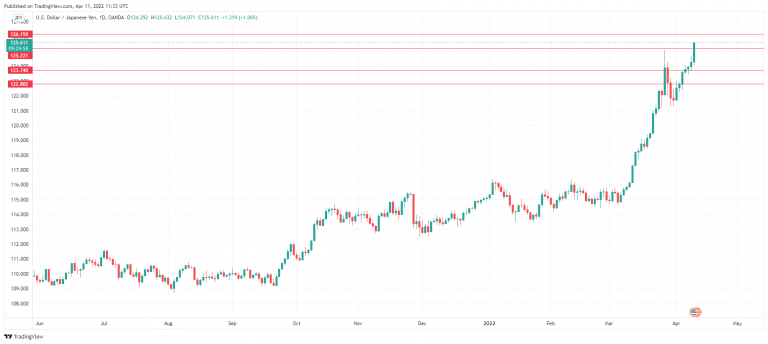
The Japanese yen continues to lose ground. Last week, USD/JPY rose 1.41% and has added another 0.97% on Monday. Earlier in the day, USD/JPY touched 125.55, its highest level since June 2015.
Yen slides, BoJ downgrades economy
It has been a bleak start to the week for the Bank of Japan. The central bank has tried to curb the yen’s slide against the dollar, albeit with limited success. USD/JPY jumped 5.85% in March and the upswing hasn’t let up, with a gain of 3.15% so far in April, with no end in sight for the yen’s slump. With USD/JPY punching above 125 on Monday, it came as no surprise that a senior BoJ official responded with a warning that excessive volatility in the exchange rate was hurting businesses. The BoJ also expressed its concern last week when USD/JPY rose above the 125 line, but clearly, this hasn’t done much to stem the yen’s nasty slide.
US Treasury yields continue to surge, with the 10-year bond rising to 2.78%, its highest level since 2019. The US/Japan rate differential continues to widen, which is bearish for the yen, as the currency is very sensitive to the rate differential.
The BoJ on Monday downgraded its outlook for 8 of 9 regional economies, with Governor Kuroda warning that the war in Ukraine had led to “very high uncertainty” as to the impact on Japan’s economy and inflation. This has raised concerns that the BoJ may lower its growth forecasts later in April, which could put further pressure on the wobbly yen.
The Fed is under pressure to move quickly and quench spiralling inflation. Policy makers have been busy telegraphing the possibility of 0.50% hikes, and there are growing expectations of back-to-back 0.50% hikes in May and June. The Fed prefers increments of 0.25%, but is scrambling after falling behind the curve on inflation. The danger with super-size rate hikes is that it could send the economy into a recession, making the increase in rate hikes a tricky task for the Fed.
USD/JPY Technical
- USD/JPY has broken above resistance at 125.22. Above, there is resistance at 1.2615, which has held since May 2002
- There is support at 123.71 and 122.81
GBPUSD Wave Analysis
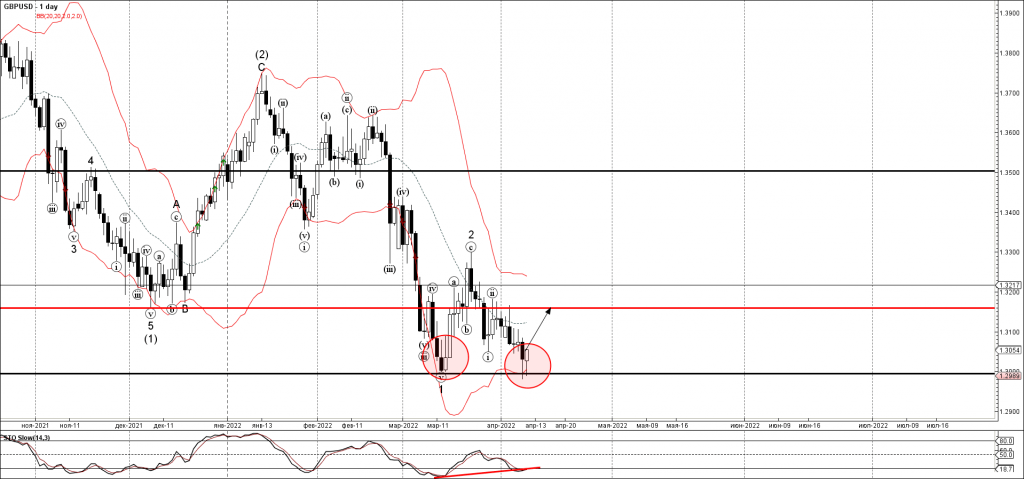
- GBPUSD reversed from round support level 1.3000
- Likely to rise to resistance level 1.3160
GBPUSD currency pair today reversed up with the daily Hammer from the round support level 1.3000 (which stopped the previous sharp impulse wave 1 in the middle of March).
The support zone near the support level 1.3000 is strengthened by the lower daily Bollinger Band.
Given the bullish divergence on the daily Stochastic – GBPUSD currency pair can be expected to rise further toward the next resistance level 1.3160.
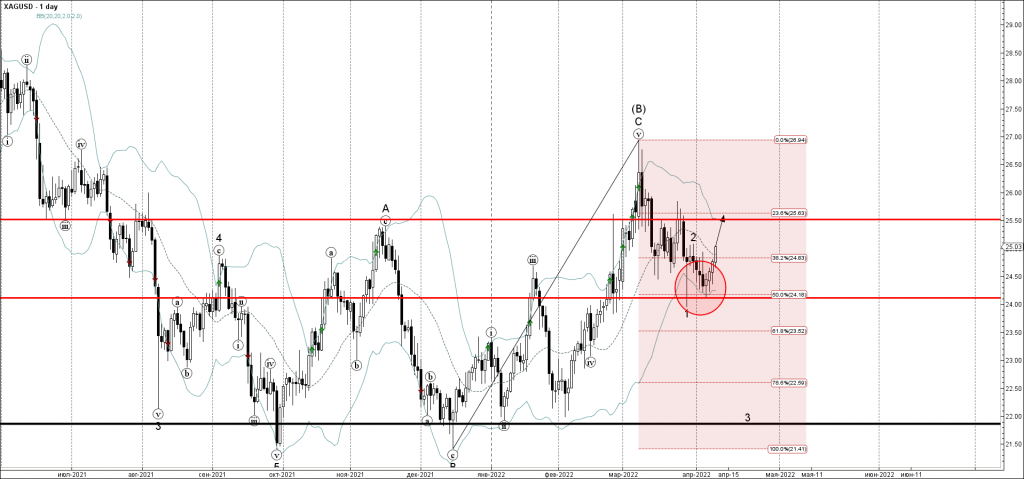
Silver Wave Analysis
- Silver reversed from support level 24.10
- Likely to test resistance level 25.50
Silver recently reversed up from the key support level 24.10 (which stopped the previous minor impulse wave 1 at the end of March).
The support zone near the support level 24.10 was strengthened by the lower daily Bollinger Band and by the 50% Fibonacci correction of the upward impulse from December.
Silver can be expected to rise further toward the next resistance level 25.50 (which reversed the price at the end of last month).
New Zealand Dollar Extends Slide
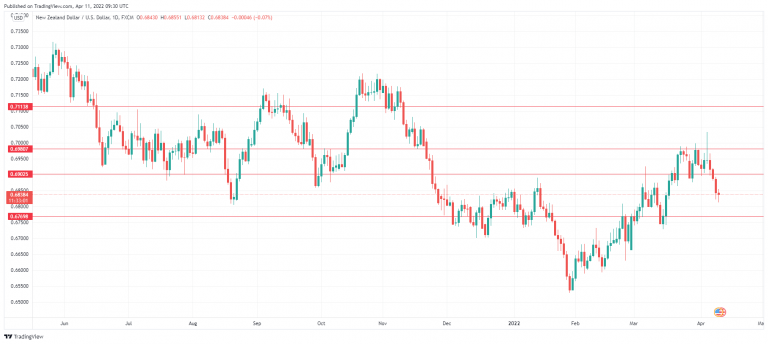
The New Zealand dollar remains under pressure and is in negative territory at the start of the week. Earlier in the day, NZD/USD dropped to 0.6813, its lowest level since March 16th.
Markets await RBNZ rate decision
The RBNZ, like many other major central banks, is finding itself playing catch-up with soaring inflation. The Federal Reserve, for example, is widely expected to bring out the heavy ammunition; namely, one or more 0.50% rate hikes in order to curb inflation. The markets are expecting the RBNZ to follow suit with hawkish forward guidance. However, the consensus is that the RBNZ will increase rates by just 0.25% at this week’s meeting, which would bring the Cash Rate to 1.25%. This could result in disappointment in the markets and send the New Zealand dollar sharply lower.
Some economists are predicting a 0.50% hike at the meeting, and the uncertainty could well contribute to NZD/USD volatility around the time of the rate decision. The RBNZ is well on its way to normalization, with the central bank’s forecasts predicting that rates will climb to 2.5% over the next 12 months and peak around 3.25% at the end of 2023.
Later today, New Zealand is expected to release the NZIER Business Confidence index. In Q4, business confidence worsened, falling from -11 to -28, due to the Covid lockdowns and shortages of material and labour. The lockdowns are gone but the shortages remain, and with high inflation hurting businesses, I expect another decline in the NZIER Business Confidence index.
There are concerns about China’s growth, as Covid cases rise while the government presses ahead with its Covid-zero policy. The city of Shanghai remains in lockdown and if the government extends lockdowns to other cities, the economic outlook will certainly worsen. The property crisis hasn’t been in the headlines but remains a potent problem. Zhenro Properties, a major developer, has officially defaulted on some US dollar bonds, worth USD 540 million.
NZD/USD Technical
- 0.6980 is the first line of resistance, followed by 0.7113
- There is support at 0.6902 and 0.6769
GBP/USD Putlook: Bears Probe Again Through Key 1.30 Support
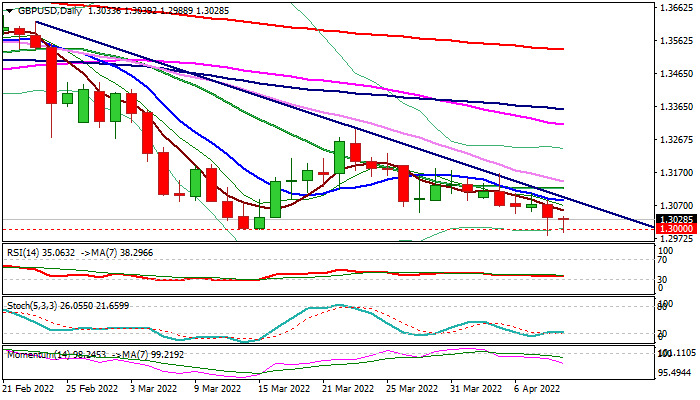
Cable remains in a negative mode in early Monday and probed again through key 1.30 support (psychological/Mar 15 low), following last Friday’s short-lived dip to 1.2982 (the lowest since Nov 2020).
Rising US dollar keeps the pound in defensive, while weaker than expected UK Feb GDP data added pressure to the currency, threatening of a final clear break of 1.30 pivot that would risk extension towards 1.2855/ 20 zone (lows of Nov/Oct 2020 respectively).
Quick bounce from the levels below 1.30 on Friday/today, signals that bears face strong headwinds here and may struggle further in attempts to break lower, however, near-term action remains biased lower and extended consolidation is likely to precede fresh leg lower.
The notion is supported by rising negative momentum on daily chart and moving averages in full bearish setup, with upticks to offer better selling opportunities while holding below 1.3100 zone (falling 10DMA/trendline resistance/Fibo 38.2% of 1.3298/1.2982 bear-leg).
Res: 1.3054; 1.3085; 1.3102; 1.3140.
Sup: 1.3000; 1.2982; 1.2900; 1.2855.
Pound Tests 1.3000 Again, Risks Falling to 1.2600
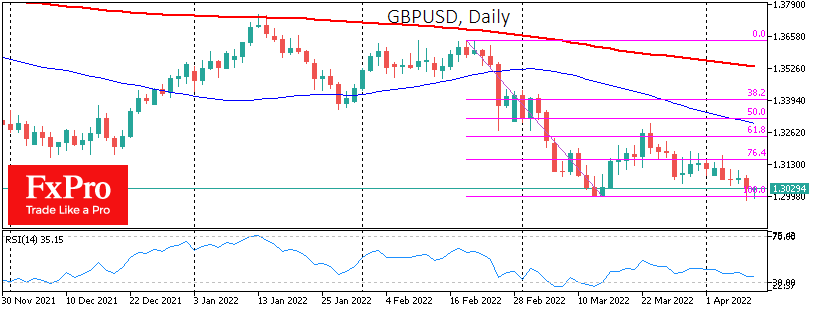
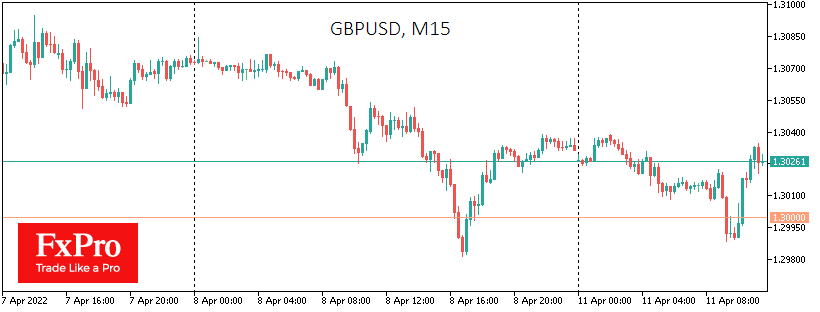
The British pound returned to the $1.3000 area, a significant circular level from which the British currency bounced in the middle of last month. The bulls continue to hold for the second consecutive trading session. The intraday charts clearly show buying impulses when going under the psychologically crucial round level.
A fresh batch of UK statistics sets the mood that the local rebound might be temporary. The economy added 0.1% in February compared to 0.8% a month earlier and was twice as weak as expected. Industrial production fell by 0.6% compared to an expected 0.3% increase. This demonstrates the damage to business activity in sectors that are often one step ahead of the economic cycle.
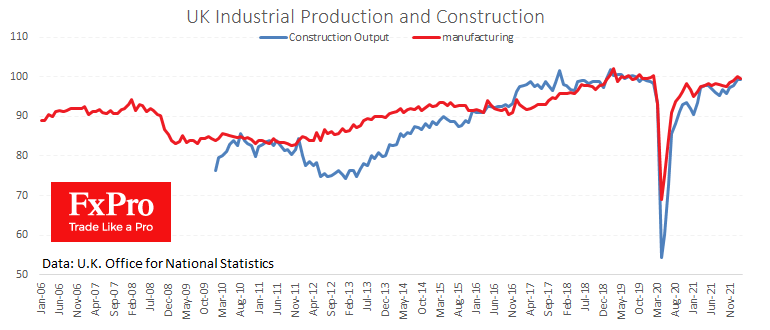
A sharp slowdown in the economy will reduce the room for monetary policy tightening by the Bank of England.
The decline in stock markets also plays into the hands of pound sellers, which positively correlates with demand for risky assets. GBPUSD went into a spike on events around Ukraine, losing more than 4.5% from late February to the lows of March. The subsequent rebound failed to gain traction, stalling near the 61.8% level of the initial decline. A consolidation under 1.3000 potentially paves the way to 1.26 (161.8% level).