Sample Category Title
France Outperforms after Weekend Election
European stocks are slipping again at the start of what is likely to be another very lively week in financial markets.
That has very much become the norm this year for obvious reasons but this week has an interesting mix of central bank decisions, the start of earnings season and major data releases which will keep us all on our toes. And then of course there's China, where restrictions are causing concern, property firms are back in the spotlight and policymakers could unleash some support after bold promises a few weeks ago.
Considering what's to come, it's no surprise that it's actually been a relatively timid start to the week. Compared to what we've become accustomed to, of course. Interestingly, the CAC is the only major index in the green after the weekend's first-round election, which saw Emmanuel Macron and Marine Le Pen progress to the second round in a couple of weeks.
The run-off between the two candidates is looking to be far closer than five years ago when Macron scooped two-thirds of the vote. While there is still plenty that could not bring themselves to vote for Le Pen as we saw in 2017, her softened image appears to have swayed others and while pols still favour Macron, some fall within the margin of error that makes Le Pen a realistic victor this time around.
While that would no doubt be bad news for Europe, it seems markets aren't particularly concerned if today's trading is anything to go by. Some have chosen to compare a Le Pen victory to Brexit and Trump, two events that were deemed to be a negative for stock markets before the vote but did not turn out to be so over time. Perhaps lessons have been learned.
Oil slides amid Chinese restrictions
Oil is off around 3% on the day, with Brent back below $100 and hitting its lowest level in almost four weeks. There has been a big effort to alleviate the pressures in the oil market in recent weeks which has no doubt helped but it's the lockdowns in China that are driving the latest declines.
The country's zero-Covid policy is naturally having a dampening effect on demand which is aiding the rebalancing efforts. Of course, this is just a temporary demand hit so the upside risks to the price remain but it is offering some reprieve for now. How widespread the restrictions become and for how long will determine the sustainability and severity of the declines.
Gold pares gains after facing resistance once more
Gold is up a little on the day but has given back the bulk of its gains from earlier in the session. Once again the yellow metal has run into resistance around the same region it did a few weeks ago and a recovering dollar has also weighed on it around those levels.
If it can break beyond here - an impressive feat considering we're still seeing yields rising - then $2,000 becomes the next big test. Whether it's inflation fears or risk aversion driving the move, we're certainly seeing gold coming back into favour. Not that it ever really fell out of favour, even as risk appetite returned and interest rate expectations were ramped up considerably.
Further pain ahead for bitcoin?
Bitcoin is getting hit hard again on Monday, losing more than 4% and coming close to $40,000 where it could see some support. A break of this level could be a psychological blow. From a technical perspective, it would also mean a break of the 50 fib level - 2022 lows to highs - which could also be a negative signal. It will be interesting to see if these levels attract dip buyers as the breakout two weeks ago looked to be a very bullish move. But it's all been downhill since then.
ECB ‘Half Measures’ Unlikely to Stop Euro’s Bleeding
The European Central Bank will conclude its next meeting at 11:45 GMT on Thursday, and with inflation running wild, it will likely signal that a rate increase is on the menu soon. Ending asset purchases in July followed by a rate increase in September seems like the most likely endgame. However, markets have already priced an even more aggressive tightening pace, so such signals might not be enough to rescue the battered euro.
Stagflationary breeze
The ECB has a crisis on its hands. Eurozone inflation is running at 7.5% per year, which is the fastest clip since the euro came into existence. And this may not be the peak. Supply chains are still a mess with the recent lockdowns in China while the invasion of Ukraine has sent commodity prices rocketing higher, so more inflation is probably in the pipeline.
The problem is that economic growth is losing steam. This means the ECB cannot raise interest rates with brute force to fight this inflationary spiral. Consumers are being forced to spend more on necessities like food and energy, which limits their ability to consume everything else. Coupled with the slowdown in China that will restrain European exports, economic data over the next few months could be ugly.
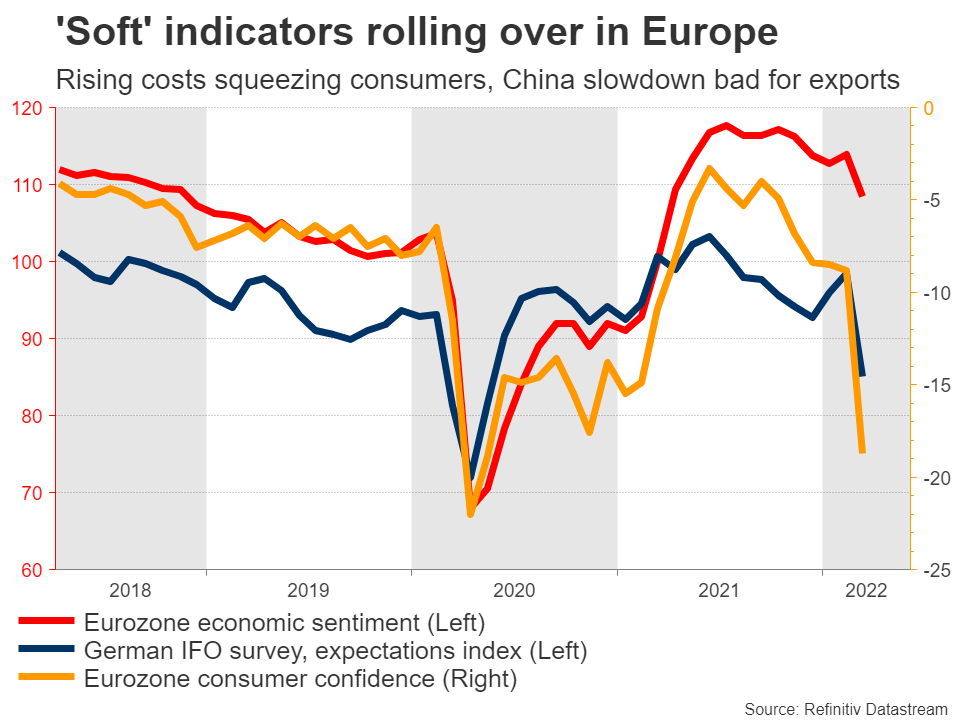
Business and consumer confidence readings have already cratered and even though governments have rolled out support measures to cushion the impact, there is still a clear risk of recession in Europe.
Slow and steady
In this environment, the ECB is essentially trapped. It needs to tighten policy to control inflation, but if it steps on the brakes too hard, it would increase recession risks even further. That’s not a gamble the officials want to take.
Hence, the only realistic option is to raise interest rates in a very careful manner. The ECB has to strike the right balance, tightening neither too fast nor too slow.
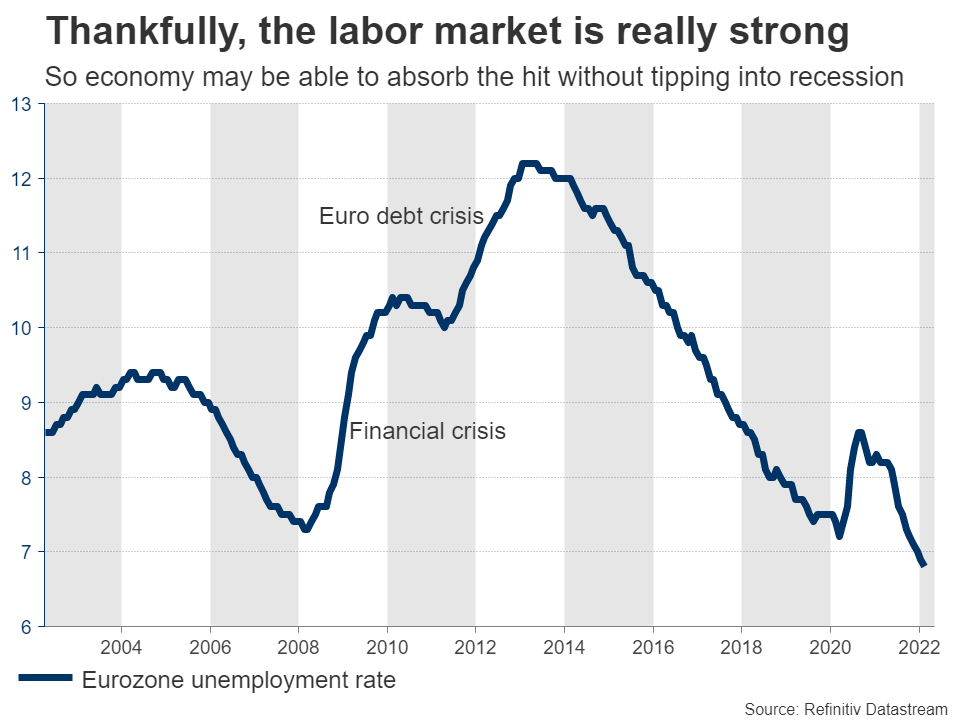
On the bright side, the labor market was very strong before the Ukraine crisis. The unemployment rate hit a record low in February, so there is some optimism that the economy can absorb the hit without falling apart.
No relief for the euro?
All told, the ECB is about to hike rates for the first time in a decade. While it won’t commit to a specific meeting this week, it is becoming clear that September is a realistic time for liftoff. Asset purchases could end in July, the earliest possible date according to the forward guidance.
But for the euro, this might not be enough to stop the bleeding. Money markets have already priced in 73 basis points of rate increases for this year, which amounts to three quarter-point hikes. The first move is fully priced for September and market pricing also implies a 60% probability for a ‘double’ hike of 50 basis points at that meeting.
This is a tall bar for the ECB to overcome. Therefore, even though the central bank is moving in a more hawkish direction, its speed might not be enough to satisfy euro traders.
Euro/dollar has been trending lower for more than a year and if the ECB only delivers ‘half measures’ this week, that’s unlikely to change. A disappointment could see the pair test the 1.0835 region again.
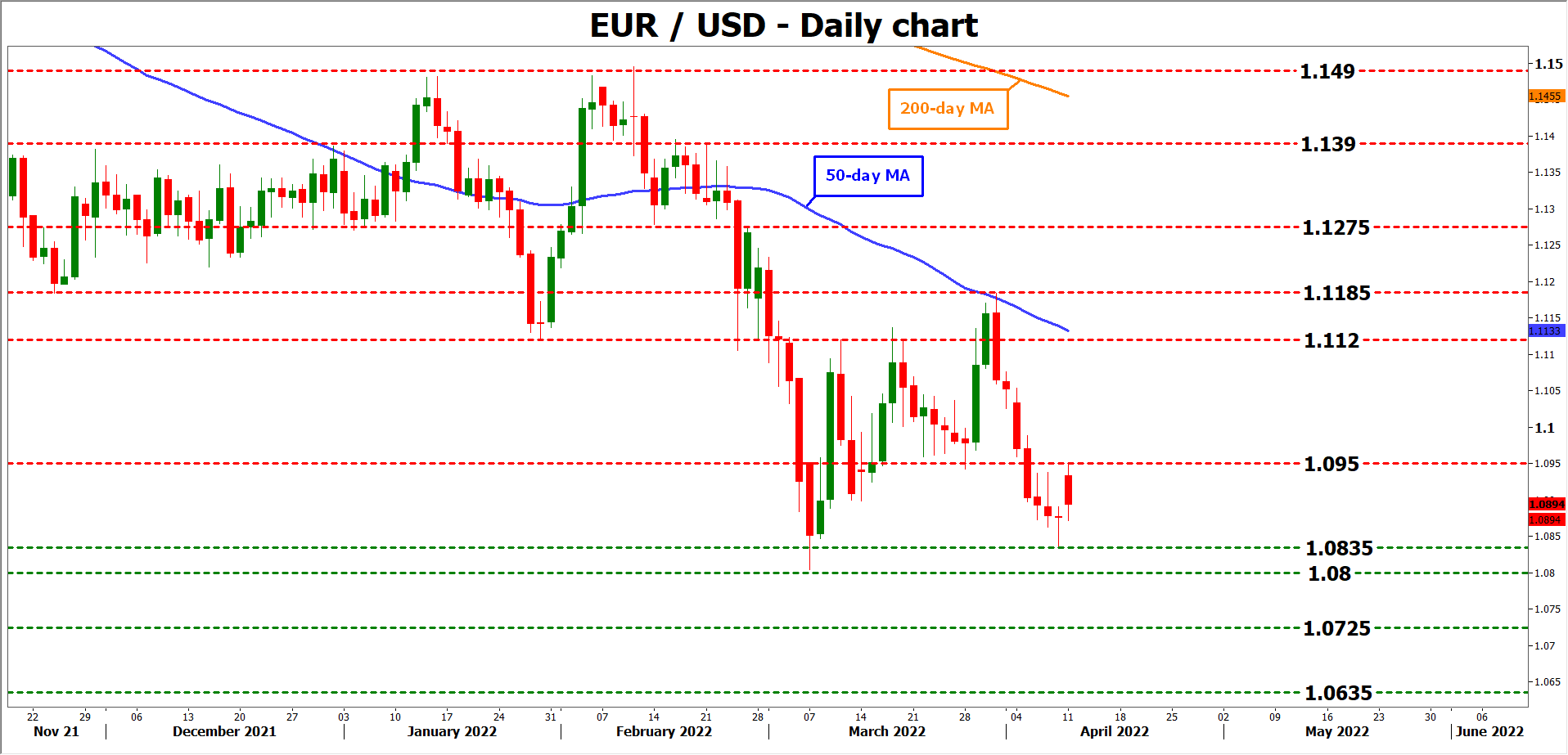
If the ECB wants to save the euro, it needs to signal that rates can be raised earlier, possibly over the summer. This is a low-probability outcome as it would violate its own forward guidance, but not impossible given the inflation dynamics. In this scenario, euro/dollar could shoot higher, perhaps towards the 1.1120 zone.
Of course, for the euro to stage a sustainable rally, the growth outlook needs to improve first. That’s unlikely to happen until there’s a ceasefire in Ukraine and the French presidential election is out of the way.
French Election a Historic Test for the Euro
Politics is once again temporarily becoming the main driver for the single currency. EURUSD returned to 1.0925 on Monday, gaining 0.8% from Friday’s lows on reports that incumbent Macron is ahead of far-right Le Pen and will potentially get even more votes in the second round on April 24th as the majority of those voting for alternative candidates lean towards Macron.
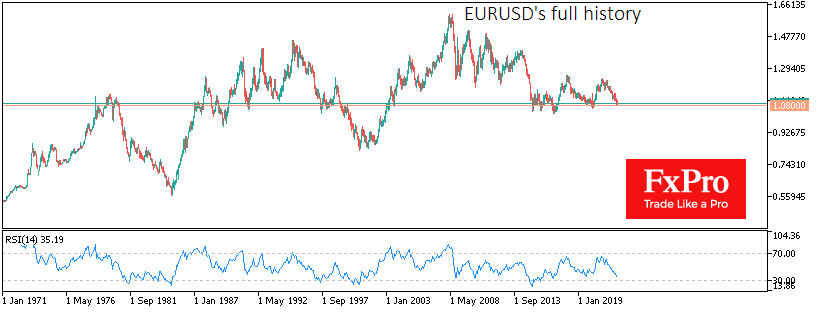
The lowering of political risks is attracting buyers of the single currency as EURUSD fell late last week to 1.0850 – near the lows of March and a support area in the pair between February and May 2020.
In 1997, the EURUSD (then still non-cash) was gaining support near this level, but a return to 1.08 two years later triggered a capitulation. The EURUSD sell-off then had only halted two years later after the single currency had lost a quarter of its value and only after ECB interventions.
The French elections and the events in Ukraine have enough potential to trigger a historic euro move away from that line.
A strong pullback under 1.0800 opens the direct road to 1.05 (pandemic lows), but it may only be the first step in a long-term slide of the single currency towards 0.8500.
The opposite is also true: the political détente in the coming weeks may fundamentally change the attitude towards the single currency, making purchases attractive in the long term from the current levels.
Investors and traders should pay close attention to the EURUSD in the coming weeks because the following dynamics will be decisive for the number one currency and the entire forex market for many months.
Sunset Market Commentary
Markets
The new week starts the way it ended last Friday: with a new bond sell-off. The trend of higher yields is definitely not new but received new impetus from the Fed and ECB Meeting minutes last week. Both highlighted the fact that monetary hawks are either firmly behind (Fed) or are in the process of taking over the steering wheel (ECB). The fact that the economic calendar is semi-backloaded with US CPI due tomorrow and the ECB meeting on Thursday did not keep markets sidelined as they usually do. Quite the opposite actually: it seems that bond markets are frontrunning. They do have a point though, especially with respect to the ECB. We wouldn’t be surprised if the outcome of the April meeting showed a further shift to the hawkish side of the spectrum. Core bonds slide with German Bunds underperforming US Treasuries. Yields rise 8.3 bps (2y) to 10 bps (30y), steepening the curve with moves mainly driven by real rates. The 10y yield (+9.8bps) is attacking the 2018 high of 0.80%. A break higher paves the way towards the 2015 resistance area around 1%. European swap yields add 5.3-8.3 bps. The 2y is testing the 2013 resistance of 0.78% with euro area money markets raising their ECB bets by the day. They currently discount two 25 bps hikes and counting by October. The US curve bear steepens too in an offshoot of the rapid quantitative tightening pace (targeting the longer end) as suggested by last week’s Minutes ($95bn per month). Changes range from 3.1 bps (2y) to 6.3 bps (30y). The 10y reference finds itself in the resistance zone of 2.76%-2.80%.
The Japanese yen on FX markets catches the eye. Minor risk-off is not even close of an enough support against the surge in core bond yields. EUR/JPY convincingly surpasses 136 and is on track for the highest close since early 2018. USD/JPY crushes the 125 handle it tested end of March (125.48) to trade at the highest level since mid-2015. The Norwegian krone is second to last in the G10 club (see below). The euro opened strong this morning. It enjoyed a minor relief/stop-loss rally after Macron held the upper hand over Le Pen in Sunday’s first round of the presidential elections. They will face each other in the second round on April 24 in a repeat of the 2017 elections. The race to the Elysée however is much tighter than it was back then. The common currency in the meantime pared some of those early gains, especially against the USD. EUR/USD trades flat at 1.088 after having touched an intraday high of 1.095. EUR/GBP was a copy paste; gapping higher above 0.84 at the open only to give up on all gains. Sterling itself is relatively well bid too, despite disappointing industrial production figures this morning.News Headlines
Of late most inflation releases surprised to the upside. Norwegian March inflation was the exception to the rule. Both headline and core inflation printed softer than expected. Headline inflation rose 0.6% m/m to be up 4.5% y/y. Core inflation rose a modest 0.3% m/m, leaving the y/y figure unchanged at 2.1%. The Norges Bank started a gradual rate hike cycle in December. In its March policy report, the NB indicated to hike quarterly with a next step at the June meeting. It forecasted the policy rate to reach 2.5% at the end of next year. Broader inflationary pressures, however, raised questions whether the NB also should consider faster policy normalisation. Today’s soft core inflation serves as a counterargument. The Norwegian krone, which recently profited from a higher oil price and expectations of higher interest rate support, corrects modestly. EUR/NOK rebounded from the 9.48 area just before the CPI release to 9.5475 currently.
At the other end of the inflation spectrum, Czech CPI again accelerated to a pace faster than expected. Prices rose 1.7% M/M to be up 12.7% Y/Y. Costs of transportation rose 7.1% M/M, domestic fuels rose 21.7%. Costs related to housing, which has a weight of 26.7% in the basket, had risen 17.6% Y/Y. The CNB raised its policy rate 50 bps to 5.0% at the end March meeting. With risks for inflation to rise even somewhat further in the coming months, another bold rate hike at the next meeting (May 5) is likely. The Czech krona gained modestly today with EUR/CZK trading at 24.42.
Euro Gets Slight Lift from French Vote
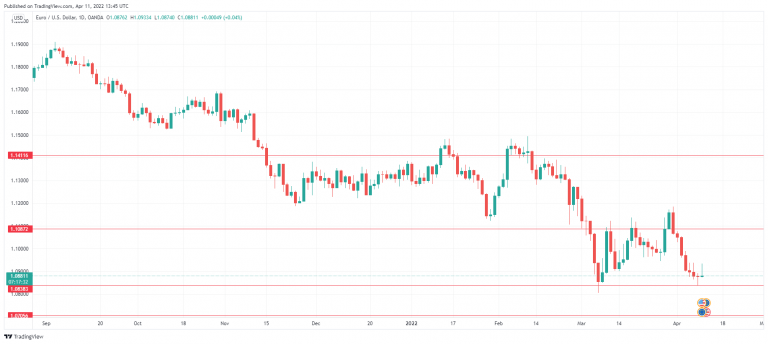
The euro clawed its way back to the 1.09 line on Monday but has retreated. EUR/USD fell 1.57% last week and hasn’t had a winning session in the month of April.
It’s Macron vs. Le Pen, again
The first round of the French presidential election is over, and it will be a repeat run-off (final round) between President Emmanuel Macron and Marine Le Pen of the far-right. The two candidates ran against each other in the 2017 election, which Macron easily won. This time, however, it is shaping up to be a much closer race. Macron is slightly ahead, but Le Pen has been closing the gap and there is a sizeable amount of the electorate that is unhappy with Macron’s performance. The runoff takes place in two weeks, and election polls will likely have an impact on the euro’s movement. Le Pen is a fierce euro-sceptic and if she appears to be gaining in the polls, it will be bearish for the euro.
The ECB holds a policy meeting on Thursday, and a dovish stance from the central bank won’t do any favours for the struggling euro, which is down 1.52% in April. EUR/USD dropped to 1.0836 on Friday, putting pressure on the 1.0800 line, which has held since May 2020. If 1.08 fails, the euro could take a tumble all the way to 1.06.
Germany releases the ZEW Economic Sentiment index on Tuesday. The index swooned in March, falling from +54.3 to -39.3. The magnitude of the slide was stunning, and the markets are braced for even worse, with a consensus of -48.4 for April. The driver behind the sour mood is the war in Ukraine, which together with sanctions against Russia is having a sharply negative effect on the German economy. Inflation is expected to continue to accelerate, which is adding to the pessimistic outlook. The Eurozone ZEW Economic Sentiment is projected to show similar numbers, and soft ZEW releases could spell trouble for the euro.
EUR/USD Technical
- There is resistance at 1.1008 and 1.1141
- 1.0838 is a weak support line. Below, there is support at 1.0705
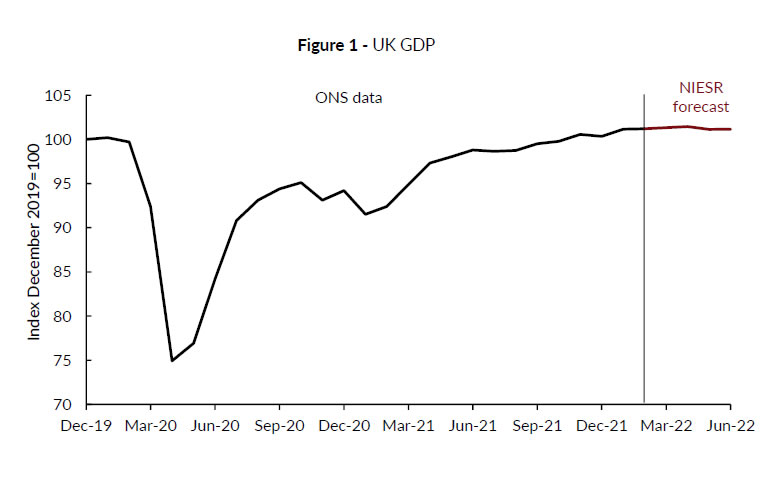
NIESR forecasts 1% UK GDP growth in Q1, flat in Q2
As UK GDP grew merely 0.1% mom in Q2, NIESR said the final forecast for Q1 is for growth of 1.0% only. The initial nowcast for the second quarter of 2022 is for GDP unchanged from the first quarter, with a small quarter-on-quarter fall in production and a small rise in construction.
NIESR added: "NIESR research has suggested that inflation will now average 7 per cent in 2022, and GDP growth could be reduced by 0.8 percentage points to 4.0 per cent from the 4.8 per cent we forecast in our Winter 2022 UK Economic Outlook. This analysis will be updated in our Spring UK Economic Outlook, to be published on 10th May."
Will the RBNZ Increase Rates by 25 or 50 Bps?
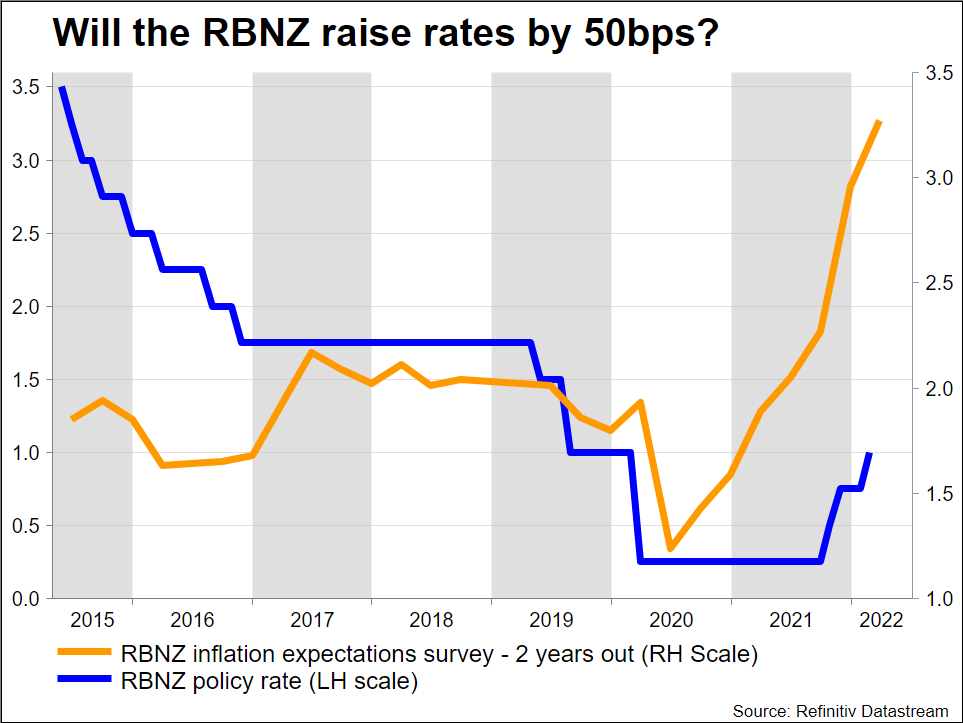
Early on Wednesday the Reserve Bank of New Zealand will begin its monetary policy meeting and it could be significant as it could become the first central bank to hike interest rates by a sizeable 50 basis points. After raising interest rates three times already, there's a considerable possibility the Reserve Bank of New Zealand will choose for a more significant hike in April.
RBNZ expects to hike rates; 25 or 50 bps?
The Reserve Bank of New Zealand increased its OCR by 25 basis points to 1.0 percent in February, as predicted. With rising inflation and home prices, the Bank raised rates for the third time in a row. The board said more monetary tightening was needed to cool a hot economy, and that the cash rate would hit 2.2% by year's end and 2.57% by March 2023, up from 2.1% and 2.3% in November's predictions.
The RBNZ is expected to hike the Official Cash Rate by another 25 basis points to 1.25%. The extremely slow flow of information between reviews will not assist in making that choice. Near-term inflation is becoming an increasing source of concern for businesses and households. However, housing prices are at last starting to cool down, most probably as a result of the monetary policy actions taken to date. The bank has provided scant information on how it would interpret recent developments.
The only issue for the New Zealand dollar is that the Reserve Bank of New Zealand's hawkish approach may not provide much of a boost when other central banks are also hawkish in their outlook. Despite an excellent rebound versus the US dollar since late January, the kiwi's strength can be ascribed in part to an increase in commodity prices. If the Reserve Bank of New Zealand disappoints and raises rates by only 25 basis points, the kiwi might be faced with selling.
Kiwi/dollar tumbles ahead of policy meeting
The impact on the kiwi, however, could in the end be negligible. From a technical perspective, the outlook for kiwi/dollar is currently negative in the short-term. The pair has already erased the sharp upside move towards the almost five-month high of 0.7030, sliding below the uptrend line near 0.6830. The 38.2% Fibonacci retracement level of the down leg from 0.7220 to 0.6524 at 0.6790 could be the last opportunity for a rebound before the negative trend extends towards the 0.6725 barrier.
Alternatively, the pair will need to pierce the 50.0% Fibonacci of 0.6870 and 0.6890 resistance to gain access to the 61.8% Fibonacci of 0.6950. Even higher, the 0.7000 round number and the almost five-month peak of 0.7030 could come next.
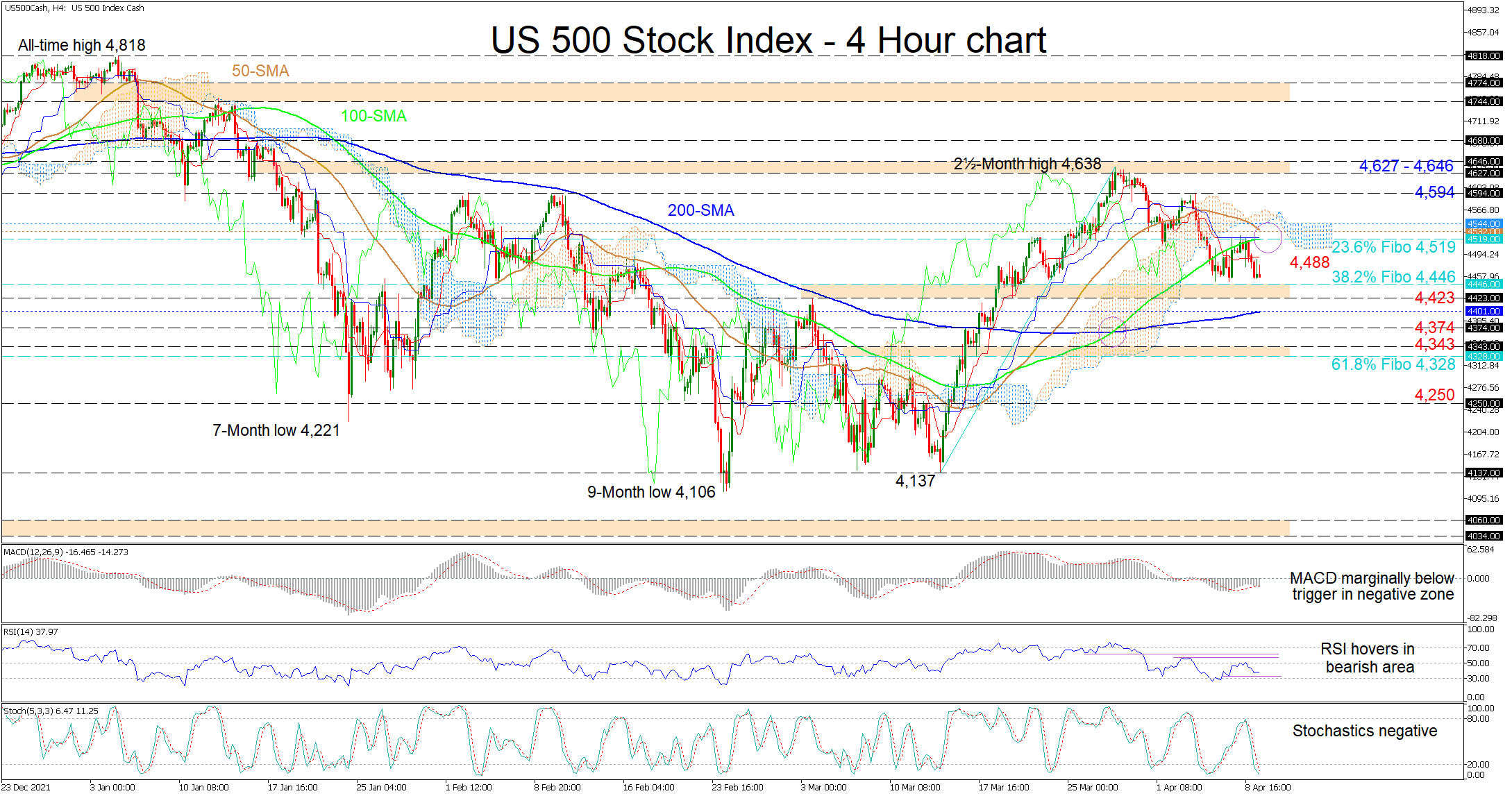
US 500 Index’s Positive Tone Shaky Near 38.2% Fibonacci
The US 500 stock index (Cash) is consolidating slightly north of the 4,446 level, which is the upper part of a support border and coincidentally the 38.2% Fibonacci retracement level of the up wave from 4,137 until 4,638. The rolling over of the 50-period simple moving average (SMA) and its nearing of a bearish crossover of the still climbing 100-period SMA, is reinforcing the waning in the index, and specifically weakness in the latest two-week rally.
Currently, the horizontal Ichimoku lines are indicating a pause in negative pressures, while the short-term oscillators continue to reflect a price preference aimed southward. The negatively charged stochastic oscillator and the bearish demeanour of the MACD are both promoting a renewal in downward forces. That said, for now the RSI is floating in the bearish region, failing to signal fresh directional momentum in the index.
In the negative scenario, an initial support barrier exists between the 38.2% Fibo of 4,446 and the 4,423 obstacle. If this critical support border fails to provide buyers with positive traction, they may shift their hopes towards the 200-period SMA underneath at 4,401. However, if selling interest intensifies, the 4,374 low could try to delay the test of the support boundary linking the 4,343 level to the 61.8% Fibo of 4,328. Should downward pressures overwhelm, the March 16 trough of 4,250 could then draw attention.
Alternatively, if buyers improve from the 38.2% Fibo’s vicinity and overstep the nearby red Tenkan-sen line at 4,488, significant upside limitations may arise from the 23.6% Fibo of 4,519 until the Ichimoku cloud’s upper band at 4,544. This key section encapsulates the bearish crossover of the 50-period SMA with the 100-period SMA and the flattened blue Kijun-sen line too. So, a successful jump in the price north of the cloud may propel the price toward the 4,594 barrier before buyers seek out the 4,627-4,646 resistance band.
Summarizing, the US 500 index has adopted a bearish bearing in April, which could gain pace if the price sinks below the 4,423-4,446 support. Moreover, a dive past the 61.8% Fibo of 4,328 may rekindle worries about a risk-off outlook. Yet, for optimism to return in the index, the price would need to climb north of the 4,627-4,646 deterrence.
EUR/USD is Full of Risks
On Monday 11 April, EUR/USD remains weak; the asset is currently trading at 1.0892.
The Monetary Policy Meeting Accounts published by the European Central Bank last week said most policymakers believed that the regulator should take immediate measures aimed at helping the monetary policy reach stability. Such a stance is based on high inflation, which may preserve in the future. However, there is no consensus here, the monetary committee has the right to choose.
Still, this line is rather soft and couldn’t support the EUR, while the “greenback” got much stronger after the US Fed announced the rate hikes in the nearest future. American policymakers say that the rate might reach 3.5% by the end of the year to take control over inflation. By the end of 2022, the бmonetary policy should reach a neutral level.
Investors are also keeping a close eye on the presidential elections in France. The Euro is rather unlikely to be very sensitive to the voting results but some part of politics-related risks might be included in prices.
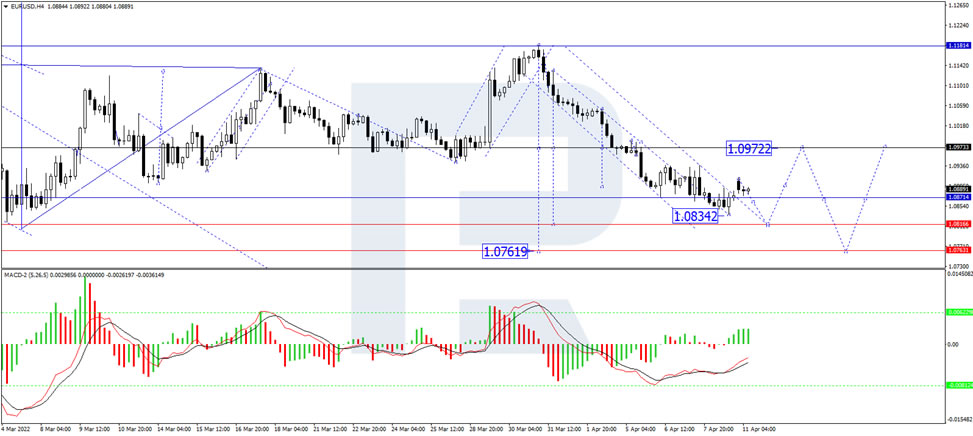
In the H4 chart, having rebounded from 1.0973, EUR/USD continues falling towards 1.0816. Later, the market may correct to test 1.0973 from below and then form one more descending wave with the target at 1.0763. From the technical point of view, this scenario is confirmed by MACD Oscillator: its signal line is growing to reach 0 and may soon rebound from this level to start a new decline and update the lows.
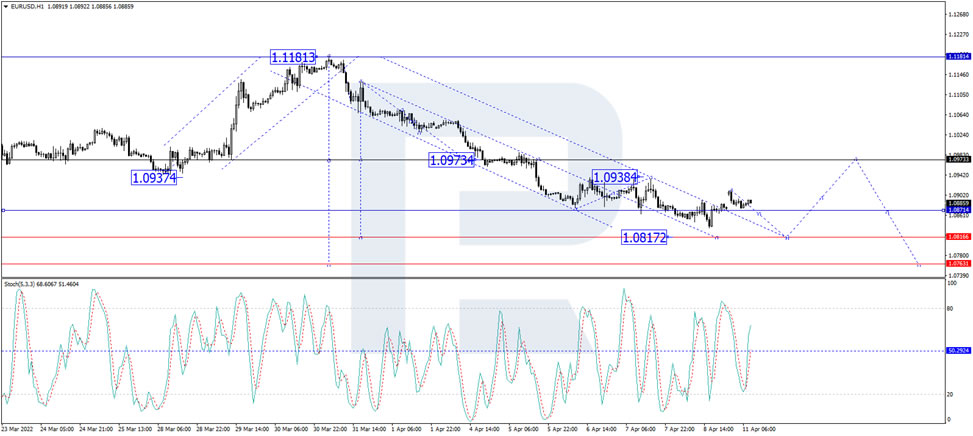
As we can see in the H1 chart, after completing the correction at 1.0910, EUR/USD is expected to resume falling towards 1.0816 and then start a new correction to reach 1.0973. After that, the instrument may resume trading downwards with the target at 1.0763. From the technical point of view, this idea is confirmed by the Stochastic Oscillator: after breaking 50 to the downside, its signal line may continue moving to reach 20. Later, the line may rebound from 20 and start a new growth towards 80.
EUR/USD Mid-Day Outlook
Daily Pivots: (S1) 1.0845; (P) 1.0868 (R1) 1.0900; More...
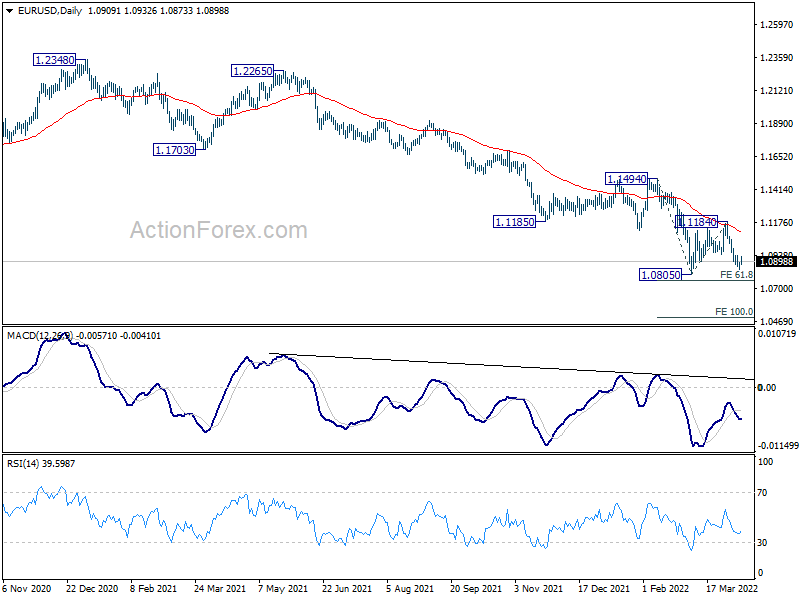
Intraday bias in EUR/USD remains neutral for the moment. But further fall is expected with 1.0987 resistance intact. On the downside, decisive break of 1.0805 low will resume larger down trend. Next target is 61.8% projection of 1.1494 to 1.0805 from 1.1184 at 1.0758, and then 100% projection at 1.0495. On the upside, above 1.0987 minor resistance will turn bias back to the upside for 1.1184 resistance instead.
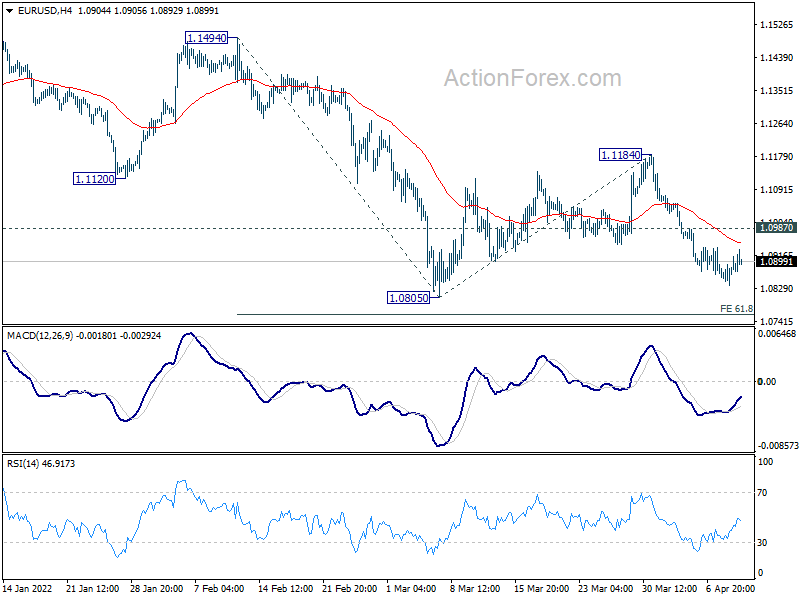
In the bigger picture, the decline from 1.2348 (2021 high) is expected to continue as long as 1.1494 resistance holds. Firm break of 1.0635 (2020 low) will raise the chance of long term down trend resumption and target a retest on 1.0339 (2017 low) next. Nevertheless, break of 1.1494 will maintain medium term neutral outlook, and extending term range trading first.