Sample Category Title
The Weekly Bottom Line: Canada – Rate Hikes Ahead
U.S. Highlights
- The first full week of the second quarter was sparse on economic data. The service sector showed signs of modest acceleration, while vehicle sales declined for the second consecutive month in March.
- The Federal Open Market Committee (FOMC) March meeting minutes reiterated members’ unwavering commitment to moving fast to restore price stability.
- The minutes provided a blueprint of the Fed’s balance sheet runoff, which will be more aggressive and ramp up faster than before. At such pace, the runoff should finish by the end of 2024.
Canadian Highlights
- The economic news was non-stop this week, from the Business Outlook Survey, to the Federal Budget, and capping it off with another banner jobs number.
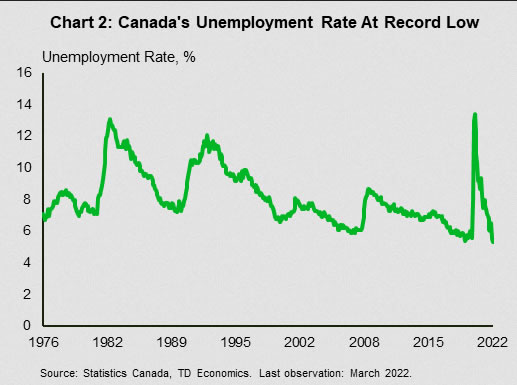
- The job market keeps getting tighter, with the unemployment rate reaching a series low of 5.3%. Wage growth is picking up but remains slightly lower than the latter half of 2019.
- Combined with strong business sentiment, and a steady federal fiscal picture, it is all systems go for a rate hike next week. Given inflation and economic strength, a 50 basis-point move is justified.
U.S. - The Fed’s Most Important Task
The first full week of the second quarter was sparse on economic data. On Tuesday, the Institute for Supply Management released its report on services that provided signs of modest acceleration in economic activity in the sector. Still, the report was full of contrasting elements. On the one hand, demand indicators were higher with business activity, and both new domestic and export orders up on the month. This was likely supported by stronger employment and the recent improvement in delivery times allowing businesses to rebuild depleted inventories.
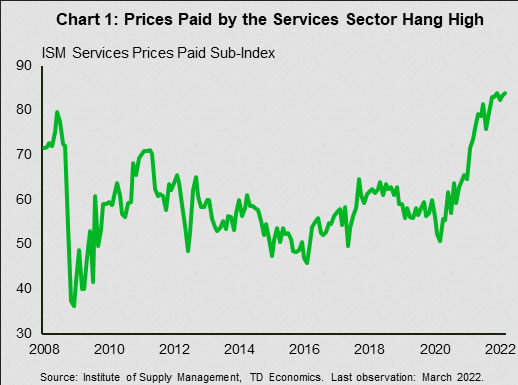
On the other hand, the imports sub-index fell into a contractionary territory while ongoing supply chain issued lowered purchasing managers’ inventory sentiment to an all-time low. The prices paid indicator was unsurprisingly higher given the energy shock dealt by the Russia-Ukraine war with all 18 industries reporting higher prices (Chart 1). In addition, respondents’ comments were quite negative, reflecting the pessimism over increasing cost and ongoing supply chain disruption.
This pessimism was echoed in the vehicle sales release, which showed the second consecutive month of decline in March. While underlying demand remains strong and improving, sales will remain constrained by limited inventory. Furthermore, production may suffer another blow should the war in Ukraine result in semiconductor shortages later in this year. As a result of strong demand and tight supply, the inventory-to-sales ratio – a measure of adequacy of supply relative to current demand – remains historically low. This will continue to put upward pressure on car prices over the near-term.
Fighting persistent price pressures remains the Fed’s most important task. The Federal Open Market Committee (FOMC) March meeting minutes reiterated members’’ unwavering commitment to moving fast to restore price stability and reach a neutral policy stance by year end. Many participants expressed their concerns about inflationary risk and voiced their preference to tighten the policy rate by 50 basis points at the next meeting on May 3rd-4th.
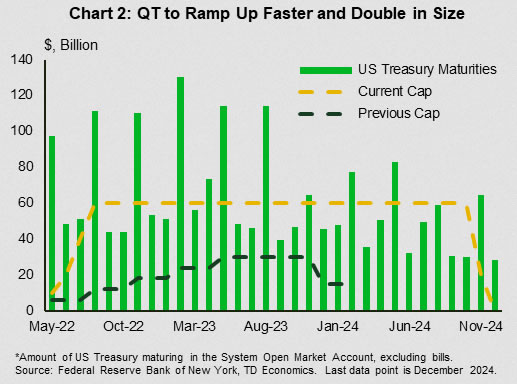
Chart 2 shows the dollar amount of maturing U.S. Treasuries (in billions) in the System Open Market Account (SOMA) from March 2022 to December 2024 alongside the series for monthly cap of the previous runoff cycle of 2017-2019 and the one expected this time. In the previous cycle the Fed limited the caps to $6 billion per month, steadily raising the level to $30 billion over the period of 12 months, and then reducing it to $15 billion in 2019. This time the Fed is expected to phase-in within three months reaching the cap of $60 billion – double the maximum size of the previous runoff cycle.
The minutes also provided a plan for the Fed’s balance sheet runoff (aka Quantitative Tightening or QT). As we wrote in this report, the monthly caps will be larger than in the previous QT cycle, scaled up by the increase in asset holdings (Chart 2). The participants agreed to shed $60 billion Treasury securities and about $35 billion agency MBS monthly, but the phase-in period will be shorter than we expected at just three months. The runoff may start as early as May, which suggests that the balance sheet could shrink by $2.7 trillion by the end of 2024. By this time, we expect that the Fed will reach $1.7 trillion in reserves – the level of reserves “consistent with the Committee’s ample-reserves operating framework”.
Bond markets reacted by selling longer-dated US Treasury securities, which led to yield-curve steepening. At the time of writing, the 10-year Treasury yield was at 2.69% - up 0.3 percentage points relative to where it closed last week.
Canada - Rate Hikes Ahead
The economic news was non-stop this week, from the Business Outlook Survey, to the Federal Budget, and capping it off with another banner jobs number. The overall takeaway is there was nothing in any of it to give the Bank of Canada pause before raising rates by half a point next Wednesday.
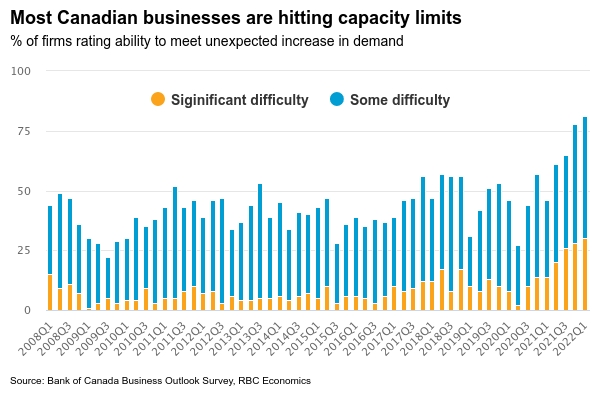
The Bank of Canada's Business Outlook Survey showed that firms remained quite upbeat about the outlook. Investment intentions remained elevated and labour markets remained tight – a pain point for businesses, but a sign of a healthy economy. The survey was largely conducted before Russia invaded Ukraine, though a recent special survey indicated, not surprisingly, that businesses expect the war to add to inflationary pressures through higher input costs. The lower-profile companion survey on consumer expectations echoed the same themes – strong labour markets and inflation worries. However, spending intentions remained strong, and the probability that people would quit their jobs in the next year rose to a series high of 22%.
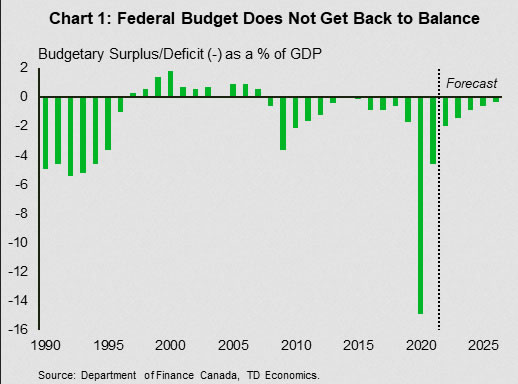
One economic player that inflation is helping is the federal government, where higher inflation has improved the fiscal outlook presented in Budget 2022 relative to what was presented in the Fall Economic Statement (see analysis). However, the budget does not get back to black over the forecast horizon, thanks to close to $60 billion in additional spending (Chart 1). The Federal debt-to-GDP ratio remains on a downward trajectory, however, due to a growing economy.
New spending measures were spread across priorities on housing, climate and environmental action, childcare, defense, dental care, and measures to further reconciliation with Indigenous peoples. Revenue raising measures were targeted: a tax on large financial institutions and increased efforts to close tax loopholes are expected to generate $17 billion over five years.
Topping off the week, March's employment data revealed that Canada's job market shows no sign of cooling down, with 73k new jobs created. The unemployment rate fell even lower, to 5.3% – the lowest level since comparable data became available in 1976. Not surprisingly, wage growth has also picked up, with average hourly wage growth up 3.4% versus a year ago. Abstracting from the distortions in wages over the pandemic – as job losses were skewed to lower wage positions, lifting the average – wage growth is still not as strong as it was in late 2019. Wage growth is also not keeping pace with inflation, which was 5.7% year/year in February. But, with the labour market this tight, wage growth is sure to heat up.
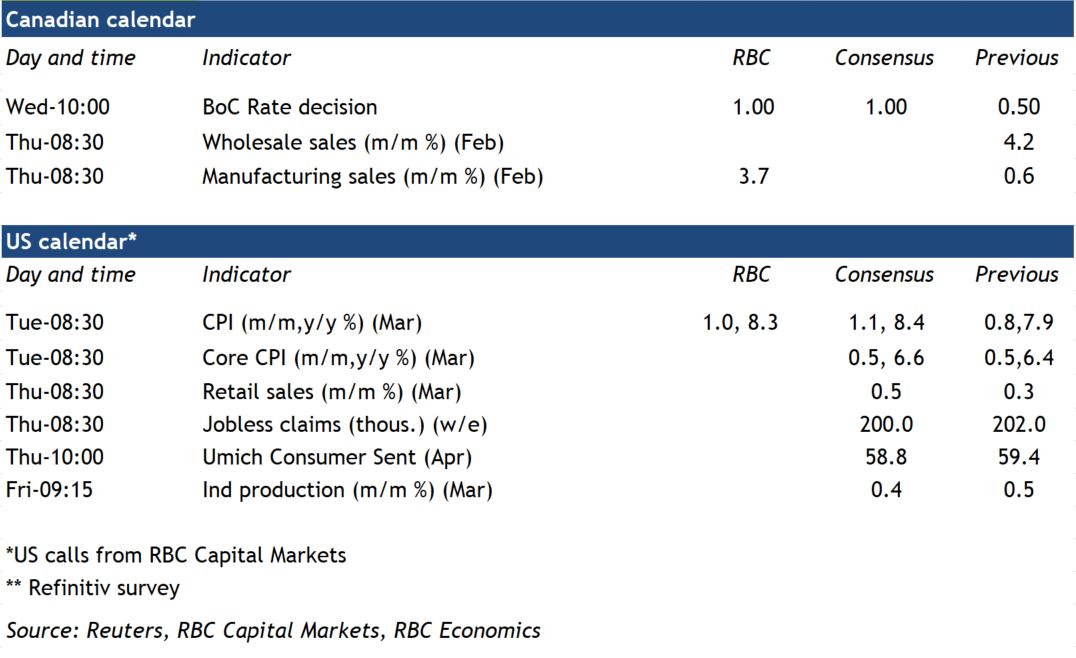
The Bank of Canada is widely expected to raise rates 50 basis points next Wednesday. It would be an aggressive move by the Bank, which has only hiked in 25 basis point increments over the past 20 years. Given the hot economy, the move is justified.
Bank of Canada to Hike Rates for Second Straight Meeting
We expect the Bank of Canada to hike interest rates by 50 basis points next week. The move will follow up on the 25 bp rate hike in March and come alongside the widely-expected start of ‘quantitative tightening’ as the central bank begins to reduce asset holdings. Labour markets have strengthened dramatically, pushing the unemployment rate back below pre-pandemic levels. Acute labour shortages are now widespread. And the latest Bank of Canada Business Outlook Survey reiterated that longer-run production capacity limits and surging input costs are larger concerns for businesses than any weakness in demand. The central bank will likely take some comfort from the fact that businesses expect inflation to return to the 2% target after the next couple of years. But current price growth is still running too firm to ignore, with pressures building over a widening array of products and services. Easing off the monetary policy accelerator—and getting interest rates back to a more ‘neutral’ level that won’t add to or subtract from longer-run inflation pressures—is a the most likely path near-term.
We expect more rate hikes from the Bank of Canada to lift the overnight rate to 2.00% (up from 0.5% currently) before the end of this year. The bank will likely pause at that point to assess what we expect to be a slowing economic growth backdrop. The U.S. Federal Reserve is expected to be more aggressive, continuing to hike into 2023, as it grapples with more significant production capacity pressures and firmer inflation readings. March U.S. CPI data next week will reinforce those inflation concerns with the headline rate likely to increase to the 8.3% range, driven by skyrocketing gasoline prices following the Russian invasion of Ukraine. But gas isn’t the only thing to see faster year over year price growth. And pressures are broadening as strong consumer demand bumps up against production capacity limits and extremely tight labour markets.
Week ahead data watch:
Canadian home resale markets remained exceptionally tight in February. Regional reports this week flagged still heated activity across Canada in March with prices continuing to grow and inventories very low—albeit with some signs of moderation in some larger markets including Montreal and Toronto.
The flash estimate of February Canadian manufacturing sales was very firm at 3.7%, reflecting higher petroleum prices but also some easing in auto production disruptions and a surge back in hours worked after a sharp January decline when Omicron kept a large share of the workforce off sick and/or self-isolating. We expect sale volumes (excluding price changes) to also look firm at +2%.
Week Ahead – Rapid Tightening on the Way
Central banks playing catchup
There has been incredible resilience in equity markets in recent weeks as central banks have ramped up interest rate expectations, particularly at the Fed, and bond markets have at times priced in a recession. While there have been wobbles in stock markets, they’ve quickly recovered which suggests investors may not be buying the recession warnings.
Of course, all recessions aren’t equal and it’s possible that much lower growth in the near term is already priced in as a result of the multiple headwinds facing the economy. A mild recession probably wouldn’t drastically change anything as far as markets are concerned. Especially if central banks succeed in getting inflation under control again.
Considering their collective record over the last six months or so, there isn’t a huge amount of faith in central banks to fix the mess that is at least partly of their own doing. Perhaps they’ll surprise us all but that will probably mean some big rate hikes over the coming months as they hope to make up for lost time.
US
Right now the most important economic data release for the Fed is inflation data. Wall Street is buying the Fed’s hawkish turn and is pricing in rate hikes at every policy meeting for the rest of the year, with the next two policy decisions delivering super-sized rate hikes of 50-basis points. The latest inflation report is expected to show pricing pressures are intensifying, with the March reading showing an 8.4% gain from a year ago.
Inflation is widely expected to make a fresh four-decade high and that should justify expectations for a 50-basis rate hike at the May 4th FOMC policy meeting and the start of the balance sheet reduction. Other notable economic releases occur on Thursday and include retail sales and preliminary University of Michigan consumer sentiment reading. On Friday, the Empire manufacturing survey and industrial production data will be released.
It will be another week full of Fed speak, with Bostic, Bowman, Waller, and Evans speaking on Monday, before the latest inflation report. Brainard will be the first to speak after the release on Tuesday, while Barkin will speak later that night. Mester and Harker will both speak separately on Thursday.
EU
The Ukraine invasion continues to dominate the outlook as far as Europe is concerned, with sanctions imposed coming at a greater cost than those from elsewhere, due to the closer trade ties. And with the low hanging fruit picked, further sanctions will be very damaging unless phased in over a long period of time which to a great extent undermines their impact.
The ECB meeting next week won’t see interest rates rising, as we’re seeing elsewhere, but we could see the tone shifting as the central bank comes to terms with much higher levels of inflation. The ECB became much more hawkish in March but if markets are to be believed, and they’ve very much have with other central banks over the last six months, there’s a lot further to go. We could get an indication that they’re heading that way next week although they may save any big announcements for June when they have fresh economic projections.
The French presidential election kicks off this weekend and the race between Emmanuel Macron and Marine Le Pen has become much closer in recent weeks. Once seen as unelectable, Le Pen is now a serious contender and the two are expected to progress to the second round, at which point some have the vote falling within the margin of error, meaning a victory is not assured for Macron. Many are pointing to Brexit and Trump as evidence that the once seemingly impossible can become very possible and Le Pen could be the next to be added to that list which may make some in Brussels very nervous. A strong showing this weekend could make traders nervous on the open next week.
UK
A shortened week for the UK but we still get the usual data dump with GDP on Monday, jobs report on Tuesday and CPI inflation Wednesday. It’s obvious which is most important in the current environment, with the CPI data potentially telling us whether the BoE is correct to be already cooling its tightening talk. Considering how this has gone so far, I expect the data won’t make for good reading for the MPC.
Russia
Russia is facing the steepest recession since the fall of the Soviet Union but currency controls have worked in stabilising the rouble which enabled the CBR to cut rates by 3% on Friday. The Key Rate now stands at 17% and they warned it could be cut further which didn’t trouble the currency.
Further sanctions have been imposed but those that will really hurt continue to face resistance. No major economic events next week.
South Africa
Tier two and three economic releases next week only.
Turkey
Inflation rose to a 20 year high last month at 61% which would ordinarily give central bankers sleepless nights but those at the CBRT are no ordinary policymakers. We shouldn’t expect any rate hikes on Thursday, with the repo rate seen remaining at 14%. The monetary policy review will determine the next steps, whenever that is completed.
China
The ongoing lockdown of Shanghai is starting to unnerve markets around its impact on China’s growth and by default, the rest of Asia. Cases hit 24,000 on Friday and the evolution of this situation will be closely monitored over the weekend. A spread to other cities or a worsening in Shanghai will be a strong headwind on China’s equity markets this coming week.
That will overshadow China’s inflation on Monday which should still be benign as the PMIs indicated consumer confidence is fading. New loan growth, which has faded recently, and the House Price Index, have considerable downside risks and are a potential negative for equities across the region.
But markets will be watching for the latest 1-year Medium-Term Financing release this week. China has talked a big game on stimulus with no signs of concrete action. Markets are pricing in a 10 to 15 bps cut this week which could provide modest equity support. No move could be another equity headwind.
The PBOC has drained liquidity over the past week and kept USD/CNY fixings neutral after weakening them in the previous weeks. If they resume weakening the Yuan next week, offshore CNH will fade and regional Asian currencies could follow suit.
India
The Reserve Bank of India left its headline policy rate unchanged on Friday, but in a huge shift, reimposed a 50bps rate corridor and hiked the policy rate it lends to banks to 4.25%. Additionally, the RBI Governor stated that inflation will now take priority over maintaining growth, a major shift in policy direction. India equities seem to have priced the news in, but the change in stance by the RBI may cap equity gains and be supportive for the INR in the weeks ahead.
India continues to buy Russian commodities such as oil and coal. There are geopolitical risks associated with this from the Western powers and the fine line India is treading will be an ongoing negative risk to the INR and domestic markets.
Political instability in Sri Lanka and Pakistan should be closely monitored. Both governments face potentially disorderly collapses this week which could have a negative spillover into Indian markets.
India releases industrial production, manufacturing and most importantly, inflation midweek. The latter could heighten tightening risks around RBI policy and potentially be negative for equities.
Australia
The RBA changed the tone of its language from ultra-dovish at the policy decision in the past week. The ensuing AUD rally quickly ran out of steam as the US Dollar and US yields surged. The AUD is at risk of a much deeper downward correction in the coming week as it closes near support this week, with a lot of good news baked into its price on rate hikes and commodities.
Noise is increasing about softening property prices in Sydney and Melbourne and bank stocks may come under pressure in the week ahead.
Australia releases business confidence, consumer confidence and employment data this week. The latter on Thursday is arguably the most important having seriously outperformed in previous months. Fading confidence and employment gains will dampen sentiment in Australian markets and could increase the risk of a material correction lower by AUD and local equities. In the bigger picture, the Ukraine/Russia war will remain supportive of Australian assets via the commodity complex.
New Zealand
The RBNZ releases its latest interest rate decision on Wednesday, one of the most anticipated in recent years. Anything less than 50 bps could see NZD/USD take a serious bath and erode confidence further over the RBNZ’s management of the Covid economy. A 50 bps hike could be a signal of more to come and may keep NZD steady. Local equities may struggle as the RBNZ, perhaps one of the worst-performing central banks in the developed world rushes to play inflation catchup.
Softening house prices and voter anger around the cost of living increases may further erode equity market confidence. AUD/NZD could continue to outperform, but like AUD/USD, NZD/USD faces some heavy downside risks in the week ahead.
Japan
Japan releases its Tanken survey this week, along with bank lending and machinery orders data. The Tanken has downside risks that may weigh on Japanese equities.
USD/JPY remains at the mercy of the US/Japan rate differential which widened sharply in the past week as US yields rose and the BOJ successfully capped 10-year JGB rates. That has sharply reversed the USD/JPY sell-off and we are now back to 124.00 once again. USD/JPY could easily test 125.80 in the weeks ahead despite BOJ/MOF rhetoric. I expect no intervention until we near 140.00, but the rumours could see short-term spikes lower by AUD/JPY.
Singapore
The MAS has announced that on April 14th it will hold its semiannual monetary policy meeting. The MAS has already telegraphed it will tighten policy by appreciating the SGD via the NEER, as well as increasing its appreciation slope. Although I expect this to occur, the language of the statement, if very hawkish still, could weigh on local equities. Conversely, if the MAS blinks, the SGD may fall while local equities find temporary respite.
Economic Calendar
Sunday, April 10
- French presidential elections first-round results
Monday, April 11
Economic Data/Events
- China PPI, CPI
- Fed’s Evans speaks on the economy and monetary policy at the Detroit Economic Club
- EU foreign ministers meet in Luxembourg
- Japan machine tool orders
- Mexico industrial production
- New Zealand card spending
- Russia trade
- South Africa manufacturing production
- Turkey current account, unemployment rate
- UK industrial production, services index, trade balance
Tuesday, April 12
Economic Data/Events
- US Mar CPI M/M: 1.2%e v 0.8% prior; Y/Y: 8.4%e v 7.9% prior, monthly budget statement
- Fed’s Brainard speaks at the WSJ Jobs Summit
- Fed’s Barkin speaks to Money Marketeers of NYU
- Banks kick off earnings season
- Australia consumer confidence, household spending
- France trade
- Germany CPI, ZEW survey expectations
- India industrial production, CPI
- Japan PPI
- Mexico international reserves
- New Zealand central bank (RBNZ) rate decision: Expected to raise rates by 25bps to 1.25%
- New Zealand net migration
- South Korea money supply
- Thailand forward contracts, foreign reserves
- Turkey industrial production
- UK jobless claims, unemployment
- OPEC monthly oil market report
- EIA crude oil inventory report
Wednesday, April 13
Economic Data/Events
- US PPI, MBA mortgage applications
- Australia consumer confidence
- Bank of Canada (BOC) rate decision: Expected to raise rates 50bps to 1.00%
- China trade, medium-term lending facilities
- Japan machinery orders, M2 money stock
- Eurozone industrial production
- Italy industrial production
- New Zealand food prices, rate decision
- South Africa retail sales
- Spain CPI
- UK CPI
Thursday, April 14
Economic Data/Events
- US retail sales, initial jobless claims, business inventories, University of Michigan consumer sentiment
- Fed’s Mester speaks at Ohio Economic Forum
- Fed’s Harker speaks at Rider University
- US bond markets close at 2pm EST
- China property prices
- ECB rate decision: No changed expected main refinancing rate, marginal lending facility, and deposit facility rate
- New Zealand PMI
- Australia unemployment, consumer inflation expectations
- Singapore GDP, monetary policy statement
- Turkey rate decision: One-week repo rate expected to remain unchanged at 14.00%
Friday, April 15
Economic Data/Events
- US Stock and Bond markets closed for Good Friday, UK markets also closed
- US cross-border investment, Empire manufacturing, industrial production
- France CPI
- Poland CPI
- China new home prices
- No major sovereign rating updates expected
AUDUSD Wave Analysis
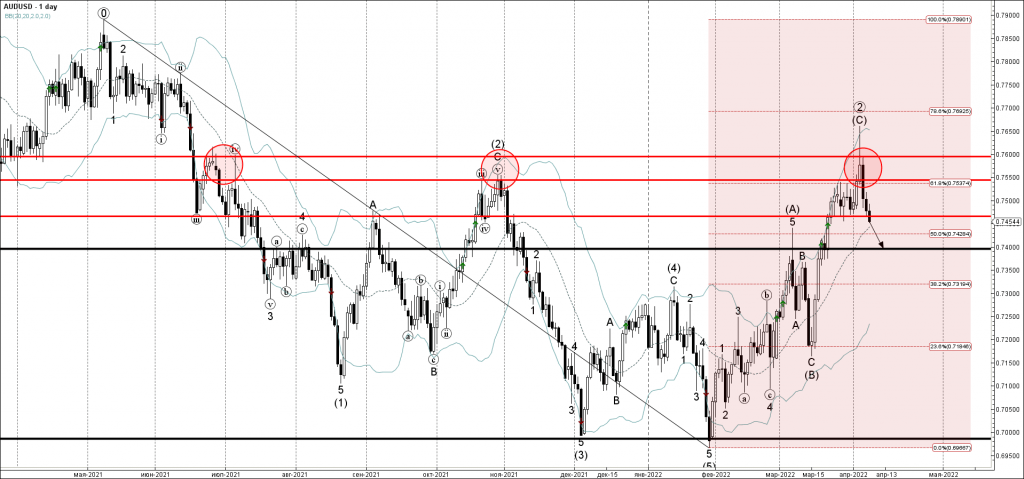
- AUDUSD reversed from resistance zone
- Likely to fall to support level 0.7400
AUDUSD currency pair recently reversed down from the resistance zone located between the key resistance levels 0.7545 (June high) and 0.7595 (October barrier)
The downward reversal from this resistance zone created the daily Japanese candlesticks reversal pattern Bearish Engulfing.
Having just broken the support level 0.7465 – AUDUSD can be expected to fall further toward the next support level 0.7400.
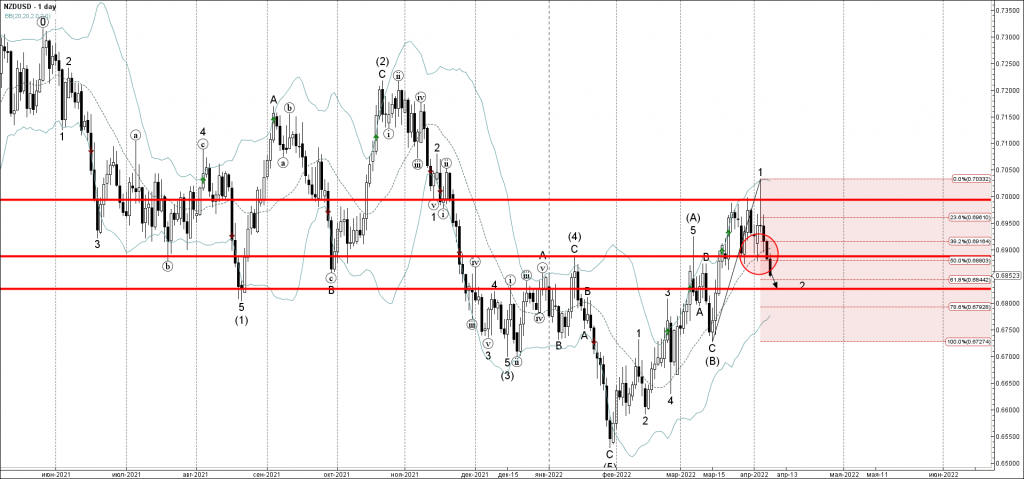
NZDUSD Wave Analysis
- NZDUSD reversed from resistance zone
- Likely to fall to support level 0.6830
NZDUSD currency pair recently reversed down from the resistance zone located between the round resistance level 0.7000 and the upper daily Bollinger Band.
The pair just broke the support level 0.6890 (which has been reversing the price since March) – which accelerated the active wave 2.
NZDUSD can be expected to fall further toward the next support level 0.6830 (target for the completion of the active wave 2).
Weekly Focus – Monetary Policy is the Most Important Market Topic
War fears among investors are declining despite horrible pictures from Bucha, new Western sanctions on Russia and no progress in Russia-Ukraine peace talks. We are definitely beyond "peak financial stress" (the VIX index is much lower than in early March). The war is first and foremost a humanitarian crisis but it seems like investors believe the global economy can cope with the negative shock. Instead, investors are focusing on monetary policy and how much central banks will tighten, as elevated commodity prices increase already high underlying inflation pressure. Still, war headlines are important to monitor over the coming weeks although we doubt there will be any real progress in peace talks. Also keep an eye on possible EU sanctions on energy imports from Russia.
This week's FOMC minutes from the March meeting supported our view that the Fed is about to front-load rate hikes in order to get the Fed funds rate quickly back to neutral. "Many" participants supported one or more 50bp rate hikes, as the Fed is behind the curve amid the highest inflation rates in 40 years and a very tight labour market. We continue to expect the Fed to hike by another 225bp this year, see Fed Update: Quickly back to neutral by front-loading rate hikes, 30 March. At the next meeting in May, the Fed is likely to announce the beginning of QT (cap USD95bn per month).
Significant tightening of monetary policy in the US also increases the risk that the US falls into recession within 1-2 years, which is becoming an increasingly important topic in financial markets. The US yield curve is very flat (and the 2s10s spread was inverted at some point), which is usually considered a strong signal that recession risks are on the rise. Based on the UST 2s10s spread, markets are pricing in a nearly 40% risk of a recession over the coming year.
Yet another challenging meeting awaits ECB on 14 April, as inflation continues to surprise to the upside and the economic outlook is increasingly uncertain. While we expect ECB to re-confirm previous guidance to end APP during Q3, the press conference will be interesting. While we do not expect Lagarde to directly mention a September rate hike as a possibility, similar to other voices in the GC, we believe she will keep the door open as a way to respond to high inflation pressures. We discussed further in ECB Preview: Lagarde to bring September into play - we revise our ECB call, 8 April. We now expect the ECB to hike in September and December (vs. December and March 2023 previously).
In New Zealand, RBNZ meets on Wednesday 13 April. We see risks as tilted towards a 50bp rate hike given the global inflation pressures.
While Western central banks are tightening, the story is quite different in China, where we may see more easing soon (maybe reduction in RRR and/or rate cut). This week, China's state council said there was a need for more monetary easing "at an appropriate time". More easing from China would also support the global economic outlook, as China is usually contributing to one-third of total global GDP growth.
Finally, watch out for the first round of the French presidential elections on Sunday.
Week Ahead – BoC and RBNZ to Hike Big, ECB to Bide its Time
It’s going to be a major week for central banks ahead of the long Easter weekend, with three meetings on the way and rate hikes looking almost certain to be the outcome of at least two of them. So the spotlight will fall on the Bank of Canada, Reserve Bank of New Zealand and European Central Bank for much of the week. Although economic data will also be ample – inflation numbers will be watched in China, the United States and United Kingdom, while French elections might rattle European markets.
Will the RBNZ get the 50-bps ball rolling?
The Reserve Bank of New Zealand will kick off next week’s central bank meetings early on Wednesday but perhaps a more relevant point is that it could become the first to raise interest rates by a larger 50 basis points. Having lifted rates three times already, there’s a good chance the RBNZ will opt for a bolder increase in April.
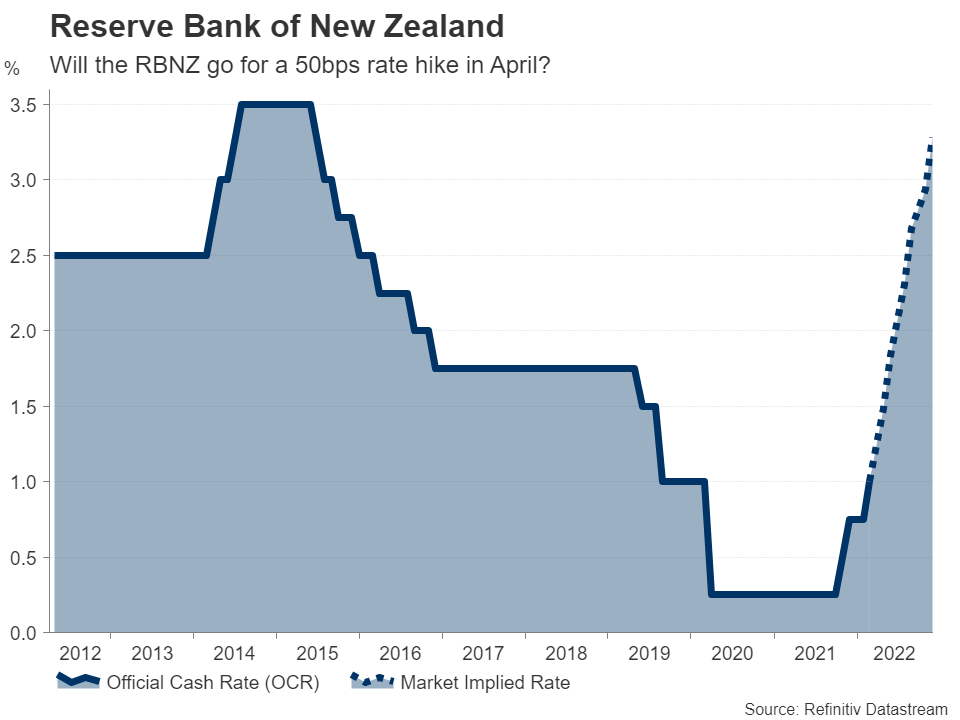
New Zealand’s economic recovery has been bumpier than most thanks to snap lockdowns. And even though the country abandoned its zero-Covid policy following the emergence of the highly transmittable Omicron variant, some restrictions were re-imposed in January and February. That will probably weigh on economic growth in the first quarter. Monday’s electronic card sales will be monitored to see whether consumption bounced back in March. Overall, however, the economy is doing well. The unemployment rate has fallen to record lows and inflation hit 5.9% y/y in Q4.
Although there’s a risk that the jobless rate will rise a bit now that the government has reopened New Zealand’s borders to the rest of the world and growth might slow from the Ukraine crisis, inflation is predicted to keep rising in coming quarters. Hence, the expected 50-bps hike, which is about 90% priced in, could be the first of many.
The only problem for the New Zealand dollar is that the RBNZ’s hawkish stance might not provide much of a boost when other central banks are similarly hawkish. The kiwi has staged an impressive rally against the US dollar since late January, but a lot of that is attributed to the surge in commodity prices. Should the RBNZ disappoint and raise rates by only 25 bps, the kiwi could plunge.
Bank of Canada also poised for double rate hike
Over in Canada, it’s a similar economic picture of a tight labour market and soaring inflation. Despite taking the lead in initiating the normalization process after the pandemic began to ease, the Bank of Canada only began its rate hike cycle in March. But policymakers look set to take things into higher gear in April as the BoC is expected to raise its overnight rate from 0.5% to 1.0% on Wednesday.
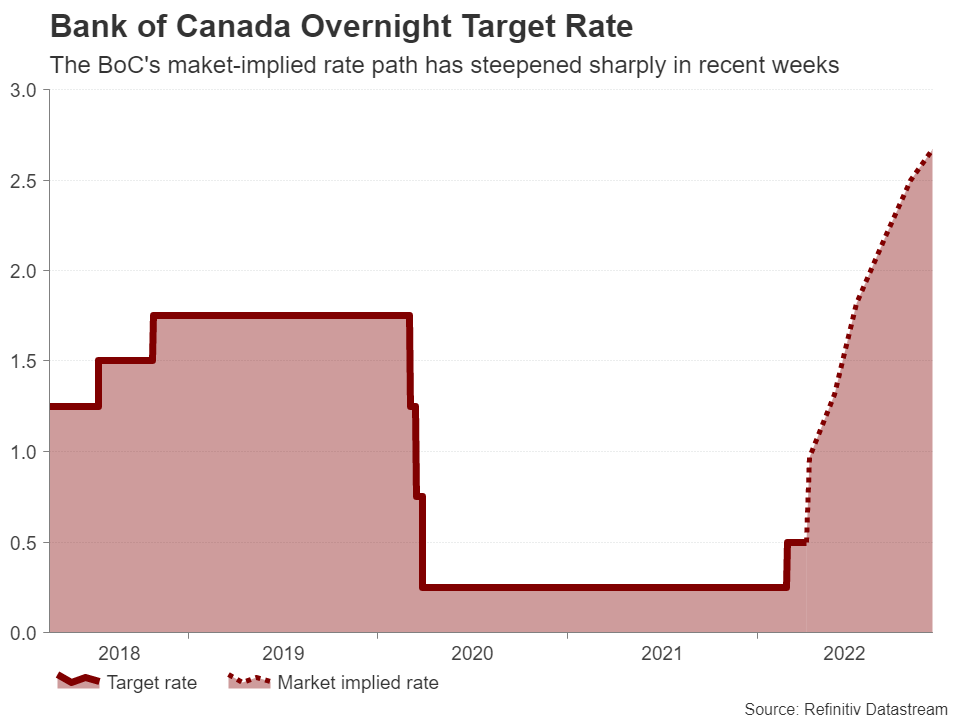
The Canadian economy is not only likely to be little impacted from the West’s sanctions against Russia, it is also benefiting from higher oil prices. Moreover, with inflation at a more than 30-year high and signs of wage pressures building up, investors think the BoC will hike rates by 50 bps a few more times this year.
If the Bank signals as such in its updated quarterly forecasts, the Canadian dollar might make another run towards its recent five-month high versus the greenback. However, the loonie will also be guided by oil futures. Energy prices have retreated somewhat following the move by the US and a few other countries to release supply from their strategic oil reserves. If there’s a further pullback in oil next week, either by the efforts to rein in prices or because of any progress towards a ceasefire by Russia and Ukraine, the loonie may not gain much from a hawkish shift by the BoC.
ECB to mull timing of rate hike, French elections in focus
The European Central Bank is not expected to announce any changes to its policy on Thursday, having already outlined how it will taper its bond purchases at the last meeting. However, policymakers have yet to make up their minds on the precise date to terminate their quantitative easing programme, something which will ultimately decide the timing of the first interest rate rise.
The Bank will probably continue to keep its options open as it waits to see how the Ukraine war will unfold, so the odds for fixing an end date are low at the April meeting. The ECB is hoping that should the conflict de-escalate and the energy shock eases, it might be able to delay a decision on lifting rates from negative territory. However, this is looking increasingly unlikely as there doesn’t seem to be a quick end to the fighting on the EU’s border, while the inflation problem is only getting worse.
It's possible therefore that policymakers will begin to pave the way for a rate increase at some point after the summer, either by altering their forward guidance or by hints from President Lagarde in her press briefing. The euro could edge higher if Lagarde explicitly flags an early liftoff. But aside from the ongoing geopolitical turmoil that’s weighing on the single currency, there is another risk that could potentially provide a fresh setback for euro bulls.
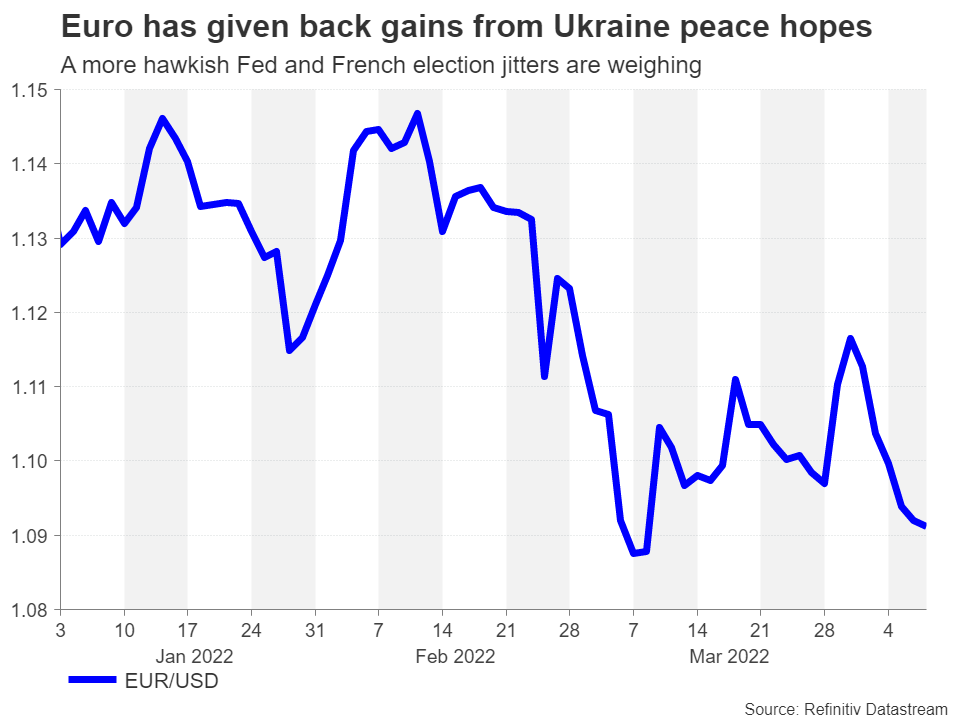
France holds the first round of the presidential election on Sunday and investors have started to get nervous as incumbent President Emmanuel Macron’s lead has narrowed recently. His main rival is far right leader Marine Le Pen. Although Macron is the favourite to win the first round, should he do so with a small margin, that would bolster the odds of a Le Pen victory in the second round.
A win for Le Pen would be seen as dealing a blow to the efforts for closer EU integration, something that would in turn damage the euro’s long-term prospects.
Pound may struggle to find much upside from UK data flurry
Across the channel, it’s a jam-packed week for UK economic indicators. The monthly data dump will begin on Monday with GDP, industrial production and trade figures for February. The employment report for the same period is out on Tuesday and March CPI numbers will follow on Thursday.
The UK economy likely grew at a healthy pace in February, while the labour market is expected to have tightened further. However, as it may take several months before the combined effect of the war and the squeeze on consumers from higher inflation and taxes start to drag on growth, it is the latest inflation numbers that can have the biggest short-term impact on monetary policy.
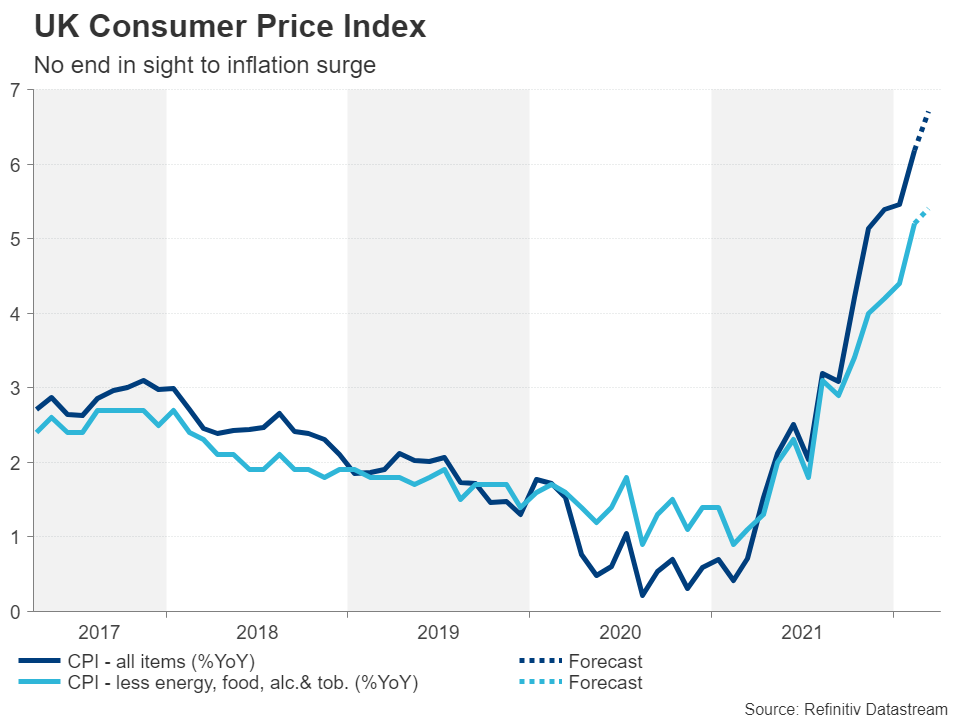
Britain’s consumer price index hit a three-decade high of 6.2% year-on-year in February. A further jump in March could add pressure on the Bank of England to act more swiftly in tightening monetary policy.
The pound could gain slightly on the back of stronger-than-expected readings, though, unless there is a massive beat, the market-implied rate path for the BoE won’t alter significantly.
Can US inflation and retail sales keep the dollar rally going?
The Federal Reserve is on a sure path to raise the fed funds rate by 50 bps in May, having well-telegraphed its intentions by now, most recently in the March meeting minutes. The dollar has appreciated on the back of these expectations, as well as on the signal for the pace of the balance sheet reduction, which has boosted long-term Treasury yields.
Next week’s data out of the US, which are mainly the March inflation and retail sales figures, will likely reinforce the view that the Fed is about to step a lot harder on the brakes to cool the red-hot economy.
America’s headline CPI rate hit a fresh four-decade high of 8.3% y/y in February. It is expected to have risen again in March, to 8.3% when released on Tuesday, while the core rate is forecast to have inched up to 6.6%. The producer price index will follow on Wednesday.
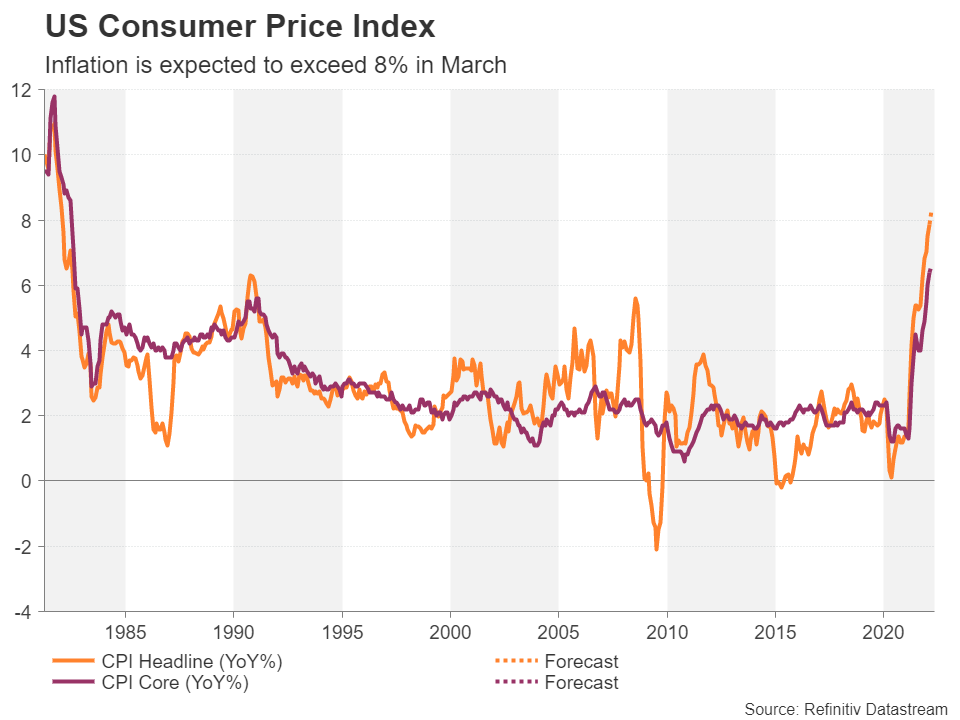
The retail sales report comes out on Thursday and the projections are for a month-on-month increase of 0.6%. Also of importance will be the University of Michigan’s preliminary read on consumer sentiment for April and industrial production for March on Friday.
The dollar could firm a little from a solid set of numbers, but with markets already betting on a very aggressive Fed, it’s questionable how much further it can climb without the added safe-haven boost from any deterioration in the geopolitical landscape. That leaves the greenback slightly exposed to a small downside correction from any surprise softness in the data.
Aussie eyes Chinese inflation and Australian jobs
Lastly, inflation will also be at the forefront in China. The consumer and producer price indices for March are both due on Monday, and on Wednesday, the latest trade figures might attract some attention. There are worries that China is headed for a sharp slowdown from the recent lockdowns in Shanghai and several other cities so any signs from either the inflation or trade data that growth is weakening could dent risk sentiment.
The Australian dollar, which often trades as a liquid proxy for the Chinese economy, has had a very strong bullish run since the start of February but a slowdown in China has the potential to halt the uptrend, even as the currency has managed to breeze through the Ukraine turmoil. On the other hand, Thursday’s labour market indicators out of Australia could provide plenty of support to the aussie if there was another big jump in employment in March.
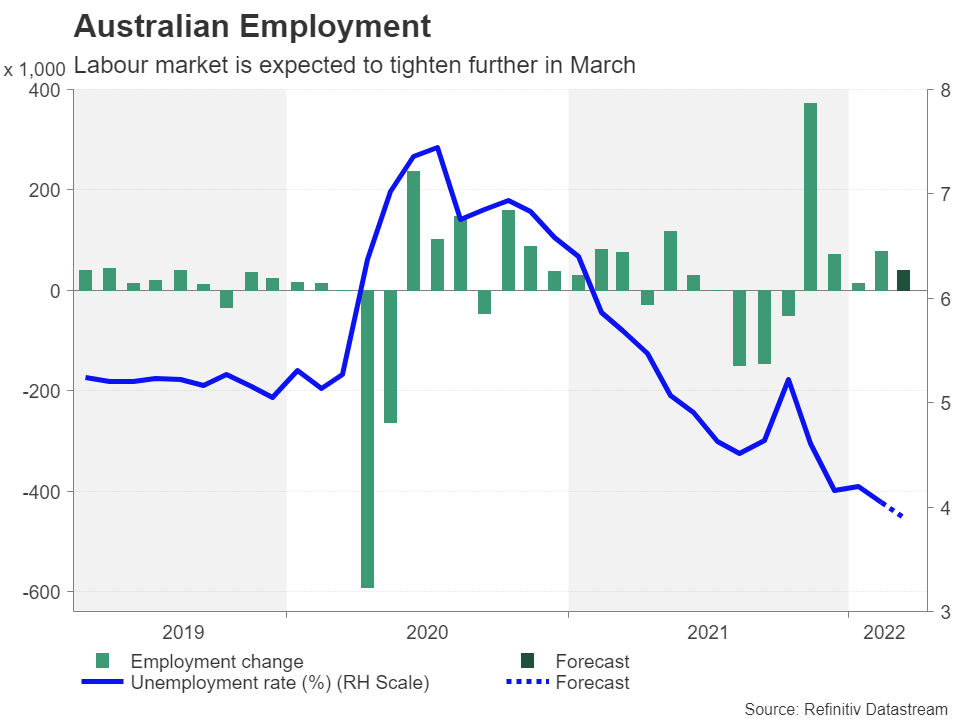
The Reserve Bank of Australia is lagging other central banks in terms of the tightening cycle so any acceleration on that front would be positive for the local dollar.
Research China – Three New Headwinds to Delay Recovery
The Chinese economy has been hit by three new headwinds from covid outbreaks, the Ukraine war and financial stress. We expect this to delay a recovery into H2. We expect more economic stimulus, as China needs to step harder on the gas to lift the economy out of the current slump. The China weakness will add a further drag on the global economy in coming months, not least on Europe.
Freight rates have continued to fall despite the Shanghai lockdowns suggesting the fundamentals are improving and shipping costs will be disinflationary in 2022. Other factors (wage growth, commodities) keep global inflation pressures high.
A recovery in H2 should give upside for Chinese stocks. We also look for USD/CNY to turn higher as the Chinese trade surplus is set to come down.
ECB Preview – Lagarde to Bring September into Play – We Revise Our ECB Call
We revise our ECB call slightly after the recent Governing Council (GC) comments, hawkish minutes and inflation surprises. We now look for a 25bp rate hike in both September and December 2022. Beyond that, we do not look for a prolonged hiking cycle into 2023 at the current stage as inflation falls back to target and Fed tightening will also have contributed to a significant tightening of financing conditions globally -thereby worsening the economic outlook.
Yet another challenging meeting awaits next week, with ECB facing an increasingly uncertain economic outlook. The economic backdrop since the last meeting has moved further towards a stagflationary scenario in the euro area, with weakening growth, higher uncertainty, lower confidence and higher inflation. However, the increasing risk of unanchored inflation expectations and second round effects on wages will keep the pressure on ECB to proceed with its policy normalisation despite rising recession risks in our view.
While we expect the statement to re-confirm the decisions taken at the March meeting just 4 weeks ago, with its guidance to end APP during Q3 and the first hike to come 'some time' after the end of net asset purchases, we believe the press conference will be the most interesting part, where we expect Lagarde to repeat the gradual, flexibility and optionality mantra. While we do not expect Lagarde to directly mention a September rate hike as a possibility, similar to other voices in the GC, we believe she will keep the door open as a way to respond to high inflation pressures.
We expect markets to buy in to September hike in play (current 31bp priced for September) and thereby we also believe that risks are skewed towards a hawkish market reaction, notably in the 2022 segment of the curve, where there are currently 66bp priced (€STR terms).
Pound Shifts Attention to Busy Calendar as Selling Pressures Persist
The British pound has a tough time against the US dollar for more than a week now, making investors wonder when the next bullish round will take place. Next week’s session could set a new tone to the British currency as the calendar will get relatively busier. February’s GDP monthly data will be out on Monday, followed by employment and CPI inflation figures on Tuesday and Wednesday respectively, all due at 07:00 GMT. Expectations are not great, but if the data manage to defy the increasing conservatism within the Bank of England (BoE), the pound could gain, though, perhaps only modestly.
UK CPI inflation to print new highs
Several major economies experienced an inflation spike during the month of March and the UK will not be an exception. The headline CPI is expected to spiral to a new three-decade high of 6.7% y/y from 6.2% previously, whilst the core equivalent, which excludes volatile food and energy prices, is expected to stabilize around 5.1%y/y.
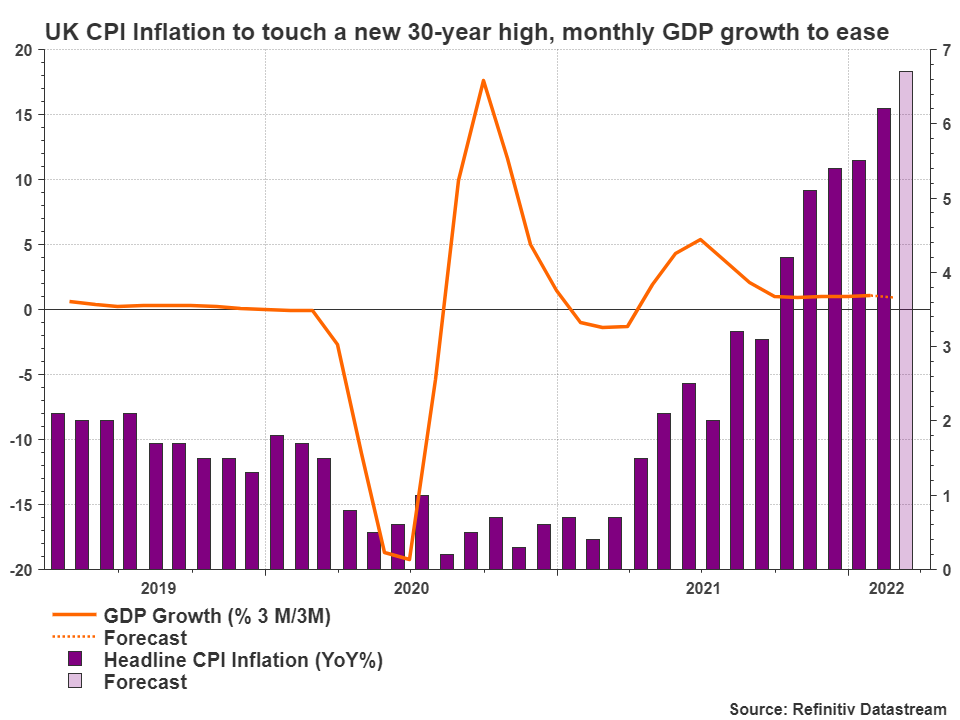
The Bank of England (BoE) has hiked its interest rate three times to 0.75% so far this year with the scope to combat accelerating inflation and cool it down to its 2.0% price target, but apparently more is needed to be done. The BoE chief clearly stated last month that monetary tightening will continue in the coming months, though surprisingly, he did not suggest a larger 50 bps rate hike, which several policymakers backed in February. Instead, he judged that only a modest tightening may be appropriate in the coming months, with futures markets currently being almost certain for four 25 bps rate increases by December.
The reasoning behind the BoE’s renewed skepticism is that although it is focused on taming inflation, reducing stimulus too aggressively could damage the UK’s evolving post-lockdown recovery, especially as the war in Ukraine and the mounting sanctions against Russian oligarchs are increasingly threatening to worsen the cost of living in the energy-importing UK economy and shock its financial system.
GDP growth to fizzle out, labor market remain tight
Therefore, the BoE may wisely attempt to build in some insurance against a potential growth slowdown and data releases during the next few months could play a key role in determining that. Besides CPI inflation readings, monthly GDP growth and employment figures for February could shed some light on economic conditions this week, but the war factor will be absent from the stats and perhaps investors may consider them outdated. Yet, the figures could still be worthy to watch as those may provide some clues on the health of the UK’s economy before Ukraine’s invasion.
The news, however, may not be very encouraging or better to say it could be more neutral overall for the pound. Forecasts point to a monthly growth slowdown to 0.3% from 0.8% in January, with the three-month average expected to touch a one-year low of 0.9% from 1.1% previously.
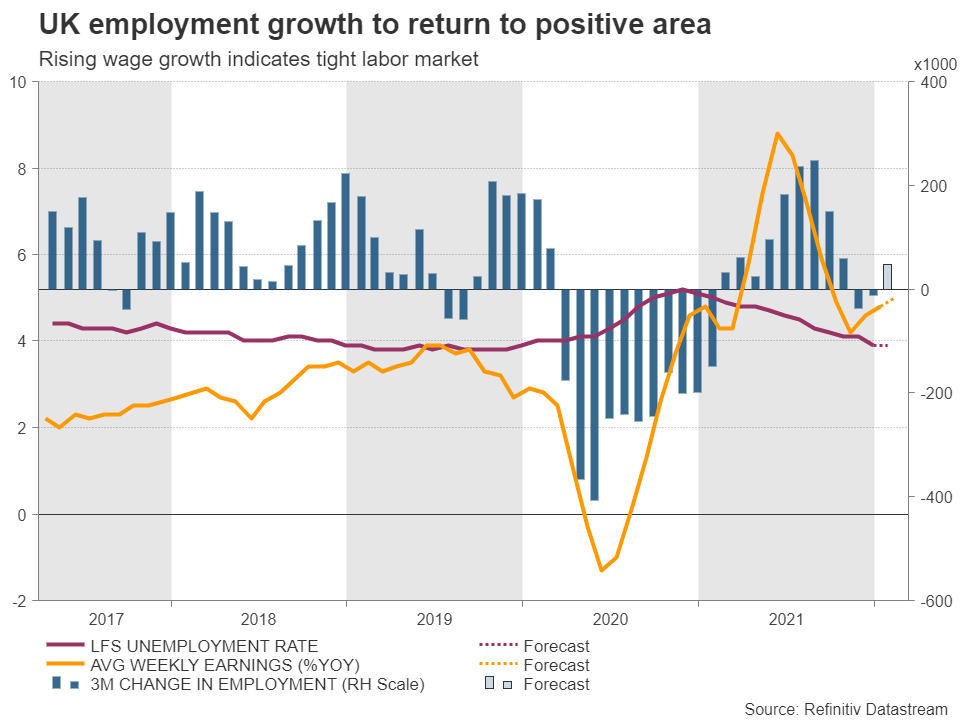
Turning to the employment report, analysts anticipate the economy to have created 48k new jobs after the 12k contraction in the previous month. Such an addition could still be the lowest in a year, and probably not strong enough to press the unemployment rate below 3.9%. Nevertheless, with average weekly earnings (excluding bonuses) expected to keep trending higher to 4.0%, a weak employment growth could be considered to be a result of persisting labor shortages.
BoE in a challenging situation
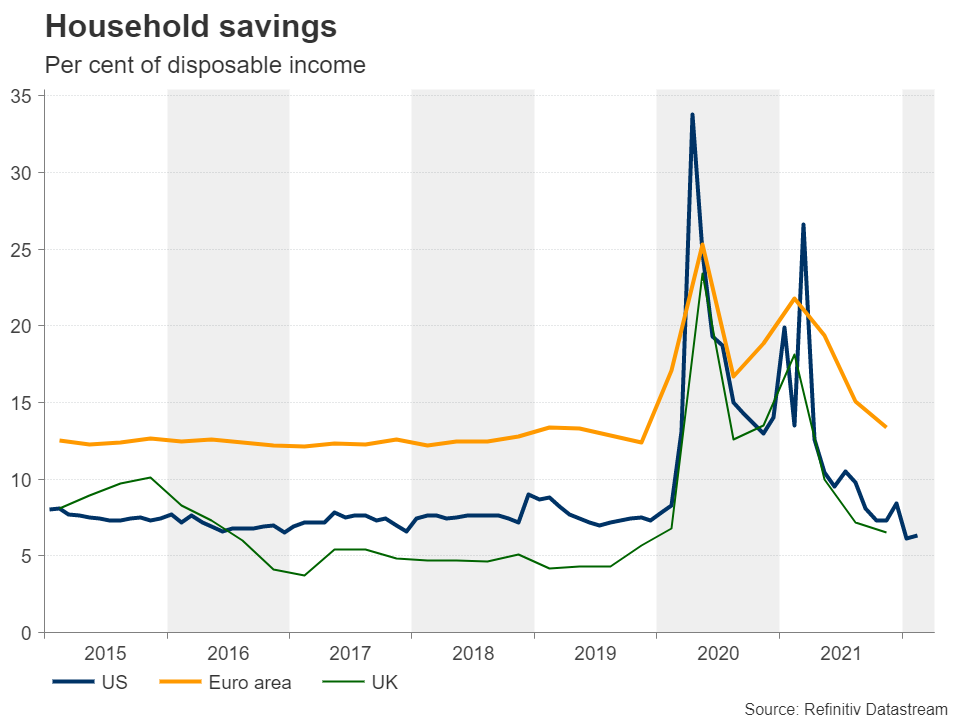
Household spending as a share of disposable income has been falling at a faster pace in the UK than in the EU and the US during 2021 and the post-Brexit EU-UK relationship remains strained, disrupting trade and labor supply. Moreover, Sunak’s spring statement indicated that the government is not comfortable in opening its liquidity taps again in the way it did during the pandemic.
Hence, the ball seems to be in the central bank’s hands and how the economy will perform in the next quarters could direct policy accordingly. But if a stagflation situation develops, the BoE could find itself between a hard and a rock place. Therefore, in this case, adjusting policy settings in either direction could be risky.
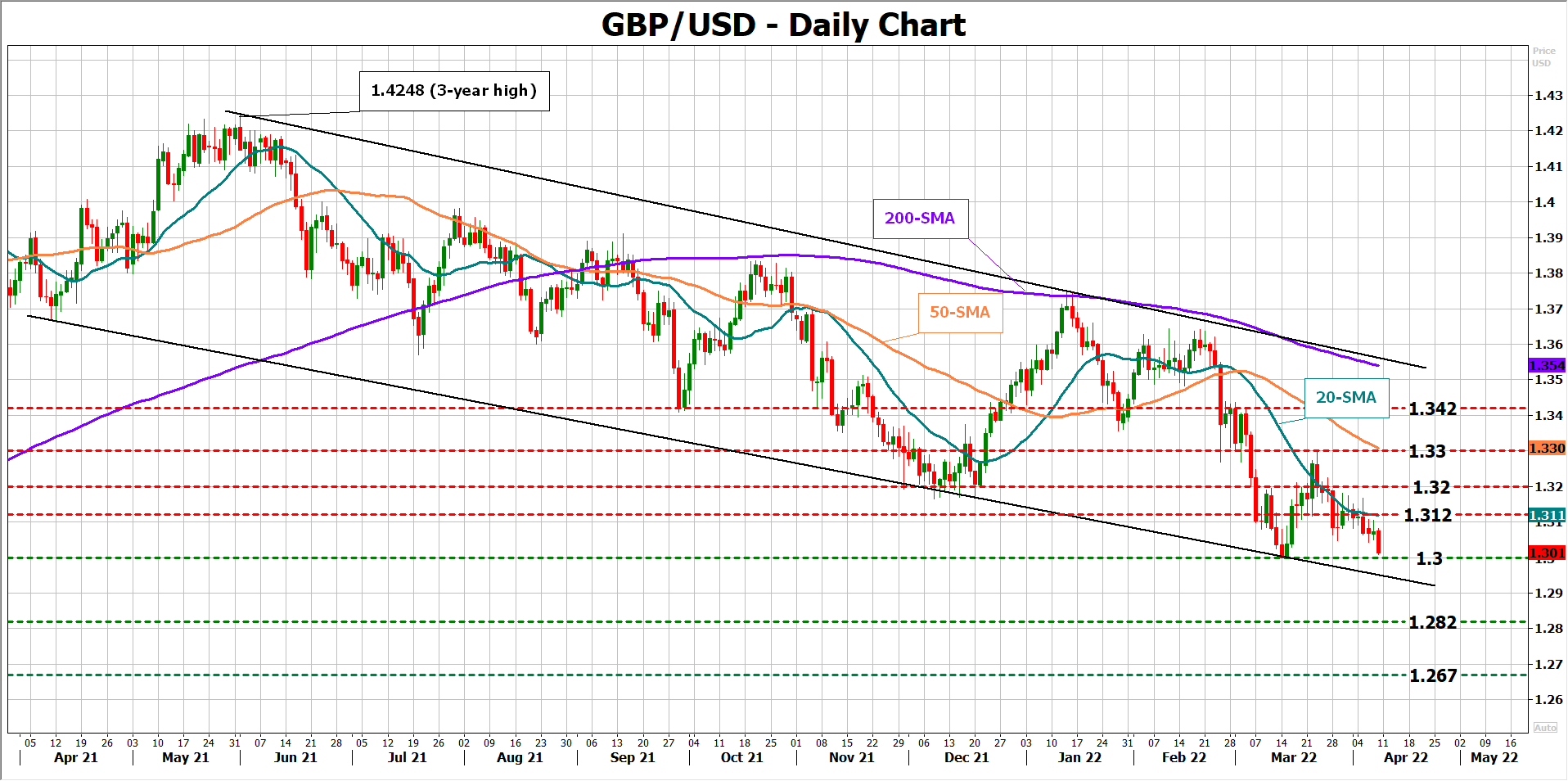
GBP/USD
For now, weaker-than-expected figures, especially on the labor front, could justify the BoE’s policy conservatism and downplay investors’ expectations of four rate increases, likely squeezing pound/dollar below the 1.3000 level. If that turns out to be the case, the price may initially test the bottom of the one-year-old bearish channel around 1.2925 before heading for the 50% Fibonacci retracement of the 1.1409 – 1.4248 upleg at 1.2820. If the sell-off further sharpens, the next pivot point could occur around the September 2020 low of 1.2670.
Alternatively, should the data reveal a resilient economy, traders may remain patient and wait for Q2 figures before they question the central bank’s careful policy approach. Nevertheless, if the stats strongly beat expectations and inflation soars, the focus will turn to the constraining 1.3128 -1.3200 zone. If upside pressures knock down that wall, the next resistance could commence around the 50-day simple moving average (SMA) at 1.3300.