

Sample Category Title
Weekly Economic & Financial Commentary: Soaring Price Gauges Turn Up the Pressure on the Fed
Summary
United States: Soaring Price Gauges Turn Up the Pressure on the Fed
- The Fed's difficult job got harder this week. Its preferred inflation gauge set another fresh 40-year record high, while the ISM prices paid measure shot up 11.5 points to 87.1. Payrolls increased 431K in March with steep upward revisions that lifted the past two months' gains, but personal income is not quite keeping pace with price increases. Small wonder, the yield curve temporarily inverted, a sign the bond market is losing faith in a soft landing.
- Next week: Trade Balance (Tue.), ISM Services (Tue.), FOMC Meeting Minutes (Wed.)
International: Eurozone Inflation Continues to Accelerate
- Eurozone March CPI inflation quickened more than expected to 7.5% year-over-year, driven by higher energy prices, with other price gains more modest. Still, the overall rate of inflation should see a timely move by the European Central Bank to less accommodative monetary policy despite a mixed growth outlook. Sentiment surveys from China and Japan were soft in tone, suggesting subdued growth from those economies during the first quarter.
- Next week: Mexico CPI (Thu.), Brazil CPI (Fri.), Canadian Employment (Fri.)
Credit Market Insights: Mortgage Rates Accelerate in March as Homebuyers Rush to Lock In
- Thirty-year mortgage rates reached 4.67% this week, the highest level in over three years. The quarter-of-a-percent increase from last week's 4.42% reading has 30-year mortgage rates on a breakneck pace to reach the 5% mark, a level not seen since February 2011. The white-hot housing market, although resilient, has not been entirely immune to the effects of rising mortgage rates.
Topic of the Week: Russia-Europe Gas Standoff Puts the Pressure on American Producers
- The economic fallout from Russia's invasion of Ukraine continued this week with Putin targeting the EU's heavy dependence on Russian energy sources. President Biden has committed to ramping up U.S. production to cover the gap and released a historic 180 million barrels of oil to help lower domestic prices, but capacity constraints and soaring domestic inflation present headwinds.
The Weekly Bottom Line: Economic Recovery Battles Inflation Headwinds
U.S. Highlights
- Another solid jobs report showed that the U.S. economy added 431k jobs in March. Wage growth picked up and the unemployment rate fell 0.2 percentage points to 3.6%.
- President Biden presented a $5.8 trillion budget to Congress with a hefty focus on defense spending. Separately, the President also announced releases from the strategic petroleum reserve to combat rising energy prices.
- Nominal consumer spending and income rose in February. Real income, however, pulled back as prices rose rapidly. Inflation, as measured by the year-on-year percent change in the personal consumption price index accelerated to 6.4%.
Canadian Highlights
- Fiscal policy dominated headlines this week as Ontario signed on to the national child-care plan and an update on climate change initiatives was announced.
- These developments come ahead of the expected release of the federal government’s budget next week (April 7th) which is likely to feature new measures to address housing affordability and other platform promises.
- With economic data continuing to show healthy growth the groundwork is set for a 50-basis point hike by the Bank of Canada in April.
U.S. - Economic Recovery Battles Inflation Headwinds
On the agenda this week were several important data releases including consumer income and spending, manufacturing activity, and the March employment report. President Biden also released his budget proposal and announced a plan to release supply from the strategic petroleum reserve in order to combat rising prices.
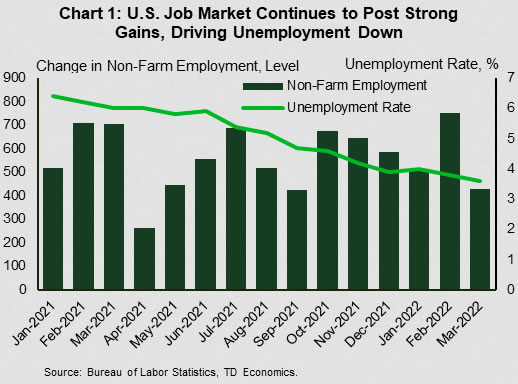
Jumping right in, nonfarm payrolls expanded by 431k in March with most sectors posting job gains. The only exceptions were transportation & warehousing and utilities. The unemployment rate edged down to 3.6% from 3.8% in February as household employment growth exceeded growth in the labor force (Chart 1). Wages continued to post solid year-on-year growth, ticking up from 5.1% in February to 5.6%. Overall, the report indicates a job market driving full steam ahead, and barring further disruptions, could be back to its pre-pandemic level of employment by the middle of the year.
The ISM Manufacturing Index indicated that factory activity, while still expanding, slowed in March. The index pulled back to 57.1 from 58.6 the month before. There were notable declines in new orders and an increase in prices paid. On the upside, the backlog of orders declined, while the employment index rose.
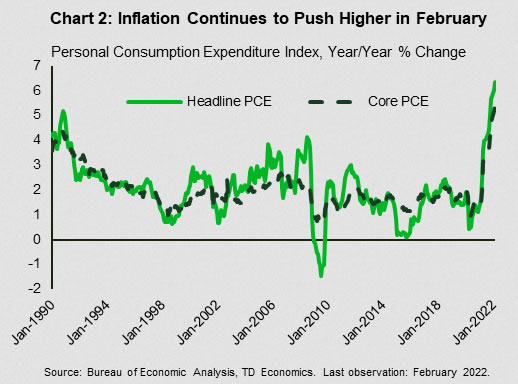
Turning to the household sector, nominal personal income and spending rose 0.5% and 0.2% respectively in February. An even stronger gain in prices however took a bite out of real disposable income, which declined for the third consecutive month, largely reflecting waning transfers to households. Inflation, meanwhile, continued to accelerate. The personal consumption expenditure (PCE) index rose 6.4% year-over-year (y/y) versus 6.1% in January (Chart 2). The core PCE index also accelerated to 5.4% y/y in February, up from 5.2%. From the Fed’s perspective, inflation is uncomfortably high as supply chains remain stressed, Covid shutdowns in China hamper trade and the Russian-Ukraine war sparks further volatility.
In response to rising energy prices, President Biden plans to release up to 180 million barrels of oil from the strategic reserve over the next six months. While the release may help to alleviate near-term market tightness, the reserve is currently at a 20-year low. Further releases would drive the stockpile even lower, ratcheting up risks surrounding global spare capacity over the longer term.
Finally, President Biden presented his budget proposal for the 2023 fiscal year. The $5.8 trillion budget would raise taxes on billionaires and corporations. A new tax proposal would require households worth more than $100 million to pay a rate of at least 20% on their income as well as a tax on unrealized capital gains on assets such as stocks, bonds, or privately held companies. On the spending side, the budget would increase spending on the military, law enforcement, affordable housing and supply chains, while attempting to reduce the federal deficit by $1 trillion over a decade.
Canada - Fiscal Plans Take the Spotlight
Fiscal policy news dominated the headlines this week in Canada, as the last province signed on to the national child-care initiative, the federal government outlined a plan to reduce greenhouse gas emissions, and attention shifts to the federal budget announced to be released next Thursday (April 7th).
Early this week, Ontario signed on to the federal daycare program, setting the stage for a 50% reduction in daycare fees by the end of the year – on the path to $10 per day care throughout the province. The program is estimated to save the average family $6,000 per child in 2022. With inflation ripping at multi-decade highs reduced expenditures for a big line item in young families' budgets is a welcome lift.
Next, the federal government rolled out its 2030 Emissions Reduction Plan. The plan outlines the path to achieve a 40-45% reduction in carbon dioxide emissions (relative to 2005) by 2030 – with an intermediate goal of a 20% reduction by 2026. To help meet the target, an additional $9.1 billion in funding for new investment was announced.
Following these major announcements, the federal budget will be released next week. Announcements will likely include measures addressing housing affordability, healthcare spending, details on the actions combatting climate change, and possibly some funds to offset the effects of high inflation. Chart two shows the trajectory of two regional FRB manufacturing surveys on an ISM adjusted basis. The Empire State and Philadelphia Fed manufacturing surveys showed a noticeable deceleration in growth in January, notching multi-month lows. The Empire state survey fell from 60.8 to 54.4, while the Philadelphia Fed survey fell from 60.2 to 57.6. Importantly, both readings still indicate expansion, but slower than in the prior months.In totality, these initiatives will likely raise expenditures by roughly $10 billion per year over the next five years. Moreover, with the war in Ukraine turning attention to defense spending, additional investment on this file is likely.
Revenue raising measures are likely to be modest. A banking and insurance sector tax seems probable, carbon taxes are set to rise, and there may be some levies on foreign investment in housing. However, these are not going to be the focus of the budget. Moreover, despite only modest additional revenue measures, the trajectory for the deficit will likely remain unchanged as higher inflation will lift tax revenues and bolster government coffers.
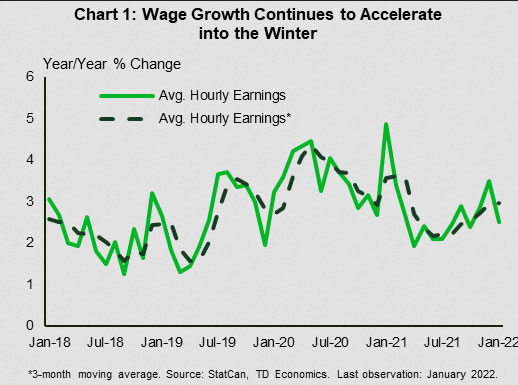
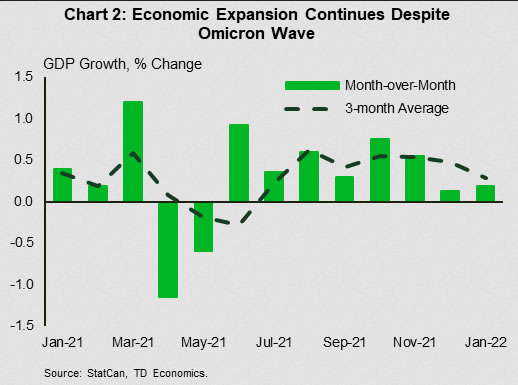
Economic data this week showed solid wage growth continued into 2022 (Chart 1) as the fixed composition wage measure in the Survey of Payrolls, Employment and Hours posted a 2.5% year-over-year gain in January 2022. January's GDP number confirmed that pandemic restrictions didn't stop the expansion (Chart 2) and with most restrictions in the rearview mirror, and strong growth in February, the recovery continues to gain steam.
Amid strong economic growth, an increasingly tight labor market, and fiscal fuel being added to the fire, look for the Bank of Canada to continue leaning against inflation by raising rates 50 basis points at its April meeting.
Tight Labour Markets & Higher Inflation Raise Odds of Faster Rate Hikes
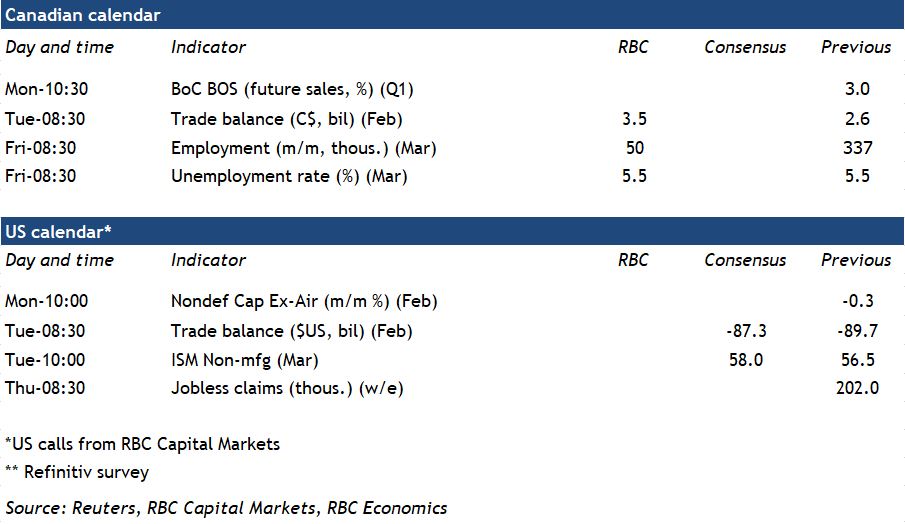
With the Bank of Canada weighing how quickly to raise interest rates, all eyes will be on next week’s Business Outlook Survey (BOS) and the March Canadian jobs report.
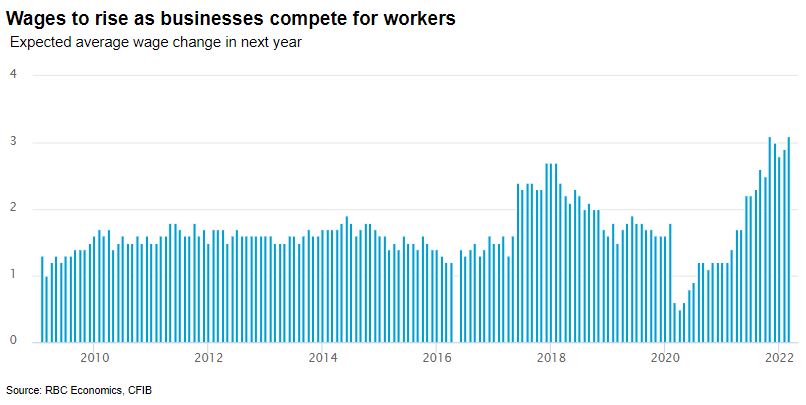
We expect a 50,000 increase in employment. That’s a slowdown from February when employment surged 337,000 following a 200,000 drop in January—when Omicron prompted a range of restrictions and left a large share of the workforce sick and self-isolating. Job vacancy rates are still very high, particularly in the hospitality sector, where employment remains well below pre-pandemic levels. Despite the availability of jobs, at 5.5%, the unemployment rate is not just below pre-pandemic levels, it’s the second lowest monthly rate on record dating back to the early 1970s. That will both limit the pace of future employment growth and add to higher wage pressures as businesses compete for a smaller pool of available workers. We look for the unemployment rate to hold at 5.5% in March.
With inflation running above-target and labour markets looking exceptionally tight, interest rates are clearly poised to rise further—but the tone and commentary of the Bank of Canada surveys could offer hints about the pace and magnitude of those adjustments. The quarterly BOS will likely reinforce that production capacity limits, scarcity of labour, and rising input costs have become, for many businesses, more significant concerns than a lack of orders. Inflation expectations will be watched closely (both in the BOS and the separate Survey of Consumer Expectations) for signs that higher and more persistent price growth over the last year is becoming ingrained in longer-run expectations. Our own updated interest rate forecast assumes the BoC’s overnight rate will increase to 2.0% by the end of this year (from 0.5% currently) including an expected 50 bp hike in the next decision on April 13th.
Week ahead data watch:
- The Canadian merchandise trade balance likely moved higher in February from the $2.6 billion surplus in January. A 10% increase in oil prices will add to energy exports. And railcar shipments rose sharply in February after slowing in January.
Week Ahead – Risks Mounting
Are investors right to be optimistic?
As we head into the second quarter, it seems the list of economic concerns is growing rather than shrinking and yet equity markets find themselves in a very comfortable position. The rebound from the post-invasion lows has been impressive, to say the least, but whether it’s sustainable will become clear in the coming weeks.
Soaring inflation, high commodity prices, aggressive monetary tightening and inverted yield curves are just some of the things concerning investors right now. But what about the companies? Well, we’ll hear from them soon enough as they report on the first quarter which will no doubt be interesting and could determine whether this recovery has legs. Could stocks really find their way back to record highs in this environment?
The job of a monetary policymaker is never easy. Not least in the transparent world we now live in where every speech and decision is heavily scrutinized and then criticized with the benefit of hindsight. The job of reining in inflation while avoiding a recession lies ahead and inverting yield curves suggest they may be on the brink of tipping the economy over the edge.
US
Another nonfarm payroll report showed that the labour market remains strong. The focus for many traders will remain on market expectations for how aggressive the Fed will be with the next round of rate hikes. Everyone on Wall Street will pay close attention to Fed Brainard’s comments on Tuesday. Harker speaks on Tuesday morning, while the minutes are released in the afternoon. Bullard, Bostic, and Evans appear on Thursday.
A wrath of economic releases will focus on how business activity is holding up given the early impact of the war in Ukraine. On Monday, the release of factory orders in the month of February should show a steep decline, while the final reading of durable goods confirms orders weakened. Tuesday contains trade data that could narrow and the ISM services index which is expected to improve. Wednesday is all about the FOMC meeting minutes, which could contain further hawkish clues that could confirm a half-point increase for some traders. Thursday has jobless claims in the morning and consumer credit in the afternoon. Friday finishes the week off with wholesale inventory data.
EU
Positive moves are happening in negotiations between Ukraine and Russia but as we’ve seen this past week, tensions are still high between Russia and the West and that is creating tremendous economic uncertainty. Putin’s demands last week for all gas purchases to be made in roubles have seemingly been resolved after the G7 initially rejected them. It highlights the growing hostility and mistrust though between Russia and its biggest natural resource export markets which should ensure volatility in the commodity space remains high and prices probably also for the foreseeable future. That was also reflected in the inflation data which should intensify the pressure on the ECB to start raising rates. Minutes released on Thursday could be of interest.
Next week offers a broad selection of economic data, although it mostly consists of tier two and three readings.
UK
Governor Bailey is due to speak on Monday and traders will search for interest rate clues. The BoE softened its tone a little after the last meeting and yet markets are heavily pricing in a 25 basis point hike at each of the next five meetings, taking Base Rate to 2% by the end of the year. Bailey may use the platform to push back but probably to little avail given current inflationary pressures and more to come from commodity prices and the higher energy price cap from this month. We’ll also hear from a selection of other members of the MPC next week, while final services and construction PMIs are the data highlights.
Russia
Next week we’ll get the first insight into the effects of sanctions as inflation is seen rising to 16.9% for March, up from 9.2% a month before. It is the start of a very tough period for the Russian economy, with the 5% GDP number expected on Friday for the fourth quarter of last year likely the last good reading for some time.
South Africa
Only tier three data next week but going forward, traders will be alert to further price pressures as the central bank continues raising rates. Inflation is at the top of the 3-6% target range and commodity prices will only further contribute to that.
Turkey
Not long ago, the Finance Minister was hoping inflation wouldn’t rise past 50%. Next week, official data – that has at times been called into question – is expected to show CPI inflation hitting 61.6% in March. While that may typically offer some insight into central bank policy going forward, the CBRT is no ordinary central bank and will continue to be driven by economic fantasy rather than inflation. The monetary policy review, when it is finally completed, will tell us more about their plans going forward but you can guarantee rate hikes will not be a part of it.
China
Caixin Services PMI Wednesday is the only significant data release this week. That follows weak official and Caixin Manufacturing PMIs and this week’s number may disappoint as covid lockdowns bite; a negative for local equities.
China has gone quiet on concrete action after jawboning equities higher two weeks ago and China shares have run out of momentum. However, a RRR cut could come at any stage in Q2, boosting equities in the short term.
China risk is all event-driven right now. Delisting risk of US-listed China companies. Share suspensions in Hong Kong due to delayed audits. Modern Land and Evergrande NEV suspended stock trading in Hong Kong. Developments in the property developer sector are a forgotten but important risk, with offshore bondholders getting exasperated with domestic delaying tactics. US sanctions for trading with Russia. An escalation of Ukraine tensions. Rising oil and metals prices. Finally, the Shanghai covid lockdown has been tightened, and further lockdowns elsewhere for extended periods will threaten growth. The list is long, none of it is good for China’s equities.
India
The Reserve Bank of India announces its latest policy decision on Friday. Rates should remain unchanged at 4.0%, but there is an upside risk thanks to inflation, a weaker INR and a slew of data showing recovery signs. India’s imported energy bill, even if it is heavily discounted Ural blends, will also feature in the RBI’s thinking if the INR weakens.
The Sensex has performed well over the past week as investor sentiment recovered slightly. India is treading a fine line on Russia sanctions though, and officially incurring the G-7 ire could negatively impact equities. Similarly, if the RBI springs a surprise hike, local equities could move sharply lower.
Australia
Australia has a big week ahead with Retail Sales on Monday and the RBA rate decision on Wednesday. Arguably the greatest risk of the two is a change in forward guidance by the RBA, bringing rate hikes forward. The RBA remains ultra-dovish despite a series of strong data points that suggest the economy is verging on overheating like New Zealand. A powerful retail sales print will increase the noise. A change in guidance could spur a large and rapid rally in the AUD, while local equities may take a temporary tumble.
Assuming no risk-off events from Ukraine, AUD/USD has upside potential, having spent all of the past week ranging and consolidating its recent gains.
New Zealand
No significant data releases. A series of government measures were announced to bring down the cost of living in the past week, but the Reserve Bank of New Zealand remains even further behind the inflation curve than the Federal Reserve. Although record agricultural exports are cushioning the blow, NZ remains at risk of a hard landing this year.
Japan
Japan’s calendar is quiet in the week ahead, with only the trade balance of note on Thursday. Investors will be looking for signs of a surging import bill due to high commodity and energy prices, which could start another round of Yen selling versus the USD, AUD and NZD.
USD/JPY has had a frantic week, rising to 125.00 before falling to 121.50 and then recovering to 122.50. The BOJ bond-buying operation to cap JGB yields helped cap USD/JPY, as did lower US yields and year-end repatriation flows. With year-end past, a rise in US yields could spur another rally in USD/JPY.
Singapore
No significant data. Investors will be on MAS watch now, with their latest policy announcement due in April, but they don’t tell you when. The MAS is widely expected to tighten monetary policy by increasing the slope of SGD appreciation. Depending on market conditions and the timing of the announcement, that could push USD/SGD sharply lower, albeit temporarily.
Economic Calendar
Saturday, April 2
Economic Events
- New York Fed’s Williams gives keynote remarks at the Griswold Center for Economic Policy Studies at Princeton University.
- ECB’s Schnabel participates in the annual Ambrosetti Finance Workshop in Cernobbio, Italy.
Sunday, April 3
Economic Events
- Hungarian parliamentary elections: PM Orban’s Fidesz party has a small lead
Monday, April 4
Economic Data/Events
- US factory orders, durable goods
- Senate Judiciary Committee votes on the nomination of Ketanji Brown Jackson to US Supreme Court
- Germany trade
- BOE Gov Bailey speaks at Stop Scams Conference
- BOE Deputy Gov Cunliffe speaks at European Economics & Financial Centre Distinguished Speakers Seminar
- Australia inflation gauge
- India Markit manufacturing PMI
- Japan monetary base
- Singapore electronics sector index, PMI
- Spain unemployment
- Turkey CPI
Tuesday, April 5
Economic Data/Events
- US trade
- Fed’s Brainard speaks on unequal impacts of inflation
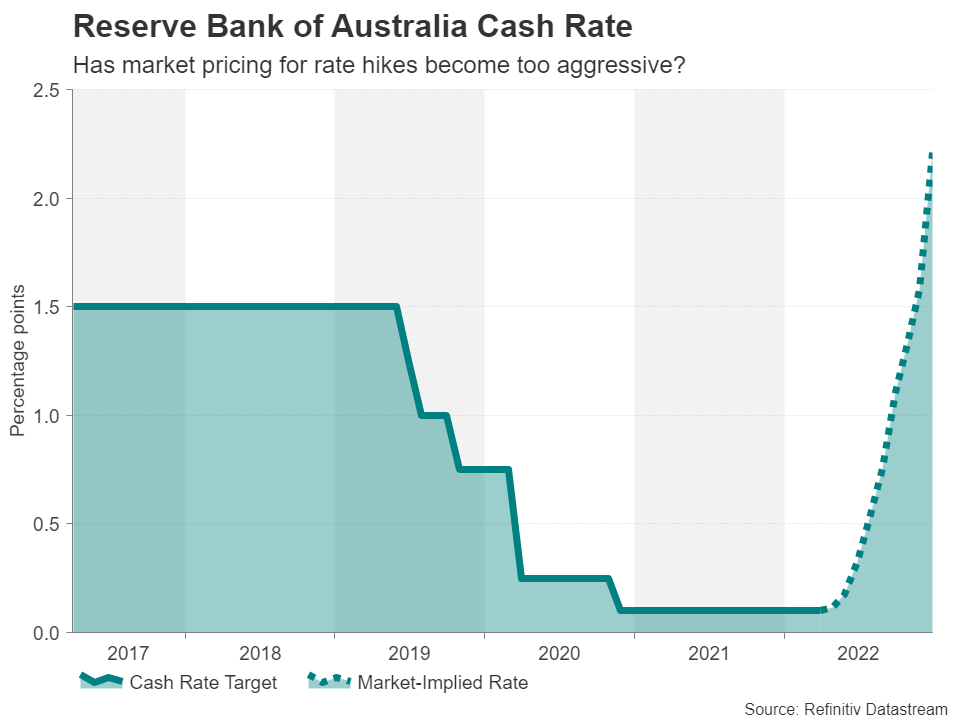
- RBA rate decision: Expected to keep Cash Target Rate unchanged at 0.10%
- Australia Markit PMI, consumer confidence
- Eurozone Markit services PMI
- France industrial production
- Japan household spending, Jibun Bank PMI
- Thailand CPI
- Mexico international reserves
- Singapore retail sales, Markit PMI
Wednesday, April 6
Economic Data/Events
- Fed minutes
- Fed’s Harker speaks on the economic outlook
- Oil executives testify on gasoline prices and the House Energy Commerce subcommittee holds hearing
- China Caixin composite and services PMI
- Eurozone PPI
- Germany factory orders
- India Markit PMI composite and services
- New Zealand commodity prices
- Poland rate decision: Expected to raise Base Rate 50bps to 4.00%
- Russia CPI
- EIA crude oil inventory report
- Bitcoin 2022 conference starts
Thursday, April 7
Economic Data/Events
- US initial jobless claims
- China foreign reserves
- ECB Minutes released for March policy decision
- Mexico central bank minutes released
- BOE Chief Economist Pill speaks
- Fed’s Bullard talks about the economy and monetary policy
- Fed’s Bostic and Evans participate in an event on economic mobility and inclusive full employment
- UN’s Food & Agriculture Organization release food price index
- Singapore foreign reserves
- Australia trade
- Eurozone retail sales
- Germany industrial production
- Japan leading index
- Mexico CPI
- Singapore GDP
Friday, April 8
Economic Data/Events
- US wholesale inventories
- Canada unemployment
- India rate decision: Expected to keep Repurchase Rate unchanged at 4.00%
- RBA semi-annual financial stability review
- Czech central bank (CNB) minutes
- Japan BoP, trade balance, bankruptcies, consumer confidence index
- New Zealand ANZ truckometer heavy traffic index
- Russia GDP
- Spain industrial production
- Thailand foreign reserves, forward contracts, consumer confidence
Sovereign Rating Updates
- Austria (Fitch)
- Finland (Fitch)
- Ukraine(Moody’s)
US: ISM Manufacturing Index Registers 22nd Consecutive Month of Expansion
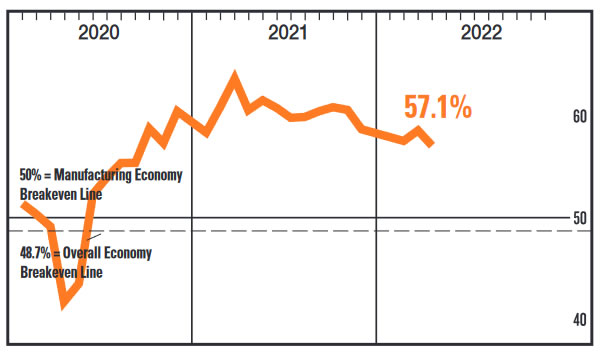
The March ISM manufacturing index registered 57.1, missing expectations of a 59.0 print. The index fell 1.5 percentage points from the February reading of 58.6.
New orders fell by 7.9 percentage points to 53.8, while new export orders fell by 3.9 percentage points to 53.2.
The backlog of orders sub-index came in at 60.0, falling 5.0 percentage points from February's 65.0 print.
The production index decreased 4.0 percentage points to 54.5 while the employment index rose 3.4 percentage points to 56.3.
The supplier deliveries sub-index fell to 65.4 from 66.1 in February. The sub-index continues to reflect difficulties in improving delivery rates due to production issues related to the pandemic.
15 of 18 manufacturing industries reported growth in March. Growth was led by Apparel, Leather & Allied Products, Furniture & Related Products, Food, Beverage & Tobacco Products, and Electrical Equipment, Appliances & Components.
Key Implications
The song remains the same in March as the ISM Manufacturing report shows the continued expansion, despite ongoing struggles with supply chains. A bright spot is sustained employment growth helping to alleviate prior labor shortages. Indeed, the March payrolls gain of over 400k new positions along with an improving labor force participation rate confirm this is not just a manufacturing sector story.
Solid job growth in March and continued expansion in the manufacturing sector affirm that the American economy continues to rumble along, brushing off temporary setbacks. The emergence of the BA.2 variant is another risk to add to the radar but, like with prior strains, its effects will likely prove temporary yet again.
The risks to supply chains remain ever-present. The shock to energy prices following the start of the war in Ukraine is yet another inflationary shock global manufacturers are absorbing. Thus far, the knock-on effects on American manufacturers have been limited to input prices gains (rather than outright shortages). More pressing are concerns about the ongoing lockdowns and reported port delays in China that could again limit deliveries amid strong demand.
Week Ahead – Fed and ECB Minutes Eyed as Ukraine War Rages on, RBA to Stand Pat
The minutes of the Federal Reserve’s and European Central Bank’s last policy meetings will likely grab the chunk of investors’ attention next week as the economic agenda quietens down somewhat. The Reserve Bank of Australia is not anticipated to announce any policy shifts at its meeting, but Canadian employment numbers might boost expectations of a 50-basis-points rate hike by the Bank of Canada. However, the evolving geopolitical situation with Ukraine will probably once again be a more important driver for the markets.
Dollar to take its cues from Fed minutes, ISM PMI and geopolitics
Expectations about how many times the Fed will raise interest rates this year have gone through the roof lately as there’s been no let-up in the relentless upsurge in inflationary pressures. Crucially, Fed officials have come out in droves since the mid-March gathering to back a 50-bps increase at the next meeting.
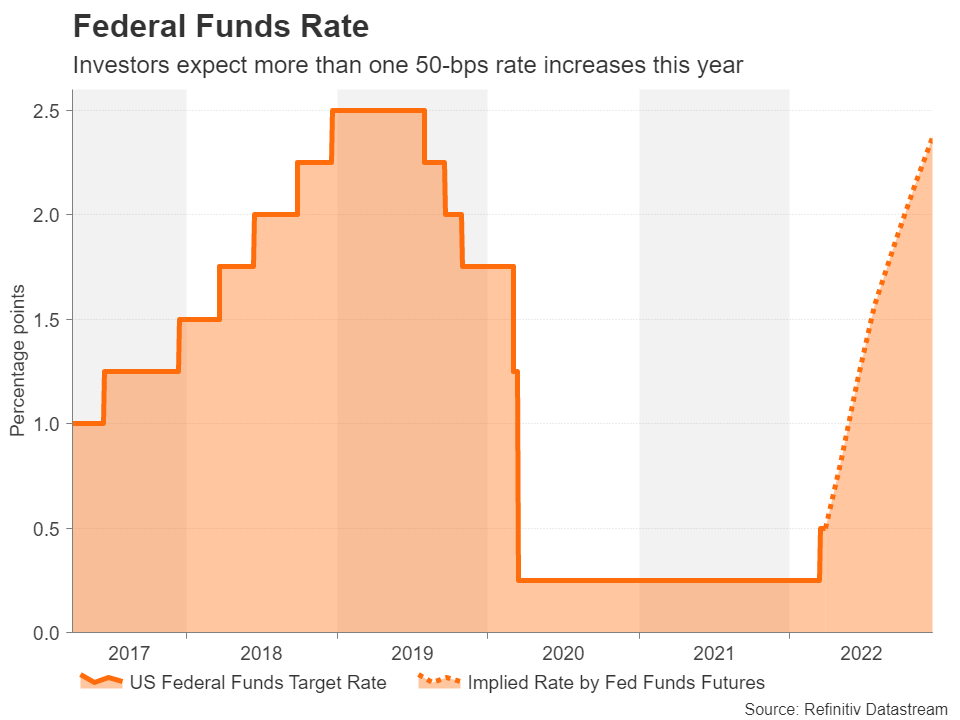
It’s unlikely therefore that the March minutes published on Wednesday will reveal anything new on voting intentions. However, what might draw more interest is what FOMC members discussed about reducing the Fed’s humongous $9 trillion balance sheet. The Fed put off any decisions about the balance sheet until the May meeting but any hints on the pace of quantitative tightening could spark a reaction in Treasury yields, and in turn, the US dollar.
On the data front, the ISM non-manufacturing PMI due Tuesday will be the main data to watch out for in the United States. The services activity composite is expected to have edged up from 56.5 to 58.0 in March, which would reinforce the view that the US economy is in robust shape. However, any unforeseen weakness might heighten fears of an economic slowdown induced by the Ukraine crisis, potentially weighing on the greenback. Factory orders for February will be out too, on Monday.
Euro to remain sensitive to Ukraine fallout
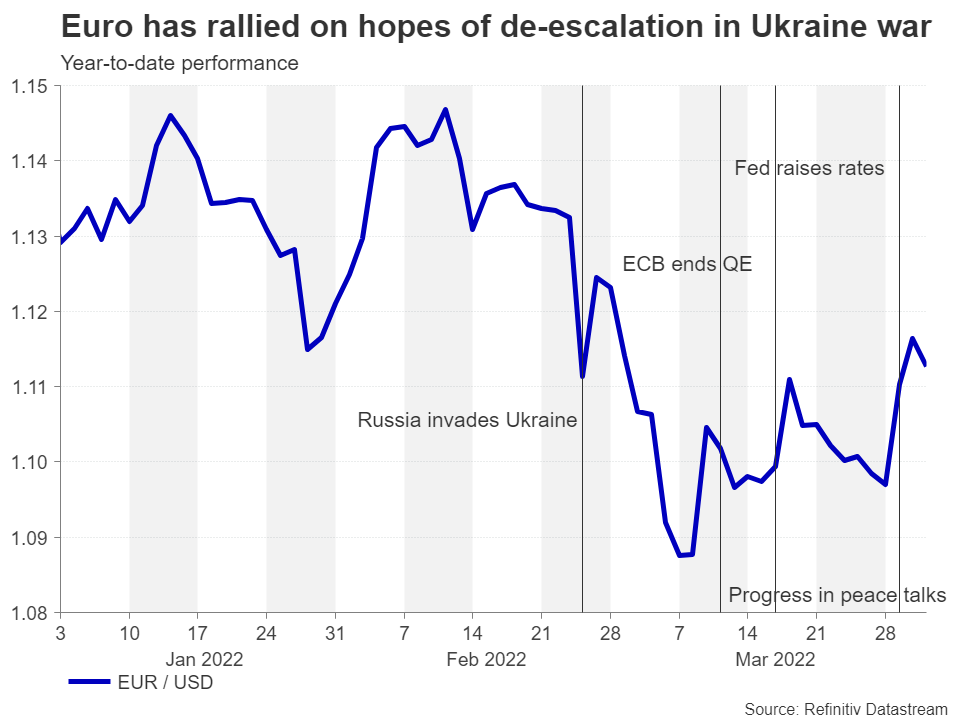
In Europe, recessions risks also look set to dominate the market theme. Aside from the final readings of the March services PMIs that are due on Tuesday, the Eurozone sentix index for April released a day earlier will be the other business survey that will be monitored.
With the euro area economy more exposed to the fallout from the Russia-Ukraine conflict than any other, investors will be keeping a close eye for any signs that point to a deterioration in growth. Although any weakness is not likely to show up in the hard data just yet as next week’s numbers on German industrial orders (Wednesday), industrial production (Thursday) and Eurozone retail sales (Thursday) are all for February, a downward revision to the final PMI prints would be worrisome.
The ECB’s account of its March meeting out Thursday might not necessarily spur a huge market response either as European policymakers have become even more data-dependent than their US counterparts amid the very uncertain outlook. Still, following the somewhat confusing viewpoints of Governing Council members recently, an overall inclination in either a hawkish or dovish direction with regards to the timing of the first post-pandemic rate hike could sway the euro.
RBA will probably stick to familiar language
The RBA holds its April policy meeting on Tuesday but is not expected to join the wave of central banks that hiked rates in March. Although the Australian economy has bounced back strongly from the Omicron wave and the labour market is tightening, policymakers are in no hurry to raise borrowing costs.
The RBA will likely again stress that it wants to see inflation hit its 2-3% target sustainably, and for that to happen, wage growth will need to pick up more substantially than it has done already. Therefore, no change in policy is expected next week but Governor Philip Lowe may hint that the cash rate could rise later this year.
Investors think liftoff will come in June. But even if there is a reasonably strong possibility of that, the market pricing of more than 200 bps for the whole year seems too aggressive. Yet, it’s unlikely anything the RBA says will cause a rethink by traders just yet. Thus, the Australian dollar will be guided by the broader market mood, as well as by the direction of commodity prices.
Canada’s jobs report could further boost BoC rate hike bets
Expectations on the number of rate increases by the Bank of Canada have also risen sharply ever since Western sanctions against Russia sent commodity and energy prices spiralling higher. But the BoC had already been gearing to tighten policy considerably this year as Canada’s labour market has now completely recovered from the pandemic and wage growth could soon accelerate above the current modest pace of around 3%.
The next employment report is due on Friday and it’s projected that another healthy gain in jobs was recorded in March.
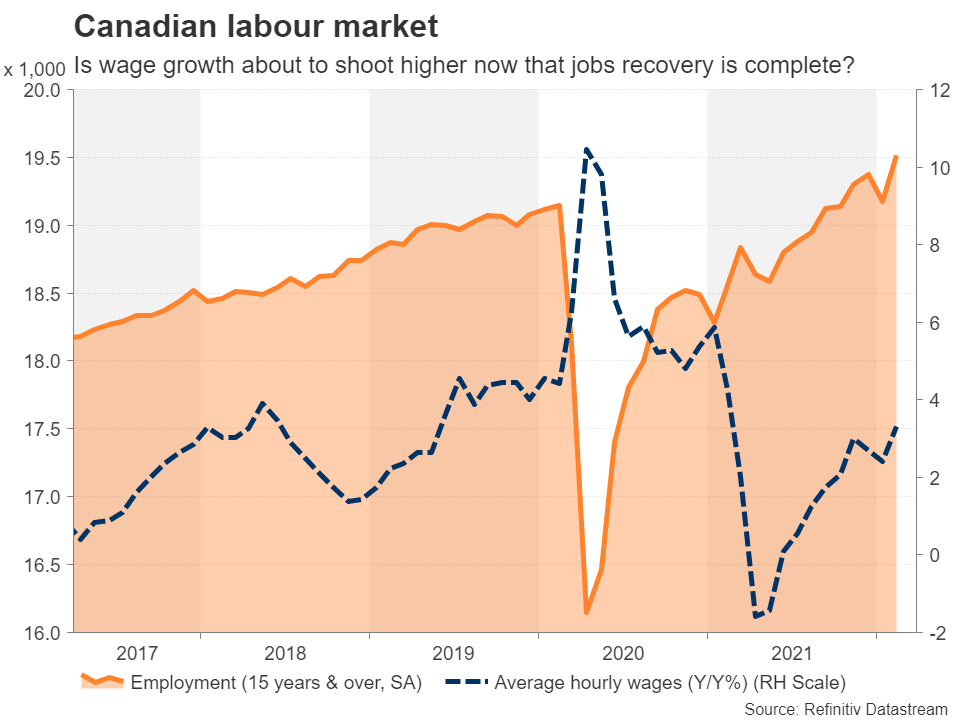
Like the Fed, the BoC has been dropping hints recently that it may need to move in 50-bps increments, so a strong jobs print could push up the odds even higher than the current probability of about 70%. It would also help cushion the Canadian dollar against any further possible slides in oil prices following the past week’s pullback that was brought about by the improved risk tone as well as by America’s decision to release more of its strategic petroleum reserves.
In other data, the Ivey PMI will gauge overall Canadian economic activity for March on Wednesday.
Yen: one eye on Ukraine and another on the BoJ
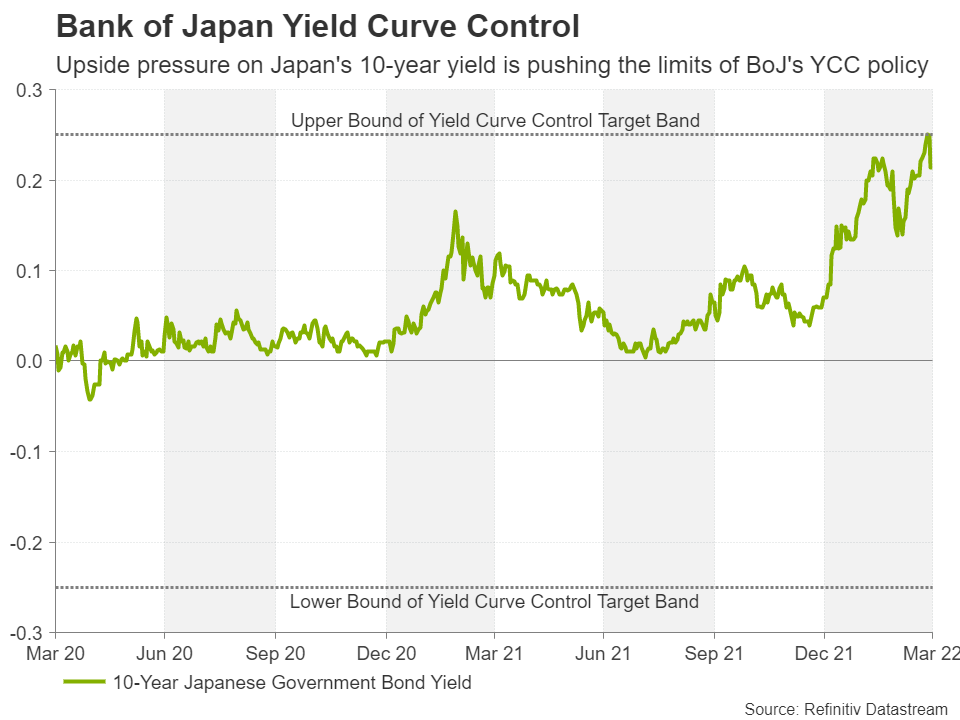
Despite intensifying upward pressure on Japanese government bonds (JGB) amid the global rout in bond markets, the Bank of Japan is refusing to alter course, maintaining its pledge to keep the 10-year yield near zero percent.
In the past week, the BoJ not only ramped up its purchases of JGBs, but it also telegraphed heavier intervention in the coming weeks after it released its schedule for market operations for the second quarter.
The move signals that the upper cap of 0.25% on the 10-year yield is here to stay, though judging by the yen’s reaction in the last few days, some investors are questioning how feasible the BoJ’s yield curve control policy is in its current form.
The yen hit a near seven-year low against the dollar on March 28, but it has since recovered from above 125 yen per dollar to the 122 region. The fading hopes of a quick ceasefire agreement between Ukraine and Russia likely contributed to its rebound against other currencies but not so much against the greenback. Should those hopes recede further over the next few days and there is increased demand for safe havens, the yen could claw back more lost ground versus its peers and stabilize a bit against the dollar.
However, there can be little doubt that the BoJ’s stance has left the yen extremely vulnerable to more big plunges in the event there is another turnaround in risk-on sentiment from a de-escalation in geopolitical tensions.
Weekly Focus – Optimism in the Markets Despite War Dragging Out
Despite Russian officials calling for less military operations around Kyiv, fighting has continued widely across Ukraine this week. Ukraine has signalled it would be willing to give up its aspirations to join NATO, and block western states from placing military bases or nuclear weapons on its grounds. Despite this, it has also aimed to gain bilateral security guarantees for example from the US or some of the larger European countries, which we consider unlikely. Another key remaining issue is the eastern Donbass area, where Russia appears to increasingly focus on. Media reports with regards to Ukraine's willingness to make any territorial concessions have been mixed, but we do not see how Russia could spin the results from its 'special operation' as a win domestically without gaining control over at least the regions in Eastern Ukraine. Despite the optimism we have seen in the markets recently, we think the war is still unfortunately far from over. Read our latest take in Research Russia-Ukraine: Talk is cheap - we expect no immediate breakthrough in peace talks but market focus to shift elsewhere, 31 March.
As the war drags on, central bankers appear increasingly open for front-loading rate hikes to tame the inflationary pressures. This week, we updated our Fed call, and now look for three consecutive 50bp hikes in May, June and July, and expect Fed Funds Target Range to end the year at 2.50-2.75%. Despite markets pulling back on the rate hike pricing and yields moving lower this week, we think that further tightening in financial conditions will be needed. Read the in-depth update at Fed Update - Quickly back to neutral by front-loading rate hikes, 30 March.
Energy price volatility continues, with oil prices moving lower this week on the back of the US announcement of largest Strategic Petroleum Reserve (SPR) release in history. 1 million barrels of reserves will be released per day, over the upcoming six month period, but as this will not be enough to compensate for the expected drop in Russian supply, we maintain our view of elevated crude oil prices going forward, read more in Oil comment - Oil prices to remain elevated despite the SPR release, 31 March. Natural gas prices, in contrast, have moved modestly higher, as Russia has threatened to cut off Europe's gas supply unless the buyers start settling their payments in rubles. EU members have called this a violation of contract terms, with the likely purpose of supporting RUB and making it increasingly difficult to sanction the remaining Russian banks. The deadline for switching the payment currency is today, but at the time of writing, the situation remains uncertain.
In China, the new lockdowns continue to weigh on activity, with PMIs falling to recession territory in March, signalling further weakness for the global economy and increasing supply chain challenges. Lockdowns will continue in Shanghai next week, read our latest take in COVID-19 Update: China sticks to its "dynamic zero covid"-policy, 31 March.
Next week will be quiet in terms of economic data or events. From US we will have a range of Fed speakers as well as FOMC minutes from the March meeting, with focus on any hints about the upcoming QT announcement. ECB minutes will also be released alongside a range of European February hard data, which will however be mostly outdated due to the war. The Reserve Bank of Australia (RBA) will meet Tuesday morning, but despite the global inflationary pressures, we do not yet expect to see changes to their monetary policy.
US ISM manufacturing dropped to 57.1, corresponds to 2.9% annualized GDP growth
US ISM manufacturing dropped from 58.6 to 57.1 in March, below expectation of 58.4. Prices jumped from 75.6 to 87.1, above expectation of 76.0. Employment also rose from 52.9 to 56.3, above expectation of 53.7.
ISM said: "The past relationship between the Manufacturing PMI and the overall economy indicates that the Manufacturing PMI for March (57.1 percent) corresponds to a 2.9-percent increase in real gross domestic product (GDP) on an annualized basis."
Sunset Market Commentary
Markets
Investors were relatively cautious to place strong directional bets at the start of the new quarter. There was no follow-through price action on yesterday’ risk-off move. Or was it simply an end of quarter repositioning? Whatever, Asian equity investors took a cautious start to the new quarter. There were again plenty of diffuse stories on the developments in Ukraine, the next round of negotiations between Russia and Ukraine in Turkey and the payment of gas supply in rouble as asked for by Russian president Putin. Even so, equities gradually regained some traction with core bonds again slipping away. Main European indices gain 0.25% to 0.50%. The market focus turned to the EMU inflation figures and the US payrolls. EMU CPI surged by a whopping 2.5% M/M. The y/y reading rose from 5.9% to 7.5%, easily setting a new record high and outpacing 6.7% consensus. Underlying core inflation increased from 2.7% Y/Y to 3% Y/Y (vs 3.1% consensus). Details showed energy prices obviously responsible for the inflation acceleration, rising by 44.7% Y/Y. Food, non-energy industrial goods and services recorded increases of respectively 5% Y/Y, 3.4% Y/Y and 2.7% Y/Y. Last month’s upgraded ECB inflation forecasts already pale after today, even as the ECB lifted this year’s average number to 5.3% Y/Y. The strength of the price pressure leaves no doubt that the ECB will react with policy normalization even as the economic outlook looks gloomy. German yields add 2.5 bps to 3.5 bps today in a slight steepening move. The euro failed to regain any significant ground against the dollar (EUR/USD 1.1055) or sterling (EUR/GBP 0.8430) following yesterday’s beating. US payrolls printed close to consensus. They confirm the image of a tight US labour market which leaves space for the Fed to up the ante in its inflation battle. The US economy added 431k jobs in March (vs 490k consensus). January and February figures were upwardly revised by a combined 95k. The unemployment rate fell from 3.8% to 3.6% which is near the pre-Covid (and multidecade) low of 3.5%. The participation rate rose from 62.3% to 62.4% and remains well below the early 2020 level of 63.4%. Hourly earning rose as expected by 0.4% M/M and by 5.6% Y/Y. The data didn’t impact the dollar, but did trigger additional sales of US Treasuries, which significantly underperform German Bunds. The US yield curve bear flattened with yields adding 10.7 bps (2-yr) to 5.8 bps (30-yr). Brent crude held near this week’s sell-off low of $104/b after the US confirmed the release of around 1/3rd of its Strategic Petroleum Reserves (180 million barrels) in coming months. Focus will remain on the Russian war in Ukraine next week. The eco calendar is rather thin but the Minutes of the ECB and Fed policy meetings could provide interesting details on deliberation at the key March policy meetings and perhaps offer some insight on what to expect on April 14 (ECB) and May 4 (Fed).
News Headlines
Polish CPI quickened into the double digits to 10.9% y/y in March. That’s up from 8.5% the month before and more than the 9.8% expected. The flash reading only contains a limited amount of details but it is clear energy has had a big part in the price surge, rising 4.4% m/m and 23.9% y/y. Fuel prices rose a stunning 28% m/m to be up by a third - 33.5% to be precise - on a yearly basis. Food prices rose 2.2% m/m and 9.2% y/y. Polish money market rates move up by about 17 bps, outpacing Central-European peers. The zloty trades stoic around the strongest level since the Russian invasion on February 24 at EUR/PLN 4.64.
The OECD’s chief economist said governments are not enough aware of the economic fallout from the war on the medium term. “The longer the war will last, the more uncertainty we have and the more worried we’re getting because uncertainty deters consumer purchases and business investment.”, Boone said. She added the conflict will also have long-lasting effects on energy, food and digital security, payments systems and trade. The OECD already shaved 1 ppt of global growth in its March interim update earlier this month due to the war. Europe was revised down by 1.4 ppts. Inflation was seen 2.5 ppts higher worldwide and 2 percentage points in Europe.
US: No April Fools Here, Job Growth Momentum Remained Strong in March
The U.S. economy added 431k jobs in March, coming in slightly below the consensus forecast of 490k, but a solid reading nonetheless. As has been the case in recent months, upward revisions for the prior two months were meaningful, adding an additional 95k jobs!
Employment gains were widespread, with leisure and hospitality (+112K) seeing the biggest gains – though hiring still remains 8.7% below its (February 2020) pre-pandemic level. Professional & business services (+102k), education & health care (+53k), and retail trade (+49k) also recorded solid gains in March. Goods producing industries (+60k) also saw decent hiring last month, with gains concentrated in manufacturing (+38k) and construction (+19k). Only transportation & warehousing (-500) and utilities (1.2k) recorded declines in March.
The unemployment rate edged lower by 0.2 percentage points (pp), falling to 3.6%. The decline was driven by civilian employment (+736k) outstripping continued growth in the labor force (+418k). The participation rate ticked higher by 0.1pp to 62.4%.
Average hourly earnings rose 0.4% month-on-month (m/m) – and accelerated to 5.6% year-on-year from February's reading of 5.1%.
Key Implications
Another strong month for US job growth! Through the first quarter of the year, the US economy has added 1.7M jobs, bringing the payroll tally within 1% (or 1.6M jobs) of its pre-pandemic level. At the current pace of hiring, the gap could be completely closed by mid-year.
However, some caution is warranted over the very near-term. According to the CDC, the BA.2 subvariant – the most contagious strain of COVID to date – is now the dominant strain within the US. While case counts still remain low, there is some risk of a new wave of infections, which could slow the pace of hiring (particularly in the leisure and hospitality sector) over the coming months.
The lack of labor supply remains a key challenge for the recovery ahead. Indeed, we saw a further improvement on this front in March, with the participation rate edging modestly higher – though it still remains a full percentage point below its pre-pandemic level. The demand-supply mismatch continues to put upward pressure on wages, which should gradually draw increasingly more individuals back into the labor force. Given the increased cost pressures faced by consumers, further gains in wage growth alongside still elevated levels of excess savings should provide households a sufficient buffer to absorb higher food and energy costs.
Bond yields have moved noticeably higher in recent weeks, as the FOMC has become increasingly more hawkish on the path of future interest rate hikes. The abrupt change in tone has led to a significant flattening in the yield curve, with the 10Y-2Y spread having completely collapsed following this morning's release. While today's employment report provides further support that the US economy can certainly withstand higher interest rates, the near inversion of the 10Y-2Y spread shows that financial markets have become increasingly worried about the potential speed of adjustment. We know the FOMC closely monitors movements in the yield curve, so it will be interesting to see if they soften the hawkish tone in the weeks ahead. At present, markets are full priced for another rate hike at the Fed's next meeting on May 4th, with a 70% probability of a 50bps move.