Sample Category Title
There is Room Left to Price in an ECB Catch-up Move
Markets
The massive core bond yield surge eased or reversed after having experienced the worst month in many decades. European swap yields registered the biggest monthly jump since the creation of the EMU, even after giving up 5.7 (30y) to 11.3 bps (5y) yesterday. German Bunds hugely outperformed US Treasuries with yields 6.6 (30y) to 10.9 bps (5y) lower. Short-term US yields’ late-session last hurrah brought them back in positive territory for the day. The 5y closed 2.9 bps higher. Q1 thus ended with a 30y/5y inversion as yields at long tenors finished a little less than 3 bps lower.
Several elements could explain yesterday’s moves. First, the decline in oil prices amid reports the US will release 1mln barrels a day for six months from its Strategic Reserve, resulting in easing inflation expectations. Second, the weak equity sentiment with Europe and Wall Street shedding about 1.5%. Third: end-of-quarter rebalancing. Some of the recent trends on currency markets reversed too at the last day of the quarter.
The USD and euro started on equal footing but the odds soon turned in favour of the greenback. EUR/USD retreated from its recent bounce to 1.1067, below 1.1121 support. The Japanese yen outperformed peers. USD/JPY eased slightly to 121.70, EUR/JPY give up more than a big figure to 134.67. The Swiss franc also got reprieve, rallying 0.9% to the euro and testing EUR/CHF 1.02 support. Sterling caught a better bid as well. This prevented EUR/GBP from taking out 0.85 and instead finish lower at 0.842. Asian-Pacific stocks trade soft in the wake of the US performance. China is one of the few exceptions (+1%). The private (Caixan) manufacturing PMI slipped deeper in contraction territory (48.1) than expected but was no big surprise after official data showed the same yesterday.
Japanese corporate assessment (Tankan) of both current conditions as well as the outlook for Q2 weakened across the board. Soaring prices and geopolitical uncertainty offset a hoped-for rebound after Covid restrictions were eased in March.
The yen is under pressure this morning though that’s probably more the result of rising core/US yields (>4 bps). Equity futures suggest a pale green open. The euro and dollar again start with similar momentum. Both face key economic indicators later today.
EMU inflation in March is expected at a record 6.8% y/y. Even after already being revised higher, national readings earlier this week make an upward surprise possible still (7%?). March payrolls, expected at a strong 490k, are due in the US. US money markets expect 200 bps of additional tightening by the Fed this year and that may suffice for now. Meanwhile, we continue to believe there is room left to price in an ECB catch-up move, especially after yesterday’s correction. This should support EMU yields in particular and EUR/USD. A weekly close above 1.1121 should bring technical comfort to the currency pair.
News Headline
The Czech National Bank yesterday decided to raised its policy rate by 50 bps to 5.0% in a 5-2 vote. Two members preferred the keep the policy rate unchanged. However, at the press conference, governor Rusnok indicated that a 75 bps hike was also discussed. The Board sees the risks and uncertainties compared to the winter forecast as being markedly inflationary in the short run. These risks also require significantly tighter monetary policy and probably for longer than expected previously. Inflation (11.1% Feb) was already significantly higher than expected before the war in Ukraine amid higher food prices and administered regulated prices. Price pressures are being exacerbated by the war. Inflation now is expected to rise further in spring and remain very high for the rest of the year. The CNB remains prepared to raise rates further to restore price stability as soon as possible. The impact of the war is expected to cut expected growth in half (was 3%). With respect to FX interventions, the CNB indicated they mainly intended to address excessive koruna fluctuations. There was no deep debate on using the koruna as a policy tool. Rates are the preferred tool, but the koruna is no taboo. De koruna hovered up and down after the policy announcement, but finally closed marginally stronger near EUR/CZK 24.40.
Oil Falls, Focus on US Jobs, EZ Inflation
Intense selloff in crude oil pulled the price of a barrel to around the $100pb level, which is the critical 50-DMA support to the latest crude rally.
The question is, whether Washington could reverse the positive momentum in oil prices with its promise to release a million barrels of oil from the strategic reserves per day, for the next six months starting from next month.
If history is any indication, strategic oil reserves have a short-term easing effect on oil prices, which is then followed by a rebound to higher levels, as the extra barrels are a quick fix which doesn’t solve the longer-term supply gap. The $100pb level is critical. Clearing this support could pave the way for a further fall toward the $88pb, which coincides with the 100-DMA and the major 61.8% Fibonacci retracement on the latest December – March rally. Yet failure to clear the $100p resistance could reinforce the idea that energy prices will continue surging, and there is nothing the US could do about it.
And oh, OPEC and Russia agreed on Thursday to increase the oil output modestly as widely expected, but more importantly, they dumped the International Energy Agency as a data source in a sign of worsening relations with the West. Not only that OPEC is not standing with the West in the battle to weaken Russia, but the bond with the West is seemingly getting weaker, which certainly calls for more headache in the future, and well, higher prices. So, the output has been raised to 432’000 per barrel, from 400’000 previously. The 32’000 extra barrels per day is nothing but a joke in the face of the deepening energy crisis that the world is going through. The decision comes just in time for April fool!
Can’t ignore the curve inversion
Falling oil prices couldn’t prevent a selloff in equities yesterday, as investors couldn’t stop worrying about the inversion of the 2-10 year curve, and the rumours of recession that come along with it. The S&P500 lost more than 1.50% yesterday, and Nasdaq failed to extend gains above the 200-DMA.
Data
Latest Caixin PMI manufacturing index fell below the 50 mark, showing that the Chinese manufacturing activity contracted in March as the latest measures to contain the Covid outbreak took a severe toll on the economic activity. If China continues insisting on its utopic zero-Covid policy, we may see further slowdown in recovery. And of course, when China sneezes, the world catches a cold: the slowdown in activity in China also means longer waiting times, deeper supply chain crisis, and an additional pressure on consumer prices, for everyone.
Today, the US will reveal how many nonfarm jobs the US economy added last month, and Europe will reveal ho bad inflation got in March. According to the Bloomberg survey, the US economy may have added close to half a million new nonfarm jobs in March. The average hourly earnings, closely watched due to its potential impact on inflation may have risen from 5.1% to 5.5%. A strong NFP print, combined with a strong growth in people’s pay may further boost the Federal Reserve (Fed) hawks, push the short-end of the yield curve higher and weigh on the mood in riskier markets. While a soft read will hardly revive the Fed doves, as the Fed can’t do many things at a time; it has to fix the rising inflation problem.
Speaking of inflation, the European Central Bank (ECB) should also address the inflation problem, in theory, as the price stability is its primary objective. The flash inflation figures will confimr how fast inflation is rising in Europe after inflation in Germany spiked above the 7% mark, and inflation in Spain neared 10%. Despite Christine Lagarde insistingly pushing back the idea that the ECB should act fast to ease the pressure on consumer prices, the market starts preparing for a 50-bp hike before the end of the year to tame inflation. The EURUSD extended gains to 1.1185 yesterday before falling back to the 1.1060 this morning. The incentive to buy a dip is clearly present as the ECB will certainly give in to the rising pressure to hike the rates, but when is the million-euro question. I wouldn’t bet on a large upside potential until we hear a more aggressive tone from the ECB, as Lagarde doesn’t seem to lower her guard faced with the rising inflationary pressures, for now.
Oil Prices Lower
Market movers today
(Online) peace talks between Ukraine and Russia might resume today. However, we are sceptical an imminent deal will be found, see Research Russia-Ukraine: Talk is cheap - we expect no immediate breakthrough in peace talks but market focus to shift elsewhere, 31 March.
In Europe, the highlight will be the euro area HICP inflation figures for March. Country figures point to another record high headline rate of 7.4%, while core inflation likely accelerated beyond 3%, piling up inflation worries for ECB.
Markets will also keep a close eye on the US non-farm payrolls report for March released today. We look for a decent report with jobs growth around 450k, but the unemployment rate and wage growth will also be in focus to gauge underlying inflation pressures. Later in the day, the ISM manufacturing index for March will show how factories are coping with high prices and fresh supply chain problems.
The EU and China will hold a virtual summit. While EU-China economic ties remain critical to both sides, geopolitical interests are diverging ever more sharply and the EU-China investment treaty agreed in 2020 remains a distant prospect.
In Scandinavia, March PMIs are released in Sweden and Norway and we expect Norwegian unemployment to fall from 2.1% to 2.0% in March.
The 60 second overview
Oil prices fell after US action and yesterday's OPEC meeting: As widely expected, OPEC agreed yesterday to increase oil production in May only modestly, by 430 000 barrels per day. The decision is in contrast to the US announcement to release up to 180 million barrels of oil from its Strategic Petroleum Reserves (SPR). Oil will be released at a pace of 1M barrels per day over a period of six months, which will cover roughly 1/3 of the estimated drop in Russian supply. Yesterday, we published a comment on the US decision, arguing that despite it being the largest SPR release in history, it is unlikely to change the narrative for elevated oil price levels for the upcoming months, read the one-pager at: Oil comment - Oil prices to remain elevated despite the SPR release, 31 March. Reflecting this, Brent prices continue to trade clearly above pre-war levels. Today, IEA countries will reportedly meet to discuss possible reserve releases in its other member countries.
Confusion over European payment of Russian gas: The Russian government has demanded that Western European countries should pay for Russian gas in Roubles, which has been met with resistance from the West, raising fears that Russia would stop gas deliveries. According to the German government, Russian president Putin told German Chancellor Scholz that payments could continue to be in euros. This was not confirmed from the Russian side and earlier yesterday, the Italian government had been told that western countries would have to open a euro-denominated account in Russia to make payments. Natural gas prices first fell but ended the day 4% higher on the news.
Equities: Equities went lower yesterday led by cyclicals and growth stocks while implied volatility was higher. However, it was not the type of moves we saw back in early March, and market moves still fit well with a classic post correction recovery. Equities have now regained most of the lost ground and from here on it will be choppier and slower. Following a classic playbook would still suggest more upside in the coming months led by cyclicals with vol coming further down especially in Europe. The drop in equities yesterday was rather synchronised across sectors and regions which is also a sign that uncertainty is coming down and investor are making adjustment rather than going all in or all out. In US yesterday, Dow -1.6%, S&P 500 -1.6%, Nasdaq -1.5% and Russell 2000 -1.0%. Asian markets are mixed this morning. Futures in Europe are flat while US futures are slightly higher this morning.
FI: Yesterday's rates markets rallied hard after the inflation surprises on Wednesday from Germany and Spain which was followed by French CPI only surprising marginally on the upside, while the Italian CPI came in lower than expected (but still at very high levels). This was also combined with oil lower (on release of US oil reserves) left the EUR inflation forwards 8bp lower in the 2y2y, now at 2.45%. At the same time, German inflation linked bonds (DBRI 2030) performed 4bp to -2.19%.
FX: NOK came under severe pressure yesterday on both SPR-release news and Norges Bank's announcement that they will become a (record large) NOK seller of NOK2bn per day in April. EUR/NOK rose from 9.56 to nearly 9.74. USD/JPY traded mostly sideways yesterday and ended the day below 122 after a few action-packed days for JPY.
Credit: Credit markets were relatively unchanged yesterday as we approached quarter end. The main index was unchanged at 73.0bp while ITraxx Xover was wider by 1.4bp to 338.4bp. Cash bonds too saw only modest movements, with the spread of investment grade bonds closing 0.7bp tighter at 63.3bp while the high-yield bond spread widened by 5.5bp to 330.9bp.
Nordic macro
March manufacturing PMI is set to look quite OK, remaining in the 55-60 range. Preliminary prints from the German PMI and the Swedish NIER confidence survey suggests manufacturing is still growing at a strong pace.
GBP/JPY Daily Outlook
Daily Pivots: (S1) 159.30; (P) 160.10; (R1) 160.74; More...
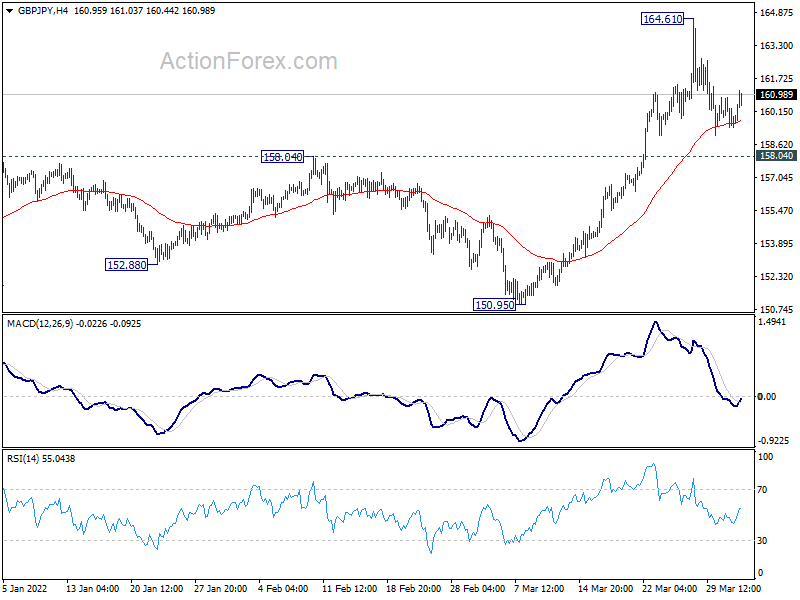
Intraday bias in GBP/JPY remains neutral as consolidation from 164.61 is extending. Outlook stays bullish with 158.04 resistance turned support intact, and further rally is expected. On the upside, break of 164.61 will resume larger up trend to long term fibonacci level at 167.93. However, firm break of 158.19 will turn bias to the downside and bring deeper pull back.
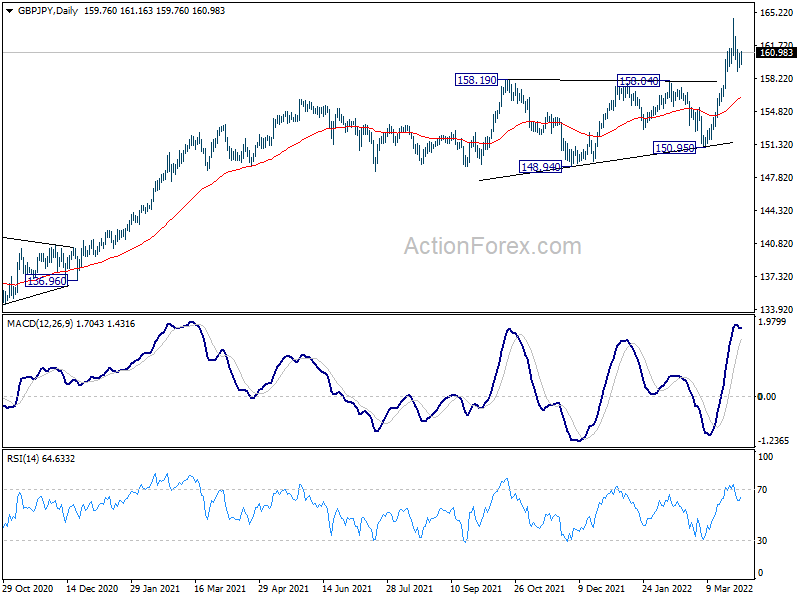
In the bigger picture, up trend from 123.94 (2020 low) is still in progress, and notable support from 55 week EMA affirms medium term bullishness. Next target is 61.8% retracement of 195.86 (2015 high) to 122.75 (2016 low) at 167.93. Sustained break there will be a long term bullish signal. This will now remain the favored case as long as 150.95 support holds.
EUR/JPY Daily Outlook
Daily Pivots: (S1) 133.86; (P) 135.35; (R1) 136.18; More....
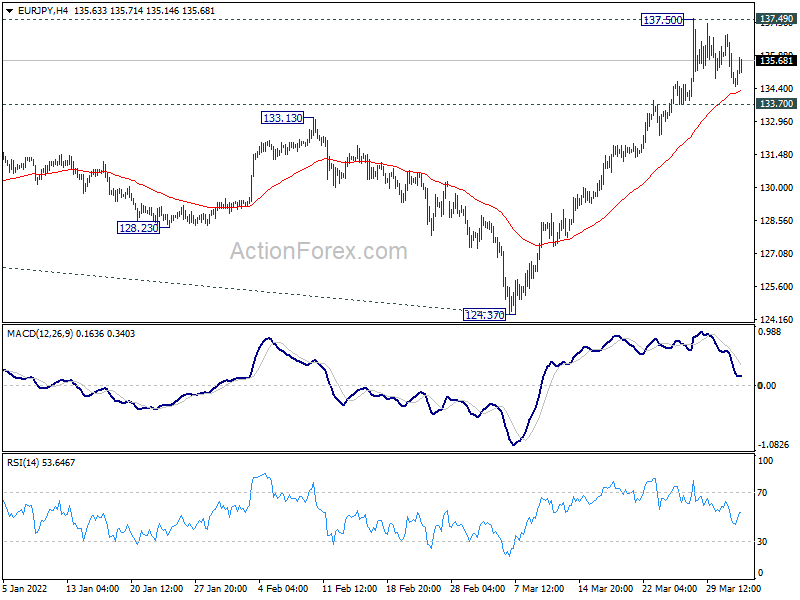
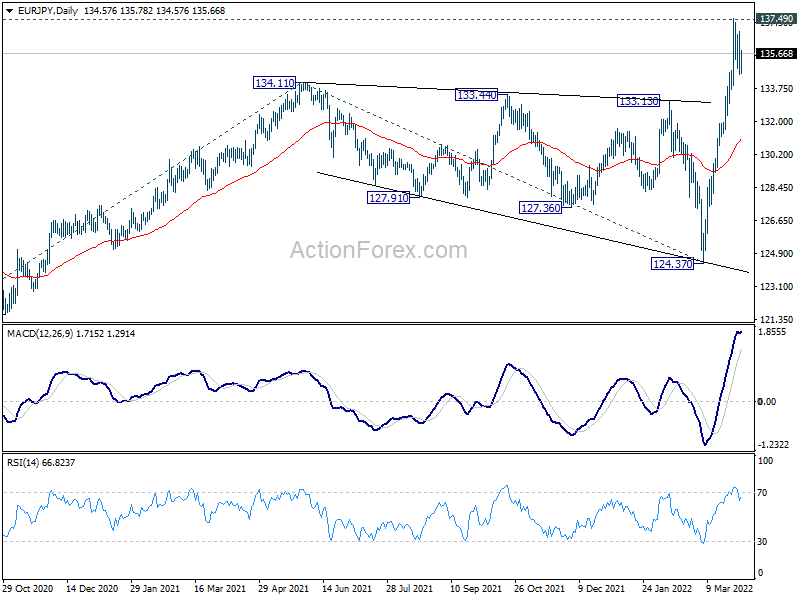
EUR/JPY is staying in consolidation from 137.50 and intraday bias remains neutral first. Overall, further rally is expected with 133.70 minor support intact. On the upside, sustained break of 137.49 resistance will resume larger up trend for 144.06 projection level next. However, firm break of 133.70 will indicate short term topping, and turn bias back to the downside for deeper pull back.
In the bigger picture, up trend from 114.42 (2020 low) is in progress. Sustained break of 137.49 (2018 high) will resume larger pattern from 109.30 (2016 low). Next target will be 100% projection of 114.42 to 134.11 from 124.37 at 144.06. In any case, outlook will now remain bullish as long as 124.37 support holds, in case of deep pull back.
EUR/GBP Daily Outlook
Daily Pivots: (S1) 0.8390; (P) 0.8451; (R1) 0.8482; More...
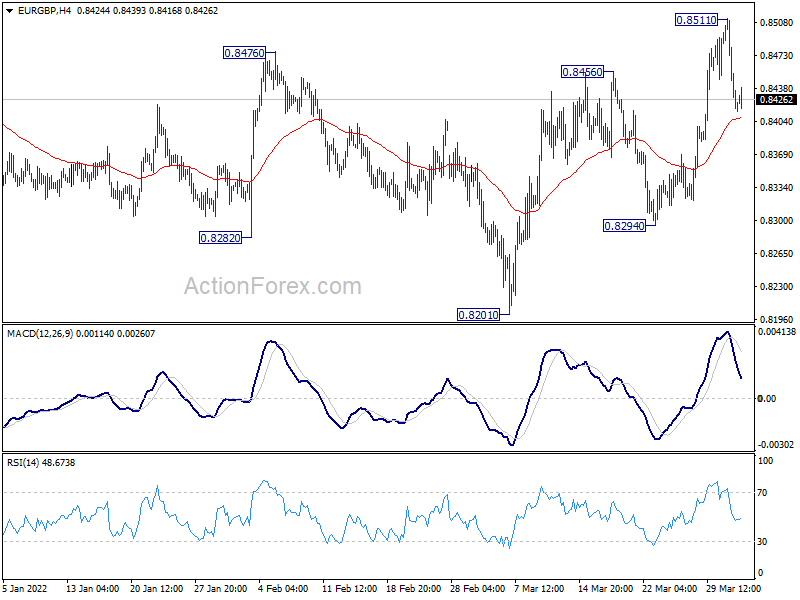
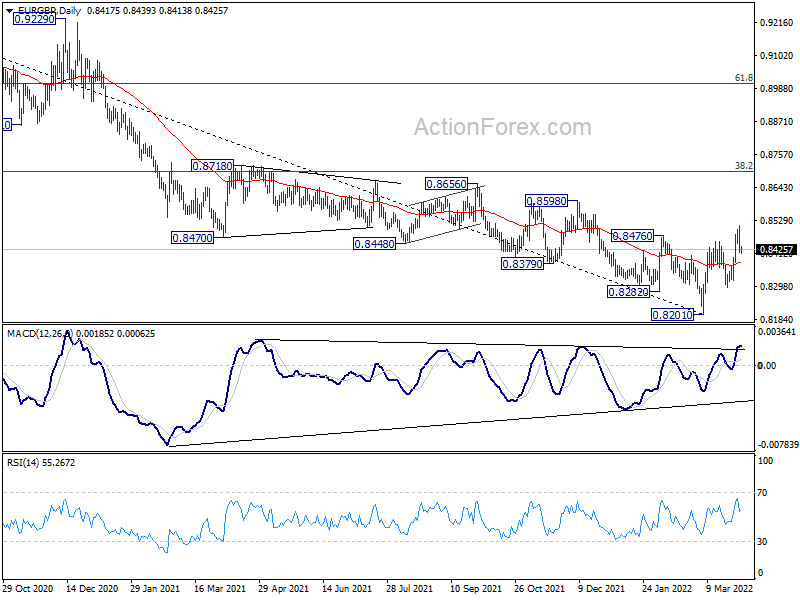
Intraday bias in EUR/GBP remains neutral for the moment. But further rally is expected as long as 0.8294 support holds. 0.8201 is seen as a medium term bottom. Above 0.8511 will target 0.8697 medium term fibonacci level next. However, break of 0.8294 will dampen this bullish view and bring retest of 0.8201 low.
In the bigger picture, a medium term bottom should be in place at 0.8201, on bullish convergence condition in daily and weekly MACD. Rise from there could either be a correction to the down trend from 0.9499 (2020 high), or a medium term up trend itself. In either case, further rise should be seen to 38.2% retracement of 0.9499 to 0.8201 at 0.8697. Sustained break there will target 61.8% retracement at 0.9003. This will remain the favored case as long as 0.8294 support holds.
EUR/AUD Daily Outlook
Daily Pivots: (S1) 1.4722; (P) 1.4833; (R1) 1.4901; More...
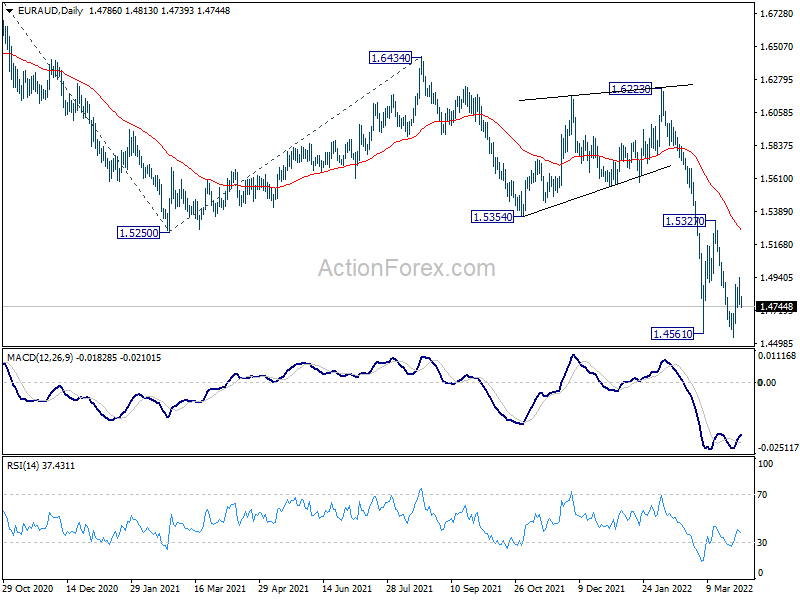
Intraday bias in EUR/AUD is turned neutral again as recovery from 1.4533 lost momentum. Overall, it's seen as in consolidation from 1.4561. As long as 1.5327 resistance holds, larger down trend is still expected to continue. Break of 1.4533 will confirm down trend resumption for 1.3624 long term support.
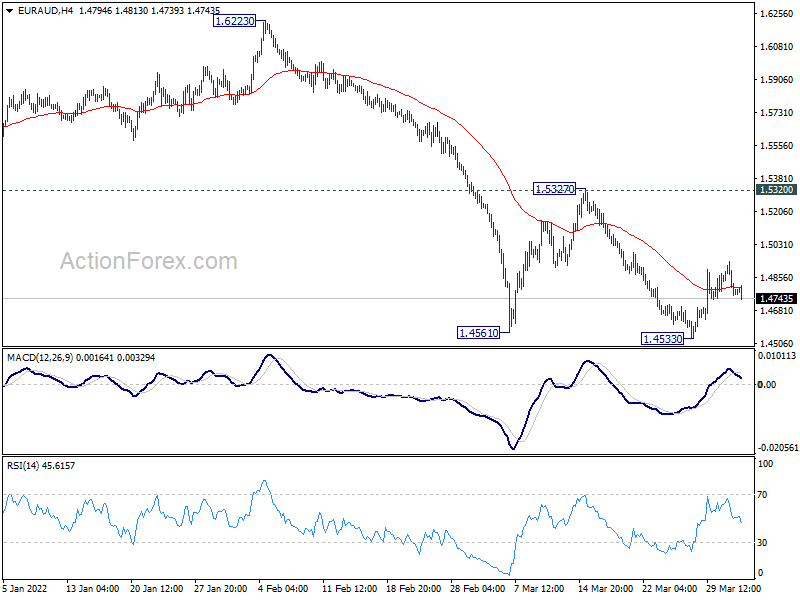
In the bigger picture, fall from 1.9799 is seen as a long term impulsive move. Next target is 61.8% projection of 1.9799 to 1.5250 from 1.6434 at 1.3623, which is close to 1.3624 long term support (2017 low). Some support could be seen there to bring interim rebound. But overall, break of 1.5354 support turned resistance is needed to be the first sign of medium term bottoming. Otherwise, outlook will stay bearish in case of recovery.
EUR/CHF Daily Outlook
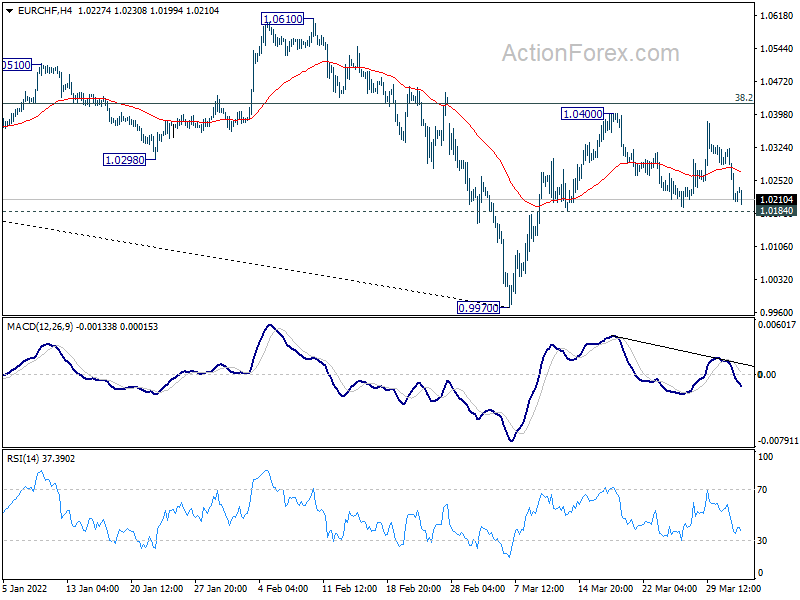
Daily Pivots: (S1) 1.0173; (P) 1.0249; (R1) 1.0290; More....
Intraday bias in EUR/CHF remains neutral as range trading continues. On the upside, break of 1.0400 will resume the rebound from 0.9977 to 1.0610 key structural resistance next. On the downside, however, break of 1.0184 will turn bias back to the downside for retesting 0.9970 low.
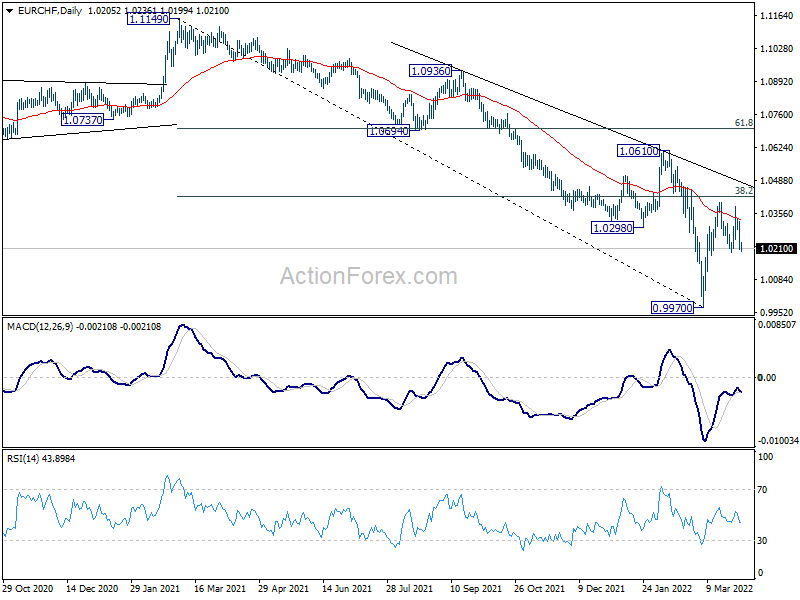
In the bigger picture, long term down trend from 1.2004 (2018 high) is still in progress. Next target is 100% projection of 1.2004 to 1.0505 to 1.1149 at 0.9650. In any case, sustained break of 1.0505 support turned resistance is needed to be the first sign of medium term bottoming. Otherwise, outlook will remain bearish.
USD/CAD Daily Outlook
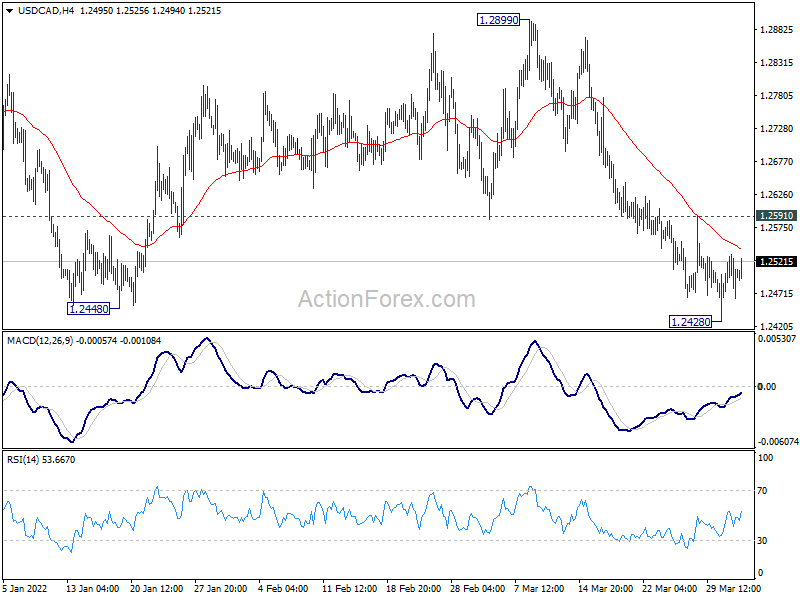
Daily Pivots: (S1) 1.2470; (P) 1.2501; (R1) 1.2539; More...
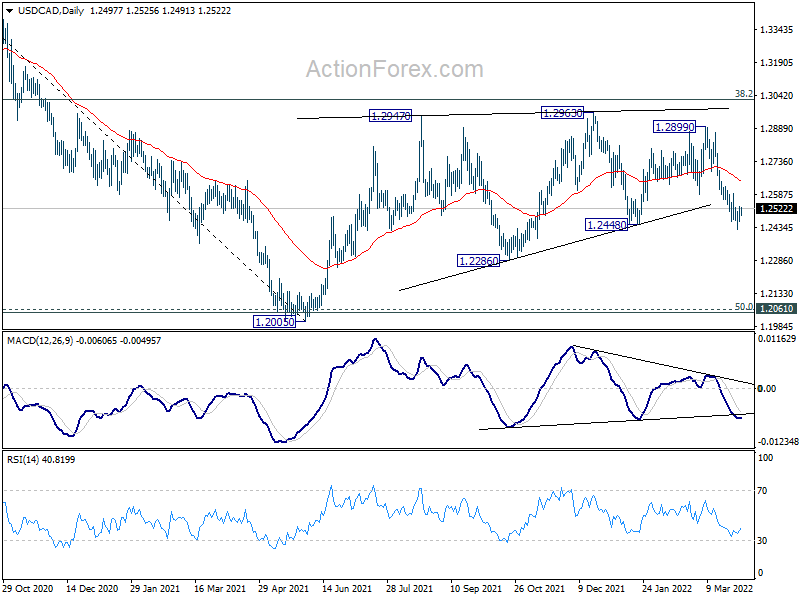
Intraday bias in USD/CAD remains neutral for consolidation above 1.2428 temporary low. Further decline is expected as long as 1.2591 resistance holds. Corrective pattern from 1.2005 could have completed already. Firm break of 1.2448 support should confirm this bearish case and bring retest of 1.2005. On the upside, nevertheless, break of 1.2591 resistance will turn bias back to the upside for 1.2899 resistance instead.
In the bigger picture, focus stays on 38.2% retracement of 1.4667 (2020 high) to 1.2005 (2021 low) at 1.3022. Sustained break there should confirm that the down trend from 1.4667 has completed after defending 1.2061 long term cluster support. Further rise would then be seen towards 61.8% retracement at 1.3650. However, rejection by 1.3022 will maintain medium term bearishness. Break of 1.2005 will resume the down trend from 1.4667 and that carries larger bearish implications too.
AUD/USD Daily Report
Daily Pivots: (S1) 0.7463; (P) 0.7492; (R1) 0.7513; More...
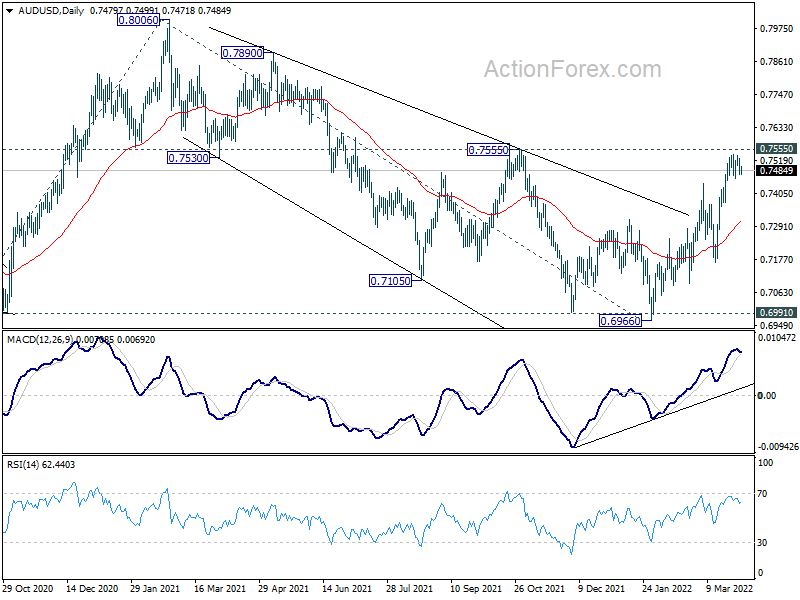
Intraday bias in AUD/USD remains neutral and outlook is unchanged. Further rally is expected as long as 0.7372 minor support holds. On the upside, decisive break of 0.7555 should confirm that whole corrective decline from 0.8006 has completed at 0.6966. Further rise should then be seen back to retest 0.8005. However, break of 0.7372 will dampen this bullish view and turn bias back to the downside for 0.7164 support instead.
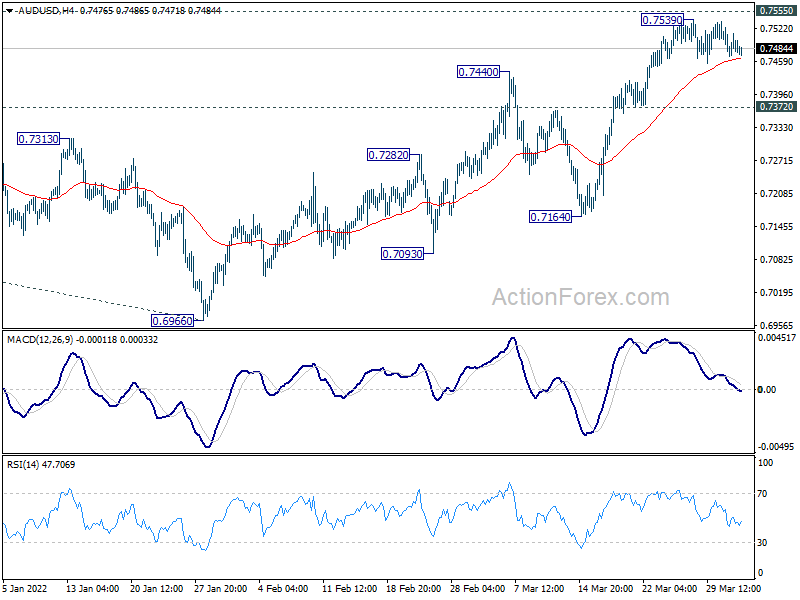
In the bigger picture, correction from 0.8006 could have completed at 0.6966, after drawing support from 0.6991. That is, up trend from 0.5506 (2020 low) might be ready to resume. Firm break of 0.8006 will target 61.8% projection of 0.5506 to 0.8006 from 0.6966 at 0.8511 next. This will remain the favored case as long as 0.7164 support holds.