Sample Category Title
EUR/USD Mid-Day Outlook
Daily Pivots: (S1) 1.1024; (P) 1.1104 (R1) 1.1148; More...
Intraday bias in EUR/USD remains neutral for the moment. Further rally is mildly in favor as long as 1.0943 support holds. Break of 1.1184 will resume the rebound from 1.0805 to 38.2% retracement of 1.2265 to 1.0805 at 1.1363. However, break of 1.0943 will revive near term bearishness and bring retest of 1.0805 low first.
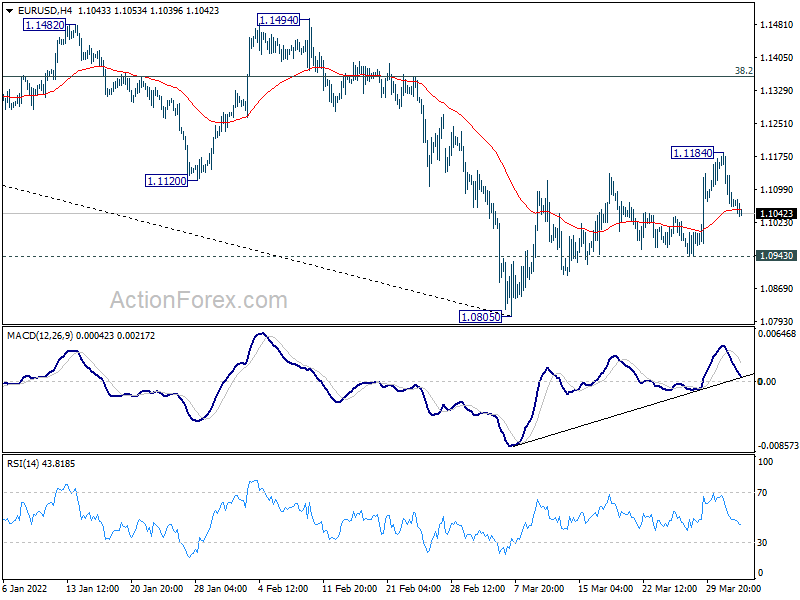
In the bigger picture, the decline from 1.2348 (2021 high) is expected to continue as long as 1.1494 resistance holds. Firm break of 1.0635 (2020 low) will raise the chance of long term down trend resumption and target a retest on 1.0339 (2017 low) next. Nevertheless, break of 1.1494 will maintain medium term neutral outlook, and extending term range trading first.
GBP/USD Mid-Day Outlook
Daily Pivots: (S1) 1.3108; (P) 1.3142; (R1) 1.3178; More...
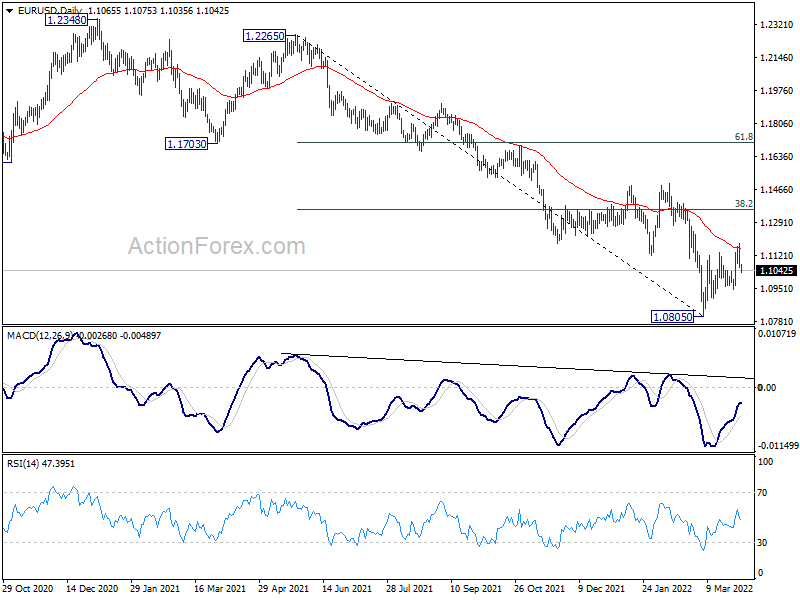
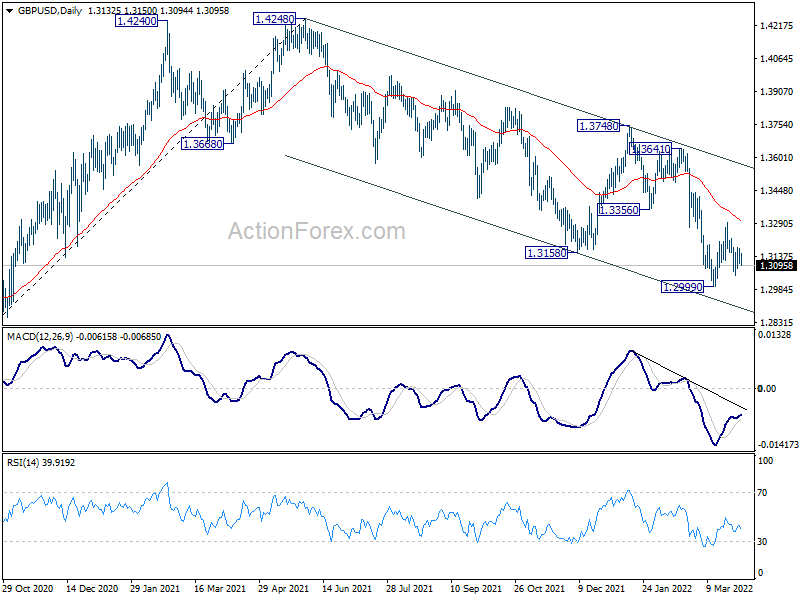
Range trading continues in GBP/USD and intraday bias remains neutral. Outlook remains bearish with 1.3297 resistance intact, and further decline is expected. On the downside, break of 1.2999 low will resume larger down trend from 1.4248. However, firm break of 1.3297 will turn bias back to the upside for stronger rebound.
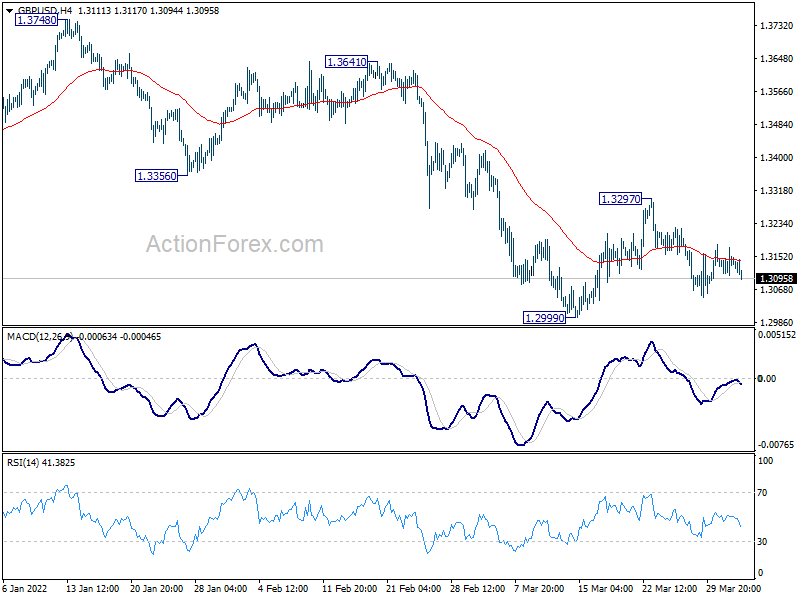
In the bigger picture, current development suggests that the up trend from 1.1409 (2020 low) has completed at 1.4248. Decline from 1.4248 could still be a corrective move, or it could be the start of a long term down trend. In either case, deeper decline would be seen back to 61.8% retracement of 2.1161 to 1.1409 at 1.2493. In any case, break of 1.3748 resistance is needed to indicate medium term bottoming, or outlook will stay bearish.
USD/CHF Mid-Day Outlook
Daily Pivots: (S1) 0.9194; (P) 0.9226; (R1) 0.9258; More....
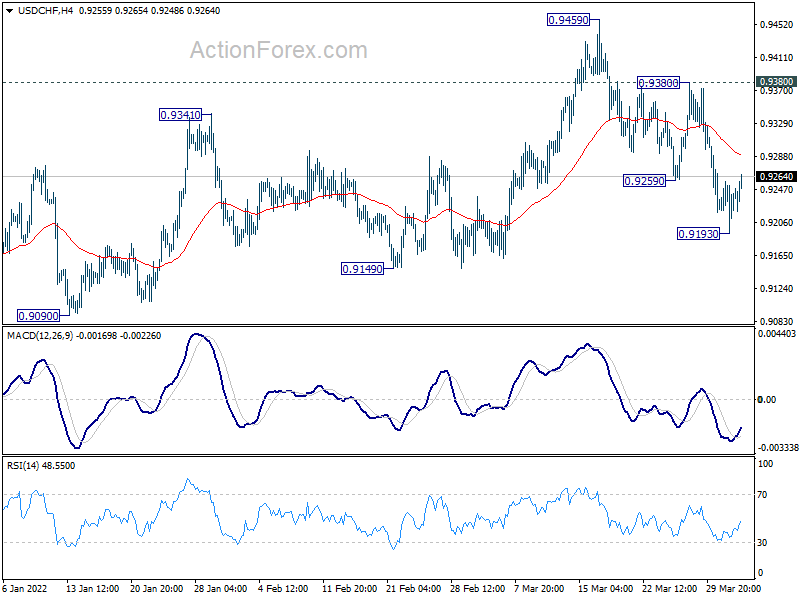
Intraday bias in USD/CHF is turned neutral with current recovery. But further fall could still be seen as long as 0.9380 resistance holds. Below 0.9193 will resume the decline from 0.9459 to 0.9149 support. Firm break there will turn near term outlook bearish for 0.9090 support and below. On the upside, above 0.9380 resistance will flip bias back to the upside for 0.9459 resistance instead.
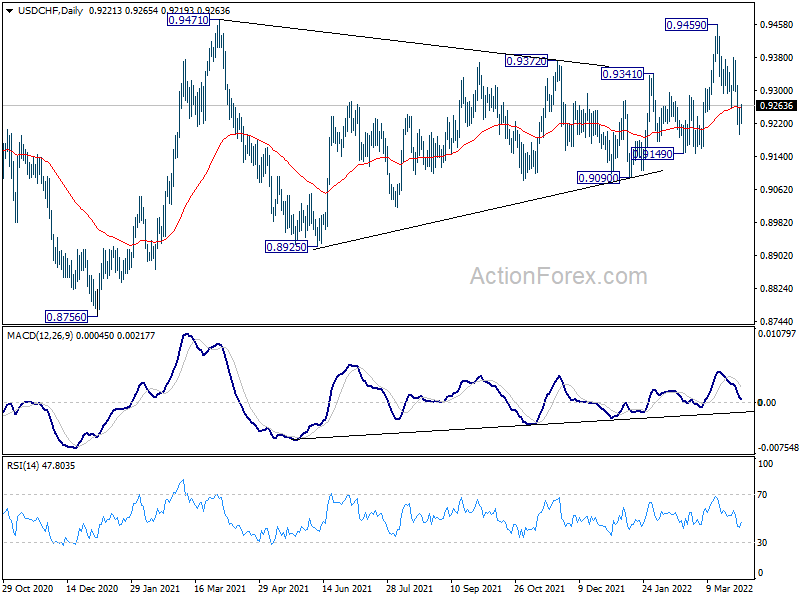
In the bigger picture, medium term outlook will be neutral at best as long as 0.9471 resistance holds. Larger down trend could still extend through 0.8756 (2021 low). However, firm break of 0.9471 will argue that whole down trend form 1.0342 (2016 high), has completed with waves down to 0.8756. A medium term up trend should be set up to target 1.0237/0342 resistance zone.
USD/JPY Mid-Day Outlook
Daily Pivots: (S1) 121.03; (P) 122.12; (R1) 122.92; More...
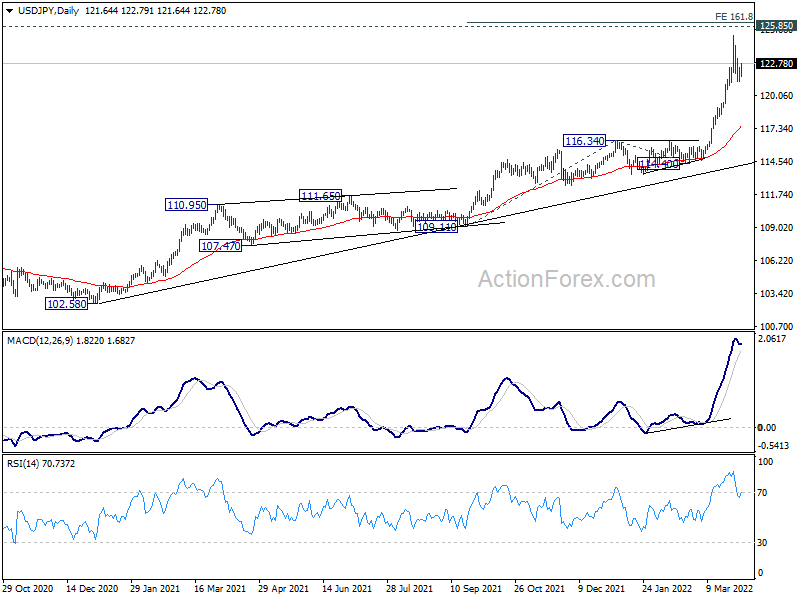
Intraday bias in USD/JPY remains neutral for the moment. With 121.17 support intact, further rally is in favor. On the upside, above 125.09 will target 161.8% projection of 109.11 to 116.34 from 114.40 at 126.09, which is close to 125.85 long term resistance. However, break of 121.17 will indicate short term topping, and bring deeper pull back.
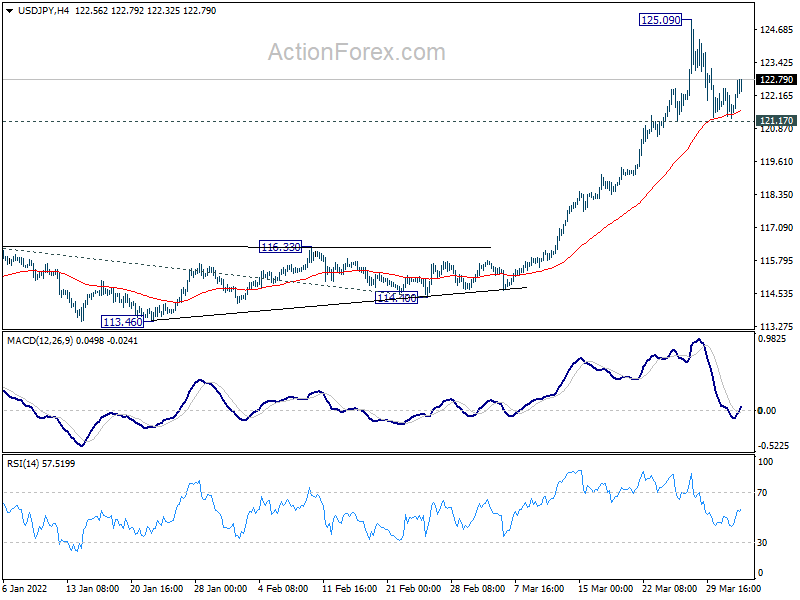
In the bigger picture, up trend from 98.97 (2016 low) in in progress for retesting 125.85 (2015 high). Sustained break there will confirm long term up trend resumption. Next target will be 61.8% projection of 75.56 (2011 low) to 125.85 (2015 high) from 98.97 at 130.04. This will now remain the favored case as long as 116.34 resistance turned support holds.
Dollar Little Changed After Solid NFP, Euro Shrugs CPI
Dollar is little changed after another set of solid job data. The greenback is trying to extend the near term recovery against Euro and Yen, but turns softer against Aussie. Euro also shrugs off much stronger than expected consumer inflation reading. Yen continues to consolidate in tight range, digesting recent losses. There is still prospect of some bigger moves, depending how the risk markets end the week.
In Europe, at the time of writing, FTSE is up 0.36%. DAX is up 0.35%. CAC is up 0.47%. Germany 10-year yield is up 0.031 at 0.580. Earlier in Asia, Nikkei dropped -0.56%. Hong Kong HSI rose 0.19%. China Shanghai SSE rose 0.94%. Singapore Strait Times rose 0.31%. Japan 10-year JGB yield rose 0.0006 to 0.216.
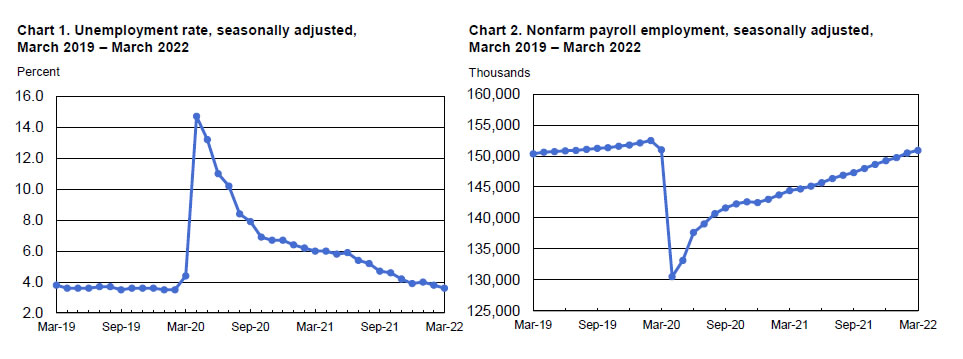
US NFP employment grew 431k, unemployment rate dropped to 3.6%
US non-farm payroll employment grew 431k in March, lower than expectation of 488k. Overall job growth averaged 562k per month in Q1, the same as the average monthly gain for 2021. Employment was still down by -1.6m, or -1.0%, from its prepandemic level in February 2020.
Unemployment rate dropped from 3.8% to 3.6%, better than expectation of 3.7%. Labor force participation rate rate little changed at 62.4%.
Average hourly earnings rose 0.4% mom, matched expectations.
Eurozone CPI rose to 7.5% yoy, core CPI up to 3.1% yoy
Eurozone CPI accelerated sharply from 5.9% yoy to record high at 7.5% yoy in March, above expectation of 6.5% yoy. Core CPI also rose from 2.7% yoy to 3.0% yoy, but missed expectation of 3.1% yoy.
Looking at the main components of Eurozone inflation, energy is expected to have the highest annual rate (44.7%, compared with 32.0% in February), followed by food, alcohol & tobacco (5.0%, compared with 4.2% in February), non-energy industrial goods (3.4%, compared with 3.1% in February) and services (2.7%, compared with 2.5% in February).
Eurozone PMI manufacturing finalized at 56.5, Ukraine war an ominous new headwind
Eurozone PMI Manufacturing was finalized at 56.5 in March, down from February's 58.2, hitting a 14-month low. Looking at some member states, Germany PMI manufacturing dropped to 18-month low at 56.9. Italy dropped to 14-month low at 55.8. France dropped to 5-month low at 54.7.
Chris Williamson, Chief Business Economist at S&P Global said: "Just as the fading of the latest pandemic wave was creating a tailwind for the eurozone manufacturing recovery, with economies re-opening and supply chain bottlenecks easing, the war In Ukraine has created an ominous new headwind."
UK PMI manufacturing finalized at 55.2, hit by several headwinds simultaneously
UK PMI manufacturing was finalized at 13-month low of 55.2, down from February's 58.0. S&P Global said new export orders contracted for the second month running. Inflationary pressures strengthened.
Rob Dobson, Director at S&P Global, said: "Manufacturers are being hit by several headwinds simultaneously, as supply shortages, greater caution among clients, escalating inflationary pressures, ongoing Brexit factors and rising geopolitical tensions all hamper the upturn. It is therefore little surprise that business optimism has slumped to a 14-month low."
China Caixin PMI manufacturing dropped to 48.1, fastest contraction in two years
China Caixin PMI Manufacturing dropped from 50.4 to 48.1 in March, below expectation of 49.7. The pace of contraction was quickest since February 2020. Caixin said production fell at quickest rate for just over two years amid tighter pandemic restrictions. Total new work and foreign demand had steep declines. Suppliers' delivery times worsened while cost pressures intensified.
Wang Zhe, Senior Economist at Caixin Insight Group said: "Overall, impacted by factors including the Covid-19 outbreaks in multiple parts of China, manufacturing activity largely weakened in March. Supply contracted. Demand was also under pressure, and external demand worsened. The job market was more or less stable. Inflationary pressure continued to rise. And market optimism weakened."
Japan PMI manufacturing finalized at 54.1, improvement in operation but subdued international markets
Japan PMI Manufacturing was finalized at 54.1 in March, up from February's 52.7. Markit said there was renewed rise in output and stronger new order growth. But export orders had sharpest fall for 20 months. Stocks of raw materials had record rise amid higher prices and delays.
Usamah Bhatti, Economist at S&P Global, said:
"The Japanese manufacturing sector saw an improvement in operating conditions at the end of the first quarter of 2022... new order inflows saw a quickening in growth... international markets were subdued, following the reintroduction of strict restrictions across parts of China and the outbreak of war between Russia and Ukraine. As a result, new export orders fell at the sharpest rate since July 2020....
"Beyond the immediate future, firms remained confident about the year-ahead outlook for output, though the downside risks led to the softest degree of optimism for seven months. This is in line with current estimates for industrial production to rise 3.7% in 2022, meaning that output lost to the pandemic is unlikely to be recovered until 2023."
Australia AiG manufacturing rose to 55.7, price pressures stepped up
Australia AiG Performance of Manufacturing Index rose from 53.2 to 55.7 in March. Looking at some details, production dropped -1.2 to 53.4. Employment rose 9l9 to 53.4. New orders rose 5.2 to 65.0. Input prices rose 6.8 to 82.4. Selling prices rose 0.4 to 72.0. Average wages rose 1.7 to 66.6.
Innes Willox, Chief Executive of Ai Group said: "The Australian manufacturing sector grew faster in March as manufacturers added new staff, lifted sales and continued to expand production (although at a slower pace than in February)... Across manufacturing pressures from wages and input prices stepped up while selling prices growth saw manufacturers recover some cost increases in the market. There was an encouraging rise in new orders in March although with labour and input supply constraints growing, manufacturers will be stretched to fill orders in a timely way."
USD/JPY Mid-Day Outlook
Daily Pivots: (S1) 121.03; (P) 122.12; (R1) 122.92; More...
Intraday bias in USD/JPY remains neutral for the moment. With 121.17 support intact, further rally is in favor. On the upside, above 125.09 will target 161.8% projection of 109.11 to 116.34 from 114.40 at 126.09, which is close to 125.85 long term resistance. However, break of 121.17 will indicate short term topping, and bring deeper pull back.
In the bigger picture, up trend from 98.97 (2016 low) in in progress for retesting 125.85 (2015 high). Sustained break there will confirm long term up trend resumption. Next target will be 61.8% projection of 75.56 (2011 low) to 125.85 (2015 high) from 98.97 at 130.04. This will now remain the favored case as long as 116.34 resistance turned support holds.
Economic Indicators Update
| GMT | Ccy | Events | Actual | Forecast | Previous | Revised |
|---|---|---|---|---|---|---|
| 21:30 | AUD | AiG Performance of Mfg Index Mar | 55.7 | 53.2 | ||
| 23:50 | JPY | Tankan Large Manufacturing Index Q1 | 14 | 12 | 18 | |
| 23:50 | JPY | Tankan Large Manufacturing Outlook Q1 | 9 | 10 | 13 | |
| 23:50 | JPY | Tankan Non - Manufacturing Index Q1 | 9 | 5 | 9 | |
| 23:50 | JPY | Tankan Non - Manufacturing Outlook Q1 | -10 | 8 | 8 | |
| 23:50 | JPY | Tankan Large All Industry Capex Q1 | 2.20% | 4.40% | 9.30% | |
| 00:30 | JPY | Manufacturing PMI Mar F | 54.1 | 53.2 | 53.2 | |
| 01:45 | CNY | Caixin Manufacturing PMI Mar | 48.1 | 49.7 | 50.4 | |
| 06:30 | CHF | CPI M/M Mar | 0.60% | 0.50% | 0.70% | |
| 06:30 | CHF | CPI Y/Y Mar | 2.40% | 2.40% | 2.20% | |
| 07:30 | CHF | SVME PMI Mar | 64 | 61 | 62.6 | |
| 07:45 | EUR | Italy Manufacturing PMI Mar | 55.8 | 57 | 58.3 | |
| 07:50 | EUR | France Manufacturing PMI Mar F | 54.7 | 54.8 | 54.8 | |
| 07:55 | EUR | Germany Manufacturing PMI Mar F | 56.9 | 57.6 | 57.6 | |
| 08:00 | EUR | Eurozone Manufacturing PMI Mar F | 56.5 | 57 | 57 | |
| 08:30 | GBP | Manufacturing PMI Mar F | 55.2 | 55.5 | 55.5 | |
| 09:00 | EUR | Eurozone CPI Y/Y Mar P | 7.50% | 6.50% | 5.90% | |
| 09:00 | EUR | Eurozone CPI Core Y/Y Mar P | 3.00% | 3.10% | 2.70% | |
| 12:30 | USD | Nonfarm Payrolls Mar | 431K | 488K | 678K | 750K |
| 12:30 | USD | Unemployment Rate Mar | 3.60% | 3.70% | 3.80% | |
| 12:30 | USD | Average Hourly Earnings M/M Mar | 0.40% | 0.40% | 0.00% | 0.10% |
| 13:30 | CAD | Manufacturing PMI Mar | 56.5 | 56.6 | ||
| 13:45 | USD | Manufacturing PMI Mar F | 58.5 | |||
| 14:00 | USD | ISM Manufacturing PMI Mar | 58.4 | 58.6 | ||
| 14:00 | USD | ISM Manufacturing Prices Paid Mar | 76 | 75.6 | ||
| 14:00 | USD | ISM Manufacturing Employment Index Mar | 53.7 | 52.9 | ||
| 14:00 | USD | ISM Manufacturing New Orders Index Mar | 59.8 | 61.7 | ||
| 14:00 | USD | Construction Spending M/M Feb | 0.90% | 1.30% |
US NFP employment grew 431k, unemployment rate dropped to 3.6%
US non-farm payroll employment grew 431k in March, lower than expectation of 488k. Overall job growth averaged 562k per month in Q1, the same as the average monthly gain for 2021. Employment was still down by -1.6m, or -1.0%, from its prepandemic level in February 2020.
Unemployment rate dropped from 3.8% to 3.6%, better than expectation of 3.7%. Labor force participation rate rate little changed at 62.4%.
Average hourly earnings rose 0.4% mom, matched expectations.
Euro Stems Bleeding as CPI Hits 7.5%
Inflation sizzling in the eurozone
Inflation has been skyrocketing in the US and UK, giving the Fed and BoE plenty of sleepless nights. Inflation levels had been lower in the eurozone, and ECB President Christine Lagarde has not made inflation a priority, arguing that high inflation would ease. Meanwhile, eurozone inflation for March jumped to 7.5% YoY, up from 5.9% in February and above the consensus of 6.6%. Ahead of the release, ECB Vice-President De Guindos said that inflation should peak in the next two or three months.
Clearly, the ECB brass has no intention of tightening policy in response to accelerating inflation. Lagarde has acknowledged that this stance will put the ECB out of sync with the Fed but has argued that the two central banks are dealing with different economic conditions. According to Lagarde, the war in Ukraine is having a much greater effect on Europe than on the US, which requires different policies from the two central banks.
Lagarde can make a case for not embarking on the same rate path as the Fed, but what happens if inflation does not peak in the next few months, as the ECB is counting on? If that happens, Lagarde could choose to stick to her guns, or she may have to finally begin to tighten policy in order to curb inflation.
The US releases the March nonfarm employment report later today. A month ago, the release was overshadowed by the Russian invasion of Ukraine, but the Ukraine crisis is no longer grabbing the headlines to the same extent. The forecast stands at 490 thousand, lower than the previous reading of 636 thousand, but still a respectable gain. Today’s release could have a significant impact on the size of upcoming rate hikes – a print of 600K or higher will bolster the arguments that the economy is strong enough to withstand a series of 50-base point hikes.
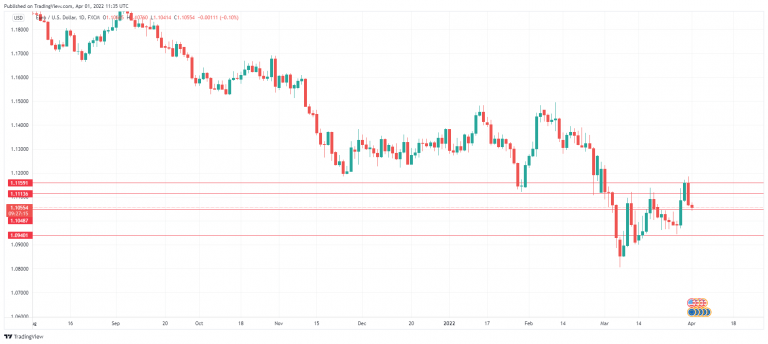
EUR/USD Technical
- There is weak support at 1.1049, followed by 1.0940
- There is resistance at 1.1114 and 1.1158
CAD in Holding Pattern ahead of NFP
The Canadian dollar has posted small gains, trading just below the symbolic 1.25 line in the European session. We could see stronger movement from the currency when US nonfarm payrolls are released later today.
The month of March has brought plenty of turbulence to the financial markets, highlighted by the Ukraine-Russia war, which shows no signs of ending anytime soon. The war has caused a massive humanitarian crisis and ruptured relations between Moscow and the West, and clearly, such a grim landscape has taken its toll on investor risk appetite.
The Canadian dollar is sensitive to risk, but gained ground in March, as USD/CAD fell by 1.28%. The currency has managed to remain in demand despite heightened risk apprehension, thanks to the Canadian economy, which is a major exporter of oil and other commodities. The ongoing surge in commodity prices has boosted the Canadian economy as well as the Canadian dollar, which earlier this week hit its highest level since November 2021.
Canada’s economy rose by a modest 0.2% in January. GDP has now expanded for the eighth month in a row, but the recovery has been hampered by the Covid pandemic. Some parts of the country are experiencing a spike in Omicron cases, which appears to be a sixth wave of Covid. If the government responds by tightening health restrictions, the move will likely dampen economic activity.
US nonfarm payrolls could affect Fed policy
All eyes are on US nonfarm payrolls, with a consensus estimate of 490 thousand jobs. There is growing talk that the Federal Reserve could resort to salvos of 50 basis points in order to contain hot inflation, and today’s release could have a significant impact on the size of upcoming rate hikes – a print of 600K or higher will bolster the arguments for that the economy is strong enough to withstand a series of 50-base point hikes.
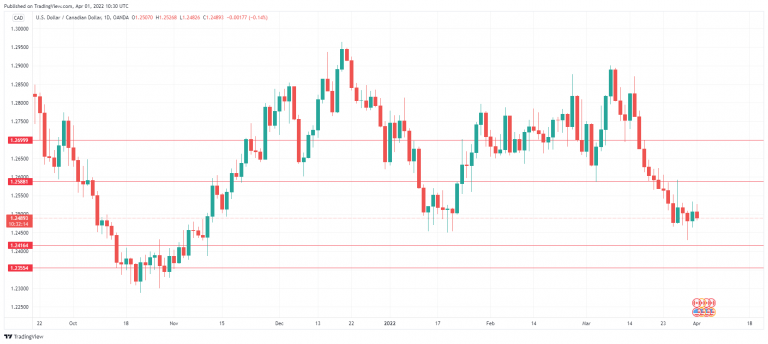
USD/CAD Technical
- USD/CAD faces resistance at 1.2588 and 1.2699
- There is support at 1.2416 and 1.2355
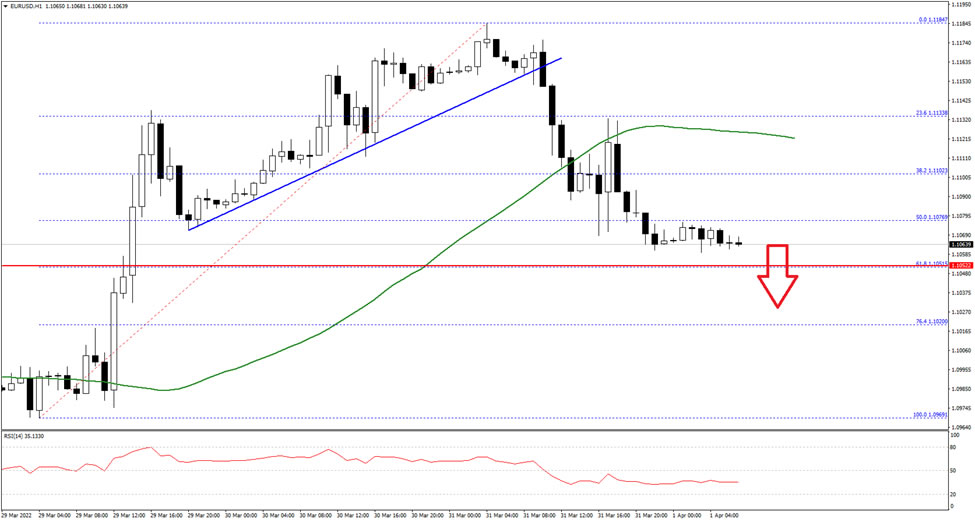
EUR/USD Pair Started a Fresh Decline from $1.1180
The Euro started a fresh decline from the 1.1180 resistance zone against the US Dollar. The EUR/USD pair declined below the 1.1120 level to move into a short-term bearish zone.
The price even traded below the 1.1100 level and the 50 hourly simple moving average. There was a break below a key bullish trend line with support near 1.1170 on the hourly chart. The pair is now trading below the 1.1080 level.
The next key support is near 1.1050 on FXOpen, below the pair could decline towards the 1.1020 level in the near term. Any more losses might send the pair towards the 1.0980 level.
On the upside, the pair might struggle near 1.1100. The next major resistance is near the 1.1120 level. A break above the 1.1100 and 1.1120 resistance levels could start a decent increase towards the 1.1170 level in the near term.
GBPJPY is Back to Gains; Broader Outlook is Bullish
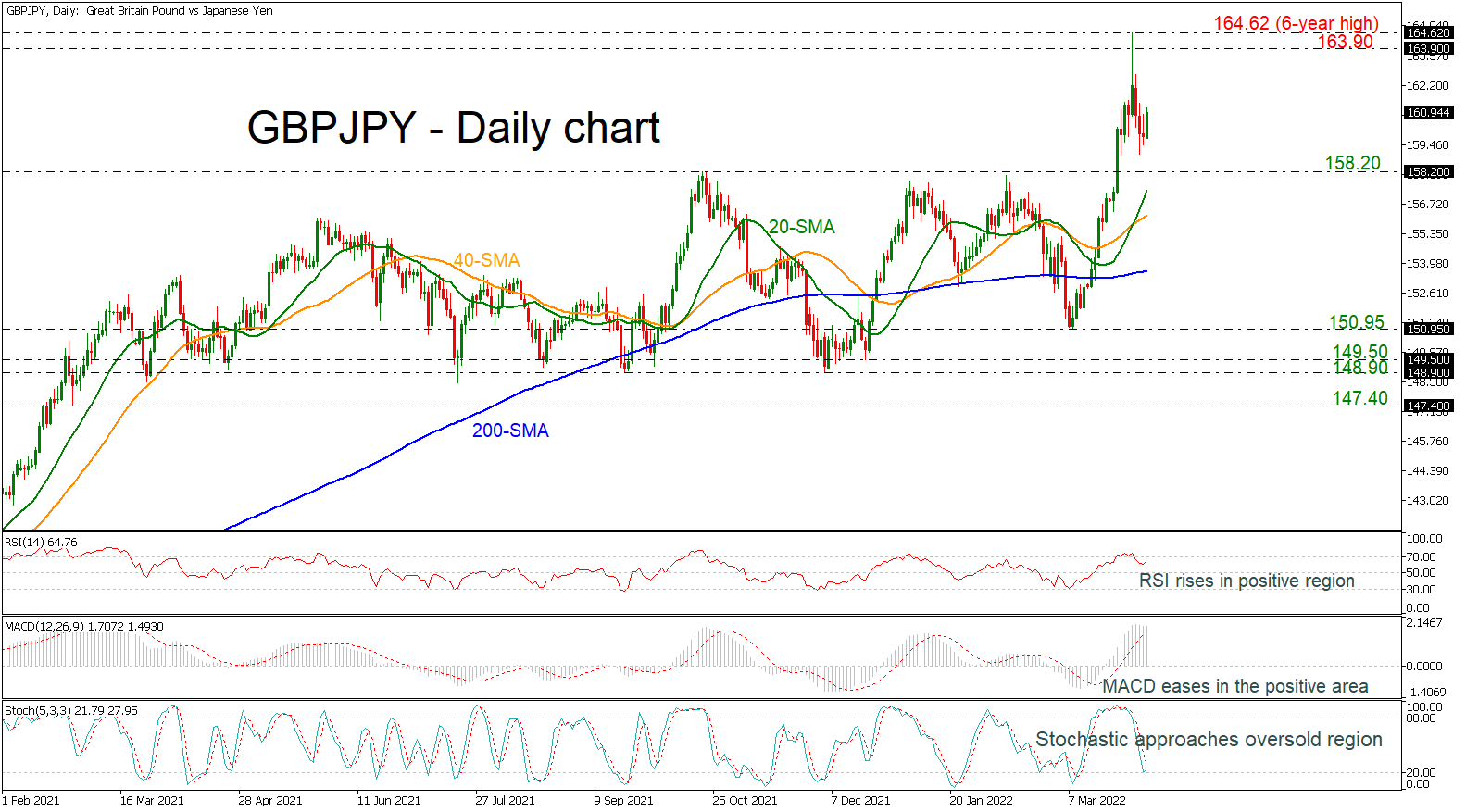
GBPJPY is gaining some ground again after three consecutive red days with the technical indicators endorsing this view. The RSI is heading up in the positive region and the MACD is looking highly elevated above its trigger and zero lines. However, the stochastic is approaching the oversold zone indicating that the next move would be to the downside.
Should an upside reversal take form, immediate resistance will likely come from the 163.90 mark, while a break higher it could meet the six-year high of 164.62. Surpassing these levels could shift the bias to a bullish one, visiting the 168.10 resistance, taken from the peak in October 2014.
If prices head lower, support should come from the 158.20 support, which was a significant barrier in the past before the jump on March 22. A drop below this level would reinforce the short-term bearish view and open the way towards the 20- and 40-day simple moving averages (SMAs) currently at 156.85 and 156.05 respectively. Even lower the flat 200-day SMA at 153.60 may halt the negative movements.
All in all, GBPJPY has turned the broader outlook from neutral to positive after the increase above 158.20.