

Sample Category Title
US initial jobless claims rose to 202k, continuing claims dropped to 1.307m
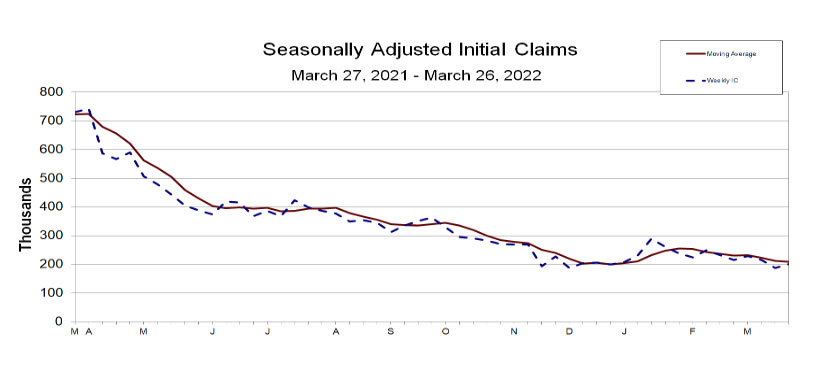
US initial jobless claims rose 14k to 202k in the week ending March 26, slightly above expectation of 200k. Four-week moving average of initial claims dropped -3.6k to 208.5k.
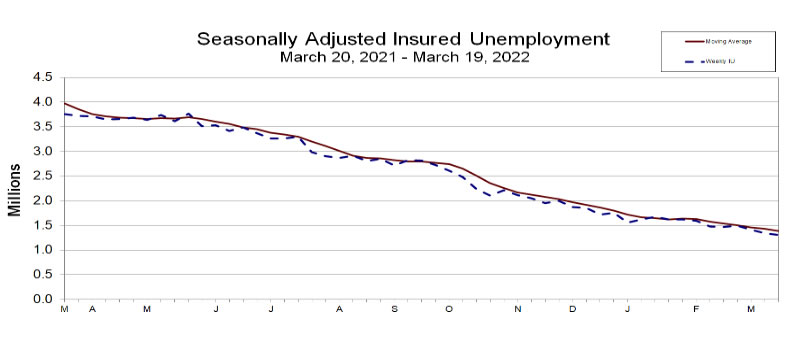
Continuing claims dropped -35k to 1307k in the week ending March 19. That's the lowest level since December 27, 1969, when it was 1304k. Four-week moving average of continuing claims dropped -41k to 1389k, lowest since February 7, 1970.
Canada GDP grew 0.2% mom in Jan, to rise further 0.8% in Feb
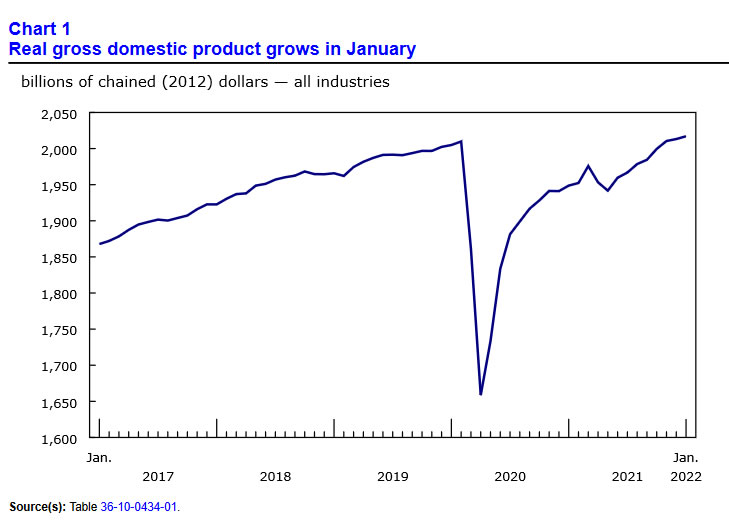
Canada GDP grew 0.2% mom in January, a below expectation of 0.4% mom. But that's still the eight month of increase in a row. Goods-producing industries grew 0.8% mom. Services-producing industries rose 0.0% mom. Overall, 9 of 20 industrial sectors increased in January.
Statistics Canada said advance information indicates an approximate 0.8% expansion in real GDP in February. Notable increases were observed in the manufacturing sector as well as in mining, quarrying, and oil and gas extraction, accommodation and food services, and construction.
US Plans to Sell Off Reserves Won’t Turn Crude Prices Around
Biden’s team has announced that it is considering releasing up to 180 million barrels of Oil from Strategic Petroleum Reserves over the next 180 days. According to the latest weekly estimate, about one-third of the existing Strategic Petroleum Reserve of just over 568M barrels.
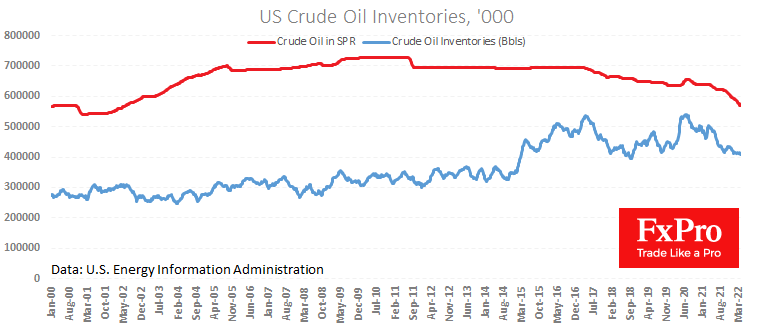
Since last September, the USA has been actively cutting this reserve, selling around 9%, with an 8% cut since October, when Biden announced coordinated market interventions with other countries to bring down the price of Oil and influence inflation.
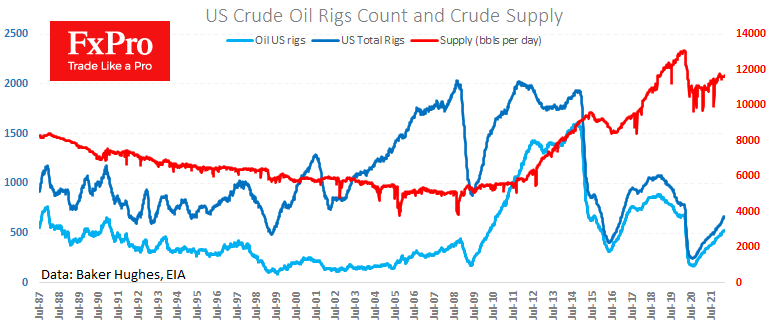
Interestingly, however, US producers are still unable to increase supply substantially. According to the latest data, production last week averaged 11.7m barrels, having been stuck near these levels for six months. But it is clear from the trend of declining commercial and strategic reserves that the US needs to produce significantly more to reverse the trend.
America is also promising to ramp up gas supplies to Europe to help it move away from Russian gas. But it is also increasing the depletion of Oil as a first gas substitute.
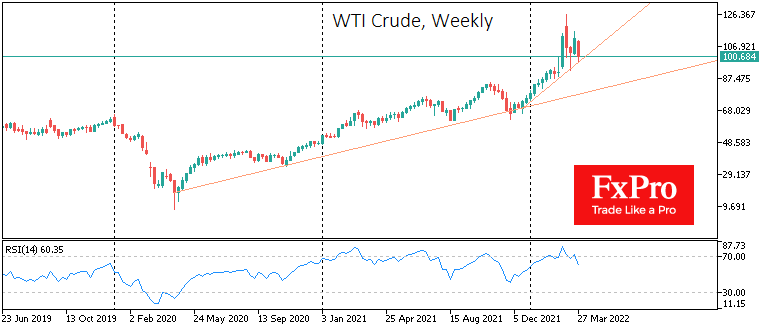
The large-scale selling looks like a broad-based measure, and the market has reacted accordingly at the moment, with WTI down 5%, testing the $100/bbl mark again.
However, such sales look like a temporary measure as they do not represent a credible long-term solution, which could be a production stimulus in both the US and OPEC countries.
At its peak in March 2020, the USA was producing 13m barrels per day, 1.3m barrels above current levels. However, it is clear to see how the pandemic has crippled the industry in the US, where production growth has slowed sharply compared to the 2011-2015 and 2017-2020 momentum.
Furthermore, it is logical to expect the US and Europe to step up efforts and offer more ‘carrots’ to OPEC and sanctioned Iran and Venezuela, which have a spare production capacity in the short term and the potential to increase production multiples in the long term.
Until then, we should expect the upward trend in Oil that emerged last December to remain in place, taking the price steadily above $120 before the end of the year.
Canadian Dollar Eyes GDP
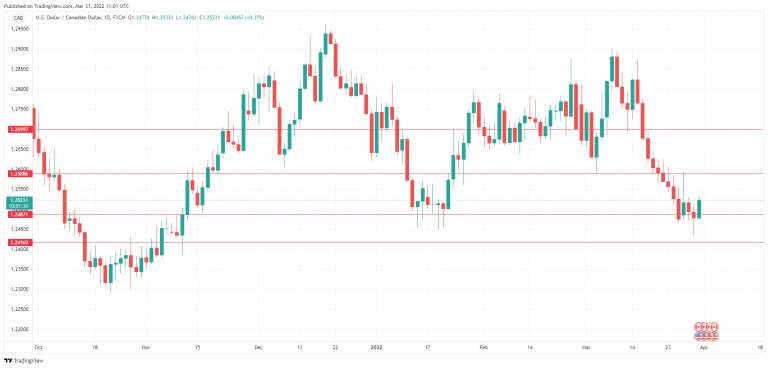
The Canadian dollar has looked sharp over the past two weeks, posting gains in 11 out of 12 days. On Wednesday, USD/CAD fell to 1.2429, its lowest level since November 2021.
What has been especially impressive about the Canadian dollar rally is that it has taken place in turbulent market conditions, where risk apprehension has been volatile. The main driver of movement in the markets has been the Russia-Ukraine war, which has killed thousands, displaced millions and ruptured relations between East and West, perhaps for years to come.
The risk-sensitive Canadian dollar has managed to gain ground in recent weeks, largely due to the surge in commodities, with the Ukraine crisis sending the price of oil and other commodities even higher. Canada is a major exporter of oil and other commodities, and the demand for these items has boosted the economy and buoyed the Canadian dollar.
Canada is likely in the midst of a sixth wave of Covid, as there are reports of an increase in Covid cases. This will likely result in health restrictions being ramped up after they were recently eased. If the restrictions continue for an extended period, economic growth for Q2 may have to be revised downwards. Later today, Canada releases GDP for January, with a forecast of 0.2% MoM, compared to the 0.0% reading in December.
ADP employment report dips, NFP next
This week’s highlight is US nonfarm payrolls, which will be released on Friday. The ADP report came in at 455 thousand, down slightly from the previous release, which was revised upwards to 486 thousand. Although the ADP is not considered a reliable indicator for the official NFP, it has nonetheless raised expectations that Friday’s NFP will be solid, with the consensus estimate at 490 thousand.
USD/CAD Technical
- USD/CAD faces resistance at 1.2588 and 1.2699
- There is support at 1.2487 and 1.2416
Yen Takes a Breather
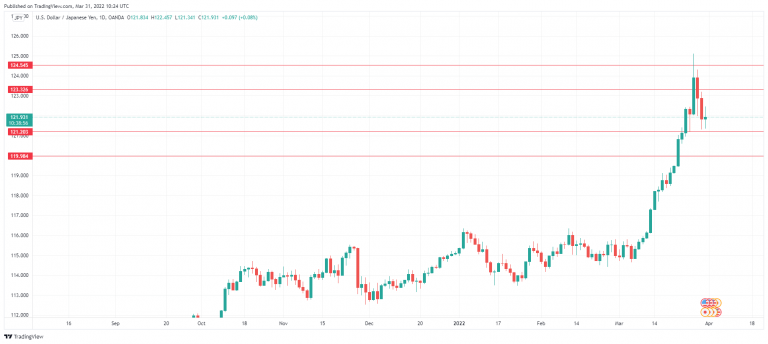
The Japanese yen has settled down after a raucous showing this week. USD/JPY is trading quietly around the 122 line in the European session.
Yen stabilizes after wild ride
The yen has steadied today, after taking investors on a roller-coaster ride this week. USD/JPY climbed 300 points at the start of the week and hit its highest level in almost six years, only to cough up all of these gains. The volatility was driven by the Bank of Japan, which made an usual move of intervening in the financial markets and pushing 10-year JGBs down to 0.22%, slightly below the Bank’s ceiling of 0.25%. The Bank made an unlimited bid on the 10-year yields for four straight days this week, underlying its commitment to its yield curve and fighting off speculators, as USD/JPY punched above the symbolic 125 line before retreating.
The yen has stabilized, but it should be noted that the currency may well have received a boost from year-end repatriation flows. These flows could quickly reverse and put downward pressure on the Japanese currency. As well, a rebound in US yields would be bearish for the yen.
The US dollar was broadly lower on Wednesday, as the markets jumped on the news that Russia announced that it was reducing troops around Kyiv. This raised expectations of a ceasefire, but once again these hopes have been dashed. It appears that Moscow is simply regrouping its forces, apparently to consolidate its grip on the eastern part of Ukraine. The fighting continues, and if risk sentiment dips, the US dollar could get a boost.
This week’s highlight is US nonfarm payrolls, which will be released on Friday. The ADP report came in at 455 thousand, down slightly from the previous release, which was revised upwards to 486 thousand. Although the ADP is not a reliable indicator for the official NFP, it has nonetheless raised expectations that Friday’s NFP will be solid, with the consensus estimate at 490 thousand.
USD/JPY Technical
- 121.21 is providing support, followed by 119.98
- There is resistance at 123.32 and 124.55
Upbeat UK data confirms GBPUSD long-term upside
On Thursday morning, another pack of upbeat statistics from the UK supports the British pound. Final GDP data for the fourth quarter showed a gain of 1.3%, revised up from the previous estimate of 1.0%. The balance of payments deficit at 7.3 bln was the lowest in 11 years.
Separately, Nationwide reported that the price of houses rose 1.1% YoY in March and accelerated to 14.3% YoY, the fastest pace since 2004. This is another factor favouring the Bank of England’s stance on tightening monetary policy to prevent the credit bubble and curb inflation from spiralling further out of control.
Such data suggests less outflow of currency from the country and points to solid fundamentals in the economy to withstand further monetary policy tightening to combat inflation, which is positive for GBP. Earlier, the Bank of England showed that it could implement policy tightening ahead of the US Fed, which is positive for the GBPUSD and suggests the potential for a sustained reversal of the pair to long-term growth.
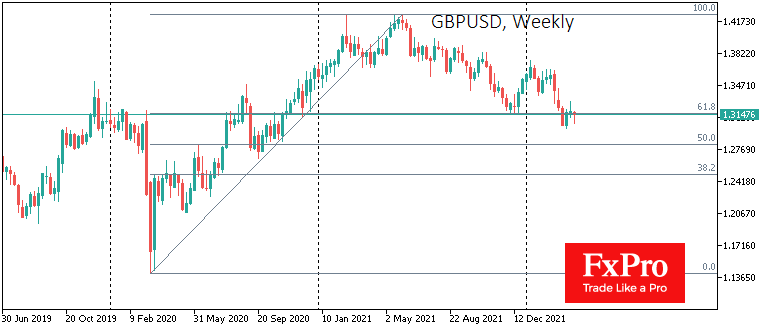
The technical picture is also on the bullish side. GBPUSD has corrected around 40% of the rally from the lows at the start of the pandemic from May 2021 to March 2022, which fits into the Fibonacci retracement. Resilience at current levels opens up the potential for further long-term strengthening to 1.6000.
AUDUSD Bullish Bearing Eases a Little, Minor Uptrend Intact
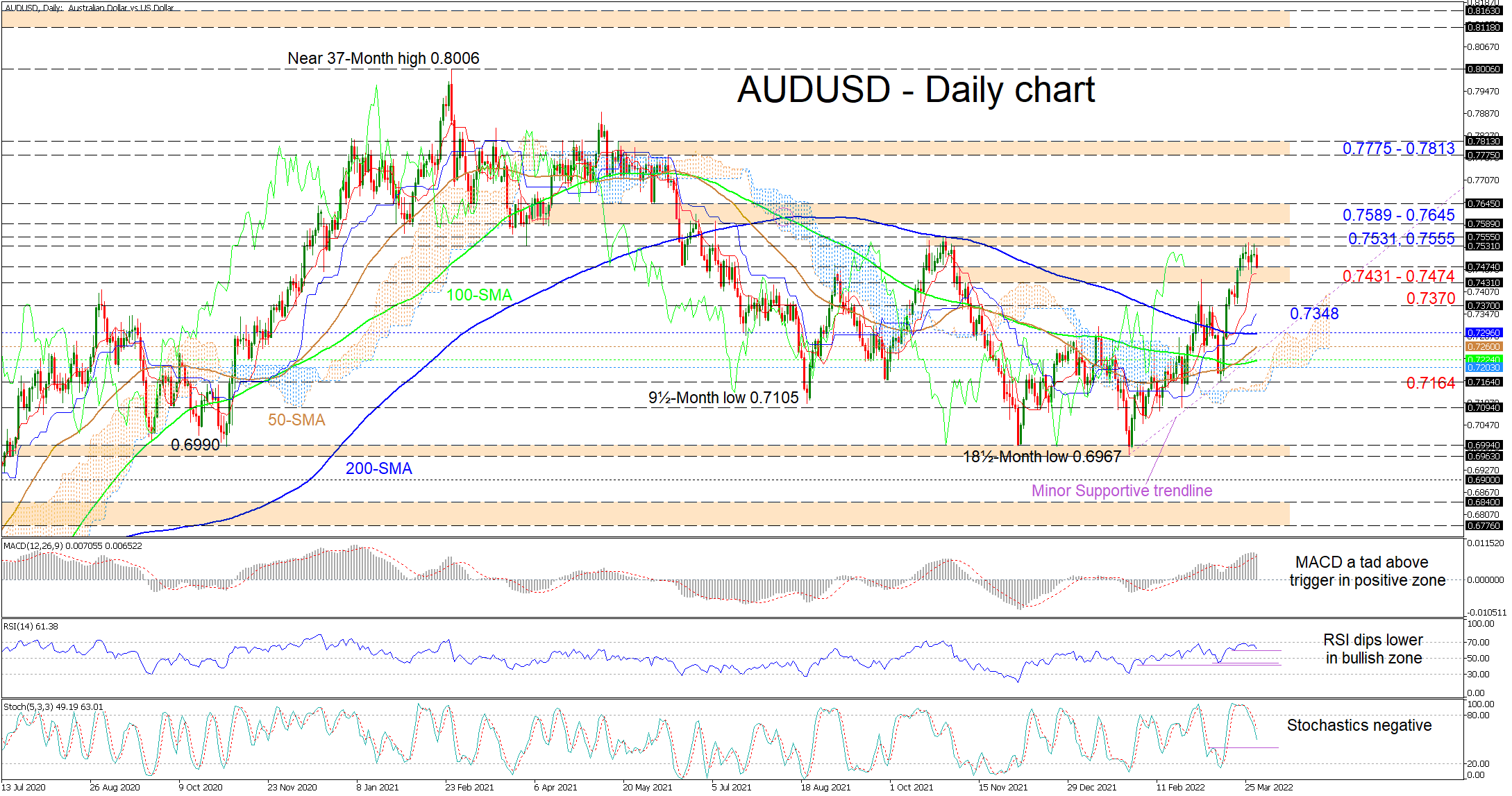
AUDUSD’s fresh pullback from the October 2021 area of highs looks to be finding support from the red Tenkan-sen line within the 0.7431-0.7474 zone (previous resistance-now-support). The steadier 200-day simple moving average (SMA) and the upturn in the slopes of the 50- and 100-day SMAs indicate that the minor uptrend, which began from the 18½-month low of 0.6967, is gradually pacing higher.
Meanwhile, the Ichimoku lines suggest positive forces are active, while the short-term oscillators reflect the latest dwindling in positive momentum. The MACD, far north of the zero mark, is easing towards its red trigger line, while the RSI is fading in the bullish region. Furthermore, the negatively charged stochastic oscillator is endorsing extra weakening in the pair.
If buyers manage to mould a foothold within the 0.7431-0.7474 zone, resistance could originate from the recently tested resistance area shaped by the October 2021 highs of 0.7531 and 0.7555 respectively. Stretching past this obstacle, the bulls may then challenge the 0.7589-0.7645 resistance border that extends back to April 2021. Overcoming these boundaries could boost optimism in the pair, cheering buyers to aim for the 0.7775-0.7813 section of highs linked to the mid-May until mid-June 2021 period.
On the other hand, if positive pressures continue to wane and the price slides below the 0.7431-0.7474 support, the next level to defend the uptrend could be the 0.7370 low. However, if downside pressures prevail, the blue Kijun-sen line at 0.7348 may try to delay the test of the 200-day SMA at 0.7296, adjacent to a possible supportive trend line pulled from the 0.6967 low. From here, the bears may struggle to overpower the support section from the 50-day SMA at 0.7260 until the Ichimoku cloud’s floor at 0.7203. That said, if sellers overpower this fortified area, the 0.7164 trough could come under attack.
Summarizing, AUDUSD is exhibiting a sturdy bullish bearing above the 0.7370 trough and the SMAs. Upside momentum may ramp up with a climb in the price beyond the 0.7589-0.7645 barrier, while an initial dive below the 0.7431-0.7474 support, could trigger concerns whether the March 15 trough of 0.7164 would stand steadfast against a deeper retracement in the pair.
Eurozone unemployment rate dropped to 6.8% in Feb, EU dropped to 6.2%
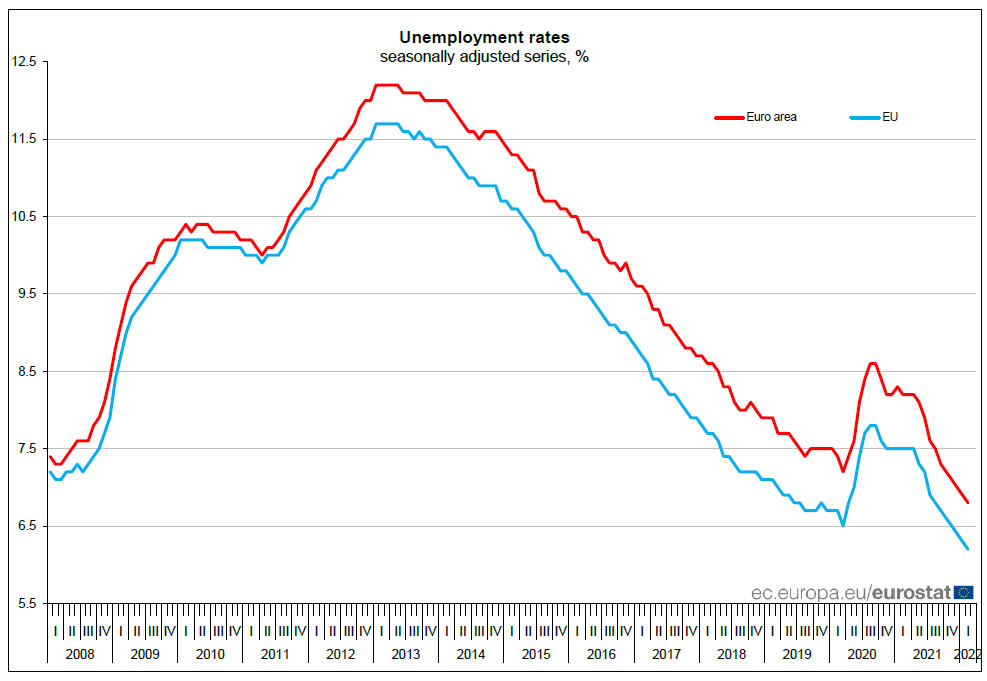
Eurozone unemployment rate dropped from 6.9% to 6.8% in February, above expectation of 6.7%. EU unemployment rate also dropped from 6.3% to 6.2%.
Eurostat estimates that 13.267 million men and women in the EU, of whom 11.155 million in the euro area, were unemployed in February 2022. Compared with January 2022, the number of persons unemployed decreased by 221 000 in the EU and by 181 000 in the euro area.
Cable (GBP/USD) Eyes Lower: Elliott Wave Analysis
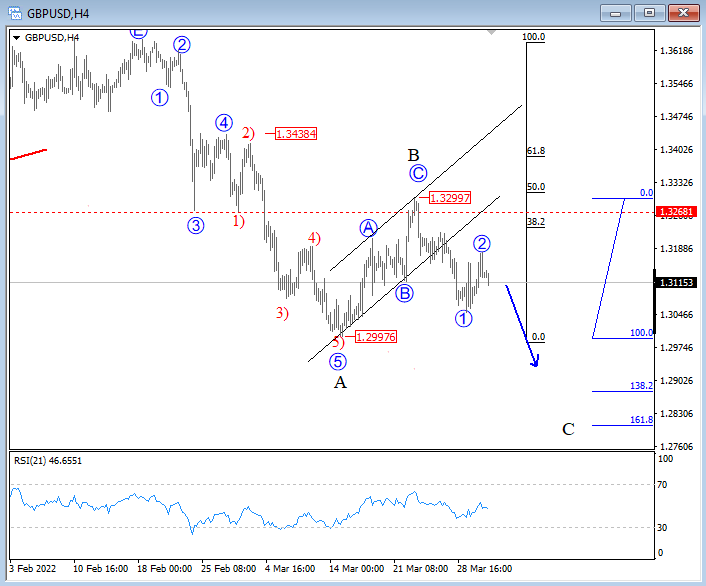
Cable, GBPUSD has been recovering as expected, with three waves up in wave B on 4h time frame which found a resistance later at 1.3268. So far we can see a nice sell-off below the trendline support of a corrective channel which is an indication of more weakness in sessions ahead. Ideally, wave C is now underway down to 1.28-1.29 area.
GBP/USD 4h Elliott Wave analysis
ECB Lane: Important for optionality to be two-sided
ECB Chief Economist Philip Lane said in a speech, "the Governing Council sees it as increasingly likely that inflation will stabilise at our two per cent target over the medium term". Under this pathway, 'the degree of monetary policy stimulus put in place to address the pre-pandemic challenge of persistent below-target inflation can be normalised in a gradual fashion towards a more neutral setting."
"In current conditions, it is especially important to remain data-dependent and for optionality to be two-sided," he said. "On the one side, we should ensure that our policy settings are adjusted if de-anchored inflation expectations, an intensification in catch-up wage dynamics or a persistent deterioration in supply capacity threaten to keep inflation above target in the medium term."
"On the other side, we should also be fully prepared to appropriately revise our monetary policy settings if the energy price shock and the Russia-Ukraine war were to result in a significant deterioration in macroeconomic prospects and thereby weaken the medium-term inflation outlook."