

Sample Category Title
SPR Rumours Send Oil Lower
Biden expected to release oil from reserves
Asian markets are being dominated today by the news that US President Biden is apparently considering a material release of oil from its strategic petroleum reserves (SPR), which could total a million barrels a day and potentially total 180 million barrel. That is roughly 1/3rd of the total SPR. WTI has immediately dropped by around 5.0%, with Brent crude not far behind.
Depending on who you talk to, the amount of Russian crude sanctioned from international markets now is around 3.5 million barrels. If the US releases a million barrels a day over the next six months, and OPEC+ continues hiking by 400,000 bpd in that time frame, the output gap will have considerably narrowed by the US mid-term elections. How convenient.
Of course, OPEC being OPEC, it may not be that simple. The OPEC+ Joint Technical Committee (JTC) has just announced the immediate firing of the International Energy Agency (IEA) as their secondary data source, replacing them with Wood Mackenzie. I’m not sure what to read into that, but I suspect firing the IEA is positive news on the international relations front between OPEC+ and the US.
The ministerial meeting this week should announce the 400,000 bpd increase will go ahead, but if the US measures materially assist in market rebalancing over the coming months, OPEC+ may respond. The Game of Thrones has nothing on the plot twists of international oil. Another plot twist is emanating from New Zealand of all places, perhaps the world’s greatest energy NIMBYs. The energy minister said that the IEA members as a whole could announce a coordinated SPR release at its meeting on Friday. Perhaps that’s why they just got fired by OPEC+?
My initial reaction is that the Biden plan, if correct, could put a cap on international oil prices but will likely see the Brent/WTI spread widened. It will not immediately change the structural deficit caused by Russian sanctions. Therefore, although oil prices may have seen their highs since the rent-a-crowd all started calling for USD 200 oil, we shouldn’t pin our hopes on oil moving to the low 80s. 100 dollars to 120 dollars for Brent crude still sounds about right. Of course, OPEC+ may yet have something to say on the matter. And although President Putin has allowed energy payments in euros to continue for now instead of roubles, we definitely haven’t seen the last of that story.
With oil politics giving me a headache, it’s time to look at this morning’s slew of Asian data releases. China’s official Manufacturing PMI eased from 50.2 to 49.5 in March. The Non-Manufacturing PMI for March slumped from 51.2 to 48.8. The headlines made for ugly reading but the impact on China equity markets has been minimal. The city lockdowns and mass testing by Chinese officials in March have clearly distorted the data and China will get a pass mark this month because of that. Things will get darker if China’s Covid-zero policy sees much wider spread and extended lockdowns. We are not there yet.
South Korean Business Sentiment, unsurprisingly, retreated to 83 in March, but Industrial Production and Manufacturing for February beat expectations handsomely, rising 6.50% and 6.20% YoY respectively. Retail Sales also clung to positive territory. Semiconductors and electronics led the charge and demand remained relatively immune to geopolitical ructions internationally. Japan’s Industrial Production eased to 0.10% for February, likely impacted by earthquakes. Meanwhile, Singapore Bank Lending in February rose to SGD 829.5 bio. All in all, Asia continues to show resilience despite the Ukraine war, with the data being moved by national events and not international ones, for now. It won’t be enough to set off a bull market in Asian equities, but it certainly isn’t a reason to dump them.
Probably the most concerning data are from Australia. Private Sector Credit rose slightly to 7.90% in March YoY, but preliminary Private House Approvals MoM for Feb soared by 16.50%. Preliminary Building Permits MoM for Feb meanwhile, jumped by a mind-boggling 43.50%. This is despite extensive flooding in parts of the country, or perhaps because of it. Either way, Australian interest rates are near record lows, lending is increasing, and a building boom is occurring. The pressure is going to seriously mount on the RBA’s ultra-dovish stance after this data set.
The pan-Europe unemployment data will have a minimal impact this afternoon. If the Russian situation bites deeper in the months ahead, it will become more important. US Personal Income and Spending for Feb are expected to rise by 0.50%. The headline and Core PCE Indexes could rise by near 6.0%, probably sending Fed hiking jitters through the market again. US yields fell once again overnight, but that may be a temporary lull.
Tomorrow, we get Japan’s Tankan Survey and China’s Caixin Manufacturing PMI along with Eurozone Inflation. Then follows the week’s data highlight, US Non-Farm Payrolls interspersed with ISM Manufacturing. Markets are looking for a jobs gain of 490,000 after last month’s blockbuster 625,000 gain. Trading in the immediate aftermath of the Non-Farm’s is a good way to lose money I’ve found; I shall content myself to watch from the sidelines.
WTI Oil Futures Face Another Failure, But Keep Eyes on 98.50
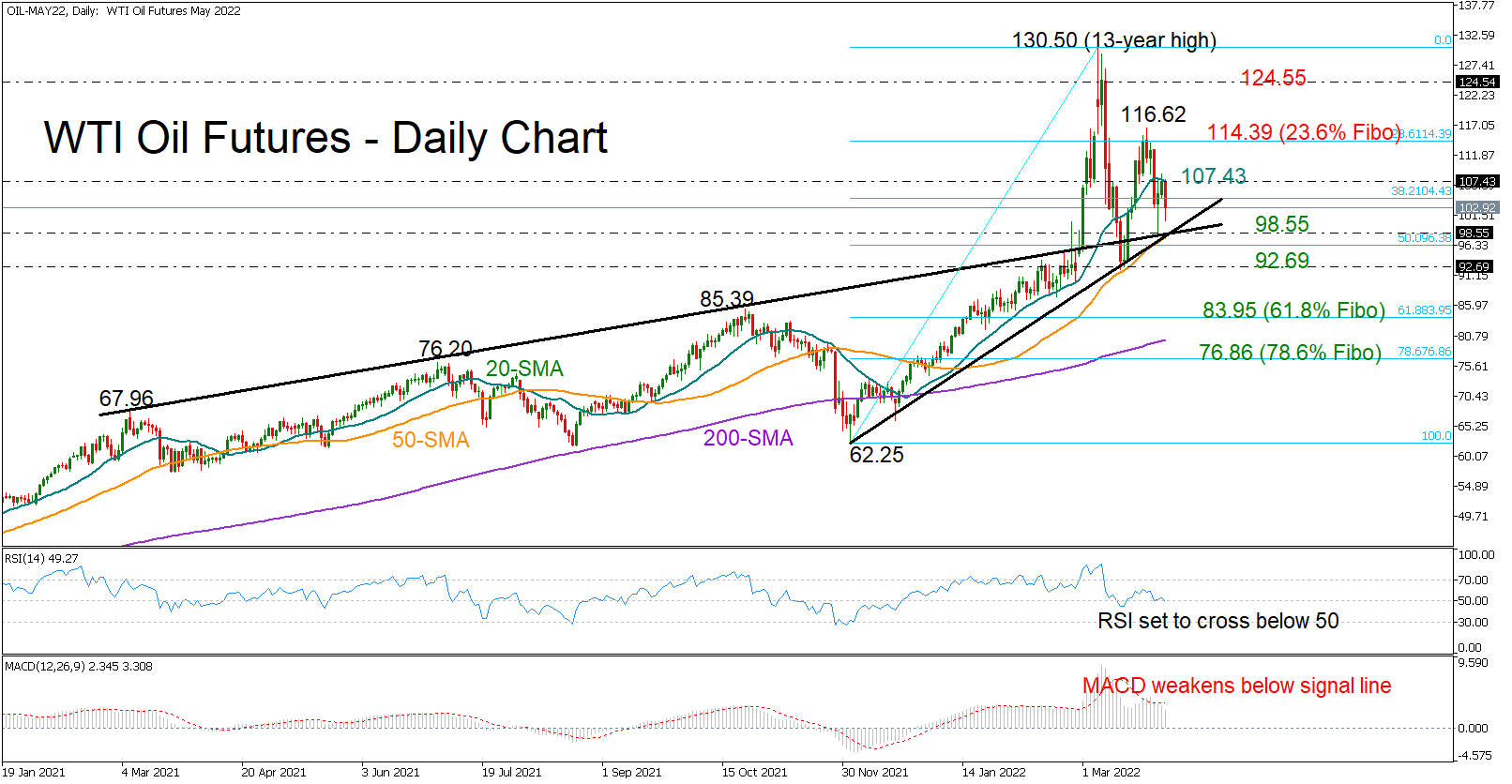
WTI oil futures (May delivery) retreated towards the 100 level early on Thursday after a strong rejection from the 20-day simple moving average (SMA) at 107.78.
The sharp rebound off 92.19 in mid-March did not drive the black gold back to the 13-year high of 130.50, with the market creating a lower high at 116.62 instead. That said, the market is still set for a bullish monthly close.
Technical signals are not encouraging either as the 20-day SMA looks to be pivoting to the downside. Likewise, the RSI and the MACD have resumed a negative slope, with the former set to cross below its 50 neutral mark and the latter decelerating below its red signal line.
Despite the technical discomfort, traders may wait and see whether the bears can push the price below December’s key ascending trendline at 98.55. The resistance line, which was active from March 2021 to February 2022, is passing through the same location, making any violation important to watch. In case that base collapses, the price could retest the support region of 92.69. Any violation at this point would ruin the positive trend in the market, likely squeezing the price towards the 61.8% Fibonacci retracement of the 62.25 – 130.50 upleg at 83.95. Slightly lower, the 200-day SMA may attempt to pause the sell-off ahead of the 78.6% Fibonacci of 76.86.
In the event the trendline puts brakes to the bearish action, a bounce above the 20-day SMA could be a prerequisite to revisit the 23.6% Fibonacci of 114.39 and the previous high of 116.62. Beyond the latter, the door would open for the 124.55 number, which the market could not successfully claim earlier this month, while higher all eyes will turn to the 130.50 top.
In brief, WTI oil futures have been showing some fragility since the peak at 130.50 earlier this month. The short-term bias is currently viewed as neutral-to-bearish, but sellers may not take the upper hand unless the price tumbles below 98.50.
Dow Jones and Nasdaq 100 Strong Comeback Paused
American stocks declined on Wednesday over concerns about energy and the ongoing crisis in Ukraine. The Dow Jones declined by about 100 points while the Nasdaq 100 fell by 248 points. The main concern is that the crisis will continue despite the positive comments from negotiators on Tuesday. Russia continued shelling cities in the eastern side of the country while experts warned that the country was regrouping. Lululemon was among the best performing stocks after the company published strong quarterly results. Cannabis stocks like Tilray and Aurola also did well as investors watched ongoing legislation in Congress.
The price of crude oil rose in the overnight session on fears of a prolonged crisis in Ukraine. The price also reacted to the latest inventories data from the United States. According to the Energy Information Administration (EIA), the number of inventories declined by over 3.44 million barrels last week. The decline was bigger than the median estimate of 1.022 million barrels. It was also the second straight week that the sector saw a drawdown. Oil prices rose on concerns about shipments from Russia after the country insisted that it will only be paid using rubles.
The Australian dollar was little changed after the latest economic data from Australia and China. The Australian Bureau of Statistics published strong building approvals and housing starts data. As a result, investors are now focusing on the upcoming RBA meeting for clues on when it will start hiking interest rates. Later today, the Office of National Statistics will publish the final reading of UK GDP data. Based on the initial estimates, analysts believe that the economy expanded by 6.5% in Q4. The other important data will be the latest German unemployment rate and the US PCE numbers.
EURUSD
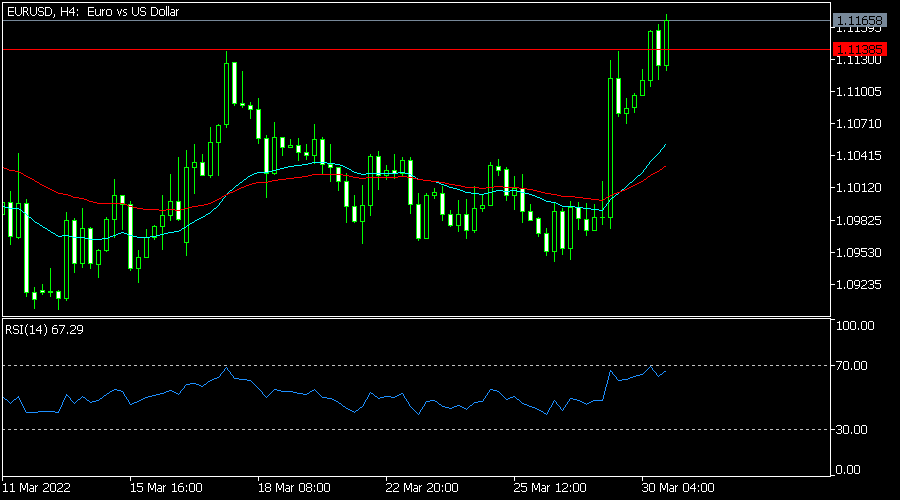
The EURUSD pair moved above the key resistance level at 1.1138, which was the highest level since March 17th. The price is slightly above the 50% Fibonacci retracement level. The bullish view is also being supported by the 25-day moving average while the Relative Strength Index (RSI) has been in an upward trend. Therefore, there is a possibility that it will keep rising today.
USDJPY
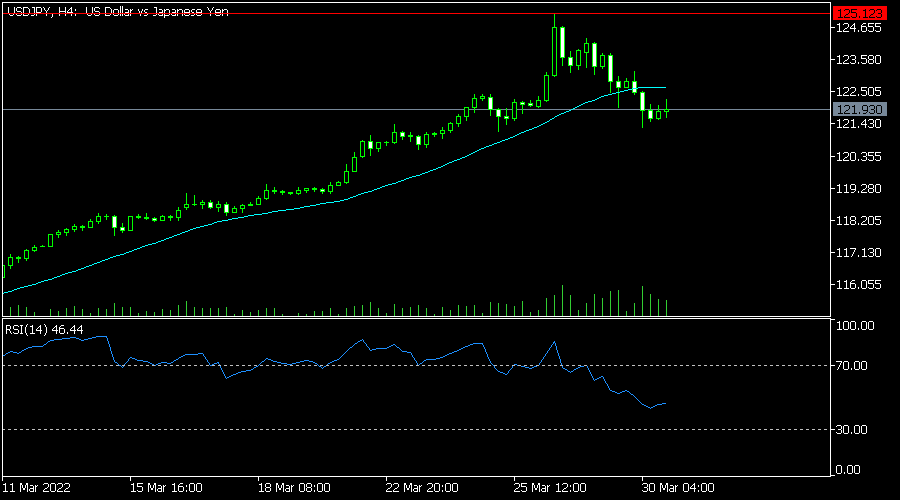
The USDJPY pair was little changed on Thursday morning. It is trading at 121.91, which is lower than the year-to-date high of 125.12. It has managed to cross the 25-day MA, signaling that bears are in control. Also, the Relative Strength Index (RSI) has been pointing lower while the pair has formed a bearish flag pattern. Therefore, there is a possibility that it will keep falling as bears target the next key support level at 120.
USDZAR
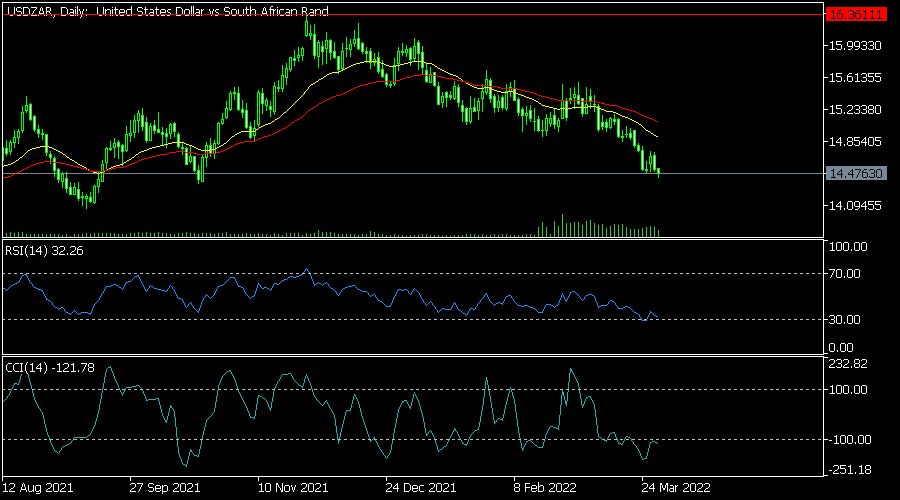
The USDZAR pair continued its downward momentum as the South African rand strength continued. It fell to the lowest level since August last year. It has declined sharply from its November high of 16.36. It has dropped below the 25-day and 50-day moving averages while the Commodity Channel Index (CCI) has moved to the oversold level. Therefore, the pair will likely keep falling.
FX Markets Took Aim at the Dollar
Markets
Rising energy prices after Germany initiated the first of its three-phased emergency plan and red hot European inflation prints from Belgium over Germany to Spain smacked German bunds in real Will Smith style. Short-term yields at some point rose 11.5 bps (2y). The rise was mainly driven by inflation expectations (new 14y high in the 10y). Net changes eventually amounted to 1.3 bps (10y) to 5.5 bps (2y), still underperforming USTs. The American yield curve bull steepened, changing -2.6 bps (30y) to -6.8 bps (3y) during a risk-off session (equities lost 1% amid fading hopes of a de-escalation). Some end-of-quarter repositioning may also have been at play after experiencing the worst month for core bonds in decades.
FX markets took aim at the dollar. The greenback slid vs all major peers. A good euro performance at the same time allowed EUR/USD escape the bullish triangle and finish above first resistance of 1.1121. It already tested the next one too around 1.117 but closed just below at 1.116. EUR/GBP extended its recent ascent to beyond the resistance level of 0.847 that marked the lower bound of the 2021 sideways trading range. The mixed core bond performance, a fragile risk sentiment and technical trading supported JPY, especially against the dollar. USD/JPY eased further to 121.83 only to reverse course to 122.25 this morning even as Japanese officials, especially in government circles, are growing more vocal on the yen. Chief cabinet secretary Matsuno this morning said he is closely watching the FX impact on the economy, adding that rapid forex fluctuations are not desirable. The Chinese yuan is holding steady near USD/CNY 6.35 despite declining economic activity (see below). In a broader perspective, the yuan trades remarkably strong given growing monetary policy divergence. EUR/USD and core bonds trade unchanged, equity markets are mixed. Oil slips on the headline detailed below.The Fed’s preferred inflation gauge, PCE deflator, is due in the US today after the CPI measure was released earlier this month. France and Italy will print above-consensus inflation numbers ahead of the EMU figure tomorrow. From a technical point of view, US and especially European rates (German 10y 2018 high at 0.80%, 10y swap yield 2015 high at 1.37%) still have upward potential. The euro is alive and kicking after yesterday’s technical breaks vs the USD and GBP. EUR/USD is testing 1.1186 resistance (Nov 21 low). EUR/GBP tries to overcome the 0.85 big figure .
News Headlines
Activity in the Chinese economy as measures by the official PMI’s contracted in March. All three indices dropped below the 50 level that separates growth from contraction. The manufacturing measure declined from 50.2 to 49.5. Most activity related sub-indicators including output, new orders and employment remained or stayed below the 50 mark. At the same time, price indictors continue to rise. Contraction was mainly reported by medium and small enterprises. The non-manufacturing measures also slipped further into negative territory from 47.6 to 45.7. The indices published today probably don’t capture the full impact of the new lockdowns that were imposed in cities like Shanghai. The composite index dropped from 51.2 to 48.8. Despite recent signs of economic weakness, a state council meeting yesterday confirmed that the government maintains its aim to reach about 5.5% growth this year. In this context, the PBOC yesterday reiterated its commitment to support the economy and to try to improve the transmission mechanism of monetary policy.According to sources, the US administration is working on a plan to release over the coming months up to 180mln barrels of oil from its Strategic Petroleum Reserve (about 1mln p/d) in an attempt to cap recent sharp rise in prices. The plan might be revealed later today. It would be the third attempt of the US to try to control oil prices via the release of reserves. The Brent oil price overnight eased from $112+ to $108 p/b. Later today OPEC+ also will decide a further reduction of production cuts. However, sources suggest that OPEC will hold to a gradual output hike. The precious months OPEC+ raised production targets by 400 000 barrel p/d. For May a slightly higher hike of $432 000 b/d might be on the cards.
Daily Technical Analysis
EUR/USD
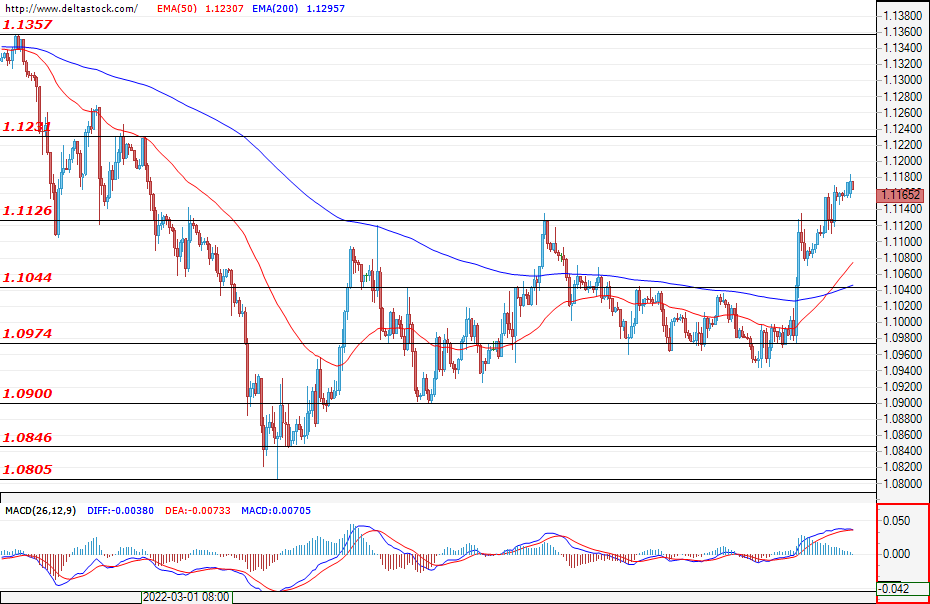
The single European currency managed to overcome and stay above the important resistance at 1.1126. The expectations for today's session are rather positive – for a move towards the next level of resistance at 1.1230. The alternative and less likely scenario is for the bears to manage to overcome the level of support at 1.1126, which should help them bring the pair towards their next goal at 1.1044. In the absence of new developments around the war in Ukraine, we are unlikely to see more significant movements in the currency pair until the release of the important economic data for the United States – the initial jobless claims data (today; 12:30 GMT) and the unemployment rate and non-farm payrolls reports to be released on Friday.
USD/JPY
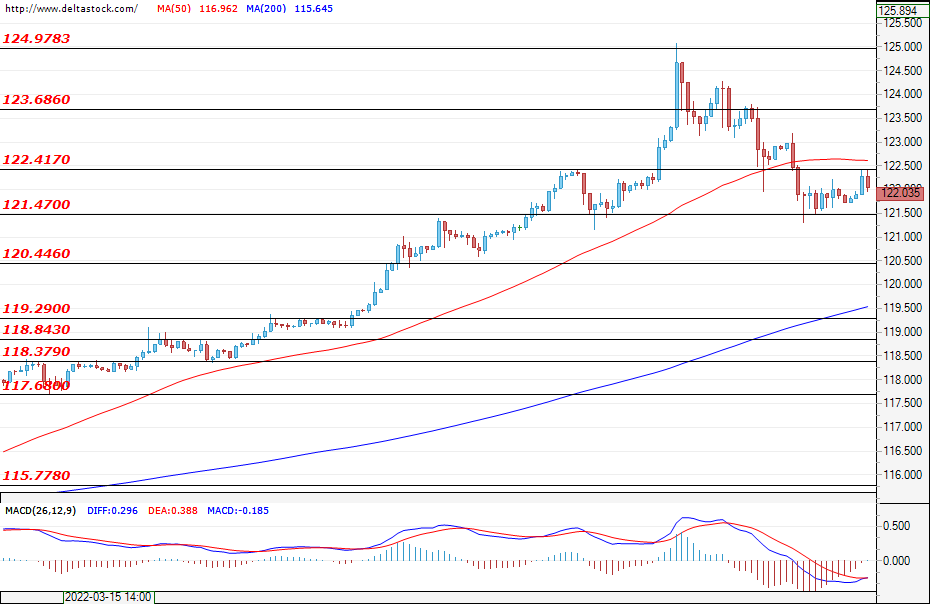
During the last session, there was a consolidating movement of the currency pair between the support level at 121.41 and the resistance level at 122.47. This shows that the corrective phase, in which the pair is currently in, may be coming to an end. A successful breach of 122.47 can be considered a signal that the bulls are regaining control and that the upward trend is resuming. However, if the support at 121.41 is overcome, then this could be considered a deepening of the correction towards the zone at 120.45 and could end the upward trend.
GBP/USD
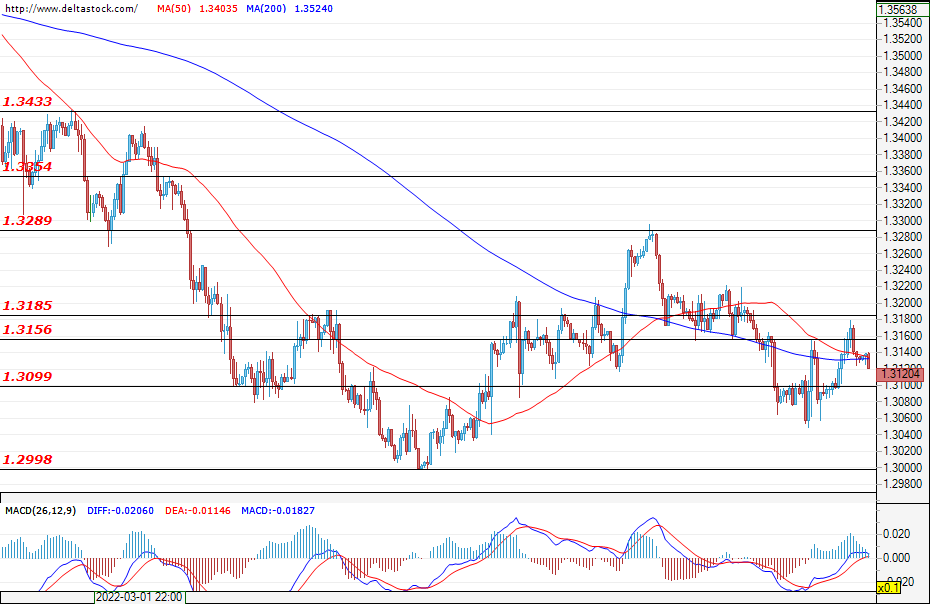
During the last session, the Cable failed to overcome the resistance at 1.3185 and the pair is likely to return to the lower level of the range – the support at 1.3050. A likely signal that the buyers may return to the market would be a new test and a breach of the resistance at 1.3185. If this does not happen and the important supports at 1.3050 and 1.2997 are overcome, then we could observe a deepening of the downward movement towards the next support zone at 1.2854, as seen from the higher time frames.
EUGERMANY40
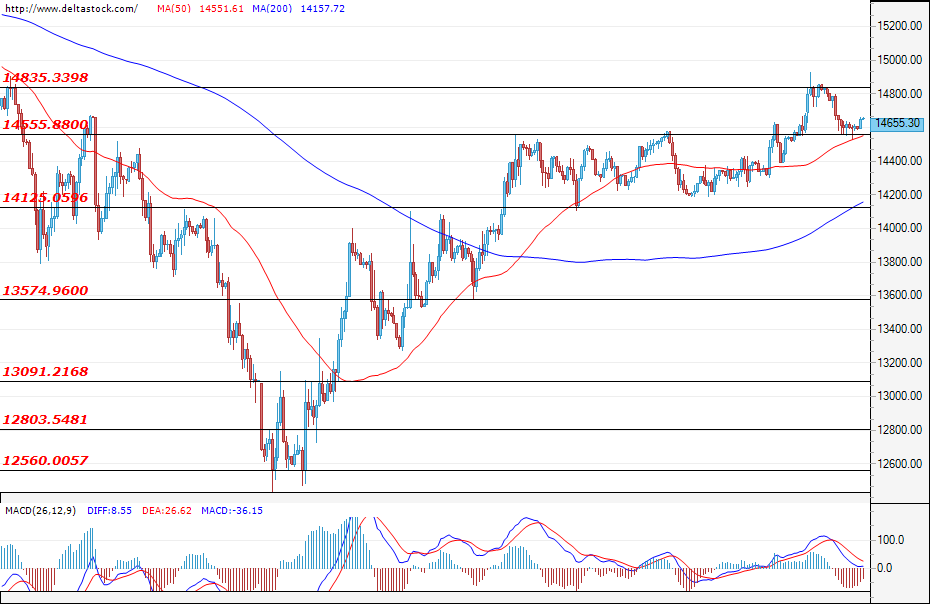
The recovery of the German index during the last session was suspended due to news regarding the disagreement over the payment of natural gas supplies between Russia and the European Union. Despite the negative market sentiment, the support zone at 14555 was unsuccessfully tested twice. This shows that, at least for the moment, the bulls have the necessary resources to withstand the bearish pressure and can direct the price towards the resistance at 14832. An alternative scenario would be a successful breach of the support at 14555, which would nudge the price towards the zone at 14135.
US30
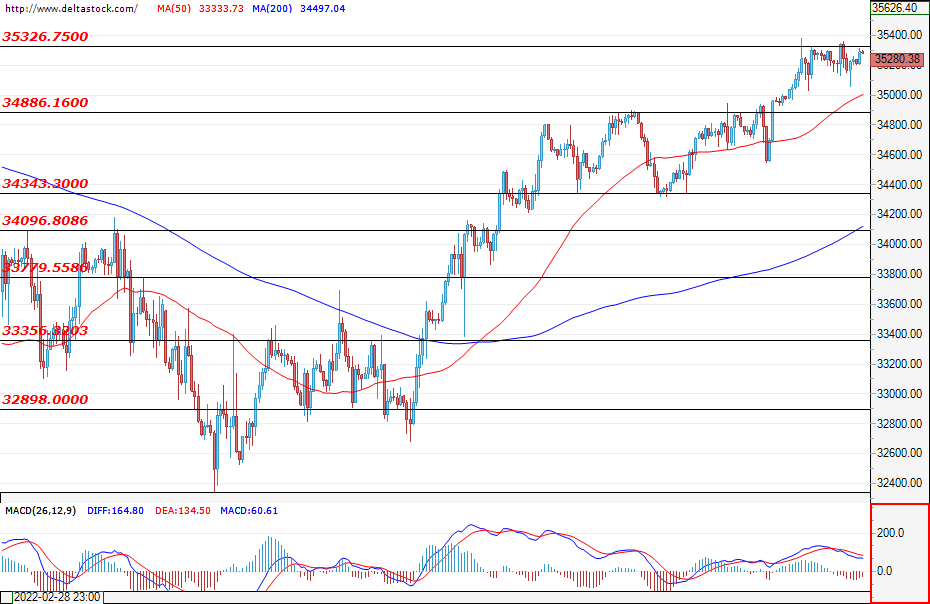
The past trading session was rather calm for the U.S. blue-chip index. Although its upward movement was halted by the resistance at 35326, its price has so far managed to consolidate above the support at 34890. A signal that the bears may return to the market and stay there for a longer period would be the violation of the support at 34343. However, a more likely scenario is for the important resistance at 35326 to be successfully overcome and for the bulls to consolidate their control over the market.
US Oil Bounces off Psychological Level
WTI crude rallies as the EIA shows a larger-than-expected fall in inventories.
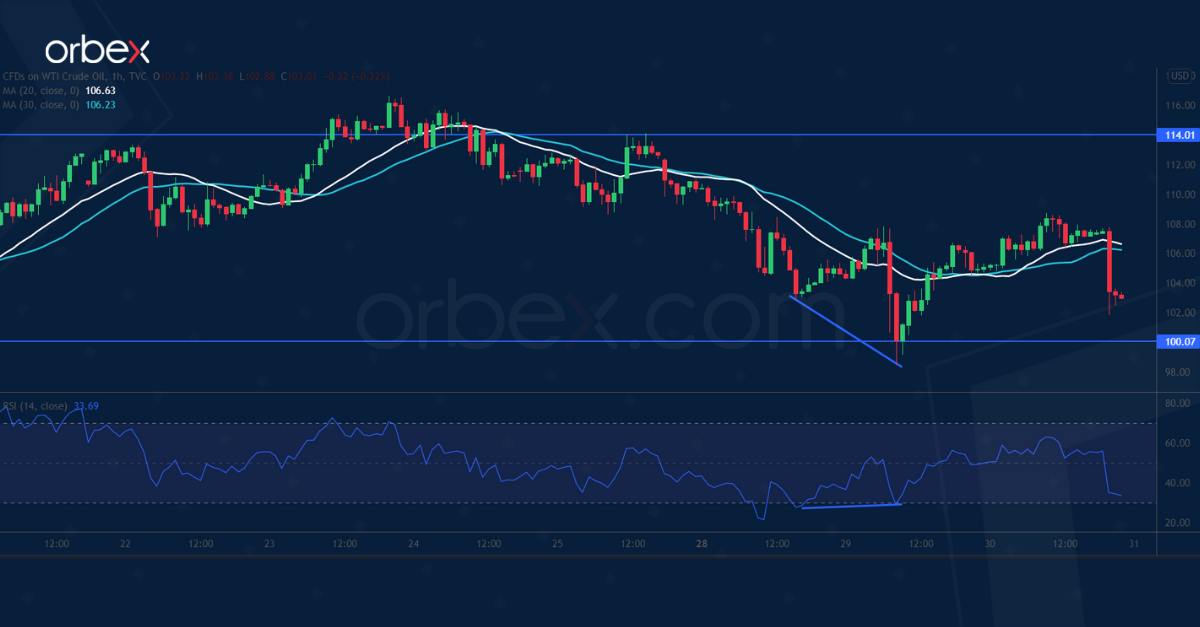
The price saw solid support in the demand area between the psychological level of 100.00 and the 30-day moving average (103.00). A bullish RSI divergence in this congestion zone suggests a loss of momentum in the retracement.
A follow-up close above 107.00 would prompt sellers to cover, easing short-term pressure in the process. 114.00 is the next resistance and a breakout could lift offers to 129.00. 94.00 is a critical support to keep the rally intact.
USD/CAD Breaks Daily Support
The Canadian dollar inched higher on expectations of aggressive tightening by the Bank of Canada.
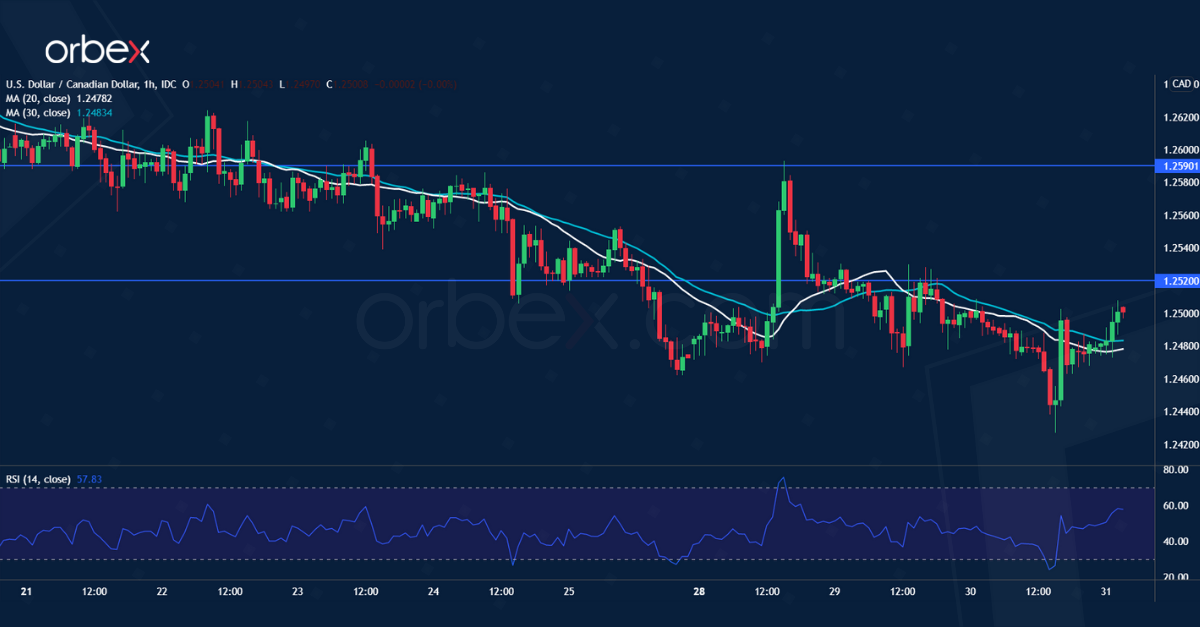
The US counterpart has given up all its gains from earlier this year. In turn, this indicates a lack of commitment from the buy-side. A tentative rally above 1.2590 has failed to secure follow-ups, further undermining the US dollar.
1.2400 is the next target after a drop below 1.2450 and a deeper correction would send the price to October’s lows around 1.2300. A rebound could be capped by fresh resistance at 1.2520.
EUR/USD Attempts Reversal
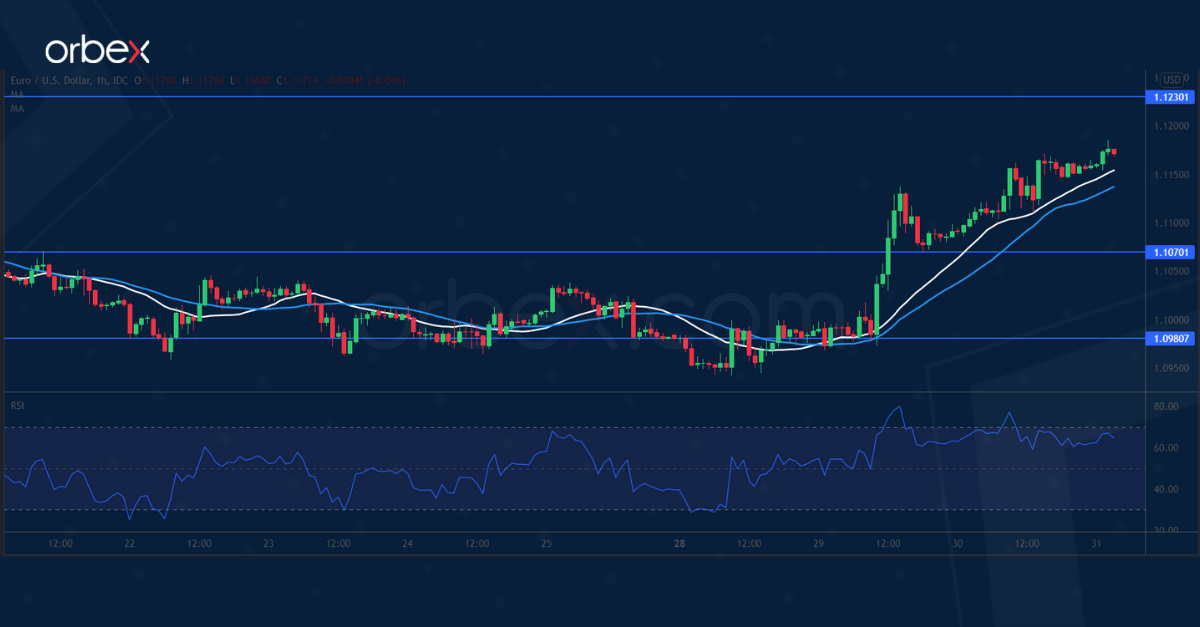
The US dollar weakened after the Q4 GDP failed to impress. The euro gained momentum after it broke above 1.1130 which sits next to the 30-day moving average.
1.1230 at the origin of the March sell-off is a major resistance where medium-term sellers might be waiting to double down. Further pressure could be expected if intraday buyers take profit as the RSI shows a double top in the overbought area.
1.1070 is a fresh support. 1.0980 at the base of the current breakout is an important level to safeguard the rebound.
Research Russia-Ukraine: Talk is Cheap – We Expect No Immediate Breakthrough in Peace Talks But Market Focus to Shift...
Despite the prevailing optimism, we think it will take weeks, probably months, before any peace deal between Russia and Ukraine can be achieved. The devil is in the details and many details remain open. The key questions relate to security guarantees proposed by Ukraine, its neutrality status and the destiny of Crimea and Russian-occupied territories in Eastern Ukraine.
Any peace deal is likely to be placed under a referendum in Ukraine, and in the context of rising patriotism, we do not think the Ukrainian public is ready for any substantial concessions to end the war yet. Instead, they want to win the war.
Hence, we think the war will drag on as the peace talks are protracted. However, in the absence of escalation outside Ukraine, market focus will increasingly focus on other topics: tighter financial conditions, high inflation and recession risks.
Optimism around the peace talks between Ukraine and Russia is gaining ground. The negotiating delegations met face-to-face on Tuesday 29 March for the first time in two weeks and are due to continue talks albeit that the exact date for the next round of talks has not been set yet. According to Russia, the talks have been constructive, and according to the Ukrainian aide, time could soon be ripe for the two presidents to meet. Despite the prevailing optimism, we do not expect any immediate breakthrough. Rather, it is likely to take at least weeks, probably months, before any agreement could be made.
Ukraine has said it could give up its aspirations to join NATO if it received security guarantees from third parties. While Ukraine dropping its ambitions to seek NATO membership would likely satisfy Russia, we are not convinced it is plausible for Ukraine to receive such guarantees. Ukraine could seek security guarantees from the US, the UK, China, Turkey, Israel or some of the larger European countries. Under the Ukrainian proposal, guarantor countries would have to consult each other within three days after the beginning of any military aggression or hybrid war. After consultations, the guarantor countries would have to provide Ukraine troops, weapons and protection over Ukraine's airspace. As we have seen no evidence of third-party guarantees being prepared, and particularly as the US has not supplied troops or weapons to Ukraine and NATO has consistently rejected Ukraine's request for a no-fly-zone, we are sceptical whether third countries would have motivations for providing such guarantees.
The current draft proposal also includes provisions for Crimea and Donbass region. Under Ukraine's proposal, the question of Crimea would be frozen for 15 years, during which Ukraine would hold negotiations with Russia on the status of the region. The status of Russian-occupied Luhansk and Donetsk regions is proposed to be discussed in the meeting between the presidents. Media reports with regards to Ukraine's willingness to make any territorial concessions have been mixed. In any case, we do not see how Russia could spin the results from its 'special operation' as a win domestically without gaining control over at least the regions in Eastern Ukraine. Hence, we see a deal without any territorial concessions unlikely or unsustainable at least.
What is worth keeping in mind is that the Ukrainian President Zelenskyi has promised a referendum on key terms and conditions of any peace deal. A referendum would only be held after Russian troops had withdrawn from Ukraine. Russia has said they will reduce their military activities in Kyiv and Chernihiv (in Northern Ukraine), but only time will tell whether Russia walks the talk or whether they are simply buying time to regroup and provide maintenance for their troops in the frontline. In the last days of March, Russia has continued heavy attacks on the Ukrainian capital Kyiv despite their official communication signalling de-escalation. Hence, we think there is a long way to go for Russian troops to start withdrawing (and definitely no evidence yet), a key precondition for a Ukrainian referendum on any peace deal terms and conditions.
Recent public opinion surveys highlight the strong patriotic sentiment in Ukraine in the context of their remarkable resistance against the Russian army in conventional warfare. According to the survey conducted by the Ukrainian Sociological Group "Rating" on 18 March, 77% of the respondents believe that things in Ukraine are moving in the right direction. Belief in victory remains high, as 93% of the respondents believe that Ukraine will be able to repel Russia's attack. A clear majority of respondents (82%) consider the threat of the country being split unlikely, and this confidence has increased significantly during the war. To us, these opinions signal that Ukrainians, as of now, are unlikely to vote for a peace deal that would include substantial concessions to Russia.
In terms of NATO membership, more people now support NATO cooperation outside of the alliance than before the war, implying that the Ukrainian public could be in favour of dropping aspirations to join NATO. However, a slight majority (44%) still believes Ukraine should join NATO while 42% prefer cooperation with NATO without becoming a member. Support for NATO membership is stronger in the West and Centre of Ukraine, while people in the South and East prefer cooperation outside the alliance.
We continue to highlight that the terms and conditions on the negotiation table are a reflection of the actual war developments and as long as the Ukrainian resistance remains strong, Russia will struggle to achieve terms favourable enough for it to spin its 'special operation' a victory in the homeland. Hence, the most likely scenario is that Russian aggression will remain over the coming months, as peace talks are protracted and the current set of sanctions remaining in place. A Russian attack with chemical, biological or tactical nuclear weapons may now seem more unlikely but it remains a possibility. However, in the absence of such attacks and/or a substantial step-up in sanctions (such as an EU embargo on Russian energy), market focus is likely to increasingly shift to other topics – tightening financial conditions, high inflation and looming recession risks being the main drivers.
ECB is Making a Mistake
Inflation in Spain came at a spitting distance to the 10% mark, and inflation in Germany shot up to 7.3% in March, compared to 6.3% expected by analysts and 5.15 printed a month earlier. Not only that the expectations were strong, but they have also been strongly beaten, showing how fast the price stability is getting out of control in Europe amid the Ukrainian war.
And it comes as no surprise given the skyrocketing energy prices that add to the supply chain disruptions.
The EURUSD extended gains to 1.1160 as the jaw-dropping inflation data from the Eurozone countries revived the European Central Bank (ECB) hawks, but the chief Christine Lagarde said that the ECB will only ‘move gradually to normalize policy in the face of raging inflation’, and that the ‘first rate hike wouldn’t come before the end of the ECB’s net purchases’. But the bond buying program is not scheduled to end before the Q3.
As such, the ECB is certainly making the same mistake than the Fed, and may pay a high price for not having been responsive enough. And the lack of response is in the phase of becoming a major risk to the European economies.
As per the euro, the risks are tilted to the upside, but the upside is capped by a surprisingly dovish ECB response to the growing threat to European price stability.
Oil down, appetite up
US crude tanked to $101 per barrel this morning on news that the United States is considering the release of up to 180 million barrels from its strategic petroleum reserve over several months to calm soaring crude prices.
That’s good, because OPEC and Russia are likely to stick to their existing deal to gradually increase oil production, which is expected to increase from 400’000 to 432’000 per day… and the extra 32’000 barrels will certainly not ease the tension at the pump.
Despite falling oil prices this morning, the medium-term outlook remains positive on the back of a tight supply and rising demand. The price pullbacks are still seen as interesting dip buying opportunities to strengthen long positions, and the major support to the actual positive trend stands at the 50-DMA, which is a touch below the $100 psychological support.
On the data front, the latest jobs report showed that the US added 455000 new private jobs in March, in line with expectations. The Q4 growth has been revised slightly lower to 6.9%. Due today, the PCE index, which is another gauge of inflation will certainly confirm the rising pressures in February and keep the Fed hawks on alert.
Yet, US and European futures are in the green this morning, as cheaper oil tempers the inflation worries.