

Sample Category Title
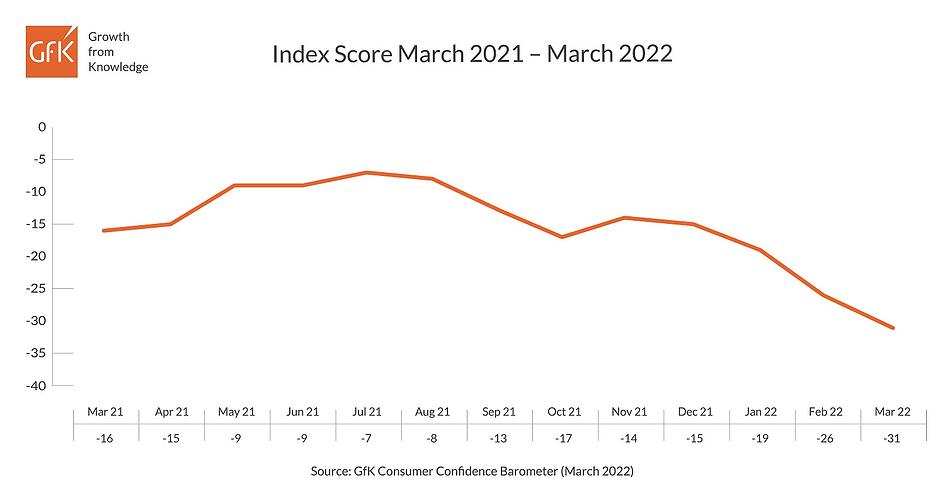
UK Gfk consumer confidence dropped to -31, a wall of worry is confronting
UK Gfk Consumer Confidence Index dropped from -26 to -31 in March. That's the lowest level since November 2020. Personal Financial Situation over last 12 months dropped from -11 to -13. Personal Financial Situation over next 12 months dropped from -14 to -18. General Economic Situation over last 12 months dropped slightly from -50 to -51. Genera Economic Situation over next 12 months dropped from -43 to -49.
Joe Staton, Client Strategy Director GfK, says: "A wall of worry is confronting consumers this month and there is an unmistakable sense of crisis in our numbers. Consumers across the UK are experiencing the impact of soaring living costs with 30-year-high levels of inflation, record-high fuel and food prices, a recent interest-rate hike and the prospect of more increases to come, and higher taxation too – all against a background of stagnant pay rises that cannot compensate for the financial duress. This is the fourth month in a row that UK consumer confidence has dropped."
BoJ Kuroda: Weak yen is generally positive for Japan’s economy
BoJ Governor Haruhiko Kuroda told the parliament, "there's no change now to my view a weak yen is generally positive for Japan's economy."
He also reiterated the view that "cost-push inflation that is not accompanied by wage hikes will hurt Japan's economy." And as such, "it won't lead to sustained achievement of our price target. That's why the BOJ will continue to maintain powerful monetary easing."
ECB Schnabel leaves the door ajar on asset purchases
ECB Executive Board member Isabel Schnabel said yesterday that it had "left the door ajar" for more asset purchases if the impact of Russia invasion of Ukraine turn out to be much worse.
"If we now fall into a deep recession due to the Ukraine crisis, we'll have to rethink that," she said. "Otherwise, we'll end the bond purchases in the third quarter and as soon as we've done that we can raise rates at any time depending on how inflation develops."
Separately, Governing Council member Mario Centeno emphasized "normalization of the ECB's monetary policy will be carried out gradually and proportionally at the end of this year".
USD/JPY Surges Above 120, Why It Could Rise Further
Key Highlights
- USD/JPY rallied above the 120.00 resistance zone.
- A connecting bullish trend line is forming with support near 121.00 on the 4-hours chart.
- EUR/USD is now trading well below 1.1120, and GBP/USD faced sellers near 1.3300.
- Oil price is struggling to clear the $120.00 resistance zone.
USD/JPY Technical Analysis
The US Dollar remained in a strong uptrend above the 115.00 level against the Japanese Yen. USD/JPY even broke the 118.00 resistance to move further into a positive zone.
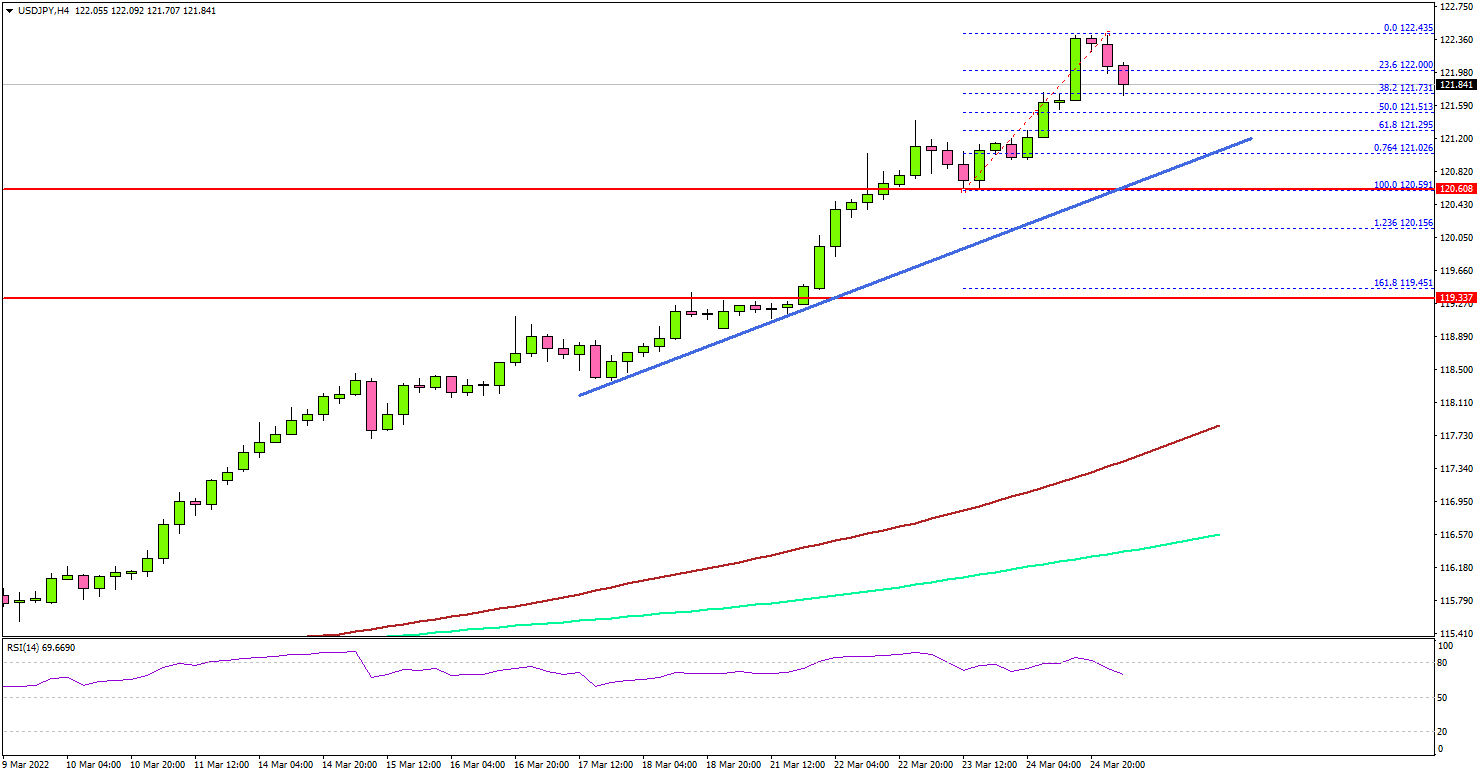
Looking at the 4-hours chart, the pair gained pace and cleared the 120.00 level. There was also a close above the 120.00 level, the 100 simple moving average (red, 4-hours), and the 200 simple moving average (green, 4-hours).
It even spiked above 122.000. An immediate resistance is near the 122.00 level. The main resistance sits near the 122.50 level. A clear move above the 122.50 zone could set the pace for a move towards 125.00.
If there is a downside correction, the pair might find support near the 121.20 level. Besides, there is a connecting bullish trend line forming with support near 121.00 on the same chart.
The next key support is near the 120.80 level. A downside break below the 120.80 support might start a steady decline. In this case, the pair could decline towards the 119.40 support zone.
Fundamentally, the US Manufacturing Purchasing Managers Index (PMI) for March 2022 (Prelim) was released yesterday by the Markit Economics. The market was looking for a decline from 57.3 to 56.3.
The actual result was better than the market forecast, as the US Manufacturing Purchasing Managers Index increased from 56.3 to 58.5.
Looking at EUR/USD, the pair struggled to clear the 1.1080 and 1.1100 resistance levels. Besides, GBP/USD failed to gain strength for a move above the 1.3300 resistance.
Economic Releases
- German IFO Business Climate Index for Feb 2022 – Forecast 94.2, versus 98.9 previous.
- US Pending Home Sales for Feb 2022 (MoM) - Forecast +1.5%, versus -5.7% previous.
Cliff Notes: Shifting Fiscal Priorities and Monetary Expectations
Key insights from the week that was.
The key release for Australia this week was not a data point but a preview, with Westpac Economics outlining our expectations for Budget 2022, brought forward to March this year given the timing of the next Federal election. Chief Economist Bill Evans outlined the key themes and forecasts we expect in his video update; our written preview provides full detail.
Most notable is that, with the economy having recovered from the pandemic and inflation pressures prevalent, we expect the Government’s priorities to shift from supporting demand to supply, albeit while also seeking to help households with cost of living pressures. A focus on budget repair is also anticipated. Of the $78bn improvement in the budget bottom line we expect to be announced over the forward estimates, $58bn will be directed to lowering the deficit and reducing debt.
Ahead of the Budget, our latest edition of Coast-to-Coast provides a full view of conditions and growth opportunities across Australia’s states.
Over in New Zealand, concerns over the cost of living are clearly front of mind for consumers, sentiment falling to its lowest level since the GFC. In addition to elevated inflation, rising interest rates are also pressuring discretionary incomes. Amplifying the effect of these cost of living pressures on confidence, while the NZ labour market is unquestionably strong and consumers are positive on job opportunities, current and expected earnings growth remains below pre-pandemic levels.
Then to the US. Data might have been sparse this week, but FOMC speakers were certainly not. Underlying all of the Committee members commentary this week was one critical concern: the outlook for inflation. This was most apparent in Chair Powell’s speech which, with respect to policy, had a near singular focus on inflation. Making this possible is the FOMC’s very strong confidence in the economy and its resilience. Also, Committee members look to be holding a view that the longer inflation is materially away from target, the greater the likelihood of inflation expectations becoming unanchored.
To us, Chair Powell and the Committee are making it clear they intend to tighten policy aggressively in coming months, with the consequences to be assessed later. As such, we now look for back-to-back 50bp rate hikes in May and June and a 25bp rate hike at each of the remaining meetings in 2022. That would leave the fed funds rate at 2.375% by December 2022, six months earlier and 50bps higher than our prior peak. Note however, this is not to say we have become more optimistic on the outlook for real income growth or financial conditions and consequently the US’ growth prospects.
Instead, we expect this fight against inflation to come at a cost in 2023, with US’ growth to end that year below trend and the unemployment rate higher at around 4.5%. Also, it is entirely possible that real wages won’t fully recover by end-2023, having declined through 2021 and the first half of 2022. As soon as inflation is brought back to near target, likely late-2023, we anticipate the FOMC will need to reverse course, taking on an easing bias and then cutting twice in 2024 to a fed funds rate of 1.875%. This shift in the policy stance will become apparent in term interest rates through 2023 then stabilise in 2024 as the cuts are delivered.
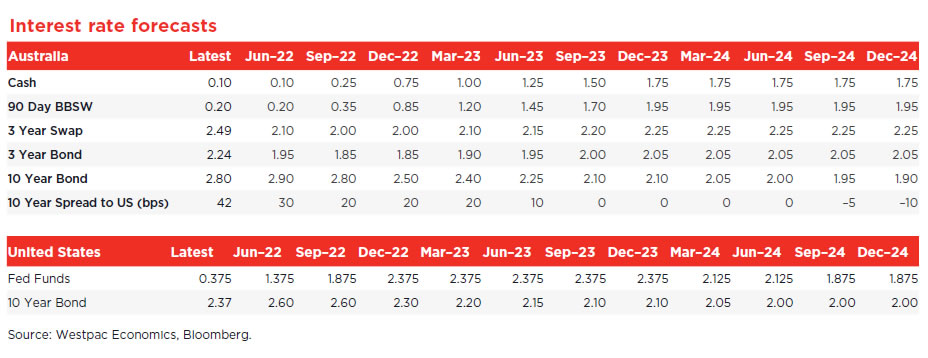
Returning to Australia, note that global developments and the hawkish response of the FOMC provide scope for the RBA to move more quickly, once the hiking cycle has been justified by domestic developments. As outlined by Chief Economist Bill Evans, we still expect the RBA’s hiking cycle to begin in August, but that first move is now expected to be followed by hikes in October and December, then once per quarter through 2023. This means the 1.75% peak cash rate for this cycle is now seen three months earlier in December 2023.
FOMC to Lift Federal Funds Rate to Peak of 2.375% by End 2022; Slight Tweak to RBA Profile
Last week's FOMC meeting delivered a 25bp rate hike and a clear signal that balance sheet normalisation will begin in Q2. The surprise for us was the Committee's decision to narrow their focus for policy to the inflation outlook, having previously taken a balanced view across inflation and activity.
This decision comes at a time of heightened global uncertainty and, for the US, declining real wages and tightening financial conditions. But the FOMC is confident in the strength of the US economy, believing it will be able to weather these headwinds and maintain full employment.
When central banks provide such explicit public guidance as we have recently seen from the Chairman and other members of the FOMC with respect to meetings in the very near term we listen and learn. That approach does not necessarily follow for longer term guidance where our economic forecasts may differ from those being used by the central bank.
Therefore, recognising that clear intent, we have brought forward our rate hike profile to accommodate a move at every meeting this year. It starts with 50bp moves at both the May and June meetings, to be followed by a series of 25bp hikes in July, September, November and December. The federal funds rate reaches 2.375% by year end.
Our previous prior was that the combination of five hikes in 2022 and two more by June 2023 in combination with a determined approach to shrinking the balance sheet would weigh significantly on the US economy. The new accelerated profile will result in a more immediate slowing in growth and inflation, hence our expectation that the cycle will be completed by December 2022 when the slowdown will have become abundantly apparent.
Once inflation is back under control, we expect the FOMC to cut twice back to 1.875%, through 2024 to help growth sustain a near trend pace into the medium term.
Why do we expect the peak federal funds rate to be materially below the current guidance of the FOMC (2.8%) and the view of the market (2.7%)?
From a policy perspective, we are expecting that the determined commitment to reduce the size of the balance sheet combined with a series of rate increases will have a nonlinear impact on financial conditions, as we saw in 2017/2018.
We also expect more vulnerability from the labour market than is the FOMC's base case.
Employment growth has been very strong throughout this recovery resulting in a very tight labour market (currently 1.7 openings for every available worker) and the unemployment rate is printed 3.8% in February. Yet, because of low participation, the share of the population employed is only 0.5ppts above its level in November 2015, when the 2015–2018 hiking cycle commenced. This matters, because the share of the population employed dictates the base earnings capacity of the household sector and consequently their spending.
In addition to the number employed, the other important aspect is the pace of wages growth. While the Employment Cost Index was abnormally strong over the year to December at 4.5%yr, this gain was swamped by CPI inflation of 7.1%yr, leaving real wages 2.6% lower than a year earlier. If we take monthly earnings from the establishment survey as a guide for wage growth in Q1 2022, it is clear real wages continue to decline, with CPI inflation running at more than twice the annualised growth rate of average hourly earnings.
As the FOMC's focus remains on inflation in coming months, higher interest rates across the curve will continue to dial up the pressure on US households which are under the relentless pressure of contracting real wages.
GDP growth will hold above trend in 2022. But growth is then expected to slow from 2.1% annualised in the six months to December 2022 to 1.7% in first-half 2023 and 1.4% in the second.
Although the aggregate household balance sheet shows a high level of savings, these savings are reported to be overwhelmingly held by high income earners, limiting the buffer for tightening financial conditions and falling real wages. The unemployment rate is also expected to edge up to 4.5% by end- 2023 as participation continues to normalise and growth slows.
Inflation momentum is almost certain to ease.
We expect six-month annualised CPI inflation to hold above 5% to June 2022, falling to 2.9% in December 2022 before slowing further to 2.4% in June 2023 and 2.2% in December 2023.
Energy prices are expected to decline modestly from in 2022 H2 while supply-chain disruptions to other goods prices will dissipate as risks related to COVID-19 and the invasion of Ukraine recede.
That easing in supply pressures will be complemented by the slowdown in demand to ease inflation momentum.
Our forecasts still incorporate price growth for goods (exenergy) remaining materially above the pace seen prior to the pandemic. Growth in food prices is also forecast to remain elevated well into 2023 given the potential for significant secondary price rises over time. And shelter costs are projected to continue increasing at a rate in the top half of their historic range reflecting limited excess capacity.
Even if these pressures result in slightly higher inflation in 2023 than our current forecast, we expect the FOMC, committed to its recently adopted average inflation policy, will be comfortable to hold rates steady and concentrate on balance sheet repair that will take years.
What are the implications for 10-year bond rate?
We retain our guideline that the 10-year bond rate will peak around 6 months before the peak in the federal funds rate and at a slightly higher level.
We have therefore lifted and brought forward the peak for the 10-year bond to 2.60% by June (from 2.3% by December), still reaching its peak 6 months before the peak in federal funds rate (2.375%). It is only expected to hold at this level until September before declining to 2.30% by December 2022 and 2.20% by March 2023, a slight inversion of the curve relative to cash. We expect the curve to invert further through 2023 as the market recognises growth has slowed below trend and inflation is no longer a concern.
Two rate cuts during 2024 for a federal funds rate of 1.875% will settle expectations for both the economy and the curve.
If we are wrong and the federal funds rate reaches current market pricing, a sharp curve inversion will surely precede a much more significant slowdown in the US economy.
This adjustment has implications for the RBA.
We have not changed our core views that the RBA tightening cycle will begin in August with the cash rate peaking at 1.75%. Even though we are still on board with the RBA Governor's intentions to run policy according to Australian conditions rather than following FOMC policy the more determined actions of the FOMC are likely to slightly accelerate the RBA's tightening profile.
Our current forecast is for the RBA to raise the cash rate by 15 basis points in August; to be followed by 25 basis points in October; and 25 in February; May; August; and December in 2023; with the final 25 in February 2024.
We now expect the RBA to bring forward the third hike from February, 2023 to December 2022, and follow the same pattern throughout 2023 with the cycle ending in November 2023 rather than February 2024.
This would mean that the RBA would end 2022 having restored the 65 basis points of emergency cuts which it implemented during Covid.
Relative to market expectations our forecasts for the cycles of both FOMC and RBA are significantly more modest, relying on two things - more progress in settling inflation and tempering demand than is expected by the market and the complementary tightening of financial conditions that will be delivered by both central banks as they shrink their balance sheets – FOMC through its QT policies and RBA with the repayment of the $180 billion TFF in September 2023 and June 2024.
With the RBA expected to be narrowing the wide interest rate differential with the FOMC during 2023 and prospects of cuts in the federal funds rate in 2024 a more settled risk environment in 2023 still supports our forecast for the AUD to reach USD0.80 in 2023.
AUDJPY Defies Gravity, Reaches More than 7½-Year High
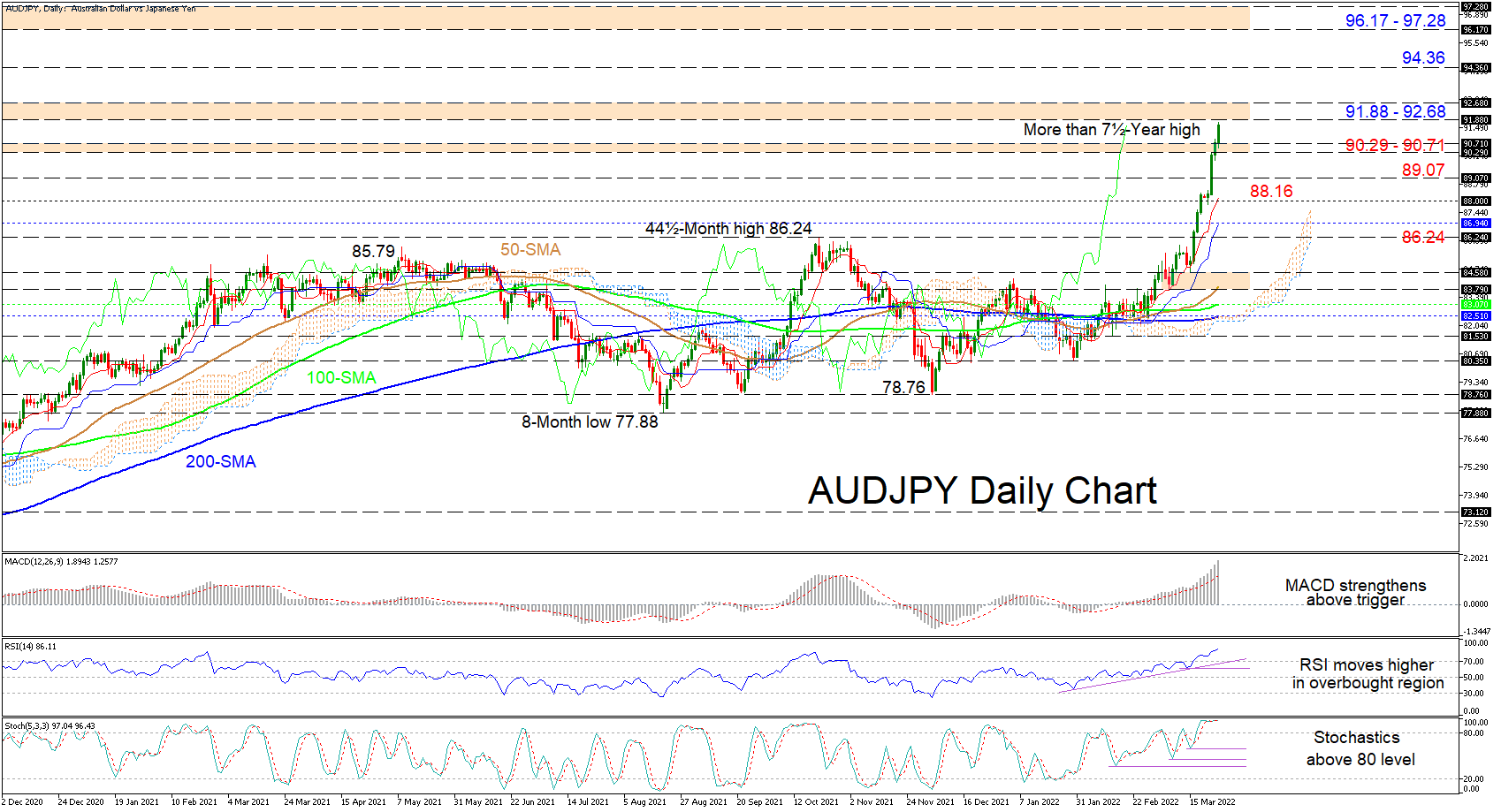
AUDJPY has recorded a multi-year high of 91.75 just beneath the 91.88-92.68 resistance region formed by the August 2015 highs. The upturn of the simple moving averages (SMAs) reflects the surge in bullish momentum after the price overran the 44½-month high of 86.24.
Currently, the climbing Ichimoku lines signal no weakness in bullish forces, while the short-term oscillators exhibit an upward preference in the pair. The MACD is increasing over its red trigger line, while the RSI is rising in overbought territory. Moreover, the stochastic lines reflect no pickup in negative momentum.
Maintaining the current price trajectory, the bulls face preliminary resistance from the 91.88-92.68 boundary. If the pair successfully overcomes this obstacle, the price may then steer for the 94.36 barrier before buyers eye the 96.17-97.28, May-June 2015 area of highs.
If upside pressures fade, support could commence from the 90.29-90.71 border. Retreating lower, the 89.07 level may step into the spotlight prior to the red Tenkan-sen line and the 88.00 price handle. Should a deeper retracement endure, the bears could seek out the rising blue Kijun-sen line at 86.94 and the key 86.24 inside swing high.
Summarizing, AUDJPY is sustaining a strong bullish bias above the 88.00 hurdle and the October 2021 high of 86.24.
Eco Data 3/25/22
[php_everywhere instance="1"]
Swiss Franc Steady after SNB Meeting
In this topsy-turvy new world of ours, it’s reassuring to know that some things stay the same. For example, the Swiss National Bank, which maintained its expansionary monetary policy at today’s policy meeting. With the Swiss franc always in demand, the SNB can afford to treat its customers with deposit rates of -0.75%, by far the lowest rate of any major central bank.
SNB says willing to intervene with exchange rate
The war in Ukraine has bolstered the Swiss franc’s status as one of the leading safe-haven currencies. The crisis has resulted in capital inflows that have put upward pressure on the Swiss franc. This poses a problem for the SNB, which does not like to see the currency in disorder. The Bank’s Monetary Policy Assessment (MPA) noted that the central bank remained “willing to intervene in the foreign exchange market as necessary, in order to counter upward pressure on the Swiss franc.” The fact that the SNB took pains to state this in the MPA sends a stern message to speculators that the Bank will intervene in order to keep the Swiss franc from rising in value, which would damage the economy by making Swiss exports more expensive.
Switzerland has not been immune from rising inflation, but CPI has been climbing more slowly than in the eurozone. The headline rate broke above the 2% level in February, for the first time since October 2008. Growth was anemic in Q4, at just 0.3% QoQ, compared to 1.9% in the third quarter. The Swiss economy was hampered by the Covid wave and the ensuing health restrictions.
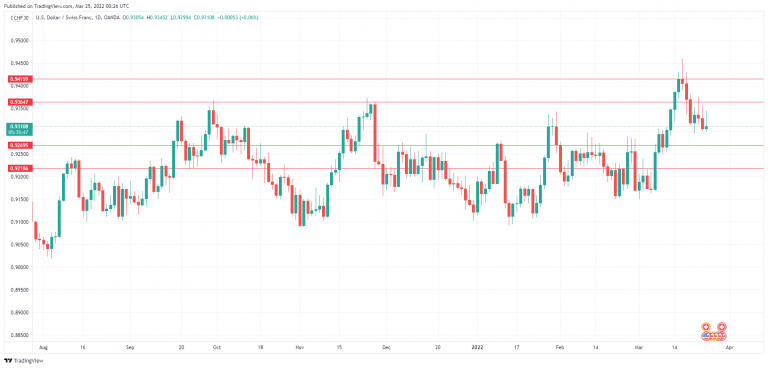
USD/CHF Technical
- There is resistance at 0.9396, which has held since April. Above, there is resistance at 0.9482
- There is support at 0.9167 and 0.9024
Sunset Market Commentary
Markets
EMU PMI’s provided the first real (sentiment) update on consequences from the Russian invasion in Ukraine. The official setback was smaller than feared in March. The composite number fell from 55.5 to 54.5, with the decline more or less similar in the export-oriented manufacturing sector (57 from 58.2) and the domestic services industry (54.8 from 55.5). Details nevertheless showed that a boost to demand from the further reopening of the economy from Covid-19 restrictions offset the economic impact of the Russian invasion. It’s worth mentioning that companies grew increasingly concerned about the outlook. Chief Business Economist Williamson at S&P Global, responsible for the PMI release, warned for the risk of the eurozone falling into decline in the second quarter given that the short term Covid-rebound will fade. Other dark details from the upbeat headline print include aggravated price pressures because of the war, leading to record inflation rates for firms’ costs and selling prices, which will inevitably feed though to higher consumer prices in the months ahead. Today’s response on FI markets confirms our view that investors turned a page. Central bank’s focus is on inflation (expectations) with markets aware that this stance will come at a price for the economy. Yesterday’s rebound of core bonds proved again short-lived. The US yield curve bear steepens with yields adding 4.1 bps (2-yr) to 8.2 bps (30-yr). German yields add up to 7.5 bps with the belly of the curve underperforming the wings. Stock markets and oil prices trade volatile near opening levels. EUR/USD is still toying with the 1.10 big figure. UK and US PMI contrasted with the EMU release. In the UK, a rebound in services more than offset a setback in manufacturing. Details were nevertheless in line with the EMU gauges. In the US, both subindices contributed to a surge in the composite PMI to the highest level in 8 months. The feared impact of the (European) war is obviously smaller, but the outlook nevertheless weakened as well.
News Headlines
The ECB today announced a timeline setting out the steps to phase out the temporary pandemic easing measures with respect to collateral that were introduced in April 2020. The phasing out will occur in three steps between July 2022 and March 2024. Amongst others, measures that are scaled back are a temporary reduction in collateral haircuts. The ECB also no longer will maintain the eligibility of marketable assets that initially fulfilled minimum credit quality requirements but whose credit ratings subsequently deteriorated below the minimum credit quality. However, the ECB continues to allow NCBs to accept as eligible collateral Greek government bonds (GGBs) that do not satisfy the Eurosystem’s minimum credit quality requirements but fulfil all other applicable eligibility criteria, for at least as long as reinvestments in GGBs under PEPP continue.
The Norges Bank raised its policy rate from 0.50% to 0.75%. The Norwegian economy continues to recover while price and wage inflation has been higher than expected. The war in Ukraine contains risks of both lower growth and higher inflation. Due to capacity constraints and global price pressures the NB is concerned about higher wages and prices. It raised the path for its policy rate forecast and now sees policy rate at 2.5% end last year versus 1.75% end 2024 in the December forecast. The NB also signaled that a next rate hike in June is likely. The Norwegian krone touched a new correction low near 9.45, but this move was also supported by a persistent high oil price.
The Swiss National Bank left its policy rate unchanged at -0.75% and no change is imminent. Inflation is expected to rise temporary to 2.2% Y/Y in Q1 and Q2, but will return to an average of 0.90% in 2023/24. The SNB sees the franc has highly valued and is willing to intervene in the FX market as necessary. However, it takes into account the overall currency situation and the inflation rate differential with other countries. A favourable relative cost development versus trading partners mitigates the need of an aggressive intervention policy in case the rise of the franc stays modest. The Swiss franc today gained modestly further to trade near EUR/CHF 1.0225.