

Sample Category Title
Nasdaq 100 Bullish Momentum Accelerates as Volatility Reduces
American stocks rose on Thursday evening after mixed economic data from the country. According to the Bureau of Labor Statistics (BLS), the country’s initial jobless claims declined from 215k to 187k last week. This was the best performance in a few weeks. Additional data showed that the continuing jobless claims dropped from 1.47 million to 1.35k. Meanwhile, durable goods orders declined sharply in February as the cost of doing business rose. Durable goods declined by 2.2% after expanding by 1.6% while core durable orders fell by 1.35%. Some of the best performing stocks were companies like Nvidia, AMD, Nikola, and Global Foundries among others.
The British pound was little changed against the US dollar after ahead of the upcoming UK retail sales numbers. Economists polled by Reuters expect the data to show that the country’s retail sales rose by 0.6% on a MoM basis in February from the previous 1.9%. On a year-on-year basis, they expect the data to show that sales rose by 7.8% even as consumer prices jumped. Meanwhile, analysts expect that core retail sales rose by 5.6%. These numbers will come two days after the UK published strong inflation data and a week after the Bank of England (BOE) raised interest rates for the third time.
The price of crude oil retreated slightly even as analysts predicted that the situation would get cloudy in the next few months. Brent declined to $119 while West Texas Intermediate fell to $$112. Still, analysts believe that the situation will continue worsening as western countries continue debating on how to substitute Russian oil. The key economic events to watch today will be the latest German business confidence data and the NATO meeting in Brussels.
EURUSD
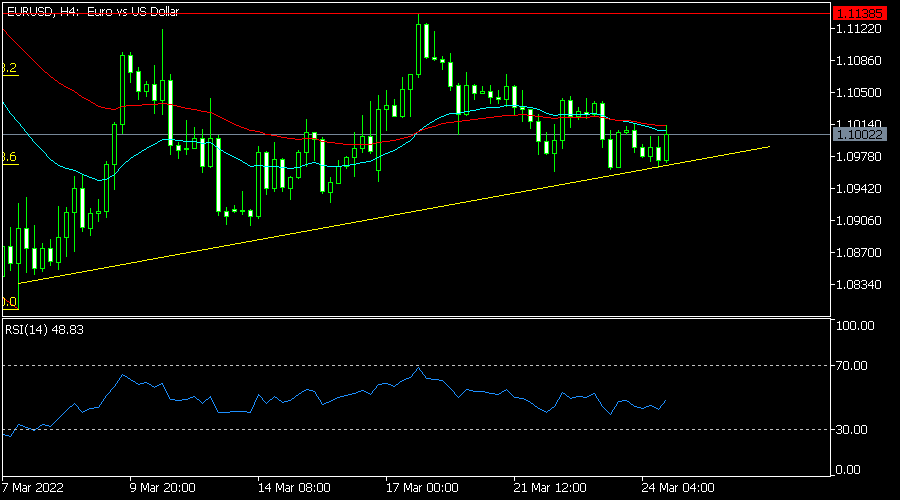
The EURUSD pair remained above the ascending yellow trendline in the overnight session as the volatility index retreated. It is trading at 1.100, which is slightly above this week’s low of 1.0964. It is trading at the 25-day moving average and is between the 23.6% and 38.2% Fibonacci retracement level. The Relative Strength Index (RSI) has also flattened at the neutral level. Therefore, the pair will likely remain in this range today.
GBPUSD
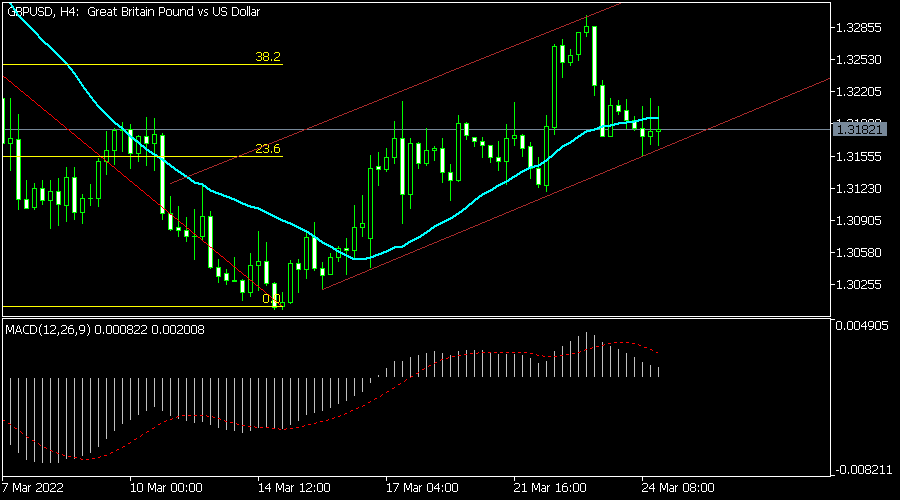
The GBPUSD pair was also in a tight range ahead of the latest UK retail sales data. On the four-hour chart, the pair is along the lower side of the ascending channel pattern. It has also moved above the 23.6% Fibonacci retracement level. It is also slightly below the 25-day moving average while the MACD has made a bearish crossover pattern. Therefore, the pair will likely have a bearish breakout.
NAS100
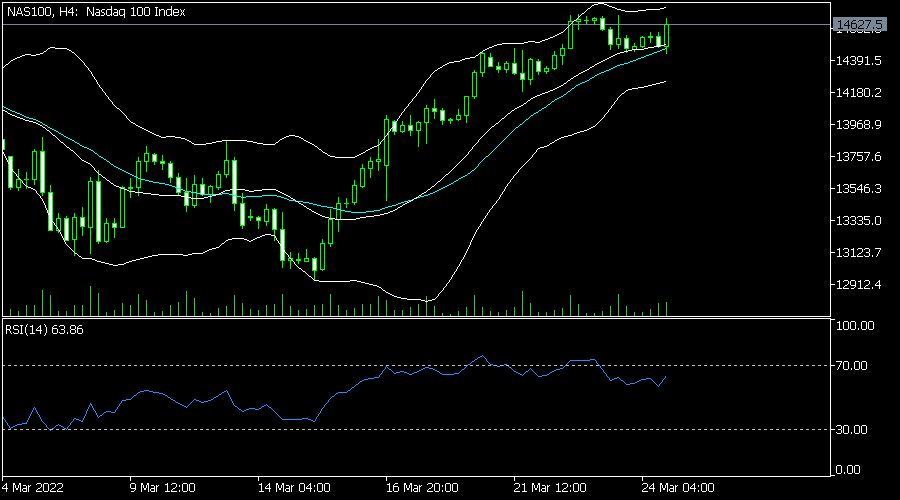
The Nasdaq 100 index has been in a strong bullish trend in the past few weeks. It is now trading at the highest level since February 17. It is also between the middle and upper side of Bollinger Bands while the RSI has moved below the overbought level. Therefore, the index will likely maintain its bullish trend.
Dollar Momentum Remains a Bit Bleak Given the Uncertain Context
Markets
Wednesday’s ‘classic’ risk-off correction with a setback in equities and a decline in yields proved to be a one-off rather than the start of a new trend. Oil (temporarily?) returning above $120 p/b was a warning that inflationary risks still have a key role to play in global/bond markets.
Eco data, especially headline readings, were better than expected. The EMU March composite PMI eased from 55.5 to 54.4. A bigger drop was expected and figure remains well above the 50 boom-bust level, suggesting solid growth at the time of the start the war in Ukraine. However, price pressures at firms’ levels continue to build and companies grew increasingly concerned about the outlook.
In the US, volatile durable goods orders disappointed (-2.2% M/M). However, weekly jobless claims dropped sharply from 215k to 187k. The US PMI’s even brought an unexpected rise (composite 58.5 from 57.3). Both in the services and manufacturing sector activity indicators, including employment, were strong and inflationary pressures persist. The report confirmed that the US economy currently is strong enough for the Fed to keep the focus on inflation.
US yields rose between 4.6 bps (2-y) and 8 bps (5 & 10-y). German yields also recaptured their uptrend rising between 4.6 bps (30y) and 7.8 bps (5-y). For equities there was a big deviation between Europe (EuroStoxx50 -0.15%) and US indices rebounding further (S&P +1.43% & Nasdaq +1.93%).
The dollar outperformed, but gains remained modest. DXY closed at 98.79, off the intraday top. EUR/USD for most of the day traded below the 1.10 handle to close at 1.0997. The combination of a US risk-on, a high oil price and higher core yields propelled USD/JPY to close at 122.40, the highest level since Dec 2015. Sterling lost modest ground against the euro to close at EUR/GBP 0.8339.This morning, Asian equities don’t profit from the strong WS performance yesterday. The Nikkei is little changed. Chinese equites underperform. Oil returns below the $120 p/b level as markets watch the outcomes of the meetings US president Biden is having with its allies in Brussels.
In an address before Parliament, BoJ governor Kuroda indicated that a change in the BoJ policy will be triggered by the prospect of stable inflation, not by yen weakness. Interestingly, even as the yen shouldn’t expect direct support from the BoJ, USD/JPY this morning dropped sharply from 122.40 to the 121.20 area, but currently again trades near 121.85.
Today, the calendar contains German IFO confidence. Several Fed speakers will give their view. US and German yields yesterday rebounded sharply, confirming the uptrend in yields. Even so, the pace of the rise might slow short-term.
Dollar momentum also remains a bit bleak given the uncertain context. EUR/USD might try a new attempt to regain the 1.10 barrier. This morning, UK February retail sales printed softer than expected (-0.3% M/M vs +0.7% expected). EUR/GBP (0.8350) is gaining a few ticks.
News Headlines
The central bank of Mexico raised rates from 6% to 6.5% yesterday. Above-target inflation (7.28% in February vs 3% goal) and rising inflation expectations prompted a hiking cycle which started in June last year. The tightening pace doubled from 25 bps to 50 bps since December. Having boosted headline and core inflation forecasts with risks still tilted to the upside, the door remains opens for further hikes. The Mexican peso appreciated vs the dollar yesterday to USD/MXN 20.09, the strongest level since September 2021. Part of the move occurred hours before the rate announcement after President Lopez Obrador in a morning statement leaked the decision.Monetary policy in South Africa was also tightened for a third time straight yesterday. The central bank brought interest rate from 4% to 4.25% in a move expected by most. More interest increases are imminent given the deteriorating inflation outlook with the war adding to upward price pressures. The central bank sees its 6% ceiling of the inflation target range breached in Q2. For the whole year 2022, inflation may average 5.8%, above the 4.5% midpoint target, before easing to 4.6% in 2023 and 2024. The SARB’s model projects a key rate of 6.7% by the end 2024. The South African rand rallied to its best level in five months. USD/ZAR closed at 14.52, down from an intraday high of 14.79.
GBP/JPY Daily Outlook
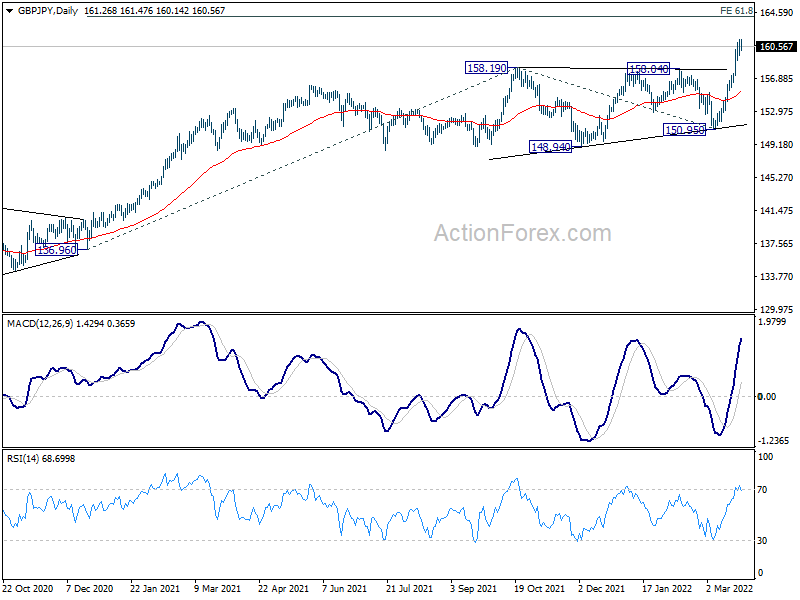
Daily Pivots: (S1) 160.15; (P) 160.78; (R1) 161.97; More...
GBP/JPY's rally resumes after brief retreat and intraday bias is back on the upside. Current up trend should target 61.8% projection of 136.96 to 158.19 from 150.95 at 164.07. On the downside, below 159.01 minor support will turn intraday bias neutral again. But downside of retreat should be contained above 156.35 minor support to bring another rally.
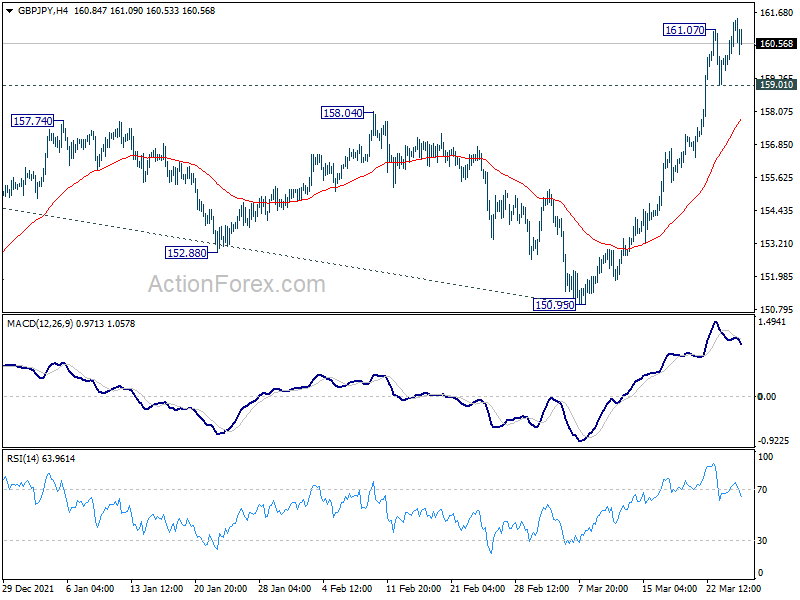
In the bigger picture, up trend from 123.94 (2020 low) should still be in progress, and notable support from 55 week EMA affirms medium term bullishness. Next target is 61.8% retracement of 195.86 (2015 high) to 122.75 (2016 low) at 167.93. Sustained break there will be a long term bullish signal. This will now remain the favored case as long as 148.94 support holds.
EUR/JPY Daily Outlook
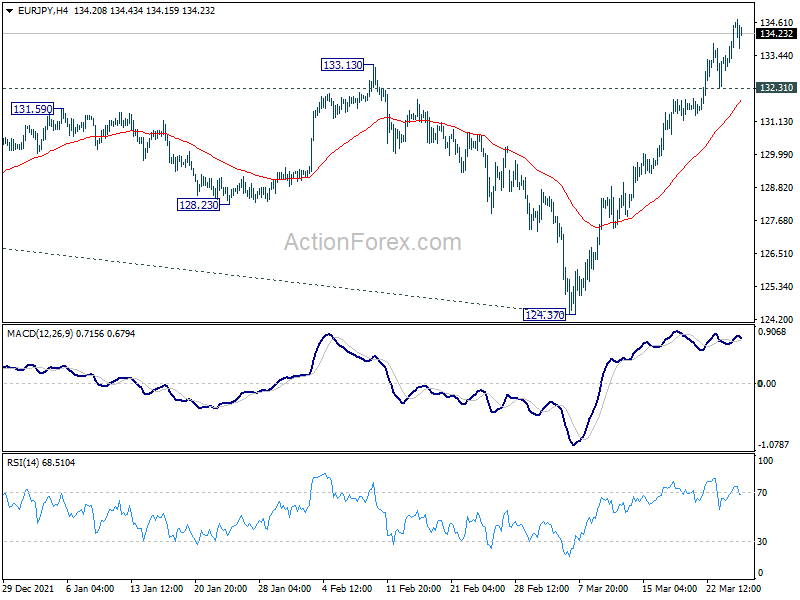
Daily Pivots: (S1) 133.47; (P) 134.04; (R1) 135.14; More....
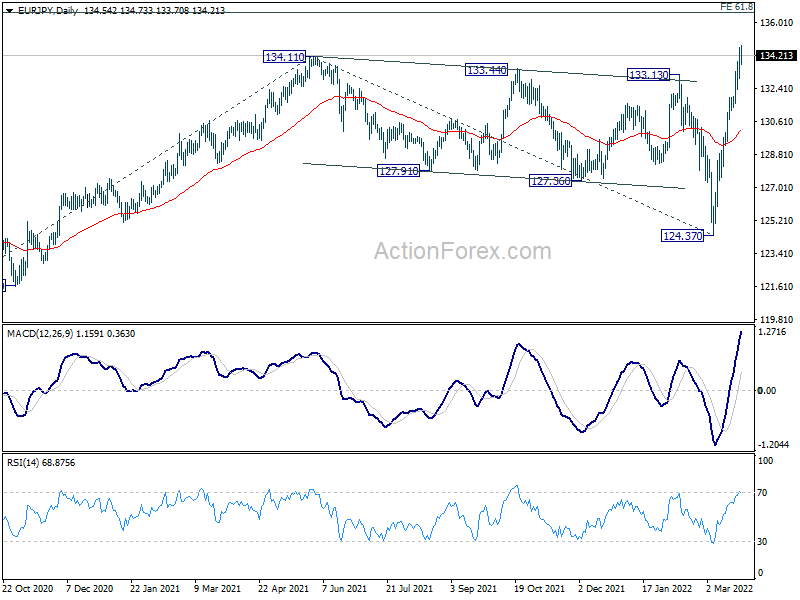
Intraday bias sin EUR/JPY remains on the upside for the moment. Sustained trading above 134.11 high will confirm resumption of larger up trend next target will be 136.53 medium term projection level. On the downside, though, break of 132.31 minor support will delay the bullish case and turn bias neutral first.
In the bigger picture, current development suggests that corrective pattern from 134.11 has completed at 124.37 already. Firm break of 134.11 will resume the up trend from 114.42 (2020 low). Next target is 61.8% projection of 114.42 to 134.11 from 124.37 at 136.53, and then 137.49 (2018 high). This will now remain the favored case as long as 124.37 support holds.
EUR/GBP Daily Outlook
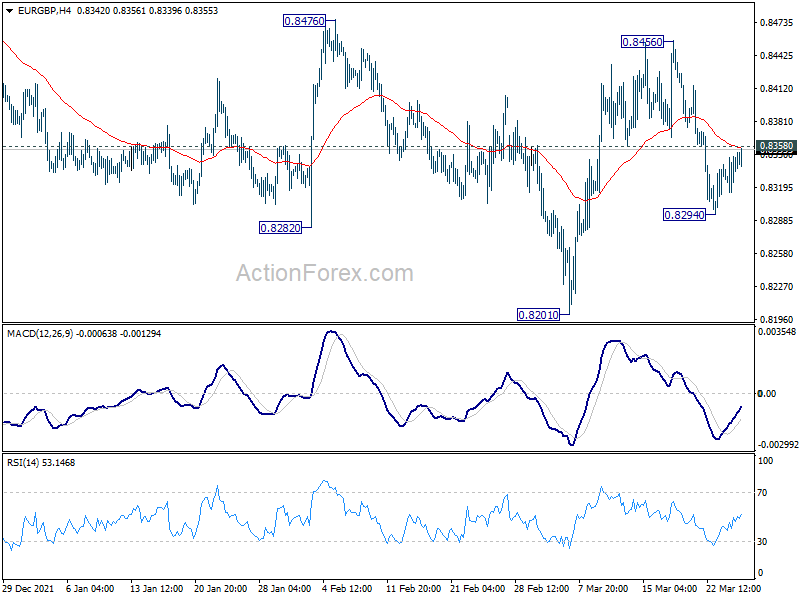
Daily Pivots: (S1) 0.8321; (P) 0.8336; (R1) 0.8354; More...
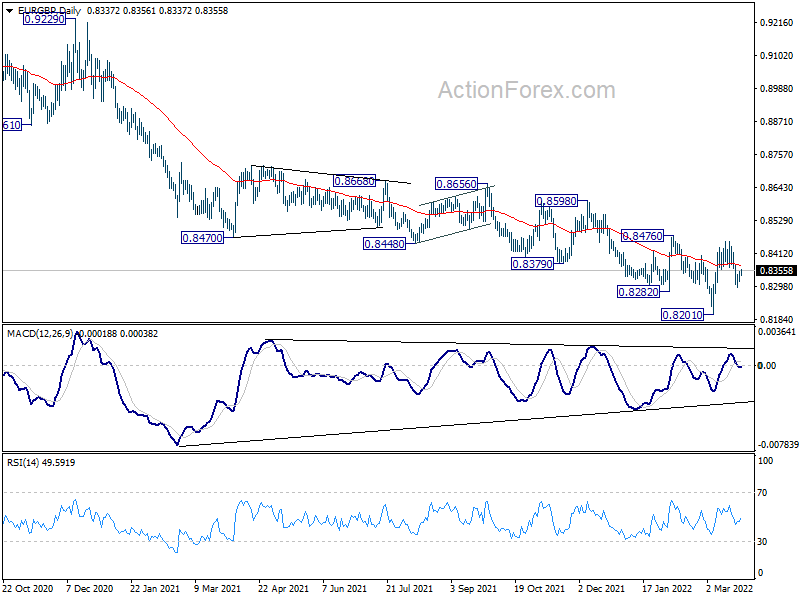
Intraday bias in EUR/GBP is turned neutral with current recovery. On the downside, below 0.8294 will target 0.8201 low. Break there will resume larger down trend. On the upside, above 0.8358 minor resistance will turn bias to the upside for 0.9456 resistance. Firm break of 0.8476 structural resistance will carry larger bullish implication and target 0.8598 resistance next.
In the bigger picture, the down trend from 0.9499 is expected to continue as long as 0.8476 resistance holds. Sustained trading below 0.8276 support will argue that the whole up trend from 0.6935 (2015 low) has reversed. Deeper fall should be seen to 61.8% retracement of 0.6935 to 0.9499 at 0.7917 next. However, firm break of 0.8476 will indicate medium term bottoming at least. Focus will be back on 55 week EMA (now at 0.8523) for more evidence of bullish reversal.
EUR/AUD Daily Outlook
Daily Pivots: (S1) 1.4595; (P) 1.4654; (R1) 1.4699; More...
Intraday bias in EUR/AUD remains on the downside for 1.4561 support. Firm break there will resume larger down trend from 1.9799. On the upside, however, break of 1.4986 minor resistance will turn bias back to the upside, and extend the pattern from 1.4561 will another rising leg.

In the bigger picture, fall from 1.9799 is seen as a long term impulsive move. Next target is 61.8% projection of 1.9799 to 1.5250 from 1.6434 at 1.3623, which is close to 1.3624 long term support (2017 low). Some support could be seen there to bring interim rebound. But overall, break of 1.5354 support turned resistance is needed to be the first sign of medium term bottoming. Otherwise, outlook will stay bearish in case of recovery.

EUR/CHF Daily Outlook
Daily Pivots: (S1) 1.0216; (P) 1.0266; (R1) 1.0293; More....
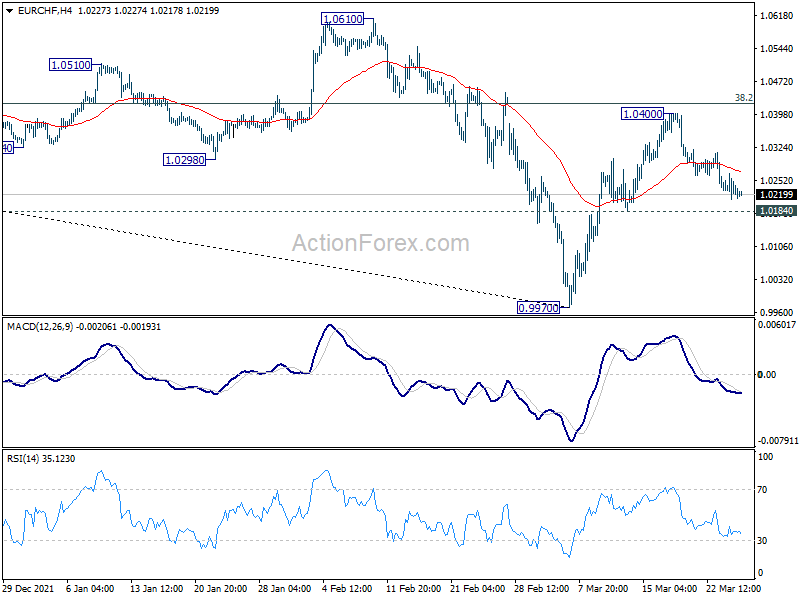
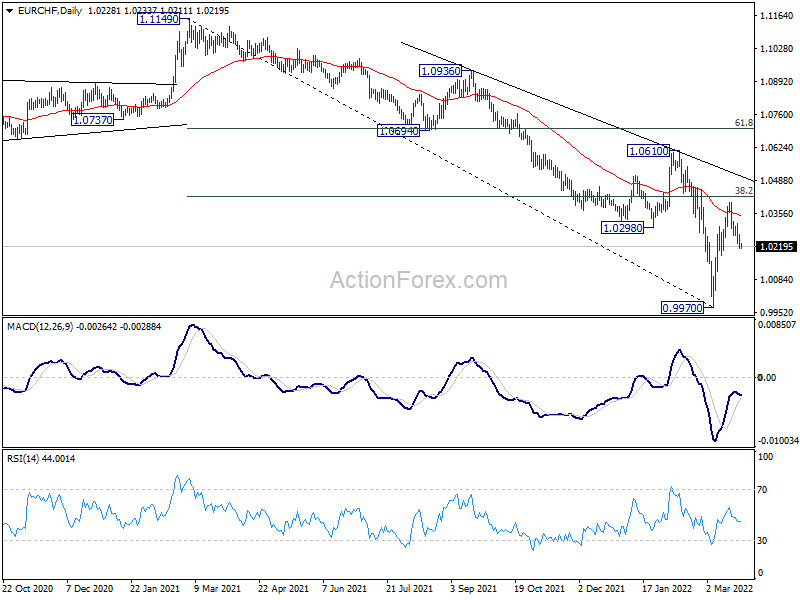
No change in EUR/CHF's outlook and intraday bias remains neutral at this point. On the upside, break of 1.0400 would resume the rebound from 0.9970 to 1.0610 key structural resistance. However, break of 1.0184 minor support will argue that the rebound is finished, ahead of 38.2% retracement of 1.1149 to 0.9970 at 1.0420. In this case, intraday bias will be turned back to the downside for retesting 0.9970 low.
In the bigger picture, long term down trend from 1.2004 (2018 high) is still in progress. Next target is 100% projection of 1.2004 to 1.0505 to 1.1149 at 0.9650. In any case, sustained break of 1.0505 support turned resistance is needed to be the first sign of medium term bottoming. Otherwise, outlook will remain bearish.
EUR/USD Pair Started a Fresh Increase from $1.0950
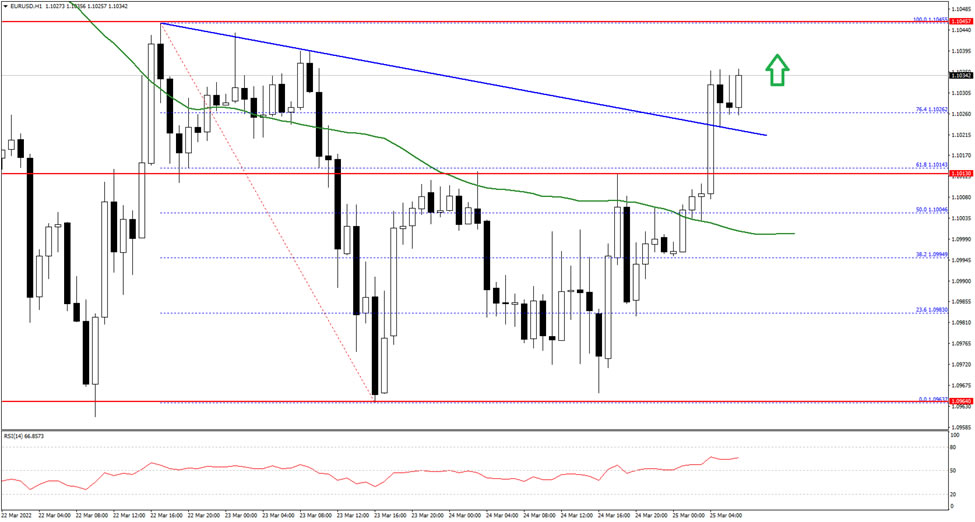
The Euro started a fresh increase from the 1.0950 support zone against the US Dollar. The EUR/USD pair traded above the 1.1000 resistance level and the 50 hourly simple moving average.
It even moved above the 1.1020 level and cleared a key bearish trend line at 1.1025 on the hourly chart. The pair is now showing positive signs, with an immediate resistance near the 1.1040 level.
The next major resistance is near the 1.1050 level. A break above the 1.1040 and 1.1050 resistance levels could start a decent increase towards the 1.1100 level in the near term.
If not, there might be a downside correction below 1.1020 on FXOpen. The next key support is near 1.1000, below the pair could decline towards the 1.0980 level in the near term. Any more losses might send the pair towards the 1.0950 level.
No Ban on Russian Oil, But on Russian Gold
New sanctions against Russia are kicking in, but the much-expected Russian oil ban in destination of European countries doesn’t seem to be part of them.
European reluctance to walk away from the Russian oil weighs on oil prices. The barrel of US crude eased to $112 per barrel as the latest news reduce oil bulls’ appetite to push the rally back above the $120pb level before the weekly closing bell, whereas the long-term outlook remains comfortably bullish as the combination of tight global supply, and the expectation that the global oil demand will reach a record high in the second half of the year should throw a floor under the short-term price pullbacks. Technically, the 50-DMA should continue acting like a major support, and it stands near $98 per barrel right now.
Gold ban
The new sanctions may not include a ban on European oil imports from Russia, but it well includes a ban on Russian gold, as there were signs that Russia was using gold to go around the international sanctions.
To stop that, the US issued a notice that gold transactions with Russia are now prohibited, which requires US people and companies to stop dealing with sanctioned Russian entities in an effort to further hammer the ruble’s power.
The Russian gold ban certainly comes as a response to Russia asking the ‘unfriendly’ countries to buy their oil and gas in rubles.
Russia has been building strong gold reserves since 2014 and the central bank is thought to have between $100 and $140 billion in gold reserves, which they may no longer use to convert against currencies that they can still trade.
The news shouldn’t have a negative impact on gold’s value, if anything we shall see the yellow metal extend gains toward the $2000pb on escalating tensions and looming uncertainties.
Last resort, Bitcoin
There is now news that Russia is considering selling its oil and gas in Bitcoin to ‘friendly’ countries like Turkey and China.
The news sent Bitcoin’s price above the 100-DMA resistance, yet there are a couple of questions that hang in the air.
One: China hates Bitcoin; will it change its mind to buy cheap Russian oil? If China buys the Russian oil in exchange of Bitcoin, will Chinese be able to trade Bitcoin as well? Then, how long the West, which recently didn’t want to impose restrictions on Bitcoin, will tolerate Russia going around sanctions via Bitcoin. Could the West ban the Russian Bitcoin like they did with the Russian gold? And if yes, is it even possible to ban ‘Russian’ Bitcoin?
Drying liquidity in commodity markets
Wild price moves and jaw-dropping margin calls push many investors out of the commodity markets, which, in return, reduce liquidity and has a boosting effect on price volatility.
Nickel has clearly become the face of that wild volatility, as the price surged 15% to the limit for the second day in a row yesterday. The rising commodity prices further boost inflation expectations and the central bank hawks, weigh on government bonds, yet equity traders remain surprisingly bullish.
EU Still Unlikely to Impose Embargo on Russian Energy
Market movers today
The EU summit continues today following the expanded version yesterday that included US President Biden, and also following the recent G7 and NATO meetings. EU leaders could announce new sanctions against Russia today but they are still not expected to impose an embargo on Russian energy, as Austria has said they would not support such a move.
In terms of economic data releases, it is a relatively quiet day today. UK retail sales are due today with consensus expecting a drop in monthly growth from 1.9% in January to 0.7% in February. Also, Denmark February retail sales figures are out. Our Spending Monitor indicates that retail sales were slightly down in February compared to January.
German IFO index is also released today and consensus expects a marked drop in sentiment in March. Final Michigan survey from March and pending home sales data from February also released in the US.
The 60 second overview
Russia invasion news: Yesterday, US announced a new package of sanctions on Russian elites, politicians and companies. NATO agreed to deploy more military in Eastern Europe. Italy and Germany say that charging RUB for Russian gas would be a violation of contracts. US President Joe Biden says he would like to remove Russia from G20. Russian equities rose yesterday but price movements do not reflect fundamentals, as foreigners are not allowed to sell stocks and Russian funds are required to buy stocks in order to support markets. Jens Stoltenberg will remain NATO Secretary General for another year and withdraws as upcoming Governor of Norges Bank. NATO is concerned about possible use of chemical weapons. EU officials believe that China may supply Russia with technology and hardware in order to soften the blow to the Russian economy from Western sanctions.
Economic indicators: We still do not have a lot of indicators covering the post-invasion period, but we have received some. Yesterday, preliminary PMIs were overall not as weak as one could have feared, but risks remain elevated, also because confidence indicators such as consumer confidence have fallen, especially in Europe. US jobless claims fell to new post-COVID lows suggesting that the US labour market is still in fine shape amid still high labour demand.
Norges Bank and SNB: Norges Bank raised the policy rate by 25bp to 0.75% as expected. While we share many views of Norges Bank, our base case remains that NB will have to halt its normalisation process half a year earlier resulting in a top in policy rates of 2.0% - and not the 2.5% signalled by NB and priced in markets. SNB kept its policy rate unchanged at -0.75% as expected but lifted its inflation path near-term. We believe the SNB is underestimating underlying inflation pressure and hence still expect the SNB to follow ECB eventually.
Equities: Mixed session on Thursday, as US gradually improved over the day. Tech stocks led the index higher as yields calmed, with semis the clear outperformer. S&P500 closed up 1.4%, Nasdaq 1.9%, Dow 1.0% and Russell 2000 1.1%. Chinese markets in the exact reversal this morning, with tech stocks selling off again. However, the rest of Asia and US futures are slightly up.
FI: European rates sold off in the morning session supported by surprisingly resilient PMI figures in the euro area. After noon, European rates were trading virtually sideways. The most central bank sensitive point in the 5-10y area suffered the most with 6-7bp higher on the day while both the shorter dated maturities as well as the long end was up "only" 2-4bp. Spreads tightened across the board except in Italy and Greece which widened marginally - and the latter despite that ECB has decided to include the GGBs as collateral as long as PEPP is reinvested (current guidance at least through the end of 2024).
FX: The SNB monetary policy decision had limited impact on CHF. Higher NOK rates boost the relative attractiveness of owning NOK from a pure carry perspective.
Credit: Only subdued moves in credit markets yesterday where iTraxx Main closed 0.7bp wider while Xover tightened 0.5bp. Cash bonds too saw only very modest movements, with both IG and HY bonds closing around 1bp tighter.