

Sample Category Title
USD/CAD Weekly Outlook
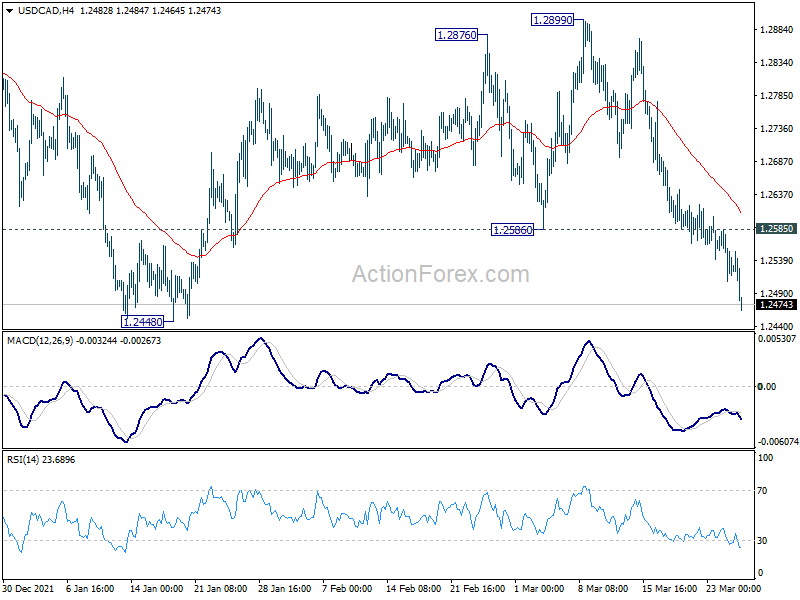
USD/CAD's strong break of 1.2586 support last week confirmed completion of rebound from 1.2448. Initial bias remains on the downside this week. Firm break of 1.2448 will argue that whole corrective pattern from 1.2005 has completed and bring retest of this low. On the upside, above 1.2585 minor resistance will turn intraday bias neutral and bring consolidations first, before staging another fall.
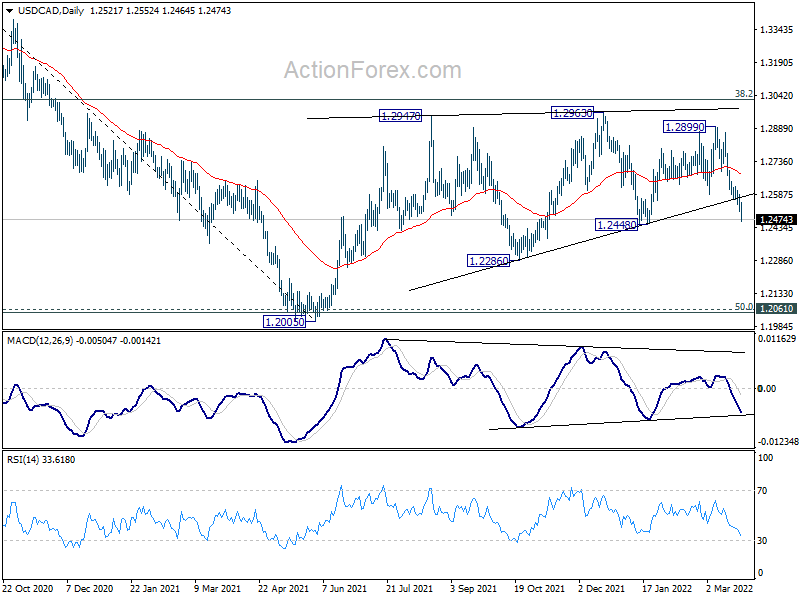
In the bigger picture, focus stays on 38.2% retracement of 1.4667 (2020 high) to 1.2005 (2021 low) at 1.3022. Sustained break there should confirm that the down trend from 1.4667 has completed after defending 1.2061 long term cluster support. Further rise would then be seen towards 61.8% retracement at 1.3650. However, rejection by 1.3022 will maintain medium term bearishness. Break of 1.2005 will resume the down trend from 1.4667 and that carries larger bearish implications too.
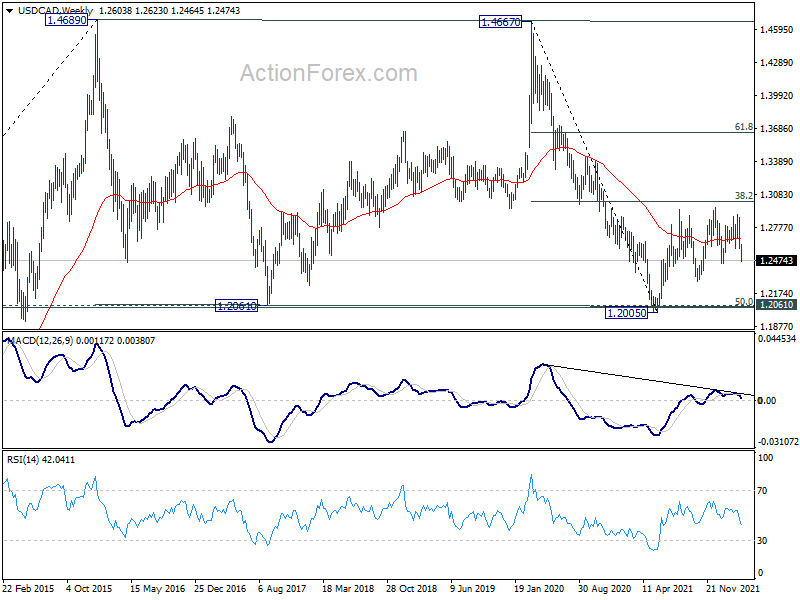
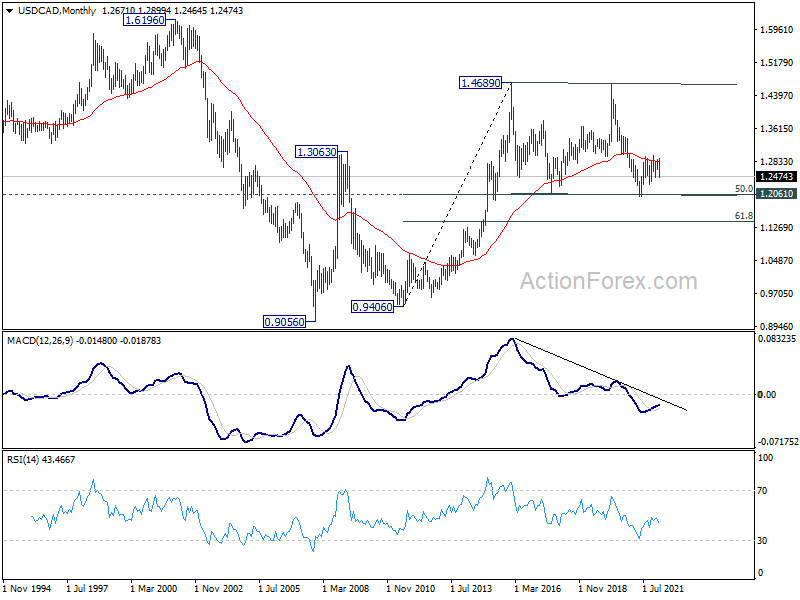
In the longer term picture, we're viewing price actions from 1.4689 as a consolidation pattern. Thus, up trend from 0.9506 (2007 low) is still expected to resume at a later stage. This will remain the favored case as long as 1.2061 support holds, which is close to 50% retracement of 0.9406 to 1.4689 at 1.2048. However, firm break of 1.2061 support will argue that USD/CAD has already started a long term down trend. Next target is 61.8% retracement of 0.9406 to 1.4689 at 1.1424.
GBP/JPY Weekly Outlook
GBP/JPY's strong break of 158.19 resistance last week confirmed resumption of larger up trend. Initial bias stays on the upside this week. Next target is 61.8% projection of 136.96 to 158.19 from 150.95 at 164.07. On the downside, however, break of 159.01 minor support will tun intraday bias neutral, and bring consolidations first, before staging another rally.
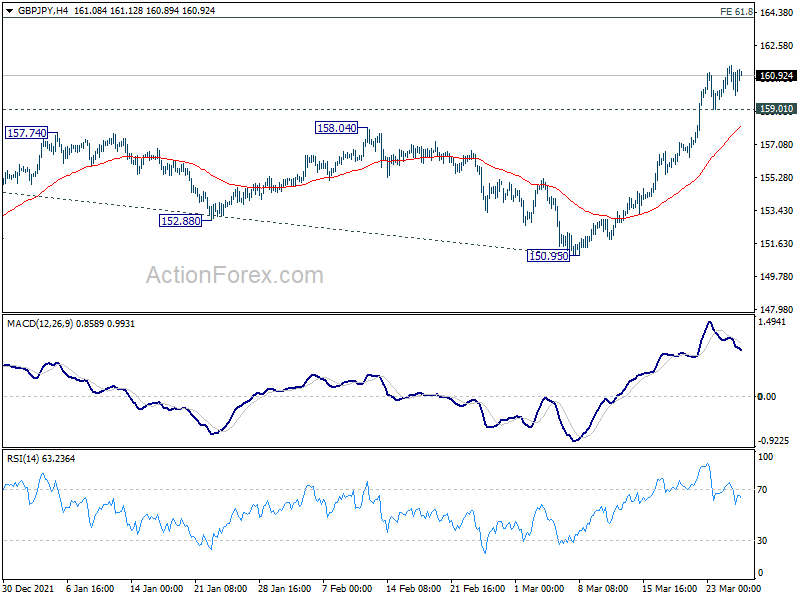
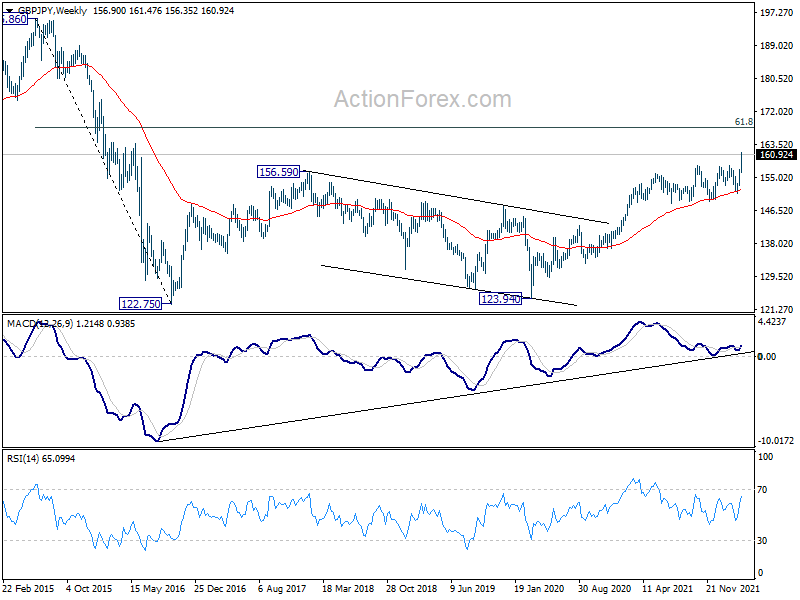
In the bigger picture, up trend from 123.94 (2020 low) is still in progress, and notable support from 55 week EMA affirms medium term bullishness. Next target is 61.8% retracement of 195.86 (2015 high) to 122.75 (2016 low) at 167.93. Sustained break there will be a long term bullish signal. This will now remain the favored case as long as 150.95 support holds.
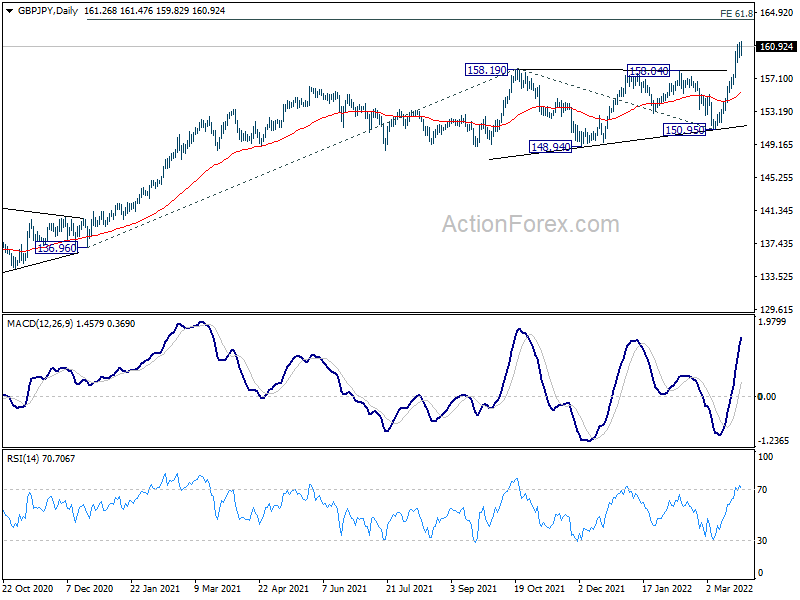
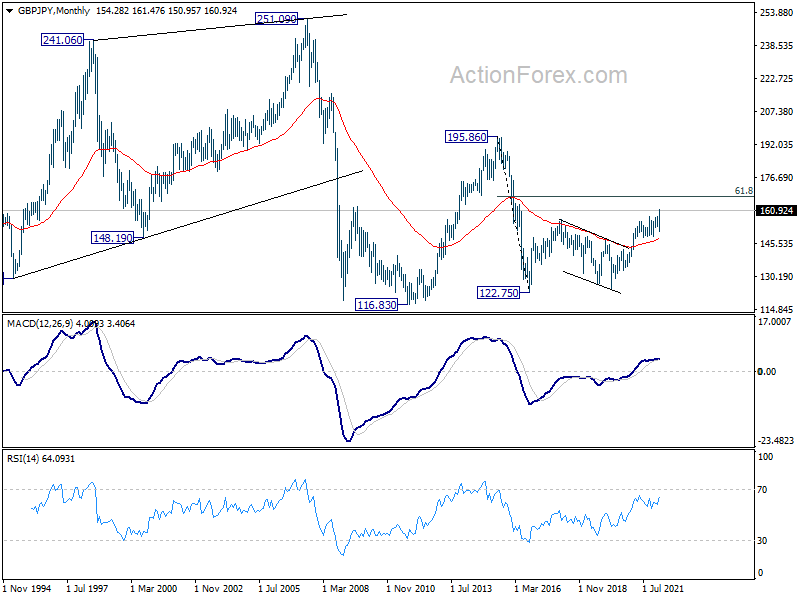
In the longer term picture, as long as 55 month EMA (now at 147.73) holds, we'd still favor more rally to 61.8% retracement of 195.86 to 122.75 at 167.93. Sustained break there will pave the way to 195.86 (2015 high).
EUR/GBP Weekly Outlook
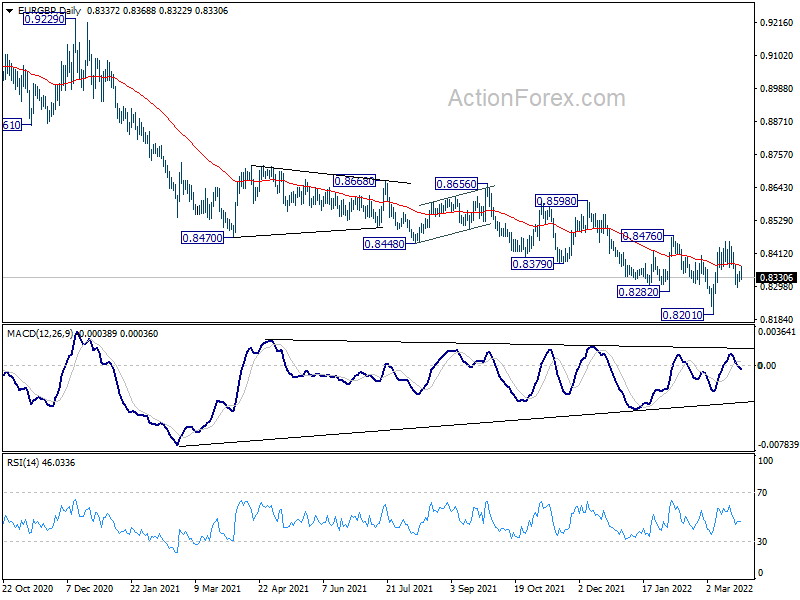
EUR/GBP dropped sharply to 0.8294 last week but recovered since then. Initial bias is neutral this week first. On the downside, below 0.8294 will resume the fall from 0.8456 to retest 0.8201 low. Firm break there will resume larger down trend. On the upside, however, break of 0.8456 will resume the rebound from 0.8201 to 0.8476 structural resistance.
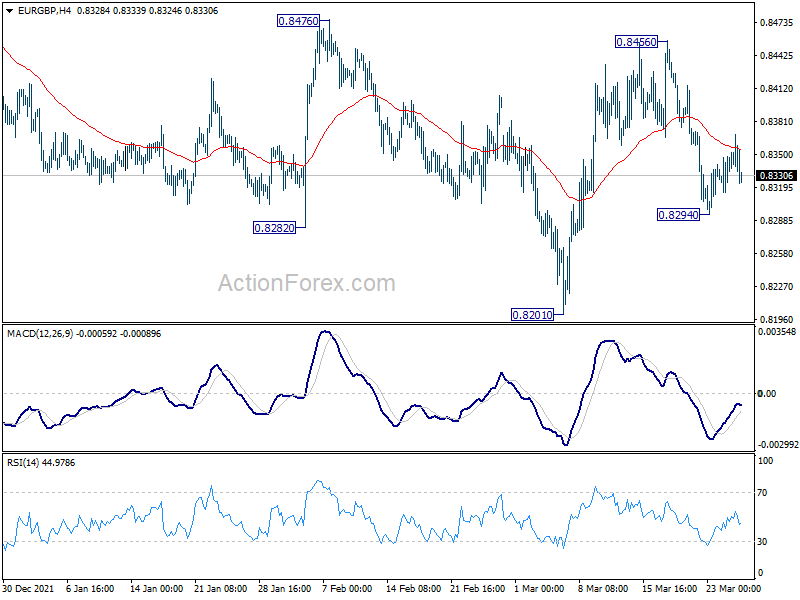
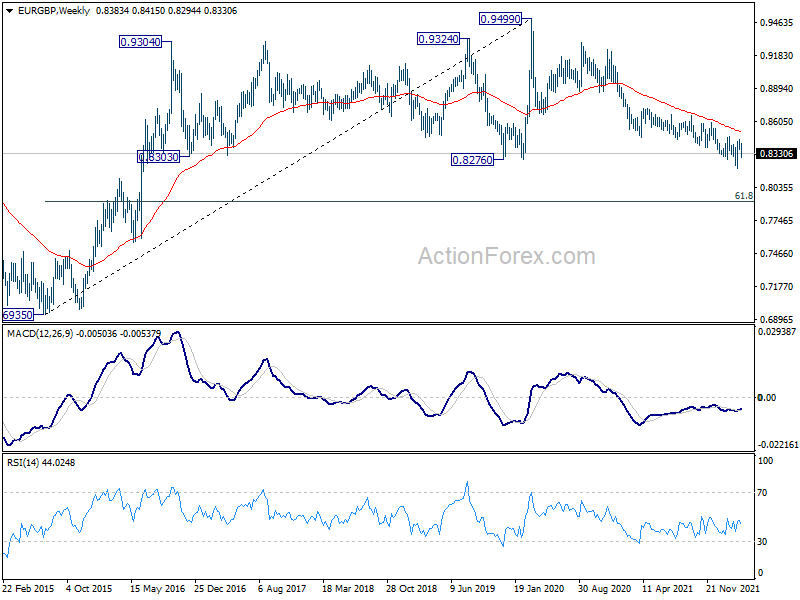
In the bigger picture, the down trend from 0.9499 is expected to continue as long as 0.8476 resistance holds. Sustained trading below 0.8276 support will argue that the whole up trend from 0.6935 (2015 low) has reversed. Deeper fall should be seen to 61.8% retracement of 0.6935 to 0.9499 at 0.7917 next. However, firm break of 0.8476 will indicate medium term bottoming at least. Focus will be back on 55 week EMA (now at 0.8523) for more evidence of bullish reversal.
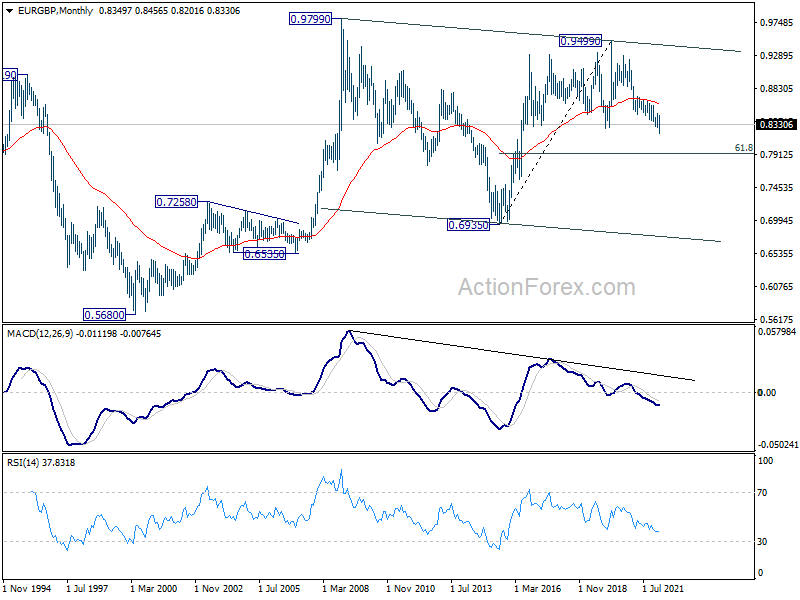
In the long term picture, current development argues that fall from 0.9499 is probably the third leg of the pattern from 0.9799 (2008 high). Sustained break of 61.8% retracement of 0.6935 to 0.9499 at 0.7917 will pave the way back to 0.6935 (2015 low) and probably below.
EUR/AUD Weekly Outlook
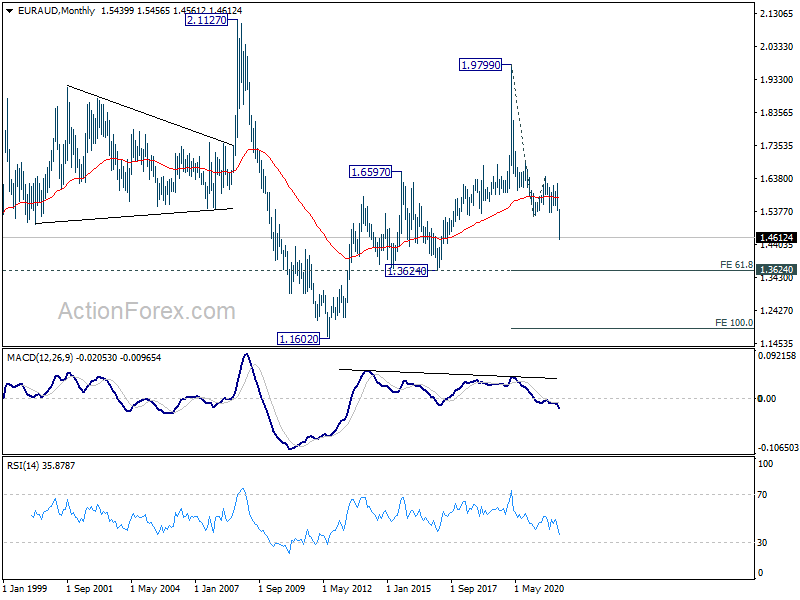
EUR/AUD's decline from 1.5327 continued last week and hit as low as 1.4591. In spite of diminishing downside momentum, initial bias stays on the downside this week for 1.4561 support. Decisive break there will resume larger down trend from 1.9799. Next target is 1.3623 projection level. On the upside, above 1.4804 minor resistance will delay the bearish case, and turn bias back to the upside for another recovery first.
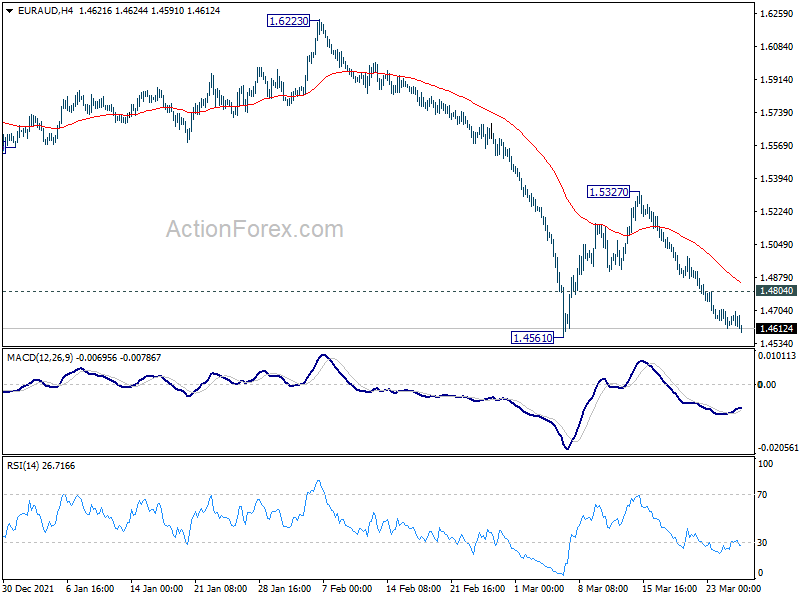
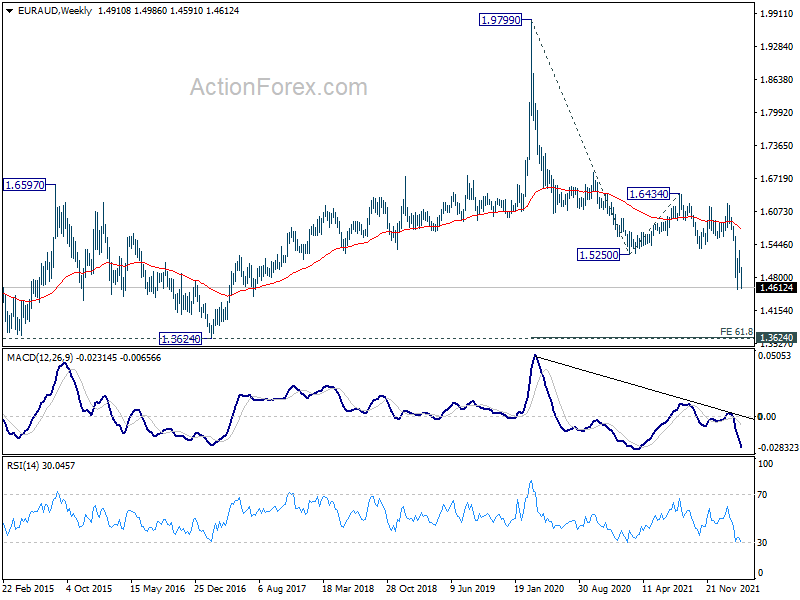
In the bigger picture, fall from 1.9799 is seen as a long term impulsive move. Next target is 61.8% projection of 1.9799 to 1.5250 from 1.6434 at 1.3623, which is close to 1.3624 long term support (2017 low). Some support could be seen there to bring interim rebound. But overall, break of 1.5354 support turned resistance is needed to be the first sign of medium term bottoming. Otherwise, outlook will stay bearish in case of recovery.
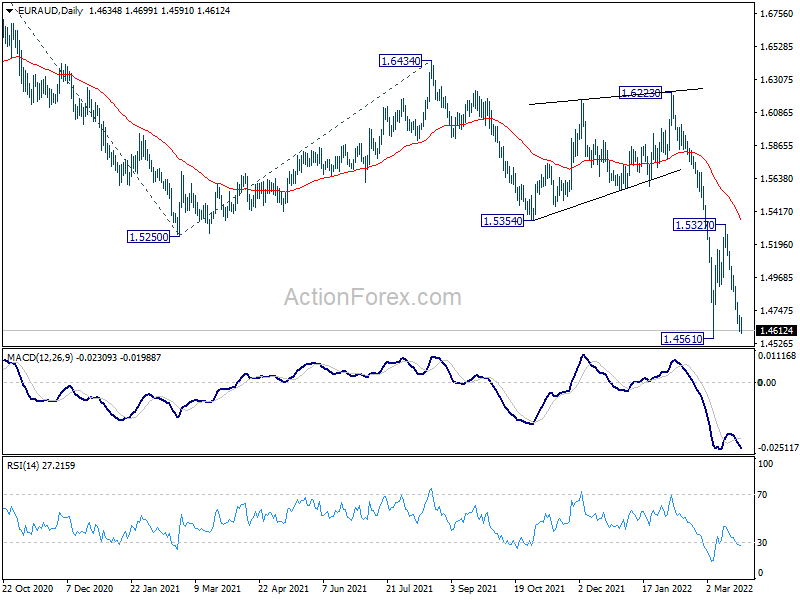
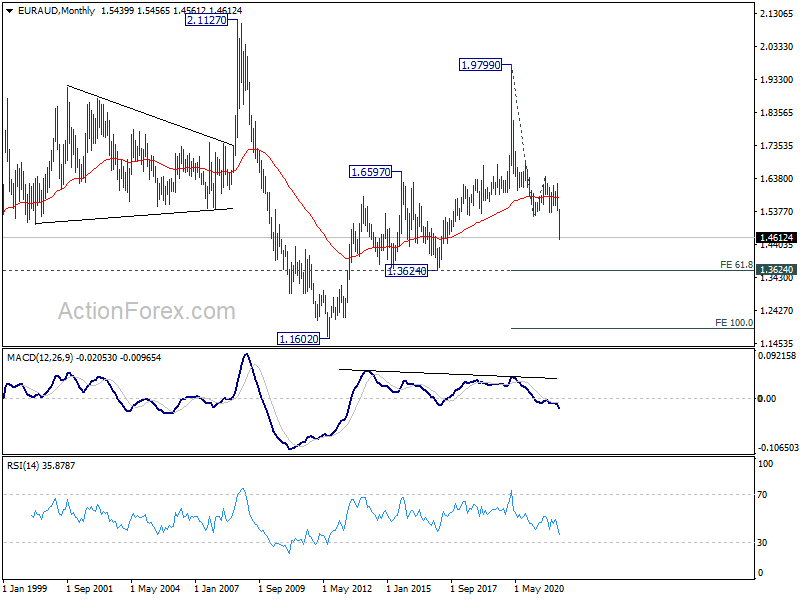
In the longer term picture, fall from 1.9799 (2020 high) is seen as the third leg of the pattern from 2.1127 (2008 high). Deeper fall should be seen to 1.3624 support. Decisive break there would pave the way back to 1.1602 (2012 low).
EUR/CHF Weekly Outlook
EUR/CHF gyrated lower last week but stays above 1.0184 minor support. Initial bias remains neutral this week first. On the downside, break of 1.0814 will indicate that rebound from 0.9970 has completed at 1.0400, ahead of 38.2% retracement of 1.1149 to 0.9970 at 1.0420. In this case, intraday bias will be turned back to the downside for retesting 0.9970 low. On the upside, break of 1.0400 will resume the rebound to 1.0610 key structural resistance.
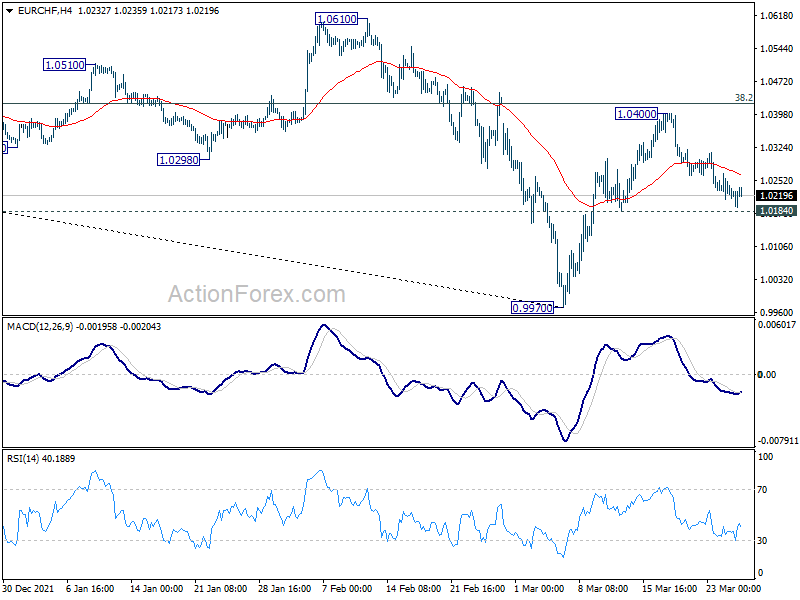
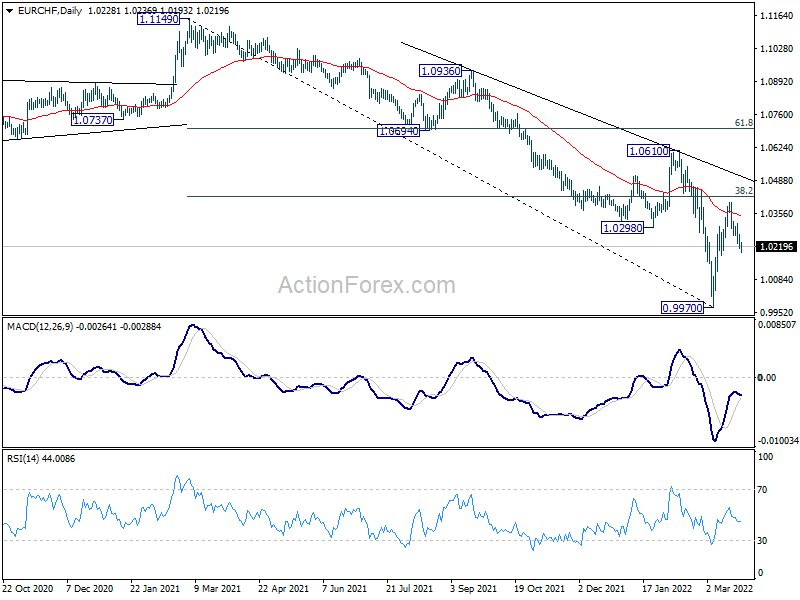
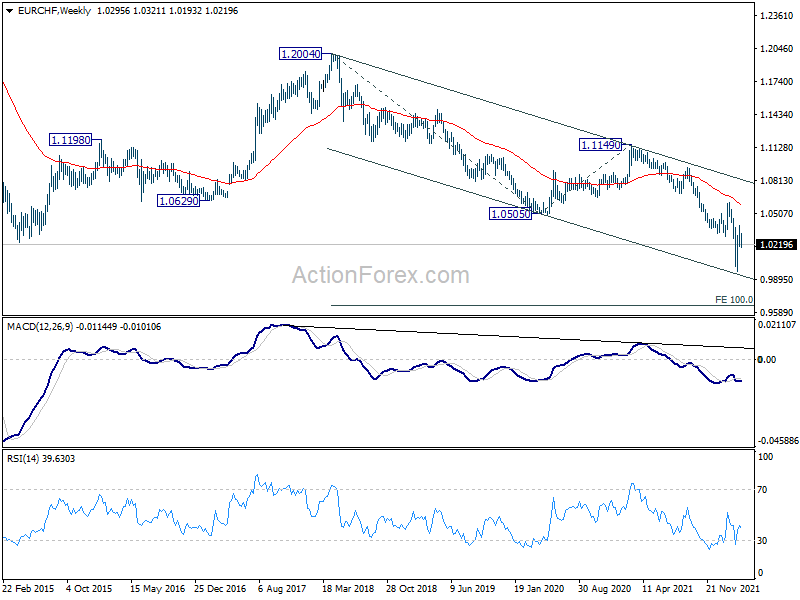
In the bigger picture, long term down trend from 1.2004 (2018 high) is still in progress. Next target is 100% projection of 1.2004 to 1.0505 to 1.1149 at 0.9650. In any case, sustained break of 1.0505 support turned resistance is needed to be the first sign of medium term bottoming. Otherwise, outlook will remain bearish.
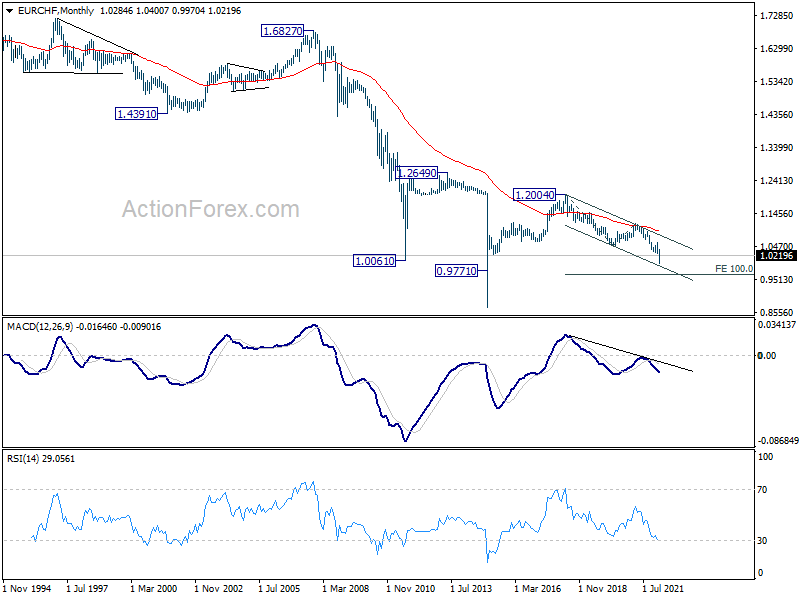
In the long term picture, capped below 55 month EMA, EUR/CHF is seen as extending the multi-decade down trend. There is no prospect of a bullish reversal until some sustained trading above the 55 month EMA (now at 1.0909).
Yen Extended Down Trend as US 10-Yr Yield Hit 2.5, Euro Vulnerable Again
Yen was once again the runaway loser last week as global benchmark treasury yields, except JGB, surged. BoJ has clearly put a cap in 10-year JGB yield and the result is widening spread and persistent Yen selloff. Euro showing some renewed weakness but it's so far still range bound against Dollar. Nevertheless, extended decline in Euro against Swiss Franc could finally prompt a breakout in EUR/USD.
Commodity currencies are the clear winners, with Aussie leading the way. While RBA is still in wait-and-see mode, traders are probably starting to price in more aggressive tightening should the cycle start late. Also, as a major export of agricultural product and raw materials, the Aussie would continue to be benefited from surging commodity prices.
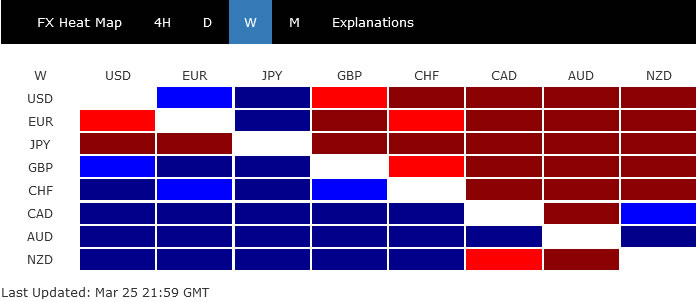
Global benchmark yields surge, US 10-year yield to break multi-decade channel?
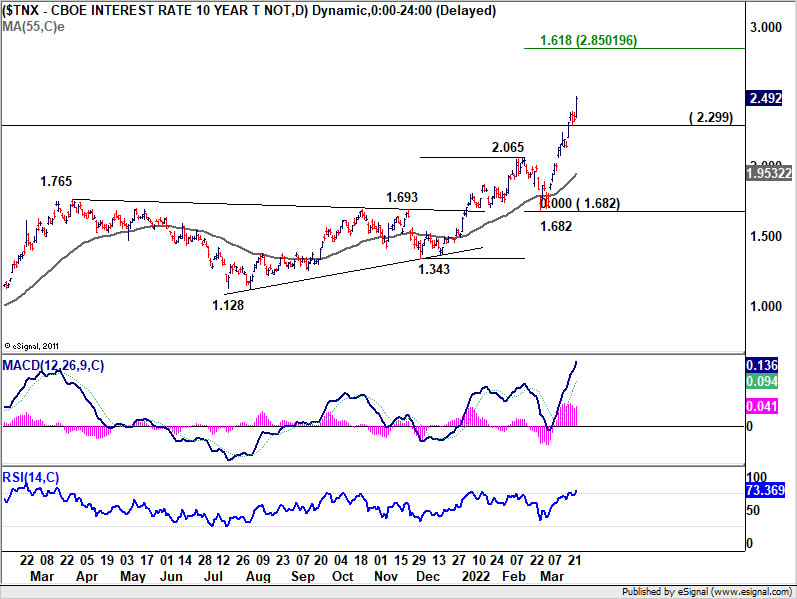
Global benchmark treasury yields extended recent up trend as bet intensified on faster monetary policy normalization and higher inflation for longer. Germany 10-year bund yield rose 0.218 for the week to 0.589, highest since 2018. UK 10-yield gilt yield closed up 0.197 at 1.697, back to the level last seen in 2016.
US 10-year yield also jumped sharply by 0.344 to 2.492, after even breaching 2.5 handle. Near term outlook will stay bullish as long as 2.299 support holds. And next target if 161.8% projection of 1.343 to 2.065 from 1.682 at 2.850.
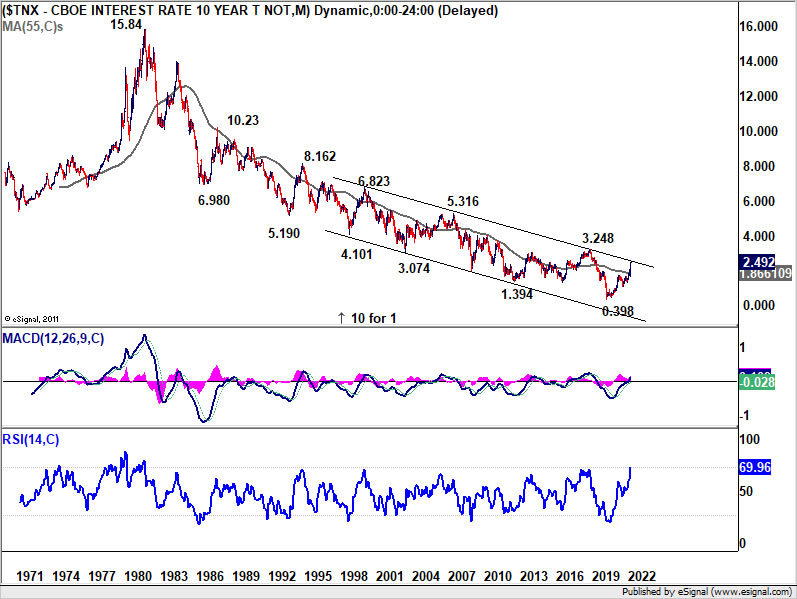
But even more importantly, TNX is now eyeing multi-decade channel resistance at around 2.65. Sustained break of this level would be a strong sign that it's finally reversing the whole down trend from 15.84, made during the early 80s. 2018 high of 3.248 would be the next target and firm break there would confirm the start of a new "era". The pandemic and then the Ukraine war are the turning point to be marked in history.
AUD/JPY and CAD/JPY extend long term up trend, as BoJ caps JGB yields
Yen's extreme weakness could easily be explained by the sluggishness in Japanese yields. 10-year JGB yield did rose 0.032 to 0.240 last week. But rally slowed at it approached 0.25 handle. It should be remembered that BoJ pegs the 10-year yield to 0%, with an allowance to fluctuate up or down 25bps. Also, 0.25% was the level that triggered BoJ intervention with its market operation last month. So unless BoJ re-calibrates its policy, the yield gap with others will more likely grow larger than not.
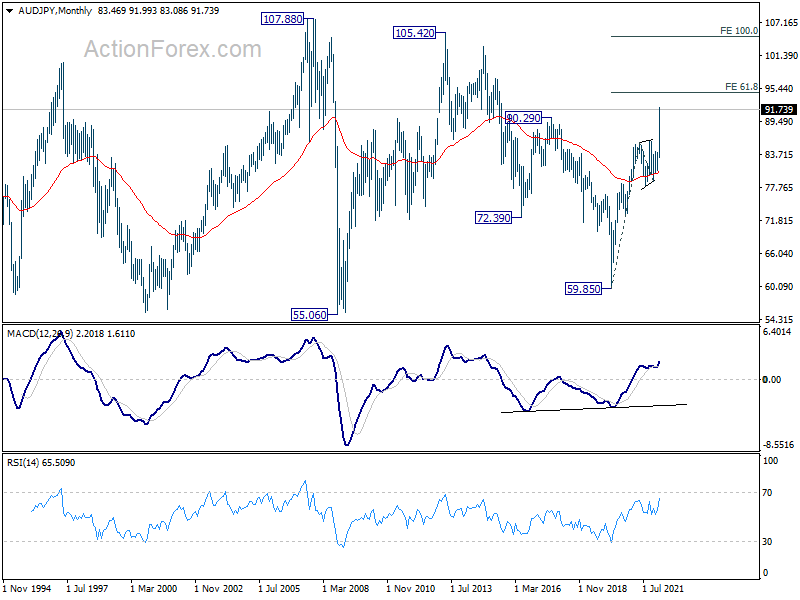
Commodity Yen crosses were the biggest movers last week on expectation of further rise in commodity prices. AUD/JPY rose 3.76% to close at 91.73 and there is no sign of topping. Further rise is expected this week for 61.8% projection of 59.85 to 85.78 from 78.77 at 64.79 next. On the downside, break of 89.91 support will bring near term consolidations first, before staging another rally.
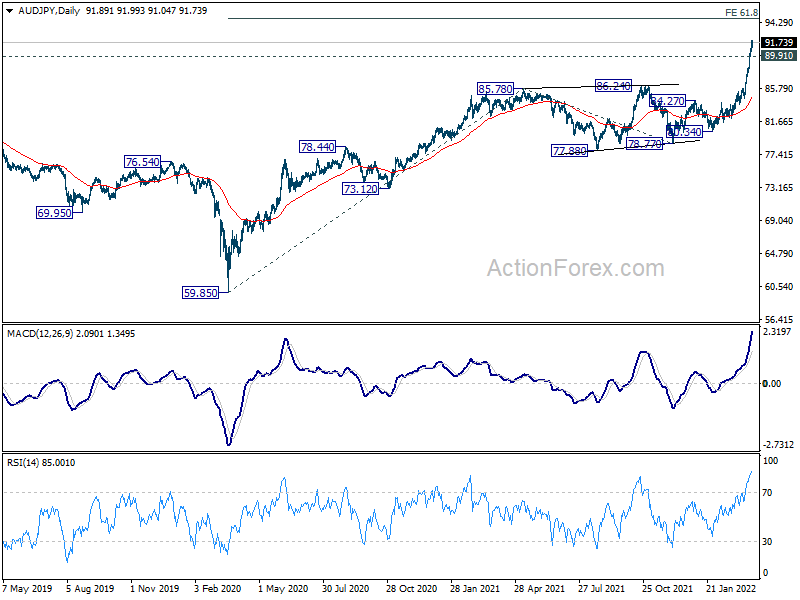
More importantly, AUD/JPY broke through 90.29 long term resistance with solid strength. Rise form 59.85 (2020 low) is seen as reversing the whole down trend from 105.42 (2013 high). That is, there is prospect of more medium-to-long-term upside to zone of 105.42 and 107.88 (2007 high).
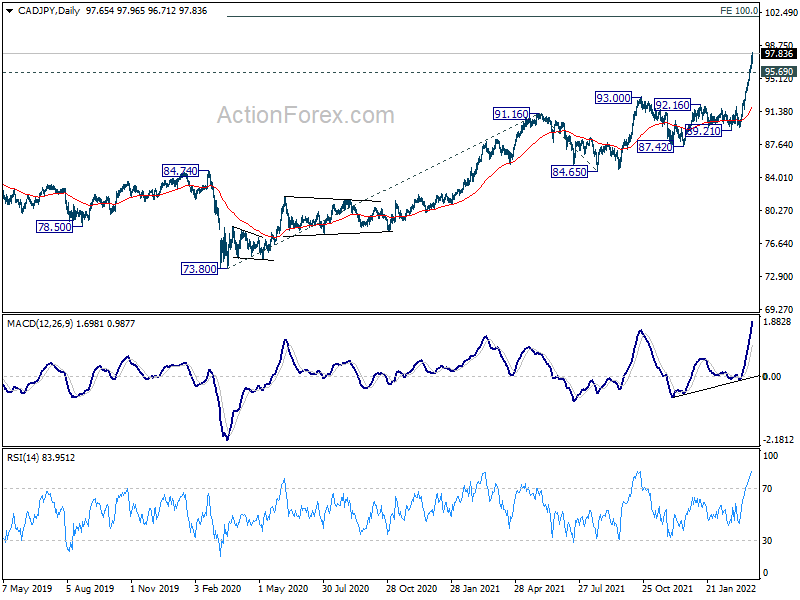
CAD/JPY rose 3.40% to close at 97.83. Further rise is expected to 100% projection of 73.80 to 91.16 from 84.65 at 102.01 next. On the downside, break of 95.69 support will bring near term consolidations first, before staging another rally.
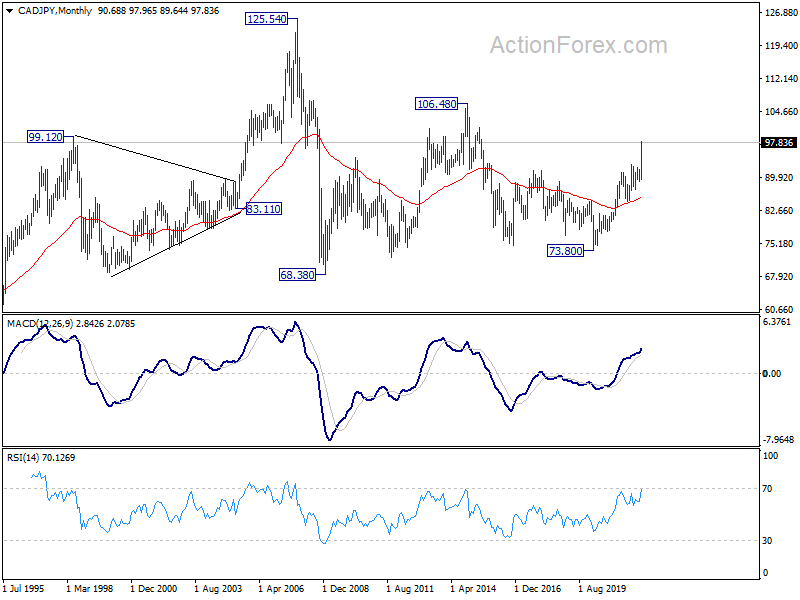
Similar to AUD/JPY, CAD/JPY is now reversing corresponding down trend from 106.48 (2015 high). There is prospect of break through this resistance in the medium-to-long-term, towards 125.54 (2007 high).
Euro and Sterling weak against Aussie and Loonie too
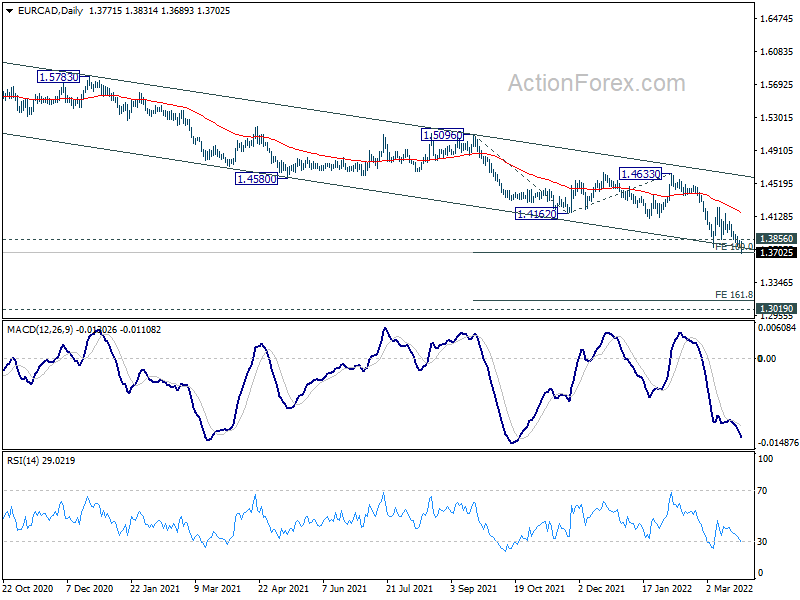
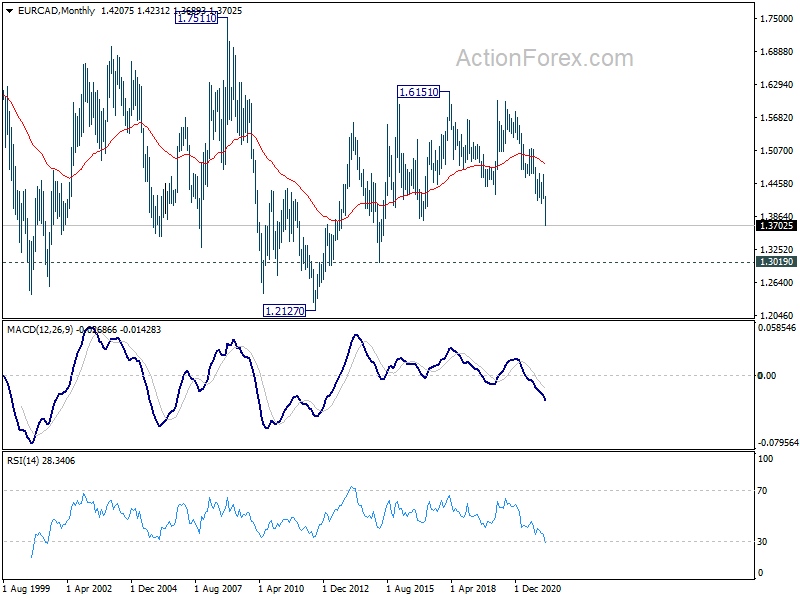
The strength of Loonie and Aussie is also apparent against European majors. EUR/CAD's down trend resumed last week and hit 100% projection of 1.5096 to 1.4162 from 1.4633 at 1.3699 already. Near term outlook will remain bearish as long as 1.3856 support turned resistance holds. Next target is 161.8% projection at 1.3122.
From a long term point of view, EUR/CAD is reversing whole up trend from 1.2126 (2012 low). The above mentioned projection target is also closed to 1.3122 long term support.
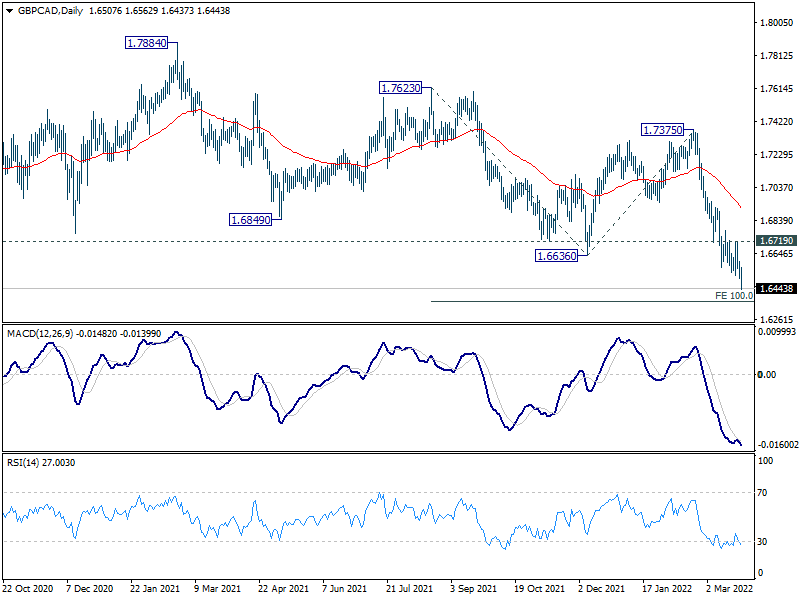
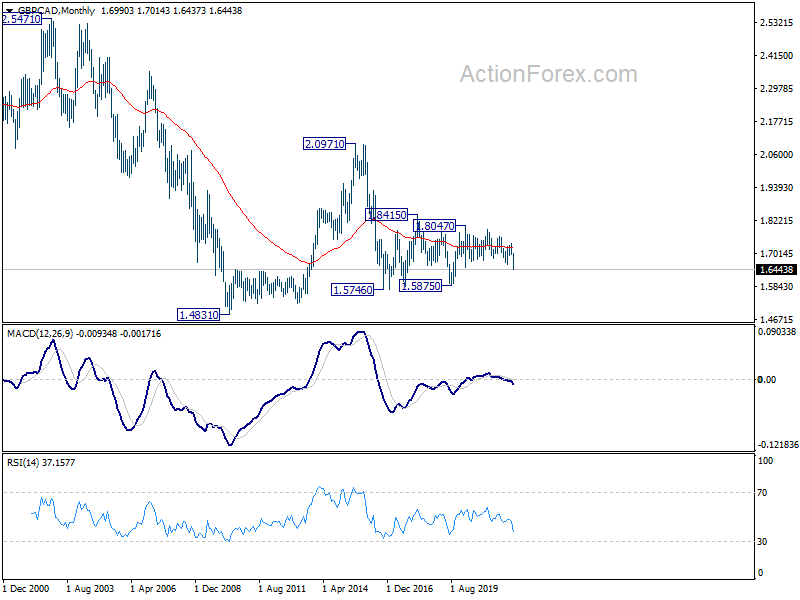
GBP/CAD's down trend also resumed and hit as low as 1.6437. Near term outlook will stay bearish as long as 1.6719 resistance holds. Next target if 100% projection of 1.7623 to 1.6636 from 1.7375 at 1.6388. Decisive break there will pave the way to 161.8% projection at 1.5778.
The fall from 1.8047 (2020 high) could either be a leg of the corrective pattern from 1.5746 (2016 low), or resuming the down trend from 2.0971 (2015 high). In either case, based on current momentum, GBP/CAD could have a test on 1.5746/5875 support zone before bottoming.
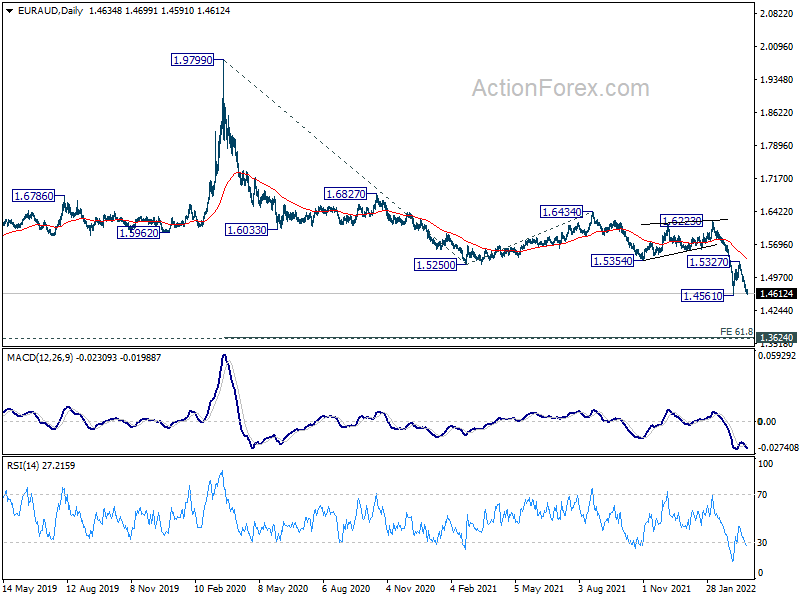
EUR/AUD's rebound from 1.4561 has likely completed at 1.5327 already. Further break of 1.4561 support will resume larger down trend. from 1.9799. Next target is 61.8% projection of 1.9799 to 1.5250 from 1.6434 at 1.3623, which is close to 1.3624 long term support.
Also, EUR/AUD's decline from 1.9799 (2020 high) should be reversing whole rise from 1.1602 (2012 low). Decisive break of 1.3624 will pave the way back to 1.1602 low.
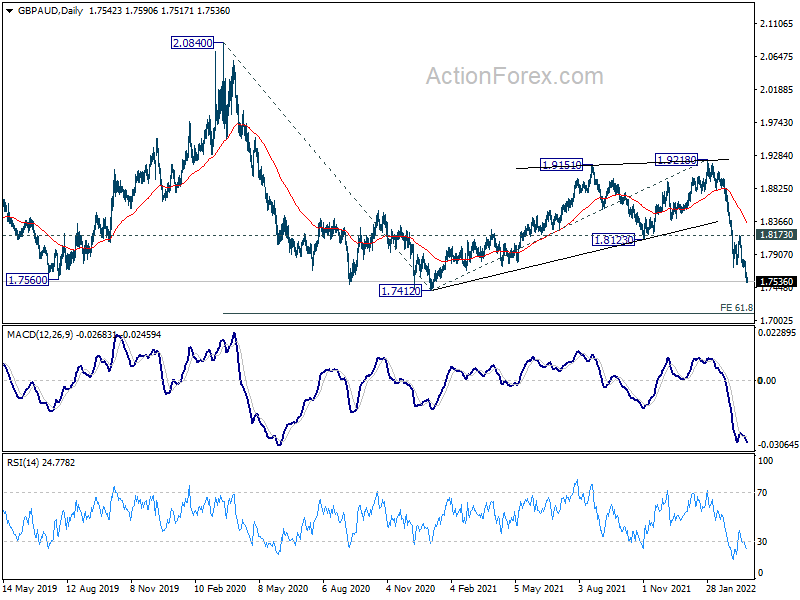
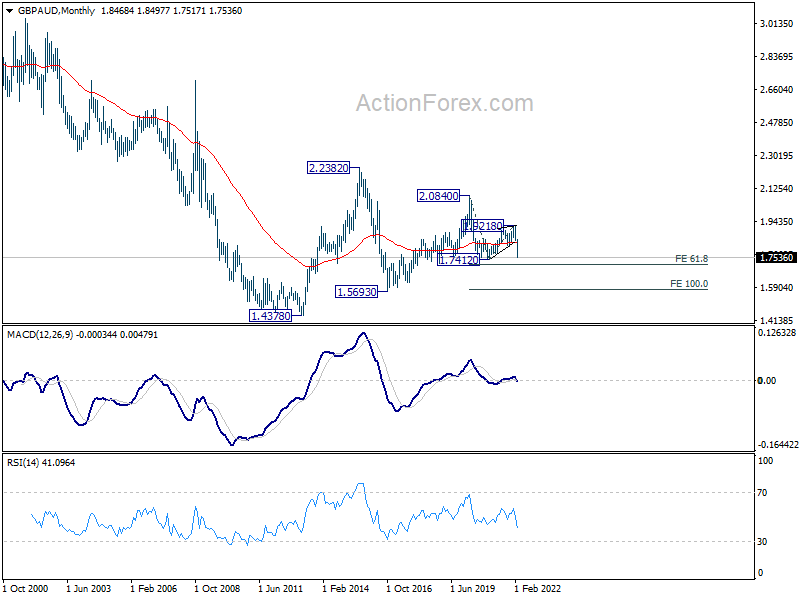
GBP/AUD has yet to resume the corresponding down trend from 2.0840 (2020 high). But it should be a matter of time only. Break of 1.7412 low will target 61.8% projection of 2.0840 to 1.7412 from 1.9218 at 1.7099.
Fall from 2.0840 is seen as the third leg of the pattern from 2.2382 (2015 high). Hence sustained break of 1.7099 would pave the way to 100% projection at 1.5790, which is close to 1.5693 support.
EUR/CHF Weekly Outlook
EUR/CHF gyrated lower last week but stays above 1.0184 minor support. Initial bias remains neutral this week first. On the downside, break of 1.0814 will indicate that rebound from 0.9970 has completed at 1.0400, ahead of 38.2% retracement of 1.1149 to 0.9970 at 1.0420. In this case, intraday bias will be turned back to the downside for retesting 0.9970 low. On the upside, break of 1.0400 will resume the rebound to 1.0610 key structural resistance.
In the bigger picture, long term down trend from 1.2004 (2018 high) is still in progress. Next target is 100% projection of 1.2004 to 1.0505 to 1.1149 at 0.9650. In any case, sustained break of 1.0505 support turned resistance is needed to be the first sign of medium term bottoming. Otherwise, outlook will remain bearish.
In the long term picture, capped below 55 month EMA, EUR/CHF is seen as extending the multi-decade down trend. There is no prospect of a bullish reversal until some sustained trading above the 55 month EMA (now at 1.0909).
Summary 3/28 – 4/1
Monday, Mar 28, 2022
[php_everywhere instance="1"]
Tuesday, Mar 29, 2022
[php_everywhere instance="2"]
Wednesday, Mar 30, 2022
[php_everywhere instance="3"]
Thursday, Mar 31, 2022
[php_everywhere instance="4"]
Friday, Apr 1, 2022
[php_everywhere instance="5"]
The Weekly Bottom Line: Fed’s Focus Tilts Squarely on Restoring Price Stability
U.S. Highlights
- In a carefully crafted speech this week in D.C., Fed Chair Powell reaffirmed the Fed’s keenness for a more aggressive removal of monetary stimulus in order to restore price stability.
- Powell highlighted the potential for the Fed to go with hikes larger than 25 basis points (bps) if deemed appropriate. Market odds now heavily favor 50 bps hikes at the next two FOMC meetings in May and June.
- On the data front, both new single-family home sales and pending (existing) home sales pulled back in February.
Canadian Highlights
- Bond yields shot higher this week, building on prior gains. The Canadian dollar also moved higher for the second straight week as past flight-to-safety moves unwound somewhat.
- Saskatchewan, New Brunswick and Quebec released budgets this week, making a total of six provinces that have reported. Fiscal positions have turned out to be much better than anticipated at this time last year, and provincial government spending should be supportive of growth in 2022.
- Stealing the fiscal spotlight was the new partnership between the federal Liberals and NDP. The upshot is that both Liberal and NDP platform promises could be pushed through in the House, paving the way for new spending.
U.S. - Fed’s Focus Tilts Squarely on Restoring Price Stability
If last week’s Fed rate hike (and a sharp move up in the number of future expected hikes among FOMC members) left any doubt about the Fed’s transition to a more hawkish stance, Powell’s remarks this week are likely to have sealed the deal. There was no shortage of Fed speeches to parse, in a week that didn’t have much in the way of data.
The most noteworthy speech was Fed Chair Powell’s remarks in D.C. on Monday. Reading carefully crafted remarks, Powell recognized that the labor market is strong and still has “substantial momentum”. Further driving home his point, last week’s jobless claims fell to the lowest level since 1969. Powell also noted that inflation is “much too high”, and touched on the fallout from the Russia-Ukraine conflict, which will put additional upward price pressure through several key commodities, including crude oil. The price of the latter is up from last week and is holding near $110 per barrel at time of writing – a level that is broadly in line with our recent forecast (see here). Powell also emphasized that the path of inflation remains uncertain. He pointed out the potential for more COVID-related supply chain disruptions out of China, where a rise in Covid infections led to the lockdown of another major city of nine million people this week.
On the monetary policy response, Chair Powell noted that the Fed would not assume significant near-term supply-side relief on inflation but would instead be looking for actual progress on the ground. This was followed by more hawkish comments regarding the size of rate hikes, with the Chair highlighting the potential for the Fed to go with hikes larger than 25 basis points (bps) if deemed appropriate. Powell went further, stating that if the Fed determines the need to “tighten beyond common measures of neutral and into a more restrictive stance”, it would do that as well. This was already shown in the Fed’s updated dot plot, which had a median projected policy rate of 2.8% in 2023-24, above the long-run rate of 2.4%.
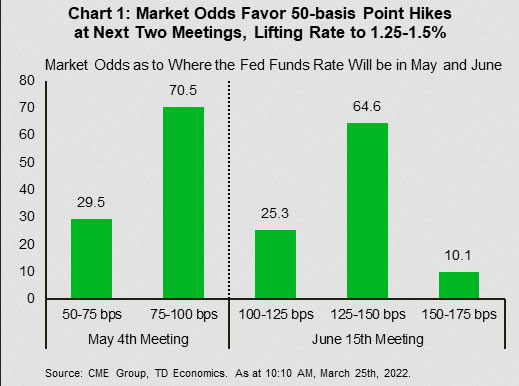
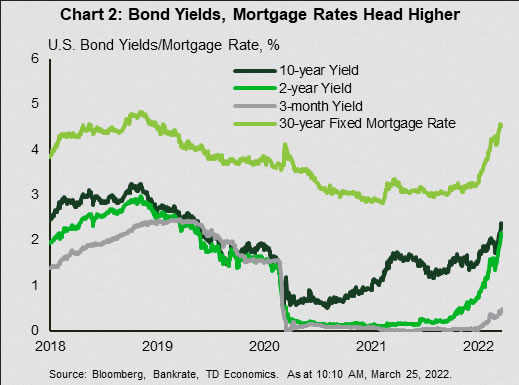
Several other Fed officials, including Mester, Daly, and Evans, echoed the hawkish stance by showing more comfort with rate hikes larger than a quarter point. It comes as no surprise then that market odds are now heavily favoring 50 bps hikes at the next two policy meetings (Chart 1). Bond yields and mortgage rates, meanwhile, continued to head higher (Chart 2). Thirty-year mortgage rates rose above 4.5% this week – a sharp increase from a little over 3% at the start of the year. Higher interest rates will take some steam out of housing demand this year, with this week’s declines in new and pending home sales for the month of February not entirely surprising. Higher borrowing costs are part of the reason why we expect the housing market to cool this year. For more on our housing outlook see here.
The bottom line is that the Fed is behind the curve on inflation, and now needs to take stronger steps to rein it in. While this also increases the chances of policy error, the Fed has reaffirmed its keenness for a more aggressive removal of monetary stimulus to restore price stability.
Canada - Fiscal Developments Take the Stage
Oil prices continued to be volatile although as of writing, are on track to end the week higher. Meanwhile, while bond yields continued their rise this week. On the yield front, central bank hawkishness has been driving yields higher across the curve this month, although more so at the front end. The loonie has also joined the fray, rising further this week as earlier flight-to-safety flows reverse. It is has risen about two cents since mid-March.
This week, Saskatchewan, New Brunswick, and Quebec released their budgets for the upcoming fiscal year. Six provinces have now reported, with Alberta, B.C. and PEI released earlier. Although we are missing Ontario, some themes are beginning to emerge. First, provinces mostly avoided major new revenue initiatives, although New Brunswick is introducing new tax relief measures, while Saskatchewan is broadening its tax base by adding the PST to admission and entertainment charges.
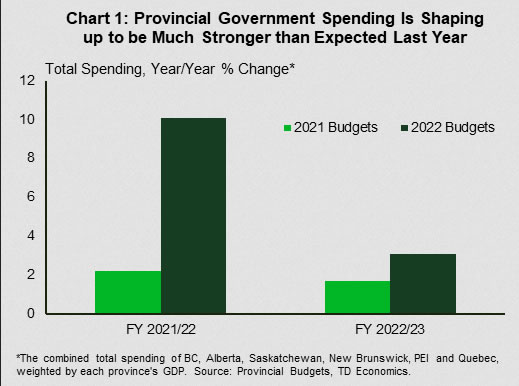
Second, election cycles matter, as Quebec is delivering direct cash payments to most of its population ahead of its October election. Third, government spending will likely be growth-supportive in 2022, as the combined, GDP weighted, expenditures of all six provinces is estimated to have grown by 10% in FY 2021/22 (Chart 1). This means that spending strength likely extended into the early part of this year, which should help economies post above-trend growth (see latest Provincial Economic Forecast). Aggregate expenditure growth is forecast to slow to 3% in the upcoming fiscal year, but inflation is also expected to ease moving forward, which will make inflation-adjusted spending look better. Finally, capital spending is featuring prominently in budgets so far.
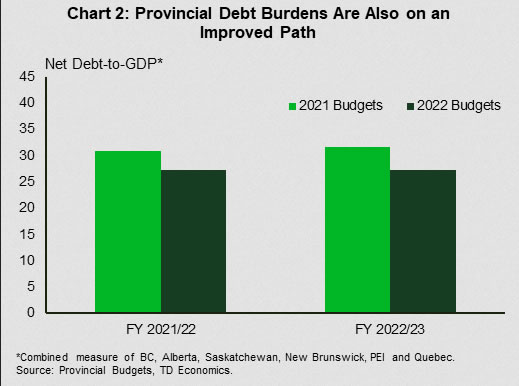
Governments are in a much better fiscal position compared to expectations imbedded in last year's budgets. The combined deficit for FY 2021/22 of the six provinces reporting so far amounts to about $9 billion – $30 billion below what was expected last year. As a result, aggregate net debt-to-GDP is also lower (Chart 2). This picture may ultimately turn out even better for Alberta and Saskatchewan, given the modest commodity price profiles built into their budgets.
Despite the flurry of budgets released this week, the more eye-catching fiscal development was the new partnership between the federal Liberals and NDP. The NDP will back Liberal platform plans, including a tax on banks and insurers, and action on housing. In turn the NDP wants to add an income-based dental care program and a national pharmacare program. Perhaps the biggest takeaway here is that significant new spending could be forthcoming in the federal budget, expected in April. While this could prove growth supportive, it will do little to quell inflation, putting more onus on the Bank of Canada to rein it in.
Week Ahead – An Encouraging Recovery
Are investors correct to be optimistic?
Investors appear remarkably calm at the moment given the level of uncertainty we’re facing this year, from inflation to interest rates and even Covid, when you consider China is still embracing lockdowns.
Throw soaring commodity prices into the mix and there’s plenty of reason to be pessimistic. But when you look at financial markets, that isn’t what we’re seeing. Equities aren’t far from record highs in many cases and the yield curve isn’t yet inverted in a way that suggests a recession is coming.
Instead, the Fed is warning of a very aggressive tightening cycle, telling us the labor market is too strong and that inflation will be under control again soon enough. For once, the central bank and markets appear on the same page. Which probably makes me feel more uneasy than it should.
US
The focus on Wall Street remains on geopolitics, but many traders will pay close attention to the economic readings about the US jobs market, consumer, inflation, and manufacturing activity. The Fed is confident that the economy is on solid footing despite surging inflation, but if the economic data tells a different story, that could change the front-loaded approach of supersized rate hikes.
The nonfarm payroll report will confirm that the labor market remains strong. The consensus estimate for jobs created in March is 450,000 which would be a decrease from the 678,000 gain in February. The unemployment rate is expected to tick lower to 3.7%, while average hourly earnings could rebound to 0.4%, an improvement from the flat reading seen a month ago.
EU
It goes without saying that the focus next week will continue to be what’s happening in Eastern Europe and what the EU is doing in order to reduce its reliance on Russian energy and allow it to impose more severe sanctions. The latter is unlikely any time soon but the US LNG deal was a step towards it.
Next week offers an abundance of economic data, with the standout being flash inflation indicators. The eurozone flash CPI on Friday will be the one to watch but we could get hints from individual nations earlier in the week.
Central banks have been forced to back down on their transitory message in recent months and the ECB took a step in that direction a couple of weeks ago. Further unexpected inflation spikes will further pile on the pressure and make comments from President Lagarde and her colleagues all the more interesting.
UK
Mostly tier two and three data from the UK next week, with a speech from BoE Governor Andrew Bailey on Monday the highlight. The MPC last week gave the impression that they were slightly softening their hawkish stance after three consecutive hikes but inflation last month accelerated faster than expected which may force them to persevere for a few more meetings yet. Deputy Governor Ben Broadbent also speaks on Wednesday.
Russia
Against the backdrop of Russia’s illegal invasion of Ukraine, sanctions imposed on it by the West, and the Kremlin’s attempts to hit back – for example, the decision this week to insist on purchases of Russian gas to be made in rubles – there’s going to be little hype about the unemployment and manufacturing data next week.
Negotiations are continuing with Ukraine but appear to be making little progress. Meanwhile, sanctions are continuing to be imposed and the EU is slowly severing energy ties which will be damaging in the long run. In the near future, the economy is expected to fall into a two-year recession, with this year’s contraction being particularly sharp at up to 10%.
South Africa
The SARB raised interest rates by 25 basis points this week but two members (out of five) of the MPC voted for a 50 basis point hike. The tightening cycle looks set to continue with inflation running at the upper end of its 3-6% target range and commodity pressures increasing.
Turkey
A relatively quiet week is in store for Turkey, with the manufacturing PMI the only notable release.
China
There is a myriad of forces impacting Chinese markets in the week ahead. Evergrande is back in the headlines with foreign bondholders running out of patience. Covid-19 continues spreading in the mainland, raising the threat of lockdowns impacting manufacturing and logistics. US authorities are less positive about the audits of US-listed China companies than the noise from China. Russian support, tacit or official, is a huge risk point from a sanctions point of view.
China also releases its official and Caixin manufacturing and services PMIs.
All of this provides downside risk to Chinese equities which have quickly run out of steam after government jawboning to support the market last week. China left its LPRs unchanged, disappointing participants who wanted to see concrete action.
India
India releases its balance of trade on Friday, which could show the impact of higher oil prices. As a huge net energy importer, and with the central bank continuing its reluctance to hike interest rates, the INR remains near the weak end of its range. A sharp rise in oil prices, or US yields next week, could spark more INR weakness which could also see hot money exit the Sensex.
Australia
The AUD/USD is close to recent highs thanks to the new surge in commodity prices and potentially some haven inflows, although risk sentiment remains better than the previous week. Employment data was strong and the week ahead features retail sales, private sector credit, and manufacturing PMI. AUD and local equities will also be sensitive to the China PMI prints.
There is a lot of good news built into AUD at these levels, helped also by AUD/JPY buying. Weak data, a sharp sentiment swing, or weak China PMIs could cause an abrupt correction lower by AUD, which could also be reflected in equity markets.
New Zealand
The New Zealand Dollar has rebounded sharply on commodity prices and haven inflows as markets prime for a faster RBNZ tightening. There is a lot of good news built into the price like AUD/USD, and that leaves NZD vulnerable to a sharp correction lower.
ANZ business confidence on Tuesday may provide that excuse if confidence slumps due to the Ukraine war and soaring inflation.
Japan
USD/JPY has risen 400 points in the past week as the US/Japan rate differential exploded wider. The BoJ and MoF have tried to talk them down with limited success. Currency markets should now be on alert for more “watching FX closely” comments, which could send USD/JPY sharply lower intraday over the coming weeks.
Japan has a heavy data calendar featuring unemployment, retail sales, and arguably most important industrial production and the Tankan Large Manufacturers Survey. The latter two will give a snapshot into whether the Ukraine disruption and inflation wave are impacting business. Low prints could be a headwind for local equities.
Singapore
Inflation rose this week, setting up a MAS tightening in April. Local markets have been buoyant though as Covid restrictions were dramatically eased. PPI has upside risk this week which could increase the MAS noise and dampen equities. USD/SGD remains content to continue running with the USD/Asia pack, which is moving entirely on Ukraine sentiment swings right now.
Economic Calendar
Sunday, March 27
Economic Data/Events
- China industrial profits
Monday, March 28
Economic Data/Events
- US wholesale inventories
- President Biden to reveal 2023 budget request
- South Africa unemployment
- Mexico trade
- Norway Norges Bank Deputy Governor Borsum speaks to the bank’s regional network
- UK Chancellor Sunak appears before Treasury Committee to discuss his Spring Statement
- BOE Gov Bailey speaks on the economy at an event organized by European think tank Bruegel
Tuesday, March 29
Economic Data/Events
- US consumer confidence
- Australian Treasurer Frydenberg presents the annual budget
- Philadelphia Fed President Harker discusses the economic outlook at an event hosted by the Center for Financial Stability in New York
- Bank of England quarterly bulletin
- Japan unemployment
- Australia retail sales, consumer confidence
- Mexico international reserves
Wednesday, March 30
Economic Data/Events
- US Q4 final GDP
- Germany CPI
- Fed’s Barkin speaks at a conference on investing in rural America hosted by his bank
- BOE’s Deputy Governor Broadbent speaks at “The MPC at 25” conference
- UK PM Johnson appears before the Liaison Committee
- Russia unemployment
- Mexico unemployment
- New Zealand building permits, business confidence
- Thailand rate decision: Expected to keep benchmark interest rate unchanged at 0.50%
- Japan retail sales
- Eurozone economic confidence, consumer confidence
- EIA crude oil inventory report
Thursday, March 31
Economic Data/Events
- US consumer income, initial jobless claims
- OPEC and non-OPEC ministerial meeting on output
- SNB’s Maechler, Moser speak at a money market event in Zurich
- Fed’s Williams makes opening remarks at a conference
- Bank of Italy Governor Visco makes an annual address on the state of the economy
- France and Italy CPI
- UK GDP
- Czech Republic GDP
- Japan industrial production
- South African trade balance
- Eurozone and German Unemployment:
- China manufacturing PMI, non-manufacturing PMI
- Australia job vacancies, building approvals
- India fiscal deficit, eight infrastructure industries, BoP
- Thailand BoP
- Japan housing starts
- Singapore money supply
Friday, April 1
Economic Data/Events
- US Mar change in nonfarm Payrolls: 450K v 678K prior, construction spending, unemployment, ISM Manufacturing, vehicle sales
- Europe-EU virtual summit with Chinese President Xi and Premier Li Keqiang along with European Council President Michel and European Commission President von der Leyen
- Eurozone Manufacturing PMI, CPI
- Eurozone ECB’s Schnabel and Knot speak at an event in Cernobbio, Italy
- Poland CPI
- Germany manufacturing PMI
- UK Manufacturing PMI
- New Zealand house prices, consumer confidence
- Japan vehicle sales, PMI
- Singapore home prices
- Australia home loans value, house prices
- China Caixin PMI
- Thailand PMI, foreign reserves, business sentiment index
Sovereign Rating Updates
- Poland (S&P)
- Turkey (S&P)
- Italy (Moody’s)
- South Africa(Moody’s)
- France (DBRS)
Weekly Economic & Financial Commentary: Interest Rate Volatility Near a Decade-High
Summary
United States: From Factories to Construction Sites, Supply Shortages Slow Activity
- Economic reports this week for both manufacturing and homebuilding shared two main themes: disappointing headline numbers, but plenty of backlogs for future work. Whether it is new homes or durable goods, the biggest clog in the production pipeline continues to be supply shortages, and it is increasingly evident that no part of the economy is spared from their pernicious effects.
- Next week: Personal Income & Spending (Thurs), Employment (Fri), ISM Manufacturing (Fri)
International: U.K. Inflation Soars to a 30-Year High
- In the context of elevated global price pressures, inflation in the United Kingdom is showing no signs of slowing down anytime soon. The February CPI surprised to the upside, rising 6.2% year-over-year, as higher prices for energy and commodities have started to reverberate throughout the economy to affect prices more broadly.
- Next week: China PMIs (Thurs), Japan Tankan Survey (Fri), Eurozone CPI (Fri)
Interest Rate Watch: Interest Rate Volatility Near a Decade-High
- The roller coaster ride for U.S. interest rates continued this week. By at least one measure, interest rate volatility is currently well above its average over the past decade and is nearing the highs reached during the peak of the COVID crisis in March 2020.
Credit Market Insights: Looking Back at 2021 with the Distributional Financial Accounts
- The Federal Reserve's Distributional Financial Accounts was released for the fourth quarter of 2021, giving us more information on the state of households across diverse segments of the American population. Across the socio-economic spectrum, household balance sheets have been bolstered since the onset of the pandemic, with growth particularly concentrated at the lowest and highest ends of household wealth.
Topic of the Week: Prices Keep Pumping Up at the Pump
- Gas prices reached record highs during the first weeks of March, raising concerns about the potential implications for consumer spending. It's a predictable pivot, as a sudden price increase in a product that most households cannot do without has historically been associated with wilting consumer sentiment.