Sample Category Title
US Dollar Rises in Asia
Yen, euro start week with losses
The US dollar moved sideways in New York on Friday, the dollar index finishing almost unchanged at 98.80. However, with the Bank of Japan standing in the JGB market today to cap rises in yields the dollar index has risen sharply, boosted by a weaker yen and euro. The dollar index is 0.33% higher at 99.13. In the bigger picture, 99.50 and 97.75 remain the levels to watch.
USD/JPY has surged 0.80% higher to 123.05 this morning, a 100 point gain. Short of a spectacular reversal lower by US yields, USD/JPY is now on track to retest 125.00, potentially this week, with the BOJ having now shown its hand. Attempts by Japanese officials to talk down USD/JPY will have a short-lived impact and are likely to be dips to buy.
The Biden, Putin must go, rhetoric over the weekend is weighing heaving on the euro today as it sparks fears of wider escalation from Russia. EUR/USD has fallen 0.30% to 1.0950, and rallies above 1.1000 are going to be challenging to sustain at the start of the week. The fall today leaves EUR/USD mid-range between longer-term support at 1.0800, and resistance at 1.1150.
Weak Retail Sales data weighed on GBP/USD into the end of the week, and it has moved lower in sympathy with the euro today. GBP/SD has fallen 0.25% to 1.3145, mid-range between major support/resistance at 1.3000 and 1.3300.
AUD/USD and NZD/USD continue defying a stronger US dollar as markets price in a faster pace of rate hikes on both, and commodity prices remain in space. Also helping is a relatively quiet Ukraine news ticker, reducing risk aversion sentiment for now. Both currencies continue to consolidate at the top of their ranges, at 0.7325 and 0.6950. A rise through 0.7550 and/or 0.7000 signals more gains ahead.
Asian currencies are modestly weaker across the board today as USD/JPY soars, amid worries about a covid slowdown in China. In the bigger picture, rising US interest rates and soaring commodity prices will weigh on Asian currencies. As we start the week though, Asian currencies prefer to wait for directional inputs from the northern hemisphere heavyweights.
Shanghai Surprise
It seems appropriate on Oscar’s day that one of the worst films ever made according to critics, Shanghai Surprise, is also dominating Asian markets today. In what was really not much of a Shanghai surprise, Chinese authorities announced over the weekend that Shanghai the city, would enter a two-stage lockdown to stymie surging covid cases and allow mass testing. Half of the city will lockdown from today through to April 1st. The other half will lockdown from April 1st through to April 5th.
As China’s financial centre and an economic powerhouse in its own right, the impact has been immediate. Tesla has halted production at its factory there and other major manufacturers are sure to follow. Mainland China equity markets have fallen today along with Taipei which has a high manufacturing beta to the region. The impact on growth and consumption had also seen oil prices, at least temporarily, sink by around 2.0%.
That has drowned out an improved China Industrial Profits number that was released over the weekend. Industrial Profits for a combined January and February rose by 5.0% YoY, an improvement on December’s 4.0%. Dig below the surface though, and the gains were concentrated, unsurprisingly, in the energy and raw materials sectors.
Additionally, it looks like China’s third-largest property developer missed two bond payments on Friday. This soft underbelly of the China economy has been shifted from the front pages by the Ukraine conflict but hasn’t gone away. The cost-push inflation from the Russian sanctions won’t make the sector any more appealing. China still has work to do on the stimulus front, despite its obvious reluctance to do so. RRR and LPR rate cuts, and a weaker yuan, should be on the way, especially as China’s attempt to jawbone the stock market higher two weeks ago has quickly run out of steam.
Friday’s main data points haven’t done much to dispel economic nerves around inflation dampening demand, or the downstream effects of the Ukraine conflict. UK Retail Sales and Germany’s IFO both missed badly to the downside. US Pending Home Sales slumped by 4.10% versus a 1.0% gain expected. Michigan Consumer Expectations for March also eased to 54.3. They say the best cure for high prices is high prices. Be that the cost of goods or rising mortgage rates. It seems that the signs of that are increasing while inflation shows no sign of abating. Unsurprisingly, the US yield curve moved higher again on Friday. Even more surprisingly, US equities recorded modest gains. You must think one of them has to lose eventually, I know which one my money is on.
The news stream around the Ukraine conflict was relatively light over the weekend, allowing markets to temporarily focus on fundamentals. The main headlines surrounded President Biden saying President Putin had to go. That was greeted by European allies’ face-slapping as they try to negotiate the delicate nuances of not escalating an already very unstable situation on their doorstep. US officials have gone to great lengths to walk back those comments, and the market impact has been limited.
One thing that is moving today in Asia is USD/JPY, which has shot 0.70% to 122.90 this morning. As one of the few dovish central banks left in the world, the Bank of Japan placed an unlimited offer to buy 10-year JGBs at 0.25% this morning, capping yields as they move to the top of the BOJ’s acceptable rate corridor. We can expect some more “watching forex moves closely” comments as well, but I expect their impact to be much less potent than last week. Japan and the USD/JPY are a microcosm of the stresses much of Asia will face this year, with the propensity to tighten monetary policy with the US very low.
The heavy-weight data releases this week are skewed towards the end of the week. We have Australian Retail Sales and US JOLTS Jobs Openings tomorrow and German Inflation on Wednesday. Asia’s highlight will be the release of China’s official Manufacturing and Non-Manufacturing PMIs on Thursday, with the Caixin PMIs on Friday. Thursday also features US Personal Income and Spending before we hit US Non-Farm Payrolls on Friday, with the early betting on a 475,000 gain. I don’t know about you, but the Non-Farms seems to have come around again very quickly.
I’ll be watching the US bond market this week, and another strong US Non-Farms is likely to spark more upside pain for yields. The China covid situation and the Ukraine conflict will keep the news tickers busy, as will more Talking Heads than Stop Making Sense from the Federal Reserve.
Bank of Japan Offered to Buy Unlimited Amount of 10-Y Government Bonds
Markets
The Interfax report on Friday suggesting Russia may be refocusing on the “complete liberation of Donbas” caused yet another sharp core bond selloff. Markets believe such de-scaling of the conflict to the eastern regions of Ukraine is the first step in ending it. This would ultimately result in less economic uncertainty and allow central banks to push through with policy normalization.
It explains the hefty bear flattening in both the US and Europe. US yields jumped 4.6 bps (30y) over 13.2 bps (2y) to 14.7 bps (5y). German/European yields added between 2.5-8.5 bps. US stocks fell initially but staged a comeback throughout the session. The S&P 500 and DJI managed a close of about 0.5% in the green. Oil prices rose with Brent crude sticking near $120/b after Europe announced a deal with the US that allows the continent to cut reliance on Russian fossil energy (a little).
The US dollar wasn’t in great shape but held the upper hand against the euro still. EUR/USD headed into the weekend below 1.10. EUR/GBP closed marginally lower at 0.833. The Japanese yen recouped a tad of the whopping losses in recent weeks in a move that didn’t convince anyone. USD/JPY and EUR/JPY still closed above 122 and 134 respectively and surge further this morning. USD/JPY (123.12) is closing in on the 2015 high (125.86).
The Bank of Japan announced unlimited bond buying this morning (see below), in an increasingly contrasting move with other central banks to keep policy as easy as possible. Japanese yields continue to rise nevertheless, as do core (US) bonds.
The short end adds another 10bps+ with more segments of the US yield curve inverting (30s5s for the first time since 2006). US money markets expect well more than 200 bps of additional tightening by year-end in the meantime. The peak policy rate is slowly being pulled forward in time (now 2H2023).
Overall risk sentiment is fragile, more so than on Friday, allowing the greenback this time to bank on yield support. EUR/USD eases further south to 1.095. The trade-weighted dollar rises to YtD highs at 99.21.The economic calendar this week is particularly backloaded with, amongst others, payrolls and ISM business confidence for the US and European inflation figures both due on Friday. Speeches by Bank of England governor Bailey and UK’s finance minister Sunak (in the wake of the spring budget) are worth mentioning for today.
Our main attention goes to the development of Asian market trends going into European dealings though. The European 10y swap yield is attacking the 2018 high of 1.192%. In case of a break, the 2015 (intraday) high is not that very far off (1.37%). The US 10y yield takes out 2.50% and is already looking at resistance of 2.56% (76.4% recovery of the 2018-2020 decline). The combo of a vulnerable equity sentiment with monetary policy frontrunning in theory gives the advantage to the USD.
News Headlines
The Bank of Japan this morning offered to the buy an unlimited amount of 10-y government bonds to cap the yield of the bonds at 0.25%. The bank took a similar fixed rate buying operation on February 14. The BoJ under its yield curve control wants to keep the 10-y near 0.0% with a deviation allowed up to 25 bps. For now the action had hardly any downward impact on yields. The offer comes after BoJ’s Kuroda pledged that, contrary to several other major central banks, the BoJ wants to keep an easy monetary policy even as inflationary risks are building. The BoJ is allowing more flexibility in yields of bonds with a longer maturity than 10-y. The 30-y yield this morning is testing the 1.0% barrier, the highest level in more than six years.In a speech Bank of Canada (BoC) deputy governor Sharon Kozicki indicated that the bank is prepared to act forcefully to bring inflation back to target. "Inflation in Canada is too high, labor markets are tight and there is considerable momentum in demand", Kozicki was quoted. In this context, she expects ‘the pace and magnitude of interest rate increases and the start of QT to be active parts of our deliberations at our next decision in April’. The hawkish comments are also raising expectations that the BoC could move to steps of 50 bps rate hikes at one of the coming meetings. The 10-y Canadian government bond yield on Friday jumped 15 bps to reach 2.55%. The 2-y yield jumped 20 bps to 2.35%.
Daily Technical Analysis
EUR/USD
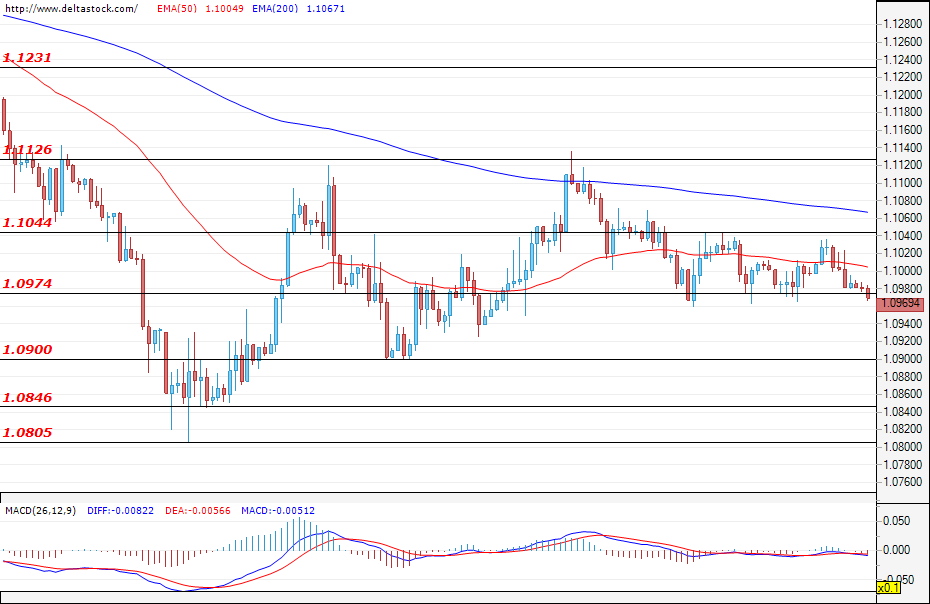
The EUR/USD is testing the support at 1.0974 yet again during the early hours of today`s trading.. A confirmation of the breach here could deepen the decline and could lead to a test of the target at 1.0900, followed by the lower zone at 1.0846. However, if the bearish momentum fades and the bulls prevail, then the first resistance would be the upper border of the range between 1.0974 and 1.1044. A violation of the level at 1.1126 would strengthen the positive expectations for the future path of the pair and could lead to a rally towards the zone at 1.1231. An increase in market volatility can be expected around the announcement of the data on Non-farm Payrolls Change and Unemployment change in the U.S. (Friday; 13:30 GMT).
USD/JPY
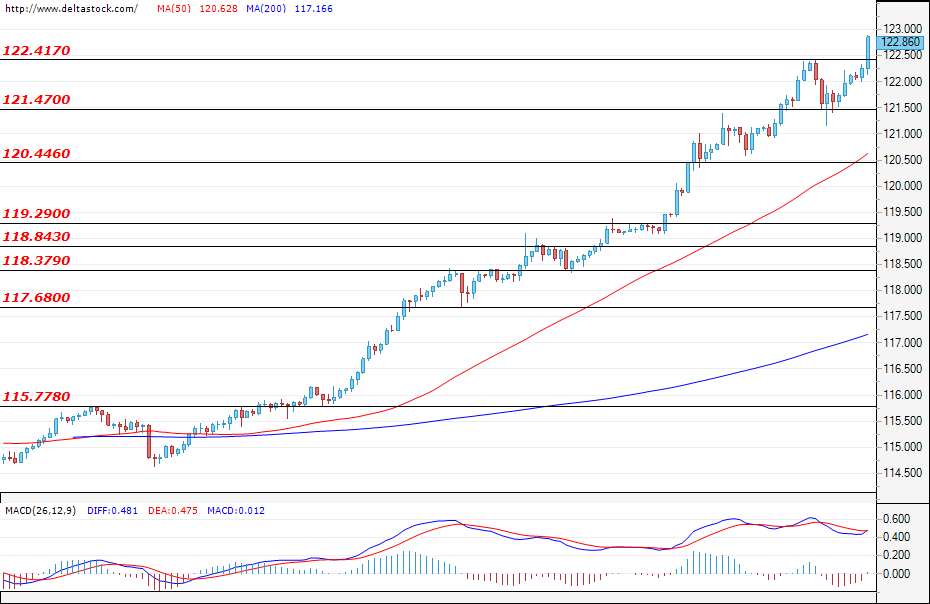
The dollar continues its massive rally against the yen as the currency pair had previously violated the resistance zone at 122.41. If the bullish attack continues, then а test of the important zone at 123.00 would be the most probable scenario and could easily lead to even more gains for the Ninja. If the bears take control instead, then the correction should be limited to the support zone at 120.44.
GBP/USD
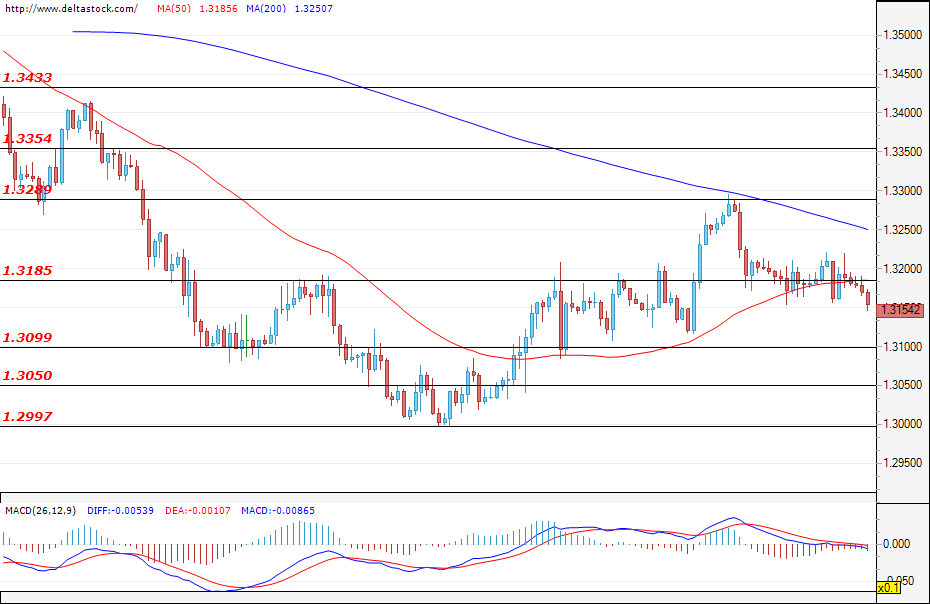
The pound lost some ground against the dollar during the early hours of today`s trading, and if the bears continue to prevail, then a successful test of the support zone at 1.3099 would strengthen the negative sentiment and could easily deepen the decline towards the zone at 1.3050. Better-than-expected data in the UK for its GDP (Thursday; 07:00 GMT) could help the bulls re-enter the market. A potential breach of the close resistance at 1.3185, followed by a violation of the next target at 1.3289, could lead to a more sustained recovery towards the resistance at 1.3354.
EUGERMANY40
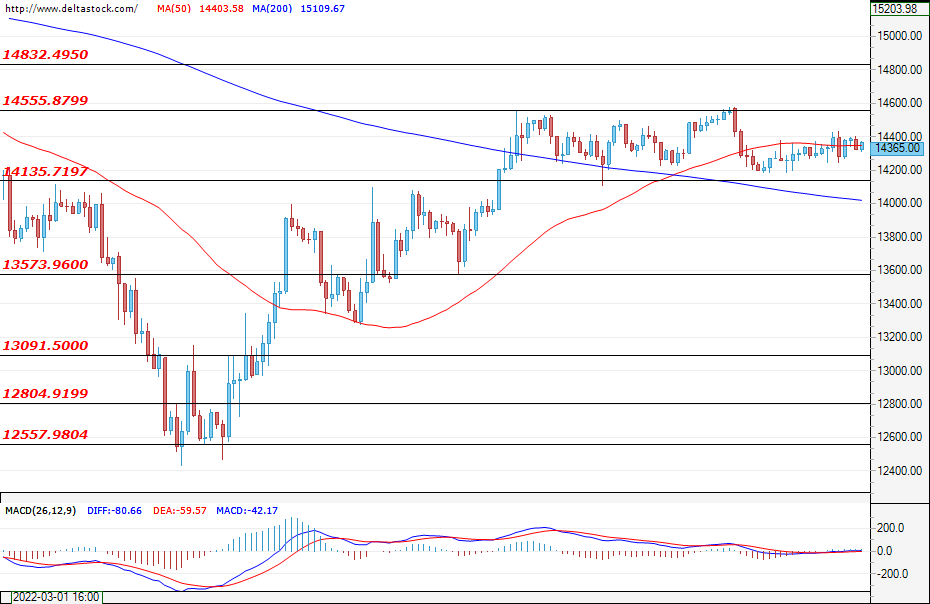
The sentiment remains neutral as the EUGERMANY40 continues to trade in the zone between 14135 and 14555. If the bulls prevail and breach the upper border of the mentioned range, followed by the next target at 14832, then the rally will most likely gain steam and erase all of its losses that it had sustained as a result of the war between Russia and Ukraine.. The first support is still the zone at 14135. A successful test of this level could easily lead to a sell-off towards the level at 13573.
US30
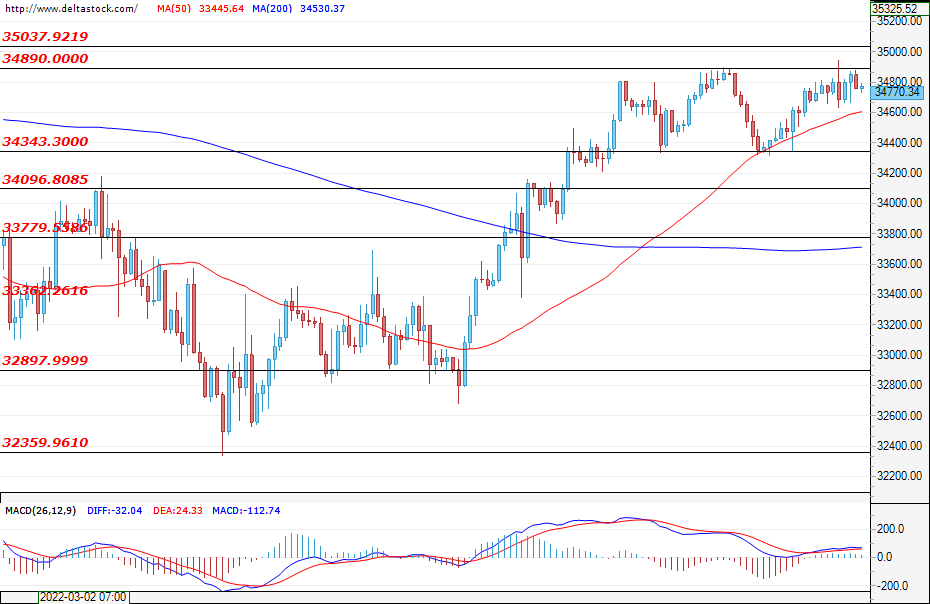
The U.S. index gained some ground, and during the early hours of today’s trading, it is headed towards a test of the resistance at 34890. A violation of the mentioned zone could easily pave the way for an attempt at breaching the next important target at 35037. Success for the bulls here could continue the rally towards 35200. However, if the zone at 35037 withholds the bullish attack, then a correction might develop, but it should be limited to the support at 34096. Important trading news for this week is the expected U.S. Non-farm Payrolls Change and Unemployment change data (Friday; 13:30 GMT).
Oil Down, Dollar Up
The week kicks off on a mixed note as US President Joe Biden called Putin a ‘butcher’ and said in a speech in Warsaw that ‘for God’s sake, this man cannot remain in power. Then, the news that Shanghai is going to a phased lockdown didn’t help lifting the mood in Asia.
Oil, which rallied last Friday on news of a drone attack on a Saudi storage facility, slumped again this morning to $110pb.
The new shutdown measures due to covid are expected to be short-term road bumps on a long up-trending road, as the impact of the lockdowns on medium-term oil demand will certainly remain limited, whereas the tight supply concerns – which are amplified by the tensions in Saudi with the Houthi rebels should keep oil prices under a decent positive pressure.
Investors wonder if OPEC will finally boost its oil output to counter the Russian supply disruptions at this week’s meeting, as a potential boycott on Russian oil could lead to a 3-million-barrel fall per day from April, even though the Europeans are not up for banning the Russian oil for now.
Then comes the question of whether the OPEC+ makes sense for the OPEC countries, if Russia starts seeing a significant demand fall for its oil. So far, OPEC stood behind the OPEC+ agreement.
It is reported that OPEC’s scare capacity has fallen to between 2 to 3 million barrels per day, mostly concentrated in Saudi Arabia and the UAE, and the falling OPEC capacity could explain why the OPEC+ agreement is still alive.
To conclude, the war and the worries of falling capacity from OPEC are more disturbing than a Shanghai lockdown. Therefore, the price pullbacks are still seen as opportunities to buy a dip for a further extension of the rally toward the $140/150pb level. On the downside, the 50-DMA, which stands just below the $100pb level should continue giving a solid support for a further rise, unless there is a significant and a material change in the geopolitical situation which would favorize a medium-term decline.
US dollar up
The US dollar begins the week on strong footage, as the dollar index advances above the 99 mark on geopolitical tensions and the Fed hawks. The US 2-year yield just can’t move higher faster, it’s already testing the 2.40% to the upside, while the 10-year yield is just a touch above the 2.53% mark, hinting that the inversion in this portion of the curve is imminent. The 5-10 year spread already inverted and the 5-30 year spread slipped below zero for the first time since 2006, as well.
The flattening and the inversion of the yield curve bring about the worries of a recession in the US, but Fed Chair Powell is pushing back against concerns that an inverted yield curve would signal the economy is headed for a recession. He says that it makes more sense to focus on the shorter end, where curves remain steep. In reality, there is nothing he could do about it, as the inflation problem needs to be addressed fast.
The EURUSD slipped below the 1.10 mark on the back of a stronger US dollar, and there seems to be little that the ECB hawks could do against such a strong US dollar right now, even with the prospects that the rising inflation in Europe would force the ECB to become more aggressive on its tightening plans.
GBP/JPY Daily Outlook
Daily Pivots: (S1) 160.05; (P) 160.77; (R1) 161.69; More...
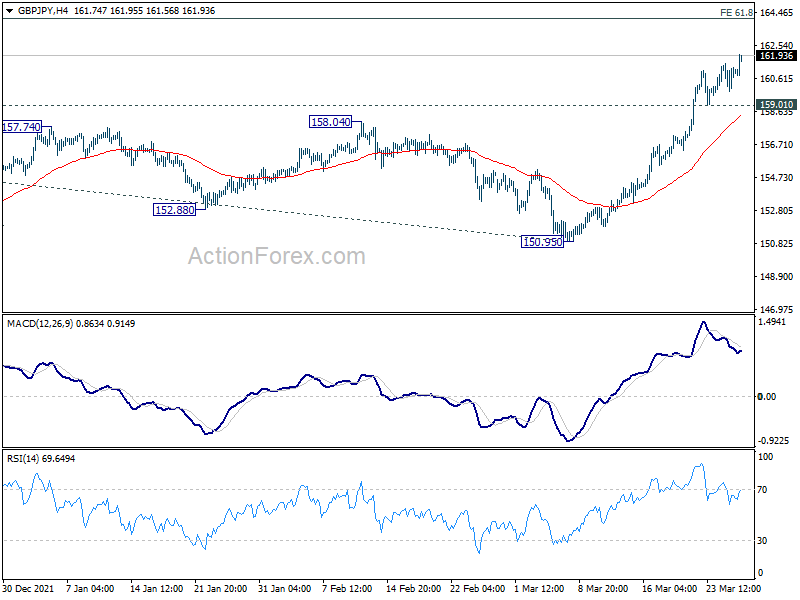
Intraday bias in GBP/JPY remains on the upside and outlook is unchanged. Current up trend should target 61.8% projection of 136.96 to 158.19 from 150.95 at 164.07. next. On the downside, however, break of 159.01 minor support will tun intraday bias neutral, and bring consolidations first, before staging another rally.
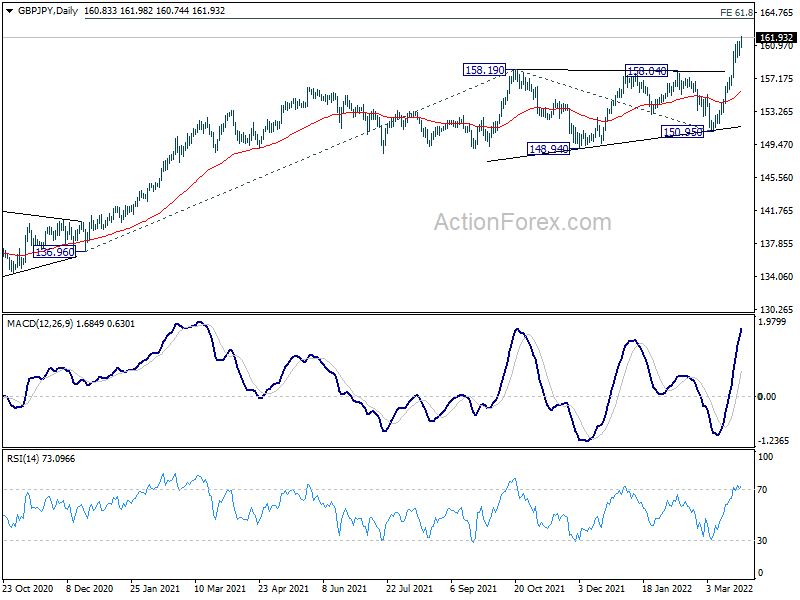
In the bigger picture, up trend from 123.94 (2020 low) is still in progress, and notable support from 55 week EMA affirms medium term bullishness. Next target is 61.8% retracement of 195.86 (2015 high) to 122.75 (2016 low) at 167.93. Sustained break there will be a long term bullish signal. This will now remain the favored case as long as 150.95 support holds.
EUR/JPY Daily Outlook
Daily Pivots: (S1) 133.65; (P) 134.20; (R1) 134.67; More....
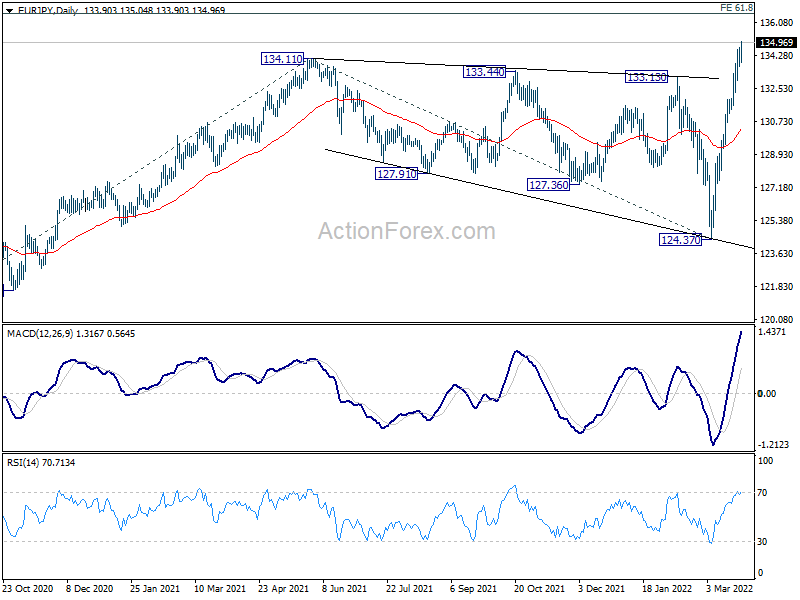
Intraday bias in EUR/JPY remains on the upside at this point. Current up trend should target 136.53 projection level next. On the downside, though, break of 132.31 minor support will turn bias neutral and bring consolidations first, before staging another rally.
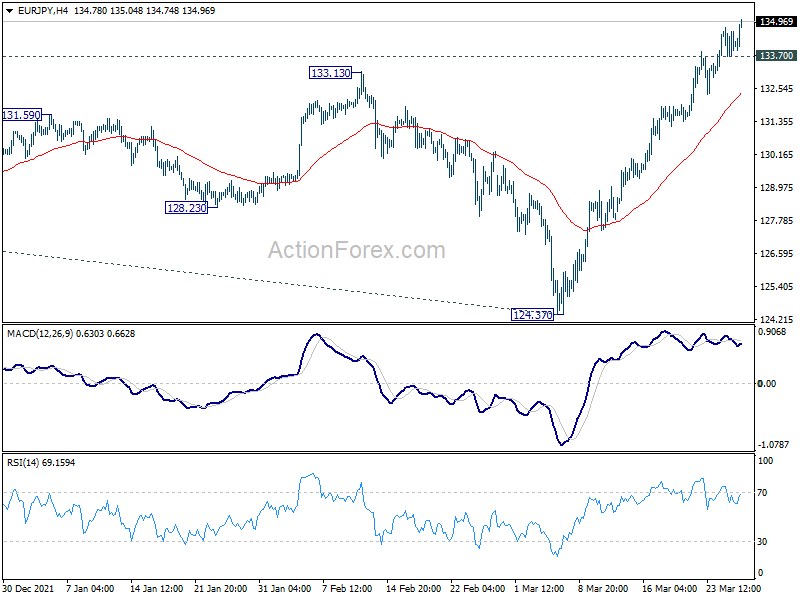
In the bigger picture, up trend from 114.42 (2020 low) is in progress and resuming. Next target is 61.8% projection of 114.42 to 134.11 from 124.37 at 136.53, and then 137.49 (2018 high). In any case, outlook will now remain bullish as long as 124.37 support holds, in case of deep pull back.
EUR/AUD Daily Outlook
Daily Pivots: (S1) 1.4572; (P) 1.4637; (R1) 1.4679; More...
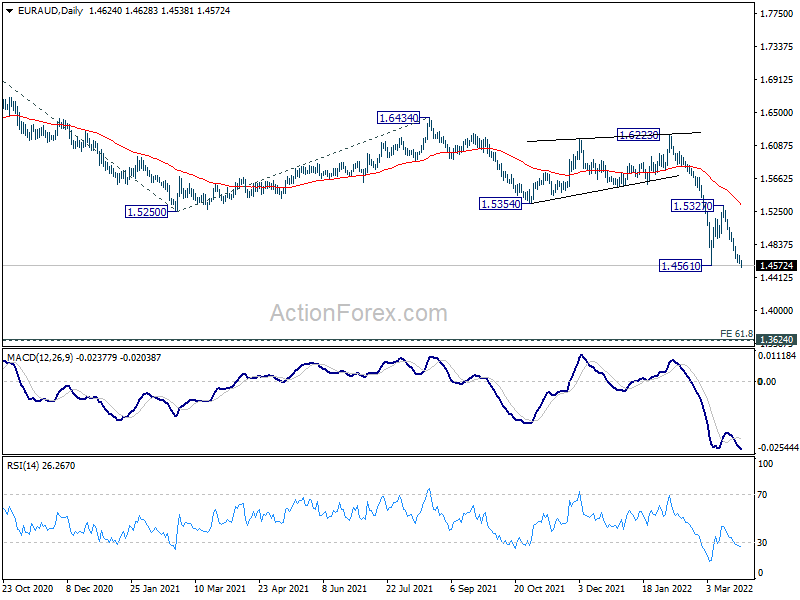
Intraday bias in EUR/AUD remains on the downside. The breach of 1.4561 short term bottom indicate larger down trend resumption. Next target is 1.3623 projection level. On the upside, above 1.4804 minor resistance will delay the bearish case, and turn bias back to the upside for another recovery first.
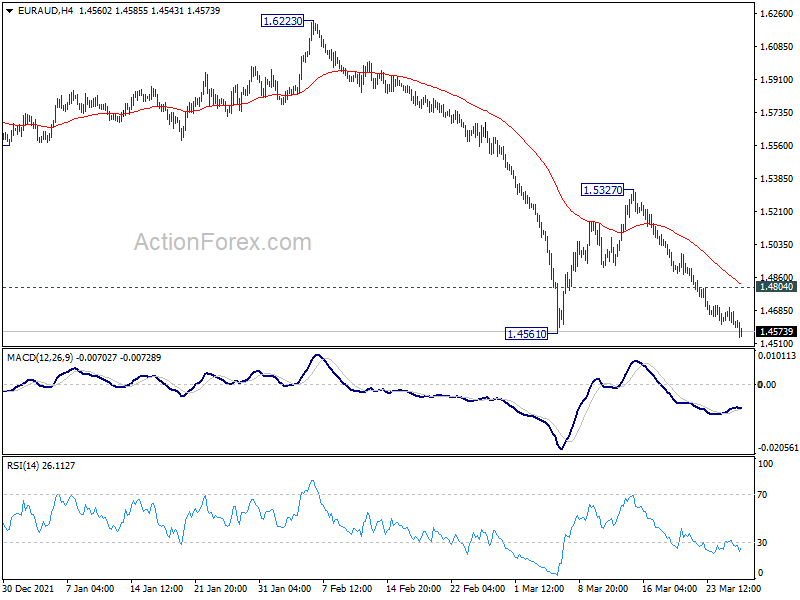
In the bigger picture, fall from 1.9799 is seen as a long term impulsive move. Next target is 61.8% projection of 1.9799 to 1.5250 from 1.6434 at 1.3623, which is close to 1.3624 long term support (2017 low). Some support could be seen there to bring interim rebound. But overall, break of 1.5354 support turned resistance is needed to be the first sign of medium term bottoming. Otherwise, outlook will stay bearish in case of recovery.
EUR/GBP Daily Outlook
Daily Pivots: (S1) 0.8314; (P) 0.8342; (R1) 0.8360; More...
Intraday bias in EUR/GBP remains neutral for the moment. On the downside, below 0.8294 will resume the fall from 0.8456 to retest 0.8201 low. Firm break there will resume larger down trend. On the upside, however, break of 0.8456 will resume the rebound from 0.8201 to 0.8476 structural resistance.
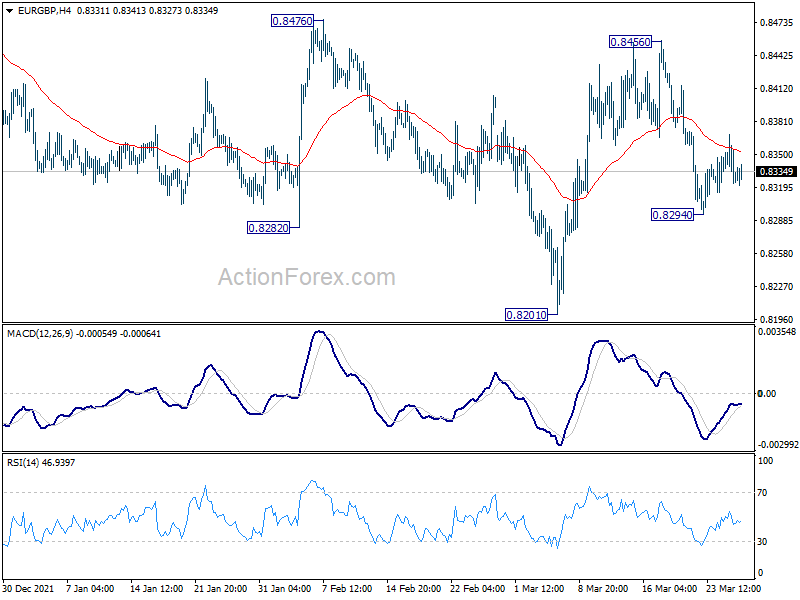
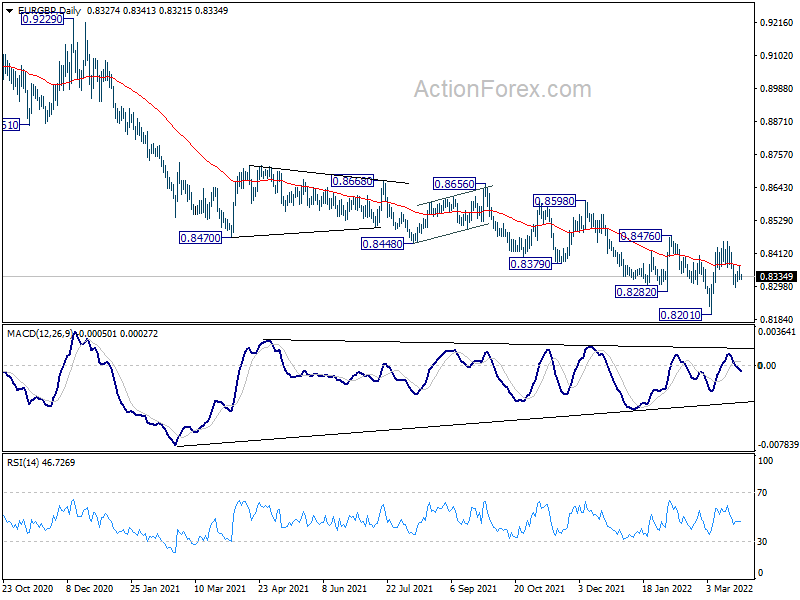
In the bigger picture, the down trend from 0.9499 is expected to continue as long as 0.8476 resistance holds. Sustained trading below 0.8276 support will argue that the whole up trend from 0.6935 (2015 low) has reversed. Deeper fall should be seen to 61.8% retracement of 0.6935 to 0.9499 at 0.7917 next. However, firm break of 0.8476 will indicate medium term bottoming at least. Focus will be back on 55 week EMA (now at 0.8523) for more evidence of bullish reversal.
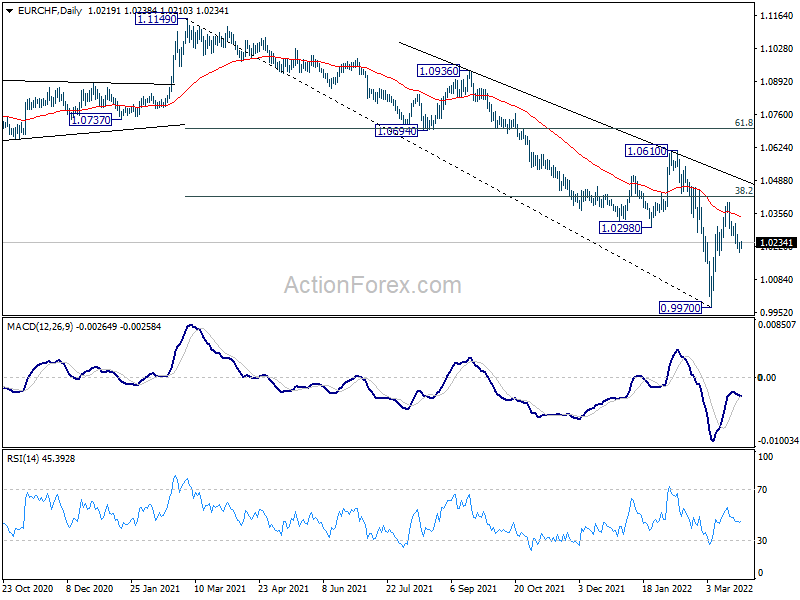
EUR/CHF Daily Outlook
Daily Pivots: (S1) 1.0198; (P) 1.0218; (R1) 1.0242; More....
Intraday bias in EUR/CHF remains neutral for the moment. On the downside, break of 1.0814 will indicate that rebound from 0.9970 has completed at 1.0400, ahead of 38.2% retracement of 1.1149 to 0.9970 at 1.0420. In this case, intraday bias will be turned back to the downside for retesting 0.9970 low. On the upside, break of 1.0400 will resume the rebound to 1.0610 key structural resistance.
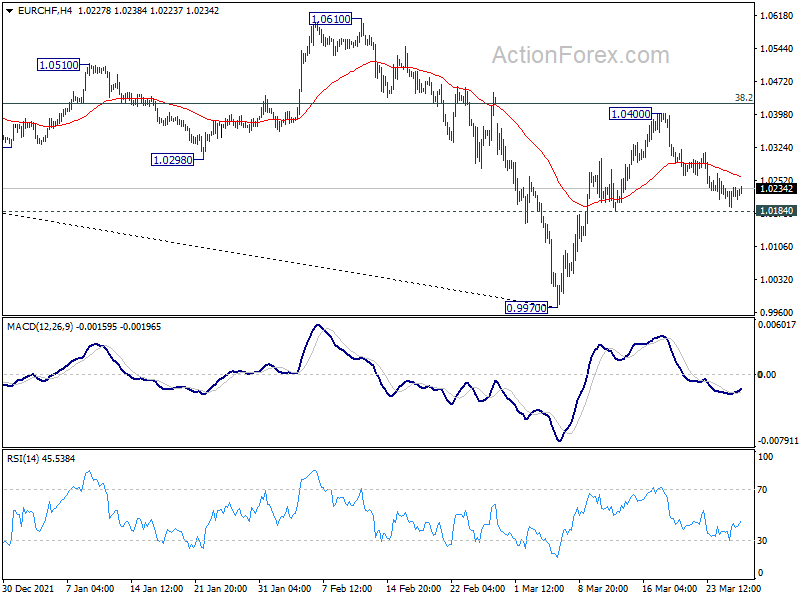
In the bigger picture, long term down trend from 1.2004 (2018 high) is still in progress. Next target is 100% projection of 1.2004 to 1.0505 to 1.1149 at 0.9650. In any case, sustained break of 1.0505 support turned resistance is needed to be the first sign of medium term bottoming. Otherwise, outlook will remain bearish.