Sample Category Title
Weekly Focus – Fed is Stepping Up the Pace
As the conflict in Ukraine remains frozen for now, markets have started shifting their attention also to other topics, especially monetary policy signals. Despite volatile oil prices rising again to USD/bbl 120 after Russia demanded Rouble payments for gas, positive risk sentiment sent yields higher and equities held up. Bund yields rose above 0.5% for the first time since 2018 and 10Y US Treasury yields are now trading around 2.4% after hawkish comments from Fed chair Powell, which seemed to prepare the ground for a more aggressive monetary policy tightening ahead. EU leaders agreed on more joint gas buying going forward, although an embargo on Russian energy imports remains off the table for now amid German opposition. G7 leaders agreed to crack down on Russia's ability to sell its gold reserves to support its currency and the US announced expanded sanctions against more than 400 Russian individuals and companies.
Norges Bank (NB) continued with its gradual policy tightening and hiked rates by another 25bp this week, but we think the NB rate path will prove too aggressive and pencil in fewer hikes and an earlier top in policy rates (read more in Reading the Markets Norway - NB firms tightening signals but maintains 'gradual' pace, 24 March).
In contrast, the Fed's new mantra seems to be "get to neutral as fast as possible", and a range of FOMC members this week talked about front-loading rate hikes, with none ruling out a 50bp at this point. With inflation still high and the Fed behind the curve, we see an increasing probability that the Fed will tighten more and faster than we have pencilled in (i.e. risks are skewed towards the Fed hiking by 50bp in both May and June or 75bp in one go). Tighter monetary policy (and financial conditions) and the commodity price shock increase the risk of a global recession 1-2 years down the road, which is also reflected in the ongoing flattening of the US yield curve.
In Research Russia - EU embargo on Russian energy could be a game-changer, 23 March, we took a closer look at the economic implications from the war in Ukraine on Russia. The 'Fortress Russia' policies have already significantly weighed on households' living standards and the war ensures that weakness will persist for years to come. On a positive note, PMI figures for March suggested that the hit to the euro area economy from the Ukraine war might have been less than feared, calming immediate recession fears. That said, growth momentum in both manufacturing and services slowed and future output expectations have become more clouded amid renewed supply disruptions, weakening export orders and sharp rises in input prices.
While Ukraine war developments will remain in focus amid signs of a stalling Russian advance, next week central banks will also get more data to assess the state of the labour market and inflation pressures. The US labour market report for March is due on Friday and we look for a decent report with jobs growth around 450k. In the euro area, flash HICP figures for March are released and we expect to see a further rise in headline and core inflation (to 6.5% and 3.0%, respectively) as higher input costs are still working their way up through the pricing chain, keeping pressure high on ECB to normalize policy. We see some downside risks for Chinese PMIs released on Thursday, following recent headwinds from COVID-19 outbreaks, property sector stress and the rise in commodity prices.
Week Ahead – Euro/Dollar Braces for US Jobs and European Inflation
The Fed keeps warning it will need to roll out the big guns in its battle against inflation. Traders have priced in faster rate increases to reflect this shift but the dollar hasn’t really benefited. Instead, it is the yen that has suffered. The coming week includes inflation stats from Europe and employment numbers from America, which combined could decide what’s next for euro/dollar.
Fed leads the pack
Fed officials are saying they are prepared to do whatever it takes to cool inflation. That means raising interest rates as quickly as possible to slow down the US economy, hopefully without tipping it into recession. This message rocked global markets lately.
Treasury yields went through the roof, eclipsing pre-pandemic levels as traders scrambled to price in faster tightening. Another seven and a half quarter-point rate increases are now baked in for this year, which would push the federal funds rate to around 2.25% by December.
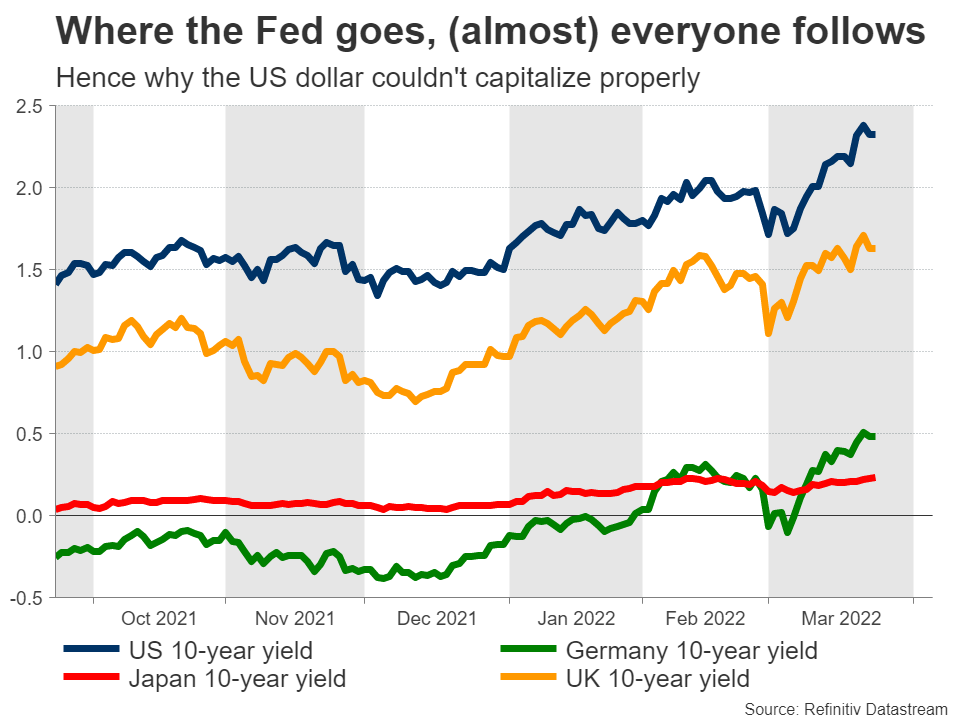
With US yields powering higher, one would have expected the dollar to bulldoze its way through the FX arena. But that hasn’t really happened. Instead of the dollar strengthening, it is the yen that has been demolished. This boils down to a signaling effect.
When the Fed hits the brakes, everyone else is expected to follow suit. Even in Europe, traders have cranked up their bets for rate hikes lately, propelling European yields higher. While the ECB will be slower than the Fed, this repricing has been enough to negate the impact on euro/dollar.
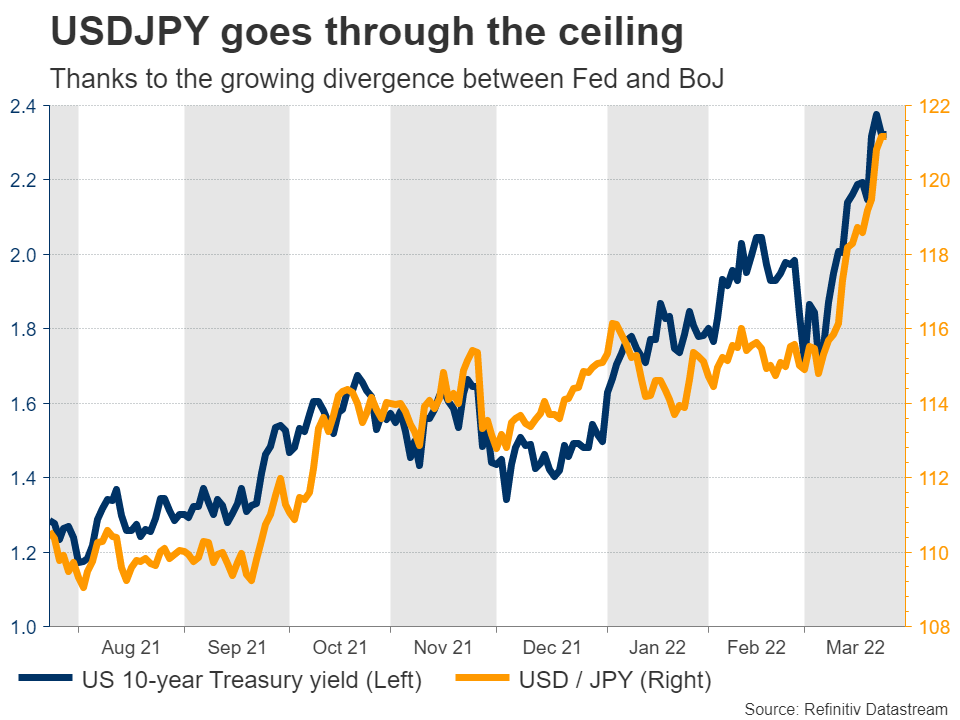
The yen is the exception to this rule as the Bank of Japan is the only major central bank that’s not expected to raise rates this year. It also remains committed to its yield curve control strategy, which prevents Japanese yields from rising beyond a certain level and therefore makes the yen less attractive as foreign yields soar.
Dollar turns to nonfarm payrolls
The main event next week will be the US employment report for March, due on Friday. Forecasts point to another solid month for the labor market. Nonfarm payrolls are expected to clock in at 450k, pushing the unemployment rate down one tick to 3.7%. Wage growth is also expected to pick up steam.
With the economy approaching full employment, wage growth is now the most important metric for the Fed. It is considered an early indicator of what inflation will do in the future, so it’s crucial for how many rate hikes are required.
So far, early employment indicators point to a stellar report. Jobless claims fell substantially during the survey week and the composite Markit PMI report showed that the rate of job creation was the sharpest in a year.
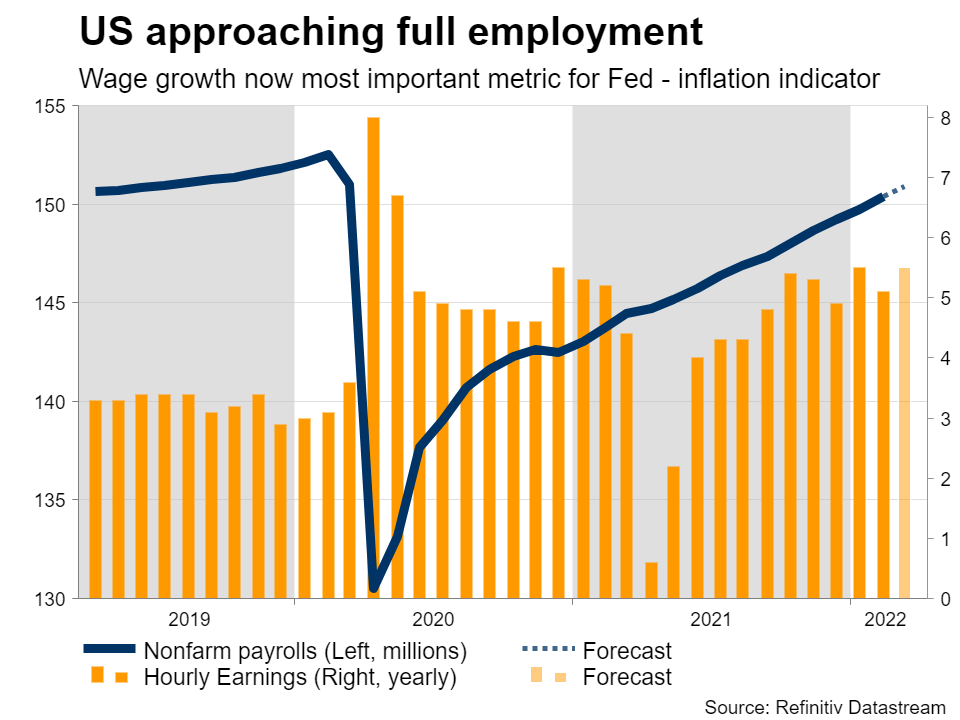
Investors are split on whether the Fed will raise rates another seven or eight times this year, so a solid report could help tip the scales towards eight and by extension re-energise the dollar’s rally.
Aside from the employment report, the ISM manufacturing PMI for March will also be released on Friday. The core PCE price index will be published one day earlier, but this is not a market mover.
Hot inflation unlikely to save euro
In the Eurozone, preliminary CPI inflation stats for March will hit the markets on Friday. With the war in Ukraine catapulting raw material prices higher and PMI surveys suggesting businesses raised their selling prices at a new record pace, it is safe to assume the yearly CPI rate will edge higher than the 5.9% it printed in February.
But perhaps not much higher. This is the period when inflation really started to heat up last year, so going forward, it will be much harder for the yearly CPI rate to keep rising so dramatically as tougher base effects kick in.
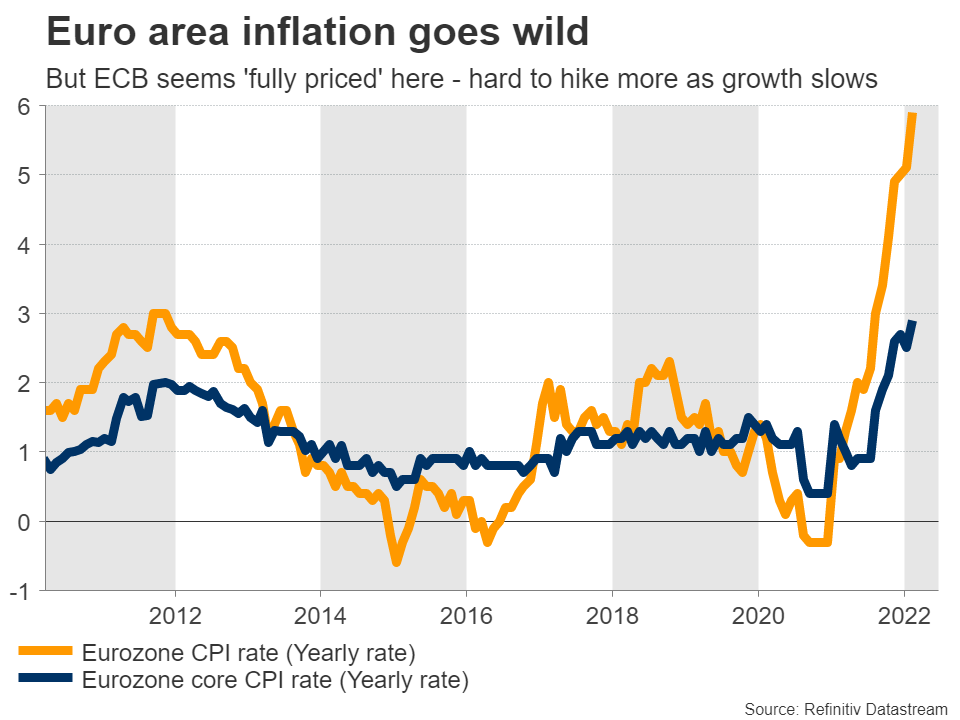
For the euro, even a very hot print is unlikely to change much. Money markets are already pricing in two rate hikes from the ECB this year, which is probably as much as the central bank can do without breaking the economy.
Growth is already slowing down as consumers get squeezed by rising energy and food costs. Stepping on the policy brakes too hard would raise the risk of recession even further. That’s a gamble the ECB wants to avoid.
For now, the main variable for the euro is whether there’s a ceasefire in Ukraine soon. That would set the stage for a relief rally. However, it’s going to be difficult to sustain any rally until the growth outlook improves.
Japan’s Tankan and Chinese PMIs
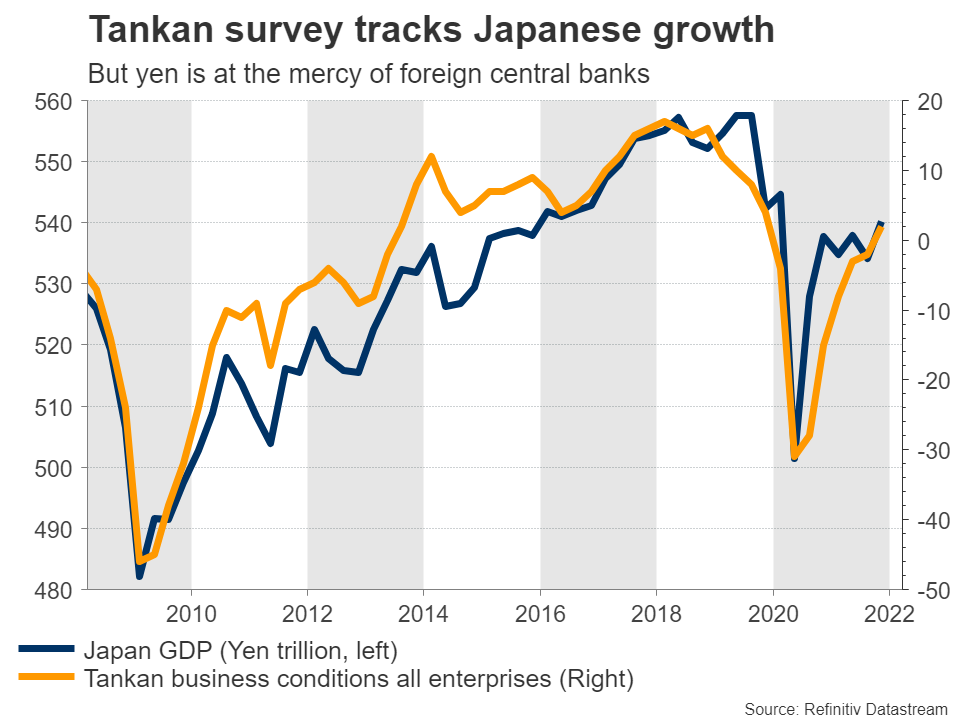
The Bank of Japan will also release its quarterly Tankan survey on Friday. Forecasts suggest businesses are becoming less optimistic as they grapple with soaring energy prices and geopolitical uncertainty. As for the yen, it’s difficult to envision a trend reversal until the BoJ joins the global normalization party.
In China, the official PMIs for March are out on Thursday and are likely to reflect the latest lockdowns across Chinese cities. On the bright side, the government has pledged to open the spending taps to support the economy.
With Chinese authorities promising more stimulus and commodity prices surging, the Australian dollar has come back to life. The Australian economy has recovered too, with the unemployment rate reaching record lows lately.
That said, markets are already pricing in the first RBA rate increase for June and a total of eight hikes for the year. This seems overly aggressive considering that wages haven’t fired up yet and the RBA continues to preach patience.
Sunset Market Commentary
Markets
Europe’s aspiration to cut reliance on Russian fossil energy by two-thirds end 2022 and almost completely by 2024 became a little bit more concrete today. The continent announced an agreement with the US under which Europe will receive at least 15 billion cubic meters of additional LNG supplies. That amount may go up to 50bn by 2025, when new projects are scheduled to come online, until at least 2030. For now, the extra 15bn would only replace Russian LNG flows though while the country also ships about 150bn cubic meters of gas to Europe every year. The decision is thus politically symbolic more than something else. Yet, oil and gas prices do decline. Brent eases 2% to $117/b, Dutch gas futures lose 6% to €106/MWh. European stock markets are in slightly better shape today. They erased opening losses to trade about 0.8% higher. US stocks trade 0.6% higher with the Nasdaq underperforming (flat) after US/core bond yields suddenly spiked higher. Press agency Interfax reported the Russian “forces will focus on the main thing – the complete liberation of Donbas”. Markets took it as a hint Russia may be backing away from taking over other pieces of Ukraine. Such de-escalation of the conflict may ultimately result in a less cloudy economic outlook, allowing central banks to move ahead with normalization without looking back. US money markets all but price in 200 bps additional tightening by year-end. This would align with two 50 bps hikes in May and June, followed by four regular 25 bps hikes at each of the remaining policy meeting. US yields add 9 to 14 bps in a bear flattener. The report also sharpened ECB expectations, though less intense. European swap yields add 4-5 bps across the curve. A first full hike is priced in for September with a second one discounted for December.
Rising US/EMU interest rate differentials fail to support the dollar. The resilient risk climate helps EUR/USD to keep the 1.10 dry although we must admit it looks vulnerable. USD/JPY almost completely retraced morning weakness (down one big fig) to trade near multi-year highs of 122.1. EUR/CHF tested 1.02 but prevented a break lower even as the SNB yesterday signaled not to be in a hurry for FX interventions. Sterling’s weakness after disappointing retail sales this morning didn’t last. EUR/GBP is trading only marginally higher at 0.834. Central-European currencies enjoy some risk-on bids. The forint (EUR/HUF down to 373.85) and the zloty (EUR/PLN 4.73) outperform the Czech koruna (EUR/CZK 24.66). Most of today’s gains occurred before the Interfax story though – its impact was contained to rates markets.
News Headlines
Belgian business confidence as published by the National Bank of Belgium declined for the fourth consecutive month from 2.3 in February to 0.4 this month. However, according to the assessment of the NBB: ‘the current context does not seem to be weighing too heavily on confidence in the business world. The decline in the business barometer that began last December has gained momentum, although still only moderate’. The sharpest loss of confidence was registered in the trade sector -6.5 from -2.6) and the manufacturing sector (-2.7 from 0.3). The building industry is less affected (1.2 from 2.3). Morale as even picked up in the sector of business related services (15.1 from 13.1).
Today, the International Monetary Fund (IMF) meets to decide on a new $ 45 bln deal/programme with Argentina. The new programme would replace a previous one agreed upon in 2018 under which Argentina still had to repay over $40 bln. The 2018 deal with Argentina was the largest in the IMF’s history. According to sources, the country might receive funds worth of $9.8 bln once the deal is approved by the Board. Additional payments will be subject to quarterly reviews over a 30 month horizon.
AUD/USD outlook: Bulls are losing traction on approach to key resistance
The Australian dollar remains well supported, with strong gains against Japanese yen, underpinning the AUDUSD pair.
Aussie advanced around 5% vs the US dollar and 10% vs yen in past almost two weeks, as Japanese currency remains under pressure on dovish BoJ and soaring prices of commodities and energy, as the country heavily depends on imports.
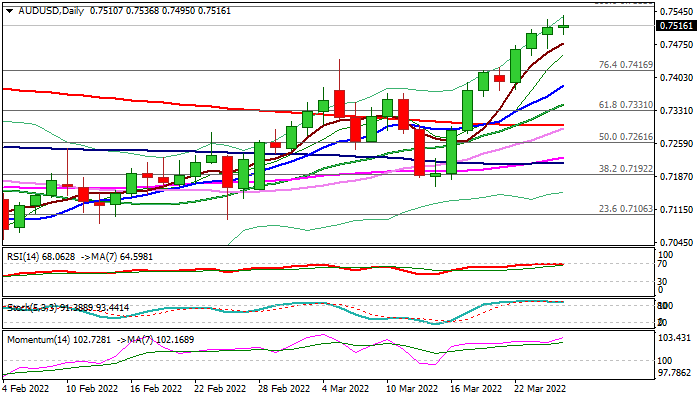
The daily chart shows that AUDUSD price action is slowly running out of steam, on approach to key resistance at 0.7555 (28 Oct 2021 high) as the bodies of daily candles are getting smaller, while shadows are longer on both sides.
Although the bullish momentum continues to strengthen, overbought stochastic adds to signals stall.
Correction is likely to be shallow, as weekly studies are in full bullish configuration and the pair is on track for the second strong weekly gains and close above weekly cloud top that generates bullish signal.
Good supports lay at 0.7441/17 (Mar 7 spike high / broken Fibo 76.4% of 0.7555/0.6967) with extension towards rising 10DMA (0.7385) not ruled out and expected to offer better levels to re-enter bullish market.
Break of 0.7555 pivot would expose net key barrier at 0.7634 (Fibo 38.2% of 1.1079/0.5514, 2011/2020 downtrend).
Res: 0.7536; 0.7555; 0.7600; 0.7634.
Sup: 0.7477; 0.7441; 0.7417; 0.7385.
EUR/USD Mid-Day Outlook
Daily Pivots: (S1) 1.0971; (P) 1.0993; (R1) 1.1019; More...
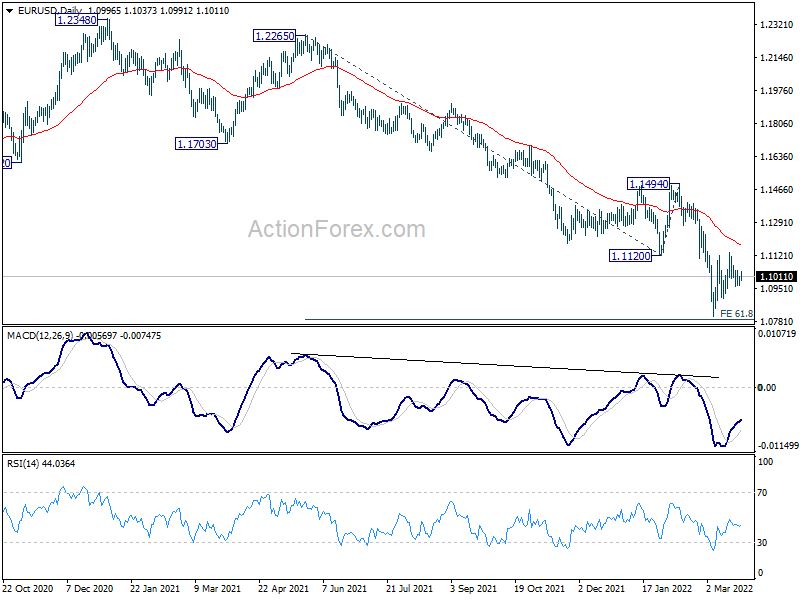
Intraday bias in EUR/USD remains neutral and outlook is unchanged. On the downside, below 1.0899 minor support will turn bias back to the downside for 61.8% projection of 1.2265 to 1.1120 from 1.1494 at 1.0786. However, firm break of 1.1120 will confirm short term bottoming at 1.0805. Bias will be back on the upside for 55 day EMA (now at 1.1173) and above.
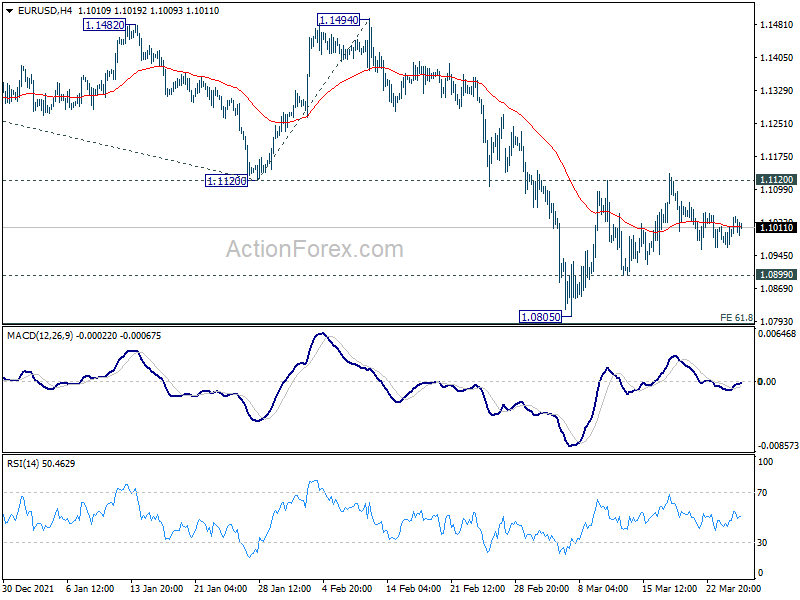
In the bigger picture, the decline from 1.2348 (2021 high) is expected to continue as long as 1.1494 resistance holds. Firm break of 1.0635 (2020 low) will raise the chance of long term down trend resumption and target a retest on 1.0339 (2017 low) next. Nevertheless, break of 1.1494 will maintain medium term neutral outlook, and extending term range trading first.
GBP/USD Mid-Day Outlook
Daily Pivots: (S1) 1.3158; (P) 1.3186; (R1) 1.3215; More...
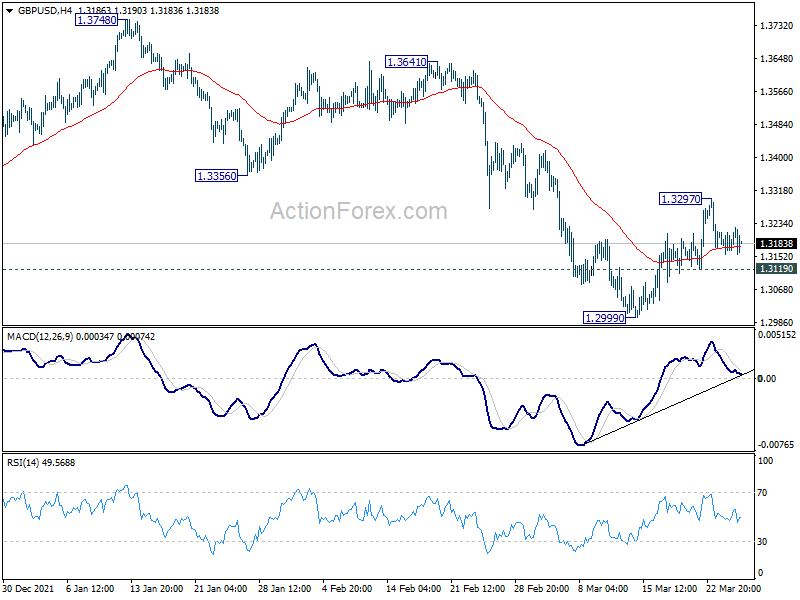
GBP/USD is staying in range trading and intraday bias remains neutral at this point. On the downside, break of 1.3119 minor support will turn bias back to the downside for retesting 1.2999. Firm break there will resume larger down trend from 1.4248. On the upside, above 1.3297 will resume the rebound to 55 day EMA (now at 1.3341). Sustained break there will target medium term channel resistance (now at 1.3590).
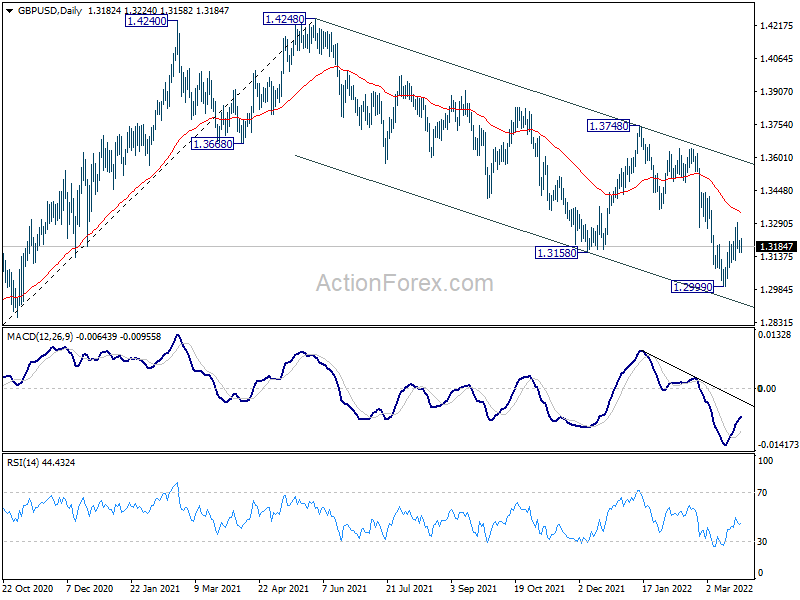
In the bigger picture, current development suggests that the up trend from 1.1409 (2020 low) has completed at 1.4248. Decline from 1.4248 could still be a corrective move, or it could be the start of a long term down trend. In either case, deeper decline would be seen back to 61.8% retracement of 2.1161 to 1.1409 at 1.2493. In any case, break of 1.3748 resistance is needed to indicate medium term bottoming, or outlook will stay bearish.
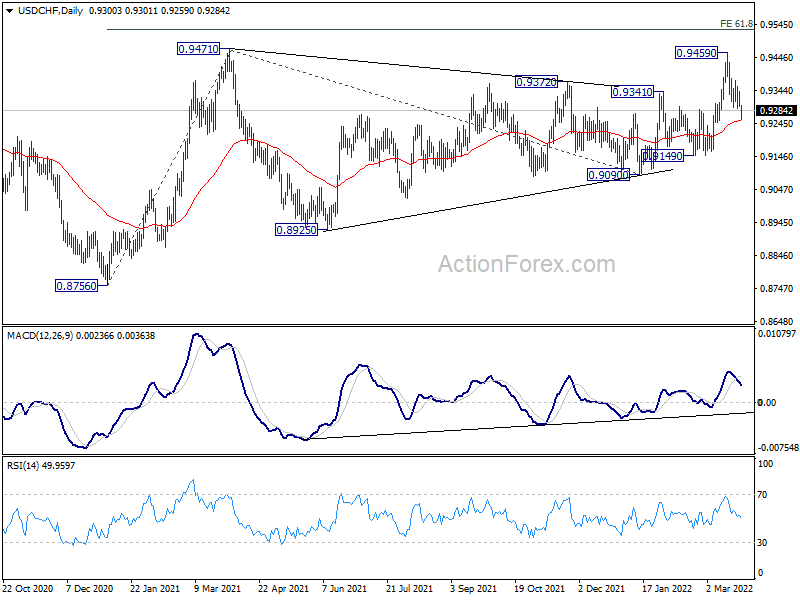
USD/CHF Mid-Day Outlook
Daily Pivots: (S1) 0.9283; (P) 0.9314; (R1) 0.9333; More....
Intraday bias in USD/CHF remains on the downside as fall from 0.9459 is in progress. Sustained break of 55 day EMA (0.9255) will target 0.9149 structural support. On the upside, break of 0.9374 minor resistance will flip bias back to the upside for 0.9459 resistance instead.
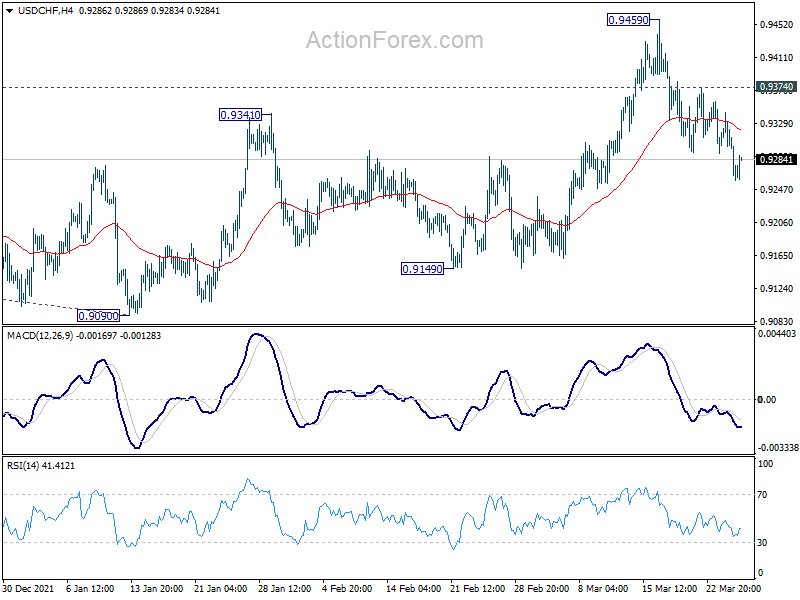
In the bigger picture, medium term outlook will be neutral at best as long as 0.9471 resistance holds. Larger down trend could still extend through 0.8756 (2021 low). However, firm break of 0.9471 will argue that whole down trend form 1.0342 (2016 high), has completed with waves down to 0.8756. A medium term up trend should be set up to target 1.0237/0342 resistance zone.
USD/JPY Mid-Day Outlook
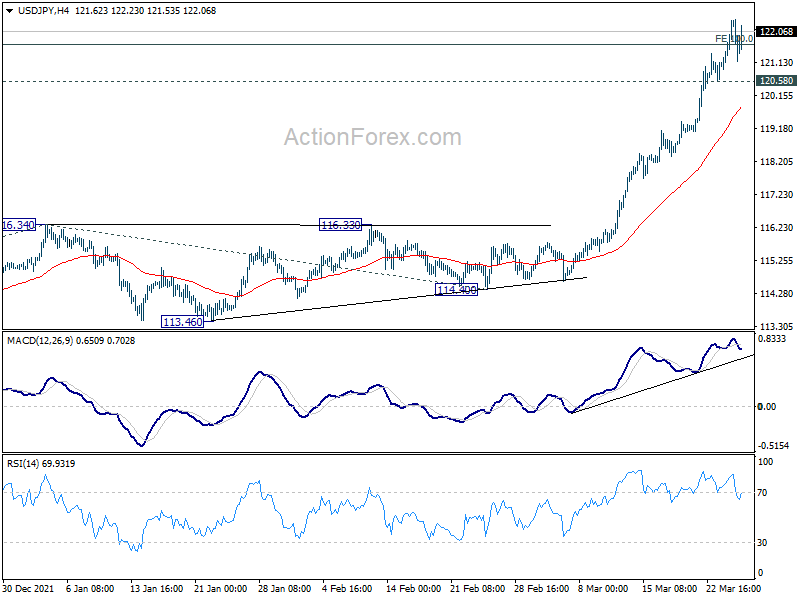
Daily Pivots: (S1) 121.41; (P) 121.91; (R1) 122.86; More...
USD/JPY is losing some upside momentum as seen in 4 hour MACD. But with 120.58 minor support intact, intraday bias stays on the upside. Sustained trading above 100% projection of 109.11 to 116.34 from 114.40 at 121.63, will pave the way to 125.85 long term resistance. On the downside, however, below 120.58 minor support will turn intraday bias neutral and bring consolidations first, before staging another rally.
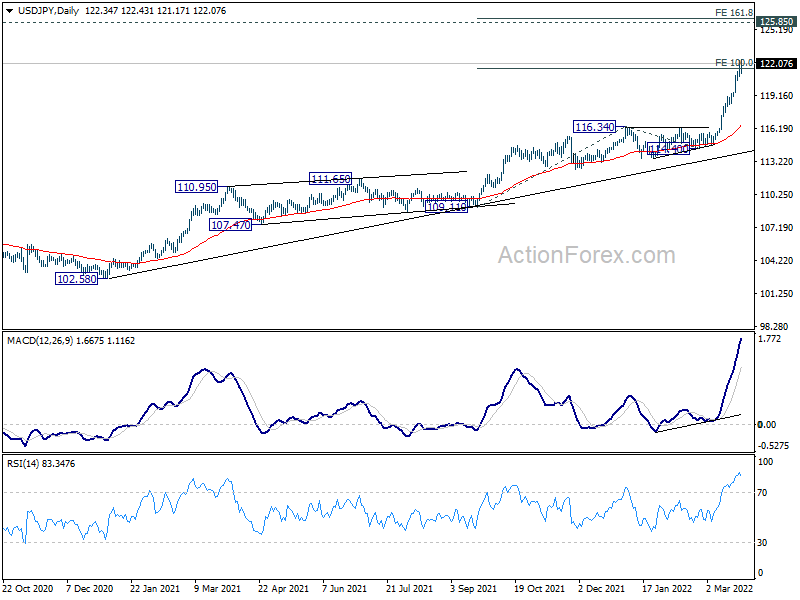
In the bigger picture, the break of 118.65 resistance (2016 high) suggest that up trend from 98.97 (2016 low) is resuming, with rise from 101.18 (2020 low) as the third leg. Medium term outlook will remain bullish as long as 116.34 resistance turned support holds. Next target is 125.85 (2015 high).
Euro Weakens after Poor Germany Business Climate, Yen Struggles to Recover
Euro turns slightly softer after poor German business climate reading, in particular against Swiss Franc, Aussie and Loonie. Dollar is also weak except versus Yen. Yen is trying to recover but there is no clear follow through buying. It's the the runaway loser of the week. Overall, Aussie is set to end as the week as the best performer.
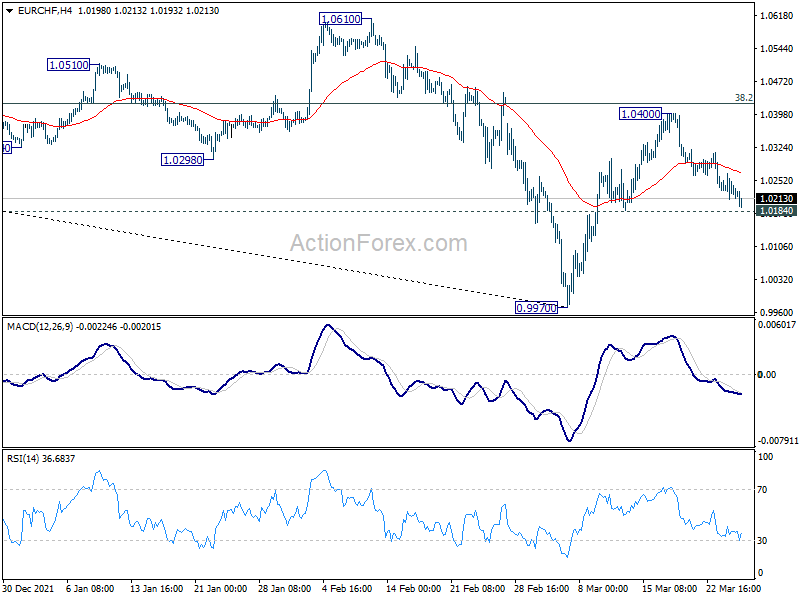
Technical, 1.0815 support in EUR/CHF is worth a watch early next week. Firm break there should confirm completion of the rebound from 0.9970, and retest of this low should be seen next. The development could be accompanied by downside breakout in both EUR/CAD and EUR/AUD for down trend resumption too.
In Europe, at the time of writing, FTSE is up 0.15%. DAX is up 0.87%. CAC is up 0.68%. Germany 10-year yield is up 0.0268 at 0.561. Earlier in Asia, Nikkei rose 0.14%. Hong Kong HSI dropped -2.47%. China Shanghai SSE dropped -1.17%. Singapore Strait Times rose 0.41%. Japan 10-year JGB yield closed flat at 0.240.
Germany Ifo business climate dropped to 90.8, record collapse in expectations
Germany Ifo Business Climate dropped from 98.5 to 90.8 in March, below expectation of 94.5. Current Situation index dropped from 98.6 to 97.0, below expectation of 97.3. Expectations index dropped from 98.4 to 85.1, well below expectation of 97.2, and a record collapse.
By sector, manufacturing dived from 23.1 to -3.3. Services dropped from 13.6 to 0.7. Trade dropped from 6.6 to -12.0. Construction dropped from 8.0 to -12.2.
UK retail sales dropped -0.3% mom in Feb, ex-fuel sales down -0.7% mom
UK retail sales volume dropped -0.3% mom in February, much worse than expectation of 1.0% mom rise. On a 12-month basis, sales rose 7.0% yoy, below expectation of 7.8% yoy. Also, sales volume was 3.7% above pre-pandemic level in February 2020.
Ex-fuel sales volume dropped -0.7% mom, below expectation of 0.5% mom. On a 12-month basis, sales rose 4.6% yoy, below expectation of 5.0% yoy. Ex-fuel sales volume was 4.0% above pre-pandemic level in February 2020.
Auto fuel sales volume rose 3.6% mom, above pre-pandemic level (by 0.9%) for the first time, on lifting of restrictions and increased travel.
UK Gfk consumer confidence dropped to -31, a wall of worry is confronting
UK Gfk Consumer Confidence Index dropped from -26 to -31 in March. That's the lowest level since November 2020. Personal Financial Situation over last 12 months dropped from -11 to -13. Personal Financial Situation over next 12 months dropped from -14 to -18. General Economic Situation over last 12 months dropped slightly from -50 to -51. Genera Economic Situation over next 12 months dropped from -43 to -49.
Joe Staton, Client Strategy Director GfK, says: "A wall of worry is confronting consumers this month and there is an unmistakable sense of crisis in our numbers. Consumers across the UK are experiencing the impact of soaring living costs with 30-year-high levels of inflation, record-high fuel and food prices, a recent interest-rate hike and the prospect of more increases to come, and higher taxation too – all against a background of stagnant pay rises that cannot compensate for the financial duress. This is the fourth month in a row that UK consumer confidence has dropped."
BoJ Kuroda: Weak yen is generally positive for Japan's economy
BoJ Governor Haruhiko Kuroda told the parliament, "there's no change now to my view a weak yen is generally positive for Japan's economy."
He also reiterated the view that "cost-push inflation that is not accompanied by wage hikes will hurt Japan's economy." And as such, "it won't lead to sustained achievement of our price target. That's why the BOJ will continue to maintain powerful monetary easing."
Released from Japan, Tokyo CPI core rose from 0.5% yoy to 0.8% yoy in March, above expectation of 0.7% yoy. Corporate service price index rose 1.1% yoy in February, below expectation of 1.2% yoy.
USD/JPY Mid-Day Outlook
Daily Pivots: (S1) 121.41; (P) 121.91; (R1) 122.86; More...
USD/JPY is losing some upside momentum as seen in 4 hour MACD. But with 120.58 minor support intact, intraday bias stays on the upside. Sustained trading above 100% projection of 109.11 to 116.34 from 114.40 at 121.63, will pave the way to 125.85 long term resistance. On the downside, however, below 120.58 minor support will turn intraday bias neutral and bring consolidations first, before staging another rally.
In the bigger picture, the break of 118.65 resistance (2016 high) suggest that up trend from 98.97 (2016 low) is resuming, with rise from 101.18 (2020 low) as the third leg. Medium term outlook will remain bullish as long as 116.34 resistance turned support holds. Next target is 125.85 (2015 high).
Economic Indicators Update
| GMT | Ccy | Events | Actual | Forecast | Previous | Revised |
|---|---|---|---|---|---|---|
| 23:30 | JPY | Tokyo CPI Core Y/Y Mar | 0.80% | 0.70% | 0.50% | |
| 23:30 | JPY | Corporate Service Price Index Y/Y Feb | 1.10% | 1.20% | 1.20% | |
| 00:01 | GBP | GfK Consumer Confidence Mar | -31 | -30 | -26 | |
| 07:00 | GBP | Retail Sales M/M Feb | -0.30% | 1.00% | 1.90% | |
| 05:30 | GBP | Retail Sales Y/Y Feb | 7.00% | 7.80% | 9.10% | 9.40% |
| 07:00 | GBP | Retail Sales ex-Fuel M/M Feb | -0.70% | 0.50% | 1.70% | |
| 05:30 | GBP | Retail Sales ex-Fuel Y/Y Feb | 4.60% | 5.00% | 7.20% | 7.50% |
| 09:00 | EUR | Germany IFO Business Climate Mar | 90.8 | 94.5 | 98.9 | 98.5 |
| 09:00 | EUR | Germany IFO Current Assessment Mar | 97 | 97.4 | 98.6 | |
| 09:00 | EUR | Germany IFO Expectations Mar | 85.1 | 97.2 | 99.2 | 98.4 |
| 09:00 | EUR | Eurozone M3 Money Supply Y/Y Feb | 6.30% | 6.30% | 6.40% | |
| 14:00 | USD | Pending Home Sales M/M Feb | 1.40% | -5.70% | ||
| 14:00 | USD | Michigan Consumer Sentiment Index Mar F | 59.7 | 59.7 |
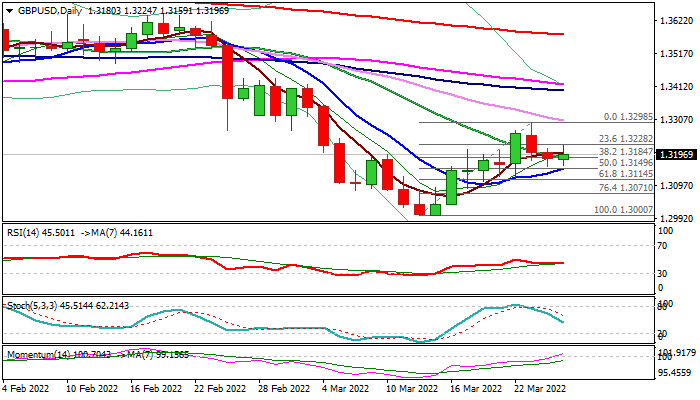
GBP/USD Outlook: Cable Remains Directionless Between Pivotal Fibo Levels
Cable holds in a choppy and directionless mode for the second straight day and remained resilient despite downbeat UK retail sales data for February.
Weaker dollar in European trading on Friday helped sterling ahead of pivotal support at 1.3150 (50% retracement of 1.3000/1.3298, reinforced by 10DMA), after the action was already rejected at this zone on Thursday.
Technical studies on daily chart lack clearer direction signal as bullish momentum is rising but stochastic is heading south and 10/20DMA’s are in mixed mode.
Watch the action around 1.3150, as firm break here would encourage sellers and risk test of Fibo supports at 1.3114 and 1.3071 (Fibo 61.8% and 76.4% of 1.3000/1.3298 respectively) which guard key 1.30 level.
At the upside, initial barrier lays at 1.3245 (Fibo 38.2% of 1.3642/1.3000) followed by 1.3298 (Mar 23 recovery peak), violation of which would bring bulls back to play.
Res: 1.3245; 1.3282; 1.3298; 1.3321.
Sup: 1.3150; 1.3114; 1.3071; 1.3034.